



Abstract
A connected battlespace aims to enable seamless, real-time connectivity between various military assets across all domains of contemporary warfare. Such a program, however, cannot be accomplished without the use of space-based assets that are designed to store and transmit data; enable communications, surveillance, and imagery; and bolster interoperability between different military forces and services. Given recent technological advancements, coupled with international interest and the diminishing cost of launching satellites into low Earth orbit, this article explores the opportunities and drawbacks associated with the Canadian Armed Forces’ embrace of novel space-based technologies. Following dozens of consultations and a stakeholder workshop held with academic, industry and policy experts, we argue that developing, procuring, and exploiting these capabilities is essential for Canada’s future force development, augmenting situational awareness in a pan-domain environment, and retaining a degree of sovereignty in an era marked by disruptive technologies, strategic uncertainty and great power competition.
Keywords
Deloitte’s 2020 Global Aerospace and Defense Industry Outlook report estimated that worldwide defence spending will reach approximately $1.9 trillion USD by 2020 as governments continue to modernize and recapitalize their militaries. 1 Much of this growth is a direct result of innovation in space-based technologies that are pivotal for attaining a connected battlespace (CB). 2 As the Canadian Armed Forces (CAF) embark on a new chapter of force development and modernization, a host of emerging technologies—many of which are space-based—will be needed to make this a reality.
For defence and commercial purposes, space-based assets have proven crucial to storing and transmitting data, enabling communications, and bolstering interoperability and connectivity between different military forces and services. Currently, Canada’s space capabilities focus primarily on: (1) satellite communications (SATCOM); (2) surveillance from space; (3) surveillance of space; and (4) positioning, navigation and timing (PNT). In recent years, however, a boom in technological advancements, coupled with international interest and the diminishing costs of launching satellites into low Earth orbit (LEO), has resulted in militaries around the world increasing investments in this domain, and thus expanding the realm of traditional practices. As more militaries continue to alter their force structure and doctrine to be centred on the exploitation of space-based services, Canadian decision-makers must determine how best to proceed.
This policy brief examines the opportunities and drawbacks associated with the CAF’s potential embrace of novel space-based technologies, specifically LEO satellites. We argue that developing and procuring these capabilities is essential for modernizing the CAF, augmenting situational awareness in a pan-domain environment, and retaining an element of sovereignty in this domain. The findings presented derive from dozens of consultations and a stakeholder workshop held with academic and industry experts, as well as those working at the Department of National Defence (DND), the CAF and the United States Space Force (USSF). This research stems from a larger Mitacs Accelerate project that examines the nexus between technology, defence, and security. 3 The article unfolds in three sections, beginning with a description of Canada’s space-based capabilities and the shifting industry landscape, turning next to an analysis of our findings and concluding with a summary of next steps for research and policy.
Setting the table: Canadian, international and industry dynamics
In today’s digital age, space is an indispensable element of security and defence. Defence and commercial companies around the world are leveraging space-based assets in order to provide stable and reliable communications, PNT, and intelligence, surveillance, and reconnaissance, among other services. For Canadian defence purposes, space is used for command and control, situational awareness, surveillance, weather information, navigation, communications, mapping, and search and rescue missions. 4 Notable Canadian endeavours include the Protected Military SATCOM project that uses extremely high-frequency satellites to provide resilient and jam-resistant SATCOM; the Mercury Global project that provides high-bandwidth communications; RADARSAT, which is a remote sensing Earth observation satellite; and the Sapphire Satellite, which works with the United States Space Surveillance Network to identify and track manmade objects in space (including debris). Canada currently has nine satellites orbiting Earth, and operations are directed, depending on the purpose, from either the Canadian Space Agency (CSA) or the Canadian Space Operations Centre (CANSpOC). 5
Since the early 2000s, the global space industry has begun a noticeable shift from “old space” to “new space.”
6
The former is characterized by large-scale and long-lasting projects that were driven and developed primarily by defence (and other government) departments. Testing of space assets took many years, and few private companies had the ability or access to bid on contracts. The latter and still emerging era, however, has seen civil society organizations and companies become the prevalent actors in developing, launching and renting space-based capabilities.
7
As seen in Figure 1, this shift has impacted the way states cooperate with allies, design and think about space-related assets, and the role for industry. The transition from old space to new space.
8
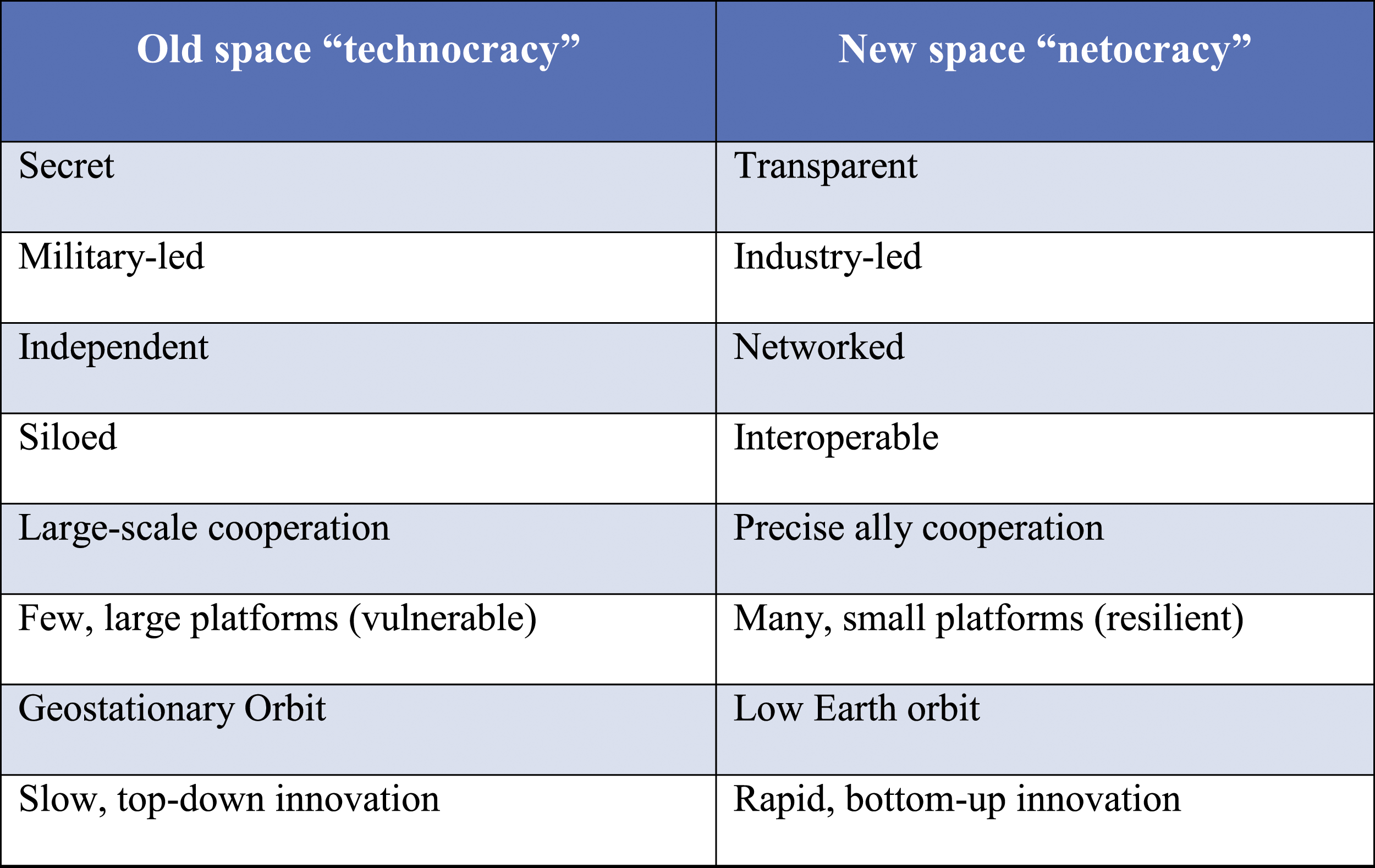
The transition to a “netocracy,” defined by James Moltz as an “organization based on public-private partnerships,” has also opened the floodgates for state and non-state investment in space. For example, the commercial space sector currently accounts for 75 percent of the $323B a year spent internationally on space activity. 9 Much of this spending has resulted in shortened testing and delivery times, serial production (especially of satellites and payloads), and a higher degree of standardization across the sector. 10 This has allowed more countries and industry stakeholders to enter the market, further driving down the costs of development, and thus making way for LEO satellite constellations to be built and replenished at record speeds. If current estimations prove accurate, more than 50,000 satellites will be launched (mostly into LEO) over the next decade, representing a 2000 percent increase from today. 11
LEO satellites promise to reduce latency and increase resiliency, bandwidth, and manoeuverability. Not only are large-scale companies like SpaceX, Facebook, and Amazon interested in these emerging capabilities, but defence, security, and intelligence organizations are also keen to leverage the technology for ubiquitous imagery, surveillance, and communications. The United States, for example, is investing heavily in LEO technology through the Defence Advanced Research Projects Agency (DARPA)’s Blackjack program. 12 In the UK, the government recently acquired a 45 percent (US $500M) stake in OneWeb, a company that builds and launches LEO satellites. 13 And France, Australia, Germany and China are likewise actively exploring and using LEO satellites for defence purposes and military planning.
The future of space in Canada: Workshop findings 14
Despite the changing nature of the global space industry and the precipitous shift towards LEO technology, many questions, specifically in the Canadian context, remain unanswered. Namely, we sought to identify the advantages and disadvantages of LEO satellites, the role for industry in future (space) force development, the need for multilateral cooperation, and the types of niche technologies and skillsets the Canadian government should consider prioritizing in the coming decades.
LEO advantages
Geostationary orbit (GEO) satellites operate approximately 35,000 km above the Earth’s surface, which is drastically farther than LEO satellites, which orbit at an altitude between 160 and 2,000 km. 15 The lower altitude of these satellites creates a number of important advantages. The first is that it reduces latency. Essentially, a shorter trip is a faster trip, and this allows for data to be sent and returned at much quicker speeds. In addition to shortening the Observe, Orient, Decide, Act loop, decision-makers will be able to process data in near real-time and potentially make operating unmanned vehicles from space a reality.
Second, LEO satellites can circle the Earth at approximately 27,000 km/h, which is considerably quicker than GEO satellites, which travel at around 11,000 km/h. 16 This means LEO satellites are spending far less time over individual ground stations—an essential component for transmitting data. Despite this, LEO satellites are smaller and therefore can be launched into orbit in greater numbers—creating constellations—that can operate much closer to one another. This network of satellites can then form a “web” covering the vast majority of the Earth’s surface, allowing for information to be transferred between satellites to ensure data arrives at a ground station in a more reliable fashion. This method avoids triangulating the data through “overseas facilities,” which are more vulnerable to ground-based attacks and critical delays in processing. In turn, this broad system offers a high degree of resiliency as it will be unlikely for operations to lose connection in the event that a number of constellations are attacked or otherwise malfunction.
Encrypted LEO networks will also provide the military with an additional layer of security. Through optical links, data will travel end-to-end across a single encrypted network that, as expressed by one stakeholder, is resilient to traditional jamming techniques. Since LEO satellites are highly maneuverable—that is, they can be manipulated and moved while in orbit—constellations can be rerouted to dodge impending collisions or (space and ground-based) attacks. In the case that a successful anti-satellite attack does occur, attribution and greater space situational awareness will allow for targeted nations, and their allies, to pinpoint the exact location and time of the attack, as well as potential escalatory action, within minutes.
Lastly, LEO satellites will expand the operational theatre by providing communications and surveillance in hard-to-reach regions, including, notably, the Arctic. The newfound speed and coverage provided by LEO satellites will help deter enemy aggressors in the far north; facilitate difficult regional missions, environmental research, rescue operations; and assist remote and Indigenous communities. Since the cost of launching and building LEO satellites is far cheaper than ever before, and because they can provide commercial services, the rapid replenishment of these constellations and payloads has, for the first time, become economically attainable.
LEO disadvantages
One major vulnerability for LEO satellites pertains to hacking and decrypting. As countries become more reliant on LEO networks to share secure information, along with an increase in dual-use constellations, the odds these networks will eventually be targeted and compromised by nefarious or malicious actors increases. Moreover, advancements in quantum technology may pose a challenge to encryption—in space or otherwise—a concern current LEO platforms are not necessarily designed to thwart.
Second, as militaries develop and deploy hypersonic anti-satellite weapons, the window to make decisions will become increasingly narrow; targeted militaries will need artificial intelligence and edge processing to defend constellations against future physical attacks. 17 While having the ability to attribute kinetic attacks against LEO satellites might deter some adversaries, including advanced states with known counter-space capabilities, kinetic attacks launched by other adversaries, including non-state actors and emerging powers, remain a legitimate concern.
The third challenge relates to space congestion. Given the mass of LEO satellites that are expected to launch over the next ten years, it is possible the frequency of mid-orbit collisions will increase. Space debris can have dramatic consequences on a country’s space infrastructure, either through the Kessler Syndrome, or through constellations themselves being used as “kinetic-kill” vehicles. 18 An example of the former occurred in 2009 when a defunct Russian satellite collided with an American commercial spacecraft, creating more than 2,300 pieces of debris.
Lastly, the shrinking development lifecycle and the shorter lifespan of LEO satellites in orbit means technology is evolving faster than it can be procured. Failing to develop or acquire the latest technologies might render Canada’s current capabilities obsolete. Canada will then have to rely disproportionately on foreign technology and capabilities, which may adversely affect state sovereignty and autonomy when it comes to interoperable requirements and specifications. Overreliance on key allies can also degrade Canada’s domestic industry capacity and knowhow as fewer companies and labs with these skillsets will exist, thus affecting the placement of newly graduated, highly specialized, students. In short, the longer Canada waits to acknowledge, develop, and own LEO space infrastructure, the harder it will be to catch up to those who do.
A renewed role for industry
In today’s netocratic space environment, modernizing the CAF will not be possible without large-scale investments and cooperation between defence and traditional industry players. Given how dual-use space technologies will serve both the CAF and the general Canadian public, DND needs to foster closer participation with commercial actors in order to fully exploit cloud-based digital platforms. 19 Canada must also address the growing digitization gap and existing infrastructure bottlenecks by moving away from a “waterfall” approach that increases development times and limits industry-government joint initiatives. The current process could be phased out through experimentation with more agile methods that emphasize flexible requirements, lower classification barriers, and more rapid and continuous capability delivery options. In the United States, for illustration, the Defense Innovation Unit has proven successful in attaining quick, time-sensitive and cost-effective solutions to difficult procurement challenges, such as the joint NORAD USNORTHCOM Pathfinder initiative. 20 Designed to fuse data from commercial and government sensors in order to create a common operating picture for continental defence, Pathfinder has already proven effective in detecting and tracking small unmanned aircrafts that had previously evaded traditional radar systems. 21
DND and the CAF must also work to guide industry goals. This entails outlining short- and long-term initiatives that are both financially and politically supported. Setting a clear agenda that emphasizes the development of specific capabilities, rather than large-scale omnibus programs, will provide industry with the roadmap needed to build Canada’s future space infrastructure. One way to do so is to invest in long-term capabilities with explicit requirements, while also supporting the enhancements of existing systems in the short-term. Ultimately, such a shift will depend on the introduction of software methodologies and open-system architecture approaches, such as DevOps and modular design. 22
Canada-allied cooperation
Canada must work to develop technology in tandem primarily with the US, but also with its fellow Five Eyes (FVEY) and NATO allies. It is in the strategic interest of DND/CAF to foster an environment where Canada’s multilateral partners can benefit from each other’s capabilities and infrastructures, where feasible. Such a relationship would preserve network sovereignty while also providing an option for information sharing between allies. One particularly successful example is the Canadian Sapphire Satellite, which has provided the US Space Surveillance Network with critical data regarding orbiting satellites and space debris since 2014. Trust built through this initiative, stakeholders noted, resulted in the US sharing classified information with Canada that might not have otherwise been shared. In this light, Canada cannot simply be a net consumer of space development and technology. Instead, a trusted digital environment must be created that maximizes the opportunity for joint technology testing and capability development between allies. This entails leveraging existing capabilities, platforms, equipment, academic knowledge, and intellectual property.
The United States’ commitment to expand the space domain—including with the creation of the USSF—places Canada in a strategically advantageous position. So long as Canada can exert leadership in the binational NORAD construct, the US will be compelled to share at least some technological capabilities that are required for interoperability and connectivity—capabilities that Canada would otherwise be unable to develop alone. Leveraging this advantage, however, will require explicit signalling from decision-makers within Canada’s current (i.e., Strong, Secure, Engaged) and future defence mandates that NORAD modernization and continental defence are a top priority. Working alongside the US to identify specific capability gaps, including those pertaining to a CB (known in the US as Joint All-Domain Command and Control or JADC2) and its many sub-projects (i.e., the Advanced Battle Management System, Project Convergence, and the Joint Enterprise Defence Infrastructure) is an area where Canada can provide assistance. More so, it should be acknowledged that supporting NORAD modernization in space is not simply the job of DND; a whole of government approach (alongside political leadership) is needed to effect change. This is where a holistic Canadian space strategy, drafted alongside our American counterparts, is essential—a strategy that will benefit Canada’s economy, science, innovation, defence, Arctic and climate change priorities.
Niche Canadian capabilities
The United States has adopted a (short-term) risk and (modest) fail-fast mindset to developing military technology at-scale. Given Canada’s resource and size constraints, the same approach cannot be emulated. However, per capita, Canada is extremely well positioned to exploit its expertise in AI, machine learning, robotics, system engineering, telecommunications and advanced manufacturing. Furthermore, Canada can specialize in developing sub-projects that are particularly useful for NATO, NORAD and the FVEY. This includes building interoperable cloud technology and digital intelligence, as well as updating and exporting some of our critical space assets, such as the North Warning System (NWS), RADARSAT-3, and the Sapphire Satellite.
Arctic communications and surveillance are another niche area where investment from state and non-state actors remains limited. In addition to updating the already successful NWS, emerging LEO capabilities and remote sensing will allow Canada to provide the US with live PNT and global positioning system (GPS) data. From a defence perspective, further space development in the Arctic will give decision-makers more time to track information, pinpoint targets, coordinate assets, and generate effects, if and when necessary. On the commercial side, it will enhance communications and access to rural, remote, and underserved regions. It will also aid rescue missions, along with environmental and climate change research.
Finally, Canada can play an important role in developing space debris removal technology and strategies. There are an estimated 934,000 pieces of space debris orbiting the Earth that are larger than one centimetre in diameter. In fact, such a piece recently collided with Canadarm2, a Canadian-made robotic arm that is used on the International Space Station. 23 As the space economy grows and more satellites are launched into LEO, innovative solutions will be needed to track, collect, remove and divert space debris. Continued support for Canadian companies working on this problem, such as NorthStar Earth & Space, can lead to an improvement of global space situational awareness and space traffic management. It will also solidify Canada as a thought leader in this field, resulting in economic incentives for both the government and industry stakeholders alike.
Next steps and policy considerations
Space exploration and research has played an important role for Canada—a space-faring nation—over the last sixty years. In the new space economy, however, the leveraging of space and space-based assets for defence purposes will likely continue unfettered. Great power competition, coupled with the development of new, novel, and cost-effective capabilities, has created an opportunity for modernizing the CAF, supporting NORAD modernization and strengthening Canada’s domestic industry and economy.
This article briefly outlined some of the key opportunities and constraints associated with such a shift. It is evident that space-based capabilities, and specifically LEO satellites, can be transformative for Canada’s force development; its innovation capacity in a rapidly growing market segment; its partnership in NORAD, NATO, and the FVEY; as well as its ability to retain a degree of sovereignty and self-sufficiency in this domain. Given the above, we recommend the Canadian government commit to the following: • • • • Becoming a leader in • Continuing to • Identifying, consulting, and drafting recommendations to pressing and unanswered
Canadian decision-makers must also recognize the importance of—and engage differently with – other emerging technologies, such as cloud computing, quantum, AI, ML, 5G and so on. Failing to do so will seriously hinder the ability to draft meaningful policy around LEO infrastructure—especially one that is outsourced for dual-use capabilities.
Put simply, before anything can be accomplished, symbiosis and coordination between industry and policy are needed. Even then, many future research questions persist: Who will build and operate this LEO infrastructure? What international agreements and moral conflicts arise when discussing Canada’s potential participation in the militarization of space? 24 What cybersecurity concerns need to be addressed? How will Canadian assets link to those of critical allies? And if all the above never materialize, what does this mean for Canadian defence and security?
Space-based assets, and LEO technology more specifically, are the much-needed vehicle that will allow Canada to continue exerting soft power, while also maintaining its global positioning as a middle power. With only one military satellite, Canada is handicapping both its defenssive and offenssive capabilities in this domain. It is therefore incumbent on Canadian decision-makers to seize this opportunity for force development while the technology is still in its infancy. Anything less will not only jeopardize Canada’s ability to reach a connected battlespace, but will expose a major defence lacuna to its allies and adversaries alike.
Footnotes
Acknowledgements
The authors express their sincere gratitude to Sean Murphy and Albert Johnson for their tireless efforts in organizing the stakeholder roundtable and assisting in researching and reviewing this article.
Declaration of conflicting interests
The author(s) declared no potential conflicts of interest with respect to the research, authorship, and/or publication of this article.
Funding
The author(s) disclosed receipt of the following financial support for the research, authorship, and/or publication of this article: This work was supported by a 2020-2022 Mitacs Accelerate award (IT17023).
