



Abstract
The main issue in the present article is to investigate how to solve a mixed integer fractional signomial geometric programing problem (MIFSGP). In the first step to achieving this idea, we must convert a fractional signomial programing problem into a non-fractional problem via a simple conversion technique. Then, a convex relaxation with a new modified piecewise linear approximation with integer break points as a pre-solve method is used to reach an integer global optimum solution. A few numerical examples are included to illustrate the advantages of the proposed method
Keywords
Introduction
A mixed integer signomial geometric fractional programing problem (MISFP) arises from the minimization of a quotient function which consists of several signomial terms appearing in the objective function subject to given signomial constraints with some integer decision variables. 1 In the optimization literature, geometric fractional programing problems play a very important role in engineering designs and management problems.
Fractional programing problems occur in many decision programs such as industrial economics, Information theory.2–4 In addition, fractional programing problems are identified to optimize power distribution systems. 5 Even though fractional programing has received intensive attention in the last four decades because of its importance in modeling many optimization problems, the discussion on methods of solving signomial fractional problems (SFP) has received less attention. Since these problems often occur in Complex industrial designs with a large number of variables and require a lot of accuracy, the main challenge of such problems is to reach the global optimal solution for integer or real variables within the shortest time and the least amount of computer memory space usage. For this reason our effort has been made to reach a more efficient and faster method than the previous methods.
In 1967, Dinkelbach 6 proposed an algorithm to solve continuous nonlinear fractional programing problems that were also used to solve many issues involving geometric fractional objectives. Several specialized methods have been proposed to obtain the global optimum for mixed integer geometric programing problems (MIGPP). 7
Chang 8 worked on a problem to reach a solution as close as a global solution for the mixed integer fractional posynomial programing problems. Tsai 9 proposes a new treat by using a convex and linearization method for solving nonlinear fractional programing problems, with multiple fractional signomial functions.
M. Saraj et al. (2018) solved posynomial fractional programing problems (PFP) via the linearization approach, in addition, they have also considered the problem of linear multi objective geometric programing problem via reference point approach in (2014).10,11 In a recent researches, Mishra et al 12 solved nonlinear fractional programing problems by signomial geometric programing approach. Shirinnejad et al. 13 proposed a technique to solve a signomial fractional programing problems globally with as small as distance from the solution of the original problem. In a valuable work by Westerlund, 14 a few helpful transformation techniques are considered in deterministic global optimization for signomial programing problems. In addition, he applied the most effortless power transformations to convexify posynomial and signomial geometric terms. Although the GGPECP algorithm used by Westerlund in 2003 was used to solve the convexified and underestimated problems to reach a globally optimal solution, in his method, he used too many constraints in expressing a piecewise linear function, which may cause heavy computational burdens. Therefore we have presented an efficient technique by combining power transformations tool to convexify the non-convex signomial terms and a more accurate modified linearization technique which can give mixed integer solution as close as possible to the original problem. By applying our propose, we observed not only less number of iterations but also got the integer solution as well.
There are two ways to convex a positive signomial term (posynomial) with power transformation, so-called Negative power transformation (NPT) and positive power transformation (PPT).
Although using NPT is more accessible than PPT, the PPT technique makes a convex form of signomial function tighter than NPT to original non-convex functions, as explained in Westerlund et al. 14 Tsai (2005) proposed a new approach to solve a general signomial fractional programing problem to reach a global optimum. He used NPT to convexify posynomial terms and superior piecewise linearization techniques. We now use the PPT technique to convexify the non-convex posynomial term along with piecewise linear approximations.
In this work, we have applied a modified model for piecewise linear functions of one and two variables which perform significantly better than the standard binary models that Vilma and Nemhauser 15 proved the efficiency of this superior piecewise linearization technique. Therefore, this work discusses a mixed integer global optimal solution to convexify every non-convex signomial term. Univariate transformations are applied in such a way to convexify and underestimate with this piecewise linear approximation of the inverse transformation of f(x), where x lies in the interval [a0, am] such that a0, am∈ Z with m + 1 integer breakpoints. In this article, applying integer breakpoints for integer variables is studied in detail as a pre-solution method to reach the integer solution for those variables.
This issue develops a global optimization method with fewer iteration numbers and CPU time than other methods to obtain a mixed integer solution in solving a Signomial Fractional Programing problem (SFP).
Problem formulation
A mixed integer signomial fractional programing problem (MISFP) seeks an approximate global optimum solution denoted as
The variables in a signomial function must be Positive.
This study considers a MISFP problem with the following form:




Where P(x) and Q(x) represent twice–differentiable signomial functions and
The matrix A and vector b are constants, and Bk and Ck represent convex and non–convex signomial functions, respectively.
Since the transformation approach is valid for signomial constraints, therefore the signomial fractional expression





The problem is further converted to:

Where
(2.2) is a signomial function and may be non–convex.
Convexification strategies
The problem of convexification a non-convex signomial term, such as inverse and exponential transformations, is discussed in detail in Shen and Yu2,7 Lundell et al. 16 , Chang 1 In this study, we use a particular case of the inverse transformation technique suggested by Westerlund. Convexity requirements for negative and positive signomial terms are given in the following propositions. 9
Proposition 2 in the literature is called (NPT). The technique of NPT is used to convexify and underestimate the posynomial terms because it seems simpler than positive power transformation (PPT). Westerlund indicated that PPT is a tighter underestimate than (NPT).
Therefore, we apply PPT to convexify posynomial terms. PPT can be expressed and proved in Proposition 3.
Consider the following Lemma and Hints from Tsai 9 :

Proposition 3 is called PPT technique in the literature.
We demonstrate an alternative proof for this proposition:
Proof. Through the Hessian matrix H(X) of f (X), for
Hint 1, we have
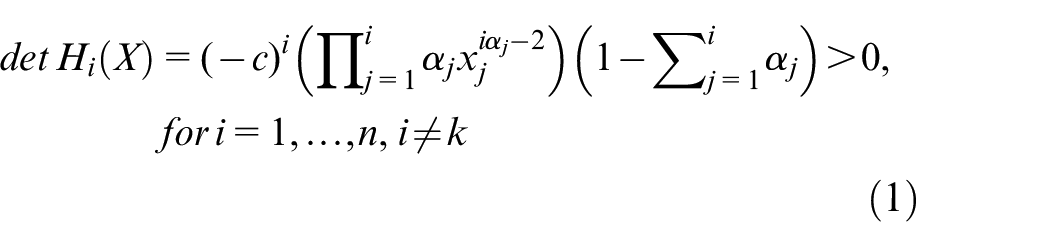

Now, concerning k, there are two modes:
(1) If k is even, then:
since
The number of
Therefore:
(2) If k is odd, then:
Since
The number of
Therefore:
Since
Transformation and underestimation approach
Convexification a non-convex function is a very essential concept in determining global optimization techniques. A good convex under-estimator should be as tight as possible and contains a minimum number of additional variables and constraints. By approximating the inverse power transformations,
Consider the following remark from Tsai and Lin, 17 which expresses the conditions to convexify a power function:
(i)
(ii)
(iii)
Where L(Xi) is a piecewise linearization approximation of

And L(Xi) is a piecewise linearization approximation of

Proof. Since all powers in (iii) are positive with

We find that (5) and thus (iii) will be valid if (3) and (4) are convex functions; it is fulfilled if
Thus,
i)
ii)
iii)
Where L(Xi) represents piecewise linear approximations of

and

Proof. Without losing generality, z can be rewritten by (i) by choosing
Inequality (iii) should be valid if


Since the first transformation variable in the left-hand inequality of (iii) is an increasing function where the next k−1 variables in the transformed signomial term have negative powers, it corresponds to decreasing functions. Hence, it was found that (8) and (9) are valid if the inverse transformation (6) is provided a concave function and the inverse transformations (7) are offered by convex functions too. Thus, (iii) is fully satisfied parameter
Since
The first term is positive and the second and third are negative. It is also valid for any sufficiently large α and small
Hence, according to conditions (ii) and (iii), z is a convex w.r.t.
Piecewise linear approximation
A custom way to Solve piecewise linear approximation is to apply the special order sets (SOS). However, this study used a much better approach in fractional programing, which is more efficient than ordinary methods. Therefore, this work uses a tight relaxation method of approximating piecewise linear functions. 15
Remark
17
: An injective function
Let



Since we are looking for a global integer solution for a class of mixed integer nonlinear programing problems, we use in this study integer breakpoints in the piecewise linearization technique to approximate the inverse transformation functions for every integer decision variable. This strategy can solve the mixed integer convexified signomial programing problems faster than the custom (SOS). Thus, the integer results were achieved for integer variables with no greater dominations.
Illustrative examples
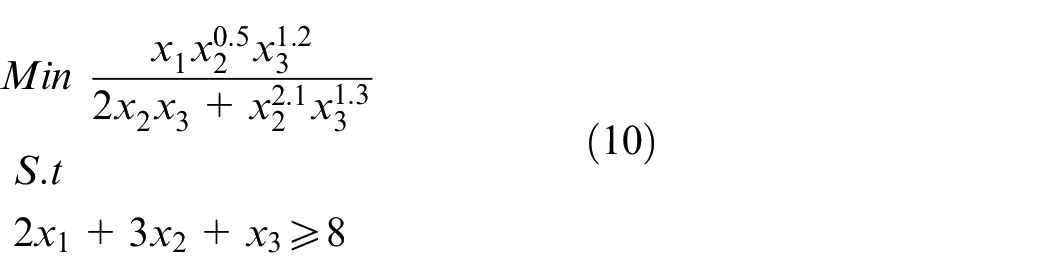





We introduce a new and small variable
This problem then becomes a convex MISP problem below:
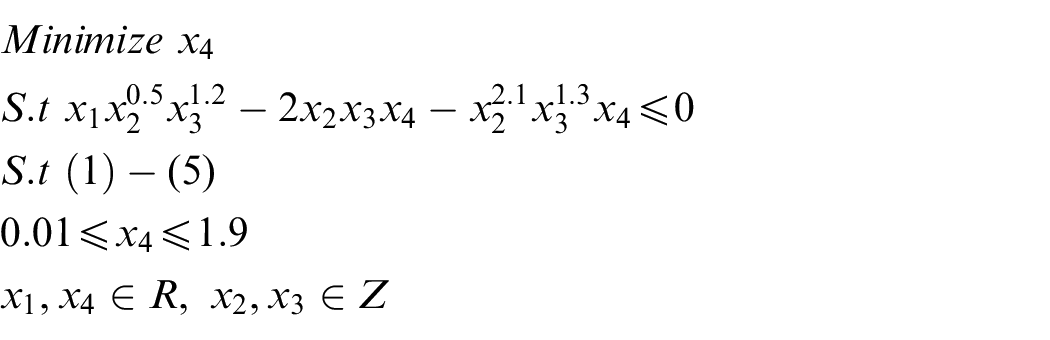
There are three non-convex terms in the constraints. To convexify the positive term
Let K = 3,
Let
To convexify the non-convex negative signomial term
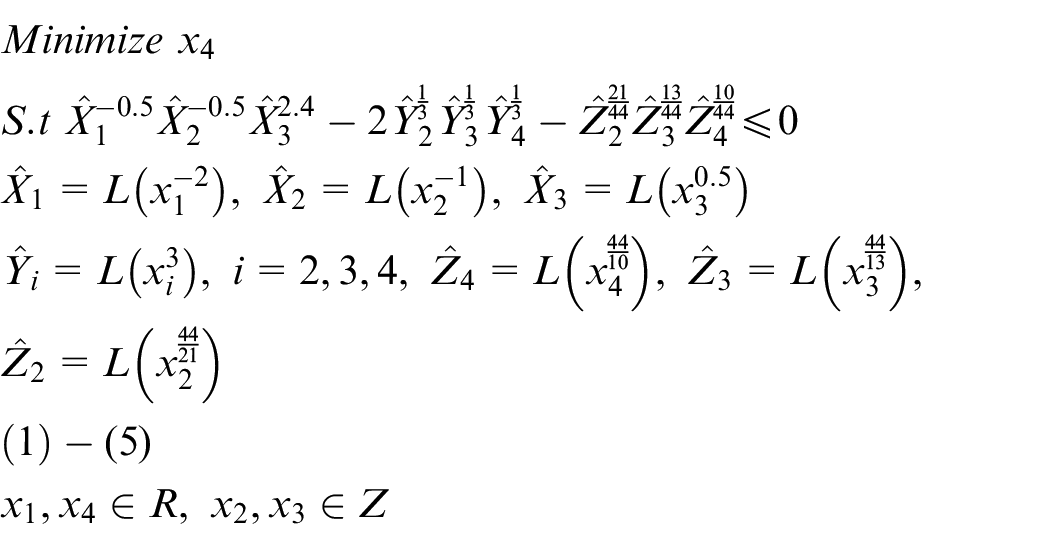
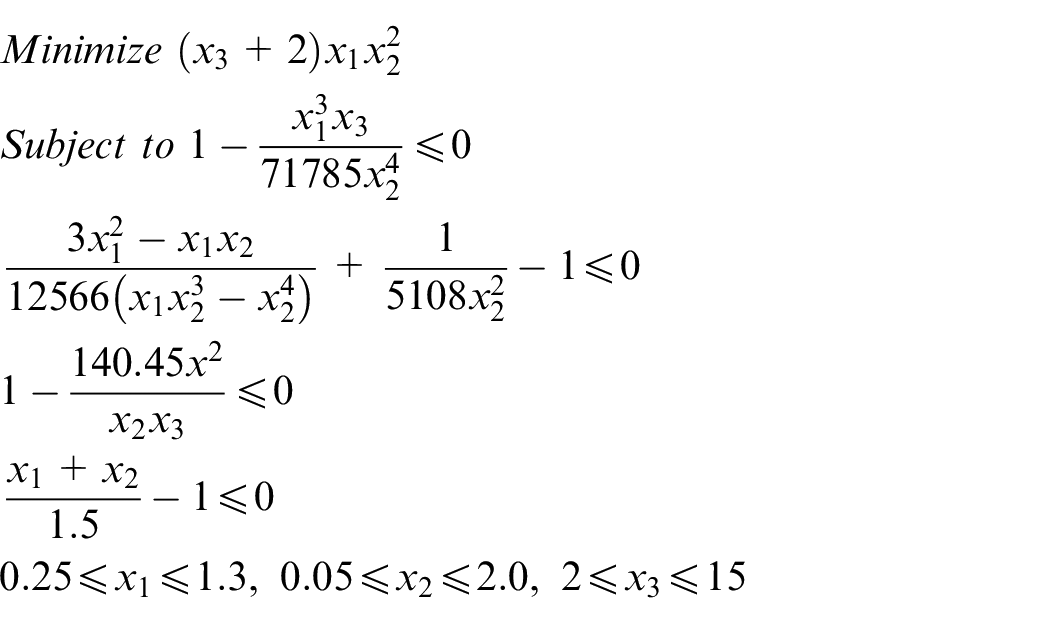
The original MISFP problem is reformulated as follows:
Where
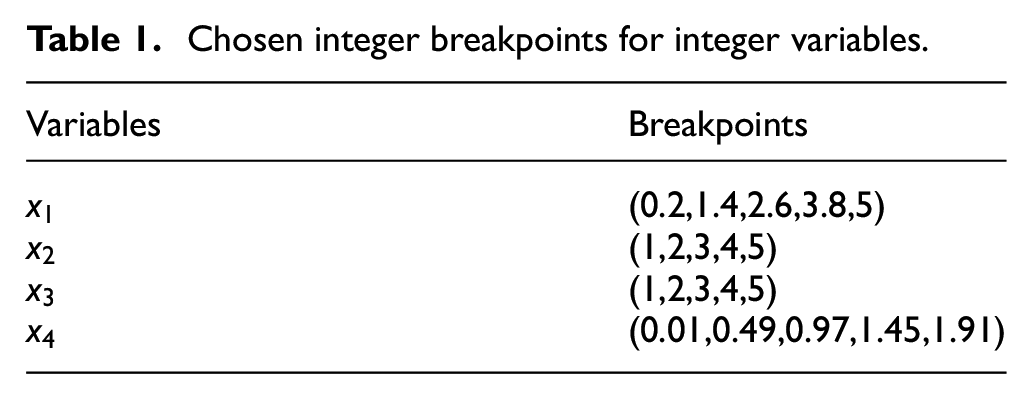
Chosen integer breakpoints for integer variables.
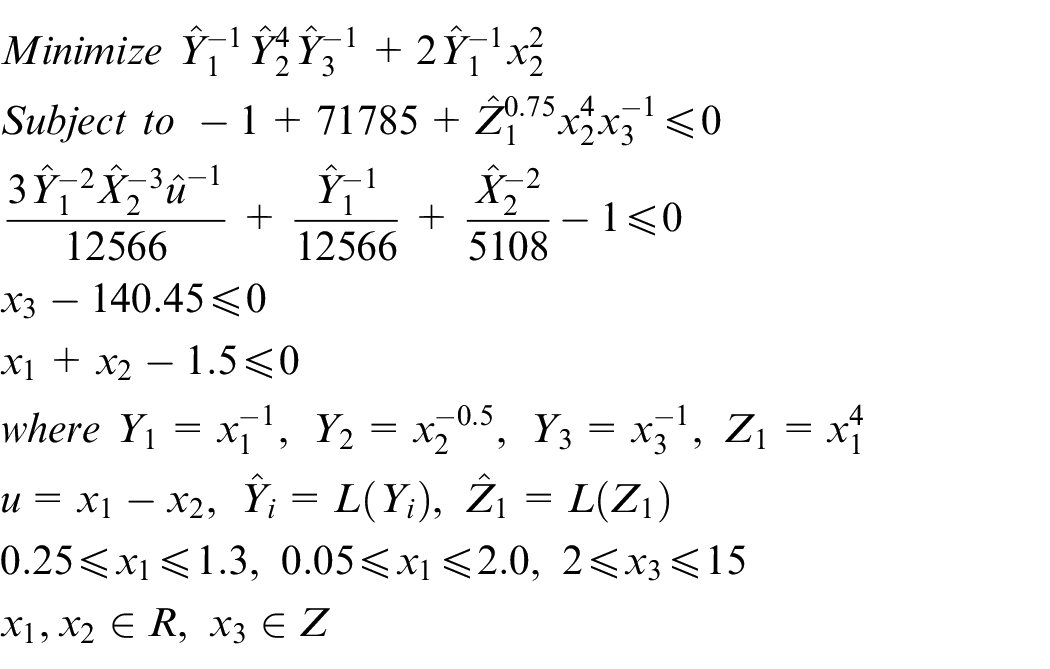
The above problem can be reformulated as follows:
By previous theorems

L(Yi) represents the piecewise linearization expressions of the terms Yi = 1,2,3 by Theorem 2.
Without utilizing any integer algorithm, to reach a global optimum solution for four breakpoints, we have:
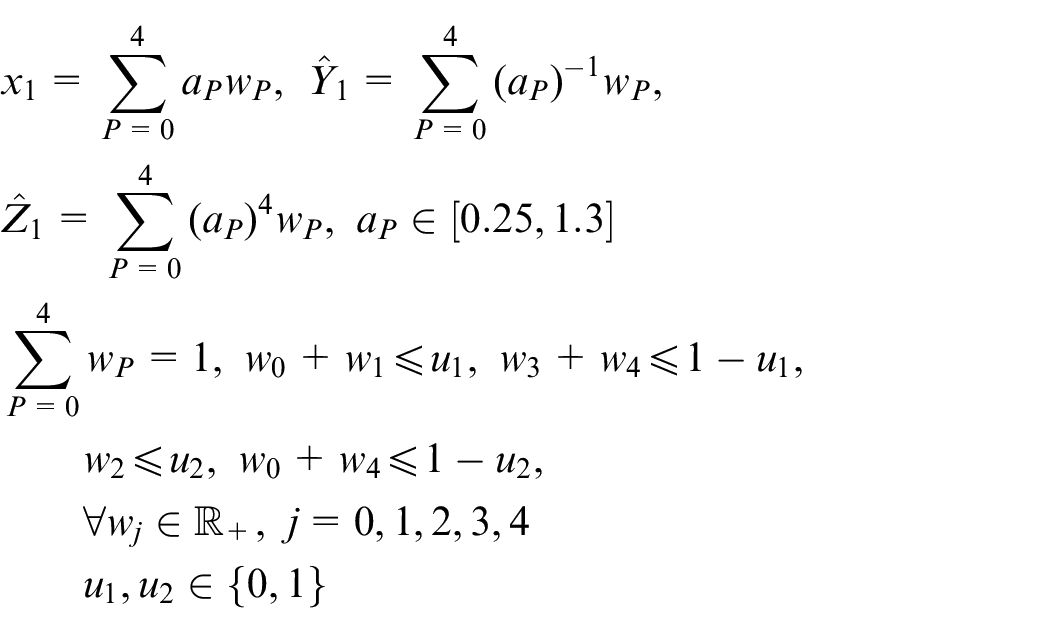
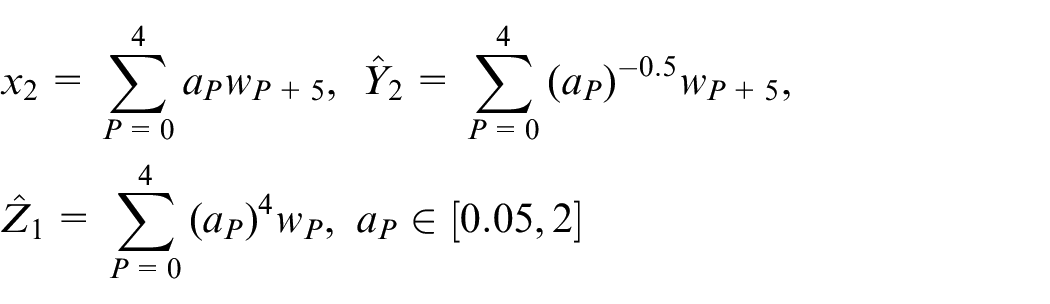
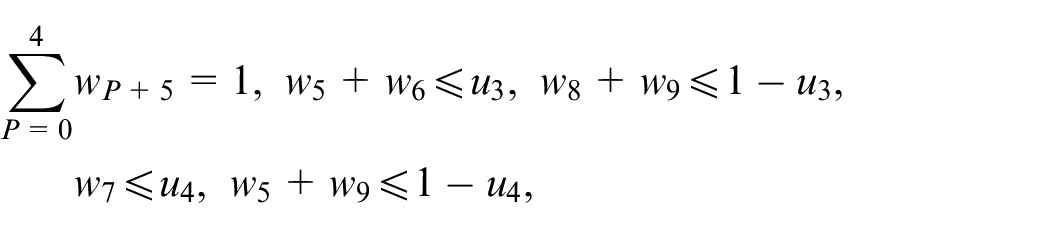

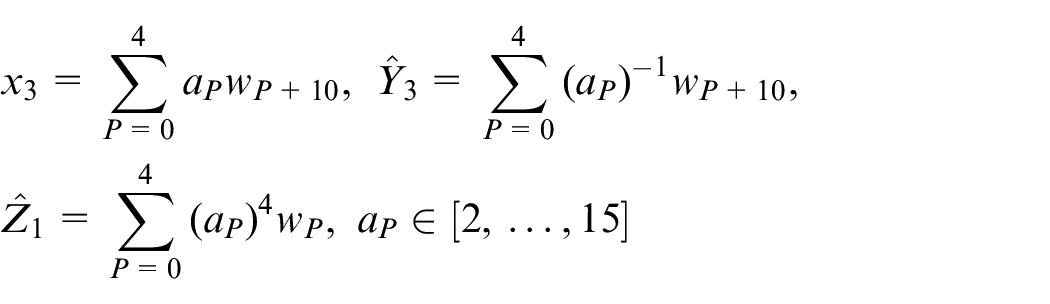
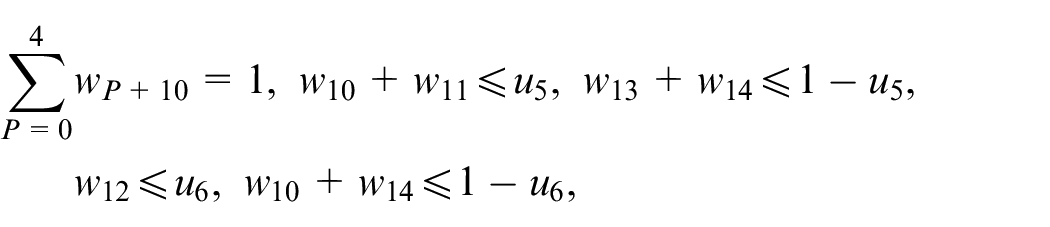


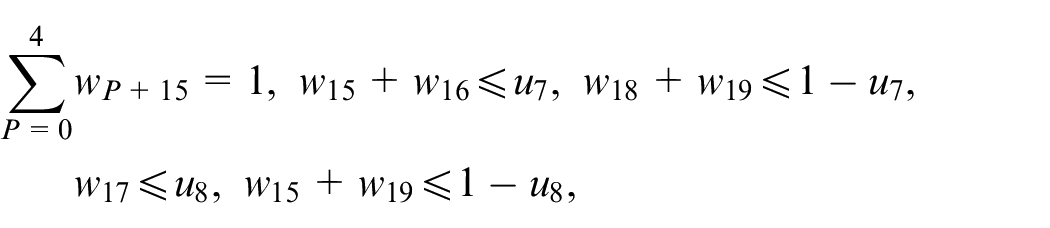

This program is solved by LINGO 18.0 (2014), where the tolerable error is specified as 0.001. The obtained mixed integer solution with the comparison of solutions of previous methods is listed in Table 2.
The comparison of results for the shock absorber design problem.

This table indicates the advantage of our method compared with the other solution obtained by the other authors, as Table 2. shows the results of the proposed method is global optimum within the tolerable error of 0.001.
Conclusion
In this study, we applied a convenient non-fractionalization technique and a tight power transformation method (PPT) with a novel modified piecewise linear approximation to convert a non-convex MIFSP problem into a convex MISP problem that yields global optimality. It is essential to be noted the mentioned piecewise linear approximation underestimates convexified functions, and we could obtain an integer solution without using any integer algorithm. Since this proposed method works only for a class of non-convex signomial fractional programing problems with integer variables where the integer variables have no large domains, we can introduce this technique as a pre-solve reduction method to reduce the calculation of problem-solving and reach a better solution. After comparing the results of this study with the previous works (see example in Tsai 9 ), we found that using the proposed algorithm is more efficient and tighter to obtain a mixed integer signomial fractional global solution.
Footnotes
Declaration of conflicting interests
The author(s) declared no potential conflicts of interest with respect to the research, authorship, and/or publication of this article.
Funding
The author(s) received no financial support for the research, authorship, and/or publication of this article.
