



Abstract
Energy storage plays an important role in integrating renewable energy sources and power systems, thus how to deploy growing distributed energy storage systems (DESSs) while meeting technical requirements of distribution networks is a challenging problem. This paper proposes an area-to-bus planning path with network constraints for DESSs under uncertainty. First, a distribution location marginal price (DLMP) formulation with maximum fluctuation boundaries of uncertainties is designed to select vulnerable areas exceeding voltage limits and higher line losses that occur in distribution networks. Different from simple multi-scenario power flow calculation and sensitivity analysis, DLMP with time and regional characteristics could be more intuitive to reflect line losses and voltage limits of distribution networks through price signals. After that, a two-stage stochastic robust optimization based planning method is developed to determine locations and capacities of DESSs in vulnerable areas. To make the uncertainty problem more tractable, stochastic scenarios are used to portray upper and lower boundaries of uncertainties, which avoids too-conservative decisions for robust optimization. Finally, numerical tests are implemented to testify the reasonability and validity of the proposed area-to-bus planning path under uncertainty. Compared with the DESSs planning framework without DLMP, the costs of DESSs are observably reduced with DLMP. With same budgets of uncertainty, investment costs of DESSs for the stochastic robust optimization with 30 and 50 scenarios are 3.91% and 4.45% lower than classical adaptive robust optimization (ARO).
Keywords
Introduction
Background and significance
Energy storage systems are seen as an important part of efforts to boost intermittent renewable energy consumption while ensuring the stable operation of energy systems. In recent years, various centralized energy storage stations have been massively built around the world, such as 250 MW gateway energy storage project in California, and 100 MW energy storage demonstration project in Shanghai and so on. 1 However, these centralized power stations not only cover a huge area, but also require high operation and maintenance costs, in particular they are clumsy in preventing the expansion of battery accidents. In contrast, distributed energy storage systems (DESSs) have gradually emerged as the focus of markets due to their small capacity and lower expenses. Through absorbing or releasing excess power quickly, DESSs increase the self-consumption of renewable energy onsite and can offer significant cost savings to the private owner in distribution networks.2,3 Most existing DESSs are not directly controlled by distribution system operators (DSOs), which could increase electricity prices at peak demand, influencing consumers. 4 In other words, the planning for DESSs does not globally consider operating conditions of distribution networks, thus it is difficult to improve the power quality in vulnerable areas of distribution networks. Moreover, some repetitive and unreasonable planning for DESSs will not only increase investment costs but also affect the stability of distribution networks.5,6 Some planning procedures without considering uncertain factors may cause deployments for DESSs divorced from reality. This paper attempts to answer the following key questions: 1) how to configure DESSs reasonably and orderly in vulnerable areas of distribution networks? 2) how to design the locations and capacities for DESSs scientifically under uncertainty?
Literature review
In order to enhance the flexibility of distribution networks in higher penetration of renewable energy sources, DESSs planning mostly revolves around load management, 7 mitigation of voltage deviation,8,9 peak-load shaving10,11 and so forth. Researchers 7 ascertain the optimal planning framework for battery energy storage to minimize network losses in terms of different load management. A scale of DESSs placement (e.g. uniform and non-uniform energy storage systems sizes) is developed to reduce voltage deviations and line losses. 8 In order to delay distribution networks upgrade and mitigate voltage deviations, residual values, investment and operating costs of DESSs are integrated into a planning model. 9 In Pimm et al., 10 the co-location of energy storage systems with loads could provide balancing services to grid, in which the potential of electricity storage for peak shaving is fully exploited. Similarly, an optimal configuration approach for battery units is applied to alleviate power unbalance, while achieving the maximum allowable photovoltaic capacity. 11 However, some grid and market factors (e.g. power flow and electricity prices) are not taken into account in the above approaches, which results in most energy storage systems being placed in unreasonable areas. It is difficult to capture potential economic values of DESSs and meet the fundamental requirements of distribution networks.
Some advanced approaches have been studied for planning distributed energy sources considering grid and market factors. In a nodal transmission-constrained energy market, price makers and geographically dispersed battery systems are coordinated using locational marginal price (LMP) in a nonlinear optimization model. 12 It is observed that such operation in the transmission line is suitable, but not always, desirable in distribution networks. In Singh and Goswami, 13 a node pricing allocation scheme is developed for planning location and capacity of distributed energy sources. However, directly adapting the transmission level LMP to distribution systems and ignoring high R/X ratio could lead to large errors in marginal prices due to the discrepancy between distribution systems and transmission systems. For this reason, distribution location marginal price (DLMP) is applied to plan distributed energy sources in distribution networks. DSOs determine DLMP of distribution systems by taking into account charging constraints to alleviate disorderly charging with high penetration of electric vehicles.14,15 An extension of former DLMP model based on novel linearized optimal power flow is developed by Yuan et al. 16 and Wang et al., 17 in which accurate price information can be obtained. Inspired by the aforementioned literature, this paper develops a DLMP-based location planning strategy for DESSs. First, a price-guiding DLMP model in distribution networks is established according to the upper and lower boundaries of robust intervals of uncertainties. Second, the resulting schemes guide the preliminary planning of DESSs locations to reduce line losses and relieve voltage deviations for buses.
After a preliminary selection of planning areas, the detailed planning locations and capacities of DESSs are key points. Many optimization-based planning approaches have been studied, taking account into random renewable energy and loads. Stochastic programing-based planning approaches are developed to select suitable locations and capacities for energy storage systems. 18 Whereas, these approaches make a tremendous computational burden due to a large number of scenario simulations.19,20 Alternatively, robust optimization uses uncertain boundaries to cover worst-case scenarios for risk aversion, which alleviates the calculation pressure caused by stochastic scenario production. 21 In order to facilitate the high percentage of renewable energy, an optimal allocation scheme for energy storage systems using robust optimization is proposed. Simulation results show that robust optimization schemes could reduce expansion planning costs while delaying network reinforcements. 22 Considering N-1 contingencies, an adaptive robust optimization (ARO) model is established to confirm an optimal investment location for expansion planning. 23 To obtain the planning solution with minimum investing and operating costs, an ARO-based planning approach for energy storage units and electrical vehicle charging stations in distribution networks is developed considering short-term and long-term uncertainties. 24 In order to avoid too-pessimistic decisions of ARO-based approaches, distribution robust optimization (DRO) combines the advantages of stochastic programing and robust optimization to derive an optimal solution under the worst uncertain probability distribution. 25 Yang et al. 26 describe the coordinated planning for energy storage units and grid connection lines using DRO to minimize investment costs under wind abandonment constraints, but ignoring power flow in distribution networks. To optimize the sizing of battery energy storage in the power system, Guo et al. 27 propose a dedicated power flow model, in which inexact probability distributions are encapsulated in Wasserstein-metric based ambiguous set for the random renewable generation. However, the Wasserstein-metric based ambiguous set for DRO cannot be solved directly and its solution efficiency is impacted by the size of specimens.28,29 Combining stochastic programing and robust optimization techniques for practical planning, this paper employs stochastic scenarios to portray an uncertainty set to simplify problem-solving processes. Fluctuation boundaries of stochastic scenarios are used to build upper and lower boundaries of robust intervals, which represent dynamic deviations from nominal values.
Contributions
This paper aims at solving the DESSs planning problem for DSOs under uncertainty. An area-to-bus planning path for DESSs is developed to meet fundamental requirements of distribution networks while handling uncertainties of renewable energy sources and loads. Compared with traditional planning methods, the proposed method accurately reduces voltage deviations and line losses. The stochastic scenarios and the robust interval are used to portray uncertainties of the planning process, in which the proposed model allows the upper and lower fluctuation intervals to be different. Therefore, mainly contributions of this paper can be summarized as follows.
The area-to-bus planning path is designed to optimize the locations and capacities of DESSs for DSOs under uncertainty, which alleviates voltage deviations and reduces line losses in distribution networks.
At the area level, according to the maximum boundary of uncertainty, DLMP approach is used to find vulnerable areas of the distribution network to guide the installation of DESSs at candidate buses. Fluctuation boundaries of stochastic scenarios are applied to depict upper and lower boundaries of uncertainty set.
At the bus level, the DESSs planning problem under uncertainty can be formulated as a two-stage stochastic robust optimization, which refrains too-conservative or over-optimistic decision schemes for stochastic programing-based planning and ARO-based planning approach. The effectiveness of the proposed model is verified in different stochastic scenarios.
The rest of this article is organized as follows. The problem statement of DESSs planning is given in Section 2. Section 3 introduces the power flow model and the stochastic-robust uncertainty model. Section 4 and Section 5 give a mathematical model of the proposed DESSs planning framework and solution methodology. Case studies and numerical results are discussed in Section 6 and conclusions are drawn in Section 7.
Problem statements
In this paper, the set of candidate buses for locating DESSs in distribution networks is defined as
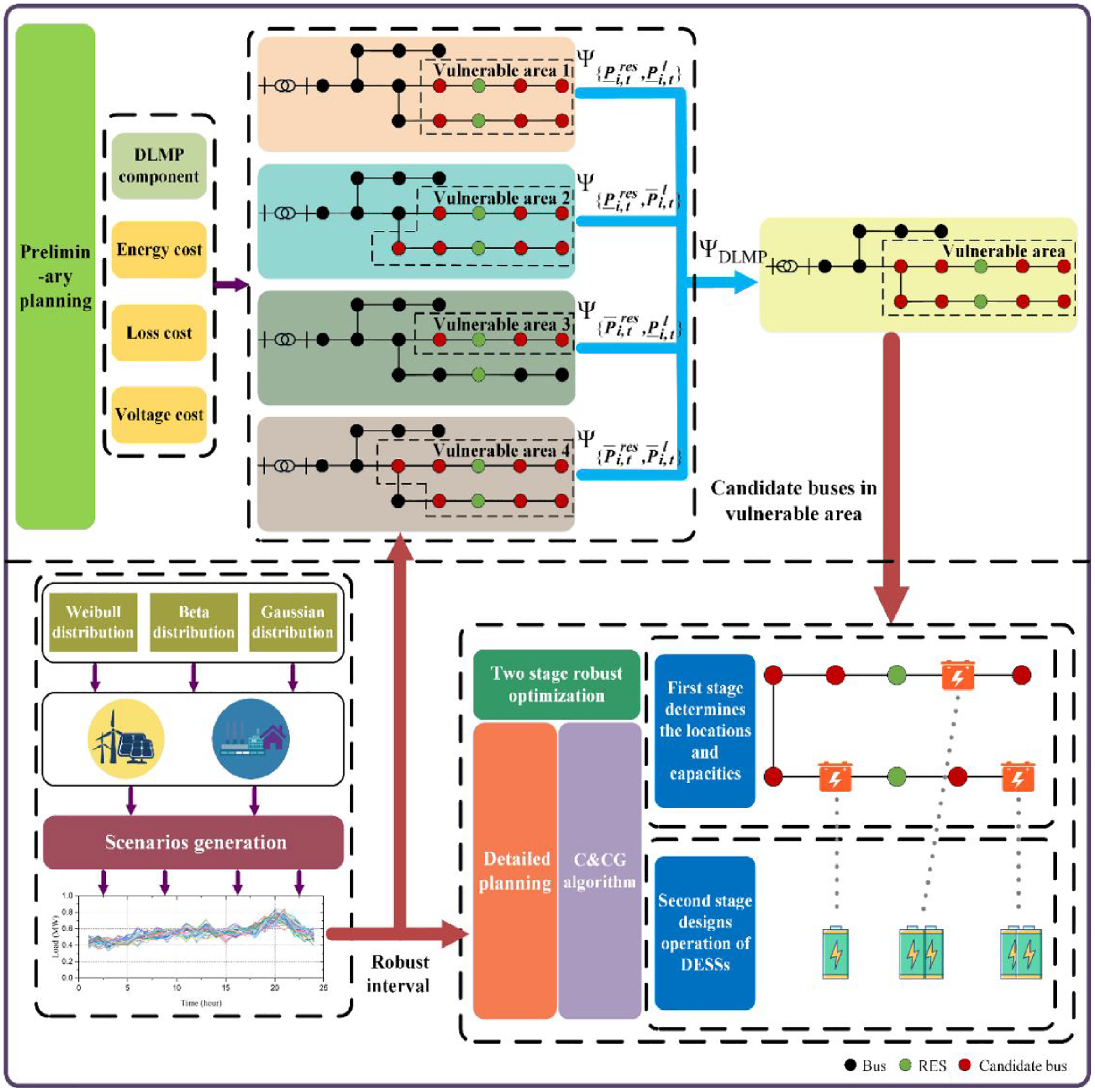
A simplified illustration for DESSs planning in distribution networks.
First, the preliminary area planning problem for DESSs could be described as a DLMP problem with maximum fluctuation boundary of uncertainties. Based on the upper and lower boundaries of robust intervals of uncertainties, the preliminary planning finds a vulnerable area, in which power sold/purchased to/from upper-level grids are considered as decision variables. Different from traditional modes of operation (e.g. voltage limits through equipment), power market is an effective means to manage and utilize the power in the distribution network. The application of marginal pricing concepts in the distribution network can also be seen as signal of operational costs. 30 The price signal of DLMP is used to DESSs planning to alleviate the possible voltage deviation in the future distribution network with high renewable energy sources.
Second, the detailed locations and capacities planning problem of DESSs for DSOs under uncertainty is a two-stage planning problem after the preliminary selection of planning areas. The first stage pursues optimal locations and capacities for DESSs at candidate buses; then the second stage designs suitable operation schemes for DESSs. Given the existence of uncertainties of renewable energy sources and loads, the two-stage planning problem can be described as a two-stage stochastic robust optimization. The decision of DESSs with or not at candidate buses is treated as binary variable, and continuing variables include DESSs capacity and operation decisions (e.g. energy capacity and power capacity of installed DESSs, charging and discharging power of DESSs).
Preliminaries
Power flow model
Energy storage systems are accessed to regional distribution networks and transmit their power through transmission lines, which will undoubtedly have an impact on directions of power flow in distribution networks. Thus, power flow constraints are crucial for the DESSs planning model. Consider distribution networks described by a tree

where all buses satisfy power balance:

According to
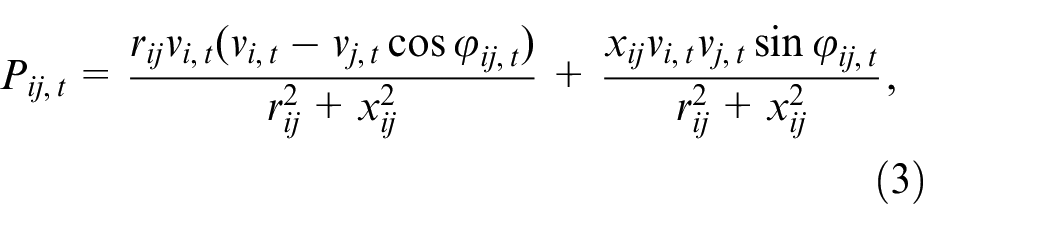
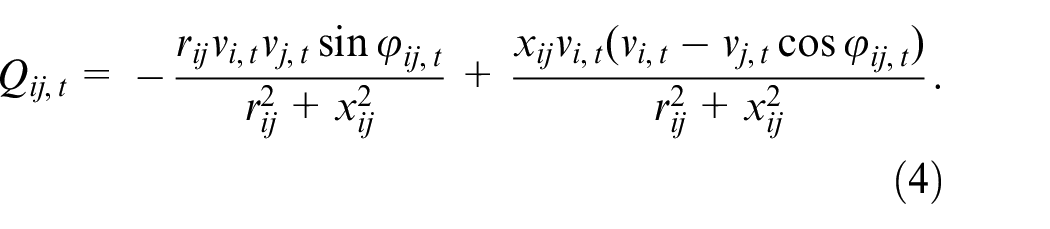
(1) Linearized optimal power flow for networks: To obtain vulnerable areas in distribution networks, it is inefficient or even impracticable to straightly solve high R/X ratio using a linear approach. Thus, the linearized optimal power flow model 16 is employed. To develop the linearized power flow formulas, two reasonable hypotheses based on generalization conditions need to be created below:
Based on the above hypotheses, equations (3) and (4) could be a step forward to simplifying, which denote the model of novel linearized power flow.


Similarly, matrix form of power injection at all buses can be expressed as:





In equation (7),
(2) DistFlow model for networks: Linearized optimal power flow could satisfy the search of vulnerable areas, but it could cause capacity deviation at buses. In this paper, optimal power flow is applied in detailed planning for DESSs. A DistFlow model is formulated in network
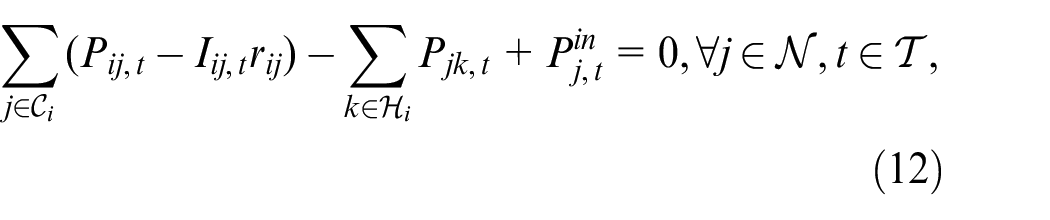
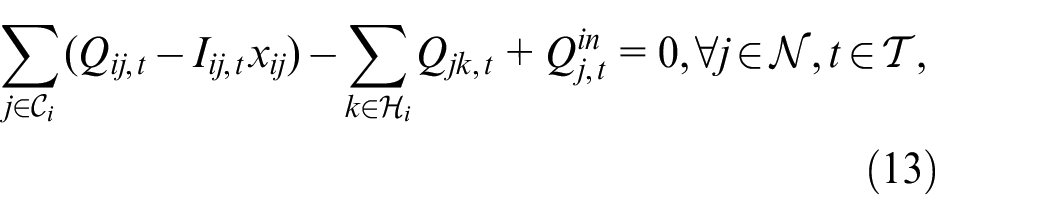




Equations (12) and (13) describe active and reactive power conservations of distribution networks. At time slot t, voltage magnitude at bus i and current magnitude on line ij, respectively, can be calculated by equations (14) and (15). Equations (16) and (17) guarantee that the bus voltage magnitude and the line current magnitude would not beyond permitted ranges. However, the above model is non-convex due to the division operation among different variables in constraint (15). An inequality constraint (18) is adopted to relax the original model into a second-order cone programing 31 that could be efficiently solved by commercial optimization solvers.

Stochastic-robust uncertainty model
In general, the deviation between the nominal value and the actual value of uncertain factors in the robust optimization is assumed to be fixed value at time slot t. Nevertheless, such descriptions for robust intervals could be regarded as too-pessimistic due to the fact that fluctuation ranges of uncertain factors are different in upper and lower boundaries. In this paper, fluctuation boundaries of stochastic scenarios are used to build dynamic deviations from nominal values at time slot t.
First, the stochastic scenario is used to characterize uncertainties. Here, wind speed, solar irradiance and loads are supposed to follow Weibull distribution, Beta distribution and Gaussian distribution
32
respectively. Latin hypercube sampling method is adopted to generate approximately random samples


An occurrence probability accompanies each scenario, and the sum of all probabilities is equal to 1 (i.e.

Based on nominal and boundary values obtained from the aforesaid scenarios, the robust set with budget of uncertainty is used to capture uncertainties. A straightforward structure of this uncertainty set could be, but is not restricted, as follows:
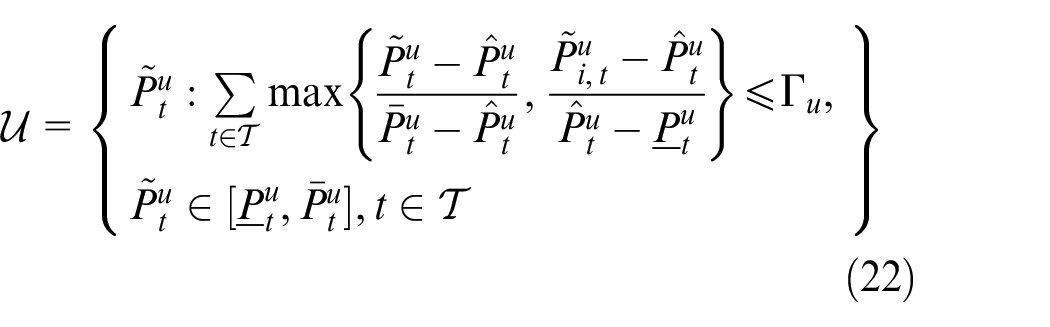
where
Preliminary area planning mathematical formulations
In this section, vulnerable areas for DESSs are selected based on the DLMP approach. At present, the safety of distribution networks is mainly considered congestions and line losses, however, the voltage limit is an urgent problem for radial distribution networks. First, the linearized optimal power flow model 16 is employed to minimize operation costs of distribution networks. Then, a price-guiding DLMP formulation can be derived from the resulting power flow. DLMP with time and regional characteristics could be more intuitive to reflect line losses and voltage limits of distribution networks through price signals. Based on the price information, vulnerable areas can be determined to guide the installation of DESSs at candidate buses. The detailed mathematical formulation is listed as follows:
Preliminary area planning model

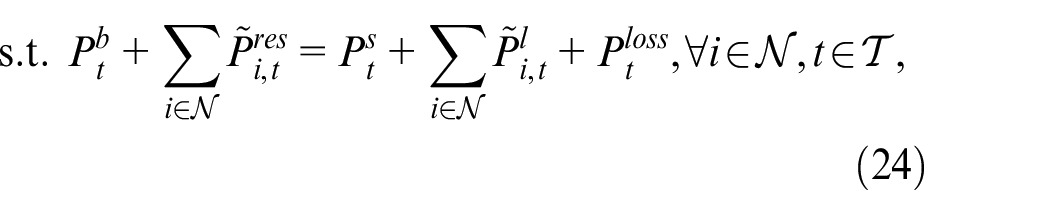




where
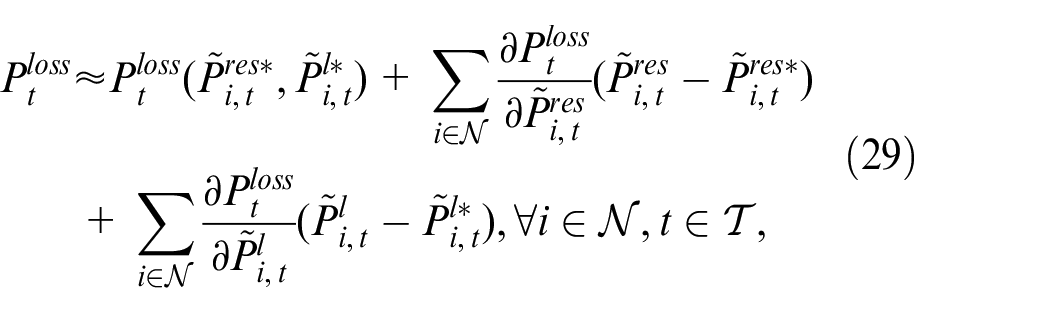
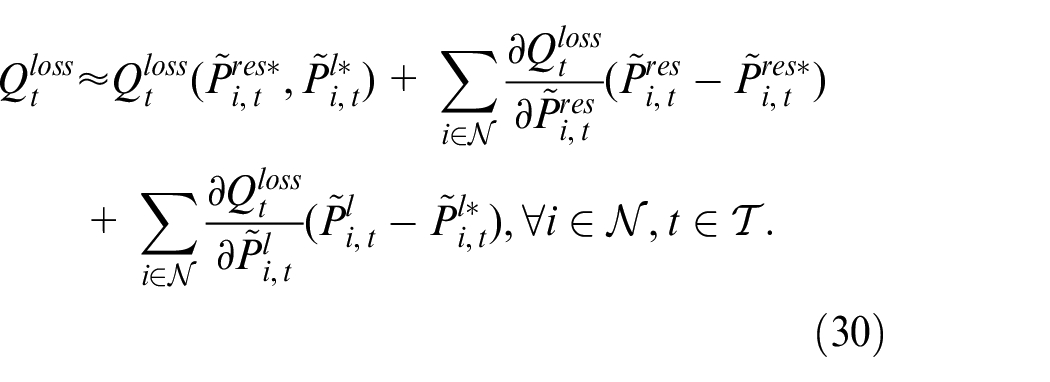
In order to obtain the relationship between voltage magnitudes and marginal prices for buses, equation (31) provides a detailed derivation of the linear function
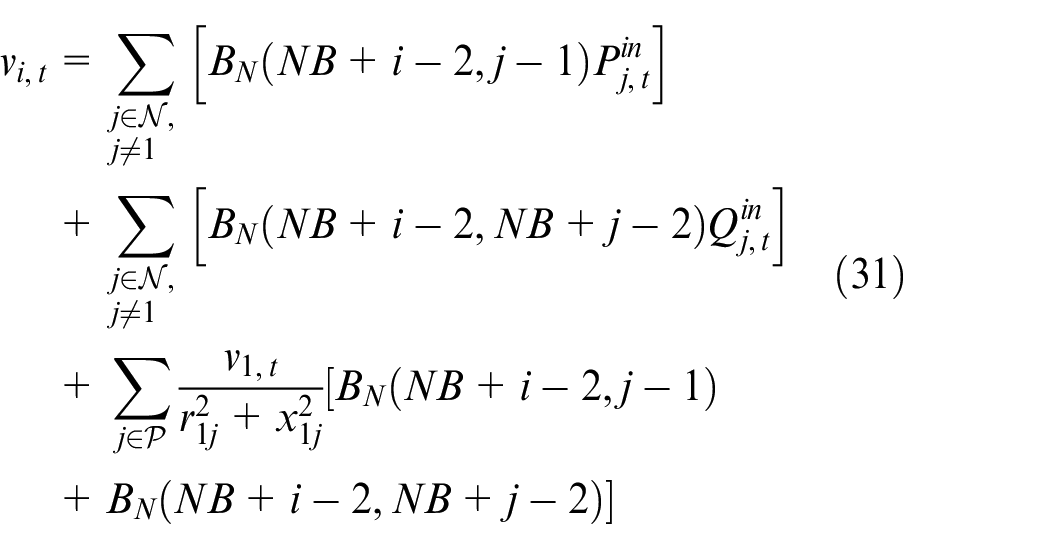
where
Selecting vulnerable areas based on DLMP
Operation costs for distribution networks are not separable because of the existence of strong coupling relationship between constraints (24), (25), (26), (27) and (28), therefore which can be added into objective function using Lagrangian relaxation under uncertainty. The Lagrange function can be defined as follows:
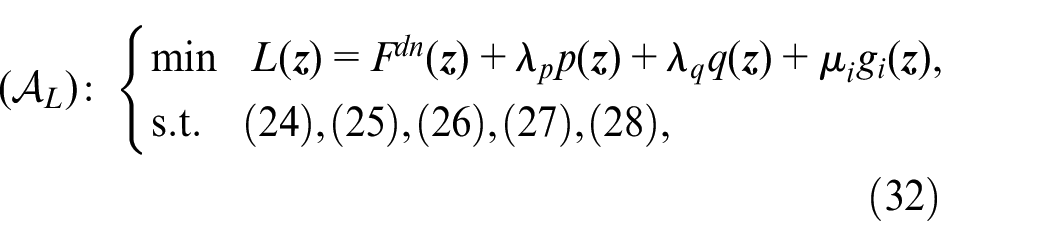
where
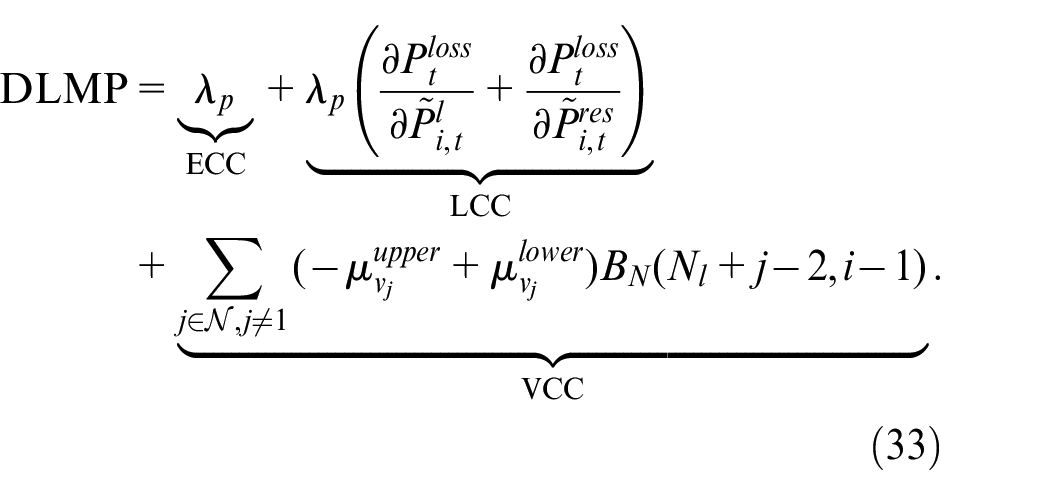
In equation (33),
The DLMP is used to estimate the cost of exceeding voltage limits and higher line losses that occur in regional distribution networks. The marginal prices usually run within a reasonable range, which is given by DSOs based on historical experiences. Therefore, vulnerable areas are formed by areas in which the DLMP exceeds a reasonable price range. In fact, the apparent extent of vulnerable areas in distribution networks is subject to the worst-case uncertainties of renewable energy sources and loads. In constraint (22), as

Solution methodology for the vulnerable area
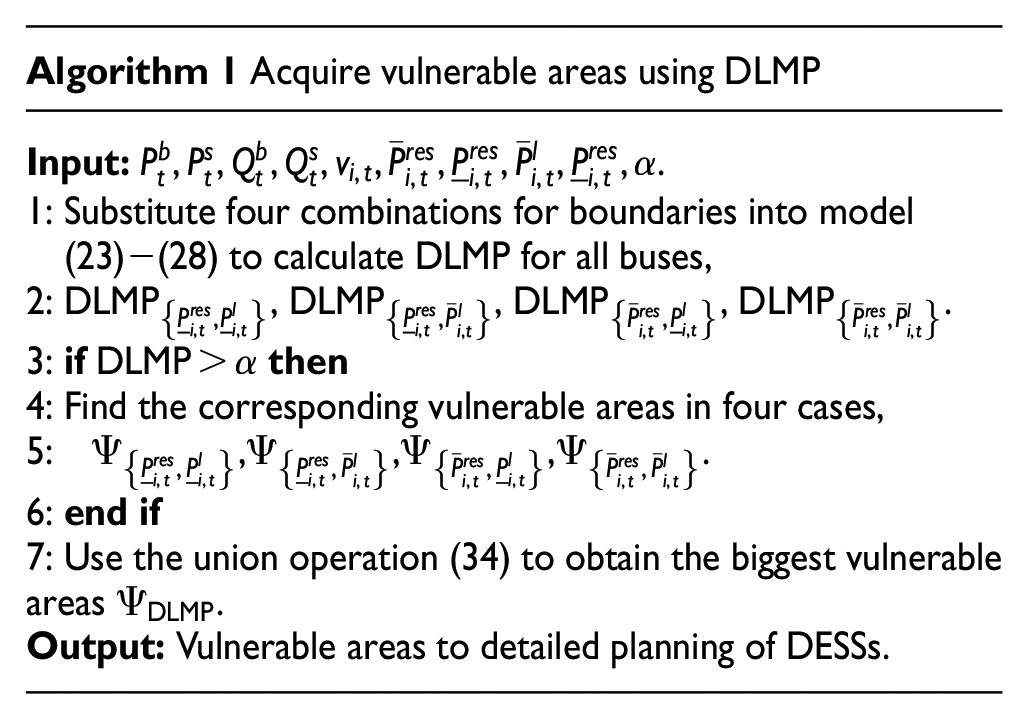
The linearized optimal power flow model is calculated with Matpower 7.0. 36 Pseudo codes of acquired procedures for vulnerable areas using DLMP are outlined as Algorithm 1. In general, Algorithm 1 can be divided into three parts: Line 1 to line 2 is calculated DLMP in distribution networks using the linearized optimal power flow. Line 3 to line 6 found the corresponding vulnerable areas in four cases. Line 7 uses the union operation to obtain the biggest vulnerable areas.
Detailed planning mathematical formulations
Objective function of DESSs planning
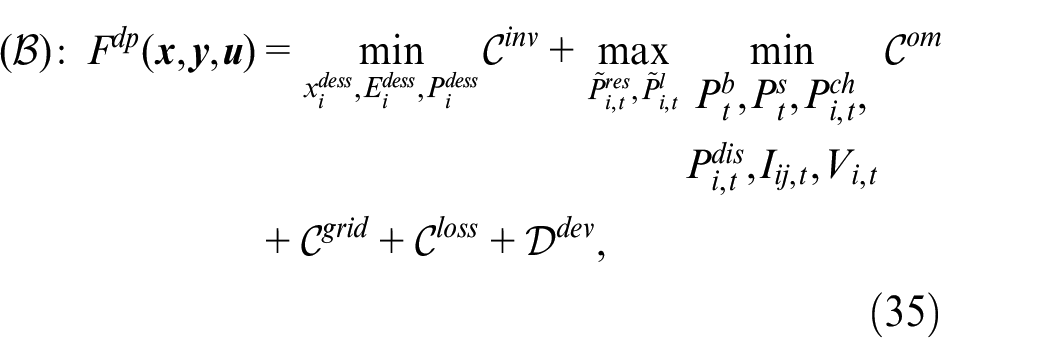
After preliminary planning to select vulnerable areas, the detailed planning locations and capacities of DESSs at candidate buses in vulnerable areas are key points. Given uncertainties of renewable energy sources and loads, this paper designs a two-stage stochastic robust optimization based DESSs planning approach to pursue the optimal DESSs planning scheme, in which voltage deviations for buses and line losses are fully considered. All buses in the vulnerable area have the potential to be candidate buses, thus, we consider that
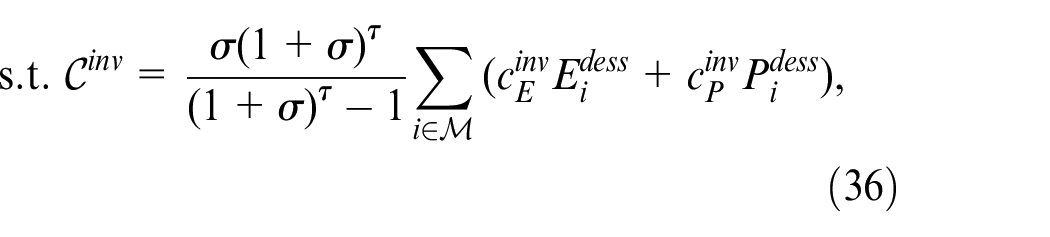











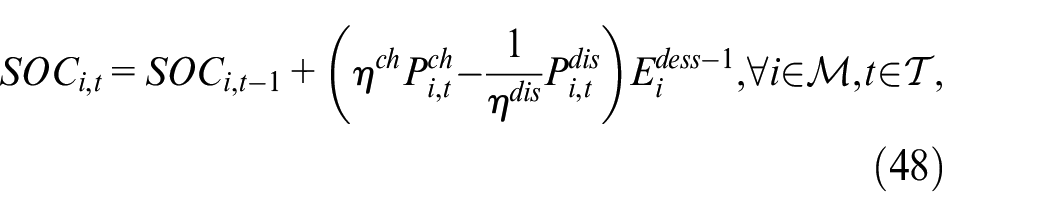

where
Solution methodology
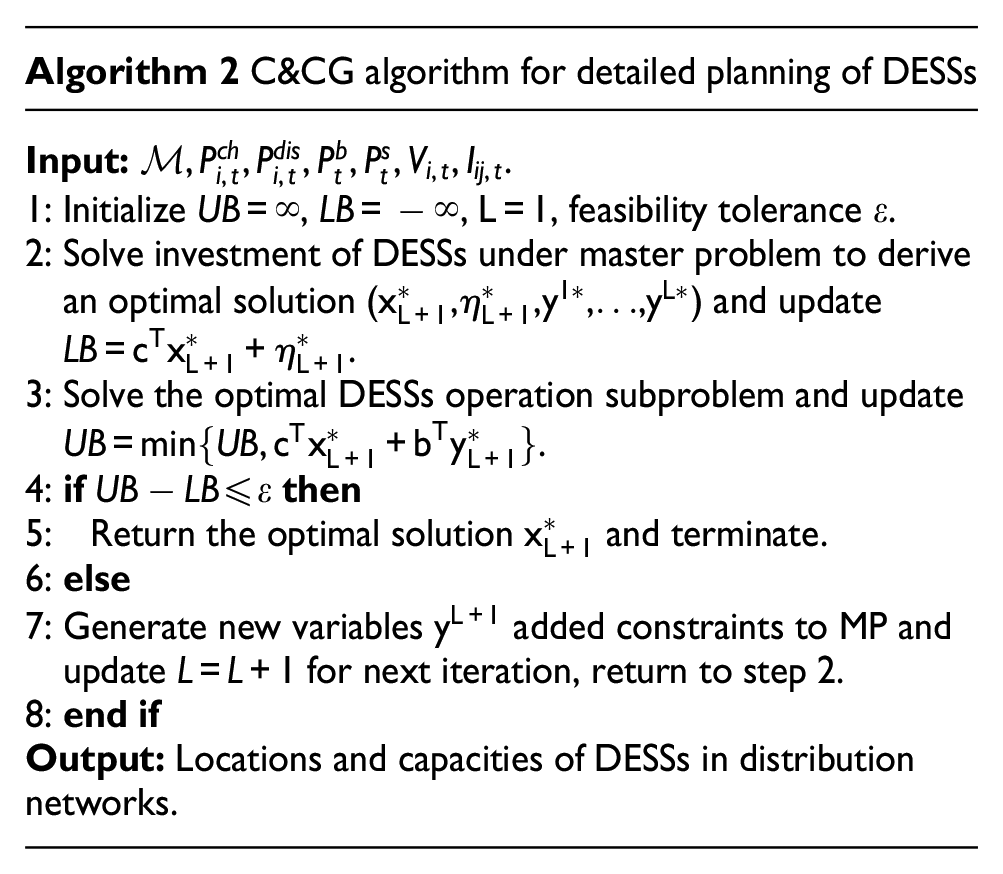
Currently, with cutting plane solution methods, like Benders decomposition method or column-and-constraint generation (C&CG) algorithm, 38 two stage robust optimization problems could be solved. Thus, C&CG algorithm is used to settle the planning model in the paper. First, the initial two stage DESSs planning model is transformed into a master problem (MP) determining DESSs with or not by discrete variable and a subproblem (SP) optimizing continuous system operation. MP and SP are then solved iteratively with discerning remarkable scenarios of uncertain factors in SP, and adding homologous constraints into MP. Eventually, MP and SP converge to an optimal solution by few iteratively solving. For a succinct exposition in this section, a compact matrix formulation for detailed planning of DESSs at candidate buses is given:


where




and
(1) Master problem: MP of detailed planning at candidate buses is mostly developed to seek out the optimal investment decision under the uncertain scenarios at each iteration. It also provides a lower bound for the premier model (50). MP is expressed as:







where L represents the iteration number and
(2) Subproblem under uncertainty: The goal of SP is to generate the worst-case scenarios of uncertainties for the aforementioned MP and likewise provide an upper bound on (50). SP is expressed as:





where the investment decisions of DESSs at candidate buses are fixed as

s.t. (64)−(67)







where

where M denotes an adequately large constant and
Based on the aforementioned MP and SP, pseudo codes of procedures to solve the detailed planning problem using C&CG are outlined as Algorithm 2, in which line 2 means to solve MP, line 3 represents solving SP under uncertainty, and lines 4–8 determine whether the conditions are met. The solving flow chart of C&CG algorithm is shown in Figure 2.
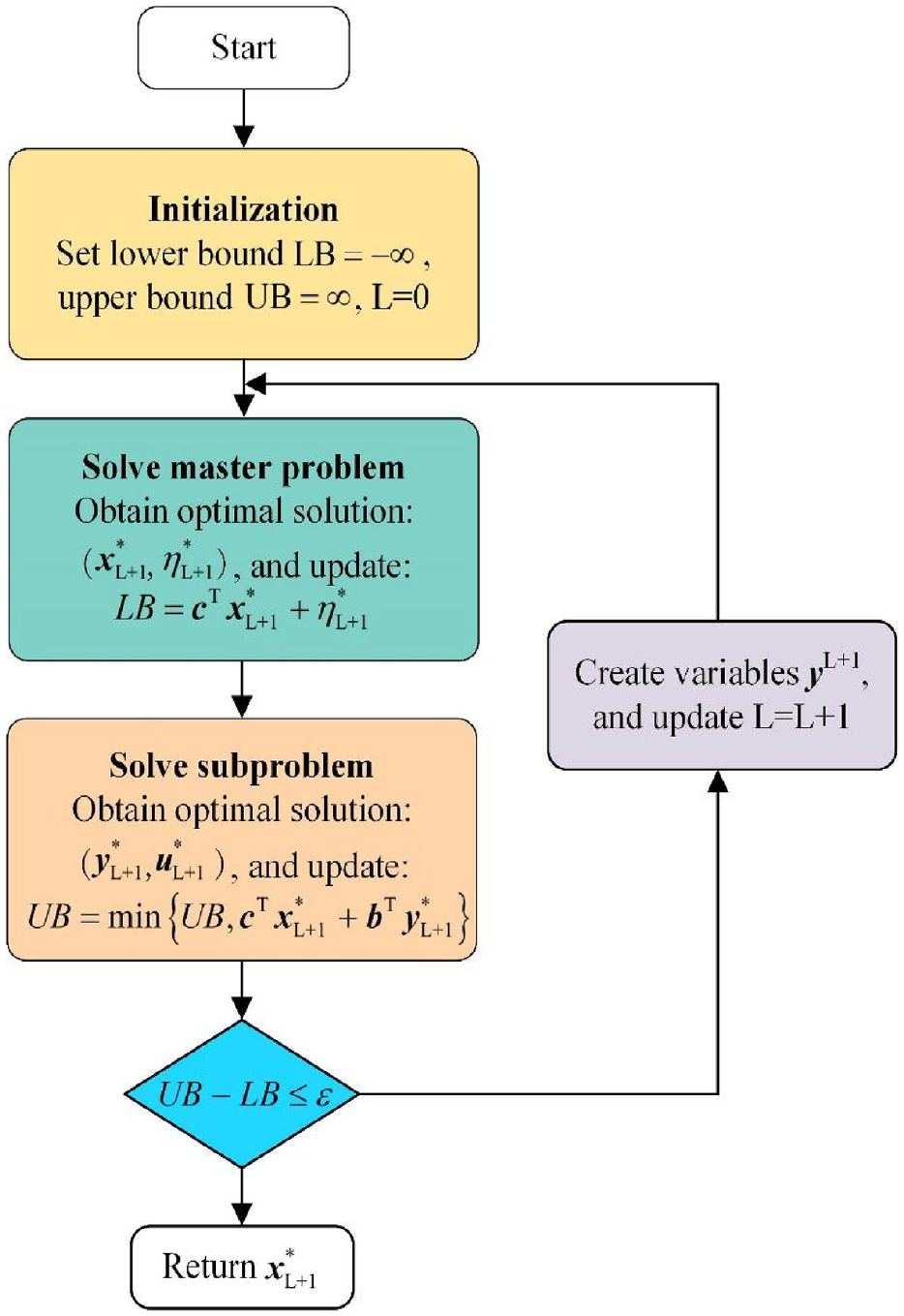
The flow chart of C&CG algorithm.
Case study
In this section, different case studies are given to assess the performance of the proposed area-to-bus planning for DESSs in regional distribution networks. All simulations are performed on a laptop with an Intel Core i7 of 2.2 GHz and 16 GB of memory. Relevant problems are solved utilizing MATLAB (version 2019a) with YALMIP toolbox and GUROBI (version 9.5.0) solver.
In this paper, a modified IEEE 33-bus distribution network with four renewable energy sources at bus 4, 15, 21, 30
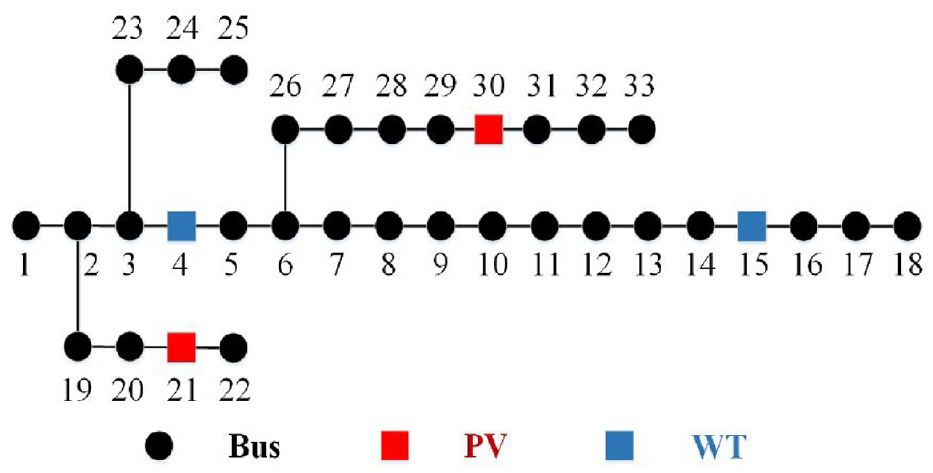
A modified IEEE 33-bus distribution network.
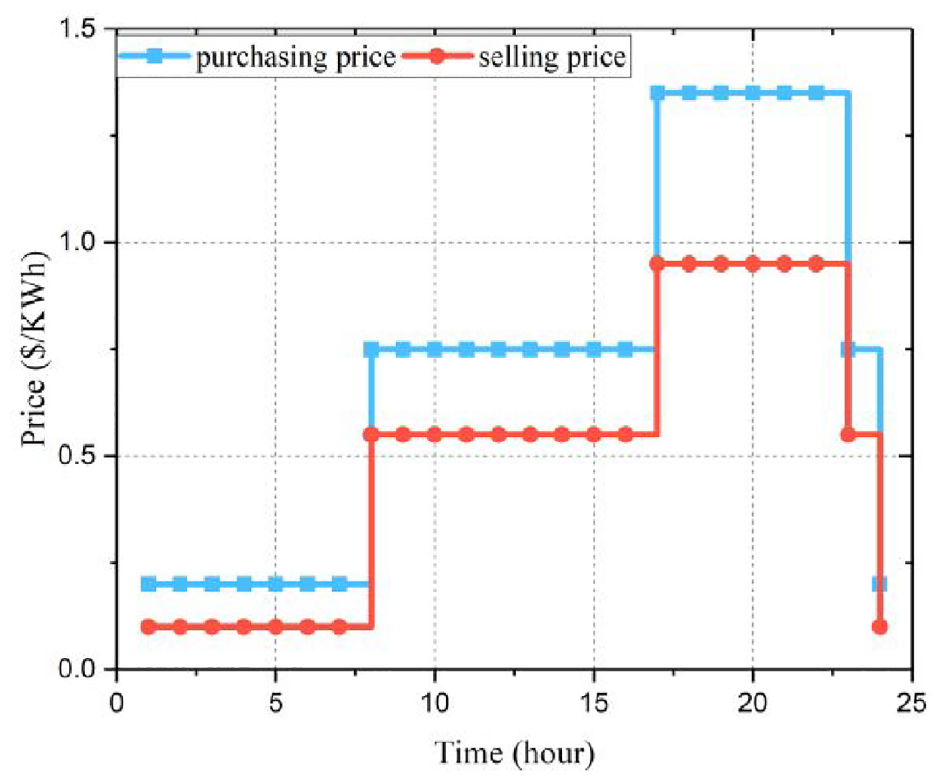
Purchasing and selling electricity prices.
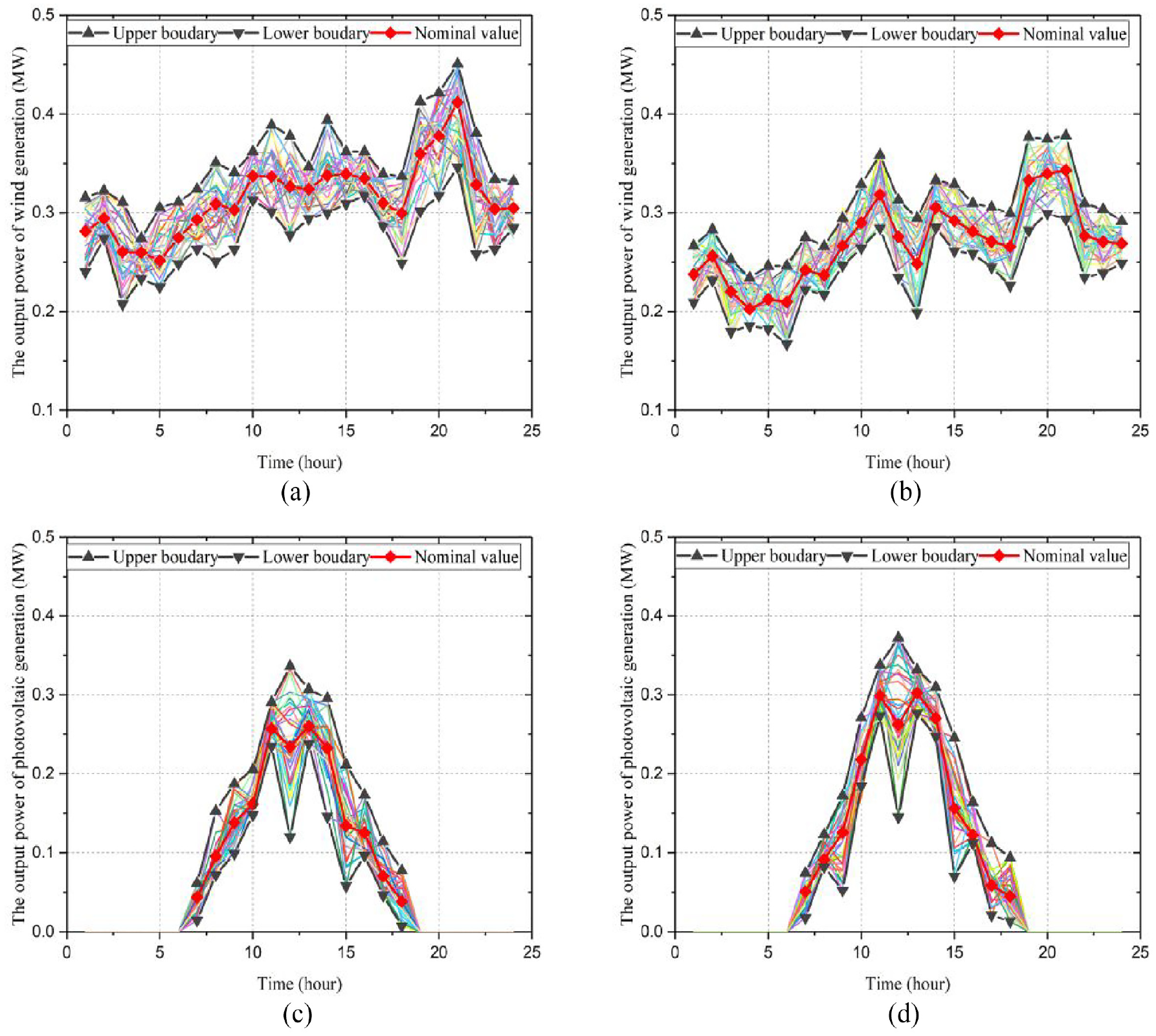
Robust intervals of renewable energy sources based on stochastic scenarios: (a) the output power of wind generation in bus 4, (b) the output power of wind generation in bus 15, (c) the output power of photovoltaic generation in bus 21, and (d) the output power of photovoltaic generation in bus 21.
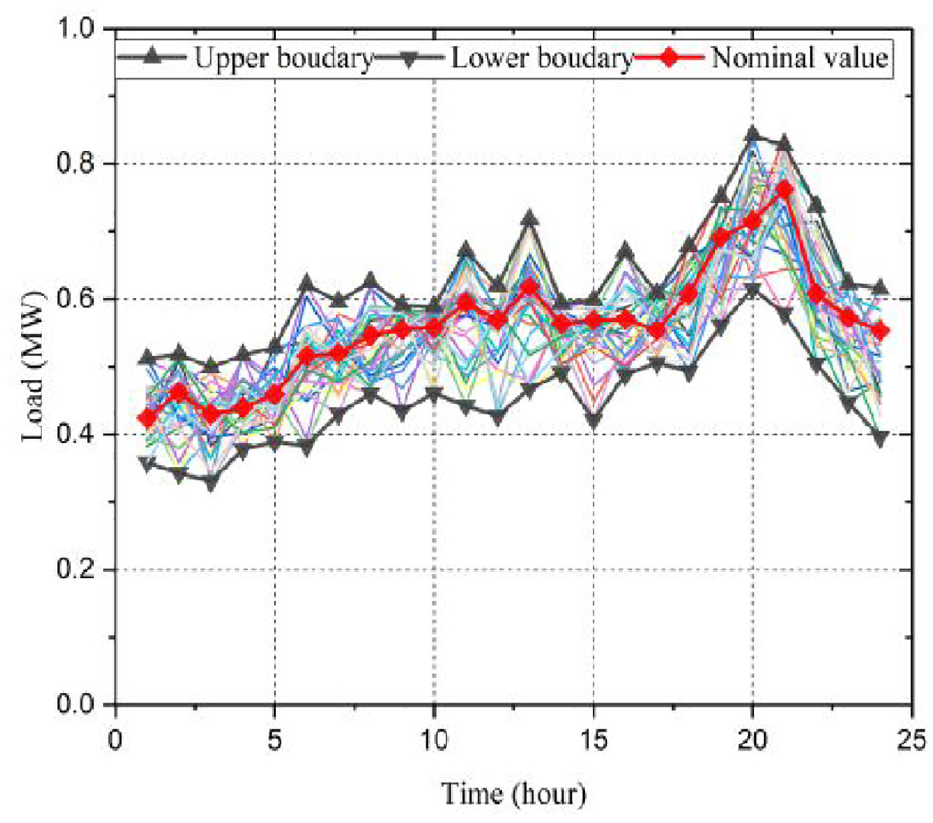
Robust intervals of load in bus 13 based on stochastic scenarios.
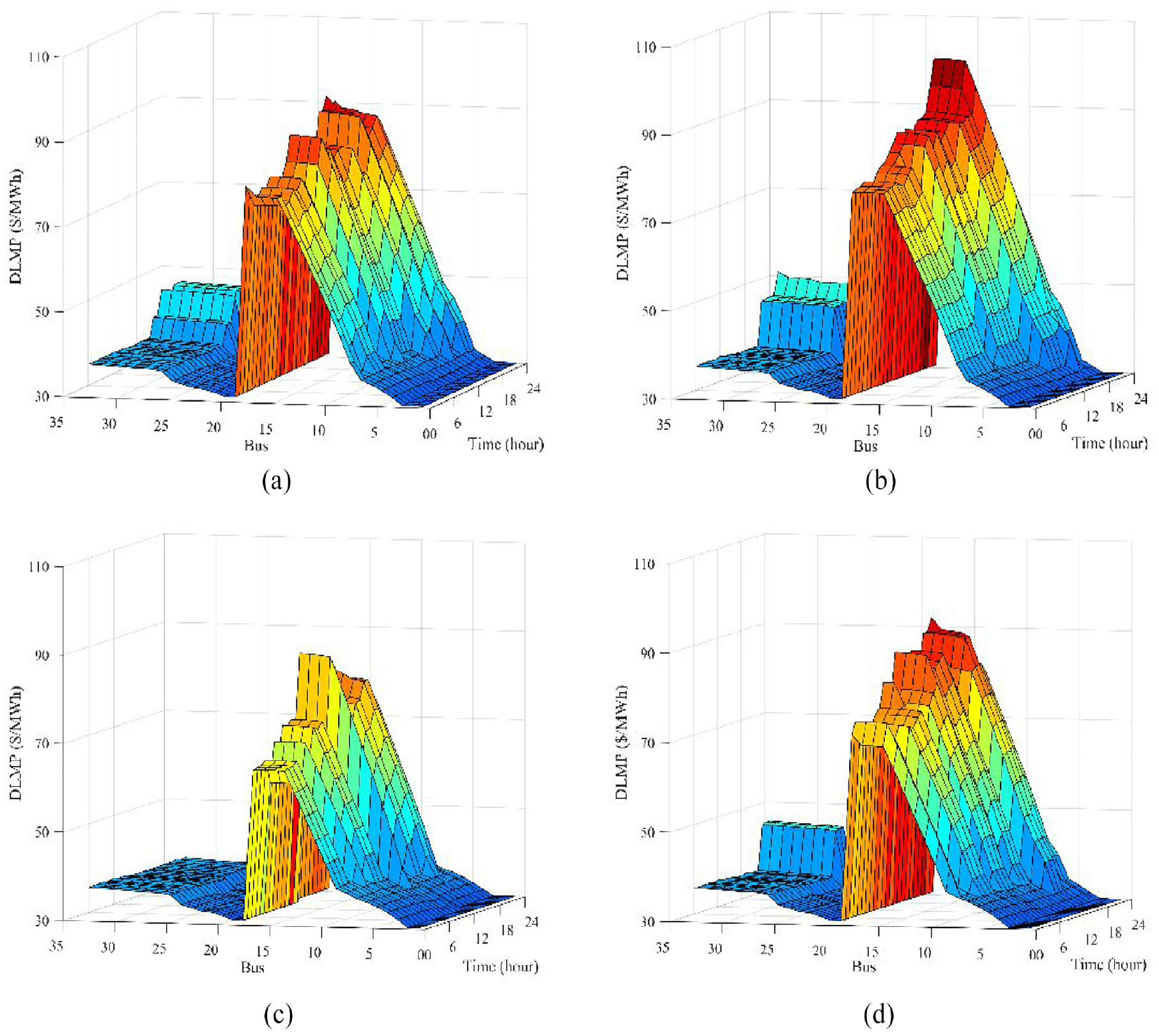
Different DLMP results of the modified IEEE 33-bus: (a)
Comparison of DESSs planning with and without DLMP
This paper compares the results of DESSs planning methods with and without DLMP. Different from the DESSs planning method with DLMP for selecting vulnerable areas, the DESSs planning method without DLMP is an untargeted method. According to equation (34), if
Candidate bus in vulnerable areas with different DLMP.
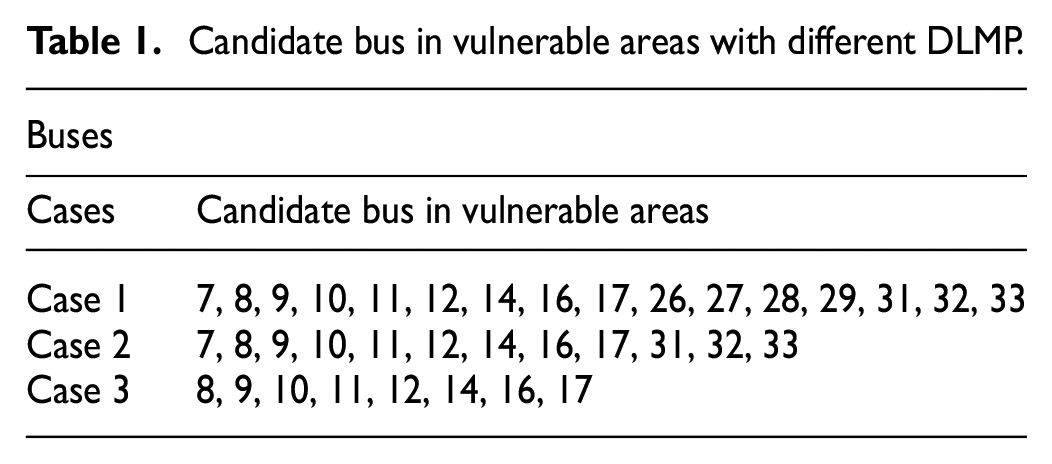
In the detailed planning, let
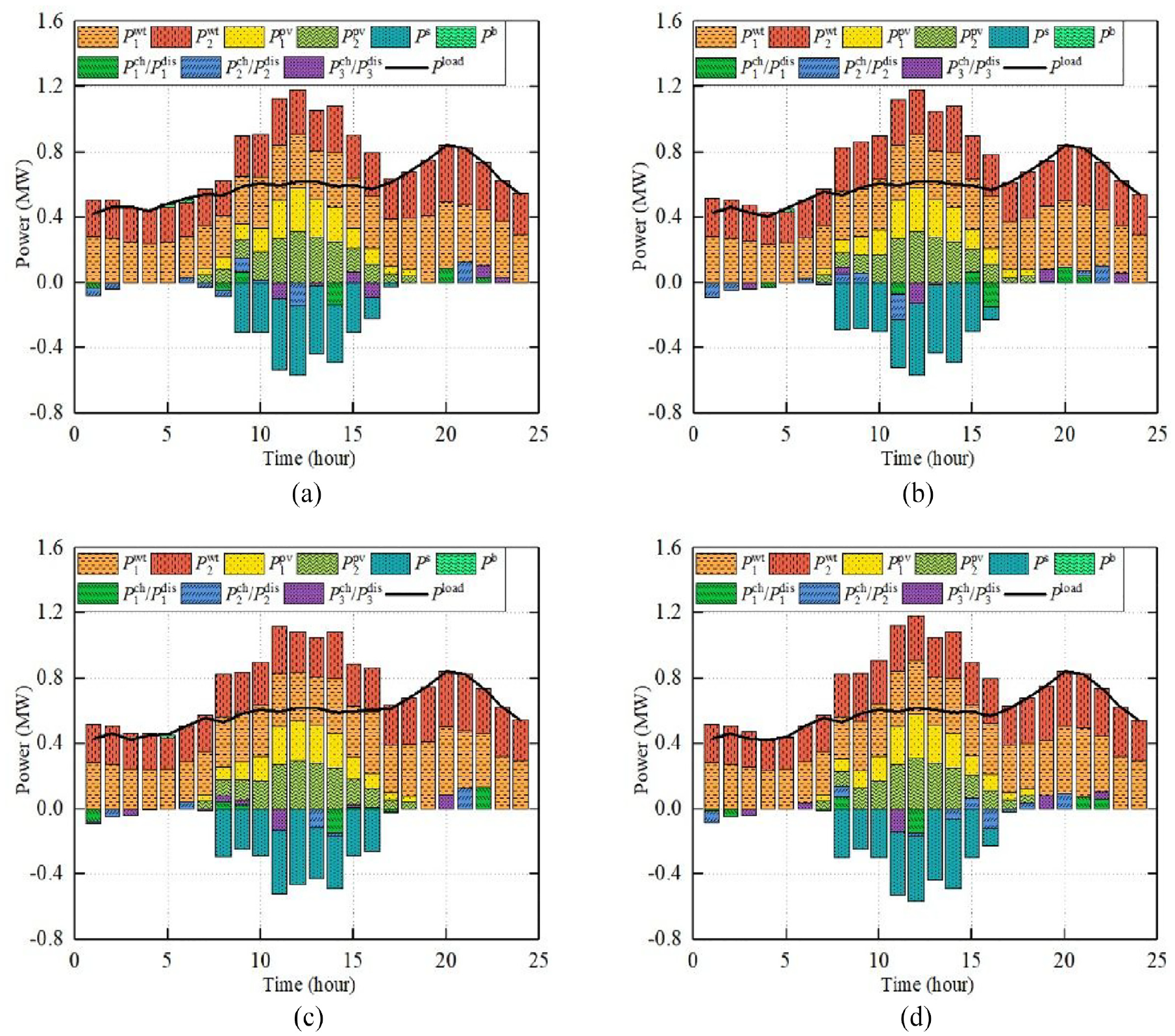
Comparison of power profiles under different planning methods: (a)
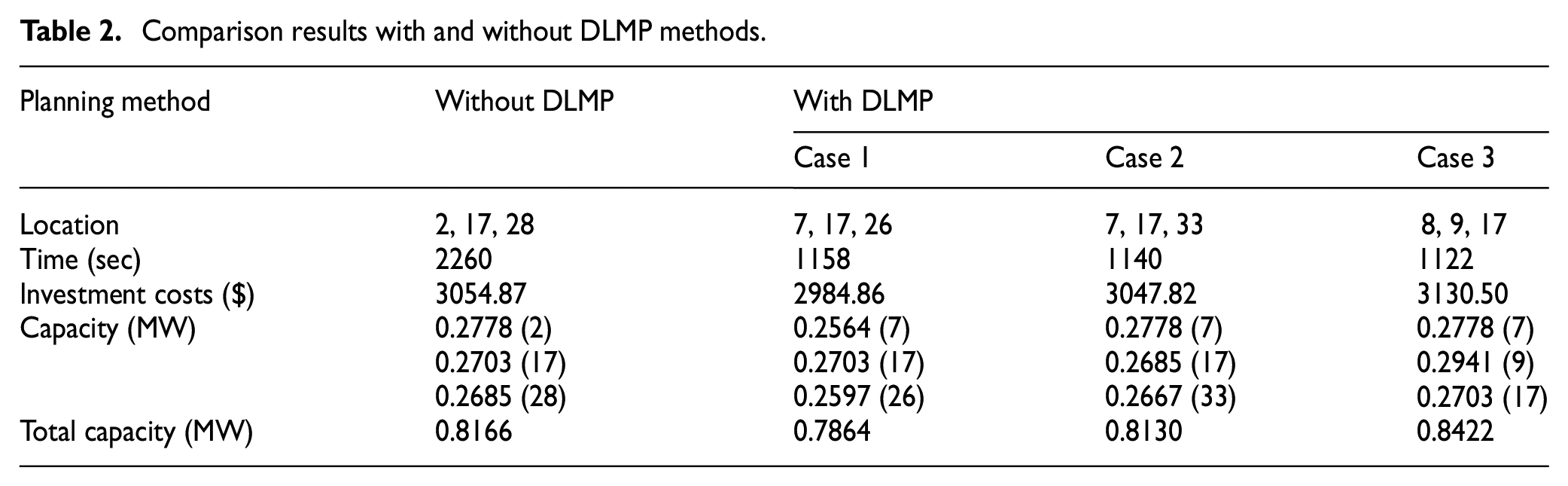
Comparison results with and without DLMP methods.
To demonstrate the effects of DESSs deployed in the distribution network, DLMPs of case 1 with DESSs and without DESSs are depicted in Figure 9. Compared to the DLMP in Figure 9(a), the DLMP in Figure 9(b) is significantly reduced. Especially at 21:00, the DLMP is reduced by $66.73/MWh. This is because the voltage offset at buses could be adjusted flexibly and the line loss can be reduced by charging and discharging of DESSs. Select the time point at 20:00 as the research point, voltage deviations for buses in case 1 with DESSs and without DESSs are shown in Figure 10. Voltage deviations for buses in the case with DESSs are lower than those in the case without DESSs. In bus 29, the voltage deviation is greatly reduced by 26.94%, which satisfies the power supply quality requirements of the distribution network. The price signal of DLMP is used to DESSs planning to alleviate the possible voltage deviation in the future distribution network with high renewable energy sources.
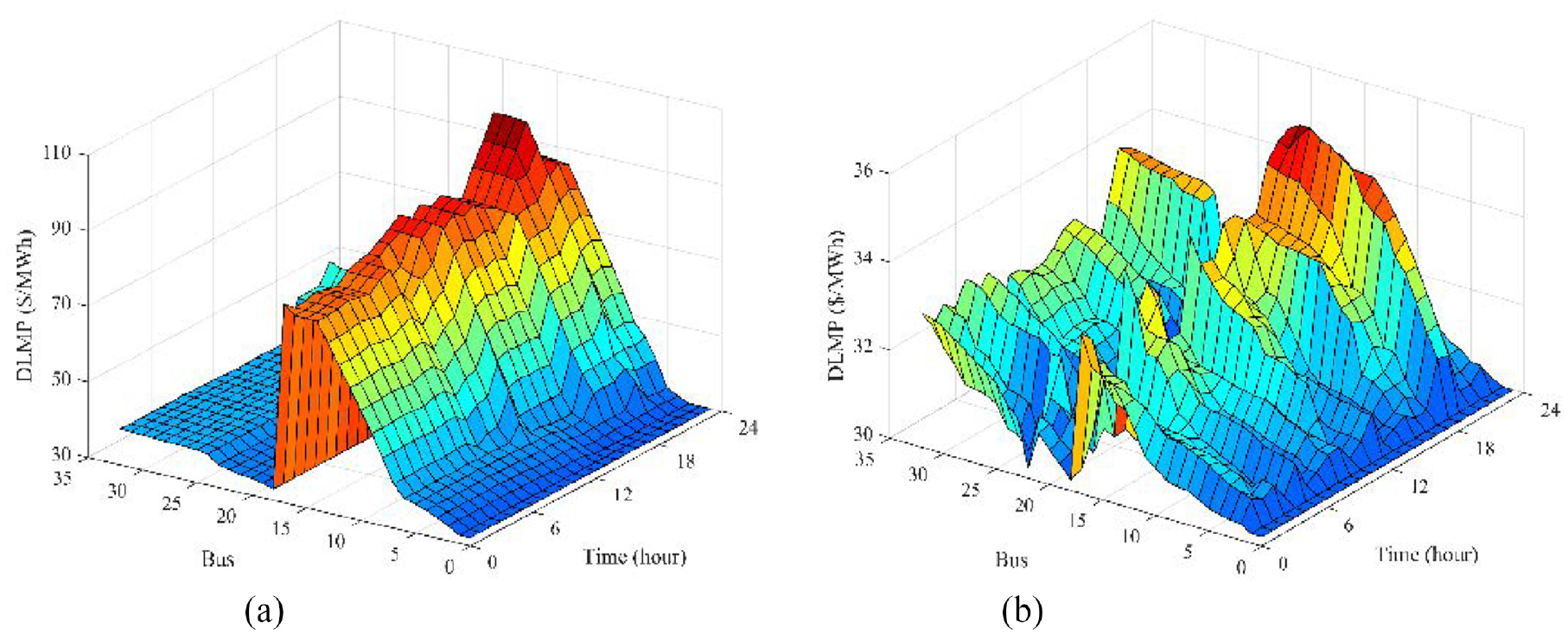
The DLMP with DESSs and without DESSs: (a) the DLMP without DESSs and (b) the DLMP with DESSs.
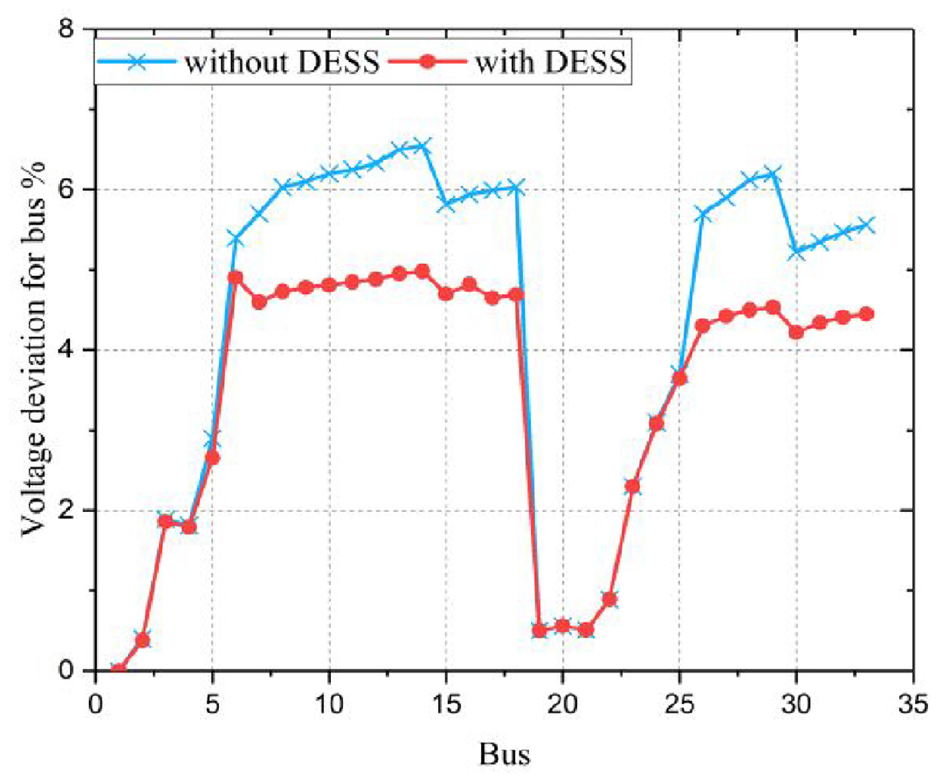
Voltage deviation for buses with and without DESSs.
Comparison of DESSs planning under different budgets of uncertainty
As mentioned in preliminaries, the conservativeness of robust optimization problems can be dominated by adjusting
Figure 11 shows that comparison of power profiles under different budgets of uncertainty. With the increase of uncertainty, DESSs are usually charged when the output of renewable energy sources is high and discharged when the power is short with the output of renewable energy sources insufficiently. The distribution network is motivated by electricity prices selling power to upper-level grids to reduce operation costs. As
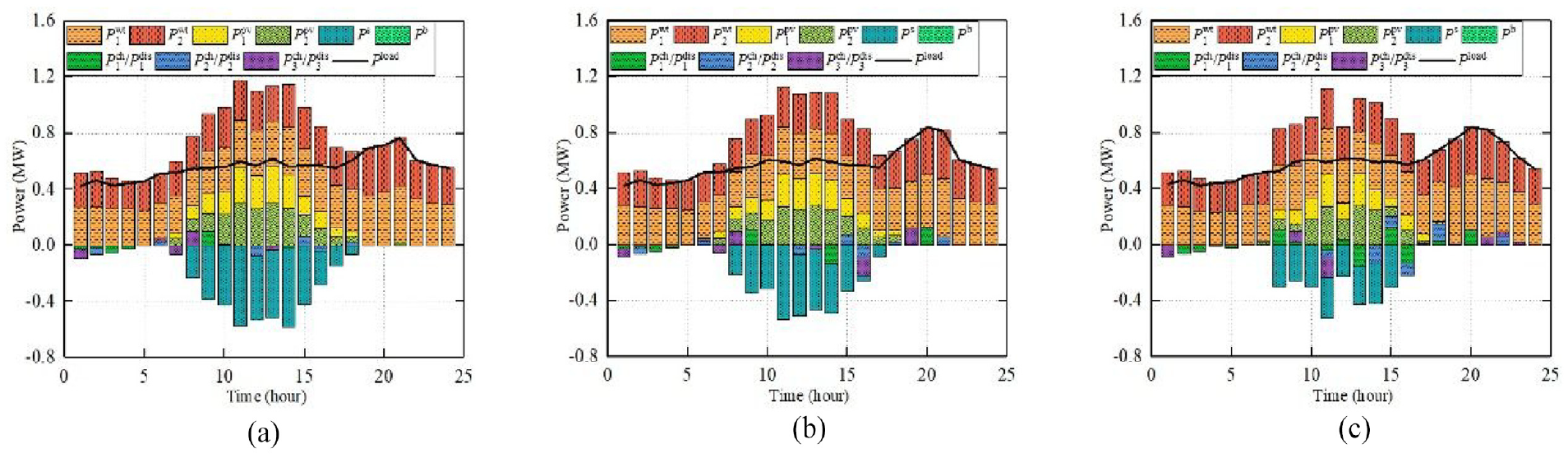
Renewable energy source and load profiles under different budgets of uncertainty: (a)
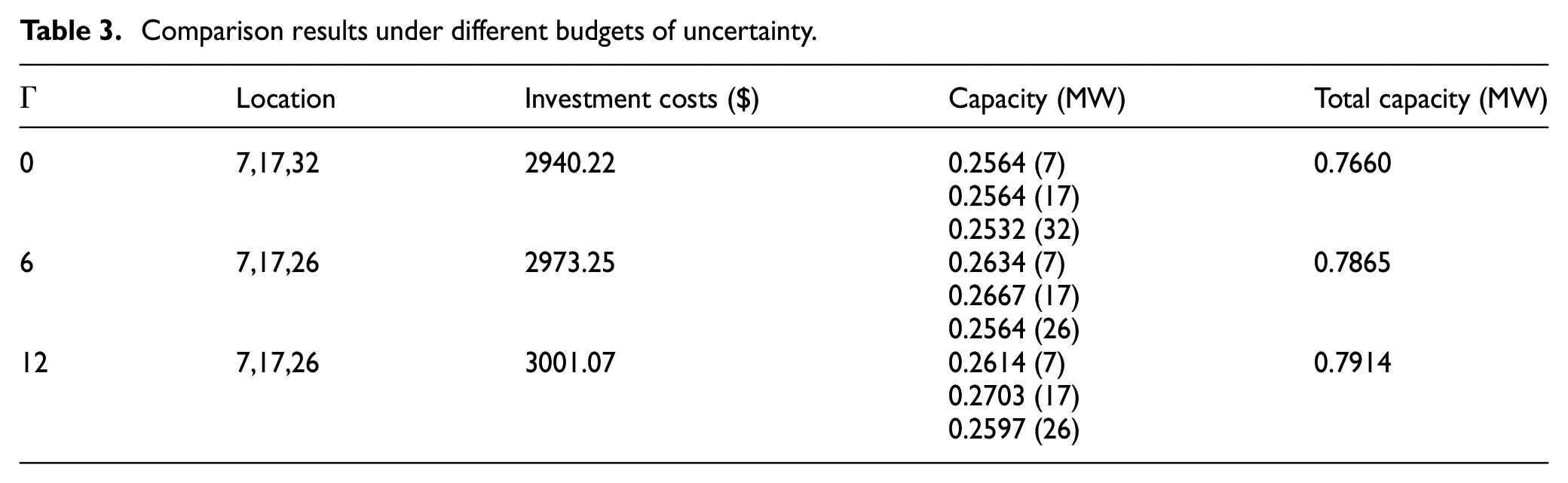
Table 3 lists comparison results under different budgets of uncertainties. Although the locations of DESS planning varies with
Comparison results under different budgets of uncertainty.
Comparison of stochastic robust optimization and classical ARO
The different comparisons among stochastic robust optimization and classical ARO are shown in this section. Note that parameters selected by all optimization approaches are identical but the uncertainty sets are slightly different due to different upper and lower boundaries of the corresponding robust interval. In classical ARO, the uncertainty sets usually run within a reasonable range, which is given by historical experiences, as shown in Figures 12 and 13. Fifty representative stochastic scenarios for photovoltaic generations, wind generations and loads are generated to portray robust intervals of uncertainties, see Figures 14 and 15. The deviation of the nominal value from the upper and lower boundaries is usually equal in the classical ARO. However, stochastic robust optimization uses stochastic scenarios to describe the interval boundaries, and the deviation between the nominal value and the upper/lower boundaries may be unequal. Compared with classical ARO, stochastic robust optimization can better reduce conservatism.
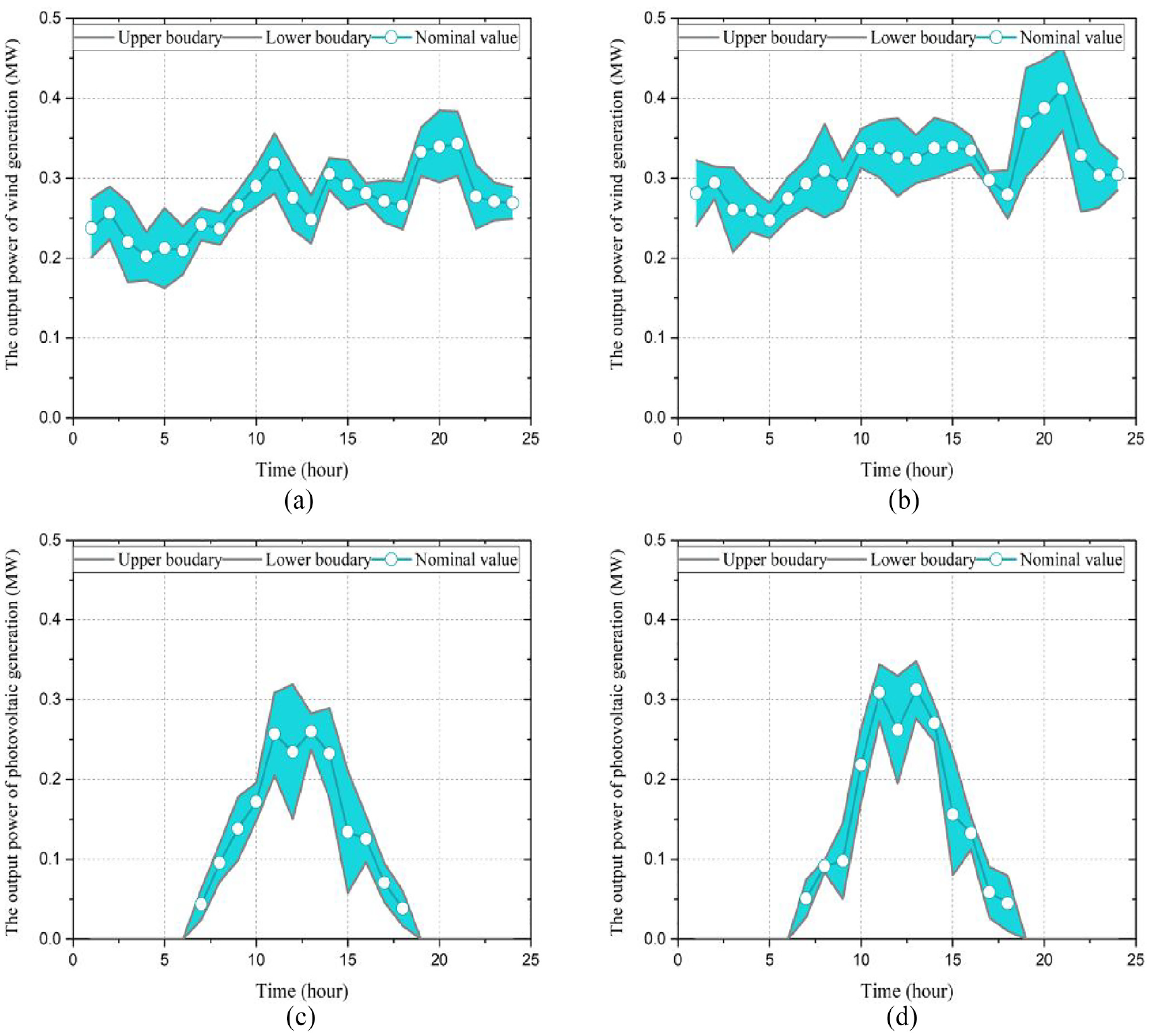
Interval forecasts of renewable energy sources: (a) the output power of wind generation in bus 4, (b) the output power of wind generation in bus 15, (c) the output power of photovoltaic generation in bus 21, and (d) the output power of photovoltaic generation in bus 30.
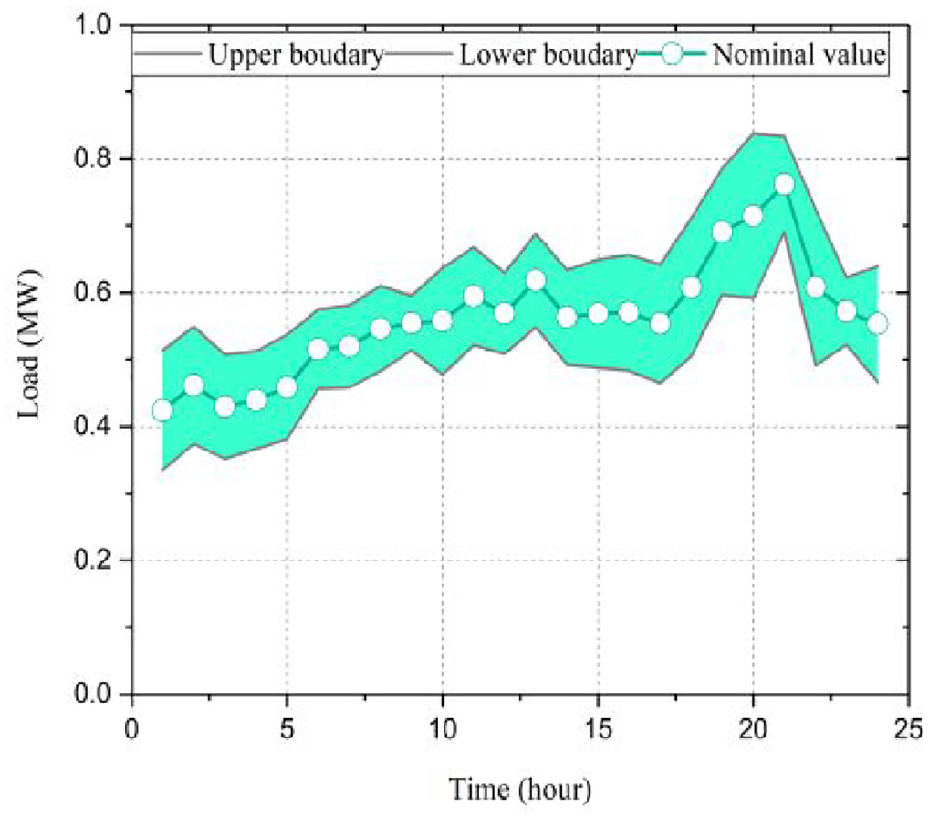
Interval forecasts of load in bus 13.
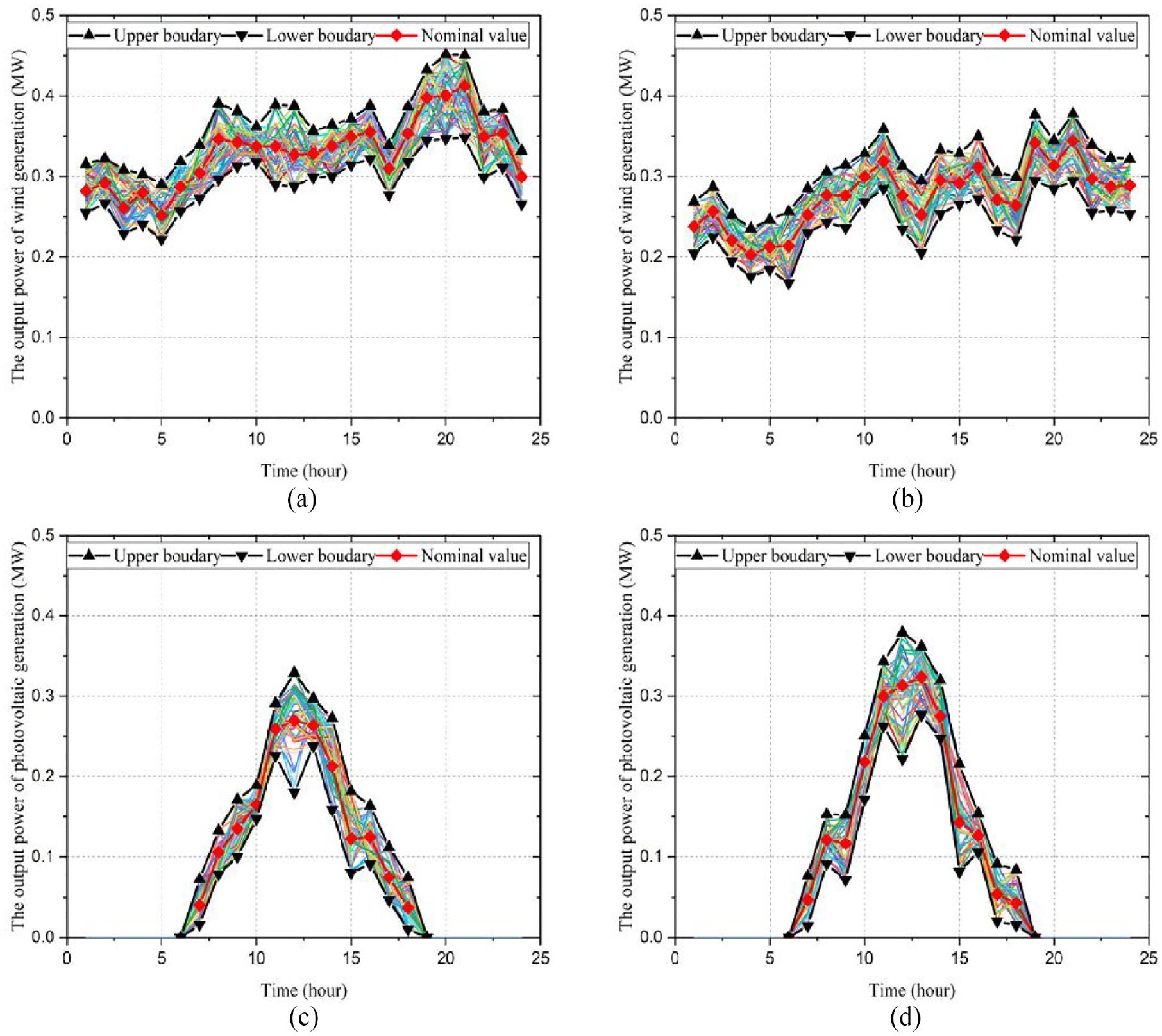
Robust intervals of renewable energy sources based on 50 scenarios: (a) the output power of wind generation in bus 4, (b) the output power of wind generation in bus 15, (c) The output power of photovoltaic generation in bus 21, and (d) THE output power of photovoltaic generation in bus 30.
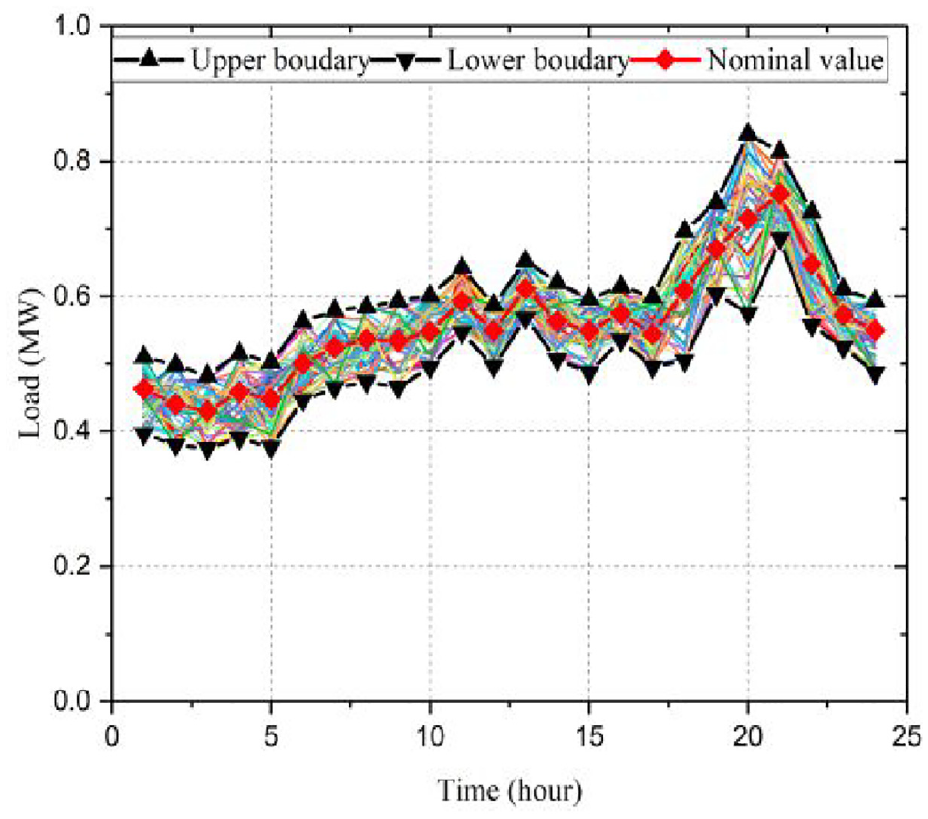
Robust intervals of load in bus 13 based on 50 scenarios.
In this part, let
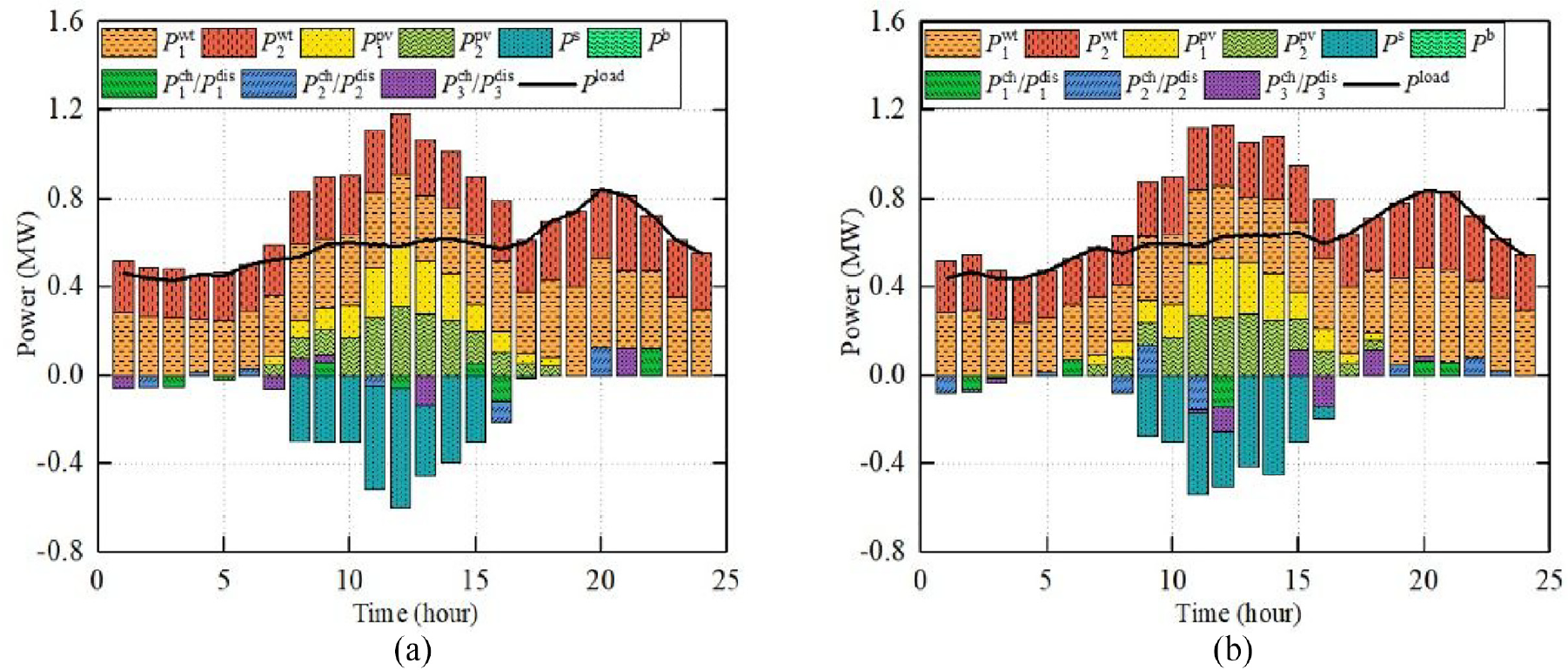
Comparison of power profiles under stochastic robust optimization and classical ARO: (a) stochastic robust optimization with 50 scenarios and (b) classical ARO.
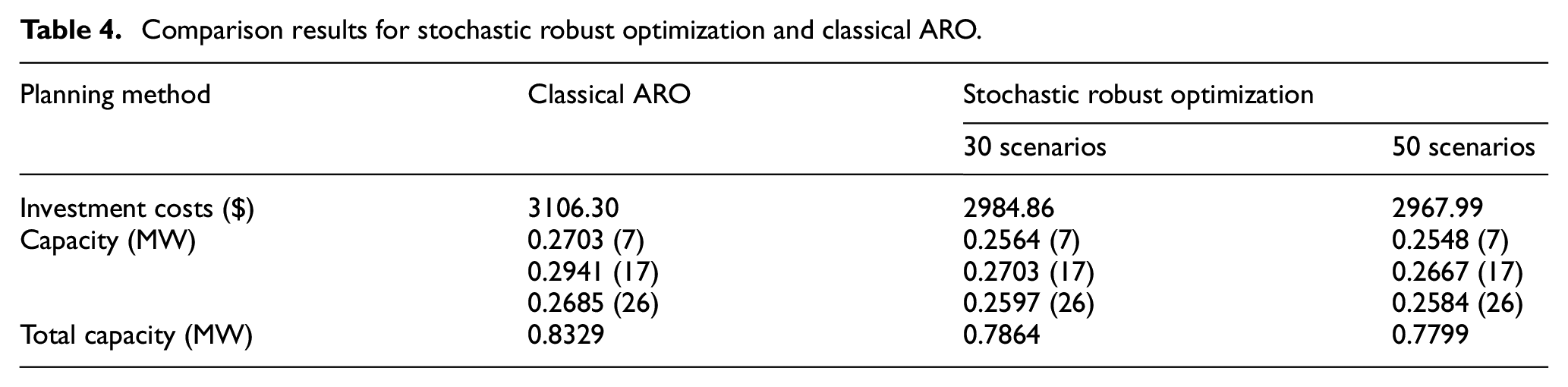
Comparison results for stochastic robust optimization and classical ARO.
Conclusions
An area-to-bus planning path is designed to obtain acceptable vulnerable areas of distribution networks in preliminary area planning as well as determine locations and capacities of DESSs at candidate buses in vulnerable areas with detailed planning.
Different from the DESSs planning method with DLMP for selecting vulnerable areas, the DESSs planning method without DLMP is an untargeted method. Simultaneously, DLMP with time and regional characteristics could be more intuitive to reflect line losses and voltage limits of distribution networks through price signals. Under same conditions of uncertainty, the total capacity of DESSs in the method with DLMP is less than that in the method without DLMP. The total capacity savings are 3.84%, 0.44%, respectively. Thus, DLMP could help the DESSs planning reduce overall planning costs and improve planning effectiveness. If the method only considers a part of the vulnerable area of robust interval, it may not satisfy planning requirements for the distribution network. Hence, the biggest vulnerable area needs to be derived considering different boundaries of uncertainty. The stochastic robust optimization can describe the dynamic deviation from nominal values of uncertainties. With the same budgets of uncertainty, investment costs of DESSs for the stochastic robust model with 30 and 50 scenarios are 3.91% and 4.45% lower than the classical ARO, respectively. Thus, the stochastic robust approach avoids too-pessimistic decisions than classical ARO approach.
The proposed DESSs planning framework conforms to the network constraints of power systems. Thus, the theoretical framework and implementation methods for DESSs planning are developed to provide strong support for DSOs in practical applications. In order to make the model tractable, this paper adopts stochastic robust optimization. However, the accuracy of uncertainty description is still lacking. Therefore, future work will be studied DRO to enhance its precision.
Footnotes
Appendix
Declaration of conflicting interests
The author(s) declared no potential conflicts of interest with respect to the research, authorship, and/or publication of this article.
Funding
The author(s) received no financial support for the research, authorship, and/or publication of this article.
