




Abstract
An aggregative game of disturbed Euler-Lagrange systems is studied in this paper. The cost function of each player depends on its own decision and the aggregate of all decisions. Different from the well-known aggregative games, the second-order nonlinear dynamic of every player is considered in our problem, and every player is influenced by exogenous disturbances. To seek the Nash equilibrium, a distributed algorithm is developed via state feedback, gradient descent, and internal model. The convergence of the algorithm is analyzed with the help of variational analysis and Lyapunov stability theory. It shows that the Euler-Lagrange players with the proposed algorithm, can asymptotically converge to the Nash equilibrium, even though exogenous disturbances have impact on the behaviors of the players. Finally, a numerical simulation is given to illustrate the effectiveness of our algorithm.
Introduction
Game problems have been widely investigated in economics, 1 environmental studies, 2 communication networks, 3 smart grids, 4 and military defense. 5 In recent years, Nash equilibrium (NE) seeking problems have attracted considerable attention, and some distributed algorithms for game problem have been developed (see Maojiao and Guoqiang, 6 Yi and Pavel, 7 Deng, 8 and Ma et al.9,10).
In aggregative games, each player has its cost function which depends on its decision and the aggregate of all players’ decisions. Our objective is to seek the NE of the aggregative game. To this end, many distributed algorithms have been investigated. For example, the authors proposed distributed algorithms for price-based demand response games based on consensus techniques in Maojiao and Guoqiang 6 and Deng, 8 studied the generalized Nash equilibrium seeking algorithm for nonsmooth aggregative games. In Koshal et al., 11 distributed algorithms for aggregative games were exploited where the players’ objectives are coupled through a more general form of the aggregate function. Various constraints from environment are omnipresent in many applications (see Paccagnan et al. 12 and Grammatico 13 ). For this reason, aggregative games with different constraints attracted much attention. Paccagnan et al. 14 presented a distributed algorithm for game problems with linear inequality coupling constraints. Liang et al. 15 exploited distributed algorithms for aggregative games with coupled constraints and nonlinear aggregates. Besides, Wang et al. 16 studied the energy-optimized games for wireless sensor networks. In practice, the players in the game may have their own physical dynamics such as electricity market 17 and energy resources. 18 However, the aforementioned works do not involve physical systems.
With the development of cyber-physical system, distributed strategies which consider the dynamics of physical systems have been extensively studied. Deng 19 investigated distributed algorithms for second-order multi-agent systems to solve resource allocation problems, and Wang et al. 20 studied nonsmooth convex optimization problems of second-order multiagent systems. Deng and Hong 21 and Zhang et al. 22 studied distributed optimization problems of EL systems. However, few results about aggregative games for disturbed EL systems have been investigated. How to design distributed algorithms for seeking NE with EL systems is more attractive and realistic, because the EL systems can accommodate many multi-agent systems such as optimal network performance games in unmanned aerial vehicle (UAV) networks. 23 Most existing distributed algorithms for seeking Nash equilibrium, such as Maojiao and Guoqiang, 6 Deng, 8 and Liang et al. 15 cannot be used to solve the problem directly, due to the EL dynamics and exogenous disturbances.
In practice, different kind of disturbances, from environment, measurement, or communication (see Lin and Ren 24 and Wang et al. 25 ) may affect the performance of the physical systems. Distributed optimization for a class of nonlinear multi-agent systems with disturbance rejection was studied in Wang et al. 25 and Deng et al. 26 investigated event-triggered distributed optimization for disturbed multi-agent systems. Deng and Nian 27 studied aggregative games with disturbed systems over digraphs, and Zou et al. 28 investigated the higher-order dynamics with stochastic disturbances. On the other hand, Internal Model is an effective technique to solve different type of disturbances (refer to Wang et al., 25 Davison, 29 and Huang 30 for details).
In this paper, we investigate the aggregative game problem of nonlinear EL systems with exogenous disturbances. A distributed algorithm is designed for the EL systems to seek the Nash equilibrium. The contributions are listed as follows:
(i) This paper studies the aggregative games of disturbed EL systems and investigates how the EL players autonomously seek the NE, even though they are influenced by exogenous disturbances. Our problem is an extension of the NE seeking problem in Maojiao and Guoqiang, 6 Deng and Hong, 21 Zhang et al., 22 and Deng and Nian 31 by considering EL systems and/or exogenous disturbances. Owing to the dynamics of EL systems and exogenous disturbances, most existing distributed algorithms for seeking Nash equilibrium of aggregative games, such as Maojiao and Guoqiang, 6 Deng, 8 and Liang et al. 15 cannot be applied to our problem directly.
(ii) Based on state feedback and gradient descent, we design a distributed Nash equilibrium seeking algorithm, in which internal model principle is utilized to reject exogenous disturbances. The convergence of our algorithm is analyzed by virtue of Lyapunov stability theory and variational analysis. We prove that EL players with the proposed algorithm can asymptotically converge to the Nash equilibrium of the aggregative game, though the EL systems are influenced by exogenous disturbances. Moreover, by the proposed algorithm, all players do not exchange their decision variables and local cost functions, which protects the privacy of every player.
The remainder of this paper is as follows. The preliminaries and mathematical formulation are given. Then, we designed a distributed algorithm for the EL systems to seek the Nash equilibrium of the aggregative game and provided the convergence analysis. Finally, an examples of smart grids is provided to verify the effectiveness of the proposed algorithm, and the conclusion is given.
Notation:
Preliminaries and formulation
In this section, we introduce some concepts on graph theory and convex analysis. Then, the problem of this paper is formulated.
Preliminaries
We briefly introduce some concepts on graph theory (referring to Mesbahi and Egerstedt
32
). A weighted undirected graph
The following definitions are given in Rockafellar and Wets 33 which are well-known in convex analysis.


A function

A function

Problem formulation
In this paper, an aggregative game with

By the following definition, the Nash equilibrium of game (4) is illustrated (see Maojiao and Guoqiang, 6 Paccagnan et al., 14 and Liang et al. 15 ).
The above definition implies that player
Define the following mapping for subsequent analysis:



where
We make the following assumptions, which were widely used, such as Maojiao and Guoqiang, 6 Koshal et al., 11 Paccagnan et al., 14 and Liang et al. 15
The NE of the aggregative game (4) is unique under Assumptions 2 and 3 (referring to Theorem 2.2.3 of Facchinei and Pang
34
). In this paper, we only consider the case of finite decision variables. In other words,
Define:

The Nash equilibrium of the aggregative game (4) is clarified by the following lemma:

On the other hand, EL dynamics can accommodate to many multi-agent systems, like UAV networks and multi-robot systems (see Li et al. 23 and Mishra et al. 36 ). In our work, the player has the following EL dynamics:

where

where
The EL systems (7) have the following properties (referring to Spong 37 ):
1.
Our purpose is to design a distributed algorithm for the aggregative game (4) of EL system (7) with exogenous disturbance (8) such that the players can seek the Nash equilibrium of the game (4).
Main results
In this section, a distributed Nash equilibrium seeking algorithm is proposed. By the proposed algorithm, the EL system (7) converges to the Nash equilibrium of the aggregative game (4). Then, we analyze the convergence of our algorithm by Lyapunov stability theory and variational analysis.
Distributed algorithm design
We give the following lemma about the exogenous disturbances, which is introduced in Wang et al., 25 Deng et al., 26 Deng and Nian, 27 and Huang. 30

where
Based on internal model principle,

Based on (9), (10), state feedback and gradient descent, the distributed algorithm is designed for the aggregative game (4):


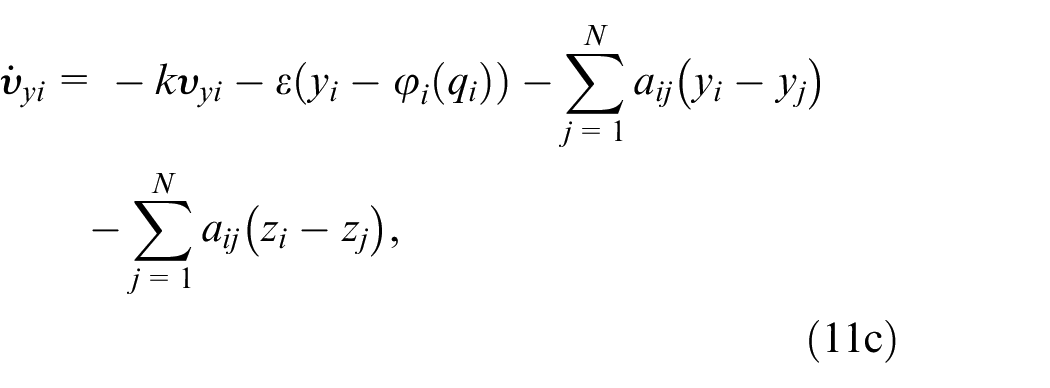

where
The algorithm (11) can be decomposed into two part: game part (11a) and gradient estimation part (11b) − (11d). In more details,
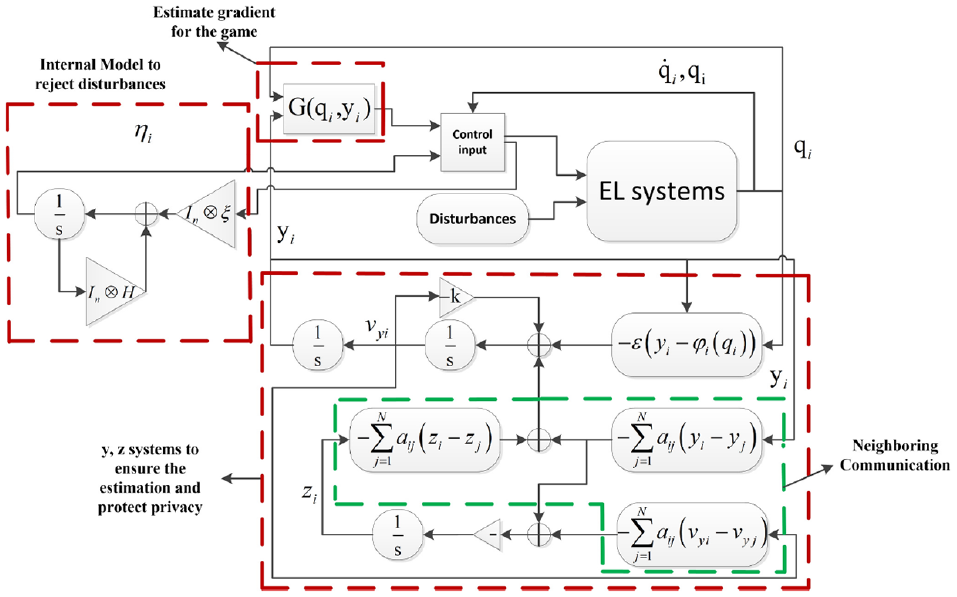
The illustration of the proposed algorithm (11).
Convergence analysis
The convergence is analyzed in this section.
Define

which can be regarded as the compensating error. It should be noticed that the exogenous disturbance is rejected as
Let



where
With the help of Lemma 1, we have the following conclusion about the equilibrium point of the system (13).
Proof. When the compensating error term (12) and the system (13) are at equilibrium, we have




From (14a) and (14b), we have
Theorem 1 reveals that if (13) is stable, the system (7) converges to the Nash equilibrium of the non-cooperative aggregative game (4) with the help of the algorithm (11). The following theorem shows the stability of (13).
Proof. First, we make the following coordinate transformation,
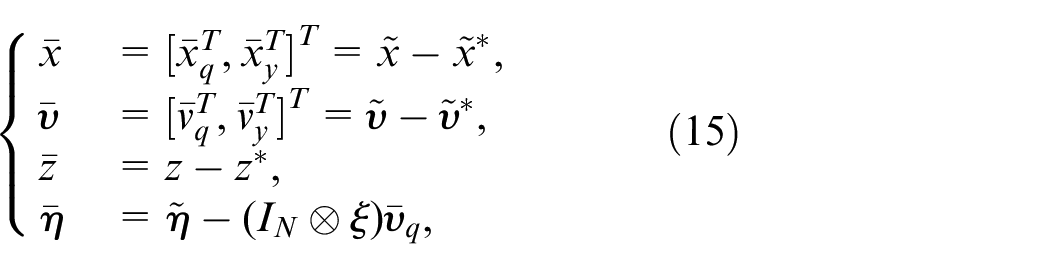
where
Based on (13), (14a), (14b), and (14c), we have
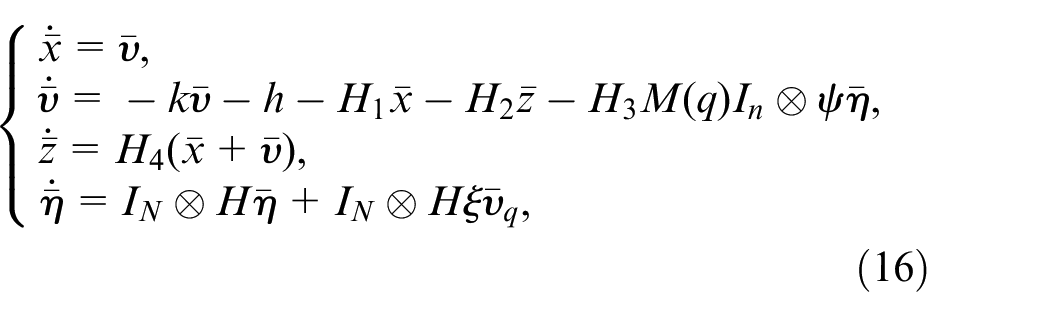
where
By (15),
Make the following orthogonal transformation,
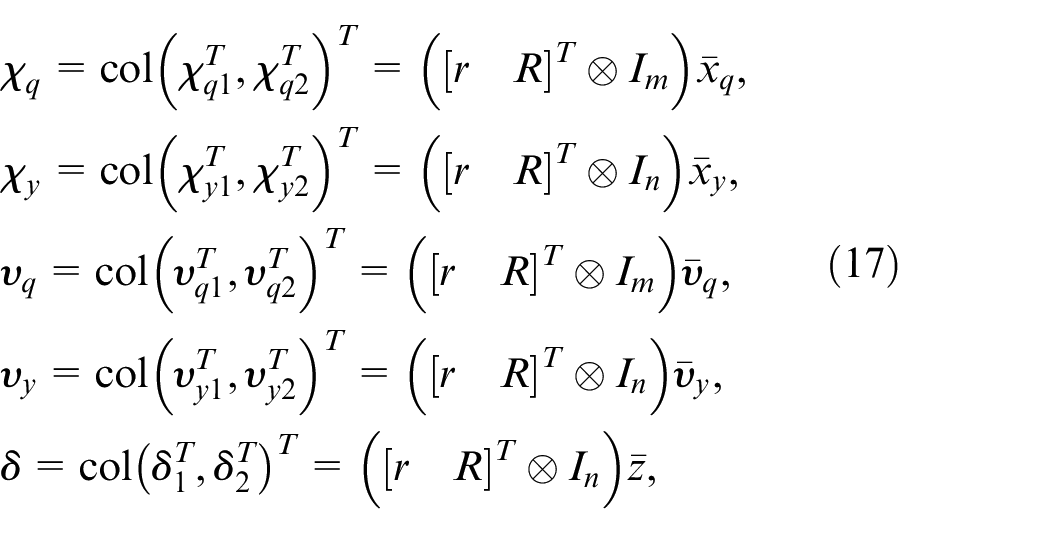
where
Let

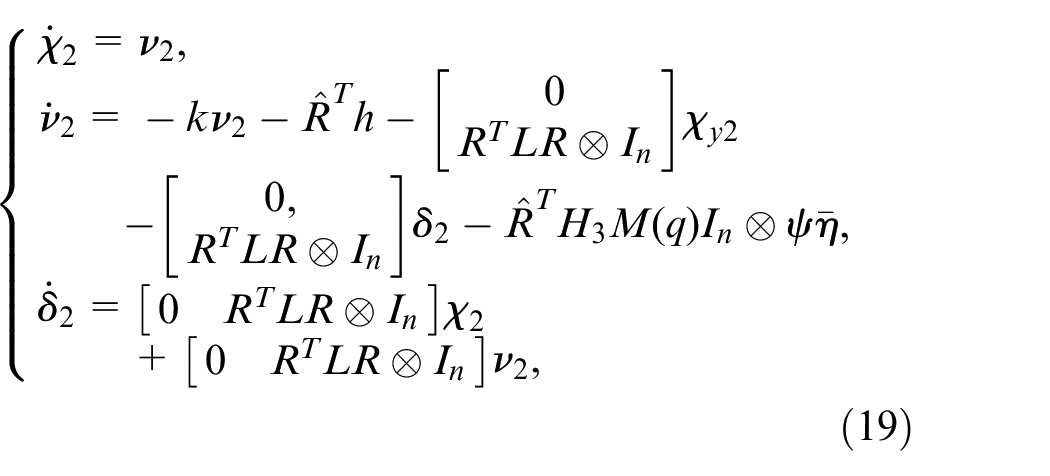
where
Take the candidate Lyapunov function as follows:
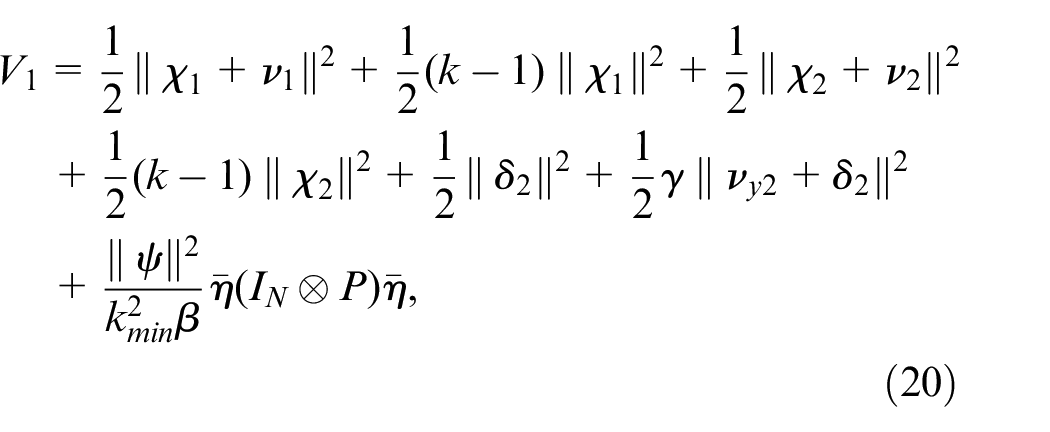
where
The derivative of
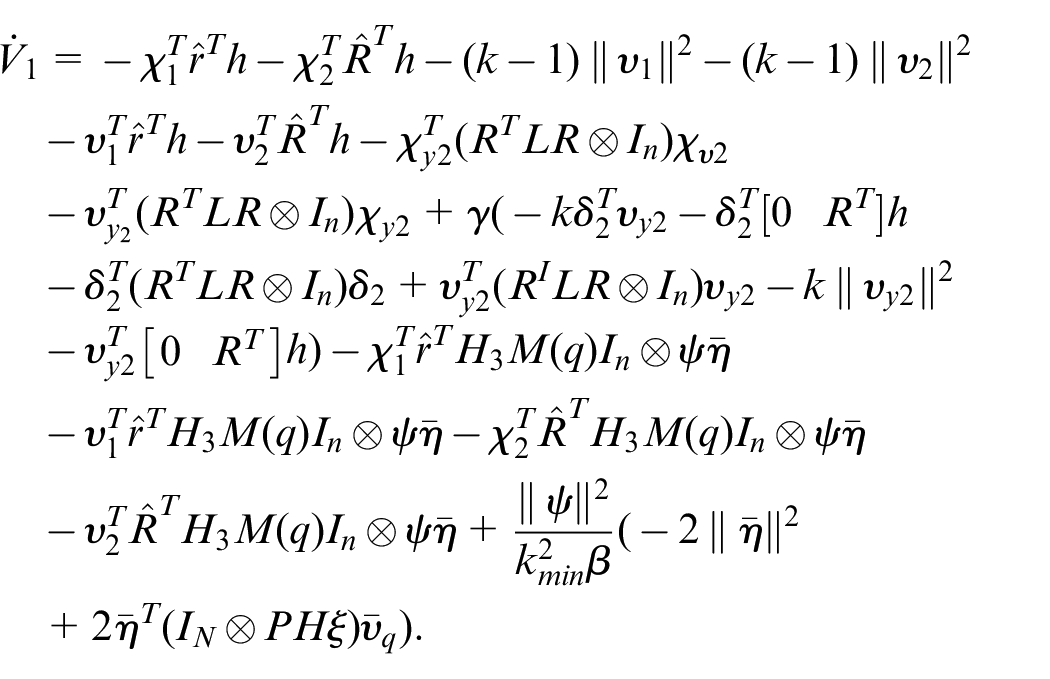
Then

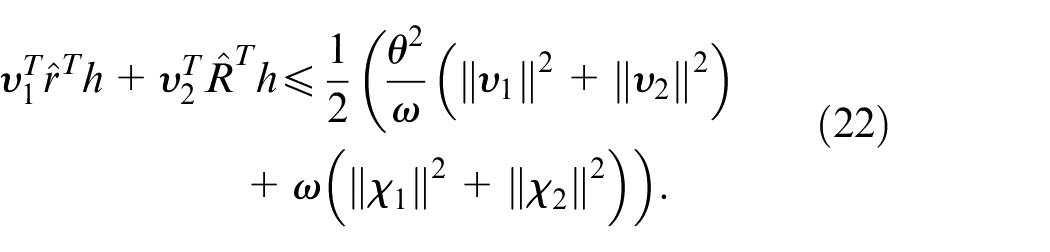
According to Schur Complement Lemma,

which implies that
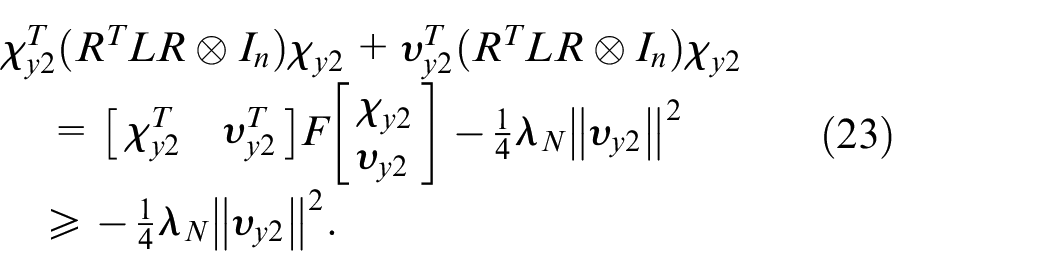
Besides, it results from

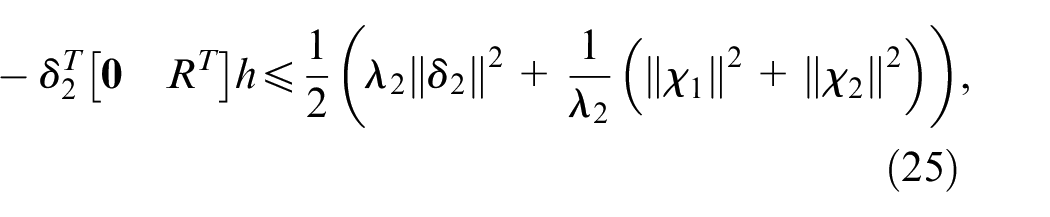
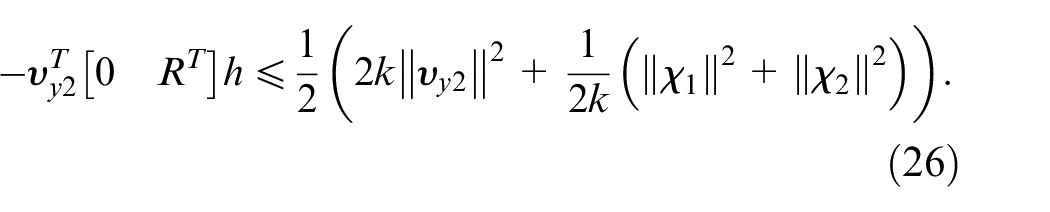
Also, we have
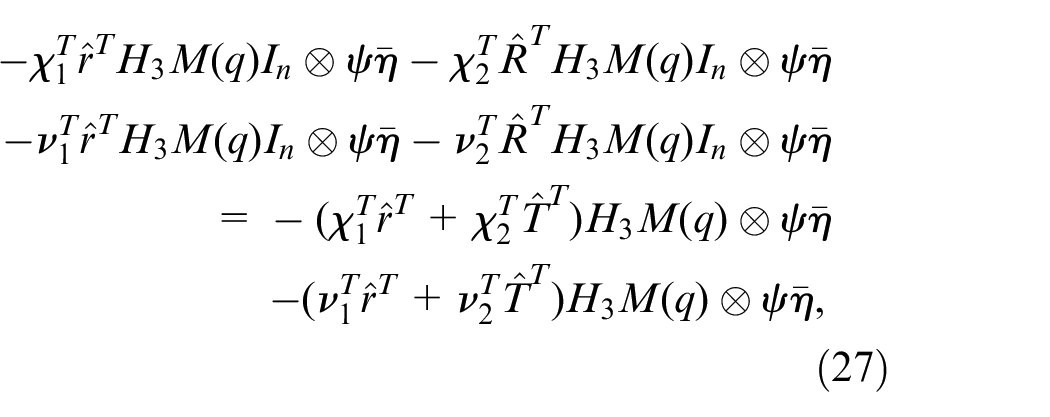
and due to the orthogonal transformation, we have
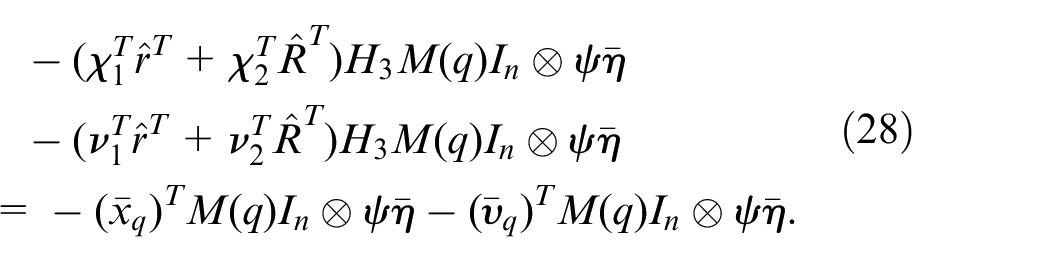
Similarly, by the properties of EL systems
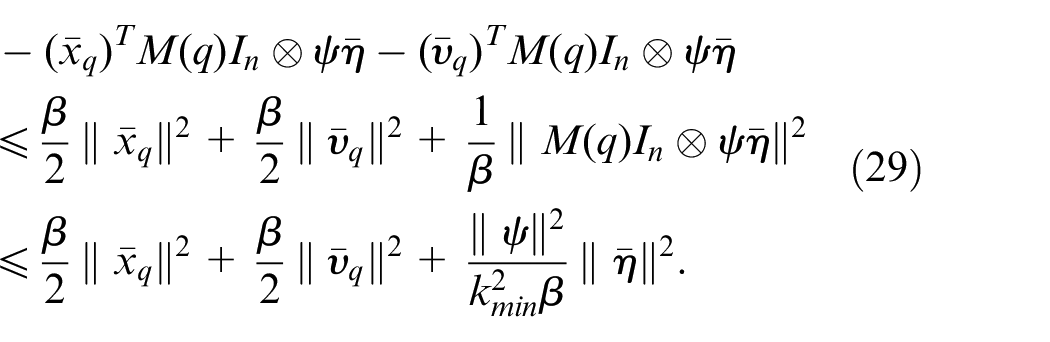
In the internal model item, there is

From the orthogonal transformation, obviously we have

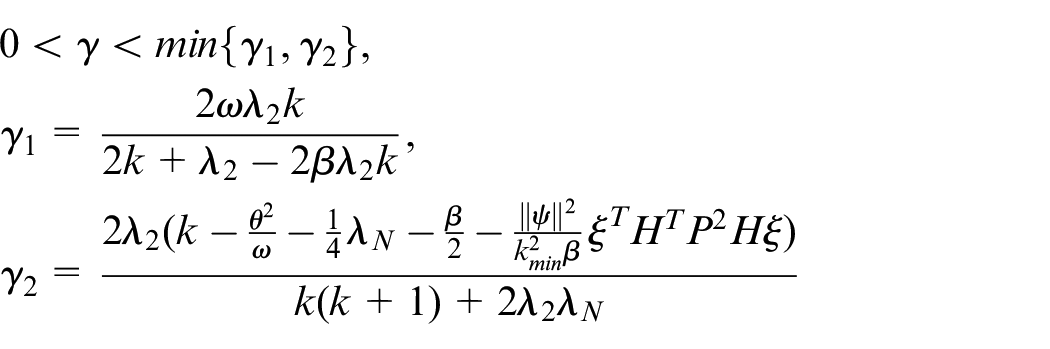
With (21)−(31), we have
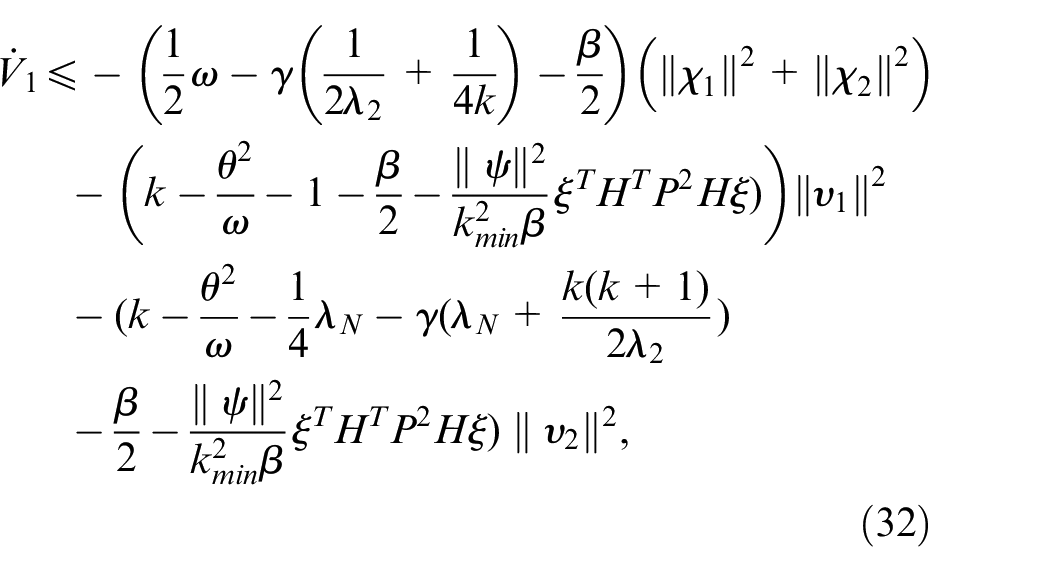
where
and
Simulations
The competition between multi-agent energy resources in the electricity market can be viewed as a kind of Nash-Cournot game (referring to Hobbs and Pang
18
and Liu et al.
38
). In this case, we consider six generation systems for the Nash-Cournot game to verify our algorithm. The communication topology is formulated as an undirected graph, which is shown in Figure 2. The cost function of player

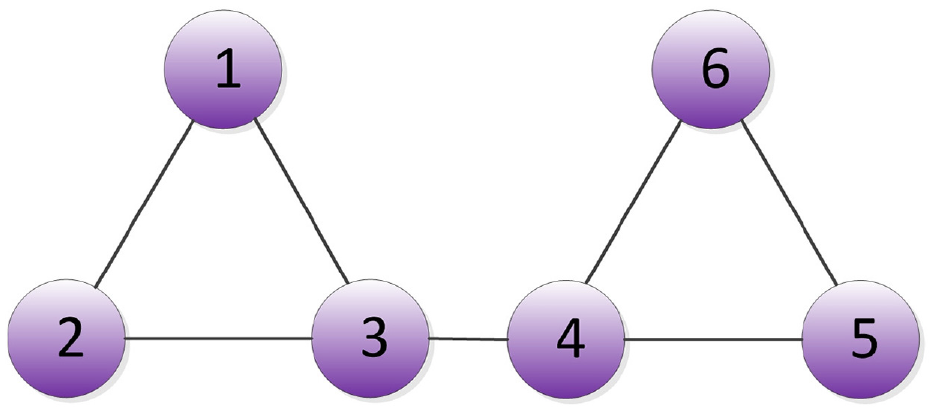
The communication topology.
where

where
When the mechanical and electromagnetic losses are neglected, the dynamics of the generator can be simplified to the following form (referring to Guo et al. 17 ).
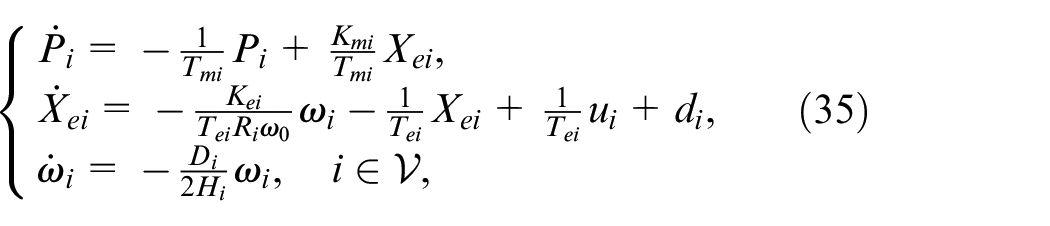
where
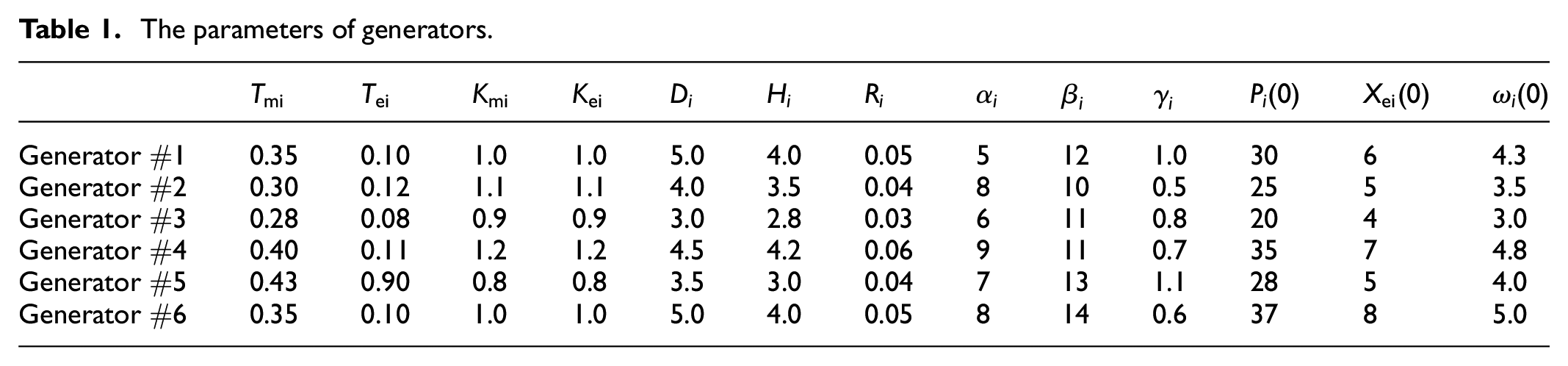
The parameters of the turbine-generator systems are showed in Table 1. In this case, we let
The parameters of generators.
The parameters of the disturbances are
The output powers of the turbine-generator systems and convergence of the cost functions are shown in the Figures 3 and 4, respectively.
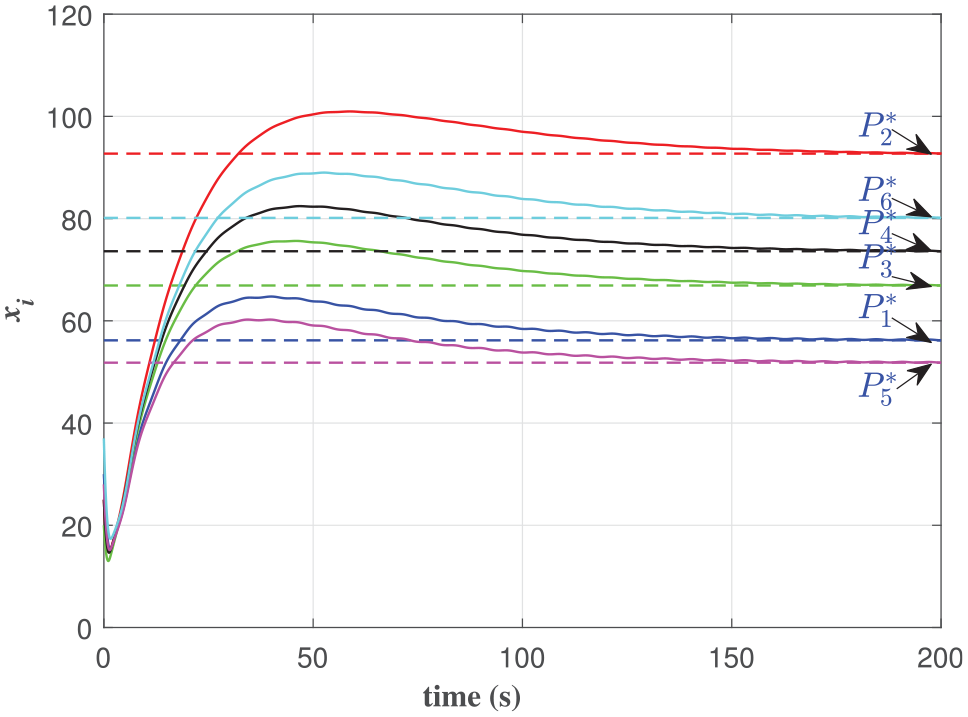
The evolutions of output powers of turbine-generator systems.
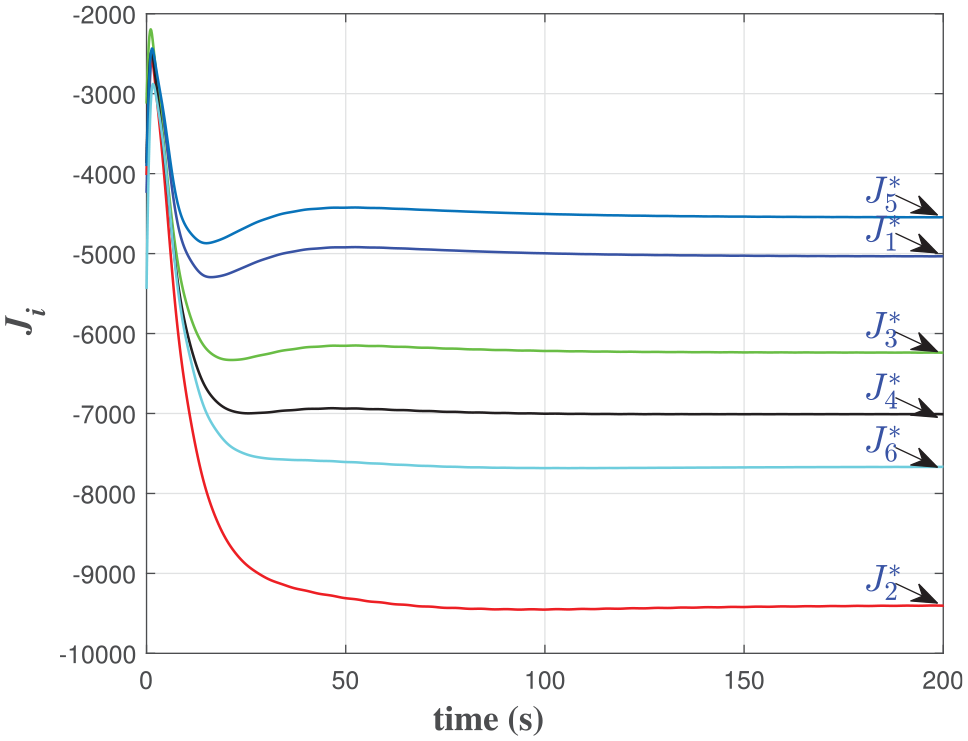
The evolutions of the cost functions of turbine-generator systems.
Conclusion
This paper has studied the aggregative games of second-order nonlinear multi-agent systems, where the dynamics of the players are described by EL equations and are influenced by exogenous disturbances. We have designed a distributed algorithm to seek the NE of the game, where internal model principle is used to deal with the exogenous disturbances. Moreover, we have analyzed the convergence of the algorithm. By the proposed method, the EL players can not only reject the exogenous disturbances but also asymptotically converge to the NE of the game. An example of smart grids has verified the effectiveness of our algorithm.
Footnotes
Declaration of conflicting interests
The author(s) declared no potential conflicts of interest with respect to the research, authorship, and/or publication of this article.
Funding
The author(s) disclosed receipt of the following financial support for the research, authorship, and/or publication of this article: This work was supported by the National Natural Science Foundation of China under Grant 61803385, the Hunan Provincial Natural Science Foundation of China under Grant 2019JJ50754 and the National Defense Pre-Research Foundation of China under Grant 61403120406.
