




Abstract
In coal and rock recognition technology, the acquisition of sound signals is affected by background noise. It is challenging to extract cutting features and accurately identify cutting patterns effectively. Therefore, this paper proposes an approach for combined noise reduction of the cutting sound signal based on the improved adaptive noise complete ensemble empirical mode decomposition (ICEEMDAN) and a singular value decomposition (SVD). First, the method used the ICEEMDAN method to decompose the noisy signal into several intrinsic mode functions (IMF). It calculated the correlation coefficient between the IMF component and the noisy signal and then selected the noisy IMF components based on the threshold formula. Meanwhile, this method constructed a Hankel matrix of the noisy IMF component signals. It used SVD technology to obtain the singular values. According to the singular value standard energy spectrum curve, the paper determined the order of the effective singular value and removed the noise component in the signal. Then, the denoised IMF and noiseless IMF components are superimposed and reconstructed to obtain the noise-reduced cutting sound signal. Finally, it applied simulation signal and simulated shearer cutting experiment to verify the performance of the method. The results show that the proposed method can effectively remove the influence of background noise in the signal and retain the characteristic frequencies of the original cutting sound signal. Compared with traditional noise reduction methods, the ICEEMDAN-SVD combined noise reduction method performs better in noise reduction evaluation standards of signal-noise ratio and root mean square error. It achieved a better noise reduction effect, which could help coal and rock recognition technology based on sound signals.
Introduction
Drum shearer is the critical equipment in the process of mechanized coal mining. Improving its intelligence level is significant for safe and efficient coal mining.1,2 The development of coal and rock identification technology is directly related to the shearer’s adaptive cutting feasibility.3,4 When the shearer cuts, the picks on the cutting drum impact and collide with the cutting medium, causing it to break and collapse. The material properties of coal and rock are different. Therefore, there are some differences in the sound signals generated by the shearer’s pick when cutting different media. Hence, coal and rock recognition technology based on sound signals has received significant attention in recent years. 5 However, in the actual coal mining work, affected by the noise of the working face, the cutting sound signal is often weak compared with the intense background noise. It is often submerged by background noise, which makes it challenging to extract signal features. In order to effectively extract the characteristic signal of the shearer cutting sound signal, it is necessary to reduce the noise of the sound signal.
At present, there are relatively little researches on denoising methods of shearer cutting sound signals. Xu et al. 6 proposed using the wavelet threshold method to reduce the influence of noise in the cut sound signal and combined it with experiments to prove the method’s effectiveness. However, this method is restricted by the selection of wavelet function. Xu et al. 7 chose to use the Empirical Mode Decomposition (EMD) method to process and reduce the noise of the sound signal. The EMD method can adaptively decompose the sound signal to obtain a series of intrinsic mode functions (IMF). However, the EMD method has severe modal aliasing and end effect defects, which affect the noise reduction effect. 8 The cutting sound signal of the shearer appears as a non-stationary random signal. 9 Therefore, it is necessary to adopt an effective signal analysis method to process the noisy sound signal to obtain the characteristic information in the signals. Based on EMD, Huang et al. proposed the ensemble empirical mode decomposition (EEMD) algorithm. 10 In signal processing, the EEMD algorithm suppresses modal aliasing by continuously adding white noise. 11 Some scholars propose to select several IMF components obtained by EEMD processing and superimpose them to achieve signal noise reduction. However, this processing method is easy to lose feature information, resulting in noise reduction signal distortion. Meanwhile, the EEMD algorithm can not effectively eliminate residual noise, resulting in signal reconstruction error.12,13 The complete ensemble empirical mode decomposition with adaptive noise (CEEMDAN) algorithm obtains the IMF component by adding a finite number of adaptive white noise and calculating the unique residual signal at each stage of signal decomposition. 14 The algorithm can effectively overcome the modal aliasing problem in EMD decomposition. 15 Li and Wang 16 decomposes the sound signal by the CEEMDAN method and realizes signal noise reduction by combining the minimum mean square criterion and the minimum mean square adaptive filter. However, a small amount of noise remains in the decomposition results of the CEEMDAN algorithm, and the algorithm runs for a long time. 17 Therefore, Colominas et al. 18 proposed an improved CEEMDAN (ICEEMDAN) algorithm. ICEEMDAN algorithm improves the computational performance of the CEEMDAN algorithm, can effectively reduce the influence of noise in the signal, and the signal reconstruction error is small. Li and Xu 19 uses a wavelet packet to denoise and reconstruct the signal decomposed by ICEEMDAN to achieve signal denoising. However, the selection of wavelet function and decomposition levels still limits the further popularization of the method.
As a nonlinear filtering method, singular value decomposition (SVD) can remove the noise component in the signal and retain useful information to the greatest extent. It has good stability and invariance.20,21 For noisy signals, it constructs a Hankel matrix and performs SVD processing to obtain certain singular values. The key to SVD noise reduction is the selection of effective singular values. By selecting the appropriate singular value boundary point and signal reconstruction, the noise component in the signal can be eliminated to the greatest extent, and the effective characteristic information can be retained. However, the cutting feature information for the shearer cutting sound signal is easily submerged in the strong background noise, making it challenging to obtain a good noise reduction effect by the SVD method.
Because of the above analysis, this paper proposes an ICEEMDAN-SVD combined noise reduction method. This method first processes the cutting sound signal of the shearer through the ICEEMDAN algorithm. Then, it uses the correlation coefficient threshold to select the noisy IMF components and performs noise reduction processing through SVD. Finally, the approach reconstructs all the IMF components to obtain the noise-reduced cutting sound signal. Analysis by constructing simulation signals and experimental signals shows that the combined noise reduction method can effectively remove the random noise in the signal and retain the useful components in the signal.
The rest of the paper is arranged as follows. Section 2 introduces the related theoretical basis. Section 3 proposes a joint noise reduction model for cutting sound signals. Meanwhile, Section 4 establishes a simulation signal analysis. Section 5 describes the noise reduction processing of the cut sound signal. Finally, Section 6 draws some conclusions.
Theoretical basis
ICEEMDAN principle
Assume that there is an original signal y(t) to be decomposed. A standard Gaussian white noise signal with zero mean and unit variance is added in each signal processing process. 22 Then the signal added for the i-th time (i = 1,2,…, I) is denoted as vi(t). ε represents the standard deviation of the noise. Ek(·) means the k-th IMF component generated by the EMD algorithm. M(·) is the mean value of the EMD decomposition signal.23,24 Then there is a signal yi(t) = y(t)+ε0E1(v i (t)), i = 1, 2, … , I, where I is the number of processing times. The decomposition process of the ICEEMDAN algorithm is as follows.
(1) Perform EMD decomposition on the signal yi(t), and calculate the first residual signal r1(t) and IMF component as:

(2) When k = 2, 3,…, K, calculate the k-th residual signal as:

where εk-1 is the standard deviation of the noise added for the k-th time.
(3) Calculate the k-th IMF component as follows.

(4) Repeat steps (2) and (3) until the obtained residual signal can no longer be decomposed. It means that the number of extreme points of the residual signal shall not exceed two at most. When the algorithm cycle ends, K modal components are finally obtained.
Singular value decomposition
For one-dimensional noisy discrete signals {yi, i = 1, 2, …, N}, the m×n Hankel matrix is constructed using phase space reconstruction theory.
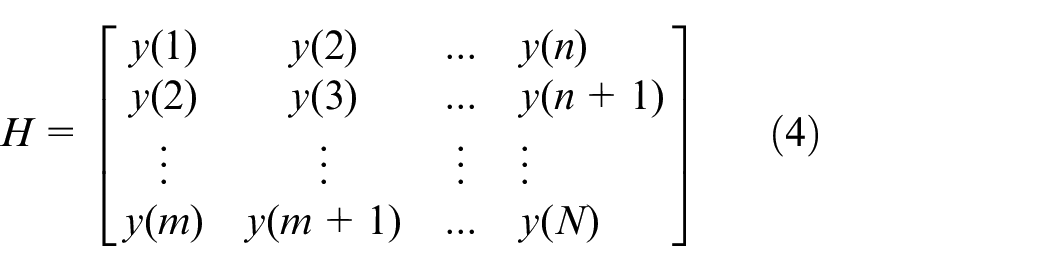
where N is the length of the signal, m and n are the numbers of rows and columns of the matrix. If N is an even number, then n = N/2. Otherwise, N is an odd number, then n = (N+1)/2, m = N-n+1. 25
SVD can process the noisy matrix

The diagonal matrix

where σi (i = 1, 2, …, q) is the singular value of matrix
Singular value standard energy spectrum
According to the singular value theory, the effective signal in the noisy signal is mainly reflected in the first L singular values. However, the remaining singular values represent noise.
26
Retain the first L effective singular values and set the following singular values to zero to construct a new diagonal matrix
In order to accurately determine the boundary point of effective singular value, this paper adopts a singular value standard energy spectrum method. The expression of singular value standard energy is as follows.

where σmax is the maximum singular value.
The energy distribution of the effective signal in the shearer cutting sound signal is relatively concentrated, corresponding to high singular value energy. The noise signal energy is dispersed, and the singular value energy accounts for less. According to the singular value standard energy spectrum curve, the amplitude of the effective signal is large, and the slope of the curve is high. However, the amplitude of the noise signal is small, and the curve changes gently. Therefore, the inflection point on the energy spectrum curve is the dividing point between effective signal and noise signal. It can determine the number of effective singular values L.
ICEEMDAN-SVD combined noise reduction method
In order to reduce the noise of shearer cutting sound signal, this paper proposes an ICEEMDAN-SVD combined noise reduction method. It realizes the purpose of signal noise reduction by selecting appropriate IMF component reconstruction and SVD noise reduction. In order to effectively reduce the noise of the cutting sound signal, this paper introduces the correlation coefficient to select the IMF component. The calculation formula of the correlation coefficient is as follows. 27
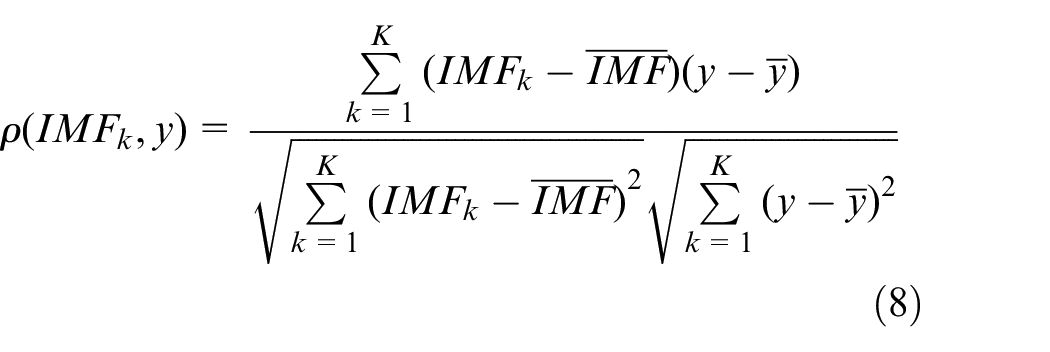
where ρ(IMF k , y) is the correlation coefficient of the k-th IMF component, hereinafter referred to as ρk. y is the noisy signal.
The method selects the IMF component according to the threshold formula (9). If the correlation coefficient is greater than the threshold, it is the noisy IMF component. Otherwise, it is regarded as a noiseless component. 28

where ρ′k is the threshold, max(ρk) is the maximum correlation coefficient value.
The main steps of the ICEEMDAN-SVD combined noise reduction method are as follows.
It applies ICEEMDAN to decompose the noisy signal y(t) to obtain multiple IMF components.
This method calculates the correlation coefficient between the IMF component and noisy signal, selects the noisy IMF component according to the threshold formula, and superimposes it.
It constructs a Hankel matrix for superimposed noisy IMF component signals and performs singular value decomposition. This method determines the boundary point of singular value noise reduction according to the standard energy spectrum to realize SVD noise reduction. It reconstructs the noise reduction signal through inverse transformation.
Finally, it superimposes the noise reduction signal obtained in step (3) with the noiseless component to obtain the final noise reduction signal y′(t).
The noise reduction process of shearer cutting sound signal is mainly shown in Figure 1.
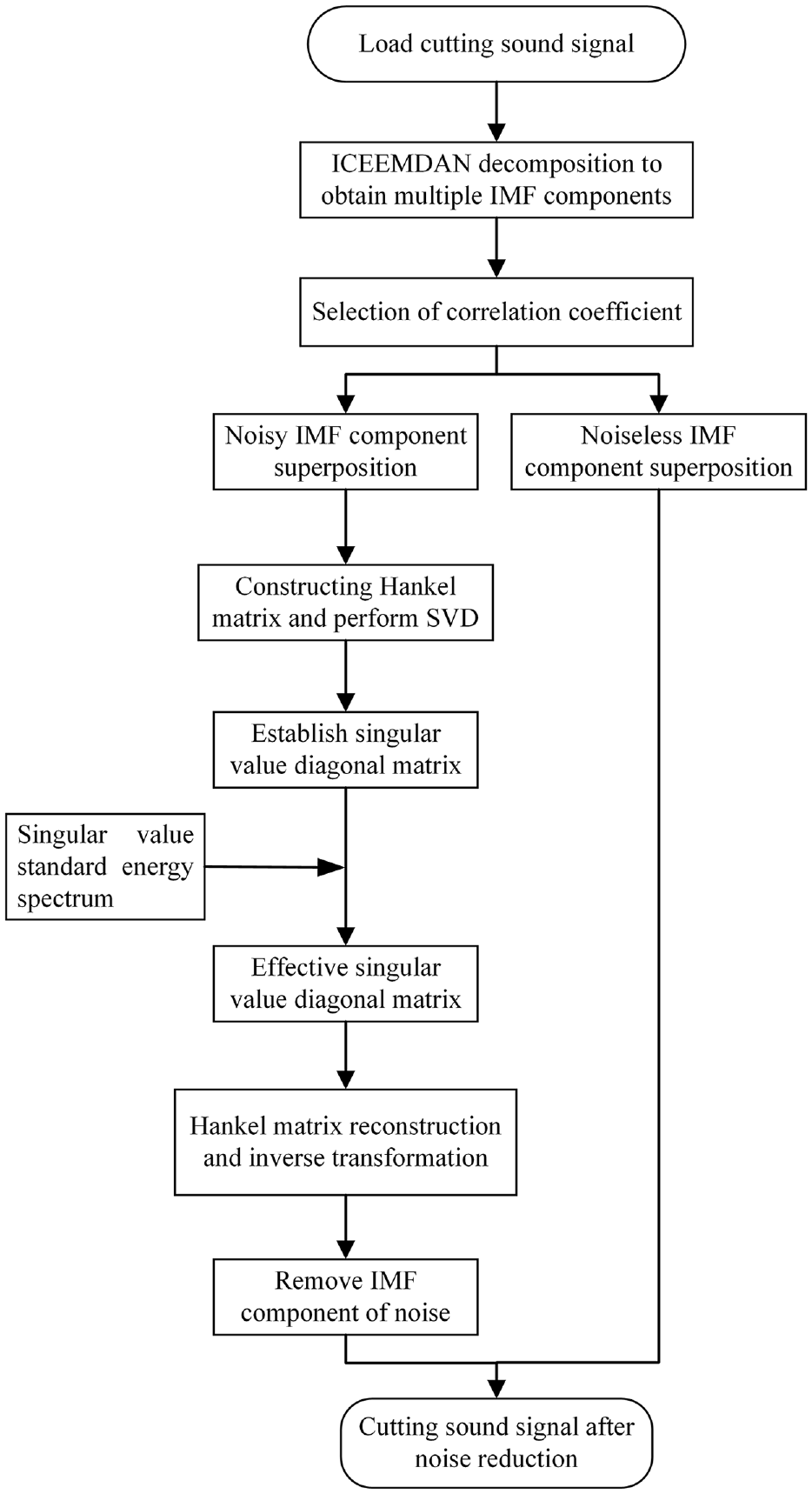
Flow chart of ICEEMDAN-SVD noise reduction method.
Simulation analysis
Simulation signal processing
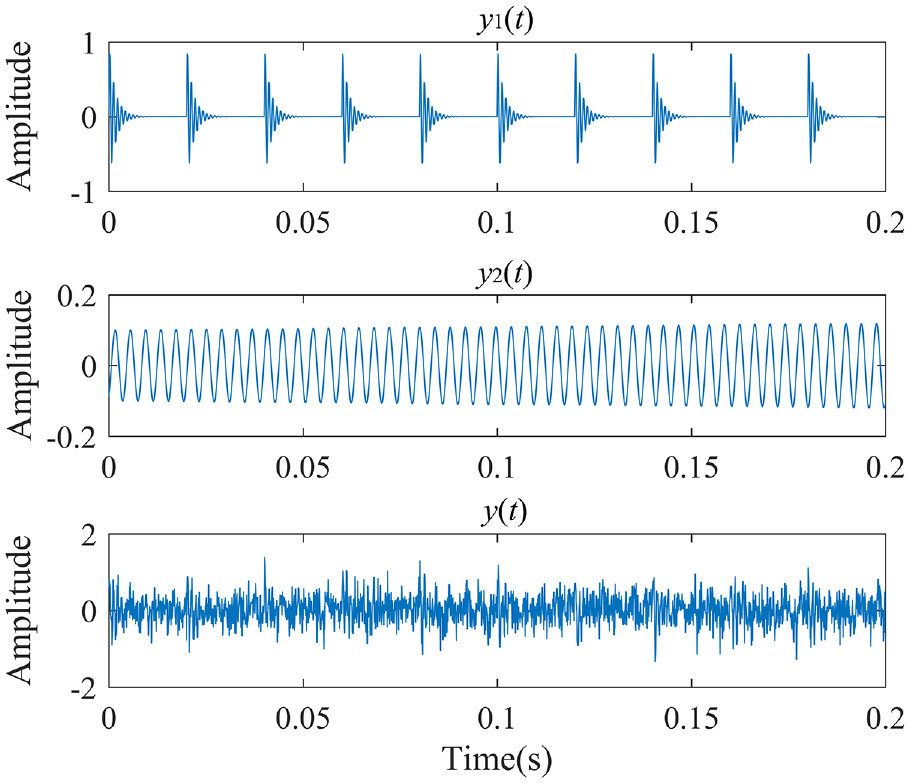
In order to verify the effectiveness of the proposed combined noise reduction method, the paper established a noisy simulation signal y(t) as follows.
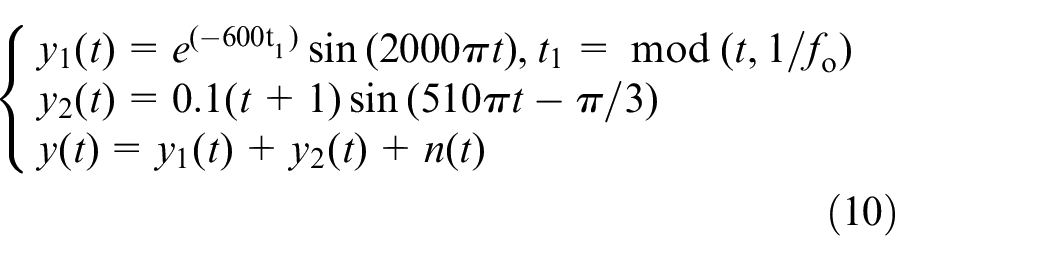
where y1(t) means the periodic shock signal, the shock frequency fo is 50 Hz, the attenuation coefficient is 600, the signal frequency is 1000 Hz, and the shock period is 0.02 s, y2(t) represents the amplitude modulation signal, the frequency is 255 Hz, n(t) reflects the added background noise. It consists of 10 dB standard Gaussian white noise and impulse noise with a center frequency of 1200 Hz. The relative bandwidth of impulse noise is 1.
Set the sampling frequency to 10,000 Hz and the sampling time to 0.2 s. It obtains the simulated signal waveform, as drawn in Figure 2.
Simulation signal waveform.
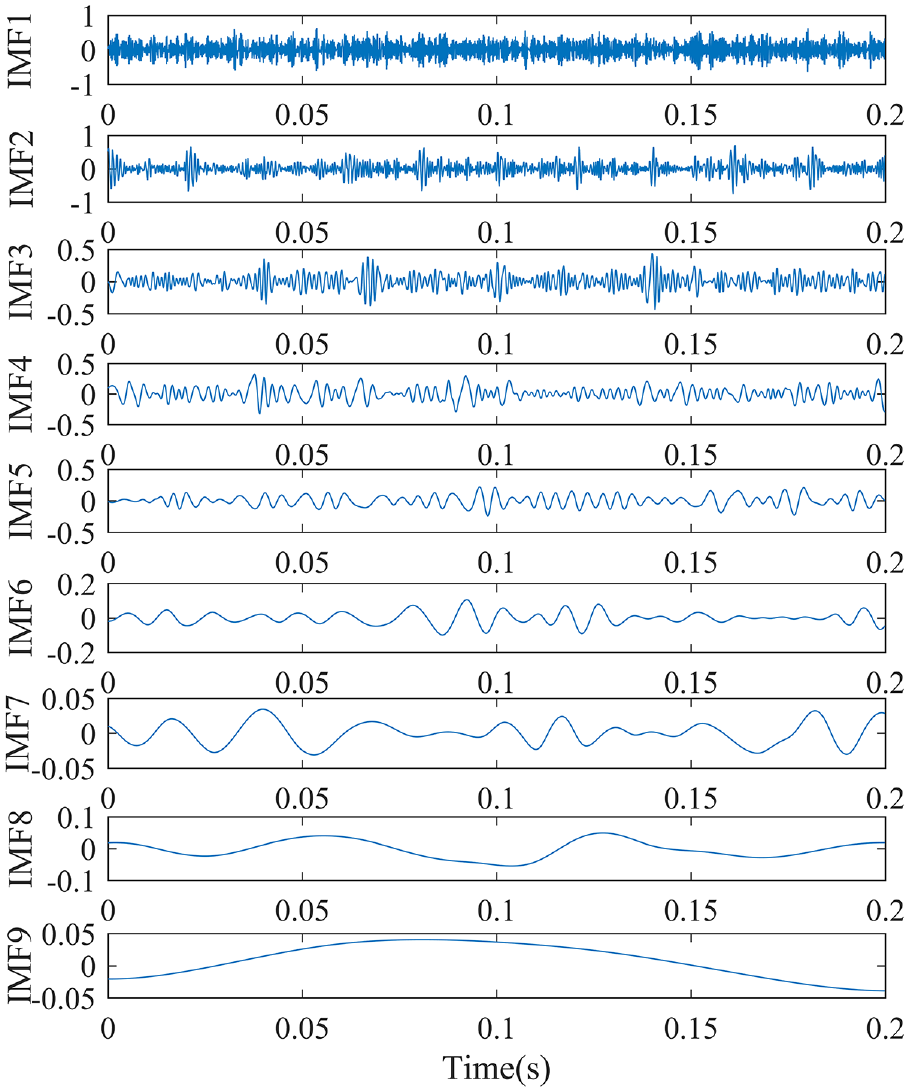
Figure 2 shows that the impact component in the simulation signal is basically submerged by noise due to noise pollution. The waveform contains a large number of burrs. Set the number of noise additions to 100 and the maximum number of iterations to 500. The method uses ICEEMDAN to process noisy simulation signals and can obtain 9 IMF components. It places the corresponding IMF components from high frequency to low frequency, as described in Figure 3.
Simulation signal decomposition results.
Calculate the correlation coefficient between the IMF component and the simulated signal. The correlation coefficient of the IMF1 component is the largest, reaching 0.6944. It uses the threshold formula (9) to determine the threshold ρ′k is 0.1761. After comparison, the correlation coefficient of IMF1-IMF5 is greater than the threshold. They have a strong correlation with the noisy simulated signal and contain more noise. The correlation of the IMF6-IMF9 component is weak and almost contains no noise. Therefore, these IMF components are considered noiseless components.
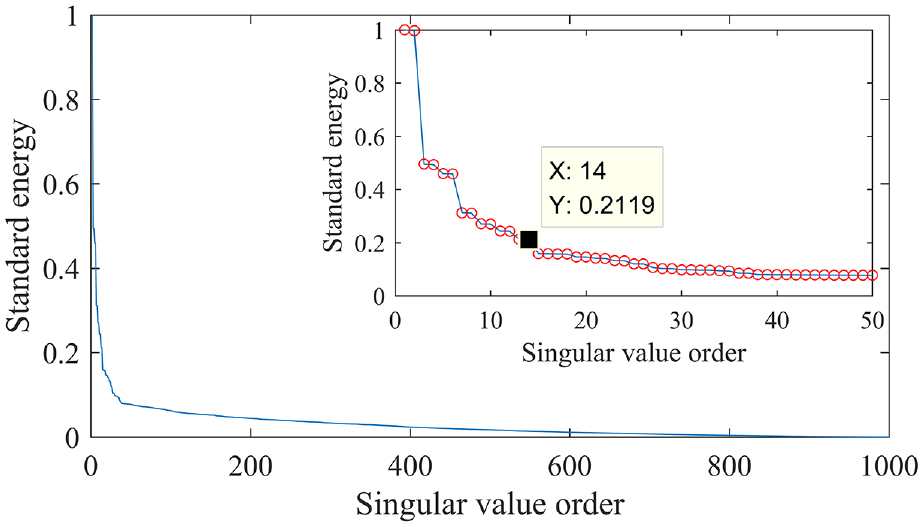
It superimposes the IMF1-IMF5 components to construct a new noisy signal. This method performs SVD processing on the signal to obtain the singular value standard energy spectrum curve, as shown in Figure 4.
Standard energy spectrum curve of singular value.
Figure 4 reflects that the standard energy value change decreases significantly after the marked 14th order singular value. The curve tends to ease, which indicates that the inflection point of the curve appears. This point is regarded as the dividing point between the useful component and the noise component in the signal. It determines that the number of effective singular values L is equal to 14.
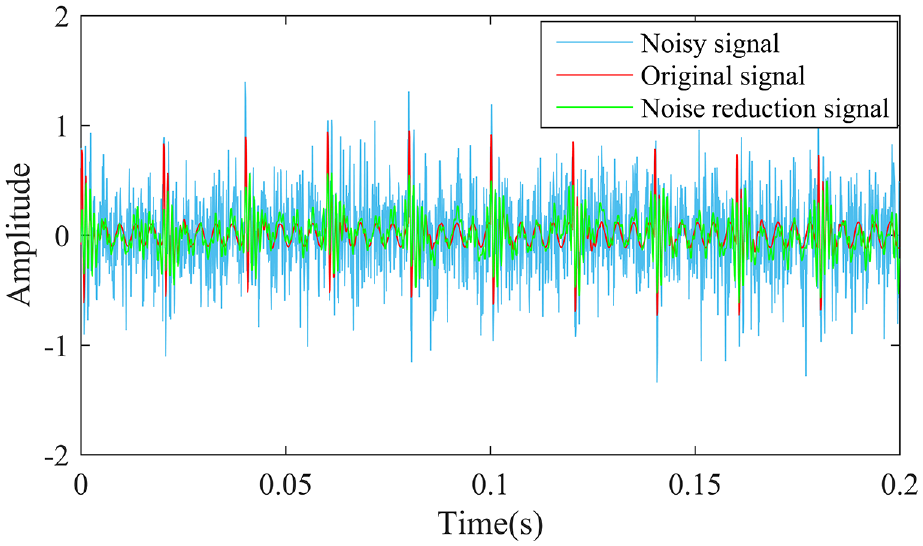
This paper selects the first 14 singular values for SVD reconstruction and superimposes them with the noiseless components to obtain the denoised simulation signal y′ (t). The noise reduction effect is drawn in Figure 5. Figure 5 indicates that the signal burr problem is eliminated after ICEEMDAN-SVD processes the noisy simulated signal. The noise reduction signal has a high degree of coincidence with the original signal, and the waveform is smoother and clearer.
Time-domain diagram before and after noise reduction of simulated signal.
It obtains the spectrum of the simulated signal before and after noise reduction, as shown in Figure 6.
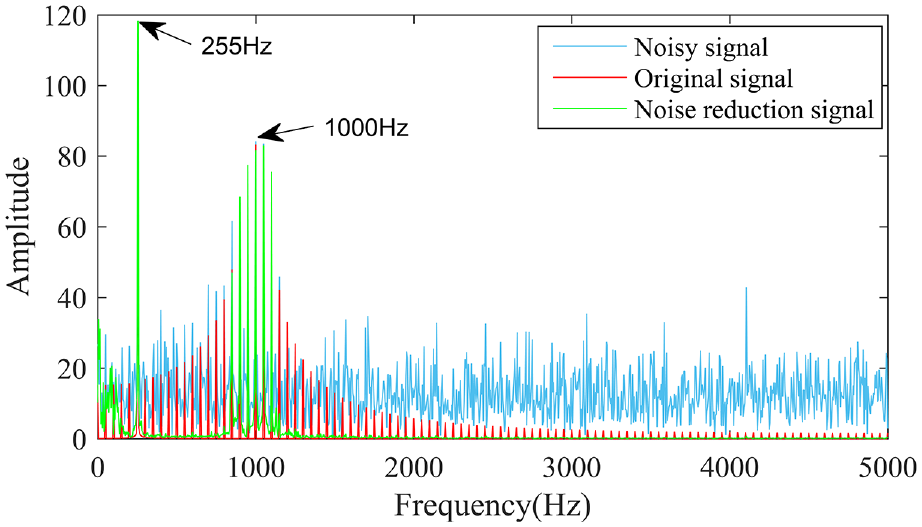
The spectrum of the simulated signal before and after noise reduction.
Figure 6 shows that the original signal mainly has two main frequency components: 255 and 1000 Hz. After adding noise, the existence of noise frequency is reflected in the spectrum. Through the noise reduction method proposed in this paper, the original noise components in the spectrum are removed. It retains the two main frequency components of the simulation signal, and the amplitude does not change. Therefore, the noise reduction method proposed in this paper has a noticeable noise reduction effect on noisy signals.
Comparison of noise reduction methods
In order to compare and reflect the superiority of the noise reduction effect of the proposed method, this paper adds 5, 10, and 15 dB Gaussian white noise to the simulation signal and the pulse noise signal with 1200 Hz center frequency is added, respectively. The paper designs three groups of noisy simulation signals. It applies wavelet noise reduction, EEMD correlation coefficient method, LMS adaptive filter, and the method proposed in this paper to denoise the noisy signal. After many experiments and comparisons, it selects db15 as the optimal wavelet basis, and the number of decomposition layers is 6. The paper selects the evaluation criteria for signal-noise ratio (SNR) and root mean square error (RMSE).29,30 The larger the SNR value and the smaller the RMSE value, the better the noise reduction effect. Equations (11) and (12) are SNR and RMSE, respectively.
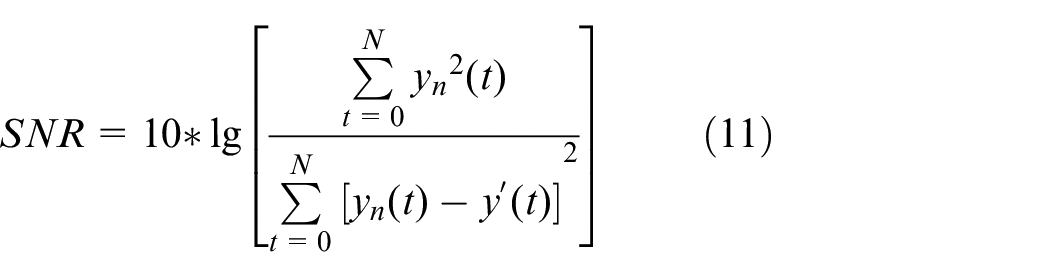

where yn (t) is the noiseless original signal.
It applies the above four methods to denoise the simulation signal and calculates the SNR enhancement as Figure 7. Where the amplitude of SNR enhancement = | SNR of the signal after noise reduction − SNR of the signal before noise reduction |.
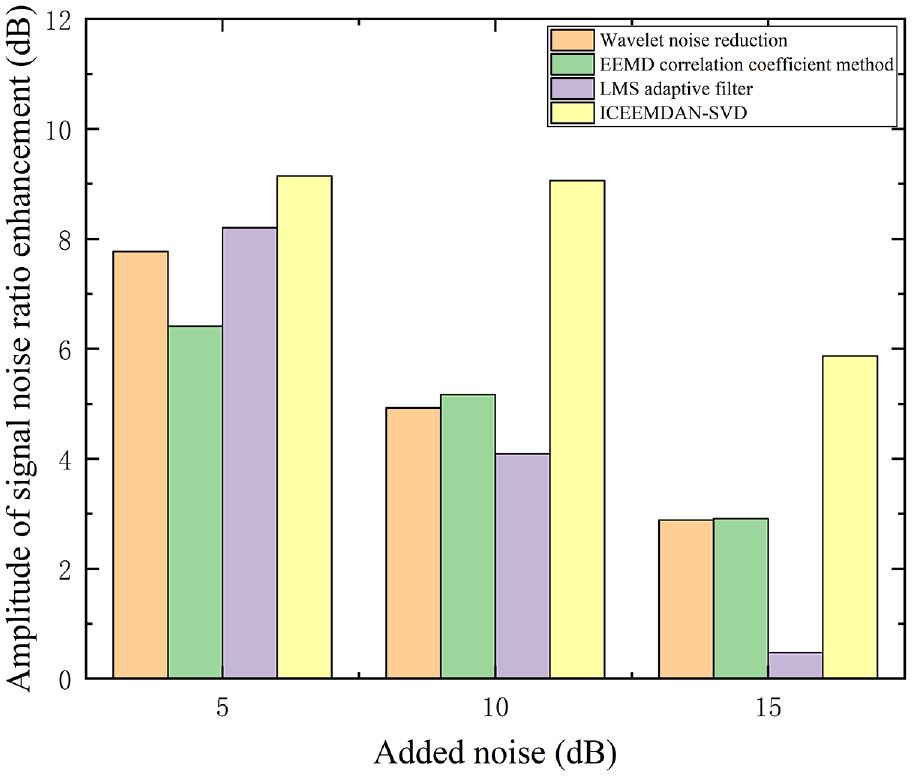
The amplitude of signal noise ratio enhancement.
Figure 7 represents that compared with the other three noise reduction methods, the simulation signal processed by the ICEEMDAN-SVD combined noise reduction method has the most significant improvement in signal-noise ratio. Its noise reduction signal contains the slightest noise.
Meanwhile, it calculates the RMSE of the signal, and the results are described in Figure 8.
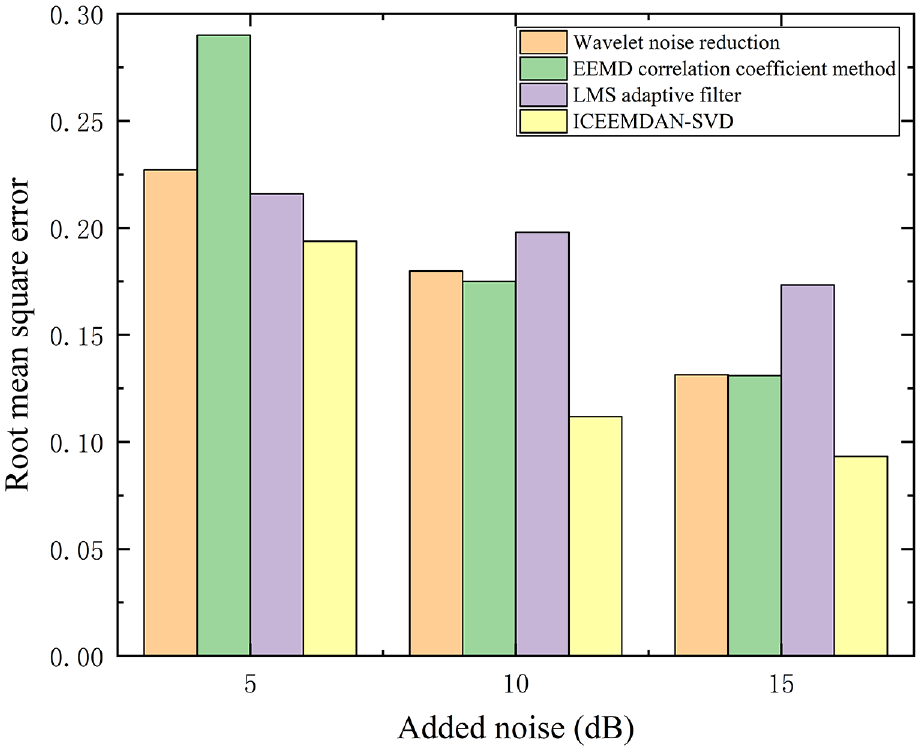
The root mean square error.
Figure 8 shows that the RMSE of the noise reduction signal processed by the ICEEMDAN-SVD combined denoising method is the smallest. It obtains the highest precision of noise reduction signal.
Compared with the other three noise reduction methods, the SNR value of the noisy simulated signal processed by the ICEEMDAN-SVD method is the largest and the smallest RMSE value. Therefore, the noise reduction method proposed in this paper has a better effect.
Experimental analysis
Establishment of the experimental system
In order to obtain the sound signal generated by the shearer cutting, based on the similarity theory, this paper takes the MG2X160/710WD thin shearer as the prototype machine. 31 It develops the shearer simulation cutting experimental system, as described in Figure 9.
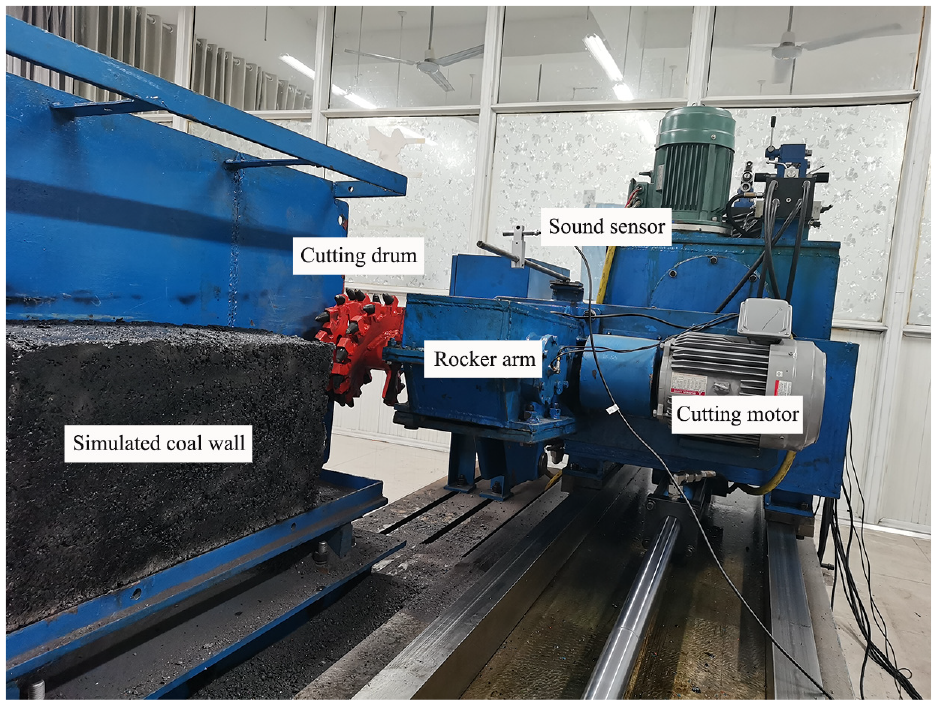
The shearer simulation cutting experimental system.
During the experiment, set the speed of the simulated cutting system to 0.5 m/min. The input frequency of the cutting motor is 30 Hz. Considering that the frequency of the sound signal heard by the human ear is between 20 and 20,000 Hz, according to the sampling theorem, the sampling frequency of the cutting sound signal is 48,000 Hz, and the number of sampling points is 4800.
The experiments used coal powder, cement, sand, and water as similar materials to formulate simulated coal walls at specific mass ratios. The sound sensor is selected with a combination of an AWA14423 capacitor microphone and an AWA14604 preamplifier. The data acquisition card model is NI-PCIe-6323.
Sound signal noise reduction processing of cutting mode 1
In order to verify the effectiveness of the proposed noise reduction method, the sound signal of cutting mode 1 is collected under laboratory conditions. Cutting mode 1 made the simulated coal wall with the mass ratio of 58% coal powder, 10% cement, 15% sand, and 12% water. The strength of the coal wall is 1.07 MPa. According to the design theory of shearer simulation cutting experimental system, the similarity coefficient between simulated coal wall and natural coal seam is 1/4. In addition, the simulated coal wall has a uniform texture, while the natural coal seam has problems with bedding, joints, and gaps. Combining with the experimental results, the strength coefficient of the simulated coal wall is 1/2.5. Finally, the simulated coal wall with a strength of 1.07 MPa corresponds to a 10.7 MPa natural coal seam, converted into a soft coal seam with a hardness of 1.07. The experiment collected the sound signal of cutting mode 1 as shown in Figure 10.
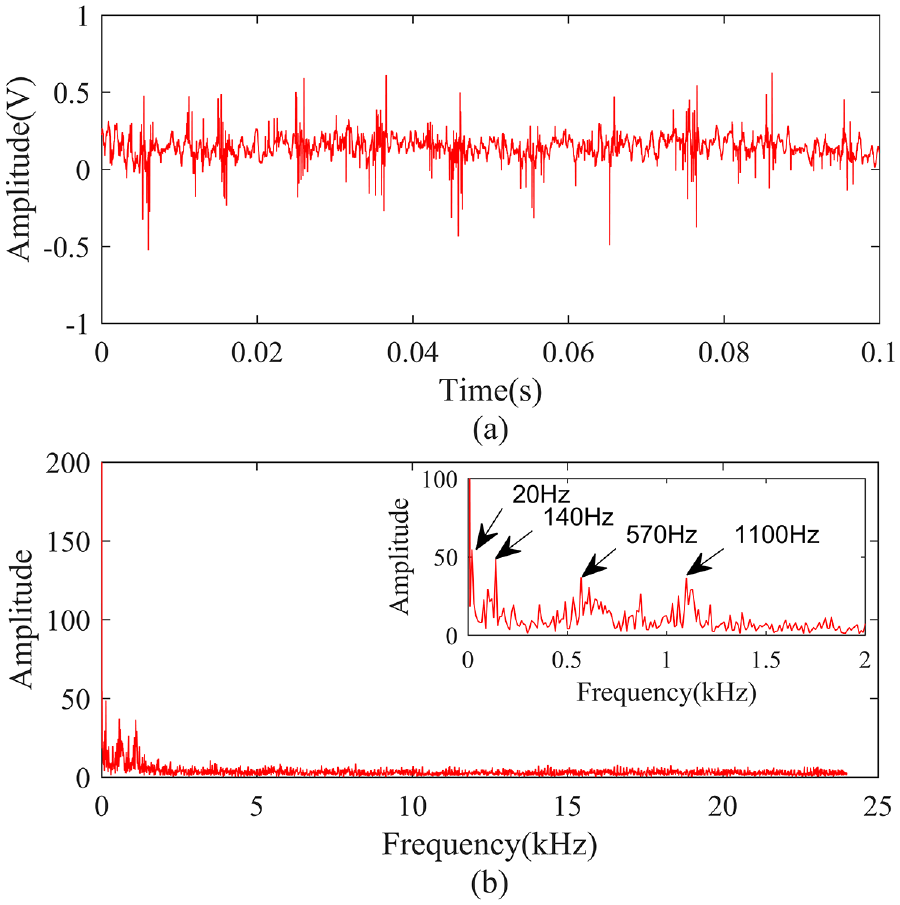
Waveform (a) and frequency spectrum (b) of the sound signal in cutting mode 1.
Figure 10(a) reflects that the cutting sound signal contains a distinct impulse signal component. Figure 10(b) describes that the primary frequency of the cutting sound signal is between 0 and 2000 Hz. After calculation, the frequency of 20 Hz is mainly gear meshing frequency in the shearer rocker arm. Furthermore, there are 3 prominent frequency peaks at 140, 570, and 1100 Hz. During signal acquisition, the cutting sound signal is susceptible to strong background noise in the coal mine. According to the research, the collected cutting sound signal mainly contains much white noise produced by working surface equipment. Meanwhile, it is difficult to obtain pure noise-free shearer cutting sound signals. Therefore, this paper takes the cutting sound signal collected under quiet conditions in the laboratory as the original signal. By adding 10 dB standard Gaussian white noise and 1000 Hz pulse noise as background noise, the original cutting sound signal is completely submerged to simulate the actual cutting condition. Figure 11 shows the waveform and spectrum of the cutting mode 1 sound signal with added noise.
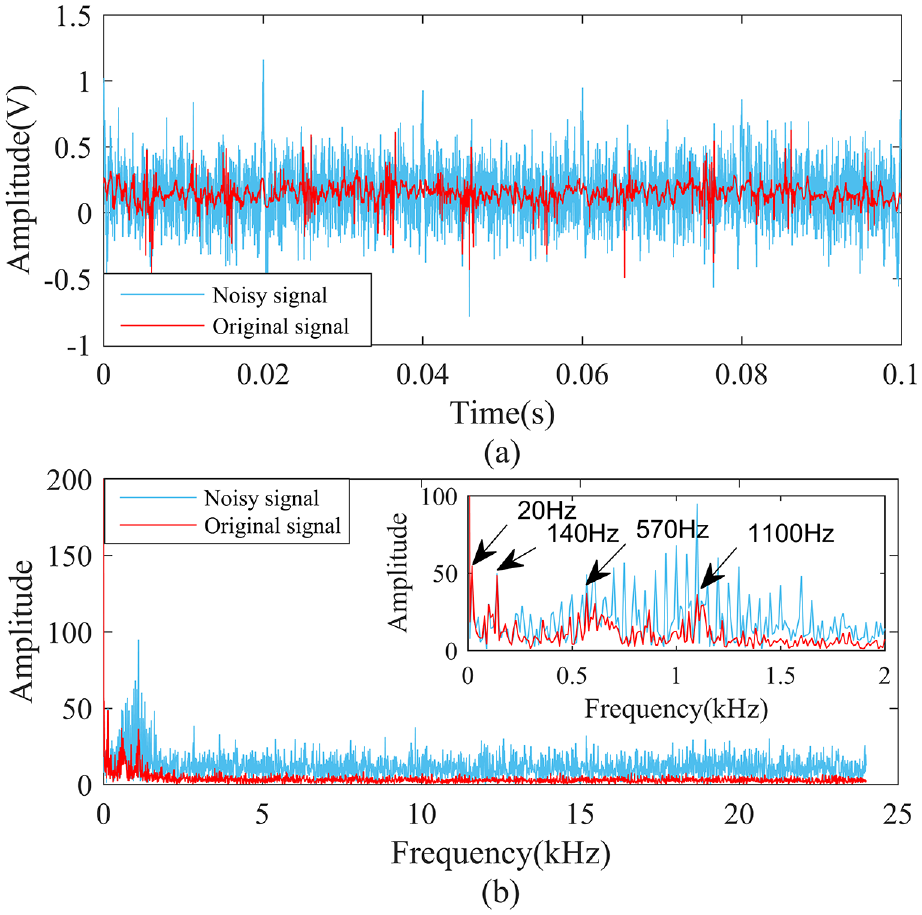
Waveform (a) and frequency spectrum (b) of the noisy sound signal in cutting mode 1.
Figure 11(a) indicates that after adding noise, the waveform of the original cutting sound signal is submerged by noise. Figure 11(b) represents that a large number of noise frequency peaks appear in the spectrum, and the original characteristic frequency is difficult to reflect.
The paper applied the ICEEMDAN method to decompose the noised cutting sound signal and obtained 13 IMF components, as shown in Figure 12. It calculated the similarity coefficient between IMF component and cutting sound signal with noise and obtained the maximum similarity coefficient of IMF1, 0.69. The threshold value was 0.1769 according to the threshold formula (9). The correlation coefficients of IMF1∼IMF6 were all greater than 0.1769. Thus, the combined noise reduction method constructed a Hankel matrix by selecting the above IMF components as noisy IMF components. IMF7∼IMF13 was considered as noiseless components. The method used SVD to process the Hankel matrix and obtained the standard singular value energy spectrum curve as drawn in Figure 13.
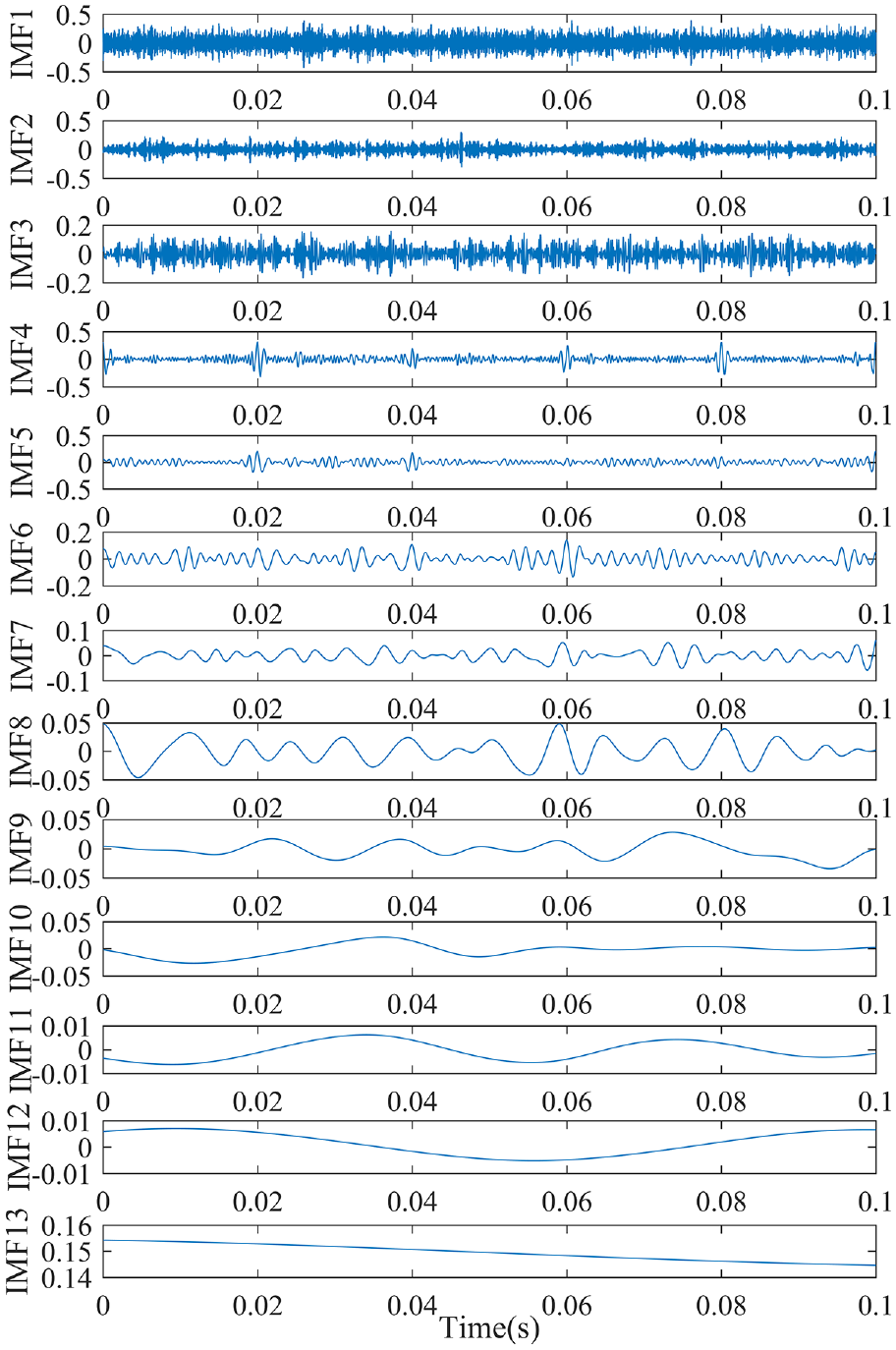
Decomposition results of the noisy sound signal in cutting mode 1.
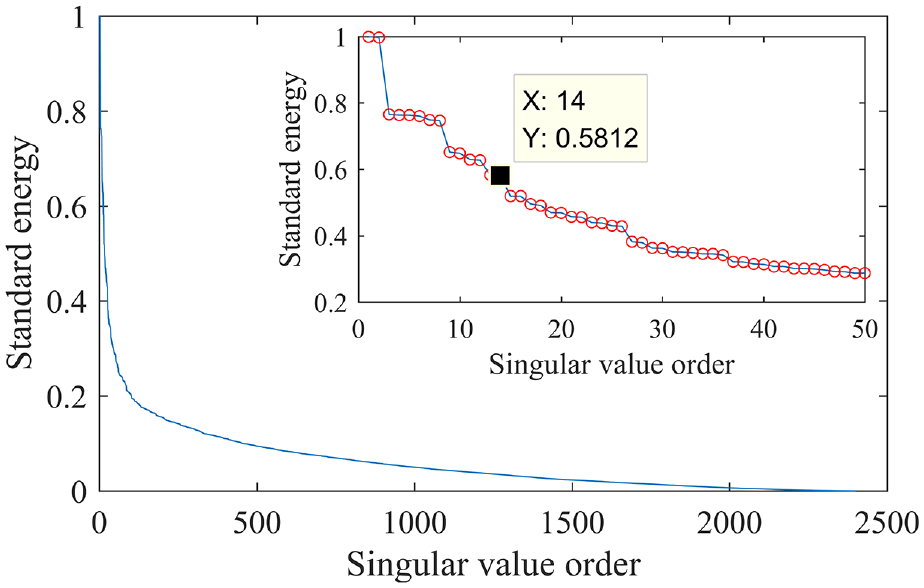
Standard energy spectrum curve of singular value in cutting mode 1.
Figure 13 reflects that after the 14th order singular value, the singular value standard energy spectrum curve tends to be flat, and there is no obvious turning point. It takes the first 14 singular values for SVD reconstruction and obtains the denoised cutting sound signal by superposition. The time and frequency domain of the sound signal before and after noise reduction is shown in Figure 14.
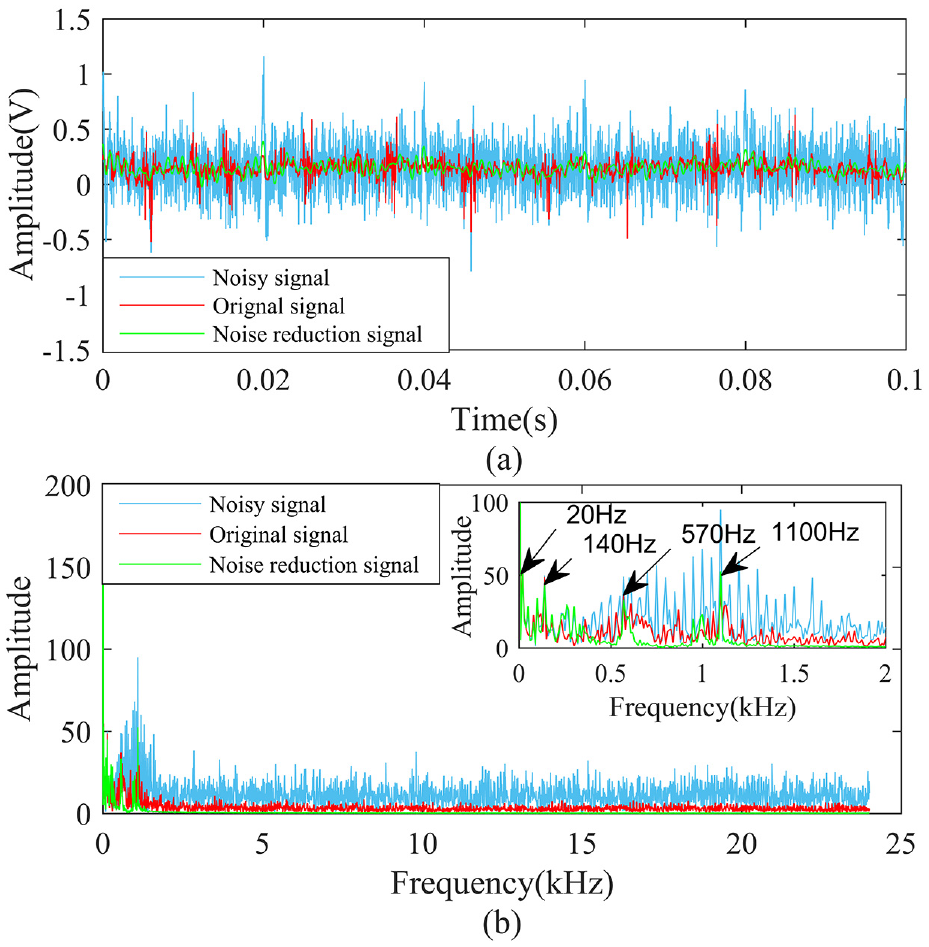
Waveform (a) and frequency spectrum (b) of the sound signal after noise reduction in cutting mode 1.
Figure 14(a) indicates that after processing with the noise reduction method proposed in this paper, the coincidence degree between the denoised and original signals is high. The background noise component in the noisy signal is significantly suppressed. Figure 14(b) describes that the high-frequency noise in the noisy signal is filtered out. Meanwhile, the main frequency components in the original signal are retained, and the amplitude does not change.
In order to reflect the superior performance of the noise reduction method proposed in this paper, it is compared with the noise reduction method mentioned above. After calculation, the SNR value of the noisy signal is −1.2702, and the RMSE value is 0.1861. The noise reduction results are listed in Table 1.
Comparison of noise reduction effect of the sound signal in cutting mode 1.
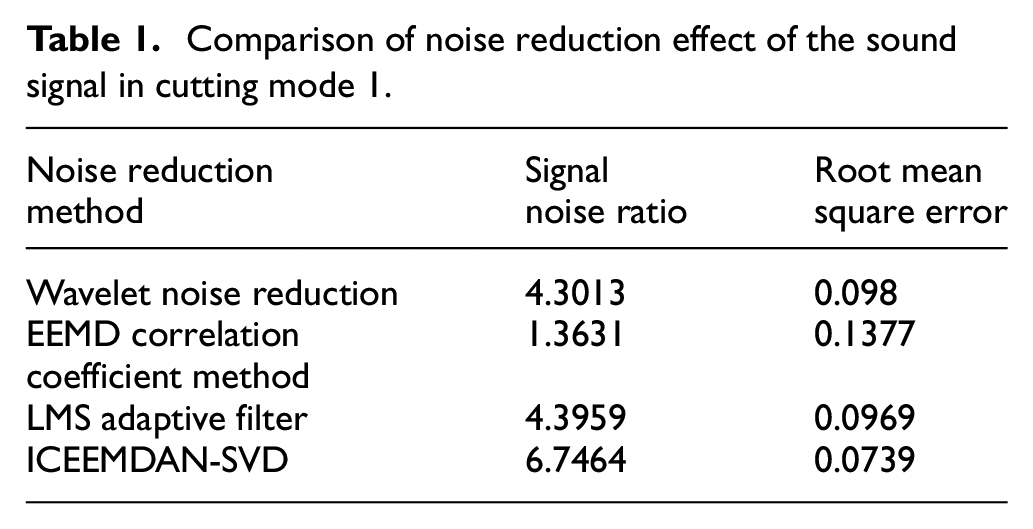
Table 1 shows that the SNR value of the proposed noise reduction method is the largest, and the RMSE value is the smallest. Compared with the other three noise reduction methods, the noise reduction effect is more pronounced.
Sound signal noise reduction processing of cutting mode 2
In cutting mode 2, the simulated coal wall was made with the mass ratio of 60% coal powder, 15% cement, 15% sand, and 10% water. The measured compressive strength was 2.14 MPa. It corresponded to the medium-hard coal seam with a hardness of 2.14. Acquisition of sound signals from cutting mode 2 under laboratory conditions is drawn in Figure 15.
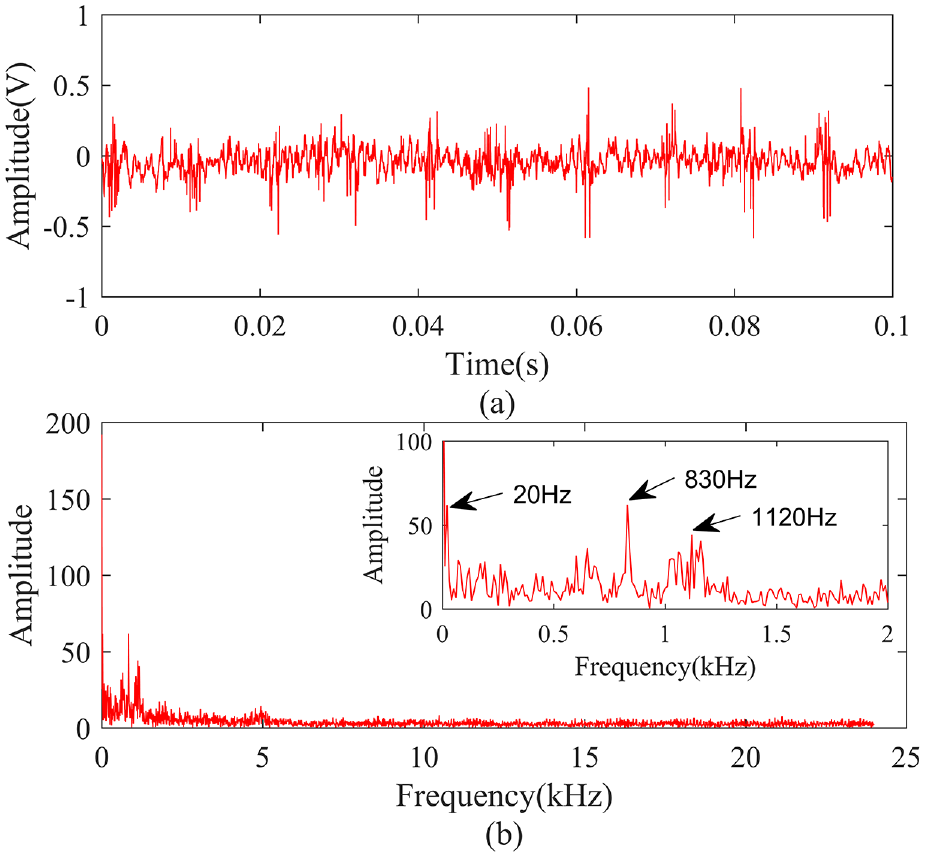
Waveform (a) and frequency spectrum (b) of the sound signal in cutting mode 2.
Figure 15(a) represents that the waveform of the cutting mode 2 sound signal also has a noticeable impact component. Figure 15(b) reflects that, in addition to 20 Hz, there are two main frequency peaks, 830 and 1120 Hz. The amplitude of the signal frequency is also higher than the sound signal of cutting mode 1.
Similarly, it added a standard Gauss white noise and impulse noise to the signal as strong background noise, and the result was shown in Figure 16. Figure 16(a) indicates that the original cutting sound signal is completely submerged by background noise. Meanwhile, Figure 16(b) describes that due to noise, the original characteristic frequency component is also submerged by the noise frequency component.
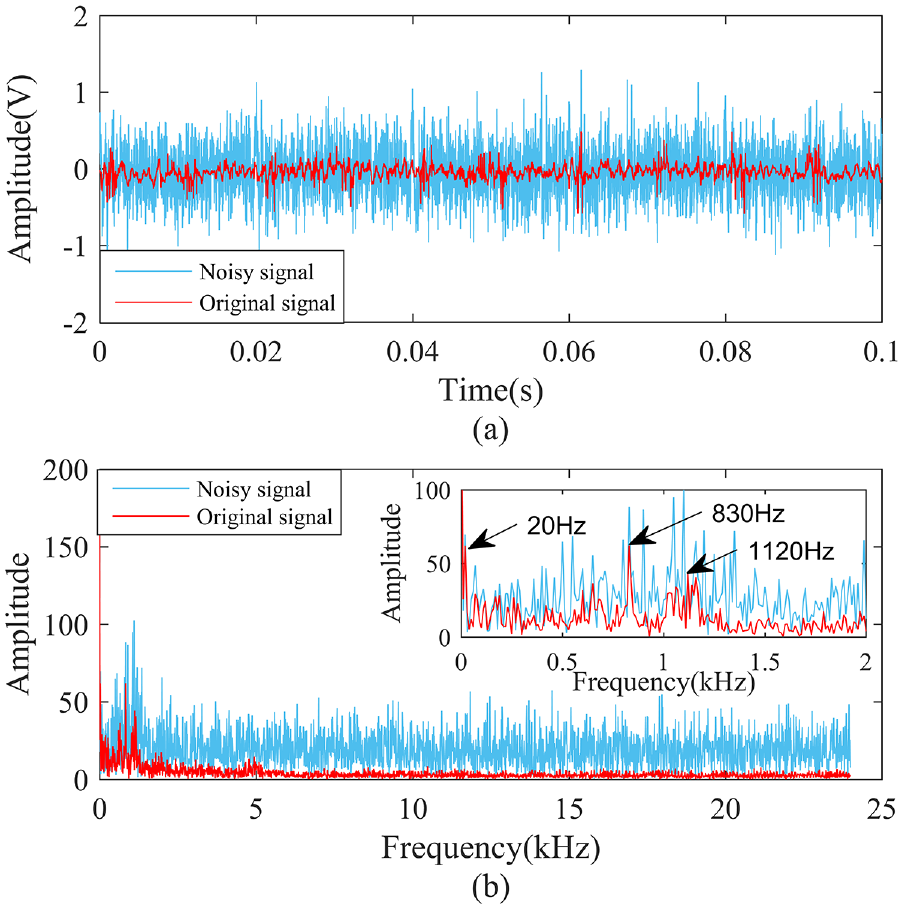
Waveform (a) and frequency spectrum (b) of the noisy sound signal in cutting mode 2.
The method used the ICEEMDAN method to process the noisy sound signal in cutting mode 2 and obtained 12 IMF components, as shown in Figure 17.
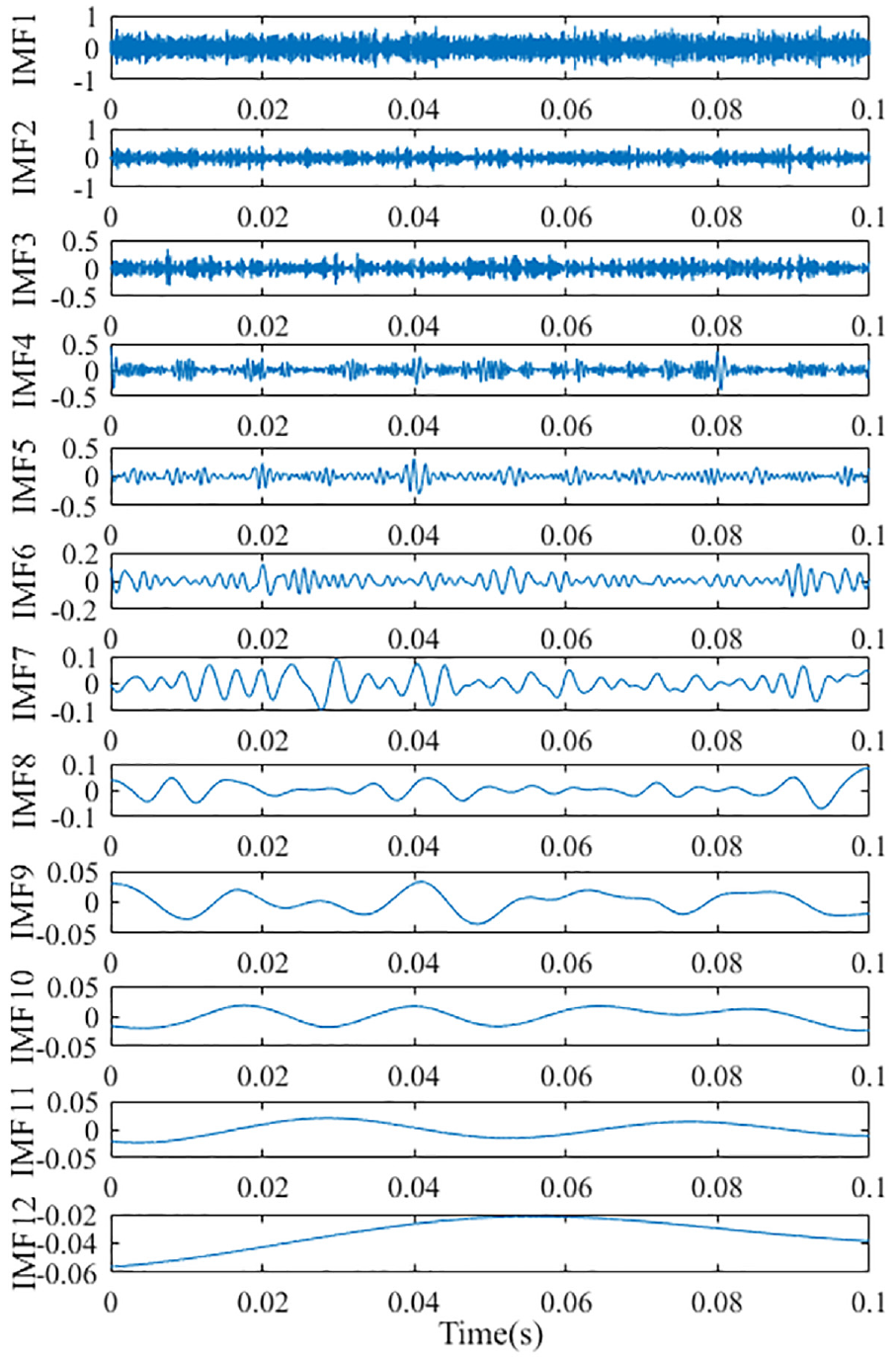
Decomposition results of the noisy sound signal in cutting mode 2.
It calculated the correlation coefficients of 11 IMF components with a noisy cutting sound signal. The maximum correlation coefficient of IMF1 is 0.6432. Furthermore, the threshold value is 0.1874. It chose IMF1∼IMF6 and IMF10∼IMF11 as noisy IMF components, while the remaining components were considered noiseless components. It applied SVD to process noisy IMF components and obtained the signal’s singular value standard energy spectrum as described in Figure 18.
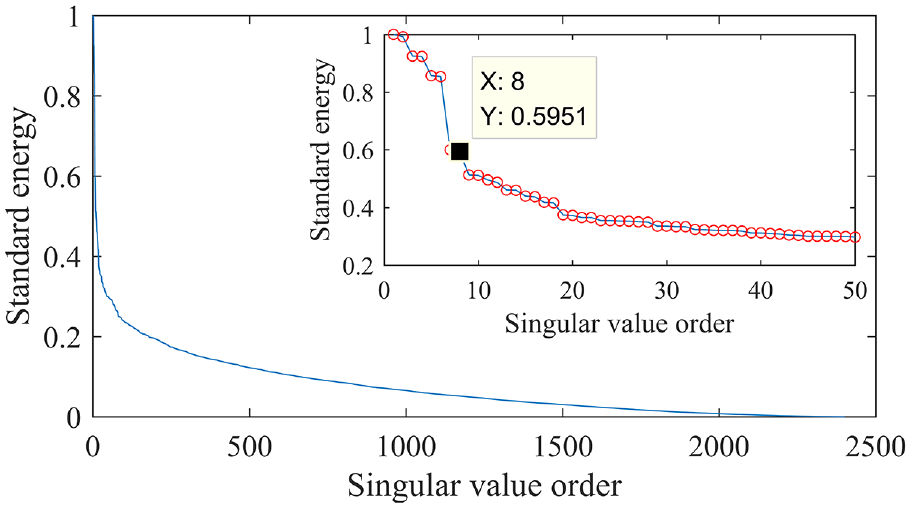
Standard energy spectrum curve of singular value in cutting mode 2.
Figure 18 represents that the singular value energy spectrum curve shows a gentle downward trend after a significant transition at the 8th order singular value. It was considered that the singular value from the 8th order was the boundary point between useful signal and noise signal. The paper has taken the first 8 order singular values for reconstruction and superimposes the noiseless IMF components to obtain the cutting sound signal after noise reduction, as indicated in Figure 19.
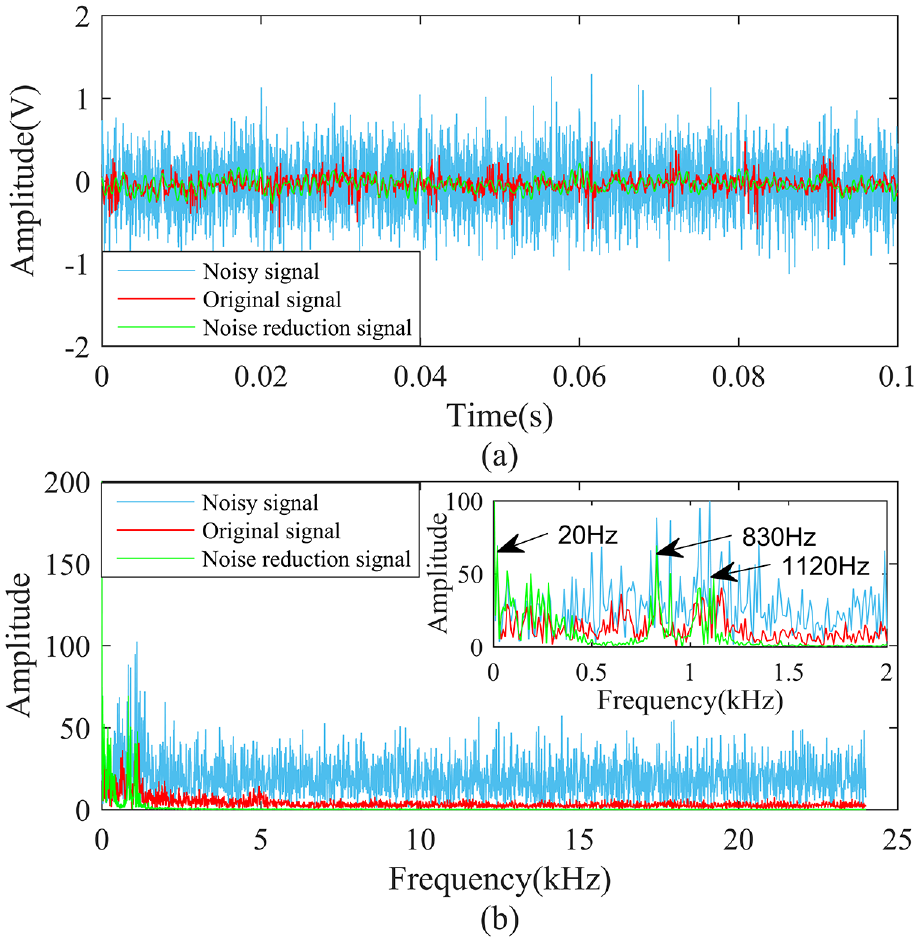
Waveform (a) and frequency spectrum (b) of the sound signal after noise reduction in cutting mode 2.
Figure 19(a) reflects that the background noise in the signal is significantly suppressed after noise reduction, and the burr phenomenon is greatly improved. Figure 19(b) describes that the high-frequency noise in the original noisy sound signal spectrum has been removed. 20 Hz meshing frequency, 830 Hz, and 1120 Hz characteristic frequency components have been reflected, with minor variation in amplitude.
Similarly, it used the noise reduction method mentioned above to denoise the noise signal of cutting mode 2, and the noise reduction effect was listed in Table 2.
Comparison of noise reduction effect of the sound signal in cutting mode 2.
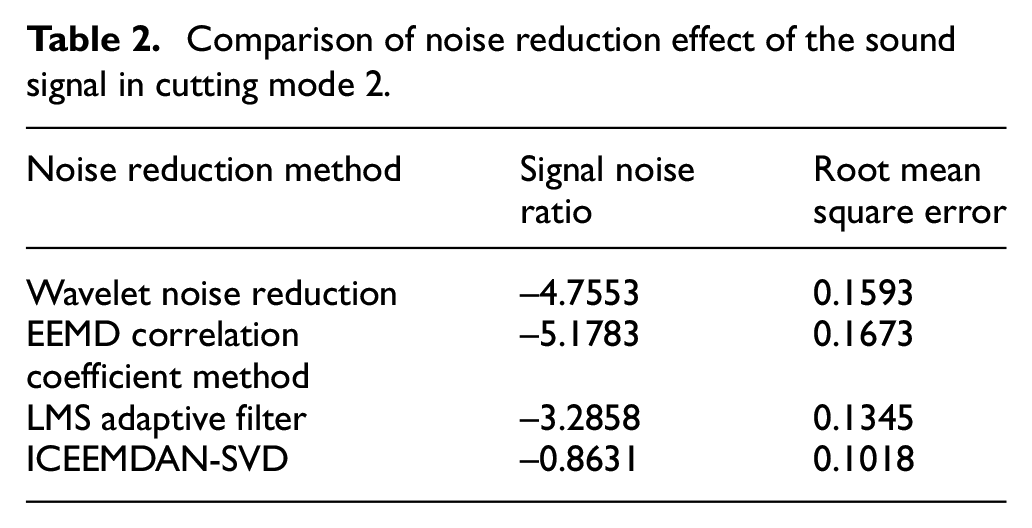
After calculation, the SNR value of the noisy cutting sound signal is −10.9576, and the RMSE value is 0.3254. Table 2 indicates that the ICEEMDAN-SVD method has a better noise reduction effect than the above three noise reduction methods.
Conclusions
This paper proposes a combined noise reduction method based on ICEEMDAN-SVD. The method first uses ICEEMDAN to decompose the noise signal and applies the correlation coefficient threshold to select the noisy components for superposition. It constructs the Hankel matrix and processes it with SVD. Meanwhile, the paper combines the singular value standard energy spectrum curve to determine the useful components in the signal, reconstructs the signal, and superimposes the remaining noiseless components. Finally, it obtains a noise reduction signal. The simulation results show that the ICEEMDAN-SVD method can effectively remove noise components from noisy signals. Compared with traditional noise reduction methods, the SNR of the noise reduction signal is the highest, and the RMSE is the smallest. The results of the simulation cutting experiment of the shearer reflect that the ICEEMDAN-SVD combined noise reduction method can effectively suppress the noise effect in the cutting sound signal of the shearer and retain the primary frequency component in the cutting sound signal. Meanwhile, the noise reduction effect is better than other noise reduction methods, proving the effectiveness and practicability of the combined noise reduction method. It indicates that this method can be used for noise reduction of cutting signal of shearer under strong background noise and has strong engineering guiding significance for improving the level of intelligent cutting of shearer.
Footnotes
Declaration of conflicting interests
The author(s) declared no potential conflicts of interest with respect to the research, authorship, and/or publication of this article.
Funding
The author(s) disclosed receipt of the following financial support for the research, authorship, and/or publication of this article: This research was funded by the National Natural Science Foundation of China—Research on shearer automatic height adjustment electro-hydraulic proportional control system based on cutting sound signal (No. 51475001).
