




Abstract
In order to improve the service life of the V-ribbed belt and the ride comfort of the vehicle, the friction noise of V-ribbed belt was studied by simulation and experiment. A theoretical model of V-ribbed belts vibration is established, and the conditions for unstable vibration are derived. Based on the theory of mode coupling, the causes of high frequency friction noise of V-ribbed belts are analyzed, and it is considered that the coupling between the vibration of the V-ribbed belts and the natural frequency of the belts’ cross section causes the self-excited vibration of the belt, resulting in high frequency friction noise. Firstly, ANSYS Workbench is used to identify the belts’ cross sections with 3, 4, and 6 wedges, and the natural frequencies of the belts’ cross sections are obtained. Then on the belt drive friction tester, the influences of tension and relative sliding speed on the frequency of high frequency friction noise is studied using a single factor test method, and the frequency response curve of high frequency friction noise is also analyzed. The results of the experiment and simulation show that the transverse vibration of the V-ribbed belts is closely related to the phase and amplitude of the high frequency friction noise, and the changes in tension and relative sliding speed do not affect the frequency of the high frequency friction noise. The frequency of high frequency friction noise has a good consistency with the natural frequency of belts’ cross section, which shows that mode coupling causes the strong self-excited vibration of the V-ribbed belts and the high frequency friction noise. It provides a method and theoretical basis for the control of friction noise.
Keywords
Introduction
Since the 21st century, with the continuous improvement of vehicle performance requirements and the continuous development of vehicle engine to lightweight and high efficiency, higher requirements have been put forward for the stability, vibration, and noise of the engine front end accessory drive system on vehicle. Due to the complex working environment of the system, a large part of R&D expenses in the vehicle industry are used to solve the abnormal vibration and noise generated. As an important part of the system, the vibration and noise characteristics of V-ribbed belt have attracted more and more attention.1–3 As a fully viscoelastic frictional material, for belts in sliding contact with pulley, the combined effect of adhesion and internal damping contributes to friction. In sliding, adhesion acts at the contact area, whereas strain develops within the belts leading to the buildup of elastic energy. When the elastic stress exceeds the adhesive force, the breakage of the contact bond takes place and sliding occurs. The adhesion then moves to a new area, and so on.4,5
Since the V-ribbed belt is directly exposed to the air, and the working environment is more complicated, when the car starts, brakes or the load changes suddenly, the V-ribbed belt will have a large slip on the surface of the pulley groove. The surface of the V-ribbed belt will be worn and broken because of excessive slip, accompanied by vibration and sharp friction noise. The frequency of friction noise is high and the sound pressure is high, which seriously affect the NVH (Noise, Vibration, Harshness) performance of the system and the ride comfort.6,7 Scholars at home and abroad have studied of friction noise. Gregor E established a dynamic model of belt-wheel contact, and proposed that when the friction coefficient exceeded the critical value, the system would become unstable and prone to friction noise, but the frequency of friction noise is not analyzed. 8 The sliding noise caused by wet friction and dry friction of V-ribbed belts was studied by Sheng G, the results showed that friction caused dynamic instability and noise of the system, and the noise was directly related to the negative slope of the friction velocity curve, but the influence factors of friction noise are not studied.9–12 Rhee et al. believe that the metal friction noise is caused by the self-excited vibration of the friction system, and the frequency of the noise is always close to the natural frequency in the friction system. 13 Some scholars have studied the friction noise between metals, it has guiding significance for the study of friction noise frequency.14–17 In conclusion, most of the existing research measure and analyze the friction noise through experiments, but the mechanism and control method of the friction noise of the V-ribbed belt are still lack of systematic research, in particular, no work has been done to point out the specific factors affecting the frequency of friction noise.
This paper is aimed to explore the generation mechanism of friction noise through the test and simulation, so as to provide theoretical basis and methods for the control of friction noise, and to improve the service life of V-ribbed belt and the riding comfort of vehicle. Therefore, in this paper, a theoretical model of the V-ribbed belts’ vibration is established, and the generation mechanism of the high frequency friction noise is analyzed based on the mode coupling theory. Through the establishment of the finite element simulation model of V-ribbed belts’ cross section with 3, 4, and 6 wedges, the natural frequency of the belts’ cross section is obtained by the method of modal identification. The vibration and noise of the V-ribbed belts with 3, 4, and 6 wedges (made from the same material) were tested on the belt-drive friction tester, the influence of tension and relative sliding speed on the frequency of friction noise is studied.
Establishment of stick slip vibration model
The friction system between the V-ribbed belt and the pulley can be simulated in a simplified way by the model shown in Figure 1. 9 F is the horizontal direction of tension, m1, k1, c1 are the belt system, m2, k2, c2 are the pulley system, the speed difference between the belt and the pulley is v, the friction coefficient between the belt and the pulley is μ, and the pressure-viscosity coefficient of the V-ribbed belt is α. According to the mechanical principles, the dynamic equation of the system is established as follows:


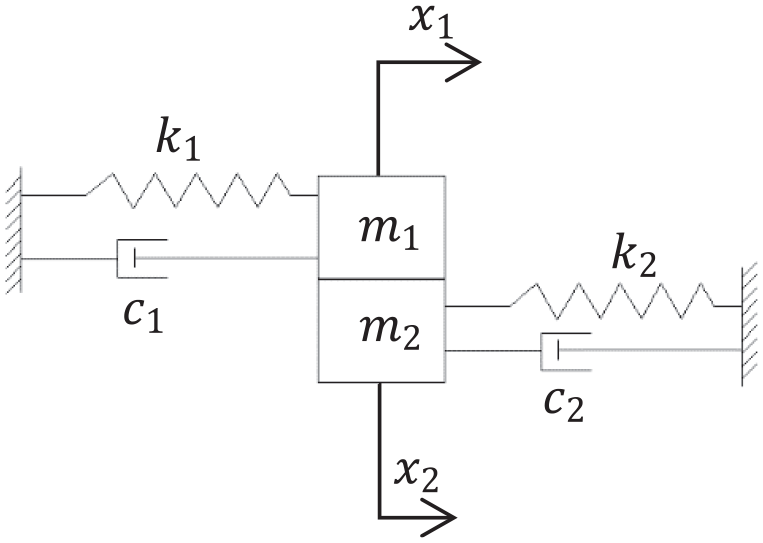
Theoretical model of V-ribbed belts’ vibration.
The characteristic equation of this system is:

Where:
The characteristic equation can be written as a polynomial:
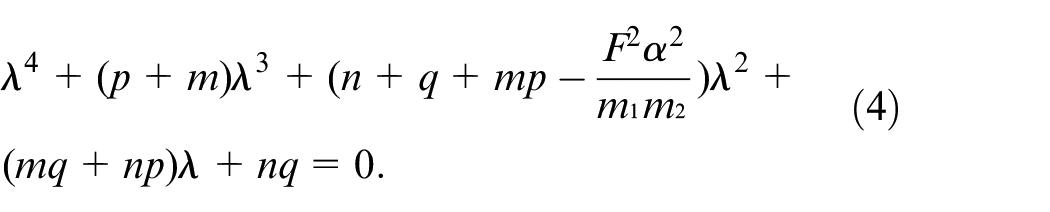
According to Routh stability criterion, when the coefficient of characteristic equation is positive, the system is stable, thus the condition for system instability is:
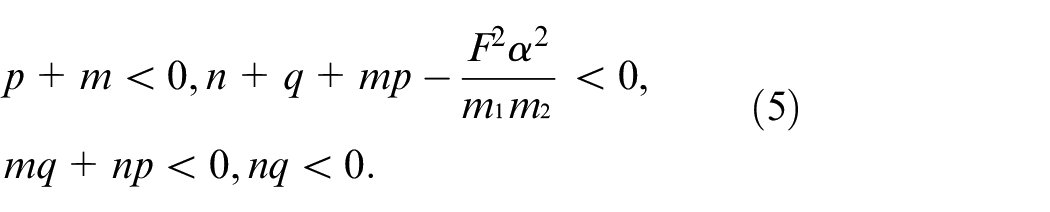
If only the motion of the belt is considered, then:

It can be seen that the stability of the vibration of the V-ribbed belts’ is closely related to the structural parameters and contact parameters of the belt body. In the case of normal tension of the V-ribbed belts’, formula (6) is satisfied. Therefore, the vibration of stick slip will occur in the transmission process of the V-ribbed belts’, resulting in the fluctuation of the internal stress of the V-ribbed belts’, especially in the contact position between the V-ribbed belts’ and the belt wheel, which will produce a large amount stresses and strains in the direction perpendicular to the cross section of the belt wedge. When the frequency of stick slip vibration is close to the natural frequency of a certain order with wedge section, it will cause strong self-excited vibration and sharp friction noise.
Finite element model and results
In order to verify the generation mechanism of high frequency friction noise, the natural frequencies of V-ribbed belts’ cross section with 3, 4, and 6 wedges need to be calculated by modal simulation. The structure of 3PK V-ribbed belts’ cross section is shown in Figure 2, and the cross-sectional size parameters are shown in Table 1.
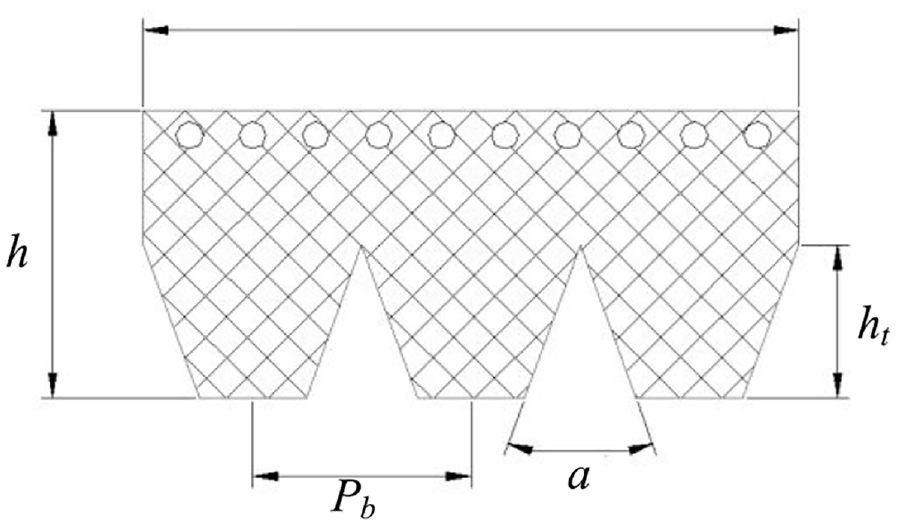
Cross section of 3PK V-ribbed belts.
Cross section dimensions of 3PKV-ribbed belts.

UG (Unigraphics NX) is used to build the 3PK (three wedges) V-ribbed belts cross section model, and then the geometric model is imported into Workbench for parameter setting and grid division. The material type is set as EPDM, Young’s modulus E = 7.84 MPa, Poisson’s ratio μ = 0.41, Density ρ = 1240 kg/m3, and Hex Dominant is used for grid division. The result is shown in Figure 3, with 933 nodes and 110 solid elements in total.
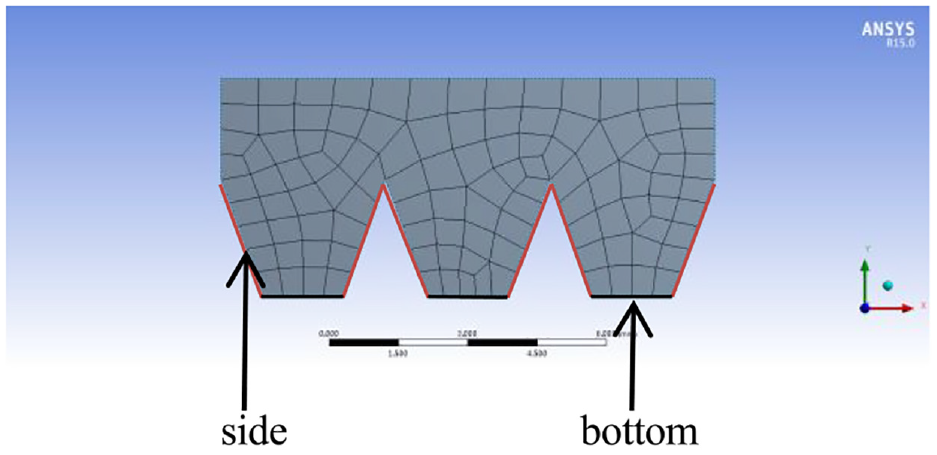
Grid generation results.
When the V-ribbed belt is wedged into the pulley, the side of the V-ribbed belt contacts with the pulley, while the bottom of the V-ribbed belt does not contact with the pulley, The V-ribbed belt can move in the y direction and z directions during transmission, so only the x direction displacement constraint is applied to all sides of the V-ribbed belt, and the prestress is applied to the V-ribbed belt’s surface. The cross-sectional area of the belt is calculated to be 43.415 mm2. When the tension is 400 N, it is equivalent to applying a pressure of 9.213 MPa on the surface of the V-ribbed belt. After confirming the constraint and pressure, the modal module of ANSYS Workbench software is used to modal analysis. Because the low mode is easier to excite than the high mode, only the first four modes of V-ribbed belts’ cross section are calculated. The modal analysis simulation results show that when the tension is 400 N, the first four modal shapes of the cross section are as shown in Figure 4, and the first natural frequency of the cross section is 4265.2 Hz.
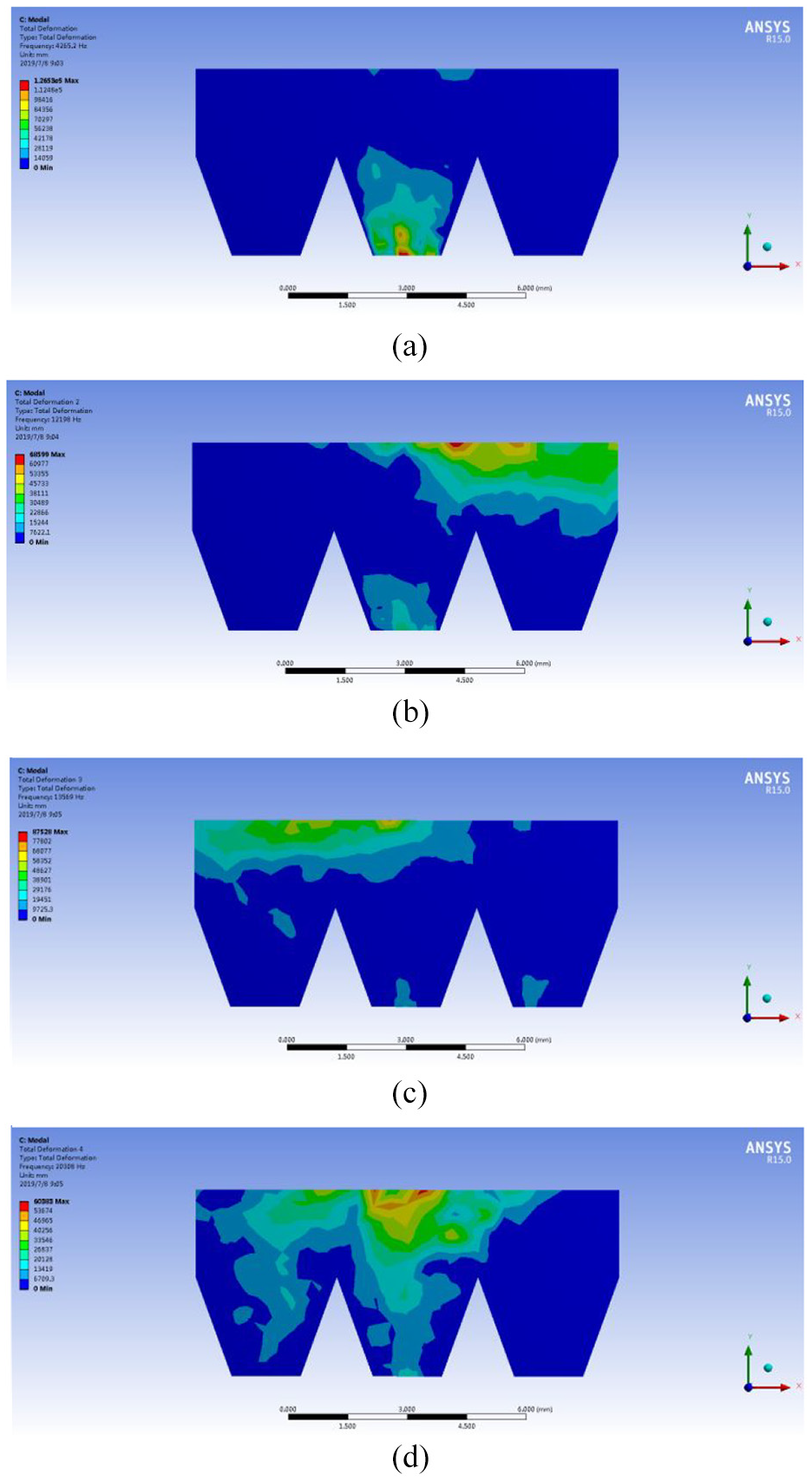
Modal shape of cross section with tension of 400 N: (a) first vibration mode, (b) second vibration mode, (c) third vibration mode, and (d) fourth vibration mode.
The same method is used to identify the modal identification of the 4PK and 6PK V-ribbed belts’ cross sections. The first natural frequency of the 4PK cross section is 4 396 Hz, and that of the 6PK cross section is 4 501.6 Hz.
Friction noise test
The test of noise and vibration is carried out on the belt drive friction testing machine, which mainly includes a fixture, a test pulley, a force sensor, an acceleration sensor, and a sound pressure sensor, etc. The overall structure is shown in Figure 5. The sample belt is connected with the pulley, and the wrap angle between the belt and the pulley is 90°. The upper end of the sample belt is connected with the force sensor through the fixture. The lower end is connected with the force sensor, fixing on the slide, which can be moved up and down to adjust and lock the tension. The speed adjustment range of the pulley is 0 to 80 rpm, and the tension adjustment range is 0 to 800 N. The pulley is made of carbon steel, the pitch diameter is 60 mm, the material of the belt is EPDM, the belt length between the pulley center and the fixture is 200 mm, the sound pressure sensor is located at 130 mm in front of the pulley on the right. The INV9206 sound pressure sensor is used to collect noise signal. The sampling frequency is 20 kHz, the acceleration sensor is bonded at 50 mm above the pulley, and the 84303 acceleration sensor is used to collect the tangential vibration signal, the sampling frequency is 20 kHz.
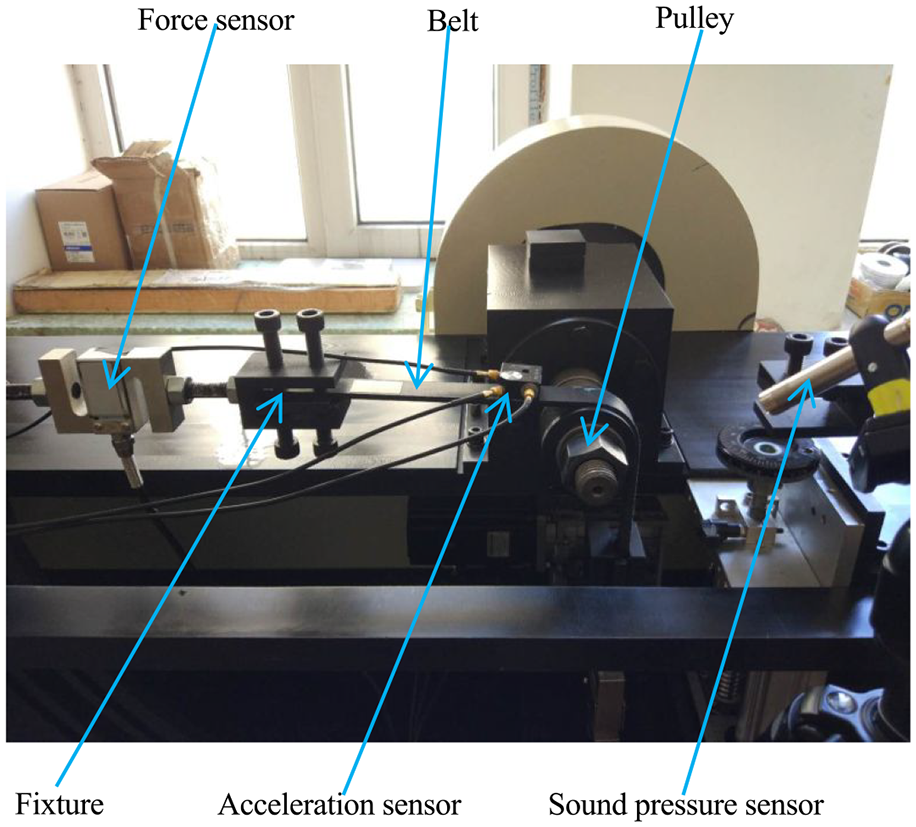
Belt drive friction tester.
During the test, because the belt is fixed tightly by the fixture and the pulley rotates, the rotating speed of the pulley is the relative sliding speed between the belt and the pulley. It is calculated that when the rotating speed of the pulley is 10 rpm, the relative sliding speed between the belt and the pulley is 0.06 m/s. When the rotating speed of the pulley is stable, the noise and vibration signals are collected.
Test results
Results analysis
In the process of V-ribbed belts’ friction transmission, there are transverse vibration perpendicular to the motion direction of the frictional pair and longitudinal vibration parallel to the motion direction of the friction pair. It has been shown that the frequency of high frequency friction noise increases with the increase of relative sliding speed. Therefore, in order to observe the friction noise better from the time-domain signal, the pulley should maintain a low speed. When the tension is 400 N and the relative sliding speed is 0.06 m/s, the time-domain signals of 3PK V-ribbed belts’ noise and vibration are shown in Figure 6. The high frequency friction noise occurs six times and has obvious intermittent characteristics. The high frequency friction noise and the V-ribbed belts’ transverse vibration have high consistency in amplitude and phase changes, which shows that transverse vibration affects the generation of high frequency friction noise.
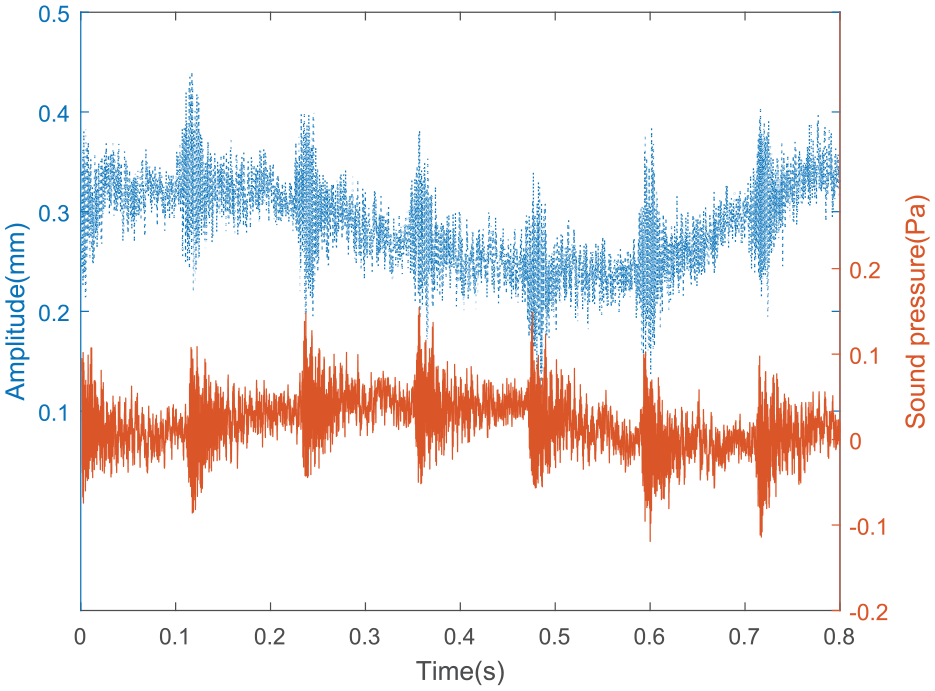
Time domain characteristic curve of 3PK V-ribbed belts’ noise.
With the 3PK V-ribbed belt as the test object, the frequency-domain characteristic curve of transverse vibration and noise is shown in Figure 7 when the tension is 400 N and the relative sliding speed is 0.12 m/s. It can be seen from the figure that the vibration has an obvious peak at 2160 Hz, but does not produce large noise, which is considered to be caused by the vibration of other parts of the belt drive friction tester. Meanwhile, at 4206 Hz, the noise sound pressure and vibration energy increase significantly. This is because the frequency of vibration is close to the natural frequency of the cross section 4265.2 Hz, which causes the self-excited vibration of the V-ribbed belts, causes the high frequency friction noise, and causes the energy of vibration and noise to increase suddenly at 4206 Hz. Similarly, the peak of noise is also very obvious at the double frequency 8463 Hz of cross section natural frequency. This is because the frequency of vibration is close to twice of the cross section’s natural frequency, which results in self-excited vibration of V-ribbed belts and high frequency friction noise, which verifies the generation mechanism of high frequency friction noise.
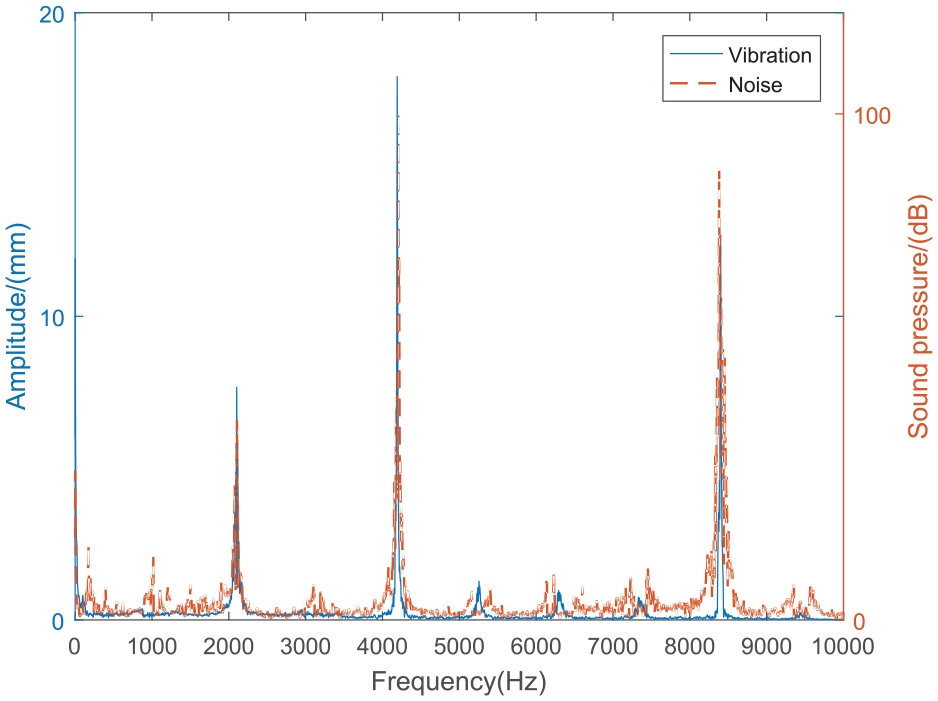
Frequency response curve of 3PK V-ribbed belts’ vibration and noise.
The frequency response curve of 4PK V-ribbed belt noise and transverse vibration is shown in Figure 8. It can be seen from the figure that the vibration frequency response curve also peaks at 2160 Hz but does not produce large noise, so the vibration is caused by the vibration of other parts of the belt drive friction tester. The frequency response curves of vibration and noise have obvious peaks at 4337 Hz. This is because the frequency of vibration is just close to the natural frequency of 4396 Hz of the cross section of 4PK V-ribbed belt, and the mode coupling occurs, which causes the strong self-excited vibration of the belt and causes high frequency friction noise, and leads to the increase of noise sound pressure at 4337 Hz. Similarly, the vibration and noise signals also show peaks at 8750 Hz, the double frequency of the cross section, which is consistent with the generation mechanism of high frequency friction noise.
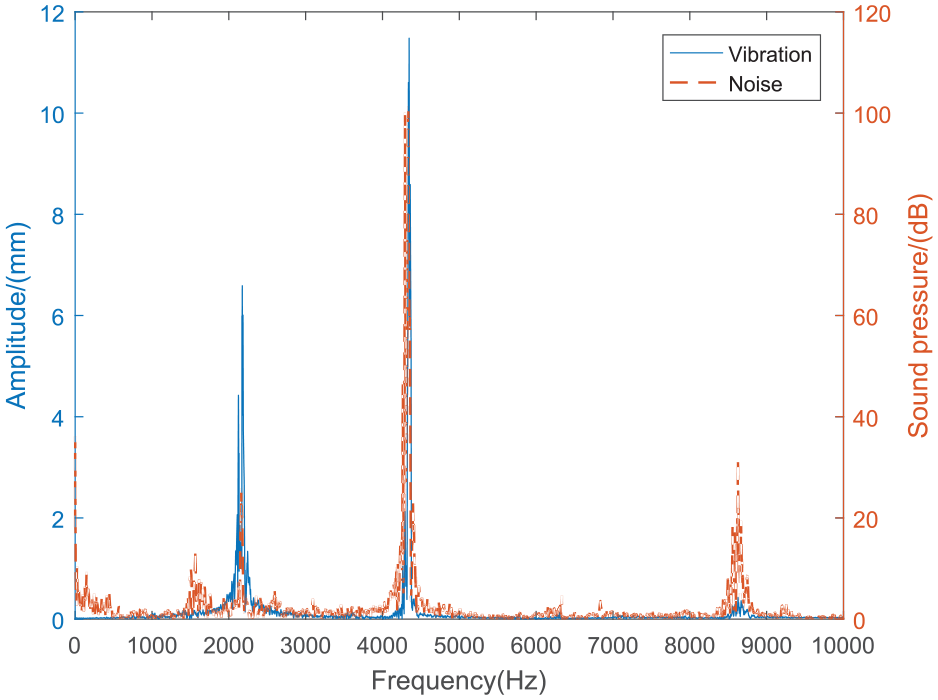
Frequency response curve of 4PK V-ribbed belts’ vibration and noise.
The frequency response curve of noise and transverse vibration of 6PK V-ribbed belt is shown in Figure 9. It can be seen from the figure that the energy of vibration and noise is obviously concentrated at 4595 Hz. This is because the frequency of vibration is similar to the natural frequency, 4501.6 Hz, of the 6PK V-ribbed belts’ cross section, which causes self-excited vibration of V-ribbed belt, and causes high frequency friction noise. It is consistent with the mechanism analysis of high frequency friction noise of 3PK and 4PK V-ribbed belts.
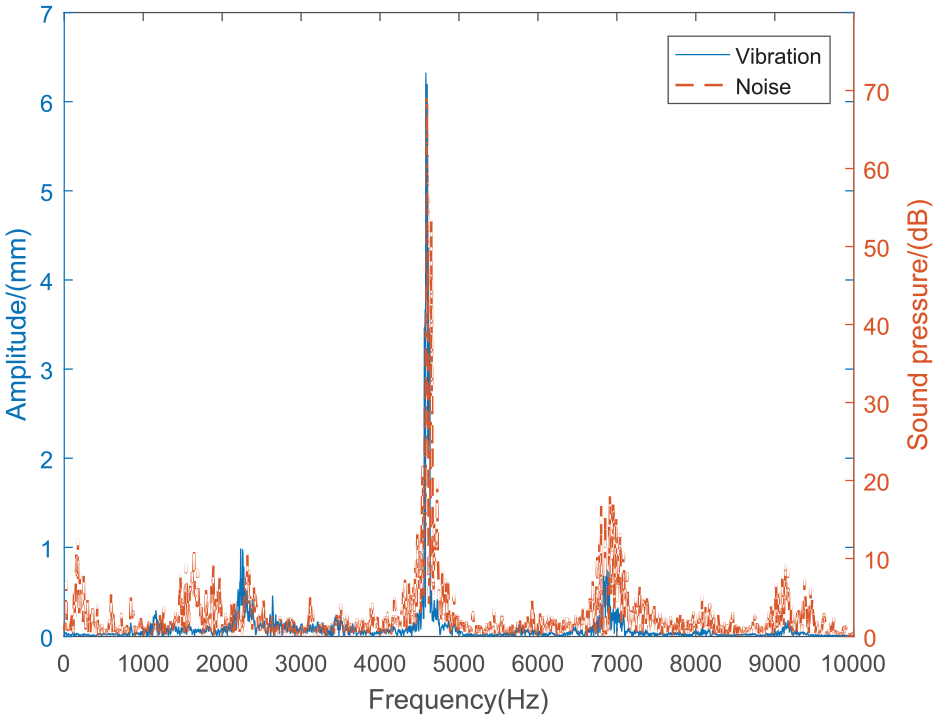
Frequency response curve of 6PK V-ribbed belts’ vibration and noise.
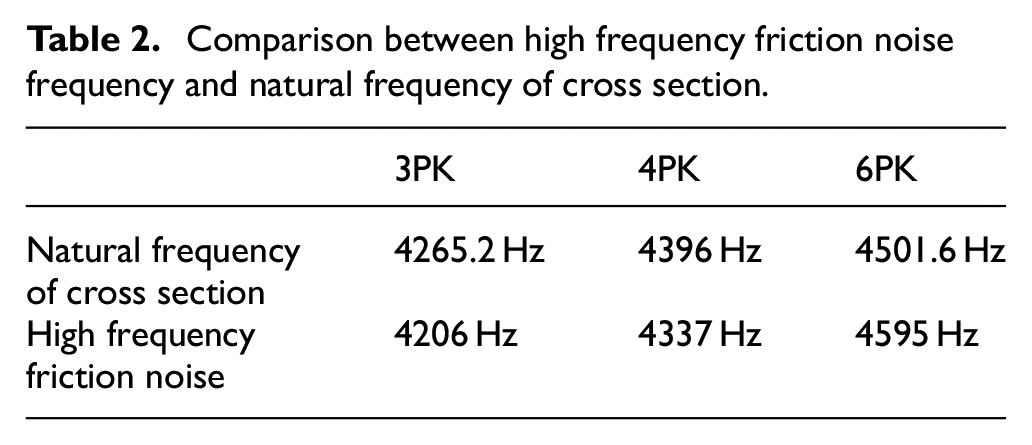
See Table 2 for comparison between high frequency friction noise frequency and natural frequency of V-ribbed belts’ cross section. It can be seen from the table that the frequency of cross section’s natural frequency is consistent with that of high frequency friction noise, which is consistent with the mechanism analysis of high frequency friction noise. When the materials of the belts are the same, the frequencies of natural frequency and high frequency friction noise increase with the increase of the number of belt wedges.
Comparison between high frequency friction noise frequency and natural frequency of cross section.
Effect of tension and relative sliding speed on friction noise
In order to study the influence of tension and relative sliding speed on the frequency of high frequency friction noise, the single-factor test method is used to test the influence of tension and relative sliding speed on high frequency friction noise of 3PK V-ribbed belts. The frequency of high frequency friction noise is obtained through spectrum analysis of the noise signal obtained from the test. Figure 10 shows the influence curve of the tension under different relative sliding speeds on the frequency of high frequency friction noise. Figure 11 shows the influence curve of the relative sliding speed under different tension on the frequency of high frequency friction noise. It can be seen from Figures 10 and 11 that the frequency of 3PK V-ribbed belt’s high frequency friction noise fluctuates around 4200 Hz, and the changes of tension and relative sliding speed hardly affect the frequency of high frequency friction noise.
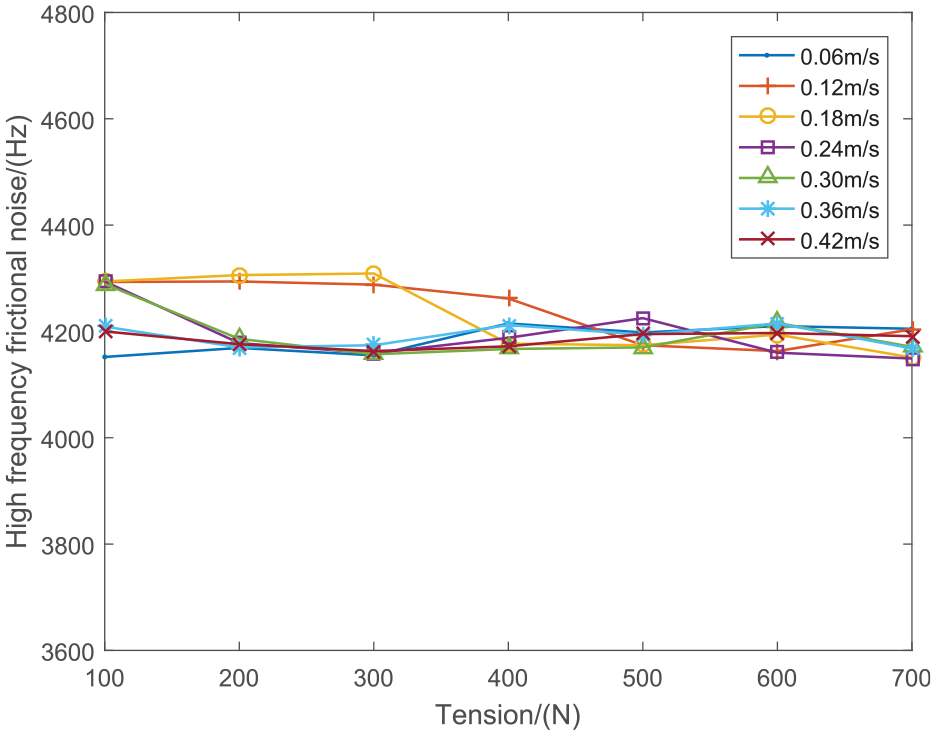
Effect of tension on high frequency friction noise frequency.
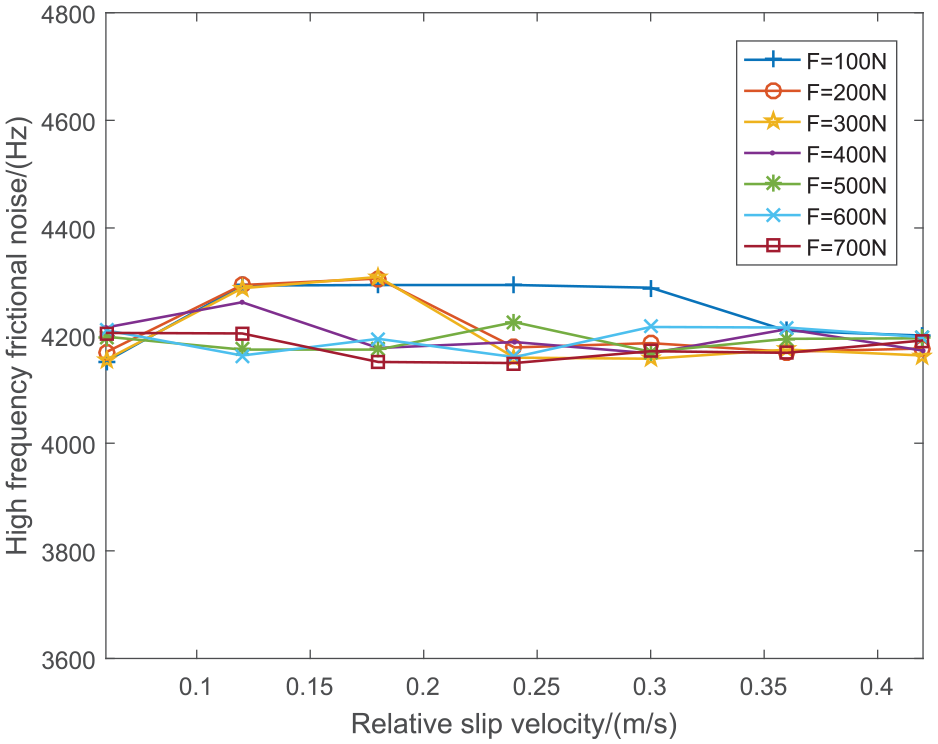
Effect of relative sliding speed on high frequency friction noise frequency.
It can be seen from the above analysis that the frequency of high frequency friction noise of V-ribbed belt is not affected by tension and relative sliding speed, and the frequency of high frequency friction noise is closely related to the natural frequency of V-ribbed belts’ cross section, while the natural frequency of cross section is greatly affected by the material of belt, so the control of high frequency friction noise can be achieved by changing the component of belt material, which will be the next step of research.
Discussion
The results of simulation and test show that the frequency of friction noise is close to the natural frequency of cross-section of V-ribbed belt, and the friction noise is caused by self-excited vibration of V-ribbed belt. Sudden changes in the transmission load of the V-ribbed belt will cause the slip between the belt and the pulley to increase suddenly, which will increase the vibration. And when the frequency of vibration is close to the natural frequency of the cross-section of the belt, it will cause strong self-excited vibration and sharp friction noise. Sharp friction noise is generated when the slip is large and the frequency of the noise is related to the natural frequency of the cross-section. In order to control the friction noise, on the one hand, by changing the arrangement of the gear train, the sliding of the V-ribbed belt can be reduced to prevent excessive sliding. On the other hand, the natural frequency of the cross section can be changed by altering the material of the belt, so that the natural frequency of the cross section is different from the vibration frequency when the belt is working, and self-excited vibration will be avoided. This will be our next research content.
Conclusion
The theoretical model of the vibration of the V-ribbed belt is established, and the conditions for unstable vibration are derived. It is pointed out that mode coupling occurs when the frequency of vibration is close to the natural frequency of V-ribbed belts’ cross section, which results in strong self-excited vibration and high frequency friction noise of V-ribbed belts.
The transverse vibration of V-ribbed belts affects the high frequency friction noise. The high frequency friction noise has a high consistency with the amplitude and phase of the transverse vibration of V-ribbed belts. Changes in tension and relative sliding speed do not affect the frequency of high frequency friction noise.
The frequency of friction noise is related to the natural frequency of the section with wedge, so the frequency of friction noise can be controlled by changing the wedge and material.
Footnotes
Declaration of conflicting interests
The author(s) declared no potential conflicts of interest with respect to the research, authorship, and/or publication of this article.
Funding
The author(s) disclosed receipt of the following financial support for the research, authorship, and/or publication of this article: Development and reform commission project of Jilin Province (2019C040-1); Special cooperation project of Changchun science and technology program (18DY031).
