




Abstract
Stochastic disturbances play a profound problem in the power system, which have an important impact on the stability of the power system. The paper proposes the stability analysis of stochastic disturbance bounded value of linear power system, and presents that the stability of power system has bounded value under stochastic disturbance and additional disturbance, and gives the analysis process in combination with stochastic differentiation. The equation theory proposes a numerical solution based on mean stability to calculate the boundedness of infinite systems under the influence of stochastic disturbance and additional disturbance. The results show that the system has bounded value stability under the disturbance.
Introduction
The power system is a multi-dimensional complex system with stochastic disturbances. The quality of power is directly related to the normal development of society. Disturbance is one of the important factors affecting power quality and normal operation of power systems. By studying the impact of noise on grid stability, people can better improve the system and reduce the problems caused by grid instability in production and life. There have been many stochastic stability analysis methods.
For the study of the stability of stochastic power systems, stochastic modeling and stability analysis in wind power systems are proposed, which are based on Markov theory, the response and stability of the power system under small Gaussian stochastic excitation are used. 1 For uncertainty and stochastic ness discussion, probabilistic transients stability assessment tools is proposed in power systems. 2 There has been considerable recent interest in the analysis of small signal stability problem in power system operation, 3 The literature studies the control network system based on Markov delay characteristics. 4 Stochastic differential equations (SDEs) are employed. 5 An evaluation of parameter uncertainty for power system dynamics calculated for the feasible method. Some literatures focus on the problem of Gauss stochastic small excitation, and have achieved good results.6,7
The scale of the interconnected power grid is constantly expanding, and stochastic disturbances caused by loads, faults, etc. are becoming more common, which makes the power system suffers. The stochastic disturbance is more and more obvious, the power system stability is affected to some extent.8–11 Some literatures use the improved probability method to analyze the dynamic stability under different operating modes, 12 some propose an evaluation. 13 A feasible method for calculating the influence of parameter uncertainty on the dynamic behavior of power systems are developed.14,15 The analysis of the stochastic disturbance stability of different power systems are proposed.4,16–18
This paper firstly describes the current research status of stochastic power system stability, and analyzes the stability of stochastic linear power system. Based on this, the mean stable method is analyzed. Then simulate the system stability and analyze the simulation results. Finally, and the significance of studying the stability of stochastic power systems is illustrated.
Stable interval stability of power system stochastic disturbance
In many practical projects, the disturbance experienced by the system can be approximated as a zero-mean Gaussian process with smooth independent increments. A stochastic linear model and stochastic nonlinear model can be expressed as in general 19 :
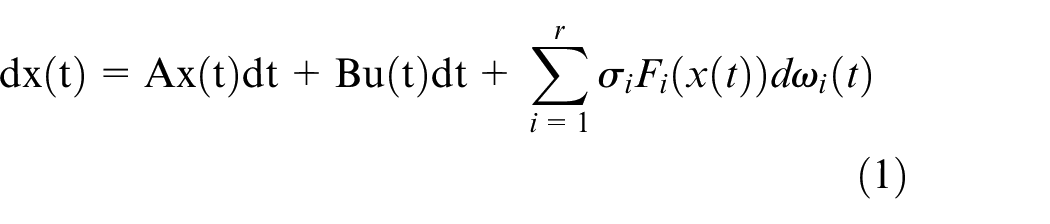

Based on this basis, considering the additional disturbance of the stochastic system, a mathematical model of the following Stochastic state is formed,

Where f(x(t))dt denotes an n-dimensional vector in equation (3). Where
Model analysis
The state space equation in a continuous linear system is defined generally 19 :

As such, linearize the above equation is chosen as follows,

Equation (5) is the object model. Where: x(t) is an n×1 state vector, A is an n × n coefficient matrix. g(t) is the m×1 control vector. t is continuous time. In the absence of disturbance, the power system is usually in stable operation. This paper will study the stability of stochastic power systems with stochastic and additional disturbance.
Stochastic disturbance is a type of disturbance that is unpredictable at a given instant due to the accumulation of large amounts of undulating disturbances that are randomly generated in time. Additional disturbance is a type of disturbance superimposed on a signal, which is often referred to as a secondary additional disturbance, whether there is a signal or not. The amplitude distribution follows the Gaussian distribution, and the spectral power density is uniform, so it can be considered Gaussian noise, and considered as Gaussian noise. Generalized exponential model of additional disturbance
7
is

where ξ(t) represents a stochastic disturbance vector, and l(v(t)) is an additional disturbance vector. It is now necessary to study whether the upper form is bounded and whether the solution of the model converges to equilibrium in continuous time.
Stability analysis
Stochastic stability theory is used to solve stochastic systems where the initial state is not in equilibrium. At time [t_0, ∞), it is judged whether the distance of the solution of the stochastic system to the equilibrium state is bounded, and whether the solution of the stochastic system converges to the equilibrium state at t→∞.
Power system stochastic disturbance bounded value stability model
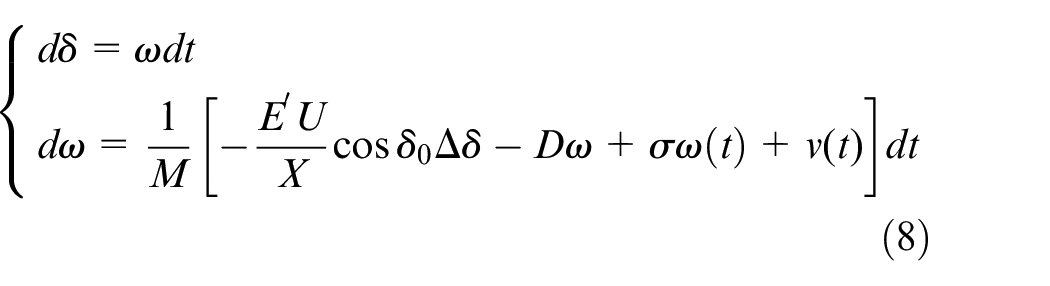
Equation (12) is considered as the definition of a single-machine infinite system. The equation of rotor motion after adding stochastic disturbance and additional disturbance to the generator can be written as follows:

where: M is the inertia time constant; δ denotes the power angle, ω is the rotational speed, t is the time, D is the damping coefficient, σ represents the intensity of the stochastic disturbance ω(t), and ε>0, such that
Model mean stability
Regarding the stability study of power systems, the numerical simulation of transient differential algebraic equations for power systems under stochastic loads is proposed. 20 This paper presents a numerical method of mean stability to solve the stability of the system.
The mean stability is studied
12
: In the literature,
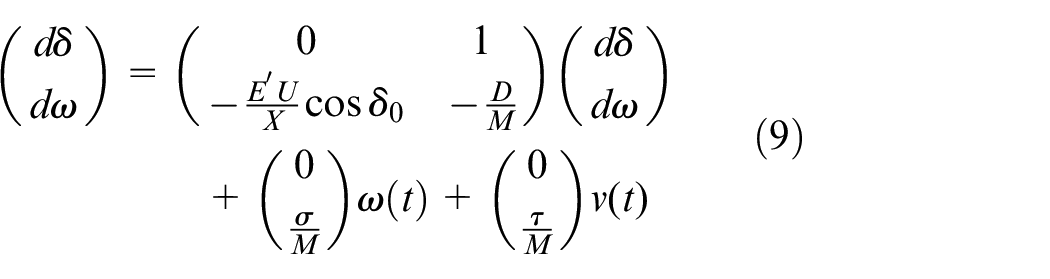
The above equations are given by:

Where,
According to the stochastic differential equation, the secondary additional stochastic disturbance has the same stochastic attribute:

The relationship between mathematical expectation and variance in probability theory:
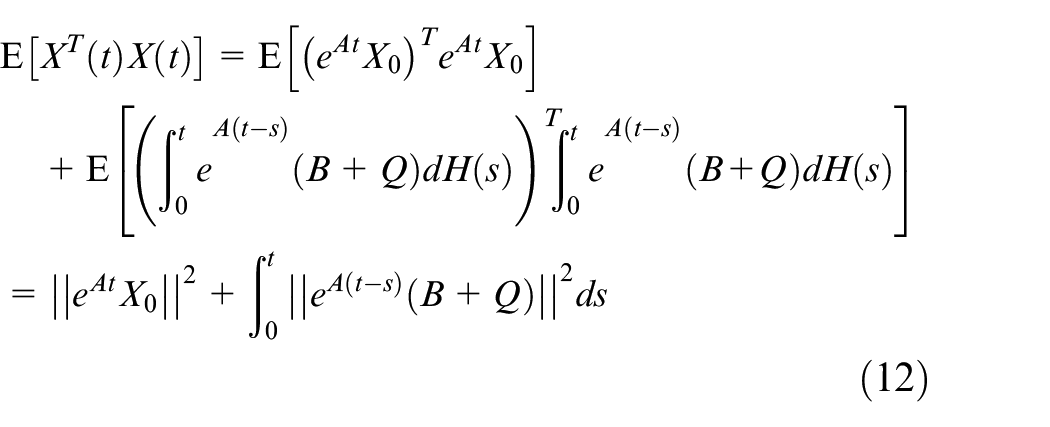
and
1)

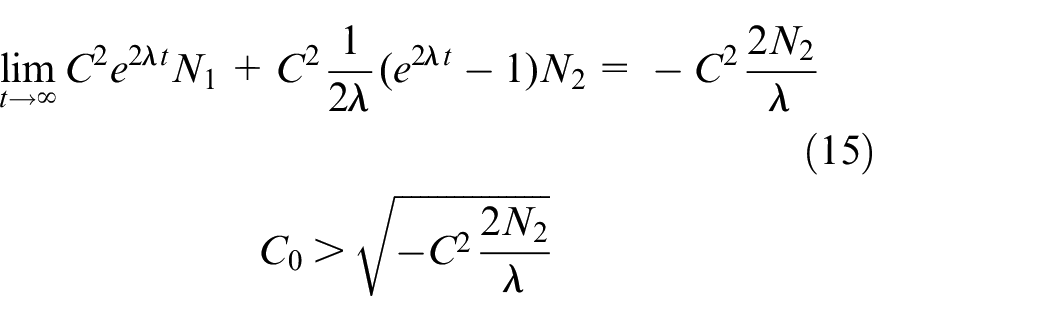
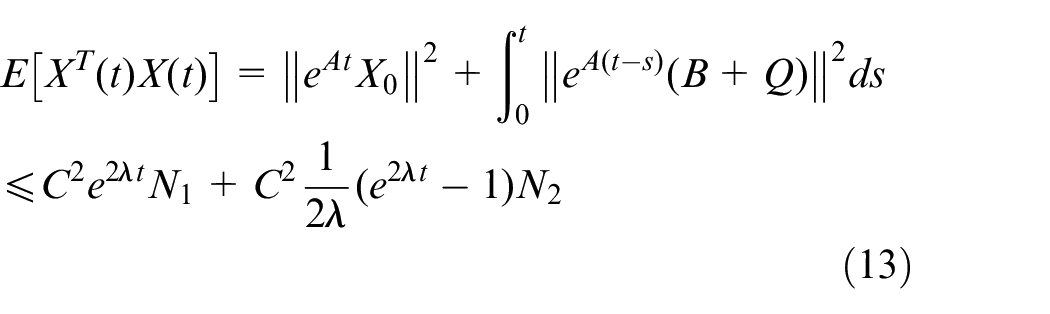
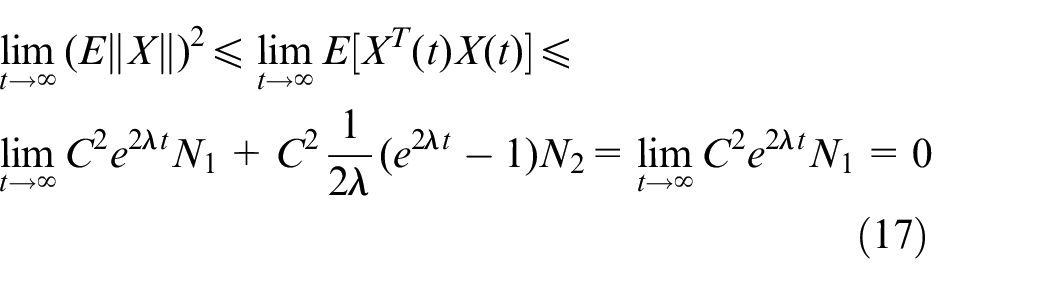
Since the real part of the eigen values of the state matrix of the small disturbance stabilizing system is less than zero, so there is λ < 0. We obtain the differential according to the nature of matrix as follows:

then,

2)


3)

Then,
4)
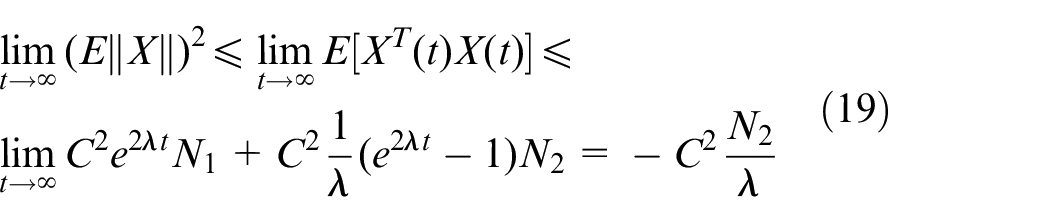

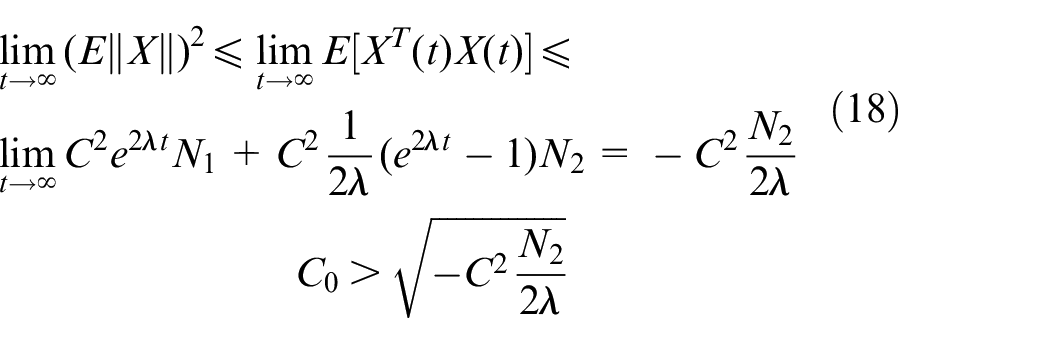
we can obtain C in a series as follows,

Where,

From the above equations, the interval of the boundary value can be deduced from the following:

5)

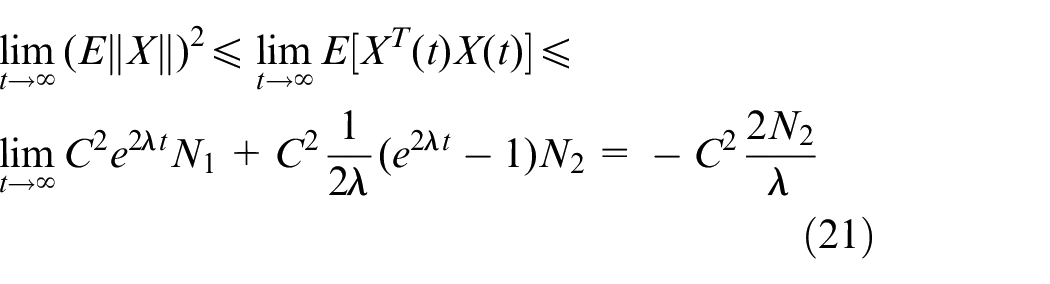


The above equations are used to analyze the stability of the stochastic disturbance bounded value of power system. By comparing the system with stochastic disturbance and additional disturbance, it is concluded that the system with additional disturbance increases than the boundary value of only stochastic disturbance, and the boundary value is quantified. Further analysis shows that stochastic disturbance in power systems that only contain stochastic disturbance is part of a system with both multi-dimensional stochastic and additional disturbance. For a multi-dimensional complex system power system with stochastic disturbances, the stochastic disturbance and additional disturbance of the stochastic linear power system are stable, with stochastic small disturbances, the stochastic power system is mean stable and free from Stochastic and additional disturbance.
Therefore, the small disturbance stochastic stability system is bounded, which proves that the system mean is stable under the disturbance.
Results and discussion
The stability of the synchronous operation of the power system is judged according to the variation law of the system voltage after the disturbance, and this property is also called voltage stability. The simulation model will study the effects of disturbance of different intensities on voltage stability.
A set of data is generated by using a function to simulate a power system site. Setting the sampling frequency to 1000 Hz, the number of sampling points to 600, and the grid frequency to 50 Hz to model the power system signal. Set the Fourier transform data point to 512, and perform Fourier transform on the sampled signal to obtain the spectrum signal, as shown in Figure 1.
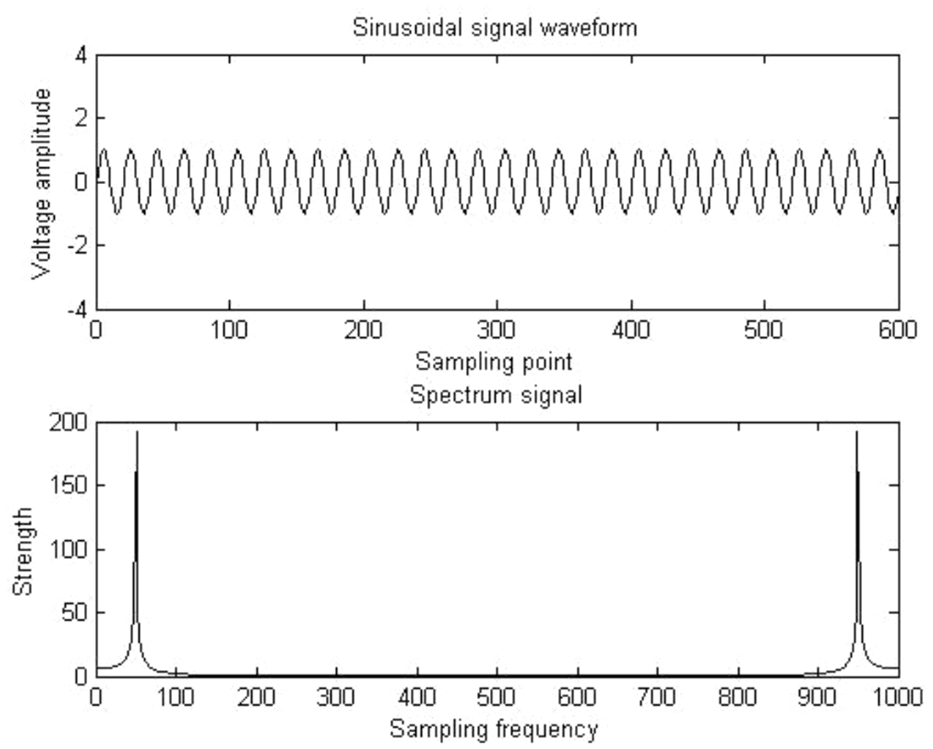
Power system spectrum signal.
During normal and stable operation, the voltage of the system is constant and the frequency domain signal is also in a convergent state.
When disturbance is introduced, the sampled signal receives a change in the disturbance waveform. Similarly, the spectrum signal is obtained after performing Fourier transform on the set data points is as shown in Figure 2.
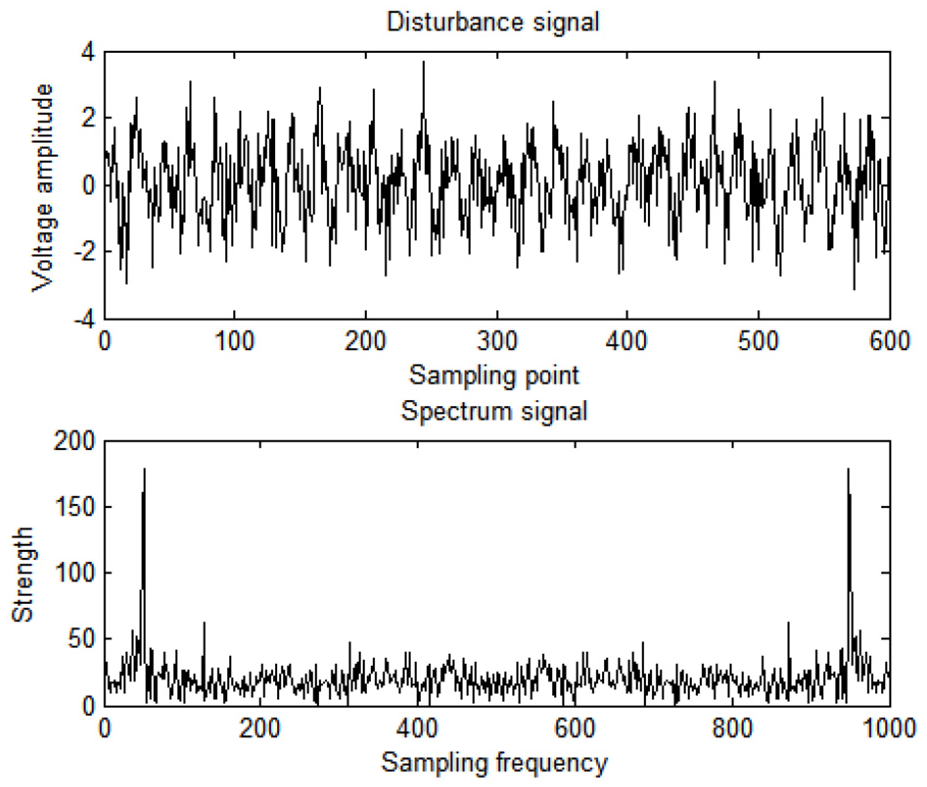
Spectral signal under stochastic disturbance.
When the disturbance intensity is 20%, the voltage fluctuation and the Fourier transformed spectrum signal are shown in Figure 3.
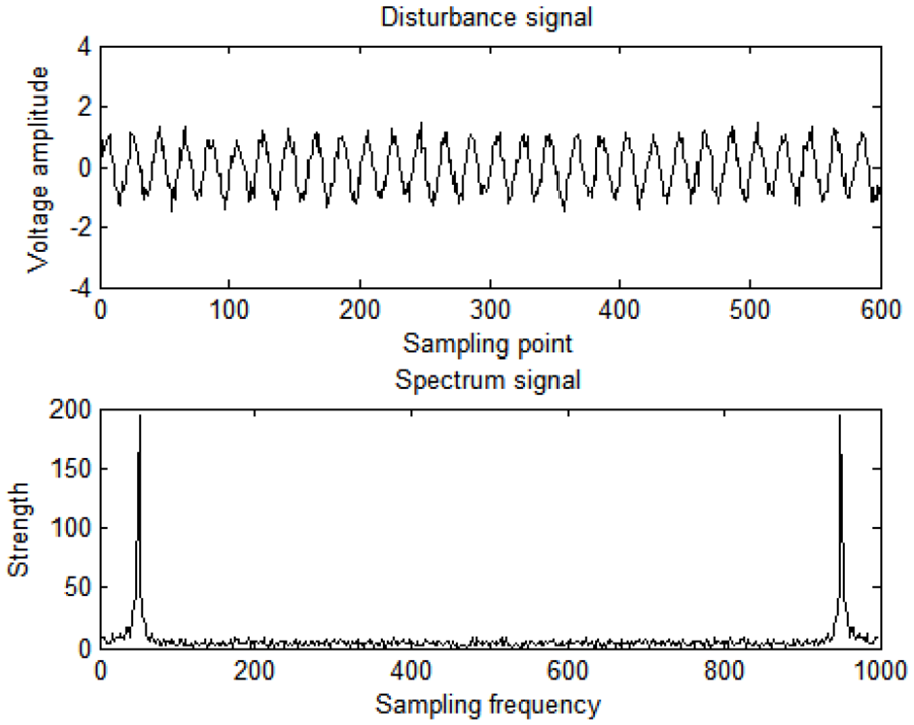
20% stochastic disturbance intensity spectrum signal.
It can be seen that the introduction of 20% disturbance intensity, the voltage is disturbed, the signal fluctuates around the equilibrium point in a small range, and the amplitude of the fluctuation does not exceed ±2 V, which does not have much influence on the equilibrium point of the system. After transforming the time domain signal into a frequency domain signal by Fourier transform, it can be found that the spectrum of the periodic signal is a non-periodic line, called a spectral line. The spectral line amplitude has a decreasing trend as a whole, and the system converges.
It is reflected from Figure 4 that when 50% disturbance intensity is introduced, the voltage fluctuation amplitude gradually increases, but the fluctuation amplitude still does not exceed ±2 V. The fluctuation of the frequency domain signal increases slightly, and the system is still in a stable state.
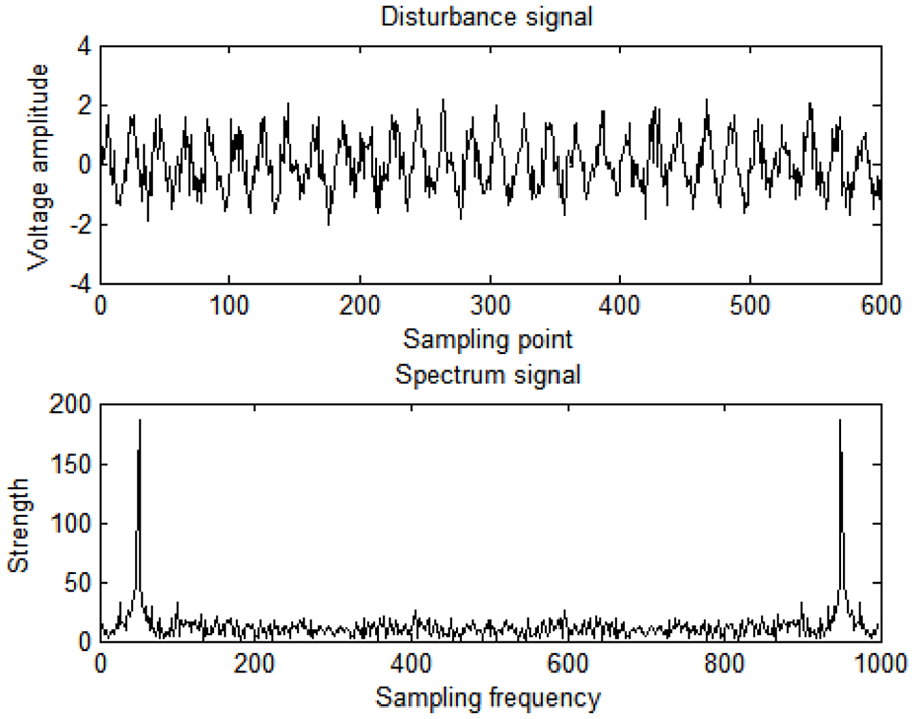
50% stochastic disturbance intensity spectrum signal.
When the disturbance intensity is 80%, the voltage fluctuation and the Fourier transformed spectrum signal are shown in Figure 5.
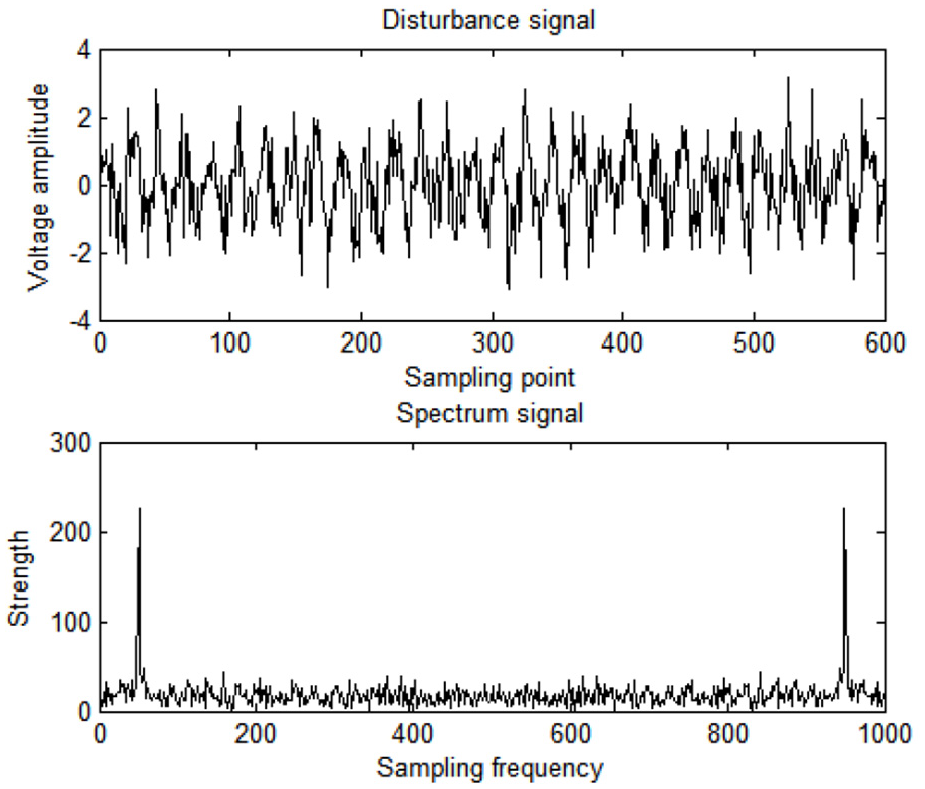
80% stochastic disturbance intensity spectrum.
When 80% a secondary additional disturbance intensity is introduced, the voltage fluctuation amplitude is large. In the frequency domain signal, the fluctuation of the spectral line also increases, and the system gradually loses stability.
The simulation results show that the power system has average stability when it is interfered by low-intensity a secondary additional disturbance. The signal fluctuates around the equilibrium point and does not affect the equilibrium stability. This will have a great impact on the normal operation of the power system, so a secondary additional disturbance in the production of electric energy should be minimized.
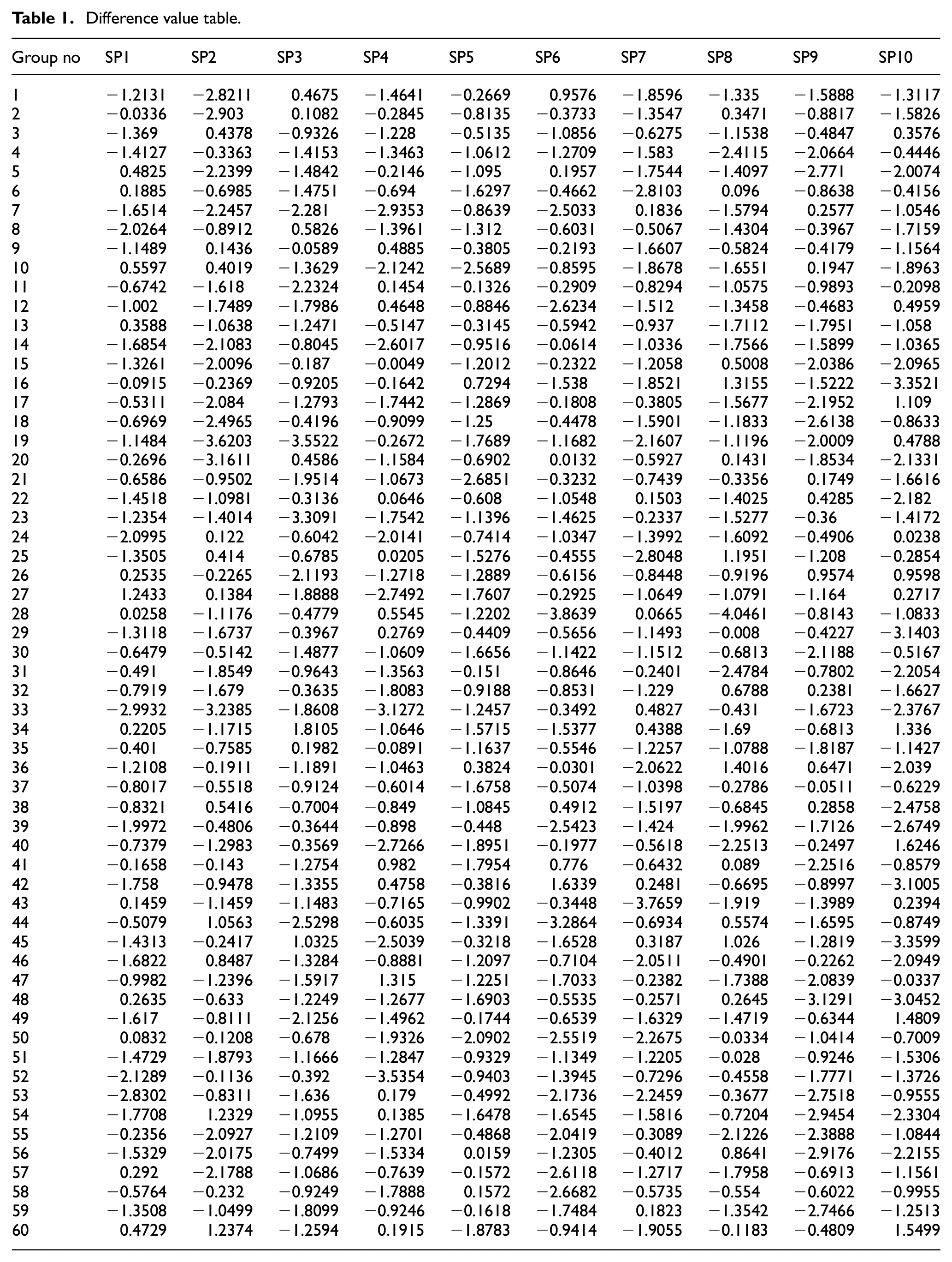
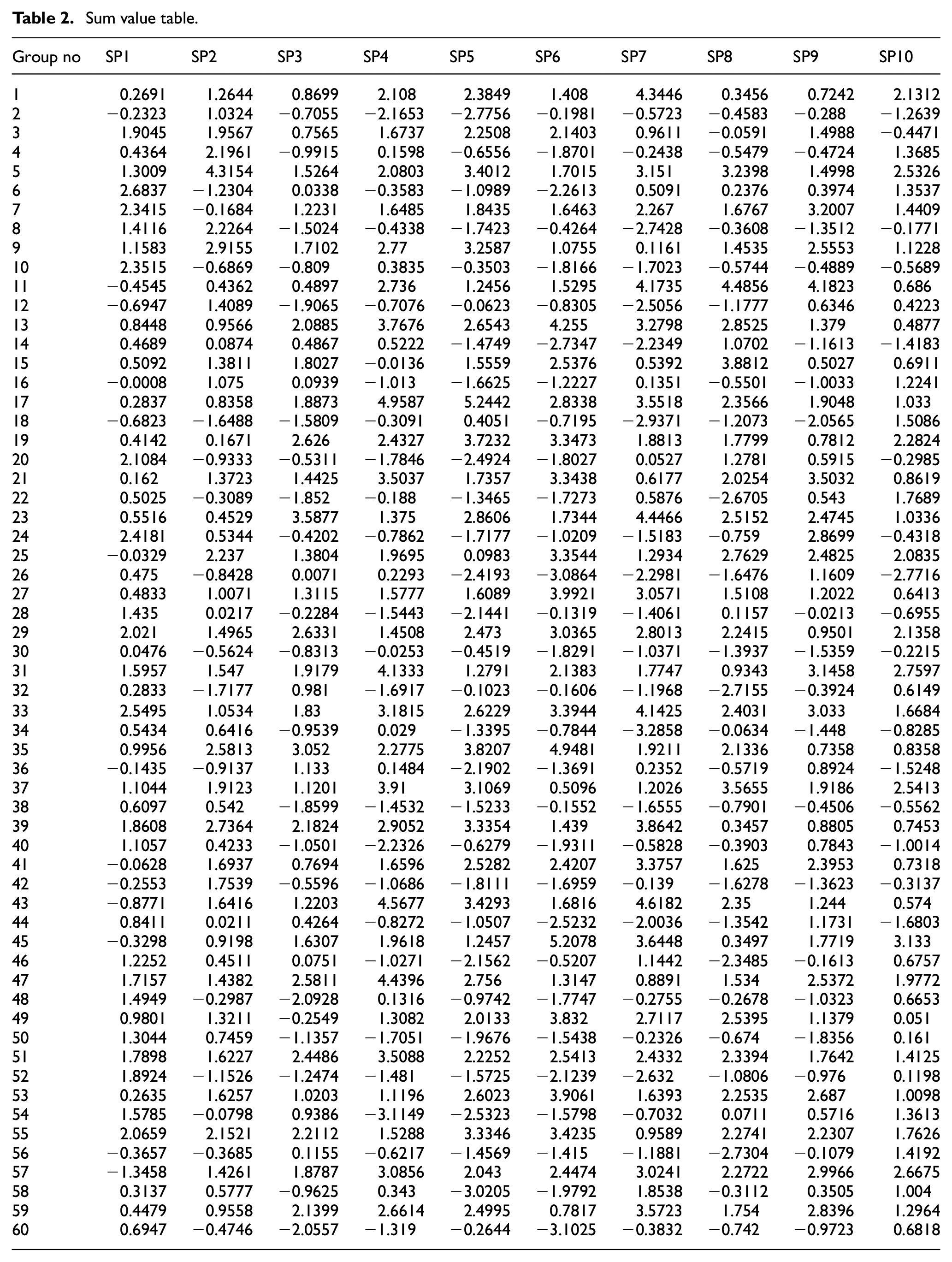
As shown in Figure 6, the difference between stochastic disturbance and additional disturbance is the boundary value of the system, parameter values are shown in Table 1. As shown in the results in Figure 7, the sum between the two is the boundary value of the stochastic linear power system, parameter values are shown in Table 2. Sampling point (SP) means that each group has 10 points. Here, stochastic disturbance difference is used, and there is a bounded value interval for the stochastic disturbance of the linear power system. The system output with stochastic disturbance, and secondary additional disturbance has presence boundary value.
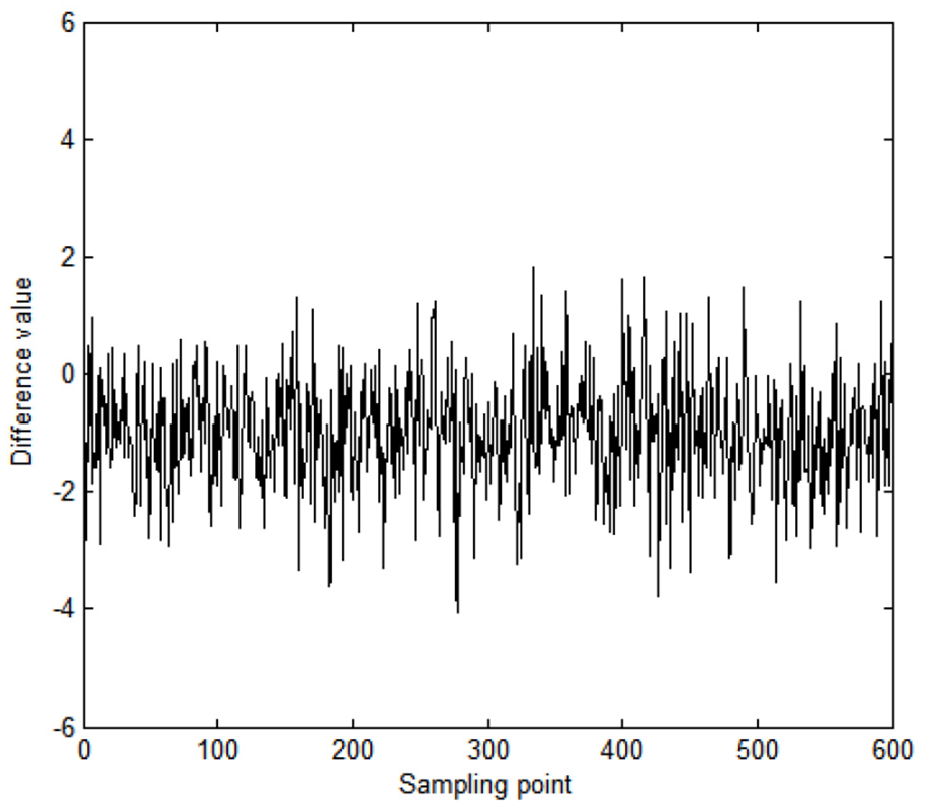
Boundary difference between stochastic disturbance and additional disturbance.
Difference value table.
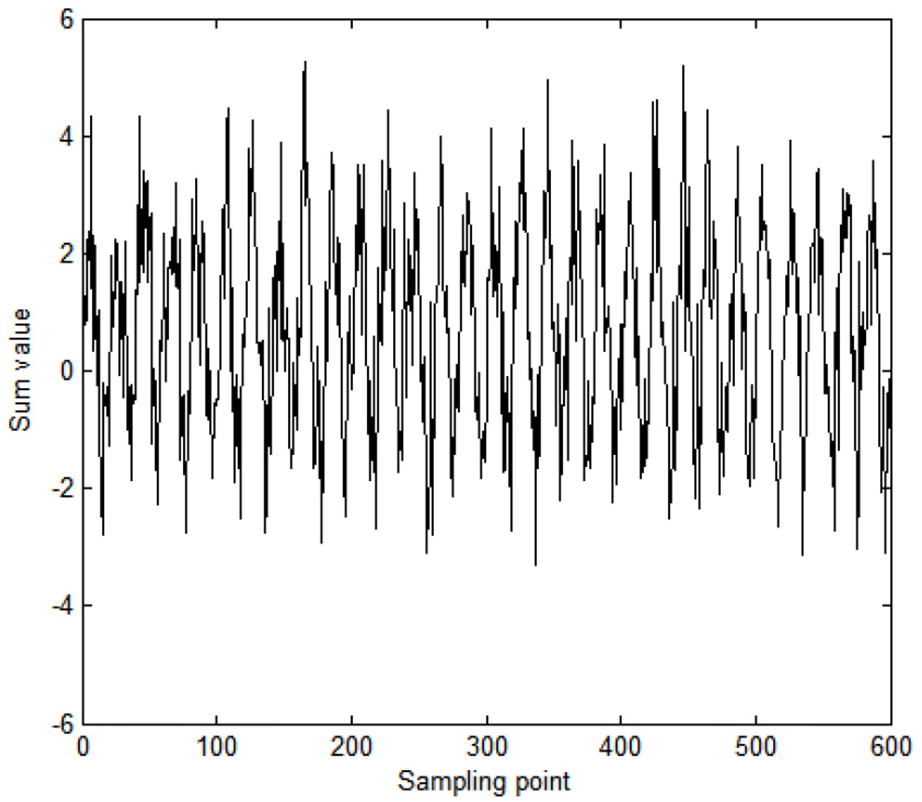
Boundary sum between stochastic disturbance and additional disturbance.
Sum value table.
Conclusion
In the process of social and economic development, the power system will be affected by more and more factors. The power system is a high-dimensional, multi-objective, associative and decentralized system. The traditional model can not meet the new factor disturbance situation, which makes it impossible to accurately judge the stability of the system. Therefore, modeling issues influenced by more factors are of great significance to power system stability. We will further study the mean stability and mean square stability of stochastic linear power systems under multi variate stochastic disturbances.
This paper studies the stability of the bounded value of a stochastic linear power system under stochastic disturbance and additional disturbance. The causes of various disturbances are expounded, the research status of such problems is analyzed, the mathematical model under stochastic state is proposed, and the model is analyzed and calculated. The mean stable method is used to calculate the system bounded under stochastic disturbance. The system with additional disturbance is introduced. The results show that the system is in a stable state, which verifies the existence of bounded value stability of stochastic disturbance in linear power systems.
Footnotes
Declaration of conflicting interests
The author(s) declared no potential conflicts of interest with respect to the research, authorship, and/or publication of this article.
Funding
The author(s) disclosed receipt of the following financial support for the research, authorship, and/or publication of this article: This work is supported by Anhui Province Natural Science Foundation (1908085MF215), Pre-research of National Natural Science Fund Project of Anhui Polytechnic University (Xjky02201905).
