




Abstract
A novel performance seeking control) method based on Beetle Antennae Search algorithm is proposed to improve the real-time performance of performance seeking control. The Beetle Antennae Search imitates the function of antennae of beetle. The Beetle Antennae Search has better real-time performance because of the objective function only calculated twice in Beetle Antennae Search at each iteration. Moreover, the Beetle Antennae Search has global search ability. The performance seeking control simulations based on Beetle Antennae Search, Genetic Algorithm and particle swarm optimization are carried out. The simulations show that the Beetle Antennae Search has much better real-time performance than the conventional probability-based algorithms Genetic Algorithm and particle swarm optimization. The simulations also show that these three probability-based algorithms can get better engine performance, such as more thrust, less specific fuel consumption and less turbine inlet temperature.
Keywords
Introduction
The coupling relationship between the controllers of aircraft and engine is seldom taken into account in the conventional controller systems design process. 1 However, the coupling relationship between these two parts is becoming increasingly close with aerospace technology developments.2,3 The aircraft performances are always affected by the this coupling relationship, which may increase overflow resistance, after-body drag and so on.3,4 Therefore, the performance seeking control (PSC) is proposed by NASA (National Aeronautics and Space Administration).5,6 PSC seeking some best engine performance for a specific flight mission, such as maximum thrust, minimum turbine temperature or minimum specific fuel consumption. Meanwhile, the operating engine should operate within all limits. The on-board model and optimization algorithm are the two key points to realize PSC. The main job of this paper is focus on the second one—the optimization algorithm.
NASA developed PSC based on linear programming (LP) in the 1990s, for better engine performance.5,6 However, the control error is inevitably existing if the engine model is linearized due to the strong nonlinear characteristic of engine. Therefore, some scholars proposed a series of PSC optimization algorithms,7–17 such as MAPS (Model-Assisted Pattern Search), 18 SQP (Sequential Quadratic Programming),19,20 FSQP, 7 PSMA (Particle Self-Migrating Algorithm),8,9 GA (Genetic Algorithm), 10 PSO (particle swarm optimization), 11 IA (Interval Analysis). 12 During these algorithms, the probability-based algorithms, such as GA, PSO, make engine get better engine performance. The main reason is that the engine is a strong nonlinear object and has many local optimum values. The probability-based algorithms have strong search ability for this problem. However, the probability-based algorithms always have bad real-time performance. Inspired by the searching behavior of beetles which imitates the function of antennae, Jiang proposed Beetle Antennae Search (BAS).13–17 The objective function only calculated twice in BAS at each iteration. That is why the BAS has better real-time performance and has global search ability.
For these, a new PSC method based on BAS is proposed. The BAS is a simplicity, flexibility and local optimum avoidance optimization algorithm. The simulations show that the BAS optimization algorithm has better real-time performance than the conventional optimization algorithms—GA and PSO. The PSC control structure is shown in Figure 1. The PSC mainly consists of digital electronic engine controller, digital flight controller, aero-engine, nonlinear conversion module and PSC calculation module. The controlled plant is component-level model (CLM) which has highly static and dynamic modeling accuracy.1,21,22 Based on different flight missions, a pilot can select different PSC modes. For a special PSC mode, the best control variables can be optimized by the PSC calculation module. It can be seen that, to realize PSC, the most important part is the PSC calculation module, which mainly includes two parts—on-board model and optimization algorithm. The on-board model of this paper is the CLM, and the work about optimization algorithm will be mainly focused in this paper. The details will be introduced as follows.
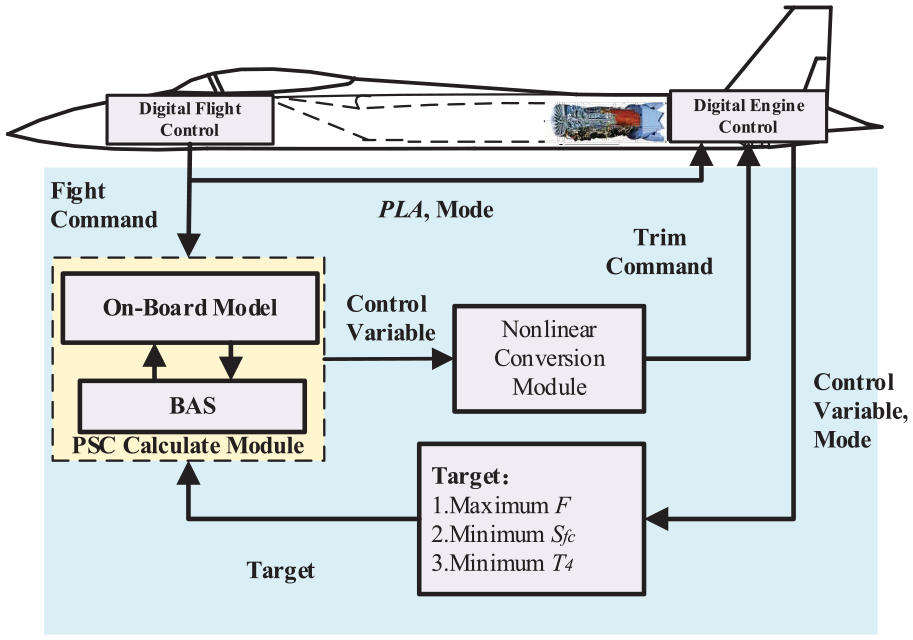
The control structure of PSC.
The principle of PSC
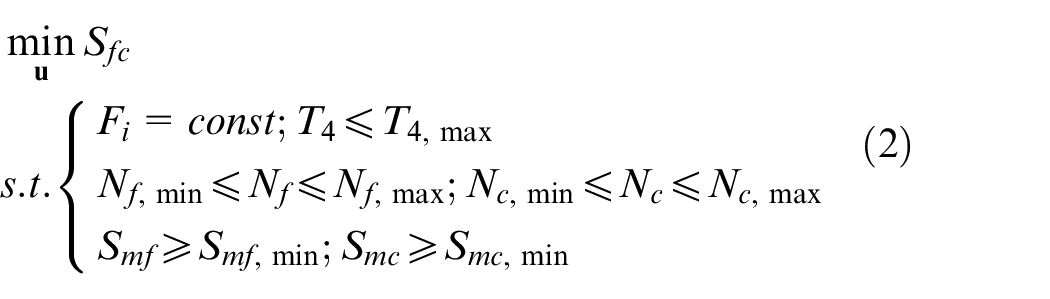
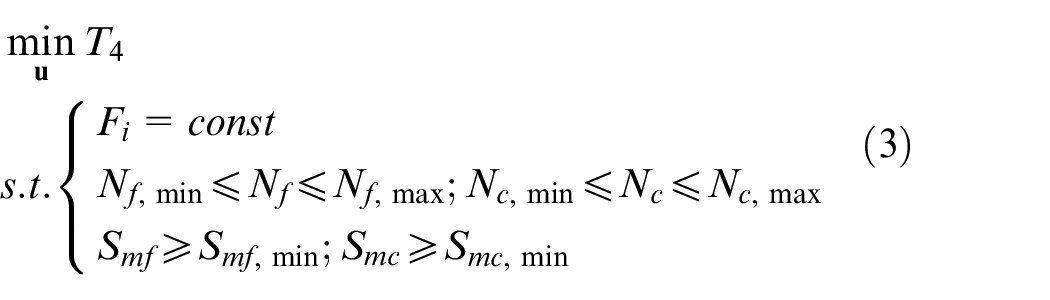
The optimization problem of maximum thrust, minimum specific fuel consumption and minimum turbine inlet temperature could be described as follows.
The maximum thrust
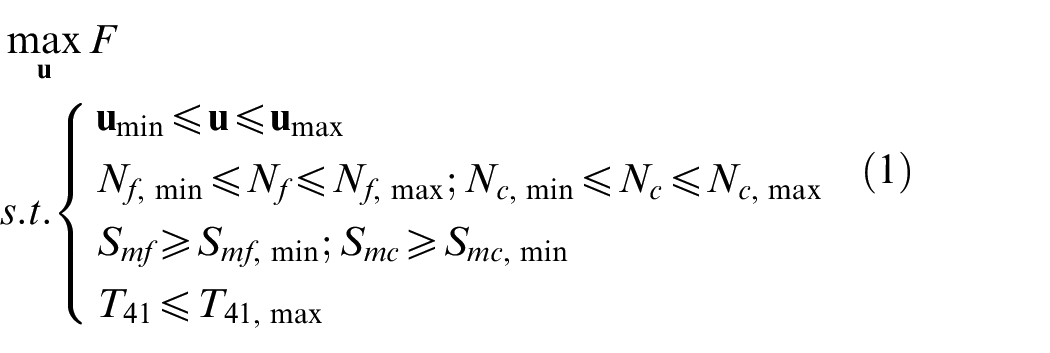
where
Minimum specific fuel consumption
For extending engine service life, the minimum turbine inlet temperature
The principle of BAS
The BAS is a meta-heuristic optimization algorithm. As shown in Figure 2(a), longhorn beetles are characterized by extremely long antennae. The fundamental functions of these two antennaes are finding prey odors and obtaining the potential suitable mate sex pheromone. As shown in Figure 2(b), the beetle searches nearby area randomly by antennae. The beetle searching behavior can be described as an objective function to be optimized.
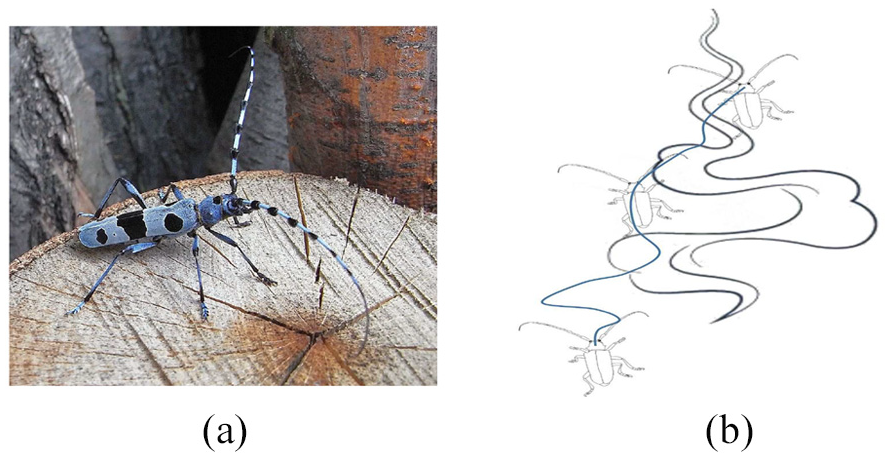
Longhorn beetle and its searching behavior: (a) longhorn beetle and (b) searching behavior with long antennae.
The BAS is proposed to solve the following optimization problem

The PSC is the constrained optimization problem. Therefore, the penalty function is adopted here as follows

where

Define a random beetle searching direction as follows

where k is the domain dimension,

where
The searching behavior of beetle can be described as follows

where
Simulation and analysis of the PSC
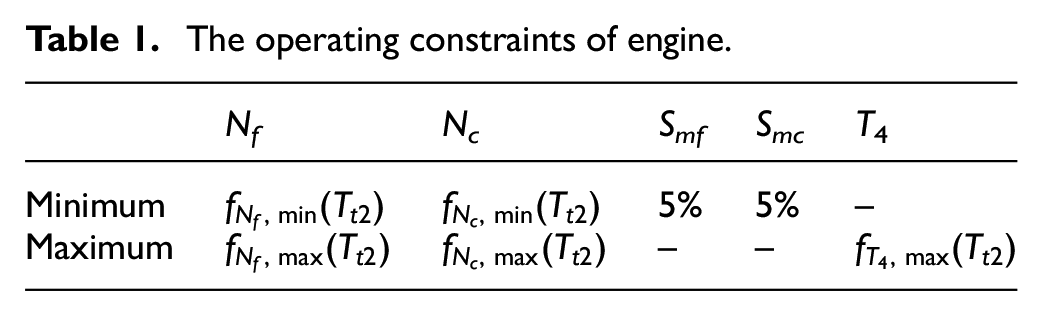
At present, the most popular probability-based optimization methods in PSC are GA and PSO. Therefore, there are three PSC simulations based on BAS, GA and PSO which are carried out, respectively, to verify the real-time performance of the proposed optimization algorithm. For the sake of narrative, these three simulations are named PSC I, PSC II and PSC III in the following, respectively. The operation limits of engine are given in Table 1.
The operating constraints of engine.
As shown in Figures 3–8, the simulations of maximum F mode, minimum Sfc mode and minimum T4 mode are conducted at the cruise flight envelop H = 8–12 km, Ma = 0.7–1.5. Figures 3–5 show the real-time simulations of BAS, GA and PSO, respectively. The running environment of these three programs are identical. The computer is ASUS with Windows 7 Ultimate (sp1 x64), Intel(R) Core(TM) i7-7700 and 8GB RAM. The software is Matlab 2016b run. It can be seen that the program running times of maximum F, minimum Sfc and minimum T4 of BAS are most less than 0.6 s. In contrast, the program running times of maximum F of GA are almost more than 2 s. The program running times of maximum F of PSO are almost more than 1 s. In particular, in the minimum Sfc and minimum T4, the program running times of these two PSC modes of GA and PSO are almost more than 3 s. Therefore, the proposed method has better real-time performance.
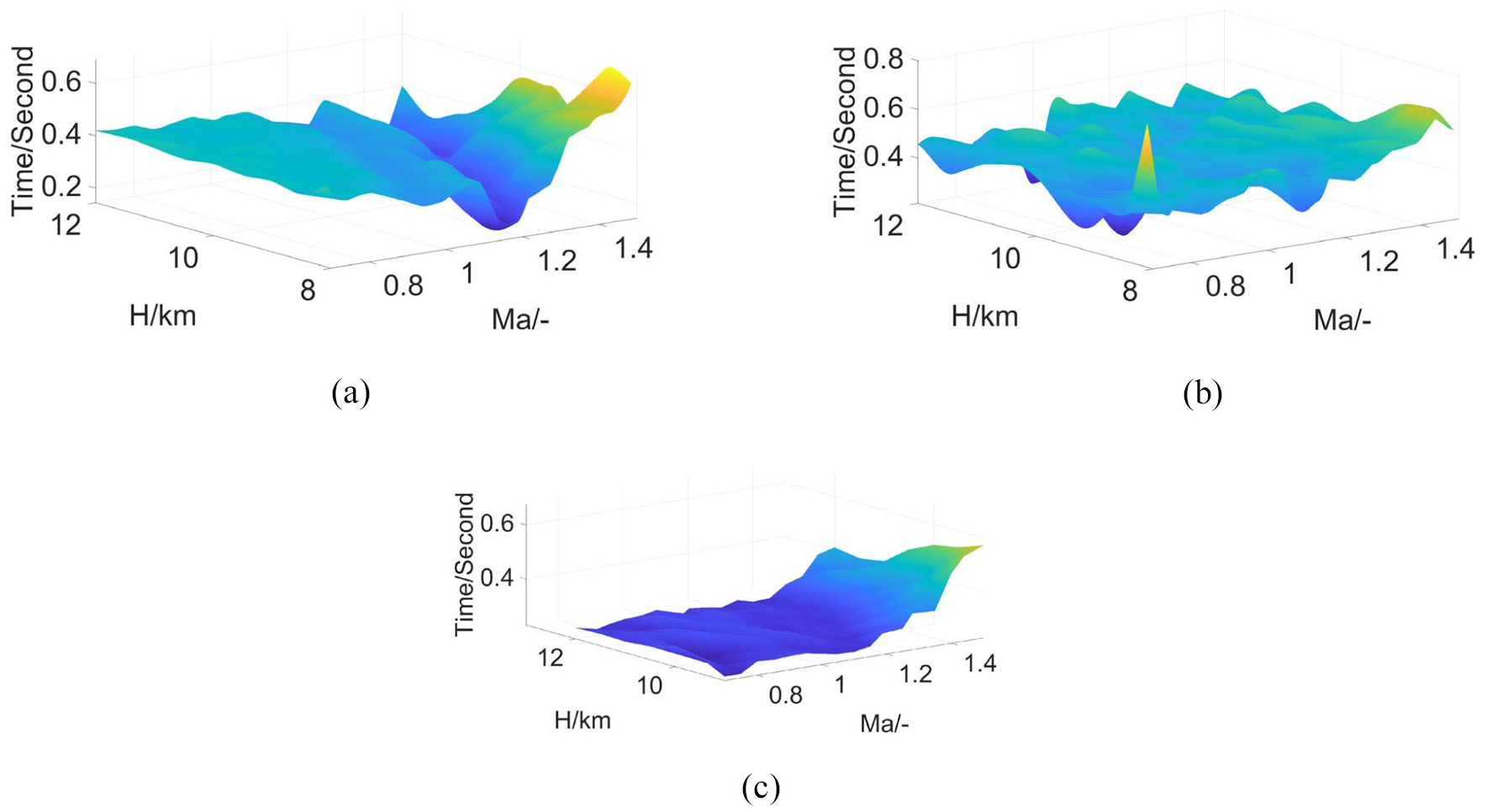
The program running time of BAS: (a) maximum F mode, (b) minimum Sfc mode and (c) minimum T4 mode.
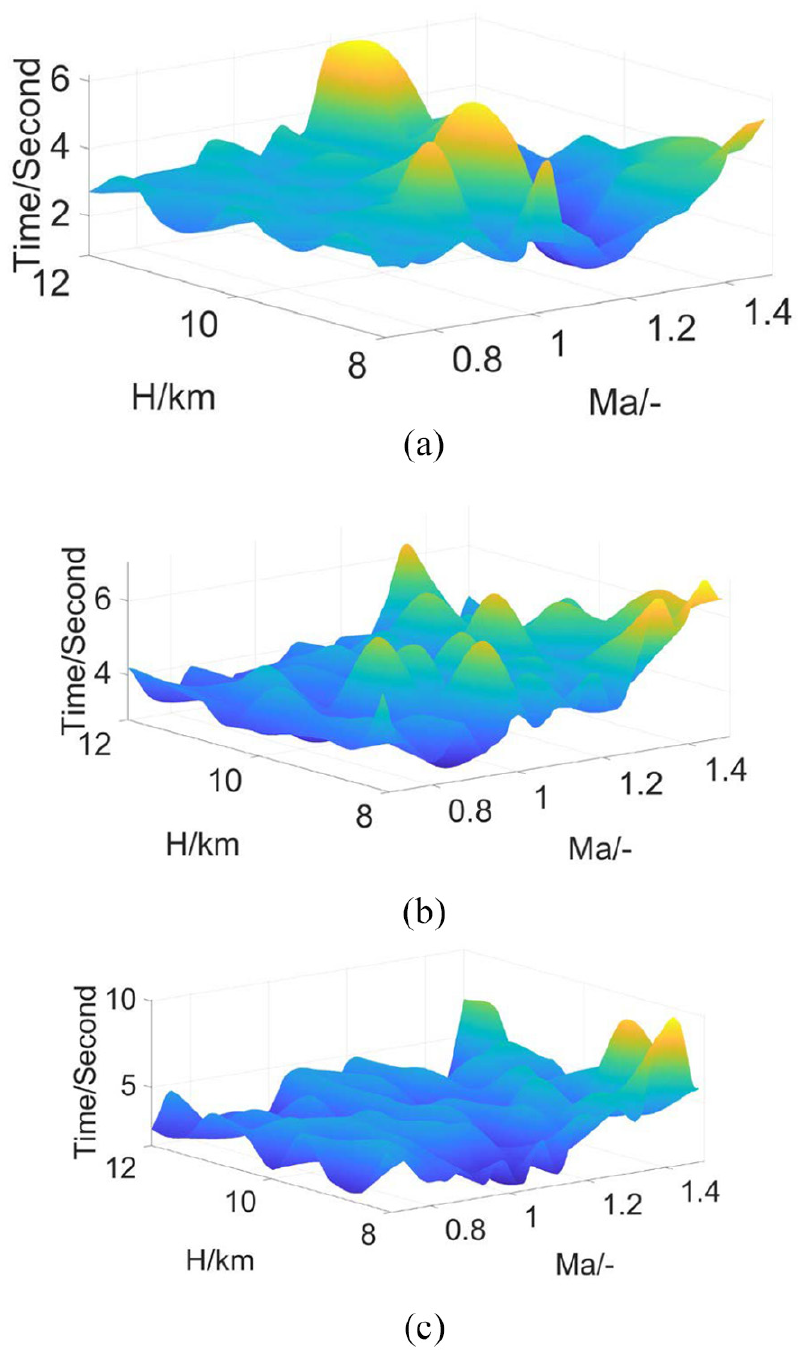
The program running time of GA: (a) maximum F mode, (b) minimum Sfc mode and (c) minimum T4 mode.
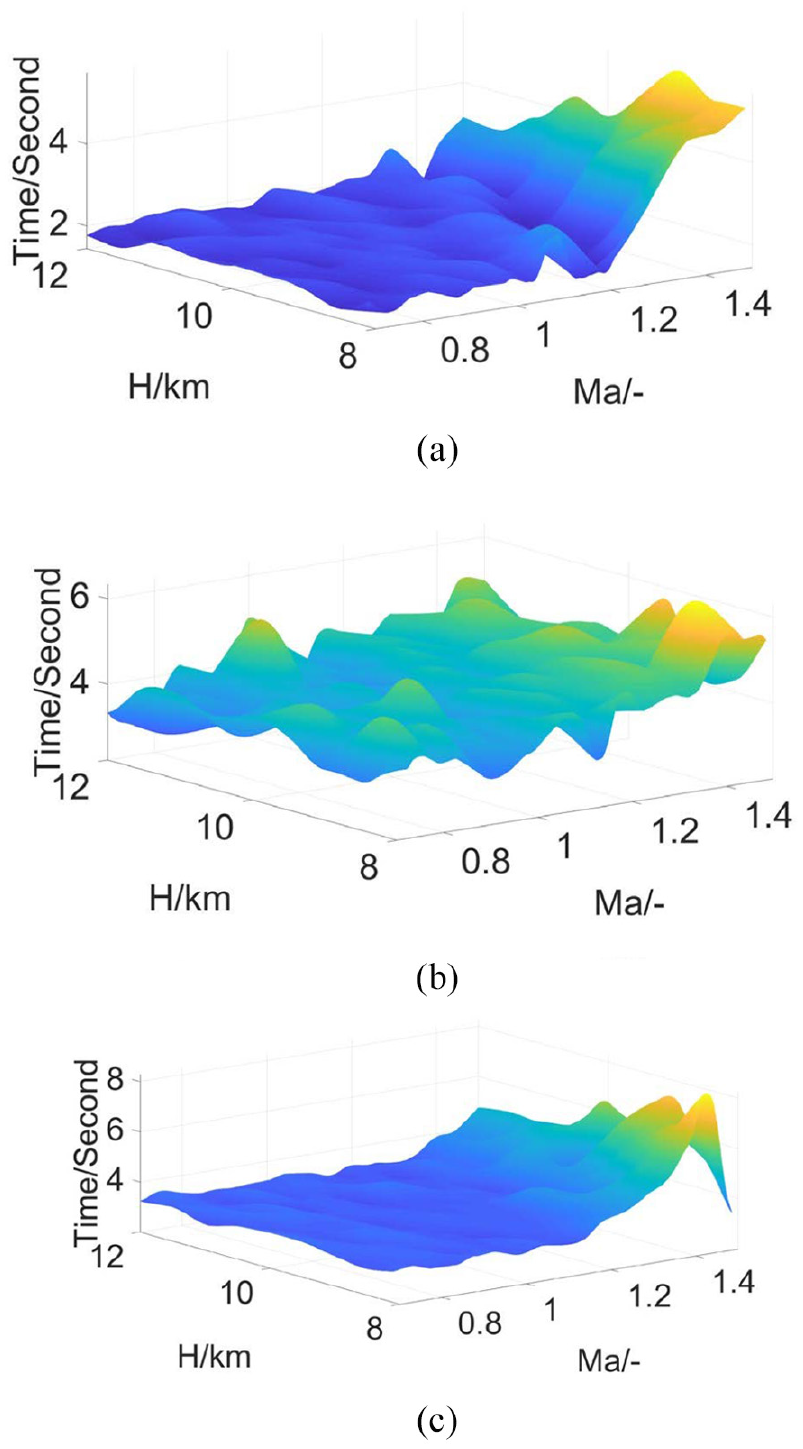
The program running time of PSO: (a) maximum F mode, (b) minimum Sfc mode and (c) minimum T4 mode.
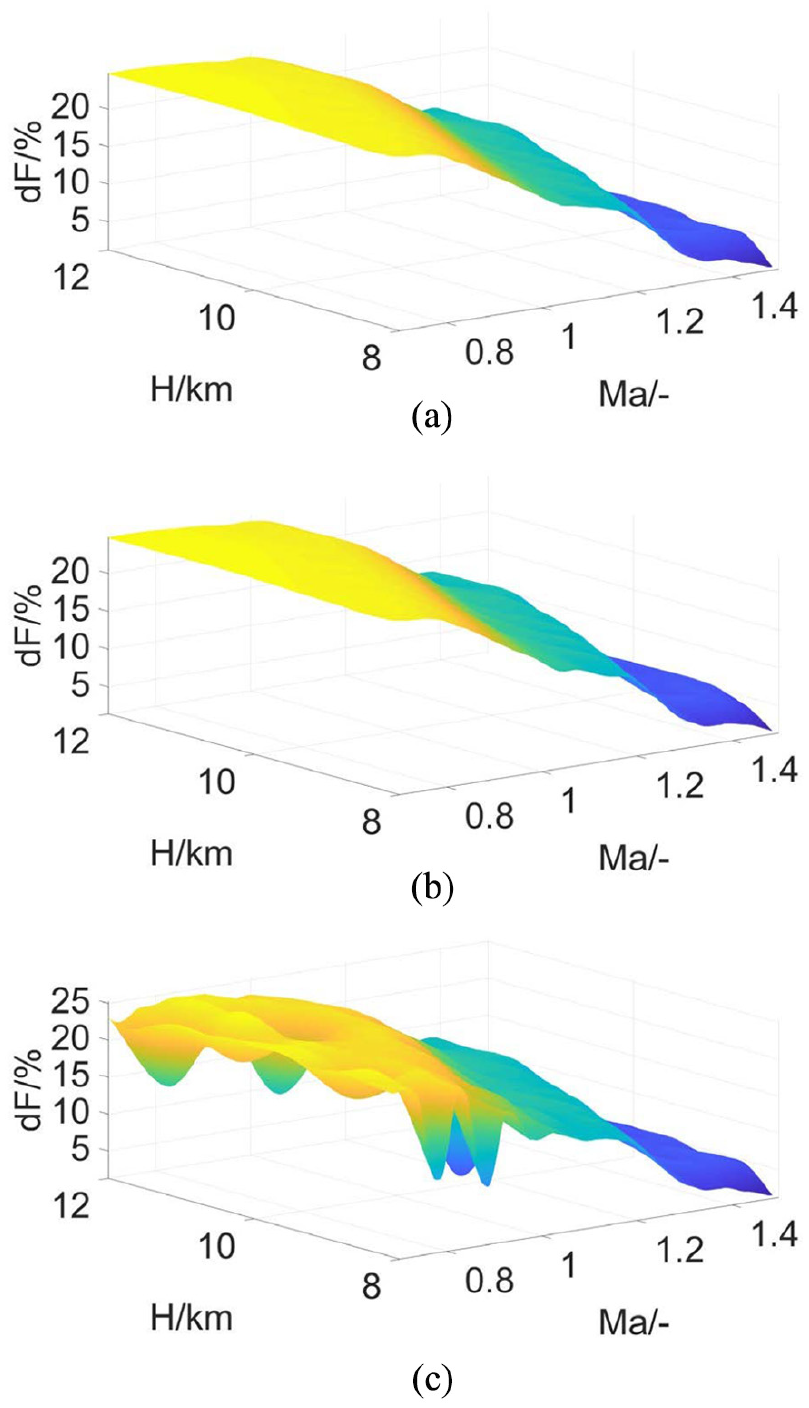
The increase of F in maximum thrust mode: (a) BAS, (b) GA and (c) PSO.
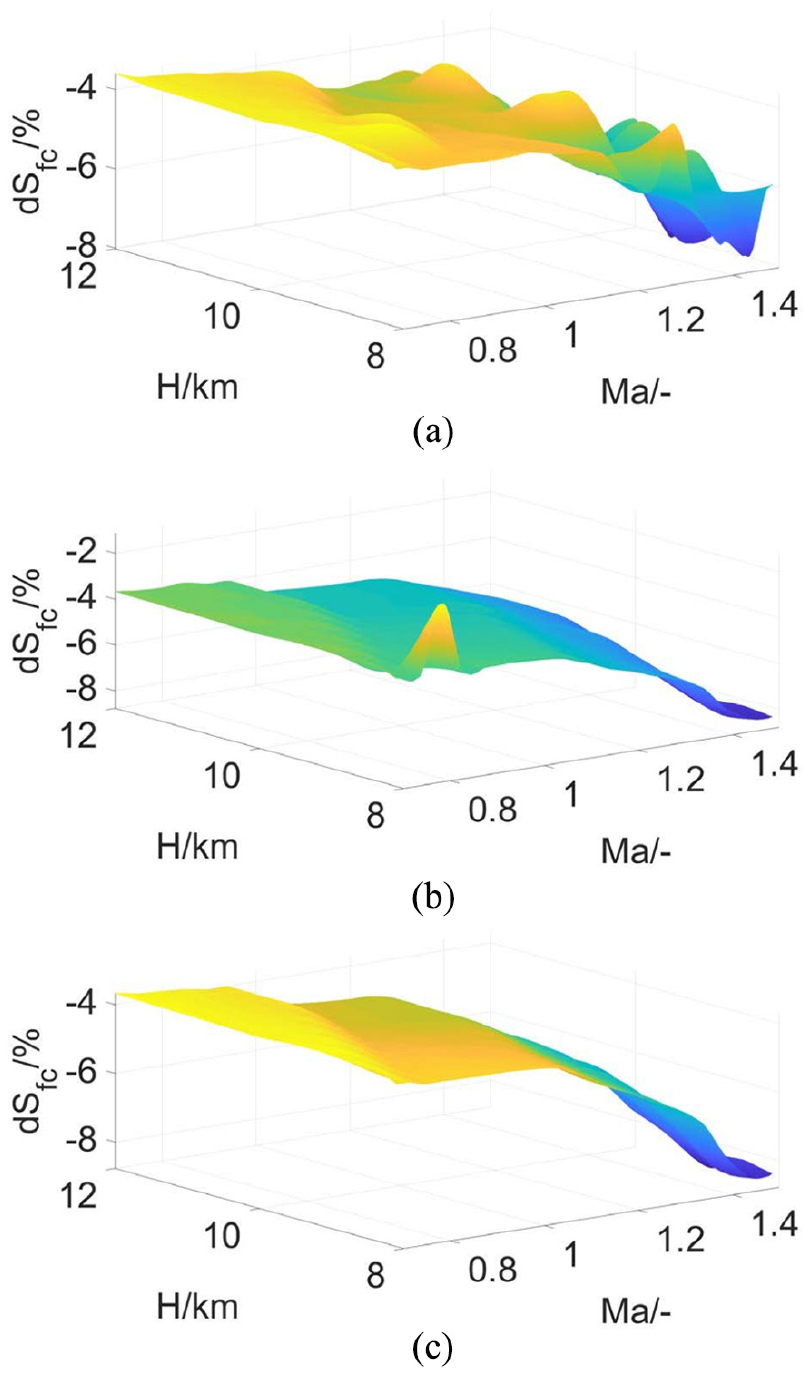
The decrease of Sfc in minimum specific fuel consumption mode: (a) BAS, (b) GA and (c) PSO.
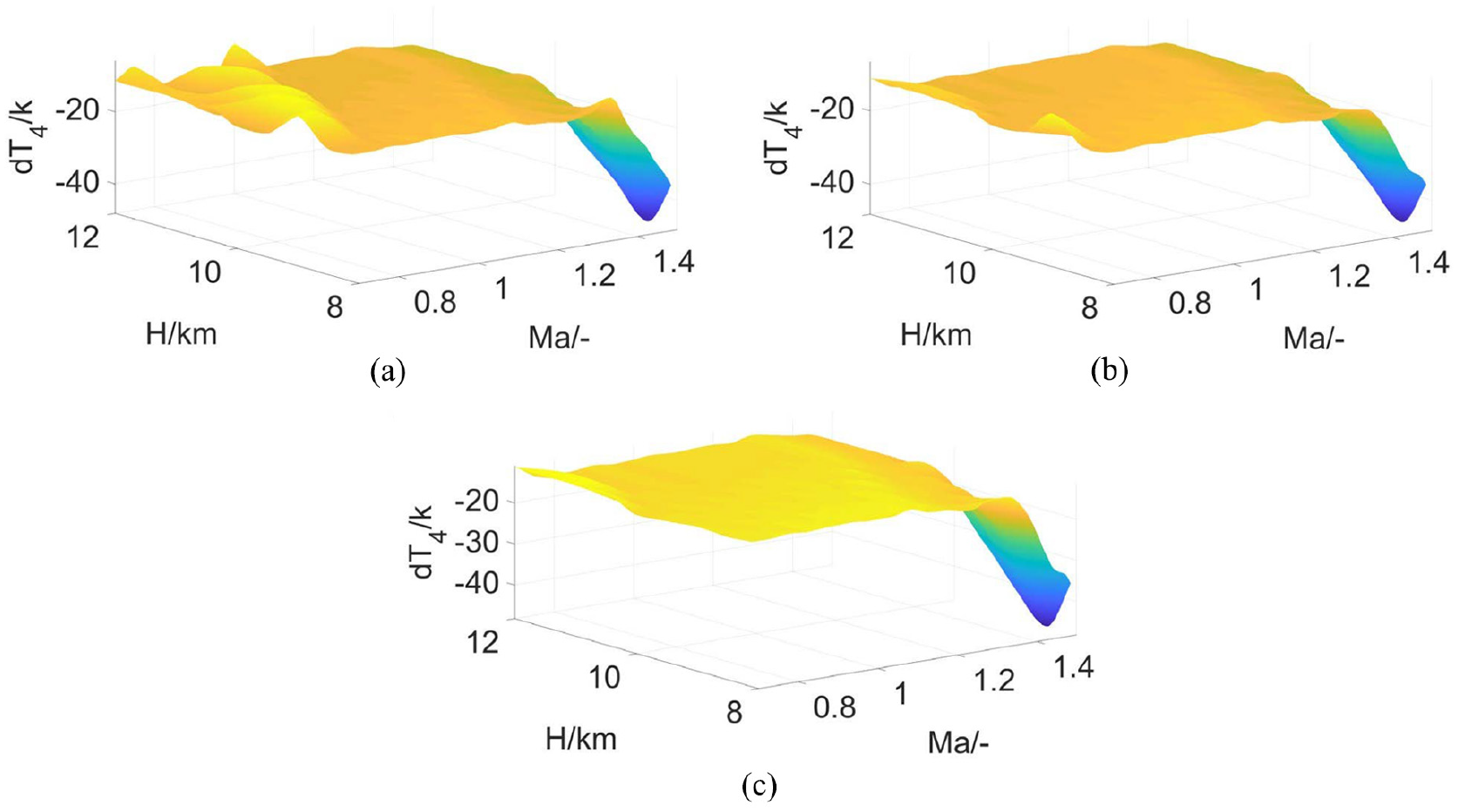
The decrease of T4 in minimum turbine inlet temperature mode: (a) BAS, (b) GA and (c) PSO.
Figures 6–8 give the changes of F, Sfc, T4 after executiving the program of maximum F, minimum Sfc and minimum T4, respectively. It can be seen from Figure 6 that the change of F decreases with the increase of Mach number. The reason is that the turbine inlet temperature will increase rapidly with the increase of the Mach number, which results in the increase in the inlet temperature of engine and turbine. In this case, with the increase of the Mach number, the engine will have less potential. The largest change of F reaches more than 20%. It can be seen from Figure 7 that the decrease of Sfc is almost more than 4%. It can be seen from Figure 8 that the decrease of T4 is more than 20k. It also can be seen from Figures 6–8 that the BAS, GA and PSO have the almost same optimization ability.
Conclusion
A new PSC method based on BAS is proposed in this paper. The BAS has better real-time performance and has global search ability on the optimization problem. The simulations of PSC based on the BAS, PSO and GA are carried out. The results show that the BAS has much better real-time performance than the conventional probability-based algorithms GA and PSO. The program running times of maximum F, minimum Sfc and minimum T4 of BAS are most less than 0.6 s. In contrast, the program running times of GA and PSO are almost more than 3 s. Moreover, these three probability-based algorithms can get more thrust, smaller turbine inlet temperature and less specific fuel consumption. After executing the program of maximum F, minimum Sfc and minimum T4, the largest change of F reaches more than 20% in the subsonic envolop, the decrease of Sfc is more than 4% and the decrease of T4 is more than 20k.
Footnotes
Declaration of conflicting interests
The author(s) declared no potential conflicts of interest with respect to the research, authorship and/or publication of this article.
Funding
The author(s) disclosed receipt of the following financial support for the research, authorship and/or publication of this article: This study was supported in part by National Science and Technology Major Project under grant 2017V-0004-0054, in part by National Natural Science Foundation of China under grant 51906102, in part by Research on the Basic Problem of Intelligent Aero-engine under grant 2017-JCJQ-ZD-047-21, in part by China Postdoctoral Science Foundation Funded Project under grant 2019M661835, in part by Aeronautics Power Foundation under grant 6141B09050385, in part by the Fundamental Research Funds for the Central Universities under grant NT2019004.
