




Abstract
With the development of mobile communication and global positioning system navigation and positioning technology, analysis of user behavior on mobile Internet has become a hot topic in research area. Sign in sharing-bicycles’ app, find bicycle location, and selected has become a part of mobile Internet user’s daily life. Based on the data analysis of the spatial and temporal characteristics, find out sharing-bicycle’s user behavior obeys power-law distribution. In the time interval, user behavior of sharing-bicycle has strong intermittency and weak memory; the exponent of probability that K edge nodes is three by fitting the distance of sharing-bicycle’s data curve. It is verified that mobile Internet is long to scale-free networks. We conclude seven characteristics of user’s behavior of sharing-bicycle in mobile Internet application from experimental results. The analysis of sharing-bicycle’s behavior has become a complement and extension in human dynamics research field.
Introduction
In 2005, scholar Barabási publish paper on Nature journal, he found human dynamic theory that the time intervals of human activities obey power-law distribution. In 2006, Brockmann propose the non-random walk and Levy flight features. At present, many scholars have done a lot of research on real-life data. For example, celebrity letter, 1 Online movie on demand, 2 Music channel acceptance, 3 content of GitHub, or Android release and response in forum.4,5 In the above studies, time interval of events shows non-Poisson statistical characteristics be long to human dynamic field. Zhou Tao summed up the latest research results that behavior interval obeys the power-law distribution approximately; the power exponent is between 1 and 3; it shows the feature of short bursts and long-term dormancy. The behavior of human use of mobile Internet products also exhibits the power-law distribution of non-Poisson characteristics. A previous study 6 analyzes 5 million video-on-demand records for YouTube web. The attractiveness of users shows a power-law decay trend after the new video is online. A previous study 7 found that the time intervals of user comments in Tianya forum communities can be describe by power function. In addition, Gibrat’s law in Economics,8,9 Taylor’s law in wave analysis, 10 and Fractal feature extraction method by analysis of time series 11 can describe the characteristics of user’s behavior.
Mobile Internet provides travel data for human dynamics. It is more scientific and accurate than the circulation of dollars, 12 the use of questionnaires or tickets 13 to study. Scholar research on features of the pedestrian, 14 bicycle, 15 taxi, 16 private car,17,18 bus, 19 subway, 20 aviation, 21 and other travel data; master the laws of urban spatial density degree, the city, the migration behavior of county, villages, and towns. By establishing a model, we find the correlation between human behavior spatial characteristics and Continuous Time Random Walk (CTRW) walking, Levy flight. Relying on a power index model does not generalize user behavior in all domains. Because the bus card and taxi global positioning system (GPS) data lack individual information, there is a lack of microeconomic analysis of user behavior. In recent years, analysis of mobile communication base station location, cell registration, roaming information14,16 has gradually become an effective method of human dynamics field.
In the field of human dynamics, there are not many studies of sharing-bicycles. This paper focuses on the spatiotemporal characteristics of sharing-bicycle user behavior. The main purpose of this paper is to study the time interval and trip distance distribution of sharing-bicycles. The main contributions are as follows:
We analysis mobile Internet data that time interval and trip distance by Mobike cup competition data. Find out that the time interval obeys fat-tailed distribution, and the power exponent is 0.7. The conclusion is that the probability of K edge node obeys power exponent is 3.
We confirm the sharing-bicycle of user behavior that strong intermittency and weak memory; summarize seven characteristics of bicycle user behavior.
Materials and methods
With the development of mobile communication and GPS navigation and positioning technology, sharing-bicycle is a short distance vehicle designed for urban residents to travel. In Figure 1, sharing-bicycles rely on the BTS to locate the inner chip and send the position to the running server of sharing-bicycle. The server calls the electronic map API, for example, Baidu map, Tencent map, and Amap, Visualize idle shared bike locations and numbers at the user’s APP. The role of sharing bicycles is between walking and motor vehicles, solving the problems of the residents, and has a strong adaptability to the road. Sharing-bicycle is rapidly popularized all over the country by advantages of green idea, time-saving, convenient, flexible, and so on.
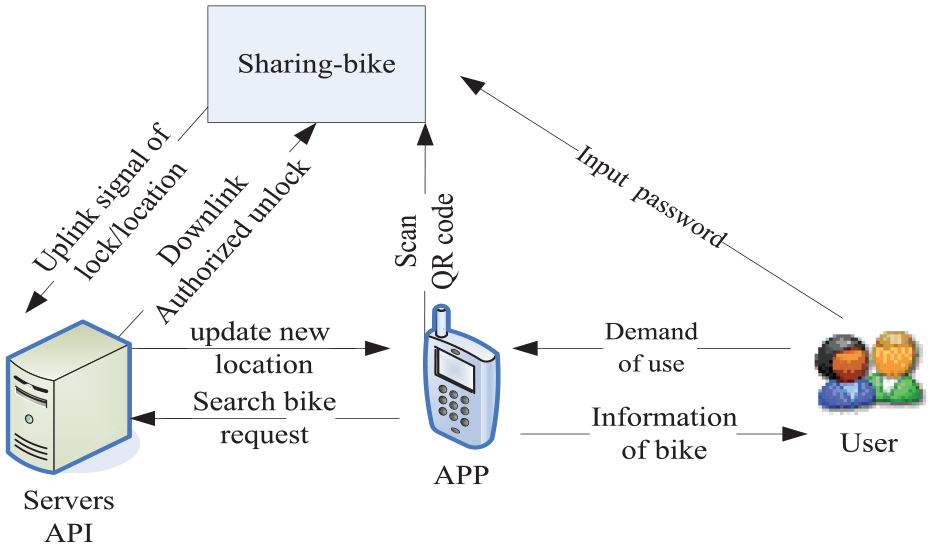
Sharing-bicycle’s user of communication process.
Data set
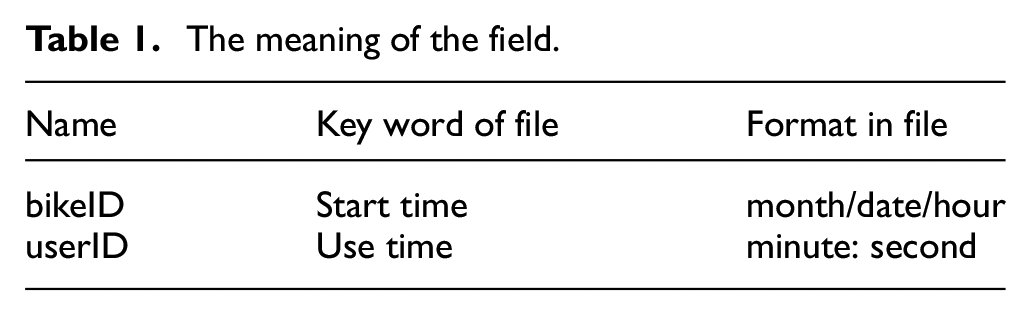
The experiment data set from Mobike company records in 2017 May Beijing area is shown in Table 1. Privacy preserving data from the Mobike cup competition contains 3 million desensitization travel records data, covering more than 300 thousand users ID and 400 thousand bicycle running log. The data set includes start time, the time of use, the vehicle ID, the type of vehicle, and the user ID. The file train.csv includes 3,214,096 travel records. The file test.csv includes 2,002,996 travel records.
The meaning of the field.
Results
Spatial characteristics
In the study of human behavior, the literature1,12,15,21,22 points out the travel distance and the exponential distribution of the bus, subway, taxi, and private cars. But public transport depends on the service time of the driver, limited by route planning for social service. The data of public transport cannot reflect the moving behavior of users completely. The probability density function of bicycle user behavior in exponential is p(Δt) = λe–λΔt. Sharing-bicycle travel distance is S=v × t, v is the user speed estimate, and t is the use of time. Distance is an important reference for users to choose the transportation. Choosing sharing-bicycle saves more time than walking in short distance shuttle. When overstep walking and physical endurance, users will turn around other vehicles in destination. Thus, there is a peak 3 km value in Figure 2(a). The result is less than the peak of 5 km by bus or subway.19,20
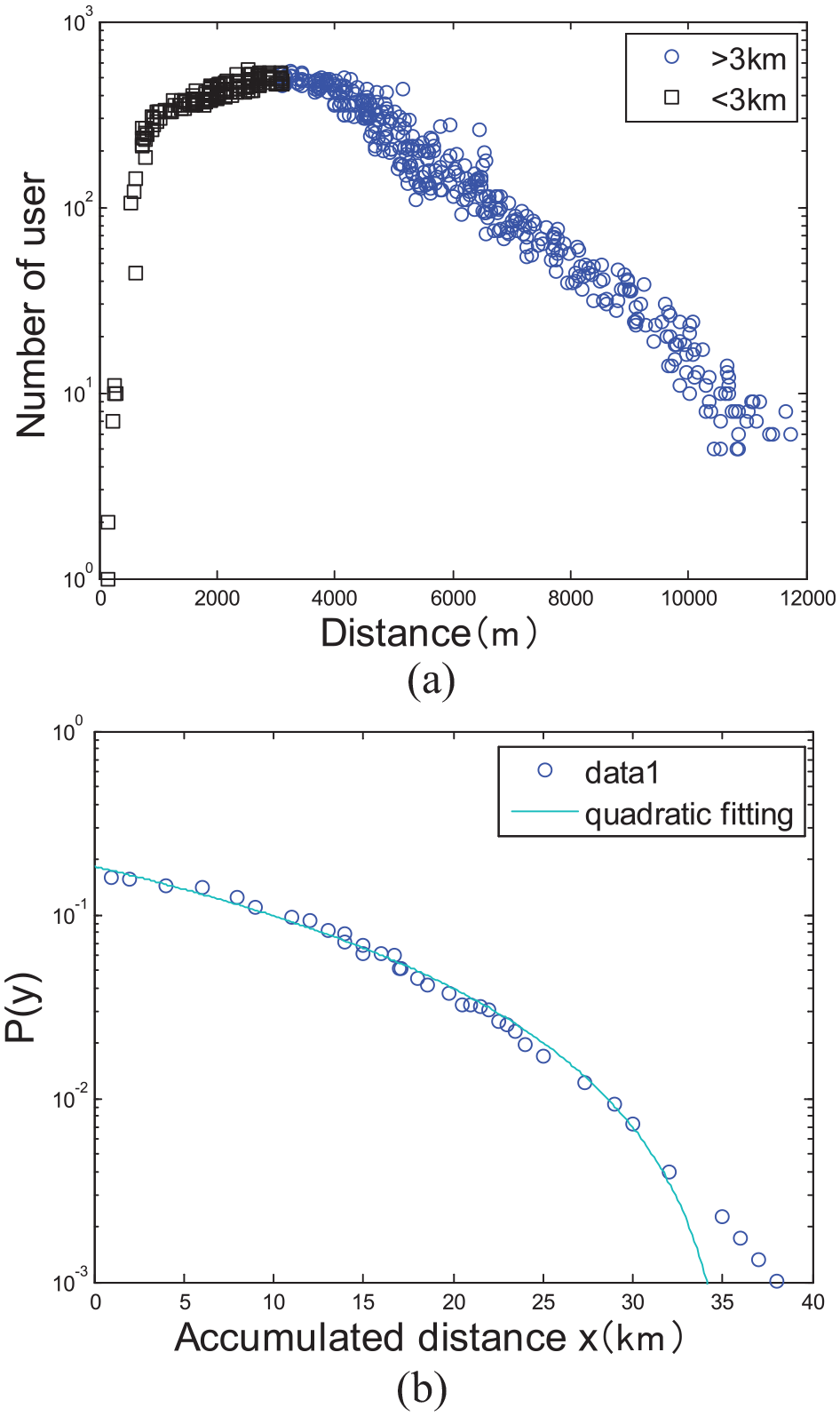
(a) The number and distance of users and (b) fitting of accumulated distance.
Sharing-bicycle when compared with other vehicles, show the scattering characteristics of flexible free travel. The spatial characteristics of sharing-bicycle is more like Taxis and private car tend to be exponentially distributed. The probability of total distance is inversely proportional to the number of times. In Figure 2(b), the fitted exponential distribution is obey the exponent distribute and power index is

In Figure 3, use sharing-bicycle time curve floats up and down within an average range. The shape of spikes indicates long periods of travel occasional. The behavior of sharing-bicycle is strong burst and weak memory properties will be described in Figure 5.
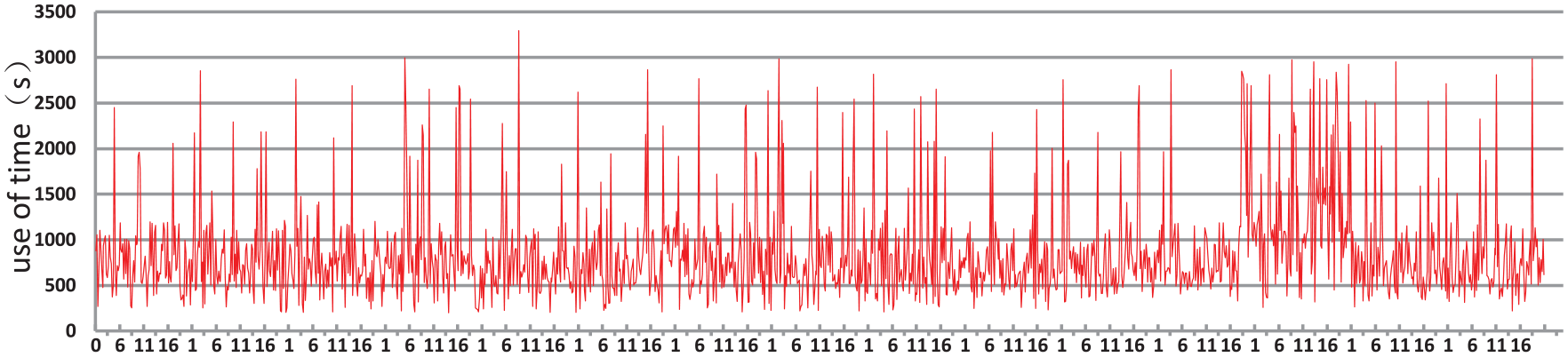
Positive sequence from sample of 15 bicycles in previous 20 counts.
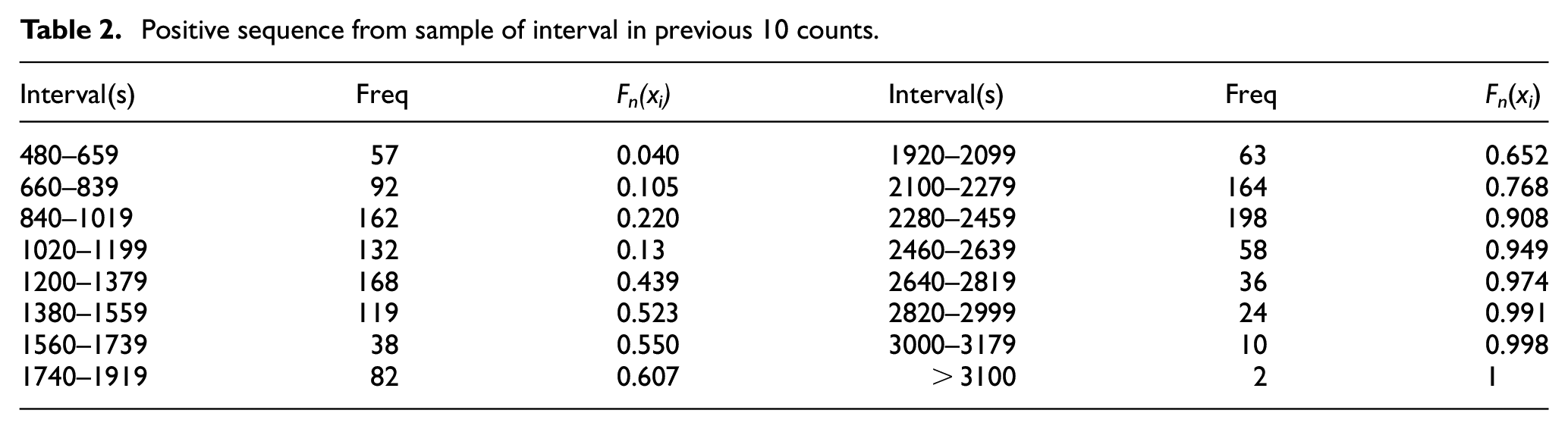
In the research process of using time and frequency, 1425 bicycles were sampled from the competition data set. Value of frequency are shown in exponential distribution by Kolmogorov–Smirnov test in the 16 interval group. In Table 2, Fn(xi) is empirical distribution.
Positive sequence from sample of interval in previous 10 counts.
The experimental results of the data set show that the bicycles tend to circle a limited radius of activity. It shows that the spatial characteristics of the radius of human activity increases with time. The inverse relationship between users running distance and physical strength, the diffusion behavior of bicycle is different from Lévy model to describe. The user’s moving distance approximately obeys the power law distribution, as show in (2)

The data in the experiments by Gonzalez et al.
14
consist of a variety of modes of transportation. As shown in Figure 4, the fitting function is

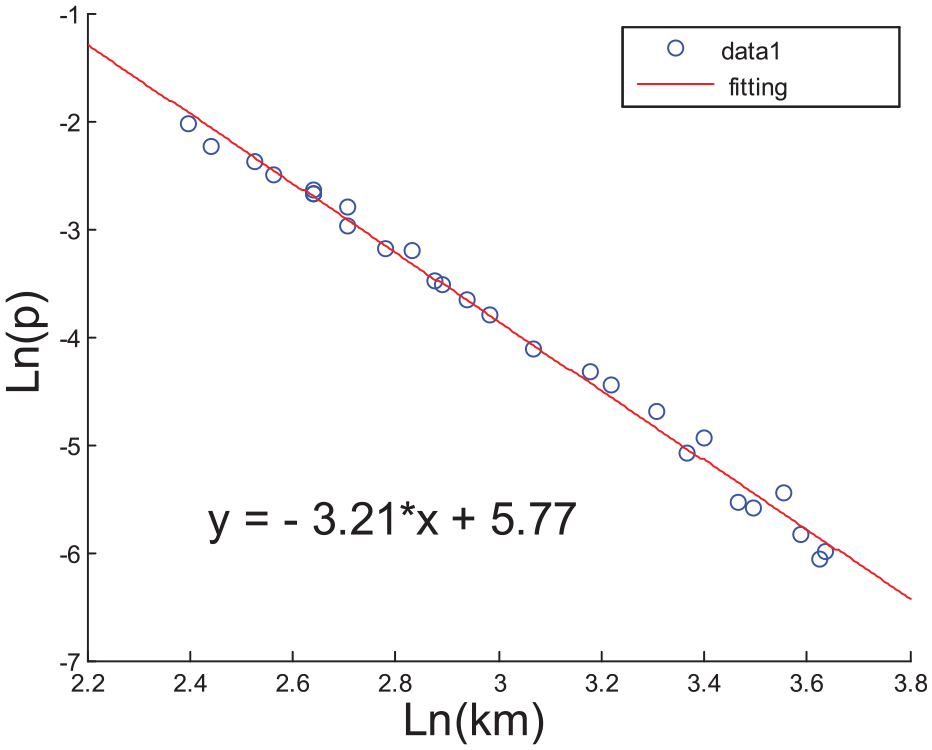
Power exponent fitting use time.
The non-scaling of complex networks is embodied in sharing-bicycle user nodes. Power index is α = 3.21. It validates the conclusion that the node probability of the K edges obeys the power exponent of 3 in scale-free networks.
Paroxysmal and memory
User of sharing-bicycle is human beings who follow the biological clock pattern. Human migration is a regular movement with periodic repetition. The essential is difference from physical particles in space motion. According to the literature, 23 characteristics of human dynamics are strong paroxysmal and weak memory. Human activities divided into busy hours and break time.
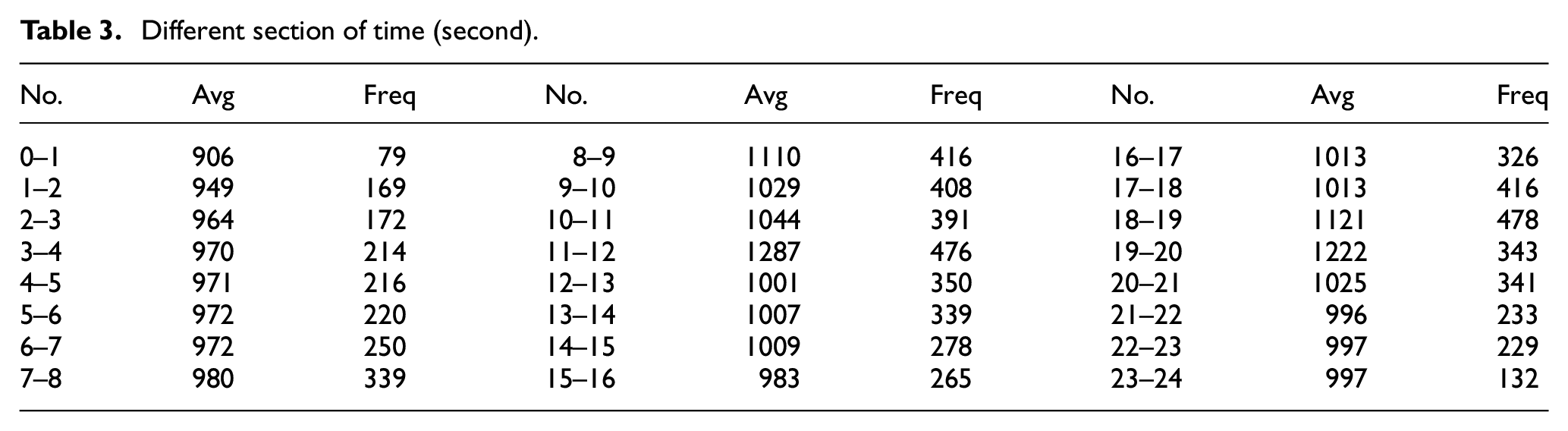
According to the literature, 23 human activities are divided into busy hours and break time. As shown in Tables 3–6, from zero to one o’clock(0∼1), a total of 79 use records from the statistical results of 1425 sharing-bicycles, the mean of time is 906 s. After the K-S test, it conforms to the Poisson distribution. Results from the 24-period K-S test are found that the time distribution of bicycles used is subject to Poisson distribution in each period (Table 5). The sharp curve in Figure 5 reflects the occasional behavior of the individual point of time. The strong spontaneity of sharing-bicycle reflects the desire to commute anytime and anywhere. When choice of bus shortly or scarcely, it shows that biological clock characteristics influence the use of time and spacing.
Different section of time (second).
24 Section of time.
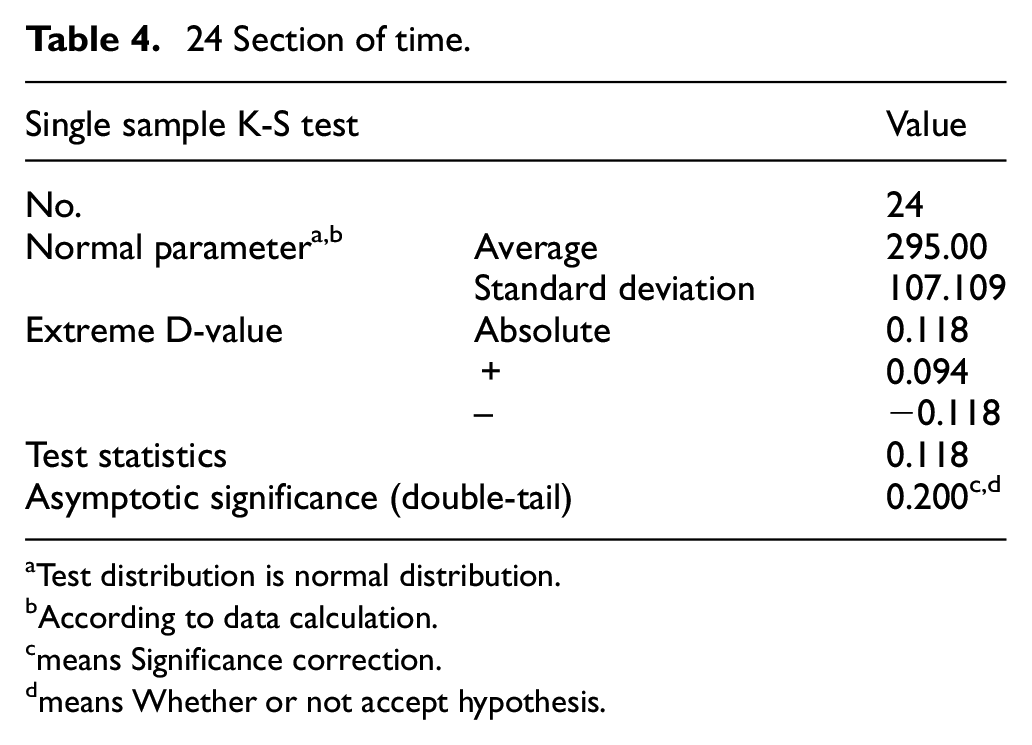
Test distribution is normal distribution.
According to data calculation.
means Significance correction.
means Whether or not accept hypothesis.
Section of time 0–1.
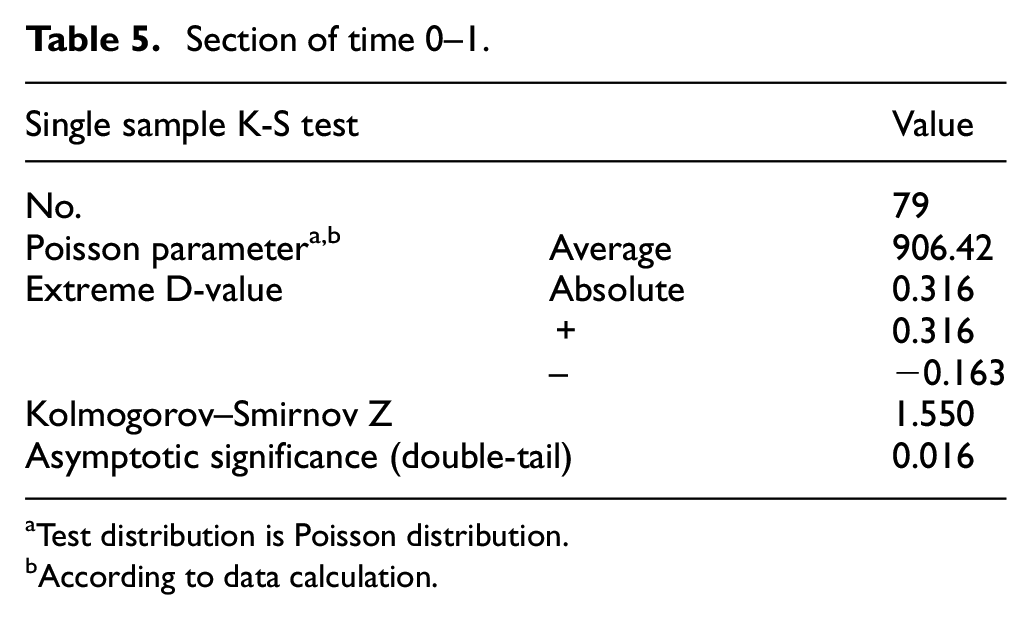
Test distribution is Poisson distribution.
According to data calculation
Parameter in 0:00–1:00–2:00 section.

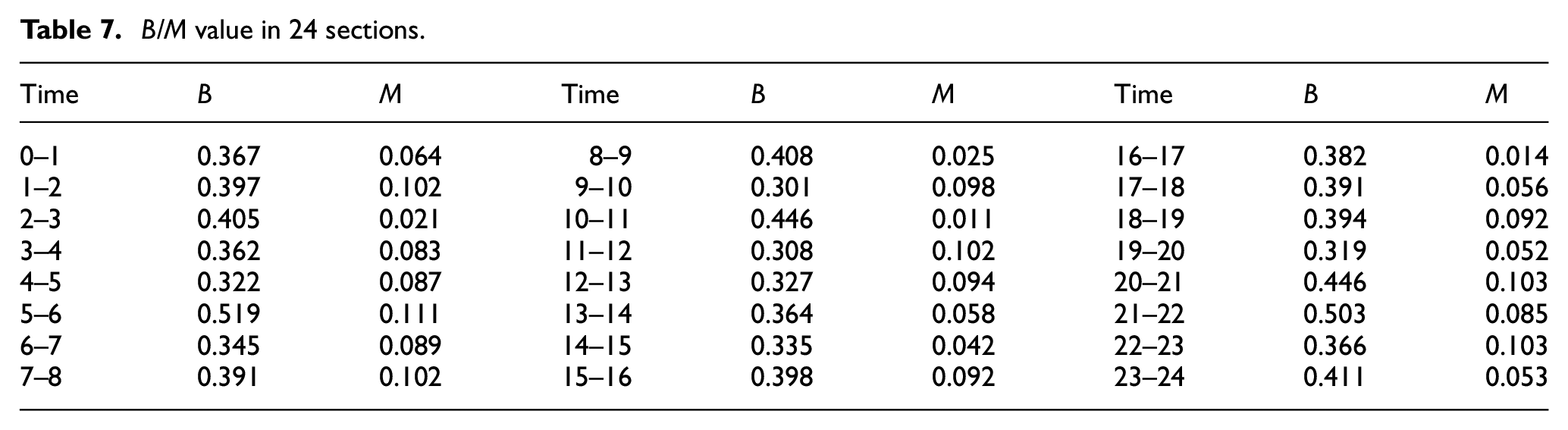
B/M value in 24 sections.
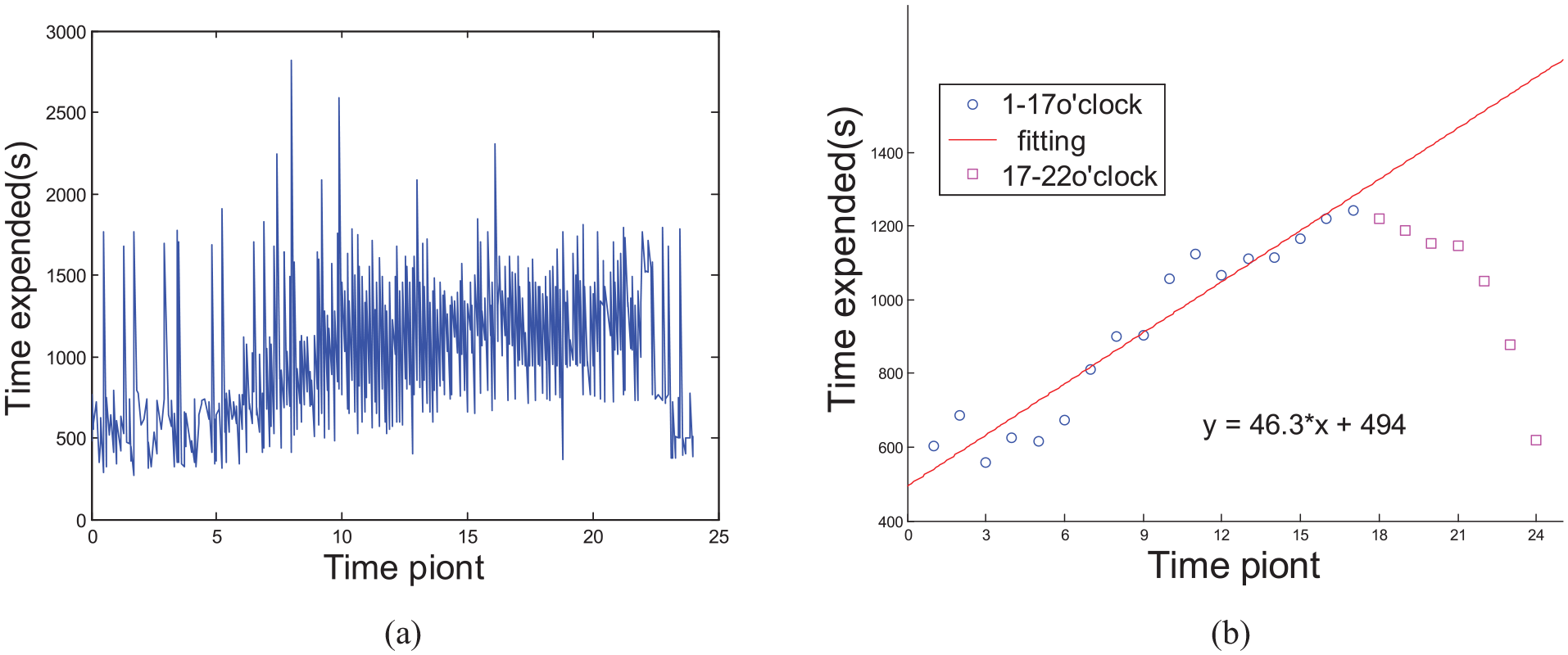
Length of 24 h and fitting.
The number and quantity of customers used in different hour (1 h/2 h/3 h) in Figure 6. In statistical results, peak curve of reuse bicycle illustrate the powerful paroxysmal and efficiency of sharing rate. The valley of curve shows weak memory and inefficient sharing rate.
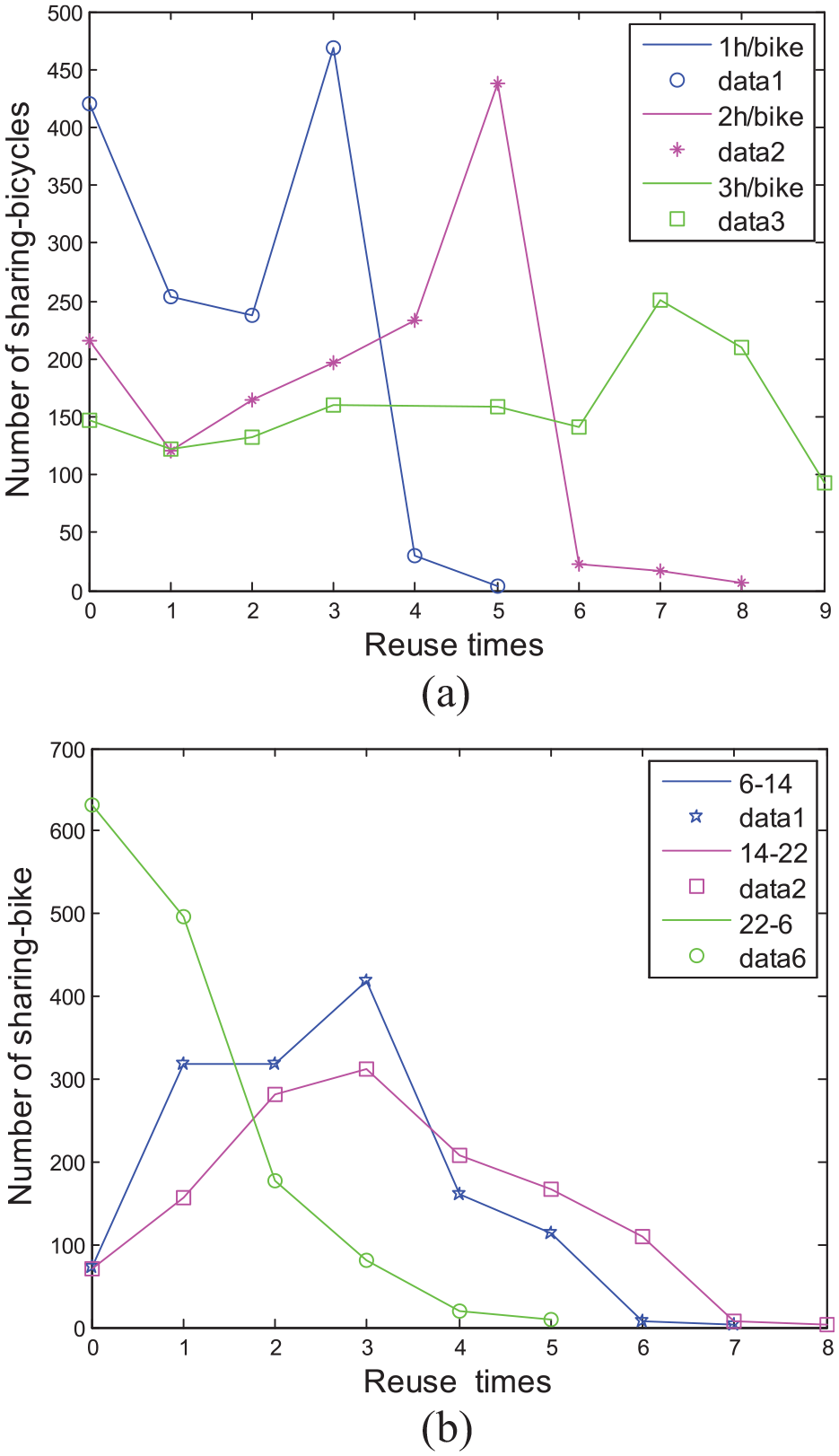
(a) Bicycle reuse in 1 h/2 h/3 h periods
In order to avoid the user behavior of paroxysmal phenomenon attributed to the external environment, for example, traffic demand in the day and night; seasonal effects of winter and summer. Using the relative clock method proposed in document, 23 change data in Table 4 to confirm the paroxysmal occurrence of shared cyclists. Take the relative clock in the same time zone (Beijing). Literature8,9 propose a new timing method using a relative clock, where the time length between two consecutive events of a bicycle customer is counted as the number of other bicycle customers’ events appeared during this interval. Compared with the absolute clock, the relative clock can eliminate the temporal bursts caused by the influence of vacation factors. Formulas for episodic and memory of complex network are introduced in document. 23
For example, from this observation period of 0:00–1:00, the sharing-bicycle is used by customers 79 times and time of occurrence does not overlap.

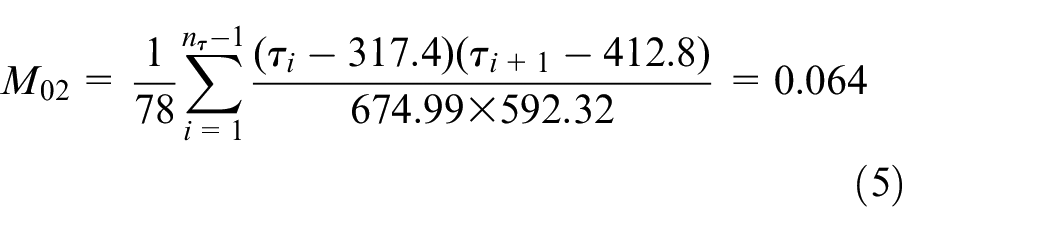
According a previous study, 24 the conclusion of B and M values is between –1 and 1. Due to the heavy tail characteristics of the sharing-bicycle, paroxysmal data B value close to 1, the phenomenon of frequent occurrence during rush hours and idle in most of time. Memory of sharing-bicycle is M that value near median zero. M > 0 means memory effect; M < 0 stands for the anti-memory effect. The behavior of time series has a weak memory characteristic.
Temporal characteristics
At first Vázquez divides human behavior into two general classes of power indices: –1 and –1.5. Gradually, all kinds of behavior patterns have been confirmed. 19 In order to explore different power exponents, Zhou and Han 24 summarize some human behaviors in the literature: the interval of behavior occurring approximately obeys the power-law index, and the power-law distribution is between 1 and 3. For example, E-mail, 25 letter, 26 swing card record, 27 hobbies,28,29 interests, 23 entertainments, in Web browsing, Outdoor sport, 30 and communication. 31 Provide travel services for residents, freedom to use, and high flexibility. Recent research reveals the behavior patterns of user groups using sharing-bicycles. Literature 32 is proved mathematically, when uniform distribution of first moment that independent and having a Poisson process aggregation, respectively. Learn from the results of human dynamics34,35 that exponential distribution describes the probability of user behavior intervals. In the known x period of time, p is probability of uses sharing-bicycle has been known. In Figure 7, Y-axis is P[T≥t], t is interval between the two times of the same bicycle by different user; p represents the probability of using the time interval. Correlation coefficient (R2 = 0.837) has obvious power-law characteristics. Fitted in double logarithmic coordinate

when Ln p =y, Ln t =x, power exponential form is

Generally speaking, probability of interval approximation power function

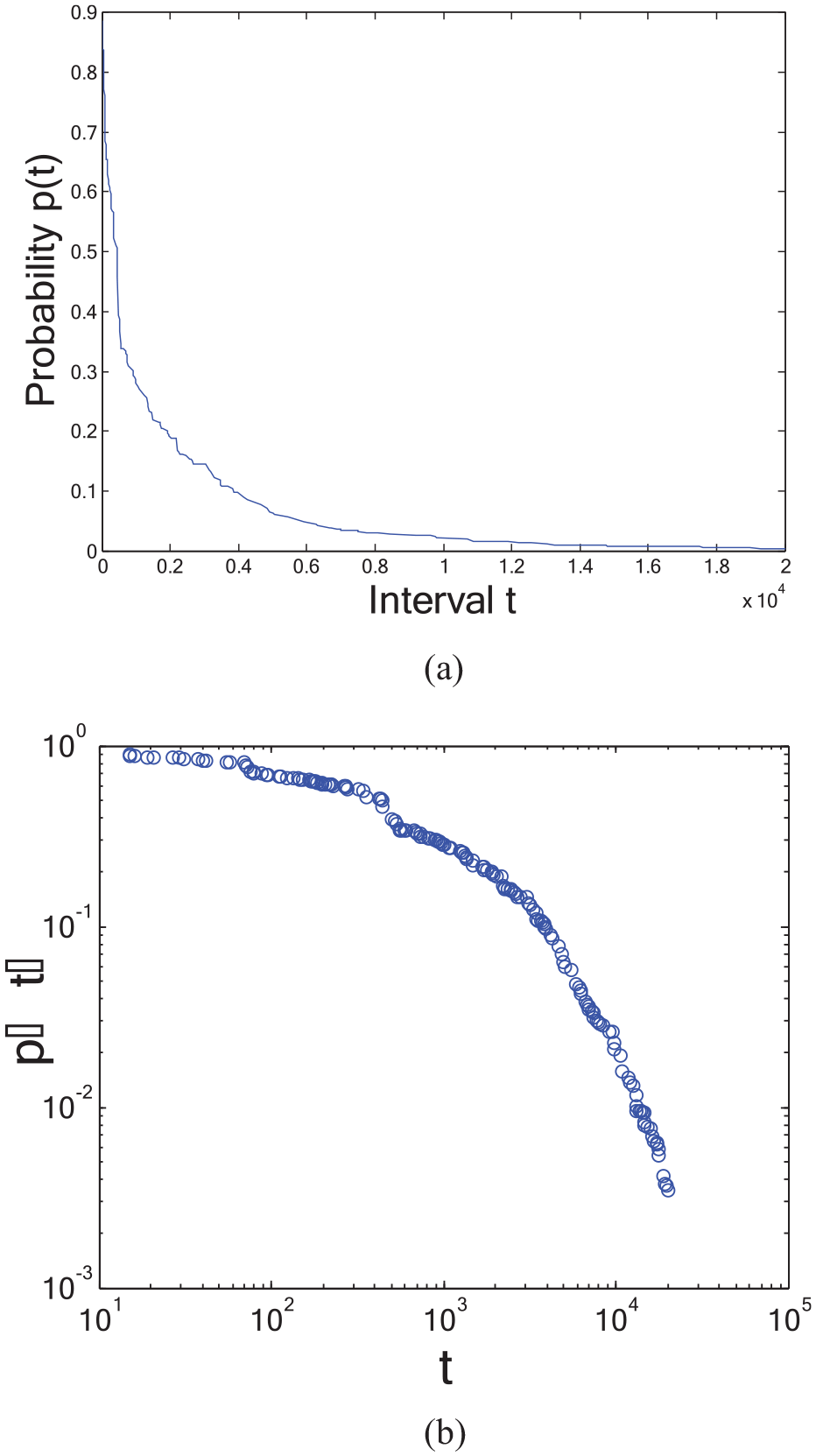
Time interval exponential distribution in log or log–log coordinate system.
In the data sample of 1425 sharing-bicycles, time intervals of sharing-bicycle show fat-tailed distribution characteristics. No.1, the time interval used can be described as τ11, τ12,..., τ1n, The probability is f11, f12,..., fn1n

When parameter is Ln p =y, Lnτ=x as show in Figure 8

User behavior of sharing-bicycle is a power-law distribution with truncation property. When x→0, some of the minimum values deviate from the power-law distribution. It become a special heavy-tailed distribution with scale-free properties. In Figure 8, the reason for the fat-tail distribution is task priority based on the theory of task queues. Remove brand influence, the behavior of using a bicycle without priority level. In different places. The behavior of sharing-bicycles creates case of priorities. For example, sharing-bicycles are frequently used in areas where demand is strong; sharing-bicycles are scarce where the demand is poor. The fat-tail phenomenon of probability explains the backlog of sharing-bicycles in some places. The phenomenon of idle is called “graveyard of sharing-bicycle.” The priority of human behavior is an important reason for the formation of fat-tailed distributions.
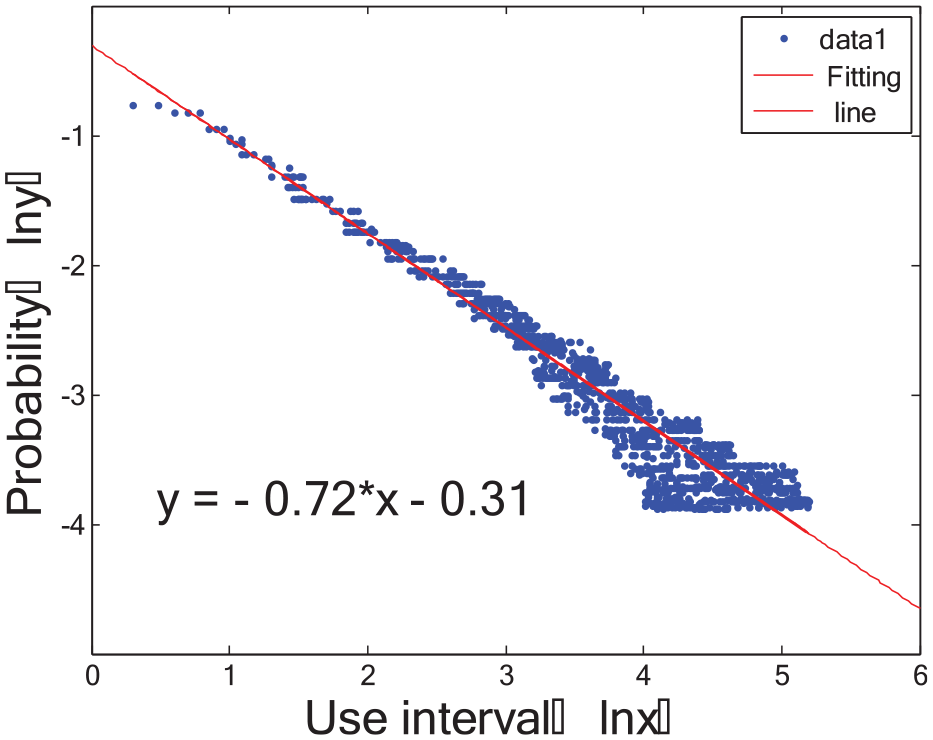
Fat-tail distribute of sharing-bicycle time interval.
Discussion
According to the experimental conclusion. The fat-tailed distribution is described as follows: (1) in different time intervals, the number of events that occur is independent of each other; (2) the function of event decreases linearly with time; (3) frequency of occurrence in short and long periods obey the Zipf laws. User behavior of sharing-bicycle confirms the following conclusions:
1. Property of fat tail
In the process of find and ride sharing-bicycle, the behavior of user includes communication and traffic. The time interval obeys fat-tailed distribution and the power exponent is 0.7. Therefore, the behavior of users accessing mobile Internet resources conforms to the conclusion that the power exponent ranges from 0.7 to 3.
2. Strong paroxysmal
Paroxysmal feature of sharing-bicycle in a shorter time interval is verified. For example, sharing-bike on paring platform is idle in the most of time, bursts of busy shift one by one in short time.
3. Periodic
In the cycle of time, there is a rule of time for users to use sharing-bicycles.
Communication and browsing behavior of user access to mobile Internet are result that regular pattern and periodic in long term of human migration.
4. Fluctuate
According to the spatiotemporal characteristics of sharing-bicycle users statistical analysis, is difficult to predict the abnormal behavior of individual but the mean of groups is predicted easily.
5. Weak memory
The temporal sequence of human behavior can also be described by memory. User behavior shows that longer intervals did not follow another long interval followed, shorter intervals are not to follow hard at heel.
6. Interesting
The degree of interest in a thing (bicycle) continues to decline as time goes on. User moving distance is related to physical strength and interest. Physical strength determines the distance to travel by bike. Interest determines the timing of using a bike.
7. Radius of activity
The distance traveled by user is usually within a radius by sharing-bicycle. The user will return to the original place after ending sharing-bicycle. The travel of user is not random walk. The distance between the user’s shuttle home and the workplace is the active radius. The radius of action is proportional to the logarithm of time.
Furthermore, the more bicycle are shift by different users frequently, the more characteristic of sharing is obviously. Number of repetitions and usage is low. When the number of repetitions and usage decreased heavily, indications waste of resources after gathering and parking platform need to be optimization.
Conclusion
Human dynamic and mobile Internet are becoming more and more cooperative in the communication, entertainment, life, and work field. The biological clock law of user behavior is a factor that cannot be neglected. In different time periods, there are different regular pattern of behavior. For example, commuting, learning, work in the day time, shopping, entertainment in the evening. Time element is a reference for analyzing the behavior data of mobile Internet users. In this way, find out characteristic of crowded together, mobility, bursty in weekday, and inattentive; Characteristics of slow convergence in weekend. The purpose of this study is to analyze spatiotemporal characteristics of shared bicycle data and find out user of mobile Internet life behavior pattern.
Footnotes

Declaration of conflicting interests
The author(s) declared no potential conflicts of interest with respect to the research, authorship, and/or publication of this article.
Funding
The author(s) disclosed receipt of the following financial support for the research, authorship, and/or publication of this article: This work was supported by the National Natural Science Foundation of China under Grant No. 61702046 and National Key R&D Program of China under Grant No. 2017YFB1401500.
Supplemental material
Supplemental material for this article is available online.