




Abstract
In restructured power systems, transmission congestion is an imperative issue. Establishment of solar photovoltaic system at appropriate areas is likely to relieve congestion in transmission lines in the restructured power systems. Congestion management technique by utilizing solar photovoltaic sources, using an improved teaching learning–based optimization, is investigated in this article. Bus sensitivity factors which have the direct influence on the congested lines are utilized to locate the solar photovoltaic sources at appropriate areas. Congestion management is figured as an optimization problem with a goal of limiting the congestion management price utilizing the improved teaching learning–based optimization approach, which espouses the self-driven learning principle. IEEE-30 bus test system is simulated and tested in MATLAB environment so as to demonstrate the viability of the suggested methodology than different methodologies.
Keywords
Introduction
Violation of stability, thermal, and voltage limits in transmission lines is quite often due to transmission open access (TOA) in competitive electricity markets, which results in congestion. The consequence of this happening may lead to widespread blackouts. Thus, congestion relief is the fundamental transmission issue to be addressed properly by independent system operator (ISO). It normally selects the approach of rescheduling of generators/load curtailment than other methods like incorporating flexible alternating current transmission system (FACTS) devices and usage of tap-changing/phase-shifting transformers. Many researchers in academia and industry were intended to address this congestion relief issue in transmission lines and proposed many solutions in recent years.1–10
Unsurprisingly, congestion management (CM) is an optimization problem with many constraints. Lagrangian relaxation, linear programming, nonlinear programming, quadratic programming, and so forth are utilized to tackle CM issue.11–13 Later, by the adverse applications of evolutionary computations and meta-heuristic algorithms, the CM problem is solved with genetic algorithm (GA), particle swarm optimization (PSO), differential evolution (DE), and so on.14–16 An algorithm inspired by the teacher student learning procedure of the classroom called teaching learning–based optimization (TLBO) invented by Rao et al.17,18 proved its better performance in solving optimization problems of large scale. This manuscript ascertains the competency of TLBO calculation in solving the CM issue. In this presentation, an idea called self-driven learning is integrated with the prevailing procedure of the TLBO to improve its output. 19
In recent years, the power generation by means of renewable energy sources (RES), such as solar and wind in particular, rises very rapidly in view of their eco-friendly nature. Optimal utilization of RES along with the conventional generators for CM on a day-ahead electricity market is elaborated in Sood and Singh. 20 Incorporation of wind farms for CM problem using sensitivity factors is discussed in Suganthi et al. 21 There is substantial research that has been conducted to integrate solar photovoltaic (PV) sources in power system to alleviate congestion. 22 This work analyzes the impact of the integration of solar PV in managing the congestion and mainly in reducing the rescheduling cost. Development of CM strategy by integrating the solar PV using improved teaching learning–based optimization (ITLBO) is the foremost goal of this work.
Modeling of solar photovoltaic system
The output of solar photovoltaic power is mainly subjected to the radiation level of the sun. The PV real power output can be calculated as

where


where
The total capacity of the battery bank can be written as



where
A suitable inverter should be placed to convert the DC output of the solar PV to AC, which in turn is used to feed the power into the grid. The yield power of the inverter is determined by
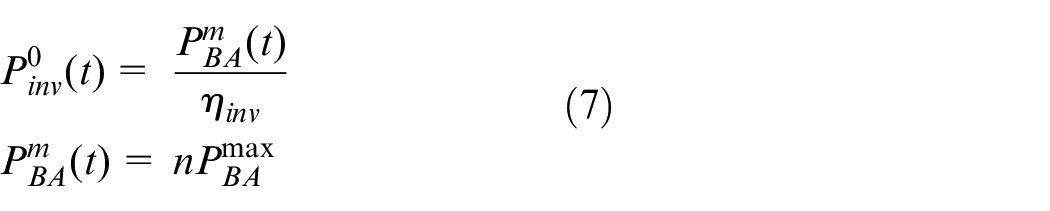
where
Problem statement
Bus sensitivity factor
The bus sensitivity factor (BSF) presented in this section is to find the appropriate place for solar PV, which in turn effectively alleviates the congestion in transmission lines. A BSF of a PQ bus “n” in a power system is described as a change in real power flow through transmission line k connected between buses i and j due to a change in real power injection at bus “n.” This can be mathematically stated as

BSFs of all the PQ buses can be determined using equation (8). The buses which have high values of BSF may be selected for the installation of solar PV.
Rescheduling cost
ISO has the accountability for CM by rescheduling the real power of available generators. Rescheduling process has to be done, centered on the bids agreed by the generators with the aim of increasing social benefits. Hence, the major aim of the CM issue is to limit the rescheduling cost which can be stated mathematically as follows:
Limit re-dispatch cost (RC)

where
As solar PV is one of the naturally available sources, the bidding cost of solar PV (
Proposed algorithm—ITLBO
TLBO is a new efficient meta-heuristic approach which is influenced by means of the teacher student learning procedure. Similar to other meta-heuristic approaches, TLBO is a population-based technique and utilizes a number of solutions to achieve the result. In this algorithm, population is nothing but a cluster of learners. The whole process of TLBO is separated into two segments: one is the “Teacher Segment,” and the other one is the “Learner Segment.” Knowledge transfer between teacher and learners is described in the “Teacher Phase,” whereas the knowledge transfer between learners is described in the “Learner Phase.”
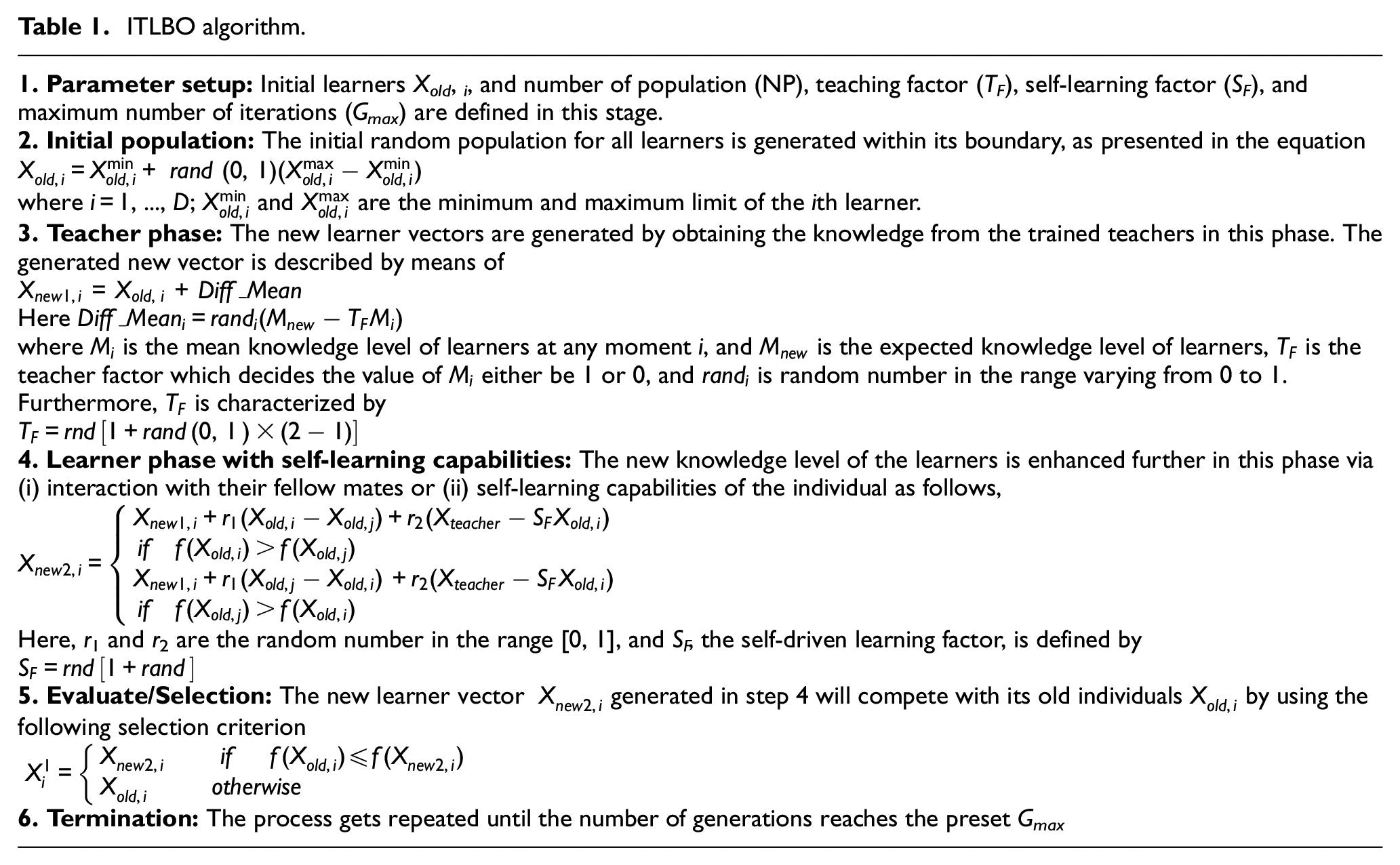
There exist many strategies to augment the performance of the algorithm. In this regard, an attempt was made here with the concept of “self-learning capability of the learners.” To achieve good results, every learner should have a self-propelled ability based on his own ability. Thus, self-driven capability of learners is added in order to obtain better output of population reproduction, resulting in different variants. The detailed approach of the ITLBO algorithm is briefed in Table.1. Figure 1 explains the application of the suggested ITLBO approach to CM issue.
ITLBO algorithm.
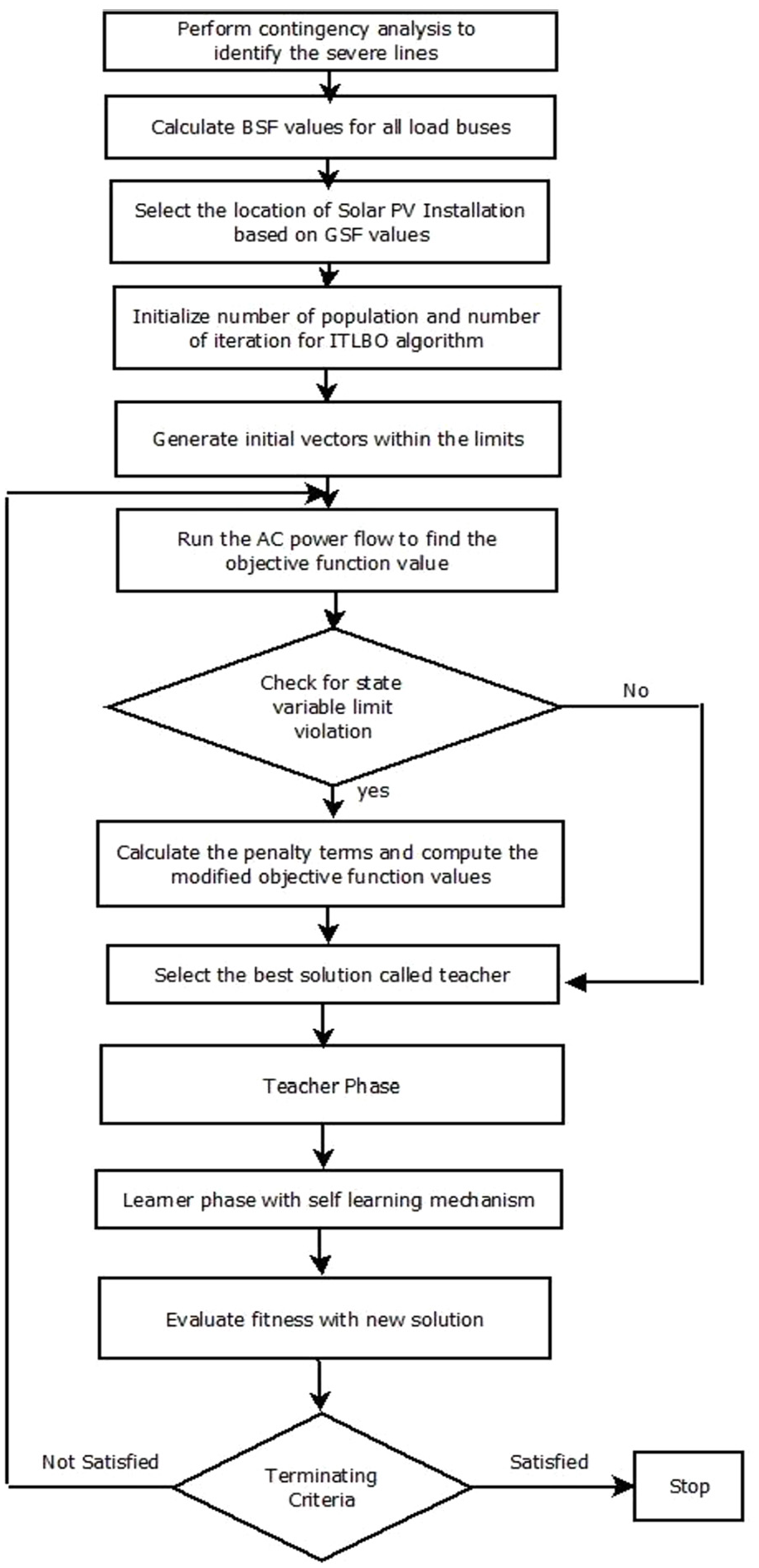
Application of ITLBO approach for CM issue.
Results and discussion
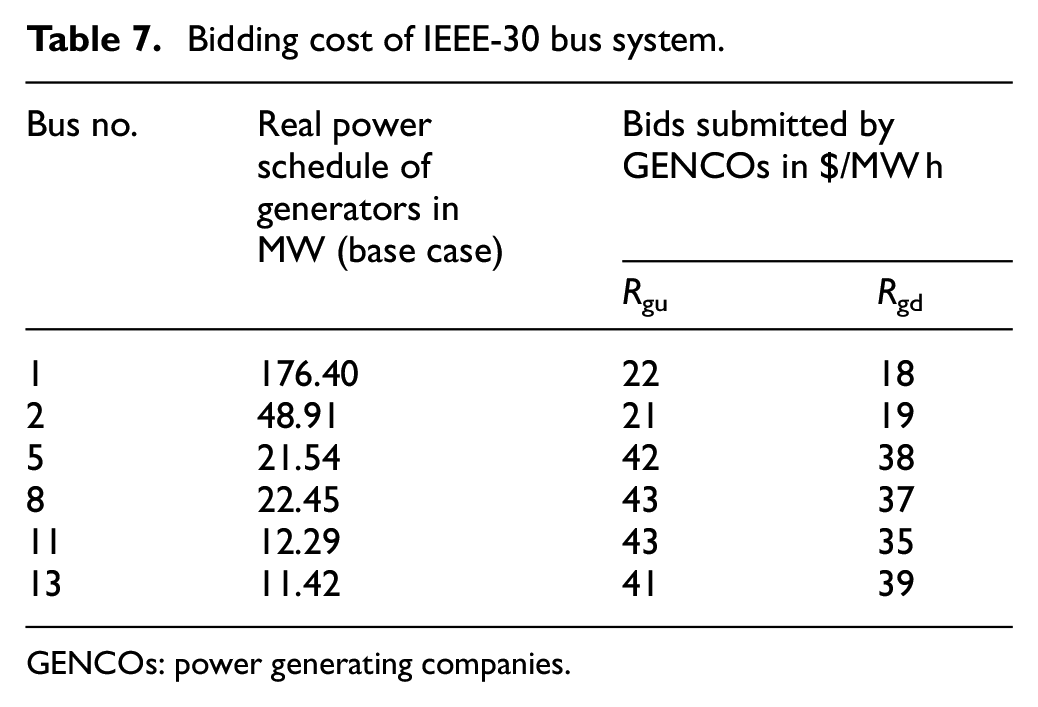
To check the adequacy of the anticipated methodology utilizing ITLBO for CM issue, it is tested on the standard IEEE-30 bus test system. 23 Using MATPOWER software package, the MATLAB coding has been developed for the ITLBO approach and tested on the standard IEEE-30 bus system. The bidding cost coefficients considered for the congestion management cost calculation of standard IEEE-30 bus system are given in Appendix I
Congestion is formed in the test system exaggeratedly as discussed in Suganthi et al. 21 The line (1–2) is recognized as the most dangerous line by contingency analysis because it causes heavy power flow violation on the lines (1–3), (3–4), and (4–6). The details are listed in Table 2.
Power flow violations in the resulted congested lines.
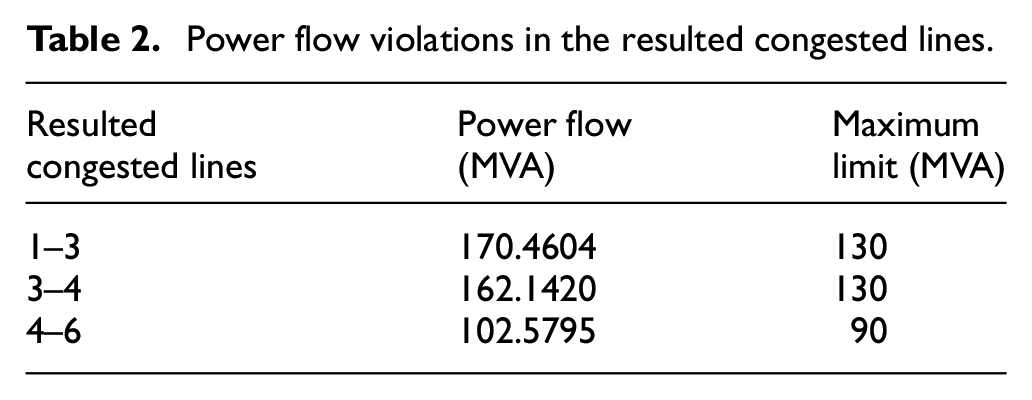
Figure 2 shows the calculated BSF values for all the PQ buses. Buses which are having high negative sensitivity values are selected for the establishment of solar PV at appropriate places. From Figure 2, it is obvious that load bus 20 has large negative BSF values concerning all congested lines. Hence, it is decided to locate solar PV on load bus 20.
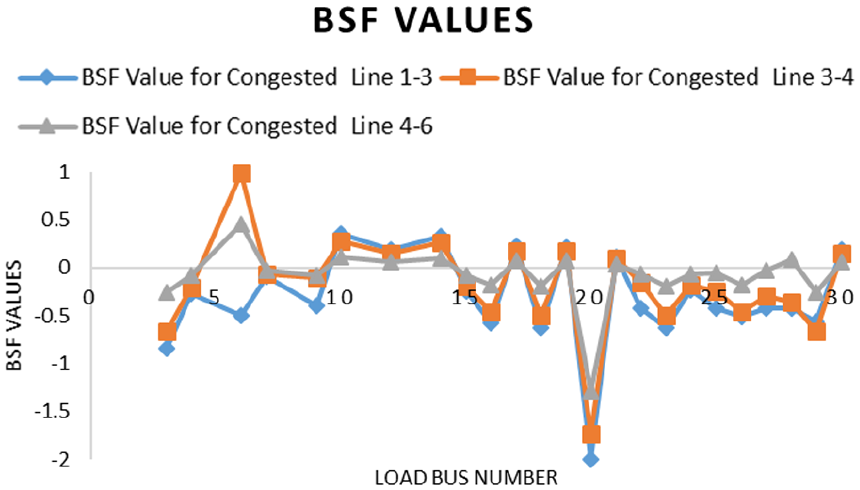
Bus sensitivity factors for congested lines.
The optimal results of the control parameters and the congestion price acquired by the developed ITLBO are recorded in Table 3. It also provides insights regarding congestion price, with and without solar PV. From Table 3, we infer that, 30 MW of real power is been utilized from the solar panel which is installed at bus number 20 to relieve congestion. Because of this, there is much reduction in the congestion cost when compared to case 1. Also, only two conventional generators are participating in the rescheduling process. The convergence characteristic of the suggested method and the drift in the real power values of individual generators with the inclusion of solar PV are appeared in Figures 3 and 4. The radical reduction in the congestion price with the inclusion of solar PV is outlined in Figure 5.
Optimal results of control parameters and congestion price acquired by ITLBO approach.
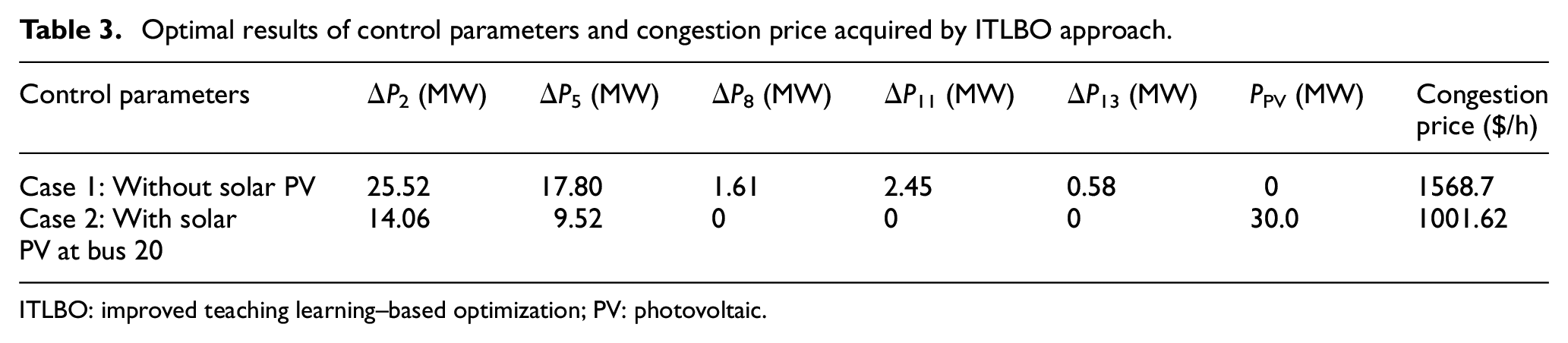
ITLBO: improved teaching learning–based optimization; PV: photovoltaic.
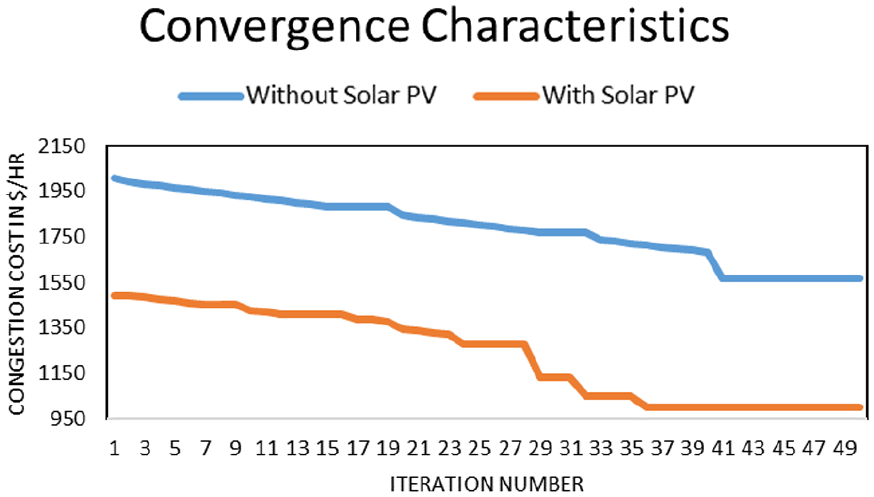
Convergence characteristics of ITLBO with and without solar PV.
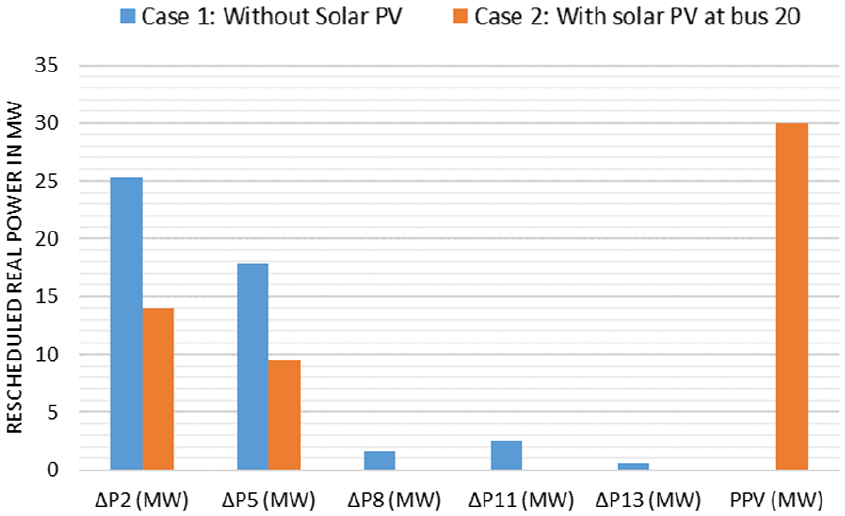
Rescheduled real power with and without solar PV.
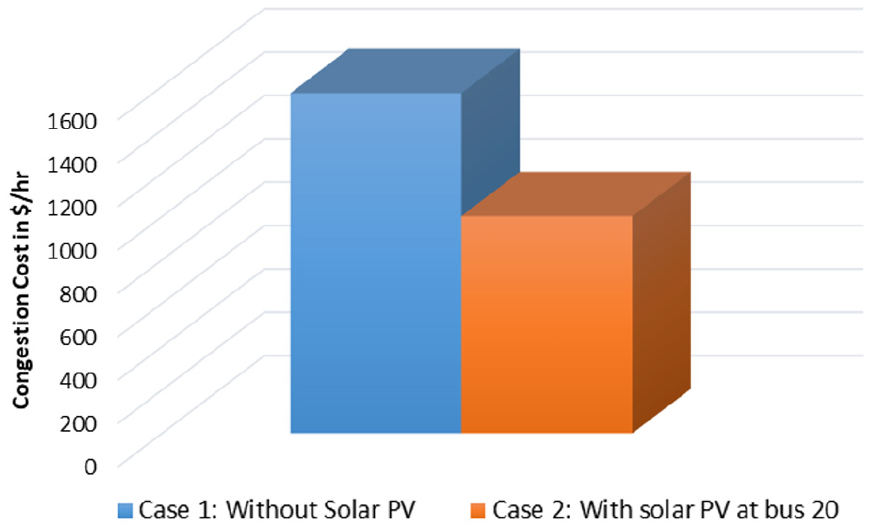
Reduction in congestion cost with solar PV.
The impact of the rescheduling process on the congested line before and after establishment of solar PV is detailed in Table 4. Power flow in all the congested lines are greatly diminished and came to safe working points with the establishment of solar PV.
Power flow details of congested lines before and after rescheduling.
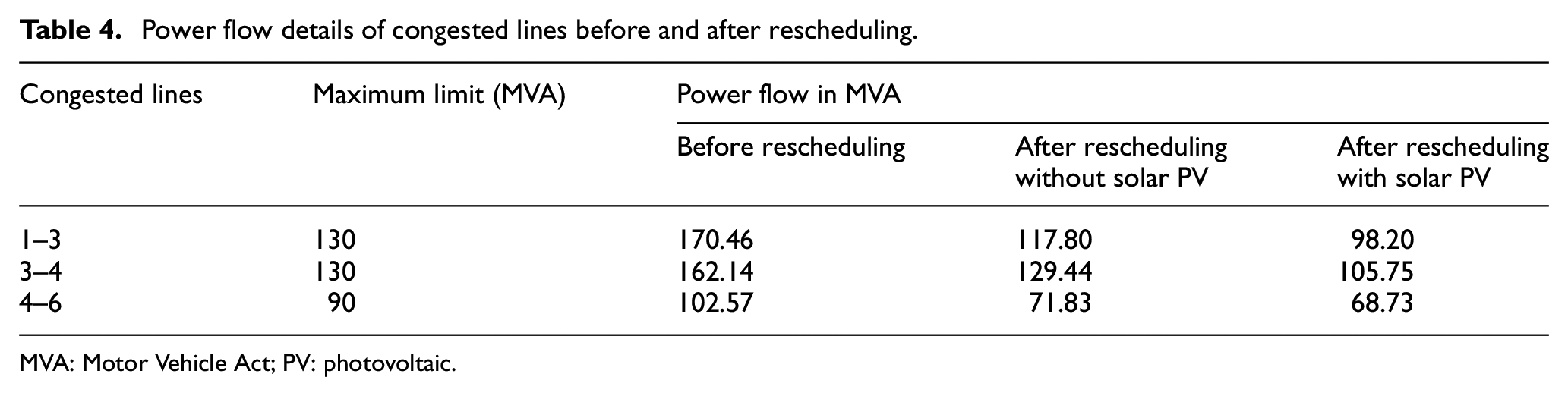
MVA: Motor Vehicle Act; PV: photovoltaic.
The proposed ITLBO-based method is compared with other heuristic approaches suggested for CM. The comparison of the obtained results with former heuristic algorithms like GA, PSO, and DE is demonstrated here in both scenarios, that is, without the installation of solar PV and with solar PV. Both the control parameters and congestion price are recorded in Tables 5 and 6. The convergence characteristics of all the meta-heuristic algorithms including ITLBO with both scenarios, with and without solar PV, are depicted in Figures 6 and 7. The figures are the evidence for the greater convergence of the proposed ITLBO algorithm in both the scenarios.
Comparison with other algorithms without solar PV.
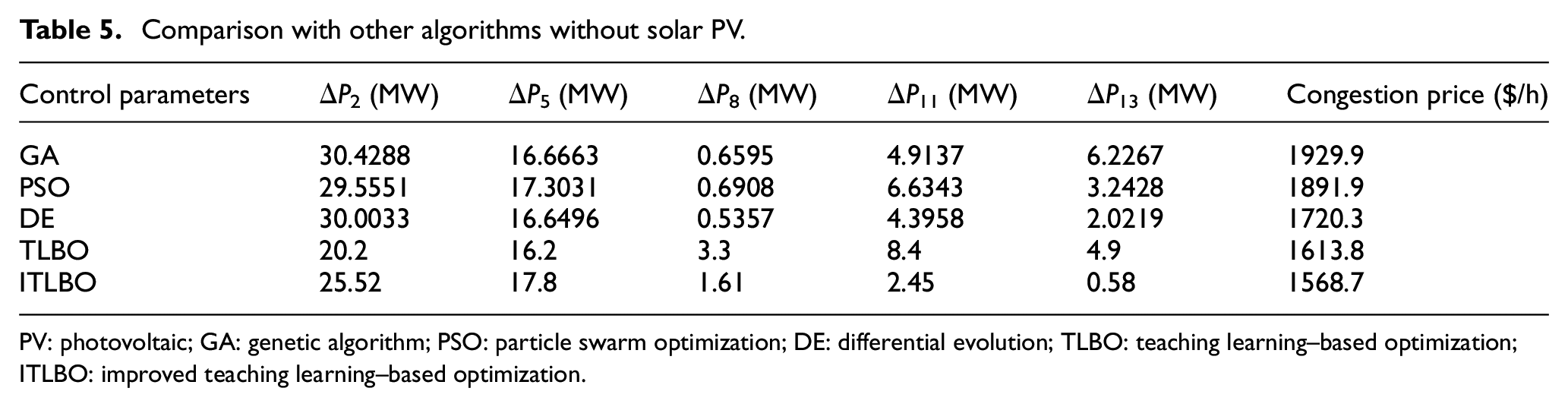
PV: photovoltaic; GA: genetic algorithm; PSO: particle swarm optimization; DE: differential evolution; TLBO: teaching learning–based optimization; ITLBO: improved teaching learning–based optimization.
Comparison with other algorithms with solar PV.
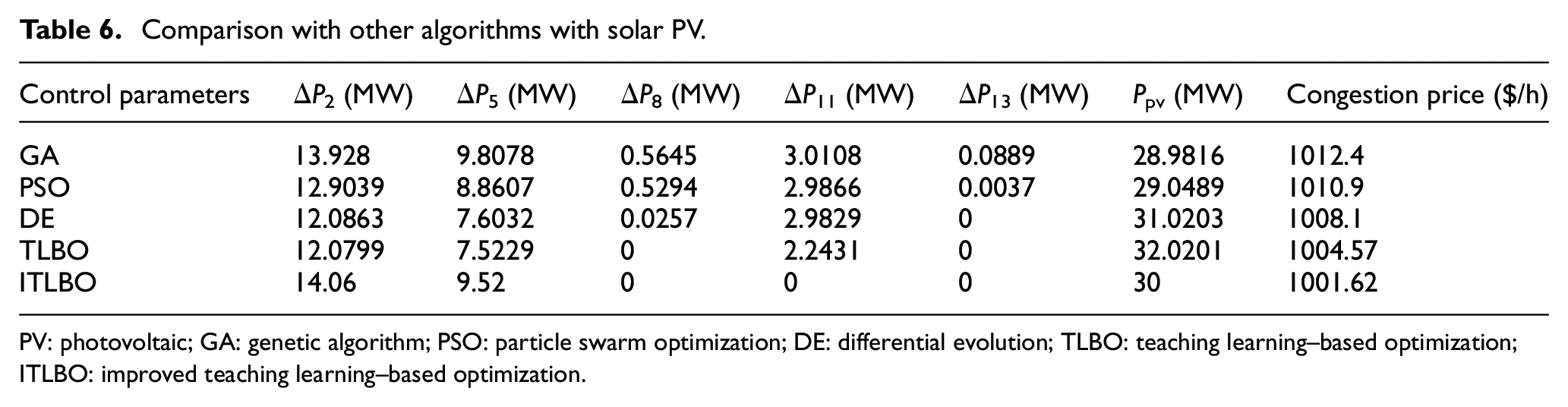
PV: photovoltaic; GA: genetic algorithm; PSO: particle swarm optimization; DE: differential evolution; TLBO: teaching learning–based optimization; ITLBO: improved teaching learning–based optimization.
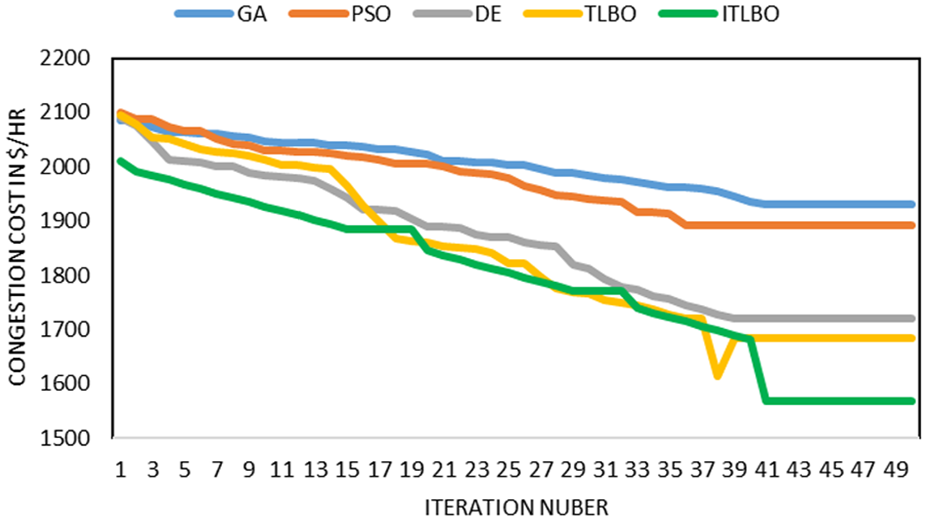
Comparison of convergence characteristics without solar PV.
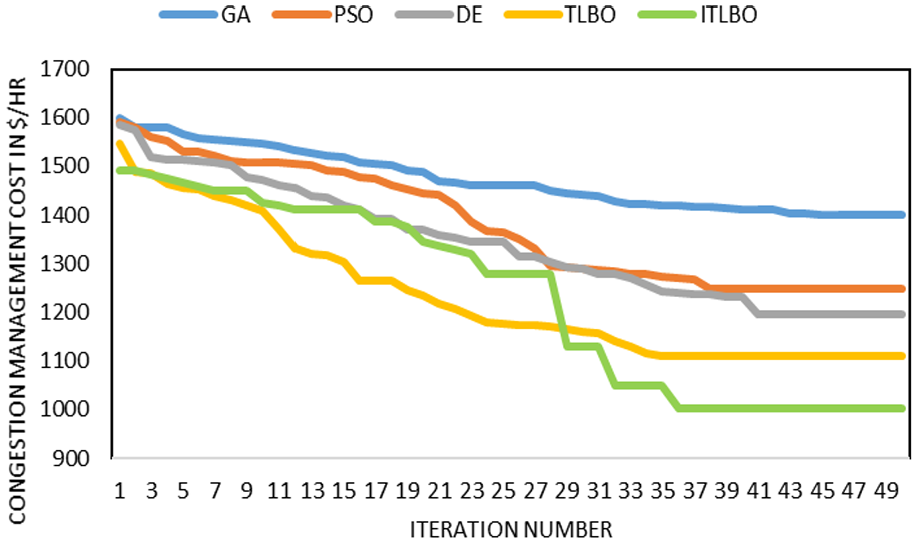
Comparison of convergence characteristics with solar PV.
Conclusion
This paper deals with the strategy of incorporating solar PV energy sources for CM through generation rescheduling. BSFs used here are good indicator for identifying the location of the solar PV and help in relieving the congestion in an effective manner. The CM issue is figured with an objective function which includes the solar PV active power as one of its decision variables with the aim of reducing the rescheduling cost incurred for alleviation of the congestion. The output of the suggested ITLBO approach is assessed on standard IEEE-30 bus system. The obtained outcomes are the proof of suggested calculation’s proficiency as far as convergence speed and optimized result are concerned. The idea of self-driven learning mechanism, which when included in the basic TLBO operation stimulates the algorithm’s performance, yielded notably better solution compared with other existing methods.
Footnotes
Appendix 1
Bidding cost of IEEE-30 bus system.
| Bus no. | Real power schedule of generators in MW (base case) | Bids submitted by GENCOs in $/MW h | |
|---|---|---|---|
| R gu | R gd | ||
| 1 | 176.40 | 22 | 18 |
| 2 | 48.91 | 21 | 19 |
| 5 | 21.54 | 42 | 38 |
| 8 | 22.45 | 43 | 37 |
| 11 | 12.29 | 43 | 35 |
| 13 | 11.42 | 41 | 39 |
GENCOs: power generating companies.
Declaration of conflicting interests
The author(s) declared no potential conflicts of interest with respect to the research, authorship, and/or publication of this article.
Funding
The author(s) received no financial support for the research, authorship, and/or publication of this article.
