




Abstract
In recent years, e-commerce has developed rapidly. Many manufacturers are beginning to integrate with the Internet and regard online platforms, such as online marketplaces and self-owned online malls, as important sale channels for their products. Considering the difference of shopping experience between the two online channels, this paper models price and service competition between the two channels. This paper discusses the decisions of supply chain participants with three power structures, that is, the manufacturer Stackelberg game, the online marketplace firm Stackelberg game, and the Nash game. The results show that the channel service level and the consumer sensitivity to channel service positively affect the channel price and demand. We characterize a threshold for the wholesale price. When the wholesale price is below the threshold, the channel prices are lowest in the Nash game, and when the wholesale price is greater than the threshold, the channel prices are lowest when the manufacture acts as the leader. Differentiated services can improve the supply chain participants’ profits and the system’s profit compared with the same service. More interestingly, this paper finds that the online marketplace firm should pay attention to improving its service level, while the manufacturer should pay attention to other work differently, such as focusing on generating promotional value and shaping corporate brand image by the self-owned online mall channel.
Introduction
In recent years, e-commerce has developed rapidly. Many manufacturers are beginning to integrate with the Internet and regard online channels as important sale channels for product, such as online marketplaces and self-owned online malls (SOMs). Online marketplaces, such as Amazon.com and JD.com, wholesale products from manufacturers and resell them to online consumers. 1 Consumers’ enthusiasm for online shopping has boosted the online marketplace. The influence of the online marketplace is increasing in recent years. Simultaneously, with the rapid growth of online sales and the shift in consumer focus, more and more manufacturers directly sell their products to customers through the establishment of SOM. 2 SOM is a digital storefront independently operated by the manufacturer. In essence, it is an online version of the traditional offline store. Examples of SOMs include vmall.com and apple.com. Many manufacturers choose to cooperate with the online marketplace firms and also actively build the SOM. Online marketplaces and SOMs bring different shopping experiences to consumers. First, consumers get different service experiences from the two. For example, (1) consumers will have a higher perceived risk to the online marketplace and more trust to the SOM. 3 (2) The manufacturers only sell their own brand products through the SOM. However, the online marketplace provides consumers with abundant product categories and abundant products under each product category. (3) The online marketplace attracts a large number of consumers through a large number of product information, price comparison mechanisms, more convenience to search for information, and more. 4 Second, the same products have different prices in the two channels. 5 Products on the online marketplace have lower prices. 3 Liu and Zhang 6 found that product price is the most important factor affecting online hotel bookers’ choice of the OTA (Online Travel Agents) rather than the hotel website. The different shopping experiences brought by the two online channels have changed consumers’ online shopping behavior, resulting in changes in the market demand structure.
The combination of the SOM and the online marketplace meets the needs of online consumers with different preferences and improves the manufacturer’s market share. However, there is fierce competition between the two channels, resulting in channel conflict. 4 How to manage and coordinate them is an important issue in dual-channel operation management and also a key issue for both the manufacturer and the online marketplace firm. From the perspective of price and service competition, this paper discusses how the online marketplace firm and the manufacturer should deal with the conflict between them in customer acquisition. Specifically, this paper aims to answer the following questions: (1) How does the online marketplace firm make the price and service decisions in the cooperative and competitive relationship with the manufacturer? (2) How could the manufacturer make price and service decisions to ensure that it can compete and cooperate with the online marketplace firm in an orderly manner while improving its own profit?
This paper contributes to the dual-channel supply chain research. The specific contributions are as follows: (1) Drawing on the operating model of the SOM and the online marketplace channels, this paper models price and service competition between the two channels. (2) From the perspective of the manufacturer and the online marketplace firm providing services and pricing independently, this paper studies the price and service competition issues between the two. A lot of studies have focused on price competition issues.7–12 With regard to service competition, Zhao et al. 13 presumed that the manufacturers compete to provide services, while Ali et al. 14 studied the service competition issues among the retailers. Few studies have examined the price and service competition issues simultaneously. 14 Ali et al. 14 studied the issues of price and service competition between two retailers. This paper examines the issues of price and service competition between a retailer and a manufacturer.
The remainder of this paper is organized as follows. In section “Literature review,” we review the relevant literature. The decision model of the manufacturer and the online marketplace firm is described and the related notations are introduced in section “The model.” Section “Analysis results” discusses the decisions of supply chain participants under three power structures. In section “Numerical studies,” we numerically analyze the impact of a service on supply chain participants’ profits and the system’s profit under three power structures. Section “Conclusion” gives the main conclusions, theoretical and management implications, and research limitations and directions for future research. We provide proofs of the propositions and corollaries in this paper in Appendix 1.
Literature review
This article is related to the research on the power structures of channel participants, pricing, and service.
The power structures among the supply chain participants present diverse characteristics. In the actual market environment, there are three kinds of power structures, namely, the retailer Stackelberg game, the manufacturer Stackelberg game, and the Nash game. 15 Some scholars have studied the issues related to the supply chain’s decisions under a single power structure. For example, Xiao et al. 16 developed a retailer Stackelberg model to study the channel choice strategy of the manufacturer. Ali et al. 14 studied price and service effort decisions when the manufacturer wields leadership. However, Sheu and Hu 17 argued that the power structure plays an important role in developing good relationships between channel participants and improving the channel performance. Therefore, more and more scholars study the problems under the diversified power structures. For example, Zhang et al. 12 studied the pricing issues of supply chain participants under different power structures. Wu et al. 18 introduced the topic on power structures into a fresh product supply chain with logistics outsourcing. Chen and Wang 19 studied the effect of power structures on both price policies and channel selection decisions in free and bundled channels in a smartphone supply chain.
Cattani et al. 20 found that the implementation of unified pricing can only reduce channel conflict when the online channel is not convenient or costly. Therefore, the literature related to the dual-channel supply chain mainly pays attention to differential pricing.9–11 Pricing is an important competitive tool for both the retailer and the manufacturer to attract customers. 21 Chiang et al. 22 studied the dual-channel pricing problem based on consumer utility theory. Park and Keh 8 found that the addition of the direct sale channel will reduce the market price and increase the sales volumes. Netessine and Rudi 23 discussed issues related to the channel conflict, pricing, and inventory between the online and traditional channels. Retailers can use pricing policies to influence consumer buying behaviors. 24 Liu and Zhang 25 argued that personalized pricing is an effective strategy for the traditional retailer to prevent the manufacturer from directly selling products to consumers. Huang et al. 7 discussed the optimal price decisions of dual-channel participants under production cost disruptions. Yao and Liu 26 studied equilibrium pricing strategies of the supply chain participants when the price and the service simultaneously affect the demand.
The work reported in this article is also related to the research on the channel services. Ali et al. 14 argued that service, even though not playing an important role as price, could also consider owning the same importance as price does. Iravani et al. 27 even argued that the role of service in market competition has exceeded the role of price. At present, according to the difference of the service provider, the literature on channel service issues can be broadly divided into three categories. The first category of the literature is related to the research on retailer-providing service. For example, Yan and Pei 28 argued that the manufacturer’s online trading website will stimulate the retailer to improve its service quality, thereby alleviating channel competition and improving supply chain performance. Pu et al. 29 examined how free riding influences the retailer’s sales effort in a dual-channel supply chain. They found that both the sales effort level of the traditional retailer and the supply chain’s profit will decrease with the increase in the number of free-riding consumers. A study by Carlton and Chevalier 30 showed that the manufacturer can weaken consumers’ free-riding behavior by setting higher product prices in its own website. Sang 31 studied the optimal decision-making of channel participants when retailers provide services in an uncertain environment. The second is related to the research on manufacturer-providing service. For example, Zhao et al. 13 studied service-level decisions of two manufacturers when the two manufacturers provide substitute products to the same retailer. The third is related to the research on service simultaneously provided by both the retailer and the manufacturer. For example, Dumrongsiri et al. 32 regarded the service levels of both the direct and retail channels as uncontrollable variables and studied the difference in service level between the two channels and the impact of marginal costs on supply chain decision and performance. Chen et al. 33 assumed that consumers have different tolerances for the delivery lead time of the online channel, and all consumers respond the same to product availability in the traditional channel. They studied the optimal decisions of both the manufacturer and the retailer in the context of service competition between the two channels.
By summarizing the above literature, we find that previous dual-channel research focuses on the combination of the online channel and the offline channel, and the research on purely online channel decisions is rare. Besides, few studies simultaneously consider price and service competition issues. 14 Drawing on the operating model of the SOM and the online marketplace channels, this paper studies the supply chain participants’ decisions from the perspective of price and service competition under three power structures, that is, the manufacturer Stackelberg game, the online marketplace firm Stackelberg game, and the Nash game.
The model
Problem description
This article considers a supply chain composed of a SOM channel and an online marketplace channel. The unit cost required by the manufacturer to produce a product is
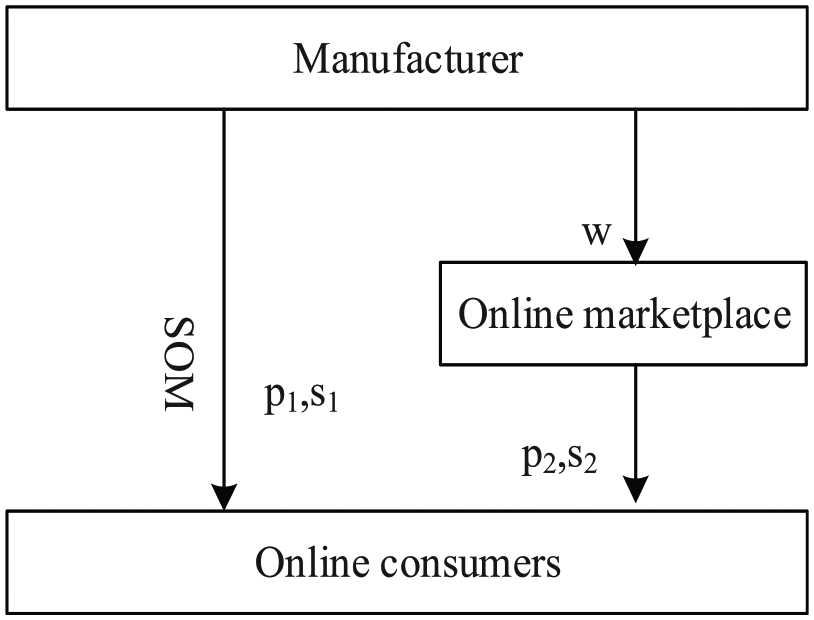
The dual-channel structure model.
This paper assumes that the following: (1) Both the manufacturer and the online marketplace firm are risk neutral and fully rational. (2) The wholesale price is determined by the market price or the long-term contract price, which is an exogenous variable. (3) The supply chain participants know each other, and there is no information asymmetry. (4) According to Ryan et al., 34 consumers prefer to buy products through the online marketplace channel rather than buy through the manufacturer’s direct channel.
Demand model and profit functions
In this paper, price and service quality are two important variables that influence the channel demand. Drawing on the research of Yao et al.,
35
the demands for the SOM channel
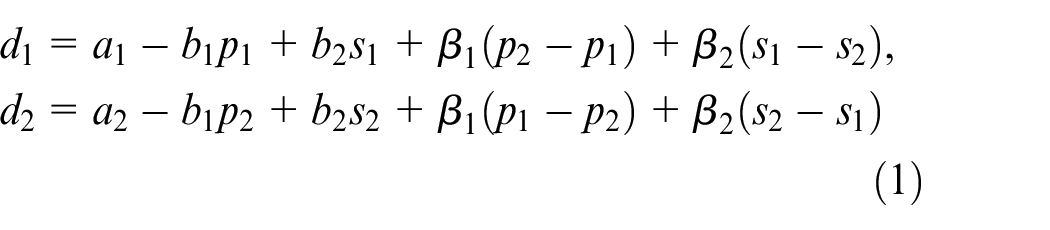
where
The parameter
In practice, the strict convex function
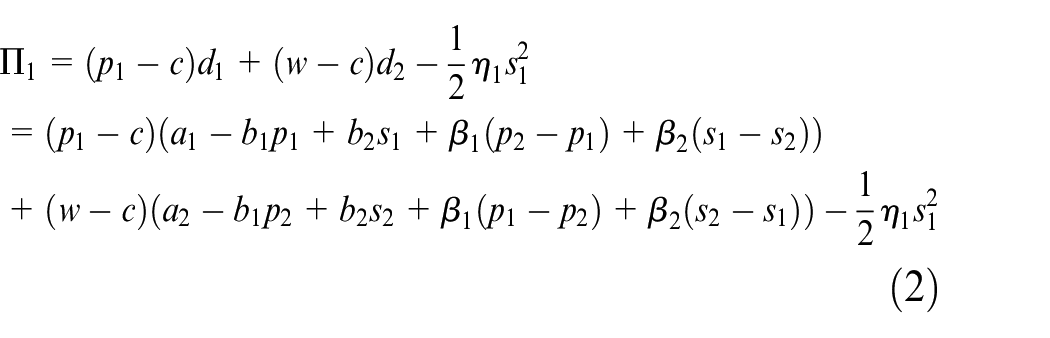
The profit of the manufacturer is given by
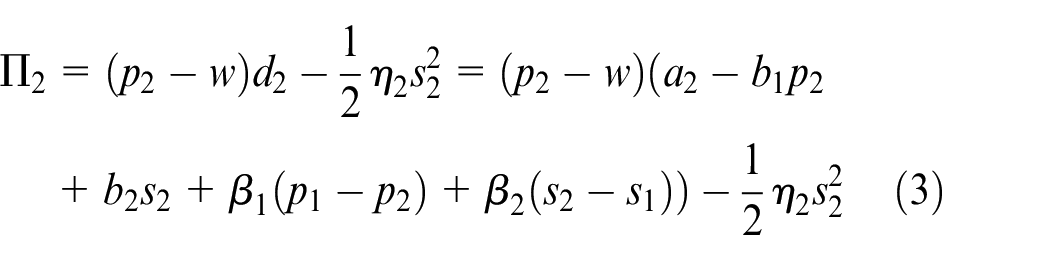
The profit of the online marketplace firm is given by
The supply chain’s profit is given by
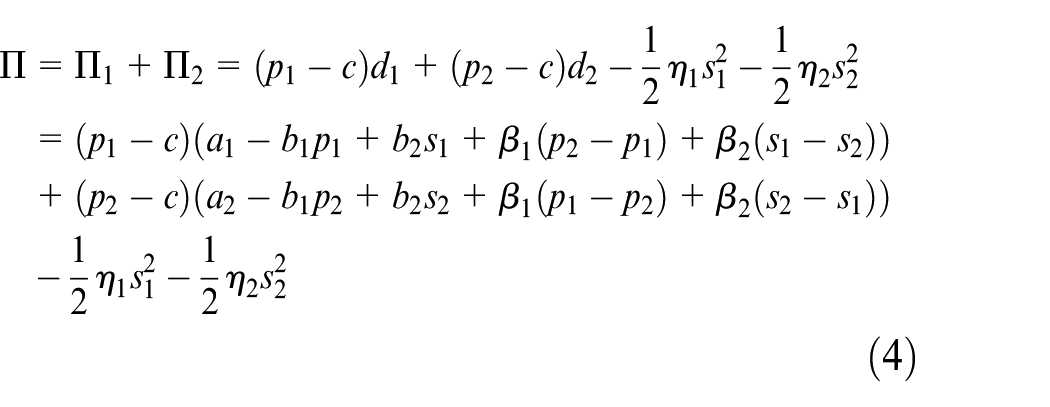
Table 1 summarizes the notations used in this study.
Summary of notations.
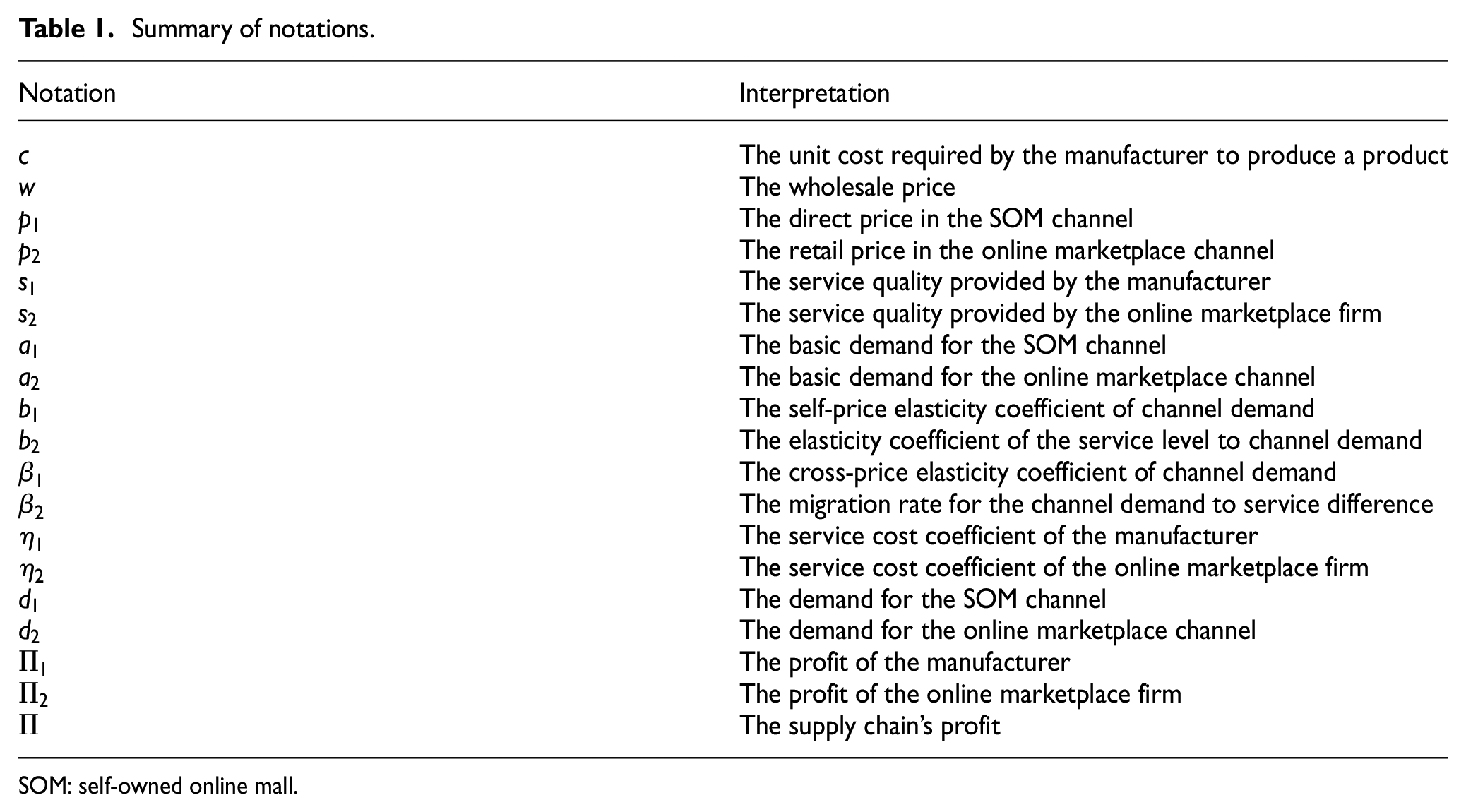
SOM: self-owned online mall.
Analysis results
The manufacturer Stackelberg game
In this game, the manufacturer wields leadership and the online marketplace firm acts as the follower. The Stackelberg game process is as follows: First, the manufacturer sets the optimal direct price
Proposition 1
In the manufacturer Stackelberg game, the optimal prices of supply chain participants are given by

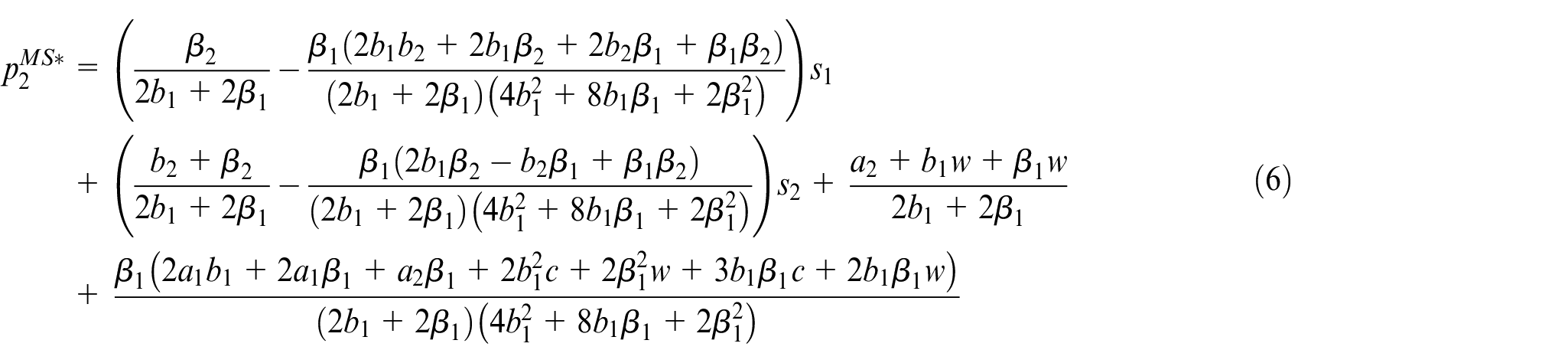
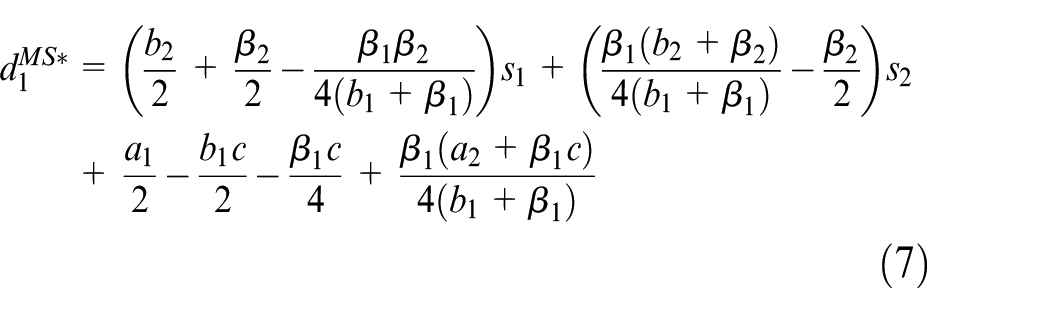
By substituting equations (5) and (6) into equation (1), the equilibrium demands in the two channels are
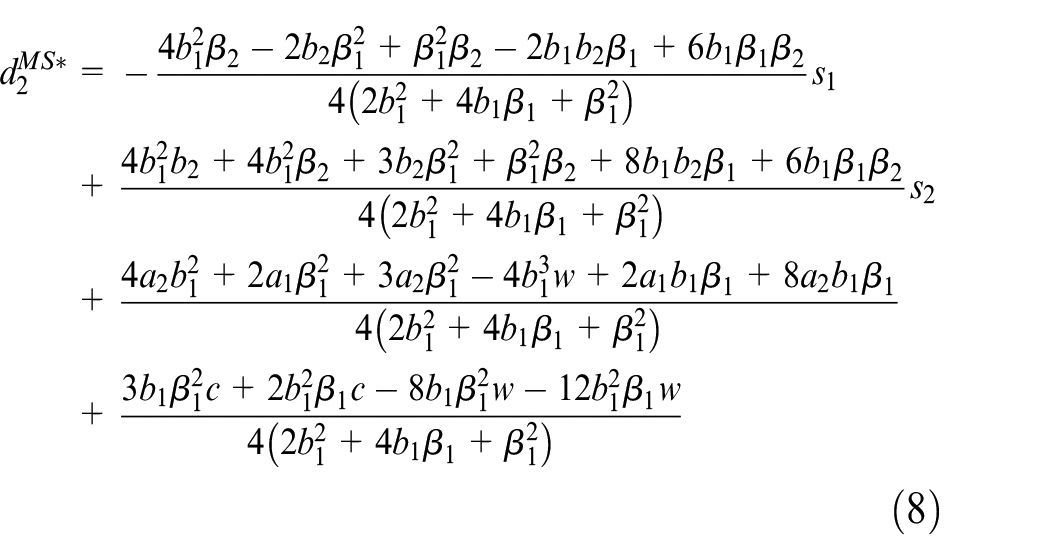
The proof of Proposition 1 is given in Appendix 1.
The online marketplace firm Stackelberg game
In the Stackelberg game, the online marketplace firm wields leadership and the manufacturer acts as the follower. The Stackelberg game process is as follows: First, the online marketplace firm sets the optimal price
Proposition 2
In the Stackelberg game with the online marketplace firm as the leader, the optimal prices of dual-channel supply chain participants are given by
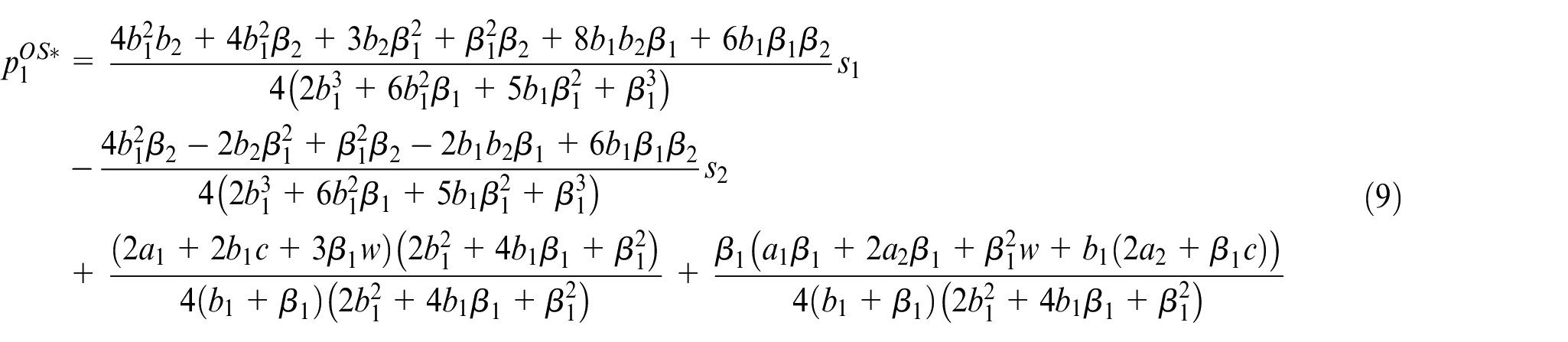

By substituting equations (9) and (10) into equation (1), the equilibrium demands in the two channels are
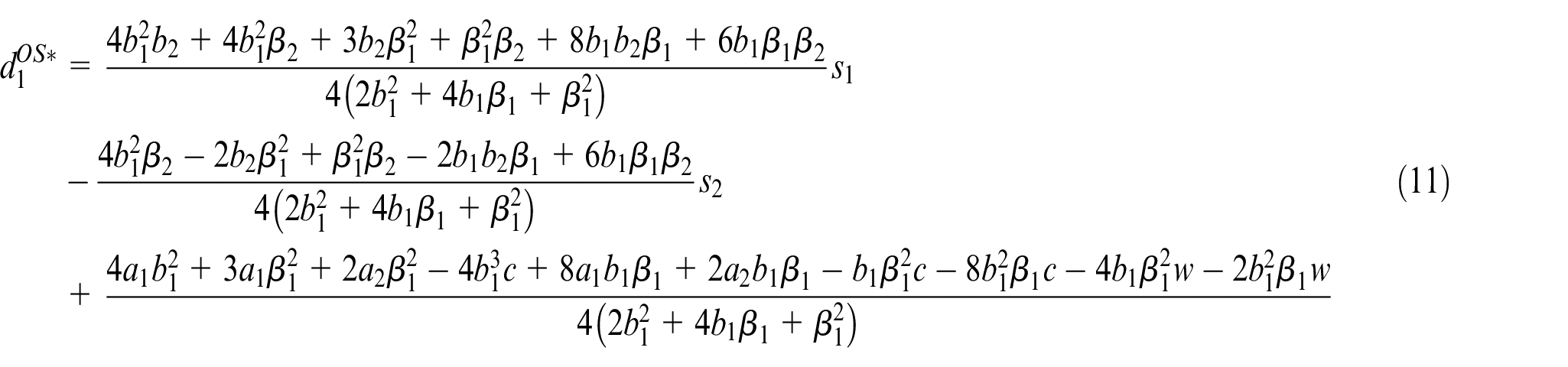

The proof of Proposition 2 is given in Appendix 1.
The Nash game
In the Nash scenario, the two participants have equal status. They independently set the product prices. The Nash game process is as follows: The manufacturer determines the optimal direct price
Proposition 3
In the Nash equilibrium game, optimal prices of dual-channel supply chain participants are given by


By substituting equations (13) and (14) into equation (1), the equilibrium demands in the two channels are
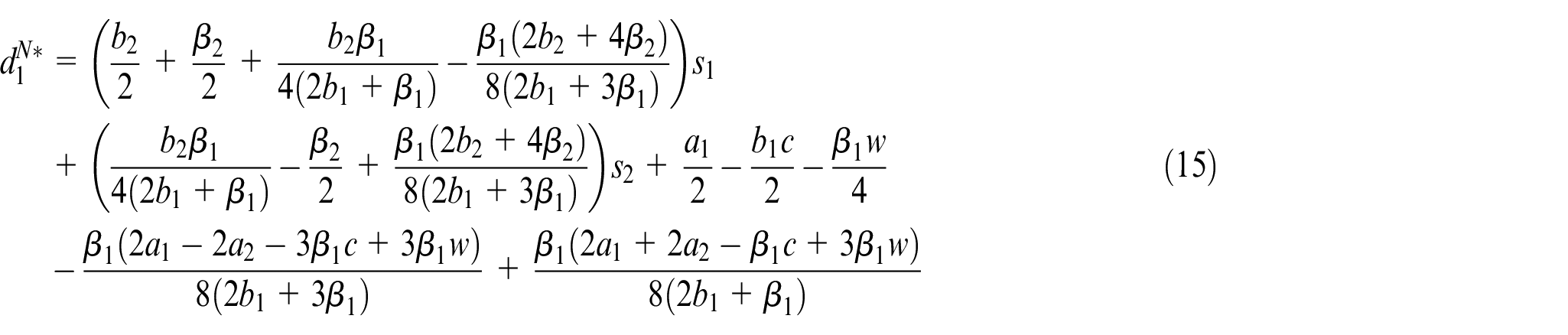

The proof of Proposition 3 is given in Appendix 1.
Corollary 1
(1)
The proofs of Corollaries 1–6 are given in Appendix 1. Corollary 1 shows that the optimal direct price in the manufacturer’s direct channel is positively associated with its own service level, and the optimal retail price in the online marketplace channel is positively associated with its own service level. Corollary 1 implies that in a supply chain where two channel participants compete to provide service, good services will bring larger pricing space. The improvement of channel service levels leads to an increase in the cost of supply chain participants and the channel prices increase accordingly. In the end, it is consumers who pay for the high quality of service they enjoy. Therefore, there are no services that consumers can enjoy for free, even if two channel participants compete to provide services for consumers. While the manufacturer and the online marketplace firm improve the channel service levels, they need to weigh consumers’ assessment of the price and the service quality. Both of them should set price and service strategies for different types of consumers according to their own market positioning.
Corollary 2
(1)
Corollary 2 shows that the demand in the SOM channel is positively associated with its service level, and the demand in the online marketplace channel is positively associated with its service level. The management implication of Corollary 2 is that online channel participants should focus on the driving role of service in increasing channel demand. In the process of building the online channel, online channel participants should focus on improving service level. They can use service to affect the demand, thereby increasing the market coverage ratio of their channels.
Corollary 3
(1)
Corollary 3 shows that the service level in the SOM channel exerts a greater influence on the direct price than on the retail price; the service level in the online marketplace channel exerts a greater influence on the retail price than on the direct price. The management implication of Corollary 3 is that when the consumer’s service quality requirements for the SOM are reduced, the direct price will also decrease according to Corollary 1. In order to compete with the manufacturer, if the online marketplace firm wants to adopt price reduction strategies, the extent of its price reduction is smaller than that of the manufacturer’s price reduction. When the consumer’s service quality requirements for the online marketplace are reduced, the channel service level will be reduced. From Corollary 1, the retail price will also decrease. If the manufacturer wants to adopt price reduction strategies, the extent of its price reduction is smaller than that of the price reduction of the online marketplace firm.
Corollary 4
(1)
Corollary 4 shows that the direct price in the SOM channel is positively associated with the consumer sensitivity to service, and the retail price in the online marketplace channel is positively associated with the consumer sensitivity to service. Corollary 4 implies that the higher the consumer sensitivity to service is, the higher the direct price or the retail price is. This is because the manufacturer directly sells products through its own channel. As a result, the online marketplace channel no longer has a price advantage. In order to continue to maintain its market share, the online marketplace firm must improve service capabilities to win customer trust. In order to ensure its profit, the retail price will also increase. The improvement of the service quality in the online marketplace channel also stimulates the manufacturer to improve the service quality in its own channel. At this time, the manufacturer also feels pressures from the cost, thereby increasing the direct price.
Corollary 5
(1)
Corollary 5 shows that the demand in the SOM channel is positively associated with the consumer sensitivity to service, and the demand in the online marketplace channel is positively associated with the consumer sensitivity to service. This result implies that the preference of online consumers for service contributes to the development of the online market economy. Both the manufacturer and the online marketplace firm should influence online consumers’ attention to service through a series of means, such as 24-h delivery, freight insurance, and delivery time. However, when online consumers are not sensitive to service, online channel participants should improve the position of their products in the consumers’ mind through advertising, promotion, and other means.
Corollary 6
There is a threshold for the wholesale price

Corollary 6 shows that when the wholesale price is less than the threshold
Numerical studies
Because the participants’ profit functions and the system profit function are very complex, we have to employ numerical studies to analyze how services affect profits when supply chain participants provide the same service level and differentiated service levels under three power structures.
By substituting equations (5) and (6) into equations (2)–(4), respectively, we can obtain the participants’ profits and the system’s profit in the manufacturer Stackelberg game. By substituting equations (9) and (10) into equations (2)–(4), respectively, we can obtain the participants’ profits and the system’s profit in the online marketplace firm Stackelberg game. By substituting equations (13) and (14) into equations (2)–(4), respectively, we can obtain the participants’ profits and the system’s profit in the Nash game. Because the profit functions will take up a large space, we do not write them out here. When the manufacturer and the online marketplace firm provide the same service level, which means
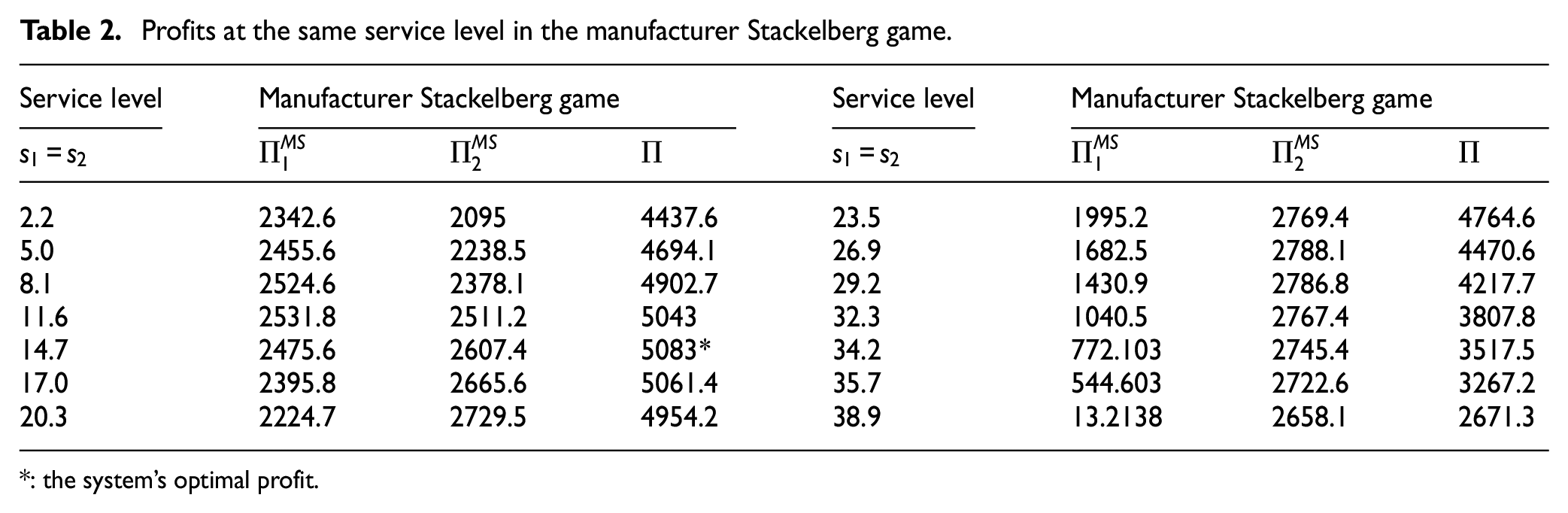
Profits at the same service level in the manufacturer Stackelberg game.
: the system’s optimal profit.
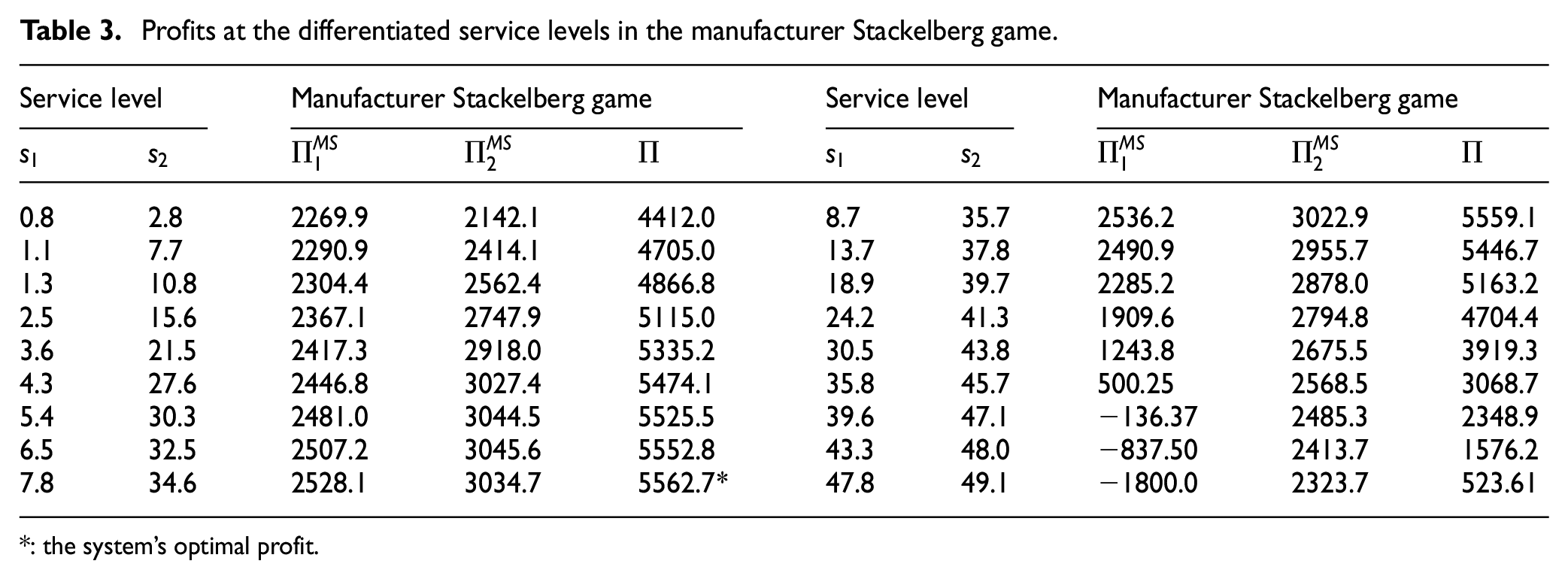
Profits at the differentiated service levels in the manufacturer Stackelberg game.
: the system’s optimal profit.
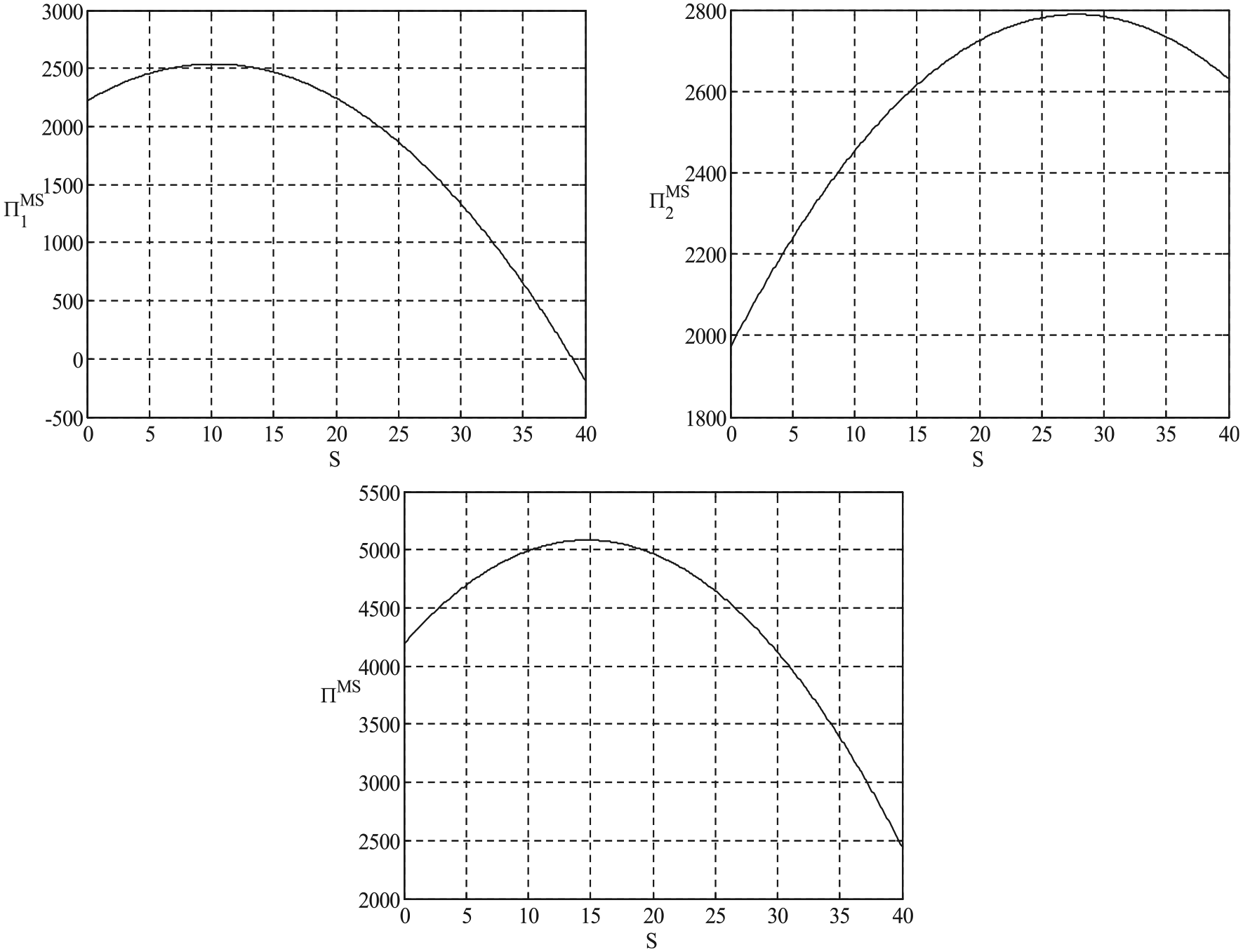
Profits at the same service level in the manufacturer Stackelberg game.
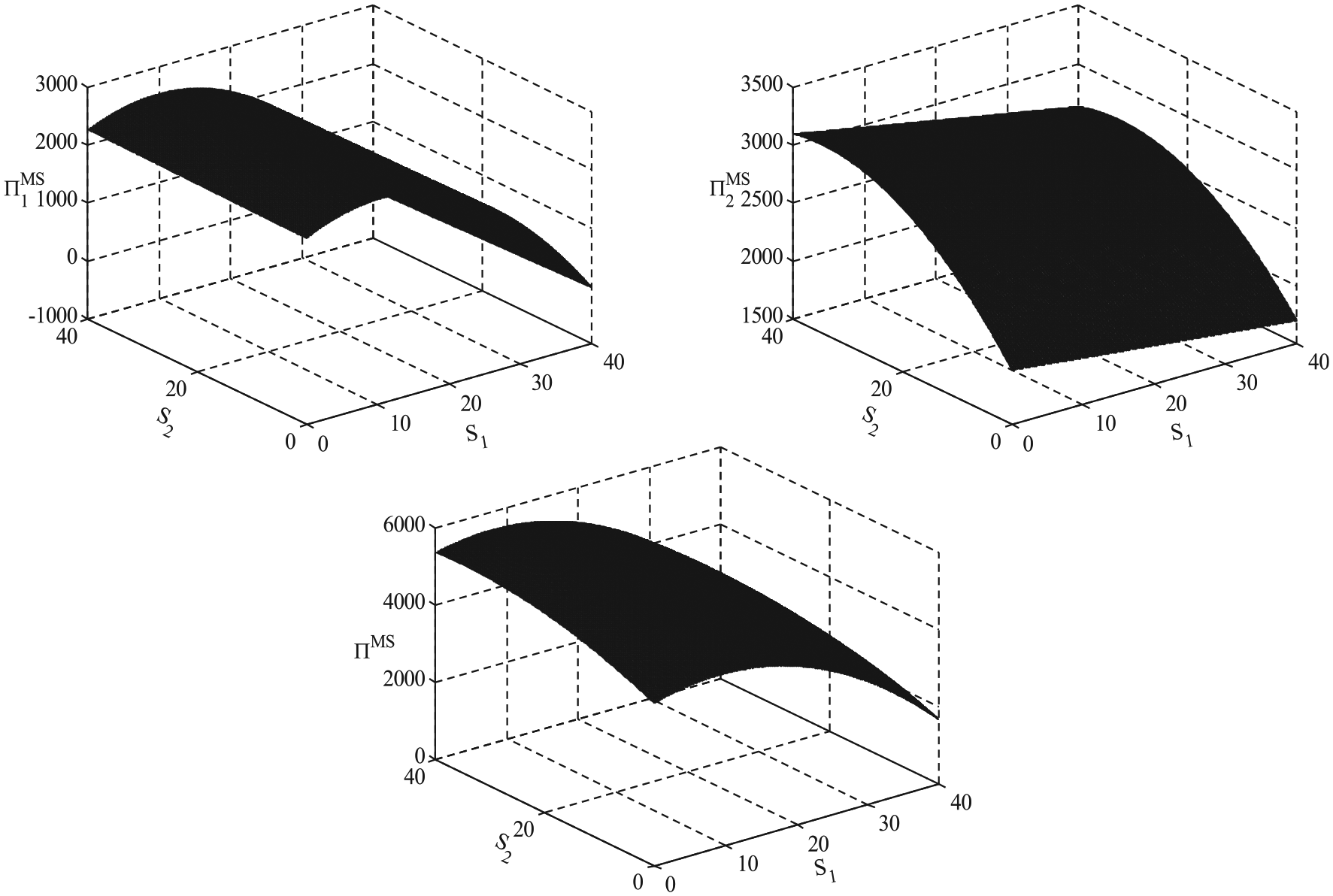
Profits at the differentiated service levels in the manufacturer Stackelberg game.
From Tables 2 and 3 and Figures 2 and 3, the profits of channel participants increase first and then decrease with the increase of their own service levels. From Table 2, the optimal service level is 14.7 at the same service level. The system’s optimal profit is 5083 and the profits of the manufacturer and the online marketplace firm are 2475.6 and 2607.4, respectively. From Table 3, the optimal service levels of the manufacturer and the online marketplace firm are, respectively, 7.8 and 34.7 at the differentiated service levels. The system’s optimal profit is 5562.7 and the profits of the manufacturer and the online marketplace firm are 2528.1 and 3034.6, respectively. Therefore, the following observations can be obtained.
Similar observations can be obtained in the Stackelberg game with the online marketplace firm as the leader and the Nash game. In summary, we observe the following.
Observation 1
The profits of channel participants increase first and then decrease with the increase of their own service levels.
Observation 1 indicates that the channel participant should develop targeted service strategies based on different stages of the online channel establishment. In the initial stage of the online channel establishment, the participant should pay attention to improving the service level. The participant can use the service to influence the channel demand, thereby increasing both the market coverage and profit of his own channel. When the channel service quality reaches a certain level, the increase in the service cost is greater than that in the channel revenue caused by the enrichment of the price and the channel demand. Therefore, the profit of the channel participant decreases. At this time, the channel participant needs to put profit in the first place to ensure sufficient profit margins.
Observation 2
Differentiated services can optimize the system profit and can simultaneously improve the participants’ profits compared with the same service.
The management implication of Observation 2 is that differentiated services are more effective in the supply chain composed of the SOM channel and the online marketplace channel. In order to achieve a win–win effect, the manufacturer and the online marketplace firm should share service information and demand forecast information. Both of them should implement differentiated service strategy based on their respective advantages. In other words, when the manufacturer adds the direct channel to implement market expansion strategies, the manufacturer should not cannibalize consumers away from the online marketplace channel. On the contrary, the manufacturer should aim at realizing an effective combination of online business activities. In this case, the manufacturer positions the SOM for consumers who typically do not purchase products through the online marketplace channel, thereby avoiding potential conflicts with the online marketplace.
Observation 3
The service level provided by the manufacturer will be reduced and the service level provided by the online marketplace firm will be improved when the differentiated services are provided than the same service.
The management implication of Observation 3 is that the online marketplace should focus on improving the service quality and the manufacturer should pay attention to other work differently. For example, the online marketplace should focus on providing consumers with good logistics delivery services, the one-stop service, and the personalized service, so that consumers have a good experience in the online shopping. The manufacturer should focus on big data and other emerging Internet technologies, the brand support effect of the SOM, the coordination between the two channels, and more.
Conclusion
The main conclusion
Considering the differences in consumer-perceived shopping experience between the SOM channel and the online marketplace channel, this paper develops a price and service competition model under the symmetrical information framework. Under three different power structures, that is, the manufacturer Stackelberg game, the Stackelberg game with the online marketplace firm as the leader, and the Nash game, this paper studies the pricing and service decisions of supply chain participants.
Our results show that, first, the channel price is affected by both the service quality and the consumer sensitivity to service. Second, both the service quality and the consumer sensitivity to service have a positive impact on the channel demand. Both manufacturers and online marketplace firms should influence online consumers’ attention to service through a series of means. Third, the profits of channel participants increase at first and then decrease with the improvement of their own service levels. Therefore, they should develop targeted service strategies based on different stages of online channel establishment. Fourth, we characterize a threshold for the wholesale price. When the wholesale price is below the threshold, the channel prices are lowest in the Nash game, and when the wholesale price is greater than the threshold, the channel prices are lowest when the manufacture acts as the leader. Finally, differentiated services can improve the supply chain participants’ profits and the system profit compared with the same service under three power structures. Interestingly, we find that when differentiated services are provided, the service level provided by the SOM channel is much lower than that provided by the online marketplace channel. In other words, the online marketplace firm should focus on improving service levels, while the manufacturer should pay attention to other work differently, such as focusing on shaping corporate brand image.
Theoretical implication
This paper contributes to the research on the dual-channel supply chain. Specific contributions are as follows: (1) Drawing on the operating model of the SOM and online marketplace channels, this paper models price and service competition between the two channels. (2) From the perspective of the manufacturer and the online marketplace firm providing services and pricing independently, this paper studies the price and service competition issues between the two participants. Few studies simultaneously study price and service competition issues. 14 For this reason, Ali et al. 14 considered a supply chain consisting of one manufacturer and two retailers, and studied the issue of price and service competition between the two retailers. This paper examines the issue of price and service competition between a manufacturer and a retailer. This paper is essentially different from the study of Ali et al. 14 From the perspective of supply chain management, the two retailers involved in Ali et al. 14 only fiercely compete with each other, but the manufacturer and the online marketplace firm in this article not only fiercely compete with each other but also work closely with each other.
Managerial implication
As the results show, the manufacturer and the online marketplace firm should provide differentiated services based on their respective advantages in order to ensure the effectiveness of supply chain services. Specifically, the online marketplace firm should pay attention to improving its service level, such as providing good logistics delivery services to consumers by strengthening the construction of a logistics distribution system. And the manufacturer needs to pay attention to other work differently, such as focusing on generating promotional value, shaping corporate brand image, and more by the SOM channel. When the manufacturer adds the direct channel to implement market expansion strategies, it should not cannibalize consumers away from the online marketplace channel. On the contrary, it should strive to avoid potential conflicts with the online marketplace firm. In other words, the manufacturer should pay attention to other work differently to realize an effective combination of online business activities on the basis of fully considering the advantages of the online marketplace channel in terms of services.
Research limitations and directions for future research
First, some uncertain factors can disturb the supply chain system, causing the demands of the supply chain participants to be disturbed. The price and service competition decisions of the supply chain participants can be studied under the condition of demand disturbance in the future.
Second, the research results of this paper are only analyzed under the symmetrical information framework. In the future, these results can be further examined in the framework of information asymmetry.
Footnotes
Appendix 1
Declaration of conflicting interests
The author(s) declared no potential conflicts of interest with respect to the research, authorship, and/or publication of this article.
Funding
The author(s) disclosed receipt of the following financial support for the research, authorship, and/or publication of this article: This research was funded by the National Social Science Foundation of China (grant no. 17AGL026).
