




Abstract
In order to enhance the sensitivity improvement of crack meter in ruins rescue site, this paper proposes a novel crack meter with a V-shape structure. The mathematical analysis showed that there is a negative correlation between sensitivity of proposed crack and angle of V-shape structure. The finite element analysis using the ANSYS Workbench illustrates that sensitivity of proposed crack meter has rapid reduce with angle of V-shape structure of 14°–28°. Experimental findings show that the proposed V-shape structure crack meter has a higher sensitivity than the traditional one. With 14° V-shape structure crack meter, the sensitivity was enhanced to 1.16 mV/(mm/V), with an increase of 2.3 times over the traditional crack meter sensitivity of 0.35 mV/(mm/V).
Introduction
In the earthquake rescue, the secondary or continuous collapse of the ruins which was caused by the aftershocks or improper rescue methods was major hidden dangers that threaten the safety of rescuers and trapped people. Cracks reflect the degree of the ruin structure inside damage which destroys the stability of the structure.1,2 The crack meter detecting changes in ruin cracks achieves an effective assessment of the stability of the ruins. The crack meter with higher sensitivity can enhance the accuracy of ruin monitoring. 3 So, it is important to improve the sensitivity of the crack meter used in ruins rescue.
In recent years, many researchers studied crack detection methods including resistance strain detection, laser scanning detection, fiber optic sensing, and ultrasonic inspection. Cho et al. 4 proposed an image methodology for structural crack detection in concrete, which had greater accuracy in measuring crack. Zhang et al. 5 employed the wavelet transform to enhance the sensitivity of damage detection based on the ultrasonic testing method which developed accuracy of crack detection. Rodríguez et al. 6 proposed an optical backscattered reflectometer system to obtain crack initiation, location, and width in concrete structures subjected to bending. Giri and Kharkovsky 7 presented a laser displacement sensor in noncontact measurement system to detect cracks in concrete. Downey et al. 8 demonstrated an application of smart bricks for crack detection in masonry walls. However, those crack detection methods have the disadvantage of complicated instrument arrangement. Nevertheless, a resistance strain crack meter can be realized simple fracture measurement. It adopted a cantilever beam and strain principle to detect the dynamic change of the crack effectively. But the sensitivity of a traditional resistance strain crack meter cannot meet the requirements of the ruin rescue crack detection. The sensitivity of a strain crack meter is mainly determined by the structure of the elastic element and strain gauge material. Subramanya et al. 9 explored a strain crack meter using graphene material to improve sensitivity that varied from 0.8206 to 0.996 Ω/με. Kim et al. 10 proposed a thin polysilicon strain gauge with better sensitivity for the measurement of structural elements. Liang et al. 11 proposed a novel E-type membrane elastic element structure in a resistance strain crack meter to enhance its sensitivity.
These methods can enhance the sensitivity of the crack meter to a certain extent. However, the structure of the crack meter cannot be changed, which has a large space for improving sensitivity of the crack meter. In this paper, a novel crack meter with a V-shape structure was proposed to enhance its sensitivity in ruins rescue. The mathematical and the finite element analyses were also used to adjust the angle of V-shape structure. The rest of this paper is structured as follows: the structural of the new structure crack meter is explained in section “Structural of the new structure crack meter,” section “Sensitivity analysis of the new structure crack meter” presents sensitivity analysis of the new structure crack meter, angular adjustment of the new structure crack meter is introduced in section “Angular adjustment of the new structure crack meter,” and section “Experiments and discussions” shows the experiments and discussions.
Structural characteristics of the new structure crack meter
Figure 1(a) and (b) show the traditional crack meter and the calculation models of the new structure crack meter, respectively, where l is the free length of the leaf-spring, b is the width of the leaf-spring, h is the thickness of the leaf-spring, P is the force,
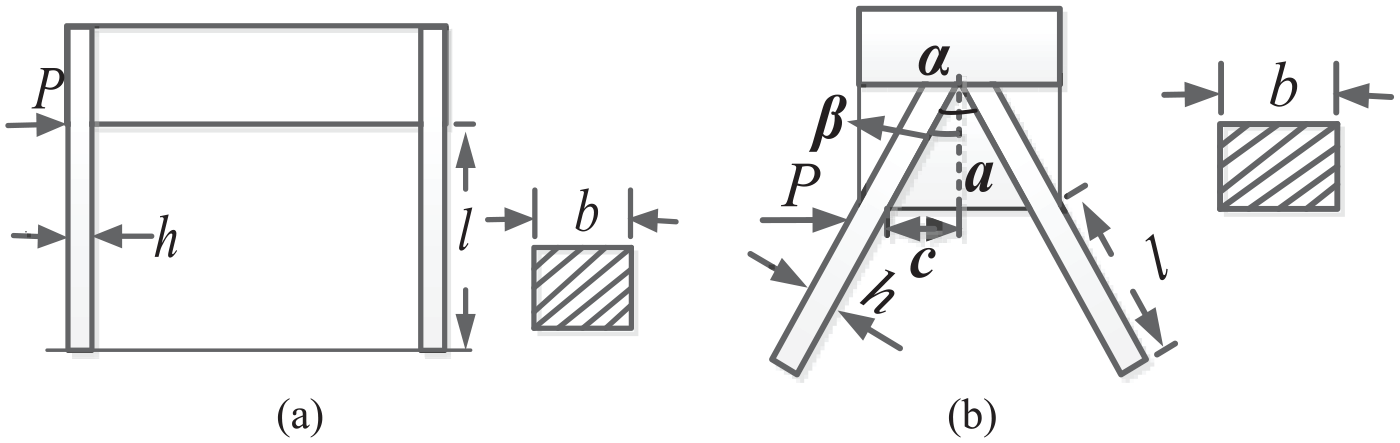
Calculation model. (a) Traditional crack meter. (b) New structure crack meter.
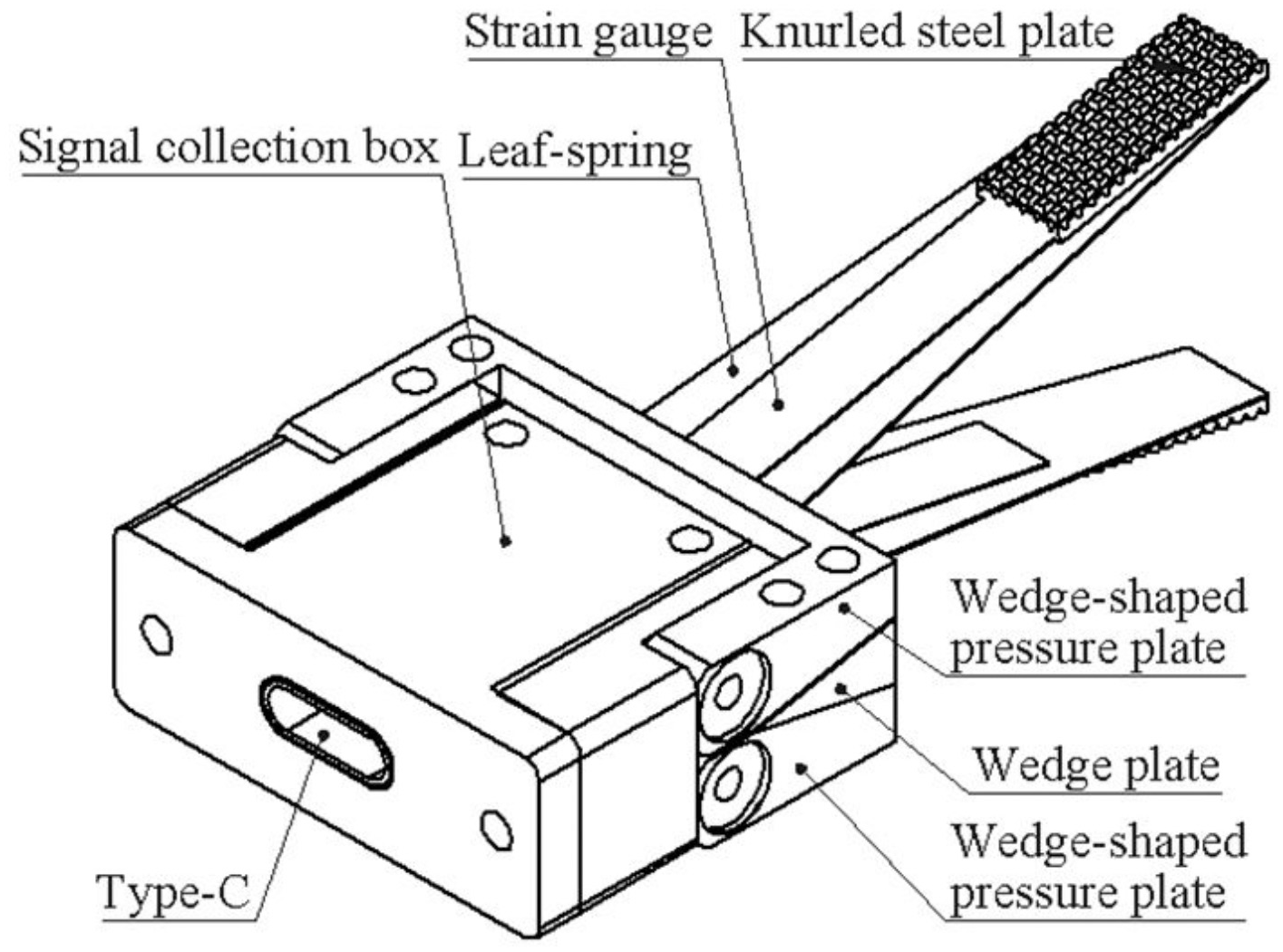
Design drawing of a new structure crack meter.
Sensitivity analysis of the new structure crack meter
The ruin rescue site environment requires a crack meter with high sensitivity to better protect the lives of rescuers and trapped people. According to the calculation model of the elastic component in the new structure crack meter and the strain principle, the following relation can be obtained.
The stiffness

where l is the free length of the leaf-spring; b is the width of the leaf-spring; h is the thickness of the leaf-spring; E is the elastic modulus; P is the force; and
The bending moment

Bending cross-section modulus

Interface stress component

The strain

From formula (5), we can get the relationship between sensitivity and strain of the elastic component

It can be seen from formula (6) that the sensitivity of the elastic component in the crack meter relates to the structural size and material properties. The length of the leaf-spring and the cosine of the half-angle of the wedge are proportional to the sensitivity. The width and thickness of the leaf-spring and the material of the leaf-springs are inversely proportional to the sensitivity. The parameters changing influence on the sensitivity of elastic component are the following




It can be obtained from the above formulas that the geometric parameters of the leaf-spring and the angle of the wedge plate have different degrees of influence on the sensitivity, wherein the length and width of the leaf-spring have less influence and the thickness of the leaf-spring and the cosine of the half-angle of the wedge have greater influence. Considering the effect of the thickness on the stiffness, the leaf-spring size in the new structural crack meter not changed here. Therefore, the adjustment of the angle of the wedge plate is studied to improve the sensitivity of the new structure crack meter.
Angular adjustment of the new structure crack meter
Through theoretical analysis of the elastic components in the new structural crack meter,
Model establishment
The new crack meter was modeled using the software Solidworks 2016 and ANSYS Workbench 18.0. Two leaf-springs were set as 65Mn spring steel material, the wedge plate and wedge-shaped pressure plates were set to cast iron material, and signal collection box was set as PVC material. The crack meter model was meshed adopting the sweep method and automatic method with elastic and other components, respectively. And the grid size was set as 0.5 and 1.0 mm with elastic and other components, respectively. Since the resistance strain gauges and the signal acquisition box did not affect the structure analysis, the timeliness of calculation was not considered. The new structure crack meter meshing results are shown in Figure 3.
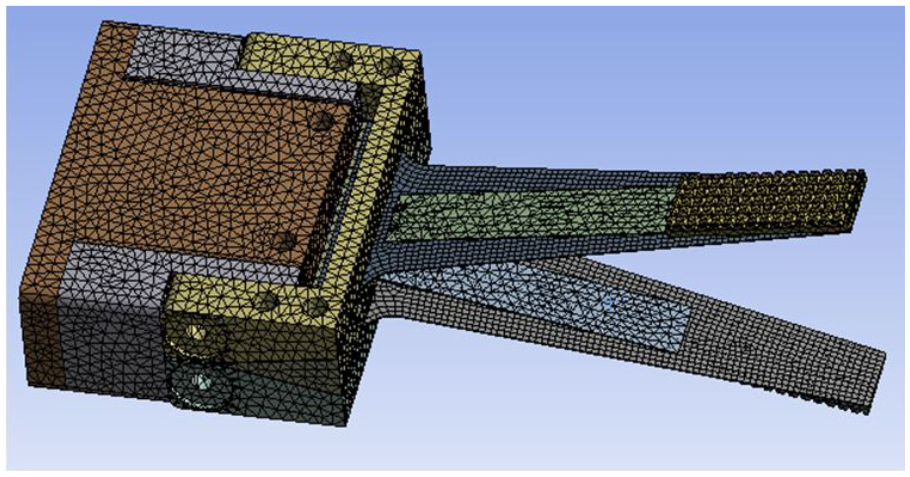
Mesh generation results.
Static analysis
The contact type of the wedge-shaped pressure plate and the leaf-spring, the leaf-spring and the wedge plate, the leaf-spring and the leaf-spring were set bonded. According to the actual working conditions, a fixed constraint was applied on the surface of the wedge-shaped pressure plates and the wedge plate; at the same time, a pressure load of 15 MPa was applied to the bottom of the leaf-spring to perform static analysis. Then, static simulation of the new structure cracker at different angles were performed by changing the c from 1 to 5 mm each time increment was 0.5 mm, wherein the wedge plate height a was constant at 10 mm. The maximum equivalent strain was recorded from the equivalent strain cloud diagram, and the maximum equivalent strain of the leaf-spring at 9°, 14°, 20°, and 25° are shown in Figure 4.
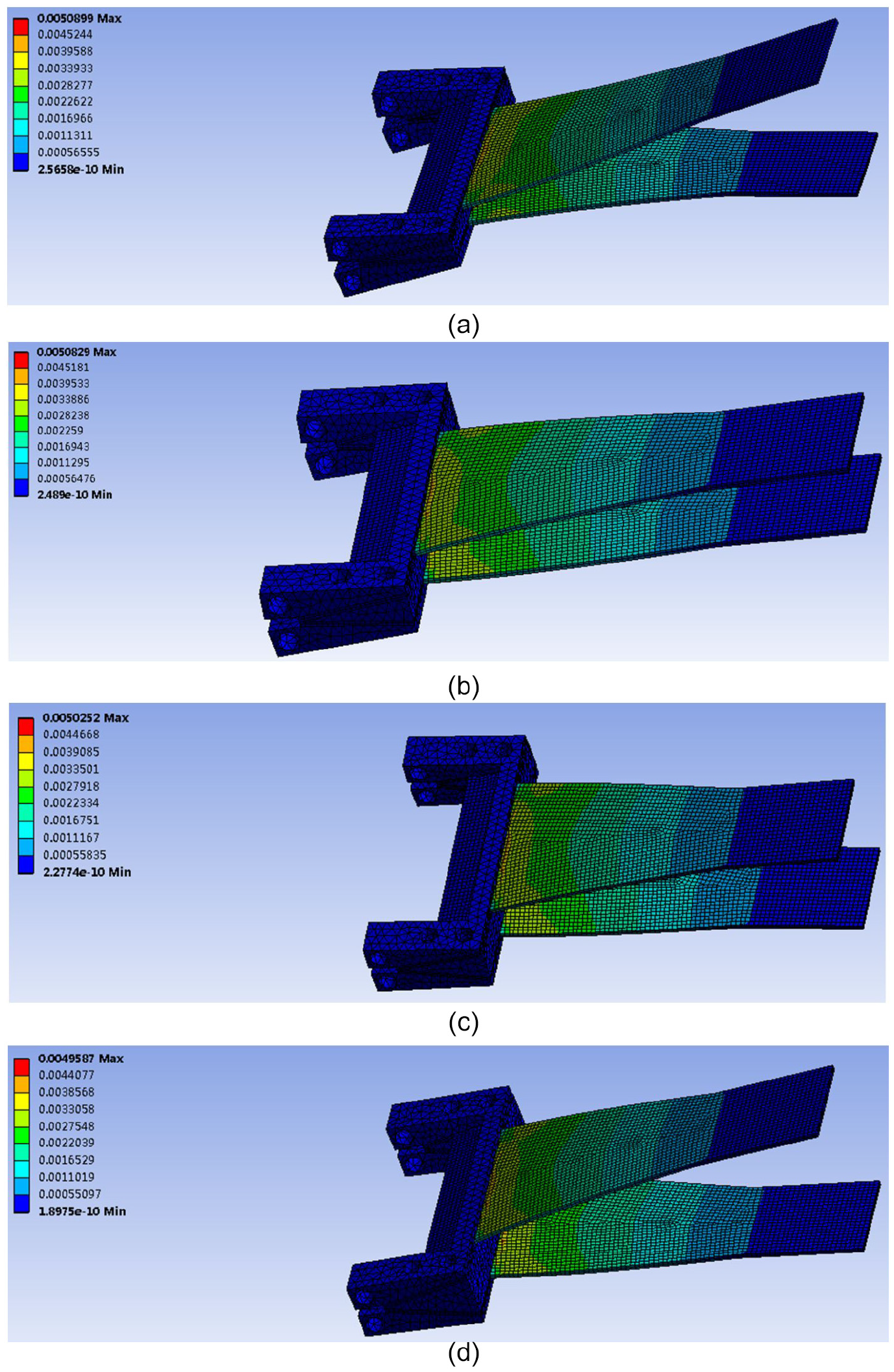
The equivalent strain cloud diagram. (a)
The equivalent strain results are shown in Figure 5. Figure 5 illustrates that the maximum equivalent strain of the leaf-spring decreases as the angle of the wedge plate increases, and the decline of the leaf-spring strain is slower in the range of 6°–14° and faster in the range of 14°–28°. There was a difference between the simulation results and the theory, and it might be related to the influence of meshing effect. But the overall trend was the same, and the most error was 2.1% within a reasonable range, so the simulation data were reliable. It can be known from formula (6) that the new structure crack meter can have a better sensitivity with a suitable angle of the wedge plate. So, the appropriate angle of V-shape structure in the range of 6°–14° must be selected to improve the sensitivity of the new structure crack meter.
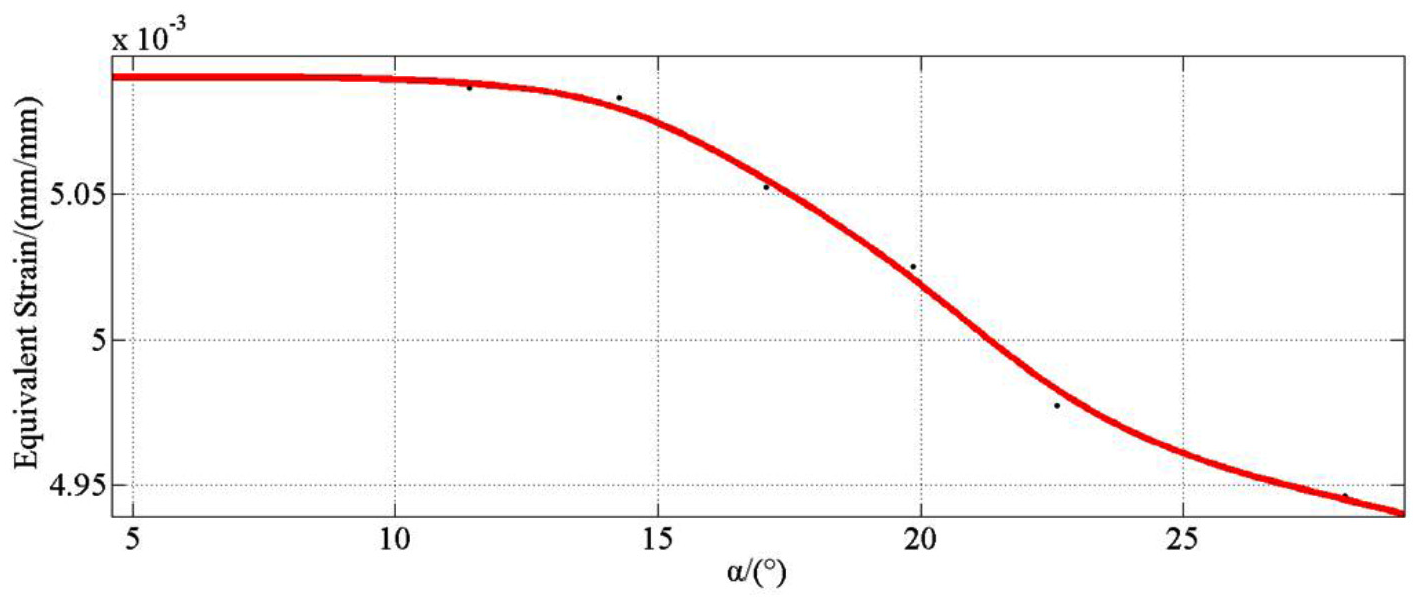
Equivalent strain results.
Experiments and discussions
Considering the fabrication of the device, we selected a new structural crack meter with an angle of 14° to make a real object, as shown in Figure 6. Fabrication and assembling of the proposed new structure crack meter included leaf-spring, wedge plate, wedge-shaped pressing plates, signal collecting box and screw fabrication, resistance strain gauges, and TYPE-C assembling of the conversion circuit. The free length of the leaf-spring is 39 mm, the thickness is 0.5 mm, and the width is equivalent to 14 mm; two resistance strain gauges are connected in series on the front and back sides of each leaf-spring, and the resistance is 120 Ω. The two leaf-springs are arranged in a V-shape structure and are fixed by a wedge plate and two wedge-shaped pressing plates. The signal collecting box is 30-mm long, 30-mm wide, and 11-mm high, and the devices are fixed by six screws.
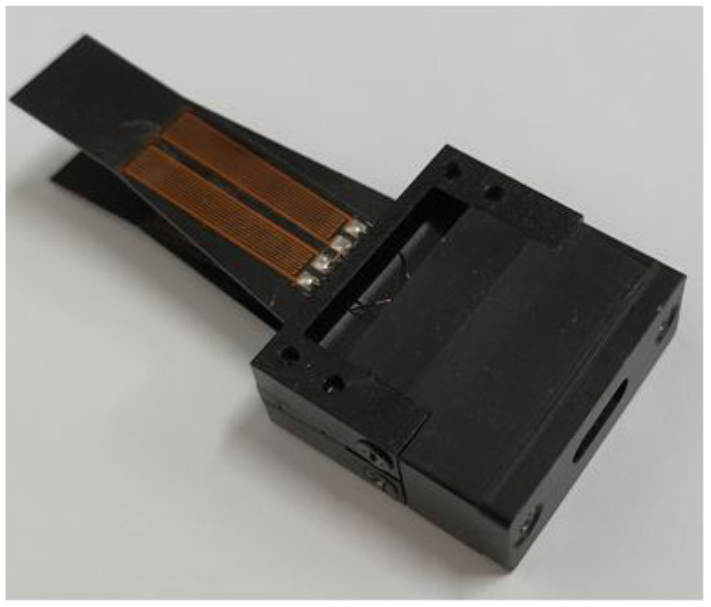
New structure crack meter physical map.
In order to validate the excellent performance of the new structure proposed, the sensitivity of the traditional and new structure of crack meters was measured in vibration precision measurement technology and instrument key laboratory and the outer diameter micrometer to simulate the cracks in the ruins. Figure 7 shows the device for sensitivity measuring experiment. The distance measurement in experiment used a TRICLE BRAND outer micrometer of 0.001-mm accuracy and 0- to 25-mm measurement range. The crack meter output voltage measurement in experiment adopted an Agilent 34410A digital multimeter of 0.0030-mV accuracy. The Agilent U8002A DC power of 0- to 30-V output range was used in the crack meters. The measured crack width was 0.010-mm interval, and eight different crack widths were measured and repeated 10 times for each measured crack width. The sensitivity of the crack meter can be calculated in unit gain and unit bridge voltage (mV/(mm/V)) from the measured data, and the average value of the calculated sensitivity was regarded as the sensitivity of the crack meter.
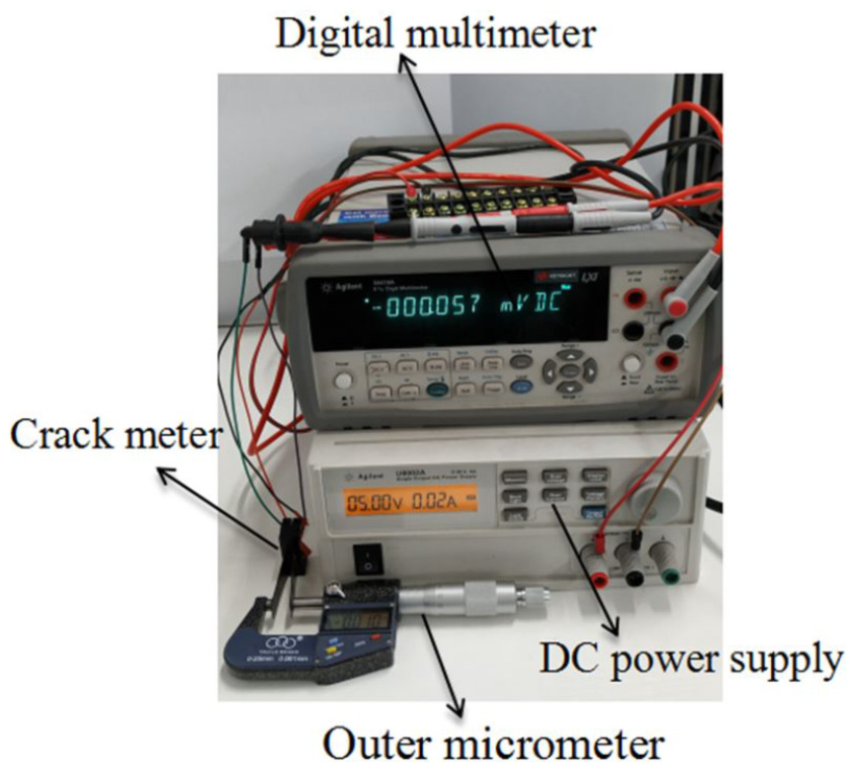
The sensitivity measuring device for experiment.
Figure 8 shows the experimental results of the traditional crack meter structure and the new crack meter structure. In Figure 8, the black line is the measurement experimental results of the traditional crack meter structure, and the red line is the measurement experimental results of the new structure crack meter. The horizontal ordinate in this figure is the experiment number, and the vertical ordinate is the sensitivity of the crack meter in unit gain and unit bridge voltage (unit is mV/(mm/V)). From Figure 8, it can be seen that the 1.16-mV/(mm/V) sensitivity of the new structure crack meter was about 3.3 times the traditional one of 0.35 mV/(mm/V). Theoretically, the 33.09-mm/Pa sensitivity of the leaf-spring in the proposed crack meter was 3.2 times the traditional one of 10.38 mm/Pa. There was a difference between the experiment results and the theory, and it might be related to material properties and processing technology that errors were within reasonable limits. So, the proposed new structure crack meter provides better sensitivity.
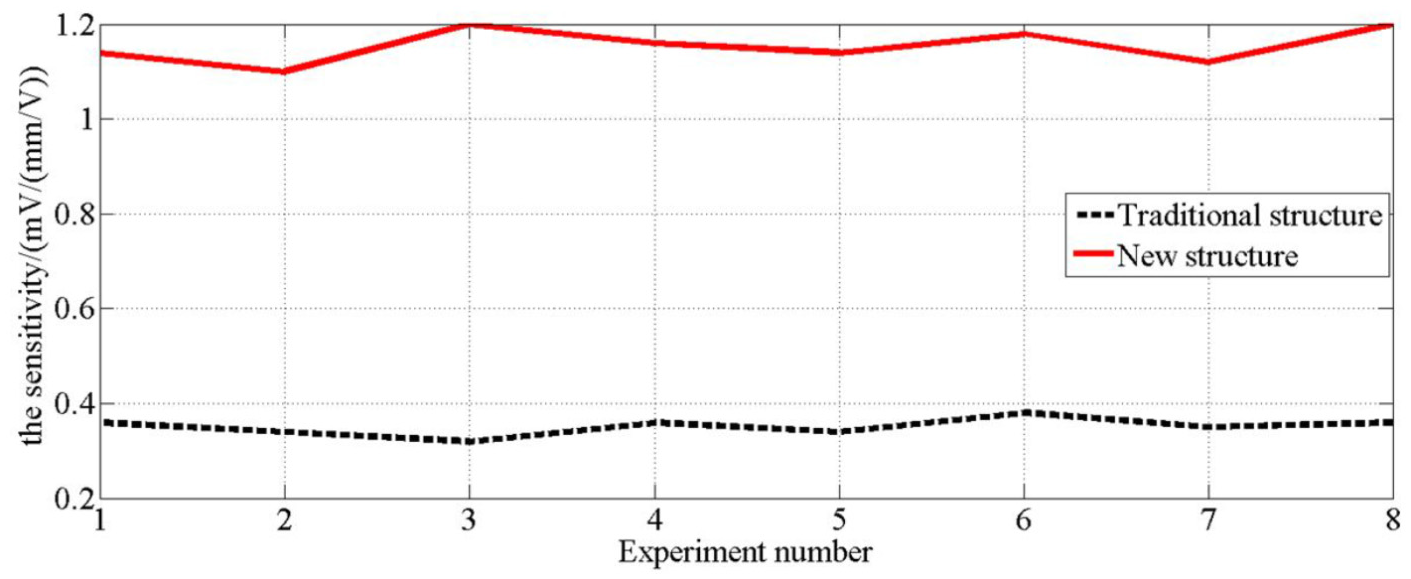
The crack meter sensitivity experimental results.
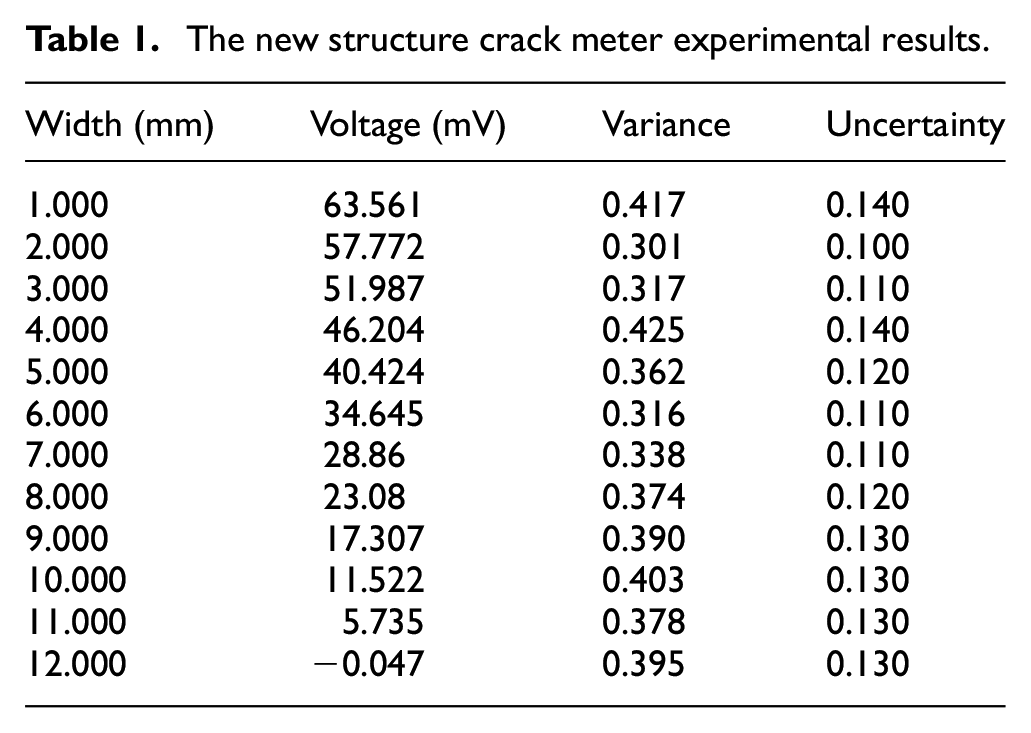
In order to obtain uncertainty of the designed crack meter, the experiments of the new structure crack meter instrument were implemented. The experiments of the new structure crack meter instrument were implemented in vibration precision measurement technology and instrument key laboratory. The distance measurement in experiment used a TRICLE BRAND outer micrometer of 0.001-mm accuracy and 0- to 25-mm measurement range. The crack meter output voltage measurement in experiment adopted an Agilent 34410A digital multimeter of 0.0030-mV accuracy. The Agilent U8002A DC power of 0- to 30-V output range was used in the crack meters. The range of new structure crack meter was 1–12 mm. The measured crack width using the new structure crack meter was 1.000-mm interval ranging from 1 to 12 mm and repeated 10 times for each measured crack width. Table 1 presents the experimental results and uncertainty. The calculation formula of uncertainty is as follows
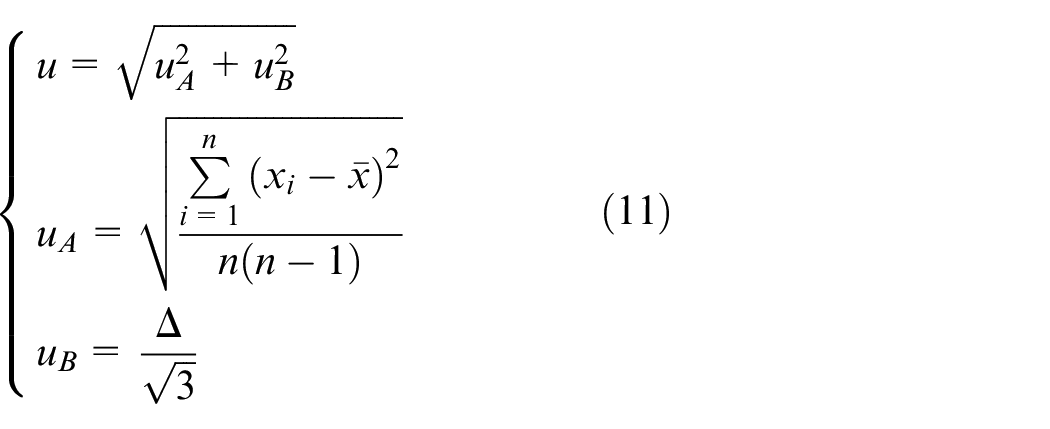
where n is the number of the experiments,
The new structure crack meter experimental results.
Conclusion
In this paper, a new structure crack meter is proposed to monitor the change of the cracks in the ruins during the rescue process and the method of improving the sensitivity of the new structure crack meter is studied. Through theoretical analysis, the angle of the wedge plate is a key factor affecting the sensitivity of the new structure crack meter. Then, making full use of ANSYS software, the static analysis is carried out for the new structure crack meters of a certain shape reed to simulate under the actual working condition. The simulation results show that the sensitivity has a rapid reduce within 14°–28°. Finally, the sensitivity of the tradition crack meter and the new structure crack meter was measured; the experimental results show that the sensitivity of the new structure crack meter is 1.16 mV/(mm/V) and the traditional one is 0.35 mV/(mm/V). Compared to the tradition one, the new structure crack meter had an increase of 2.3 times over the traditional one. Therefore, the proposed new structure crack meter can provide higher sensitivity in monitoring the cracks of the ruins after the earthquake.
Footnotes
Declaration of conflicting interests
The author(s) declared no potential conflicts of interest with respect to the research, authorship, and/or publication of this article.
Funding
The author(s) disclosed receipt of the following financial support for the research, authorship, and/or publication of this article: The research work of this paper is sponsored by the Special Fund of Fundamental Scientific Research Business Expense for Higher School of Central Government (Projects for creation teams) (No. ZY20160104) and Teachers’ Scientific Research Fund of China Earthquake Administration (No. 20140104). The research work of this paper was performed at the vibration precision measurement technology and instrument key laboratory, Institute of Disaster Prevention.
