




Abstract
This paper presents a radial basis function prediction model improved by differential evolution algorithm for coking energy consumption process, which is very difficult to get online and real time because of the complex process. In the energy consumption prediction model, target flue temperature, flue suction, water content, volatile coal and coking time are considered as input variables, and coking energy consumption as output variables. To overcome the shortcomings of radial basis function network, such as poor learning ability and slow convergence speed, the energy consumption prediction model optimized by differential evolution algorithm is improved. Using the strong global search ability of differential evolution algorithm, the center value, width and output weight of the basis function in radial basis function network is obtained by differential evolution algorithm. Then the optimal values are taken as the center value, width and output weight of the of radial basis function neural network. The results show that the improved radial basis function prediction has higher accuracy, stability and training speed of the network. The radial basis function prediction model has great significance in reducing coking energy consumption, saving enterprise costs, increasing coke production and improving enterprise economic benefits.
Keywords
Introduction
Coke is the main raw material and fuel in the production of smelting, chemical and mechanical industries, and it is an indispensable material in industrial production. Iron and steel industry is the pillar industry of China’s economic development, energy-intensive enterprises. 1 Because of the limitation of technology and equipment at present, it is difficult to realize real-time on-line measurement of some factors affecting coke-making energy consumption. The process of manual analysis is too complicated and lagging, and the impact of optimal control in coke oven production process cannot be ignored. Therefore, how to establish a prediction model of coking energy consumption is an urgent problem to be solved. 2
Experts and scholars at home and abroad have been discussing, demonstrating and improving the energy consumption of coking. Shu Guang of Wuhan University of Science and Technology put forward the “orderly process of energy flow for coking recovery,” which fundamentally solved the problem of high energy consumption and high pollution in coking recoverysystem. 3 Through theoretical calculation and analysis of heat balance of coke oven in Anyang Iron and Steel Co., Ltd., Le quantitatively reflects the actual energy consumption of coke oven. Through repeated comparison with empirical values, effective ways and countermeasures to reduce coke-making heat loss are found, which improves the utilization efficiency of heat, reduces unnecessary heat loss and achieves energy saving. To achieve the goal of reducing consumption and protecting the environment. 4
The above literature puts forward methods to reduce coking energy consumption from the aspects of coking process, but it is still unable to solve the on-line measurement of coking energy consumption. Through the analysis of coking production mechanism, the author of the document 5 establishes an improved BP (back-propagation algorithm) neural network model of coking energy consumption, realizes the prediction of coking energy consumption and has a certain guiding significance for the control and prediction of energy consumption in coking production process. In order to achieve the goal of optimizing energy allocation and energy saving and emission reduction, Li et al. 6 established a set of multifunctional energy efficiency evaluation index system with data acquisition, statistical analysis and prediction to simulate the dynamic behavior of energy consumption in the actual production process of steel. Radial basis function (RBF) neural network is a feed forward network system with a single implicit layer, which has a simpler topology, better approximation capability and faster learning speed than BP neural network. 7 RBF neural networks are widely used in various aspects, such as numerical estimation, the solution of accurate equations for data classification8–14 (Modification of the opinion literature), but the selection of RBF parameters will affect the prediction accuracy of the network, training speed and so on; hence, to improve the accuracy of network prediction, it is necessary to adjust the parameters of the network (implicit layer node points, base function center and width, implicit layer to output layer connection weight, etc.) to achieve. Differential evolution algorithm (DE algorithm) is a stochastic global search algorithm based on group difference, which has the advantages of simple working principle and few controlled parameters and has been successfully applied to nonlinear optimization control and neural network optimization.15,16
This paper takes coking production process as an example, starting with coking energy consumption model, puts forward a prediction model of coking energy consumption based on RBF neural network optimized by DE. The model is verified and analyzed by an actual production process. The analysis results show that the model not only has fast convergence speed, high learning efficiency, but also has good adaptability and prediction accuracy. The prediction model of RBF neural network optimized by DE optimizes the DE parameters of RBF network through the advantages of DE algorithm. Compared with the existing prediction model, it has higher prediction accuracy. The article is divided into five parts. First, the research background and current situation of the article are analyzed. Second, the main factors affecting coking energy consumption are analyzed. Third, the corresponding prediction model of DE-RBF neural network is established. Fourth, the actual production data are used for simulation analysis, comparative analysis, and finally, the article is summarized and analyzed.
Analysis of factors influencing coking energy consumption
The process of coking production has the characteristics of long cycle and complex reaction, and energy consumption is inevitable in coking production process. Coking heat is the main factor affecting energy consumption. It mainly includes coking heat, heat loss furnace body and heat carried away by exhaust gas. 17 According to the definition of coking heat consumption, the main factor affecting coking energy consumption is coking heat, which is an effective heat produced in the balance of coke oven, and it is an important index to measure the operation technology level of coking production in actual production, 2 which mainly depends on the target fire temperature, with coal moisture, volatile score, flue suction and coking time. The following is an introduction to the effects of these factors on coking energy consumption:
Target fire path temperature. The target fire channel temperature refers to the average temperature of the fire channel measured at the measuring points of each combustion chamber of the coke oven, which is the temperature of the side fire channel (t1) and the temperature of the coke-side fire channel (t2). Target fire channel temperature is an important index to ensure the maturity of coke cake, and it is also one of the important factors to measure the energy consumption of coking. In the specified coking period, the temperature of the fire channel is too high, the energy consumption of the finished product increases rapidly and the phenomenon of “stripping Coke” will appear; if the temperature is too low, the uneven heat is not conducive to the normal operation of the coking process.
With coal moisture (Md). The influence of coal moisture on coking energy consumption cannot be ignored. In the coking process, when the pyrolysis gas produced from the colloidal layer causes the moisture content in the coal to be less than 8%, no additional coking heat loss will be generated, but when higher than 8%, the water will have a greater impact on the coking heat, every 1% of the water changes, the corresponding coking heat will increase by 30 kJ/kg and coking energy consumption thus increases.
Coking time (T). The size of coke energy consumption is also closely related to the length of coking time. If the coking time in the coke oven is too short, more gas consumption is needed to increase the temperature of the fire channel, and the length of the coking time is longer, which will increase the coking heat and increase the energy consumption loss.
With coal volatile points (Vdaf). The content of coal volatile has a direct impact on coke machinery and reaction characteristics and has an indirect effect on the size of coking energy consumption. When the volatile content is too high, it will increase the heat absorption in the reaction process, affect the normal production process of coke oven, and when the content is too low, it will make the push coke difficult, the production time increases, the coking energy consumption increases.
Flue suction (xl). The size of flue suction has an important effect on coking energy consumption. In the heating process of coke oven, flue suction can control to achieve optimal combustion. When the intake of flue gas is too small, the combustion of gas is incomplete, so that the coking heat consumption increases, the flue suction is too large, so that the combustion of the amount of exhaust gas, so the exhaust gas to take away the heat increase, so that the coking energy consumption increased.
DE optimized RBF neural network
Coking process is a multi-variable, time-varying, complex and uncertain industrial refining process. Energy consumption during coking process causes difficulty to achieve on-line measurement. In order to minimize the energy consumption of coke oven and save resources, this paper establishes a prediction model of coking energy consumption, and uses the RBF neural network model optimized by DE to predict coking energy consumption.
RBF neural network
RBF neural network, a three-layer forward type network structure, consists of three parts: the input layer, the implicit layer and the output layer.18,19 RBF neural network has the simplicity of simple structure, simple training and fast learning speed, and is effective in avoiding local minimum and realizing global convergence.
The input layer of RBF neural network is transformed into the implicit layer by nonlinear mapping, and then transformed into the output layer by linear mapping in the implicit layer, and its neuron model is shown in Figure 1. In the neural network structure, the data of the input variable is passed to the implicit layer through the input layer, and in the implicit layer, through the action of the radial base function to the output value, the implicit layer and the output layer are passed to the output layer through linear transformation, and the corresponding output data ym is obtained.
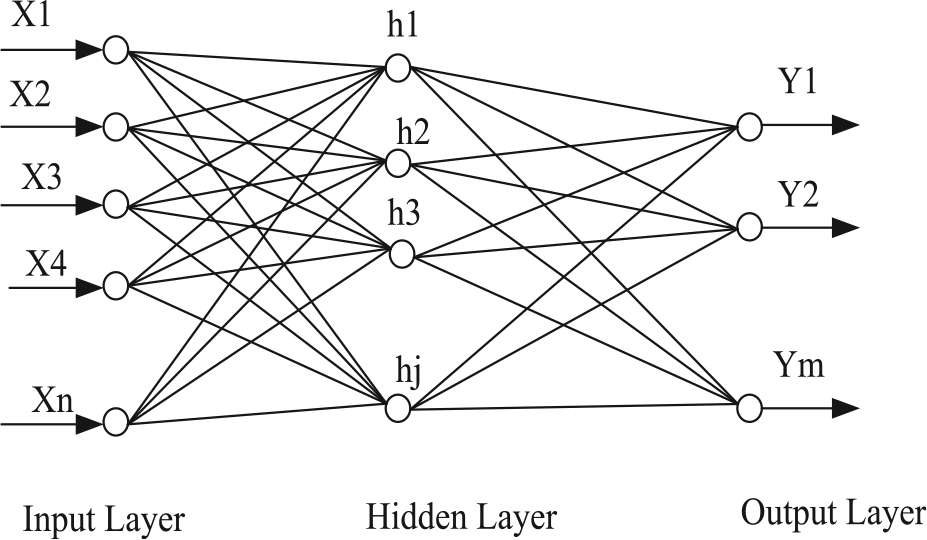
Neuron model of RBF neural network.
Our radial base function selects a Gaussian function with the expression

The output expression of the RBF network is

where x is the input vector,
Through the analysis of the influence factors of coking energy consumption, the temperature t1 of the coke-side target, the temperature of the t2, the water Md, The coking time T, the volatile Vdaf, the coke-side flue suction xl1 and the suction xl2 of the side flue are the input variables of the coking energy consumption prediction model. The value Q of coking energy is used as the output variable of prediction model to establish the corresponding prediction model.
DE algorithm
Differential evolutionary algorithm (DE) 20 uses all elements to search, encode with real numbers, make simple variations with differential elements and adopt a one-to-one selection strategy, which is simple and easy to understand. It is implemented in a very similar way to genetic algorithms and is based on three basic operations: mutation operation (mutation), crossover operation (crossover) and select operation (selection). The algorithm first uses the individual elements of the current whole element to perform the mutation operation, then obtains the intermediate element through the cross operation, then uses the choice operation proposed in the article to compare the parent element with the intermediate element, chooses the better person to retain and composes the new next generation element. 21 The standard DE algorithm is for a few six steps:
Step 1: Population initialization.
When DE is initialized, the algorithm randomly produces m individuals to form the initial population, each of which consists of n-dimensional vectors, as follows

Step 2: Evaluation of population adaptive value.
In the DE algorithm, the fitness value is an important index to evaluate the degree and disadvantages of a population. Calculate the value
Step 3: Mutation operation.
The mutation operation is mainly based on the parent element of the whole element, randomly takes three unequal individual vectors in the variation process of each generation, selects one of the individuals as the base vector, and the other two differential vectors form the difference vector. There are several formulas for the number of differential vectors and the selection of base vectors as follows:22,23
The randomly selected individual as the parent effect halogenated vector, using a difference vector to generate the mutant individual

With the current population of the most individual as the parent effect halogenated vector, the use of a differential vector to generate mutant individuals

The randomly selected individual as the parent effect halogenated vector, using two differential vectors to generate mutant individuals

With the current population of the most individual as the parent effect halogenated vector, the use of a differential vector to generate mutant individuals

where
Step 4: Crossover operation.
The crossover operation is to swap the mutant individual vector with the information of the target vector to form a new individual vector called the test vector. There are two ways to cross differential evolutionary algorithms: two-item crossover (Bin, binomial crossover) and exponential crossover (EXP).22,24,25 The specific formula is as follows:
Two-item crossover

where
Exponential crossover
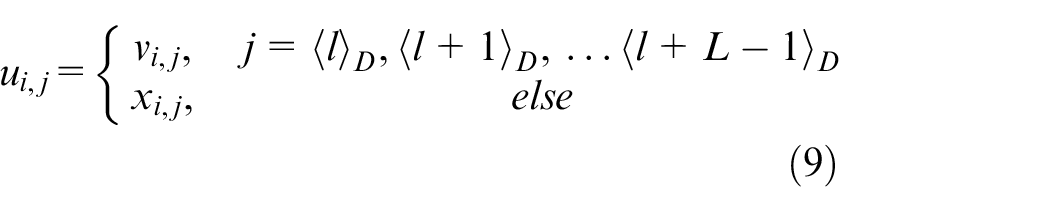
where l is any random integer in (1, D).
Step 5: Select operation.
The DE algorithm uses greedy search strategies26,27 to select individuals who can enter the population of the t + 1 generation. The test individual vectors compete with the target vector individual, and if the former is better adapted than the latter, it will be substituted as a descendant in the t + 1 style, otherwise reserved as shown in the following formula

where
Step 6: Judgment of termination condition.
If the accuracy of the algorithm reaches the requirement or the current iteration times reach the maximum, the search terminates; otherwise, the population needs to be searched and optimized until the conditions are met.
The flowchart of standard DE algorithm is shown in Figure 2.
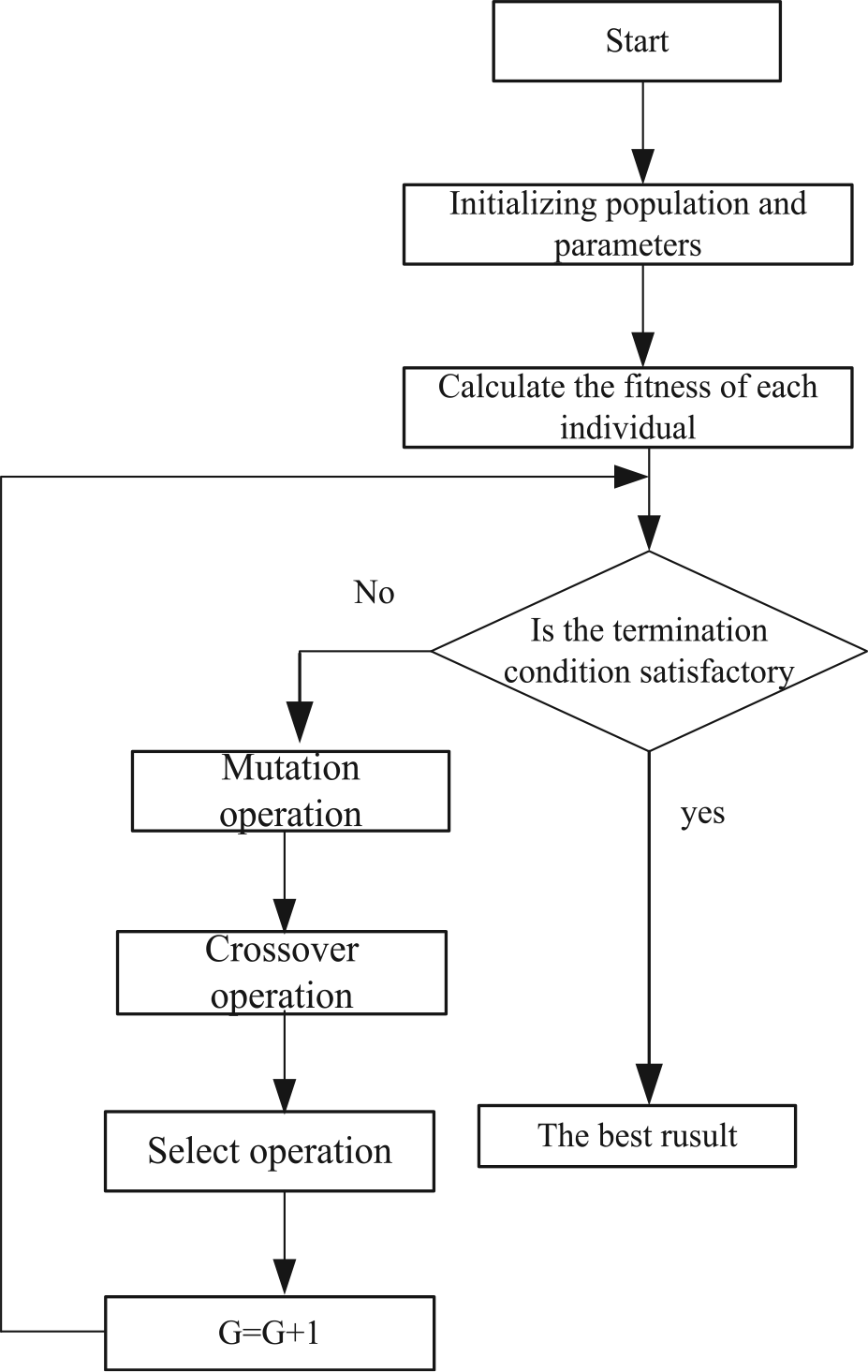
Standard differential evolution flowchart.
DE-RBF neural network predictive model
Compared with BP neural network, although RBF neural network can solve the problem of network learning parameters, there is no local optimal problem, but there are still some limitations.
The DE algorithm has strong ability of global searching, and combined with RBF neural network, it can improve the generalization ability of neural network and improve the learning ability, convergence speed and precision of the network. It is necessary to select a reasonable and effective RBF neural network parameter in the process of establishing the predictive model. In this paper, Gaussian function is used as the radial basis function, and the gradient descent method is used to determine the center cj, width bj and the connection weights between the hidden layer and the output layer of the hidden cell base function of the network wi,k. Because of the insufficiency of RBF neural network, the parameters obtained are not optimal, so the parameters of neural network are optimized by the DE algorithm, and the optimal parameters are obtained to improve the prediction accuracy of the network. DE-RBF-based network prediction model flowchart is shown in Figure 3.
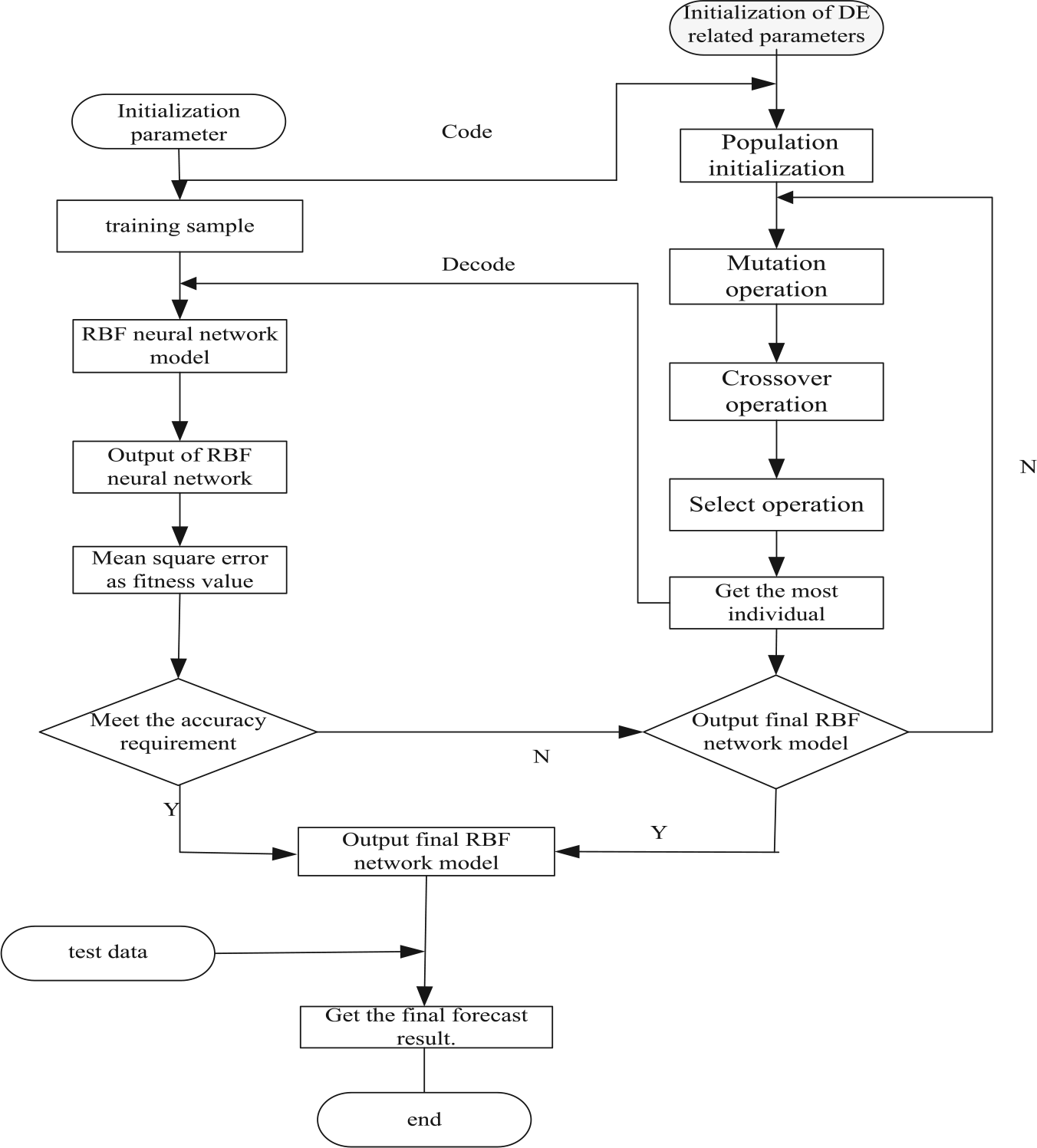
Flowchart of predictive model based on DE-RBF network.
DE-RBF optimization steps are as follows:
Step 1: Initialization parameter setting: According to the actual objective problem, we can ensure that the variation variable is sufficient to set the population number Np. The variation factor F is a control parameter proposed by Storn and Price, 28 which determines the proportion of deviation variables and affects the convergence speed of the algorithm. In order to escape the local minimum, the convergence speed is fast and the algorithm can converge to the global optimum, F is selected. The value range is [0.4, 1]; the crossover factor Cr is the real number in [0, 1], which controls the probability that an experimental vector parameter comes from the variation vector. Cris will make the algorithm premature, and the value range of Cris is [0, 1]; the larger the maximum number of iterations gmax is, the more accurate the optimal solution is, but it will also increase the calculation time of the algorithm. The number of iterations is [100, 200] and target error.
Step 2: RBF network calculation: The RBF network is trained with the input and output samples, the output of the model and the error between the sample output and the model output are calculated.
Step 3: To determine the fitness function: In DE algorithm, fitness is an important index to describe the quality of individuals in a population. The training objective of RBF neural network is to make the accuracy of the network reach the target error value. In this paper, the mean square error is used as the fitness function. The expression of fitness function is

where N is the total number of training samples,
Step 4: To determine whether the fitness value meets the target error requirements, if the satisfaction of the end, if not satisfied then go to the next step.
Step 5: If the number of iterations reaches the maximum number of
Step 6: The mutation, crossover and selection operations of DE algorithms are carried out, in which the mutation operation uses randomly selected individuals as parent base vectors and uses a difference vector to generate mutated individuals. The expression is

Binomial crossover is used in crossover operations. The expression is

where
Selection operation is based on formula (10) operation to obtain the optimal individual to meet the target error requirements, that is, the optimal RBF network structure parameters.
Step 7: The optimal RBF network is used to predict the test data and the final prediction data are obtained.
Coking energy consumption model prediction
This paper uses 100 sets of data recorded in the actual production process of steel mills to train the RBF coking energy consumption prediction model, and forecasts the coking energy consumption index by using the other 30 sets of data in the actual production of steel mills.
Data preprocessing
Because the data selected in this paper is derived from the data from the actual production process, some data may be too large or too small due to some other factors in the recording process. Because these data dimension is high and the dimensions are different, the absolute value difference is big, these will have influence on the prediction precision of the model. Therefore, the input parameters need to be normalized and the input parameters are transformed to [0, 1]. The transformation formula is

where
Establishment of prediction model for coking energy consumption
Through the analysis of the influence factors of coking energy consumption, the temperature t1 of the coke-side target, the temperature of the t2, the water Md, the coking time T, the volatile Vdaf, the coke-side flue suction xl1 and the suction xl2 of the side flue are the input variables of the coking energy consumption prediction model. The value Q of coking energy is used as the output variable of prediction model to establish the corresponding prediction Figure 4.
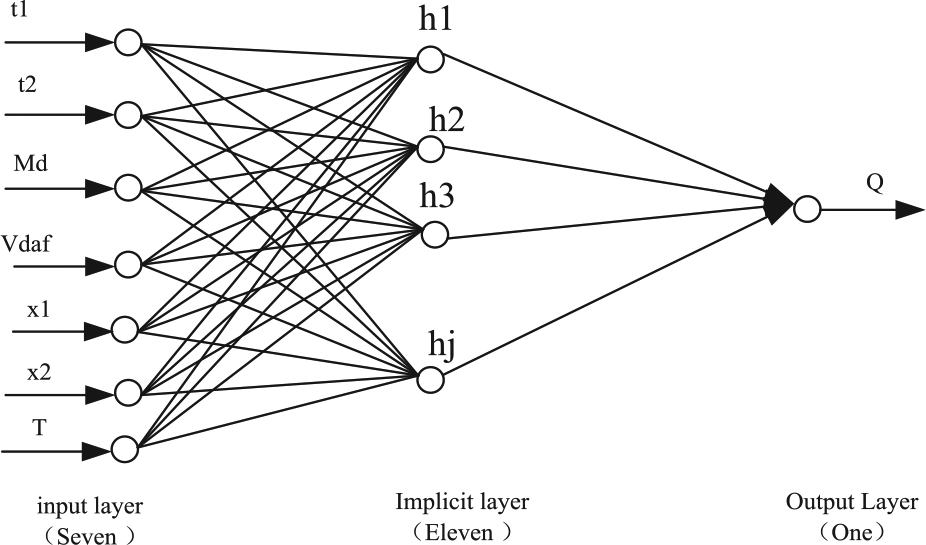
Prediction model of coking energy consumption based on RBF neural network.
Simulation experiment of prediction model
According to the coking energy consumption prediction model established in the previous section, the prediction model is simulated by using the actual data in the production process, first the network is trained by using the normalized data, then the other 30 groups of processed data are used to predict, and compared with the actual data, the corresponding prediction results are obtained, as shown in Figure 5.
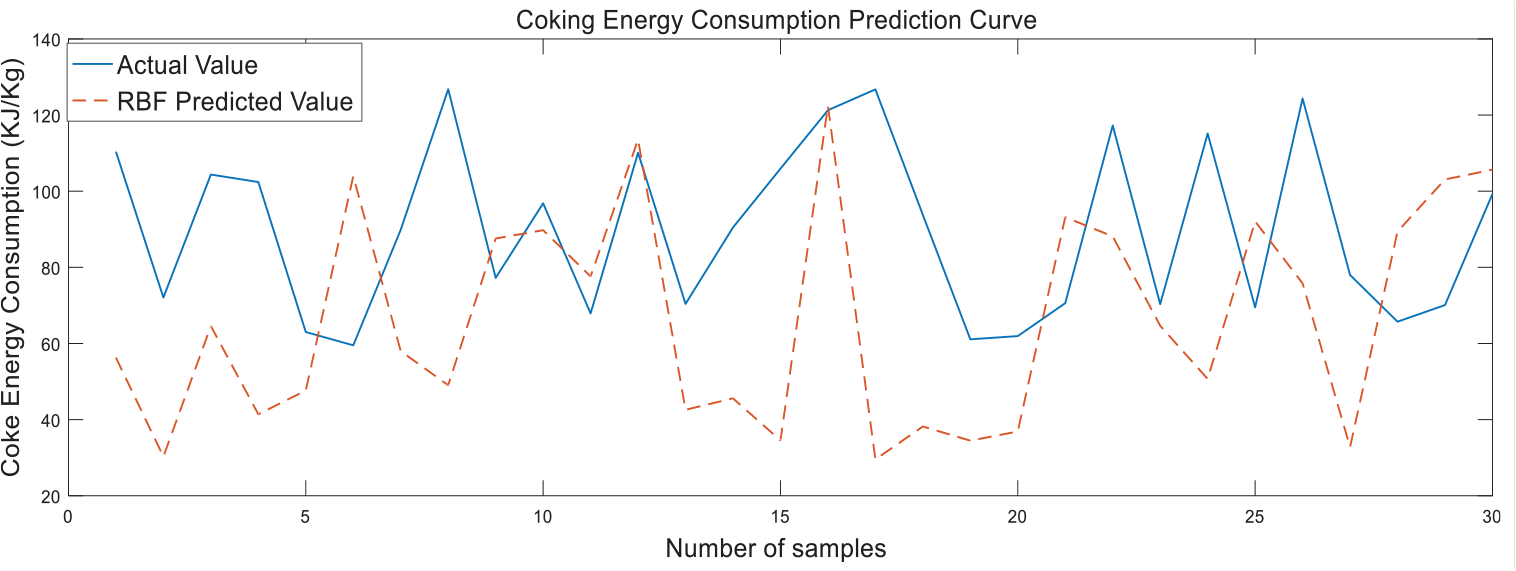
The prediction result curve of RBF coking energy consumption.
The error accuracy of the training process is 0.001, and the error accuracy is less than 0.001 by 58 iterations of the RBF neural network.
Because the RBF neural network has certain limitation in the prediction, the precision and iteration speed are slow, and the parameters of the RBF neural network are optimized by the strong global search ability of de differential evolutionary algorithm, then the network is trained by the optimized parameters, and the accuracy and iteration speed of the predicted network are improved. In the neural network after the DE optimizes the RBF parameters, the initial parameters of the RBF network are invariant, the parameters are encoded to initialize the population, the population size is 30, the mutation factor is f = 0.8, the crossover factor is Cr = 0.5, the maximum number of iterations is 100, and the error accuracy is 0.001. Using the DE algorithm to obtain the optimal parameters of RBF neural network, the parameter decoding is brought back to the RBF network, and the parameters of normalized processing are used to train and predict, and the prediction result of de optimized prediction model is shown in Figure 6 below.
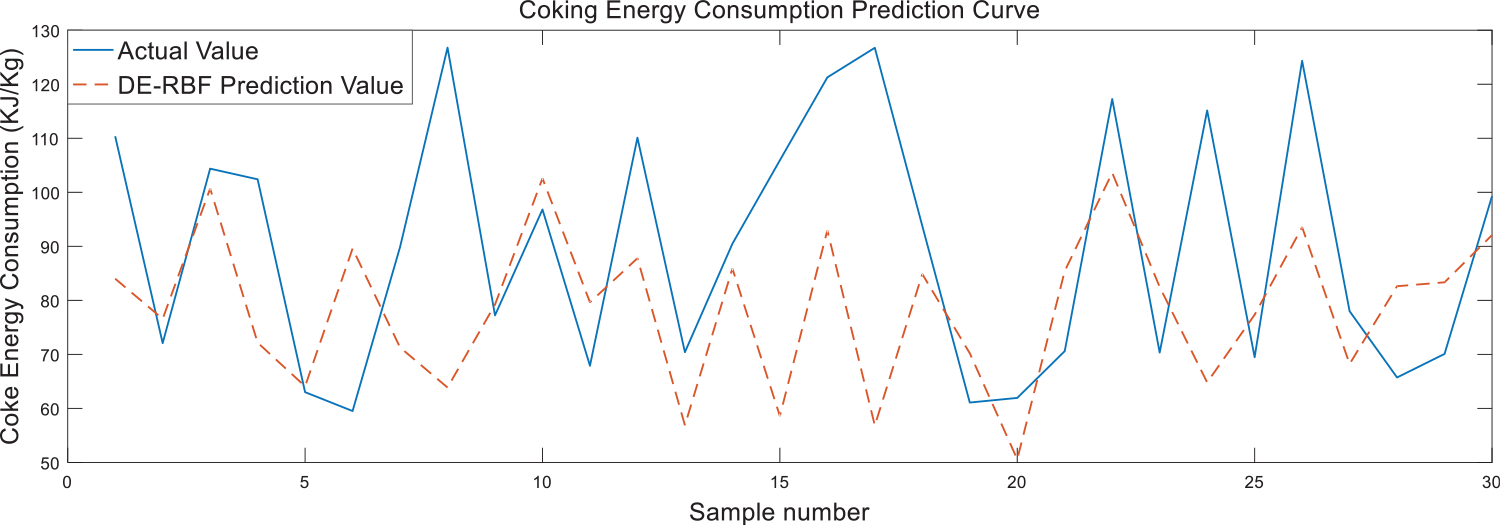
The prediction result curve of DE-RBF coking energy consumption.
Comparison of simulation results
Through the prediction chart, we can see that the data fitting degree of the optimized prediction model is better than that of RBF network. In order to accurately compare the characteristics of two networks, the maximum absolute error, mean square root error and average absolute percentage error are used as the indexes of algorithm and measurement accuracy in this paper. The three indicator formulas are as follows



In the formula, n is the total number of test samples,
Comparison of three index values of two models.
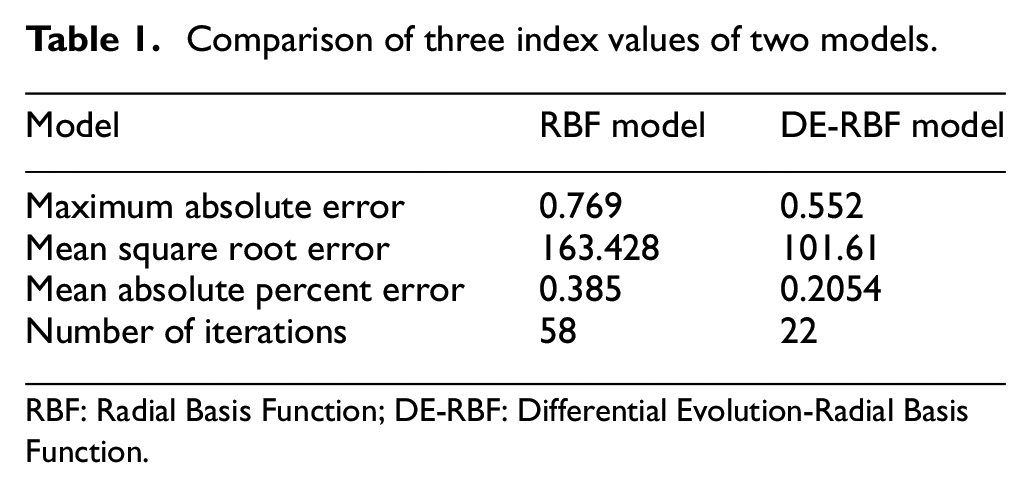
RBF: Radial Basis Function; DE-RBF: Differential Evolution-Radial Basis Function.
It can be seen from the table that the three index values of DE-RBF neural network model are smaller than those of RBF neural network model. The maximum relative error is 0.552, which is 0.217 lower than RBF neural network. The root mean square error of DE-RBF is 101.61, which is significantly smaller than that of RBF neural network 163.428, indicating that the improved network prediction results are relatively stable. The average absolute percentage error is 0.2054, which is 18% higher than that of RBF neural network model, indicating that the prediction accuracy of coking energy consumption has been improved. In addition, from the iteration number, when the mean square error reaches the target error value, the number of iterations needed decreases, indicating that the optimized operation speed has been accelerated. In conclusion, the RBF network optimized by DE algorithm is superior to the RBF network in predicting stability and accuracy, which is more conducive to guiding coking production.
Conclusion
In this paper, based on the complexity of coking production process and many influential factors, the difficulty of predicting model of coking energy consumption is presented, and the prediction model of coking energy consumption based on the RBF neural network is proposed by the DE algorithm. The DE algorithm has the advantages of strong global searching ability, fast convergence speed and high stability performance. The learning ability and prediction ability of DE-RBF neural network coking Energy consumption prediction model are better than that of RBF neural networks. The simulation example proves that the combination of the differential evolutionary optimization algorithm and the RBF neural network is a good prospect for the prediction of energy consumption of coking. For the study of coking energy consumption, due to the complexity of the production process, some data in the coking production process are difficult to be monitored, which hinders the establishment of the model and theoretical research. Therefore, it is another research content to analyze the mechanism of coking production process and grasp the principle of energy balance in the production process, which can reduce coking energy consumption while ensuring the quality of coke.
Footnotes
Declaration of conflicting interests
The author(s) declared no potential conflicts of interest with respect to the research, authorship, and/or publication of this article.
Funding
The author(s) received no financial support for the research, authorship, and/or publication of this article.
