




Abstract
The problem of vibrations in civil structures is common; nevertheless, its negative effects can be significantly reduced using structural control methods with intention of maintaining structural welfare as much as possible. This work deals with the study of structural vibration control in a model of a civil-like structure, which consists of three-level building with a tuned mass damper implemented as a passive vibration absorber, mounted on the top of the structure, to attenuate the harmonic vibrations provided by an electromagnetic actuator connected at the base of the primary system. The action of the tuned mass damper is evaluated from an energy approach. The dissipation of energy in the overall system is conducted in an experimental way, where the passive control technique is designed to minimize the undesirable forced dynamic response of the main structure via the tuned mass damper. Experimental results are provided to show the effective performance of the proposed passive vibration absorption scheme to suppress resonant frequency harmonic excitations disturbing the primary system, evaluating the performance energy and contribution of the dissipative device for the energy release in the overall system.
Introduction
Recently, the occurrence of natural events related to seismic activity or earthquakes has become of great interest for the engineering and scientific community worldwide, particularly for the civil engineering one. In general, the design and construction of hazard-resistant structures like buildings and skyscrapers are necessary in modern cities.1–3 These designs implement schemes of structural control very useful for real applications with the intention to reducing the negative effects such as the risk of crack or collapse caused by an earthquake. These schemes are known as passive, semi-active and active vibration control in civil engineering.4,5
Passive schemes are well known as energy dissipaters to reduce stress caused by an external perturbation such as earthquake. These systems are characterized by the absence of an external source of energy. As a result, overall system stability is not usually concern. The tuned mass damper (TMD) is a type of passive mechanism designed to reduce a particular frequency or vibration mode on some structure. This device is composed of a mass, a spring and a damper, which represent a secondary system, attached to a structure to minimize its movement or displacement completely where vibration energy is dissipated from the structure via dissipative elements (dampers) that are a part of the TMD system. A passive TMD system is any TMD topology which does not contain any active element, such as an actuator. As a result, these systems are entirely mechanical.
When the TMD is tuned close to the structural mode of interest, the TMD will resonate out of phase with the structure, and the resulting vibration energy will be dissipated by the damper to the environment as heat. The selection of TMD system parameters to match the damper frequency with the natural frequency of the connecting structure is the act of tuning the TMD system. Therefore, by properly tuning the TMD to the fundamental excitation modes of the attached structure, the TMD damper will dissipate a significant amount of structural vibration in terms of energy. A TMD is advantageous over conventional design methods, especially for taller lighter construction since it is economical and can be implemented as an add-on to existing or new structures. The use of TMD systems is particularly useful in structures such as suspension bridges or tall buildings, where resonant conditions coincide with external excitation frequencies. 6
In the literature, it is possible to find several real cases related to building structures that contain TMD configurations. The John Hancock Tower in Boston was designed with two dampers to reduce the response to wind gust loading. The dampers are placed at the opposite ends of the 58 story in order to counteract the building movement both laterally and torsional. The Chiba Port Tower was the first tower in Japan to be equipped with a TMD. The purpose of the TMD is to increase damping of the first mode for both
The theory of structural control in buildings evaluates the use of active schemes as an alternative to improve passive control, which consist of the feedback and/or feedforward of information by sensors mounted in the structure to control a set of resonant frequencies or vibration modes. Generally, an active mass damper (AMD) controller is more appropriate to add robustness to the objective of control. However, this advantages implies an increase of extra degrees of freedom of the original system, due to the entries of an actuator to provide the action control over the system.4,8 Recently, the assessment of active vibration control in structures is possible by using smart materials and actuators, with practical applications in mechanical and civil engineering. In this classification of smart devices, we can remark the piezoelectric actuators and the magnetorheological dampers. 9 The schemes of active vibration control using heuristic models are possible and their applications are related to systems such as petrochemical plants, gas turbine power plants and large structure as wind turbines, buildings and others.
In this paper, a primary system, consisting of a civil-like structure which has three rigid floors and a passive vibration absorber consisting of a TMD, is numerical and experimentally investigated from an energy-based design. The principal intention is to analyze the performance of a passive vibration control scheme in order to reduce the overall vibration response under movements provided by external forces using an electromagnetic actuator where the results obtained can be extended to the case in which the excitation is due to earthquake or even dynamic wind loads.
The outline of this article is as follows. In section “Experimental setup,” we present the experimental setup in detail. In sections “Mathematical model of the experimental setup” and “Measurement components,” we explain how the dynamic model of the overall system is obtained and the measurement components to be used, respectively. In section “Operational modal analysis of the structure,” the operational modal analysis of the structure is exposed. Finally, in sections “Passive vibration absorber” and “Energy dissipation,” results of the passive vibration absorber from an energetic point of view are shown.
Experimental setup
The platform set-up consists of a civil-like structure distributed over three floors, manufactured with an aluminum alloy which includes the concentrated masses of every floor and the column-beams which represent the stiffness of columns in the civil structure. The nominal stiffness is denoted as
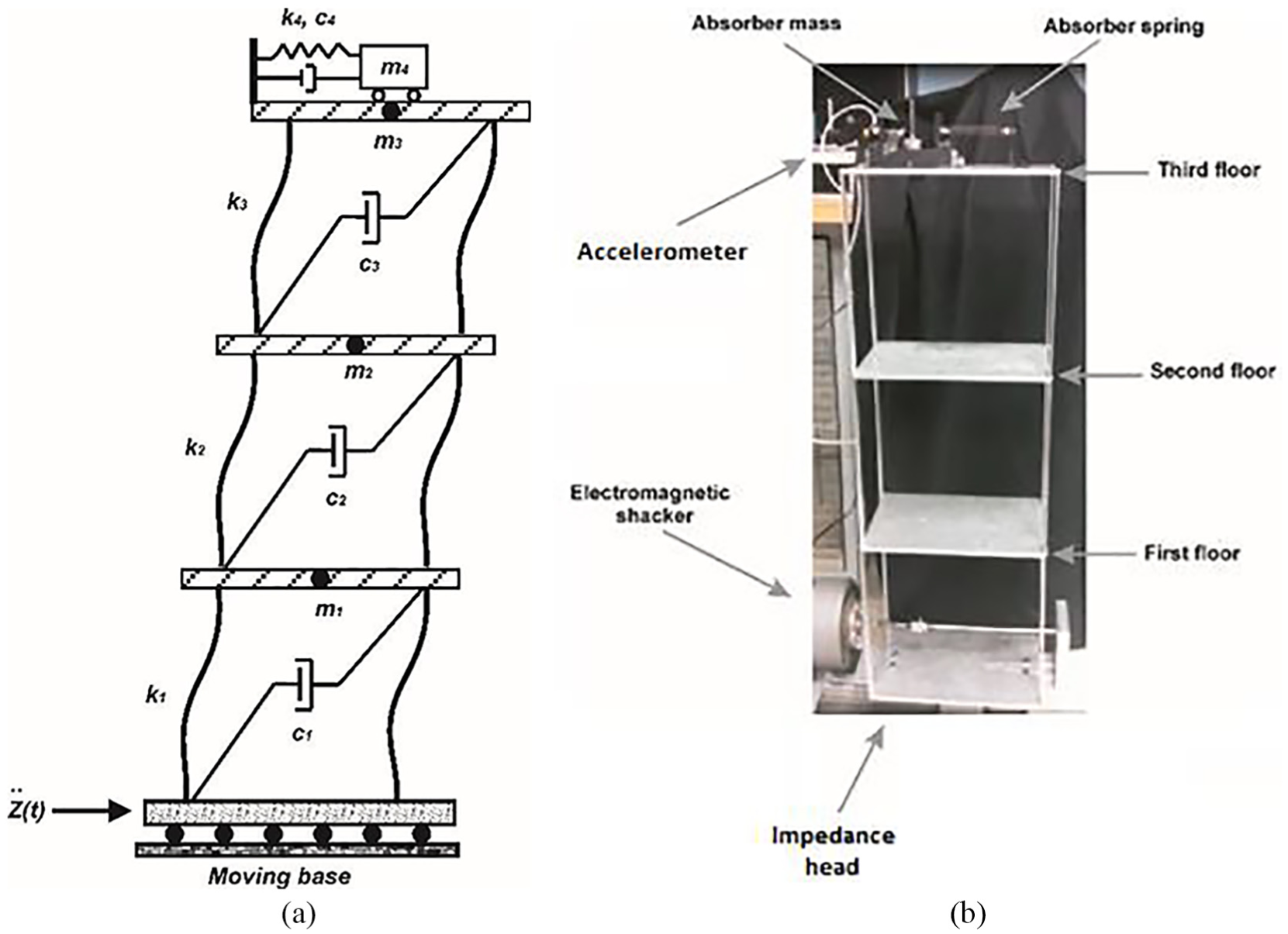
Civil-like structure: (a) schematic model and (b) experimental platform.
The platform set-up is connected directly to an electromagnetic shaker model Labworks® ET-139, controlled via a linear power amplifier Labworks PA-138, which is used to emulate external forces with low-frequency harmonic components injected into the ground or base of the structure. The electromagnetic shaker is capable to provide a frequency sweep in a wide range, which is represented as
Mathematical model of the experimental setup
The three-story building is modeled by applying an external force by ground motion (Figure 1(a)), which can be expressed as in Equations (1)

where
The mass, damping and stiffness matrices for the three-story building are given as follows
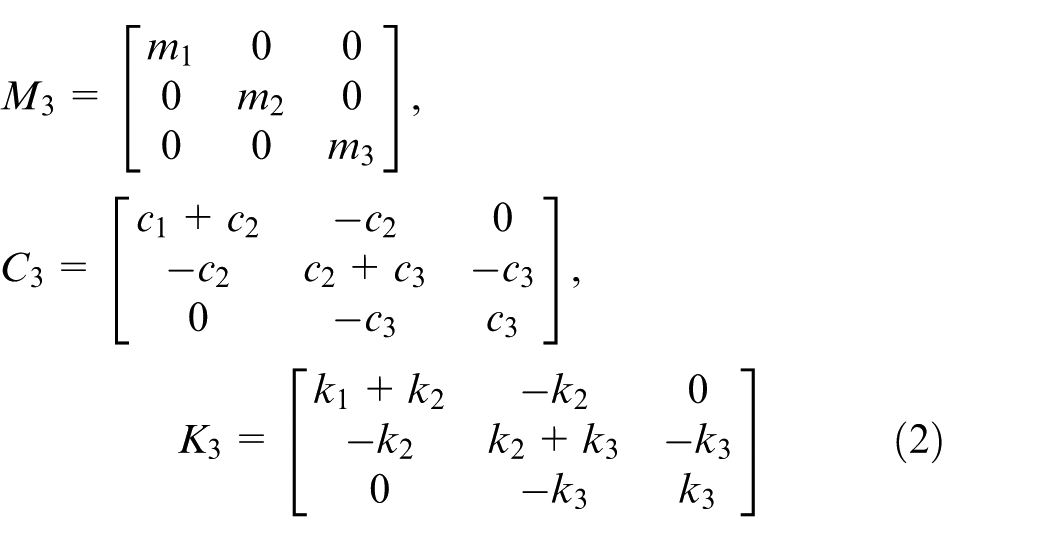
The damping matrix
Measurement components
In the application of civil structures, the use of accelerometers as sensors to measure the acceleration components of the overall structure, even when there are acceleration forces due to the presence of external forces such as earthquakes in low and high frequencies, is very common. Conceptually, an accelerometer is considered as a damped mass on a spring. The principle of operation consists of representing the acceleration through a displacement of the mass, and its displacement is measured to give the corresponding acceleration.
In the real applications, there exists a variety of accelerometer technologies such as piezoelectric, piezoresistive and capacitive, each one with particular characteristics and applications. The small microelectromechanical systems (MEMS) is the most modern accelerometer and consists of a cantilever beam with a proof-mass realized in single crystal silicon.
Operation of accelerometer
The performance of an accelerometer can be evaluated considering it as a simple mechanical system through elements such as mass (m), spring (k) and damper (c), which are exemplified in Figure 2.
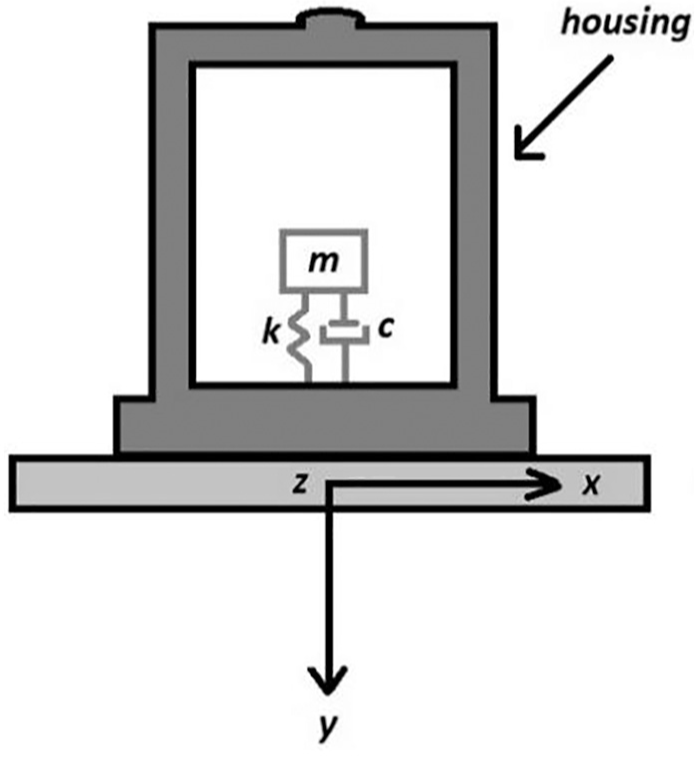
Schematic diagram of a tri-axial accelerometer.
The mass component used in accelerometers is known as seismic-mass or proof-mass. The stiffness in the sensor is related to the type of material used in manufacturing of the housing and internal modules of accelerometer. The dashpot element represents the desirable mechanical damping effect of the sensor.
Once the spring-mass system is excited by an exogenous force in terms of linear acceleration, a force equal to mass times acceleration acts on the proof-mass, inducing a deflection, which is sensed through a transducer and converted into a proportional electrical potential, and resulting in the damping component to aim for a quick stabilization under applied external force.
Technical specifications of accelerometer
The experimental results presented in this work were obtained from a Miniature PiezoBeam Accelerometer manufactured by Kistler© type 8688A50. This sensor has a high sensitivity triaxial that simultaneously measures vibration in three orthogonal axes. The measuring range is around ±50 g and it is technologically designed with a transducer electronic data sheet (TEDS), which contains information about the main characteristics of sensor, including its interface, and important technical information such as sensitivity, references frequency, polarity, in others relevant characteristics of the sensor.
Operational modal analysis of the structure
The civil-like structure is submitted to an external harmonic force at the base both in experimental and numerical analyses. An electromagnetic shaker is used to induce the exogenous force, using an interval from 0 to 60 Hz in a time of 60 s. The magnitude force is measured through an impedance head and movement of the overall structure is fed back by means of sensors allocated, which is shown in Figure 3.
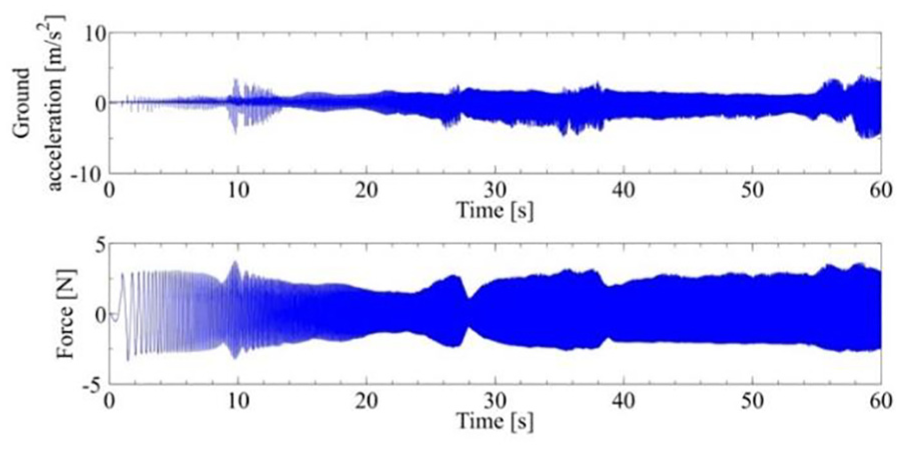
Ground acceleration and force of the external excitation.
The fast Fourier transform (FFT) is used to obtain the experimental frequency response of the system, combined with the technique of modal analysis known as Peak Picking.11,13 The maximum displacement of the building-like structure when it is excited occurs in the third floor, and the three dominant resonant frequencies are shown in Figure 4.
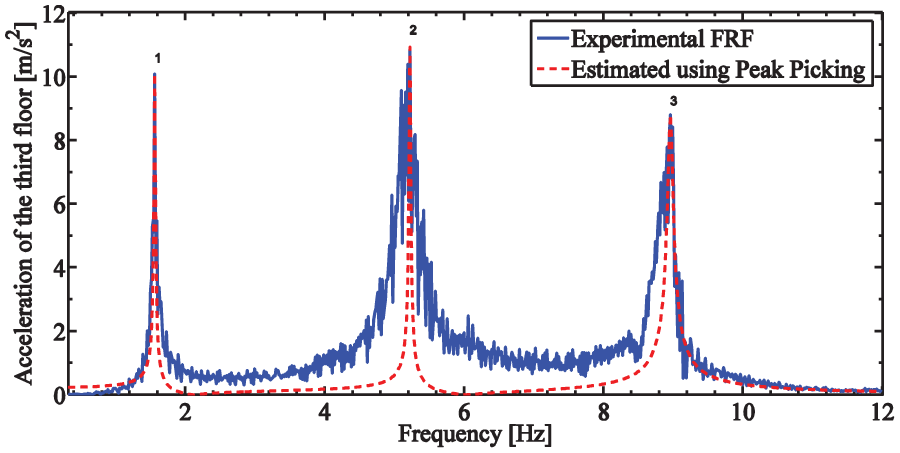
FRF of the civil-like structure using peak picking method.
In general, the peak picking technique allows to obtain the resonant frequencies, damping ratio and the modal amplitude corresponding to each resonant peak, acquired from the frequency response of the system. In the literature, it is possible to find more complex techniques such as circle fit method or curve fitting. However, in the real practice, the peak picking technique is very simple to implement and achieve an acceptable approximation of the real parameters of the system limited to certain operating conditions. 12 For more information of these modal parameter identification techniques, we recommend works from the literature.11,13
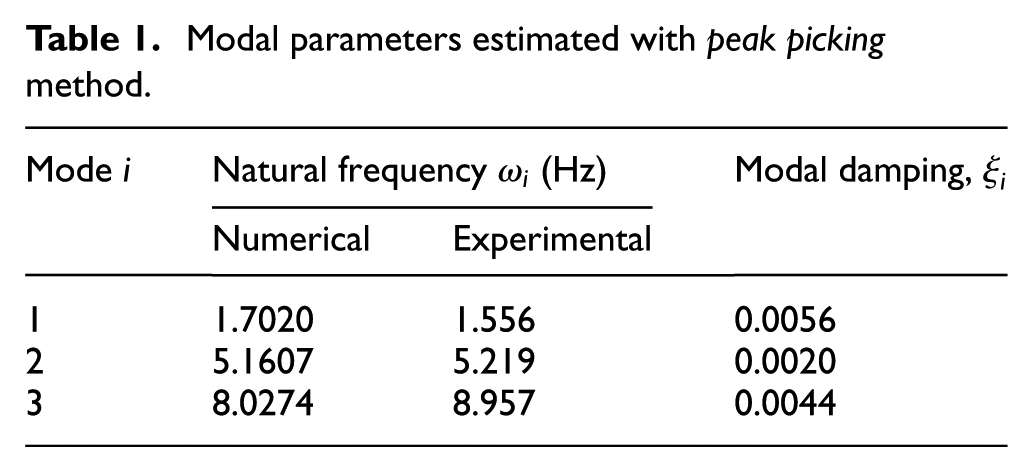
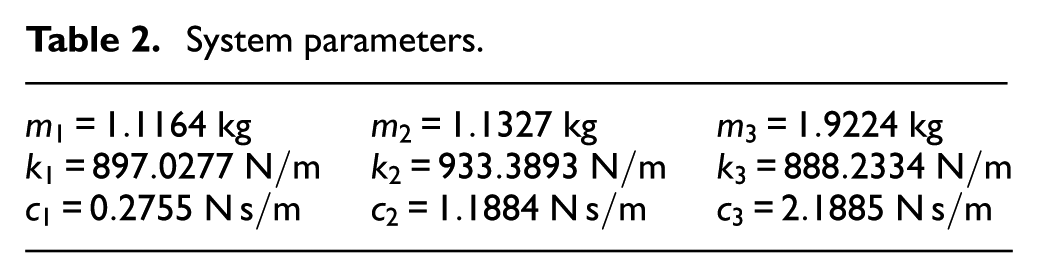
Validation of the resonance frequencies in the experimental and numerical forms are useful to evaluate the mathematical model purposes of the civil-like structure, which are described in Table 1. In both cases, the first three dominant resonant frequencies are close enough considering only the lateral displacement of the structure. Furthermore, the real parameters of the system, such as masses and stiffness of the column-beam, which are obtained from the weight, geometry and physical properties of mechanical materials, including the estimation of viscous damping, which is calculated from the experimental modal analysis (EMA), using the experimental modal damping obtained from the Peak Picking technique, are given in Table 2.
Modal parameters estimated with peak picking method.
System parameters.
The modal shape of the first three resonant frequencies of the civil-like structure identified in the Table 1 are shown in Figure 5 by means of ANSYS Workbench© a finite element modeling (FEM) commercial software.
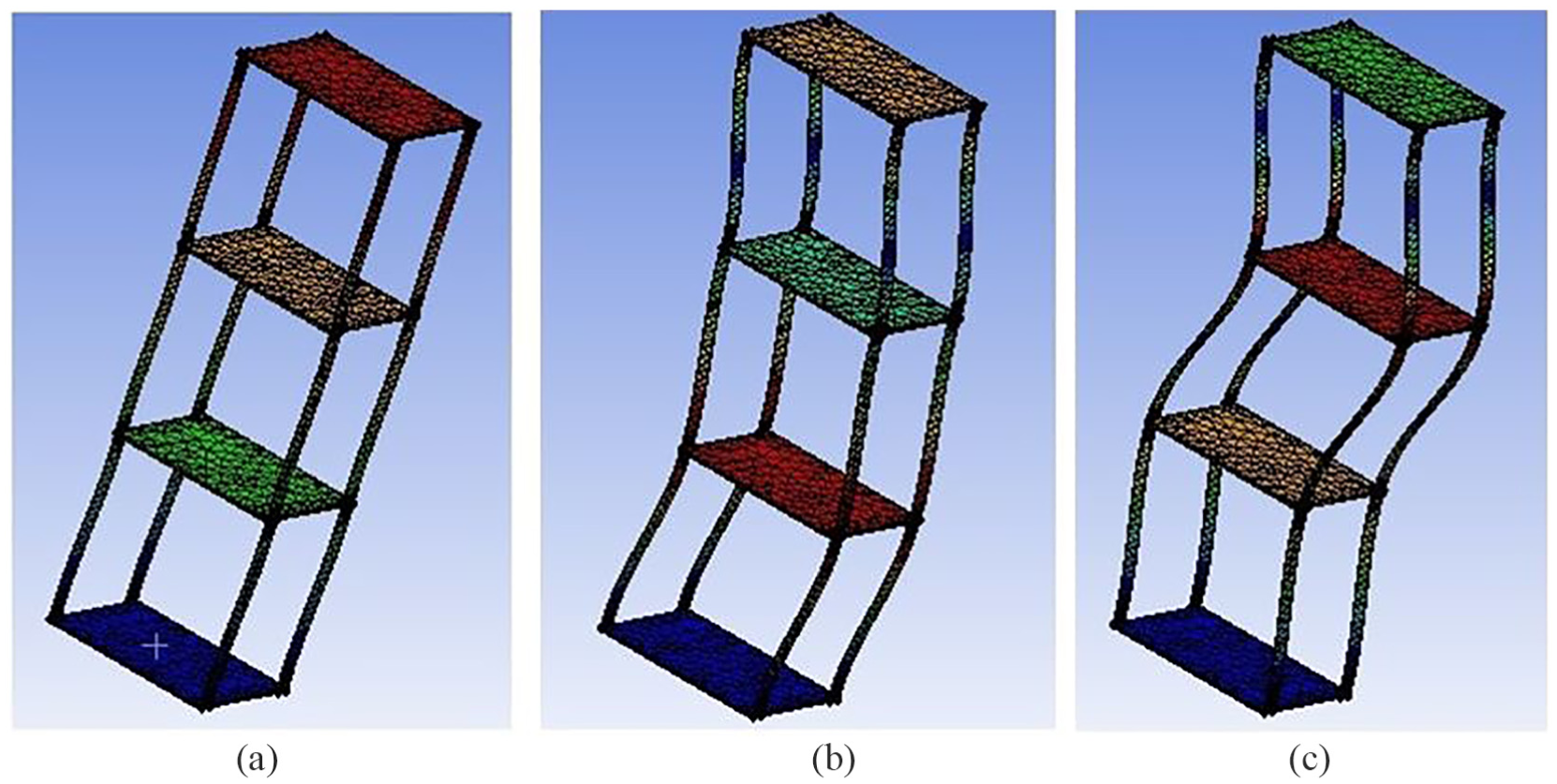
Three first modal shapes of the civil-like structure using FEM. (a) first mode, (b) second mode and (c) third mode.
Passive vibration absorber
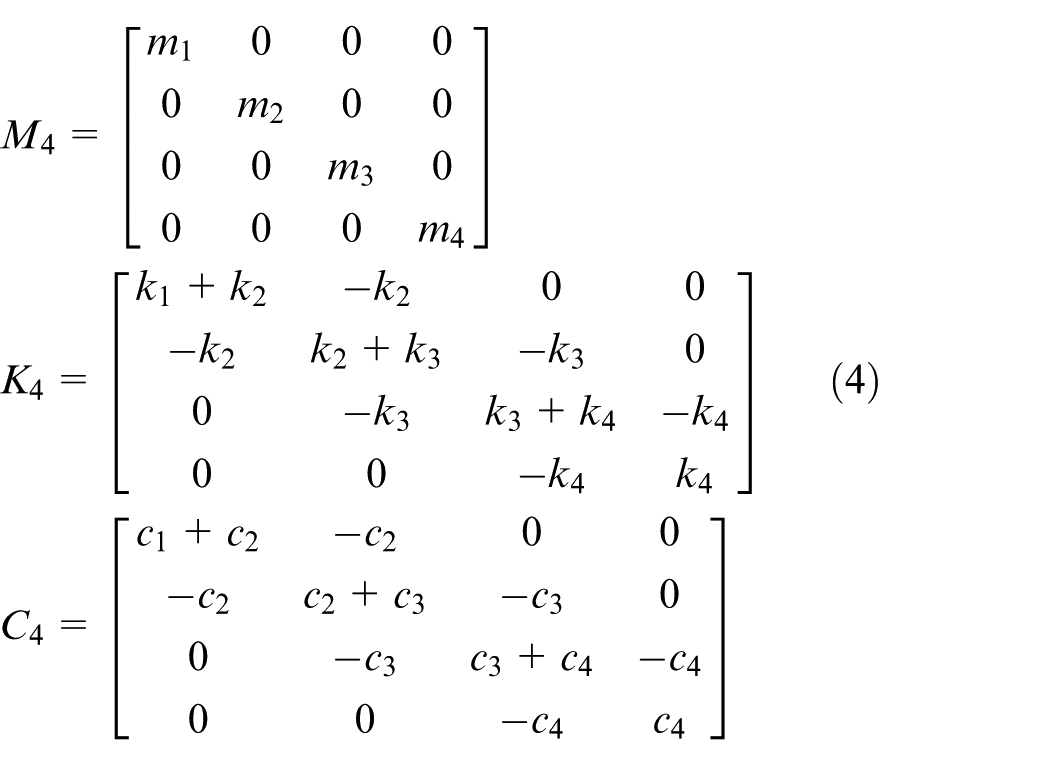
In the civil-like structure shown in Figure 1(a), the TMD is represented in terms of the followings parameters
The civil-like structure in the presence of TMD placed on the third floor of the structure, which is subject to movement

where
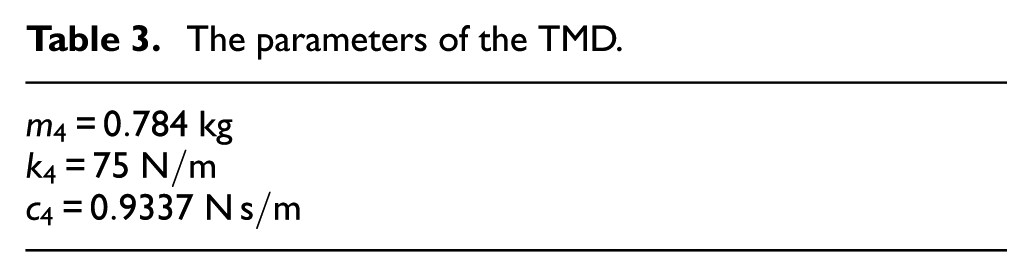
The TMD is tuned to dissipate the frequency of interest from the expression
The parameters of the TMD.
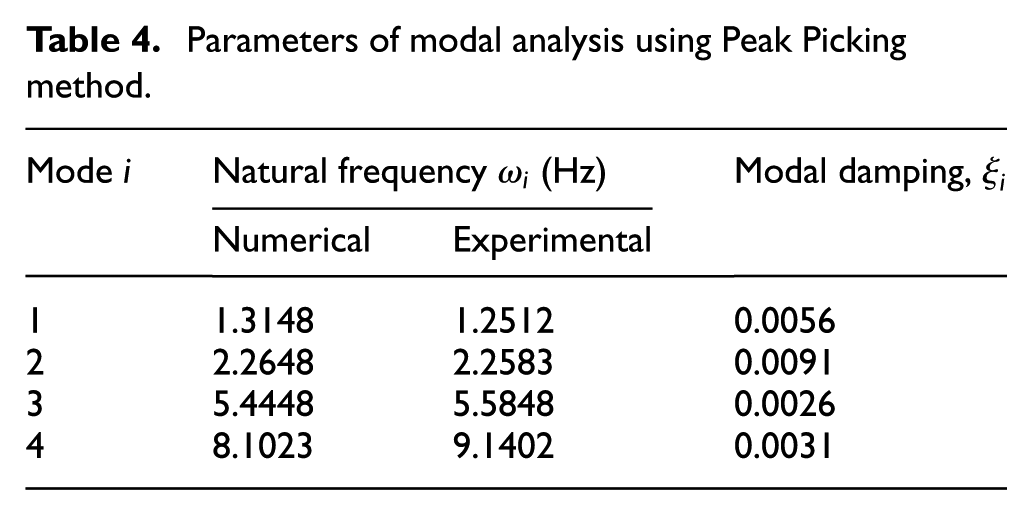
The results of EMA are shown in Table 4, where a reasonable approximation is observed with respect to the numerical results.
Parameters of modal analysis using Peak Picking method.
The experimental dynamic response (displacement) in the overall floors of the civil-like structure with/without TMD is shown in Figures 6–8.
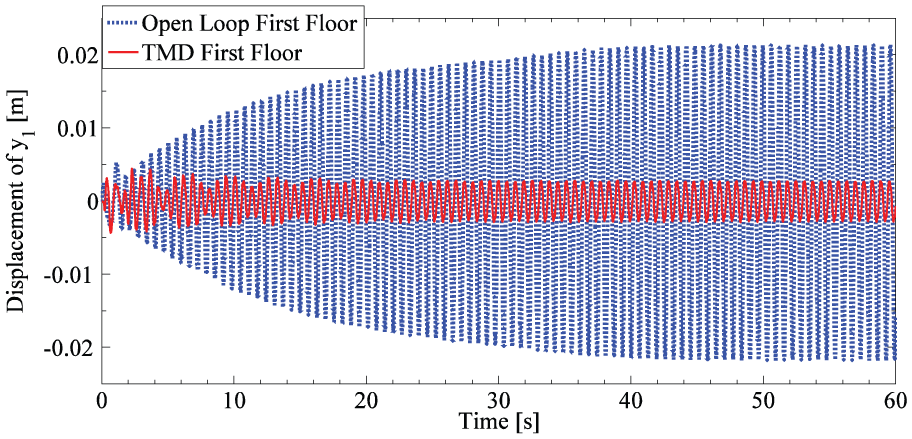
Experimental response of the first story of civil-like structure.
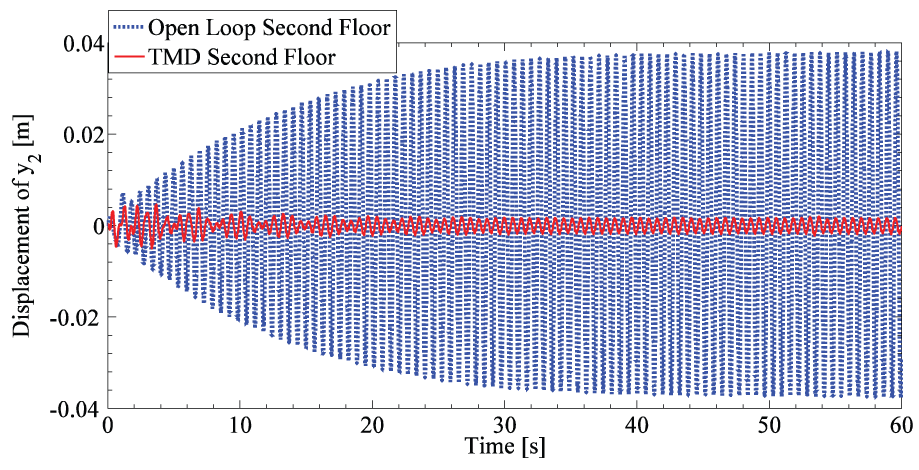
Experimental response of the second story of civil-like structure.
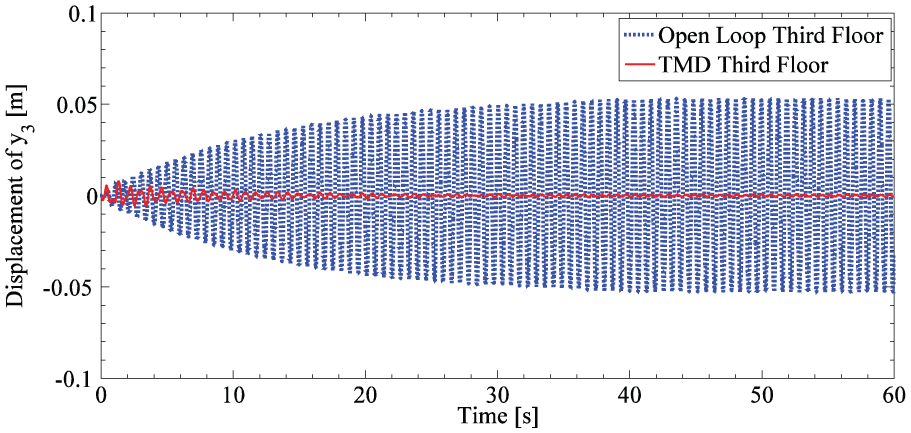
Experimental response of the third story of civil-like structure.
On the other hand, the experimental frequency response of the civil-like structure with TMD is shown in Figure 9 in terms of the third floor acceleration
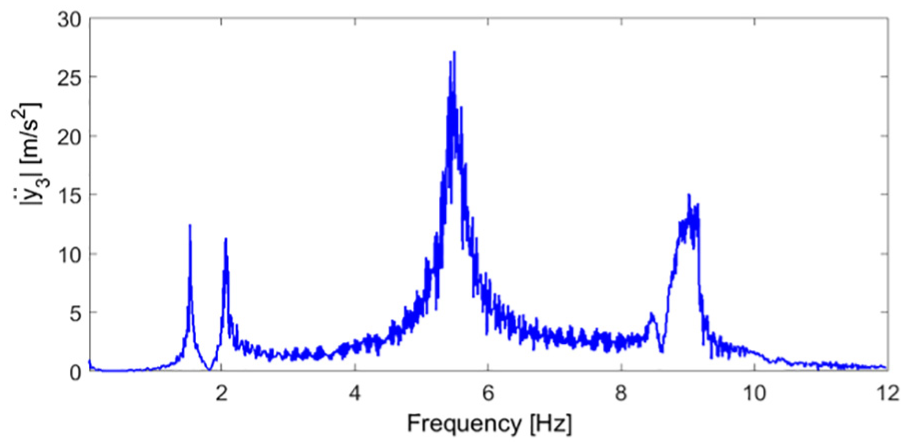
Experimental FRF of the primary system with TMD.
Energy dissipation
The principal function of a passive energy dissipation system is to reduce the inelastic energy dissipation demand on the framing system of a structure. Particularity, passive devices as TMD achieved the energy dissipation by means of the damper inertia force acting on the structure. This dissipation can be analyzed through a complete energy balance from an excitation at the base of a civil structure, which is expressed as follows

where
The first contributions related to the energy concepts in structural control were provided by Hanson and Firmansjah, 7 which focused on schemes of active control with intention to provide a first contribution in this direction. 15 In this work, we are interested in proposing an energy study concerned with a passive or dissipative scheme using a TMD.
The energy balance equation (5) can be expressed in terms of Equations (3) and represent a generalized analysis of a multi-degree of freedom (MDOF) system with control input as follows

where
Solving the matrix equation (6) and multiplying both sides by
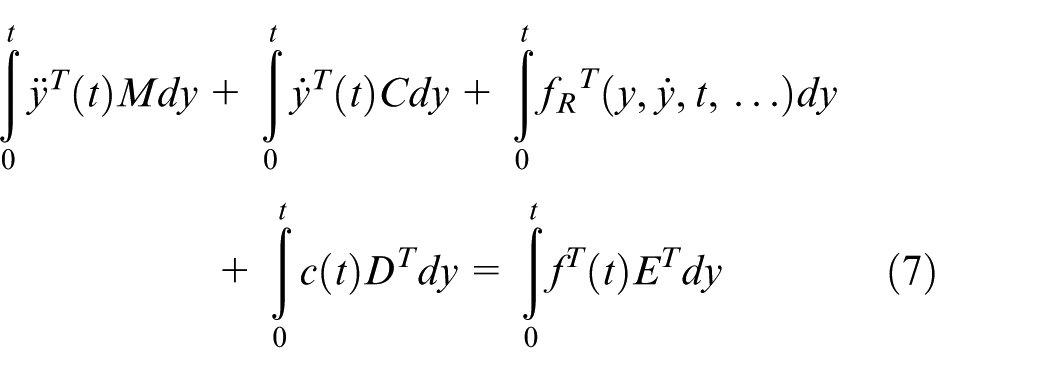
where
Therefore, the equation of energy balance of an MDOF system, obtained from Equations (7), is represented as follows


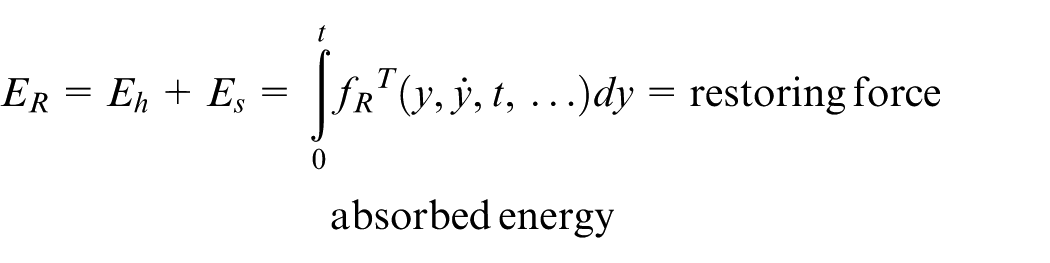
From Equations (7), it is possible to achieve additional energy information of the MDOF system

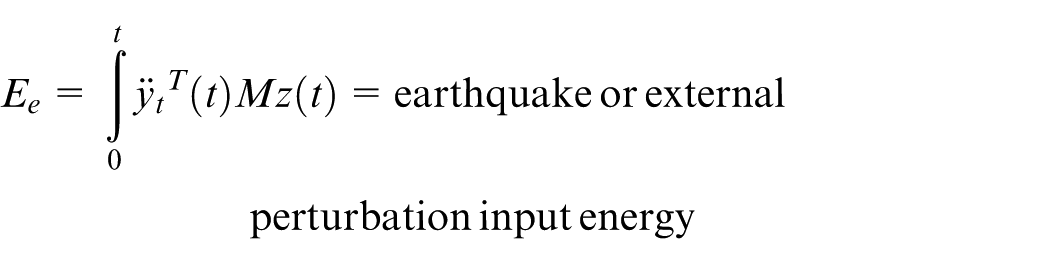

The actual work presents an energy approach analysis of the civil structure considering the presence of a TMD from experimental data. This approach involves the action of the kinetic and potential energy of the system. Therefore, the energy balance equation used can be expressed as in Equations (8)

To define complete energy approach of the system from Equations (3), we establish the kinetic and potential energy considering the Euler-Lagrange formalism and thus the kinetic energy is represented as in Equations (9)

and the potential energy is expressed as in Equations (10)

The Euler-Lagrange formalism is defined as
Thus, given the previous approach, it is possible to compare the energy analysis of the civil structure with TMD and the non-controllable or non-dissipative system. The experimental response of the system in terms of the kinetic, potential and total energy is shown in Figures 10–12.
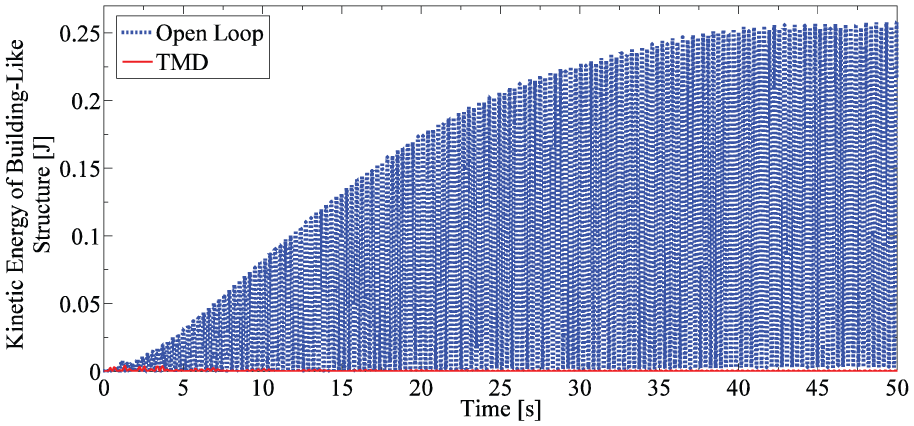
Experimental response of the kinetic energy of the civil-like structure with and without passive control.
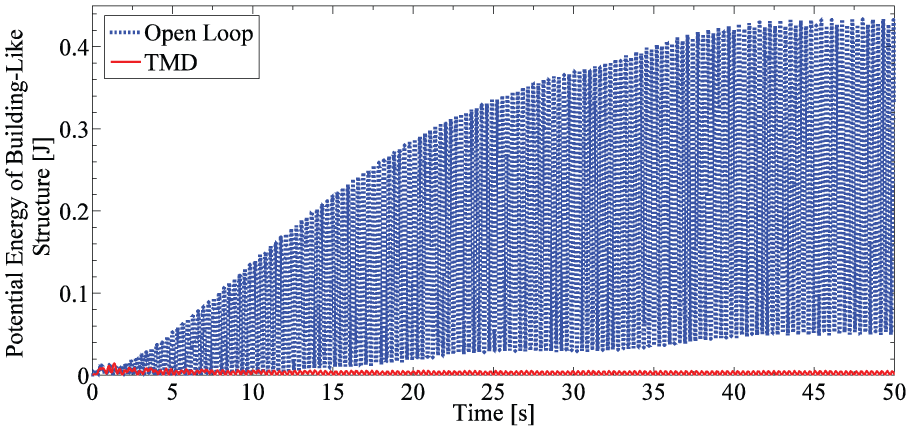
Experimental response of the potential energy of the civil-like structure with and without passive control.
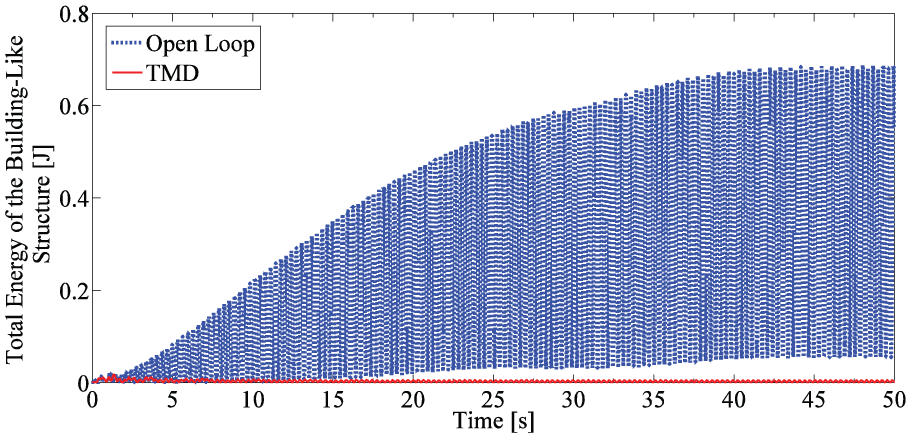
Experimental response of the total energy of the civil-like structure with and without passive control.
Conclusion
The analysis of vibrations in civil structures was investigated using a simplified numerical model of three floors perturbed by an external force at the base. The goal is to reduce the lateral displacement when it is disturbed by external forces such as an earthquake. The TMD is used as mechanical absorber tuned for an explicit resonant frequency of the civil-like structure.
The experimental results obtained indicate that the movement of the structure can be reduced indirectly by controlling the mechanical vibrations in the system, reducing the effects of lateral displacements caused by external forces like an earthquake force.
This work presents a preliminary analysis of the absorber using an experimental approach with kinetic and potential energy establishing the dynamic action of the TMD on the overall system. Future work will focus on the implementation of active vibration control to reduce the displacement of the structure significantly by using modal controllers based on optimal model predictive control (MPC)16,17 using the most up-to-date tuning rules.18,19
Footnotes
Declaration of conflicting interests
The author(s) declared no potential conflicts of interest with respect to the research, authorship and/or publication of this article.
Funding
The author(s) received no financial support for the research, authorship and/or publication of this article.
