




Abstract
With the rapid development of the emerging technologies and significant cost reduction of the deployment for solar energy and wind power, the replacement of traditional power generation by renewable energy becomes feasible in the future. However, different from currently deployed centralized power sources, renewables are categorized as one kind of intermittent energy sources, and the scale of renewables is small and scattered. In the recent literature, the architecture of virtual power plant was proposed to replace the current smart grid in the future. However, the energy sharing concept and the uncertainties of intermittent energy sources will cause the short-term energy management for the virtual power plant much more complicated than the current centralized control energy management for traditional power generation system. We thus propose a hierarchical day-ahead power scheduling system for virtual power plant in this work to tackle the complex short-term energy management problems. We first collect electricity consumption data from smart appliances used in households and predict power-generating capacity of renewable energy sources at the prosumer level. Then, the proposed hierarchical power scheduling system is employed to schedule the usage of electricity for the customers by considering the efficiency of the use of distributed renewables. Notably, charging management of a moving electric vehicle is also considered in the proposed power scheduling mechanism. In addition, a real-time power tracking mechanism is presented to deal with the forecast errors of volatile renewable power generation, electricity load, and moving electric vehicle charging, and the maximal usage of renewables and reduction of the burden on community virtual power plants during time period of peak load can be achieved accordingly. The experimental results show that the proposed day-ahead power scheduling system can mitigate the dependency on traditional power generation effectively, and balance peak and off-peak period load of electricity market.
Introduction
Virtual power plants (VPPs) integrate and coordinate distributed energy resources (DERs), storage facilities, and controllable loads via a common intelligent control center. 1 The VPPs aggregate the electrical output from a multitude of DERs and make this supply available to the system operator. If requested, the VPPs control the immediate dispatch of the connected plants, thus contributing to grid reliability. The future VPPs emphasize the comprehensive utilization of energy in the whole power system by coordinating prosumers and minimizing the cost of the whole power system, but not only the energy of any single prosumer, which inevitably results in a certain amount of power exchange among the VPP members. In other words, each prosumer can either inject spare power into or absorb lacking power from other prosumers or the main grid. Accordingly, how to accurately calculate the exchange power among prosumers in a distributed fashion is urgent for the energy management of the forthcoming VPPs.
In the recent literature, the accuracy of forecasting renewables and electricity load has been taken into account in optimal scheduling issues in power markets. An approach that optimized their energy resources of a VPP in the day-ahead and the real-time energy markets was proposed in Baringo and Baringo. 2 The uncertainty in the wind-power production and in the market prices was modeled using confidence bounds and scenarios, respectively. Kardakos et al. 3 allowed the VPP owner to optimally exploit the demand response schemes by shifting the thermostatically controlled loads (TCLs) and deviate from the forecasted hourly aggregated load consumption in order to alleviate the wind variability among different scenarios and minimize the associated imbalance costs. In Al-Awami et al., 4 a VPP that consists of generation, both renewable and conventional, and controllable demand participates in the wholesale markets. The VPP trades energy externally with a wholesale market, and fuzzy optimization was proposed for the day-ahead internal VPP market by considering the uncertainty in the renewable. A bi-level scheduling model for VPPs with a large number of distributed TCLs and intermittent renewable energy is established in Wei et al. 5 to reduce the net exchange power deviation caused by the forecast error of renewable energy. The upper level optimizes the exchange power curve and reduces the imbalance costs in intraday, while the lower level tracks the optimized power curve in real-time to complete the regulation target. Liu et al. 6 combined interval and deterministic optimization together and adopted the combined approach to solve a VPPs’ dispatch problem. The combined optimization not only maximized VPPs’ deterministic profits under forecasted scenarios to estimate the VPPs’ most likely profits, but also maximized VPPs’ profit intervals to manage uncertainties. Conditional value at risk (CVaR) and confidence degree theory was introduced in Tan et al. 7 to overcome the uncertainty influence of renewables and electricity load on VPP operation. A risk aversion scheduling model is proposed with minimum CVaR objective considering maximum operation revenue. An energy management system (EMS) that employed a metaheuristic optimization algorithm, teaching–learning based optimization (TLBO), was proposed in Kasaei et al., 8 by aggregating renewables, storage battery, and load control in a VPP framework to mitigate the impact of the variable generation and uncertainty of power system. Kasaei and colleagues 9 , 10 presented an algorithm based on imperialist competitive algorithm for optimal energy management of a VPP. The uncertainty associated with the load demand forecast error, market price changes, and renewable power changes are modeled in the optimal energy management problem.
Some researchers have presented algorithms to integrate electric vehicles (EVs) with distributed power grids in recent years. To name a few, Shi et al. 11 developed a model predictive control-based approach to address the joint EV charging scheduling and power control to minimize both EV charging cost and energy generation cost in meeting both residence and EV power demands. Yang et al. 12 studied the coordinated dispatch strategies of EVs to smooth renewable energy and load fluctuations of the microgrid while ensuring the quality of logistics services. Wang and Liang 13 investigated the energy management strategies for EVs via bidirectional V2G. A state-independent four-threshold battery charging/discharging policy was proposed to shave the peak load and flatten the overall load profile. Li et al. 14 proposed an online algorithm to conduct cost-aware scheduling of EV loads and energy supplies for microgrids. The energy management problem was formulated into a stochastic optimization problem with the objective of minimizing the time-average cost of a microgrid. A fully decentralized controlled EV charger was proposed in Teng et al. 15 to mitigate the charging impact on power grids. The proposed decentralized EV charger used the parameters measured from the power grid, EV charger, and EV battery pack to adjust the charging current.
One problem constraining the development of EVs lies in the inconvenience of charging. Currently, most EVs get charged at charging stations or at the home/workplace. If a moving EV demands power before it can arrive at the destination, it will have to detour to a nearby charging station to get charged first. However, the current deployment of charging stations is still far from sufficient. Consequently, the nearest charging stations may be in directions significantly deviating from the EV’s original route to the destination. This causes inconvenience and extra energy consumption for the EVs. A few works have studied how to manage EV drivers’ charging plans while they are on the move. Besides selecting the appropriate charging station for traditional plug-in recharging, 16 another new option is a battery switching service, which can replace a fully charged battery for an EV within several minutes by using industrial automation robots. 17 Moreover, on-road wireless charging of EVs is a promising application to avoid inconvenient vehicle stops at charging stations in the future power system since wireless power transfer technology has been developed for more than 20 years.18,19 Accordingly, on-road wireless charging provides moving EVs with one more option for route recommendation and a charging strategy.
In recent years, several studies focused on the analysis of TCLs due to their great electricity regulation potential in providing ancillary services. Vanouni and Lu 20 presented a reward allocation mechanism for a load serving entity to pay TCLs based on their capability and contributions when participating in intra-hour ancillary services. Lin et al. provided ancillary services to the power grid by employing a two-layer control system. An optimizer schedules the baseline cooling and heating power of a building based on load forecasts. A lower level controller is then used to track the scheduled baseline plus ancillary service reference signal. The schedule is periodically updated based on indoor measurements to ensure quality of service in spite of load forecasting error. 21 Rahnama et al. 22 presented an industrial scale experimental setup to aggregate the flexibility of industrial thermal loads for ancillary service provision to the grid. Trovato et al. presented a demand side response model for a heterogeneous population of TCLs, which could be directly incorporated into system scheduling tool. The comprehensive case studies demonstrate that the time-varying provision of multiple ancillary services from TCLs could significantly increase their benefits. 23 Qureshi and Jones proposed a hierarchical control scheme to provide ancillary services using building TCLs. The local building controllers at the lowest level track the temperature setpoints received from the thermal flexibility controller which maximizes the flexibility of building’s thermal consumption. At the highest level, the electrical flexibility controller controls the TCLs while maximizing the flexibility provided to the grid. 24
It can be observed from the above-mentioned recent literature that some research studies addressed the forecast error issues of renewable generation and electricity load in the VPPs. Meanwhile, the integration of EVs or TCLs with distributed power grids was discussed as well. However, little research work has presented short-term EMSs that take forecast errors of load and renewables, flexible EV charging, ancillary service provision from TCLs, and the cooperation of distributed power grids into consideration to realize the benefits associated with the future VPP. Furthermore, there is no research that integrates charging demand for moving EVs into the EMS of the future power network. Accordingly, a hierarchical day-ahead power scheduling system (DAPS) that considers emission reduction and charging demand of moving EVs is proposed in this work to tackle the complex short-term energy management problems. An electricity sharing mechanism is presented in this work to allocate excess electricity generated by a VPP to others facing with power supply shortage, and the maximization of the use of renewable energy and reduction of the burden on traditional power generation during time period of peak load can be achieved accordingly. In addition, a real-time power tracking mechanism is employed to deal with the forecast errors of volatile renewable power generation, electricity load, and moving EV charging in real-time.
The remainder of this paper is organized as follows. “Architecture of the DAPS for VPP” section presents the proposed DAPS for the future VPP. The simulation results are given in “Experimental results and analysis” section. Conclusion is made in “Conclusion” section.
Architecture of the DAPS for VPP
A VPP framework with one main grid and several community virtual power plants (CVPPs) is considered in this work. The whole power system is first divided into different regions under the hierarchical framework. Each prosumer in a CVPP might have her or his own renewables, battery energy storage system, and EVs, and each region is managed by a CVPP, whereas the main grid at the top level is responsible for global scope. Notably, the number of hierarchical levels for the CVPPs will vary with the scope of the whole power system and population densities. A greater number of higher leveled hierarchical CVPPs might be needed to handle the nearby macro-regions with higher population densities.
Figure 1 shows the architecture of the proposed hierarchical power scheduling system for the future VPP, which is constructed of the prosumers, CVPPs, and the main grid. After the main grid initiates its day-ahead power scheduling process, the main grid first requests the CVPPs to activate the first-round day-ahead power scheduling. Each CVPP issues power scheduling requests to the prosumers downstream, and ask the prosumers to generate extra power as much as they can offer. The main grid then collects the reported power data passed from the CVPPs downstream and computes the difference of power supply and demand in the whole power market. In case any power deficit appears at any time slot(s) day-ahead, the main grid will pass the power deficit data to the CVPPs to activate the second round of power scheduling.
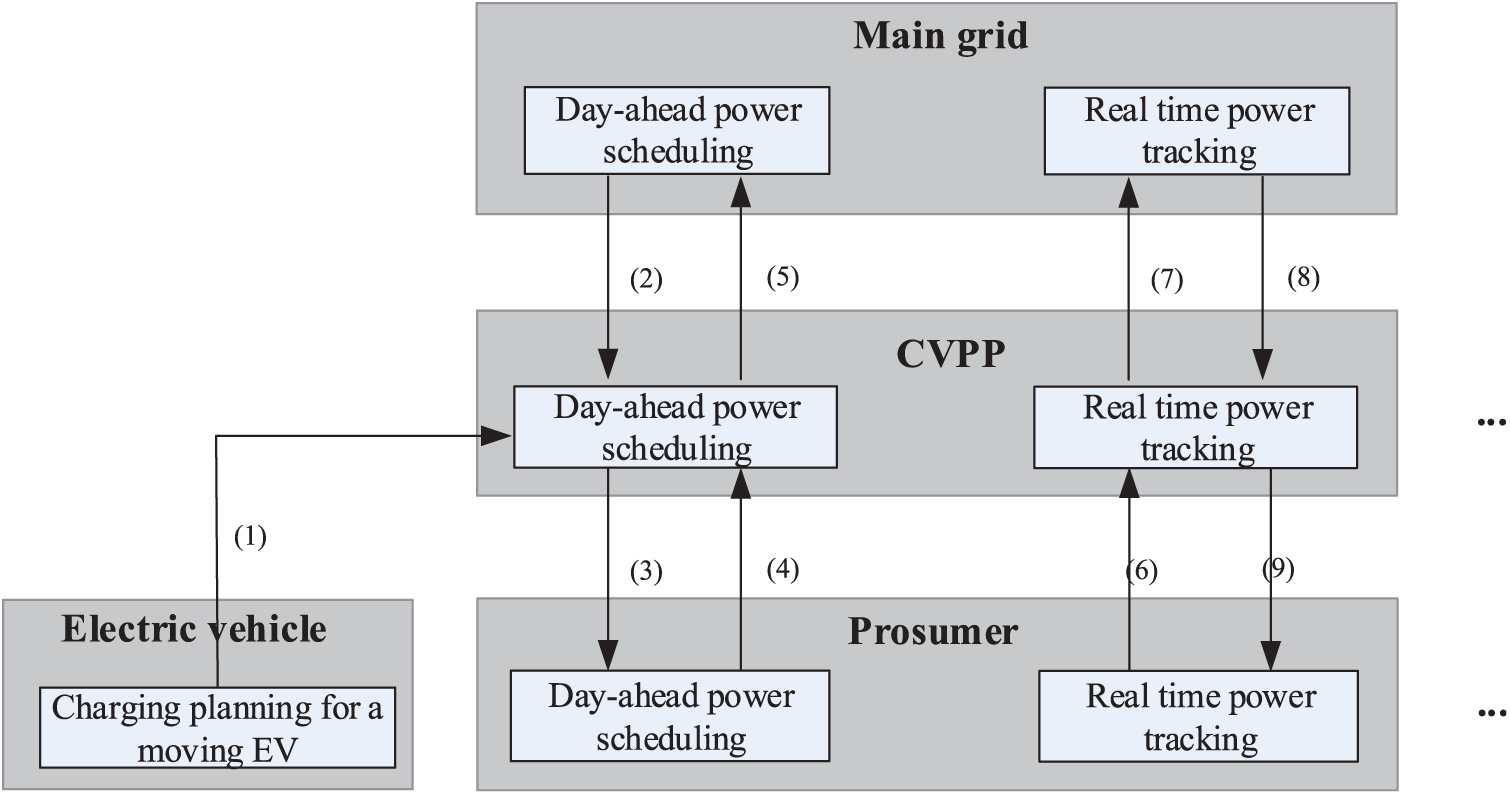
Architecture of the day-ahead power scheduling and real-time power tracking.
During the second round of power scheduling of the CVPPs, the CVPPs request the prosumers downstream to save extra power at the battery of electrical vehicle or battery storage systems owned by the prosumers to make up for the gap between the power demand and power supply during the peak hours in the whole day-ahead electricity market. The prosumers who can offer extra power will give the electricity selling price to the CVPP upstream. After the main grid receives the list of day-ahead hour-by-hour electricity selling price reported by the CVPPs, it will sort the electricity selling price list in the ascending order, and schedule the power demand and supply to minimize the gap between the power demand and supply during peak hours.
After the main grid determines where to purchase the required electricity during peak hours based on the selling price set by the prosumers, the main grid will activate the third round of power scheduling. Accordingly, the prosumers who are chosen to sell the power to the main grid will activate the third round of power scheduling to save the extra power at the battery of electrical vehicle or battery storage systems as requested. Notably, the computational complexity for the traditional algorithm based on the central control increases dramatically if the coverage area of the power system is large. Thus, the proposed approach instead makes use of a hierarchical structure, so that the computational complexity can be reduced when compared with the traditional method.
It was mentioned in “Introduction” section that the inconvenience of charging is one major problem that an EV owner often faces with. Even numerous route planning software packages have been applied in practice in recent years,25,26 route planning of a moving EV in the future VPPs should consider both road traffic and battery states together, and the route planning and charging planning for a moving EV thereby become coupled problems. In this work, we assume a moving EV needs to examine whether the battery has enough power to reach the destination after it starts moving. If the EV finds there will be a power shortage for the battery during the trip, one from among a charging station, a battery switching service, or certain roads with wireless charging can be selected as the option for recharging based on the preference of the EV. For instance, if there is no passenger in a moving EV, the EV prefers to choose from among some candidate routes with the lowest price for recharged energy. On the contrary, the EV may choose either the battery switching service or wireless charging, opting for whichever takes the shortest charging time, if there are passengers in the EV. Accordingly, the route and charging planning component should analyze the information from EVs, the power system, the energy market, and road traffic simultaneously.
We assume a route planning software package is installed in each EV in this work, and the software package can compute the time to reach a designated location to assist in determining if a future battery power shortage will occur. Meanwhile, a charging planning method for a moving EV as shown on the left in Figure 1 is proposed in this work to check the battery status and select the most suitable charging option online if a battery power shortage is detected. Notably, a fuzzy logic inference system is employed to select the charging point. Three parameters are used as the inputs to the fuzzy logic system. The three parameters are recharging electricity price, extra traveling distance required for passing by the charging point, and the time required for recharging. The fuzzy logic technique is adopted here because it has been used as a powerful tool for controlling processes that are difficult to model and linearize, and has been shown to provide superior performance in the literature.27,28 The moving EV will select the most appropriate charging point based on the output of the fuzzy logic system. Then the EV will confirm the charging request with the chosen charging point, and the regional grid that the charging point resides at will activate the first stage scheduling during a regular power check procedure during each short time period, as described below.
In practice, the deviation between the predicted data and the real time data is hardly avoided, because of the uncertainty in the renewable power generation, electricity load, and moving EV charging. The real-time operation state and scheduled power need to be changed significantly from the day-ahead schedule, if the deviation is relatively large. Thus, a real-time power tracking module as shown on the right in Figure 1 is employed to reduce the net exchange power deviation caused by the forecast errors.
It was reported in the literature that TCLs consume a large portion of the total electrical energy, ranging from 40% to 50% of the energy consumption for commercial buildings and 20% to 36% of domestic consumption in different countries.20,29,30 TCLs are typical flexible loads for three reasons. First, the human comfort zone is not a point but a range. Second, heating or cooling a house can benefit not only present but also adjoining subsequent hours because thermal insulation enables houses to store heat. Third, research in the field of indoor comfort is showing that lower winter temperatures (20°C) and higher summer temperatures (up to 25°C) can maintain comfort levels acceptable to most occupants, depending on other aspects of the residence/building, relative humidity, and the occupants’ tolerance levels. These three features make TCLs promising demand response resources.
Motivated by the above observations, the real-time power tracking module allows the prosumers to determine their comfortable temperature zones and determine the range of the power usage based on their indoor temperature. Meanwhile, each individual prosumer provides each own bidding curve if the CVPP distributes part of the energy procurement cost savings to its clients owing to the adjustment of forecast errors.
Since the renewable power, electricity load, and EV charging demand within the fixed time interval in the day-ahead scheduling do not change, the scheduled electricity load and EV charging demand obtained through day-ahead scheduling need to be updated to accommodate the real-time update and forecast error of the renewable power, electricity load, and EV charging demand. To achieve this goal, the 1-h fixed time interval is divided into 5-min time intervals in real-time. The actual data of power supply and demand are tracked every 5 min, and the forecast error(s) owing to the variations and fluctuations of TCLs, EV charging speed, or traditional power generated can then be dealt with in time. Notably, the real-time power tracking mechanism proposed in this work will calculate the reduction of power supply owing to temperature adjustment of TCLs and slowdown of EV charging, and report the accumulated power saving to the CVPP upstream. In addition, it is anticipated that each power participant follows its corresponding hourly scheduled result as close as possible during each 5-min power tracking.
In terms of power security, the proposed inter-connected CVPPs with complementary characteristics can provide reserves for each other and improve power supply security during normal operation. On the contrary, during faults of the main grid or any CVPP(s), rest of the CVPPs are able to decouple from the power network quickly, limiting the impact of the faults. Meanwhile, large numbers of the prosumers are still able to operate in the islanded mode, so that outage loss is reduced.
A brief flow chart of the proposed power scheduling and real-time power tracking system is illustrated in Figure 2. The detailed steps of all the modules developed for the proposed power scheduling and real-time power tracking system are given below.
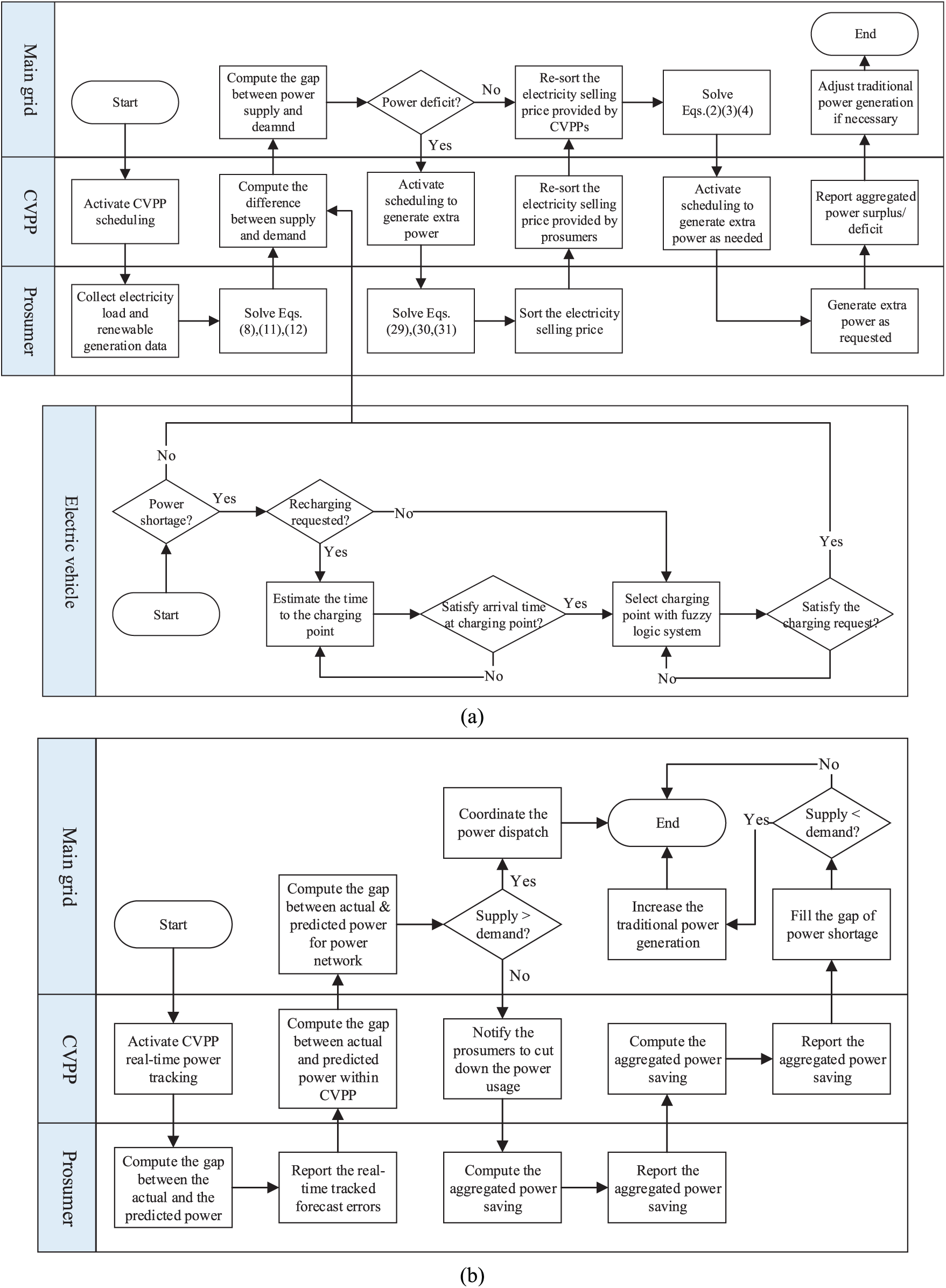
Simple flow chart of the proposed system: (a) day-ahead power scheduling and (b) real-time power tracking.
Day-ahead power scheduling main program at main grid
Step 1: The main grid requests the CVPPs to activate the first-round day-ahead power scheduling module to achieve the balance between the power supply and demand within the region of each CVPP.
Step 2: The main grid generates an aggregate power deficit vector at time t as follows

where
Step 3: If any element of
Step 4: The main grid collects the sorted list of day-ahead hour-by-hour electricity selling price reported by the CVPPs and re-sorts the electricity selling price list in the ascending order.
Step 5: The main grid computes the multi-objective optimization of the balance on power supply and demand for the whole power system as follows



where
Step 6: The main grid requests those CVPPs that require power rescheduling to activate their third-round power scheduling module to satisfy the power demand derived at the previous step.
Step 7: The main grid records the hour-by-hour power surplus/deficit reports of all CVPPs, and adjusts the day-ahead traditional power generation
First-stage day-ahead power scheduling for CVPP
Step 1: The CVPP requests each prosumer downstream to activate the first-round day-ahead power scheduling module to achieve the balance between each prosumer’s power supply and demand.
Step 2: Compute the difference between day-ahead hour-by-hour power supply and demand of the prosumers downstream as follows

where
Step 3: Return the aggregated hour-by-hour power surplus/deficit report of the prosumers downstream to the main grid.
Second-stage day-ahead power scheduling for CVPP
Step 1: Based on the value of APDt forwarded from the main grid and the retrieved hour-by-hour power supply and demand of the prosumers downstream, the CVPP requests the prosumers downstream to activate the second-round day-ahead power-scheduling module to generate extra power to the extent of APDt.
Step 2: The CVPP collects the electricity selling price list of the prosumers downstream at time t, and re-sorts the selling price list in the ascending order.
Step 3: Keep the top-ranked l elements in the electricity selling price list up to the extent of APDt as follows

subject to

where
Step 4: Return the top-ranked l elements of the sorted electricity selling price list to the main grid.
Third-stage day-ahead power scheduling for CVPP
Step 1: The CVPP requests the designated prosumers to activate the third-stage day-ahead power-scheduling module to generate extra power as needed.
Step 2: Return the aggregated hour-by-hour power surplus/deficit report of the prosumers to the power scheduling module of the main grid.
Prosumer’s first-stage day-ahead power scheduling
Three categories of appliances are assumed in this work. The first two types of appliances may have strict scheduling requirements to remain operational between the periods of operation. Some of them consume a constant amount of electricity, for example, a TV and refrigerator, while other appliances have flexible amounts of electricity consumption, such as air conditioners. The former type of appliance is designated as requiring a base load, and the latter a TCL. The third type of appliance, such as washing machine, dishwasher, or dryer, consumes a fixed amount of electricity continuously, while it is allowed to be scheduled to use electricity at other time slots. However, this type of appliance continues to consume electricity until the target consumption is achieved, once the consumption starts. This type of appliance is designated as a schedulable load. During first-stage scheduling, the minimal power required by the TCL is determined by the forecasted indoor temperature and setpoint preset by the prosumer.
Step 1: Based on the collected prediction data of electricity load and renewable, compute the difference between day-ahead hour-by-hour power supply and non-schedulable demand of the ith prosumer as follows
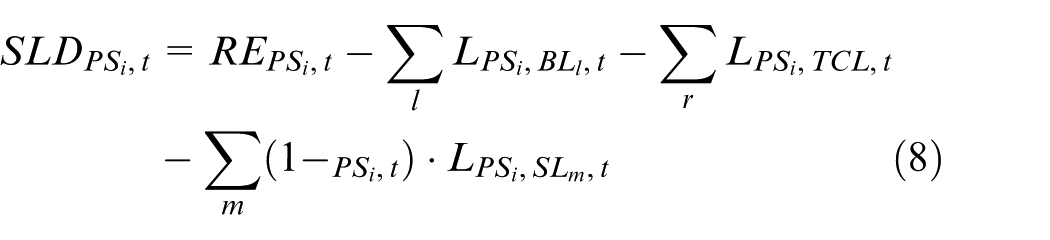
Description of parameters:
1.
2. This work assumes the CVPPs will offer discount for the prosumers who strictly comply with the scheduling of their household appliances from the CVPP. We set


where
Step 2: Compute the multi-objective optimization to achieve the balance on the ith prosumer’s power supply and demand as follows


subject to
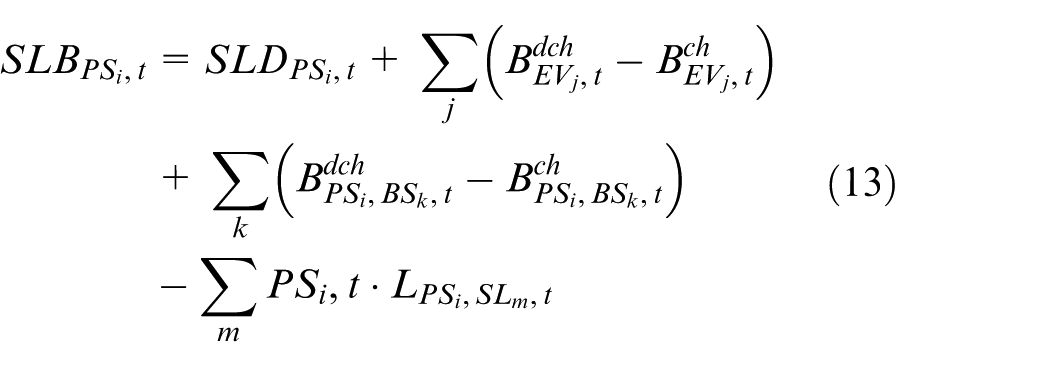










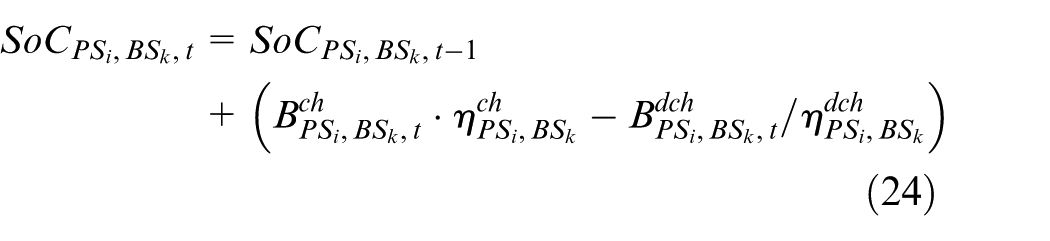




Description of parameters:
1.
2.
Step 3: Keep the records of the day-ahead hour-by-hour power supply/demand of the ith prosumer into the database.
Step 4: Submit the hour-by-hour power surplus/deficit reports to the CVPP upstream.
Prosumer’s second-stage day-ahead power scheduling
Step 1: The ith prosumer computes the difference between day-ahead hour-by-hour power supply and non-schedulable demand of the ith prosumer as follows
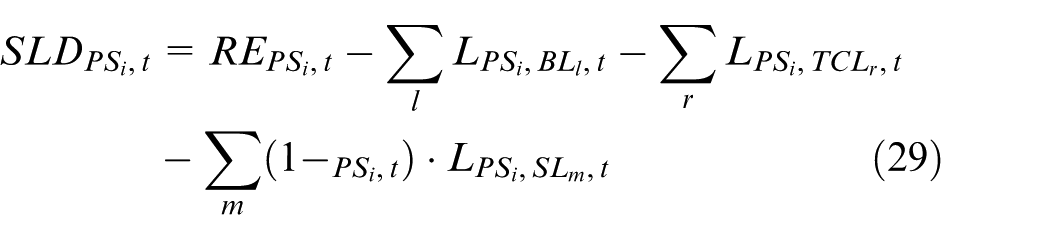
Step 2: Compute the multi-objective optimization by attempting to generate extra power to the extent of


subject to
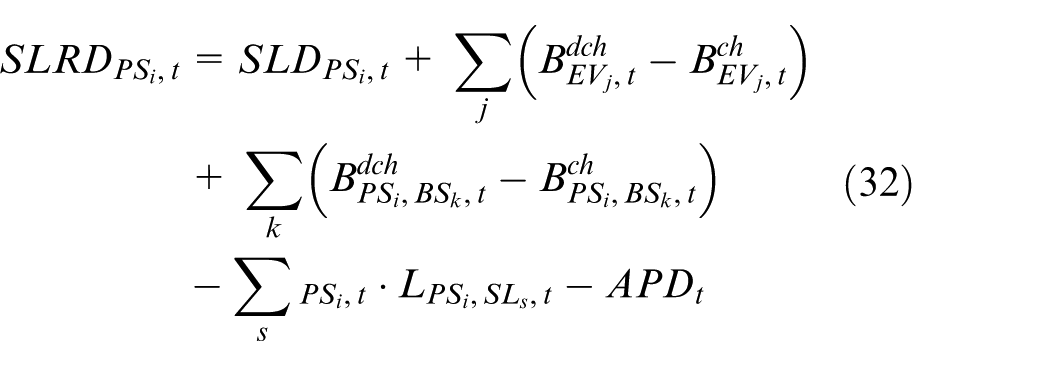
Step 3: Retrieve the records of the day-ahead hour-by-hour power supply and demand of the ith prosumer generated at the ith prosumer’s first-round power scheduling.
Step 4: Determine the selling prices of the charging power for the battery of the jth EV and the kth battery storage system owned by the ith prosumer at time t as follows



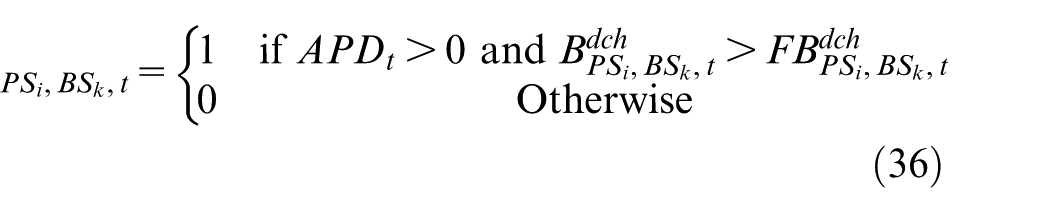
where
Step 5: Sort the electricity selling price of the extra power generated by the EVs and the battery storage system at time t in the ascending order.
Step 6: Return the sorted list of selling price along with the extra power generated at time t to the CVPP upstream.
Prosumer’s third-stage day-ahead power scheduling
Step 1: The ith prosumer generates extra power at time t as requested.
Step 2: Submit the hour-by-hour power surplus/deficit reports to the CVPP upstream.
Charging planning for a moving EV
Step 1: This module is first initiated right after an EV starts moving from the source to the destination, and will be regularly executed during each fixed time period.
Step 2: During each execution, the EV checks if there will be a possible power shortage during the trip.
Step 3: If the EV finds a possible power shortage before arriving at the destination, the EV first checks to see if it already requested recharging support.
Step 4: If the EV did request recharging and the request was granted, a routing planning software package such as Trovato et al. 23 will be used to estimate the time from the current location to the charging point. Otherwise, proceed to Step 7.
Step 5: If the time of arrival at the charging point satisfies the recharging demand of the EV, stop the execution here. Otherwise, the earlier granted charging request of the EV will be withdrawn.
Step 6: Based on the preferred recharging option of the EV, the algorithm estimates the time from the current location to the charging points on the path to the destination. The EV then submits a recharging request to those charging points, and gets informed from those charging points whether the request of the EV can be satisfied.
Step 7: The EV selects the most appropriate charging point that replied with positive feedback based on the output of a fuzzy logic inference system, wherein the three input parameters are recharging electricity price, extra traveling distance required for reaching a charging point, and the time required for recharging.
Step 8: The EV submits the recharging request to the selected charging point.
Step 9: In the case the selected charging point cannot satisfy the recharging request of the EV, it will turn to another unselected charging point on the path to request recharging support.
Step 10: If all charging points on the path to the destination cannot grant the request, the first chosen charging point on the designated path of the EV will be asked to request the CVPP upstream to harvest extra power for the EV.
Step 11: At this step, the EV should have already gotten recharging support from the power network. After the charging point that granted the recharging request of the EV completes the first-stage scheduling, it will inform the EV whether or not the recharging request can be satisfied.
Step 12: In the case where the recharging request of the EV is turned down for some reason, the EV will proceed to Step 7 for another run of power harvesting for recharging.
Real-time power tracking at main grid
Step 1: The main grid requests each CVPP to activate its real-time power tracking module.
Step 2: Based on the collected reports from all CVPPs, the main grid computes the gap between the predicted and actual power supply and demand for the whole power network as follows

where
Step 3: If RTPD is positive, it means the power shortage of some CVPP(s) can be resolved by other CVPP(s) that possess extra power. The main grid will coordinate the power dispatch among the CVPPs and stop the execution here.
Otherwise, a negative RTPD implies that certain CVPP(s) still have power shortage problem, and the main grid will notify all CVPPs to cut down the real-time power usage.
Step 4: The main grid uses the aggregated power saving reported by the CVPP(s) to fill the gap of power shortage

where
Step 5: If RTTP is negative, the main grid will increase the traditional power generation to cope with the power shortage problem.
Real-time power tracking for CVPP
Step 1: The CVPP requests each prosumer downstream to activate the real-time power tracking module.
Step 2: Based on the collected report, the CVPP computes the gap between the predicted and actual power supply and demand of each prosumer downstream as follows

where
Step 3: Notify the prosumers downstream to cut down the power usage of TCLs or EV charging if necessary, upon request of the main grid.
Step 4: Compute the aggregated power saving reported from the prosumers downstream

where
Step 5: Report the aggregated power saving of the CVPP to the main grid.
Prosumer’s real-time power tracking
Step 1: Compute the gap between the actual and the predicted power supply as follows

where
Step 2: Compute the gap between the actual and the predicted power demand as follows
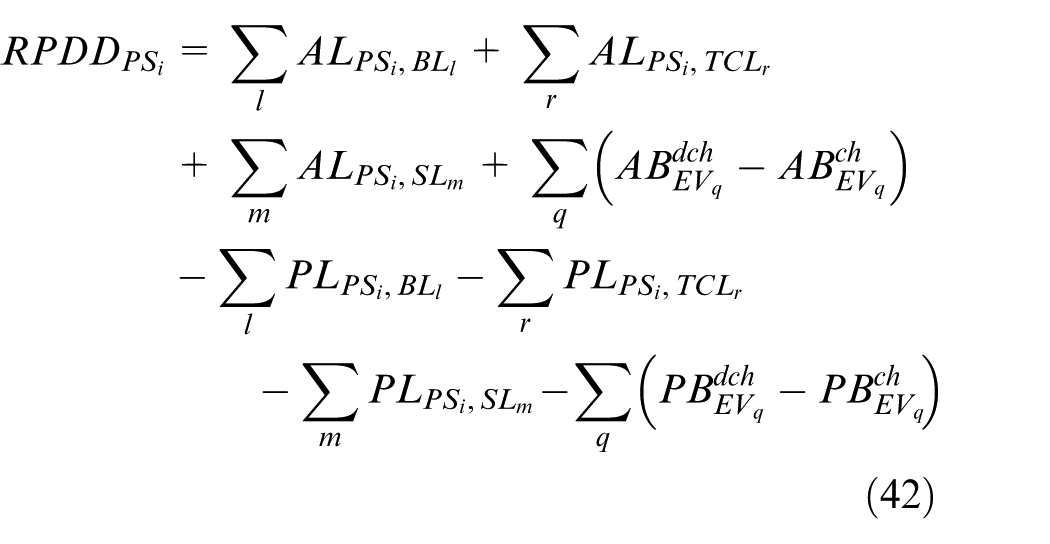
where
Step 3: Report the real-time tracked forecast errors of power supply and demand to the CVPP upstream.
Step 4: The prosumer computes the aggregated power saving by means of cutting down of the power usage of TCLs and slowdown of EV charging, upon request of the CVPP upstream
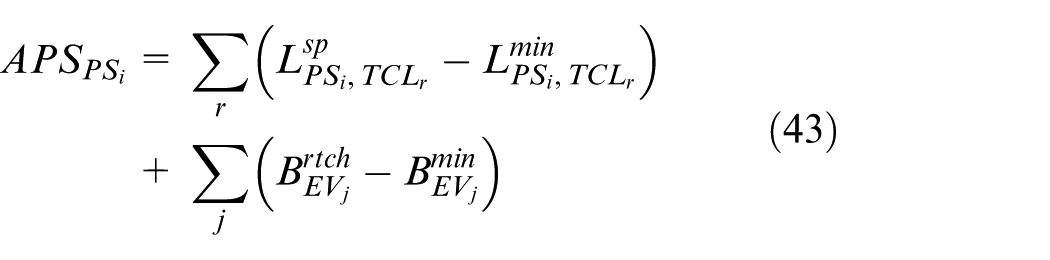
where
Step 5: Report the aggregated power saving of TCLs and/or EV charging,
Experimental results and analysis
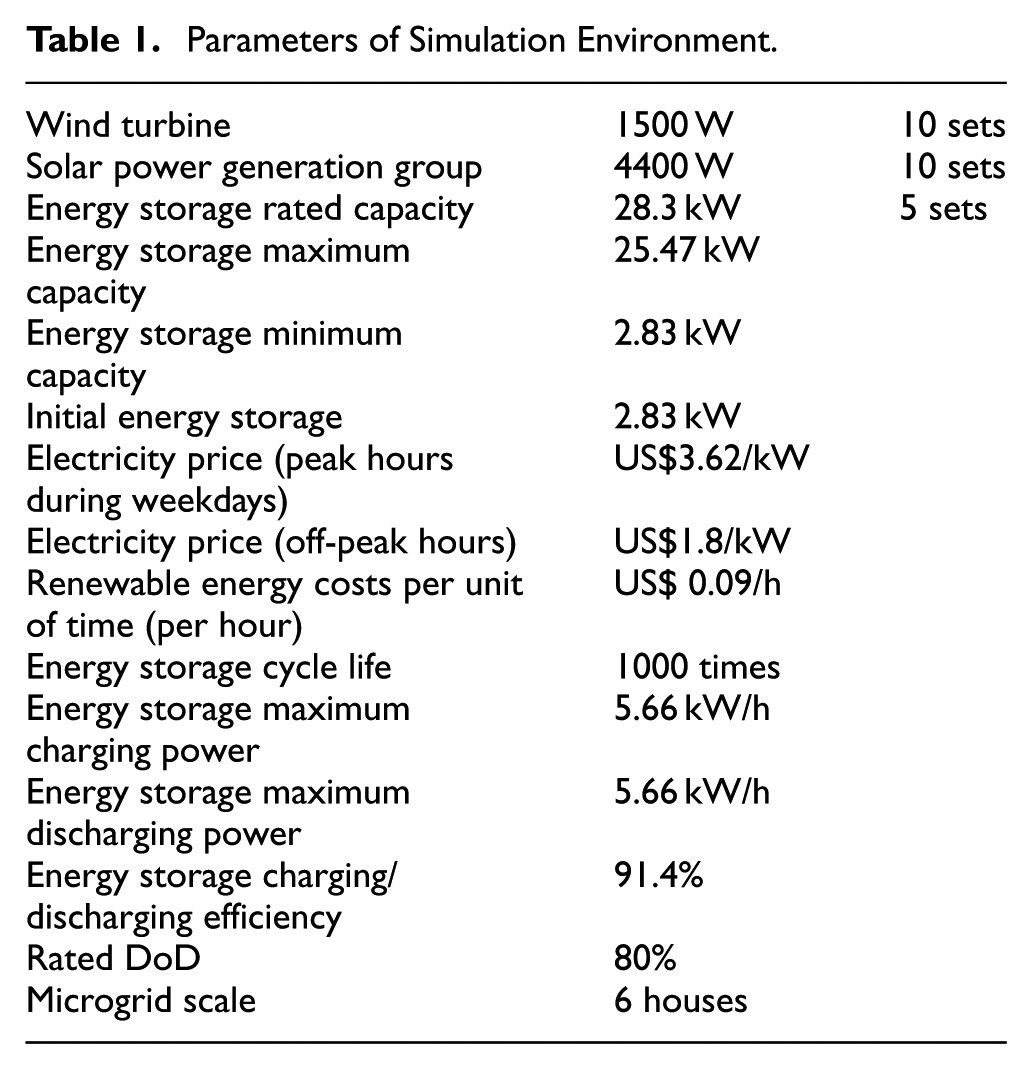
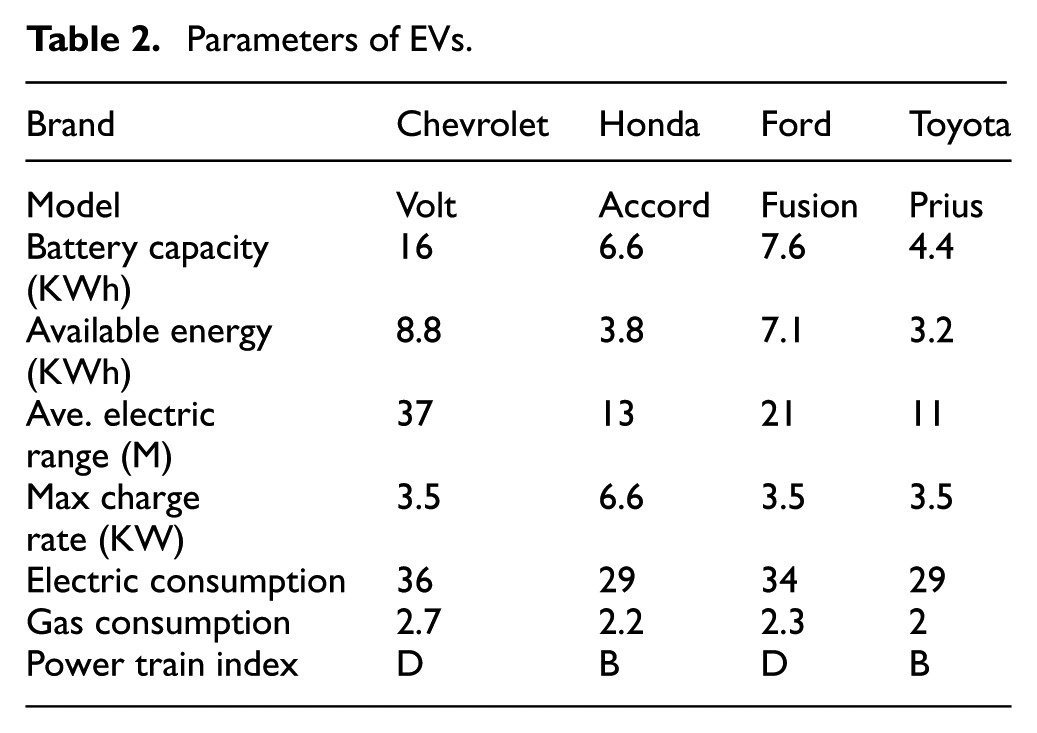
We ran a series of simulations by using python programming language to verify the feasibility and effectiveness of our proposed day-ahead power scheduling and real-time power tracking system. A personal computer built with Win10 OS, I5 3.2 GHz CPU, and 8 GB RAM was used to run the simulations. We divide the whole power usage area into three regions, and each region had its own CVPP, which was governed by the main grid. Region 1 is a big city with dense population, and only a few renewables installed on the tops of the buildings. On the contrary, Regions 2 and 3 are both located at rural areas, where renewables are installed at most of the residences. Our load data and renewables power generation profiles were obtained from http://data-archive.ethz.ch/delivery/DeliveryManagerServlet?dps_pid=IE594964 and https://transparency.entsoe.eu/generation/r2/dayAheadGenerationForecastWindAndSolar/show, respectively, and the data of EVs and battery storage systems were, respectively, collected from Akhavan-Hejazi et al. 32 to run the proposed scheduling program. Tables 1 and 2 list the parameters used in our simulations.
Parameters of Simulation Environment.
Parameters of EVs.
Figures 3 to 5 show the day-ahead electricity loads and renewables generations before applying proposed power scheduling system for each of the three regions, respectively. We can observe from Figure 3 that the power deficit becomes deteriorated during peak hours at Region 1 owing to the highly dense population and only few renewables can be installed at this area. On the contrary, as shown in Figures 4 and 5, most prosumers at the rural areas, such as Regions 2 and 3, own solar or wind power generation systems. Accordingly, some extra power can be kept at their own battery storage systems or EV batteries, or sold to other prosumers during the incoming day ahead.
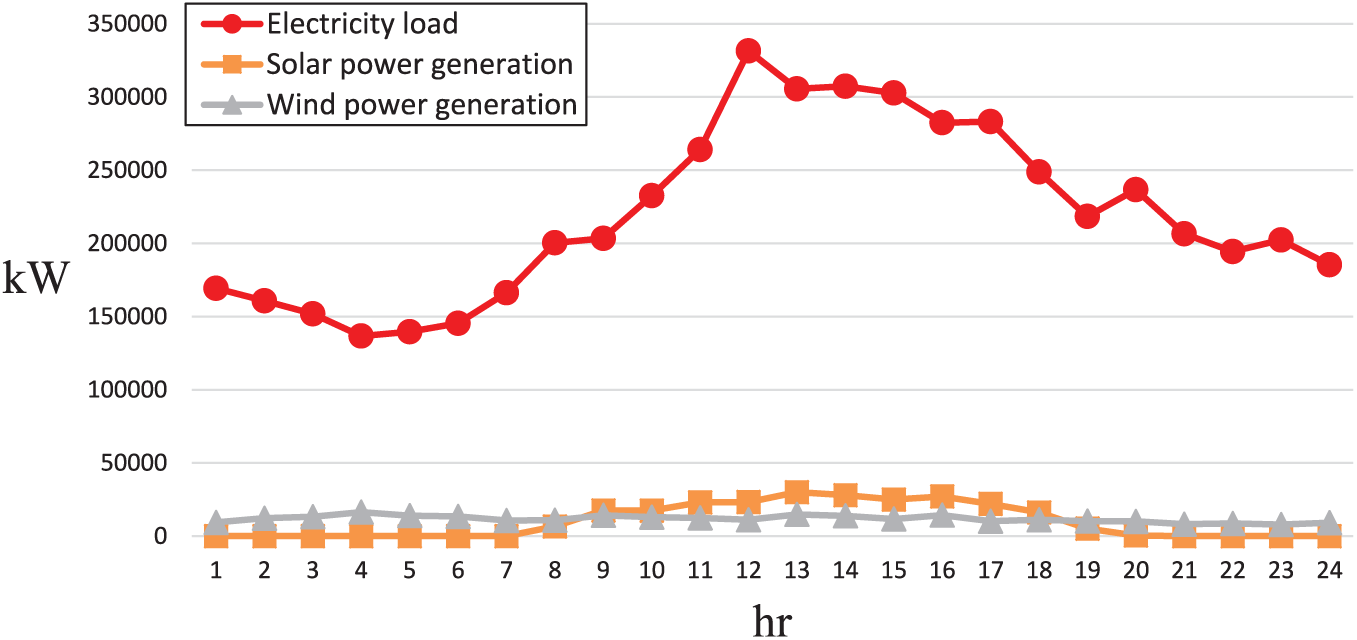
Illustration of day-ahead electricity load and renewables generation for Region 1 before applying power scheduling system.
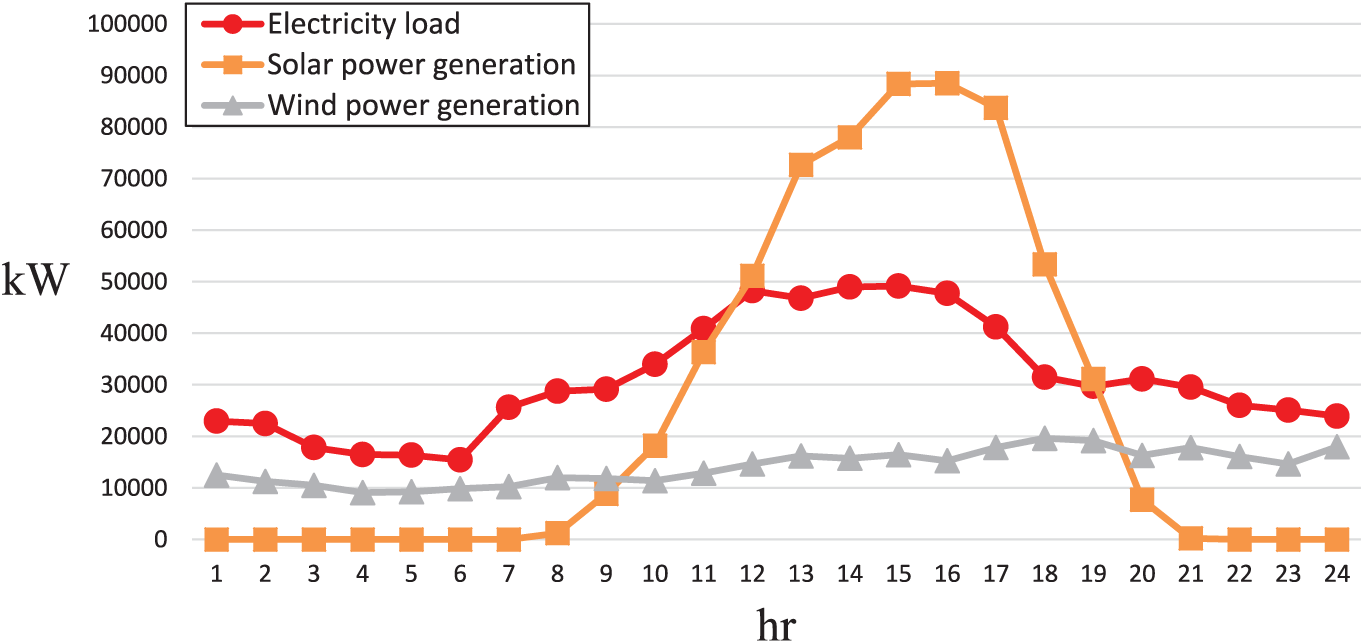
Illustration of day-ahead electricity load and renewables generation for Region 2 before power scheduling.
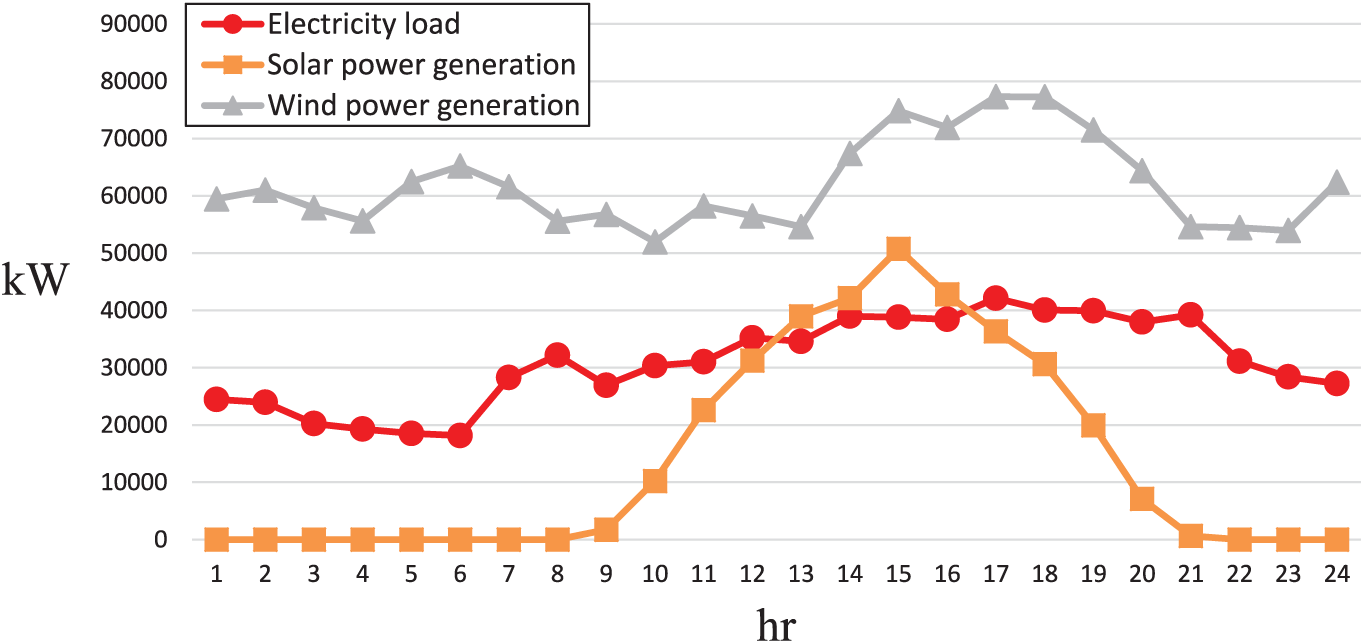
Illustration of day-ahead electricity load and renewables generation for Region 3 before power scheduling.
Figure 6 shows the aggregation of electricity load and renewables for the whole power network before power scheduling. It can be observed that the gaps between the electricity load and renewables for the whole power network appear during peak hours are much larger than those at off-peak periods.
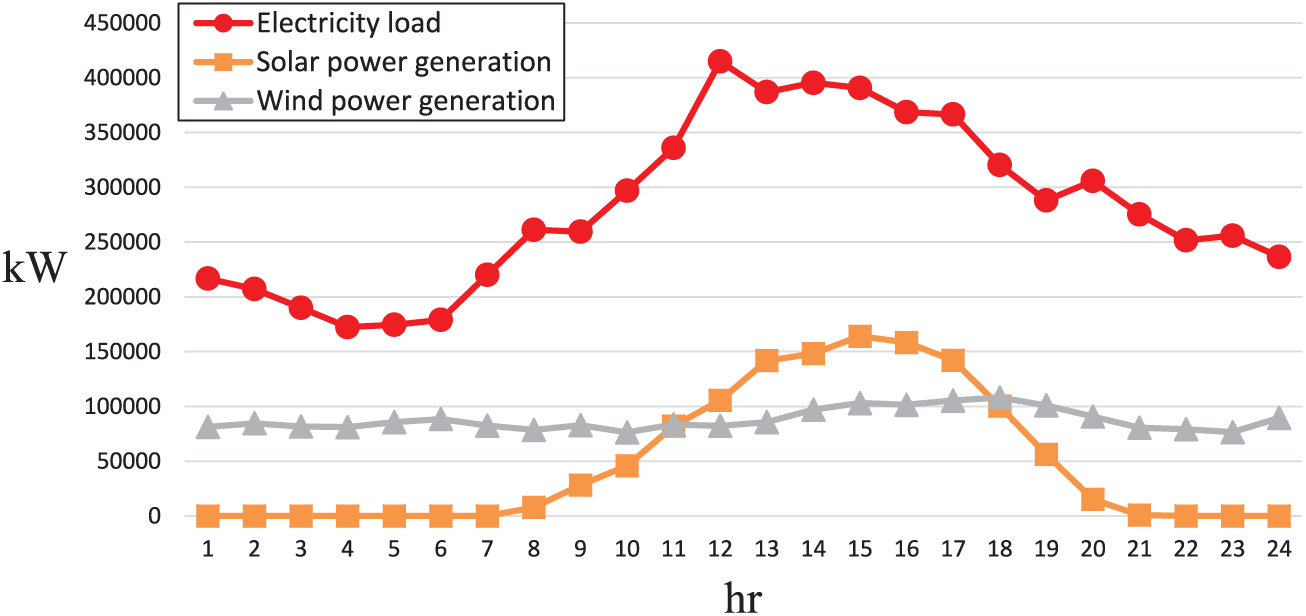
Illustration of day-ahead electricity load and renewables generation for the whole power network before power scheduling.
Comparison of net load before and after power scheduling is given in Figure 7. Notably, the net load here is calculated by subtracting the aggregate renewable generation profile from electricity load for the whole power network as shown in Figure 6, and the net load represents the loads that could not be met by renewable resources directly. It can be observed that the proposed DAPS can keep the extra power generated by renewables into the batteries at Regions 2 and 3 and shift the electricity load into off-peak period effectively. However, the actual data revealed some forecast errors of renewable power generation, electricity load, and moving EV charging in real time. Accordingly, the real-time power tracking mechanism presented in this work mitigated the forecast errors by reducing the electricity consumption of the TCLs to keep close to the actual net load predicted by the DAPS during peak period.
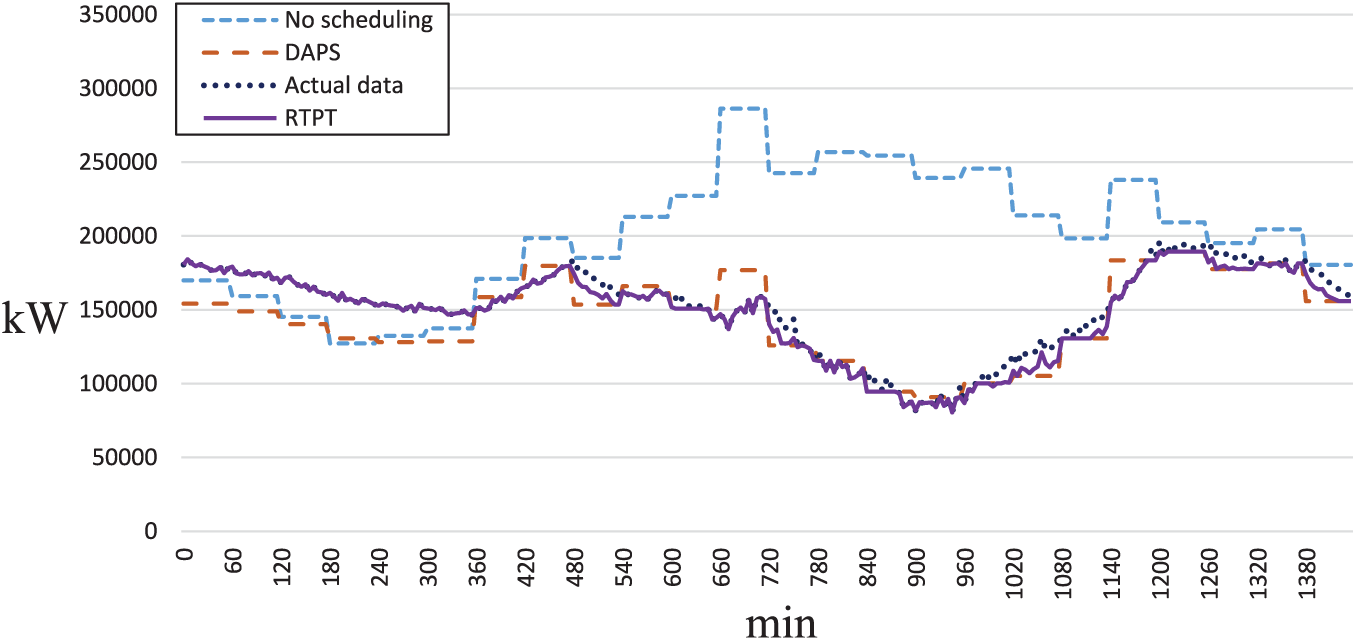
Comparison of day-ahead net electricity load before and after scheduling system.
Figure 8 shows the comparison of dependency on traditional power generation before and after power scheduling. It can be seen that the dependency on traditional power generation is substantially decreased owning the effectiveness of the proposed algorithm and assists in enhancing the reliability of the whole power network and decreasing carbon emission produced by traditional power generation. Furthermore, the wasted renewables power observed in the simulations were 1,364,681 kWh or 41.32% of the whole renewables power. The day-time solar power generation that exceeds the capacity of the battery storage systems and EV batteries at Region 2 and 3 are wasted because no power sharing mechanism is employed to save the extra power generated by renewables in traditional power management system. On the contrary, after applying the power scheduling system, the EV batteries and battery storage systems at nearby region(s), such as Region 1 in this work, can assist in storing the extra power generated by the renewables installed at Regions 2 and 3 during off-peak periods, and use the saved electricity to smooth the peak load of the whole power network during peak hours. Accordingly, the proposed work can effectively enhance the reliability of the whole power network and decrease carbon emission produced by traditional power generation.
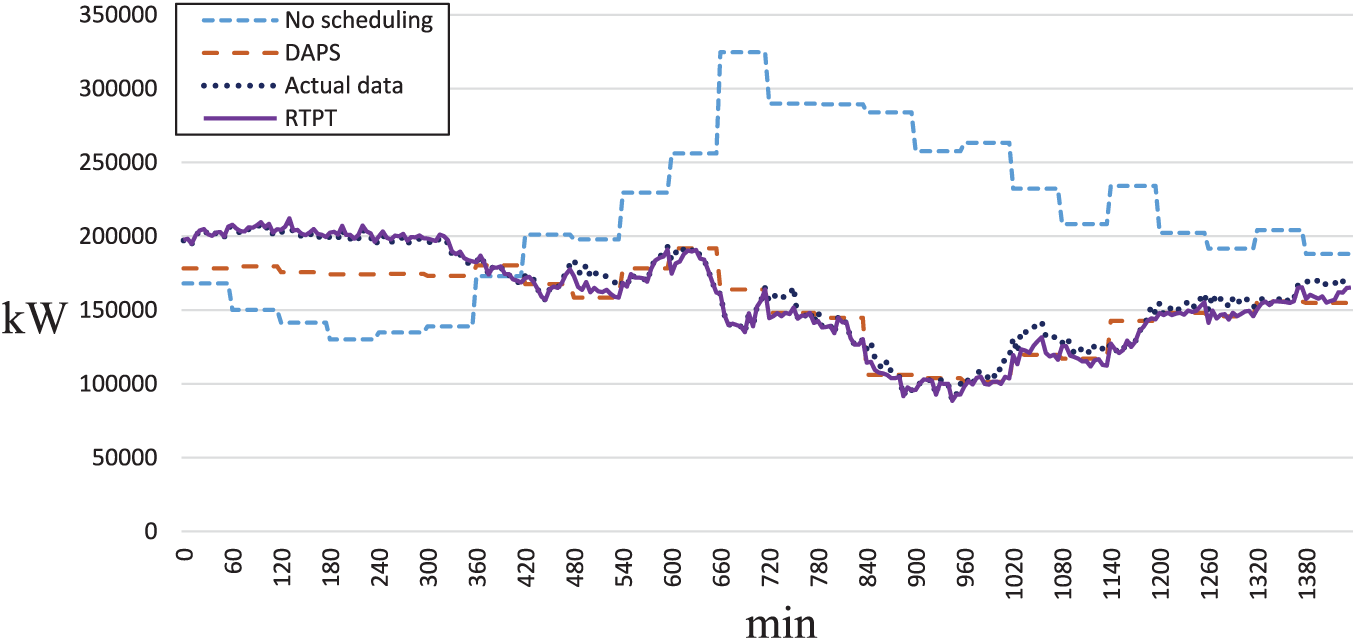
Comparison of dependency on traditional power generation before and after power scheduling.
Figure 9 shows the comparison of charging/discharging profiles of battery storage systems for the whole power network. Notably, the positive and negative power values at the y axis represent the discharging and charging behaviors of the batteries, respectively. Because the number of the battery storage systems in a metropolitan area such as Region 1 is significantly larger than that of the battery storage systems in a rural area such as Region 2 or 3 in our simulations, the overall charging/discharging behaviors were dominated by the battery storage systems at Region 1 during scheduling. Accordingly, the aggregated battery storage systems were at the discharging state, and the overall charging behavior was observed during off-peak periods, although the charging/discharging behaviors of the battery storage systems at the rural regions mildly oscillated the curve after scheduling during mid-peak and peak periods.
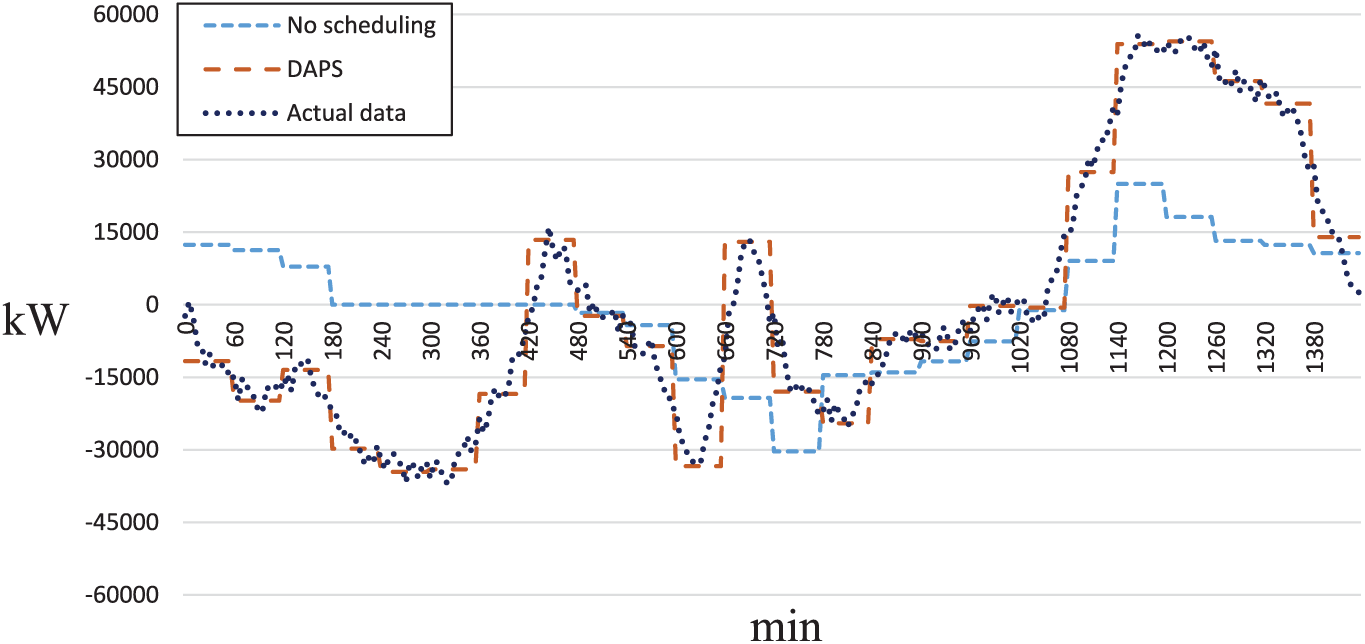
Comparison of charging/discharging profiles of the battery storage systems.
Figure 10 shows the comparison of charging/discharging profiles of the EV batteries for the whole power network. Again, since the number of the EVs in a metropolitan area such as Region 1 is much larger, we can observe that the aggregated EV batteries for the whole power network were also at discharging states to mitigate the overhead of the imported or traditional power during commute time and peak hours, while the EV batteries recharged with the cheaper electricity during off-peak and mid-peak periods. It can be seen that the real-time power tracking mechanism made up the forecast errors by slowing down the charging power of the EV batteries to keep close to the actual charging/discharging profiles predicted by the day-ahead power scheduling during peak period.
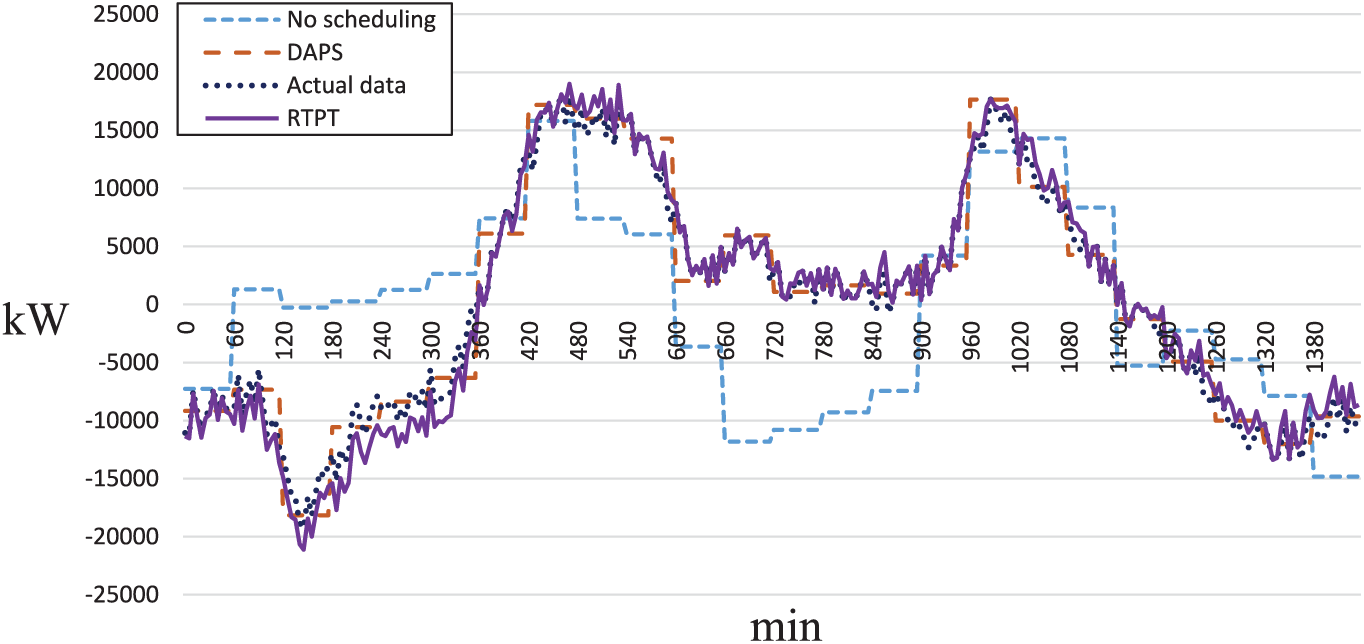
Comparison of charging/discharging profiles for the EV batteries.
Conclusion
In the recent literature, the architecture of VPPs was proposed to replace the current smart grid in the future. However, the energy sharing concept and the uncertainties of intermittent energy sources will cause the short-term energy management for the future VPP much more complicated than current centralized control short-term energy management for traditional power generation system. To tackle the forthcoming complicated short-term energy management problem of VPPs, a hierarchical DAPS that addresses the issues of emission reduction and charging demand of moving EVs is proposed in this work. Based on the collected data of short-term electricity load and power generating of renewables at the prosumer level, power scheduling at CVPP level is employed to schedule the usage of electricity for the customers by reallocating excess electricity generated by some prosumers to others facing with power supply shortage. Notably, a real-time power tracking mechanism is presented to deal with the forecast errors of volatile renewable power generation, electricity load, and moving EV charging. Accordingly, maximal usage of renewables and balancing the loading of prosumers and EVs during peak hours can be achieved. The experimental results reveal that the hierarchical day-ahead renewables-based power scheduling system proposed in this work can mitigate the dependency on traditional power plants effectively, and balance peak and off-peak period load of electricity market. Meanwhile, the forecast errors can be made up by reducing the electricity consumption of the TCLs and slowing down the charging power of the EV batteries during peak hours.
Footnotes
Acknowledgements
The authors would like to thank the Ministry of Science and Technology of the Republic of China, Taiwan, for financially supporting this research under Contract Numbers MOST 106-2221-E-259-012 and MOST 107-2221-E-259-016.
Declaration of conflicting interests
The author(s) declared no potential conflicts of interest with respect to the research, authorship, and/or publication of this article.
Funding
The author(s) received no financial support for the research, authorship, and/or publication of this article.
