




Abstract
Background:
The high-speed railway has been developed rapidly, making track allocation optimization in high-speed railway stations one of the most important problems for traffic control.
Methods:
This paper proposes a 0-1 nonlinear integer programming model from both infrastructure management and service perspectives to solve this problem at the tactical level. The goal is to balance the track occupation time and at the same time to minimize the total walking distance between the entrance hall and the platforms for all passengers. A pre-calculation technique of time points considering the preparation of the route and a line group method are firstly studied. In order to solve the programming, the simulated annealing algorithm is applied.
Results:
A case of a China high-speed railway station is used to verify the effectiveness of this model. The optimized result is much better than the original plan in some key indicators. A comparison between the proposed algorithm and an accurate method, the branch-and-bound, is demonstrated. The simulated annealing algorithm obtains almost the same result as the accurate method in a much shorter time.
Conclusions:
The proposed model is practicable for the the high-speed railway stations.
Keywords
Introduction
The high-speed railway transportation system is a huge and complex network system, which consists of two parts: stations and lines. In the last several years, the China Railway Corporation has developed the high-speed railway rapidly, making China one of the most advanced countries in the high-speed railway technology.
With the construction of the high-speed railway and the promotion of trains’ speed, the capacity of the open tracks between stations increases dramatically. As a result, the station capacity has been the bottleneck of improving the capacity of the high-speed railway network. Thus, it is necessary for the company to coordinate and match the capacity of stations and open tracks. For a railway company, it is not a wise choice to expand the station capacity by rebuilding or enlarging the yard blindly. Optimizing station operations is the best way to solve this problem. Clearly, the track allocation is an important part of station operations.
That how to schedule trains through a station automatically and optimally has attracted lots of researchers. There are four main methods used to solve this problem in current studies.
The first is known as graph-coloring approach. De Cardillo et al. 1 recommended a k L-List τ graph-coloring formulation solved by a backtracking heuristic algorithm. The same color could not be assigned to vertices indicating different trains with conflicting routes, which guaranteed the feasibility of the solution. They did these researches based on the assumption of the fixed time of trains and the determined routes of one arrival–departure track.
Another methodology is the node packing formulation. Zwaneveld and colleagues2,3 proposed the node packing approach to settle this problem. Unlike graph-coloring approach which assigned different colors to trains with conflicting routes, this method was to select the trains with conflict-free routes. Routes of trains were divided into the inbound path Ri, the platform path Rp and the outbound path Ro. For each train t ∈ T, its route R in a station was expressed as
The most common method is called the integer programming approach. Carey 4 used the mixed-integer programming model to describe what this problem was, but no solution was proposed for this model. Billionnet 5 used two linear integer programs to depict the formulation of De Cardillo et al. 1 Some Chinese researchers, like Qiao, 6 Liu et al., 7 Zhao et al. 8 and Wu et al., 9 all used multi-objective functions to settle the problem. Wu et al. 10 proposed a mean-variance model based on Markowitz’s portfolio theory. Qi et al. 11 and Meng and Zhou 12 proposed the mixed-integer programming models to solve the train control problem. But most of them constructed the models based on the conventional railway and paid more attention to the operational requirement rather than the service demand.
The last technique used to solve this problem is the simulation method. Carey and Carville 13 stated the advantage of the manual method in this problem and put forward a scheduling algorithm which emulated how the train planer assigned a train to one track in practice. The solution solved by this method made itself more explainable and acceptable to train planers. However, with the expansion of the problem size, its computing time would increase dramatically.
Existing studies have the following issues that need to be improved. First, the capacity of a station is always limited by the use of resources in the station throat area other than the occupation of platforms. A few studies coordinate the use of arrival–departure tracks and station throats. However, a track allocation plan is feasible only and only if the planner considers the routes at the throat section and the receiving–departure tracks simultaneously. Second, most researchers ignore the fact that trains must claim station resources before their actual occupation. Thus, for some stations, especially multi-directional stations where more than two main lines connect multiple directions, the time points of trains’ routes cannot be calculated only by the arrival or departure time regulated by the train working diagram. Third, most studies construct the model just from basic infrastructure management perspective and ignore the service demand from passengers.
In the past studies, the track allocation problem can be classified into strategic, tactical and operational levels according to different focuses. The emphasis at the strategic level is estimating current infrastructures’ capacity to evaluate the feasibility of a possible train working diagram. At the tactical level, the studies focus on the allocation of different resources in stations with a fixed timetable. Lots of uncertainties leading to the occasional delay of trains in real-time railway operation are considered at the operational level. This paper solves the problem at the tactical level.
The contributions of this paper are summarized as follows. First, this paper focuses on the multi-directional intermediate stations and considers the routes at the throat section. Second, a pre-calculation technique is proposed to define different time points including the preparation time of the routes and to calculate the tracks’ occupation time and the routes’ duration properly. Third, a multi-objective model for the track allocation in high-speed railway stations is constructed from both infrastructure management and service perspectives. At the same time, the constraints describe station operations more realistic than most current researches to ensure the feasibility of the track allocation solution in China high-speed railway stations. After that, thanks to the soft constraint concept, this paper considers the service quality and can always return a feasible solution. Moreover, this paper first cites the line group method in passenger stations to facilitate the construction of the conflict route set and to make it easier to express the complicated conflict route constraint. Finally, this paper gives some indicators to evaluate the track allocation plan.
This paper is structured as follows. Section ‘Introduction’ introduces the background and provides a detailed review of the studies about this problem. Section ‘Problem description’ describes the problem solved by this paper. Section ‘Problem formulation’ constructs an integer nonlinear programming model. Then, this study presents a detailed algorithm. Section ‘Case study’ applies the model in a China high-speed railway station and analyzes the results. Finally, a conclusion is made and some future research directions in this field of the study are pointed.
Problem description
The railway company provides the train service with the scheduled plans. The planning process adopted by the high-speed railway is shown in Figure 1. As illustrated, the planning result above is an input to the subsequent step. Meanwhile, if the subtask cannot get a feasible solution, the former step or even more steps should be rescheduled during the planning process. This paper considers the problem of track planning in the station and assumes the former steps are completed. Thus, the fixed timetable where the arrival and departure time of trains cannot be changed and the EMU planning are given beforehand.
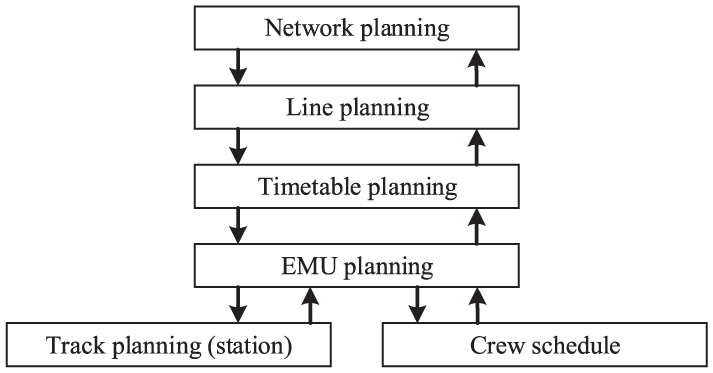
Planning process of the high-speed railway.
The track allocation problem, which is also known as train platforming problem, is to schedule whole trains of the train working diagram reasonably to the arrival and departure tracks along with conflict-free routes in a station. Nowadays, most of these tasks are done by hand. For the China Railway Corporation, in order to meet changes of the demand in the high-speed railway transportation market, frequent adjustments of the train working diagram make the track allocation optimization more and more significant for high-speed railway stations.
Compared with freight stations and conventional railway passenger stations with lower speed trains, high-speed railway stations are different in both the technical and the service demand. Station operations are more frequent because of the raising train frequency. It is hard for planners to judge whether some routes are in conflict or not. In addition, the passengers expect better services since they should pay more for the high-speed railway than the conventional railway. Thus, how to allocate trains to the tracks in good quality is the heart of this problem. It needs to be solved not only from the infrastructure management perspective but also the service.
Station version
High-speed railway stations in China can be classified as intermediate and terminal. This paper focuses on the former version. If a high-speed railway intermediate station connects more than two directions, there are two main layouts for the station yard, as shown in Figure 2.
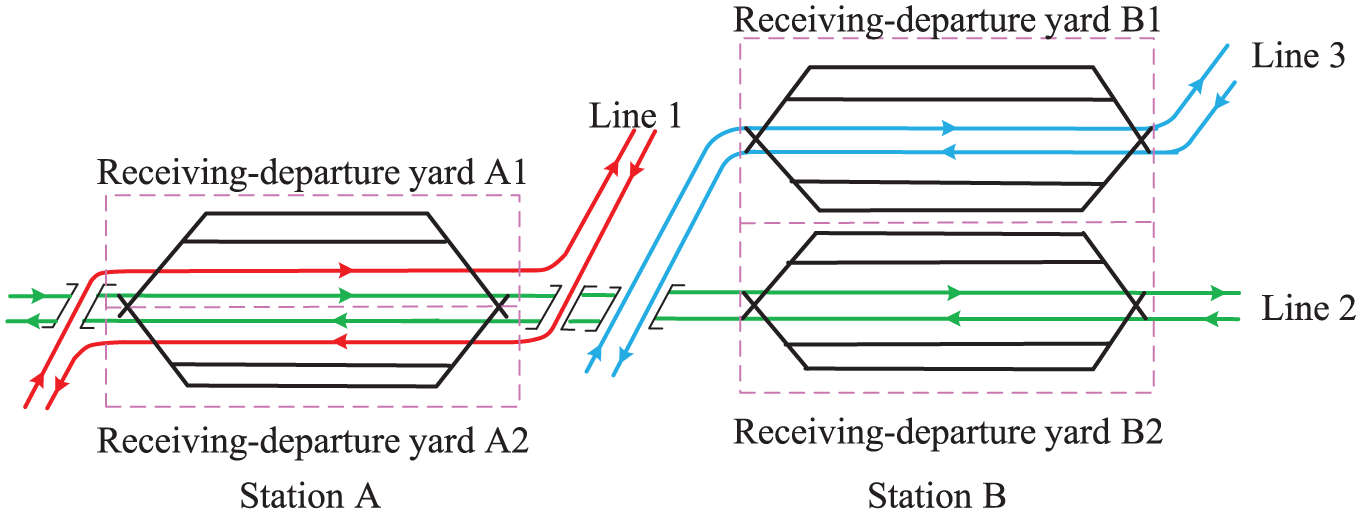
Track layout of intermediate stations in China.
When different main tracks join together in a station, two kinds of station layouts will be used. As illustrated in Figure 2, Station A and Station B are divided into two yards, A1 and A2, B1 and B2, respectively. The main tracks of one line are separated into the different yards A1 and A2 in Station A according to the train’s arrival directions, while Station B is in contrast to Station A. All trains will always fit in all tracks in China high-speed railway stations. The length of a train is assumed to be a constant. This paper focuses on the left one which is common in China. Generally, the up and down trains are almost equal in amount in 1 day and the station yard is always symmetrical; thus, the planners stipulate that the two symmetrical parts of the yard are used for up trains and down trains, respectively.
If a station connects more than one direction, the number of the main tracks at one side of the station is set to be m, the other is set to be n. Then the number of the main tracks in the station should be max {m, n}. This is a design rule for high-speed railway stations in China.
Train routes
All trains in the high-speed railway intermediate stations fall into two categories: nonstop trains and stop trains. For a stop train, the receiving route is from the home signal to the starting signal and the departure route is from the starting signal to the reverse home signal (the home signal for opposite trains). For nonstop trains, the through route is from the home signal to the reverse home signal.
Based on Qiao, 6 considering the continuity of train operations and that the train will never reach the starting signal when it stops, this paper assumes the train stop point where the middle of the train stops as the terminal point of the receiving route and the starting point of the departure route. Figure 3 illustrates the train routes clearly.
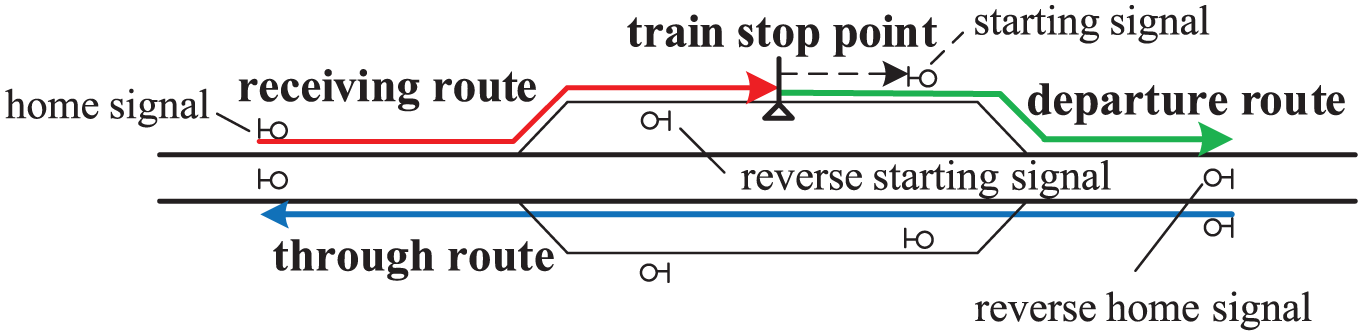
Routes for trains in a station.
Problem formulation
Time points definition
When a train passes through a station, whether it stops or not, the time points of the train passing by different equipment can be calculated. Sels et al. 14 explained the resources occupation time in detail. However, they ignored the fact that the resources of each route had been claimed by trains before their actual occupation. Based on Sels et al., 14 this paper describes time points of a stop train and a nonstop train through a station in increasing time and space dimensions in Figure 4. The vertical axis shows the significant positions and the horizontal axis shows the important time points.
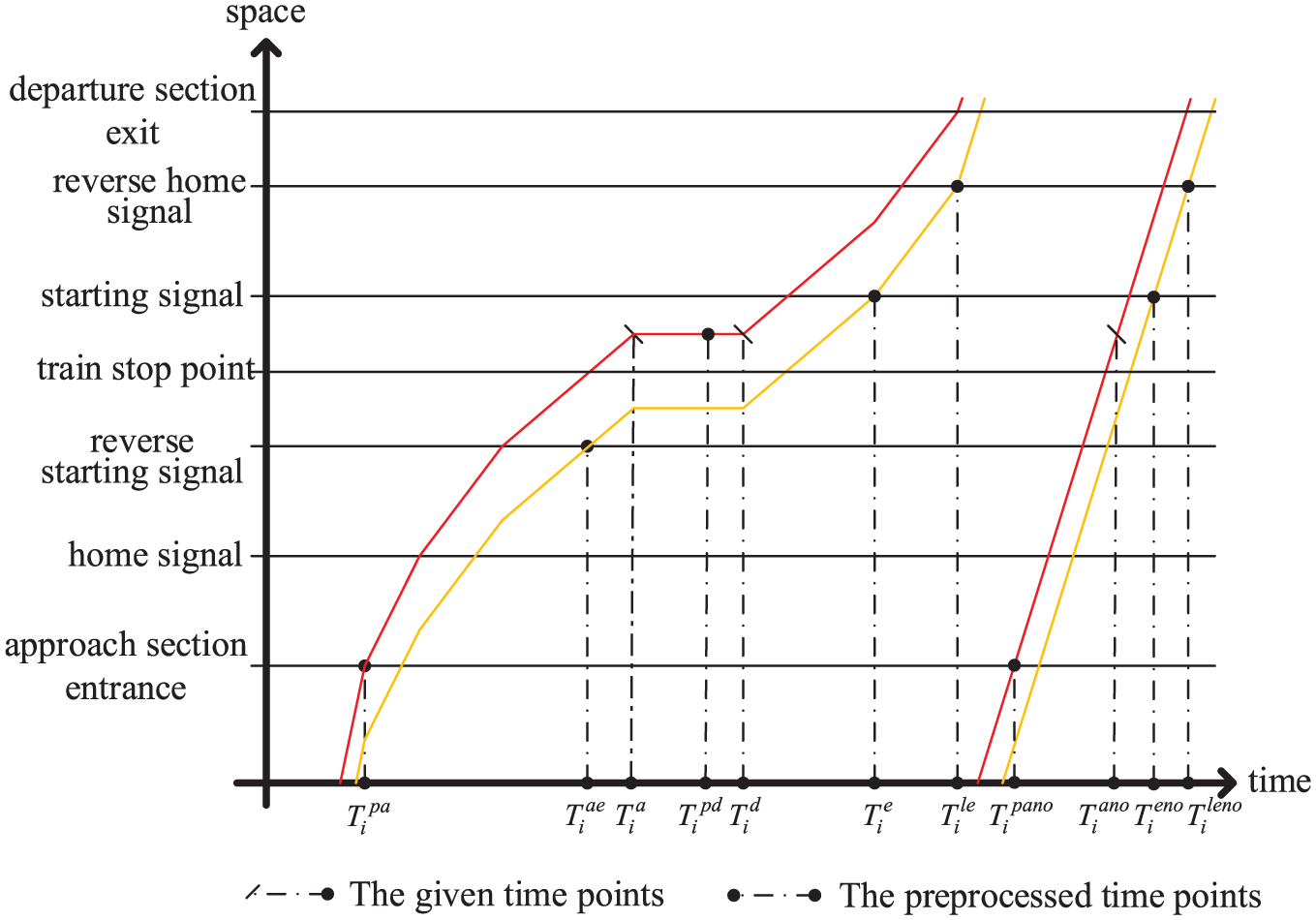
Time–space occupation of trains in a station.
The slope of the line between two vertices denotes the average speed between two positions. The top line describes the head of a train getting in and out of the station, while the bottom line represents the tail of the train. The vertical distance of each pair of lines indicates the length of the train. The left and right half of this figure show a stop train and a nonstop train crossing through a station, respectively.
As illustrated in Figure 4, the arrival and departure time of one train are the input data and other time points are the output data at the pre-processing stage. Using these time points as input, the track allocation plan is calculated by the proposed model and algorithm.
Arrival trains’ time points
This paper defines time points of a stop train entering a station as follows.
Because of the interlocking system, the receiving route or departure route should be locked for a train in advance, which this paper mentioned as the claim of routes, before arriving at or departing from a station. When time condition or space condition is satisfied, the railway traffic control system will prepare the receiving route for the coming train. In this paper, the time condition is taken into consideration.
In Figure 5, ta min and ta min denote the criterion of the minimum and maximum time that the receiving route should be pre-set for a train before its arrival (i.e. the time span of
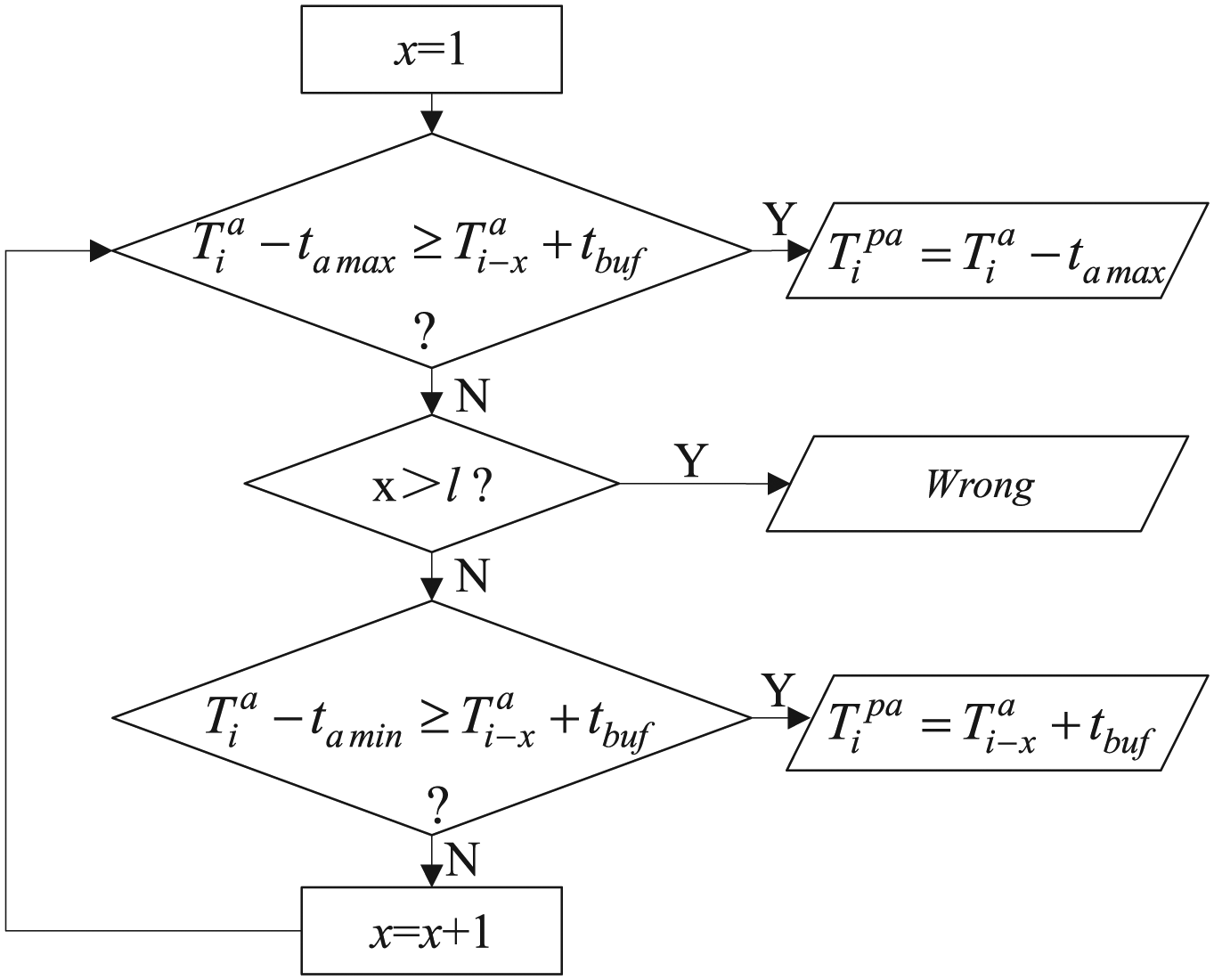
Pre-calculation procedure of the preparation time of the receiving route.
To clearly state the pre-calculation of the preparation time of the receiving route, we here give an illustration in Figure 6. If different lines merge outside Station M, like point P, they will share the same main tracks in the station, that is, C1 and C2 are the same direction C for Station M. Each line in Figure 6 is double-track. The layout of this station is similar to the left one in Figure 2. As illustrated, trains 1, 2, 3 and 4 are scheduled successively to enter Station M. Clearly, the number of the directions l is 2 for both sides. The maximum and minimum time ta min and ta min are 9 and 2 min. The buffer time
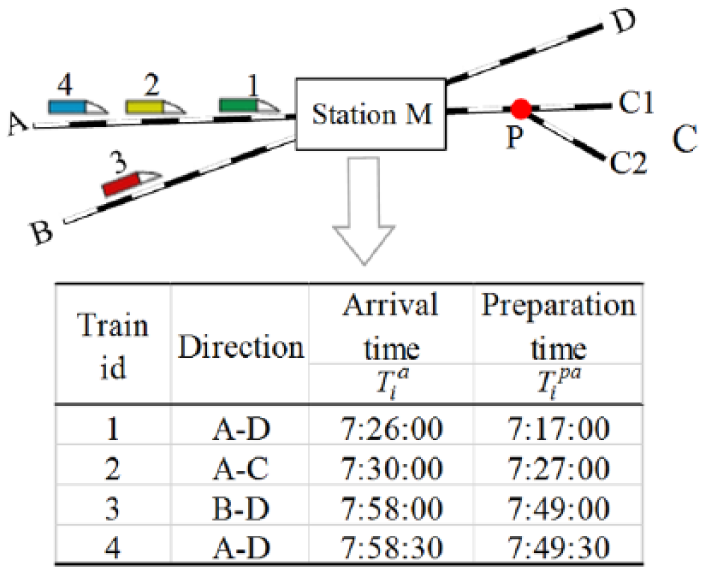
An illustration of the preparation time of the arrival route.
Departure trains’ time points
This paper defines time points of a stop train leaving a station in a similar way.
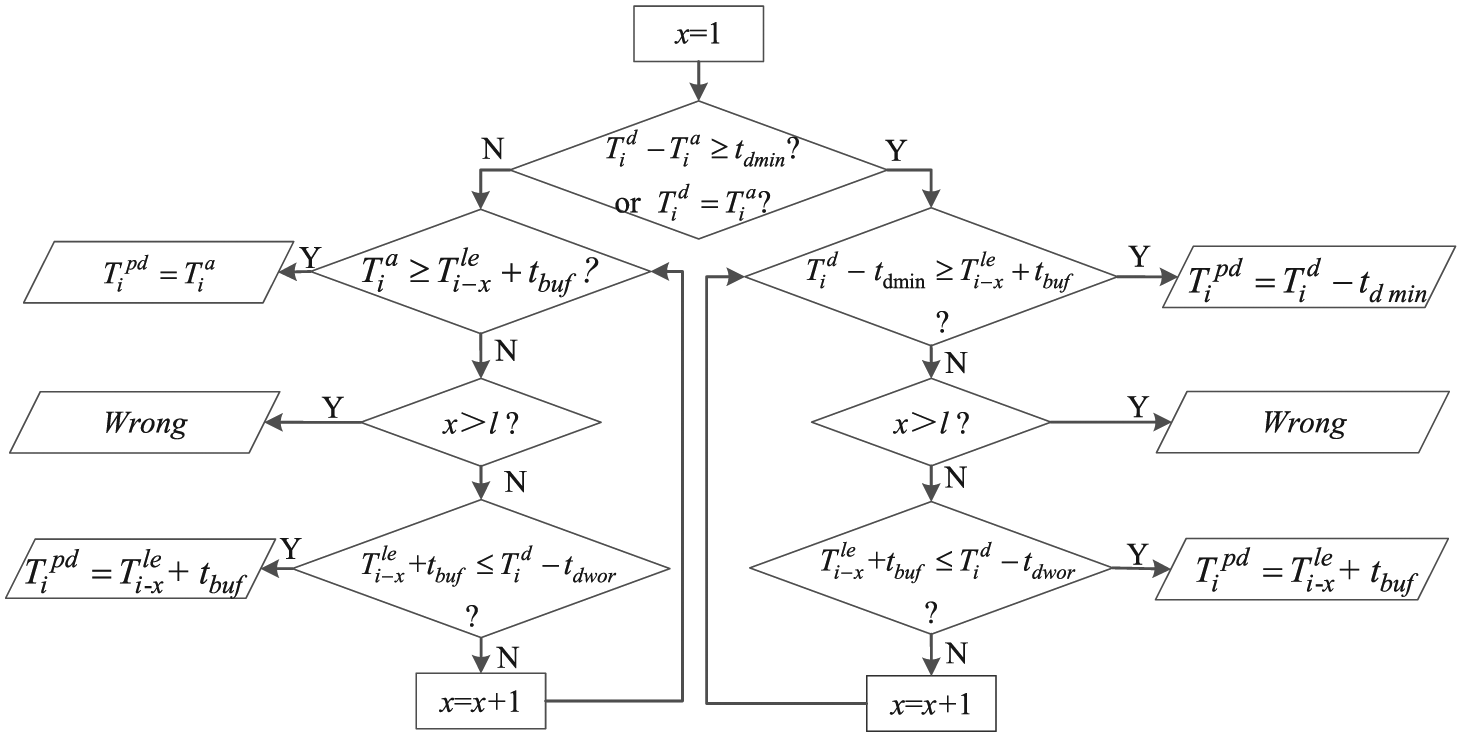
Pre-calculation procedure of preparation time of departure route.
In Figure 7,
For clarity, the time points of four departure trains are shown in Figure 8. The minimum interval
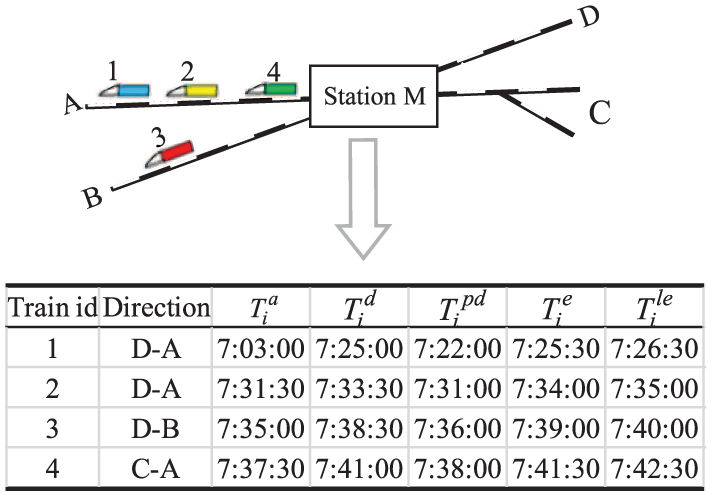
An illustration of the time points of the departure train.
Nonstop trains’ time point
The difference between a nonstop train and a stop train is the simultaneity of the time
Superscript no is used to stand for a nonstop train. The through route is separated into the receiving route and the departure route.
The arrival time
Table 1 illustrates the time points of a nonstop train traversing a station. After calculating the nonstop train’s time points as a stop train, the time point
An illustration of time points of a nonstop train.

Resource occupation time
Resources in the station yard consist of the bottlenecks (i.e. throat area) and the arrival–departure tracks. As shown in the ‘Train routes’ section, the resources can be classified as receiving routes and departure routes for stop trains and through routes for nonstop trains, respectively. When the time points above are pre-calculated, the occupation time of different resources can be computed as in Table 2.
Occupation time of different resources.
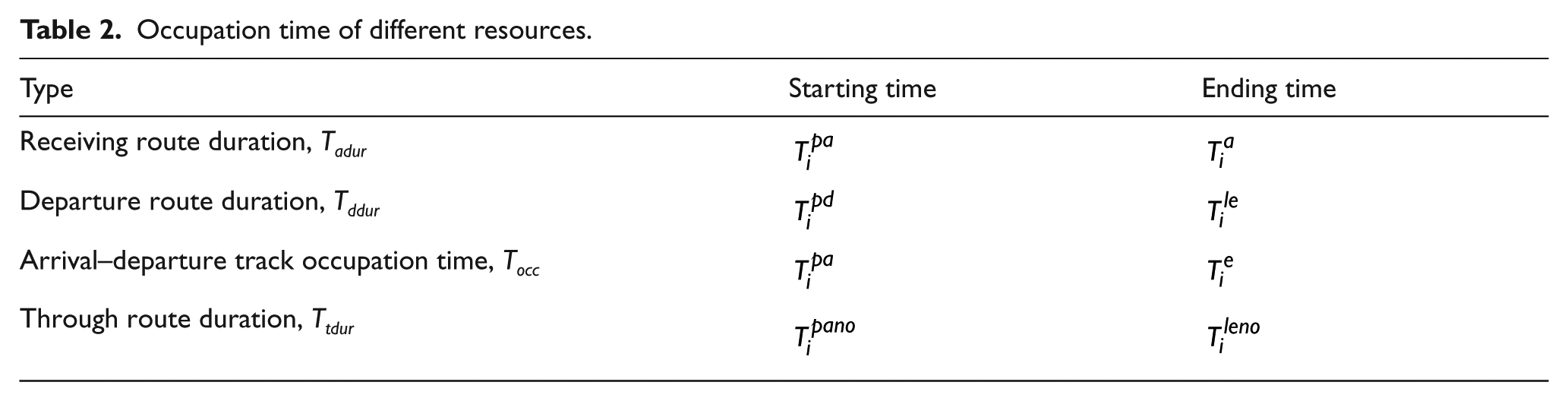
Note that the durations
When this paper calculates the occupation time of the arrival–departure track, the duration
Also, the resource durations of a nonstop train are much smaller than a stop train because of the speed differences between them in the station.
Conflicting route set definition
Route-conflict happens when more than two trains occupy the same resource of the receiving–departure tracks or the throat areas at the same time. For a station connecting one direction on each side, the time intervals between tracing trains (depart–depart headway) and between adjacent trains at the station (arrive–arrive headway) guarantee that there is no route-conflict. Also, for a high-speed railway multi-directional station, the route-conflict will not happen for trains from the same direction. However, conflicts exist for trains from different directions in the multi-directional station. To prevent the route-conflict from happening, the structure of a multi-directional station must allow the existence of parallel routes to resolve conflicts. This paper classifies the receiving–departure tracks which cannot be occupied by different trains at the same time through parallel routes, considering each side of the station, respectively, into a line group.
To illustrate this problem, the structure of a station is given in Figure 9. Considering the left side, track 1 is sorted into group I, while tracks 2 and 3 are classified into group II, according to the parallel routes R-1 and R-2; tracks 8 and 9 fall into group III, while track 10 is in group IV, according to the parallel routes R-3 and R-4. If only the right side is taken into account, tracks are sorted like the left side. Main lines (tracks IV, V, VI and VII) are divided into four different groups.
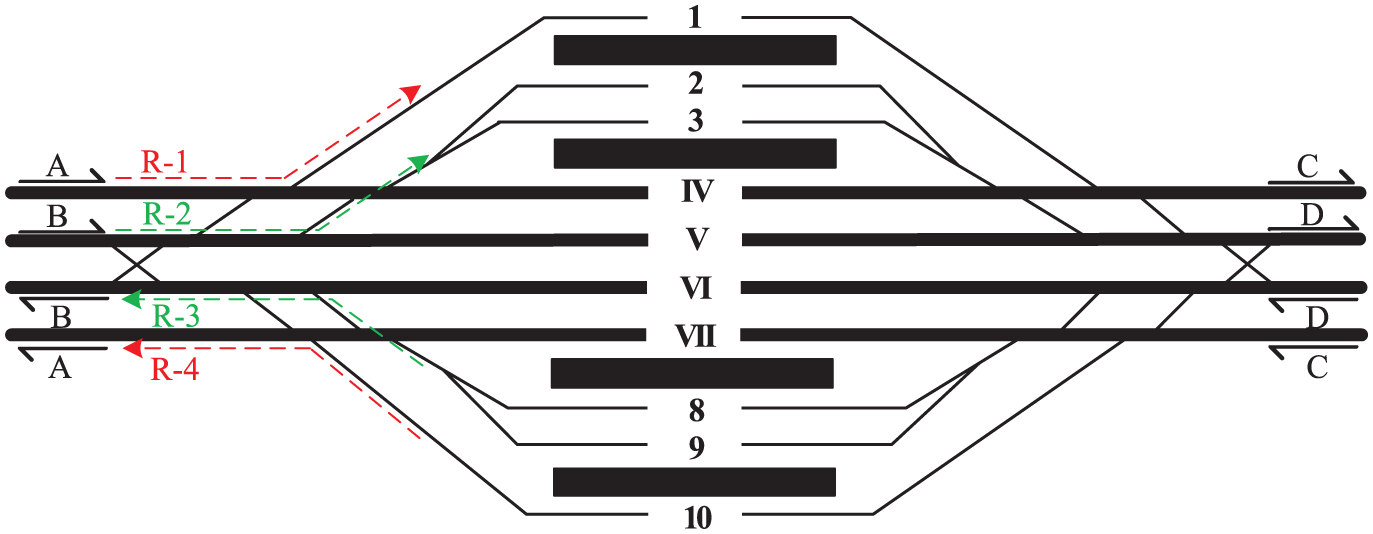
Layout of a simple railway station.
Pre-calculating the time points and grouping lines as mentioned above facilitate the construction of the conflicting route set. The set
Basic constants
Basic constants can be divided into two aspects: the train properties and the track properties. The train properties include time points as mentioned above, the number and the direction of the trains, the number of the passengers and so on. The primary track properties involve the quantity of the tracks, the layout of the yard, the operations that can be provided for trains and so on.
Train properties constants
I denotes the set of trains in a station.
The index op stands for a certain operation, such as the water supplying and the sewage suction;
This paper defines the time
Track properties constants
Decision variables
For this problem, the decision is whether the train i is assigned to track j. Thus, decision variables are expressed as follows

Objectives
The track allocation problem, which is the sub-problem of train timetabling problem and significantly affects the efficiency of train control system, can involve various consideration. The balanced usage of tracks is adopted as the evaluation index in Qiao, 6 Liu et al., 7 Zhao et al. 8 and Wu et al. 10 For a high-speed railway station, the usage of arrival-departure tracks is related to the utilization of capacity. The low usage of tracks causes the waste of capacity while the excessive usage leads to the difficulty of rescheduling trains under disruption. Unbalanced use also leads to the switch failure and the improper route display. Meanwhile, the balanced utilization of tracks can improve the anti-interference of train station operations. 15 This paper also adopts the balanced usage as an objective function from the infrastructure management perspective. Thus, the objective 1, which minimizes the variance between the total occupation time of each track, can be expressed as follows

Improving the service quality makes the high-speed railway more competitive. The short travel time means not only the travel time on trains but also the walking time in stations, especially the time for passengers to get on a train from the entrance. To improve the satisfaction of passengers from the service perspective, objective 2 which minimizes the walking time from the entrance hall to the platform can be set as follows

Constraints
Hard constraints
To fulfill the operational and security requirements, a train can only take one receiving–departure track in a station. This constraint is shown in Equation (3)

Second, a track cannot be occupied by two trains at the same time. Two occupations on one track cannot overlap each other. If the time interval Tocc of two trains is not separated by the buffer time, they cannot be arranged to the same track

In addition, two trains with conflicting routes cannot be arranged to the same line group

Constraints (3)–(5) are the basic constraints in the track allocation problem.5,15,16 And constraint (5) is always reduced to common if–then conditions, which makes this constraint hard to be solved. 12 This paper makes this difficult constraint easier to construct by introducing the pre-calculating strategy and line group method. To the best of our knowledge, up to now few related researches have considered the operation constraint and the main line constraint in the literature. However, these constraints are taken into consideration in this paper, which makes the proposed model more practicable.
Meanwhile, a train which needs a certain operation op during the dwelling time should be assigned to the arrival–departure track providing this operation

Besides, for a station, especially a high-speed railway intermediate station, the main lines should be used for nonstop trains rather than stop trains. A nonstop train should go through the main lines and the main lines generally cannot be assigned to stop trains

Finally, Equation (8) defines the domain of variables

Soft constraint
Normally, starting trains or finishing trains will have so many boarding or alighting passengers that the platform will be crowded with a large number of people in a short time. If two trains like that occupy the same platform with much time overlapped, it will reduce the service quality drastically.
Therefore, if two trains, whether they are starting or finishing, have more than 200 people to get on or get off and their critical time points stagger less than Tcri, these trains cannot be allocated to the tracks that share one platform. In China, the tickets will be checked 15 min earlier before a train departs. The value of Tcri can be set as 7 or 8 min, which is enough for most passengers to get on trains from the platform or leave from the platform. This constraint will reduce the congestion in the ticket barrier and the platform. The constraints can be expressed as follows
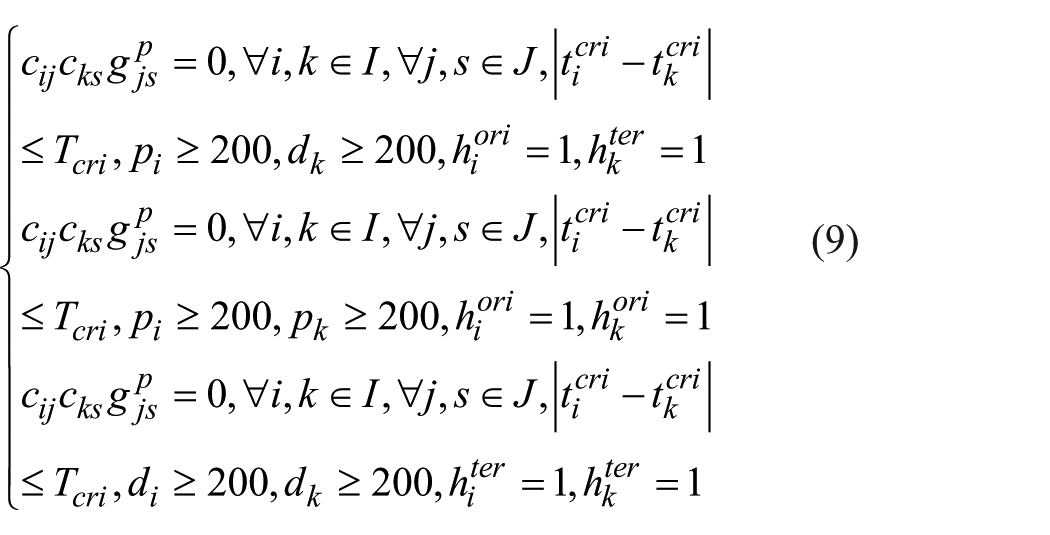
This constraint related to service quality is set as the soft constraint. If no result returns, it can be relaxed directly. Generally, when the quantity of these trains in the station is larger than the number of the platforms at a certain time, this constraint will not be satisfied; thus, the soft constraint can be relaxed.
Solving algorithm
The train allocation problem has been proved to be an NP problem. 1 The formulation in section ‘Problem formulation’ cannot get an accurate solution in a reasonable time when the problem scale is large. To solve the NP problem, intelligent algorithms, such as simulated annealing (SA) algorithm, greedy algorithm, genetic algorithm, and Tabu search algorithm, are widely used. Among them, SA is a stochastic optimization procedure and has been found effective and efficient. 10 This method increases the chance to escape from the local optimal and can guarantee the convergence. Thus, the SA algorithm is proposed to get an optimized scheduling plan in this paper.
Simplification
First, the linear weighted sum method is usually used to simplify the multi-objective model. 17 This method gives its corresponding weight coefficient according to the importance of each objective and then optimizes the linear combination to solve the multi-objective programming problem. This method transforming the multi-objective problem into a single-objective function is set properly as follows

where
Procedures of the SA
Then, an SA algorithm is applied to solve the problem in this paper. The framework of the SA is illustrated as Figure 10.
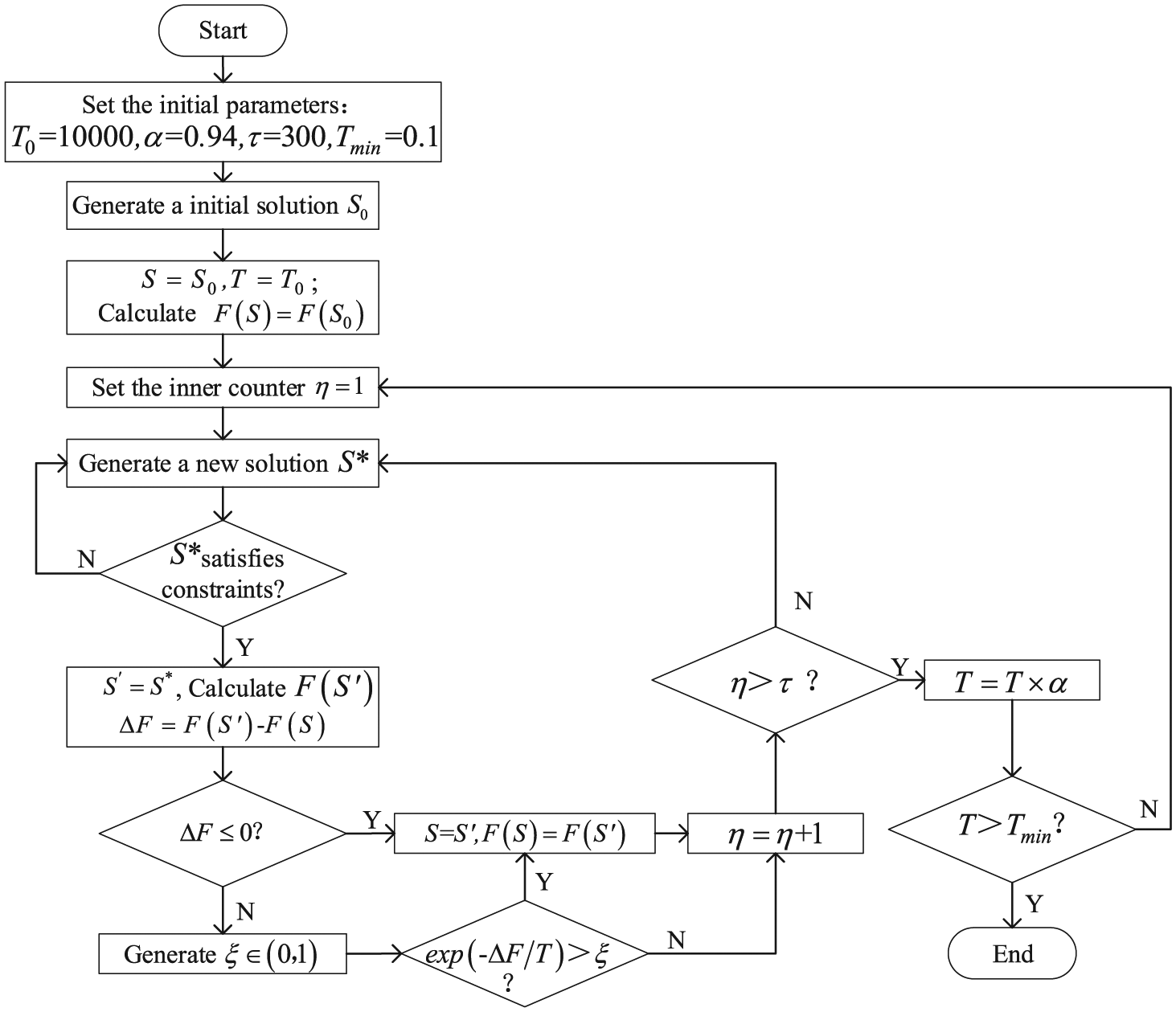
Flowchart of the SA algorithm.
The detailed procedure of the SA is described as follows:
Step 1. Set initial parameters: initial temperature
Step 2. Generate the initial solution: set the original allocation plan which is schedule by hand to be the initial solution S0. Let current solution S = S0 and current temperature T = T0. Calculate the current objective function value
Step 3. Set the inner iteration counter
Step 4. Generate a new solution S*. If the new plan S* satisfies constraints, turn to step 5. Otherwise, repeat step 4.
Step 5. Let the feasible new solution to be S′. Calculate the new objective function value
Step 6. Let
Step 7. Let
New solution generation
The generation of the new solution is shown as follows.
Obtain a number
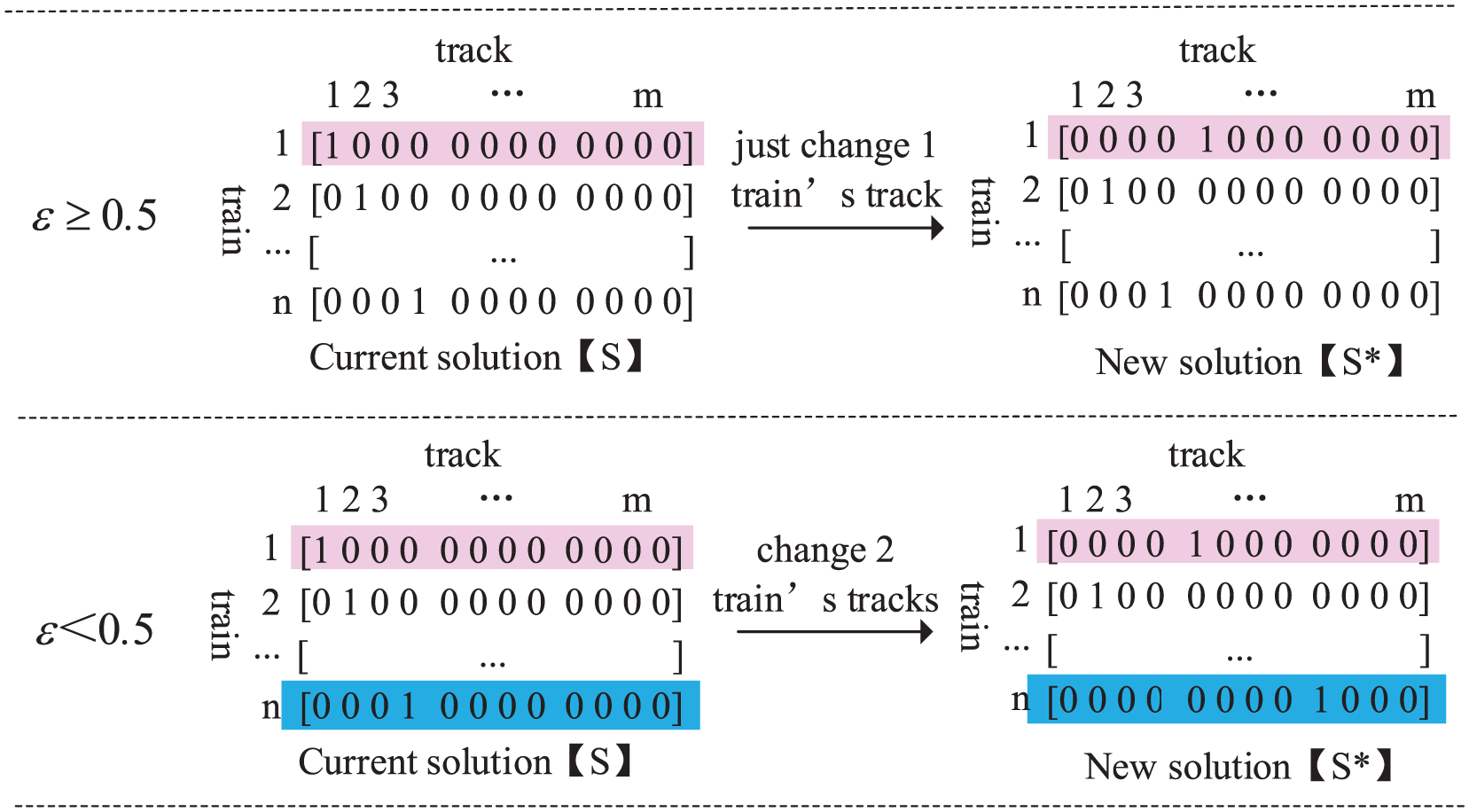
New solution generation of the SA algorithm.
In Figure 11, a matrix is used to express the solution. Each element denotes whether train i is arranged to track j or not. This generation method guarantees that one train is only assigned to one track and reduces the cycle times from the current solution to a new feasible solution.
Case study
To verify the effectiveness of this proposed model, a China high-speed railway station is illustrated as a case. This station is an intermediate station, connecting A, B, C and D. The track allocation plan can be divided into up and down parts considering the directions of train’s arrivals and the layout of this station in Figure 12. The detailed data including the trains’ timetable (from 6:00:00 to 12:00:00) and the walking time of passengers can be seen in Appendix 1. The emphasis here is that track 1 is not used to receive trains because of the inconvenience of passenger organization. As illustrated in Figure 12, considering the left side, tracks 1, 2, 3 and 4 are sorted into group I, while tracks 5 and 6 are classified into group II, according to the parallel routes; tracks 11 and 12 fall into group III, while tracks 13, 14, 15, 16 and 17 are in group IV. If only the right side is taken into account, tracks 1, 2, 3, 4, 5 and 6 are sorted like the left side; But, tracks 11, 12, 13, 14 and 15 are assigned to group V, while tracks 16 and 17 are in group VI. Main lines are divided into different groups VII, VIII, IX and X.
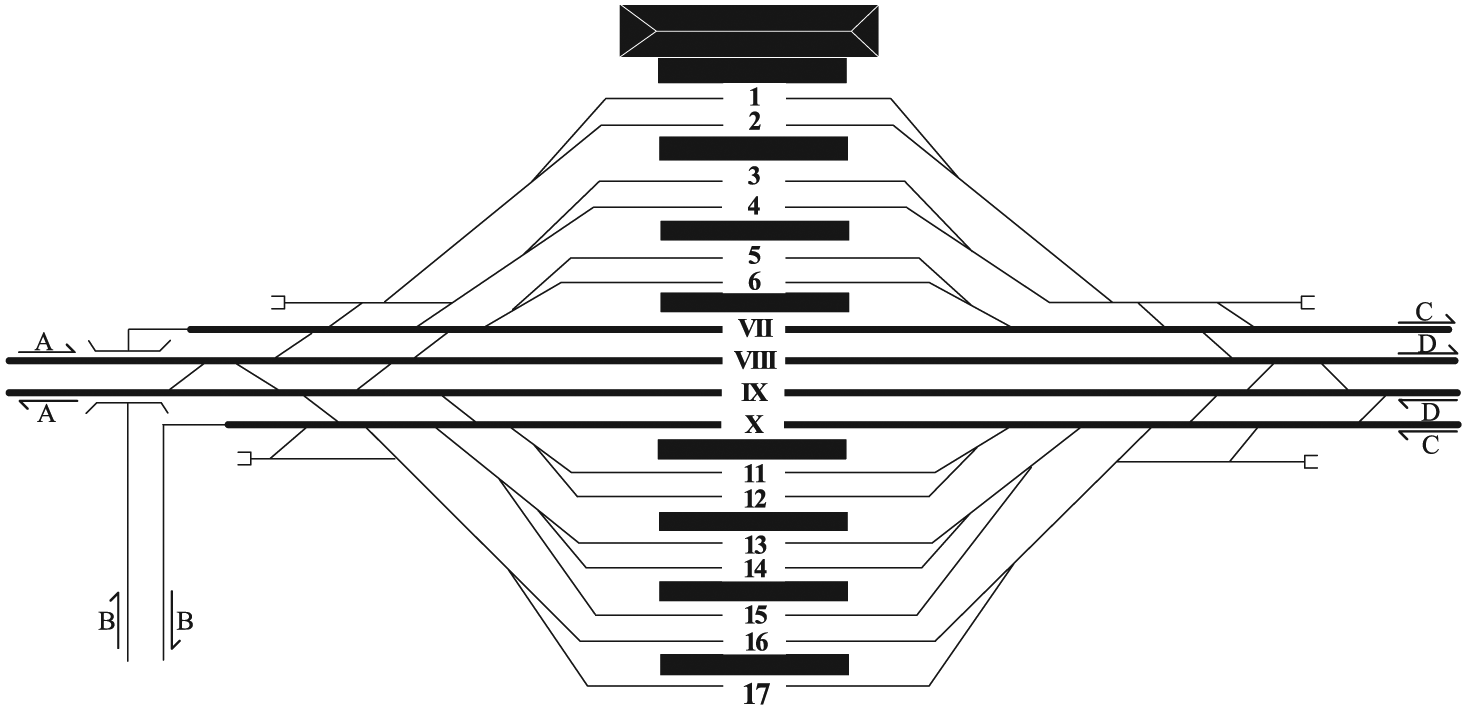
Layout of the station.
The proposed algorithm is coded in MATLAB. Here,
The influences of different weights are shown explicitly in Figure 13, where numbers under the horizontal axis represent different value combinations of two weights. In detail, the number 07.03 denotes that the value of
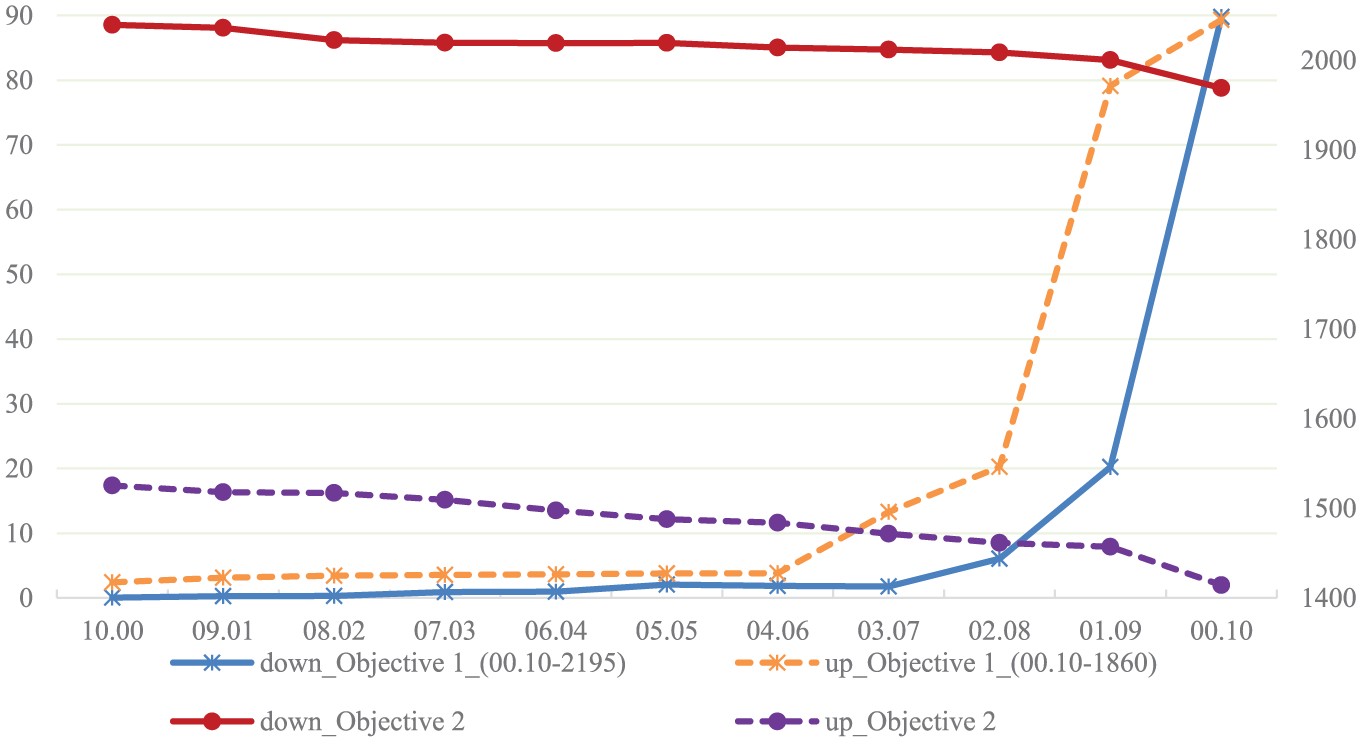
The influences of different weights.
In the following case, the values of
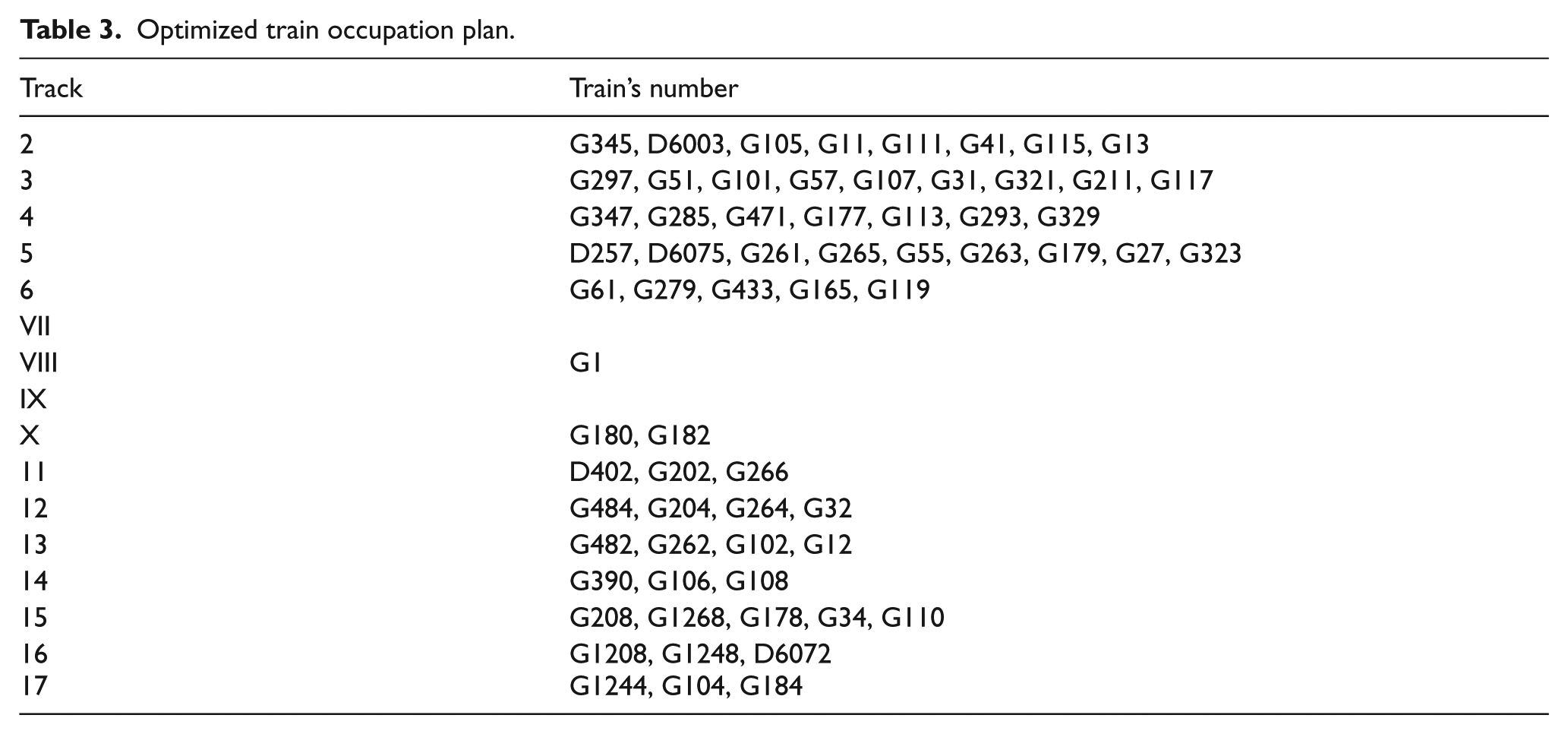
Table 3 lists the optimized arrival–departure track utilization plan. In Table 3, each train is arranged to one corresponding track and only the nonstop trains are assigned to main tracks.
Optimized train occupation plan.
To illustrate the result clearly, Figure 14 shows the trains’ occupation time of different tracks. As shown in Table 2, the track occupation starts from the preparation of the receiving route and ends up at the time point when the tail of the train passes by the starting signal. The white block presents the occupancy of the track and the black means the track is free during this time period. As can be seen in Figure 14, there is no overlap between the white sections on each track, which satisfies the safety requirement. Meanwhile, all nonstop trains are arranged to appropriate main tracks and no stop trains occupy the main lines. The tracks in the down part are busier than the up part. If there is a small disturbance between down trains, the up part of the station yard can be used to recover its scheduled plan.
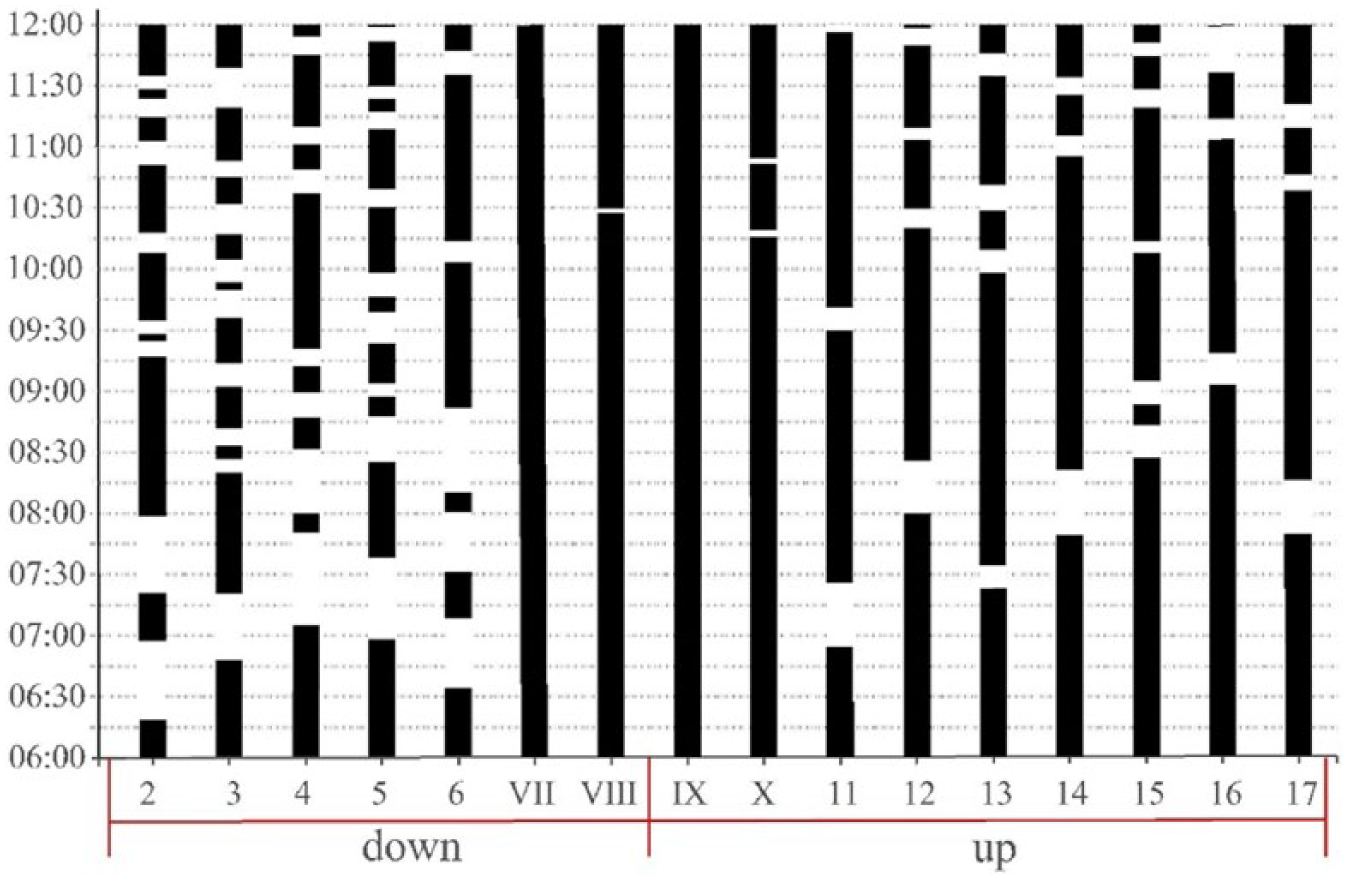
Trains’ occupation time of different tracks.
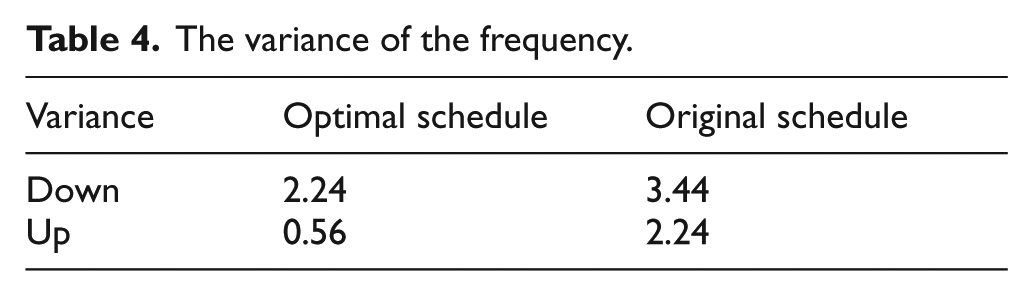
Moreover, the balanced utilization of tracks means not only the time but also the frequency. 10 To evaluate the optimized allocation result, an extra evaluation function which represents the variance of the frequency of each track can be defined as follows

The results of this evaluation can be seen in Table 4. Each track’s occupation frequency of the optimized track allocation plan, no matter down trains’ or up trains’, is much more balanced than the original plan (OP). Thus, the optimized plan improves the anti-interference of train station operations.
The variance of the frequency.
To verify the effectiveness of the method, two objective values of the optimized and original track allocation plans are shown in Figure 15. Obviously, the optimized track utilization scheme is better than the original for both objectives. The optimization effect of the objective 1 is much better than the objective 2, which satisfies the setting of the weighs.
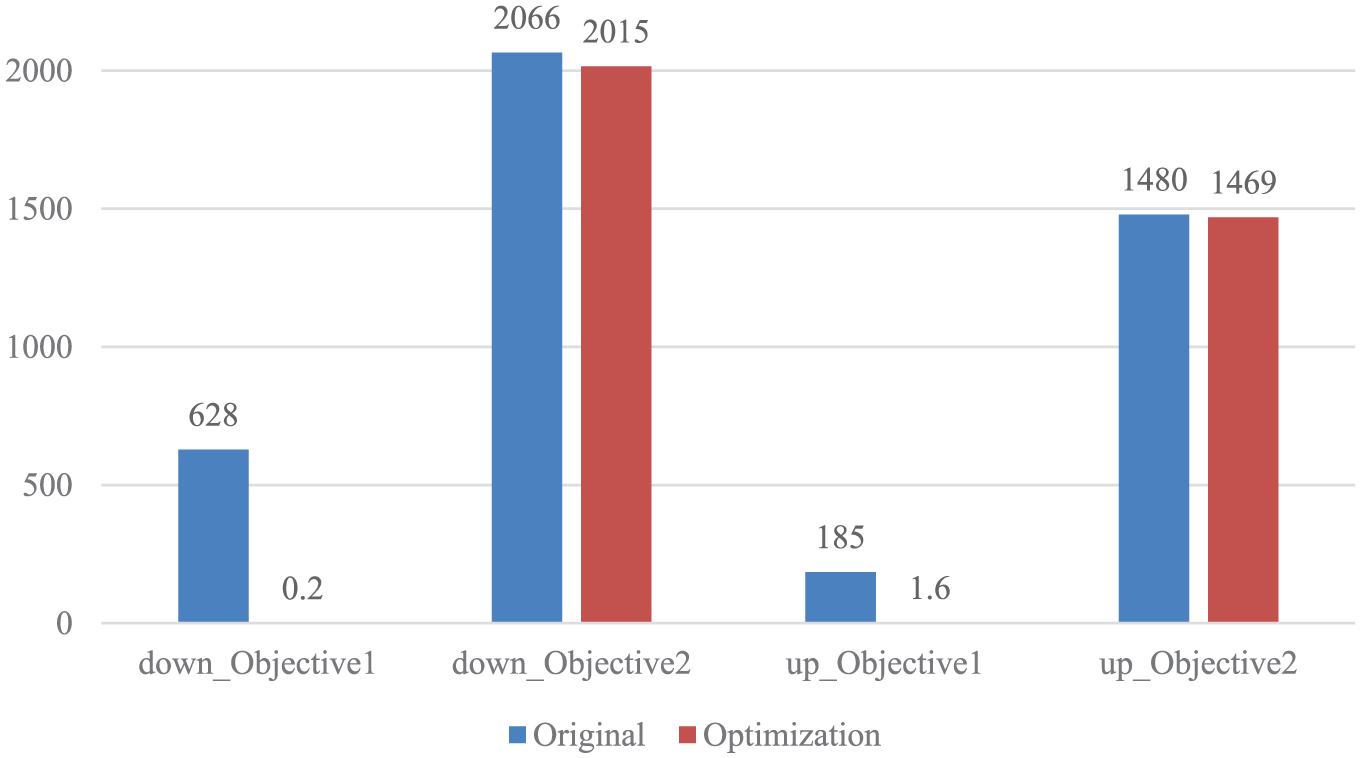
Values of two objectives of the optimized and original plan.
To illustrate the efficiency of the solution, the convergence tests of up and down trains are shown in Figure 16. Clearly, the algorithm can converge to a steady state, within iterations ending.
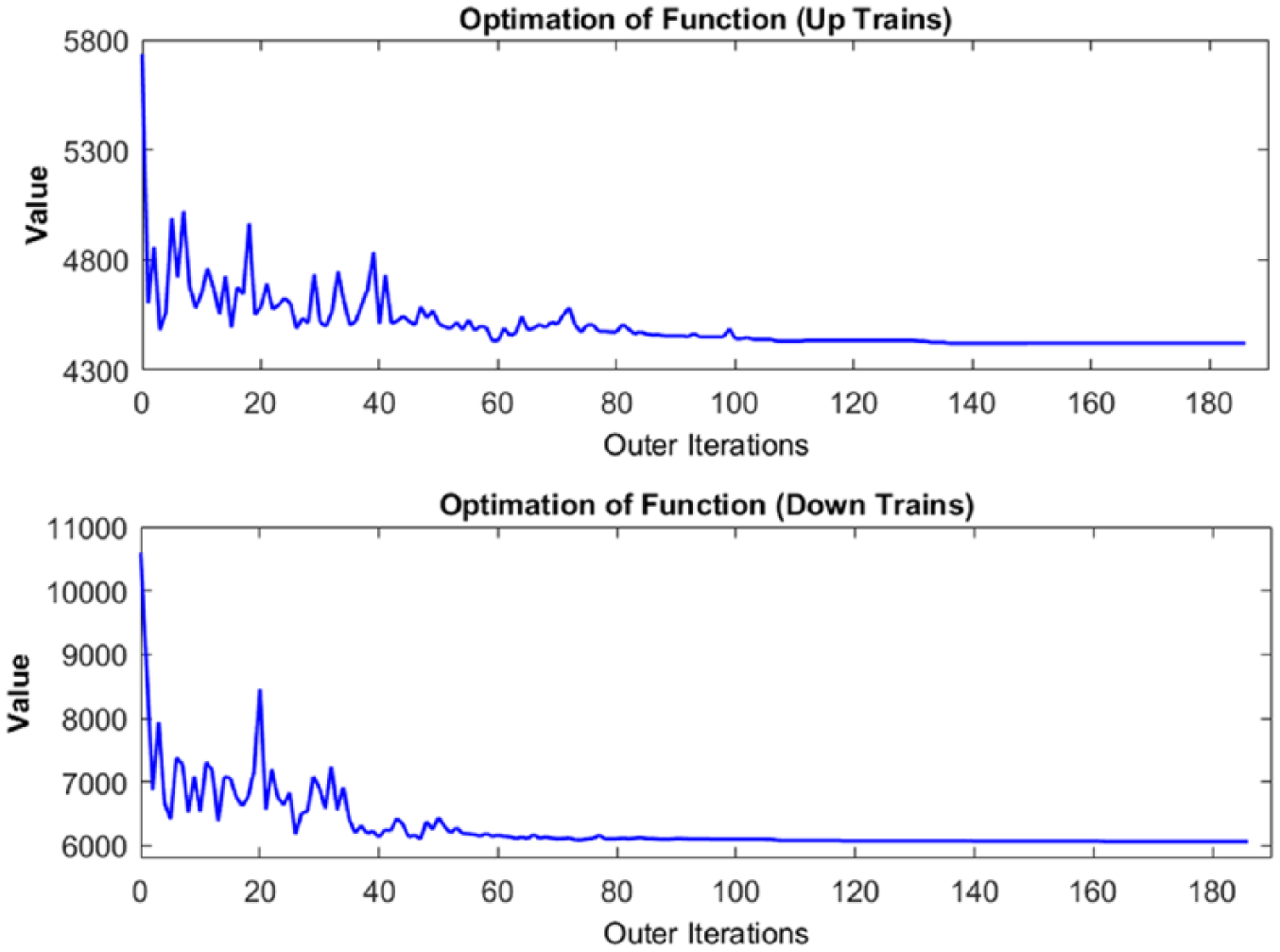
Convergence curve.
To verify the efficiency and the quality of the algorithm, this paper uses the solver LINGO with its default setting, B&B algorithm, to get solutions of different time periods. The comparisons of the OP, B&B method and SA algorithm are shown in Table 5.
Comparisons with different time periods.
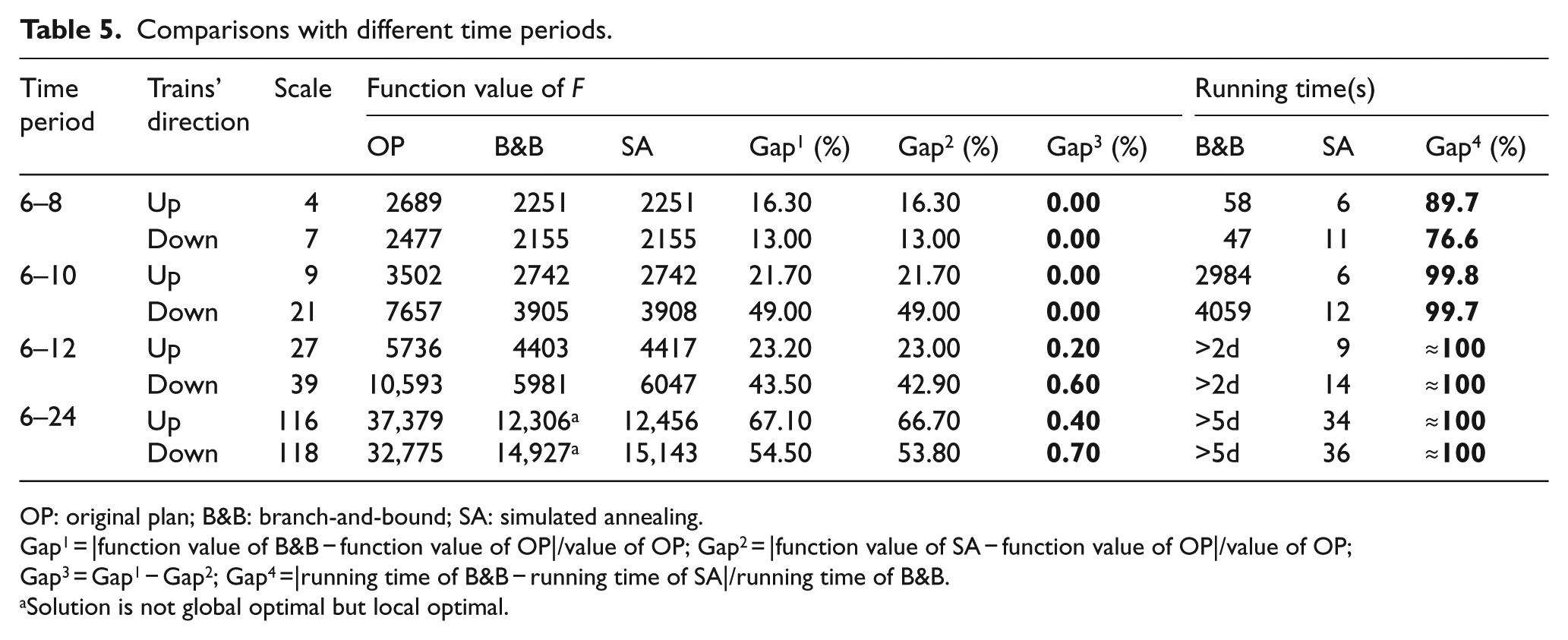
OP: original plan; B&B: branch-and-bound; SA: simulated annealing.
Gap1 = |function value of B&B − function value of OP|/value of OP; Gap2 = |function value of SA − function value of OP|/value of OP; Gap3 = Gap1 − Gap2; Gap4 =|running time of B&B − running time of SA|/running time of B&B.
Solution is not global optimal but local optimal.
In Table 5, from the columns of function value, the values of Gap1 and Gap2 are larger than 0, that is, two methods all get an optimized solution. The results of the B&B method are all global optimal except two largest instances. The largest instance cannot get the best solution in a short time; meanwhile, it takes a long time to get a local optimal result. The SA method can obtain the same solution as the B&B when the size of the problem is not large. With the raise of the problem scale, the value of Gap3 increases slowly, which indicates the SA method also get an optimized result and the difference between the SA and the B&B is very small. From the columns of running time, the calculating time of the B&B method grows dramatically with the expansion of the scale while the running time of the SA algorithm keeps stable basically. With the increase of the problem scale, the solutions calculated by the SA method are similar to the results calculated by the B&B method, while the running time of the former is much shorter than the latter. Thus, it is concluded that the SA algorithm is effective and much more efficient than the B&B method. Because the number of trains in a station won’t be too few, the SA algorithm is much more suitable than the B&B method when solving the track allocation problem.
Conclusion
Current studies about the track allocation optimization in a high-speed railway station focus on the basic operations from infrastructure management perspective. However, passengers ask for a higher standard of service nowadays. In this paper, the problem is solved at the tactical level from both infrastructure management and service perspectives. A multi-objective nonlinear 0-1 integer programming model is constructed to balance the usage of arrival–departure tracks and minimize the walking time of passengers in a station. In addition, constraints are divided into hard and soft constraints, which guarantees that there will always be a solution to return. Also, some important time points of receiving and departure routes in the station throat area are explained specifically. After that, this paper shows what is the conflicting route and uses the line group method to facilitate the construction of the conflicting route set. An SA-based algorithm is proposed to find an optimal solution effectively and efficiently. A case study of a China high-speed railway station is given to verify the model. Meanwhile, an accurate algorithm, the B&B method, is compared with the proposed algorithm. The comparison with the original track plan is given to evaluate two algorithms. It is proven that the SA algorithm is much more suitable when solving the track allocation problem.
Some possible improvements can be done in the future work. First, a model that describes the terminal stations which include train turnaround operations should be proposed. Compared with the high-speed railway intermediate stations, the track allocation problem is more complex in terminal stations because of some extra operations. Then, an algorithm that solves this multi-objective problem directly will be adopted to be compared with the proposed method. After that, more attention should be paid to solving the track allocation problem at the operational level. Finally, this problem can be settled among several stations in a certain section at the same time because the delay of trains influences more than one station. Moreover, in practice, this system is suitable for stations only with the high-speed rail. Several stations with the high-speed rail, conventional rail and freight lines are not compatible.
Footnotes
Appendix 1
Declaration of conflicting interests
The author(s) declared no potential conflicts of interest with respect to the research, authorship and/or publication of this article.
Funding
This work was supported by the National Key Research and Development Program of China [grant number 2018YFB1201403].