



Abstract

Siemens announces partnerships for Mindsphere
Accenture is building a range of applications for Mindsphere, a cloud-based platform from Siemens to enable industrial equipment makers to benefit from new services based on data insights.
Mindsphere is an industrial ‘Internet of Things’ (IoT) system with easy connectivity for all types of industrial assets. It enables the development of applications from Siemens and third party suppliers. Accenture is aiming to support original equipment manufacturers (OEMs) by building a suite of applications for Mindsphere to enable services such as predictive maintenance or remote condition monitoring.
Using these applications, manufacturers of machines and industrial equipment will be able to benefit from increased revenues and customer satisfaction while reducing claims and warranty costs. Their customers can reduce downtime, maintenance related costs and energy consumption, while increasing the lifetime of their machinery.
OEMs will have access to assets and equipment as machines becoming increasingly connected with production management, manufacturing execution, logistics and enterprise planning systems. By applying advanced data analytics generated by their systems, they can identify and predict performance bottlenecks and make smart decisions about improving asset operations, managing workforce, reducing supply chain risk, and enhance product design.
Accenture research has shown that predictive asset maintenance saves up to 12% in scheduled repair costs, reduces overall maintenance costs by up to 30%, resulting in up to 70% fewer breakdowns.
Mindsphere forms the basis for applications and data-based services from Siemens, such as the predictive maintenance of machine tools (machine tool analytics) and integrated drive systems (drive train analytics).
Siemens and Atos have announced that as part of their strategic digital alliance, Atos will be one of the first Mindsphere partners delivering a broad set of IT and digital services.

Atos offers Mindsphere customers a structured approach; from quick-start services with first real results, to production readiness of Mindsphere applications. The service supports the prototyping, validation and deployment of Mindsphere applications through automated and predefined use cases.
Atos will start to deliver Mindsphere services for Atos and Siemens customers in the 4th quarter of 2016. In 2017, Atos plans to offer Mindsphere as a hosting service, either from the cloud or on the customer’s premises.
Occupancy sensors control lighting use, reducing emissions
The committee on climate change (CCC) has recently published its annual report on the UK’s progress in reducing greenhouse gas emissions and meeting carbon budgets. The report shows that emissions have fallen some 38% below 1990 levels. However, the reductions have come almost exclusively from reducing emissions in the production of electricity.
The International Energy Agency (IEA) suggests there is a huge potential for improved energy efficiency in buildings, with up to 40% of a building’s electricity use accounted for by the lighting.
Instead of retrofitting new luminaires, the simple addition of a PIR detector or a photocell will help to reduce the amount of time that lights are left on when they are not actually in use, for example when an area is unoccupied or if there is sufficient natural light – therefore saving energy while reducing bills.
Occupancy detectors are an efficient way to control lighting. These sensors work by dimming or switching lights on and off when people enter/leave a room and can reduce electricity consumption by up to 60% depending on the model used. Occupancy detectors are becoming more commonplace in public restrooms and hotel corridors.
A recent study of the use of occupancy sensors in an old people’s home showed that the technology had helped to reduce the number of falls. Changing the lux level (intensity of the light) from the LED lighting to a low level also helped minimise the discomfort and glare issues that arose when nurses turned on bright overhead lights during their evening/night-time rounds.
Greenbrook’s Orion range of occupancy detectors integrates an occupancy sensor into a wall switch. The switch uses an infra-red heat detector that senses warmth movement in the surrounding area when it is dark, triggering the connection load. This fitting also has an in-built photocell that can identify levels of available daylight so that the light is only activated during darker hours. The detectors can also be used to control heating and ventilation.
Schneider Electric debuts Altivar ATV340 variable speed drive
Schneider Electric, the global specialist in energy management and automation, has launched the new Altivar Machine ATV340 drive. The unit is built for applications requiring rapid dynamic control in open or closed loop, using a minimum 1ms task cycle
The unit includes multiprotocol ethernet, an embedded encoder, integrated application functions, and compatibility with multiple motor types, with a library of tested, validated, and documented architectures.
The unit has Achilles level 2 cyber-security certification and is compliant with EN ISO 1384901 and EN 62061. The unit is suitable for environments with high levels of dust and vibration and operating temperatures up to 60ºC.

The Altivar Machine ATV340 variable speed drive is suited to a variety of industrial sectors as well as applications such as packaging, material handling and working, and hoisting.
Prescriptive analytics can measure data from the Internet of Things
For many businesses data can reveal significant business insights, which is why it has become a major driver for the adoption of the Internet of Things (IoT). The IoT’s network of interconnected devices can produce a remarkable amount of raw data, which is proving to be very attractive for business leaders across industries.
Earlier this year, Gartner released a report revealing that 43% of businesses will have launched their own IoT strategy by the end of this year. But are CIOs and their counterparts thinking long-term about their IoT solutions?
Without analysing the data the IoT generates with the right tools, you’d effectively have the world’s most valuable book without any way to read it. Data collection alone is not enough to draw value; the real value is found in translating that information into insights and actions, which can be taken immediately to improve operations. That’s what makes prescriptive analytics a natural fit for any IoT solution.
Once integrated with IoT devices, prescriptive analytics tools collect information and intelligently identify trends. The idea is to ingest the data, look for patterns of behaviour through machine learning, and create a descriptive insight with prescriptive actions. These are then delivered in real time to operational staff or management as appropriate. This eliminates the need for a data scientist to review and submit reports. It creates a constant loop of data collection, translation, insight delivery and action. It is, interestingly, similar to what the retail industry is doing with RFID for cold chain monitoring.
What many do not realize is that the Internet of Things is the second attempt at retail data-collection technology. In the early 2000s, the retail industry saw RFID in the same light as the IoT: a means to collect mountains of data on customers and their purchasing habits. Despite investment from several industry giants, it never fully reached its potential because the data was poorly reported. In those days, RFID was never matched with any sort of long-term solution to draw meaningful insights. Tools such as prescriptive analytics help IoT technologies, including RFID, succeed where they had failed in the past.
The IoT isn’t filtering out and streamlining data—in fact, it is doing the opposite. To maximise the value of the IoT, the data it generates must come paired with the right solution that sifts through the junk and hand-delivers the value. What makes prescriptive analytics the ideal candidate for that task is its instantaneous value-added functionality. Real-time delivery of actions can result in quick fixes which, over time, can save a fortune in profit. Prescriptive analytics is the next logical step in reaping the true value of IoT data.
Precision-geared products market to recover in 2016
Despite the slowdown in 2015, the total market for precision-geared products is estimated to have been worth more than $1.9 billion in revenues in 2015, with 2.2 billion units shipped, according to the latest IHS Markit study on precision gearboxes and geared motors.
Revenue fell by 0.8% in 2015 from 2014. This was due to the depreciation of the euro and Japanese yen against the US dollar, as well as a sluggish Asian market. This is despite unit shipments in EMEA and Japan increasing by 4.1% and 3.0% respectively.
The growth of the precision-geared product market depends largely on global production of industrial machinery. According to IHS Markit, robotics is projected to be the fastest-growing sector of the precision-geared products market, with a 12.6% CAGR in supplier revenues from 2015 to 2020.
Robotics was the largest sector of the market for precision geared products in 2015, with an estimated $596m in revenues, 31.4% of the total market. The machine tool industry was the second-largest sector of the precision-geared product market in 2015, followed by the packaging and labelling, material handling equipment, and food, beverage and tobacco sectors, with estimated $264.3m, $219.8m, $214.9m and $185.8m revenues, respectively.
The automotive industry continues to be the largest end user of robotics; but the adoption of robotics in general industries (every industry other than automotive) is forecast to grow more quickly, with double-digit annual revenue growth, especially in the consumer electronics, food and beverage, and semiconductor machinery production sectors.
Growth in the demand for robotics is driven by a number of factors, including increasing labour costs, growing concerns for worker safety, and decreasing robot prices. The need to automate labour-intensive industries with cost-effective, application-appropriate industrial robots drives installations globally.
Recent advances in the speed, accuracy and repeatability of industrial robots are prompting adoption in new areas of the factory floor. As a result, international and local suppliers are battling for market share, offering shorter return on investment (ROI), improved services and developments in technology. The global industrial robot market is forecast to exceed $23b in 2020, up from $9.8b in 2015, and is forecast to grow by 18.9% (CAGR) from 2015 to 2020.
New Intelliconnect website showcases wide range of low cost RF Connectors
Intelliconnect (Europe) Ltd has launched a new website offering visitors easier navigation and search facilities and a new “Quote Basket” facility allowing customers to automatically request a quotation for selected products.
A key element of the new website is the launch of the Taurus Range of RF connectors. This brand new range of low cost high quality standard coaxial connectors and adaptors is generally available from stock on a 1 to 3 day lead time. Taurus connectors are available in formats including BNC, SMA, SMB, MCX and N Type.
Custom cable assemblies can be designed by customers using the new cable selector which enables bespoke cable assemblies to be specified online and submitted for quotation by return.

Tsubaki expertise reduces downtime for insulation manufacturer
For one manufacturer of glass fibre insulation, a conveyor system that passed through an oven was suffering from premature chain wear which was affecting product quality. Having approached Tsubaki for a longer lasting alternative, the chain manufacturer delivered a premium chain that would last three times longer and greatly reduce production downtime.
Producing glass fibre insulation involves molten glass being poured into a perforated container that is rapidly rotating and discharging horizontal streams of glass, which are converted into fibres by a downward blast of air, or hot gas.
The fibres fall onto a conveyor, where they interlace with each other in a fleecy mass. This is then sprayed with a binder and two conveyors compress the fibre mat into the desired thickness before entering the oven where the binding agent is cured. Conveyors are constructed using heavy duty attachment chain, to which are fixed a number of cross-members, creating a platform that carries the glass fibre mat..
The elongation of the conveyor chain led to increased gaps between the cross-members which affected the quality of the finished product. As a result, the chain was only lasting for two years before it had to be replaced.
The proposed roller attachment chain, manufactured by Tsubaki, was equipped with hardened chromium-plated pins and molybdenum disulphide (MoS2) lubrication that would provide high levels of lubrication even beyond the temperatures experienced inside the oven. Being a dry lubricant it also posed no risk of contaminating the glass fibre mat during the manufacturing process.

Since its installation the chain has been shown to last for more than six years, at least three times as long as the previous chain. This produced an annual maintenance cost reduction of €62,000 and an extra six weeks production time due to the longer life of the chain.
IDTechEX predict environmental gas sensor market to grow to $3b
Chemical gas sensors will play a key role in pollutant monitoring over the next decade and IDTechEx predicts that the environmental sensor market will be worth more than $3b annually by 2027.
The chemical sensor industry is at a tipping point. Developments in micro-fabrication technology allow gas sensors to be integrated into a number of consumer devices. The new IDTechEx Research report Environmental Gas Sensors 2017-2027 describes future opportunities as well as the challenges of introducing chemical gas sensors to new markets.
The report covers sensor integration across a range of markets, from mobile devices and wearables to ‘Smart Cities’. Indoor air quality can be measured using indoor air quality units that are becoming central nodes for air purifiers and other environmental apparatus.
The environmental sensor industry’s main market is the automotive industry, where sensors monitor the environment for pollutants to control air flow into the driver’s compartment. IDTechEx analysts expect large growth in new markets, with the largest growth markets being in mobile devices and air purifiers.
With a growing ecosystem of connected devices, sensors will play a key role in monitoring air quality through the use of air purifiers, air condition, heating and smart window systems, sensors will be able to measure, forecast and react to air quality through the day, ensuring that environmental pollutants are removed.
ULIS and Schneider Electric unveil new advanced occupancy sensors at IBS 2016
ULIS, a manufacturer of innovative thermal sensors, and Schneider Electric, a global specialist in energy management and automation, displayed the MIRTIC advanced occupancy sensor (AOS) at the Intelligent Business Systems show in Paris in November 2016. Designed for the counting of people, the AOS enables services companies and users to gain a greater understanding of occupancy levels and usage to optimize operational costs and occupant services in new or existing buildings.
Advanced sensors are seen as critical in enabling facilities to comply with regulations on energy efficiency and to drastically cut building management costs. The smart buildings market for advanced sensors is projected to reach almost $3.7b by 2020 (Navigant Research, March 2014).
The AOS runs on battery power and transmits occupancy rates every two minutes, without compromising the privacy of the occupants. The unit can cover a 30m2 zone, equivalent to a meeting room accommodating 8–10 people.
The module on display at IBS marks the completion of the MIRTIC project, a five-year, €24M European initiative led by ULIS. The aim of the project was to produce a new type of thermal sensor module that will bring new capabilities to building usage diagnostics. The project began in 2011 with partner CEA-Leti, a leading microelectronic and nanotechnology research centre, Integrated Systems Development, a global systems integrator, and augmented reality technology developer Metaio (acquired by Apple).
Schneider Electric will field-test the AOS at the end of 2016 prior to entering product development.
Harting upgrades ‘Prelink’ connection system with Profinet interface
Harting has upgraded its ‘Prelink’ integrated ethernet connection system to interface with Profinet, and AWG24/19 cabling for robots.
The termination block is fitted with an inlet for 4- or 8-wire ethernet cable, which can be securely assembled in the field in a single stage with the appropriate tool.
The Profinet connector uses AWG 22/23 stranded wire and comes with printed standardised wire assignments. Also available is an interface for AWG 24 cable for robotics applications using AWG 24/19 wire configuration.
The termination block fits RJ45 and M12 jacks and connectors. The termination block can be removed and inserted in another connector in a matter of seconds, so that cables and connectors can be switched independently of one another.

Continuous production and synTQ takes centre stage at Interphex Japan 2016
Optimal Industrial Automation has generated a lot of interest in its process analytical technology (PAT) system, Optimal’s synTQ, following the Interphex Japan tradeshow. The system meets a new demand for continuous production in the pharmaceuticals manufacturing sector.
Optimal joined early entrants to the field at Interphex to show the advantages that PAT platforms can offer for continuous production and how the business has tackled the challenges of implementation. Optimal is working with operators in the global pharmaceutical industry and is upgrading the software to meet the application challenges of their customers.
While continuous manufacturing is the norm for many industrial production processes, the complexities of production together with the need for continuous quality assurance has made this difficult in the drug manufacture sector.
The synTQ system offers users ‘end to end’ quality assurance, allowing closed loop control based on product quality attributes. Such a production method removes the need for manual end of unit operation testing and lengthy ‘end of batch’ testing of the final product – reducing costs and increasing production throughput. The system is suitable for large and small molecule production as well as batch production processes, offering similar reductions in time to market for a large range of products.

Martin Gadsby, Director of Optimal Industrial Automation commented, ‘We want to stress that this is not a software that is suited to just continuous manufacture of a certain final product, but rather an adaptable framework that can be applied to all levels of any life sciences production cycle from lab to line. We have achieved this adaptability thanks to the continued adoption of synTQ by pharmaceutical manufacturers, so we can continue adding features and updates to what is an already proven and dynamic PAT solution.’
Emerson’s multiphase flow meter designed for flexible, cost-effective monitoring
Emerson Automation Solutions has introduced the Roxar MPFM 2600 M multiphase flow meter. The Roxar MPFM 2600 M is a flexible and easily manageable wellhead measurement solution based on a field-proven technology platform.
The meter is ideal for customers with direct and continuous wellhead multiphase flow monitoring needs, and can identify and measure non-symmetrical flow in varying flow regimes, to improve measurement uncertainty monitoring and reliability. The meter includes the advanced signal processing, field electronics and electrode geometry innovations of the third generation MPFM 2600.
Software modules are available to help with challenging applications including flow back measurements, well testing and allocation metering. These include a Venturi which extends the operating range of gas void fractions, a compact gamma system for improved accuracy, a formation water salinity measurement system, and a wet gas well operating mode.
IDTechEx produce wide-ranging report on autonomous vehicles
Autonomous Vehicles: Land, Water, Air 2017-2037, the new report from IDTechEx looks at the market for land, sea, and air autonomous vehicles in a balanced manner revealing how the electric vehicle business (valued at $0.7 trillion in 2017) will include many new autonomous forms, creating business opportunities for both vehicles and components.
The report reveals the many very different reasons for adoption of autonomous vehicles in commercial, industrial, military, marine, aerospace and other applications and the very different degree of difficulty in achieving what is needed. Issues such as ethical programming of cybervehicles, state monitoring, and cyber security are covered in depth.
Autonomous Vehicles Land, Water, Air 2017-2037 addresses all the challenges and opportunities.
Tecat introduces new wireless temperature measurement and monitoring system for automotive brake rotors
Tecat Performance Systems today announced the first product in its new ‘Wiser TC’ family of temperature measurement and monitoring systems. Optimised for automotive brake rotors and ideal for mounting inside wheel hubs, the range provides low power consumption and high accuracy in high-temperature environments.
Units in the range consist of three subsystems: a remote unit, base unit, and software interface. The remote unit consists of the data capture electronics connected to two K-type thermocouples, a transceiver, and a long-life battery. A custom-designed mounting plate allows for installation in any specific wheel hub or application.
The base unit, which houses an antenna and receiver, plugs directly into a PC USB port for use with the software interface, or into a power supply and data acquisition system via its four analogue outputs.

Yokogawa makes equity investment in Bayshore Networks
Yokogawa Electric Corporation has made an US$900k equity investment in Bayshore Networks Inc., a US technology innovator that develops cybersecurity software for the Industrial Internet of Things (IIoT). The partnership will develop Yokogawa’s IIoT architecture.
Bayshore Networks has created communications control technology for layer 7 of the open systems interconnection (OSI) reference model. As well as offering cybersecurity technology, this capability can also be employed in safety solutions for monitoring and controlling production facilities.
Yokogawa’s control business offers solutions ranging from field sensors to control systems, manufacturing execution systems (MES), and management information systems.
Heidenhain introduce rotary encoders for high axial loads
Heidenhain has launched the IP66-rated ROD 600-series of encoders, for applications capable of withstanding high axial and radial loads of up to 75 N.
The range provides accurate feedback of rotary speeds up to 12,000 rpm. Five different line counts can be specified from 512 to 5,000, accuracy being ± 1/20th of the grating period. The electrical output signals are TTL for ROD 620 and HTL for ROD 630.
Both models include a flange that allows axial or radial connection and a 15mm diameter shaft with key. Typical applications are on heavy duty machine tools, off-road vehicles, printing and textile machinery, paper production plant and steel mills.

Emerson agrees acquisition of Permasense
Emerson has announced that it has agreed to acquire Permasense Limited, a UK-based provider of non-intrusive corrosion monitoring technologies for the offshore and onshore oil production, refining, chemical, power, pipelines, metals and mining and other industries.
Permasense monitoring systems use unique sensor technology, wireless data delivery and advanced analytics to continuously monitor for metal loss from corrosion or erosion in pipes, pipelines or vessels. Sensors use ultrasonic wall thickness measurement principles.
The Permasense product line will become part of Emerson’s Rosemount portfolio of measurement and analytical technologies. Permasense technologies complement Emerson’s Roxar intrusive corrosion monitoring and non-intrusive sand management systems and strengthen the company’s pervasive sensing applications that provide customers a more complete view of their operations and facilities.
Industrial Internet Consortium announces new IIC test-bed
The Industrial Internet Consortium (IIC) has approved an IIC test-bed for sensor-to-the-cloud connectivity, called the “Smart Manufacturing Connectivity for Brownfield Sensors Testbed.” The testbed, led by IIC member TE Connectivity (TE), is being carried out with fellow IIC member SAP, ifm, and the OPC Foundation.
The objective of sensor-to-the-cloud connectivity is to make sensor data available to information technology (IT) systems in near real-time. This provides existing plant operators with opportunities to increase efficiencies (e.g. through reductions in energy consumption). Smart solutions are required for these “brownfield” installations in order to enable easy integration at both the operational technology (OT) and the IT level to reduce downtime and save costs.
Inmoco launch roller screw actuators for heavy duty applications
Transferring proven technology from the nuclear industry to meet other highly demanding applications, Inmoco has introduced the DA99 range of linear roller screw actuators from Diakont.
The DA99 combines an integrated permanent magnet synchronous motor (PMSM) and a roller screw system for converting rotary torque to linear motion. Inmoco claim the DA99 offers an operational life of up to five times longer than a standard ball screw actuator.
Typical uses for the DA99 include heavy presses, bending machines, injection moulding, positioning systems, machine tool axes, robotic weld guns, factory automation and discrete manufacturing applications.
The DA99 is available in 11 versions offering continuous force up to 11,800 N, peak force up to 22,000 N and dynamic load up to 56,000 N. The DA99 offers stroke lengths from 150 mm to 300 mm as standard, up to 450 mm on request, and with diameters of less than 100 mm.
An IP65 protection rating (from –15°C to +40°C) comes as standard, and rating to IP66 protection (–55°C to +150°C) is available as an option. Explosion-proof variants are also available.

The DA99 actuators offer a number of different mounting possibilities, including front flange, rear clevis, extended tie-rod or trunnion mounting. They are also fitted with patented lubrication ports to reduce maintenance downtime.
Applying a ‘maturity model’ to the industrial network
The Internet of Things (IoT) is expected to connect an astonishing 50 billion devices by 2020. In manufacturing. The demand to collect and analyze production information from the IoT in real time is driving convergence of disparate networks into a single network architecture.
A well-designed and reliable physical layer, known as the “network fabric”, serves as a critical foundation for forward-thinking manufacturers seeking to differentiate themselves from the competition.
Industrial plant automation systems are evolving from point-to-point, dedicated connections to a more switch-centric design, where traffic can be moved with greater flexibility and enhanced throughput. Switches and a converged architecture allow data to be routed securely across the company’s network.
Integrators should consider five key areas when designing and deploying a network fabric – scalability, reliability, network security, ease of deployment, and innovation.
A ‘maturity model’ helps to establish where manufacturers are in the process of moving to a unified network fabric, and how they can get there.
– Level 1 – Restrictive. Multiple separate networks offer little opportunity for consolidation. Opportunities to leverage production data are limited. Moving to the next level requires a planned, standards-based approach that understands the plant floor environment and closes any exposed network security holes at the physical layer.
– Level 2 - Functional. Production is converged into a single OT network technology, using standard IP, but connectivity to the enterprise IT network is limited. To move to an effective IP infrastructure the industrial network should be converged from multiple cells into an industrial zone that securely converges with the enterprise, replacing low-cost solutions with managed switches to improve network monitoring and traffic management. Building blocks should be pre-configured to speed up deployment.
– Level 3: Effective. Situation: Industrial and enterprise networks are converged into a single IP-centric network architecture with an effective network security approach, including the an industrial demilitarized zone (IDMZ). This eliminates data islands, improving insight into manufacturing processes. An effective network provides the opportunity to create innovative edge-based applications using wifi and mobile IP technology.
– Level 4: Innovative. The network infrastructure now supports wired and wireless connections to link people, processes, and equipment across the industrial enterprise, and ensures scalability and security for future technology changes. The physical infrastructure network is built using modular, validated building blocks, and is based on best practices and standards for both IT and TO.
The journey to a fully unified level 4 network fabric begins with understanding your network’s current maturity level.
Altra Industrial Motion stand at SPS IPC Drives shows multiple solutions
A number of suppliers successfully showed products at the Altra Industrial Motion stand at the SPS IPC Drives 2016 show this November,
Bauer Gear Motors showed their Hiflexdrive range, including stainless steel and aseptic models designed for precise conveying operations in hygienic processing areas. Bauer also showed their new EtaK motor mounted inverter drive, and an IP68 ingress-rated submersible gear motor.
Huco Dynatork showed their Huco couplings range will be represented, including the business’ flagship Oldham model. This particular model eliminates backlash by transmitting rotation through a central disk that moves over the hubs when preloaded
Matrix International presented its 1EB spring applied brake range, a low backlash brake for precision holding applications.

Warner Electric showcased their XSB series of compact electromagnetic brakes which has been introduced to service industrial braking applications where weight and available space are major concerns. Warner’s range of linear actuators were also on show.
Yokogawa sets up architecture development division in California
Yokogawa Electric Corporation has established a division in California to develop architecture for the industrial Internet of Things (IIoT). Known as the architecture development division, the organisation began operations in November 2016.
The new division is staffed by engineers from Yokogawa who have an extensive knowledge of Yokogawa systems and services, and locally recruited engineers who are conversant in a range of IT fields. To start with, the division is located at the engineering office of a partner company, and it is scheduled to open its own office in April 2017.
The division will later add functions for planning services that use the IIoT and cloud computing, and it is expected that the number of staff will be increased to around 50 over the next five years.
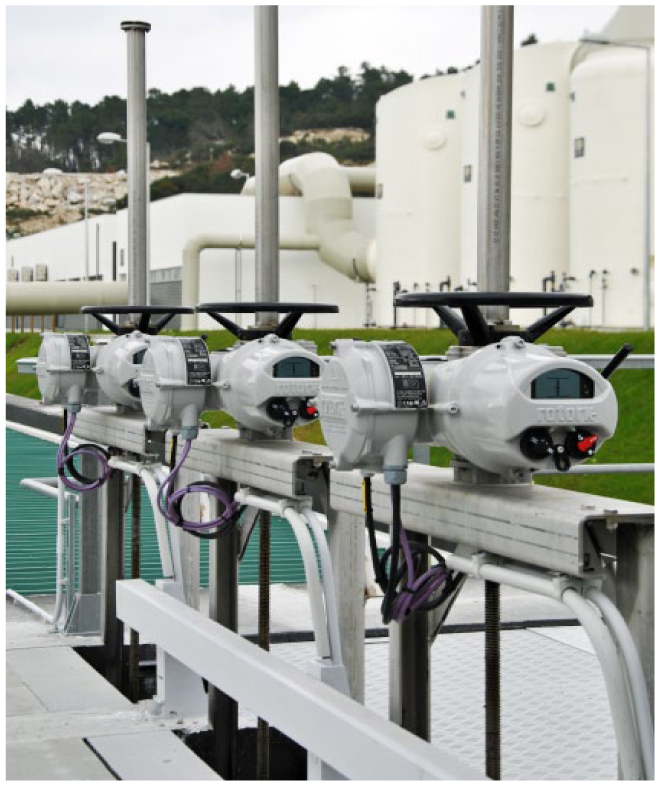
Rotork actuators support Portugal’s plan for wastewater treatment
The Viseu Sul WWTP in Portugal’s Viseu area is the first in Portugal to adopt advanced membrane filtration (MBR) wastewater treatment technology. The automated treatment facility, serving a population of 90,000, was recently inaugurated by the President of Portugal, Marcelo Rebelo de Sousa. The plant is a national environmental benchmark for future developments.
MBR treatment plants work without chemicals and with low energy consumption, using combining secondary and tertiary treatment and eliminating traditional sand and carbon filtration.
Centralised process control and automation at Viseu Sul is facilitated using Profibus DP network technology, utilising Rotork’s multi-turn and part-turn intelligent electric actuators (IQ and IQT respectively) to operate penstocks and butterfly valves for flow control throughout the wastewater treatment process.
The Rotork IQ Profibus DP interface card provides control and feedback data about the valve and actuator using DP-VO cyclic communication. Actuator diagnostics and configuration information is included in the DP-V1 acyclic data supported by the card, enabling valve profiling and diagnostic data to be incorporated into asset management systems.
The new Viseu Sul plant will allow the closure of other treatment plants in the area which do not meet the latest environmental regulations.
Pressings subcontractor replaces CMMs with Nikon video measuring machine
Second-tier supplier of light pressings and small assemblies to the automotive industry, Berck Limited, has invested in a Nikon Metrology iNEXIV VMA-4540 CNC video measuring machine fitted with tactile probing capability.
The new machine has speeded up inspection of 2D and 3D sheet metal components, improved measuring accuracy, and provided quality reports for customers. It also provides detailed historical measurement data to support improvements to manufacturing processes.

Reliable pressure control in oilfield burner management systems
Burners play an integral role in oil and gas production. They generate the heat necessary for separating the oil, gas and water mixture and to keep the gases in their vapour phase during transportation through pipelines. Burners typically use a portion of the gas coming out of the ground as the fuel to produce the flame for heating. The gases extracted from the ground enter the burner skid (commonly referred to as burner fuel train) at a high pressure and hence they need to be pressure controlled for use in burners.
Burners are gas-fired combustors used to generate the heat required for process applications. Separator burners provide heat to separation units such as heater treaters, while inline burners maintain temperature within pipes to prevent hydrate formation. Tank burners to maintain storage tank temperatures. Burners typically operate continuously and play a significant role in upstream oil and gas processing operations.
For burner ignition, a worker will often use a long stick with a burning rag at the end. This is not only dangerous, but also increases unnecessary downtime as the worker has to manually discover when the burner flame is extinguished.
A burner management system (BMS) is an electronic panel for control and monitoring of burner units. The BMS operates as the “brain” of the burner systems as it ensures safe burner start- up, reignites the burner flame automatically if required, monitors the burner and pilot flame, and modulates the burner flame intensity. The BMS can be managed remotely.
However, using a BMS brings its own operational challenges –
– When the crude oil mixture is over-heated in the treater, the intermediates (such as ethane, propane) vaporise and are vented into the atmosphere or flared. When the crude oil mixture is under-heated, water is carried over along with crude due to poor separation. The water has no value and hence reduces the quality of the crude being transported. Both these cases result in revenue loss for the producer.
– The burners that are used in heater treater applications will need to control flame intensity so that the process fluid is heated, stored and transported at an optimum temperature. The Unites States Department of Transportation (DOT) regulations require that the crude oil mixture transported by rail be maintained at a vapour pressure rating of 13.7 or lower and temperature of 110°F.
– Burner fuel gases are typically at high pressure and hence will need to be controlled and regulated before being fed to the main and pilot head of the burner. There is a series of pressure regulators used in controlling the pressure of fuel gas and maintaining the burner flame intensity. It is important to make sure that the regulator’s maximum operating pressure rating suits the operating pressures to be encountered at the intended location of the burner train. Properly selected and installed reliable pressure control elements along with a simplified fuel train should lead to safe and efficient burner operation.

Increasing safety concerns, tightening regulations and industry-wide efforts to achieve greater efficiency are all fuelling a move toward automated control of burners in well pads with burner management systems. It is essential for the safety of the burner train and downstream equipment that the pressure of fuel gas entering the train is controlled appropriately. Careful selection of reliable pressure regulators is essential for optimal fuel train performance.
Nikon video measuring machine measures free-form springs
How do you determine the diameter of a seal energising spring after manufacture? Redditch-based Clifford Springs has established an accurate process using a Nikon Metrology iNEXIV VMA-4540 CNC video measuring machine, installed in May 2016.
To consistently measure in single-figure microns, the optical measuring equipment automatically determines the length of a free-form loop of coiled spring to determine what its circumference will be when it is circular, after which dividing by pi produces a precise result for the diameter.
Clifford Springs uses the unit to count the number of coils per unit length of spring, looped or un-welded, which predicts its load deflection characteristics in use. Compared with the present method of manually counting the number of coils in a given length and using a formula to extrapolate the total number for the whole spring, the optical method will be more precise.

Yokogawa acquires Soteica Visual Mesa, integrates with Industrial Knowledge
Yokogawa Electric Corporation announces has completed the acquisition of Soteica Visual Mesa (SVM), a leading energy management technology provider, expanding Yokogawa’s advanced solution business.
This marks the beginning of the integration of SVM and the cloud-based “Data as a Service” (DaaS) provider Industrial Knowledge (IK) into KBC Advanced Technologies (KBC), which was acquired by Yokogawa in April 2016. The IK business unit was established to enhance the cloud-based advanced solution business based on the technology of Industrial Evolution (IE), which was acquired by Yokogawa in December 2015. IE developed a market-leading real-time DaaS solution that is deployed at many of the world’s major energy and chemical companies.
SVM has a solid track record in the energy management solutions (EMS) field, and provides production accounting and scheduling solutions to the refining industry.
By leveraging KBC’s premier energy consulting and Visual Mesa, SVM’s best-in-class real-time energy optimisation technology, the combined entity will be able to expand its position in the rapidly growing EMS market in the process industries.
In the immediate term, SVM’s advanced Visual Mesa utility optimisation software combined with KBC’s premium energy consultancy will provide comprehensive and best-in-class energy management solutions, underpinned by leading technologies and human performance improvement. Over the longer term, this acquisition supports KBC’s vision of seamlessly integrating utility system and supply-chain optimisation into KBC’s industry-leading process simulation platform for hydrocarbon processing facilities, Petro-SIMTM.
KBC, SVM, and IK will be led by KBC Chief Executive Officer, Andy Howell, and will be integrated under the KBC brand. This will significantly enhance KBC’s solutions portfolio and the energy management solutions business, enhance KBC’s ability to develop new cloud-based services, and accelerate KBC’s efforts to create and sustain new value for customers.