



Abstract

Research on Low-Voltage Motor Market Produced by IHS Markit
Since the third quarter of 2014, the low-voltage motor market (defined as integral horsepower motors rated at or below 690 V) has been in decline. According to the latest IHS Markit information, the global low-voltage motor market will decline nearly 13%, from US$11.8 billion in sales in 2015 to US$10.3 billion in 2017.
Despite this challenging environment, there are opportunities for motor suppliers that can adapt to the impending technological trends suppliers require. For example, motor end-users are increasingly interested in energy-efficient motors that will live longer and reduce full lifecycle costs. As the Industrial Internet of Things (IIoT) continues to grow in customer recognition and adoption, motor manufacturers are also starting to find ways to leverage this trend to offset weak sales.
While heavy industries exposed to oil and gas investment levels are not currently good areas for motor growth, there are still several industry sectors that have outperformed – or that will outperform – the market average in the short-term. For example, the US housing market is expected to experience strong growth, as is non-residential construction spending, which bodes well for motors sold into construction, infrastructure and HVAC (heating, ventilation and air conditioning) applications.
A fast-growing population and rapid urbanisation is also expected to cause motor shipments for food and beverage, water and wastewater, and power sectors to outperform the market average. In general, the discrete manufacturing (machine builder) sectors are forecast to perform better than the process manufacturing (end-user) sectors.
After accounting for more than 26% of revenues in 2015, IE1 (standard efficiency) motors are forecast to comprise 25% of global low-voltage motor market revenue in 2016 and 16% by 2020. These products are sold mainly in emerging markets that have yet to adopt any type of efficiency regulations; however, many leading suppliers are still successfully selling these motors in the United States, Germany and other developed countries.
As emerging and developed regions continue to push for more efficient motors, IE2 (high efficiency), IE3 (premium efficiency) and IE4 (super-premium efficiency) motors will continue to experience growth with revenue CAGRs of 1.6%, 4.8% and 11.3%, respectively. However, as IE4 motors account for 1% of total motor market revenues, it will take a long time for this technology to become a dominant trend.
Acquisitions and strategic partnerships, with increased research and development, have allowed the leading motor manufacturers to better position themselves for the future. Even though the low-voltage motor market is not currently thriving, today’s technological developments could be the norm for motor users in the near future – but only the companies that can adapt will be prepared for such rapid changes.
Siemens Provide Control System for SBB for the Gotthard Tunnel
Siemens has supplied the tunnel control and fire protection systems for the world’s longest railway tunnel, the Gotthard tunnel. More than 200 trains a day will travel through the tunnel at speed up to 250 km/h. The tubes are connected every 300 m by crosscuts that allow train passengers to escape to the other tube in case of a fire.
The cross ducts are equipped with Simatic ET 200S distributed controllers with integrated interface modules IM151. Each controller communicates via Scalance S602 routers using Ethernet connectivity, with seven group computers per tunnel tube, that in turn communicate with two redundant head computers that display the data to the operators in the control room. A ‘hot spare’ group computer provides redundancy in the event of failure, taking over the relevant cross ducts in minutes.
The hardware is controlled by WinCC OA software. Screen views that conform to the high-level tunnel hardware in use were adapted to the layout of the control system of tunnel operator SBB.
Each cross duct has its own IP address. Within the cross duct, the devices have private addresses that can be reached using network address and port translation (NAPT). The Scalance routing technology supports an ‘island’ design for each cross duct – function modules of the same type always have the same IP address, regardless of the cross duct in which they are located. This achieved a reduction in the need for IP addresses and simplifies programming and configuration of the controllers.
Communication between the group computers and the cross ducts is via a virtual private network (VPN), providing security.
The control system monitors all installations automatically. Video cameras at multifunction points are connected by optical fibre to two-tunnel control centres located at the north and south entrances of the tunnel. Siemens has installed a tunnel control system in each centre, with each system acting as a reserve for the other.
The movement of each train is recorded and displayed in the control centre. The system can control infrastructure throughout the tunnel − 3200 km of electrical cable and 2600 km of data cable. It detects a door that has not been closed properly or a light that has failed. When required, the ventilation system is activated, the light at the next emergency stop point is switched on and the doors are opened automatically.

The system provides information and decision-making steps for each stage for SBB, classified according to five alarm stages. Sensors check the trains for overheated brakes and leaks before they enter the tunnel and without requiring them to stop. The new system reduces downtime and improves the availability of services through the tunnel.
Senseye Launches Its Prognosys Monitoring System at Deep Tech
Senseye, the ‘uptime-as-a-service’ company, revealed its Prognosys monitoring system at the NMI Future World 2016 ‘Deep Tech’ Conference in London in September.
The Prognosys provides a predictive maintenance service by automating analysis of condition monitoring, and diagnosing current and future failures automatically. The software is cloud-based and easy to use, and helps forecast failure, reduce unplanned downtime and costs.
The Industrial Internet of Things (IIoT) generates huge amounts of machine condition information, but this has been largely untapped due to human and technical limitations. At the Deep Tech Conference, Senseye described the disciplines of condition monitoring and prognostics and how they are being shaped by advances in cloud-computing, machine learning and artificial intelligence.
Senseye is offering a free assessment of how much manufacturers could be saved with their cloud-based, easy-to-use diagnostics, prognostics and condition monitoring product.
Future World is a conference for entrepreneurs and businesses engaging in ‘Deep Tech’. These developments are consistently introducing disruptions across domains from agriculture to medical, industrial to fashion and so on.
Zika Vaccine Development Receives Big Boost from Innovate UK
The further development of a promising Zika vaccine candidate by Themis Bioscience has received strong support by the United Kingdom’s innovation agency, Innovate UK. Themis, a Vienna-based specialist for vaccine development, will receive £1 million to support the further development of this prophylactic vaccine and to conduct a phase 1 clinical trial.
The vaccine candidate is based on Themis’ proprietary Themaxyn platform that uses a well-established measles vaccine vector. The core technology has been developed at the Institut Pasteur, France.
The company’s team had tested a number of candidate vaccines in animal models and has already initiated a toxicity study and GMP manufacturing. Innovate UK is supporting a phase 1 clinical trial and development of a thermostable formulation for the vaccine.
Themis provides a validated and cost-efficient production process for its vaccines, allowing rapid upscaling of production once the vaccine candidate has been determined. This is critical for a vaccine that is supposed to combat diseases such as Zika from spreading in highly populated areas.
The measles vaccine has already proven its high efficacy and safety on well over a billion individuals over the last 30–40 years, and the technology offers an excellent safety profile. Under the terms of a broad license agreement with the Institut Pasteur, Themis owns the rights to use the measles vector for a wide range of indications including Chikungunya and Zika.
WAGO Uses Spelsberg Enclosures for New Pre-Mounted Products Available from Screwfix
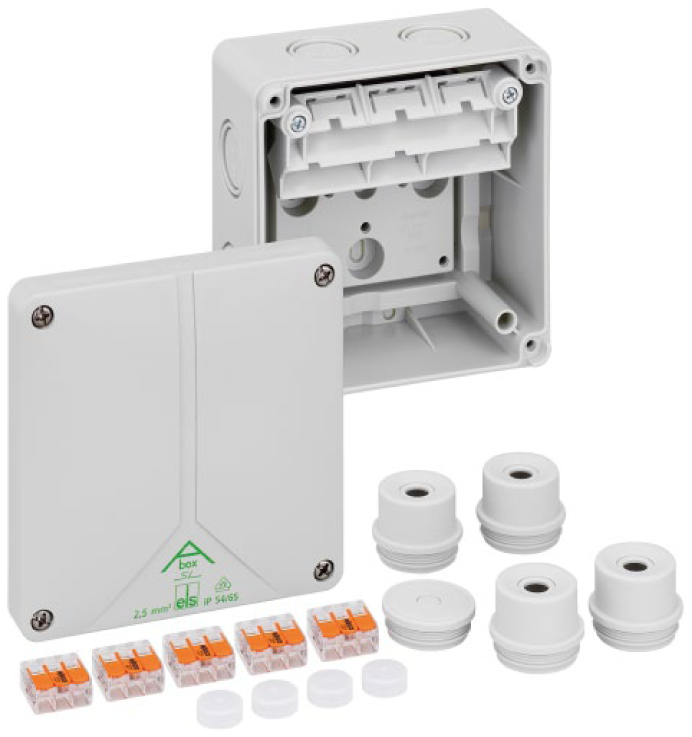
Wago, the terminal and electrical connector supplier, has announced that its terminals and conductors can now be bought pre-mounted in a Spelsberg A-Box enclosure. The range is now available from Screwfix.
The Spelsberg range was chosen for its quality and the flexibility of the available dimensions.
Paul Witherington, UK and Ireland Marketing Manager for WAGO, explains, ‘By supplying our products pre-mounted we have simplified the job of the electrician, as they just need to fix the enclosure to the wall or DIN rail and then push the conductor into place – job done’.
Spelsberg’s A-Box enclosure range has been specified to offer high quality, IP65 protection, Wago’s ‘Topjob-S’ range of terminals and 222 series of connectors. A specialised carrier mounting has been developed to perfectly accommodate the components, making best use of the space available inside the enclosure. Cable glands are also supplied.
The pre-mounted junction boxes are available from Screwfix and most other leading distributors.
Ulis Launches Micro80 Gen2 Thermal Sensor
Ulis, a manufacturer of innovative thermal sensors for the surveillance, thermography, firefighting, outdoor leisure and automotive markets, has launched the Micro80 Gen2, an advanced functionality thermal sensor.
The unit features a ball grid array infrared sensor box, packaged in a Jedec tray, and was designed using unique wafer-level packaging with vacuum technology. The unit can support optical fields of up to 120°. The unit also features an infrared sensor with a plastic lens holder.
The digital Micro80 Gen2 supports standardised interfaces and consumes less than 55 mW. The unit supports a broad spectrum of frame rates (from 1 to 50 Hz) and allows vision up to 150 m.
Cyrille Trouilleau, product manager at Ulis, said, ‘The introduction of these features is the first step towards the widespread use of thermal sensors in smart building management systems’.
The unit can distinguish humans from animals or robots in all weather and lighting conditions – without compromising privacy. This makes it ideal for occupancy detection in connected buildings, among other potential applications.

Siemens Real Estate Deploys Planon Real-Estate Management Software Worldwide
Siemens Real Estate (SRE), through its ‘ONE Global’ project that is designed and standardise global real-estate processes, has chosen to deploy Planon’s ‘Accelerator’ software worldwide. Planon’s Accelerator incorporates computer-aided facility management (CAFM), which delivers efficient management of the real-estate lifecycle.
The cloud-based software will be integrated with Siemens’ wider IT landscape, with the overall aim of implementing a global, uniform, central and integrated system that will support SRE business processes. SRE currently manages 15 m2 of office, industry, production and specialist space at over 2400 Siemens AG locations worldwide.
Accelerator also includes a wide range of pre-configured and integrated standard business processes, and it connects all real-estate operations on a central platform. The software is based on facility management best practice, gained from over 2000 successful implementations worldwide and pre-configuration ensures fast setup.
Anritsu Introduces Tri-Wavelength OTDR Module for Network Master Pro
Anritsu Company has introduced a tri-wavelength OTDR module for its ‘Network Master Pro’ MT1000A portable optical tester for core, metro and mobile networks. The new module supports high dynamic range at all wavelengths up to 1625 nm, which allows the unit to conduct extra sensitive tests to ensure the performance of today’s high-bandwidth networks.
With the new module installed, the unit can achieve a dynamic range of 46 dB at 1310 and 1550 nm, and 44 dB at 1625 nm, for the production of highly accurate macro-bend detection in single-mode fibre applications.
The module also features Anritsu’s ‘Fibre Visualiser’, a fault location function that simplifies the testing process. Fibre Visualiser selects the testing parameters to ensure the proper setup and provides a graphical summary of the fibre under test quickly. Fibre Visualiser also has individualised ‘pass/fail’ for simpler fibre optic testing.
The module includes a ‘construction OTDR’ mode, providing an automated method of testing numerous fibres at multiple wavelengths during cable installation. A single setup screen starts a testing wizard, ensuring all fibres are tested and results stored using consistent file naming. Additionally, a bi-directional measurement function has been added for event loss analysis.

The Network Master Pro MT1000A comes with an easy-to-use GUI and clear summaries allowing users of any skill level to operate the instrument. A multifunction tester, the MT1000A, is field upgradeable and can be configured with a number of OTDR modules and transport testing functions, including RFC2544/6349, Y.1564, OTN and CPRI/OBSAI.
ARC to Hold European Industry Forum for IIOT, Industrie 4.0 Experts
On 16 and 17 May 2017, ARC Advisory Group will host its ‘European Industry Forum’ (EIF) at the Meliã Hotel Sitges in Spain. The European Industry Forum is part of ARC’s successful series of worldwide conferences in the United States, India, China and Japan.
Participants are invited to attend sessions in which ARC analysts and other automation experts will analyse trends and drivers in manufacturing and tell the inside story of successful operations and applications, such as industrial analytics, cyber security and ‘Industrie 4.0’ applications.
To book your place, go to http://www.arcweb.com/events/arc-industry-forum-europe
Yokogawa Releases PRM R3.31 Software
Yokogawa Electric Corporation today announced the release of version R3.31 of its ‘Plant Resource Manager’ (PRM) software tool for the centralised management of large amounts of data from plant monitoring and control devices and manufacturing equipment.
PRM R3.31, an upgrade to R3.30, enables PRM to link with a computerised maintenance management system, and a new data display function enables field maintenance personnel to access data for locating and responding to device failures. With this latest PRM release, Yokogawa aims to offer customers a solution that enables their maintenance personnel to work more efficiently.
This latest version of PRM links the software to a computerised maintenance management system that is used to draw up maintenance plans and manage the progress of maintenance tasks. With this new PRM version, field maintenance personnel can access key performance indicator (KPI) reports on device availability and other indices that until now have been mainly available for use by management.
The PRM works with ‘Maximo’, an IBM maintenance solution. Upon detection of a device failure, PRM issues an instruction to Maximo to draw up a task plan and begin the process of managing the progress of task execution. With PRM R3.31, a symbol (maintenance mark) is displayed over the device icon in the device navigator window – this communicates the current state of the task that is being managed by Maximo. PRM R3.31 is compatible with the latest Maximo versions, 7.5 and 7.6.
Field asset KPI reports contain data about the availability of instruments, the number of instruments that are in an abnormal state, warning status, other states, and the number of alarms and events and their ranking. With PRM R3.31, maintenance personnel can now directly access field asset KPI reports via the PRM user interface, and this information can be used to detect potential device abnormalities, identify and analyse failures, and consider necessary countermeasures.
PRM is compatible with Yokogawa’s ‘Centum’ integrated production control system. When PRM R3.31 is linked to Centum using the Hart communications protocol, failures and other device statuses can be quickly identified.
FLIR Systems to Acquire Point Grey Research
FLIR Systems has announced that it has reached a definitive asset purchase agreement to acquire the business of Point Grey Research, a leading developer of machine vision cameras for use in industrial, retail, scientific, traffic, mapping and other advanced imaging applications, for approximately US$253 million in cash.
Founded in 1997 and based in Richmond, British Columbia, Point Grey is a global leader in the development of advanced visible imaging cameras and solutions used in industrial automation systems, medical diagnostic equipment, people counting systems, intelligent traffic systems, military and defence products, and advanced mapping systems. Point Grey designs, manufactures and distributes its cameras and related software to a global base of customers that build systems for improving the efficiency, quality, analysis and safety of a wide range of processes and products.
The addition of the Point Grey business will augment FLIR’s existing OEM cores and components business by adding a broad range of visible spectrum machine vision cameras and solutions. Additionally, FLIR’s thermal sensor technology, with its unique ability to remotely measure temperature, see through factory obscurants such as smoke and steam, and accurately detect and characterise human activity in retail settings, will further extend Point Grey’s product range into new application spaces. The business will become FLIR’s integrated imaging solutions line of business operating within the OEM and emerging segment.
Andy Teich, president and CEO of FLIR, said Thermal imaging technology provides vision systems customers an alternative imaging spectrum that offers a rich, largely untapped layer of information that can be further leveraged. Point Grey is a proven, high-performing business with an impressive set of products, customers, processes, and people, all of which we see as being highly synergistic and strategically significant to FLIR.
The transaction is expected to be completed in the fourth quarter of 2016.
WDS Expands Safety Quick Release Pins Range
WDS Component Parts has updated its range of safety quick release pins with the introduction of 13 new sizes. The new parts are available in 5, 6, 8, 10 and 12 mm diameters and shaft lengths from 20 to 80 mm (total lengths from 49 to 123.3 mm). Weights vary from 24 to 129 g.
Each pin’s release button is recessed so that it cannot be pushed accidently, and they are designed for simple fastening and adjusting. To make their extraction equally easy, each pin is fitted with a pull ring.
To ensure the pins are robust and suitable for duties that can be safety critical, the pins are made of hardened high-tensile stainless steel. This makes them highly corrosion resistant and therefore suitable for use in environments such as marine and shore-side, in food processing and handling operations, and industries where wash-downs using water, steam or chemicals is frequent.
The pin bodies are in 14-4 PH grade, 303 grade is used for the spindle, button and handle, while the spring is formed from 304 grade.

The safety release pins are part of WDS’s location and positioning parts range, which also includes dowel pins, stepped location pins, index plungers, lanyards and retainers, removable location pins, ball reference pins, ball lock fixturing pins, spring loaded stops, jig location elements, set collars and tenons. Like all WDS products, the new pins are manufactured to appropriate, accredited standards including BS EN ISO 9001, RoHS, WEEE and ISO 19001.
Anritsu Shows MP1800A PAM4 BER Test Solution at ECOC 2016
Anritsu Corporation demonstrated the signal quality analyser MP1800A series 64-Gbaud PAM4 BER test solution at the ECOC 2016 show in Düsseldorf, Germany, in September. The demo included the G0374A 64-Gbaud PAM4 DAC supporting 53.125-Gbaud PAM4 transmissions defined by the next-generation 400 GbE standard, as well as generation of high-quality PAM4 signals up to 64 Gbaud. Additionally, 400 GbE 53.125-Gbaud BER measurements are supported as a BER measurement set with high-input sensitivity.
The next-generation of 400 GbE Ethernet standard uses the pulse-amplitude modulation (PAM) method to increase data transfers per unit time by increasing the symbol rate and adding more lanes. PAM4 signals have an advantage over non-return-to-zero (NRZ) signalling by doubling the amount of data transferred per unit time; however, they can also result in technical issues such as lowering power consumption and increasing the signal-to-noise (S/N) ratio; these tests require high-quality signal sources and high-input-sensitivity measurements.
Anritsu’s MP1800A series supports the evaluation of devices and optical modules meeting the latest communication standards, including high-baud-rate NRZ and PAM4 methods as well as BER measurements using G0374A 64-Gbaud PAM4 DAC and MP1862A 56G/64 Gbit/s demux.
The unit is a plug-in module–type bit error rate tester (BERT) that can generate up to eight channels of synchronised signals using the 32G multichannel PPG module. The G0374A that was demonstrated at ECOC is an accessory for the MP1800A series that, when used in combination with the MU183020A 32 Gbit/s multichannel PPG, generates 64-Gbaud NRZ/PAM4 signals by simple conversion of half-rate 32-Gbit/s NRZ signals.

The G0374A can also be combined with the MP1862A 56G/64 Gbit/s demux and MU183040B 28G/32 Gbit/s high-sensitivity ED to support BER measurement of high-baud-rate PAM4 signals.
How to Architect Your Systems to Get the Most Out of Your Modbus Devices
Modbus is the lifeblood of a large number of automation applications. This de facto industrial communications protocol, featuring a master–slave architecture, has two major formats – Modbus RTU and Modbus TCP, a modified version of the former.
Both formats fulfil the same functions. Modbus RTU is used in serial communications (RS-232 or RS-485), while Modbus TCP is used for TCP/IP networks.
Many field devices support Modbus RTU protocol because it is easy to implement and allows troubleshooting at a very low cost – which explains why Modbus RTU has become so popular. As more and more industrial applications continue to migrate to Ethernet to fulfil more complex networking needs, many systems now use Modbus TCP in SCADA (supervisory control and data acquisition) software. An unfortunate outcome is communication issues between Modbus RTU and Modbus TCP protocols.
Connecting Modbus-supported devices to SCADA systems raises challenges. The first challenge is the oversupply of proprietary SCADA software on the market. Each software programme brings different levels of support for Modbus drivers to the market, making it harder for system operators to match the right product with their requirements.
Another challenge for system operators is managing a large number of serial devices over a TCP-connected architecture.
SCADA software providers abound in the marketplace; each of them offers different capabilities to support Modbus drivers. Pinpointing your system’s exact requirements is crucial to select the most suitable software. You don’t want to fumble around afterwards with interoperability issues once you have connected your Modbus RTU-supported serial devices to an Ethernet network:
A SCADA host with a Modbus TCP driver. A protocol conversion gateway can be used here. With a gateway’s help, you can use Modbus TCP protocol to communicate with Modbus RTU-supported devices. When the gateway receives the Modbus TCP request, it converts the packet to a Modbus RTU packet and sends it to the Modbus RTU-supported devices immediately.
A SCADA host with a Modbus RTU driver, with built-in serial port. For some reason, an existing SCADA host with built-in serial ports and Modbus RTU-supported devices cannot be changed, but both ends need to be bridged by an Ethernet network. In this instance, you can use a pair of gateways to enable connectivity. The gateway converts the Modbus RTU packet into a Modbus TCP packet and back to a Modbus RTU packet.
A SCADA host with a Modbus RTU driver, without a built-in serial port. A serial device server can be used to build a virtual serial port on the remote serial device server connected to your serial devices. To enable the virtual COM port, the serial device server must be configured to virtual COM mode. Since you can use the virtual COM port in the same way as a native local COM port, you can send the Modbus RTU request to the COM port directly, just as you would if it were a physical COM port.
A SCADA host with an Ethernet encapsulation driver. An alternative to a built-in or virtual CON port is an Ethernet encapsulation driver if your SCADA software supports it. Ethernet encapsulation drivers are the best option if you have an in-depth knowledge of serial and TCP/IP networks. The serial device server is configured with raw socket mode or tunnelling mode selected, using transparent TCP/IP or UDP communication. Care should be taken over interval timeouts when configuring the serial device or the Modbus RTU packet may be divided into two or more TCP/IP or UDP packets, and the incomplete packets will be dropped.
Most gateways provide flexible solutions to plan efficient TCP connection architectures for multiple Modbus RTU-supported devices connected to the different serial ports of a gateway:
Link a serial port to a unique TCP port. In this gateway configuration, each serial port will be identified by one unique TCP port. In this topology, the SCADA driver needs to build multiple Modbus TCP connections.
Link a serial port to a unique IP address. This is very similar to the previous mechanism, except the gateway uses different IP addresses. If you want to communicate with Modbus RTU-supported devices on serial port 1, you need to build a Modbus TCP connection to 192.168.2.1 with TCP port 502. The gateway will transfer the Modbus packet by TCP connection between 192.168.2.1:502 and serial port 1. In this topology, the SCADA driver also needs to build multiple Modbus TCP connections.
Use a routing table. This topology uses a single connection to communicate with multiple devices. To make sure the request can be transferred to the correct serial port, both the gateway and the routing path need to be configured properly. The drawback of this mechanism is that this topology only uses one connection, and so will be slower than the other solutions.
Although serial device servers can also connect Modbus RTU devices to an Ethernet network, a gateway solution can meet almost every system requirement. A designated gateway may involve a larger initial investment, but it provides more stable communications in the long run, and it can recognise Modbus packets to properly handle entire packets.
Optimisation of Expanding Radio Access Networks Boosts Demand for Testing
The rapid proliferation of long-term evolution (LTE) deployments around the world is intensifying network operators’ need to manage their infrastructure better. Testing vendors are developing smarter solutions which perform better measuring and plan for capacity expansions in radio access networks (RAN). These solutions can reduce capital investments in network procurement and operating expenses by optimising the utilisation of network elements and forecasting network needs with a greater degree of accuracy.
‘Analysis of the Radio Access Networks (RAN) Capacity Planning and Management Market’ is the new study of this market from Frost & Sullivan. The study also covers subjects such as aerial inspection, corrosion monitoring, Wi-Fi test equipment, analytical instrumentation and process analysers.
Measurement & instrumentation programme manager Olga Yashkova said, ‘Implementation of sophisticated traffic management solutions enhances network capacity and, in turn, enrich end-users’ quality of experience and service. These solutions collectively support RAN capacity planning and management and could widen the profit margins of operators’.
The advent of 5G and advances in software-defined networks (SDN), virtualisation of network functions, the Internet of Things (IoT) and the proliferation of self-optimising networks (SON) will all bolster the RAN capacity planning market.
However, inadequate end-user expertise in incorporating solutions onto the network infrastructure and the use of function-rich network elements by network operators, particularly in Asia-Pacific, could somewhat curb the potential of smarter third-party solutions. The presence of established participants with end-to-end solutions also raises market entry barriers.
‘By increasing the utilisation rates of individual network elements, solution providers will gain more market share from network equipment vendors’, said Yashkova.
Both testing and network equipment vendors can resolve this issue by collaborating with each other, as partnerships will increase the reliability of network elements and enhance the presence of RAN capacity management solutions across geographies. Smart RAN capacity management solutions will further help address the high costs of human capital for network operators.

RAN capacity management solutions promise high adaptability for operators due to the renewed focus on network automation. By 2020, Frost & Sullivan project that the market will grow to an estimated US$659.3 million. This translates into a healthy double-digit compound annual growth rate (CAGR) of 19.1% between 2015 and 2020.
Anritsu Launch Network Installation and Maintenance Roadshow in Europe
Anritsu Corporation are rolling out their ‘Network Installation and Maintenance Roadshow’ to engineers at 33 events in 15 countries across Europe. These events are designed to update engineers with the latest technologies in the telecom infrastructure environment. Each event takes the form of a one-day seminar and is divided into four parts:
Future technologies of telecom network architecture;
CPRI and RF over CPRI measurements;
OTN and transport network measurements;
RF interference hunting and over the air measurements.
With the ever-changing developments in cloud-based solutions, the ‘Internet of Things’, machine-to-machine communication, autonomous vehicles and the advent of 5G, topics covered at the events will include the following: mobile network evolution and the move away from copper, best practices for RF over CPRI measurements, the evolution of OTN test needs and testing of Ethernet links above 100 GbE, and changes in the RF spectrum that are driving the need for more interference hunting.

The roadshow began in Finland in September, with events continuing until February 2017.