



Abstract

Keepixo Launches Broadcast Quality Over-the-top Technology Transcoding on Kontron Platform
Kontron, a global provider of embedded computing technology (ECT), and Keepixo, a provider of software-based head-end solutions for Internet protocol television (IPTV) and over-the-top technology (OTT), have announced a joint collaboration to launch a new high-density OTT transcoding solution that combines the Kontron SYMKLOUD series of converged infrastructure platforms and Keepixo’s Genova software suite for OTT services.
Using the latest server CPU architectures with on-chip graphics media processing acceleration, the combined solution is able to transcode up to 144 high-definition (HD) channels in two rack units (2U) while consuming less than 8 W per transcoded service. This server supports broadcast-grade feature sets such as popular subtitle and closed-caption formats and OTT streaming protocols.
High-density video transcoding introduces various levels of hardware (HW) acceleration to off-load computationally intensive tasks. Keepixo’s Genova software suite makes use of media processing acceleration for low-level encoding operations while keeping full control of high-level tasks such as encoding strategy, to create the video quality required for professional applications.
Genova software family is a cloud-ready, software suite targeted at content and service providers. It includes all the components needed to build a multi-screen video workflow for OTT and IPTV services. Genova includes a multi-rate live encoder, file transcoder for video-on-demand (VOD) assets and a multi-format OTT packager.
As a 2U converged infrastructure platform, the unit combines high-density computing, storage and redundant network switching in a scalable footprint. The hybrid design approach combines carrier-grade high availability features with the cloud economies of scale of standard information technology (IT) hardware. Up to 18 Intel Xeon or Core-i7 processors are supported across nine modular servers in a compact – short-depth 2U – enclosure.
Enhancing Flaw Inspection with the Olympus IPLEX NX
The IPLEX NX is Olympus’ new flagship industrial videoscope that delivers high image quality and manoeuvrability to help locate flaws and streamline inspections even in the most difficult-to-reach areas.
The unit includes an industry-leading high-pixel charge-coupled device (CCD) chip, an ultra-bright laser diode light system and Olympus’ ‘PulsarPic’ processor to reduce signal noise and deliver clear, bright images.
The image quality and ultra-bright illumination make it easy to inspect a large area for small, subtle flaws. The videoscope can capture crisp images even in hard-to-access spaces, such as the interior of gas turbines, where external lighting cannot reach. The fine tungsten mesh insertion tube combines superb scope manoeuvrability with optimised rigidity and flexibility making it easy to navigate in tight spaces while maintaining outstanding abrasion resistance.
The distal end of the insertion tube is highly flexible and capable of making complex bends to arrive at hard-to-reach areas. Olympus’ pioneering ‘TrueFeel’ electric articulation is enhanced with reduced mechanical lag and greater sensitivity giving the NX ultra-responsive articulation and an increased range of articulation in four directions.
With powerful measurement tools, the IPLEX NX facilitates quantitative flaw evaluation and robust record keeping. Multi-spot ranging is the industry’s only tip-to-target measurement tool. The improved multi-spot ranging function measures the distance from the scope tip to five points on the surface, providing real-time surface shape information for faster inspections.
The IPLEX NX stereo measurement function has also been upgraded and features an inspection area four times larger than other videoscopes in the IPLEX series. The ghost imaging feature provides reliable inspection record keeping and defect monitoring by overlaying images captured during previous inspections with a current inspection image so users can quickly view how flaws have changed over time.
Intuitive software, available Wi-Fi functionality and advanced image processing maximise the IPLEX NX’s efficiency. The device is controlled via a vivid 8.4-in removable daylight view colour touchscreen that is clear and readable in any light. With optional Wi-Fi, inspectors in the field can wirelessly stream images and data back to the office for real-time collaboration. In addition, the image processing software uses a dot-by-dot transfer from the image sensor directly to the monitor for improved picture quality.

Operators can quickly recall and give titles to captured images directly from the device console. Olympus’ optional ‘InHelp’ data management and reporting software saves images in folders organised by inspection area so that the right image is easily recalled. In the office, recorded images can be displayed on a PC complete with comments and measurement information. The software can also generate customisable report templates that contain all the information necessary for inspection record keeping and archiving.
Pentair Expands Flexible Aisle Containment Range
Pentair has expanded its flexible aisle containment concept. Schroff aisle containments can now be integrated with cabinets of various designs and heights or adapted to accommodate special structural conditions.
Using the flexible aisle containment concept, Original Equipment Manufacturer (OEM) cabinets can also be integrated with ease. The Pentair universal profile can be used to quickly implement completely free-standing aisle containments or aisle containments consisting of only one cabinet row and also systems of various aisle widths.
Air management, the consistent separation of cold and warm air in the data centre, has now become the preferred method in optimising efficiency and energy. Furthermore, Pentair is actively involved in an International Electrotechnical Commission (IEC) standards committee focusing on the standardisation of aisle containments. Here, focus is not only placed on physical dimensions, but also increasingly on the quality of the separation as well.
An example is the 1200-mm aisle width, which is now common on the market and corresponds to the width of two double base plates. Generally, it provides sufficient freedom of movement for installing equipment and supplying air through the double base plates. The Pentair product portfolio contains standardised Schroff aisle containment components that make it possible to easily plan and quickly implement complete aisle containments, as well as allow flexibility for special customer requests – 1400 mm, 1800 mm or aisle widths up to 2400 mm have already been implemented in customer projects.
An important component in this process is the aluminium universal profile used by Pentair. This also makes it possible to design an aisle containment with only a single cabinet row. Here, the universal profiles can be fixed to the wall of the computer room using a special assembly kit that provides a fastening surface for aisle containment doors and covers, ensuring optimal use of space.
The free-standing aisle containment is another option. Here, the universal profiles are screwed on using linking elements, forming a horizontal and vertical substructure for the aisle containment components. This solution can be used both for the implementation of single-row aisle containments and for the integration of OEM cabinets supplied by the factory. Using this concept, structural conditions such as supporting columns are no longer an obstacle for implementing aisle containments.
This flexible concept can be used to meet requirements for all conditions found in real-world applications. Custom aisle containments can be implemented quickly with very minimal modification thanks to the use of a high proportion of standard components.
Harting Introduces Connector with Integrated Ethernet Switch
Harting has launched a new connector which incorporates an integrated Ethernet switch. The new US4 connector is the first device in which switch functionality resides directly in the connector, making it possible to network four Ethernet/IP or PROFINET nodes with transmission speeds of up to 1000 Mbit/s.
The US4 connector features integrated light-emitting diodes (LEDs) to provide power and network diagnostics for individual ports, displaying both the presence of the Ethernet connection and on-going data exchange and the associated speed information.
The module automatically detects the line speeds of connected devices and autonomously corrects polarity errors in wire pairs, reversing the polarity of the data signal. It also allows two connected Ethernet nodes to autonomously negotiate and configure the maximum data transfer rate – up to 1000 Mbit/s incrementally – as well as the type of transmission, that is, half-duplex or full duplex.
The US4 switch seamlessly integrates into existing ‘Han-Modular’ systems, with the interfaces required to extend an Ethernet network into existing modular connectors.

The module helps save space since it can be integrated into a plug connection with the ‘Han-Modular’ frame with no additional components required. Other features of the new switch include an option for the prioritisation of data packets, integrated reverse polarity and overvoltage protection and high data throughput. A 10- to 30-V direct current (DC) power supply adapter is also available.
Accutronics Upgrade Battery Testing Capabilities
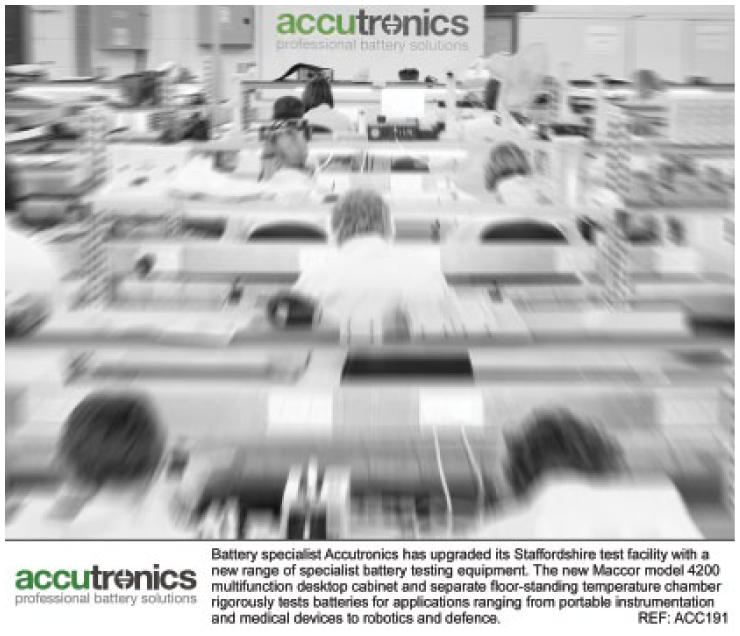
Battery specialist Accutronics has upgraded its Staffordshire test facility with a new range of specialist battery testing equipment. The new Maccor model 4200 multi-function desktop cabinet and separate floor-standing temperature chamber rigorously test batteries for applications ranging from portable instrumentation and medical devices to robotics and defence.
Installation of the new test equipment will enhance the company’s in-house testing capability and further highlight Accutronics’ commitment to sustainable battery development.
Using the latest high-precision automated testing software, Maccor’s model 4200 is designed to test batteries of various chemistries as well as super-capacitors and fuel cells. Supplied complete with software, tester PC and PowerPole interface for easy cable and holder connection, the user can configure the Model 4200 in up to 16 multi-current range channels.
For batteries used in extreme hot and cold environments, the Maccor temperature chamber can test batteries from −20 °C to +100 °C. Able to incorporate up to 32 chambers into a single automated test system, the unit is compact enough to fit on a bench top and is accurate to a temperature uniformity and accuracy of ±8 °C.
The new test equipment has reduced design times and uncertainty in the development process and improved the final performance verification phase.
Accutronics can also more closely match cell selection with customer requirements by choosing a more optimal balance of cost, cycle life, rate capability, charge time, stored energy, temperature and storage performance, ultimately cementing Accutronics’ commitment to sustainable battery development.
New Miniature Angle Encoder Introduced by Heidenhain
A miniature encoder for measuring angles to a high degree of precision has been introduced by Heidenhain. Designated the ERO 2000, the angle encoder was originally designed for use with galvanometer motors, that move mirrors and provide positional feedback in laser applications involving beam steering, microscopy or marking.
Other uses are to be found in small measuring arms, for positioning piezoelectric motors, and in micro-systems such as goniometers for determining the angle between the faces of a crystal or a blade edge.
The encoder does not have an integral bearing, resulting in low start-up torque, absence of heat generation from friction, direct coupling of rotor and stator to the host equipment, greater reliability and minimal maintenance. The comparatively large mounting tolerances and the possibility of adjusting both the incremental and the reference-mark signals make assembly easy.
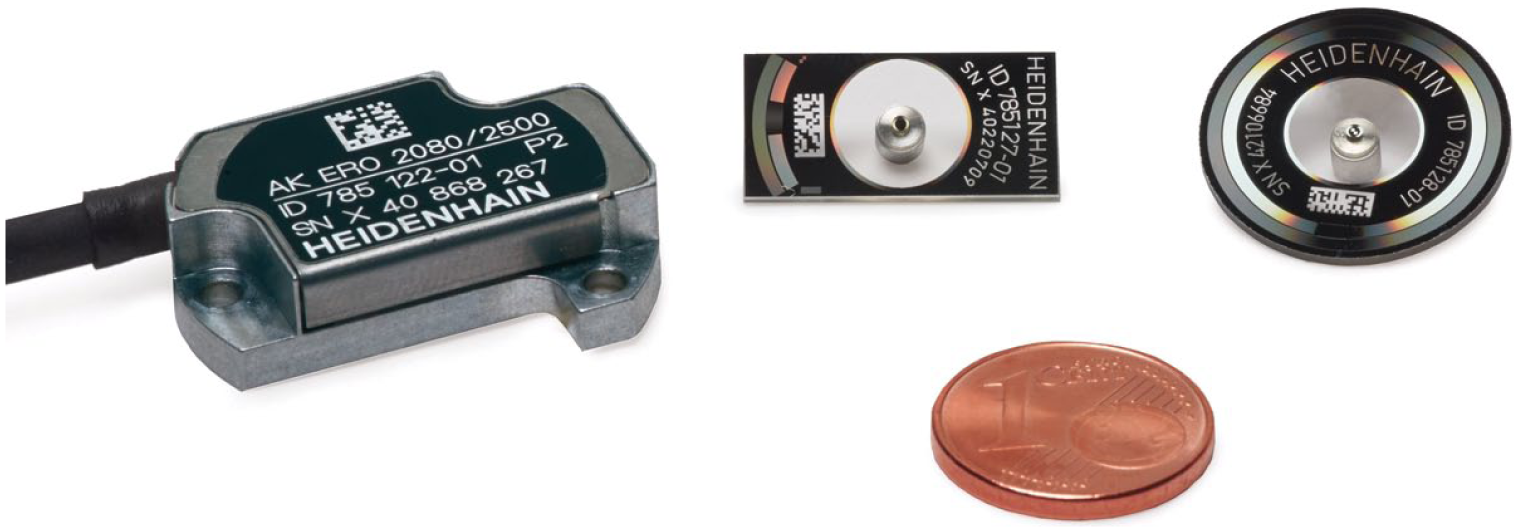
The hub is fixed to the low-inertia circular scale, making the latter easy to adjust, whether its specification is 360°/2500 line count/18.6 mm diameter, or a 45° segment. Customised and application-specific versions are available, in particular with regard to the design of the hub and scale assembly.
The 5 V DC scanning head generates a 1 peak-to-peak voltage (Vpp) sinusoidal voltage signal and operates at up to 14,000 r/min. Excellent thermal stability is claimed between the extremes of operating temperature, which are −10 °C and +70 °C.
The unit is the first of what will be a product family by the end of 2016. The range will comprise models with line counts from 1600 to 23,000 and scanning heads with a transistor–transistor logic (TTL) interface.
Rotork Delivers Smart Maintenance at VTTI Oil Terminal
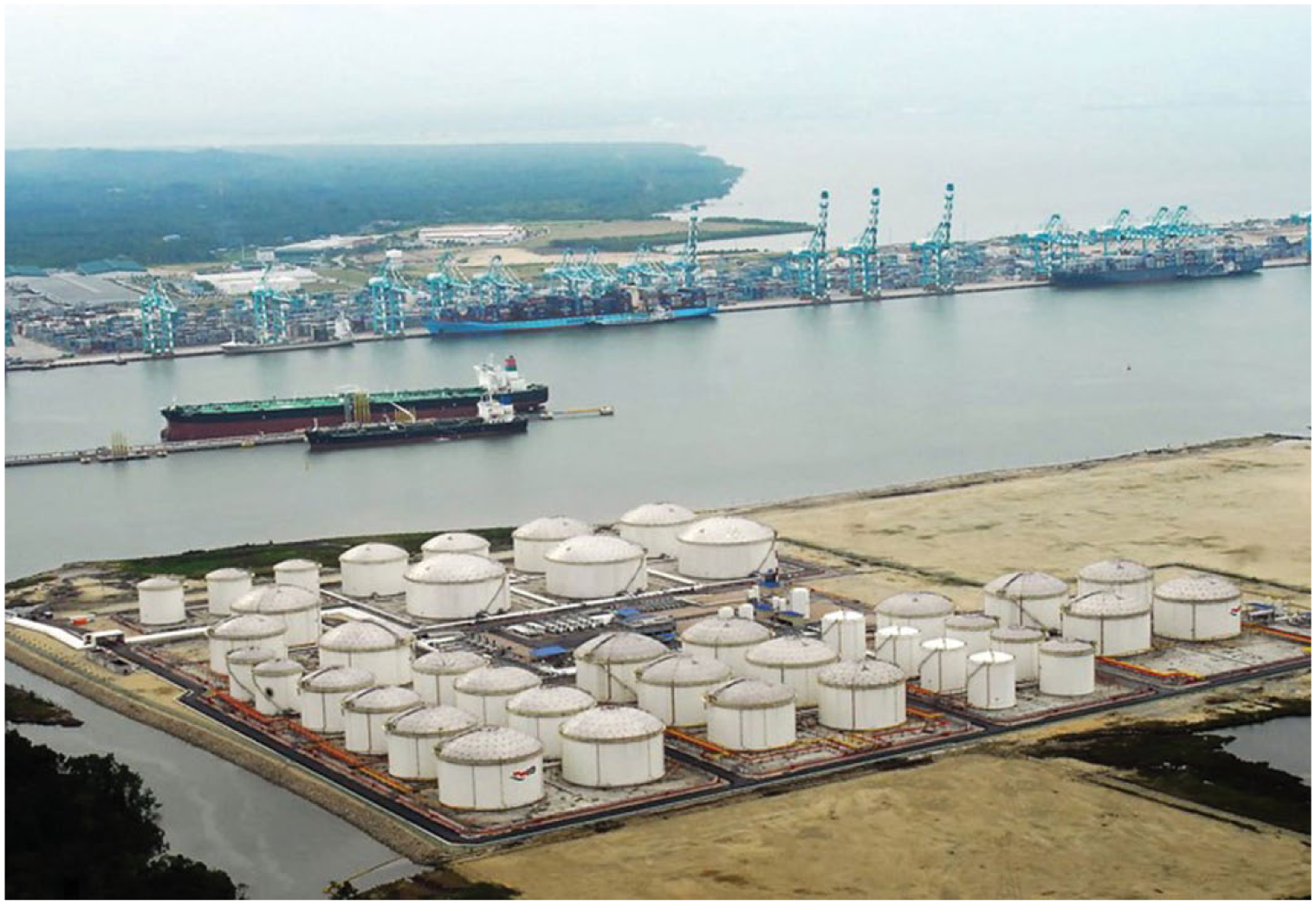
VTTI, the worldwide provider of energy storage, has awarded a client support programme (CSP) contract to Rotork for the maintenance of critical valve actuation assets at the VTTV oil storage terminal in Cyprus.
Approximately, 400 Rotork IQ3 actuators have been included in the contract. The programme exploits the functionality of intelligent IQ3 technology with remote diagnostics and monitoring via data loggers, enabling maintenance to be organised with little interruption to plant operations.
As part of the contract, Rotork regularly monitors the current health and operable status of every actuator, keeping a full history of activities performed and any parts used since the previous report. The information is analysed to provide a breakdown of critical, medium and low priority scheduled work and any corresponding unexpected work activities.
Analysis also provides trending of actuator availability and reliability against agreed target costs and historical operating data as compared to agreed key performance indicators.
The support of Rotork’s Cyprus office was crucial for the original commissioning of the Rotork equipment at VTTI and now supports the asset management and maintenance functions provided in the contract.
Testo Heating, Ventilation and Air Conditioning Smart Probes Sync Wirelessly with Smartphones
RS Components have introduced the first professional wireless heating, ventilation and air conditioning (HVAC) test and measurement instruments optimised for use with smartphones and tablets.
The Testo range of compact smart probes allows HVAC engineers and site maintenance staff to calculate, document, store and text or email equipment performance data via the new free downloadable ‘Smart Probe’ app for Android or iOS. The new smart probes connect quickly and easily to a smartphone or tablet via Bluetooth, so they can be used unencumbered by hoses or wires.
The range is available separately or in kits aimed at three main application areas:
The AC/R kit for commissioning, servicing, maintaining and troubleshooting air conditioning and refrigeration systems;
The VAC kit for measuring, balancing, troubleshooting and optimising ventilation systems;
The heating kit for radiators and hydronic heating systems.
The AC/R kit comprises two pressure probes that can measure high-side and low-side refrigerant pressure simultaneously, and two clamp thermometers to monitor the temperature of heating and cooling pipes more accurately than using a thermocouple.
The VAC kit includes everything needed to test and balance a multi-outlet ventilation system including hot wire and vane anemometers to measure air velocity, volume flow and temperature in ducts and at registers; an infrared thermometer to help assess the condition of motors and electrical equipment; and a thermohygrometer for assessing humidity and dew point issues.
The heating kit includes a differential pressure manometer to measure static pressure, airflow and volume flow – including manifold pressure and pressure drop across filters and coils – along with clamp and infrared thermometers.

The three kits are supplied in smart carry cases for ease of use on the job. Complementary products available from RS include digital manifolds and a refrigerant leak detector.
Kontron Announces New mITX-BW Motherboard
Kontron, the provider of ECT, has launched a new mITX motherboard with an Intel Atom N3xxx System on Chip (SOC).
With up to 7 years long-term availability, the new Mini-ITX embedded motherboard with Intel Atom processor N3xxx SOC series is immediately deployable. Equipped with an ATX-compatible design, a large number of system components are already available, which reduces individual development effort to a minimum.
The board supports two display ports and 24-bit low voltage differential signalling (LVDS) on the industrial automation version. An Internet of Things (IoT) connection via 3G/4G SIM card-slot and serial interfaces are also available. The mPCIe slot supports mSATA or mPCIe extensions. The operating system and application code can be stored on the optional on-board 16GB bootable negative AND (NAND) flash memory (embedded MultiMediaCard (eMMC)).
Numerous standard interfaces, among others GbE, SATA, CAN, RS485 and USB, are also integrated on this new mITX motherboard.
Nikon Metrology Extends Coordinate Measuring Machine Range, Adds Larger Sizes
The Altera ceramic bridge coordinate measuring machine (CMM) range manufactured by Nikon Metrology has been extended by the introduction of high accuracy Altera models as well as larger size machines.
Now comprising 30 standard models and 7 bridge sizes, the core ALTERA programme offers solutions for an array of applications and requirements, from the smallest measuring volume, 7.7.5 up to the largest, 60.20.15. Altera includes standard sizes ranging from 8.7.6 to 25.10.8 for inspection of critical components manufactured to the tightest of tolerances.
Altera provides high performance across a host of metrology applications, including harsh shop floor environments. Probing support is extended with REVO five-axis scanning technology for complex tactile inspection applications. Altera is delivered with a manufacturer’s 10-year accuracy guarantee.
Built and designed to exacting standards, Altera CMMs use advanced ceramic components for structural integrity and enduring performance. With near perfect stiffness-to-weight ratio, ceramic guideways facilitate impressive accuracy: 1.4 + L/375 (E150 according to ISO10360-2:2009). The ceramic bridge is resistant to temperature variation, while the stress-free, horizontal ceramic beam and advanced multi-point bearings counter any negative effect on accuracy when using long probes.
The shop-floor-ready Altera CMM makes use of several innovative new features. Folding guideway covers protect the air bearing guideways from airborne contaminants such as dust and oil. Superior pneumatic, self-levelling vibration isolators provide optimum performance in areas subject to high levels of low-frequency vibration. Automation can integrate machine tools, transfer systems and material handling to form flexible manufacturing systems.
COPA-DATA Provides Process Control for Decentralised Intelligence for Modular Applications
The software specialist COPA-DATA is one of the first providers of process control systems in the decentralised intelligence for modular applications (DIMA) project, initiated by industry specialist WAGO’s automation sector.
The objective of the project is to create a de facto standard for decentralised, modular automation of process equipment and efficient engineering. This provides industrial companies with the possibility to implement process equipment in a flexible way and individualise their production.
Fluctuating procurement and sales markets, flexible relocation of production sites and the increasing requirement for customer-specific individualisation of a product range are leading to ever shorter product and innovation cycles in the process industry.
Conventionally constructed process technology equipment in the areas of chemical processing, food and beverage, cosmetics and pharmaceuticals is usually not flexible enough and cannot efficiently master the introduction of new products or amended production quantities.
The committees of the User Association of Automation Technology in Process Industries (NAMUR) and the German Electrical and Electronic Manufacturers’ Association (ZVEI) have taken on the DIMA approach and further specified it. The objective of the cooperation is the development of an international standard service-orientated architecture (SOA), using a modular approach.
A module provides its process technology function as a service to the higher-level process control system, zenon, taking on the role of a service provider. The process control system can call up the service offered by the module, thus acting as a service user.
DIMA consequently uses the paradigm of SOA. The modules have their own ‘intelligence’ in the DIMA concept. Each module is equipped with its own WAGO controller, which executes services and monitors the module status. If companies wish to amend a production process, they only need to exchange one or more modules. The production quantity can be increased by means of numbering up, that is, adding modules of the same type.
The technical implementation of the DIMA method requires a new definition for the description of process equipment modules: the module type package (MTP). The following information is stored in the MTP: communication parameters for easy integration of the module into the equipment, services, such as the description of the process performance characteristics of the module, as well as graphics information for operation and observation. In addition, there are further descriptions, such as information on status, diagnosis, history and archiving.

To design the complete engineering or re-engineering process as efficiently as possible, COPA-DATA has developed an MTP handling and management system. With this system, companies can read in the MTPs, create all required variables and operating screens, and define their connection. All information with regard to name, size, position and variable connection of the screen objects in the operating screens come from the MTP. This guarantees that the operating screens of modules from different manufacturers, which are read in by different MTPs, correspond to the customer-specific look and feel in the control system.
Users can also track in real time, which artefacts in zenon have been created by which MTP. This allows the connection of the different modules required in the process, even during on-going operation.
Sensirion SHT3x Humidity Sensors Now Have a Protective Cover
Sensirion, the manufacturer of humidity, temperature and flow sensor solutions, now offers a protective cover for selected humidity sensors of the SHT3x series.
The SHT3x protective cover is an optional polyimide foil directly attached to the top surface of the sensor. It covers the SHT3x’s complete sensing area and thus acts as a shield against pollution during surface-mount technology (SMT) assembly of the sensor and subsequent processes, such as conformal coating or potting. The protective cover is designed to withstand multiple reflow soldering cycles.
To enable correct sensor operation, it must be removed after assembly. A flap on the cover extends over the outer dimensions of the sensor package on one side and is designed to allow the cover to be peeled off easily with tweezers.

All typical conformal coating procedures, such as brushing, spraying or potting, can be used as long as the protective cover is attached. The cover will effectively protect the sensor opening from direct exposure to these coatings and other possible pollutants during the production process.
Racer3 Is Product of the Year 2015 Control Engineering Polska
Racer3 won the ‘Product of the Year’ award in the category ‘Industrial Robots’, during the 13th edition of the contest organised by Control Engineering Poland to reward the best technology and innovations.
Built entirely in aluminium and magnesium, Racer3 weighs just 30 kg and features a maximum reach of 630 mm and payload of 3 kg. The robot is designed for applications which require maximum precision and velocity in small work spaces, such as assembly, material handling, machine tending, dispensing, and pick and place.

Panasonic Electric Upgrade Temperature Controller Range
Panasonic Electric has introduced its KT.R series of temperature controllers, the successors of the KT series.
The temperature controllers are available in the three DIN formats 48 × 48, 48 × 96 and 96 × 96 mm.
Programming is easy thanks to a nine-step setting procedure. Simply enter target values for each time period. Thanks to the high-speed processing with 125 ms, the sampling period of the new KT.R series is only half of that of the previous series. With responsiveness twice as fast as before, it is possible to carry out a much finer control of, for example, heat capacity.
The built-in auto-tuning function uses the step-response method. From the temperature rise behaviour alone, it can calculate proportional–integral–derivative (PID) constants. It is even possible to calculate constants when auto-tuning cannot be used to generate them. Because an ON/OFF operation is unnecessary, there is no disruption in temperature control. The highly accurate PID control mode ensures an input span of ±0.2%.
RS Components Introduces Innovative Filter Fan Systems from Stego
RS Components has introduced the new ‘Filter Fan Plus’ FPI/FPO series from Stego, which is designed to provide cooling by efficient forced air circulation in enclosures and cabinets. The series is ideal for engineers that need to design or maintain systems and enclosures containing sensitive components that need to work reliably at all times, whatever the climatic conditions.
The series features two optional systems – the FPI (in) or the FPO (out) system – enabling engineers to select the correct fan depending on requirements. The FPI system with airflow direction ‘in’ consists of a filter fan and exhaust filter where the filter fan is located in the lower part of the enclosure and draws cleaner, cooler air into the enclosure. The FPO system with airflow direction ‘out’ uses an intake filter and exhaust filter fan to draw warmer air out of the enclosure.
The series uses a new air-flap technology on the air-outlet side, which allows the fan to provide a high degree of airflow. The air-flap technology allows significantly more air to exit, so a smaller filter fan can achieve the same volume of airflow output as a much bigger device, saving time and installation space. When the fan is in idle mode, the recessed flaps remain closed, keeping dirt out and protecting the operating lifetime of the fan.
The range also contains a ratchet-mounting mechanism that can be inserted and mounted tool free into the enclosure, guaranteeing a tight seal. The fan can be opened using a screwdriver, which provides improved access protection and better safety.
Kontron Showcases SYMKLOUD Transcoding Demonstration during NAB
Kontron, a global provider of telecom and cloud infrastructure solutions, was invited for a fourth year in a row to showcase a cloud-based video transcoding solution, based on the Intel graphics engine, on a Kontron SYMKLOUD converged infrastructure platform. The showcase took place at NAB 2016 at the Las Vegas Convention Centre.
The showcase created muchinterest from cable/carrier operators and other video delivery service providers.
Laser Radar Is Faster and More Convenient for Large-Scale Metrology
Two new systems for large-scale automated non-contact measurement have been introduced by Nikon Metrology. The Laser Radar MV331 and MV351 perform repetitive procedures and complex inspection tasks reducing inspection time compared to traditional measurement. The units can be used in a wide variety of applications including aerospace, automotive and renewable energy.
High-speed vision scans enable faster measurement of complex features, sections and surfaces. New usability features such as an integrated robot mount and removable air filters lends itself to robotic inspection applications on the shop floor. In addition to the new, external air filters, positive air pressurisation can be used to keep dust and other airborne particles out when working in harsh manufacturing environments.
Patented technology enables direct surface and feature measurements at high data rates. As a result, laser radar eliminates the need for photogrammetry targets, spherically mounted retro-reflectors (SMRs) and handheld probes. The MV331 also slashes inspection times with high-speed vision scans that capture up to 2000 points per second, for scanning complex features and carrying out section analysis.
For fully automated, inline or line-side inspections, the laser radar can be easily installed on a standard six-axis robot arm using the built-in robot mounting interface. It is used to position the device automatically so areas can be inspected that are otherwise hidden from the line of sight. Laser radar automatically measures alignment points after every move, guaranteeing all measurements are collected in a common coordinate system and ensuring that measurement accuracy is completely independent of the robot.

Adlink Introduces Intel Xeon E5-2600 Range for Server Grade Solutions
ADLINK Technology, a global provider of cloud-based services, intelligent gateways, and embedded building blocks for edge devices that enable the IoT, today announced two new solutions based on the Intel Xeon E5-2600 (codename Broadwell-EP).
These latest ADLINK offerings are based on 14-nm technology-based, server-class Intel® processors that bring intelligence to the edge for IoT applications. The new products target networking, communications, security and other data centre applications where ruggedness is critical and computer requirements are intense.
The ADLINK aTCA-9715 40 processor blade features a dual Intel Xeon E5-2600 processor, Intel C612 chipset and Intel communications chipset 8950. The blade offers 16-memory sockets supporting DDR4 RDIMMs up to 256GB, and on-board bootable 32G mSATA flash. Interface options include dual Intel fabric interface channels, three USB 2.0 ports on the front panel, VGA, USB1 and 2, and COM. The unit supports the Intel data plane development kit (DPDK) and Intel node manager 3.0.
The CSA-7200 2U 19″ MICA network appliance features the Intel Xeon E5-2600 with Intel C610 chipset. The CSA-7200 is part of ADLINK’s new MICA platform, an industrial-grade delivery system designed to support the virtualisation requirements for software-defined networking (SDN) and network function virtualisation (NFV), while integrating a wide range of the latest hardware acceleration technologies to boost the processing of network packets and video streams.
The CSA-7200 offers up to 64 × 10 GbE SFP+ ports with I/O intensive architecture and flexible storage interfaces, including SATA, PCIe and M.2. The appliance is highly scalable with eight network interface modules, and is IPMI v2.0 compliant. The 2U 19″ rackmount form factor is ideal for communications infrastructure deployments.
Controlling Palletised Loads Moving in Automated Processes
Automated materials handling is a vital part of modern manufacturing, production, warehousing and distribution operations. Most loads need gentle handling and stopping.
This can be accomplished using dampers such as WörneR stops, which are modular, compact, adaptable stopping and separating devices for automated material handling. These are available in damped and undamped versions, are easy to fit to most belt and roller conveyors, are adjustable to suit load and speed requirements and can be set up for either local or central control.
There are a variety of stops and dampers available that will meet the vast majority of requirements, keeping the need for bespoke items to a minimum.
The ‘damped separating stops’ gently decelerate and stop pallets as they arrive at a desired location, protecting the load from damage, preventing rebound and reducing shock loads into the plant.
‘Undamped stops’ need to be of robust construction and are usable where the pallet, load and plant are equally tough. Their main purpose is to stop one or more pallets in a desired location with very short cycle times, possibly a staging post where pallets collect prior to the next step of the processing operation.
‘Anti-bounce’ stops are spring loaded stops used in systems with little friction between the means of conveyance and the pallet, where the risk of a rebound is especially high.

‘Lifting stops’, or ‘indexing cylinders’, are used to lift the pallet a set distance off the conveyor and hold it in position. The conveyor continues to run, but does not impart vibration to the pallet because there is no physical contact. This arrangement has three advantages: it can protect delicate loads, it is good in high-speed applications where vibration levels would be high and it provides precise positioning of the pallet. Often, lifting stops are used in association with damped stops which halt the pallet before it is raised up:
‘Angle dampers’ are used for assisting a pallet to change its direction of travel. This is often used when the load is fragile, shock sensitive or liable to topple over.
Bespoke and customised dampers can be designed for specific application needs. These may be to accommodate high speeds or extra loads, to provide alternating stopping positions or other requirements.
If the stop is to be used in an automated system, there is probably going to be a need for some nearby sensors to detect pallet presence/absence, count their throughput, etc. This information will be send back to the central computer that controls operations. Theoretically, at least, the computer could also be sending signals to electro-mechanical and pneumatic stops to control their functioning in real time.
Stops and dampers may not be the most glamorous elements in automated production plants and warehouses, they are hugely important. They allow operations to proceed at a relatively high speed by controlling and positioning products while also protecting products and plant from shock loads and vibrations.
Tecat Announces First Wireless Torque Sensor Model Featuring Shunt Calibration
Tecat Performance Systems today announced the release of the WISER 2030-S, the first version of the company’s wireless torque sensor to feature shunt calibration. The new WISER 2030-S will simplify instrumentation verification for users while allowing them to check calibration of the system in the field.
The WISER Model 2030-S consists of three subsystems. The remote unit consists of the data capture electronics connected to micro-measurement strain gauges, a transceiver and a long-life battery. The base unit plugs directly into a PC USB port and houses an antenna, transceiver and up to two analogue outputs. The WISER data viewer software is used for system configuration and calibration, live monitoring, and data logging. The WISER 2030-S enables positive and negative shunt calibration with two independent shunt calibration legs using 100 kΩ resistors.
In addition to measuring torque, the WISER 2030-S has the optional ability to measure three-axis acceleration, barometric pressure and ambient temperature. On-board high-speed data logging with triggering capability allows high-resolution data to be collected on the remote unit without PC or data acquisition (DAQ) connectivity, while remote flash enables firmware upgrades without removing the system from the unit under test.
Meeting the Demand for More Complex Process Control Systems
Process control systems in almost every industry are becoming more complex – customers demand improved efficiency, regulatory compliance and higher levels of automation and plant integration. The need for bespoke or low volume system design is also growing as a result. Bürkert has addressed this challenge by developing the Systemhaus approach, where regional technology solutions centres sit between the sales offices and larger-scale manufacturing facilities, solving problems and building innovative systems on-demand.
The diversity of requirements and the global appetite for these systems means that manufacturers need to take a new approach in order to meet demand. Bürkert manufactures over 100,000 different products, for example, typically valves, actuators, sensors, controllers and combined devices. Applying these products to scenarios that require specialist assemblies requires skill and experience as well as an imaginative approach, but without the volume constraints of large-scale production runs.
The definition of a bespoke control system means that designers have to start from the ground up, working closely with the client to establish what will be delivered by the new system and how best to achieve it. Existing technology and components are integrated with unique parts and custom designs in order to achieve the best solution.
Outsourcing this type of project is considered by OEMs as essential to allow them to remain competitive in a rapidly changing global market. In practical terms, this strategy can deliver a number of improvements such as reducing supply chain management costs while improving production agility and the use of internal resources.
Each industrial sector has its own requirements and these must be adhered to if any new product is to be accepted under the current certification scheme. There are statutory requirements of hazard analysis and critical control points (HACCP) for the food processing industry that set very precise standards with regard to cleanliness, safety and product quality. These standards are aimed to protect the consumer and they are enforced rigorously in most countries by regulation.
Industries that are required to adhere to stringent hygiene regulations need process control systems that will seamlessly integrate into the existing, predominantly stainless steel process structure. Bürkert ensures that all pipework associated with a design is fabricated and welded by engineers that are American Society of Mechanical Engineers (ASME) coded for process piping.

Similarly, components and systems operating in potentially explosive atmospheres must be suitably tested and certified as safe for such an environment using the ATEX and IECEx standards. This is an area that requires considerable expertise and design knowledge in order to deliver a packaged solution, typically on a skid or in a cabinet that is tested and guaranteed to operate safely once installed.
VEGATRUCK has Successful UK Tour
VEGA’s iconic American truck certainly turned some heads on its UK tour. It visited 18 sites from Aberdeen to Sussex, over 600 people came aboard, among those were engineers of all ages and experience, as well as trainees and apprentices, keen to look at the working displays, get product training and viewing the live demonstrations taking place.
The truck continues on into Europe and beyond, it will be back again one day, so if you missed it don’t worry, VEGA hope to see you on board next time!
New Addition to Coriolis Flowmeters Offers Smart Flow Measurement
ABB has expanded its range of Coriolis flowmeters with the addition of the FCB400, featuring a totally new electronics platform offering users the option of up to five freely configurable communication outputs.
Using the innovative sensor and application technology ‘SensorApplicationMemory’, FCB400 saves not only all calibration data but also all measuring point parameters and totalisers, which are linked to the sensor in a non-detachable way. This includes an automatic self-configuration function, which synchronises the configuration data in the sensor and the transmitter after power has been switched on. The configuration data are duplicated in permanent memory and ensure safe data synchronisation during maintenance.
In filling processes, the ‘FillMass’ function directly controls the downstream valve via a special digital output. By means of predefined characteristics, for example, for alcohols, sugar solutions or starch, ‘DensiMass’ enables the precise determination of the concentrations of liquid mixtures through high-precision density measurement. Moreover, the net mass or volume flow rate can be determined, too.
The FCB400 carries out a self-diagnosis and can test whether the device is still operating within specified parameters. Thus, the user can detect possible erosions or deposits inside the sensor without interrupting measurement and without removing the device. The design of the FCB400 expands usability at ambient temperatures of −40 °C to +70 °C and desensitises the device to excessive vibrations.
The device is 50% lighter and smaller than many similar devices on the market. The compact metering tube and device design set new standards for device dimensions and weights solving the space constraints of the process industry. Of course, all relevant Namur recommendations are fulfilled as well as the safety integrity level 2 (SIL2) requirements.
The FCB400 is optionally available in a hygienic design variant, named FCH400, for applications in the food and beverage industry.