



Abstract

Study Shows China Will be Biggest User of Robots
In its 2014 World Robot Statistics study, the International Federation of Robotics (IFR) states that by 2017, more industrial robots will be operating in China’s production plants than in both North America and the European Union (EU).
About 70% of the total robot sales in 2013 were in Japan, China, the United States, Korea and Germany. Between 2008 and 2013, the average robot sales increase was at 9.5% per year (compound annual growth rate (CAGR)).
The study claims that operating unit numbers in China will double from around 200,000 today to over 400,000. By comparison, North American industrial robot numbers will rise to about 300,000, with 340,000 predicted for Europe’s five biggest economies.
In fact, China is already the largest market in the world for industrial robots, yet this currently represents a very low robotic density. For example, right now, China only has 30 industrial robots per 10,000 employees in manufacturing industries. By comparison, Germany’s robotic density is 10 times larger and even bigger in Japan, while in the United States, the robotic density is five times higher than in China.
So in reality, the automation of China’s manufacturing plants has only recently started, while 80% of industrial robots operating in China are made by foreign manufacturers. Most of these are from Japan, North America and Europe. Even so, manufacturers are planning to build their own production lines in China, although the Chinese government is investing in robotics research.
The study also finds that in 2013, industrial robot sales in Europe reached almost the peak of 2011 (43,800). About 43,300 units were sold 5% more than in 2012.
For more information, go to: http://www.ifr.org/industrial-robots/statistics/
Mouser Launches New Robotics Technology Site
Mouser Electronics has provided a new Robotics Technology website. This provides developers with the resources they need to learn about the latest advances in robotics technologies, and the newest components from the company for building robotics systems.
It also contains valuable information for developers interested in expanding their knowledge about robotics systems.
The Technology section is segmented into four main categories. Overview discusses robotics in general and briefly discusses the main subsystems. Motor Control reviews the importance of how motors allow robots to perform physical tasks or travel. Sensors are used by robots to perceive the world around them and their own status. In addition, multipoint control unit (MCU) Control examines how microcontrollers run the robot and the importance of peripherals for management and communication.
The Articles section discusses topics such as the future of robotics, distributed control systems (DCS) in robotics and robots that very closely resemble humans. All articles offer an area to post comments and questions to facilitate further discussions on the topic. In addition, there are the Featured Products Technical Resources sections, plus videos, application notes and white papers.
Visit: http://www.mouser.com/applications/robotics-technology/
Non-Contact Signalling for Same Cost as Slip-Ring Types
The Kistler (http://www.kistler.com) Type 4520A sensor for measuring torque on shafts rotating at up to 10,000 r/min uses frequency modulation to transmit the torque signal from the rotating shaft. It achieves this without contact and converts it into an analogue signal.
This system is, the company claims, considerably more reliable than slip-ring signal transmission, which can suffer signal loss because of dirt and wear on the slip-rings. In the past, contactless sensors have been more expensive than slip-ring types, but this design costs about the same as inferior slip-ring types.
The sensor – which is suitable for static and dynamic measurements of torque in assembly, for quality control in production and in laboratory applications – has a transistor–transistor logic (TTL) speed signal at 60 pulses/revolution and an external 100% range check input. Ten units cover the range from 1 to 1000 Nm, all with standard ±10 V signal output, and 150% overload capacity.
Kistler’s Type 4520A sensor measures torque on shafts rotating up to 10,000 r/min

Linear Drive Aids Printed Circuit Boards Production Throughput
Demand for advances in the design, development and manufacture of printed circuit boards (PCB) is ever increasing. For this reason, PCB production equipment manufacturer Rainbow Technology Systems (http://www.rainbow-technology.com) has developed a new machine designed to help increase the speed at which circuit boards are printed, with a higher accuracy for detail, increased right first time yield and a reduction in process waste.
To ensure that the circuit boards have a smooth transition between each process stage, Rainbow Technology used several linear belt drives. However, during the initial testing stage of the machine, these belt drives failed.
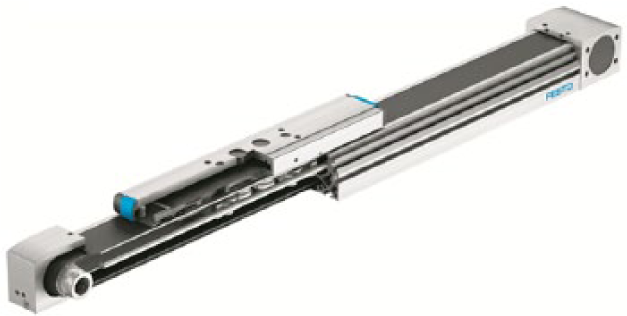
It was at this point that Rainbow Technology turned to Festo (http://www.festo.co.uk), which had been touring the United Kingdom in its electric drives mobile. The two companies met in Glasgow and agreed an order of two ELGA-RF linear belt drives as an alternative to the originals. Festo configured and dispatched the belt drives to Rainbow Technology within 2 weeks: ‘After meeting with the Rainbow Technology team and hearing their needs, we provided them with our new ELGA-RF belt drive axis’, said Nigel Dawson, product manager for electric drives at Festo. As there was an issue with the previous belt drive, we had to ensure fast delivery and precise expertise to limit the risk of any future problems with the machine. In order to carry this out, we used the sizing and selection software from Festo, Positioning Drives. This software which is free for customers to download too, allowed us to accurately size and select the most optimum solution for Rainbow in a matter of minutes.
The reliable and low-profile ELGA-RF operates the main transport system of the PCB machine. The belt drives can accept high loads at higher speeds, so helping to increase production. Robust roller bearings enable it to move faster at up to 10 m/s compared with alternative belt drives that use ball bearing guides: ‘The two belt drives were synchronised together to extend the length of travel inside the machine’, says Robert Gibson, chief mechanical engineer, Rainbow Technology. ‘Here, speed and accuracy of the ELGA-RF belt drives made a big contribution to the final design of the transfer system, as well as the predicted operational lifetime of the parts, which is in excess of five years’.
Increasing production speed – new Inner Layer Process Line PCB machine produces high-density circuits with higher yield

Main transport system – Festo ELGA-RF belt drives increase machine speeds

ELGA-RF belt drive handles almost double the payload of conventional roller bearing axis
Endress+Hauser Continues Success in the Market
In 2014, Endress+Hauser (http://www.endress.com), which is a global leader in measurement instrumentation, services and solutions for industrial process engineering, increased net sales by around 11%. This exceeded the two billion euro mark.
The Swiss-based company also improved its operating profit, as well as profit before taxes and net income.
Commented Chief Financial Officer (CFO) Dr Luc Schultheiss, ‘In view of the worldwide political and economic challenges, we can be very satisfied with these results, even if we haven’t met all of our targets’.
According to Luc Schultheiss, the Group’s organic growth in net sales reached just under 6%: ‘Overall developments in the foreign exchange rates created a slight tailwind last year. The recently acquired subsidiaries, on the other hand, put pressure on results, with the fall of the ruble necessitating significant provision for losses at Analytik Jena’, he said.
The figures of German laboratory analysis specialist, Analytik Jena, with over 1100 employees, and US company Kaiser Optical Systems operating in spectroscopy with about 80 employees, have been consolidated for the first time for the entire financial year. In addition, a new sales centre started operations in the United Arab Emirates at the start of 2014.
The CFO sees prospects for the current year rather dampened by the abandonment of the minimum exchange rate by the Swiss National Bank. Although the Endress+Hauser Group does manufacture in Switzerland, most of its production is located in the Eurozone as well as in areas that use the US dollar: ‘At present the impact is completely uncertain. We therefore have to observe future developments very carefully’, said Luc Schultheiss.
An Evaluation and Selection Guide for DCS
Based on much feedback from end-user clients over the past decades, ARC analysts have developed a comprehensive set of criteria and strategies to help plant operators select an optimal DCS to meet their needs now and in the future.
The Collaborative Process Automation System (CPAS) is ARC’s vision for future DCS. More than ever, the organisation says, owners/operators in today’ process industries require automation systems that can help them maximise their return on assets (ROA) to achieve business advantage, while reducing the cost and effort needed to comply with myriad governmental regulations.
ARC introduced the CPAS concept in 2002 in response to requests from several large end-user clients who were having difficulty evaluating the capabilities of the current DCS to meet their evolving business requirements.
So as to meet these evolving process automation requirements, ARC analysts first established a set of guiding principles – ROA, the Race for Operational Excellence (OpX), Effectiveness, Agility and Visualisation, Automate and Empower, Automation Asset Management and Data Certainty and Traceability.
ARC’s Selection Guide will help users select a solution that will meet their process automation needs now and in the future. The contents include major trends, industry and regional trends, factors contributing to adoption and inhibiting adoption and strategies for success. Go to: http://www.arcweb.com/pages/info-request.aspx
Controller for Complex Machine Control
National Instrument’s CompactRIO performance controller has been designed for complex machine control applications. It can consolidate many common tasks into a single controller to reduce system cost, development time and complexity.
This controller combines a 1.33 GHz Intel Atom dual-core processor, a Xilinx Kintex-7 FPGA and up to eight slots for NI C Series I/O modules. It offers a high-performance control and monitoring system in a strong, fanless and compact enclosure, capable of surviving the harshest environments.
The controller supports dual power supply inputs with a wide input range of 9–30 VDC to ensure reliable operation in critical tasks. It also boasts a range of connectivity options including two Gigabit Ethernet, two USB host Hi-Speed, one USB device and two serial ports.
This software-designed controller is built on the NI LabVIEW RIO architecture and programmed with the familiar NI LabVIEW development environment. The NI Linux Real-Time OS helps developers innovate with the massive software ecosystem provided by the Linux community. Go to http://uk.ni.com
Competency Suite Improves Field Operator Capabilities
Honeywell Process Solutions’ (HPS – https://www.honeywellprocess.com/) new UniSim Competency Suite has been designed to improve operator competency. It also helps prepare them faster through realistic training experiences for process industry console and field operators.
Moreover, this simulation software offers an integrated, robust training experience that will help industrial facilities address a growing shortage of trained operators.
The suite features proven simulation models, as well as new technologies. These include UniSim operations – Operator Training Simulator (OTS), which is a dynamic plant simulation system that allows users to speed knowledge transfer by consolidating a lifetime’s experience into a concise process training curriculum. It features realistic process, control and safety systems modelling.
Other features include the UniSim Curriculum, whereby customisable competency model assists in improving critical skills and behaviours, tracking operator progress and more.
There is also UniSim Tutor, which is a knowledge capture and propagation tool, and UniSim Field View. This is an interactive, navigable, panoramic view for realistic field operator training, and it uses actual facility photographs.
Finally, there is UniSim 3D Connect, which concerns UniSim Operations simulator integration and connectivity to 3D virtual environment, therefore providing credible and realistic experiences for field operators.
Device for Servos Uses Energy Feedback and Reduces Energy Peaks
From Mitsubishi Electric (http://eu3a.mitsubishielectric.com/fa) comes the Energy Assist Unit. This, says the company, is a particularly effective intelligent solution for feeding regenerative energy from servomotors over 30 kW back into the system so that it can be made usable again. Ultimately, it will reduce energy peaks significantly.
This is claimed to be ‘the ideal solution’ for tapping into the energy and cost-saving potential of machines with high energy consumption.
The Energy Assist Unit is installed as a separate component between the power supply unit and the inverter of the servo system, and it absorbs the regenerative energy generated by servomotor braking. In the process, the system recognises the renewable power and stores it in the capacitor bank. If required, the Unit makes the stored energy usable by helping to feed it back to the inverter.
The Energy Assist Unit is an effective and intelligent way to feed regenerative energy from servomotors back into the system, reducing energy peaks significantly. [Source: Mitsubishi Electric Europe B.V.]

The Energy Assist Unit controls the servo controller voltage automatically and independently directs the regenerative energy into the capacitor bank – and from there back into the drive unit. [Source: Mitsubishi Electric Europe B.V.]

Explained Oliver Giertz, Product Manager Servo/Motion/Robot, Mitsubishi Electric Europe, As the Energy Assist Unit makes regenerative energy usable directly in the machine rather than just feeding it back into the electrical power supply system, the amount of basic current required will be reduced. As a result, energy peaks can also be reduced which represents another massive benefit for the user since he will then be able to adjust his existing contract with his electricity supplier. ‘Subsequently’, he said, ‘the contract will be determined based not only on the total annual energy consumption but also on the energy peaks calculated. Ultimately, users will be able to save money as a result’.
Yokogawa and Cisco Collaborate on Cybersecurity Plans for Shell
Yokogawa Electric Corporation
Under the terms of the agreement, the three companies will work over the next 3 years to implement SecurePlant at about 50 Shell plants worldwide.
The reason for this development is that industrial producers around the world face a wide range of operational challenges, including the crucially important one of cybersecurity, which poses a very real threat to safety and availability.
Remember the very clever Stuxnet worm of 2010, which was reported to have severely damaged Iran’s nuclear centrifuges – which it was expressly designed to do. This may have been an atypical threat example, but there have been many, many more and they keep on coming.
Most global companies undertake a plant-by-plant approach to cybersecurity using validated security patches and anti-virus pattern files, an approach that usually results in variable security at best.
However, because plants typically use various control systems from a number of vendors, and often some of these are legacy systems, the process can be complex. This is why, increasingly, there is a need for plant-wide integrated services for greater efficiency in plant security management.
It is also the reason why Shell wants to improve its security practices at its plants around the world to minimise control system vulnerability, and why Yokogawa and Cisco are collaborating on SecurePlant’s design.
SecurePlant is a standard solution comprising the delivery of OS patches and anti-virus pattern files for control systems and the provision of real-time and proactive monitoring of solution delivery, as well as a help desk operation to manage it all.
Porsche Uses Radio Frequency Identification to Track Prototype Testing
Sportscar manufacturer Porsche is tracking the components fitted to its prototype vehicles and is monitoring the cars’ locations to reduce their chances of being seen by unauthorised parties while still being developed.
RFID Journal reports that the company is using a radio frequency identification (RFID) solution to better manage the development and movement of its prototypes as the new vehicles and their components are tested in the lab and on the road prior to being released to the market.
The RFID system, supplied by noFilis (http://www.nofilis.com), allows the car manufacturer to identify and confirm which parts are installed in its prototypes during each of many tests while also tracking the locations and testing of its engines.
The system also keeps an eye on the movements and parking of the prototype cars at the company’s development centre.
noFilis’ automated solution comprises EPC ultra high-frequency (UHF) RFID tags fitted to around 200 components, each with a unique ID linked to details about that part. The tagged items are fitted to the car concerned, and once testing is completed, the vehicle is driven through an RFID reader portal to identify all of its parts.
Other related system equipment includes noFilis’ CrossTalk Agent software, special readers and wide range antennas. The system even continues to work if the LAN becomes temporarily unavailable.
2014’s SPS IPC Drives Analyses – A Concept for Success
In its anniversary year, SPS IPC Drives, the huge electric automation and drives show based in Nuremberg, has proved its on-going success.
Analysis has shown that exhibitors and visitors alike repeatedly confirmed the importance of the event for the electric automation industry. Moreover, a massive 92% of visitors are already planning to visit 2015’s edition of SPS IPC Drives in November.
SPS IPC Drives 2014 offered the 1602 exhibitors the opportunity to expand their network of customers and deepen existing business relations. The impression on site is confirmed by the results of the visitor survey – 78% of visitors are involved in procurement decisions of their company.
The proportion of foreign visitors increased to 23%, and roughly, one-third of the exhibitors came from outside Germany; 41 countries in total were represented at the show, and the top five exhibitor countries (outside of Germany) were Italy, China, Switzerland, Austria and the United States.
The study showed that trade visitors enjoyed a comprehensive overview of the market. Their satisfaction is reflected by the fact that 93% of visitors rated the trade fair as very good/good, while nearly all (98%) will recommend the event to colleagues and customers. Perhaps most importantly, 83% of visitors said they had achieved the objectives of their visit.
At the 2014 SPS IPC Drives Conference, 253 participants discussed the latest in 48 lectures, two keynote speeches and a panel discussion.
The next SPS IPC Drives takes place from 24 to 26 November 2015 in Nuremberg.
Go to: http://www.mesago.com/sps
‘Mighty mini’ PCB Controllers for Automation Today
Parallel developments in machine automation in recent years have seen a massive rise in the uptake of servo technology. On one side of the equation is the growing need for increased machine performance, in terms of speed, accuracy, flexibility and reliability. Balancing the equation have been developments in servo technology, with modern servos being both affordable and easy to programme.
Those looking for high-performance control of DC brushed, brushless and stepper motors across multiple axes might typically look first at one of the popular DIN-rail mounting servo amplifiers coupled to a dedicated DIN-rail mounting or programmable logic controller (PLC) backplane-mounting motion controller.
However, INMOCO argues that in many general-purpose automation applications, as well as in life sciences equipment, scientific automation and robotics, PCB motion cards, amplifiers and motion/amplifiers can provide a better option.
A DIN-rail mounting servo amplifier coupled to a dedicated DIN-rail mounting or PLC backplane-mounting motion controller is, in performance terms, an excellent solution. But is this always the best solution? And what are the alternatives?
Today, compact, affordable and easy to programme PCB solutions open up whole new possibilities in servo control, says INMOCO, while on-board network interfaces to all of the popular technologies mean integration is as easy as it is with the typical enclosed offerings.
A complete range of motion cards developed by Performance Motion Devices is now available through INMOCO

Furthermore, while a typical enclosed servo drive or motion system may mean paying for functions most users will never use, the PCB-based mighty minis deliver only the control you want, exactly where you need it.
Importantly, these PCB solutions are no longer niche technologies. They are off-the-shelf products in exactly the same way as the more familiar servo solutions, but without the overheads of increased cost and unused functionality.
INMOCO, for example, offers a complete range of motion cards developed by Performance Motion Devices. Controlling the torque, velocity and position of DC brushed, brushless and stepper motors, they offer all the required motion profiles for even the most demanding systems, including S-curve, trapezoidal, velocity contouring and electronic gearing, combining convenience with space and cost savings.
Multi-Touch Operator Panels in Automation Survey
ARC Advisory Group is conducting a survey to look closer at the multi-touch technology and how it is used in manufacturing.
Multi-touch has been a hot topic for some years now, and many people have started to wonder whether it is a hype or a real trend. This survey looks at the trends, technology and applications, and it addresses end users, original equipment manufacturers (OEMs) and suppliers of operator panels.
ARC has designed the survey, which addresses all industries, such that there are two different sets of questions, one for OEMs and end users and one for suppliers. By doing this, the questions are tailored towards the participant, the effort and time to participate is reduced and later ARC can compare different viewpoints and statements.
ARC appreciates participation in this survey as it will contribute to a valuable analysis of the multi-touch technology in manufacturing. In appreciation, the organisation will send all valid respondents a complementary copy of the aggregate results.
The survey is located at https://www.surveymonkey.com/s/ARC_multitouch
Calling for Robotic Startups
Innoecho, the company behind Innorobo, Europe’s leading event in robotics technologies, markets and innovations, has just closed the application process for its ‘Call for Startups 2015’.
Held every year since the first edition of Innorobo in 2011, the ‘Call for Startups’ gives budding robotics companies from around the world a helping hand and a chance to shine.
Rather like ‘Dragon’s Den’, perhaps, a panel of international investors will select the five entrepreneurial ventures that will present their robotics projects at a plenary conference during the 3-day Innorobo 2015 event in Lyon, France.
A total of 59 applications were sent in this year, with 55 being chosen to take part in the project screening process. The qualifications are that participating startup companies must be less than 5 years old, receive less than €2 million in funding and not be affiliated with a large group.
Startups from 21 countries have applied to take part in the 2015 edition, whose five finalists will be awarded a stand at Innorobo 2015, which will be held from 1 to 3 July in Lyon, where they will pitch their project in front of a panel of international investors on 2 July.
For more information, go to: http://innorobo.com/call-for-startups/
Chinese Medium-Voltage Motors Market Contracts
The Chinese market for medium-voltage (MV) motors, worth around £1.25 billion in revenue in 2013, is currently suffering from the adverse effect of end markets, according to a new study by IHS (https://www.ihs.com).
The process manufacturing sector is the major downstream industry for MV motors in China. Subsectors predicted to outperform the average growth of the entire process manufacturing sector include water and wastewater, oil and natural gas, chemical and power generation.
Bearing in mind the high correlation between MV motors and the downstream industries of cement, chemical, metallurgy, mining, oil and gas, power and so on, the performance of end markets has a major influence on MV motor market trends in China.
The Chinese market for MV motors saw over 26,000 units shipped during the year. IHS estimates that MV motor market revenue in China fell by 6.6% to nearly £1.2 billion from 2013 to 2014. The organisation attributes this to a sharp decline in pricing and unit shipments as a result of the economic slowdown and sluggish end-market performance.
Looking ahead, IHS predicts that the decline in the market will decelerate in 2015 to some extent. However, demand from downstream industries will remain stagnant, the study finds, despite some focused stimulus measures from the Chinese government to fuel end markets.
In the long term, the market is expected to gradually grow starting in the middle of the forecast period. IHS forecasts that the Chinese MV motor market will grow at a CAGR of 2.0% from 2013 to 2018, reaching £1.4 billion in revenue in 2018.
Despite the general growth trend for Chinese MV motors during 2013 through 2018, as indicated by the graph above, subsectors within manufacturing industries are forecast to have diverging performances from 2013 to 2018.
Control Peripherals Innovation Showcased at ISH
Sontay (https://www.sontay.com/en-gb/), the control peripheral devices specialist firm, launched a number of new product innovations at this year’s ISH event, which took place recently at ISH, held at Messe Frankfurt. ISH has been taking place for over 50 years and is the world’s leading trade fair for building services, air conditioning technology and the energy industry.
Visitors to the BACnet stand were able to see Sontay’s new Smart Communication Sensor, which is a touchscreen thermostat, as well as additions to the innovative SonNet wireless sensing system.
Visitors to the stand were able to interact with the Smart Communication Sensor, which combines smart connectivity with intelligent sensing. The devices can be individually tailored and offer complete environmental sensing with just one sensor monitoring a number or variables – including temperature, CO2, relative humidity, air quality and fan speed.
The data collected from the sensors can then be communicated through BACnet MS/TP.
News in Brief
RFID voltage-level monitoring tag is battery-less
Farsens, a Spanish developer of RFID sensor tags, has launched a new passive UHF RFID tag designed to measure voltage levels. The battery-free tag complies with the EPC Gen 2 specifications and can transmit a unique identifier and associated voltage-level measurement data to a UHF commercial reader. The VMETER-DCLV10 measures voltages in a range from 0 to 1.5 V, with an adjustable gain of 1 to 1000. Available in a range of antenna designs and sizes, the tag features 96 bits of Electronic Product Code (EPC) memory, a 32-bit tag identifier (TID) and a password-protected kill command. Evaluation kits are available. Go to: http://www.farsens.com
DC servomotor sheds 50% weight
In the search for high performance combined with minimum weight, Faulhaber’s development of its series 3274 BP4 brushless DC servomotor has put, it says, a new ‘low weight champion in the ring’. This servomotor, measuring 32 mm in diameter and 74 mm long, has a continuous torque of 165 N m. Furthermore, it weighs in at just under 320 g, half that of conventional motors with comparable power. The four-pole brushless design is ideal for applications in which high power and dynamic start/stop operation with the lowest possible total weight is an important factor. Examples include the link drives of humanoid robots, electric grippers used in process automation or high-performance traction drives used in inspection robotics. Go to: http://www.faulhaber.com
New I/O modules for extremes
Phoenix Contact’s Axioline F I/O system for signal acquisition in the control cabinet now includes versions with an extended temperature range of −40°C to +70°C. The robust modules with the XC (extreme conditions) extension are based on standard versions. In addition to bus couplers, they also include digital and analogue I/O modules, plus a range of function modules. A special paint improves resistance to moisture and corrosive gases. The new XC versions are ideal, therefore, for use in applications with harsh ambient conditions, such as wind power plants or solar parks in regions with extreme climates. Go to: https://www.phoenixcontact.com
A new web presence for fluid technologies with eShop
Fluid technology specialist Bürkert has launched what it says is a new web concept and a new design. One of the new features is an online shop that is integrated in the product and application area. The company says that this extensive new online offering reinforces its position as a ‘worldwide leading manufacturer of measurement and control systems, a competent project planner and a systems provider’. Go to: http://www.buerkert.de
Smallest and most accurate gas and pressure sensors
At the 2015 Mobile World Congress in Barcelona, Spain, the leading sensor manufacturer Sensirion (http://www.sensirion.com) presented a new multi-pixel gas sensor, plus a new barometric pressure sensor. Both new sensors, which rank among the smallest yet most accurate in their class worldwide, are capable of measuring indoor air quality (IAQ), the gases in a person’s breath and barometric air pressure, as required for indoor navigation applications. The new sensors complement Sensirion’s existing product offering for wearables, smartphones, tablets and the Internet of Things (IoT).
Report on IoT strategies in upstream oil & gas
While significant hurdles must still be overcome, operating companies and oilfield services companies alike should not dismiss the performance improvements promised by emerging Industrial Internet of Things (IIoT) solutions. The potential operational and business process improvements and cost reductions that can be unleashed through enhanced instrumentation, connectivity and analytics in upstream oil and gas promise to be more than sufficient to overcome the obstacles. ARC Advisory Group has identified four main hurdles inhibiting the adoption of IIoT solutions in the upstream oil and gas sector – ecosystem complexity, technology maturity, rigid business models and practices and culture. To buy ARC’s report on this topic, go to: http://www.arcweb.com/pages/info-request.aspx