



Abstract

‘Internet of Things’ could help smart meters boost energy savings
Smart meters will provide many benefits to business customers by enabling them to become more intelligent with their energy saving. A new smart metering report, commissioned by the Department of Energy and Climate Change (DECC), looks at how different innovative products and services could give customers ‘actionable advice’. The ‘Internet of Things’ (IoT) could be an important part of this.
Smart meters – ‘intelligent’ energy measuring devices having two-way data flows and the ability to communicate with local area networks (LANs) – will improve the accuracy of energy metering, remove the necessity for meter reading visits, make accurate automated billing possible for utilities, and allow home- and business-owners to save more energy. And they are now seen has having still greater potential.
Such potential could be linked to increased use of Building Information Management (BIM) and the IoT, where ever more seemingly ‘normal’ everyday devices (from appliances, through mobile phone apps to building control products and lighting) are wirelessly Internet-enabled so that they ‘talk’ to each other.
The reason for trying to realise such added potential is to save still more energy and also provide a great deal of useful information about the building(s) concerned, not merely with more accurate data, but because they make using more technological additions possible.
DECC commissioned the Carbon Trust to prepare this technical report, entitled ‘Forward Look: Smart Metering-enabled Innovation in energy management in the non-domestic sector’, and it looks broadly to 2020. It has identified five key innovation areas that could be enabled before then by the smart meter roll out for non-domestic customers. These are as follows:
Non-domestic energy switching groups (so-called ‘Power of Attorney services’);
Automated checks of a building’s ideal energy performance versus its actual energy use, in order to find wasted energy;
Software engines that match smart meter statistics with building fabric information and weather data – this might become part of the growing BIM culture;
The numbers of people using the building and demand response.
Technology examples include authorised users (having consumer consent) being able to access smart energy data via Consumer Access Devices (CADs) such as gateways, smart energy hubs, smart appliances, in-home displays (IHDs) and laptop ‘dongles’ having a ZigBee SEP1.2 interface. This can help enable services, such as being able to identify individual devices among aggregated energy data.

Furthermore, smart meter data, combined with other information, could also be used by third parties to provide other advice to non-domestic customers. Using basic information about the building and combining it with rich consumption data and an analytic engine, could provide advice to customers about the cost-benefit analysis of energy-related items.
Smart meters will also become part of the IoT, where devices will be able to communicate with each other to drive efficiency, lifestyle and business benefits. Once connected, devices can report their energy consumption data, energy efficient consumption becomes more transparent and measures adopted and monitored to make consumption more efficient.
Smart meters are very likely to become part of the fast growing ‘IoT’ (picture by Centrica).
NI sees record 2014 revenue and net income
National Instruments (NI – http://uk.ni.com) has announced that it has delivered on its ‘operating leverage target’ for 2014 and that it has also increased the dividend.
The company’s Q4 revenue was £218 million, up 11% year-over-year, and its total orders were up 13% for the quarter with orders under £13,000 up 5% year-over-year, orders between £13,000 and £66,000 up 13% year-over-year, and orders above £66,000 up 36% year-over-year
Furthermore, in Q4 2014, NI recognised £4.6 million in revenue from its largest customer, compared with £2.6 million recognised in Q4 2013. Dr James Truchard, NI president, CEO and cofounder, commented, We’ve built and continue to run our company for long-term, sustainable growth. Over the course of several decades, we’ve successfully managed the business through various economic and currency cycles, and we are prepared to navigate the near-term disruptions resulting from currency fluctuations.
‘Our differentiated platform’, he said, ‘continues to deliver on our strategy of reducing the costs of our customers’ systems, while growing our business in the markets we serve’.
University-developed scanner detects composite aircraft flaws
The Engineer magazine reports that Innovate UK has provided funding for a project to develop imaging technology used in the design, manufacture and maintenance of current and future carbon composite aircraft.
Led by Qinetiq (https://www.qinetiq.com), the UK consortium of Southampton University and University College London (UCL), plus four companies in ProjectCAN, has brought together experts from academia, the aerospace industry and X-ray inspection equipment manufacture.
Innovate UK, which is part of the Government’s Aerospace Technology Institute, has provided the team with funding to develop two new non-destructive testing processes for flaw detection in composite aerospace parts.
Southampton University’s µ-VIS Centre for Computed Tomography is host to one part of this 3-year project. Together with Nikon Metrology UK, it aims to develop and test methods for scanning and visualising the insides of large, flat components using X-rays. The partners will develop the system for acquiring scan data and software to reconstruct it into a 3D volume image, allowing manipulation and visualisation using standard software.
Southampton University’s Dr Thomas Blumensath explained, Conventional computed tomography (CT) techniques are widely used, but are not well suited to image extended flat objects. We will be developing an alternative technique, which applies computed laminography (CL) techniques, to overcome the limitations of conventional CT for large, flat components.
He said, This will enhance our ability to find defects in large composite parts, such as those which are increasingly used in modern aircraft, and it will ultimately help in the production and maintenance processes and will assist in the development of more environmentally-friendly aeroplanes, as well as enhanced overall aircraft safety.
Southampton University says that traditional computed tomography (CT) requires the scanned components to be fully rotated, and will yield optimal results only when the X-ray attenuation for each angle is broadly similar. It is impossible to scan very large parts because of space restrictions.
Computed laminography (CL) systems use a different motion, such as linear translation or limited-angle rotation, to scan components where CT is impossible or ill suited.
Scope plays key role in pre-compliance testing of high-power drives for PCS
Playing a key role in pre-compliance tests on the high-power inverter drives produced by PCS (Power Convertor Solutions GmbH) is Yokogawa’s
A typical PCS system uses an AC mains voltage input and a DC link voltage (up to 1000 V), which in turn is converted to an AC voltage output. The advantage is that the frequency and amplitude of the output voltage correspond exactly to the application’s requirements, allowing optimum motor control with high dynamics.
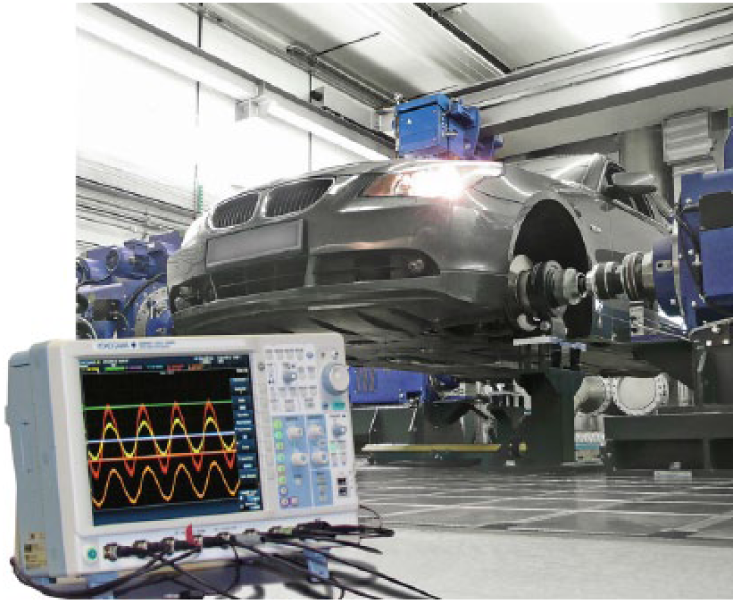
Before a new inverter can go into production, numerous measurements and tests are required. In PCS’ development department, a Yokogawa DLM4000 mixed-signal oscilloscope carries out these tests. This instrument was chosen for its eight channels, each with a sampling rate of 1.25 GS/s. The eighth input channel can also be used as an 8-bit digital input, optionally expandable with an additional 16 bits.
Christian Neisse, Head of Development & Construction Industry at PCS said, The Yokogawa DLM4000 is used to measure currents of more than 1000 A and voltages up to just over 1000 V. For these measurements, we use Rogowski coils and six high-voltage probes. The Rogowski coils are used for evaluating the current waveform and the time profiles and for locating EMC problems. These can be simply inserted round a cable, so there is no need to disconnect the circuit, which with the thick lines used would be pretty expensive.

Mirko Grimberg, developer at PCS adds, Because these are three-phase systems, we usually have to measure three voltages and three currents simultaneously, as well as monitoring the ignition signals of the IGBTs. We therefore needed an oscilloscope with eight analogue channels and some digital inputs. What was also important in this context was the high bandwidth to allow us to look at and record the fast transient signals.
For more information, visit tmi.yokogawa.com
This Yokogawa T&M DLM4038 oscilloscope was used in a PCS inverter set-up for testing components of a vehicle powertrain.
The Yokogawa T&M DLM4038 oscilloscope, as used by PCS for tests on inverters.
How to coordinate virtual power plants intelligently
The use of renewable energies such as hydroelectric, wind, solar and biomass energy has increased significantly and is still on the increase. As a result, the number of units feeding the energy network has risen.
However, the amount of electricity produced by renewable energy sources can sometimes fluctuate significantly, making the network unstable. As a result, support from conventional power plants is required in order to balance out the situation. However, insufficient planning can cause problems for conventional power plant operators since installations of this type are not necessarily suitable for flexible control.
Virtual power plants that combine different sources of renewable energy provide a solution to the problem. To guarantee a stable energy network, the relevant sources will be combined automatically based on availability.

To make the linking of individual energy sources to create virtual power plants easier, Mitsubishi Electric offers products for coordinating different energy sources intelligently, namely the process control system PMSXpro and the lifecycle software tool MAPS (Mitsubishi Adroit Process Suite). These can ensure that the installation responds quickly and flexibly to demands from the grid and control the sources connected to the virtual power plant according to their utilisation and capacities. This opens up, therefore, new economic possibilities for owners to participate in energy markets.
PMSXpro, which is a finely tuned process control system based on standardised automation components and characterised by highly uniform hardware and software, is certified to power plant standards and facilitates the reliable monitoring, operation and control of highly distributed systems in a way that is easy to understand. It also fulfils all the necessary requirements regarding availability, economic efficiency, expandability and flexibility.
Looking at MAPS, this can ensure an increase in value along the entire value chain. An integrated project assistant can generate Programmable Logic Controller (PLC) and Supervisory Control and Data Acquisition (SCADA) projects automatically, resulting in significant time savings during the planning and configuration phases. This can also ensure a structured system design, significantly facilitating the ongoing maintenance of the installation throughout its whole lifecycle.
The virtual power plant can be tested by visiting: https://eu3a.mitsubishielectric.com/fa/en/solutions/industries/power/renewables
Virtual power plants, which combine different sources of renewable energy, provide a solution. To guarantee a stable energy network, the relevant sources will be combined automatically, based on availability (source: Mitsubishi Electric Europe B.V.).
News in Brief
Internet of Things Conference set for April in USA
The ‘Internet of Things’ (IoT) promises to change the way companies interact with their customers. New devices connected to the Internet will bring greater interactivity and a wealth of new data about customer activity. The Internet of Things Conference will focus on how companies are using a variety of technologies, including ZigBee radios, Wi-Fi and machine-to-machine software, to connect things to the Internet, and how they are achieving real business benefits from doing so. Learn how to use the IoT at the inaugural Internet of Things Conference, 16–17 April 2015 in San Diego, California, USA. Go to: http://www.rfidjournalevents.com/iot/
Two-wire industrial pressure transmitter accurate to 0.1%
The Precision Controls Division of Marsh Bellofram (http://www.marshbellofram.com) has launched its Type 5000, a two-wire I/P pressure transmitter for industrial field service. This compact device converts a signal pressure input into a precise 4- to 20-mA or 10- to 50-mA output with 0.1% accuracy. It incorporates a temperature compensated piezoresistive transducer for the accurate gauge pressure measurements of non-corrosive gases and liquids. The transducer offers a claimed ‘excellent dynamic response’ and is virtually insensitive to mounting orientation and most industrial vibrations. Many industry certifications are provided for, including NEMA 4X and many others. Applications include oil and gas, chemical processing, industrial automation, pharmaceutical processing and power generation.
Anti-counterfeiting survey by ARC
The purpose of a questionnaire by ARC Advisory Group (http://www.arcweb.com) is to develop a better understanding of the best practices being used by manufacturers, distributors and packers to address anti-counterfeiting and brand protection. The survey examines methods, technologies and solutions being used to prevent counterfeit products from entering the supply chain. ARC will use the information collected to develop a supplier selection tool to give guidance to users in choosing an anti-counterfeiting solution partner. Responses are encouraged from both current and potential users of anti-counterfeiting and brand protection solutions. The organisation will send those who take part a free summary of the findings. Go to: https://www.surveymonkey.com/s/SNWV6T6
New portal shows ‘Why Professionals Choose Fluke’
Fluke has developed a new ‘Solution Centre’ portal (http://www.fluke.co.uk/whyFluke) on its UK web site featuring ‘Why Professionals Choose Fluke’ tools. The company says that it produces some of the safest, most rugged, intuitive and accurate measurement tools in the world, and the portal illustrates why today’s professionals should choose to buy these products. This new portal will be frequently updated with new information.
RFID transponder captures the locking state of cable cars
Harting has developed a radio frequency identification (RFID) transponder that will electronically detect the state of locking mechanisms on cable cars – now a legislative requirement for cable-car operators. Until now, the biggest challenge has been to supply the gondola with the power required to operate the monitoring devices. This challenge is addressed in the new device by the fact that the RFID transponder is activated via the reading device’s electromagnetic waves and requires no additional source of energy to provide the state of the locking mechanism along with the device ID directly to the control unit. To view the data sheet, go to: http://www.harting.com/uploads/tx_news/data_sheet_Ha-VIS_RFIDS-enso__Transponder_HARTING_03.pdf