




Abstract
In view of the benefits of human factors engineering for nuclear power plants, the US Nuclear Regulatory Commission published a series of Nuclear Regulatory documents to describe the systematic methodologies and processes of human factors engineering on functional requirements analysis and function allocation, task analysis, human–system interface design, training program development, and so forth of the main control room of the nuclear power plant. The purpose of this paper is to introduce the application of human factors engineering to evaluate the usability and safety of the hybrid human–system interfaces developed for the conventional main control room during the process of modernisation. A comprehensive checklist with human factors guidelines was adopted to evaluate the usability of the hybrid human–system interfaces. Expert interview was adopted to collect data on task performance, workload, situation awareness, communication, and coordination based on operators’ experiences. The results provide guidance and a technical basis that should help plant staff with planning changes to the human–system interfaces of main control rooms that address issues that arise during control room modernisation.
I. Introduction
The nuclear power plant (NPP) is required to provide low-cost and stable electricity for the population under the premise of “safety first” due to the catastrophic damage that could be caused by accidents. However, the operators in the main control room (MCR) of a NPP are required to deal with complex tasks, such as monitoring and manipulating system information, which can lead to a high workload for operators. 1 For optimization of the workload to reduce the human error of operators, in addition to the technical development of the digital human–system interfaces (HSIs) in the MCR of a NPP, the application of human factors engineering (HFE) to confirm the usability of HSIs is essential and critical.2–4
In view of the benefits of HFE for NPPs, the Nuclear Regulatory Commission tasked with protecting public health and safety related to nuclear energy published a series of Nuclear Regulatory (NUREG) documents to describe the systematic methodologies and processes of HFE on functional requirements analysis and function allocation, task analysis, HSI design, training program development, and so forth of the MCR in the NPP. For instance, NUREG-0711 5 is provided for review of the HFE programs of applicants for construction permits, operating licenses, standard design certifications, combined operating licenses, and license amendments. The purpose of these reviews is to verify that the applicant’s HFE program incorporates HFE practices and guidelines as described within the HFE program. The staff of the plant can refer to NUREG-0711 to draw up plans with comprehensive dimensions and strict procedures for HFE evaluation. Moreover, NUREG-0700 6 is focused on providing the details of HFE guidelines necessary to perform HSI evaluations. The HFE guidelines are organized into four basic parts, which are divided into sections. The first part of the guidelines concerns the basic HSI elements, such as displays, user-interface interactions and management, and controls. The second part of the guidelines covers alarm systems, group-view display systems, soft control systems, computer-based procedure systems, computerized operator support systems, and communication systems. The third part of the guidelines was developed for the review of workstations and workplaces. The fourth part of the guidelines provides a review of HSI support, such as the maintainability of digital systems. The staff can select the adaptive items from the HFE guidelines to organize a checklist according to the features or characteristics for targeting HSIs for evaluation. 7 Accordingly, even though the conditions of the equipment, system, and HSIs in the MCR would be obviously distinct in different life cycle stages of NPPs or manufacturers, the staff of a plant still can refer to these documents to evaluate these factors based on HFE aspects.
Modernisation is a transition stage, during which the equipment and system are upgraded in the MCR of a conventional NPP. Formerly, the MCR of a conventional NPP ( Figure 1 ) was equipped with cabinets for analog HSIs, such as plant parameter gauges, indicators, knobs, levers, and alarm tiles. The operators needed to walk along the cabinets to take readings of the system information and adjust the controllers. Today, most of the conventional NPPs still operate with a substantial amount of the original analog instrumentation, control systems, and equipment, even though they are approaching their life expectancies. However, the steadily deteriorating availability of replacement components and the infrastructure of manufacturers that sustain analog technology have increased operation and maintenance costs. In addition, the possibilities for adding new useful capabilities to the NPP systems and HSIs are restricted by outdated technology. Thus, modernising components of the original instrumentation, control system, and equipment to digital types is a current feasible approach that can address obsolescence and the lack of spare parts, improve plant performance and HSI functionality, and enhance operator performance and reliability throughout the world. 8
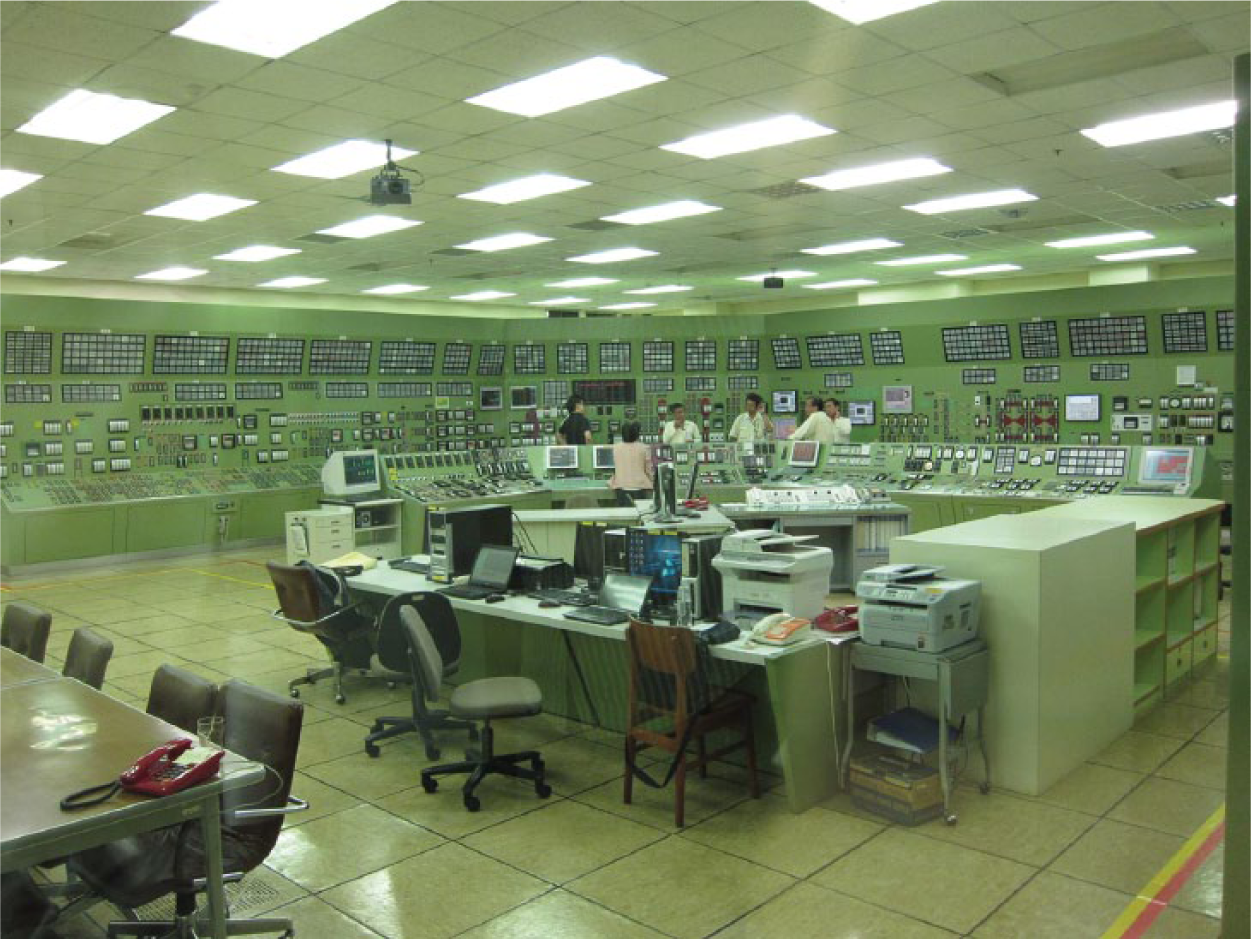
The MCR of a conventional nuclear power plant
A hybrid HSI is a specific feature of a conventional MCR after modernisation. That is, some of the analog HSIs mounted in the cabinet will be replaced with digital HSIs, so different styles of HSIs might be combined. Figure 2 shows a cabinet with a typical hybrid HSI. The video display units, marked by circles, are the digital interfaces that display digital information to operators for monitoring the system. Although the replacement of the original analog HSIs is expected to enhance operator performance and reliability after strict operator training, the new HSIs might pose new challenges for operators, such as coordination demands on operational teams (e.g. the need for communication to promote situation awareness), leading to new interaction situations of operators and systems.
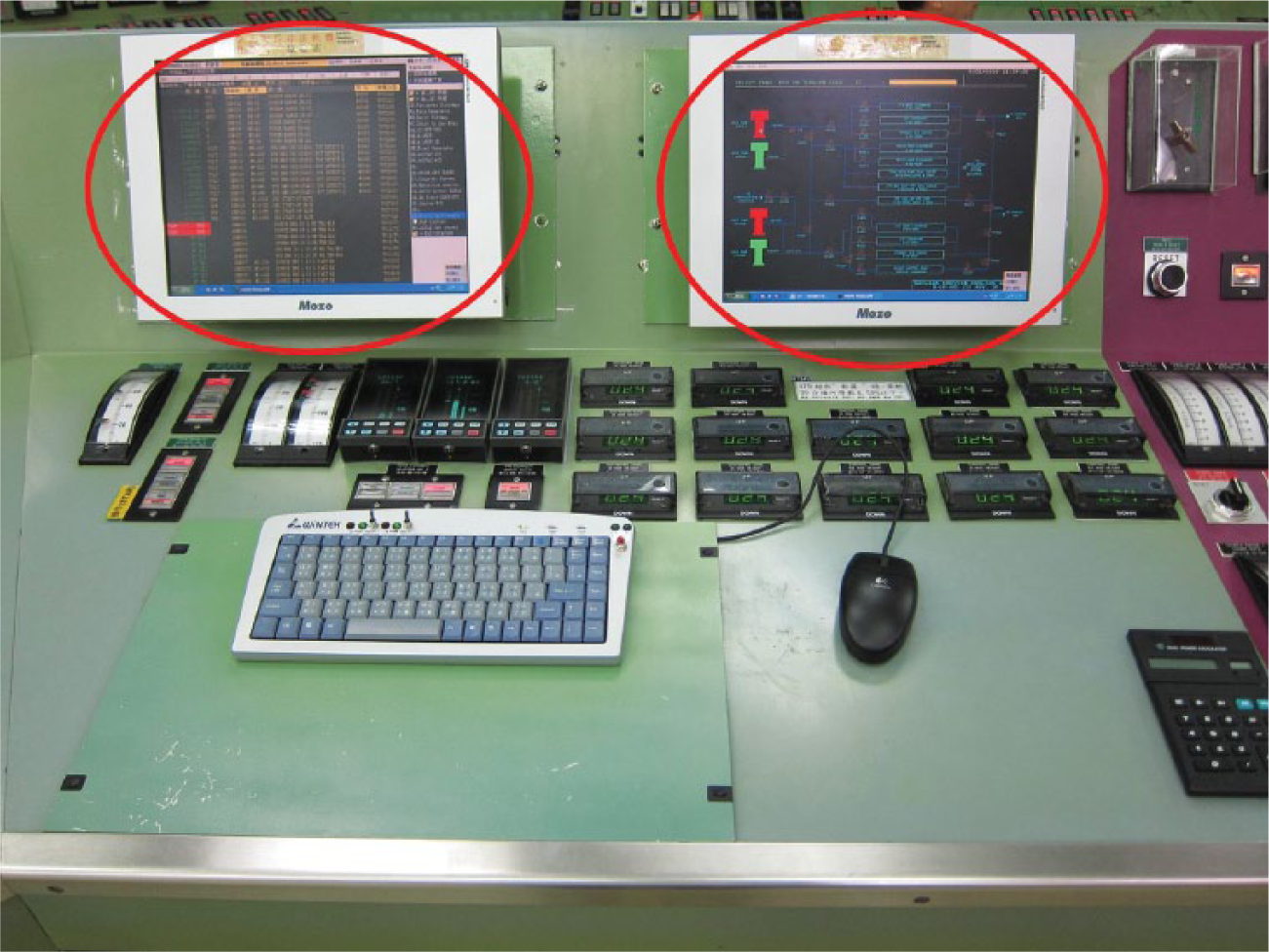
Cabinet of the MCR with a hybrid HSI
Recent studies of human factors and ergonomics have made it clear that changing an MCR design from conventional to advanced technologies (e.g. levels of automation, digital HSIs, and computer-based procedures) can affect the situation awareness, performance, and workload of operators.9–13 Such effects will continue to change until the entire modernisation process is completed. During the process, the operators have to try to adapt themselves to the upgraded HSIs. However, if the new digital HSIs and hybrid MCRs are not designed and evaluated correctly from a human factors perspective, the potential for human error will increase, and the benefits of the new technology will not be realized. In this regard, the objective of this study is to present a regulatory approach based on human factors for evaluating the hybrid HSIs of the conventional MCR. To verify the practicability of the approach, a case of a NPP in Taiwan was analyzed and is discussed using the approach.
II. Methods
For evaluation of the digital HSIs in the conventional MCR subjectively and objectively, two methods, including a checklist based on NUREG-0700 6 and an Interview Questionnaire from NUREG/CR-6749, 14 were applied in this study. The methods are introduced in detail as follows.
A. Checklist based on NUREG-0700
NUREG-0700, 6 the Human–System Interface Design Review Guideline, was developed to provide HFE guidance to the US Nuclear Regulatory Commission. It describes those aspects of the HSI design review process that are important to the identification and resolution of human engineering discrepancies that could adversely affect plant safety. NUREG-0700 6 also provides detailed HFE guidelines for the assessment of HSI design implementation. In the development of NUREG-0700, 15 revision 1, published in 1996, several topics were identified as “gaps” due to insufficient technical bases upon which to develop guidance. One such topic was the integration of advanced HSI technology into conventional MCRs. Therefore, NUREG-0700, 6 revision 2, published in 2002, included additional topics (e.g. Safety Function and Parameter Monitoring System, Soft Control System, Computer-based Procedure System, and Maintainability of Digital Systems) addressing advanced HSI technology in order to eliminate these gaps.
There are thousands of guidelines distributed among 13 topics in NUREG-0700, 6 revision 2, but not all of the guidelines are suitable for evaluating hybrid HSIs of the conventional MCR. Therefore, selecting guidelines according to the type of HSI for developing a checklist is necessary, and then experts on HFE can evaluate the digital HSIs via the checklist based on NUREG-0700, 6 revision 2. The results of such an evaluation can indicate aspects needing to be re-designed based on the human factors perspective.
B. Interview questionnaire
The Interview Questionnaire, adopted from NUREG/CR-6749, 14 was conducted to collect the actual operators’ concerns about modernisation. The topics of the questionnaire are “Opinions on the New Control Room Systems,” “Impact on Operations/Crew Performance,” “Training,” and “Operator Input to Design and Transition.” The operators were interviewed in crews. The primary purpose of the interviews was to obtain the operators’ perspectives on how they used the new digital HSIs and how the digital HSIs had affected their performance as individuals and as a team. The questions investigate the perceived impact of the digital HSIs on operator workload, situation awareness, and communication and coordination among the team members. Furthermore, it was hoped that the questionnaire would uncover design faults that the results of the checklist based on NUREG-0700 6 could not identify. The complete set of interview questions is provided in Table 1 .
Interview questions
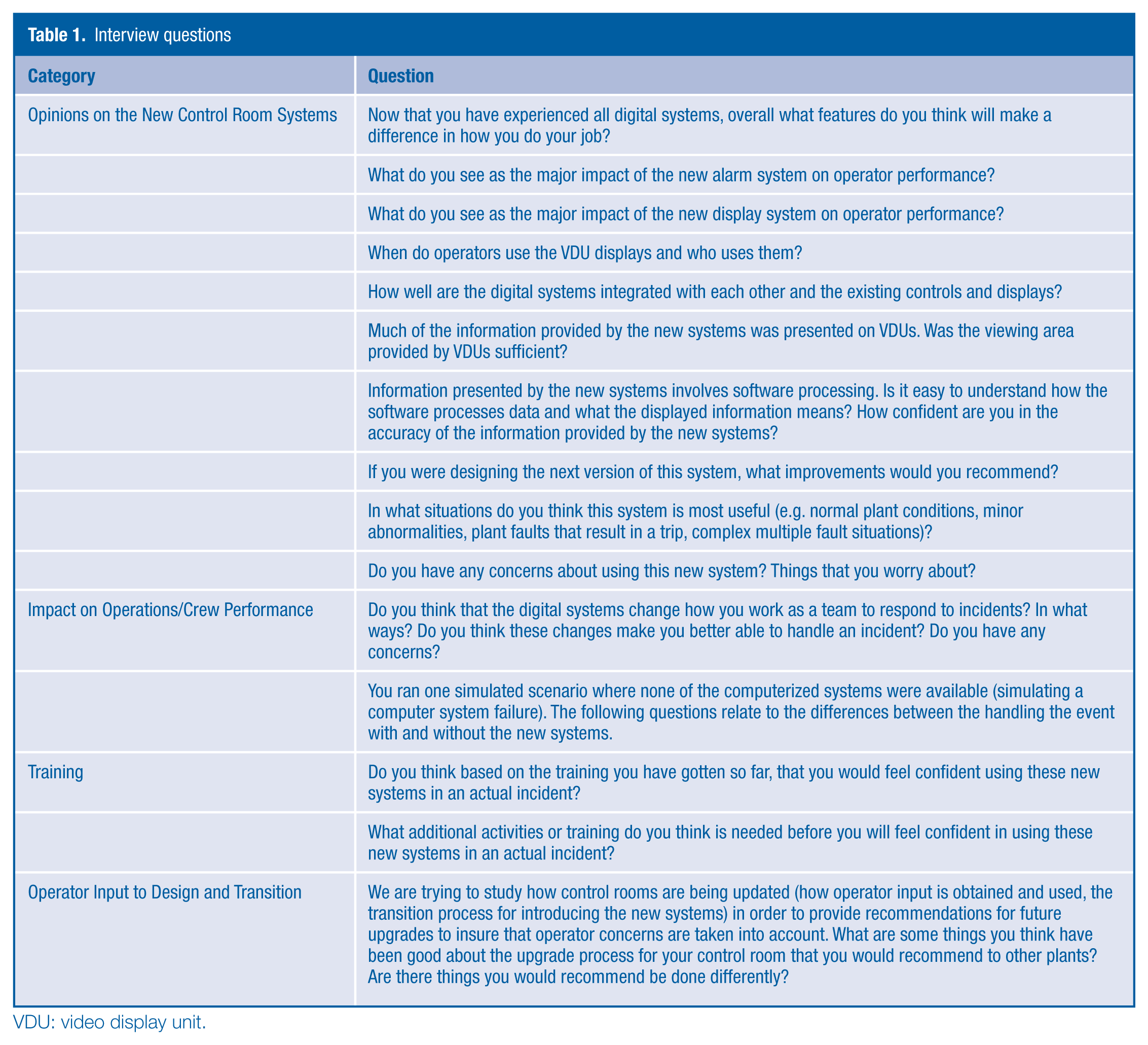
VDU: video display unit.
III. Results
A case of a NPP in Taiwan was examined with the evaluative approach in this study. This NPP, with boiling water reactors, was designed and built in the 1970s, and problems were foreseen with obtaining spare parts, increased maintenance costs, and a lack of competence related to operation with the old analog HSIs. In response to these threats, the NPP was upgraded with new digital display HSIs for the power range neutron monitor, which provides critical information for operators during the procedure of reactor startup and shutdown tasks, as replacements for analog indicators for the average power range monitor. Analysis of the results is provided below.
C. NUREG-0700
Focused on the digital HSIs in the conventional MCR, a checklist including 582 items selected from NUREG-0700 6 was developed. Most items on the checklist addressed display and alarm topics. Experts in HFE or with operating experience of the digital HSIs were invited to fill out the checklist. The results indicated a total of five failing items for the digital HSIs. The fail rate of the checklist was about 0.86%. The failing items were as follows:
Abbreviations should be avoided (except when terms are commonly referred to by their initials).
The use of the letters O and I in a non-meaningful code should be avoided because they are easily confused with the numbers 0 (zero) and 1 (one), respectively.
A maximum limit on the number and rate of unsuccessful LOG-ON attempts should be imposed.
If there are pending actions and the user requests a log-off, the system should inform the user that these actions will be lost and allow the user to cancel either the pending actions or the log-off.
An audible signal should be presented at specified intervals prior to automatic log-off.
D. Interview questionnaire
Most of the responses of the operators were positive and constructive across all of the topics of the questionnaire. A summary of the operators’ responses is provided below. First, regarding “Opinions on the New Control Room Systems,” operators noted that the digital display could show grouped and integrated information on the system, so monitoring information was convenient and efficient. Next, they also emphasized that digital information had higher readability than analog information, such as that from a dial indicator. In addition, operators noted that digital HSIs could record historical data of abnormal conditions for diagnosis of operating problems. Second, regarding “Impact on Operations/Crew Performance,” operators demonstrated that although the frequency of communication decreased due to the digital HSIs, the quality of communication increased; that is, the operator teamwork was better while they were using digital HSIs. Third, regarding “Training,” operators commented that simulators of digital HSIs needed to be provided for training before the digital HSIs were installed in the MCR. Finally, regarding “Operator Input to Design and Transition,” the operators suggested that the digital HSIs that were upgraded in the MCR had to be proven in terms of usability and reliability in overseas NPPs that had been modernised.
IV. Discussion and Conclusion
Obsolescence issues with existing analog instrumentation, control systems, and equipment mean that the operators of NPPs face significant challenges in designing and modifying the HSIs and systems of MCRs, which will be produced through various processes of instrumentation and control modernisation. Even though the result of modernisation should be more efficient operations and lead to improvements in NPP availability and safety, the operators have to try to adapt to the tasks when HSIs are updated. For instance, in the modernisation of a MCR with hybrid HSIs, the operators need to shift their operation modes according to the plant control system. Namely, the operators are likely to need to use analog and digital HSIs at the same time. However, human error may occur during operation of a hybrid HSI due to the significant differences between analog and digital HSIs. For instance, the information presented on video display units is always integrated into pages, so the operators need to navigate to specific pages to find desired information. If the operators do not remember which page holds the specific information, they cannot find it rapidly in response to actual situation demands and then make decisions safely. Therefore, the HFE goals for conventional NPP modernisation, evaluation, and validation must be applied in all processes; that is, HFE should be used to help meet this challenge and to ensure that the benefits of the new digital technology are realized, while potential operating problems are avoided. 16
Accordingly, this study attempted to explore the potential issues of hybrid HSIs in the conventional MCR during the modernisation process via a human factors approach employing a checklist and an interview questionnaire for reciprocal examination. The results of the checklist indicated only five failing items related to display topics. In short, the HSI modernisation in the case almost met HFE suggestions. The positive results were also clearly supported by the operators’ opinions expressed in the interview. The operators commented that the digital HSIs could provide more detailed and accurate information, which enhanced communication and problem diagnosis. Furthermore, integrating digital HSIs into cabinets with analog HSIs did not appear to cause problems with shifting operations between different types of HSIs, according to the operators. Although inadequate aspects of HSI design (e.g. abbreviations, code format, and warning messages) were identified by the checklist but not mentioned directly by the operators, this does not mean that the navigation effects of HSI design on system operation have been minimized enough to ignore. The operators merely expressed that such usability problems could be solved via training. That is why they emphasized the importance of a simulator for training before the installation of digital HSIs in the MCR. In conclusion, although the operators approved the modernisation in the case examined in this study and indicated that modernisation was conducive to operating performance, the digital HSIs in the conventional MCR have not been perfected, according to the results of a checklist based on NUREG-0700. 6 Ensuring the operating safety of NPPs is a serious issue, so modifications aimed at eliminating such defects are strongly recommended.
Footnotes
Acknowledgements
The author is grateful to the candidate operators of the Kuosheng Nuclear Power Plant for providing information on the modernisation of the conventional main control room examined in the study.
Funding
This research received no specific grant from any funding agency in the public, commercial, or not-for-profit sectors.