




Abstract
Visual search is commonly performed in the control rooms of several industries such as nuclear power plants, flight control, security screening, and monitoring. In this study, the effects of target prevalence and speech intelligibility on visual search performance were investigated. A 2 (target prevalence: low versus high) × 3 (speech transmission index = 0 versus 0.51 versus 0.69) mixed design experiment was conducted. Target prevalence was a between-subject variable, whereas the speech transmission index was a within-subject variable. A total of 32 participants participated in simulated X-ray screening tasks in different speech intelligibility conditions. Results revealed that both the target prevalence and the speech transmission index level had significant effects on visual search performance. The reaction time was shorter and the miss error rate was higher under low target prevalence condition than in high target prevalence condition. Compared with no speech condition (speech transmission index = 0), the reaction time of the participants increased significantly with the presence of intelligible speech in an acoustic environment. Performance loss was greatest when the speech transmission index was 0.51. The interaction effect of target prevalence and speech transmission index level was also significant. Proper measures should be taken to reduce unfavorable effects of low target prevalence and intelligible speech in acoustic environment on visual search performance in control rooms.
I. Introduction
In the control rooms of several industries, such as nuclear power plants, flight control, security screening, and monitoring, operators are required to monitor large amount of information presented on computer displays using their eyes.1–2 Visual search is a common and important task for the operators. A considerable number of laboratory studies for visual search tasks are being carried out. In typical studies, subjects are required to search for targets among distractors, in which targets are often presented on 50% of trials. 3 However, targets are often rare in real-world visual search tasks. For example, air defense radar soldiers must remain alert for a long period to scan display monitors for possible intruders. However, target prevalence is rare. The security checking task in airports and subway stations is to detect hazards in passengers’ luggage by X-ray screening, and the hazards are low prevalence targets. Such task can cause severe consequence if the target is missed.
In 2005, Wolfe et al. 3 designed an experiment in which participants looked for “tools” among objects drawn from other categories. The target prevalence was 1%, 10%, and 50%. Experimental results revealed that when the target prevalence was 50%, the miss error was 7%; 10% prevalence produced 16% errors; and errors increased to 30% at 1% prevalence. They also found that the searching speed was significantly faster with low target prevalence than with high target prevalence. In short, a dramatic increase in miss errors at low target prevalence was accompanied by a decrease in reaction time. This phenomenon was called low prevalence effect. 4 By providing an opportunity to correct the last response, observers could reduce their response execution error and thus reduce the low prevalence effect. 5 However, this effect could not be completely eliminated, especially when performing complex X-ray screening tasks. 6
Besides target prevalence, noise (as an environmental factor) may also influence the performance of visual search tasks in a control room. Usually, more than one operator are present in a control room, and they sometimes communicate with each other; in addition to conversation, the sounds of a running machine, telephone, and alarm are also common. Sundstrom et al. 7 surveyed over 2000 American and Canadian office workers in various office settings. Results revealed that 54% of workers were often bothered by one or more sources of office noise. 7 Noise affects the performance of the personnel, especially in situations that require creativity and thought, and may cause short-term memory loss. 8 Among all sources of bothering noise, speech is the most disturbing, most disadvantageous, and least pleasant; 9 intelligible speech is more distracting than unintelligible speech or sounds with no information content. 10
Speech intelligibility is a subjective measure and has been traditionally measured in rooms by listening tests. 11 In 1971, Houtgast and Steeneken 12 introduced the speech transmission index (STI) to objectively evaluate the intelligibility of speech. The STI was accepted by International Electrotechnical Commission and other organizations. The value of STI varies from 0 to 1, where 0 means silence or completely nonintelligible speech and 1 means perfectly intelligible speech. The relationship between subjective speech intelligibility and STI is nonlinear according to IEC 60268-16. 13 Hongisto’s 11 model has indicated that work performance decreases as STI increases, and the steepest slope in performance decrease is located in the STI range between 0.3 and 0.5.
Among various real-world visual search tasks, security checking is one of the most typical examples performed in an acoustic environment. In X-ray screening tasks, security screeners have to work under noisy conditions caused by the passengers’ walking and talking, public transport, and so on. Both their working environment and task itself are representative of the visual search tasks in a control room. Therefore, this study uses simulated X-ray screening tasks to investigate the effects of target prevalence and speech intelligibility on the performance of visual search tasks. The findings may benefit the control room designers and the managers of various industries.
II. Method
A. Subjects
A total of 32 participants between 18 and 28 years old participated in this study. The average age for all the participants was 24 years old. All participants’ eyesight was normal or corrected to normal, and they all had normal hearing. None of them had any previous experience with this type of experiment or background knowledge of visual search.
B. Stimuli and acoustic conditions
Stimuli were X-ray images of baggage, which were provided by a local railway station in Beijing, China. The hazards in the visual search tasks were fixed-blade knives. The length of the knives ranged from 115 to 320 mm. Hazard-present images were generated by trimming and combining the randomly selected images of bags and knives with Adobe Photoshop software (Adobe Systems Inc., San Jose, CA, USA). A total of 900 images were created. Of these, 100 images contained hazard (i.e. knife), and the rest were hazard-absent. The size of each image was 1024 × 683 pixels. Four experienced screeners from railway stations were invited to evaluate image complexity to guarantee the consistency of task difficulty.
The sound materials consisted of a 90-min speech signal and a standard pink noise as masking sound, which was free from temporal variation. 14 The speech materials were captured and combined by Adobe Audition 1.5 (Adobe Systems Inc.) from eight Chinese broadcast programs. The speech materials were divided into individual sentences whose lengths ranged from 10 to 30 s. Each sentence was independent in content. The acoustic conditions were generated by mixing speech and masking sound and changing the signal-to-noise ratio. Figure 1 shows the layout of the laboratory. The sound signal was played by two computers and two loudspeakers at both sides of the room. Three STI levels were applied: 0, 0.51, and 0.69. A Nor 140 Precision Sound Analyzer (Norsonic AS, Lierskogen, Norway) was used to calibrate the related noise levels and STI values in the experiment.
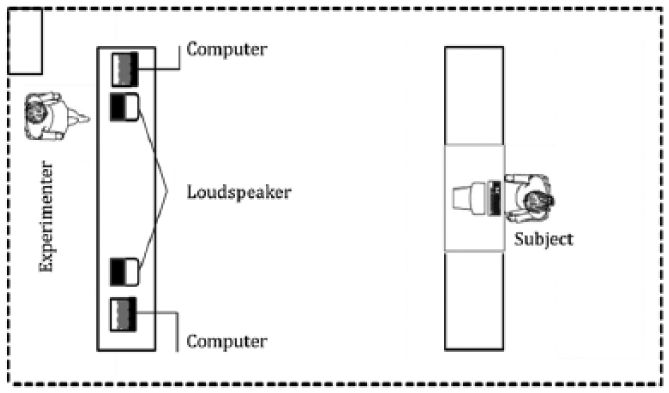
Layout of the laboratory for the experiment
Before the experiment, we measured the noise level of the security checkpoints of two railway stations by using an AZ Sound Level Meter (AZ8928; AZ Instrument Corporate, Shenzhen, China). Each site was measured three times, with a 5-min interval between two successive measurements. Results indicated that the average A-weighted noise level of the two checkpoints was 65.2 dB with a standard deviation of 1.26 dB; thus, the overall noise level of acoustic conditions in the experiment was kept at 65.0 dB. When STI = 0, only pink noise with no speech was present. When STI = 0.51, the noise levels of pink noise and speech were 47.5 and 65.0 dB, respectively. When STI = 0.69, only speech with no masking sound was present.
C. Procedure
Participants were randomly divided into two groups, and each group corresponded with one level of between-subject variables (i.e. one for high target prevalence (50%) and one for low target prevalence (5%)). Each group was required to complete three sessions of X-ray screening tasks. The STI levels of the three sessions were 0, 0.51, and 0.69. The order of the STI levels was counterbalanced across participants. In each session, the subjects completed 200 trials (10 target-present trials) in low prevalence condition and 30 trials (15 target-present trials) in high prevalence condition. The stimuli for each participant were randomly selected from the developed 900 nonrepeating images.
The task was performed using a laptop with the resolution set at 1366 × 768 pixels, and the task interface is shown in Figure 2 . The experimenter first explained the experimental process and software usage, and the participants began to practice. The content of the practice was the same with the actual trials. In each trial, participants were presented with a stimulus image. If a hazard was found, participants would press the “dangerous” icon by clicking the mouse; otherwise, they would press the “safe” icon. Subsequently, the next trial began. During the practice session, each participant completed 50 trials with 50% target prevalence. Additional practice was optional if participants felt that 50 practice trials were not enough. The actual experimental trials then followed. Participants were not informed of the specific target prevalence. After each session was completed, a 2-min break was provided.
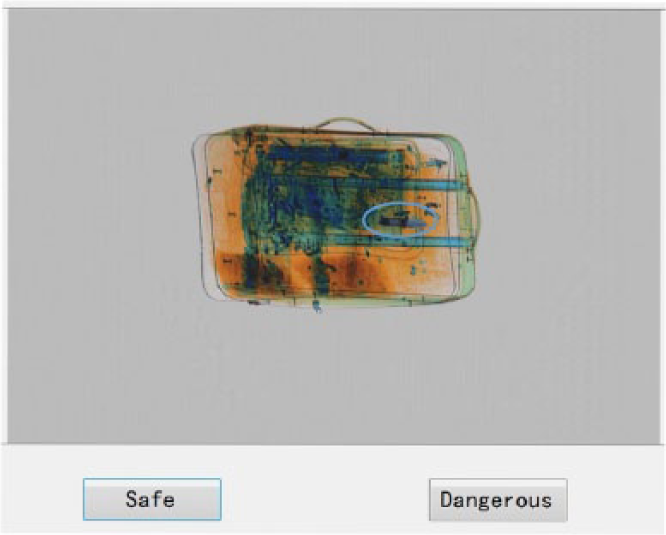
Interface of the screening task (the target is circled)
III. Result
A. Reaction time
The means and standard deviations for reaction time under various conditions are presented in Table 1 . The mean reaction times under high target prevalence condition were longer than those of low target prevalence for all the three STI situations. For both target prevalence conditions, reaction time was shortest when STI = 0 and longest when STI = 0.51.
Means and standard deviations of reaction time
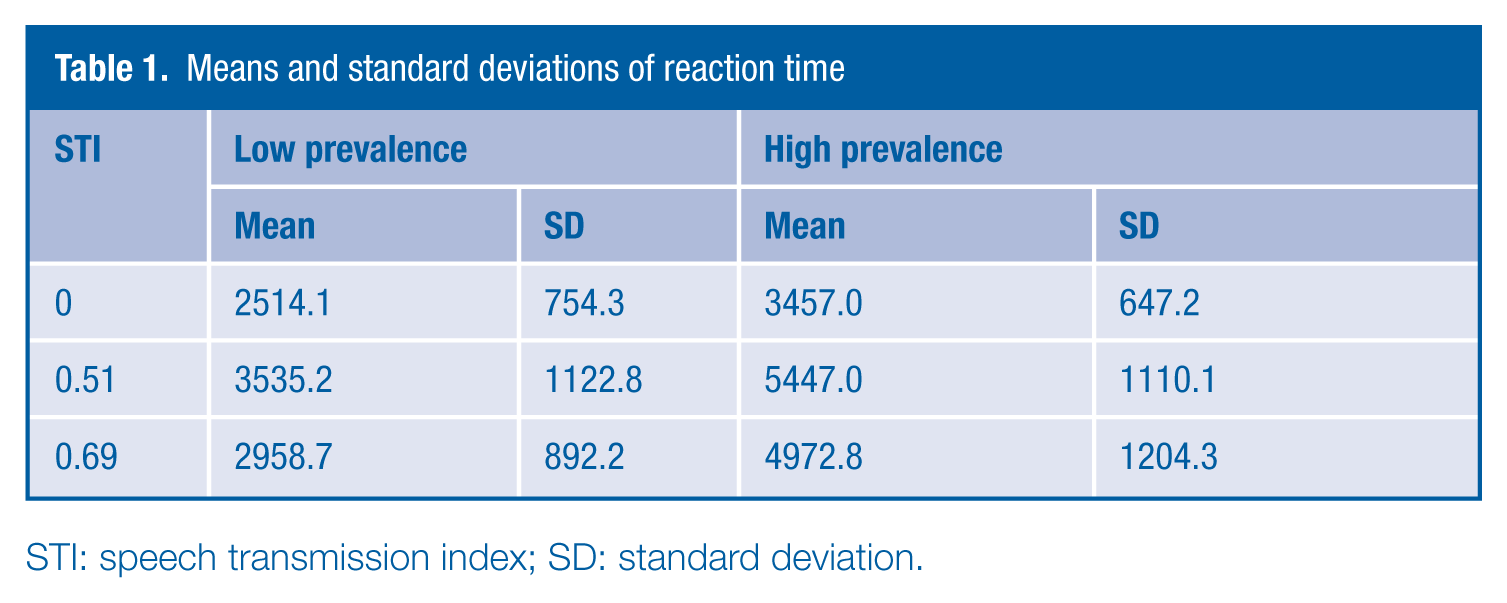
STI: speech transmission index; SD: standard deviation.
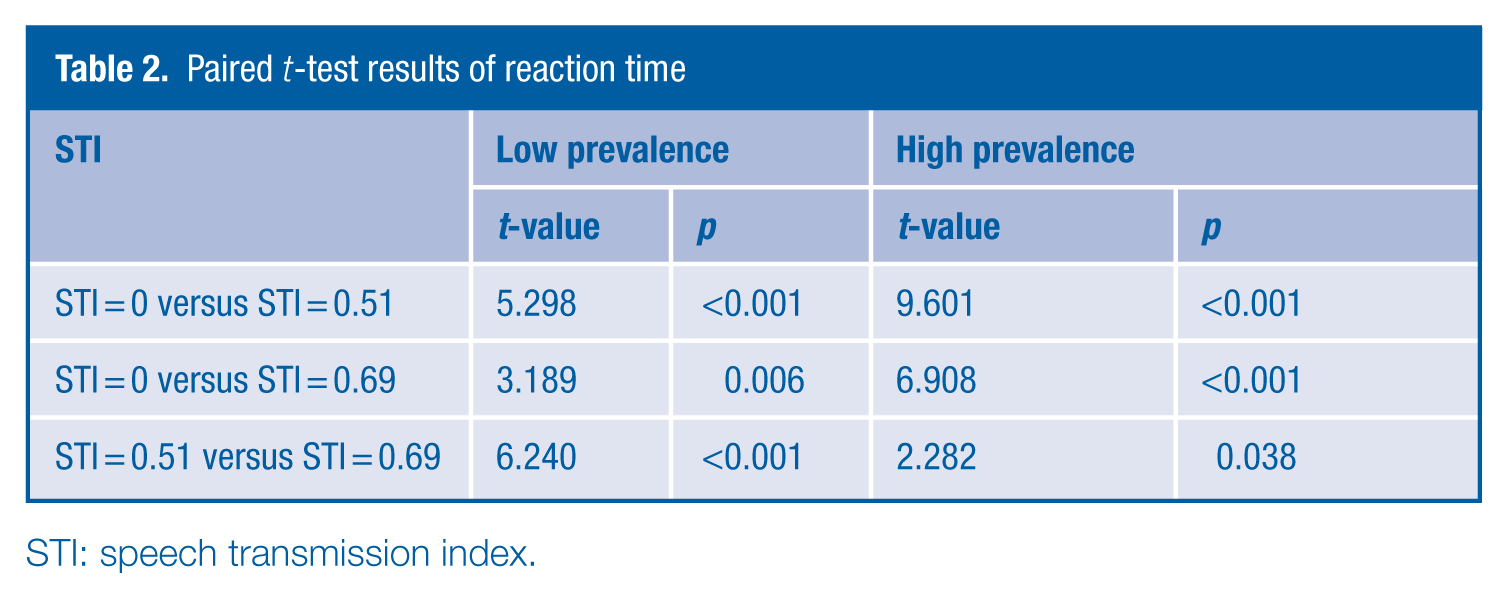
The main effects and interaction effect of the target prevalence and STI level on reaction time were analyzed by analysis of variance (ANOVA). Both target prevalence (F(1, 90) = 66.233, p < 0.001) and STI level (F(2, 90) = 19.576, p < 0.001) had significant effects on reaction time, and their interaction effect was also significant (F(2, 90) = 2.929, p < 0.10). Reaction time increased about 40% in low prevalence condition and about 60% in high prevalence condition when STI changed from 0 to 0.51. The reaction time of low prevalence trials was significantly shorter than that of high prevalence trials, as shown in Figure 3 . For low prevalence condition, one-way ANOVA showed that the effect of STI on reaction time was significant (p < 0.05), which is similar for the high prevalence condition (p < 0.001). For each condition, the results of paired t-test are illustrated in Table 2 . The results indicated that for both target prevalence conditions, as the value of STI changed, reaction time changed significantly. When STI = 0 (i.e. intelligible speech was not present), the reaction time was significantly less than those of two other conditions. Thus, the intelligible speech led to the increase in reaction time. When STI was less than 0.51, the reaction time increased as STI increased. However, when STI was larger than 0.51, the reaction time began to decrease as STI increased, regardless of the target prevalence.
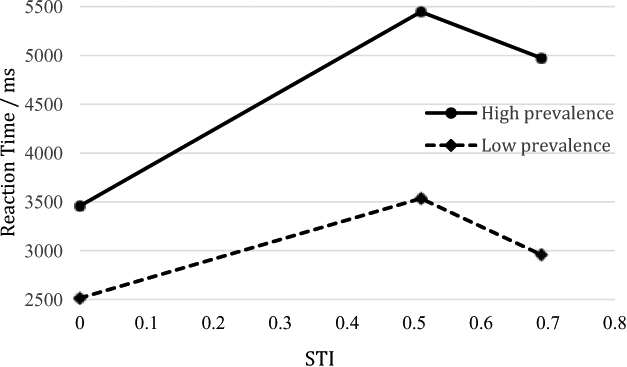
Reaction times as a function of target prevalence and STI level
Paired t-test results of reaction time
STI: speech transmission index.
B. Miss error rate
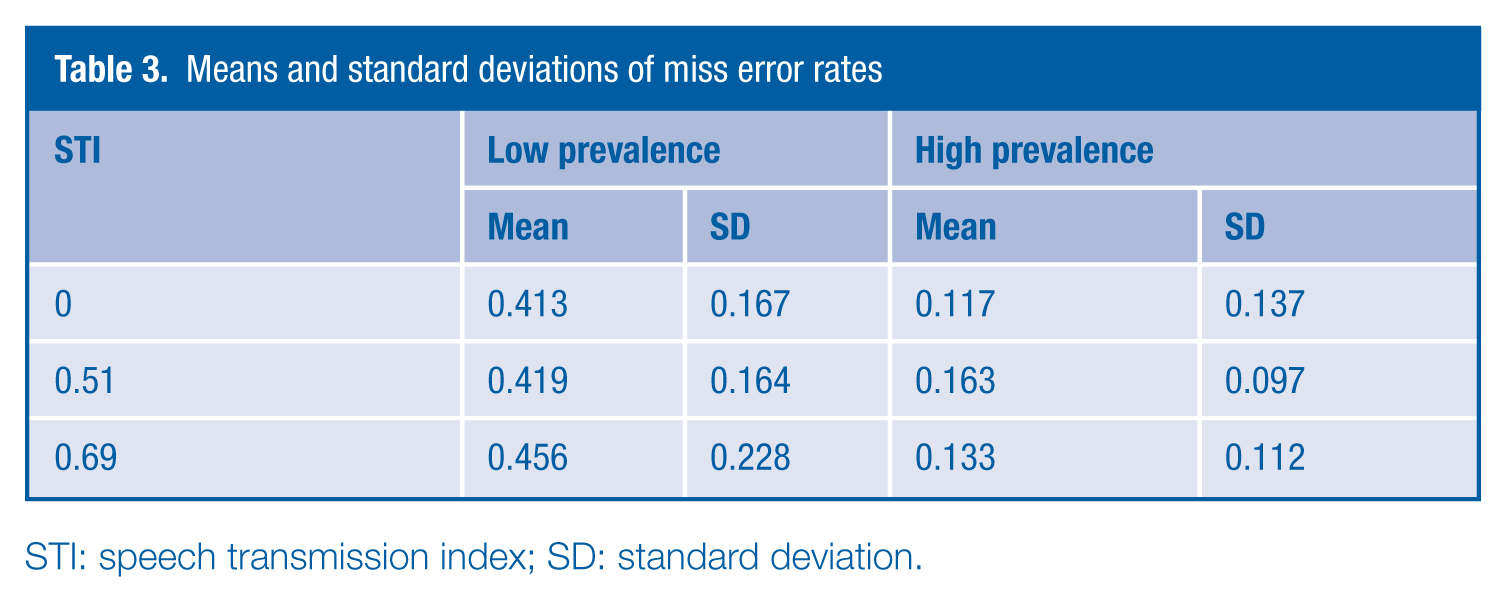
Under various conditions, the means and standard deviations for miss error rates are presented in Table 3 . Considering that the data of miss error rates did not satisfy the homogeneity of variance (p < 0.001), Mann–Whitney U nonparametric test was applied to examine the effect of target prevalence on miss error rates. The results indicated that the miss error rate of low prevalence trials was significantly higher than that of high prevalence trials (p < 0.001). The effect of STI level on miss error rates was examined by Kruskal–Wallis nonparametric test, and the results showed that STI level did not significantly affect miss error rates (p > 0.05). False alarm rates in all conditions were small (less than 4%). Neither target prevalence nor STI level had significant effect on false alarm rate (p > 0.05).
Means and standard deviations of miss error rates
STI: speech transmission index; SD: standard deviation.
IV. Discussion
Compared with high target prevalence, the reaction time with low target prevalence was shorter and the miss error rate was higher. Regardless of STI level, low target prevalence effect existed in X-ray screening tasks. Under the condition of low target prevalence, participants tended to terminate searching earlier no matter the trials were target-absent or target-present. This tendency could lead to the rise of miss error rate. 15 Given that low target prevalence is common in practical visual search tasks in a control room, miss errors are likely to occur and may lead to serious consequences. Measures such as training and emphasis on accuracy should be obtained to reduce miss errors resulting from the low prevalence effect. 16
In addition to target prevalence, STI level had significant influence on X-ray screening task performance. Reaction time was significantly longer when intelligible speech was applied. However, no significant effect was found on the miss error rate or false alarm rate. Performance loss increased as STI increased from 0 to 0.51, and the greatest performance loss was experienced when STI = 0.51, which is consistent with the previous studies. 11 The results indicated that irrelevant speech in task environment had negative effect on cognitive performance. When intelligible speech was present in an acoustic environment, the attention of the participants was divided; thus, their performance was negatively affected. By contrast, when STI increased from 0.51 to 0.69, the reaction time began to decrease. Previous studies revealed that verbal tasks suffered more from intelligible speech than nonauditory tasks did. 9 However, this study demonstrated that the task had no relationship with the auditory demand, for instance, a visual search task could still suffer from intelligible speech. Conversations are common and disturbing in control rooms with more than one operator. To reduce performance loss caused by intelligible speech, the STI value should be lower than 0.5. 7 In addition, various ways in effectively reducing speech noises, such as masking sound and room absorption, could be applied. 9
V. Conclusion
This study examined the effects of target prevalence and intelligible speech on visual search performance. A simulated X-ray screening task was used in the experiment. It can be concluded that the low prevalence effect existed in X-ray screening tasks. The reaction time of low prevalence trials was shorter than that of high prevalence trials. The miss error rate of low prevalence trials was higher compared with that of high prevalence trials. The STI affected the reaction time of the operators, whereas the miss error rate was not affected by STI. Performance loss was greatest when STI = 0.51 for X-ray screening tasks. Given that intelligible speech negatively affected work performance regardless of the work involved in the auditory demands or visual demands, proper measures should be taken to reduce their unfavorable effects on the task design and working environment of control rooms.
Footnotes
Funding
This work was supported by two grants from the National Natural Science Foundation of China (Project Nos 71071085, 71471098).