




Abstract
The increasing complexity of control room environments requires operators to interact with a wide variety of display signals and control devices. Therefore, the design of displays and controls plays an important part in determining the overall performance of operators. Compatible display-control design facilitates performance and reduces human errors that may occur as a result of a mismatch between the expectations of the operators and the relationships between the displays and controls. Three specific design compatibilities, namely, spatial compatibility, movement compatibility, and conceptual compatibility are introduced and discussed in detail in this paper. It is anticipated that this paper will provide pragmatic recommendations to assist interface designers to improve operational system effectiveness and safety by considering the many aspects of display-control compatibility necessary for effective human–machine interface design.
I. Introduction
In control room environments, displays and controls are the essential means of communication that allow operators to interact with machines and equipment. Displays provide operators with information about the operational status of systems, and control devices allow the operators to take action to influence the state of systems. Displays and controls are so important that they are used in almost every human activity, ranging from relatively simple computer and machinery operation to complex cockpit operation, interactive driving simulation, and satellite positioning.1–6 Given the prevalence and importance of displays and controls for signal presentation and response execution, studies and research on human information processing for different signal and response sets have proliferated in recent decades. 7 Compatibility is a central concept in the study of displays and controls 8 and refers to the relationships between display signals, control responses, and the expectations of the operators. The compatibility between signals and responses is an important determinant of the rate of information transformation (or recoding), such that the greater level of compatibility, the less recoding necessary for processing the information. Such reduced recoding demand represents faster response times, higher response accuracies, lower mental workload, and generally better human performance. However, compatibility per se is a very general term to describe the stimulus and response relationship. In order to more accurately and precisely describe the various characteristics and human expectations (or mental model) for different combinations of stimulus and response sets, three specific compatibilities—namely, spatial compatibility, movement compatibility, and conceptual compatibility—have been defined and studied extensively. This paper serves to summarize the aspects of compatibilities necessary to improve human–machine interface design and provide recommendations for interface designers to increase operational system effectiveness and safety and to facilitate the performance of operators; this is particularly important under emergency conditions.
II. Spatial Compatibility
Spatial compatibility refers to the correspondence of the physical arrangement in space of display and control components. Usually, the spatial compatibility (stimulus–response compatibility (SRC)) effect produces the most marked benefits when components of the response components and the stimulus components correspond physically in some obvious ways with one another. When this stimulus–response relationship is direct and natural, it is regarded as spatially compatible, whereas when the relationship is indirect and unnatural, it is regarded as incompatible. The reaction time and response accuracy of operators are the indicators usually used to measure the SRC effect. An early illustration of the importance of spatial compatibility in interface design was presented by Bayerl et al. 9 in a study on the layout of the functional keys of a keyboard and the corresponding labels for these keys on a screen. They found that when the labels on the screen were arranged in a manner physically similar to the keys on the keyboard, there was a significant reaction-time advantage. An attempt to explain the response advantages associated with SRC was provided by the coding hypothesis of Umiltà and Nicoletti, 10 which suggests that the higher speed and accuracy of a compatible S-R combination is probably due to lower coding demands and higher rates of information transfer. The hypothesis proposes that incompatible pairing of signal and response positions requires an additional translation step to interpret the spatial codes, and thus, reaction time is increased and more errors are made. Many examples of the SRC effect in human–machine interfaces have been reported, showing that responses for compatible pairings are usually faster and more accurate than those for incompatible pairings.7,11–13 A more recent account of the discrepancy in performance of display-control mappings is from the brain activity perspective. It claims that in comparison to an incompatible display-control pairing, a compatible pairing leads to higher effectiveness in the stage of mapping a display target to the corresponding response, and therefore more attentional resources are available for attending to the target. 14
Given the significance and importance of spatial compatibility, in the past 30 years, a great deal of work has been directed at understanding human information processing for different spatial relationships for stimulus and response arrays under different experimental and practical settings.7,12,14–21 In a recent experimental study, Chan and Chan 22 studied the SRC effect for a horizontal visual display with hand and foot controls ( Figure 1 ). In their first experiment, with a two-dimensional (2D) front–rear and right–left signal layout and corresponding top-hand and down-foot controls, they found that it was advantageous to respond to the front signals with hand controls and the rear signals with foot controls. Such a favorable mapping relationship remained robust even when, in their second experiment, the foot controls were moved forward to the front signals position. In a practical setting, Liu and Jhuang 6 conducted a driving simulator study to investigate the SRC effect for different display types used to present warning information. With warning information that could be presented in 12 different segmented spatial locations, the results showed that warning information displays with control spatial compatibility significantly improved driver response times and accuracy, as opposed to displays that were not compatible.
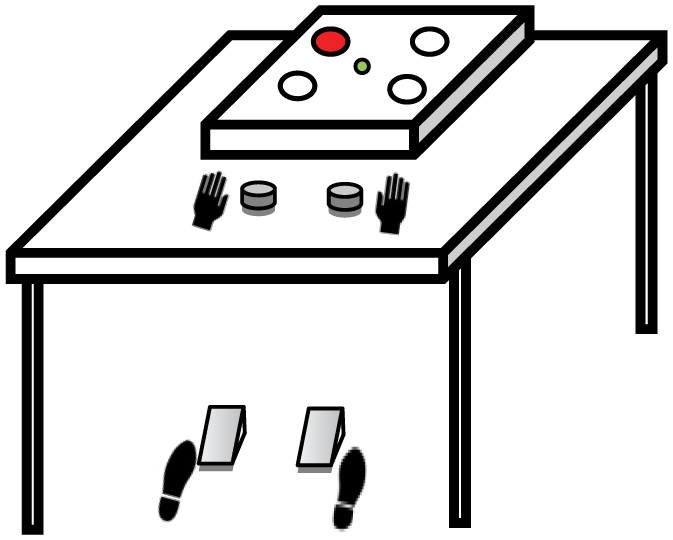
The experimental configuration used in the study of Chan and Chan 22
Although most previous studies have demonstrated the SRC effect with stimulus and response sets sharing the same spatial dimensions (i.e. stimulus and response arrays parallel to each other), it is important to note that the SRC effect also exists when the stimuli and responses are oriented orthogonally (i.e. stimulus and response arrays perpendicular to each other).13,23,24 Consistent findings have been that when mapping up–down stimulus to right–left response, there were significant orthogonal S-R compatibility effects for up-right/down-left mapping. Such superiority in up-right/down-left mapping may be explained by the salient features coding principle that states that codes for right and up are more salient than those for left and down; therefore, due to the correspondence of the relative salience of the positions, up-right/down-left mapping can lead to faster recoding and hence better response performance.7,25 This salient frame of reference also exists for 2D signal-response arrays where the spatial compatibility effect for the right/left cues is always stronger for the above/below cues due, possibly, to the spatioanatomical difference of the responding effectors (two hands/feet), resulting in significant right–left prevalence effect. 26
III. Movement Compatibility
Movement compatibility refers to the relationship between control motions and the movement of display indicators. When people interact with a control and display system, they will normally have certain expectations about the relationship between the movement of the controls and the movement of the display indicators. For instance, clockwise rotation of a control knob is expected to produce an increase in the parameter being measured or monitored. Although for taps controlling the flow of liquids or gases a clockwise rotation will reduce or stop the flow, this can be a source of confused expectations which can be especially problematic during emergencies. When such expectations are quite strong and well defined, they are known as population stereotype or direction-of-motion stereotype. An index of reversibility (IR), ranging from zero for absolute non-reversibility to unity for prefect reversibility, has been used to indicate the likelihood of the expectations being reversible. 27 Taking account of movement compatibility or direction-of-motion stereotypes is important in determining the success or failure of the design of controls and displays, 28 so much so that a great deal of research has been conducted on various control/display configurations including thumbwheel-circular displays, 29 rotatory control-linear scales,30–32 rotary control-circular displays,33,34 rotary control-digital counters, 35 four-way lever-circular displays, 36 and four-way lever-digital counters. 37 Although it is possible to train people to operate a system which is not in line with their expectations (stereotypes), it usually requires a much longer training time, and performance may deteriorate significantly under emergency conditions. Therefore, it is very important to take account of population stereotypes for the relevant operator population when aiming to design compatible control/display relationships to achieve optimal safe performance.
In general, there are three major design principles in stereotypes for controls and displays.38–40 The first one is Warrick’s 41 principle, which states that a display indicator is expected to move in the same direction as the side of the control that is nearest to it. This principle is only applicable when the control is located to the side but not at the end of the display. The second one is the clockwise-for-increase principle, 42 which states that clockwise rotation of a control will produce an increase in the display value regardless of the relative location of the control to the display. The last one is the scale-side principle, which states that there is expectation that a display indicator will move in the same direction as the side of the control which is on the same side as the scale on the display.38,43 Figure 2 illustrates bad and good designs for a rotary knob and vertical display configuration. In the bad design, there are incongruent predictions of the control knob motion and display indicator movement because Warrick’s principle and the clockwise-for-increase principle predict that a clockwise movement of the control knob (white arrow) will increase the display value (i.e. move the indicator toward 15), whereas the scale-side principle will, conversely, predict that a counter-clockwise movement of the knob (black arrow) will achieve the same result. In order to facilitate consistent and safe responses for a display-control setup, it is recommended to design in such a way that the direction of movement principles do not conflict with each other. In the good design example here, the three principles—Warrick’s principle, clockwise-for-increase principle, and scale-side principle—all predict a clockwise turn of the rotary knob will move the indicator toward 15. Many studies have shown that when the principles clash, as in the case of Figure 2(a) , the stereotype will be weakened.44,45 It has also been shown that when there is conflict among the principles, Warrick’s principle dominates the other principles and should therefore be given priority in control/display designs. 31
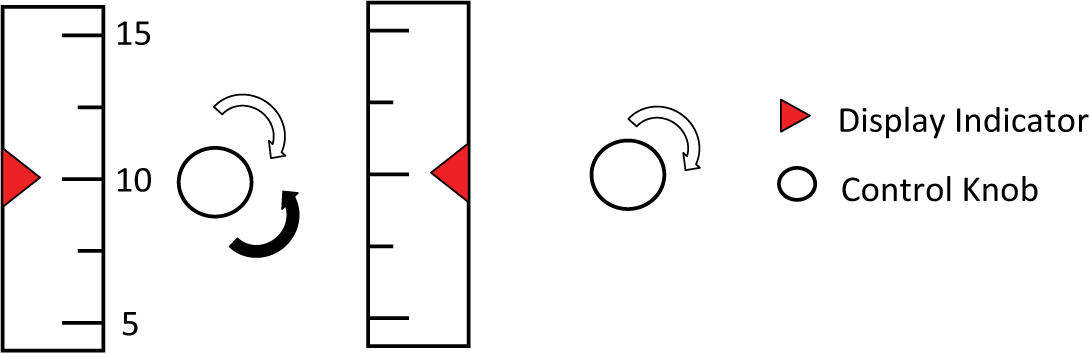
Illustration of (a) a bad and (b) a good design for a rotary control and vertical linear scale
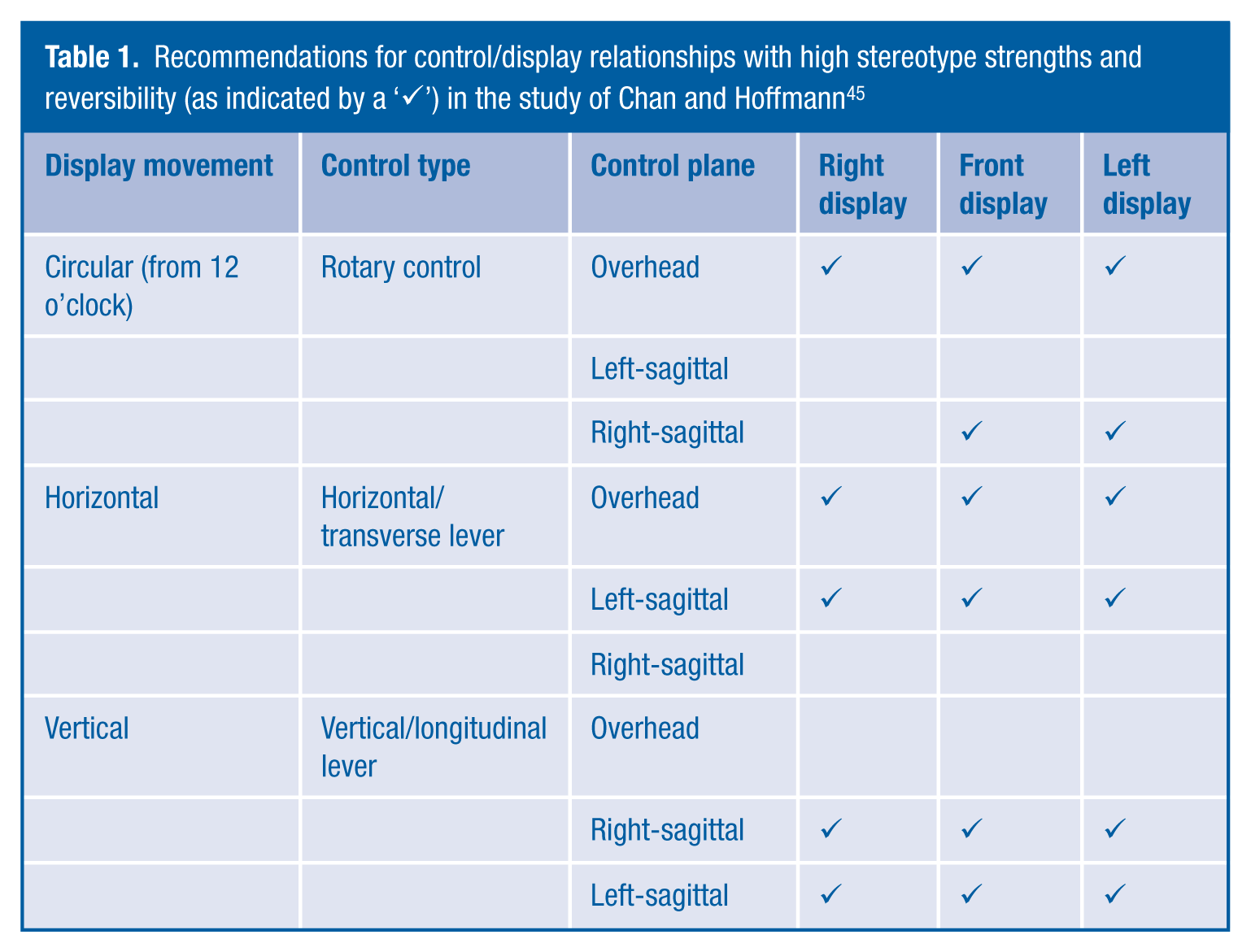
Increasing complexity of workstations is generally accompanied by an increase in the number of displays. When working with multiple displays, there are occasions when operators and control devices are in different planes relative to the displays, such as in endoscopic surgery, 46 contemporary computing environments, 47 and person-vehicle systems. 48 In such cases, three types of directional compatibility as suggested by Worringham and Beringer, 49 namely, control/display compatibility, visual-field compatibility, and muscle synergy compatibility, should be thoroughly considered. Control/display compatibility here refers to the compatibility between the direction of the control and the display, such that a control movement in a given direction results in a parallel movement of the display indicator. Visual-field compatibility refers to the compatibility between the controlling limb movement and the display indicator, and it is present when they are both in the same direction in the visual field. Muscle synergy compatibility refers to the use of the muscle synergy (muscle activation pattern) normally associated with the required direction as seen in the visual field. Figure 3 illustrates the compatibility relationships for the three rules for directional compatibility for different postures and response directions of the operator. Concerning the possible effects on response performance of different relative locations among operators, controls, and displays, several recent studies have examined response preferences to different display orientations relative to the operator along with different types of controls located in different planes.44,45 Chan and Hoffmann 45 examined stereotype strength and reversibility for displays in the front, right, and left orientations relative to the operator, using rotary, horizontally moving, and vertically moving controls located in the overhead, left-sagittal, and right-sagittal planes. They found that overall stereotype strength was determined by various components. Horizontally moving controls were governed by the visual-field model, vertically moving controls by the “up-for-up” relationship between displays and controls, and the rotary control by the “clockwise-for-clockwise” and hand/control location effect. When all the components were additive positively, the result was maximum stereotype strength. Their recommendations for control/displays relationships having high stereotype strength and reversibility are summarized in Table 1 .
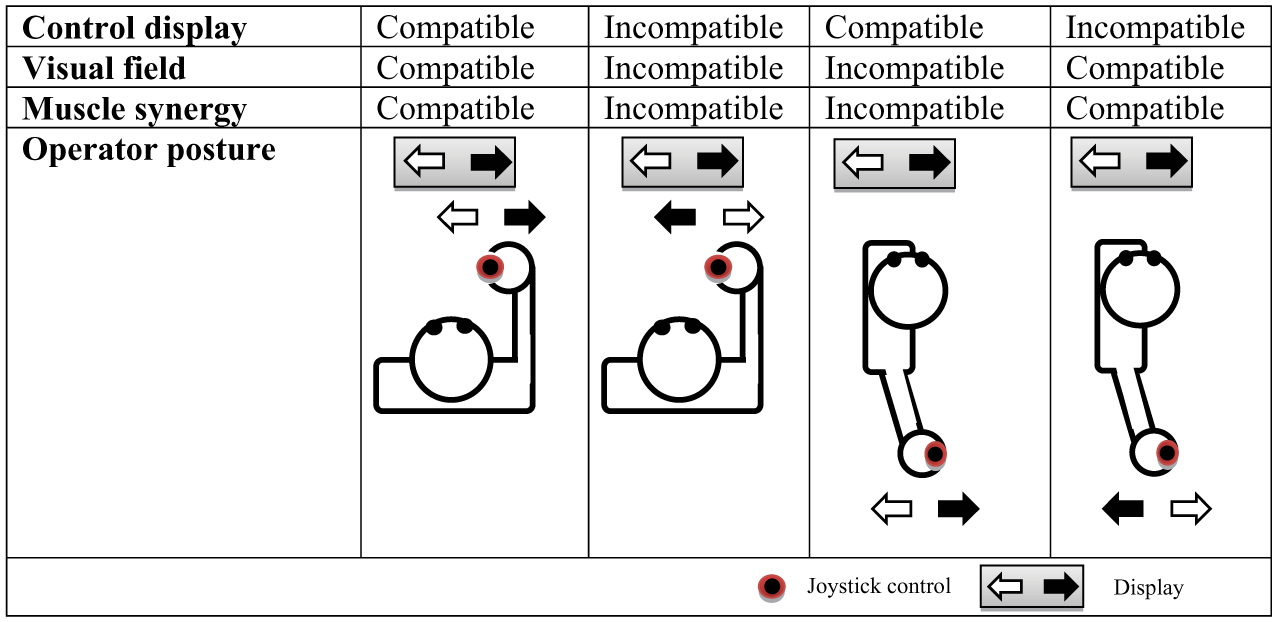
Plan view of the operator, showing the compatibility relationships for the three types of directional compatibility suggested by Worringham and Beringer 49
Recommendations for control/display relationships with high stereotype strengths and reversibility (as indicated by a ‘✓’) in the study of Chan and Hoffmann 45
IV. Conceptual Compatibility
Conceptual compatibility is concerned with the degree of congruency between the conceptual associations of human operators and the codes and symbols used. In other words, it evaluates the meaningfulness of the codes and symbols to the people perceiving them. Symbol comprehension is a measure to assess the readiness of an observer in understanding the message intended to be conveyed by the symbol. 50 Given the importance of conceptual compatibility in facilitating comprehension of symbols/signs/icons, there has been a wide variety of research in the areas of industrial safety sign comprehension,51,52 color associations,53,54 hazard perceptions, 55 and so on.
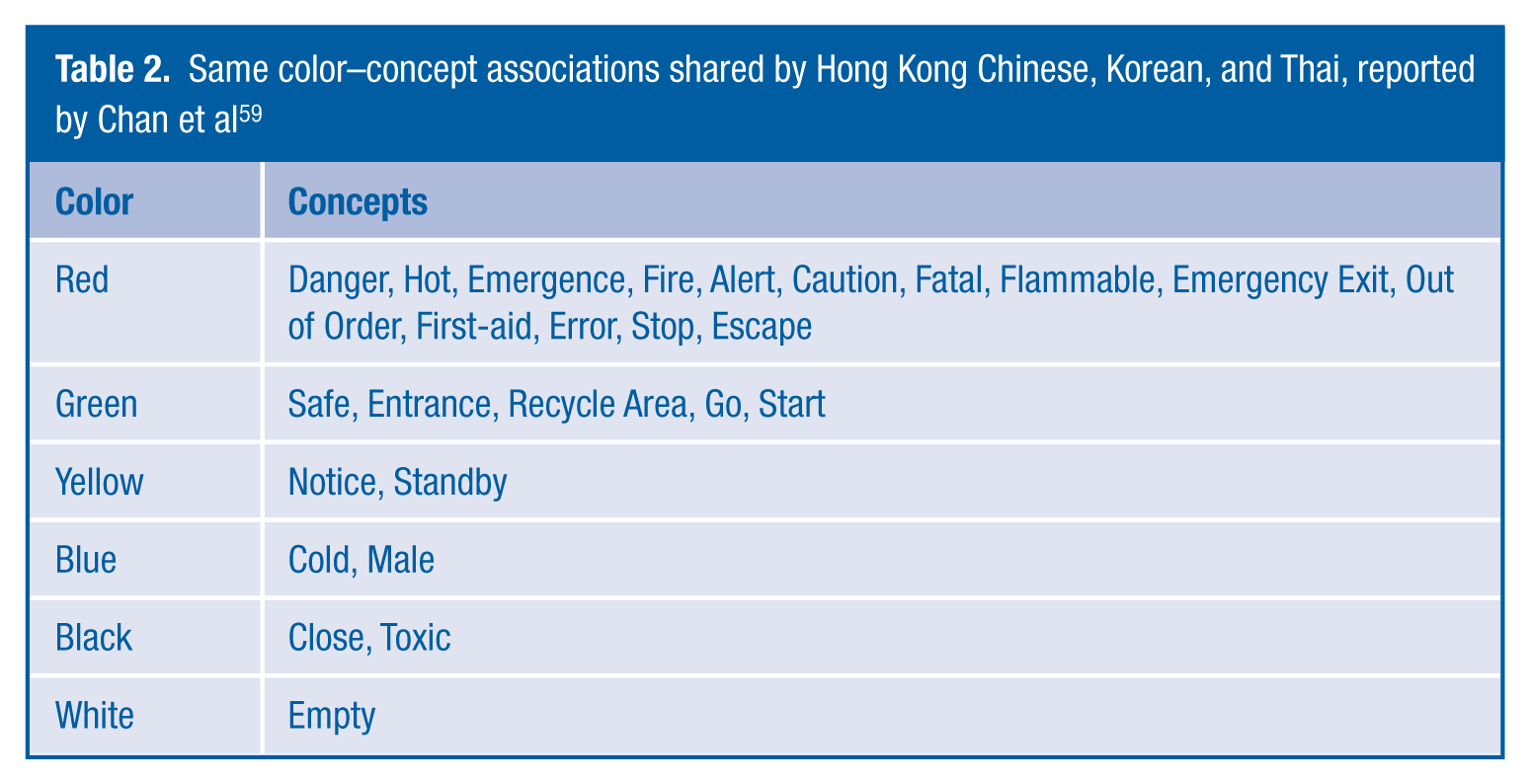
In practical workstations, different colors are commonly used to represent various conditions in control and display systems to assist the operator in monitoring and controlling different tasks. Therefore, assignment of colors which are compatible with the color associations of the operator is of utmost importance to facilitate swift understanding of operating conditions and to elicit rapid, timely, and correct control actions. It is also important to note that some color associations differ significantly among populations because of cross-cultural differences.54,56,57 For example, purple connotes anger and passion for Americans, but it usually connotes royalty for Chinese and Japanese. 58 Chan and Courtney 53 examined color associations for Hong Kong Chinese using 10 colors and 16 concepts. The results showed that the primary colors red, green, and blue had associations with 10 of the 16 concepts, suggesting that it is beneficial to use these three colors in the design of control panels or warning labels to facilitate correct interpretation of the information presented. However, comparing data from US subject, Hong Kong Chinese, and Yunnan Chinese, Chan and Courtney 53 found that there was little consensus on the color–concept associations between the populations. Thus, in order to reduce the risk of error and improve safety performance, equipment and systems should be so designed that they can, as far as possible, be in agreement with the stereotypes for the relevant population. Chan et al. 59 investigated cross-cultural differences in the three major areas of warnings, signs and equipment status, and actions required, among Hong Kong Chinese, Korean, and Thai. They found that 26 out of 38 concepts (68.4%) were associated with the same colors by the three populations. These congruencies in color–concept associations are shown in Table 2 .
Same color–concept associations shared by Hong Kong Chinese, Korean, and Thai, reported by Chan et al 59
V. Conclusion
Maintaining compatible relationships between controls and displays in human–machine systems can significantly improve human information processing of external information and enable faster and more accurate responses to stimuli. The degree of compatibility can be determined by the similarity in spatial relationships between displays and controls (spatial compatibility) or by habits or associations characteristic of the culture of the population concerned (movement compatibility and conceptual compatibility). Therefore, it is crucial for industrial designers to check the generality of their assumed relationships in human–machine interfaces so as to ensure that their designs use compatible relationships and are in agreement with the expectations of the targeted users.
Footnotes
Funding
The work described in this paper was fully supported by a grant from City University of Hong Kong (SRG7004079).