



Abstract

G3-PLC Certification Programme for Smart Grids Has Global Opening
The newly announced official and worldwide certification will now support the G3-PLC standard market, which is important in smart grid implementation, and which will secure the tenders launched by utilities. There are also electric vehicles (EVs) to charger implications.
G3-PLC is a protocol for narrow band low-frequency powerline communications. It facilitates high-speed, highly reliable, long-range communication over the existing powerline grid. Certification will guarantee, says the G3-PLC Alliance organisation, the correct implementation of the G3-PLC specifications, the performance and the interoperability of the products.
The benefits of the smart grid are well known. However, the widespread implementation has been impeded by the lack of a widely accepted two-way powerline communications technology. G3-PLC has emerged as the open standard to enable smart grid development.
As the G3-PLC Alliance puts it, ‘an electricity grid without adequate communications is simply a power distributor’. It is through the addition of two-way communications that the power grid is made ‘smart’. However, until recently, the lack of cost-effective, standardised communications that can deliver the bandwidth, reliability and security that the smart grid needs has hampered the progress and implementation of the smart grid worldwide.
G3-PLC was, therefore, developed to meet the industry’s need for a potentially ubiquitous powerline communications standard that facilitates high-speed, highly reliable, long-range communication over the existing powerline grid. With the ability to cross transformers, infrastructure costs are reduced and, with its support of IPv6, G3-PLC will support powerline communications into the future.
Two-way communications networks based on G3-PLC will, therefore, provide electricity network operators with intelligent monitoring and control capabilities. Operators will be able to monitor electricity consumption throughout the grid in real time, implement variable tariff schedules and set limits on electricity consumption to better manage peak loads.
The G3-PLC Alliance has now appointed two member companies to run the certifications tests, LAN and TÜV Rheinland. For more information, visit http://www.G3-PLC.com
Concern Over Current Automation and Control Trends
Thomas Seubert for Automation has reported that over the last couple of years, there have been concerning trends in the automation and controls sector. He reports that these trends are occurring mostly in North America, but are also happening globally. Such trends include the fact that the major manufacturers (such as the automotive giants) have got rid of their internal plant controls engineering departments and are outsourcing their control engineering project work. Because of this, he says, the amount of consecutive time spent by controls engineers at a given plant has significantly increased to as much as 14 h or more every day.
Moreover, many qualified individuals have left the controls engineering sector, and the number of young adults studying controls engineering and/or mechatronics at the college/university level has decreased. Another unfortunate trend is that the number of internships and starting-position opportunities has also decreased, which makes it harder for entry-level people to break into the industry. Moreover, the manufacturers have not restarted technology migration investments since the recession, with too many plants running obsolete hardware. Replacement parts either cannot be purchased or are five times as expensive as they were a decade ago.
The overall effect of these trends is concerning, not least because as more controls engineers retire, they will not be replaced by properly trained professionals. Since plants no longer have controls engineering teams, there are no programmes for apprentices, interns or starting engineers to obtain the experience they need. This will force them to work in other countries like India, where such programmes still exist. This existing global controls engineering capabilities.
What is required, says Thomas Seubert, is for educational and manufacturing groups to create suitable education programmes, and also to provide safeguards so that people are not stuck in a plant for more than 16 h a day. Such long hours have become one of the main reasons why professionals leave this industry and why many others refuse to enter it. Such hours could also be potentially unsafe.
Finally, he says, incentives must be provided to help manufacturers with technology migration projects. For example, an old PLC-5 system should be replaced with a ControlLogix system. Many plants struggle with lack of funding. This issue should be top of mind for operations managers at all manufacturing plants. Migrations to the latest technology are important because training classes are no longer available for the older solutions, making it more difficult to train a new engineer.
Moreover, the solution providers are doing their best to make it difficult to support the old technology. Thomas Seubert, who has 24 years of experience in controls engineering, currently works as a Manufacturing Execution System (MES) Lead for Tata Technologies.
Industrial Ethernet Descends Automation Hierarchy to Benefit Instrumentation
The latest research into industrial Ethernet devices from ARC Advisory Group (http://www.arcweb.com) reveals that this technology continues its sustained drive downward in the automation hierarchy. This has generated, says the organisation, increased user acceptance and significant annual increases in shipments within the overall slow-growing automation hardware marketplace. Continued recognition of, and additions to, the industrial Ethernet value proposition, coupled with lack of saturation in key device segments, are primary catalysts behind this phenomenon.
Greater availability of PROFINET-based devices at the field or input/output (I/O) level further fuelled shipments since the organisation’s last update, a phenomenon that is expected to continue as suppliers look to migrate the large PROFIBUS user base. Industrial Ethernet is also starting to make inroads in high-end instrumentation in the process industries in areas, such as Coriolis and magnetic flowmeters. This type of intelligent instrumentation fits well with industrial Ethernet in the process industries because of the large amount of information they can provide to the control system.
Industrial Ethernet is often considered ‘future-proof’ relative to dedicated automation networks because of its origins in, and support from, the much larger commercial information technology (IT) community. ARC sees numerous parallels between the industrial Ethernet value proposition and emerging concepts such as Industrie 4.0 and the so-called ‘Industrial Internet of Things’, adding further to the future-proof claim.
Surface-Enhanced Raman Spectroscopy Substrates for Explosives Detection
Ocean Optics has introduced a new substrate for Raman spectroscopy applications. Surface-enhanced Raman spectroscopy (SERS) substrates are highly sensitive, stable and reliable, delivering precise trace-level Raman spectroscopy measurement in applications ranging from chemical and explosive agent detection, to authentication, contaminant screening and quality control in production environments and the laboratory.
Using precisely controlled gold nanoparticles, these SERS substrates amplify very weak Raman signals by many orders of magnitude. The result is fast, repeatable SERS measurements for the identification and quantification of SERS-active analytes. Detection at the parts per billion, and even parts per trillion, level are possible.
The SERS substrate manufacturing method, claimed to be unique, results in affordable mass production with high repeatability and customisation options. Standard substrates are microscope slide format with a 5-mm diameter active area. Ocean Optics uses optical-grade borosilicate glass and high-performance silicone-based adhesive for compatibility with a wide range of solvents.
Customised designs are available with a choice of form factor such as swabs and coatings, as well as the ability to impart specificity to particular analytes. SERS substrates work reliably with the complete range of Ocean Optics Raman instruments, including the IDRaman mini handheld Raman spectrometer.
Ocean Optics is giving away free three-packs of SERS substrates, while supplies last. Samples can be requested at http://oceanoptics.com/sers-giveaway/. To learn more, email
Ocean Optics’ new substrate for Raman spectroscopy will find many applications

Industry-Compatible Back Pressure Relief Pilot Regulators Launched
BelGAS (http://www.belgas.net) has introduced its PL82, PL82B and PL83 series pilot regulators, designed to provide high-reliability gas back pressure relief within a variety of oil and gas applications. Most main gas pressure regulators are modified to accept pilot regulators from the same manufacturer, but these new pilot regulators may be used along with other industry models.
The pilot operated BelGAS PL82 and PL83 are fully compatible with the company’s P1808 and F289 back pressure relief regulators. They feature aluminium body material and choice of PSIG or WC range. The robust design allows them to vent continuously when the main valve is either repositioned or in relieving mode. They will not bleed or relieve when pressure values fall below set pressure. The PL82B has been designed for more general-purpose back pressure relief. As a low bleed pilot, the regulator will only bleed when the valve is repositioned.
The PL83 is a high-bleed restriction pilot and lower pressure unit. Options for low, medium and high gain allow for the lowest build-ups and fastest response speeds (i.e. high gain is highest speed) and are determined according to the needs of each application. Typical applications include gas and liquid service, oil and gas separators and distribution relief for gas distribution systems.
The new BelGAS PL82, PL82B and PL83 series pilot regulators provide high-reliability gas back pressure relief for many oil and gas applications

On Guard with New Electrical Safety Testers
Significant time and cost saving benefits are provided by the new Sentinel series of bench-top Hipot/flash testers from Clare (http://www.seaward.co.uk). These deliver improved type testing during product development or enhanced compliance testing in a laboratory environment. The Sentinel 200, 500 and 501 instruments manufacturers to check their products in-house to ensure compliance with the relevant international technical conformance standards such as EN 60598, UL 1598, IEC and CSA C22.2 before being sent to third-party test/approval houses. This can reduce product time-to-market, saving time and costs in the process.
The company says that this series is ideal for R&D facilities and compliance laboratories, while design, quality assurance and manufacturing and production engineers will also benefit from the easy-to-use safety test features. The fast, safe and accurate testing of high voltages up to 5 kV AC and 6 kV DC is provided across the range, while accurate testing up to 500 VA AC power output – allowing for 100 mA tripping currents, a requirement in many standards – is available on the Sentinel 500 and 501 units. The latter also provides earth bond/insulation resistance testing. These instruments can be used for compliance testing while reducing the risk of damage to the equipment under test, and fully automatic and sequential testing is also possible.
Significant time and cost saving benefits are provided by the new Sentinel series of bench-top Hipot/flash testers from Clare

Highly Compact Robot Handling Solution for Ready-to-Use Syringes
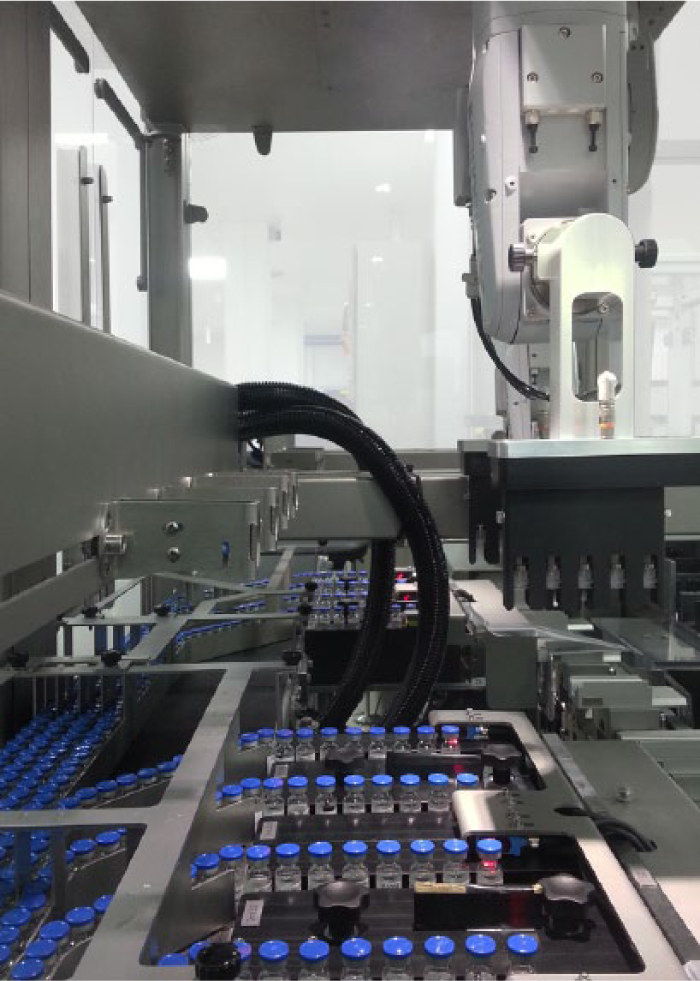
Mitsubishi Electric Europe (eu3a.mitsubishielectric.com/fa) and robotics specialist Robotronic (http://www.robotronic.ch) are providing what is claimed to be the world’s first handling concept for supplying ready-to-use syringes to an end-of-line packing system. This solution is said to be exceptionally compact and extremely fast, with a processing rate of up to 600 syringes/min. It is also so flexible that easy switching between different syringe and syringe carrier formats is possible and a wide range of handling tasks can be performed quickly and easily.
The handling solution supplies disposable syringes to the packing process quickly and flexibly via a rail system. It comprises two modular robot cells developed by Robotronic, so-called modular robot technologies (MRTs). In one cell, two precisely coordinated Mitsubishi Electric MELFA robots from the RV-4FL series look after the whole process of handling tubs and syringe carriers as well as the different syringe formats ranging from 0.5 to 10 mL. To do this, they have a suitable conversion option. The second cell contains a rotary magazine turret which supplies up to 20 tubs filled with syringe carriers to the packing system.
The Mitsubishi Electric MELFA RV-4FL robot uses vacuum grippers to remove two rows of vials, each containing five vials, from the positioning screws and place them in the waiting packing units

Measuring just 1.0 × 1.3 m, the MRT basic module occupies a space slightly smaller than a europallet and is 2.20 m high. The two compact overhead articulated-arm robots can perform both re-nesting and de-nesting tasks. The rotary turret is driven by a Mitsubishi Electric MR-J4 servomotor. The turret reloads the MRT while the process is in operation, so reducing idle time to a minimum. To achieve the same autonomy with a conveyor belt, the belt would have to be 4 m long.
The dynamics of the Mitsubishi Electric servos come into their own in the conveyor system in particular, because of the fast acceleration and high braking torques combined with a very gentle start-up and deceleration. This high level of precision is important in the indexed conveyor system for the packing units because the machine has to position new blisters every 300 ms in order to keep pace with the second-by-second cycle of the cartoning supply chain.
The handling solution can index 600 syringes/min into the emptying rail. The special feature is that Mitsubishi’s MELFA robots are not only suspended overhead but also work in pairs within an extremely limited space
Schneider Electric to Acquire InStep Analytic Software
ARC Advisory Group (http://www.arcweb.com) reports that France-based Schneider Electric (http://www.schneider-electric.com), the global specialist in energy management, has entered into an agreement to acquire InStep Software (http://www.instepsoftware.com), a leading provider of real-time performance management and predictive asset analytics software and solutions.
This move is the latest acquisition from the company’s growing software business and deepens its presence in the power and energy market. The transaction is expected to close in the fourth quarter of 2014, subject to the usual regulatory conditions. Headquartered in Chicago, InStep provides two primary real-time performance management and predictive analytics software solutions. Its eDNA historian software collects, stores, analyses, displays and reports on real-time operational and machinery sensor data.
Its PRiSM predictive analytics software monitors the real-time health and performance of critical assets by using advanced pattern recognition and diagnostic techniques to identify subtle deviations in operating behaviour that are often the early warning signs of imminent failure.
The company also offers its EBS energy management software, which helps universities reduce their utility costs by analysing energy consumption and streamlining the utility billing, cost allocation and reporting processes. The eDNA software strongly complements Schneider Electric’s Wonderware Historian software, it is claimed, and PRiSM software enhances the company’s industry-leading information and asset management software offerings.
Many of the world’s most successful companies use InStep’s software products to manage and analyse the rapidly growing amount of real-time operational and machinery asset-health-related information, but its solutions also complement Schneider Electric’s offerings in several other industries, including food and beverage, consumer packaged goods, metals and mining, life sciences and water and wastewater. InStep Software will continue to be managed by its existing executive team.
Monitoring Sensors by Mobile Phone
With the TC Mobile remote signalling and remote control system from Phoenix Contact (http://www.phoenixcontact.com), you can monitor digital and analogue inputs cost-efficiently and securely via the mobile phone network. In addition to the four digital inputs, two analogue inputs are now also available for the level sensor, pressure sensor, gas sensor or brightness sensor values.
What is special about this is the fact that the inputs can be used not only for a 0–20 mA signal but also for voltage measurement up to 60 V. If ever the measured value deviates from the reference value, an alarm is generated via SMS, email or general packet radio service (GPRS).
With a large voltage range from 10 to 60 V DC or from 93 to 250 V AC, the compact signalling system is extremely versatile, particularly when used in buildings and harsh industrial environments.
The TC Mobile remote signalling and remote control system from Phoenix Contact

News in Brief
Vision cameras for robotics and QA
One of the main areas of application for USB 3.0 from Kithara is machine vision, especially for the fields of robotics, quality assurance and medical engineering. USB3 Vision cameras are claimed to be among the most cost-effective in these sectors, are able to transfer image data at high rates as well a slow CPU-load and do not require a frame grabber or additional power supply. Combined with Kithara’s real-time environment, USB3 Vision can be integrated efficiently in a variety of systems with different demands. For more information, go to http://kithara.de/en/solutions/realtime-image-processing
GE opens up Predix industrial Internet platform to all
GE has announced that its Predix software platform, used to power the industrial Internet, will be made available to any company in 2015, allowing them to create and deploy their own customised industry apps at speed and scale to better manage the performance of their assets. GE’s new application performance management (APM) solutions focus on power optimisation, providing customers 24 × 7 access to a remote monitoring and diagnostics platform, predictive maintenance insight and incremental power when needed. Distributed Power’s current suite of data-driven solutions – On Site Power Visibility and On Site Power Performance – help to optimise the performance of GE’s aeroderivative gas turbines, reduce life-cycle costs, improve uptime, increase efficiency and drive profitability. Go to http://www.gesoftware.com/predix
Automated test technologies in webcast
Watch this NI (http://uk.ni.com) webcast series to learn how a platform-based approach can provide the right tools to create effective, programmable systems. Test engineering faces expanding requirements and unprecedented business constraints that affect time to market, cost of test and staffing levels. As devices become more complex, engineers need to increase the throughput of their test systems, reduce maintenance costs and explore lower cost solutions. In this free five-part webcast series, learn how NI’s software-defined approach, based on flexible hardware platforms and scalable software, is helping companies to build better-automated test and measurement systems.
Access your data via any mobile device
Both expert and novice Raspberry Pi users will benefit from a new product that enables easy Wi-Fi connectivity. The xPico Wi-Fi Pi Plate makes it simple to create prototyping of mobile-ready designs. Created by IoT solutions provider Lantronix, xPico Wi-Fi Pi Plate supports direct connectivity between smartphones/tablets and the Pi, while simultaneously allowing communication with cloud services. As the world’s smallest embedded device server, xPico Wi-Fi provides direct access to data and equipment via any mobile device. With no host software to load and no code to write, xPico Wi-Fi allows design engineers to cut development costs and speed time to market. Go to http://www.lantronix.com
EPSG introduces openSAFETY distribution 1.4
The openSAFETY protocol stack is now available in version 1.4 as open-source software for download from the SourceForge repository. As with its predecessor, this new version has been pre-certified by TÜV Rheinland up to SIL 3 in accordance with IEC 61508:2010. Using the openSAFETY stack can, therefore, reduce development times and risks. Another way to cut costs is the option of running the openSAFETY Configuration Manager (SCM) on non-safe hardware platforms – this means a dedicated safety controller need not be used. Further support for developers is provided by the new, clearly structured Integration Guide. This new version can now be downloaded free from http://sourceforge.net/projects/opensafety