




Abstract
The proposals approved by the 24th General Conference on Weights and Measures in 2011 for revisions to be made to the International System of Units are reviewed in non-technical terms, appropriate for readers with interests from all fields of science and its applications.
I. Introduction
The International System of Units, the SI, needs revising at intervals to match advances in the science of measurement. At the 24th General Conférence Générale des Poids et Mesures (CGPM) meeting held in October 2011, Resolution 1 for a major revision of the SI was approved unanimously, 1 as proposed by the Comité International des Poids et Mesures (CIPM) on the advice of the Consultative Committee on Units (CCU). (The CGPM is the international committee that decides changes to the SI, on the recommendation of the CIPM acting on the advice of the CCU and other Consultative Committees. The Bureau International des Poids et Mesures (BIPM) is the International Institute of Metrology, located at Sèvres, close to Paris, established and maintained by all the nations that have signed the Convention of the Metre, originally established in 1875; the BIPM is the institution that acts as the home base from which all the committees are organised and also at which some of the experimental work is carried out.) The revisions proposed in Resolution 1 will be adopted sometime in the next few years, depending on the results of some further experiments currently in progress.
This paper is a brief review and explanation of the proposed changes, written for the benefit of those with a general interest in science and its applications. A summary of the proposed changes in the SI that are discussed is as follows:
The underlying philosophy for defining all SI units is to use the fundamental constants of nature as references, rather than material artefacts such as the international prototype of the kilogram. The chosen constants are referred to as the defining constants of the revised SI.
In line with this philosophy, new definitions are recommended for the kilogram, ampere, kelvin and mole referenced to the Planck constant h, the elementary charge e, the Boltzmann constant k (kB) and the Avogadro constant NA, respectively. For the second, metre and candela, the present definitions remain unchanged in terms of the hyperfine splitting frequency of the caesium 133 atom Δν(133Cs)hfs, referred to as Δν(Cs) for brevity, the speed of light in vacuum c and the luminous efficacy of a standard source Kcd, respectively. All unit definitions, for both base and derived units, are thus made in terms of seven defining constants. This is described as an explicit-constant form for all the unit definitions.
II. Quantities and Units
In discussing the SI, it is important to distinguish clearly between quantities (e.g. length, mass, time) and units (metre, kilogram, second). Quantities are denoted with italic symbols (l, m, t) and units with upright symbols (m, kg, s). The SI, and this paper, is about defining units. Quantities are sometimes difficult to define in words, and their most useful definitions are through the equations of physics in which they occur. Thus, mass m is defined through equations involving the concepts of force and inertia, such as F = ma and dp = Fdt = mdv. Amount of substance (The name ‘amount of substance’ is not a good name for this quantity because the name has no obvious relation to its use by chemists. Chemists sometimes refer to this quantity by the name ‘number of moles’, but this confuses the name of the quantity with the name of the unit and should not be encouraged; it would be equivalent to using the name ‘number of kilograms’ as a synonym for mass. Other names for amount of substance have been suggested: see the discussion in the IUPAC Green Book 2007 edn. on p.4. 2 My personal preference is for the name ‘chemical amount’, but it is rarely used), sometimes denoted AoS for brevity, with symbol n, is the quantity for which the mole is the unit, and it often causes problems in its definition. Amount of substance is used to quantify material (usually pure material) in a way that is proportional to the number of atoms or molecules or, more generally, entities in a sample. The proportionality constant is a constant of nature called the Avogadro constant, NA. The value of NA is related to the definition of the mole, as discussed further below.
Table 1 lists a few of the equations of chemical physics as examples, with the corresponding SI units in the right hand column, to show how the equations of physics provide the information that defines the quantities of science. There are of course an infinity of quantities used in science and technology; Table 1 lists only a few, some of which have been particularly chosen to illustrate the quantity amount of substance.
The symbols used in the equations in this table are those customarily adopted in modern textbooks of physics and chemistry
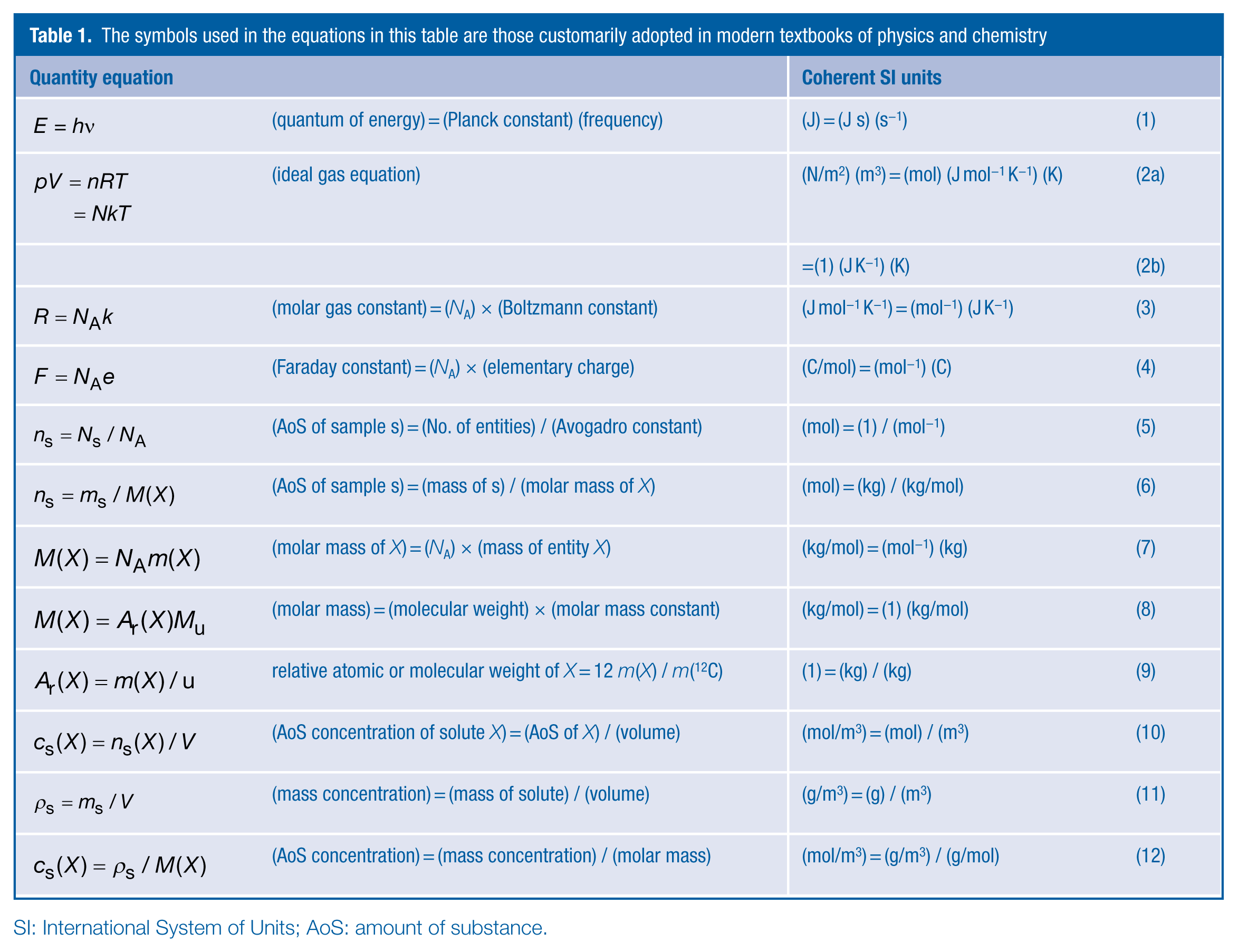
SI: International System of Units; AoS: amount of substance.
It is an important property of the equations that relate quantities that they do not depend on the units used to specify the values of the quantities. Thus, the equations between the quantities in the first column in Table 1 remain true however the units are chosen and defined. Several constants of nature (often called fundamental constants) appear in the equations in Table 1 and in the proposed revisions to the SI; examples are the Planck constant h, the molar gas constant R, the elementary charge e and the Boltzmann constant k. The Avogadro constant NA, the unified atomic mass unit u = m(12C)/12 and molar mass constant Mu = M(12C)/12 = NAu are constants that are particularly relevant to defining the mole.
III. Using Defining Constants to Define Units
The first definitions for units intended for international use, dating from the 19th century, were those for the kilogram and the metre, based on the properties of material artefacts. They were defined and adopted by the first meeting of the CGPM in 1889 as the length and mass of a prototype metre rod and a prototype kilogram mass, respectively. These definitions were found to have two disadvantages. First, prototypes are generally not true invariants because their properties are often found to be slowly changing. We now know that the prototype kilogram, in particular, has been changing in mass by a small amount in the 125 years since it was adopted. This is believed to be due to a combination of surface chemistry and possible leaching out of gases trapped in the prototype when it was cast (the prototype is stored and weighed in air). Second, prototypes have to be securely preserved in a safe somewhere so that they are not available to anyone for general use.
The unit of time, the second, was originally defined astronomically as the appropriate fraction of the mean solar day, which is a definition that had the desirable quality of being available to all, but this also proved to be not a true invariant due to the slowing down of the rotation of the earth as the years go by, resulting from tidal friction.
Other units, for electrical, thermal, optical and chemical quantities, have been added since 1889, and there are now seven so-called base units in the SI. The history of the development of the SI over the last 125 years has been a search for stable references to be used to define the units, which are true invariants, available to all, which can be measured with the highest precision by anyone at any time. The solution has proved to be that we should use constants of nature, sometimes called fundamental constants, as references to define the units. Examples of such constants are the frequency of a carefully chosen atomic spectral line, the speed of light in vacuum c, the Planck constant h and the elementary charge e (the charge on a proton or the negative of the charge on an electron). Two other examples discussed below are the Boltzmann constant k and the Avogadro constant NA. These defining constants have to be chosen with care. The seven constants chosen in the proposed revisions to the SI are listed in Table 2 . We shall call these the defining constants of the SI.
The seven defining constants of the New SI and the seven corresponding units that they define
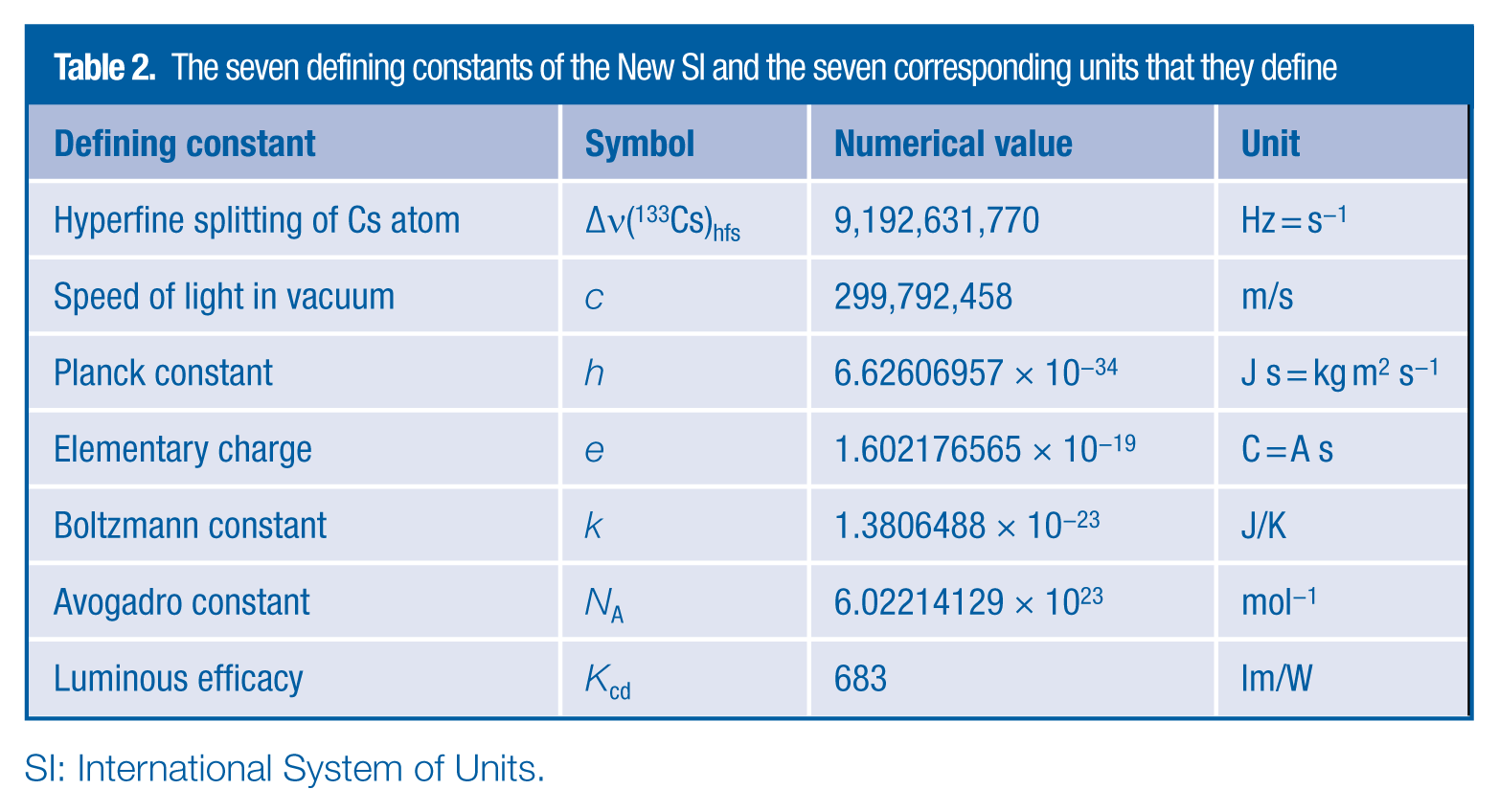
SI: International System of Units.
Throughout this paper, I shall refer to the present SI, as it is currently defined, and the New SI, as it will be when the revised presentation described here has finally been adopted.
The use of a defining constant to fix the magnitude of a unit may be understood with two examples, the second s and the metre m. The second is defined by using the frequency of the hyperfine splitting of the ground state of the caesium 133 atom, Δν(133Cs)hfs, as a reference. I write Δν(133Cs)hfs = Δν(Cs) for brevity. The value of Δν(Cs) is a constant of nature, which is not for us to choose. The value may be expressed as the product of a numerical value, denoted {Δν(Cs)}, and a unit, denoted [Δν(Cs)]

Although the value Δν(Cs) is an invariant, the numerical value and the unit may be chosen in different ways while keeping the product unchanged. By fixing the numerical value {Δν(Cs)} to the number given in Table 2 , we effectively define the unit Hz and thus also its reciprocal, the second s, because the product of the number and the unit has to be equal to the invariant value of the frequency Δν(Cs).
To define the metre, we use the speed of light in vacuum c as a reference. The value of c, which is an invariant of nature, may be expressed as the product of a numerical value {c} and a unit [c]. We write

where {c} denotes the numerical value 299,792,458 and [c] denotes the unit m/s. Although the value of c is an invariant, the numerical value {c} and the unit [c] may be chosen in different ways so that the product is always the same. If we choose the unit [c] to be defined in some independent way, as was the case prior to 1983, then at that time, the numerical value had to be determined experimentally and was subject to some experimental uncertainty. The change in the definition adopted in 1983 was instead to fix the numerical value to be exactly {c} = 299,792,458, and this had the effect of defining the unit [c] = m/s because the product has to be exactly equal to the invariant value of c. Thus, by choosing to fix the numerical value of the speed of light, the unit m/s is defined. This is the change that was adopted by the CIPM in 1983. It had the effect that the numerical value of the speed of light expressed in the SI unit m/s became known exactly, with zero experimental uncertainty.
Note that this change actually defines the unit metre per second rather than the metre. However, since we have already defined the second by fixing the numerical value of the hyperfine splitting of the caesium atom to be exactly 9,192,631,770 Hz, combining this with the definition of the unit m/s has the effect of defining the metre.
In a similar way, fixing the numerical value of the Planck constant in the New SI will define the unit J s = kg m2 s−1, and by combining this with the definitions of the metre and the second, this will define the kilogram. Fixing the numerical value of the elementary charge e will define the unit coulomb C, and since the ampere A = C/s, and we have already defined the second, this will define the ampere. Fixing the numerical value of the Boltzmann constant k will define the unit joule per kelvin, J/K = m2 Kg s−2 K−1, and since we have already defined the metre, kilogram and second, this will define the kelvin. Fixing the numerical value of the Avogadro constant will define the unit reciprocal mole, mol−1, which will define the mole. (It may sometimes be helpful to describe the unit of the Avogadro constant as ‘molecules per mole’, or ‘entities per mole’, rather than simply ‘mol−1’. However, words like molecule and entity are not strictly units in the SI. They are added to convey information about the quantity involved, which should not in general be done through the units. The quantity should always be carefully distinguished from the unit and should be defined independently of the unit. Nonetheless the additional word may help to understand the quantity involved.) Fixing the luminous efficacy of the specified source similarly defines the unit of luminous intensity, the candela.
All other units may then be derived from combinations of those for the seven defining constants in Table 2 . The definition of the entire system of units in the New SI may thus be reduced to specifying the numerical values of the seven defining constants, as summarised in a single sentence in the formal definition in Section IV.3,4 Note that the formal definition of the New SI in Section IV incorporates the revised definitions of the kilogram, ampere, kelvin and mole.
IV. Formal Definition of the New SI
The International System of units, the SI, is the system of units in which
The unperturbed ground state hyperfine splitting frequency of the caesium 133 atom Δν(133Cs)hfs is exactly 9,192,631,770 hertz;
The speed of light in vacuum c is exactly 299,792,458 metre per second;
The Planck constant h is exactly 6.62606957 × 10⁻³⁴ joule second;
The elementary charge e is exactly 1.602176565 × 10⁻¹⁹ coulomb;
The Boltzmann constant k is exactly 1.3806488 × 10⁻²³ joule per kelvin;
The Avogadro constant NA is exactly 6.02214129 × 10²³ reciprocal mole;
The luminous efficacy Kcd of monochromatic radiation of frequency 540 × 1012 hertz is exactly 683 lumen per watt.
where the hertz, joule, coulomb, lumen and watt, with unit symbols Hz, J, C, lm and W, respectively, are related to the units second, metre, kilogram, ampere, kelvin, mole and candela, with unit symbols s, m, kg, A, K, mol and cd, respectively, according to the relations Hz = s−1 (for periodic phenomena), J = kg m2 s−2, C = A s, lm = cd sr and W = kg m2 s−3. The steradian, symbol sr, is the SI unit of solid angle and is a special name and symbol for number 1 so that sr = m2 m−2 = 1.
V. Choice of the Defining Constants
The seven defining constants for the New SI, listed in Table 2 , have been chosen for practical reasons. Their values are regarded as constants of nature, and they are amenable to precise experimental measurement. They are thus appropriate references to be used to define our units.
The Planck constant h, the speed of light in vacuum c and the elementary charge e (the charge on a proton) are properly described as fundamental. They determine quantum effects, space–time effects and electromagnetic effects in physics, respectively.
The ground state hyperfine splitting of the caesium 133 atom Δν(133Cs)hfs is an atomic parameter. It is a good choice as a reference transition for practical realisations using a caesium beam or a caesium fountain atomic clock, which is a well-established experimental technique. It may be that at some future date, it will be replaced by a more fundamental reference such as the Rydberg constant to define the second, but at present, the caesium transition has practical advantages.
The Boltzmann constant k and the Avogadro constant NA have the character of conversion factors, which relate the kelvin to the joule for practical thermometry and the mole to the counting unit 1 (the unit used for expressing the quantity number of entities) for measurements of amount of substance. It is sometimes argued that k and NA are man-made constants that we choose at our convenience to define the magnitude of the units kelvin and mole, respectively, and are not constants of nature like the others, but this is a misunderstanding. For example,
it is fixing the numerical value of k that defines the unit J/K (joule per kelvin),
and fixing the numerical value of NA that defines the unit mole in relation to number of entities,
just as fixing the numerical value of c defines the unit m/s,
and fixing the numerical value of h defines the unit kg m2 s−1.
The actual values of the constants k, NA, c and h are not dimensionless, and it is their values that are constants of nature, sometimes called fundamental constants or universal constants, which are not for us to choose. It is the values (not the numerical values) of these constants that appear in the equations of physics, as shown, for example, in Table 1 . However, it is the numerical values that we choose to define the magnitude of the units. It is thus important to distinguish the value of a fundamental constant from the numerical value and the unit. It is by fixing the numerical values that we may define the units. The luminous efficacy Kcd is a technical constant related to a conventional spectral response of the human eye.
Although it is the numerical values of the defining constants that we choose to define the units, it may often be described as fixing the values of the defining constants. This is an acceptable description so long as we realise that we fix the values of the constants when expressed in terms of the SI units. However, to be formally correct, it is fixing the numerical values that define the units.
How do we choose the numerical values of the defining constants to determine the definitions in the New SI? The answer is that we choose the numerical values to preserve continuity so that the new definition of each unit agrees with the previously accepted definition, to the accuracy that the previous definition could be realised. We wish to avoid a step change in the value of a unit when we revise the definition. The numerical values presented in Table 2 and Section IV to define the New SI are taken from the 2010 CODATA recommended values of the fundamental constants of physics available in Mohr et al. 5 However, at the time the New SI is adopted by the CIPM, to replace the present SI, which might be at any time in the next 1–3 years depending on the results of experiments at present in progress to improve our knowledge of the defining constants listed in Table 2 , it may be that CODATA will have published a further revised and improved list of recommended values for the defining constants. The actual values used at the time of adopting the New SI should be the latest and best available values of the seven defining constants in order to preserve continuity.
VI. Base Units and Derived Units
The definition of the units of the SI presented here in terms of seven defining constants is equivalent to but more fundamental than presenting the definitions using base and derived units. The equivalent definitions in terms of base units are as follows. In each case, an equation is given defining the base unit in terms of one or more of the defining constants.
The second, s, is the time interval equal to 9,192,631,770 periods of the transition corresponding to the hyperfine splitting of the ground state of the caesium 133 atom, where the period T is the reciprocal of the corresponding frequency, T = 1/Δν(133Cs)hfs. The second may be expressed in terms of the caesium transition frequency by the equation

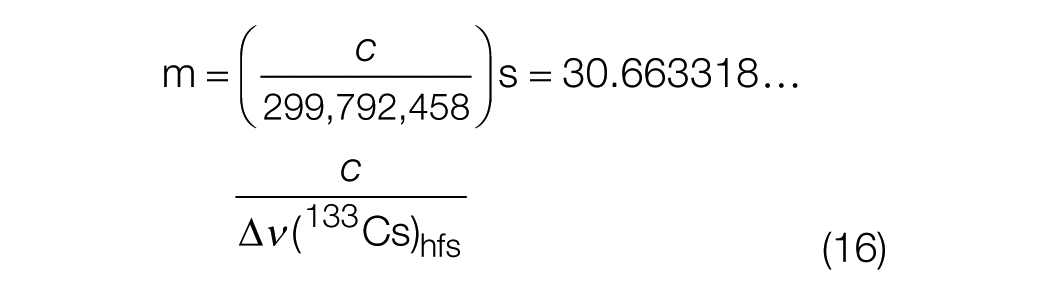
The metre, m, is the length of the path travelled by light in vacuum during a time interval of 1/299,792,458 of a second. The metre may be expressed in terms of the caesium frequency and the speed of light in vacuum by the equation
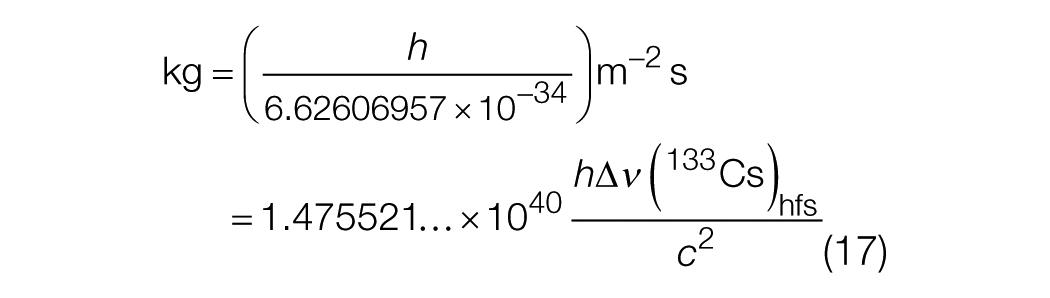
The kilogram, kg, is the mass defined in terms of the Planck constant, the caesium frequency and the speed of light in vacuum by the expression
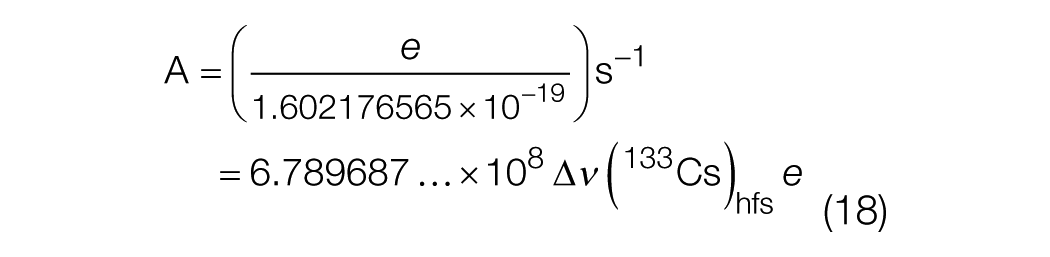
The ampere, A, is the electric current corresponding to the flow of 1/(1.602176565 × 10−19) elementary charges per second. The ampere may be expressed in terms of the elementary charge e and the caesium frequency Δν(Cs) by the expression
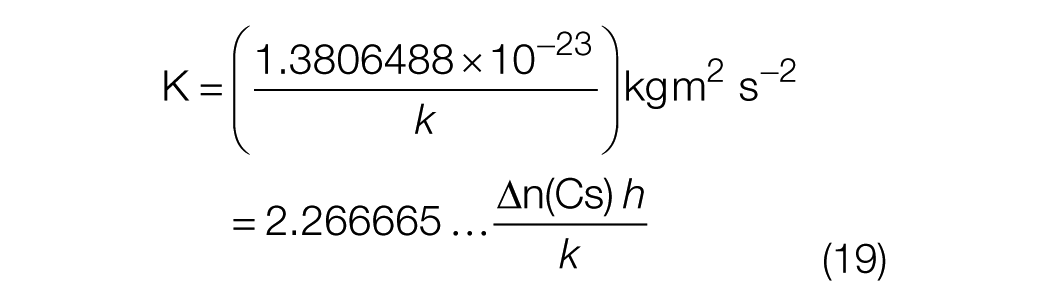
The kelvin, K, is equal to the change in thermodynamic temperature that results in a change in thermal energy kT by 1.3806488 × 10⁻²³ J. The kelvin may be expressed in terms of the Boltzmann constant k and the Planck constant h, the speed of light in vacuum c and the frequency Δν(Cs) by the expression
The mole, mol, is that amount of substance that contains exactly 6.02214129 × 10²³ elementary entities, which may be atoms, molecules, ions, electrons, any other particle or a specified group of such particles. The mole may be expressed in terms of the Avogadro constant NA by the expression

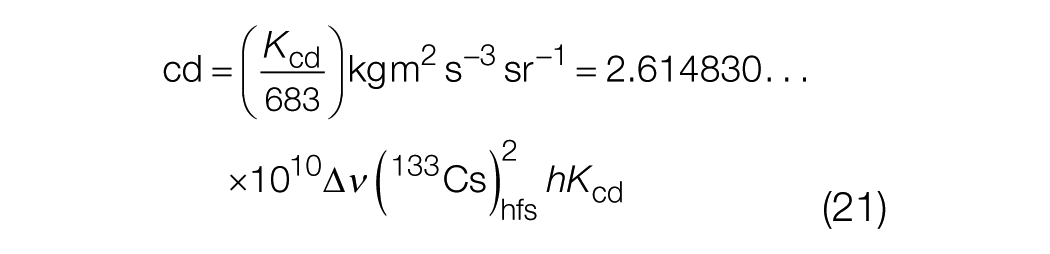
The candela, cd, is the unit of luminous intensity in a given direction; its magnitude is set by fixing the numerical value of the luminous efficacy of monochromatic radiation of frequency 540 × 1012 Hz to be exactly 683 when it is expressed in the SI unit kg−1 m−2 s3 cd sr = lm W−1 = cd sr W−1. The candela is that luminous intensity given by the expression
VII. Uncertainties in the Values of the Fundamental Constants
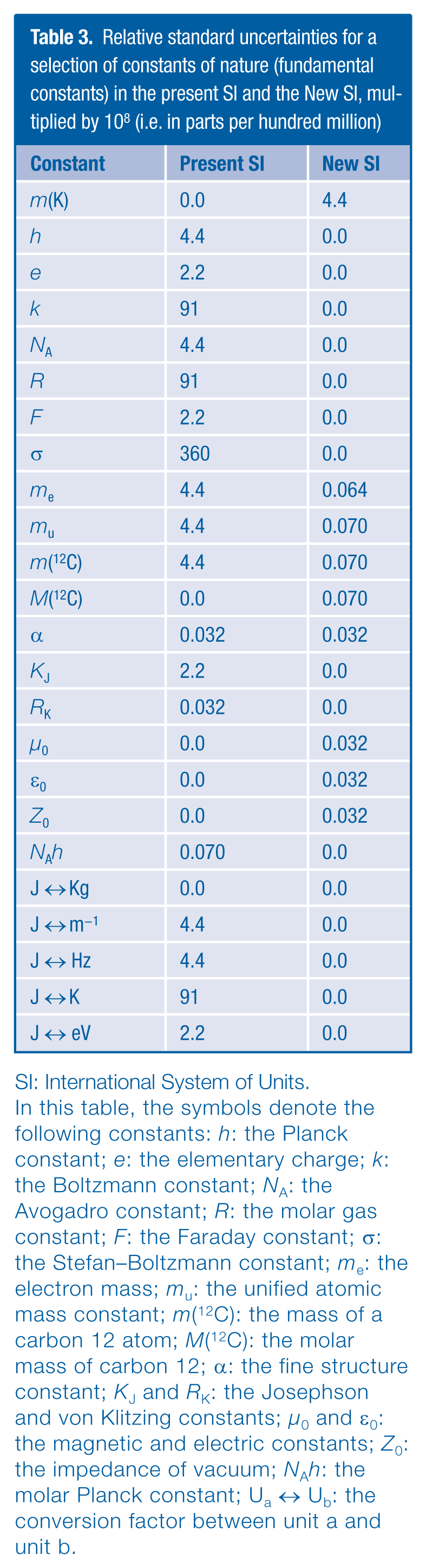
The new definitions introduced for the kilogram, ampere, kelvin and mole have the effect of reducing the uncertainties with which a number of the fundamental constants of nature are known. This is shown in Table 3 . The values of the defining constants in Table 2 become known exactly with zero uncertainty in the New SI. The reduction in the uncertainty with which many other constants are known is by more than an order of magnitude, corresponding to an increase in the accuracy of our knowledge of those constants.
Relative standard uncertainties for a selection of constants of nature (fundamental constants) in the present SI and the New SI, multiplied by 108 (i.e. in parts per hundred million)
SI: International System of Units.
In this table, the symbols denote the following constants: h: the Planck constant; e: the elementary charge; k: the Boltzmann constant; NA: the Avogadro constant; R: the molar gas constant; F: the Faraday constant; σ: the Stefan–Boltzmann constant; me: the electron mass; mu: the unified atomic mass constant; m(12C): the mass of a carbon 12 atom; M(12C): the molar mass of carbon 12; α: the fine structure constant; KJ and RK: the Josephson and von Klitzing constants; µ0 and ϵ0: the magnetic and electric constants; Z0: the impedance of vacuum; NAh: the molar Planck constant; Ua ↔ Ub: the conversion factor between unit a and unit b.
It may seem at first surprising that the precision with which the constants are known is so greatly improved simply as a result of the revised definitions. It happens because we are using the values of the constants themselves as a reference to define the units. Whenever we use a constant to define a unit, it has the effect that the value of that constant becomes exactly known. For example, immediately before the metre was redefined in 1983, it was defined as a multiple of the wavelength of a krypton atomic line so that the wavelength of that line was known exactly by definition, but the speed of light c had to be determined experimentally and was subject to some uncertainty. But immediately after the redefinition, the value of c became known exactly and the wavelength of the krypton line became an experimental quantity subject to the same experimental uncertainty which previously applied to c. Similarly, when the kilogram is redefined to fix the Planck constant, the value of h will become known exactly, but the mass of the international prototype kilogram will become an experimental quantity subject to the same experimental uncertainty which previously applied to h. The uncertainties in Table 3 reflect these facts.
VIII. Using the Definitions of the Units to Make Measurements
To make use of the definitions to make measurements, we have to always compare the magnitude of the unit to the magnitude of the unknown measurand (i.e. the quantity to be measured). In general, there may be many alternative experiments available to make the necessary measurements to realise and use the definition of the unit, which are not discussed here. Moreover, new experimental methods may be developed in the future as science progresses. However, advice on experiments to realise the definitions of the units is available in the form of mises en pratique (practical advice) on the BIPM website, 1 and this advice is updated regularly as new experiments are developed.
Footnotes
Acknowledgements
I am grateful to my many colleagues on the Consultative Committee on Units (CCU) and the Comité International des Poids et Mesures (CIPM), in addition to many others from whom I have learned so much about metrology in the last 10 years. This review is a reflection of the views of all those who have contributed to the decisions that have led to the proposals for revisions to update the present SI to the New SI. Those to whom I am indebted are too numerous to list here, but I particularly wish to mention Terry Quinn, Peter Mohr, Barry Taylor and the Executive Secretary of the CCU at the Bureau International des Poids et Mesures (BIPM), Claudine Thomas, for their endless patience and assistance in this work. The New SI presented here is now the recommendation of the CIPM and the Conférence Générale des Poids et Mesures (CGPM), but the words used to describe the New SI in this paper are of course my own.
Funding
This research received no specific grant from any funding agency in the public, commercial or not-for-profit sectors.