




Abstract
In the next few years, the world’s measurement system, the SI, will be changing. One of the most significant changes will be the replacement of the existing definition of the kilogram, which depends on the stability of an artefact made in the 19th century, with a definition based on a constant, the Planck constant h, which lies at the heart of modern quantum physics. This change will strengthen, stabilise and reunify the SI and, in addition, provide advantages to science and engineering. This paper describes the reasons for the change, the innovations which have enabled the change to be made and the efforts to ensure that the transition to the new definition is as problem-free as possible.
I. Changes to the SI – Rationale
As discussed elsewhere, in this issue, the present SI is formulated around seven base units, some of which have apparently ‘arbitrary’ definitions. The restructuring of the SI seeks to remedy this by using the fundamental constants of nature as the basis for the new SI. The second and the metre are already defined in this manner, but for the kilogram, this will mean a significant change in the way the unit is both defined and realised.
Of the seven base units of the SI, only the kilogram is still defined in terms of a material artefact, namely, the International Prototype Kilogram (IPK) kept at the Bureau International des Poids et Mesures (BIPM). The major disadvantage of this artefact-based definition is that, within the SI, the mass of the IPK is fixed, but by its very nature, we know that its mass cannot be absolutely stable.
II. History of the Kilogram
Kilogram artefacts made of platinum can be traced back to 1799 and the manufacture of ‘the Kilogramme des Archives’. Before this, in 1795, the gram had been defined in France as ‘the absolute weight of a volume of pure water equal to the cube of the hundredth part of the metre, and at the temperature of melting ice’. It was recognised that, in practical terms, a definition based on a volume of water is inconvenient and also that, for trade purposes, a gram was too small a base unit to be practicable. Thus, the Kilogramme des Archives was manufactured to have a value equal to the mass of a cubic decimetre of water at a temperature of 4 °C (where it is at its most dense). The unit of mass, the kilogram, was defined as being equal to this mass.
After the signing of the metre convention in 1875 work began to replace the Kilogramme des Archives which, being made of pure platinum, was relatively soft and prone to wear and scratching. Additionally, its volume, necessary to make corrections for air buoyancy effects, had not been determined during its manufacture (it was not considered possible to use hydrostatic weighing to determine its volume retrospectively because of the fear of water ingression into the voids, which would almost certainly have been present in the artefact due to the manufacturing process). The new kilogram, known as the IPK, was manufactured in 1879 from an alloy of platinum with 10% iridium, added to increase the hardness of the artefact and therefore improve its resistance to wear. It was adjusted to have a weight very close to that of the Kilogramme des Archives. The IPK was officially sanctioned as defining the SI unit of mass at the first meeting of the Conférence Générale des Poids et Mesures (CGPM) in 1889 and has defined the unit of mass ever since; ‘The kilogram is the unit of mass; it is equal to the mass of the international prototype of the kilogram’ ( Figure 1 ).
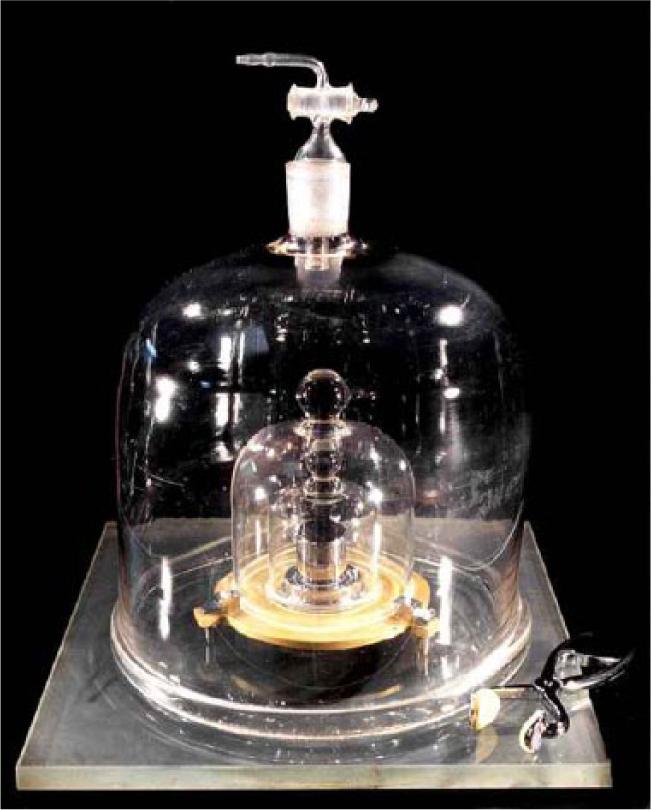
The International Prototype Kilogram stored at the Bureau International des Poids et Mesures in air under three bell jars
III. Redefinition of the Kilogram – Rationale
By definition, the value of the mass of the IPK is exactly 1 kg, and the uncertainty of this value is zero. However, as an artefact, we know that the IPK, by its very nature, cannot be absolutely stable. Of course, it is impossible to measure the stability of the IPK as there is no higher reference value against which to check it. On three occasions, roughly 40–50 years apart, the mass of the official copies and the working standards of the BIPM have been compared with the mass of the IPK and then used to assign values to the national prototypes. Before each periodic verification, both the IPK and the copies are cleaned by a process known as nettoyage-lavage. 1 The results of the comparisons show some divergence with time ( Figure 2 ).
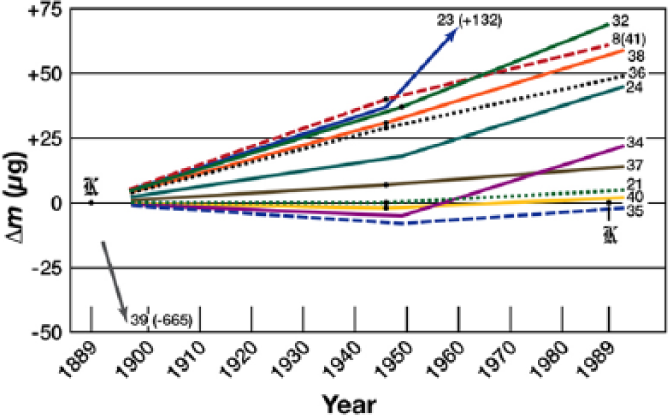
Changes in the values of various copies with respect to the IPK, determined at the three periodic verifications of the National Prototype Kilograms (1889, 1946–1953 and 1988–1992)
Changes of the order of 50 µg in some of the copies and national prototypes can be seen, but nearly half the copies show changes of less than 25 µg over the 100 years since manufacture (albeit based on data from only two subsequent measurements). By implication, it can be assumed that, in practice, the mass of the IPK is also changing with time.
It should also be noted that, at present, the definitions of the mole, candela and ampere depend on the kilogram. Thus, changes in the mass unit also influence the SI electrical units. However, the electrical units are presently maintained and disseminated in terms of highly stable quantum effects using conventional values of combinations of the Planck constant and the elementary charge which determine the scale for the volt and the ohm. This has had the effect of isolating the conventional electrical units from the SI, a situation which is desirable to eliminate.
The inevitable instability of an artefact-based definition has led to the search for a new definition of the kilogram based on an invariant of nature, instead of a material artefact, which would make it possible for anyone to realise the SI unit of mass at any place and at any time (given the necessary information and resources). The invariant chosen for the redefinition of the mass unit is the Planck constant, h. The Planck constant lies at the heart of quantum physics and can be viewed as linking the energy of a photon E to its frequency f via the relationship E = hf; if this energy is related to mass via the Einstein relation E = mc2, it can be seen that, via a fixed value of h, a mass can be related to time and length (the value of the speed of light c is fixed by the definition of the metre). These relationships cannot necessarily be used directly at a macroscopic scale but show that the relationship between h and mass is relatively simple and can, in principle, be extremely accurate. Among the advantages of the proposed changes to the SI are as follows:
The ability to monitor drift in mass artefacts and to assign a more realistic uncertainty to their long-term stability.
The abolition of the present system of conventional electrical units and the reintegration of the electrical units into the SI. The SI electrical units would be realised from the fixed values of the Planck constant and the elementary charge and the unit of time using the Josephson and quantum Hall effects (QHEs).
The mole will be redefined by linking it to an exact numerical value of the Avogadro constant (NA) and making it independent of the definition of the kilogram thus emphasising the distinction between the quantities ‘amount of substance’ and ‘mass’.
In the redefined SI, mass can be realised directly from its definition, at any given part of the mass scale, without having to relate the measurements to either the kilogram or an atomic mass.
IV. Redefinition experiments
Clearly, a redefinition by which the SI unit of mass is related to a fundamental constant of nature potentially has major benefits and would bring the kilogram into line with the other base SI units. Unfortunately, unlike most of the other units where a relatively straightforward and obvious derivation and experimental realisations exist (e.g. linking the metre to a fixed value of the speed of light), there is not an obvious relationship (and associated experiment) for the kilogram. Over the past 30 years or so, several approaches to the redefinition have been investigated, but only two have demonstrated the potential to reach the level of uncertainty required to support the redefinition. These are the watt balance and X-ray crystal density (XRCD) experiments.
It is not easy to put a value on the level of uncertainty required for the redefinition experiments to improve on the current state of the art since, as discussed, the real uncertainty in the current definition is not easy to estimate (notwithstanding that the theoretical uncertainty on the mass of the IPK within the SI is actually zero!). At present, the lowest uncertainty on an SI calibration of a stainless steel, 1 kg standard is of the order of 14 µg (k = 1). If the redefinition of the kilogram is not to have a significant impact on the users of mass calibrations, the uncertainty in the new primary realisation experiments and the additional uncertainty in disseminating the values should be comparable with this value. To balance the needs of the user community and the need to improve the SI, the Consultative Committee for Mass and Related Quantities (CCM) have made recommendations to the committee which oversees the SI – the Comité International des Poids et Mesures (CIPM) on the minimum number and quality of the measurements that must contribute to the redefinition process. They have specified that there should be at least three independent experiments, including work from watt balance and XRCD experiments, all of which must yield consistent values of the Planck constant with relative standard uncertainties not larger than 5 parts in 108 and that at least one of these results should have a relative standard uncertainty not larger than 2 parts in 108, which is equivalent to 20 µg at the 1 kg level (for the full text of the CIPM recommendation see 2 ). An increase in the uncertainty in the primary realisation of the unit of mass from nominally zero (for the IPK) to approximately 2 parts in 108 may lead to a small initial increase in the uncertainties recorded in the formal Calibration and Measurement Capabilities (CMCs) of the leading National Measurement Institutes (NMIs). In the longer term, increased numbers of improved primary realisation experiments will decrease the uncertainty associated with the realisation of the unit. This, combined with additional work to improve the dissemination of mass measurements from the primary realisation to the end user community, should result in calibration uncertainties falling significantly below the initial realisation uncertainty which, from existing data, should be around 15 µg.
Before the redefinition of a unit in terms of a fundamental constant can be contemplated mechanisms must exist to determine the value of the fundamental constant from the existing definition of the unit. This will minimise inconsistencies between the old and new realisations at the time of redefinition, minimising disruption to the users of the SI and providing methods by which the unit can subsequently be realised from its new definition. It is desirable to have at least two markedly different methods of measuring the constant to aid the search for systematic errors in the measured value as, if the methods are sufficiently dissimilar, they will share few common sources of error. As mentioned previously, in the case of the kilogram, two such methods do exist and they are the watt balance and the XRCD methods. The watt balance measures the Planck constant directly, and the XRCD method measures the Avogadro constant, but as the two constants are related by a precise formula, measurements of one may be transformed into a value of the other with no significant increase in uncertainty. Under these circumstances, the choice of the Planck constant to determine the mass unit does not particularly favour one method or the other but has been made to maximise the usefulness of the definition to physics and the community which uses the SI.
A. The watt balance
The watt balance,3,4 which was invented by Kibble at the National Physical Laboratory (NPL), is shown diagrammatically in Figure 3 and measures mass by comparing virtual electrical and mechanical power, VI = Mgu. The voltage V and velocity u are measured during one stage of the experiment ( Figure 3(a) ), and the current I and the weight Mg of the mass M are measured in a separate stage ( Figure 3(b) ). This separation eliminates the effects of loss mechanisms which would hamper a direct comparison of real power. The two stages are linked using a coil of wire of length l placed perpendicular to the field B of a strong magnet. The experiment requires that any changes in the product of B and l between the two measurements are either negligible or predictable. In the first stage, the Bl product is measured by moving the coil in the field at a measured velocity u, thus Bl = V/u, where V is the voltage induced in the coil by its motion through the field. In the second stage, the force generated when a current I is passed through the coil is balanced by the weight Mg of a mass M, thus Mg = BlI. The result of the first measurement can be used to eliminate the Bl product from the second giving VI = Mgu. The electrical quantities can be measured using quantum mechanical effects: the Josephson effect and the QHE. The Josephson effect occurs in superconducting systems at low temperatures (usually about 4 K) and can be harnessed to produce a voltage V, which depends only on a microwave frequency f′, the elementary charge e and the Planck constant h as V = hf′/2e. The QHE occurs in particular semiconductor structures at low temperatures and provides a resistance which depends only on h, e and a quantum number n as R = h/ne2. By combining measurements made with these effects, the virtual electrical power VI = V2/R can be related to h and the square of an effective frequency f which is related to f′ but, for simplicity of representation, incorporates fixed numerical factors, quantum numbers and calibration constants, thus VI = hf2. This allows h to be measured by the watt balance as Mgu/f2. After redefinition, using the fixed value of h, mass can be measured with the balance as hf2/gu. Note that the acceleration due to gravity g must be known and, for the most precise work, measured using an absolute gravimeter. A large number of factors contribute to the uncertainty of the apparatus, but most of these can be reduced to the order of a part in 109 or less. The major uncertainty contributions arise from mass measurements, resistance measurements, determination of the gravitational acceleration and the alignment of the apparatus ( Figure 4 ).
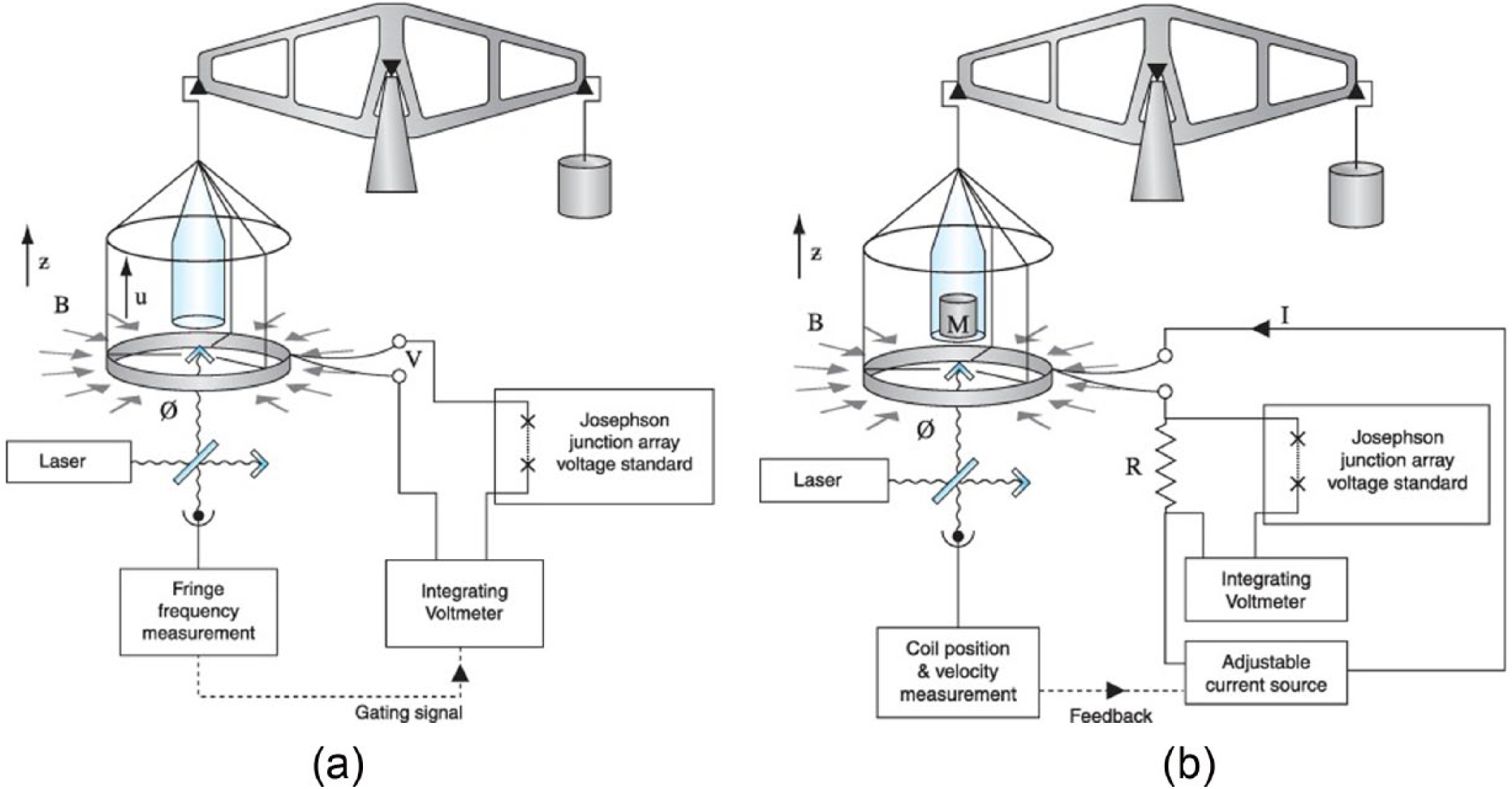
Diagrams of the operation of a watt balance: (a) the balance in moving mode and (b) the balance in weighing mode
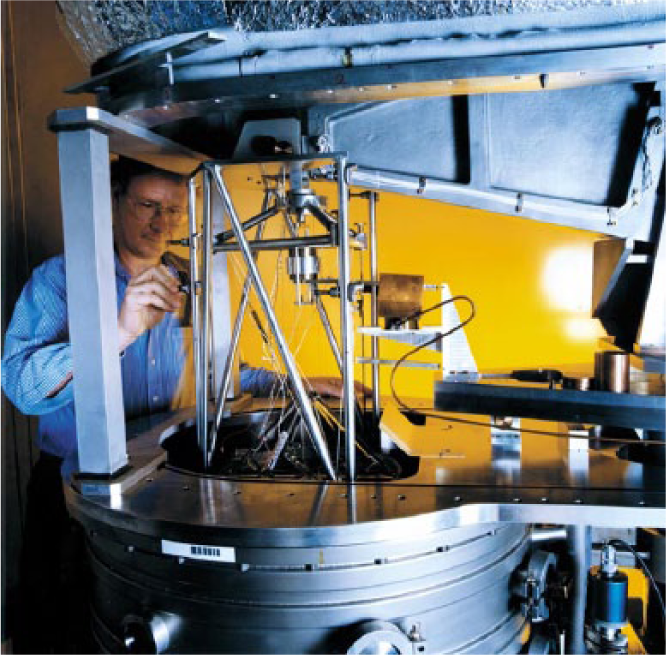
The NPL Mk II watt balance (now at NRC Canada). The magnet is in the circular vacuum vessel. The coil support and the mass lift are in the centre of the picture with part of the balance beam in the upper right
B. The XRCD method
This technique measures the mass of a single silicon atom by counting the number of atoms of silicon in a macroscopic sample (a highly polished sphere). Direct counting of sufficient atoms is out of the question, but the task can be done indirectly by measuring the volume occupied by an atom in a perfect crystal, measuring the volume of the crystal and dividing one by the other. If the mass of the crystal is also measured, the mass of a silicon atom can be calculated and the Avogadro constant derived. The crystal volume measurement is simplified by polishing the crystal into a near perfect sphere; a large number of diameter measurements are then averaged to determine the volume. This technique avoids the problems which would be encountered with edges and corners in other shapes and requires only small corrections to allow for unavoidable departures in shape from that of a perfect sphere. The volume occupied by an atom is measured by using X-rays to reveal the spacing of planes in the crystal lattice and using an optical interferometer to relate this measurement to the metre. In recent measurements, a sphere of almost pure 28Si has been used to avoid the limitations caused by the difficulty of making accurate measurements of the amounts of the different isotopes present in natural silicon. At present, the major contributions to the uncertainty of the technique are the measurements of the volume of the sphere, surface effects, spacing between atoms and the amounts of other isotopes in the sphere ( Figure 5 ).
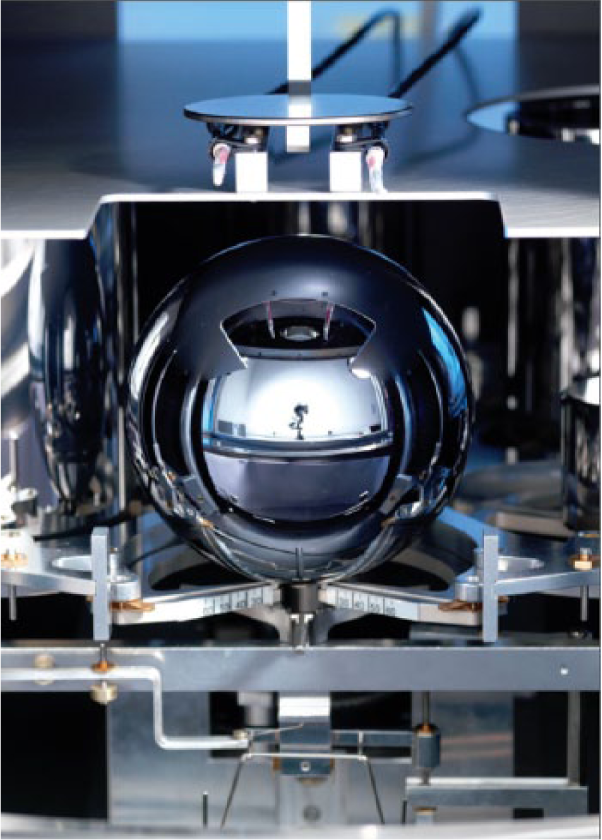
A sphere of natural silicon similar to those used in the XRCD measurements being weighed on the NPL 1-kg mass comparator
C. Recent measurements
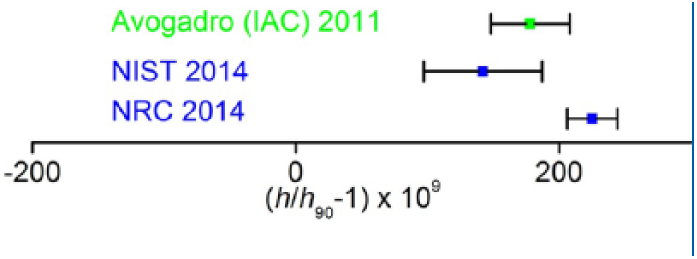
Both techniques have the potential to produce measurements with an uncertainty of the order of 10 parts in 109 or 10 µg on 1 kg. Figure 6 shows the three recent measurements of the Planck constant which can be considered to meet one or more of the CCM criteria for redefinition of the kilogram. The results are plotted with respect to a conventional value of the Planck constant (h90) which can be calculated from the conventional values of the Josephson and von Klitzing constants (KJ-90 and RK-90) which are presently used to derive the conventional electrical units. It can be seen that the difference between h and h90 will have a significant effect on the electrical units upon redefinition of the SI. The voltage unit will be most affected, although a simultaneous change in the value of e will mean that the volt will not change by as much as the change in h implied by Figure 6 . At present, the best measurement of the Planck constant has been made by the National Research Council (NRC) Canada with a relative standard uncertainty of 19 parts in 109 using a watt balance supplied by NPL in 2009. This measurement meets the most stringent requirement laid down by the CCM for the redefinition to proceed.
V. Practical Considerations
In order to achieve the uncertainties required, both the watt balance and XRCD experiments work under vacuum. The realisation of the mass unit in vacuum presents a difficulty since the current realisation (the IPK) is stored and used in air at atmospheric pressure, and the vast majority of end users also require mass values of their standards under ambient conditions. Thus, a link must be made between a mass realised in vacuum and one used in air. This will initially be required to link the redefinition experiments to the IPK in order to fix, as accurately as possible, the values of the Planck and Avogadro constants to the (current) SI unit of mass. Once the values of h and NA are fixed and the SI unit of mass is linked to the value of h, this traceability from the unit realised in vacuum to mass standards in air will still be required.
A Joint Research Project (JRP) between European NMIs under the European Metrology Research Programme (EMRP) is investigating the key issues which need to be resolved to implement the definition and maintain traceability to the SI unit of mass during the transition from the old to the new definition. The partnership also includes NMIs outside Europe such as the NRC and organisations such as the BIPM. The project is investigating the following areas:
A. Next-generation mass standards
The requirements for mass standards in the 21st century need to take into account their compatibility with the use in vacuum and in air and with the significant magnetic fields which may be present in a watt balance. The choice of platinum–iridium alloy for the IPK and its copies in 1889 was a good one in that the material is inert, relatively hard, easy to machine/polish and has relatively low magnetic permeability. It is also dense, meaning the artefacts have a small surface area and are therefore less sensitive to the accretion of contamination. The small volume also means that its apparent weight (in air) is less affected by changes in air density. However, advances in materials and finishing techniques mean that alternatives to the Pt-Ir artefacts are being investigated for improved long-term stability, better vacuum compatibility and lower magnetic permeability. Among the materials under investigation are nickel alloys, tungsten (polycrystalline and single crystal), gold alloys and pure iridium. Preliminary results suggest that single-crystal tungsten has properties (density, magnetic permeability and hardness) which are compatible with the requirements for new mass standards. Its drawbacks are that it is relatively expensive (although not compared with platinum–iridium!) and more difficult to polish than polycrystalline materials. The final quality of the surface achieved is also dependant on the quality of the source crystal with regard to inclusions and voids.
B. Transfer of mass standards from vacuum to air
To achieve traceability to the new kilogram definition, which is realised in vacuum, the effect on a mass standard of transfer between vacuum and air needs to be characterised. The sorption of water on and off the surface of such a standard during this process is the main cause of the change in its measured mass. The magnitude of this effect depends on a range of properties of both the standard and the media between which it is transferred, namely, the material, surface roughness and cleanliness of the standard, the pressure in the vacuum chamber and the humidity of the ambient air. The sensitivity of the transfer process to all these variables is being investigated with a view to minimising the mass change (which is of the order of 7 µg for a platinum–iridium standard kilogram) and improving the repeatability of this effect. This will minimise any additional uncertainty contributions arising from this process. However, one advantage of realising the standard in vacuum is the elimination of corrections due to buoyancy effects on standards of differing densities which could facilitate the calibration of standards made from stainless steel or silicon with as low an uncertainty as Pt-Ir standards.
C. Medium-term storage of mass standards and their transfer between institutes
As discussed earlier, there are relatively few experiments capable of a primary realisation of the new definition of mass operating at present. In the short to medium term, it will be necessary to compare these primary realisation experiments and ensure the continuity of traceability to the unit of mass. Following the redefinition, the maintenance and dissemination of the unit of mass will still rely heavily on artefact standards. To optimise the stability of these standards, their storage in vacuum or inert gas may be preferred to storage in air. Custom-designed storage containers will be required both to store such standards and to transport them between institutes without removing them from their optimum environment. Work has been undertaken to design such storage and transport containers which allow relatively easy movement of the weights into and out of measuring apparatus without compromising the storage conditions and to discover suitable materials to support the weights without long-term addition or removal of mass.
Additionally, the BIPM are working on an ‘ensemble’ of 12 reference mass standards made of three different materials (Pt-Ir, stainless steel and silicon) which are stored in four different media (vacuum, air, nitrogen and argon). The ensemble is designed to allow continuous dissemination of the unit of mass following redefinition by maintaining the (weighted) mean of the different primary realisations of the kilogram (transferred to BIPM during comparisons).
VI. Likely Timescale, Impact and Future Development
As discussed above, the redefinition experiments (NRC and National Institute of Standards and Technology (NIST) watt balances and the International Avogadro Coordination (IAC)) have effectively achieved the levels of uncertainty and agreement recommended by the CCM for the redefinition of the SI unit of mass. At the 24th CGPM (17–21 October 2011), the CIPM presented a resolution for consideration to agree the new definitions in principle but not to implement them until the details have been finalised. This resolution was accepted by the conference, and in addition, the CGPM moved the date of the 25th meeting forward from 2015 to (November) 2014. However, at this stage, the draft resolution on the future revision of the International System of Units, the SI states that ‘despite this progress the data do not yet appear to be sufficiently robust for the CGPM to adopt the revised SI at its 25th meeting’. Thus, the adoption of the revision of the International System of Units will not take place until at the 26th meeting of the CGPM, currently scheduled for 2018, at the earliest.
In the meantime, the BIPM Mass Department will carry out a series of extraordinary calibrations with respect to the IPK to provide improved traceability to the present definition of the kilogram to those NMIs which are involved in accurate determinations of h and NA. The BIPM will also organise a pilot study before the redefinition which will be a comparison between NMIs with primary realisation experiments. This will in effect be the first formal direct comparison between the primary realisation experiments and will also help to reduce the uncertainty contribution from mass calibration for the determination of the Planck and Avogadro constants. After the redefinition, the BIPM will organise, in coordination with the CCM, an ongoing key comparison for NMIs with primary realisation methods.
At present, the uncertainty in the realisation of the kilogram is nominally zero. ‘The kilogram is the unit of mass; it is (exactly) equal to the mass of the international prototype of the kilogram (with an uncertainty of zero)’. This ignores the inevitable drift in an artefact-based realisation, uncertainties associated with the cleaning and comparison process and the increase in uncertainty in the many years between comparisons involving the IPK. NMIs can claim a CMC of 14 µg for the calibration of stainless steel kilogram weights for end users. Given that, at least initially, the uncertainty of the weighted mean of the primary realisation experiments after the redefinition will be equivalent to approximately 15 µg on 1 kg, it is likely that these CMCs will increase in the short term by an amount which will depend on the traceability route chosen by a particular NMI. But even if such CMCs are increased to 20–25 µg, it should not significantly affect the mass end user community. In fact, in the long term, these uncertainties can be expected to decrease as more independent primary realisations contribute regularly to a world-wide consensus.
In addition to guaranteeing the ongoing stability of the SI unit of mass, the redefinition of the kilogram opens significant opportunities for future development in the way the mass scale is realised. In the short term, the realisation of the kilogram via the watt balance or XRCD experiments is prohibitively expensive for the majority of NMIs. However, future improvements in the robustness and affordability of such apparatus (see, for example, Kibble and Robinson 8 ) will open the opportunity of realising the unit at a national level to more and more NMIs. An additional benefit of linking the mass scale to the Planck constant is that it can be realised at any nominal value (not just 1 kg). Thus, for example, the opportunity to realise milligram mass values with smaller (and cheaper) watt balances to greatly improved levels of uncertainty is encouraged. The small increases in uncertainty and inconvenience in the traceability chain for mass standards may be seen as a disadvantage of the new SI, but it must be remembered that relying on a defined artefact kilogram has meant that electrical metrology has for many years operated on a conventional basis, outside the SI, and this is no longer tenable: the problem is in mass metrology, not electrical metrology, and in the new SI, this problem can be addressed and will ultimately yield a better and more robust system of mass measurement firmly rooted in the fundamental constants of nature.
Footnotes
Acknowledgements
The underlying research material related to this paper can be accessed via the relevant peer-reviewed publication listed in the references.
Authors’ note
For permission to reuse this content, please e-mail the NPL Copyright Officer at
Funding
The authors acknowledge the financial support of the National Measurements Systems Directorate of the UK National Measurement Office. This work is part of the EURAMET Joint Research Project SIB05 NewKILO. It received funding from the European Union’s Seventh Framework Programme, ERANET Plus, under grant agreement 217257.