



Abstract

Digital Resolver Offers Single Cable Connectivity
Kollmorgen has continued its drive to reduce the amount of cabling required within a servo motion system, with the launch of the SFD3 digital resolver. The single-cable technology has proved increasingly popular since the company introduced it. It is used both to replace older more complicated solutions and as the first choice for new systems.
Supplied as highly scalable motion control packages, the single-cable solutions are available with high-resolution Hiperface DSL absolute encoders or a digital resolver (SFD) feedback option, which can be used for almost all standard applications.
The range includes both standard servo drives and those with integrated motion control, so that hardware and wiring requirements can be significantly reduced. This makes system design easier and faster and also helps contain costs related to planning, installation and procurement.
As a result, Kollmorgen can implement single-cable technology with an eight-pole standard motor cable – three phases, one PE, two for the brakes, and two for the feedback system. Because of the high interference resistance, data can be transferred safely within the cable without electromagnetic capability (EMC) interference problems.
Kollmorgen’s new SFD3 digital resolver, which is available through INMOCO

The range is available in a number of packages, and all are available from precision-motion specialist firm, INMOCO (http://www.inmoco.co.uk).
ARC Publishes Study on Low-Power AC Drives
A new ARC Advisory Group (http://www.arcweb.com) Market Research Study provides current market analysis plus a 5-year market and technology forecast. This study is available in a number of editions, including worldwide, all regions, and a select group of countries.
This global market study covers hardware, software, and services for low-power alternating current (AC) drives, which comprises the micro (under 5 kW), low-end (5–40 kW), and midrange (41–200 kW) power segments.
It shows that while orders for low-power AC drives in 2013 were somewhat reduced by weaker industrial demand in mature markets and reduced growth rates in emerging markets compared to 2012, the demand for AC drives continued to remain solid to help meet the growing needs for modern infrastructure, efficient energy utilisation, and climate-friendly solutions.
The growing economies of Asia, Eastern Europe, and Latin America are giving rise to an expanding middle-class population and increasing urbanisation in many cities. To meet these needs, industrial operations must expand capacity and increase productivity, demanding more AC drives.
This growing middle class of consumers will demand more cars, packaged goods, pharmaceuticals, and health-care products, and white goods. This, in turn, will create significant demands in the requirements for fresh water, raw materials to build additional infrastructure, and energy, plus chemicals and petrochemicals. All of this will generate greater market demand for low-power AC drives.
This study identifies growth segments and market trends, as well as challenges suppliers face to achieve expansion in a very fragmented market. In addition to the quantitative assessment, this study provides an analysis of the issues that will impact this business in the future.
The challenge is how suppliers can differentiate themselves and continue to offer increasing value propositions to end users and original equipment manufacturers (OEMs). This is especially important because the market is extremely competitive and demand is expected to grow as users recognise the benefits of low-power AC drives, so well-planned strategies will be invaluable.
Embedded Vision Growth Predicted across Various Markets
Shipments of embedded vision devices in the automotive, industrial automation, physical security, and business intelligence markets are forecast to exceed 14 million units in 2018, up from almost 4 million units this year, according to IHS Technology (https://technology.ihs.com). Using a combination of embedded systems and computer vision, embedded vision enables devices to use video inputs to better understand their environment, applying logic and decision-making to video signals.
The maturity of embedded vision algorithms varies by application market, says IHS. For instance, while embedded vision technology has been active for some time in markets like physical security and industrial automation, the consumer industry represents more of an emerging opportunity.
Even so, despite the synergies in algorithm requirements across application markets, there are very few vendors that are active across multiple applications. In some markets, like automotive, the long sales cycles and high qualifying requirements have limited new competition. In others, such as physical security, the fragmented equipment market means that algorithms need to be optimised for a large number of products, which can act as a barrier to new entrants.
While the software and hardware vendors in embedded vision are unlikely to move into every application market overnight, developments in the automotive sector, in particular, should help spur more accurate and reliable algorithms across the embedded vision industry. This trend, combined with increased awareness in the consumer market for augmented reality and gesture recognition, means that demand for embedded vision devices will grow rapidly in the decade ahead.
GE’s Automation Software Provides Industrial Internet Power
GE Intelligent Platforms (http://www.ge-ip.com) has new upgrades to its core automation software products. These are Proficy HMI/SCADA–iFIX and Proficy HMI/SCADA–CIMPLICITY, and there are also new capabilities that help unlock some of the potential power of industrial Internet.
Upgrades to the company’s Proficy Mobile software solution provide faster response with the right information in context to equipment, location, and role. GE Automation says that Proficy Mobile is a proven mobile app that needs no development and which can be layered on top of existing systems.
Upgrades allow managers to view and execute workflows and ease tight integration with supervisory control and data acquisition (SCADA) systems for faster alarm responses. Also possible is easy configuration for geo-intelligence capabilities that can be used now with Google Maps.
With Proficy Mobile Tasks, operators and technicians can develop a dynamic task list with interactive, step-by-step instructions. This helps companies to enforce compliance and quality, in addition to reducing time and waste. Wherever they are, operators can receive information about upcoming issues and see critical steps that they might need to initiate to prevent that issue from occurring, avoiding unplanned downtime. With the solution’s Mobile Notes, managers can easily increase collaboration across teams and augment documentation with the latest changes to system parameters.
Proficy HMI/SCADA–CIMPLICITY precisely monitors and controls every aspect of a company’s SCADA environment, equipment, and resources. Version 9.0 brings new capabilities that enable companies to develop better applications, improve operators’ experience, extend the reach of existing systems, and take advantage of the latest OS and interoperability technologies.
New CIMPLICITY 9.0 features include better configuration, improved interaction with new, richer protocols, and a nicer operator experience. A new object library allows 256 characters for building a structured database quickly. Also included in the new release is Proficy Historian for SCADA.
Proficy HMI/SCADA–iFIX 5.8 supports dynamic graphics resolution and enables companies to drive better analytics with more reliability, flexibility, and scalability across the enterprise. This real-time information management and SCADA solution includes latest-generation visualisation tools and a reliable control engine.
ARC Surveys PLCs and PACs
ARC Advisory Group has been carrying out research on programmable logic controller (PLC) and PLC-based programmable automation controllers (PACs) for a number of years. In addition to the quantitative research, which has covered around 90% of the market in the past, ARC is now conducting an online survey, to be entitled ‘PLC and PLC-based PAC Global Market Research Study’.
This will help the organisation to include more expert opinions and further increase the quality of its research. ARC now aims to include machine builders, end users, and system integrators, next to the broad base of suppliers that supports its research.
By the time this issue goes to bed, the new study should have been published, along with a series of reports that will be available for clients and for purchase. For more information, contact Florian Güldner, Director of Research, on email
RFID Locates Pipes for Utilities
RFID Journal reports that a South American water company is piloting IDMeters’ passive ultra high-frequency (UHF) solution designed to locate pipes above or below ground. Uruguay-based technology company IDMeters is releasing an UHF radiofrequency identification (RFID) solution for use by water, gas, electricity, and petroleum companies.
The system is designed to identify meters and pipes (in the latter case, both below and above ground), as well as help utility personnel to conduct maintenance services via a handheld reader and to identify and report any tampering or other problems regarding pipes or meters in the field.
IDMeters developed the solution, which comprises software, pipe and meter tags, and handheld readers, for a South American utility company over the course of 4 years, and the company is currently testing the system.
In the meantime, says Enrique D’Amato, IDMeters’ president and CEO, the solution is available for other government and private companies as well, to help them more efficiently pinpoint pipes’ locations, identify meters, and collect their data.
The system also protects businesses against fraud, by determining whether a meter has been tampered with and by requiring employees to be onsite to collect the read data, hence ensuring that the information is not fraudulent. Go to http://www.idmeters.com.
Easy Retrofitting of Current Measuring Transformer
Phoenix Contact’s new PACT RCP current transformers for retrofitting offer time and space saving alternatives to split core current transformers. Expensive downtimes are reduced to a minimum as system parts do not have to be removed for installation.
The measuring system consists of a Rogowski coil and a retrofitted measuring transducer. The flexible measuring coil can be fitted around the conductor, even where space is limited. Unlike with split core current transformers, the current strength does not affect the size and weight of the coil form. Alternating currents of up to 4000 A can be acquired using a single handy coil type. Dangerous open circuit voltages, which could damage the transformer or a pose a risk to personnel, cannot occur, says the company.
The measuring transducer transforms the output signal from the Rogowski coil into a typical secondary current for further processing as supplied by a standard current transformer. The signal is output with phase accuracy over a frequency range from 10 to 5000 Hz. Harmonics and transients are, therefore, also recorded accurately. For universal use, eight current measuring ranges can be set per dual in-line package (DIP) switch.
Go to http://www.phoenixcontact.com for more information.
Integrated Wireless Controller Works Worldwide
Low-Power Radio Solutions (LPRS – http://www.lprs.co.uk) is offering Internet of Things (IoT) and other wireless control or communication system builders with a system-on-chip fully integrated wireless controller. This meets international frequency requirements and transmission standards.
The LPRS easyRadio Integrated Controller (eRIC) wireless module has been designed for use in all available frequency bands, power limits, and broadcast standards across the globe. Therefore, system designers have a single-device solution offering the ability to be set to the local legislative standard in the end-user market.
The main individual markets are Europe, North and South America, Asia Pacific (APAC), India, and China, with the most common standards for industrial, scientific and medical (ISM) Frequency Bands being 433 and 868 MHz for the United Kingdom and Europe and 315 and 915 MHz for the United States. LPRS’ eRIC wireless module meets European Telecommunications Standards Institute (ETSI) and Federal Communications Commission (FCC) standard requirements, the most widely recognised standards for worldwide use.
The new eRIC wireless is suitable for use worldwide

The new 802.11.AH standard coming into force in 2016 signals a move away from the present reliance on 2.4-GHz devices and will allow designers to use longer range and more reliable sub 1-GHz Wi-Fi systems. Users of LPRS eRIC modules will, therefore, have a ready-to-go global solution for implementation when the standard goes live.
LPRS MD, Barry Gillibrand, commented, Offering designers the ability to set our new eRIC system-on-chip wireless controller for operation anywhere in the world greatly simplifies the design process and reduces procurement costs.
Intelligent Sensing Platform to Speed Development of IoT Applications
B&B Electronics (http://www.bb-elec.com) has introduced its Wzzard Intelligent Sensing Platform. Wzzard is an easy-to-use, complete wireless sensor connectivity platform for the rapid deployment of scalable, intelligent, reliable IoT networking in remote and demanding environments. It has been designed to help integrators, value-added reseller (VARs), and service providers efficiently develop and deploy secure, smart, self-powered, and scalable IoT applications.
Possible applications include the following:
Flood and water level monitoring;
Smart car parks: vehicle counting, air quality;
Smart irrigation systems monitoring soil moisture, environmental conditions, leaks;
Mechanical condition monitoring/preventative maintenance;
Energy measurements and audits on a per system or machine basis;
Data centre environmental monitoring;
Tank and lift stations;
Condition monitoring and optimisation in industrial environments;
Traffic monitoring of over-height vehicles for tunnels and bridges.
The new B&B Electronics Wzzard Intelligent Sensing Platform
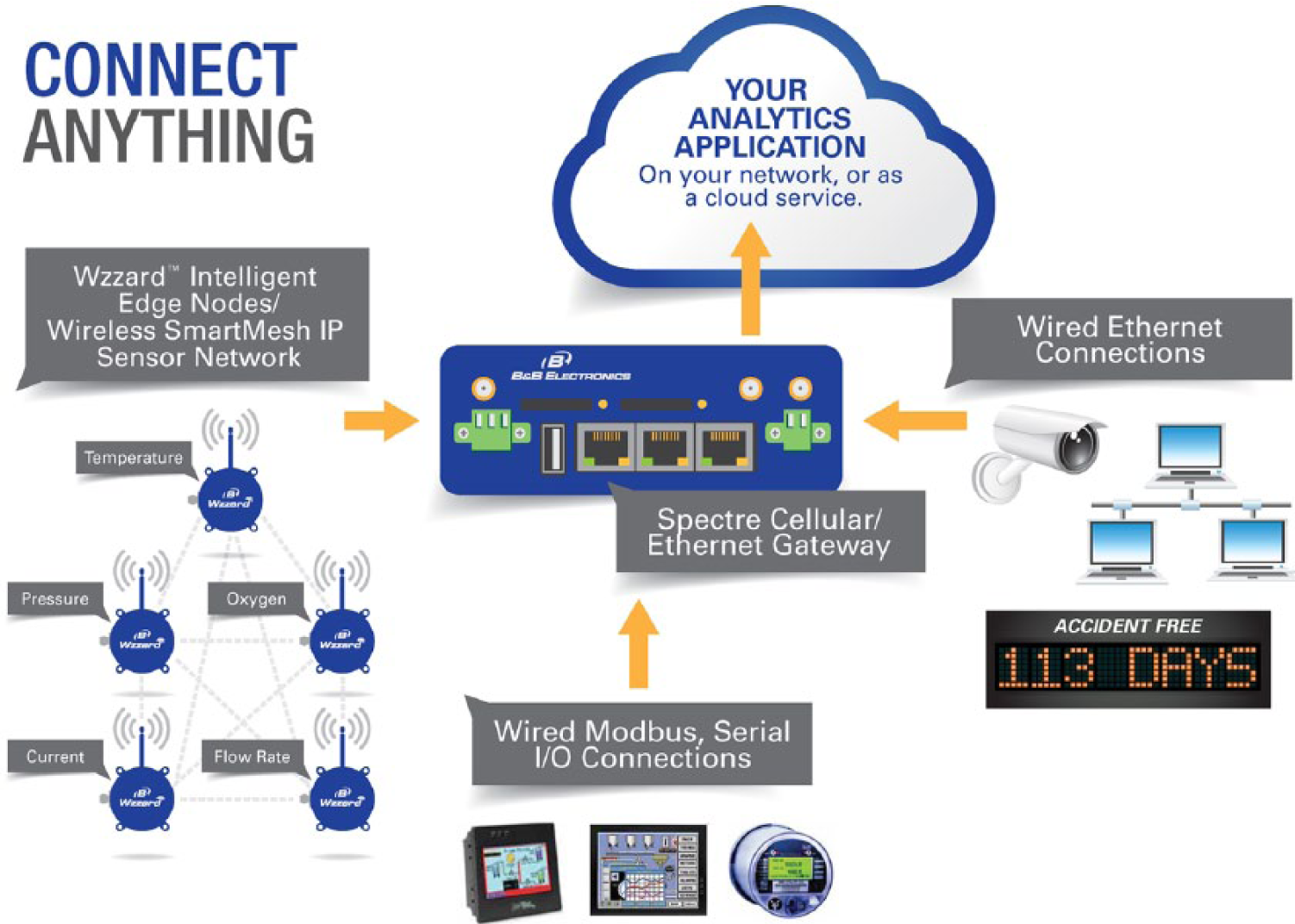
Unlike a traditional SCADA application where sensors and edge devices are simply passive conduits for raw data, edge decision-making delivers a more effective network, it is claimed. Using iterative control limits and gateway data aggregation to support applications closer to the network edge, the Wzzard Intelligent Sensing Platform brings this intelligence to the network starting at the sensor, creating a more responsive, reliable, and efficient network.
In short, the Wzzard Intelligent Sensing Platform is easily configurable (using Android or IoS smartphones or tablets), and SmartMesh IP wireless sensing technology allows the creation of ‘mesh-to-the-edge’ networks and assures, says the company, reliability, resiliency, scalability, power source flexibility, and ease of use.
ARC to Host the European Industry Forum 2015
ARC Advisory Group (http://www.arcweb.com) is organising the European Industry Forum (EIF) at the Mercure Hotel Amsterdam City, Netherlands on 4–5 March 2015. The event will focus on the ‘European Industry in Transition: The Information Driven Enterprise in a Connected World’. The EIF is part of a series of successful forums that ARC organises worldwide in the United States, Europe, India, China, and Japan.
At the 2-day forum, ARC analysts and other automation professionals will provide insights into successful applications of innovative automation technologies and present current developments. Furthermore end users and solution providers receive ample opportunity to network with their peers, exchange ideas, and share experiences during breaks and the evening event.
EIF’s presentations will cover industrial automation applications, success stories and trends, and provide a holistic view of today’s industrial automation in terms of industrial big data, cloud computing, analytics and optimisation, lifecycle management, organisation and systems for collaborative automation, cyber security, functional safety, energy management and optimisation, plus workforce development, training, and culture.
Contact the EIF team at
Inlet to Outlet Control of Showpiece Llwyn Onn Water Treatment Works
The Dee Valley Water (DVW) project to build a new water treatment works at Llwyn Onn, North Wales has now been completed, and Mitsubishi Electric (http://eu3a.mitsubishielectric.com/fa) has major control involvement.
This now operational £17m works, which provides DVW with the capacity to produce 47,000 m3 of drinking water each day for Wrexham and locality, is controlled by a Mitsubishi system redundant, Q series modular PLC solution. In addition to the standard treatment processes, Llwyn Onn also includes an automated processing system for removing naturally occurring manganese.
With a continued supply of clean water crucial, selecting a reliable automation control system for the entire works was particularly stringent. In all, four automation providers, including Mitsubishi, submitted proposals, which were scrutinised by DVW and the main project contractor Black & Veatch, before the Mitsubishi solution was chosen.
Most of the subcontract supply chain has been sourced from the north Wales area, including system integrator, Tycon Automation, which has an extensive knowledge of Mitsubishi’s product range. Investing in a large library of field proven application-specific software modules meant that Tycon was perfectly positioned to provide the integration for this large and complex site control solution.
A crucial aspect was the use of a full dual redundant PLC system. Complete with its own CPU, the secondary system is fully wired-in and tested, increasing the system reliability by mirroring the primary CPU, so if the main CPU, power supply, or base unit did ever fail, the secondary system can take over within 21 ms from the same control point.
Andrew Robertson, Technical Director at Tycon said, Historically I believe this was a Rockwell site but Dee Valley Water were flexible in their approach and were looking for a fully redundant system. We spoke to Dee Valley Water at length about their preferences and reliability was of paramount concern. The Mitsubishi QnPRH PLCs are designed to work in a redundant set-up and therefore met the specification from the outset. The system was designed with two processor racks and three I/O racks in the main MCC, with a third of the plant on each I/O rack.
Dee Valley Water’s £17m flagship water treatment works at Llwyn Onn, North Wales, is controlled from inlet-to-outlet by a Mitsubishi Electric system redundant, Q series modular PLC solution

The QnPRH is Mitsubishi’s most sophisticated control solution and represents the top end of the Q Series Automation Platform

He continued, The pump motors are mostly controlled by variable speed drives (VSDs) which are connected using a Profibus network. We used separate Profibus networks within the MCC, with separate networks going out into the field to simplify design and increase robustness. We used Mitsubishi Slice I/O with Profibus interfaces to manage the I/O locally in the field, which reduces cabling and installation costs and works well with the PLC, which will accept most fieldbus network protocols with a plug-in comms module.
He said, Speed wise, and because there is a lot of digital and 4-20 mA input/output (I/O) (over a thousand I/O points), including flow meters, level instruments and quality instruments. we segmented the Profibus networks to provide maximum redundancy and system resilience.
Robertson also said, The PLC’s response time, however, is far beyond what we would need for this application. PID control loops for flow control valves etc, are well within the processing capability of the CPU, with the control loops for the chemical dosing system being the most critical.
New Controller Reduces Measurement System Cost
National Instruments (NI – http://uk.ni.com) has launched its CompactDAQ four-slot controller. By integrating the processor, signal conditioning, and I/O into a single CompactDAQ system, engineers and scientists can reduce overall system cost and complexity while increasing measurement accuracy, according to the company.
Integrated measurement systems reduce the number of components, connections, and wiring needed, where noise and additional costs are often introduced, to ensure high-accuracy measurements and cost-optimised systems. Ryan Ewart, Mechatronics Engineer at Yanos Aerospace said, Because the CompactDAQ controller is a stand-alone device, we don’t have to spend money on a separate computer, signal conditioning or cabling. Using the CompactDAQ platform, we’ve reduced system complexity, cost and installation time.
National Instruments’ new CompactDAQ four-slot controller

The controller features an Intel Atom dual-core processor that can run either industry-standard Windows Embedded 7 or NI Linux Real-Time for ultimate system reliability. By pairing industry-standard OS options with LabVIEW system design software, customers can easily port LabVIEW code from existing measurement systems to these new CompactDAQ controllers.
Engineers and scientists can combine LabVIEW and over 60 sensor-specific I/O modules for CompactDAQ to quickly customise data acquisition systems to meet their specific application needs.
To learn more, visit http://ni.com/compactdaq/controllers.
Gemalto to Acquire Leader in Data and Software Protection
Gemalto (http://www.gemalto.com), which claims to be the world leader in digital security, has signed a definitive agreement to acquire 100% of the share capital of SafeNet (http://www2.safenet-inc.com), a worldwide leader in data protection and software monetisation, from Vector Capital for US$890m (£533m) on a debt-free/cash-free basis.
Headquartered in Belcamp, Maryland, United States, and located in 27 countries, SafeNet is one of the largest dedicated digital information security companies in the world, trusted to protect, control the access to, and manage the world’s most sensitive data and high-value software applications.
As an example, SafeNet technology protects over 80% of world’s intra-bank fund transfers and its 1500+ employees, including 550 cryptographic engineers, and serves more than 25,000 customers, both corporations and government agencies, in over 100 countries. Customers using SafeNet solutions include Bank of America, Cisco, Dell, Hewlett-Packard, Netflix, Starbucks, and many more of the world’s best-known companies.
So far, in 2014, nearly 400 million digital data records have been lost or stolen, prompting a significant rise in global awareness regarding the effective protection of data – including plant automation data. With this acquisition, Gemalto and SafeNet combine the best technologies, expertise, and services available for securing a complete infrastructure: network, users, data, software, at the core, and at the edge.
Once the acquisition is completed, SafeNet will significantly strengthen Gemalto’s Identity and Access Management business. It will become part of Gemalto’s Payment & Identity segment and its Platforms & Services activity.
Sensing Biofilms Efficiently
BioSense (http://www.biosense.com) biofilm sensors have been developed to provide online and real-time indication of biofilm activity in cooling towers, hospital water systems, pools, and spas – in fact anywhere biofilm cover grows.
The probe has been designed and operated so that microorganisms in the environment will settle on probe surfaces before they settle on vessel walls or piping. This gives an early warning of potentially dangerous biological activity in the process.
By closely tracking biofilm activity on the probe, the BioSense can take remedial action such as increasing the dosing of a biocide or dispersant. The BioSense biofilm controller can also be used to assess the effectiveness of a treatment or to schedule maintenance activities. By monitoring biofilm activity on surfaces, costly over-treatment can be avoided and chemical treatments can be optimised.
The controller applies a potential between the probe electrodes that encourages microorganisms to settle or adhere or grow on the surface of the probe before they would settle on the surfaces of a pipe or a vessel. The biological activity of the biofilm creates a signal. A BioSense controller collects and monitors that signal continually. An increasing trend in the signal indicates the onset of biofilm activity on the probe. The controller can then take remedial action automatically. This sensor ranger is available with different controllers to provide the same performance with different communication, display, and control options.
Metso Flow Control for Malaysian Gas Processing Plant
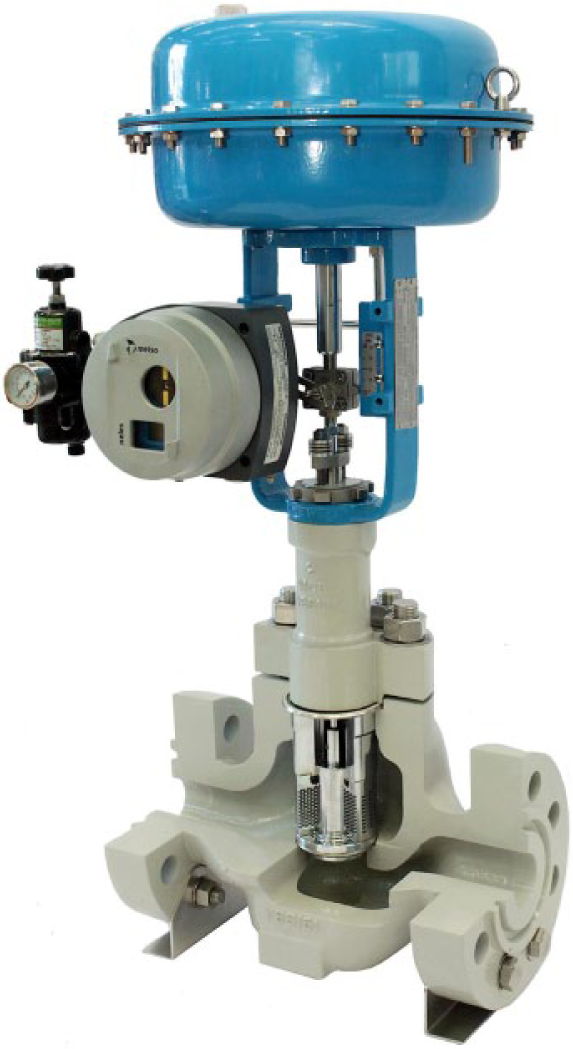
Metso
The new flow control solutions will replace the plant’s existing equipment and enable the plant to reach a higher safety integrity level while improving its environmental performance. The order includes over 140 actuated on–off and emergency shutdown (ESD) ball and butterfly valves, and this order was placed by the Toyo Japan and Toyo Malaysia consortium. Toyo will provide engineering, procurement, construction, and commissioning through a turnkey contract to expand the plant life for another 20 years.
Yoshiro Kawauchi, (Dr Eng), Asia Pacific Project Division, Toyo Engineering Corporation, said, Metso is a well-known and trusted valve manufacturer with a good product history and extensive industry experience. With Metso’s flow control technology, the plant will be able to further reduce fugitive emissions using the proven live-loaded stem packing design and by meeting the stringent ISO 15858 standards. The ESD valves will be equipped with automated partial stroke testing capabilities to improve plant safety.
In another contract, the company has also delivered more than 70 Neles globe valves for Phase II of the Longyu Coal project in Henan, China, for the production of 400,000 tonnes of acetic acid/year and 200,000 tonnes of ethylene glycol/year. The valves for this project have been installed, and their operation in extreme conditions has been flawless, proving the safety and reliability of the technology.
Metso’s order for the Malaysian plant includes over 140 actuated on–off and emergency shutdown (ESD) ball and butterfly valves
Pi gets Involved in Industrial Water Treatment
Process Instruments (Pi – http://www.processinstruments.co.uk) is well known for its work with chlorine in drinking water applications and swimming pool applications but is less well known for its work in industrial water treatment.
Still, a recent installation of a CRIUS with two pH and two conductivity sensors for industrial water treatment control shows that even from the other side of the world, Pi has a growing reputation in this market.
Indonesian firm Analitika Mandri Utama is a new professional partner for Pi and is providing Pi’s customers with the all support and expertise that they need. Pi’s export manager for Indonesia, Gabry Ostuni, commented, We’ve been working with Analitika Mandri Utama for only six months and it is a pleasure.
Pressure Switch Provides Easy Solution to Controlling Machine Pressure
Telemecanique Sensors has announced the newest product in the OsiSense range for sensing and detecting solutions. OsiSense XMLR is an intuitive pressure switch that combines high performance with maximum ease of use. It offers, says the company, easy access to current pressure information, even when the pressure transmitter itself is placed in a hard-to-reach location.
Installation is quick and simple as the device comes complete with a compact rotating body and reversed display function. It can also be placed directly on the ZMLP switch and display remotely via the M12 connector. The body can then be rotated for easy adjustment of the viewing angle.
Configuration is also very simple – just use two simple pushbuttons to navigate an intuitive menu, which is structured according to the VDMA standards. At each device start up, all segments of the display briefly light up to confirm that it is operating correctly. If necessary, the device status can be further tested via an additional fast diagnostic function.
For more information, visit http://www.tesensors.com/uk/literature/spotlight/OsiSense-XMLR-easy-pressure-switch.
OsiSense XMLR is an intuitive pressure switch that combines high performance with maximum ease of use

Hexavalent Chromium Contamination Detected in Real Time
Using a high-resolution ultraviolet–visible (UV-Vis) spectrophotometer, the OMA-300 Metal Ion Analyser by Applied Analytics (http://www.a-a-inc.com) provides an automated chromium measurement in real time. But why is this so important?
In 1952, Pacific Gas & Electric (PG&E) started adding hexavalent chromium (Cr6+) to cooling water in order to suppress rust in a Californian compressor station. The toxic metal was stored in unlined pools, allowed to percolate into the ground and contaminate the water supply. Unexplained illnesses (including respiratory cancer and organ damage) in the town sparked an investigation (as dramatised in the film Erin Brockovich), ultimately resulting in a major settlement of £200m in 1996. The Cr6+ levels in Hinkley groundwater were reported at 0.58 ppm in 1993, high above the 0.1 ppm legal limit of the time.
Because of widespread violations exposed since the Californian case, some states are planning to implement Cr6+ limits as low as 0.06 ppb. A 2010 study found that 21 US cities suffered from chromium-contaminated groundwater. There is currently no enforced contamination limit for Cr6+ in drinking water, but legislation for this purpose is in progress.
There are various methods for measuring chromium, but most are difficult to operate because they require titrations, pulling samples, and/or extensive training. US EPA Method 218.6 calls for ion chromatography to separate the chromate out from the sample and optical analysis under very strict sample conditions.
Much easier to operate than ion chromatography and colorimetric systems, the OMA-300 Metal Ion Analyser defeats cross-interference between metals by using data-driven multi-component analysis. Water backgrounds are transparent in the UV wavelength domain, making the OMA ideal for environmental applications.
Industrial Sensors on Display at Sensors & Instrumentation 2014
PCB Piezotronics will be exhibiting its wide range of industrial sensors, accelerometers, and microphones at the forthcoming Sensors & Instrumentation exhibition, NEC, Birmingham, United Kingdom, 30 September to 1 October 2014.
A range of PCB ICP low-temperature coefficient single and tri-axial accelerometers – series 339 A – designed for powertrain development and powertrain noise, vibration, and harshness (NVH) applications will be shown, along with an innovative charge output accelerometer capable of making vibration measurements in extreme heat environments up to 650 °C.
The Series 357D90 is ideal for use in gas turbine monitoring to increase turbine uptime and minimise the chances of costly unplanned maintenance, failures, and accidents. New microphone products on show will include the 377B26 probe microphone designed for R&D engineers needing to measure sound pressure in confined areas.
There will also be copies of PCB’s latest free Microphone Handbook available at the show. This provides an in-depth guide covering technology fundamentals and microphone types, selecting and specifying microphones, applicable standards, interfacing and design information, maintenance for microphones and preamplifiers, and future developments in acoustics. This publication can be downloaded from http://www.pcb.com/micFlipbook or is available as hard copy from PCB Piezotronics, United Kingdom.
The Series 357D90 is ideal for use in gas turbine monitoring to increase turbine uptime and minimise the chances of costly unplanned maintenance, failures and accidents

Rising Fuel Costs Drive Next-Generation Technology Sensors
In 2013, for the third year in a row, the annual global production of commercial aircraft crossed 1000 aircraft per year. In the next 20 years, the aerospace industry is expected to have an additional 34,000 commercial aircraft. The frenzied activity in this industry is expected to ripple into the sensor market. Sensor manufacturers have been developing technologically superior sensors to keep pace with airlines, which are updating their fleets with new fuel-efficient aircraft in order to stay competitive.
New analysis from Frost & Sullivan (http://www.frost.com), entitled ‘Analysis of Sensor Market in the Global Aerospace Industry’, finds that the market earned revenues of £0.74 billion in 2013 and estimates this to reach £1.46 billion in 2020. In this study, the aerospace industry has been segmented into commercial and general aviation.
Frost & Sullivan measurement & instrumentation senior industry analyst Sankara Narayanan, commented, The increase in fuel costs is driving the demand for fuel-efficient aircraft with next-generation engine technology and new jet power plants. These innovations are compelling sensor manufacturers to develop advanced sensors that offer compactness, low cost, reduced complexity, interoperability and ability to communicate with other sensors.
Narayanan noted, The measurement of critical parameters such as level, temperature, vibration, pressure, flow and position will remain critical for a safe flight. Therefore, as long as airlines continue to build and fly aircraft, there will be a demand for sensors in the aerospace industry.
For more information, email
Long-Range Sensors for Distant and Trick to Detect Objects
From Eaton (http://www.eaton.uk.com/electrical) comes the new E67 Long-Range Perfect Prox range of photoelectric sensors. These offer machine and system builders a precise sensing solution for longer distances and demanding applications such as pallet wrapping machines.
The long-range sensors reliably detect all targets within their sensing range and up to a distance of 2.4 M – irrespective of variances in colour, reflectance, contrast, or surface shape. This makes the reflective sensors of the E67 series Eaton’s most powerful photoelectric sensors with background rejection.
These devices are made with fixed operating distances between 60 and 240 cm (in 10 cm stages). Therefore, users do not have to define any further settings and the sensors are optimally adapted to the specific application requirements. Users, therefore, benefit from simple installation and handling, which helps prevent operating errors and keeps downtime to a minimum.
Eaton’s new E67 Long-Range Perfect Prox range of photoelectric sensors provide a solution for longer distances and demanding applications

Eaton developed this series to meet the most demanding photoelectric sensor applications. They can, therefore, detect targets that are a challenge for many other sensors – such as flat, black targets, very transparent targets like film, or off-angle targets.
News in Brief
A new perspective on GigE Vision
Kithara Software, a specialist in the field of real-time for Windows, has successfully completed the development of a software solution for 10-Gbit Ethernet cameras. The support of GigE Vision in real-time allows for deterministic image capturing with high data rates, especially suitable for quality assurance, material transport, or robotics applications.
Go to: http://www.kithara.de/en/press/gige-vision-10-gbit-camera-link.
Free power quality seminars from Fluke
Test instrument manufacturer Fluke is providing series of free Power Quality seminars throughout the United Kingdom and Ireland. Designed to help facility managers, maintenance engineers, energy consultants, and power engineers to save money on energy bills and increase machinery lifetime, the seminars are one element of the Fluke Academy programme, which can be seen at http://www.flukeacademy.shuttlepod.org/UK-seminars.
Do not miss NIDays 2014!
Join National Instruments at NIDays, the annual graphical system design technical conference and exhibition that brings together more than 600 innovators representing a spectrum of industries, from automotive and telecommunications to robotics and energy. At this event, visitors can learn about the latest technology to accelerate productivity for software-defined systems in test, measurement, and control. It will take place on 4 November 2014 at the Queen Elizabeth II Conference Centre. For more information, email:
Learn more about advanced manufacturing
‘Don’t miss’, says GE Intelligent Platforms (http://www.ge-ip.com), its 2014 User Summit. This is, the company claims, ‘your opportunity to discover how you can make the Industrial Internet real for your business’. The only trouble is that it is being held in Orlando, Florida from 27–30 October 2014. Visitors will be able to hear how exciting and transformational technologies such as additive manufacturing take conventional manufacturing to the next level. They will also be able to gain insights into the shift that’s happening across manufacturing powered by technology innovations and discover how the latest technologies are affecting the manufacturing of new parts and products.
YouTube video on industrial Ethernet network management
Moxa’s YouTube video demos show how the MXstudio industrial network management suite solves challenges throughout the network lifecycle. In this video series, the company demonstrates how you can use Moxa’s integrated network management suite MXstudio for easy network management and high productivity across the entire network lifecycle, including installation, operations, maintenance, and diagnostics. Go to http://www.moxa.com.
PC as EtherCAT slave
A module of the real-time extension RealTime Suite, the EtherCAT Master by Kithara, has been an established control solution for many years in the fields of measurement and control applications, automation, robotics, and image capture and image processing. While slaves in EtherCAT networks have normally been implemented with specialised hardware, it is now possible to employ even simple off-the-shelf PCs as slaves. The EtherCAT Master allows open function libraries to be provided and simplify the implementation, and generally enabling a much more flexible and low-cost solution than others currently available, says the company. Go to: http://www.kithara.de/en/solutions/ethercat-master.