




Abstract
The capacitive sensors are used in a variety of industrial and automotive application. A capacitive sensor converts a change in position, or properties of dielectric material into an electrical signal. These properties of capacitor can be used to measure the liquid level in storage tanks. The various aspects and configurations of capacitive liquid level measurement have been described. Here, review is also done on the several types of liquid level measurement techniques using capacitive sensor, for conducting and non-conducting liquid.
I. Introduction
The capacitive techniques are used extensively to measure all types of water level. Most of the capacitors are designed to maintain a fixed physical structure. However, various factors can change the structure of the capacitor; the resulting change in capacitance can be used to sense those factors. Change in dielectrics changes the distance between the plates and changes the effective area of the plates. The liquid properties such as pressure at depth, buoyancy, relative electrical permittivity, electrical and thermal conductivity, liquid surface reflection of sound or light waves, and absorption of radiation are used to design the different types of liquid level transducer for liquid level measurement in any process industry. There are two types of capacitive level sensor, contact-type or non-contact-type, for water level measurement. Reverter et al. 1 have described the design and implementation of a liquid level measurement system based on a remote grounded capacitive sensor. A rod of stainless steel and a polytetrafluoroethylene (PTFE)-insulated wire have been used for electrode of capacitive sensor. Guirong et al. 2 have proposed a capacitive liquid level sensor, not only for the liquid level but also for the gradient direction and the gradient angle to be measured step by step. In this proposed model, four electrodes are used for a capacitive liquid level sensor. Bera et al. 3 have been made to design a low-cost non-contact capacitance-type level sensor for a conducting liquid. They minimize the effect of air in dielectric. Bera et al. 4 have also presented a modified capacitance-type level sensor for any type liquid, in which effect of self-inductance of the metallic rod has been eliminated. Sheroz Khan et al. 5 have designed a low-cost non-contact capacitance-type liquid level sensor. A circular cylinder made of polyvinyl chloride (PVC) has been used as a dielectric for capacitive sensor.
In this review paper, basic working principle of capacitive sensor has been described, and similarly, various aspects and configurations of capacitive liquid level measurement have been described. Application and advantages of capacitive level measurement techniques are also discussed.
II. Background
The liquid properties6–9 like buoyancy, pressure at a depth, relative electrical permittivity, electrical conductivity, thermal conductivity absorption or radiation, liquid surface reflection of sound or light waves, and so on are related to the liquid level. These properties of liquid are used to design the different inferential types of liquid level transducers,6–8 such as float, displacer, pressure sensor, capacitive probe, partially immersed resistance wire probes, and so on. Of these, the contact-type liquid level sensing probes,6,7 like float, displacer, capacitive probe, and so on, have disadvantage that their characteristic properties with liquid level may change due to physical or chemical reaction between the liquid and the probe material, and hence, their life period may be limited. The non-contact-type level sensing probes,6,8 like ultrasonic probe, absorption probe, non-contact capacitance probe, and so on, may have longer life period, but they are comparatively costly and require various environmental and experimental precautions during the measurement.
The specific origin of capacitive water level sensor cannot be accurately determined, but it seems to go back to the beginning of the last decade. In 2006, Bera et al. 3 have proposed a low-cost non-contact-type capacitive technique for measurement of liquid level for conducting liquid. In this technique, they try to remove the defects of convectional non-contact capacitance-type level sensing probe; the material of a uniform right circular cylinder made of insulating material like glass, ceramic, nylon, PVC, and so on is used for dielectric of cylindrical capacitor.
Capacitive sensor can be classified into two types: one is floating capacitive sensor, and another is grounded capacitive sensor. The floating-type capacitive sensors are able to be intrinsically immune to stray capacitances. However, due to safety reasons and/or operating limitation of floating capacitive sensors, grounded capacitive sensors are still required in some applications, for example, the level measurement of a conductive liquid in a grounded metallic container. 6 Reverter et al. 1 have designed and implemented a liquid level measurement system based on a remote grounded capacitive sensor in 2007. Khan et al. 5 have designed a new non-contact capacitance-type level transducer for liquid identification objectives.
Most of capacitive level sensors have approximations based on the large difference between the dielectric constants of the liquids and the air. Canbolta 10 has proposed a method for eliminating the effect of air and for giving the accurate reading of the liquid level tank in 2009. It has mathematically proven that the method completely eliminates different factors, which affect the readings, such as air and temperature.
Guirong et al. 2 have proposed a capacitive liquid level sensor with four electrodes. The proposed method is not only used to measure liquid level of the vessel but also to evaluate the gradient status of the vessel. It has been experimentally proved by the authors.
In a conventional sensor, two identical electrodes are used for the measurement of liquid levels in a non-metallic storage tank. Bera et al. 4 have proposed that a capacitive sensor may be used for both conductive and non-conductive liquids in a metallic or non-metallic storage tank.
III. Theory and operation
The basic principle of a capacitive sensor is that it converts a change in position, or properties of the dielectric material, into an electrical signal. 3 Capacitive sensors are realized by varying any of the three parameters of a capacitor: distance between the plates (d), area of capacitive plates (A), and dielectric constant (εr); therefore

In this principle, different kinds of sensors have been developed. A number of different kinds of capacitance-based sensors are used in level measurement. General properties of the capacitor discussed above can be used to measure the fluid level in a storage tank.
In conventional capacitive-type level sensing system, two electrodes are used for non-metallic tank and one electrode for conducting tank. These systems establish a capacitor as shown in Figures 1 and 2 . If the gap between the two terminals is fixed, the fluid level can be determined by measuring the capacitance between the conductors immersed in the liquid. Since the capacitance is proportional to the dielectric constant, fluids rising between the two parallel rods will increase the net capacitance of the measuring cell as a function of fluid height. One of the two electrodes is a sensing electrode and the other is a drive electrode. To measure the liquid level, an excitation voltage is applied with a drive electrode and detected with a sense electrode. The sensing electrodes of the capacitive sensor could be shaped into various forms and structure.
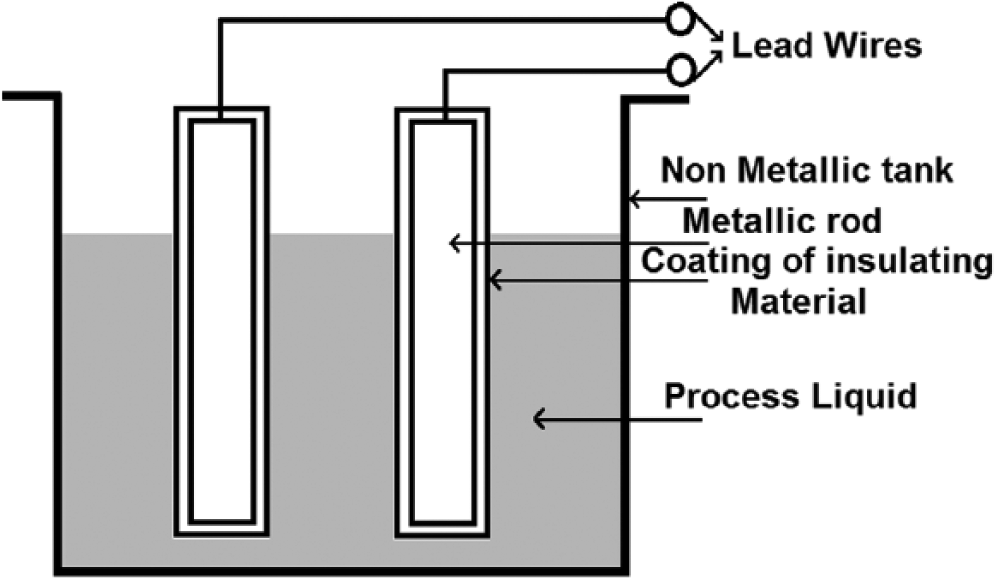
Non-metallic tank
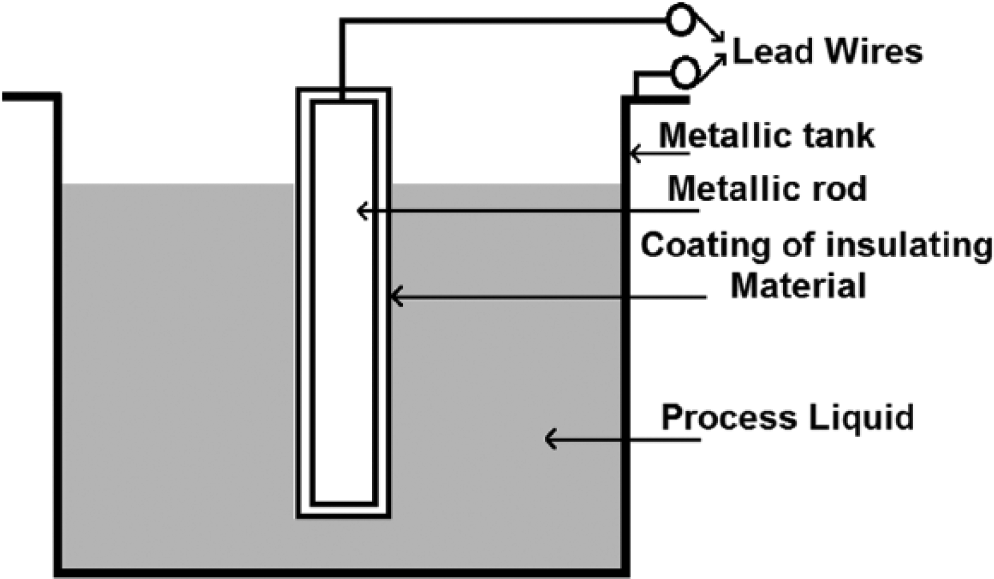
Metallic tank
IV. Review
The conventional non-contact-type liquid level transducer is used in air column between the conducting liquid level and sensing electrode of a capacitor as a dielectric. In conventional non-contact-type liquid level transducer, air is used as dielectric; as we know that air has low value of permittivity and frequently changes its dielectric properties, the transducer suffers from error and thus appears to have limited applications. To minimize the air effects on conventional non-contact capacitance-type transducer, Bera et al. 3 have designed and fabricated a low-cost non-contact capacitance-type level transducer for a conducting liquid in 2006. In the designed technique, level sensing probe is made of uniform hollow cylinder made of insulating material like glass, ceramic, PVC, and Teflon. The cylinder is connected with metallic storage tank. The proposed technique used two types of capacitive level sensors. One type of level sensor was made from high-density polyethylene (HDPE) tube having 900 mm length, 40 mm internal diameter, and 3 mm wall thickness. The PVC-insulated hookup copper wire was used for the two-layer non-inductive winding of the short-circuited coil of this level sensor. The second type of level sensor was made of Pyrex glass tube of length 800 mm with 12 mm internal diameter and 2 mm thickness, and super enameled copper winding wire of 18 standard wire gauge (SWG) was used. The two layers are uniformly wound on the sensing cylinder one above the other in the same direction. The starting ends of both layers of winding were electrically shorted. The finishing ends are also shorted and taken as one terminal of the sensing capacitor. The stray magnetic field induces currents in opposite directions, and thus, the self-inductances of the coil are eliminated. To measure change in capacitance of level sensing probe, a De Sauty bridge is modified using two operational-amplifiers (Op-amp). The static characteristics of the developed HDPE and glass tube level sensor in the metallic and non-metallic storage tanks were found linear with very good repeatability.
Capacitive sensor can be classified into two groups: one is floating capacitive sensor, and the other is grounded capacitive sensor. The former is preferable since it can be read by interface circuits that are intrinsically immune to stray capacitances. However, due to safety reasons and/or operating limitations of floating capacitive sensors, grounded capacitive sensors are still required in some applications, for example, the level measurement of a conductive liquid in a grounded metallic container. 11 In many industrial applications like the water level measurement at the bottom of oil tanks, 12 the sensors are remote from its signal conditioning circuit. In these cases, in order to reduce the effects of external noise, the sensor may be connected to the interface circuit using a shielded cable. For grounded capacitive sensors, common passive shielding is not appropriate because the parasitic capacitance of the cable, whose value can be much greater than that of the sensor, depends on the environmental conditions, and would be parallel with the sensor. The parasitic components of the sensor can also play an important role in the performance of active-shielding circuit. Reverter et al. 1 have described the design and implementation of a liquid level measurement system based on a remote grounded capacitive sensor. It provides a detailed analysis of the effects of the parasitic components on the active-shielding circuit, which before this had not yet been analyzed. The active-shielding technique was applied to interconnect the sensor to the interface circuit. In order to have a stable circuit, the bandwidth of the active-shielding amplifier must fulfill the stability condition, which depends on the parasitic components of both the interconnecting cable and the sensor. A simple relaxation oscillator was used as an interface circuit. They used operating frequencies in the range of tens to hundreds of kilohertz for both the sensor performance and the ensuing microcontroller that performs the timing measurement. The design of the system is simple and prototype, and the experimental results reported are quite satisfactory. This system can also be used for leakage detection.
In 2008, Sheroz Khan et al. 5 have designed a new non-contact capacitance-type level transducer for liquid identification objectives. An Op-amp-based modified bridge network which is shown in Figure 3 has been used to measure changes in capacitance of a proposed level sensing probe, where the effect of stray capacitance between the output leads of the bridge network was minimized.
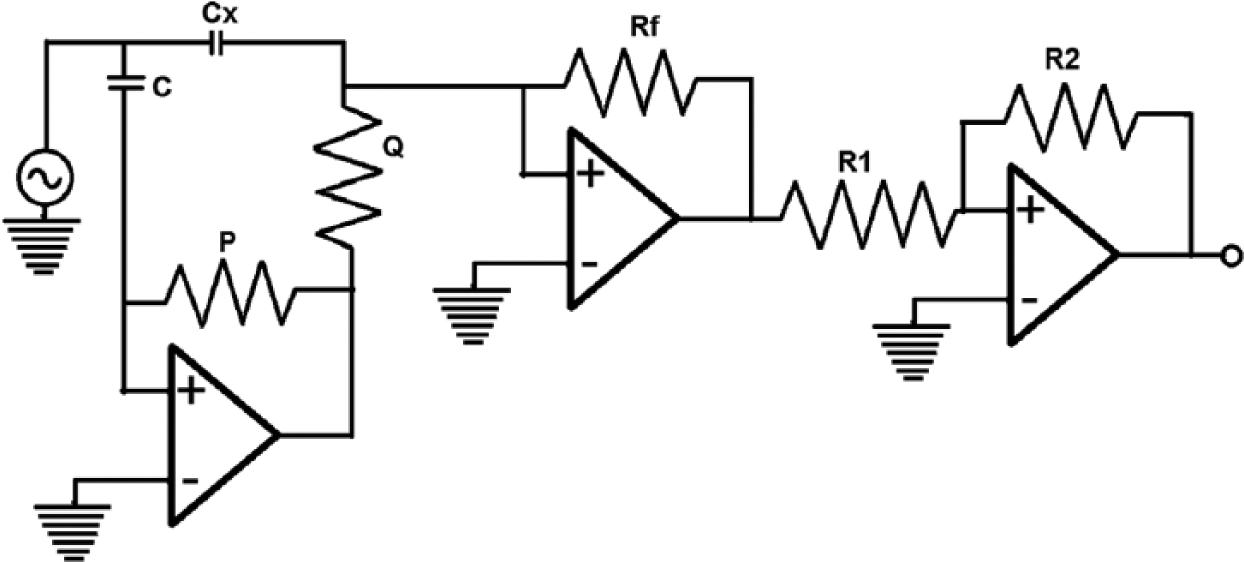
Op-amp-based modified De Sauty bridge network
The unknown capacitance is found by balancing the bridge with extra capacitance. The transfer function H(s) of the circuit is made from the lower and upper parts of the circuit
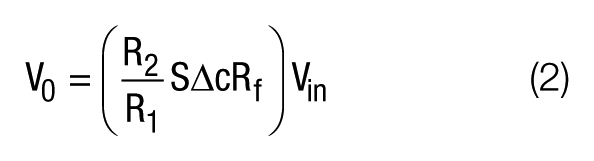
The above equation derived for the proposed model gives linear relationship of output voltage with change in capacitance if input voltage applied is constant with a stable frequency. Experimental results show good linearity with an acceptable level of accuracy in all of the measurements.
The conventional capacitive liquid sensor measured only liquid level. But more information for measured variable is also necessary in some practical applications at the same time, for example, discrimination of liquid, temperature of liquid, and so on. Whenever the vessel is located in dynamic state, the vessel status vertical and gradient are also necessary in practical application. Guirong et al. 2 have proposed a capacitive liquid level sensor with four electrodes, which is based on multifunctional sensing. The proposed model detects liquid level changes in liquid filled in a cylindrical vessel, and similarly, it detects status of vessel like gradient direction and gradient angle.
The measurement principle of the proposed sensor 2 is shown in Figure 4 . Where output of sensor C0 is used for detecting the liquid level, and other outputs C1, C2, C3, and C4 are used to estimate the status of the vessel, the gradient direction, and gradient angle.
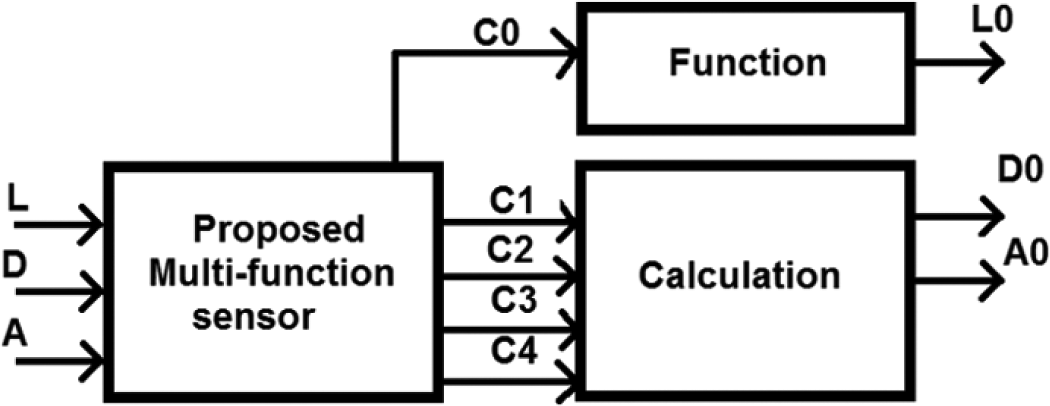
Measurement principle of a capacitive sensor with four electrodes
In the proposed model, four electrodes are connected as shown in Figure 5 . Therefore, the sensor becomes a four-electrode sensor. Capacitances C1, C2, C3, and C4 are used for liquid level measurement, and gradient of vessel is also measured by V1 = C1 − C2 and V2 = C3 − C4. In the proposed model, the performance of the sensor was good, less than 30°. The advantage of the proposed model does not need any extra component for measurement of gradient direction and gradient angle. Thus, it reduces the manufacturing and application cost.
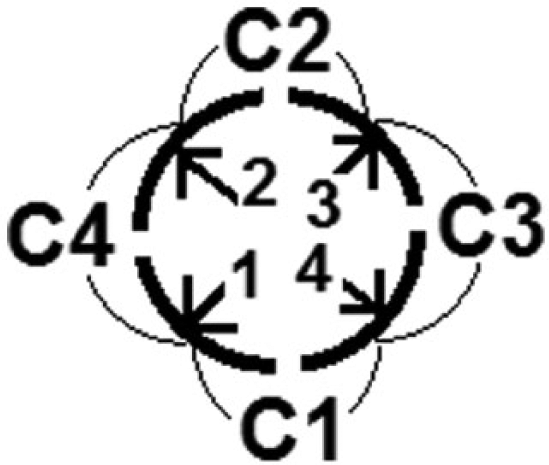
Four electrode modes
The effect of air cannot be eliminated completely in one capacitive sensor. To measure high dielectric constant of liquid, the capacitive sensor should be affected as less as possible, but moisture in the air can considerably change the readings. To neglect the effect of air, the sensor should be calibrated for each kind of liquid whenever a different kind of liquid is filled in the tank. Therefore, the sensor should be recalibrated for each type of liquid in the container. This is a costly process and, often, is not practical. Canbolta 10 has proposed a method to eliminate the effect of air and has measured accurate reading of the liquid level in tank. This method can be applied directly to any kind of non-conductive liquid without calibration.
Figure 6 is a schematic diagram of sensor set up which is used in the proposed model. He has used two extra identical capacitive sensors. The capacitive sensor at bottom of the container is used as a reference sensor for liquid dielectric reference, and the capacitive sensor at top of the container is used as an air dielectric reference. Both sensors are identical, with the same spatial dimensions. The third sensor is used as a level sensor for level measurement. For all these three sensors, the same distance d is used between the parallel plates, and width W is also same. Capacitive-to-digital converter (CDC) is used for all sensors to convert dielectric value into digital information.
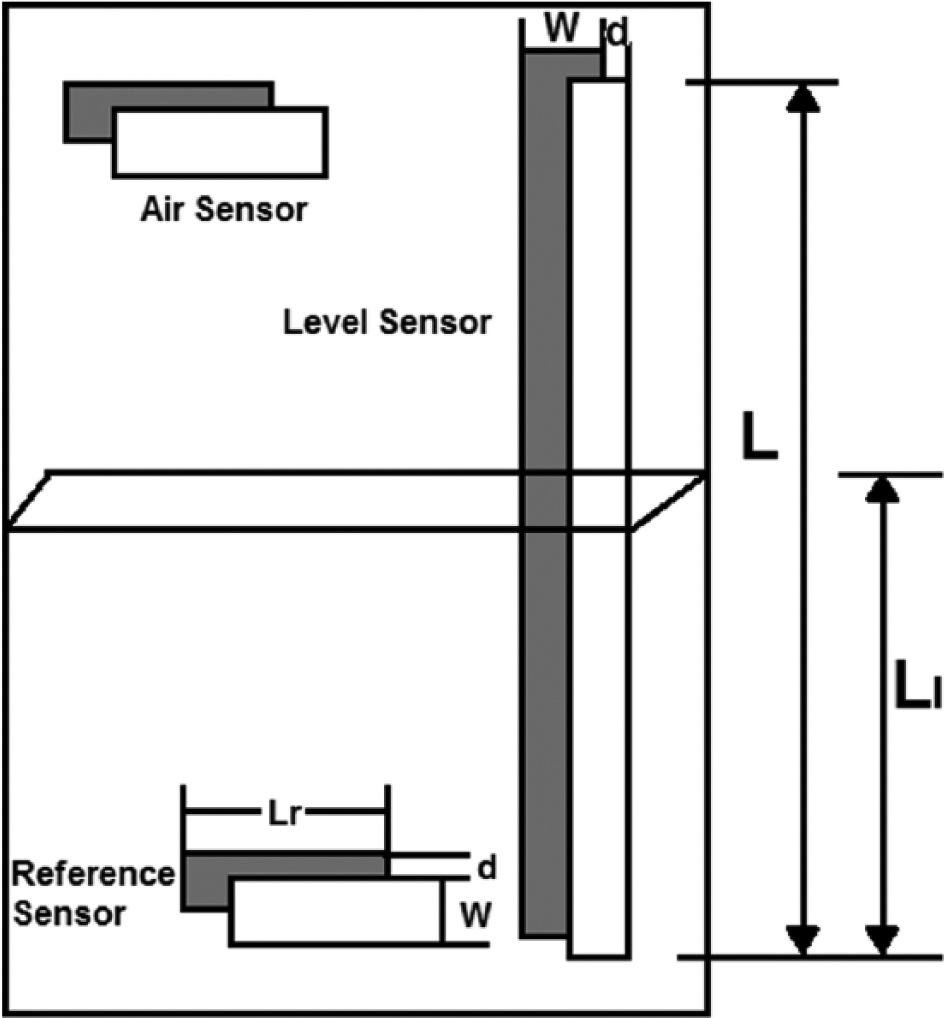
Sensor set up of a novel level measurement technique using three capacitive sensors for liquids
The conventional capacitance-type liquid level sensor consists of an insulated solid metallic rod electrode immersed in the liquid contained in a storage tank, or two such identical electrodes in a metallic storage tank. Such metallic rods may suffer from the self-inductance effect which varies non-linearly with level. Bera et al. 4 have presented a study of a modified capacitance-type level transducer for any type of liquid, which is free from the self-inductance effect of the metallic rod electrode of a conventional capacitance-type level sensor. To minimize the effect of inductance, each electrode consists of a uniformly wound short-circuited non-inductive coil on an insulating cylinder kept inside a shielding cylinder made of an insulating material, which is shown in Figure 7 .
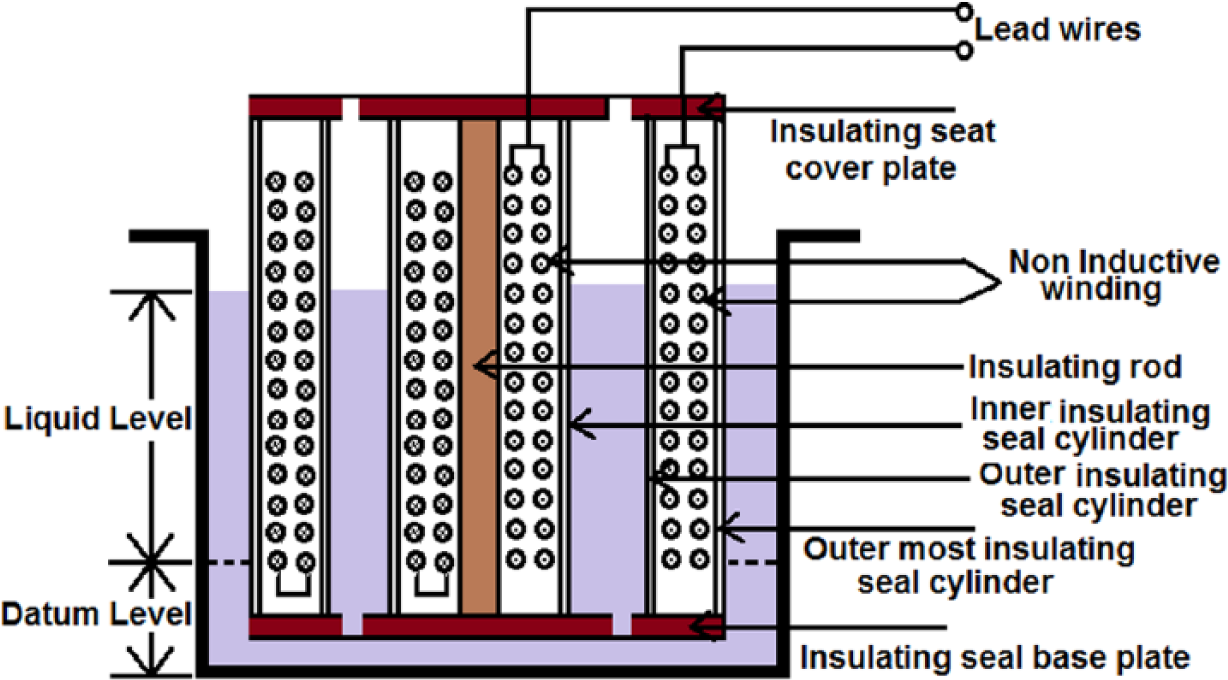
Sectional view of modified capacitance-type level sensor
Cylinder was placed inside a larger diameter cylinder so that cylindrical capacitance was formed between the inner coil and outside coil, which were not in contact with liquid. The change in capacitance of a capacitance-type level transducer has measured by a modified capacitance bridge technique. The author experimentally found that there exists a self-inductance effect between the metallic electrodes of a conventional two-electrode capacitance-type level sensor. This self-inductance varies non-linearly with level or may affect the linear dynamic performance of the level transducer. The proposed level sensor has very good linearity and repeatability. The non-inductive coils of the proposed sensor remove the self-inductance effect of the conventional capacitance-type level sensor. Since these coils have no contact with the process liquid, the life time of the sensor will be much more than that of the conventional capacitive sensor. The proposed sensor may be used for both conductive and non-conductive liquids. Conventional sensor needs two identical electrodes for the measurement of liquid levels in a non-metallic storage tank, but in the proposed model, there is no need for two identical electrodes in non-metallic tank. The design of this sensor is easier than that of conventional sensor. Cost of this sensor is also less than that of the conventional sensor. In conventional capacitive liquid level sensor, thickness of the coating material has to be uniform, but it is difficult to be obtained, and so the performance of the conventional sensor is highly affected. This does not arise in the proposed sensor since insulating cylinders with uniform thickness and copper wire with uniform enameled coating are easily available.
V. Conclusion
This paper is intended to show an overview of some important development on capacitive level sensor in recent years which includes the following:
A low-cost non-contact capacitance-type liquid level transducer which is found to be linear with very good repeatability in both metallic and non-metallic storage tanks.
A remote grounded capacitive sensor that has been used for liquid level measurement. It is applicable up to 70 cm level range, and above this range, error occurs due to non-linearity, hysteresis, and temperature.
A low-cost non-contact capacitive-type level transducer analyzed for various conducting liquids. The designed technique has been used for liquid identification objectives.
The liquid level measurement technique using three capacitive sensors reduces the effect of physical parameters, such as temperature, humid air gap, and dust: A four-electrode capacitive-type liquid level sensor is used to measure liquid level, the gradient direction, and the gradient angle; A modified capacitance-type liquid level transducer is used for both conducting and non-conducting liquid, and it removes the self-inductance effect of conventional capacitive liquid level sensor.
We observed that capacitive-type liquid level sensor is more efficient for industry application because of its low cost, linearity, and good repeatability. Using these techniques, level measurement up to 80 cm is possible. Future experiments may be done to modify capacitive liquid level sensor so that it can be utilized to measure height of the liquid level for larger range of meters.
Footnotes
Funding
This research received no specific grant from any funding agency in the public, commercial, or not-for-profit sectors.