




Abstract
This investigation measures the biomechanical response of four soccer players (age 24 (standard deviation: 0.82) years, weight 74.6 (standard deviation: 6.9) kg, footwear size 10) to the seasonal changes that occur to a natural turf playing surface. The surface was tested on two occasions where participants wore a pair of soccer boots with six screw-in studs (metal cleat) and a pair with 15 rubber moulded studs (moulded cleat) in a 2 × 2 surface-footwear design. While running (3.0 m/s ± 5%) and performing a 180° turn (consistent self-selected ± 5%), data were collected using Footscan pressure insoles (500 Hz, (RSscan, Belgium)). These data included peak impact force, peak impact force loading rate and the peak pressures and peak pressure loading rate at the medial and lateral heel and first and fifth metatarsals. Multiple two-way repeated measures analyses of variance were conducted on the data and p-values, effect size and confidence intervals determined. Intraclass correlation coefficients were also used to determine the reliability of data during the turning movement. Study findings demonstrate that greater pressure magnitudes were experienced on the harder turf surfaces when running (p < 0.05) which may contribute to the greater risk of injury seen in the literature. The study results also show that the reliability of selected data collected during the 180° turning motion was good to excellent. For some measures of loading, particularly during turning, a larger confirmatory investigation is needed with sufficient statistical power to support these findings.
I. Introduction
The 2014 FIFA World Cup is being held in Brazil during the months of June and July. Temperature and rainfall can vary significantly across Brazil, where heavy rainfall is experienced in the Northwest, while there is a semi-arid area in the interior Northeast of the country. 1 Likewise, internal areas of Brazil such as Brazillia have long dry periods, including the time between June and July, and these conditions can result in hard playing surfaces. Woods et al. 2 found that nearly one-fifth of injuries in soccer occur during the summer preseason period of June to July, which was disproportionate to the number of injuries found during the rest of the year. They also identified that of these injuries, 70% occurred on hard playing surfaces, suggesting that the conditions predispose the player to unaccustomed loads and a greater risk of non-contact injury. This evidence highlights the potential effect of hard playing surfaces on the performer, supporting the importance of understanding the precise injury mechanisms so that preventative strategies can be introduced.
The investigation of the mechanisms behind injury on different playing surfaces has received much attention over recent years, although this has mostly been into the effect of synthetic systems on the loading of the performer. 3 Since natural surfaces are considered as the gold standard for safety, 3 comparison of soccer players’ biomechanical responses have been made between artificial and natural turf surfaces. 4 However, it is currently unclear how the loading response of soccer players differs in line with changes in natural turf cushioning resulting from seasonal variation in temperature and precipitation.
Many challenges exist when measuring the player response to natural turf variations which somewhat explains the lack of literature on this topic. Since force plates have been traditionally used to measure the external forces associated with injury, this poses a particular problem for the investigation of natural turf as it is difficult to incorporate a force plate into a natural turf system. In an attempt to solve this problem, Stiles et al. 5 used plastic trays to grow different grasses in a range of soil compositions and then exported them into a laboratory for participants to run on. An alternative approach was used by Dixon et al. 6 who measured the response of participants to different levels of soil density manipulated in a soil bin, and used pressure insoles to collect loading data. This method allowed measurements to be taken at the foot–shoe interface and at specific plantar foot locations determined by dividing the foot into regions and looking at force measurements at these specific sites. Use of such regional force data is also thought to improve the ability of the study to detect changes in loading and to provide better understanding of the injury causing mechanism. 6 The authors concluded that greater density surfaces resulted in reduced cushioning of the loads experienced by the player, although they acknowledged that the effect of the surface on the player is also dependent on the footwear that is worn. Neither study, however, truly measured surfaces used by soccer players and thus lacked the potential to fully understand player loading and injury mechanisms in real situations.
Another important consideration in the investigation of playing surfaces is the choice of movements performed by participants. Often, studies utilise running or a ‘V’ shaped cutting manoeuvre used when changing running direction.4–7 However, soccer players use a range of dynamic multi-directional movements including a complete 180° turning movement. The performance of this action may change the magnitude and location of the load experienced which, with adequate repetition, may contribute to the onset of chronic lower extremity injury.
During running, movement variability can affect the interpretation of results. 8 As such, researchers use a mean of multiple trials to gain a representative value by which to compare the different footwear and surface conditions. It has been shown that a minimum of eight trials is required for a representative mean during running,8,9 although the variability of 180° turning movements is not known and thus needs further investigation.
The current investigation compares the biomechanical response of players on a real natural playing surface at two different times of the year where surface cushioning was different. It is expected that plantar foot loading will be significantly greater on the harder natural turf and that the footwear worn will also significantly influence the forces experienced. It is also expected that reliable data will be obtained during a 180° turning movement. From these data, it will be possible to understand potential injury mechanisms on harder surfaces during different movements.
II. Methods
Four healthy male participants completed testing on two occasions (study ethically approved by the University of Exeter; age 24 years (standard deviation (SD): 0.82 years), weight 74.6 kg (SD: 6.9 kg), footwear size 10–11). The test occasions corresponded to periods of the year when weather conditions are different in the south west region of the United Kingdom. These times were March (maximum temperature range of 3°–10.9°, average rainfall of 49.6 mm and 113 h of sunshine) and May (maximum temperature range of 7.2°–16.8°, average rainfall of 48.5 mm and 193 h of sunshine). 10 Each participant was tested at a different location on the same natural turf. Prior to any biomechanical data collection, mechanical testing was performed using a Standard 0.5 kg Clegg hammer (Model 500GT; Dr Baden Clegg Pty Ltd, Australia). This allowed the mechanical quantification of the surface cushioning and thus the changes that occurred over time. The Clegg hammer is a device that has a 0.5 kg weight attached to an accelerometer which is placed into a tube. The weight is then dropped five times from a height of 30 cm, the fifth being recorded as the measurement of surface cushioning. This cushioning is reported as peak gravities or G (multiple gravities), where higher the value, lower the cushioning provided. The mean values across all participants and locations was 80.0 g (± 4.0 g) for the first test occasion in March, and 102 g (± 3.0 g) on the second test occasion in May. This confirmed that a reduced mechanical cushioning was provided to the participant on the second test occasion.
Each participant wore two styles of soccer boots on each test occasion; a pair with six screw-in studs (metal cleat) and a pair with 15 rubber moulded studs (moulded cleat; 2 × 2 surface by footwear design). The Footscan pressure insole (500 Hz, (RSscan, Belgium)), shown to produce reliable data for running movements, 9 was used in this study. The insoles were inserted into each footwear condition to collect the in-shoe force and pressure data for the different footwear–surface combinations.
To collect running data, participants ran the length of the test area where a square of 1 m2 was marked midway along for them to place their dominant foot, which for all participants was their right. They were required to step into the square without adjusting their natural running gait (3.0 m/s ± 5%). The speed was standardised using two photosensitive timing gates placed 1.5 m either side of the marked square. This procedure allowed the same foot and surface area to be analysed, ensuring consistency across conditions. During the turning motion, participants ran up to the marked area, placed their right foot, twisted their hips 180° and pushed off in the direction that they had approached the area. The speed of the turn was self-selected but consistent throughout (±5%) and was monitored using a single set of timing gates where the time going through and returning back from the turn was recorded. Any trial where either the straight run or turn was not at the required speed or where the movement pattern was not as directed was subsequently repeated.
Mean values from eight running steps and eight turning movements were composed for each dependent variable. These variables included peak impact force and peak impact force loading rate as well as peak pressure and peak pressure loading rate at the medial and lateral heel and first and fifth metatarsals. These locations were chosen due to the position of the studs on the soccer boot and were obtained using Footscan software (version 6.345). Separate two-way repeated measures analyses of variance (ANOVAs) were used to analyse each data set. Individual t-tests with Bonferroni corrections were used to explore significant interactions. The alpha level used for statistical significance was 0.05. Effect sizes were determined for all comparisons and reported as Partial eta2 (η2) for the main effect of surface, as well as for the interaction between these footwear and surface variables. Hopkins’ 11 definitions of effect sizes were used to identify those that were trivial (<0.2), small (0.2–0.5), moderate (0.6–1.2) and large (1.2–2). Relative changes in measurement are expressed as 95% confidence interval (CI). To monitor the reliability of data obtained during the turning movement, intraclass correlation coefficients (ICCs) were used to compare the variance for each measurement.
III. Results
A. Running
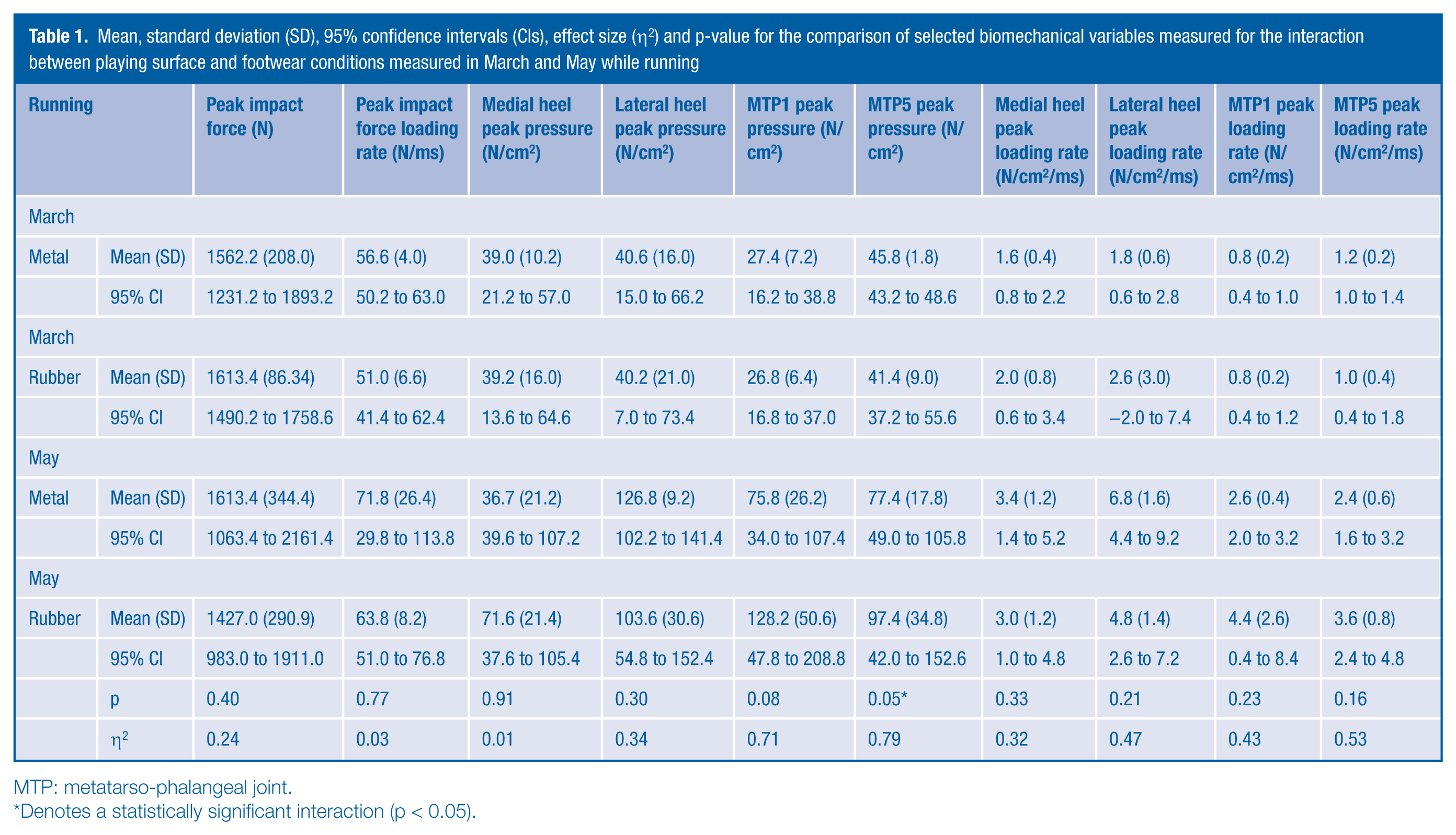
Statistical analysis revealed that during running, there was a significant main effect of surface condition where all pressure measurements were greater in May on the harder turf surface (p < 0.05, η2 = 0.8–0.99). There were, however, no significant differences between surfaces for impact force (p = 0.67, η2 = 0.07) or loading rate (p = 0.18, η2 = 0.51). There were also no significant interactions between the footwear and surface variables except for peak pressure at the fifth metatarsal (p = 0.05; η2 = 0.79, Table 1 ). Post hoc analysis indicated that loading was greater on the harder surface in May while wearing the metal cleated soccer boot compared to all other footwear–surface combinations.
Mean, standard deviation (SD), 95% confidence intervals (CIs), effect size (η2) and p-value for the comparison of selected biomechanical variables measured for the interaction between playing surface and footwear conditions measured in March and May while running
MTP: metatarso-phalangeal joint.
Denotes a statistically significant interaction (p < 0.05).
B. Turning
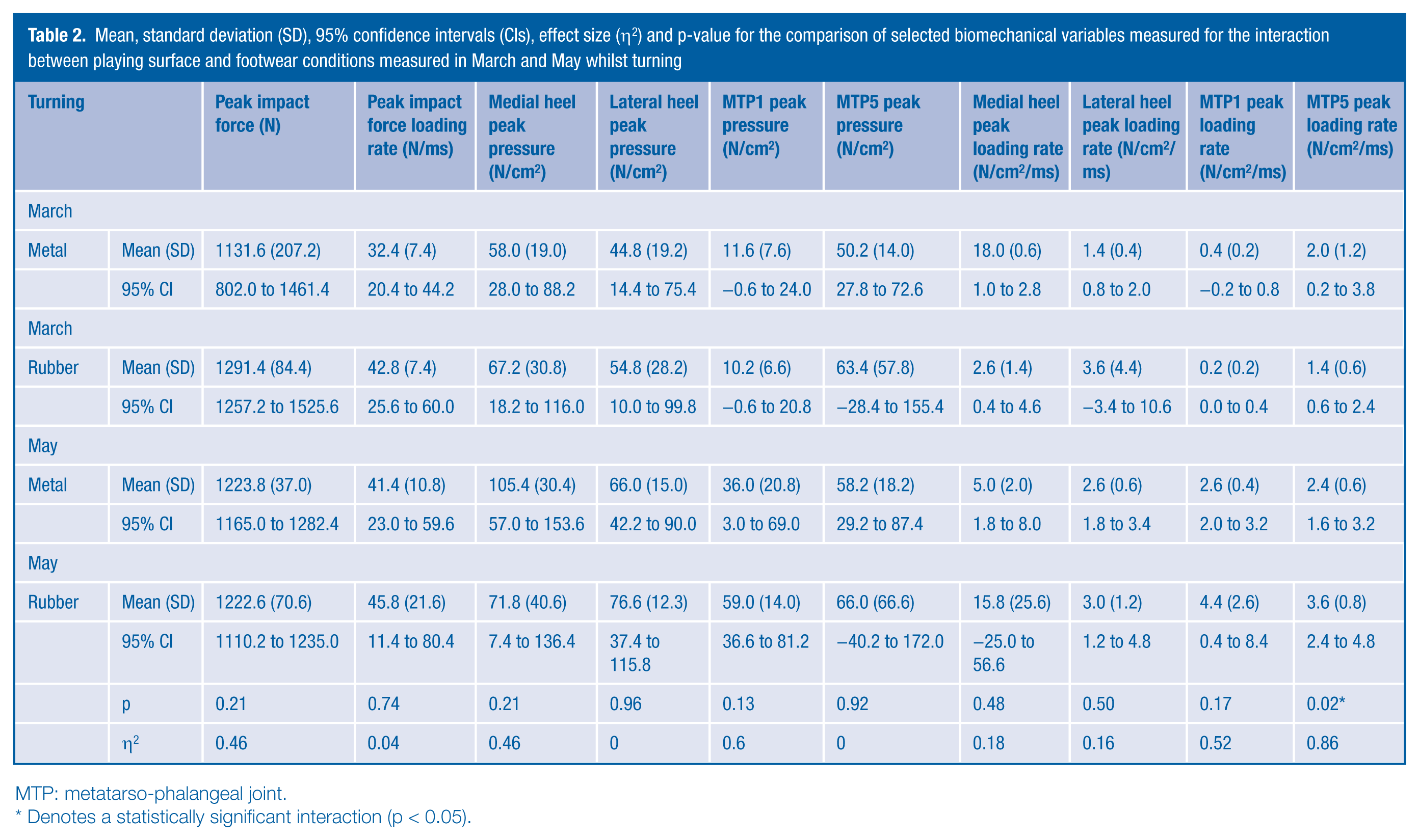
During the turning movement, there were significant differences for peak pressure at the lateral heel (p = 0.04, η2 = 0.80) and first metatarsal (p = 0.02, η2 = 0.88), and peak pressure loading rate at the first metatarsal (p = 0.03, η2 = 0.84). Each difference demonstrated that greater loading occurred on the harder surface in May, although no other differences were found (p > 0.05, η2 = 0.001–0.68). There was only a single interaction shown between footwear and surface for peak pressure loading rate at the fifth metatarsal (p = 0.02, η2 = 0.86; Table 2 ). The comparison indicated that the pressure was greater in the metal cleated footwear on the harder surface compared with the other footwear–surface combinations.
Mean, standard deviation (SD), 95% confidence intervals (CIs), effect size (η2) and p-value for the comparison of selected biomechanical variables measured for the interaction between playing surface and footwear conditions measured in March and May whilst turning
MTP: metatarso-phalangeal joint.
Denotes a statistically significant interaction (p < 0.05).
Reliability analysis of the turning movement data showed good to excellent reliability for measurement of peak impact force (ICC = 0.62), peak pressure at the medial (ICC = 0.61) and lateral heel (ICC = 0.64) and peak pressure at the first metatarsal (ICC = 0.70). Good to excellent reliability was also demonstrated for peak pressure loading rate at the medial (ICC = 0.84) and lateral heel (ICC = 0.64). Overall, however, only peak pressure at the first metatarsal and peak pressure loading rate at the medial heel were statistically significant (p = 0.01 for both). The analysis also indicated that peak impact force loading rate, peak pressure at the fifth metatarsal and peak pressure loading rate at both measured metatarsal locations offered poor data reliability (ICC < 0.4).
IV. Discussion
Playing soccer on hard natural surfaces such as those experienced during the summer months has been identified as a contributor to the disproportionate increase in injury risk compared to the rest of the year. 2 This study aimed to understand the influence of seasonal changes to natural turf on loads experienced by the player and thus provide some indication of the mechanisms behind injury during summer months. Data obtained during the running movement revealed differences in all pressure measurements, where greater loads were detected at the heel and specified metatarsal areas on the less cushioned surface (May). Likewise, during 180° turning, greater pressure values were observed at the lateral heel and at the first metatarsal area. This is similar to trends found on a variety of other surface constructions with different levels of cushioning4–6 and confirms the hypothesis that changes in playing surface due to seasonal weather variations are sufficient to cause different loads to be experienced by the player during running and turning. This therefore improves our understanding of biomechanical responses to difference in natural turf.
Although a direct relationship between pressure patterns and specific overuse injuries is difficult to establish, 12 it is conceivable that heel force magnitudes are indicative of the size of the shock waves which damages the musculoskeletal structures surrounding the foot and ankle. 13 Consequently, increased pressure patterns during running and turning movements may lead to the typical stress fractures experienced in soccer when coinciding with high repetition and inadequate rehabilitation time. 12 Furthermore, the observation of significant interaction between footwear and surface conditions demonstrates that the loading response of the player to the surface is also influenced by the footwear worn. This supports the findings of Dixon et al. 6 and suggests that both playing footwear and surface may need consideration by players if injuries are to be avoided.
According to Nihal et al., 14 injury to the first ray (metatarsal and cuneiform unit) is extremely common in soccer and is possibly a result of greater medial loading during dynamic soccer specific movements. 15 The evidence of reduced loading on the medial foot suggests that increasing the surface cushioning for match and practice situations may reduce the risk of metatarsal injury in soccer. It may also indicate reduced force production during propulsion out of the turn, which may have an undesirable effect on performance. This is unlikely, however, since in the present investigation, turning speed was kept consistent, indicating that propulsion force out of the turn remained similar for all conditions. This finding, therefore, is more likely the result of a redistribution of load across the forefoot rather than a lowering of overall force and thus should not affect performance.
In contrast to the pressure measurements, peak impact force and peak impact force loading rate data collected during running did not differ for the two surfaces. The same was also true for force measurements as well as many of the pressure measurements taken during the 180° turning movement. This observation may be due to the surface hardness being less than found in later summer months and thus was insufficient to bring about difference in loading measurements. The finding may also relate to the smaller effect sizes shown, suggesting that a larger sample size is required for sufficient statistical power to be obtained. The benefit of a larger sample size is also demonstrated by the larger CI ranges for these measurements, indicating a lack of precision in the mean collected for each independent variable. By increasing the sample size, the standard error would lower which in turn would narrow the width of the CI. This would increase the potential for significant differences to be observed. 16 The lack of sample numbers may have also resulted in the narrower CIs for those measurements that were significantly different, resulting in inaccurate effect sizes and the possibility of type I error. A future larger confirmatory study with greater sample numbers may therefore be warranted, although since many of the measured variables were identified as significantly different, it seems unlikely that all differences were purely the result of the small sample size. When selecting the sample size for a future study, it is important that all outcome variable effect sizes are considered since the largest effect size may be an anomaly resulting in an under-powering of future research. 17 Based on the data obtained and tables presented by Cohen, 18 a sample (n) of between 8 (η2 = 0.88, p = 0.05, power > 0.8) and 1000 (η2 = 0.07, p = 0.05, power > 0.8) participants are needed to compare the two surfaces, and between 5 (η2 = 0.7, p = 0.05, power > 0.8) and 1000 participants (η2 = 0.1, p = 0.05, power > 0.8) to provide sufficient power for interactions between surface and footwear to be shown. Given the trivial effect size (<0.2) for peak impact force and peak impact force loading rate, it is likely that these do not significantly contribute to a change in injury risk. This supports previous findings that question the use of impact force variables when describing the aetiology of injury.19–21 Instead, as was shown in the current investigation, use of heel force measurements may provide a more suitable method for comparing shoe and surface conditions, 6 offering greater insight and sensitivity to surface changes than measures of resultant forces.6,22 If data with trivial to small effect sizes were removed, a future study would need a maximum of seven participants (η2 = 0.50, p = 0.05, power > 0.8) for comparison of both playing surfaces and footwear–surface interaction during running and turning.
Another aim of this investigation was to quantify the reliability of data obtained during a 180° turning movement. The force and pressure data, as well as the majority of pressure measurements, demonstrated good to excellent reliability (ICC > 0.60) and were comparable to values obtained during running, 9 although only peak pressure at the first metatarsal and peak pressure loading rate at the medial heel were statistically significant. This may again relate to the sample size used. Reduced reliability was demonstrated for peak pressure at the fifth metatarsal and peak pressure loading rate at the first and fifth metatarsals. While the initial findings suggest that the movement is generally reproducible for most measurements, it is recommended that a larger number of trials is considered per condition and the reliability of the data be measured on a study by study basis.
From a technical perspective, the study demonstrates that it is plausible to obtain biomechanical data on natural turf surfaces out in the field environment. This was possible due to use of an electrical generator to power a laptop computer and pressure insole data transfer equipment. This has implications regarding when data can be collected since the electrical apparatus should not be used in wet conditions. This was not problematic in the current investigation since a small sample size was used and data collection in the rain was avoided. However, given the greater length of time required for a larger sample size, future investigation would need some form of shelter to protect the equipment. This shelter would need to be portable since repeated trials from successive participants will wear the turf, changing the turf characteristics. New areas should therefore be used to test each new participant, and the shelter would need to be moved to these new areas.
Another methodological issue identified in the current investigation was that a marked area was used for the participant to step into during the running and turning trials. While this method ensured the same area was being tested, targeting of the marked area can influence the impact data obtained. 23 The use of pressure insoles can remove this problem as data can be collected for a range of successive steps without the need to specify a location to land. However, care would be needed if this approach was taken to ensure that a consistent steady-state running speed was being used and that turf properties were acceptably uniform over the test area.
V. Conclusion
In conclusion, the preliminary findings of this current study demonstrate that a change in natural turf property occurs throughout the year, and this change is sufficient to influence the loads that the player experiences. Consequently, this study provides some insight into the possible mechanisms behind soccer injuries on harder playing surfaces, although a larger investigation with greater sample numbers may be warranted. By preparing the playing and training surfaces used during the 2014 FIFA world Cup to more closely replicate in-season cushioning conditions, players may receive a reduced risk of sustaining injury. The preliminary study findings also indicate that human interaction with the surface can be influenced by the footwear that is worn, and so, players should consider their footwear carefully to avoid the risk of sustaining injury particularly to the metatarsals. The use of a 180° turning movement can produce reliable data for most measurements, although it is worth measuring the reliability of turning movements on a study by study basis. Likewise, for the comparison of turf conditions during a turning movement, a future investigation with greater sample and trial numbers is recommended.
Footnotes
Funding
This research received no specific grant from any funding agency in the public, commercial, or not-for-profit sectors.