




Abstract
The aim of this study was to examine body fat of elite Spanish soccer referees and assistant referees by division, role and age group. Participants were 243 males (age 32.4 ± 5.3 years, weight 72.3 ± 6.2 kg, height 179.1 ± 5.9 cm and body mass index 22.5 ± 1.4) who belonged to the Referees Technical Committee of the Royal Spanish Soccer Federation. A portable bioelectrical impedance analyser TANITA BC 418-MA was used to estimate the percentage of body fat (%BF). In the first analysis, they were classified by division and role: 158 elite Spanish league referees (n = 20 first-division referees; n = 22 second-division referees and n = 116 second-B-division referees) and 85 elite Spanish league assistant referees (n = 40 first-division assistant referees and n = 45 second-division assistant referees). In the second analysis, they were divided into three age groups as previously described by Castagna: young (Y, 27–32 years, n = 144), average (A, 33–38 years, n = 66) and senior (S, 39–45 years, n = 33). Analysing by division and role, the first-division referees were the oldest and the second-B-division referees were the youngest. First- and second-B-division referees had lower total %BF than first- and second-division assistant referees (9.6% and 9.8% vs 12.8% and 12.0%, p < 0.05). Comparing by age group, Y group had lower %BF than A and S groups (10.2% vs 11.4% and 12%, p < 0.05), but no differences were found between A and S groups. These results showed that first- and second-B-division referees presented more healthy values of %BF than first- and second-division assistants. By age group, Y group had the lowest %BF.
I. Introduction
Important advances have been made within the literature regarding soccer refereeing since the first publication in 1994, which describes the physiological requirements of soccer refereeing 1 until the last review 2 focusing on methodological considerations, fitness testing and training, injuries and perceptual-cognitive expertise. Referees on average are 10 to 15 years older than soccer players, 3 and they cover an approximate mean distance of 11.7 km during a match 4 attaining at some points of the matches 85% to 95% of their estimated and individual maximal heart rate.1,5–7 Therefore, elite referees have to possess a high level of physical fitness, and field testing has been incorporated as part of the referee match selection criteria by national and international refereeing governing bodies. 8 Moreover, contemporary match play is quicker than in the past, 9 and it is evident that an even higher fitness level is needed than previously to meet the demands of elite refereeing.
Body composition is a key component of the health and physical fitness profile; overweight, obesity and/or high %BF are strongly associated with low fitness levels in adults. 10 An excess of body fat represents an inert load, associated with an increased metabolic cost. Nevertheless, too little body fat can lead to serious physiological dysfunction. Thus, controlling body fat levels in elite referees is important in order to achieve the high standards required when refereeing. In this summer’s Football World Cup, hosted in Brazil, average temperatures around 20 °C, which can increase depending on the host cities, will be common. During the competition, the main problem could be the humidity because in the host cities such as ‘Manaus’ the equatorial climate has an annual temperature average of 28 °C and an air humidity of over 80%.
Several methods can be used to assess body composition such as air displacement plethysmography (ADP), dual-energy X-ray absorptiometry (DXA), anthropometry or bioelectrical impedance analysis (BIA), among others. BIA is a simple, convenient, fast and inexpensive method for assessing body fat in large groups of people. 11 This device measures resistance (impedance) to an electrical current travelling through body tissues. Lean mass acts as a conductor due to its high amount of water and electrolytes, whereas fat mass acts as a resistor to the flow of electrical current. Due to their simple application, BIA machines are widely used by professionals from different fields such as health-care researchers, sports medicine doctors and fitness trainers for measuring body composition.12,13
To our knowledge, no studies to date have assessed body composition (lean and fat mass) in a large sample of male elite soccer referees from different divisions, age groups and roles (referees and assistant referees). Therefore, the aim of this study was to examine body composition of elite Spanish soccer referees and assistants in relation to division, role and age group using BIA. This knowledge will allow us to establish the profile of, and recommendations for, body composition in elite referees.
The research hypothesis was that the %BF in soccer referees would be lower than in assistant referees, and also lower in the youngest referees.
II. Material
A. Subjects
A total of 158 elite male Spanish soccer ‘La Liga’ referees (20 first-division referees, 22 second-division referees and 116 second-B-division referees) and 85 elite assistants (40 first-division assistant referees and 45 second-division assistant referees) enrolled in the Referee Technical Committee (CTA in Spanish) of the Royal Spanish Soccer Federation (RFEF in Spanish), participated in the study. All referees and assistants were apparently healthy and had taken part in the supervised physical training programme that the RFEF implemented.
B. Methods
Participants’ height was measured with a stadiometer to the nearest 0.1 cm (SECA 225, SECA, Hamburg, Germany). A portable BIA analyser TANITA BC 418-MA (Tanita Corp., Tokyo, Japan) with a 200 kg maximum capacity and 0.1 kg precision was used to measure weight and estimate %BF. Individuals removed shoes and socks, and the test was carried out in underwear and with a frequency of 50 kHz. The BIA device provides measurements of impedance and estimates %BF (precision 0.1%), fat and lean masses (precision 0.1 kg). Body mass index (BMI) was calculated as weight (kg) divided by square height (m2). Prior to the test, all participants followed the BIA pre-testing guidelines, and measurements were taken after the first urination in the morning (between 8 a.m. and 9 a.m.).
In order to test the age-related variations in %BF, the sample was divided into three age-group categories: younger than 33 years (young group: Y), between 33 and 38 years (average group: A) and older than 38 years (senior group: S). The cut-off points for grouping were based on the classification by Castagna et al. 14
C. Statistical analyses
Data are presented as mean and standard deviation, unless otherwise stated. The Kolmogorov–Smirnov test was applied to check the normal distribution of the variables. One-way analysis of variance (ANOVA) with a Hochberg’s GT2 post hoc test was used to determine differences between divisions and between age groups for the BIA variables. Significance level was set at 5% (p < 0.05). The Statistical Package for the Social Sciences (SPSS) version 19.0 for Windows (SPSS Inc., Chicago, IL, USA) was used for all statistical analyses.
III. Results
The anthropometric characteristics of the participants divided by (1) division and role and (2) age group are shown in Tables 1 and 2 , respectively. Analysing by division and role, the mean age of each of the groups was significantly different ( Table 1 , p < 0.05). The first-division referees were the oldest, whereas second-B-division referees were the youngest. BMI was lower in second-B-division referees than first-division assistant referees ( Table 1 , p < 0.05). Regarding age, those in the Y group had significantly lower BMI than those in the A and S groups (22.2 vs 22.9 and 23% Table 2 , p < 0.05).
Anthropometric characteristics of entire group (n = 243) and division groups
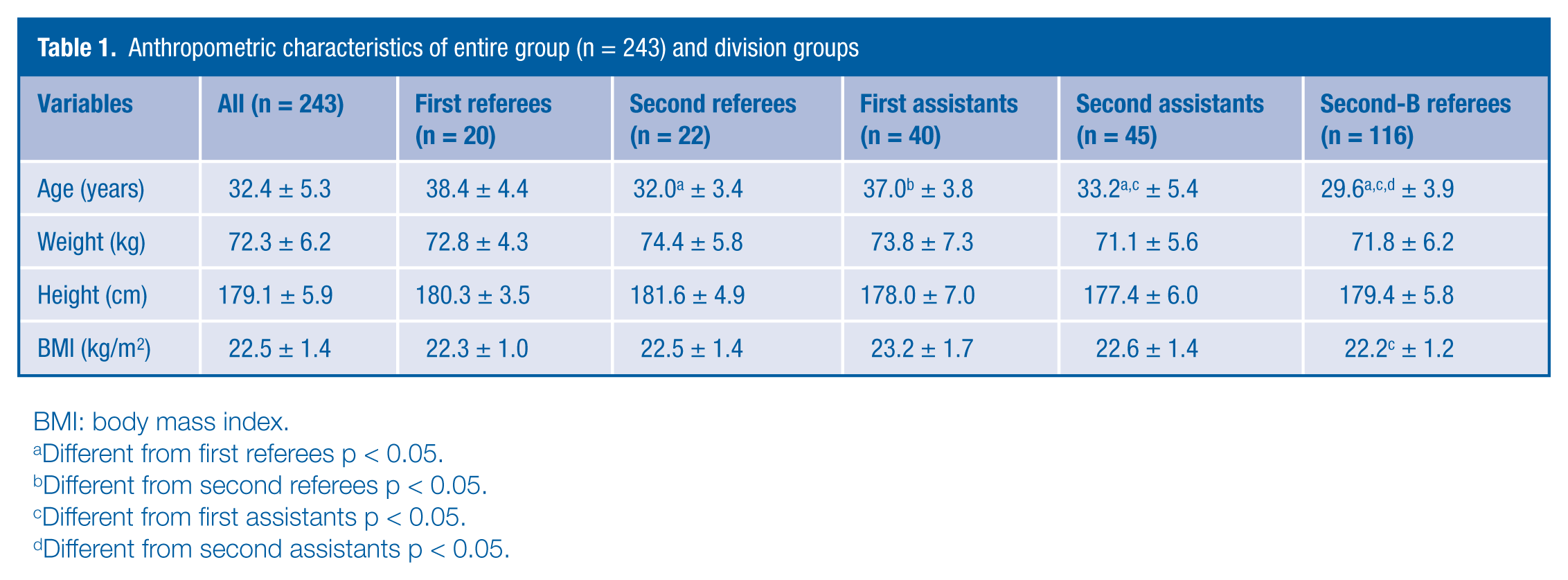
BMI: body mass index.
Different from first referees p < 0.05.
Different from second referees p < 0.05.
Different from first assistants p < 0.05.
Different from second assistants p < 0.05.
Anthropometric characteristics of entire group (n = 243) and age-related categories
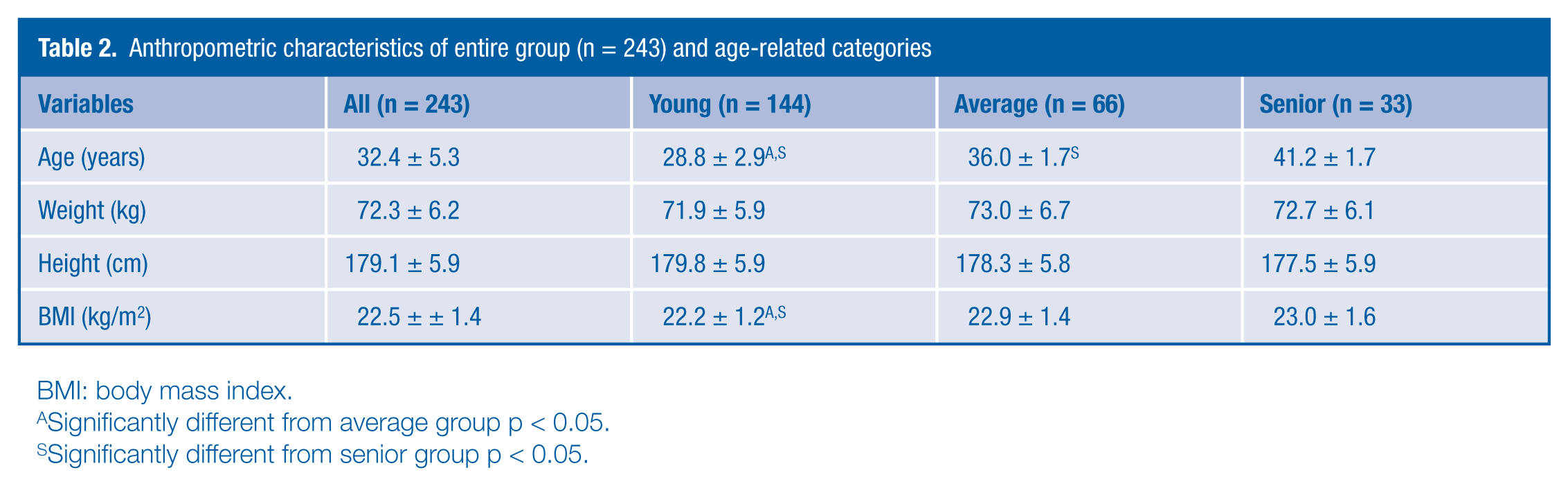
BMI: body mass index.
Significantly different from average group p < 0.05.
Significantly different from senior group p < 0.05.
The variables obtained from BIA are presented in Tables 3 and 4 and in Figures 1 and 2 . Regarding role and division, first- and second-B referees had lower total %BF than assistant referees from first and second divisions ( Figure 1 , p < 0.05). The same differences were found in the percentage of trunk fat ( Table 3 , p < 0.05). For the legs, first assistants had a higher percentage of fat than all groups of referees, but in second assistants, this was only lower than second-B referees (all p < 0.05). Focusing on fat mass (kg), the same previously described differences were found (all p < 0.05) except for the second assistant group which was not different from the first referee group for %BF and the percentage of trunk fat (p > 0.05).
Percentage body fat and other variables obtained from BIA according to division group
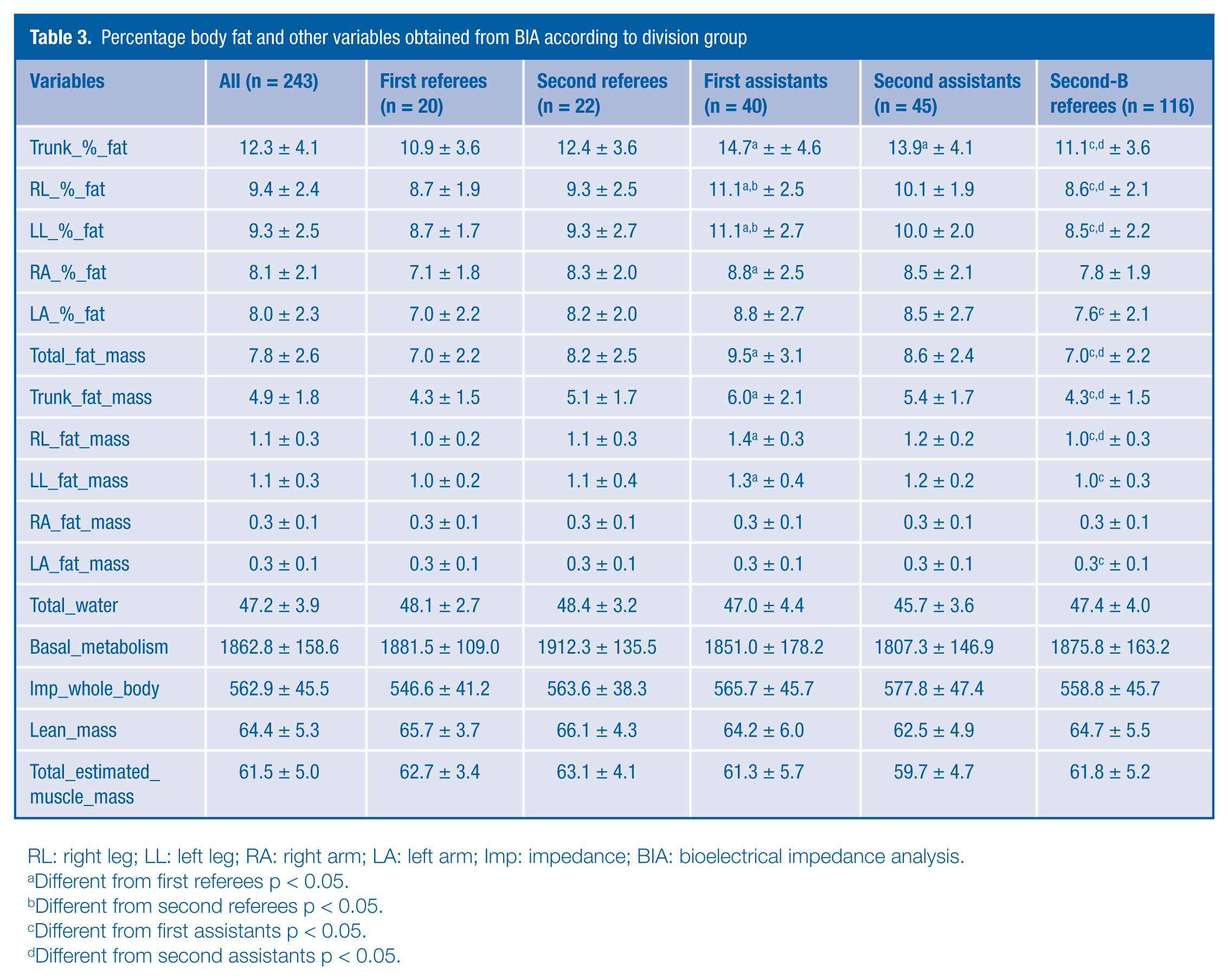
RL: right leg; LL: left leg; RA: right arm; LA: left arm; Imp: impedance; BIA: bioelectrical impedance analysis.
Different from first referees p < 0.05.
Different from second referees p < 0.05.
Different from first assistants p < 0.05.
Different from second assistants p < 0.05.
Percentage body fat and other variables obtained from BIA according to age group
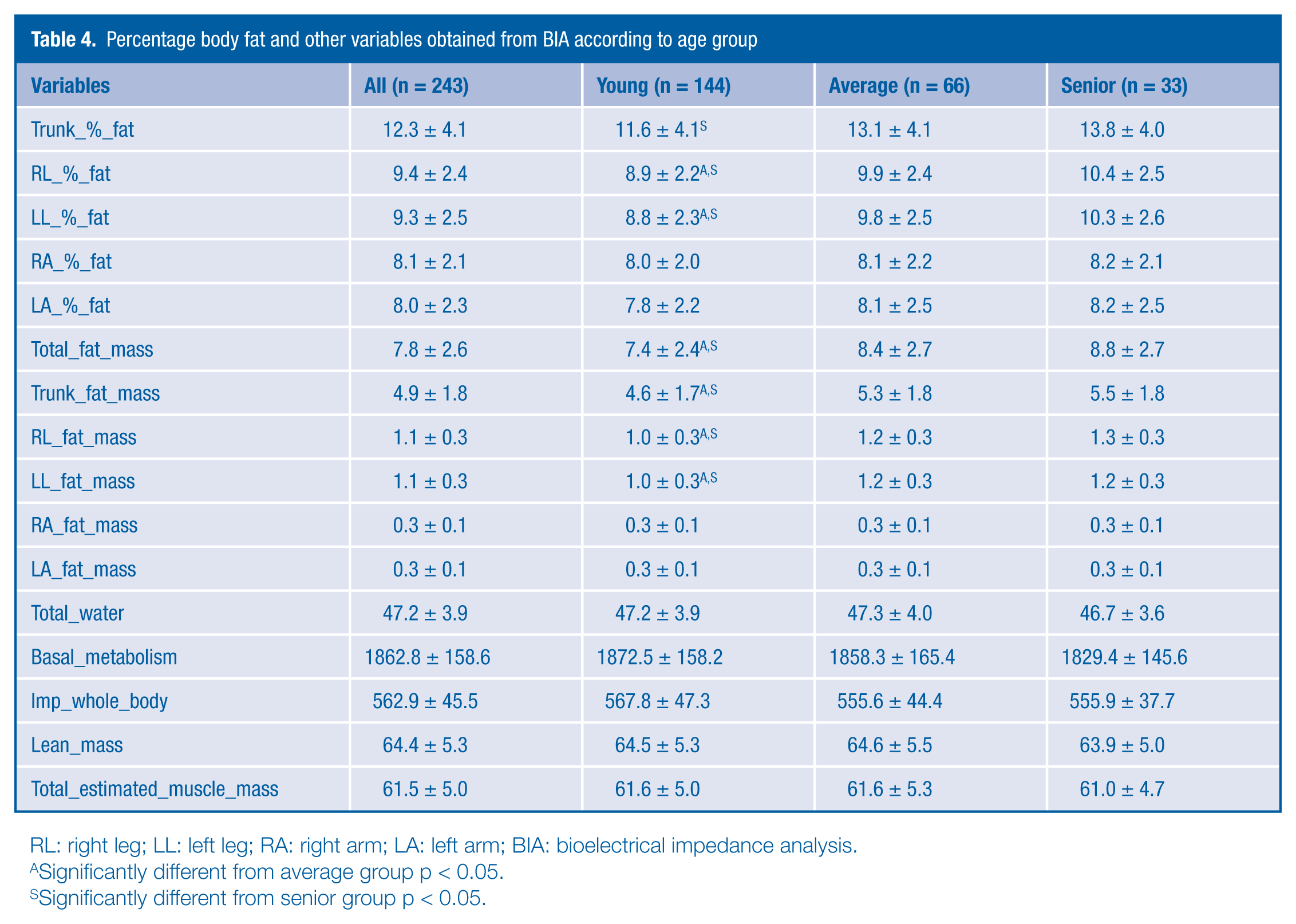
RL: right leg; LL: left leg; RA: right arm; LA: left arm; BIA: bioelectrical impedance analysis.
Significantly different from average group p < 0.05.
Significantly different from senior group p < 0.05.
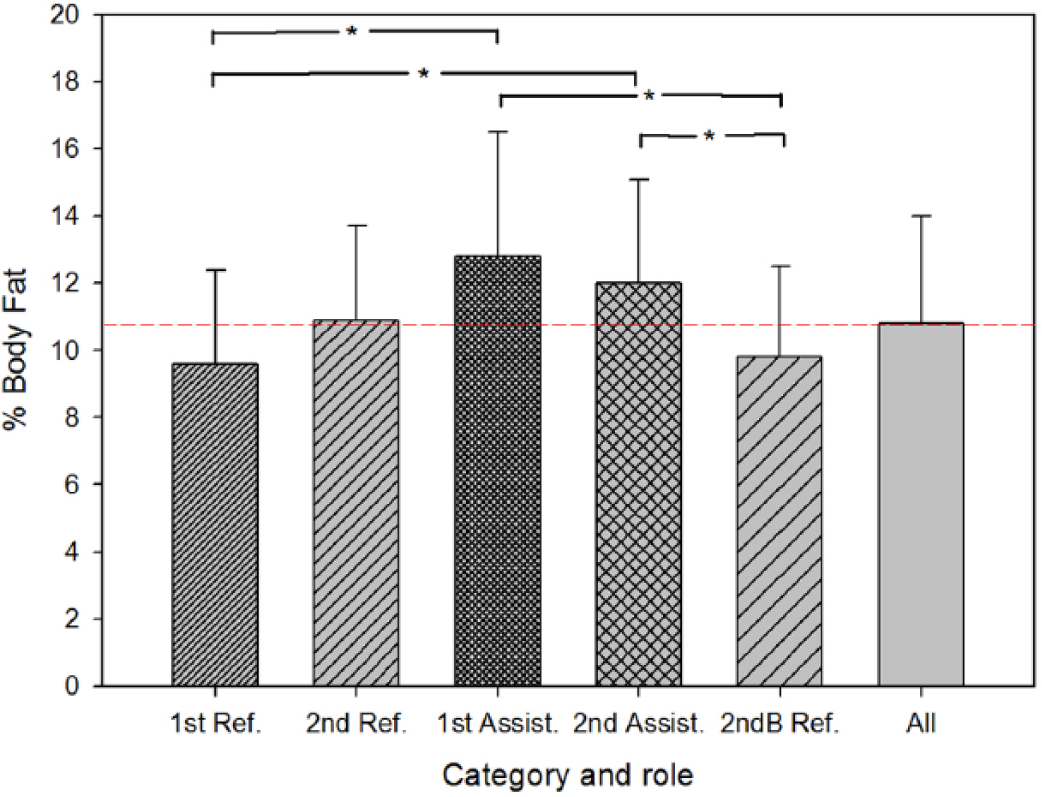
Total body fat by division
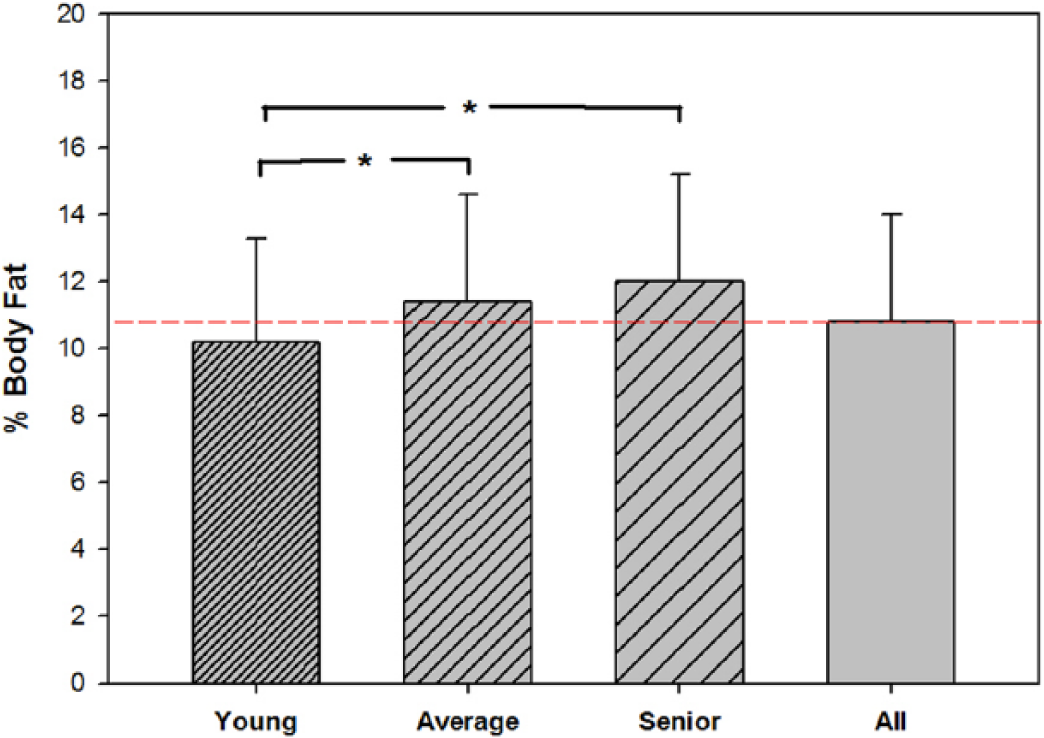
Total body fat by age group
Regarding age groups, the Y group had lower %BF than the A and S groups ( Figure 2 , p < 0.05) and lower percentage of fat in both legs than the other groups ( Table 4 , p < 0.05), but no differences were found between the A and S groups on any variable. The Y group also had a lower percentage of trunk fat than the S group (p < 0.05), but no differences were found between the Y and A groups, although the A group had higher values than the Y group (13.1% vs 11.6%).
IV. Discussion
The main finding of this study is that first-division soccer referees have the lowest and first-division soccer assistant referees the highest %BF among the roles and divisions studied (9.6% and 12.8%, respectively); nevertheless, all groups reported healthy %BF values, below 20%. Also, as expected, the youngest referees presented lower %BF than any others.
The only previous study of elite soccer referees by Casajus and Castagna 15 reported an average %BF of 11.3, estimated using skinfold anthropometry and according to Carter’s equation. 16 This average is in accordance with the one presented in this study (11.3% vs 10.8%). Overall, the referees in all divisions (first, second and second-B) had lower values of %BF than assistant referees in both divisions (first and second), with some results not achieving statistical significance. The distance that individuals in each role has to cover during a match might partially explain these differences; it has been identified that referees cover a mean distance of 11.6 km during a soccer match, while assistant referees cover 6.5 km on average. 17 Therefore, assistant referees may not need such high fitness levels as referees.
Despite these differences, all of the subjects had adequate and healthy levels of %BF, ranging from 9.6% to 12.8%. Pichard et al. 18 reported reference values for fat-free and fat masses by BIA in 3393 healthy subjects. Taking into account these reference values, our 32-year-old sample with an average %BF of 10.8 would fall within the 10th percentile in healthy persons. Following the recommended %BF levels for physically active adults proposed by Lohman et al., 19 our sample would belong to the mid-group where males aged 35–55 years had 11%BF. Compared with soccer players, Sutton et al. 20 reported a %BF of 9.2 in non-Caucasian players and 10.7 in Caucasian players (all English Premier League). This latter study assessed the players using DXA, while our sample was assessed with BIA. The validity of BIA has been investigated in adults 21 and White obese women, 22 showing that BIA tends to underestimate fat mass and %BF when compared with DXA in these populations. However, the validity of BIA has not yet been studied in soccer referees. Although a valid method, other methods such as DXA or ADP might overcome the disadvantage of BIA (i.e. underestimation) and therefore evaluate body composition more accurately.
Casajus and Castagna 15 did not find any difference in %BF between soccer referees in different age groups; our findings contradict this as the youngest referees in our sample had lower %BF than the A and S groups (10.2% vs 11.4% and 12%). Nevertheless, no differences between A and S groups were found in this study. It is important to notice that our sample size is much larger than theirs (144, 66, 33 vs 15, 17 and 15 per age group), which could influence the statistical and biological significance of the results.
The effects of ageing on body composition and fat distribution have been described elsewhere. 23 It has been shown that body composition changes with ageing, producing an increase in fat mass and a decrease in muscle mass.24,25 Even without body weight changes, fat increases with age. 26 Borkan et al. 27 reported higher amounts of visceral abdominal fat in older men, although they weighed 8.2 kg less, compared to middle-age men, showing that age affects body fat distribution. In addition to this, ageing also increases the amount of fat around and inside muscles. 28 In our study, the Y group had lower percentage of trunk fat than the S group. However, no differences were found between Y and A groups. As the trunk is the body part with more muscle mass, both changes outlined above might explain the differences found between Y and S groups.
Experience is considered as a fundamental prerequisite to officiate at the elite level, and the elite-level soccer referees usually reach their ‘golden age’ career level over 40 years of age. 29 As previously indicated, age influences body composition; therefore, changes in body composition need to be taken into account by the international refereeing governing bodies when performing physical fitness tests. Whether the ‘golden age’ for refereeing regarding experience is 40 years, strategies should be implemented to ensure referees achieve the ‘golden age’ in terms of body composition at the same or a similar age. The Fédération International de Football Association (FIFA) fitness test2 requires little specialised equipment and implementation and can be performed worldwide, with protocols that enable a large number of referees and assistant referees to be tested simultaneously. As previously explained, BIA requires little time for completion and no substantial investment, so it might be a useful inclusion within the FIFA fitness test for measuring body composition of international soccer referees during the season. This issue is especially relevant this year due to the Football World Cup being hosted in a warm environment. The main concern during the competition might be the humidity of over 80%. However, it has been shown that there is no effect of body fatness on body core temperature or heat-loss responses during moderate-intensity exercise in heat conditions, 30 but this issue might be taken into consideration when exercising at high humidity. In addition to this, physically active young, middle-aged and older males demonstrate similar hydration, thermal and cardiovascular responses during moderate- to high-intensity intermittent exercise in the heat. 31 Both studies were performed with similar conditions, a temperature of 30 °C and 35 °C and with a relative humidity from 20% to 60%. It would be interesting to study body fat during the entire World Cup because in such conditions of humidity, this has not yet been studied.
In conclusion, the results of this study showed that despite the overall healthy %BF levels in all referees and assistants, referees presented lower values than assistants. Also, younger referees presented a lower %BF than older ones. This fact might be taken into account among the international refereeing governing bodies, as older referees are the most experienced and therefore the most suitable for refereeing at the highest level. For all the above mentioned, BIA or other suitable methods might be included as a routine test for evaluating body composition in the FIFA fitness test for referees.
Footnotes
Funding
This research received no specific grant from any funding agency in the public, commercial or not-for-profit sectors.