




Abstract
An approach for estimating uncertainty in a flow total is presented; this is discussed in the context of flow measurement as typically employed in the process industries, but the technique could be used with any integrated measurement.
I. Introduction
The question of potential error or uncertainty in a measurement is very well catered for with approaches such as those outlined in BS ISO 5168:2005 1 and related standards and texts. The focus, however, is on the uncertainty associated with a given value of a measurand: for example, a particular temperature, a particular pressure or a particular flow rate (measurand: quantity subject to measurement). Often, however, in those duties where uncertainty is an especial concern, it is not the uncertainty in a particular measurement point that is the issue, but rather the uncertainty in the integrated measure. This is evident where the measurement is on a fiscal duty or associated with custody transfer. Here, the issue is not the measure of instantaneous flow rate, but the measure of flow total over a nominated period. An approach for estimating uncertainty in a flow total is presented here; this is discussed in the context of flow measurement as typically employed in the process industries, but the technique could be used with any integrated measurement. Details of the calculation formulae are given in Appendix 2. The body of the paper is focussed on a description of the approach and the considerations arising.
II. Error Types in Relation to Totalised Flow
Much of the discussion in texts devoted to measurement uncertainty is focussed on the treatment of random errors; these can be perceived as fluctuations in a measurement of a measurand which is understood to be of a constant value. (Although they will of course arise at all times in a measurement system, the stipulation of a constant measurand just helps in describing the concept.) There are entirely rigorous mathematical approaches for establishing the magnitude of these random errors. It is these fluctuations that essentially determine the repeatability specification for a measurement device.
In terms of measurement of a flow total, however, it can be seen that any error associated with truly random fluctuations will become less significant with time; the random errors will tend to cancel one another out. For practical purposes, therefore, it is suggested here that in the measurement of flow totals, random errors may be disregarded. There is an immediate simplification in the determination of overall measurement uncertainty. There is therefore merely (!) the question of systematic error to be dealt with.
In fact, it is the systematic errors that typically predominate in measurement systems, and somewhat perversely they are less tractable than the random errors since they cannot be forced into submission with the same mathematical rigour; there is generally a greater reliance on judgement and experience in their evaluation.
The uncertainty associated with the systematic errors in a measurement of a given flow rate may be determined in accordance with the established standards. The question then becomes one of how this may be reflected into an uncertainty statement for a flow total.
It is proposed here that a specification of uncertainty, expressed as a function of flow rate, may be weighted in accordance with a postulated probability distribution for flow rate, to determine the overall uncertainty associated with a flow total.
III. Process Instrument Specifications
Process instrument accuracy specifications typically fall into two categories: percentage of rate and percentage of span/full scale/range. With the former, the distribution of flow rate has no impact; uncertainty remains the same. But with the latter, uncertainty expands with reducing measurement.
If different elements within the measurement system (potentially having different specification types) are assumed to be independent in terms of their error contributions for a given measurand, they may be combined in quadrature sum (root sum of squares). If vendor specifications are used, the guidance given in ISO 5168 suggests that such specifications may, in the absence of more definitive data, be assumed to represent uncertainty with a rectangular distribution at 95% confidence. Accordingly, the standard uncertainty (i.e. that corresponding with 63% confidence level) may be established by dividing the vendor figure by √3 and then combined in quadrature sum with the standard uncertainty of other system components before expanding the combined figure by a coverage factor of 2 to give 95% confidence in the overall uncertainty.
In order to determine the uncertainty in flow total, we may then weight the point uncertainty specifications on the basis of flow rate distribution. Basically, we multiply the point measurement uncertainty, expressed as a function of normalised flow rate (scaled from 0 to 1.0), by the probability distribution of the flow. We can then integrate the result across the flow range to establish an uncertainty in the flow total.
IV. Flow Probability Distribution
A practical approach to modelling of the probability distribution of flow rate is to use a triangular distribution, with values nominated for minimum, maximum and normal operational flow rates. This allows an asymmetrical distribution and a straightforward specification (and also has the virtue of being more tractable in terms of developing an analytical solution for uncertainty in flow total). Notice the stipulation of operational flow; although zero is clearly the minimum ‘flow’ to be experienced by a system, in order to avoid distorting the analysis, it is necessary to use the minimum operational flow, that is, when a plant/process is in service rather than shutdown.
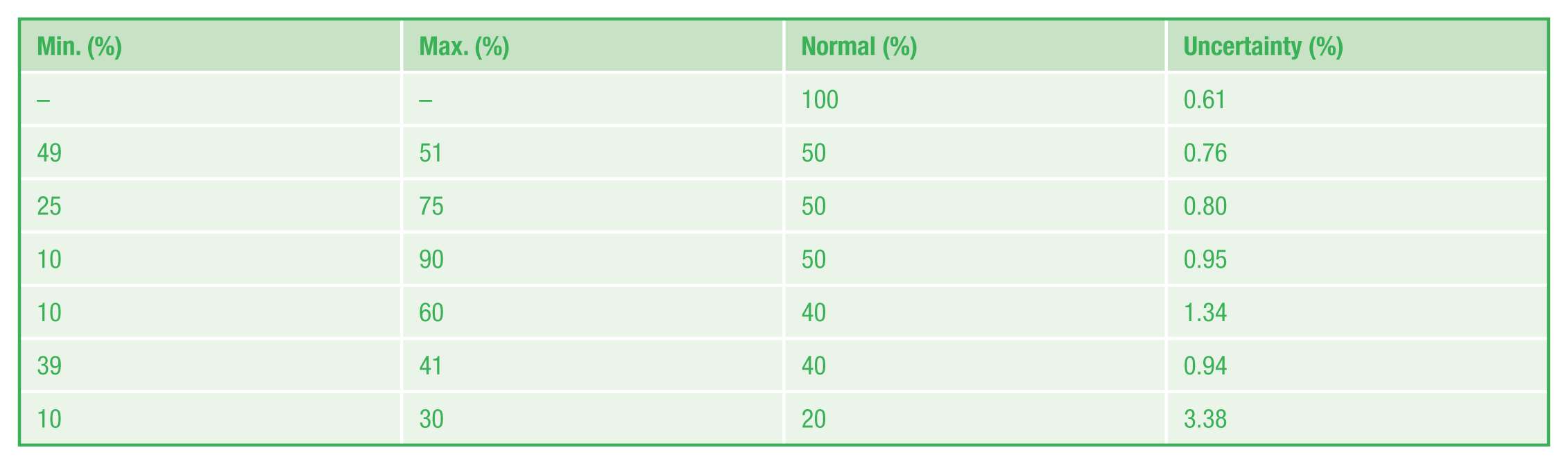
As an illustration of the influence of these considerations, if we take an orifice installation with an overall percent rate specification of say 0.6% and an overall percent span specification of say 0.2%, the corresponding uncertainty in flow total for different flow distributions would be
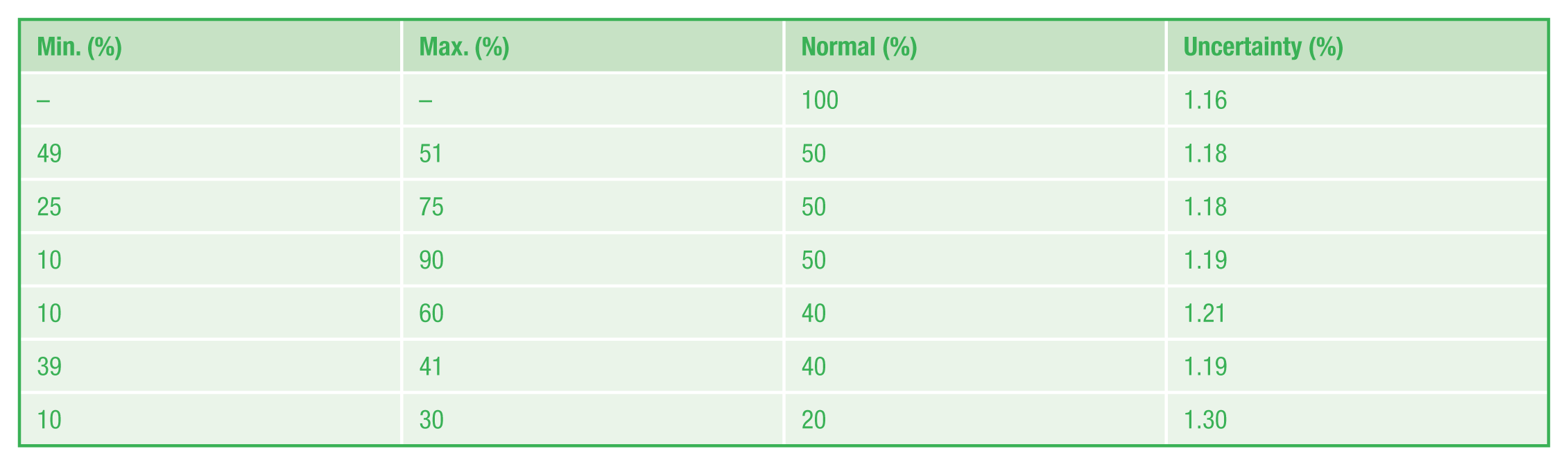
If we take a vortex meter say with overall rate specification of 1% and an overall percent span specification of 0.1%
V. Conclusion
The approach identified here allows uncertainty in integrated measures (in particular flow totals) to be estimated in a consistent manner with a degree of mathematical rigour. This same approach may be adopted for variations in other compensating measurement variables such as pressure, temperature or density, but in typical cases, the additional complication is unlikely to be warranted where there is limited variation in these variables (the important thing would be to determine the uncertainty associated with the variable at the normal operating pressure, temperature or density). Given the irreproachable rigour of standards such as ISO 5168, it is easy to forget that despite the rigour, the resulting value for uncertainty remains an estimate. Questions may be raised about the validity of the triangular distribution, but it is an admirably pragmatic basis that allows a relatively straightforward estimation of uncertainty in integrated measures. The approach outlined here has been used to estimate the uncertainty in total refinery CO2 emissions.
Footnotes
Appendix 1
Appendix 2
Funding
This research received no specific grant from any funding agency in the public, commercial or not-for-profit sectors.