



Abstract

Boost for Global Metrology Probes and Scanners Sectors
A new study indicates that single-source metrology suppliers are gaining favour with end users. The escalating need for dimensional measurement in automotive, aerospace and defence machine shops, and other industries has resulted in the introduction of vastly improved technology and product lines in the global metrology probes and scanners market.
Although the United Kingdom is seemingly now seeing an economic upturn, the earlier recession, nevertheless, compelled a reduction in manpower at the customer end, so manufacturers are now being relied upon to become complete solution providers to commission and integrate complete measuring systems.
The latest study from Frost & Sullivan (http://www.testandmeasurement.frost.com), called ‘Analysis of the Global Metrology Probes and Scanners Market’, finds that the market earned revenues of £174 million in 2012 and estimates this to reach £239 million in 2017. With the traditionally strong North American and European markets experiencing economic uncertainty, most participants are tapping the growth potential in Asia-Pacific.
Frost & Sullivan’s Measurement and Instrumentation Research Analyst Prathima Bommakanti said, Customers across end-user industries need several types of touch trigger probes, scanners and multisensor probes, and are looking for single-source suppliers that can provide these services – on their own or through partnerships. This gives manufacturers a chance to offer integrated measuring machines along with the probing systems and garner a larger share of the user budget.
Even so, probes and scanners consumption is connected with the sales of metrology equipment, and most end-user companies have postponed or stalled the purchase of capital goods.
Another issue restraining the market’s growth is the maturity of the probe technology; development has remained relatively stagnant for all but the premium end of the market.
Upward Trend in Registered Engineers for First Time in 12 Years
The Engineering Council (www.engc.org.uk) says that for the first time since 2001, the total number of individuals on the national register of Engineering Technicians (EngTech), Incorporated Engineers (IEng), Chartered Engineers (CEng) and Information and Communications Technology (ICT) Technicians (ICTTech) has increased.
The just published Annual Registration Statistics 2013 report shows that the downward trend in the total number of professionally registered engineers and technicians has reversed and begun to climb in an upward facing direction.
Jon Prichard CEng FICE FInstRE, CEO of the Engineering Council, commented, This is a welcome outcome for UK engineering. Maintaining high professional standards is key to the delivery of value to the economy. With almost 40% of professionally registered engineers and technicians currently listed on the register now over 60 years of age, and another 13% falling into the 55-59 year age bracket, it is vital that we ensure a strong pipeline of highly skilled men and women to replace these registrants as they reach retirement.
Calling it a ‘breakthrough’, The Engineering Council says that this result comes as a result of the year–on-year increase in the number of new registrants experienced over the past 6 years, coupled with the number of those no longer holding professionally registered status having decreased over the past 2 years. Comparing the 2013 figures to those of 2007, the number of individuals achieving professional registration has risen by 93%.
Driving a Major Shift in Mainstream Oscilloscope Market
Leading oscilloscope manufacturer Tektronix (www.tektronix.com) is making its MDO4000B series of mixed domain oscilloscopes (MDOs) available at the same price as MSO4000B mixed signal oscilloscopes (MSOs).
Unlike any other oscilloscopes, the company says, its MDO instruments include an integral spectrum analyser together with four analogue channels and 16 digital signal inputs. Moreover, the MDO4000B series allows the capture of synchronised analogue, digital and radio-frequency (RF) signals for a complete, time-correlated system view. This can save days – or even weeks – of debug time.
With RF devices now mainstream, designers expect superior RF test support from their test equipment. Even for designs without wireless technologies, engineers are facing electromagnetic interference (EMI), noise, modulation and other types of frequency-related signals. Now, for the same price as an MSO without spectrum analyser capability, a single instrument can be bought that meets the vast majority of test and measurement requirements, including RF test and debug.
Dave Farrell, General Manager, Mainstream Oscilloscopes at Tektronix commented, Just as MSOs have replaced analogue-only oscilloscopes, it follows that MDOs are the next logical evolution and are becoming the accepted mainstream industry standard.
Under the new pricing structure, the company is offering MDO4000B-3 models with a built-in 3 GHz spectrum analyser at the same prices as current MSO4000B oscilloscopes with equivalent analogue bandwidth across the entire line-up. Given identical pricing, there is no reason for designers to purchase MSO models, even if they don’t have an immediate need for RF capability. The prices for the MDO4000B-3 and MDO4000B-6 oscilloscopes start at £6380.
Powering Ethernet Powerlink Connectivity for Industrial Automation
The new CompactCom 40-series products from Anybus (www.hms.se) allow Ethernet Powerlink connectivity for industrial devices. Powerlink is an industrial Ethernet network originating from the Austrian automation company B+R. It is now receiving recognition from many manufacturers of automation products and systems around the world.
Powerlink is one of the first networks to be offered in the new Anybus CompactCom 40-series released this month. These devices allow very fast and accurate communication between the host device and Powerlink. Communication speed and reliability are important since Powerlink networks are often used for demanding industrial applications, such as synchronised servo drive systems. The response time is 1 µs (time from PollRequest to PollResponse), and the synchronisation jitter is 1 µs maximum.
These are available in three different formats – chip, brick and module – and are all equipped with the same software interface from the host device. This enables full flexibility for customers when preparing their automation product for CompactCom.
Leif Malmberg, Product Line Manager, embedded at HMS, commented, We see Powerlink as an important network in the future, especially among device manufacturers and machine builders that need high-performance network technology that combines reliability and fast data transfer.
Special Cabinets Protect Process Instrumentation on World’s Largest Vessel
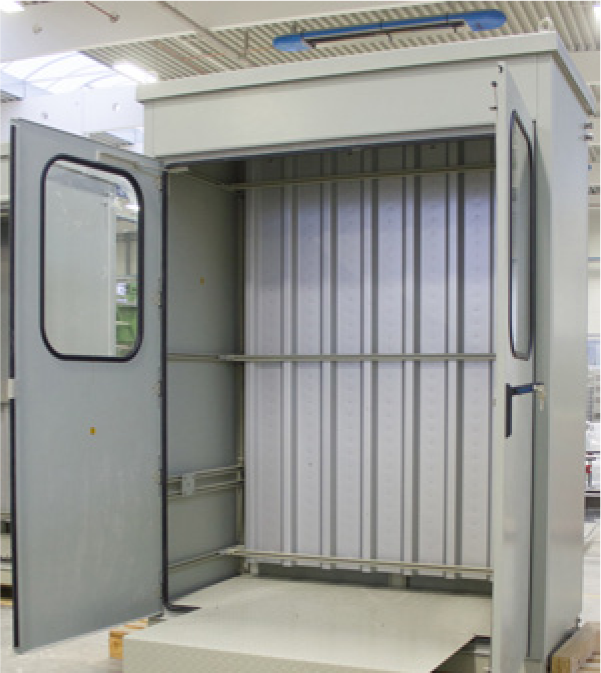
Intertec (www.intertec.info) is supplying high-performance environmental protection cabinets for Shell’s ‘Prelude’ floating liquefied natural gas (LNG) project. Designed for extended service life in hazardous areas, these cabinets incorporate innovative semi-passive cooling technology and are some of the most stringently specified instrumentation protection solutions that the company has ever produced.
The Prelude project is setting new records. Designed to liquefy natural gas extracted from sub-sea wells by chilling it to −162 °C, and then storing it until offloaded to large LNG carriers, the vessel will be the world’s largest, with a length of 488 m and a beam of 74 m. When completed, the vessel will be towed to the Prelude and Concerto gas fields in the Browse Basin near Timor, about 200 km off the northwest coast of Australia, where it will be permanently anchored for about 25 years.
Intertec is supplying the purpose-built environmental protection cabinets to house and protect much of the online process analysis instrumentation on board. In total, the company is supplying 90 cabinets for sample conditioning systems and 30 cabinets for process analysers, each designed to match the instrumentation content and layout precisely in order to optimise thermal performance.
Intertec’s Commercial Director, Hans Geiger, said, Only three of the 120 cabinets are the same size. Our specialised design and automated manufacturing capabilities enable us to produce custom environmental protection products very easily, to optimise performance and match the space available on demanding applications like this.
The cabinets must withstand Category 5 tropical cyclones with wind speeds over 157 mile/h, and to have a minimum service life of 25 years – with 50 years as a design aim. Other requirements include high resistance to corrosion, and the ability to cool electronics equipment without using explosion-proof air conditioning systems, which incur high capital and operating costs.
These cabinets are made from a proprietary composite material comprising sandwich walls of long-fibre glass-reinforced plastic (GRP) sheets, enclosing a core of polyurethane foam. The material is of a similar strength to stainless steel but is about four times lighter, making it ideal for use on offshore platforms and floating structures.
Each of the 120 cabinets incorporates a form of semi-passive cooling, which the company claims is unique. The internal rear walls are fitted with a high-efficiency heat exchanger, comprising one or more aluminium cooling plates and stainless steel coolant pipes connected to Prelude’s cold water supply system. This fetches ‘cold’ seawater via a 150-m pipe below the vessel. Heat dissipated by the cabinet equipment is absorbed by the water and transferred to the vessel’s main water-cooling system, where it is dissipated to the environment.
This has significant advantages, especially in hazardous areas or where space and weight is at a premium, as it provides a very efficient means of removing heat without local air conditioning systems, which would need to be explosion proof – and, therefore, expensive.
Moreover, transferring heat from individual air conditioners of below-deck cabinet installations to the ambient environment would be a major challenge and involve much space-consuming air ducting. The semi-passive cooling system is inherently safe in a hazardous environment; at the cabinet level, it requires little or no electrical power of its own and is virtually maintenance free, making it ideal for long life-cycle applications.
Intertec’s custom instrumentation protection cabinets will withstand Category 5 cyclones. Semi-passive cooling technology is fitted into each instrumentation protection cabinet
Tracking Lifting Gear Using RFID Techniques
German lifting equipment company RUD (www.rud.com) is using radio-frequency identification (RFID) transponders, fitted to all of its products, to access data for customers who want to automatically track inspection, maintenance and other records.
Because the integrity and reliability of lifting equipment is so crucial for safety on a construction site, manufacturing facility or other industrial plant in which often very heavy items are being lifted, each item must be inspected regularly and records of inspections and usage must be stored about each. This is the reason why RUD is introducing the RFID tags into all its products. Neosid (www.neosid.de) supplies the tags, while RUD is using its own software for accessing the data. The result is a system that enables RUD’s customers to easily track the history of the links, rings and chains used for lifting heavy objects, accessing these data on a hosted server. The software also allows customers to use the RFID tag ID numbers to access and store data related to each RUD device it inspects and maintains.
Demonstrating Sensor-Controlled Processes from the Cloud
Harting Technology Group (www.harting.com) and software company SAP collaborated at last month’s Hannover Fair. Visitors to the two companies’ stands could view two ‘Smart Services’ exhibits that were connected to each other via sensors and the Cloud.
A pump illustrated ‘the tangible Cloud’ with extensive vertical integration within the enterprise – in effect, all the way from a machine’s measurement data to back-end systems and onwards to the management of business processes.
What was new in this display, said Harting, was that specific maintenance processes could be initiated directly from data monitoring. Sensor readings were transmitted to the Cloud, from where concrete business processes were then performed. The M2M platform relayed the system’s sensor data into the SAP HANA database. The data were subjected to threshold analysis, meaning that the necessary maintenance tasks were automatically created in SAP ERP when critical values are reached.
Planning and optimisation of these maintenance tasks then took place in SAP MRS, with the tasks subsequently sent to the maintenance technician via the SAP Syclo mobile platform. The technician could then carry out the relevant tasks and, if necessary, call up and display disassembly and assembly instructions via SAP Visual Enterprise.
Harting and SAP collaborated at the Hannover Fair. This is one result that visitors saw – a ‘smart’ factory

Help in Securing Critical Industrial Automation Systems
Signal transmission expert company, Belden (www.belden.com), has announced that Schneider Electric (www.schneider-electric.co.uk) has selected its Tofino Security Technology to protect its industrial automation systems. It has expanded its ConneXium network and security offer with the addition of Ethernet/IP Deep Packet Inspection (DPI) to the ConneXium Tofino Firewall. This follows conducting a detailed security analysis of all of Schneider Electric’s major automation products and partnering with Belden to create the ConneXium Tofino Firewall 2012.
DPI’s use with the EtherNet/IP protocol allows Schneider Electric’s customers to further harden their industrial control systems against network incidents and cyber attacks. It also, says Belden, allows easier enforcement of company policies for network and device access. The result is better operational security, reliability and performance.
The firewall inspects and secures network traffic to and from Schneider Electric automation devices, providing protection from traffic storms, malformed messages and deliberate hacking attempts. Furthermore, the technology can be used to enforce plant procedure. For example, it can be used to block inappropriate modification or programming of critical devices and controllers, preventing costly mistakes and improving overall network uptime and reliability.
Advanced protection is provided through DPI technology. Traditional information technology (IT) firewalls examine transmission control protocol/Internet protocol (TCP/IP) headers in network messages and then make decisions whether to allow or block a message based on this limited information. DPI technology allows the firewall to dig deep into the supervisory control and data acquisition (SCADA) and Internet Connection Sharing (ICS) protocols that sit on top of TCP/IP. The firewall then determines exactly what the protocol is being used for and makes better decisions on what should be allowed or blocked.
Ken Mikelinich, Product Manager for Industrial Security Devices at Schneider Electric said, Cyber attacks on manufacturing and process control facilities are increasing. They are also becoming more sophisticated. Enhanced security, along with the tangible business benefits of enforcing corporate security and compliance policies are a must.
He emphasised, The extension of the ConneXium Tofino Firewall to include superior protection of EtherNet/IP communications is another important way we are helping customers mitigate risk and support plant policy using security devices.
Endress+Hauser Boost Share in Analytik Jena to over 50%
Endress+Hauser (Deutschland) AG+Co. KG has strengthened its position by acquiring additional shares in German-based Analytik Endress+JenaAG. The group now owns 50.37% of the shares, which exceeds the reportable threshold of 50% of the voting rights.
Another 0.41% are indirectly attributed to Endress+Hauser. According to an option contract with company founder Klaus Berka and German investment company bm-t, Endress+Hauser has the right to acquire a further 27.56% of shares in Analytik Jena after 1 October 2014. Dr Heiner Zehntner, Endress+Hauser’s Corporate Legal Counsel, stated, We plan to acquire more shares in future. Our aim is to take over Analytik Jena completely.
Under the Endress+Hauser Group banner, Analytik Jena will remain an independent business unit, active in analytical instrumentation and the life science industry, with its own manufacturing and sales structure.
Go to www.endress.com for more information.
North Sea Project to Use Anti-Corrosion Instrumentation
An offshore oil and gas project that will site new offshore platforms in challenging conditions in the North Sea has chosen high-reliability valves and tube connection fittings from the Instrumentation Products Division of Parker Hannifin (www.parker.com).
This new oil and gas field is located some 250 km west of Stavanger, Norway and Parker expects that it could result in more than £10 million of orders over the next year for its Barnstaple facility – which employs over 200 directly and many more at local subcontractors.
The company estimates that it will supply at least 10,000 individual valves, tube fittings and other components for this project, as well as around 10 km of tubing. These will be used to build liquid and gas instrumentation systems that will measure parameters such as temperature, pressure and flow to help control gas and oil and processing operations.
As well as use of high-grade stainless steels, the project will make extensive use of titanium and the 6Mo steel alloy in key parts of the fluid tubing systems. Such specialist materials are essential in fighting corrosion, which is a major problem in the North Sea.
In fact, it was Parker’s knowledge concerning machining valves and fittings using 6Mo and titanium and its proven supply chain for these specialist raw materials that were important factors in securing this business. Another key aspect was the global nature of the company’s business, as the engineering and construction work for Gina Krog is taking place in various places around the world.
Parker Hannifin’s Andy Guest said, In the oil and gas production sector today there’s an intense focus on extending equipment lifetimes and eliminating the threat to reliability that corrosion brings. A large proportion of our production output is now manufactured from corrosion-resistant alloys instead of more conventional stainless steels.
Cybersecurity Protects Centralised Advanced Traffic Management Systems
Many traffic signalling systems are still managed using master controllers connecting to local traffic controllers via a mix of closed-loop twisted-pair circuits, serial radios and dial-up services for traffic signal control and coordination.
Such legacy systems need frequent on-site maintenance, lack many central monitoring and control capabilities and are inadequate for system expansions such as for adding IP cameras.
In a US application, transportation officials of Henrico County, Virginia, wanted to upgrade existing traffic signalling control systems to a centralised advanced traffic management system (ATMS) with NEMA TS2 compliance. From the central command centre, operators will be able to access traffic signals at remote traffic control locations for real-time monitoring and emergency response. This advanced traffic control network will be deployed across a public network and will not only require a highly reliable connection but also cybersecurity protection to deny unauthorised access.
Henrico County’s existing traffic control system comprises 140 signalised intersections, but only 25 of these are interconnected, while the remaining 115 are isolated signal control circuits. The new signalling network will have a centralised architecture, where the central command centre can communicate with each local traffic signal controller, who will also be able to adjust and schedule traffic signal timing parameters for different times of the day to expedite traffic flow.
To transmit the data to the traffic operation centre, the system integrator will use the existing Internet service provider (ISP) public network, which requires modems for communication. However, the public network presents possible security threats to the traffic control network, so virtual private network (VPN) and firewall security measures are essential to secure data communications.
The EDR-810 industrial multi-port secure router by Moxa (www.moxa.com), an all-in-one VPN/network address translation (NAT)/firewall/switch device, was installed in the roadside cabinet of each intersection to provide secure data transmission. The EDR-810 offers Turbo Ring and Turbo Chain technologies with less than 20 ms recovery time to ensure network reliability. Furthermore, the EDR-810 supports VPN and firewall capabilities, which will provide secure remote access and critical field device protection.
The overall result will be a modern, flexible, efficient and well-protected traffic management system, which is also applicable in principle to many other parts of the world.
News in Brief
PT100 expansion module for wireless temperature measurement
New from Phoenix Contact (www.phoenixcontact.co.uk) is the PT100 expansion module, which facilitates transmission of up to four PT100 signals within the Radioline wireless system. Radioline is designed for communication with remote participants in large facilities. Its I/O mapping allows signals to be distributed within the system easily and without software. Temperature measurement is an essential measurement parameter in many systems found in the processing industry; water/wastewater sector; metal engineering; solar, wind and biogas power plants; and the RAD-PT100-4-IFS measures temperatures from −50 °C to +250 °C. The sensors can be connected to inputs using two- or three-wire connections. The accuracy is ±0.1% of the measuring range final value.
Free app for electrical testing
A helpful free app for electrical installers, electrical engineers and maintenance professionals in the field has just been launched. Called the Fluke TestGuide, this new app provides support for common measurements, providing step-by-step guides for residual current device (RCD) testing, measuring insulation and more besides. Go to www.fluke.com/fluke/uken/home/default.htm
The heat is on!
UWT (United Kingdom) has introduced a new design feature for the UWT level limit paddle switches Rotonivo RN3001 and Rotonivo RN3002. These have now been further engineered to operate safely, reliably and effectively in applications with ambient temperatures of over 1100 °C. This makes these switches ideal choices for applications having very high ambient processing temperatures. For a full-design specification and certification, email:
Data centres fuel demand for Ethernet test equipment
With data centre activities and cloud-based services rapidly gaining importance in the communications industry, the global Ethernet test equipment market has been witnessing a constant evolution of complex next-generation solutions. As carrier Ethernet use for cloud access increases because of its bandwidth scalability, security and ease of management, demand for Ethernet test equipment will grow worldwide. Adoption of 40/100 gigabit Ethernet testers, in particular, will contribute to market revenues. New analysis from Frost & Sullivan (www.testandmeasurement.frost.com), entitled ‘High Growth Testing Opportunities – Global Ethernet Test Equipment Market’, finds that the market earned revenues of £564 million in 2012 and estimates this to reach £0.84 billion in 2017.
Phoenix Contact Ethernet device are ABB certified
It has been announced that switches and security routers from the current Phoenix Contact product range are now certified by ABB as ‘Industrial IT Enabled’. This means that these network components from the Factory Line family belong to a portfolio suited for solutions in automation and information technology designed by ABB users. Unlimited compatibility with the ABB Industrial 800xA automation architecture was proven through comprehensive tests. For SFN switches, Smart Managed Compact Switch (SMCS) switches, and the MGUARD GT/GT, RS2000 and RS4000 security routers, this is documented with the ‘Industrial IT Enabled’ certificate of ABB. This guarantees the user that the devices can be perfectly combined with other Industrial IT components. For more information, go to www.phoenixcontact.co.uk
Compact encoder gets new side mount option
The Micro Tape Encoder (MTE) range of encoders, available from Inmoco (www.inmoco.co.uk), now has a side mount fitting to complement the existing top mount option. The MTE is part of the MircoE Systems product family and is optimised for linear applications with challenging space and cost constraints where rapid time to market and energy efficiency are critical. Using MicroE’s patented optical detector design, MTE delivers industry-leading sensor size, energy efficiency and alignment tolerances.
On-site training in steam processes
Bürkert Fluid Control Systems is offering more on-site training courses to those involved in the process control industry. To reduce travelling distances for trainees, the company is increasing the number of trainers who can visit customer’s premises. The steam and sensor courses are being run at the company’s new Cirencester HQ, the former in November, with only a few places left on the sensors course. Other courses are available and can be tailored to suit particular requirements. All provide theory-based learning, backed up with practical applications for a ‘hands-on’ approach. Bürkert aims to provide information on the real physics of batching, cleaning and sterilising, water producing and distributing, filling, heating, cooling, separating, fermenting, distilling or evaporating. Contact Helen Christopher at