



Abstract

Aerospace Static and Dynamic Load Testing for Design Validation
Mars Labs, LLC (www.marslabs.com), has introduced the Titan CPU Expander for its modular data acquisition (DAQ) system for use in larger channel count aircraft design validation and durability testing.
When performing static strength testing of wings and airframes, data must be acquired on the structural response to applied loads. This type of testing is commonly used to simulate the loads applied by large transient forces such as wind shear, which can have significant mechanical effects on aircraft performance and mechanical integrity.
The DAQ channel count requirements can range anywhere from a few hundred up to a few thousand. The data compare the empirically derived and simulated mechanical response of the structure under test, and so verify its design integrity. In addition to static strength testing, the structures are also subjected to cyclic loading to replicate vibrations experienced during normal operation.
The resulting high volumes of synchronised data, collected as the structure reacts to applied loads and vibrations, are then analysed to assess wing or airframe strength and durability under such conditions. Because of the large number of DAQ channels involved in testing, a high-channel-count, large distributed DAQ system is required to obtain dynamic frequency measurements, which range from static, or steady state, to frequency bandwidths of up to 50 Hz.
The modular Titan DAQ can be used for durability and fatigue, noise and vibration, shock, compression and acoustics measurements. It has been designed for direct integration with a wide range of sensing types, including integrated electronics piezoelectric (IEPE)-type piezoelectric (integrated circuit piezoelectric (ICP), Piezotron, ISOTRON and others) accelerometers and microphones; full active bridge microelectromechanical system (MEMS)-based piezoresistive accelerometers; and quarter-, half- and full-bridge strain gauge transducers.
Mars Labs’ Titan CPU Expander is designed for use with the company’s modular DAQ system, employed in larger channel count aircraft design validation and durability testing
DAQ: data acquisition
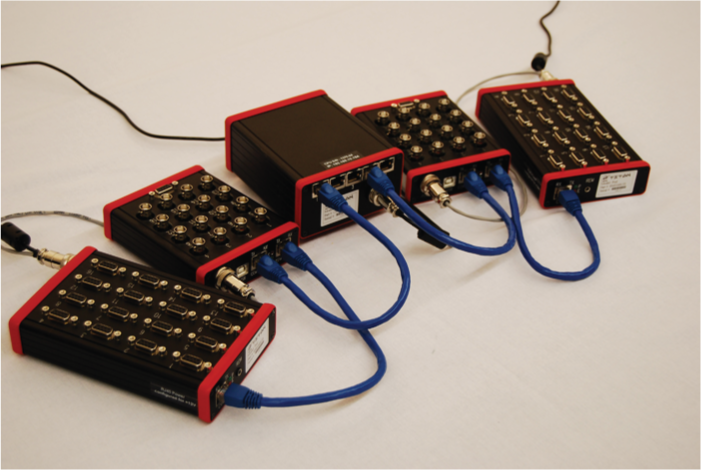
The Titan Mini-Recorder features 16 channels of low-drift, low-noise analogue front end with excellent stability for longer duration dynamic test requirements. There are other special features for aerospace wing and structural loading testing.
Emerson Acquires APM Automation Solutions
Emerson is to acquire APM Automation Solutions, a leading developer of solids volume and level measurement instrumentation, which will become part of the Emerson Process Management business.
APM’s acoustic imaging and three-dimensional (3D) mapping technologies are aimed at taking the guesswork out of measuring the level, volume and mass of bulk solids and powders stored inside a silo or open bin.
Emerson Process Management (www.EmersonProcess.com) will expand its capabilities in solids measurement applications by adding these APM Automation Solutions technologies to its Rosemount brand measurement technologies. APM Automation Solutions technology is used in food and beverage, metals and mining, power, chemical, pulp and paper and other industries.
Traceability Key to Reduced Bearing Costs and High Quality
NSK continues to invest in improved manufacturing techniques, which allows customers to benefit from new technologies and improved reliability. One example is at a very modern production facility in Newark, United Kingdom, where the super precision bearings are made.
A barcode system allows every bearing to carry details about its manufacture. Such component traceability is now an essential requirement in many manufacturing sectors, and technology is helping many industries to improve quality and reliability while also reducing overall costs.
Two-dimensional barcodes allow far more information to be stored; so instead of just a serial number or batch number, now it is possible to include manufacturing dates, axial run-out and radial run-out figures as well as preload information and machining data. All of this can now be laser etched into every single bearing, which enables both NSK and customers alike to have near instant access to this crucial information.
For NSK, this coding forms part of the manufacturing process, and it is used to populate the product database as well as produce the product labels which are fixed to the outer packaging.
By incorporating the data for every bearing produced into the production data system, it also provides a vital quality control tool as well as complete traceability, which is required by many industries such as aerospace and automotive. This information also enables identification of any product that may be affected by a defect, but with such accurate detail, the total number of products affected can be exactly ascertained.
In the past, this could only be narrowed down to a single batch or day of production, which could mean much larger numbers of the product being identified as at risk.
NSK now places a two-dimensional barcode on every bearing to carry details about its manufacture

The system delivers a proactive method of identifying any defects before the product is dispatched to the customer, so that the high product quality expected by customers is maintained and the costs associated with replacement of faulty components are greatly reduced.
Automation Solutions Provide Flexibility for Clean-in-Place/Steam-in-Place Systems
Optimal Industrial Automation, a leading UK integrator of automation systems, has developed a flexible control automation solution for Clean-in-Place (CIP) and Steam-in-Place (SIP) systems. This results in a more reliable process, improved productivity and reduced operating costs.
CIP and SIP systems, designed for automatic cleaning and disinfecting without major disassembly and assembly work, usually require a process shutdown. By using expert design techniques, however, the company can supply systems that isolate and clean individual sections of plant, while the remainder continues in production. This helps maximise plant usage, reduces maintenance costs and – when combined with a liquid recovery system – can also ensure that materials, labour costs and environmental impacts are minimised.
CIP/SIP is crucial for many industries where the processing environment must be hygienic or aseptic. For this reason, any advances in systems technology have a very broad application base and a large potential impact on the efficiency of a variety of process industries.
CIP systems come in many configurations, but common within the pharmaceutical and life sciences industries are multi-tank arrangements, employed as single-use systems. This requires the tanks to be drained between programs to avoid cross-contamination.
Washing sequences are controlled by a panel located on the CIP unit and each Optimal solution can vary from a simple manual valve system with interlocks through to a fully integrated system using a programmable logic controller (PLC) and supervisory control and data acquisition (SCADA) layer, automated valves and a human–machine interface (HMI). The control system is critical to ensuring that the equipment has been properly washed and cleaned. It must also record the relevant data for validation requirements.
A ‘stage 1’ system offers moderate automation using a single HMI screen, which provides manual as well as fully automatic control over a single-use system. Included is a recipe system, plus real-time trending and real-time parameter display, with the additional benefit of a data logging facility for batch reports.
However, flexibility and keeping the user interface simple are also important. Optimal has recently installed a ‘stage 2’ system for a leading pharmaceutical company. This comprised a fully integrated SIP/CIP system for cleaning mobile processing vessels. It uses a Siemens PLC with a SCADA system for control and display functionality. The system controls the complete CIP and SIP cycle for the target vessel and logs all data. It also tracks which vessels have been cleaned, which cleaning cycle had been used and the date of cleaning. The data validate the vessel’s use via a barcode system.
A ‘stage 3’ system, which incorporates all of the above, but adds a recovery system, has recently been built for a leading food manufacturer which required a new CIP system that was economical in its use of chemicals and water. Optimal supplied a complete automated CIP system with water recovery. A Siemens PLC system was again used, with the CIP set parameters being made available on the host control system’s SCADA.
GE Innovation Pinpoints Power Outages Faster
GE’s Digital Energy business has launched an enhanced version of its Multilin Intelligent Line Monitoring System, an end-to-end overhead line monitoring solution with advanced analytics that provides actionable intelligence to distribution utilities, improving the reliability and efficiency of power delivery to its customers.
Using the system, utilities can reduce the duration of outages by accurately identifying fault locations allowing them to quickly dispatch repair crews. Improved dynamic line rating also helps them easily identify additional available line capacity to maximise their existing infrastructure investment.
The system’s ability to reliably identify fault location and deliver analytics was the key factor in ESB Networks implementing this technology. As the licensed operator of the electricity distribution system in the Republic of Ireland, serving all electricity customers in that country, ESB Networks worked with GE to test and install the system. Martin Hand, Operation Policy and Safety Engineer for ESB Networks, said, GE’s system delivers reliable fault location across our 80,000km overhead network, and their work with us in adapting the system to meet the challenges of our various medium-voltage grounding treatments is a major element in our network performance improvement plan
Upgrades to the system include a new feeder visualiser application, which helps utilities gather data from their network to identify loading and phase imbalance issues. The improved fault location allows utilities to quickly and precisely identify trouble spots and send an email or short messaging service (SMS) message to repair crews, getting them dispatched to limit system interruptions.
By using GE’s time-synchronised data delivery, the Multilin system delivers data to utilities faster than ever before, ensuring that timely decisions are made when weather or equipment failures interrupt a network. Expanded communication backhaul options also allow for greater installation flexibility into a utility’s existing network. For more information, visit http://www.gedigitalenergy.com
Pico Technology Joins MathWorks Connections Program
Pico Technology (http://www.picotech.com) has become a member of the MathWorks Connections Program. The PicoScope 3000 Series oscilloscopes now have an instrument driver for the Instrument Control Toolbox. This includes all models, apart from mixed signal and differential oscilloscopes, with drivers for other product ranges to be provided in the future.
The MathWorks Connections Program is available to third-party organisations that develop and distribute complementary, commercially available products and services based on MATLAB and Simulink.
These partner offerings address technical needs across a wide range of applications and industries worldwide with software and hardware products that extend the usage of MATLAB and Simulink. These solutions seamlessly integrate with MathWorks products and ensure ongoing compatibility in conjunction with new MathWorks releases.
Customers are also offered training, consulting and system integration services based on MathWorks tools. MathWorks (http://www.mathworks.com) is the leading developer of mathematical computing software.
New Project to Measure Human Interaction with Robots
Psychologists from the University of Bath are taking part in a major project looking at how cutting-edge robotics can enable people to participate in public spaces, as a place to meet and share ideas without being there in person.
The £2m 3-year project – titled ‘Being there: Humans and robots in public spaces’ and funded by the Engineering and Physical Sciences Research Council (EPSRC; http://www.epsrc.ac.uk), the main UK government agency for funding research and training in engineering and the physical sciences – will examine how robotics can help bridge the gap between the way we communicate in person and online.
The project brings together researchers from the Universities of Bath, Exeter, Oxford, Queen Mary University of London and the Bristol Robotics Laboratory – a collaborative partnership between the University of the West of England and the University of Bristol – to look at the social and technological aspects of being able to appear in public in proxy forms. It aims to achieve this via a range of advanced robotics platforms.
Professor Danaë Stanton Fraser said, ‘We are excited about extending our research in trust and identity to the area of human robot interaction and drawing on our experience of carrying out studies in public spaces’.
The research team will create a ‘living laboratory’, using state-of-the-art technologies to measure how people respond to, and interact with, other people who are acting through a robot representative.
The team will be using an advanced programmable humanoid robot ‘Nao’ that it will take into public spaces around Bath and Bristol to measure human interaction with robots. Nao will be controlled remotely, and its controllers will be able to see and speak through its eyes and mouth, while directing where it looks and walks.
Better Vision Inspection Using Real-Time Ethernet
Automation is finding new levels of connectivity with vision inspection systems based upon POWERLINK communications, which is a deterministic real-time protocol for standard Ethernet managed by the Ethernet POWERLINK Standardisation Group (EPSG – http://www.ethernet-powerlink.org). This can provide simplified system architectures that can allow higher performance applications to be achieved. So says Stephan Stricker, a Product Manager for B&R Industrial Automation Corp. (http://www.br-automation.com).
As one result, no longer is a parallel network required for image processing; instead, users can communicate process and image data using a single medium. They can then implement an integrated solution to unite control, vision, input/output (I/O) and motion in one system. Cognex, a well-known machine vision and industrial design (ID) firm, provides such a vision inspection system.
Conventionally, vision inspection systems typically will not directly integrate into the PLC machine control system, although some do feature inputs allowing triggering via the PLC, as well as outputs for transmitting signals back to the PLC. This will show whether the product(s) being inspected have passed or failed.
However, modern vision systems are more complex, with many inspection steps being necessary as part of the whole to determine pass/fail. For example, it is essential to know exactly where the inspection has failed.
The direct I/O connection between PLC and vision inspection camera is fast, while Ethernet-based connection is slower, which could – in certain circumstances – slow production. However, today’s vision inspection systems only need a personal computer (PC) to commission the camera once, so is a PC actually required at all?
The answer is that many PLC vendors now combine PLC and HMI in a single device, which essentially negates the requirement for a machine visualisation PC. Cognex’s In-Sight 7000 series vision systems support POWERLINK, and the application of real-time (deterministic) Ethernet allows transfer of both basic information (e.g. trigger or pass) as well as a great deal more, which helps optimise and troubleshoot the entire vision process.
This can be achieved with the use of a PC, although in some instances, one may still be required from time to time so that the PLC can download data, or to optimise on the fly using the vision development software.
Using POWERLINK, the vision camera can remain online, running the production inspection operation over the real-time Ethernet network while the PLC becomes a router for the standard Ethernet communication. In this way, optimising jobs and uploading them to the camera can be achieved without interrupting production.
To see the full, illustrated B&R Industrial Automation white paper, please use the printed QR Code with your smartphone.

News in Brief
I12 billion motors to be shipped in consumer products by 2018
Already exceeding the number of people on the planet, electric motors used in consumer products, such as cars and electronic devices, will continue to ship in ‘robust volumes’ during the next 5 years, reaching 12 billion units by 2018. So says the ‘Electric motors in non-industrial applications’ report from IHS. Growing from 9.8 billion units in 2012, shipments of electric motors in non-industrial applications will rise 23% by 2018, according to the study. Cars are a major source of demand, with today’s light vehicles averaging more than 30 motors/vehicle, while electronic gadgets and devices also have a big effect on the global electric motors trade. See more at http://www.ihs.com
New networks router for industrial Ethernet
The new InHand Networks (www.inhandnetworks.com) IR700 line is an industrial router family boasting an extended temperature range, all virtual private network (VPN) features, serial port on board and either one or four Ethernet ports. The same company’s IR600 is low-cost industrial router family having (again) one or four Ethernet ports, as well as a serial port and VPN client function, and there is a Wi-Fi option.
Monitor industrial Ethernet switches for plant optimisation
The Crimson 3.0 software from Red Lion (www.redlion.net) integrates with N-View to monitor many devices using a single HMI dashboard. This allows all N-Tron and Sixnet industrial Ethernet switches to be effectively monitored from any locally mounted G3 operator interface. The development creates visible dashboards to monitor, display, log and alert on network status received from these switches. For those using N-Tron switches, this integration allows plant managers and IT staff to efficiently monitor various network parameters, including data collisions, received packets, dropped packets, alignment errors and more. For Sixnet switch applications, monitoring is accomplished using Modbus. Data logging features allow data collection and review of network performance history. Email and SMS notification alerts remote personnel about network issues.