




Abstract

tGard from Fortress Interlocks
tGard is the new approach to controlling access to hazardous machinery and equipment. It is a compact, metal-bodied safety system that enables the configuration of various safety products, including electrical safety gate switches (with or without guard locking), mechanical trapped key interlocks and electrical operator controls, either as separate devices or integrated into one device.
Fortress Interlocks offers tGard as a customised product, as standard. It is defined by a range of tGard elements, including safety switches (solenoid and non-solenoid), personnel keys, emergency release, push buttons, estops, indicator lamps and a choice of operating handles for both hinged and sliding guard doors. These elements are simply selected and then assembled into a robust housing, suitable for mounting onto machine guarding, providing the user with an exact configuration specific to the application.
The company states tGard is quick and easy to install and can be mounted directly onto a flat surface, doors or extruded aluminium profiles without the need for mounting plates or brackets. It is IP65 as standard and has been designed to be fully compliant with the new machinery safety standards.

Fortress Interlocks Ltd, Louise Guest
+44(0) 1902 349 000,
Replaceable Slit Spectrometers from Ocean Optics
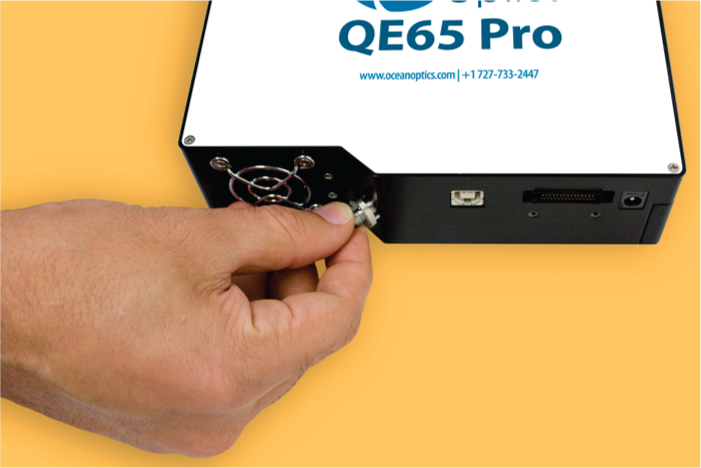
Precision laser-cut slit and aperture assemblies from Ocean Optics add flexibility to the company’s Jaz, Torus and QE65 Pro miniature spectrometers. Replaceable slits give users more freedom in spectrometer design and the ability to switch easily from one application to another with the replacement of a few screws.
Modular spectroscopy makes possible thousands of applications by mixing and matching optical bench and other components in various configurations. The availability of field-replaceable slits in the Jaz, Torus and QE65 Pro spectrometers adds another layer of customer flexibility.
Spectroscopy is a technique in which the design criteria exist as a set of trade-offs. The optimal spectrometer depends upon the application. For some users, one of the most vexing trade-offs involves the choice of entrance aperture (slit). A larger slit increases throughput, but at the expense of optical resolution. A smaller slit yields higher optical resolution, but decreases throughput. Typically, changing the slit requires spectrometer rework that has to be performed at the manufacturer’s facility.
With replaceable slits, users can change the spectrometer’s performance directly in the field. Changing slits can be accomplished within minutes, without the need for realignment. For example, QE65 Pro users who need great sensitivity for low light applications such as fluorescence can change slits from a larger slit size to a small one, avoiding saturation in absorbance applications. Or a Torus configured to resolve closely aligned emission peaks for one application can be adjusted to make low light level measurements for another application.
Ocean Optics, Daniëlle Ravenshorst
+31 26 319 0500,
HARTING’s New 4-pair PROFINET cables
HARTING has introduced a new range of 4-pair PROFINET cables in a strategic move to expand the company’s industrial Ethernet portfolio in the fast-growing market of Ethernet systems in industrial environments.
PROFINET offers a number of benefits in automation applications, including real-time transmission, robust cabling technology and high reliability as well as simple installation and fast commissioning. HARTING’s new 4-pair cables also allow data rates to be boosted from 100 Mbit/s up to 10 Gbit/s to take into account future developments in network infrastructure.
HARTING has designed the new PROFINET cables in two versions: Type A for fixed installation and Type B for flexible installation. While the PROFINET cable for fixed installation requires only inner wire conductors, the necessary mobility in the variant for flexible applications is ensured by the use of tinned stranded wires. In line with the PROFINET guidelines, the outer sheath in the pairs in metal foil (PIMF) versions is made of green poly(vinyl chloride) (PVC).
The 4-pair Ethernet cables meet the criteria for EMC separation Class D as specified in EN 50174-2, and are designed to withstand large lateral crush loads in the harsh industrial environment. In addition, they are flame-resistant and ultraviolet (UV) resistant.

HARTING Limited, Kevin Canham
+44 (0) 1604 827500,