



Abstract

Background
The United Kingdom Automatic Control Council (UKACC) is the National Member Organisation (NMO) for the International Federation of Automatic Control (IFAC). The Institute of Measurement and Control (InstMC) along with the Institution of Engineering and Technology (IET) and the Institution of Mechanical Engineers (IMechE) are currently the three corporate member bodies with representation on the UKACC Executive Committee. The UKACC has operated an annual series of UKACC Day events where meetings are scheduled in the morning for the Executive Committee as well as a wider General Committee with all eligible UKACC members, and, following lunch, an annual PhD Presentation Showcase, followed by the annual UKACC Evening Lecture is held. On 17 October 2012, the event was hosted by the IET and held at Savoy Place, London. The Secretariat for the UKACC is now held by the InstMC. This report briefly outlines the PhD Presentation Showcase and the Evening Lecture.
The PhD Presentation Showcase
The programme comprised 24 presentations given by PhD students drawn from nine of the UKACC University Control Group Members. In line with previous events, the challenge is for each student to present the work clearly and concisely in no more than 4 min (allowing 1 min for changeover). The programme was divided into a series of six sessions, with presentations categorised into transport, actuation and motion control, control and estimation theory, renewable energy, energy/efficiency and condition monitoring and electrical power systems. The venue formed an ideal networking environment for an audience of around 60 delegates comprising academics and researchers from the UK control community. Professor Andrew Plummer, chairman of the UKACC Executive, chaired the presentation event and Professor Keith Burnham agreed to chair a small judging panel with fellow judges Professor Chris Edwards and Dr Maria Tomas-Rodriguez. At the end of each session (comprising four presentations), a 10-min question/answer session involving the four speakers took place. A vibrant atmosphere prevailed throughout the whole of the afternoon, and this formed an ideal background forum for the presentations and also for the PhD students to exchange/express ideas regarding their own work as well as that within their fellow peer group. The report attempts to recapture the atmosphere in the following sections which briefly outline the six sessions.
Transport comprised the following presentations: Intelligent power management for unmanned vehicles by James Graham, Loughborough University; Active steering control to enhance narrow tilting vehicle stability by James Robertson, University of Bath; Control algorithms for optimisation of engine combustion process with continuously changing fuel consumption by KinYip Chan, Kingston University; and REPOINT by Samuel Bemment, Loughborough University.
Actuation and motion control comprised the following presentations: Platform hopping robots by Jawaad Bhatti, University of Bath; LASSO-MPC model predictive control for over-actuated systems by Marco Gallieri, University of Cambridge; Control of a fast switching valve for use in digital hydraulics by Nathan Sell, University of Bath; and Control of atomic force microscopes by Umar Khan, University of Southampton.
Control and estimation theory comprised the following presentations: Robust positively invariant sets for uncertain systems by Furqan Tahir, Imperial College London; Distributed economic model predictive control by Jaehwa Lee, Imperial College London; Parity equations-based unknown input reconstruction for Hammerstein–Wiener systems in errors-in-variables framework by Malgorzata Sumislawska, Coventry University; and Piecewise Gaussian process for system identification by Juan Yan, Queen’s University Belfast.
Renewable energy comprised the following presentations: Optimal active control and optimisation of a wave energy converter by Edo Abraham, Imperial College London; Optimal control with application to energy harvesting by Zhe Feng, Imperial College London, Ocean wave forecasting for wave energy converters by Ming Ge, Imperial College London; and Control strategies for a solar system assisted by heat pump by Muhammad Waseem Ahmad, Loughborough University.
Energy/efficiency and condition monitoring comprised the following presentations: Active control of large aeroelastic wind turbine models for load alleviation by Bing Feng Ng, Imperial College London; Detecting the location of damaged components in MDOF structural using the transmissibilities of NOFRFs at super harmonic by Xueyan Zhao, University of Sheffield; Condition monitoring for a cryogenic vacuum system by Nick Wright, Loughborough University; and Occupancy driven supervisory control to minimise energy use in airport terminal by Abdulhameed Mambo, Loughborough University.
Electrical power systems comprised the following presentations: Distributed control for smart grids by Antonio De Paola, Imperial College London; Improvement to control and reliability in power systems (frequency regulation) by Amr Kamal, Kingston University; Inverters with capacitive output impedance (c-inverters) by Yu Zeng, University of Sheffield; and Fault diagnosis for power transmission line using statistical methods by Yuanjun Guo, Queen’s University Belfast.
Each session generated a healthy and searching set of questions, and all speakers were asked at least one question from a very lively and actively involved audience. Following the final session, refreshments were served, and the judging panel had the difficult task of deciding the overall winner of the day. After some deliberation, it was unanimously agreed that there was an overall winning presentation and that there were a further three that could be described as highly commendable.
In true ‘Miss World’ style, the overall winning presentation was announced last. However, before announcing the award winners, Chair of the judging panel Professor Burnham provided feedback to all of the presenters and acknowledged the excellent presentations made and congratulated all speakers and said: ‘as judges we have to make some difficult distinctions, but in my view you are all winners here today’. He also thanked all those in the active audience for making this such a vibrant and worthwhile event for the presenters and, in asking the searching questions, had significantly enriched the outcome of the day. The following three were deemed to be equally highly commendable and awards were presented to: Edo Abraham, Imperial College London, Nathan Sell, University of Bath and Nick Wright, Loughborough University. Finally, the overall winner for the UKACC 2012 event was James Robertson, University of Bath, with his presentation: Active steering control to enhance narrow tilting vehicle stability.
In summary, the quality of the presentations overall was extremely high, and it was pleasing to witness the high standards of the UK PhD student control community, as well as the comradeship shared among them.
Photos
Professor Andrew Plummer, Chairman of the UKACC Executive presents certificates to the award winners:
James Robertson (overall winner)
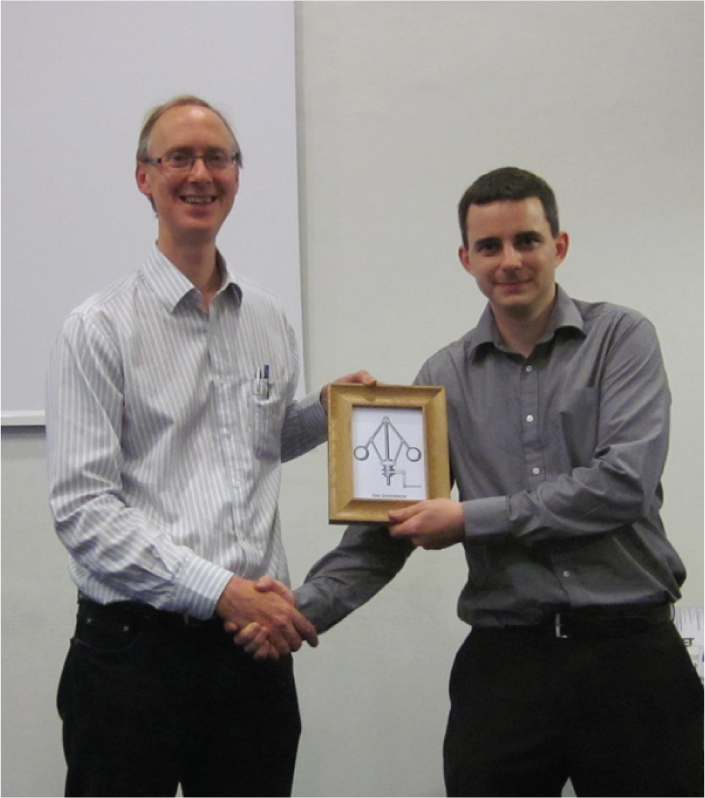
Nathan Sell

The Evening Lecture
The 2012 UKACC Evening Lecture was presented by Professor Roger M. Goodall, Loughborough University, and was titled: Maglev – the dream – and the reality. Professor Goodall, who is a leading authority on magnetic levitation and railway control systems, gave a fascinating insight spanning the early years up to the present day and also hinted towards future developments. The talk raised questions regarding the maturity of the earlier technology and whether developments had been implemented differently things might have evolved in a totally different way. Magnetic suspension systems were studied at least as far back as 1842, with Earnshaw’s theorem: ‘there is no stable static configuration’. The presentation touched on the history and swiftly took us on a journey through the developments that witnessed the world’s first application at Birmingham Airport, followed by later developments in Japan and future developments planned for China in 2027. Several developments in other countries such as the American stabilized permanent magnet system, the mechanically configured German M-Bahn system, the UK high-temperature superconductor (HTS) concept, the idea of ultraconductors and the Brazilian HTS COBRA system were discussed. On the control side, the talk touched on flux feedback and complementary filtering with air gap position feedback used for the Birmingham Airport Maglev system, which led to a modal controller of 44th order with 26 sensors feeding back to control eight magnets. Despite these scientific developments, however, parallel engineering developments appear to dictate that it is more economical to upgrade existing conventional railways than to introduce maglev. A question then arises: Where might maglev work? An answer might be: where there is no existing railway and there are large populations at large distances apart. There is the added requirement to supply spare component parts and to support the infrastructure. There is a need to remove track debris, particularly for maglev systems that have permanent magnets as part of the track structure, and also to consider power-consumption issues. It would appear that the pioneering maglev shuttle at Birmingham Airport which was in use from 1984 to 1996 was before its time technology-wise, and obsolescence meant that the lack of spare parts, particularly the electronic components, created an ever-increasing issue with reliability.
Edo Abraham

Nick Wright

