




Abstract
The government had, during the Second World War, constructed a massive system of protected storage depots and pipelines for the storage and transport of petroleum fuels. With the end of the war, the system was largely decommissioned. It was to be another war, the ‘Cold War’, which would lead in the 1950s to the reuse, and a considerable expansion, of the system. It was later to be adapted to additionally meet the increased use of petroleum fuels for civil aviation, heating and motor transportation. This article describes how this system was monitored and controlled from the 1950s up to the present day. It covers the improvements in the usage of instrumentation, automation, telemetry and SCADA (Supervisory Control and Data Acquisition) systems during that 60-year period.
I. Introduction
The Government Pipeline and Storage System (GPSS) was constructed for the Second World War, but it was to be the ‘Cold War’ that would lead to its reuse and expansion. It had been built with virtually no instrumentation and was reliant on manual control. However, gradually, instrumentation, controls, telemetry and Supervisory Control and Data Acquisition (SCADA) computer systems were installed. This article covers that development.
II. The Cold War Expansion of the GPSS
With the ending of the Second World War, much of the GPSS was decommissioned with fuel deliveries reverting to road, rail and barge. However, with the start of the ‘Cold War’ in the late 1940s, the decision was taken to recommission the GPSS. When the pipelines were tested, the trans-Pennine pipeline was found to have significant corrosion. Although it was stayed in operation until the 1960s, it was decided in 1951 to build a second pipeline, complete with three new Petroleum Storage Depots (PSD), from the Mersey to the Humber. At 300 mm, it was larger than any of the wartime pipelines; also it was class 600 rated and so could operate at up to 99 bar rather than around 50 bar.
Following the severe winter of 1947, the government looked into means of increasing petroleum storage capacity. A study showed that significant quantities could be safely stored in salt cavities. In 1951, the government decided to build 34 cavities at Plumley in Cheshire by leaching out the salt with brine (see Figure 1 ). They were designed to hold approximately 1.2 million tonnes of petroleum. A complex of pipelines was built to link the cavities to the pipeline network, to the Stanlow refinery, and to three PSDs built as part of the complex. 1 It was later decided to enlarge each cavity, and by July 1963, the total capacity was 2.6 million tonnes, 1 million tonnes greater than the total capacity of the 88 storage depots built by the Air Ministry during the Second World War.
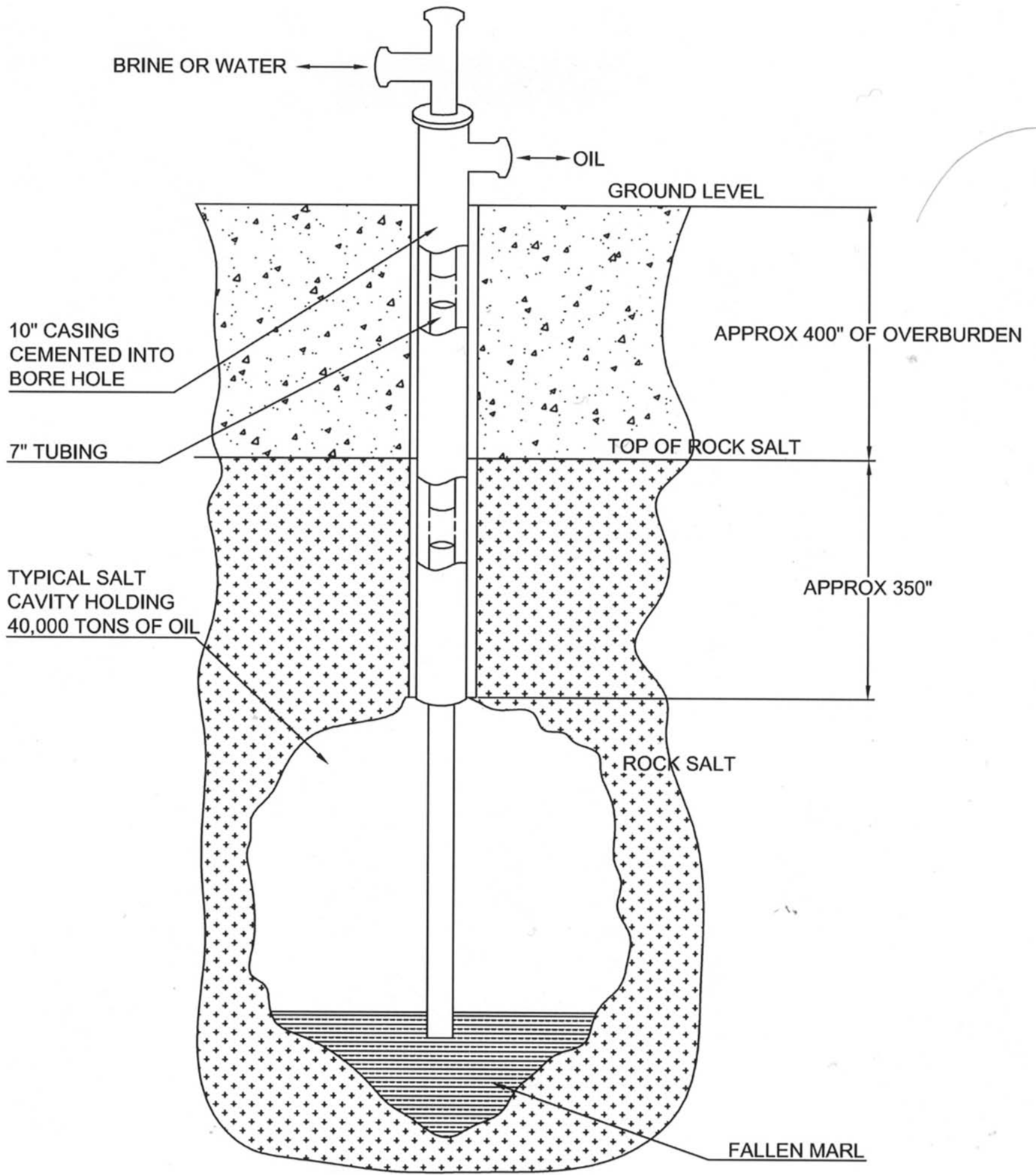
Diagram of a typical salt cavity at Plumley. Reproduced with kind permission from the Oil and Pipelines Agency
Three new oil import facilities were also constructed in the 1950s. Killingholme on the Humber was designed for road, rail and sea distribution of petroleum. Like a number of other PSDs built during the 1950s, but unlike any built earlier, it was constructed with 8000 tonne as well as 4000 tonne protected storage tanks. A second large import facility was constructed on the west coast of Scotland, although this was not connected to the pipeline network. However, the largest and most innovative import facility was built in the south-west of England. The Redcliffe Bay PSD on the North Somerset Coast was equipped with three off-shore tanker berths connected to the PSD by submarine pipelines. Tankers could off-load petroleum without needing either a jetty or a port. Multiple pipelines connected Redcliffe Bay to two new other PSDs constructed to provide petroleum distribution by road, rail and coastal tanker. Two 400 mm pipelines linked Redcliffe Bay to the rest of the pipeline network.
III. Instrumentation and Telemetry
Wartime instrumentation had been largely confined to pressure gauges, voltmeters and ammeters. Depth and temperature gauges were fitted to tanks on some Air Ministry sites, but these proved to be unreliable and their use was ended. 2 In the 1950s, some PSDs were equipped with pump control instrumentation. Orifice plate flow-meters were installed to provide measurement of product movement flow-rates. At Plumley, an echo system was used for surveying the cavities. In addition, stainless steel probes carrying a neutron source producing gamma radiation could be used to give a measurement of the oil/brine interface (see Figure 2 ).
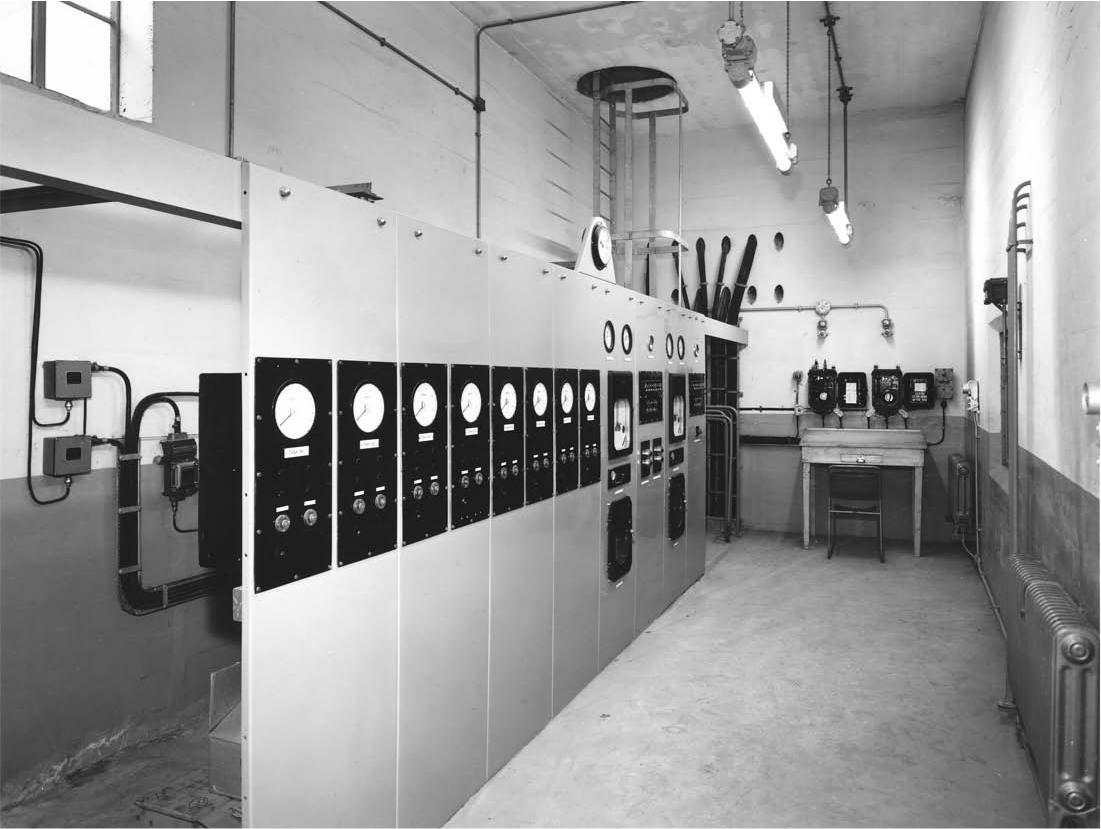
Pump-house built in the 1950s. Reproduced with kind permission from the Oil and Pipelines Agency
In 1959, the first Pipeline Control Centre (PCC) was set up at Aldermaston. It comprised a visual display unit (VDU) and a printer linked by telemetry to a number of sites. Outstations would automatically dial in to the master-station if they were in alarm while the master-station would dial each outstation on an hourly basis to monitor parameters such as product pressure, temperature, flow and the specific gravity. As shown in Figure 3 , by the mid 1960s, there were five PCCs. However, each one only monitored a few sites and not all of the pipelines were yet covered by telemetry.
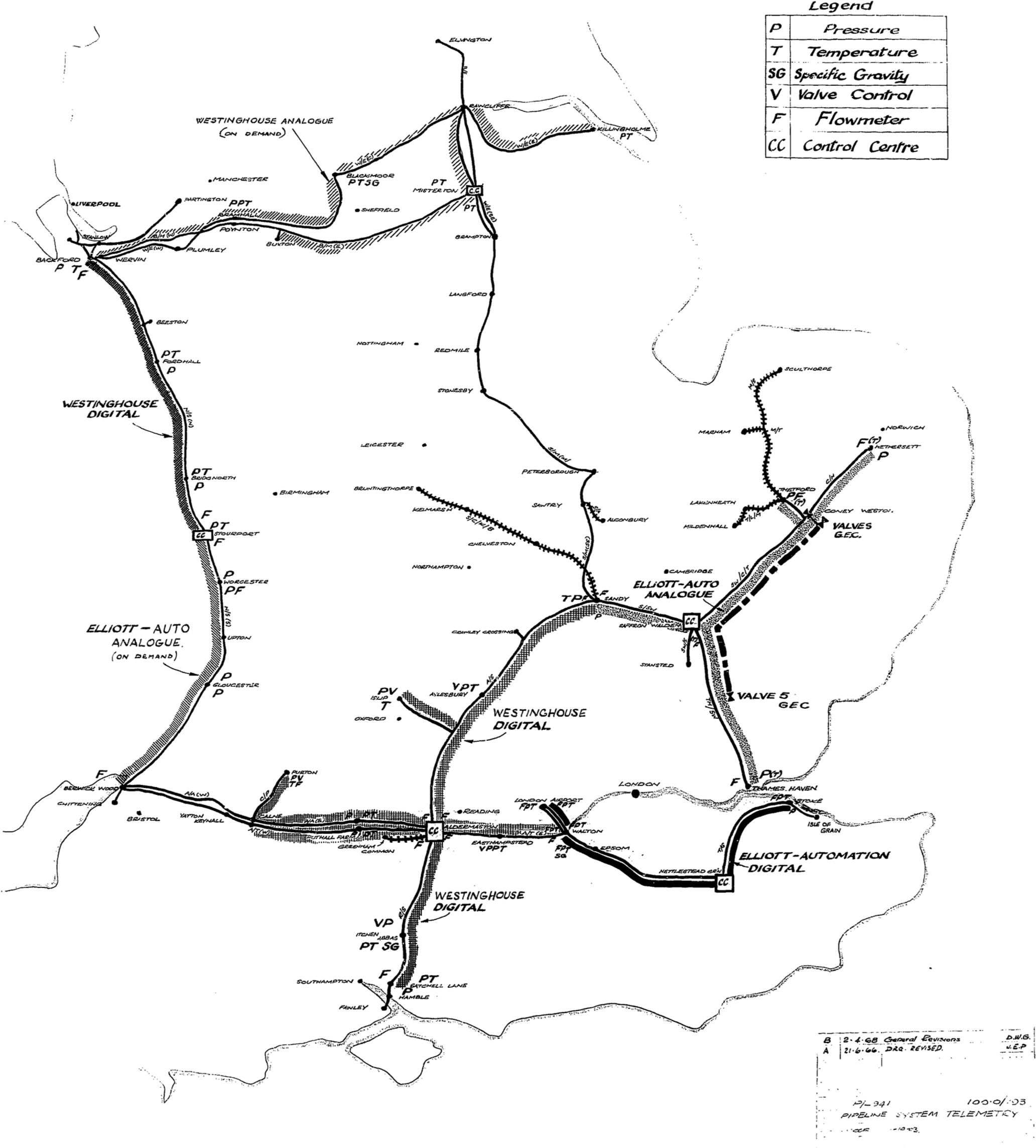
GPSS Telemetry 1966. Reproduced with kind permission from the BPA
IV. Commercial Usage
In the 1950s, petroleum companies started to utilise the GPSS, particularly to supply fuel to London Heathrow. For example, Esso pumped fuel from the Fawley refinery, and BP, from the Isle of Grain refinery, to the Walton on Thames PSD. At first, fuel was road loaded to Heathrow, but in 1959, the first commercial pipeline in Great Britain was built from Walton to Heathrow. In 1963, Esso built a pipeline from Fawley to Heathrow. Two large commercial pipeline networks were later to be constructed, the United Kingdom Oil Pipeline (UKOP) in the 1960s and extended in the 1980s, and the Esso Main and Midlines in the 1970s and 1980s.
In 1963, British Rail commenced a major restructuring, known as the Beeching Axe, involving the closing of thousands of miles of branch lines. A number of GPSS PSDs, as a result, were no longer able to load and receive by rail. Those PSDs that were not also pipeline fed were mostly closed and rail transport of fuel greatly diminished on the GPSS.
There was a significant increase in car ownership and resultant greater petrol consumption in the 1960s. To help meet this demand, Conoco leased a number of PSDs that were supplied from the newly built Conoco refinery at Immingham, via the pipeline network. GPSS road-loading facilities were then used to transport ground fuels throughout a large part of England. This usage continued up to the mid-1990s.
V. Defence Pipeline Construction
In the 1950s, the United States Air Force (USAF) took over a number of Royal Air Force (RAF) bases and spur pipelines were constructed to them. In the early 1970s, a number of new defence pipelines were built in East Anglia. These were class 600 and the existing pipeline feeding them from the Shell Haven refinery was also upgraded to class 600. To increase flow-rates, a new diesel pump-station was built at Thameshaven, and five new diesel pump-houses were constructed on existing PSDs. Additional semi-buried storage tanks were also installed at four PSDs that supplied USAF airbases.
The majority of airbases from which the RAF operated were, however, still not pipeline fed. Starting in 1980, a major project was undertaken to connect eight airbases to the GPSS. In addition, two pipelines were built, one in Scotland and one in Cornwall, to supply RAF airbases that could not be connected to the GPSS ring-main. In 1988, Linkswood in Scotland became the last PSD to be constructed. It was rail-fed and supplied fuel to an RAF base via a short pipeline.
VI. The First SCADA Systems
In the early 1970s, the Saffron Walden PCC was equipped with data loggers, a computer and VDUs. For the first time, there was a limited form of leak detection with the computer carrying out a balance check between input and output flows. In the mid-1970s, the first true SCADA PCC was installed at Rawcliffe replacing the PCC at Misterton. It included not just monitoring but also operator controls for the trans-Pennine pipeline. It was extended in 1982 to control the pipeline from Rawcliffe to Aldermaston. 3 The computer was upgraded at the same time to a dual processor such that if one computer failed the other, acting as a ‘hot standby’, would automatically take over. Saffron Walden, Rawcliffe and Aldermaston were now the only PCCs on the GPSS with the others having been closed. In the late 1980s, the control and monitoring of the East Anglian Network was transferred from Saffron Walden to Rawcliffe.
A second telemetry system was added to the Aldermaston PCC in the 1970s (see Figure 4 ). It consisted of a master-station, eight outstations and a data logger and could be used to control as well as monitor sites. Around 1980, the first true SCADA system was installed at Aldermaston to monitor and control the pipelines from the Mersey to Aldermaston. It used two ‘hot standby’ DEC computers with three Man Machine Interfaces (MMI), an event printer, hourly log printer and a printer to record product movements. An article in the operating company’s in-house magazine considered the way ‘one operator sitting at a control desk can be in total control of a pipeline system’ to be ‘akin to science fantasy’. 4
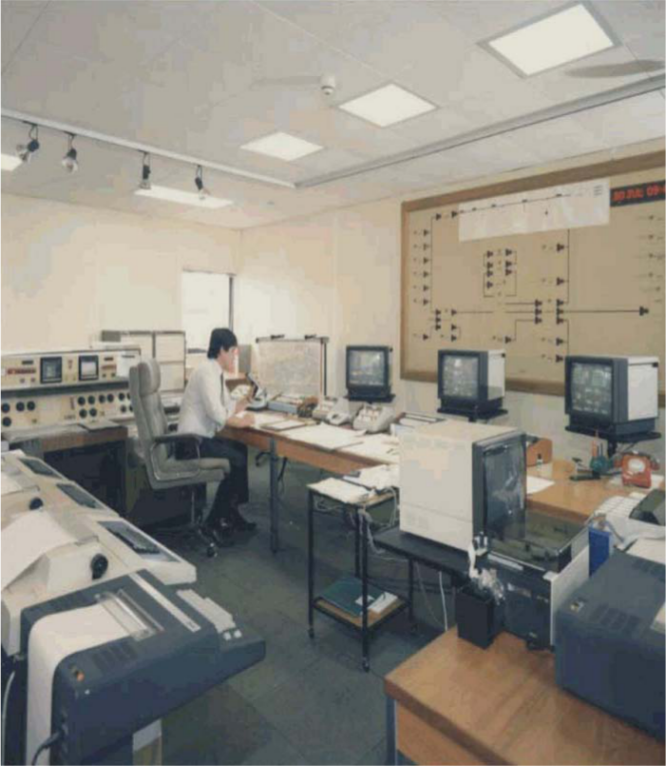
Aldermaston PCC in the 1980s with three separate systems. Reproduced with kind permission from the BPA
VII. Instrumentation, Controls and Shutdown Systems
During the 1970s, higher accuracy turbine flow-meters, including, in certain cases, meter provers to calibrate the flow-meters, were installed on the more active PSDs. Specific gravity meters, installed upstream of the depot and connected by telemetry, gave PCCs an early warning of the arrival of an interface between two types of product.
The nature of the operation of the GPSS was such that the necessity for control loops was quite limited. Pump discharge pressure and flow needed to be controlled without letting the suction pressure fall too low. The site pipework, which was class 150, had to be protected from being overpressured by the cross-country pipelines that operated at either class 300 or 600. To achieve this, Foxboro Spec 200 controllers were installed at a number of PSDs and pump-stations. The author, who started in the industry at Foxboro in 1973 when Spec 200 first became available, was both surprised and pleased to see them still operational when he joined OPA in 1990. They were still working when the author retired in 2012, demonstrating that occasionally what the salesman says about reliability is true!
In order to maximise the amount of product stored, the practice had been to fill the tanks to the brim. During the 1980s, high and high–high level switches were installed on active main storage tanks. On some PSDs, the activation of the high–high level switch also automatically closed the site inlet valve. Both the RAF and USAF, however, expressed concern over the resultant fall in their stock levels.
A form of automatic tank gauging (ATG) was installed on active tanks to provide continuous and remote read out of the tank levels. The type used on the GPSS tanks utilised a float, which would go up and down with the liquid level. The main problem with float gauges was that, unless they were regularly serviced, they could stick and fail to move as the level changed. From the mid-1990s, these began to be replaced with servomotor-driven ATG giving a theoretical accuracy of 1 mm or 1 m3 of product.
VIII. PSD Closures
In the early 1980s, with North Sea Oil on stream, the government decided that they no longer had any requirement for fuel storage for a possible civil emergency and Plumley was emptied and closed. Already in the 1970s, in response to spending cuts, the policy on the GPSS was generally to only retain those PSDs that were pipeline fed and for which a military or commercial use could be found. Most of the large number of depots that were not pipeline fed were gradually emptied, demolished and the land sold.
In the early 1990s, following the ending of the Cold War, there was a whole-scale programme of closures of PSDs, previously used for storing military aviation fuel and of military spur pipelines. Many of these PSDs were, however, to have a final period of extreme activity due to the First Gulf War in 1991. Sites that had been static for many years were now emptied, often as fast as the pipeline network could transport the fuel to the airfields. In many cases, this was carried out entirely under manual operation as these ‘static’ PSDs had been starved of investment. They mostly had no ATG, no high level alarms, no SCADA monitoring and no automated valves. The author was engaged in a number of projects to upgrade these PSDs, but the closure programme started before the projects could be put into effect.
IX. New Commercial Ventures
In 1985, the Mobil Coryton Refinery was connected to the GPSS at Thameshaven. Allied to this, a new pipeline-fed commercial distribution depot was built at Wymondham in Norfolk. For the next 15 years, ground fuels were pumped through the GPSS to Wymondham and then distributed by road tanker throughout East Anglia.
RAF Stansted Mountfitchet had been a USAF airbase during the Second World War. In 1954, USAF built a pipeline from the Saffron Walden PSD to Stansted; however, the pipeline was never commissioned. In 1984, the government approved a plan to develop Stansted Airport, and in 1988, Stansted agreed to fund the pipeline being refurbished. Design work started in 1989, and in 1990, the pipeline was intelligently pigged. It was repaired, new pumps were installed at Saffron Walden and receipt facilities at Stansted with the line became operational in 1991.
As early as 1984, a proposal had been put forward to use the GPSS to supply Manchester airport. The plan was to reuse a mothballed GPSS pipeline between the Backford North PSD and Plumley and construct a new commercial pipeline from Plumley to Manchester. It was not until 1989, however, that the Manchester Jetline (MJL) company was set up to carry out this project. Work on the commercial pipeline started in 1989 and was completed by 1990. In 1991, an intelligent pig run was carried out on one of the GPSS pipelines. Repairs were completed by 1993, and the MJL became fully operational in 1994. 5 In 2002, it was decided to increase the capacity of the MJL, and in 2005, new pumps were commissioned at Backford.
X. The Aldermaston SCADA Replacement Project
In 1991, a contract was signed to replace the three independent telemetry and SCADA systems at Aldermaston with one SCADA system. The control of the trans-Pennine pipeline was transferred to Aldermaston such that the new SCADA would control the entire pipeline network from Killingholme through Aldermaston (see Figure 5 ). Four SCADA sub-masters that could control a number of outstations and pipelines, but which were also backed up by the SCADA master-station, also formed part of the project. The contract took just over 3 years to complete.
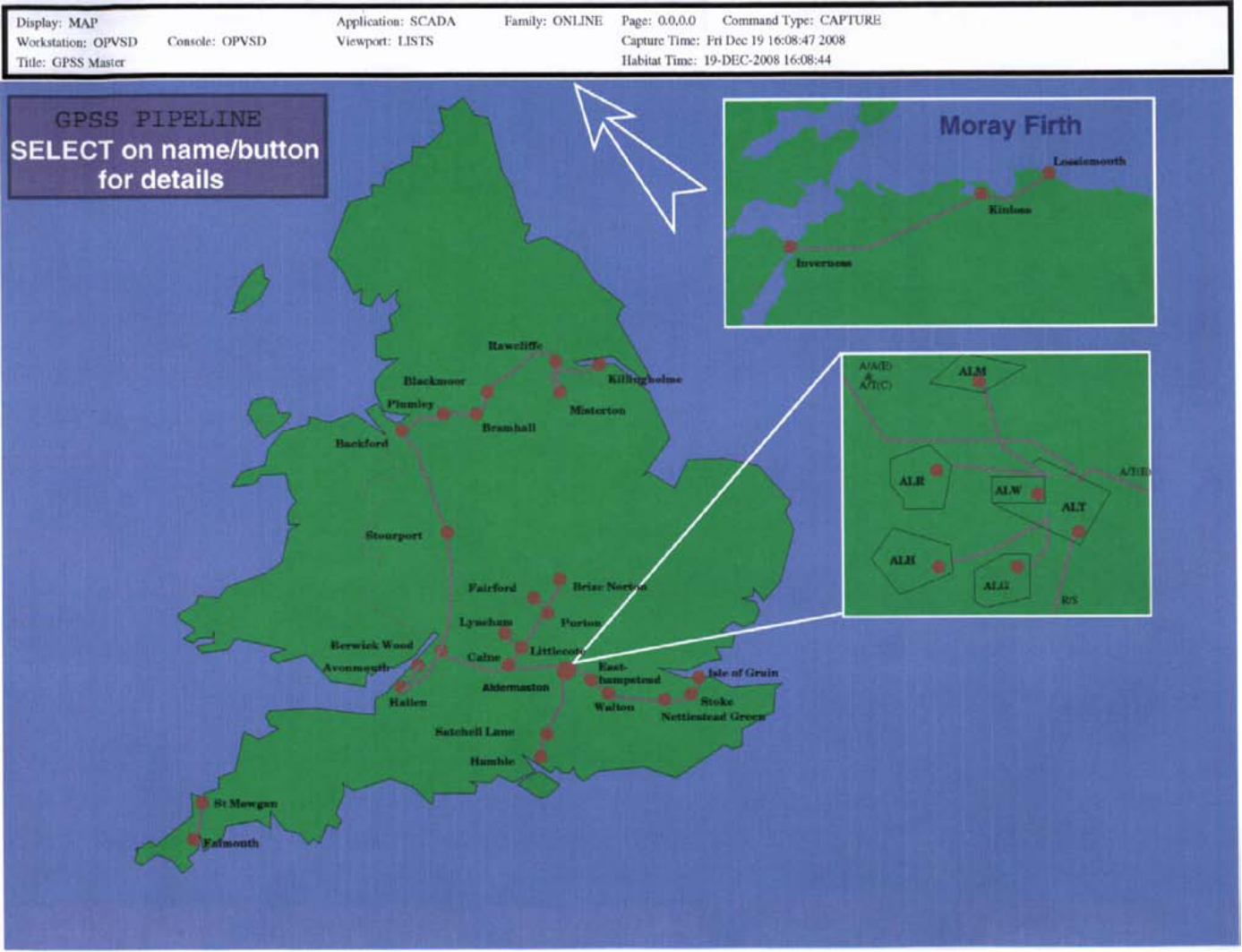
Aldermaston SCADA overview mimic. Reproduced with kind permission from the Oil and Pipelines Agency
The SCADA included a number of pipeline specific software modules such as under (vacuum) and over pressure protection, leak detection, pig tracking and ‘parcel tracking’. The leak detection software was designed to identify static leaks (no flow in the pipeline), dynamic leaks (flow in the pipeline) and bursts (pipeline rupture). A ‘parcel’ is a user-defined volume of product and is the accounting mechanism used for separating the product in the pipeline for ownership purposes. The parcel-tracking software provided tabular and graphical representations of all the parcels on the pipeline system.
All the previous SCADA systems had relied on BT analogue private lines with up to 12 outstations on one line. This made for slow response times; on one occasion, a control action took 7 min, and the potential for the loss of control of a large number of outstations if the line went down. The new Aldermaston SCADA, however, used BT Kilostream digital communications. This gave a greatly improved 2-s update time period for analogue and digital values and controls. Valves and pumps, as a result, would respond virtually immediately to commands.
A computerised pipeline scheduling package was commissioned at the same time. It could take 11 days for a parcel of product to be pumped from Killingholme to Aldermaston, and scheduling of this previously had to be carried out manually. The scheduling computer allowed the pipeline schedulers to simulate various scenarios until they achieved the required programme for the next month. 6
XI. The Rawcliffe SCADA Replacement Project
By the time the Rawcliffe SCADA was due to be replaced in the early 2000s, BT Kilostream Assured Restored could be used (see Figure 6 ). This gave a 99.99% guaranteed availability due to it automatically switching over to ISDN (Integrated Services Digital Network) line on Kilostream failure. A level of redundant routing was achieved by forming a communication ring between Rawcliffe and three other PSDs, each equipped with sub-masters. The system was Factory Acceptance Tested (FAT) in 2002, and installation and commissioning was completed early in 2004. The system was designed such that it could later be expanded to cover the entire GPSS. 7
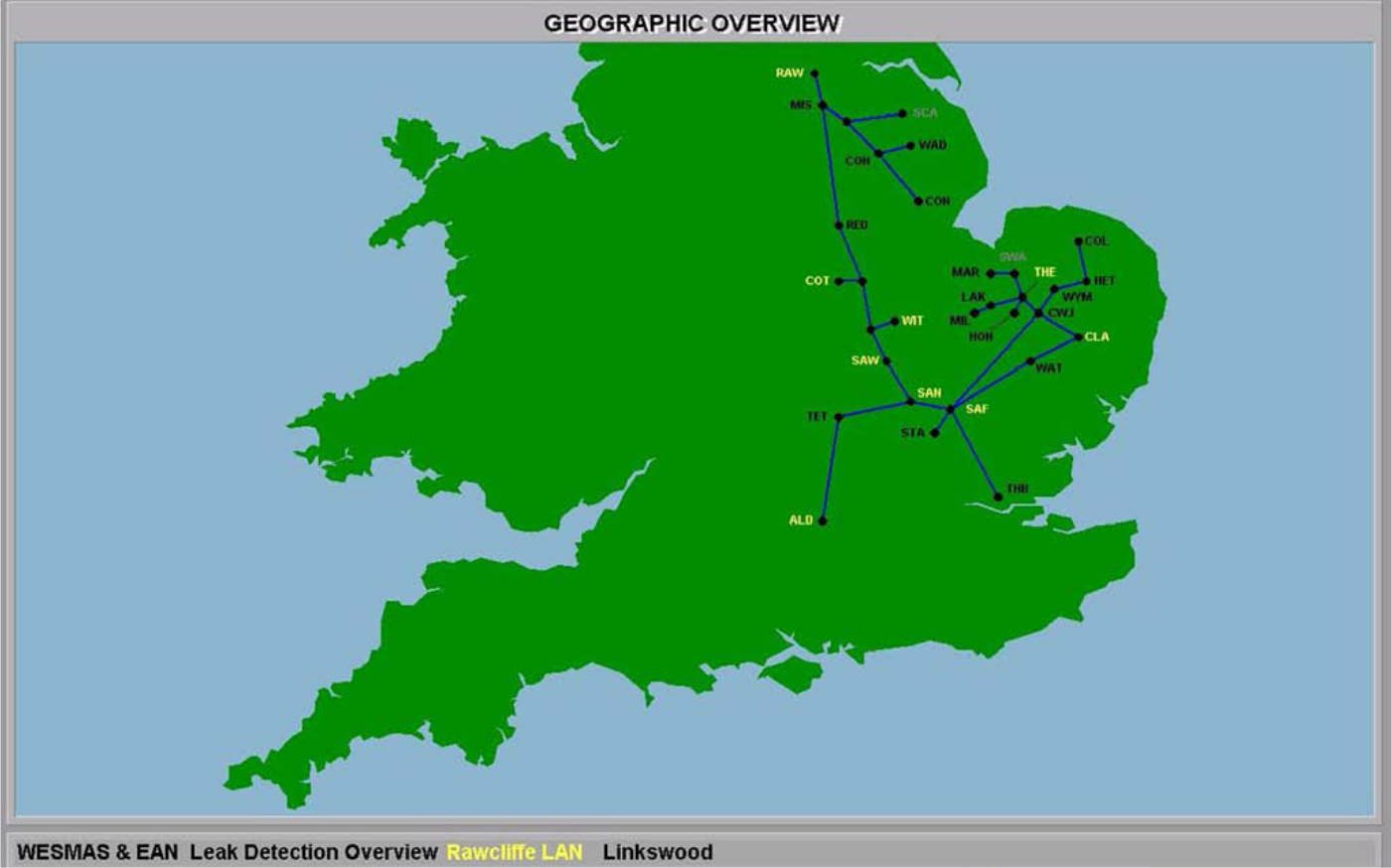
Rawcliffe SCADA overview mimic. Reproduced with kind permission from the Oil and Pipelines Agency
There were a variety of different leak detection systems available on the market in the late 1990s, but the track record for many of them was less than encouraging. There are two essentials for a leak detection package: that they do not generate false alarms, otherwise operators will come to ignore them, and that they should pick up leaks, if they should happen. The author visited a commercial PCC where a mathematical model based leak detection system was ignored because of the large number of false alarms generated (see Figure 7 ). The leak detection used at Rawcliffe, produced by a Slovakian company, proved to be both accurate and reliable. In Western Europe, leaks are most commonly caused by third parties accidentally hitting a pipeline. In Eastern Europe, however, there have been occurrences of third parties deliberately drilling into pipelines to steal fuel. This has acted as a significant motivator for the development of fast-acting, accurate and reliable leak detection software.
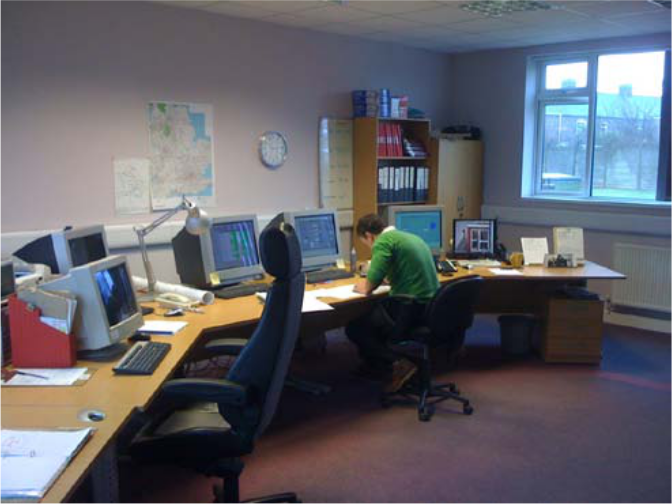
Rawcliffe PCC 2010
XII. The Avon to Thames (A/T) Pipeline
The A/T pipeline had been the first GPSS pipeline to be constructed, and it is still the most active. In order to meet increasing demands for aviation fuel at both Heathrow and Gatwick, the pipeline between Aldermaston and Walton was upgraded from class 300 to class 600. New pumps were installed at the Aldermaston PSD, and a new pump-station constructed at East Hampstead. The work was completed in 2001.
In 2002, work started on a new major petroleum import facility and pump-station at the Royal Portbury Docks. Both the Redcliffe Bay PSD and the two 400 mm pipelines, which connected it to the ring-main, had ceased operations in 1993, but were now recommissioned. Redcliffe Bay required extensive modernisation including the fitting of high-accuracy servo-based ATG, independent overfill protection systems, automation of valves on the tank inlet and outlet lines, installation of pipeline instrumentation and a SCADA outstation. Aviation fuel was delivered by tanker to Royal Portbury Dock and pumped in two directs simultaneously into Redcliffe Bay and the Hallen PSD, located near Bristol (see Figure 8 ). This allowed a very high rate of off-loading. Aviation fuel was then pumped from Hallen to Aldermaston and onwards to Walton. As Hallen was emptied, more fuel was pumped across from Redcliffe Bay.
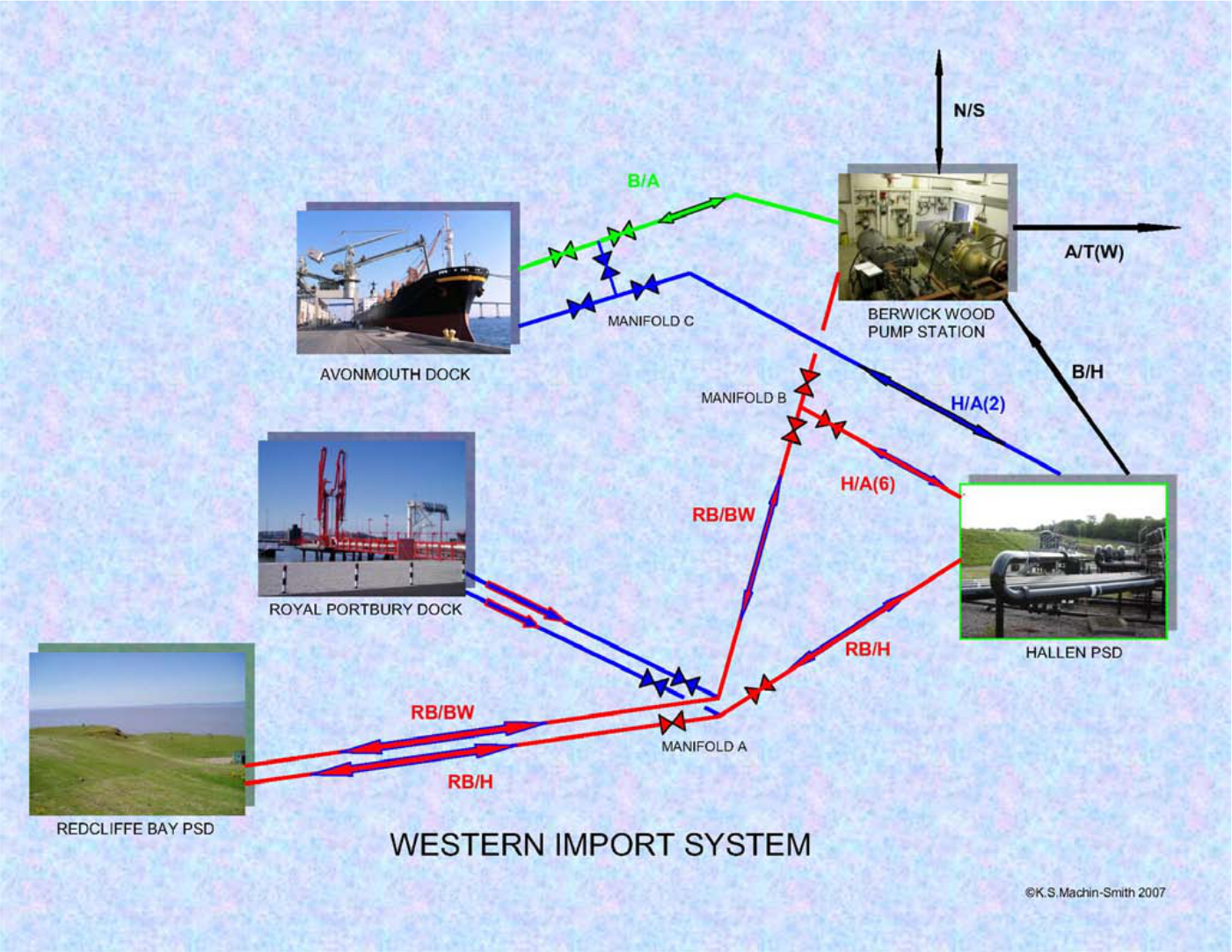
Fuel importation from Royal Portbury dock
Subsequently, new pump-sets were installed at the Berwick Wood PSD and the Calne pump-station on the A/T pipeline. These followed the same general design as at Aldermaston Top Site and at Easthampstead. The purpose was to increase the flow-rate in the A/T pipeline from Hallen to Aldermaston from around 200 to 270 m3/h with both Berwick Wood and Calne pumping.
XIII. An Integrated GPSS SCADA
After the successful commissioning of the Rawcliffe SCADA in 2004, it was recognised that it would be necessary to replace the Aldermaston SCADA in the next few years. The SCADA software was no longer being developed, the VAX computers were no longer manufactured and the communications hardware was no longer available. 8 A study carried out in 2007 recommended that a new Aldermaston SCADA system should be integrated with the existing Rawcliffe SCADA. This would provide a complete disaster recovery PCC, and it would be possible to transfer pipeline controls between PCCs. To enable greater communications flexibility, Multiprotocol Label Switching (MPLS) was used. Engineering work commenced in 2008, and the project was substantially complete when the author retired in 2012.
XIV. At the End of the Pipeline
PSD closures continued in the 1990s and 2000s reflecting military cutbacks. There was also closure of a number of commercially operated depots on and off the GPSS. These left only the trans-Pennine from Killingholme to the Bramhall PSD near Manchester, which was on commercial hire, carrying multi-products. The rest of the GPSS transported and stored only kerosene. This had a significant impact on the evaluation of the GPSS by the Health and Safety Executive following the explosion at the commercially owned Buncefield terminal in 2005. The explosion had resulted from a gasoline overfill, and the explosion would not have occurred with a kerosene spillage.
In 2010, the government announced that it intended to sell off the GPSS. At the start of 2013, there were still about 1900 km of operational pipelines. There were, however, only 18 operational PSDs left, three of which were on commercial hire. The Air Ministry alone had built 88 depots during the Second World War; around 70 PSDs were operational in the 1960s and 40 in 1990. The GPSS, though, is still the largest operational remnant left of the vast infrastructure that was built to help fight the war.
Sir Donald Banks in 1945 had attended a ceremony in Belgium in 1945 to mark the connection of the final piece of pipeline linking the Rhine with the Mersey. Banks related how the Belgians were perplexed about how the British ‘could succumb to such emotions about a prosaic bit of piping’. 9 A period of 68 years after that ceremony, the author can still share that enthusiasm for petroleum pipelines. The GPSS has constantly adapted and evolved to survive the end of the Second World War, the Cold War, civil storage and gasoline storage, and to add significantly to the post-war history of Britain. How and whether it will survive the government’s planned sell-off remains to be seen.
Footnotes
Acknowledgements
This article is based on the second part of a history of the GPSS that the author is currently writing. The author would like to thank all his former colleagues who worked with him on the GPSS and various friends for assisting him in the preparation of the book and for their comments and corrections.
Funding
This research received no specific grant from any funding agency in the public, commercial or not-for-profit sectors.