




Abstract
In 1936, the Royal Air Force (RAF) held only very limited stocks of aviation gasoline at a relatively few RAF stations. The only reserves available were 8000 tonnes held by the oil companies. At peak wartime consumption of aviation fuel, this would have only been enough for one day of war! In 1936, the first test flight of the Spitfire took place, but such fighters would need fuel, which would require storage facilities. Unlike during World War One, that storage would need to be protected against aerial bombardment. By the start of World War Two, a massive construction programme of new storage depots with protected storage tanks was well underway, and this programme continued during the war. Additionally, in order to help transport fuel around Great Britain, from 1941, a petroleum pipeline network was constructed eastwards and southwards from the west coast ports. This network included the laying of undersea pipelines across the Channel, code-named PLUTO. This article sets out how the storage and pipeline system was designed, constructed, and controlled during the war.
I. Introduction
In 2010, the government announced that they would be selling the Government Pipeline Storage System (GPSS). In 2012, they included the sell-off in the Energy Bill. It is probably true that most people have never heard of the GPSS. It should, however, be better known and appreciated as it is the largest network of refined petroleum pipelines and storage depots in the United Kingdom. It connects with several refineries and ports. It transports fuel, either directly or indirectly, to Heathrow, Gatwick, Stansted and Manchester airports, and to most major airbases. It also road loads fuel to several regional airports. Historically, it is the largest operational remnant left of the vast infrastructure that was built during World War Two. This article sets out to examine how the GPSS was constructed and the vital part it was to play in that war.
In 1936, the Royal Air Force (RAF) held only very limited stocks of aviation gasoline and had just 8000 tonnes in reserve. This was estimated to be enough for 10 days of war, 1 but at peak wartime consumption, it would have only lasted 1 day. The first Spitfire flew in 1936, but such modern planes would require fuel storage facilities protected against aerial bombardment. Most existing storage was at ports in large above-ground tanks. The Home Office had concluded that ‘it is perfectly plain that if a determined attack was made on these installations nothing could save them’.
In July 1936, the Air Council decided to build 90,000 tonnes of protected petroleum storage. A month later, all the military were advised to build up reserves such that they had sufficient fuel stocks for 6 months of war. The Air Ministry requirements were increased to 290,000 tonnes. Their demand for fuel storage was to continue to increase, and by the end of the war, they had constructed 78 fuel storage depots with a total capacity of over 1.6 million tonnes.
II. Storage Depot Construction
The depots were, as far as possible, to be constructed in rural areas west of a line from the Tyne through to Southampton Water. They were to be capable of being filled and emptied by road, rail or in certain cases, by barges. Some of the new tanks were completely buried, but it was considered that it would be too expensive and too slow to do this for all tanks. Therefore, the majority were only semi-buried, typically half below ground and half above. The D1 design tank was quite small, about 500 tonnes in capacity and rectangular in shape, protected with concrete and then mounded over with earth. It was mainly used at small Air Force Distribution Depots (AFDD) and minor civil depots that needed to be located in more vulnerable areas.
In 1938, work started on several AFDDs with floodlights erected such that the construction could continue late at night. Mountnessing, 2 miles north of Brentwood in Essex, was one of the first, becoming operational in March 1939. It had four 500-tonne D1 tanks for aviation gasoline and two small lubricating oil tanks, and it received fuel by rail and delivered by road.
The tanks for the main Air Force Reserve Depots (AFRD) were normally much larger, about 4000 tonnes in capacity, and were mainly of a C2 design. This was a vertical, cylindrical, reinforced concrete, semi-buried, steel-lined chamber built on a concrete foundation. The concrete roof slab was supported on 45 columns within the tank. It was relatively cheap to build and proved excellent in service. The C1 tank was built in the same way as the C2, except that it was above ground. They were only constructed in areas where the risk of air attack was considered to be very low. Noone wrote that ‘possibly the most remarkable thing about the whole programme was the reliance upon welding’. 2 Tanks built up to the 1930s had been riveted.
Construction of the first AFRD started in February 1938 at Micheldever in Hampshire, which became operational in September 1939. Unusually, it did not have C2 tanks but thirty 650-tonne horizontal mounted cylindrical tanks. They were laid side by side in a former quarry and encased in a 600-mm monolithic concrete block. They were then covered with earth to a depth of 6–9 m and faced with a concrete blast wall, making them virtually impregnable to air attack.
III. War
At midnight on 3/4 September 1939, all the oil companies joined together to form the Petroleum Board. Every petrol station, depot or office, became a Petroleum Board establishment. Around 18,500 staff and every road tanker, barge or rail tanker wagon came under the Board. All the different grades of petrol were done away with and there was one ‘pool’ grade. The teleprinter network at Shell-Mex House in London allowed communication from the Board to regional offices, depots and refineries. 3
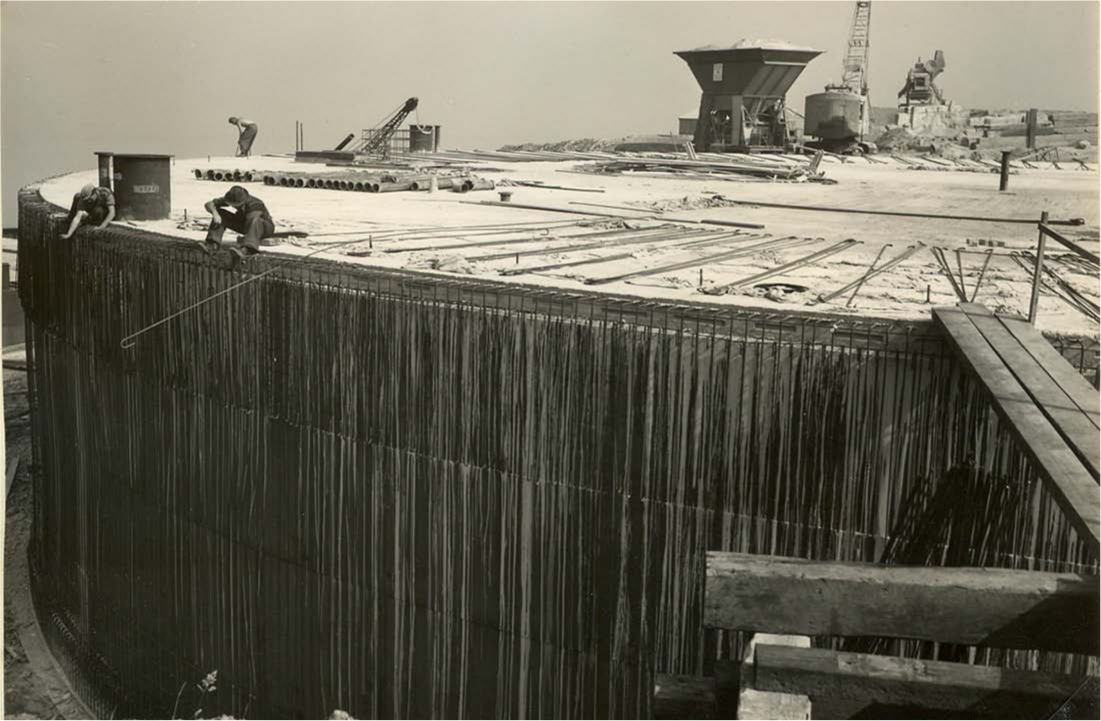
C2 Tank Construction Showing Concrete Roof and Shell (Walls) . Reproduced with kind permission from the Oil and Pipelines Agency.
The programme for building protected storage depots proceeded at an increasing rate, the peak being between 1940 and 1942. Greater mechanisation and more experience meant that the rate of tank construction improved. It took 4½ weeks rather than 6½ weeks to build a C2 tank, and the required labour force fell from 30 to 20. However, the blackout made work at night impossible and there were shortages of labour and materials. Steps were also taken to protect, as far as possible, the existing above-ground storage tanks. Most large commercial installations were camouflaged, and bunds were built, where possible, around the tanks.
IV. Aerial Bombardment
None of the schemes designed to reduce the effects of air attack on the petroleum industry had been completed by July 1940. By July 1941, 500,000 out of the 10 million tonnes of above-ground storage had been lost. By comparison, only two semi-buried tanks were destroyed, one at Poole in Dorset and one at Falmouth in Cornwall. The tank at Poole was hit by a 500-kg bomb that blew off half of the concrete roof, demolished the side of the tank and the tank tunnel. There was, however, no fire, and none of the adjacent tanks were damaged. 4 The tank at Falmouth was hit on the night of 30/31 May 1944. The tank fractured with flames reaching 70 feet in the air. A stream of burning gasoline 6-feet wide flowed towards the village of Swanvale. Two American servicemen volunteered to drive bulldozers to dam the stream of flaming product. They were later to be awarded the British Empire medal.
Deliveries of fuel had to be made to airfields while they were under attack, with road tankers themselves being machine gunned; not a comforting thought for the driver with all that aviation gasoline. Squadrons had to be moved to reserve airfields, which then needed to be fuelled at very short notice. However, during the battle of Britain, the ‘few’ were never grounded for lack of fuel.
Many petroleum installations, particularly in the London area, were hit repeatedly. One depot was bombed 71 times, seven attacks caused serious damage, while another was bombed 21 times with seven cases of either serious or severe damage. One distribution depot supplying fuel oil and gas oil to the north-west and midlands was unable to operate as a result of damage sustained. The Petroleum Board was able to rapidly put new supply arrangements into operation. 5
V. The First Pipelines
With the east and south coast ports closed, petroleum needed to be discharged and transported as fast as possible from the west coast. The road and rail network was at saturation point, and therefore, the obvious solution was to build a pipeline. The construction of the Avonmouth/Thames pipeline started in June 1941. It was just over 160-km long and was completed by November 1941. It connected the Avonmouth docks and its storage depots with a new depot on the Thames. Motor spirit was distributed from there by road tanker and barge. The pipeline was designed to operate at 50 bar with a capacity of 180,000 tonnes per month (tpm).
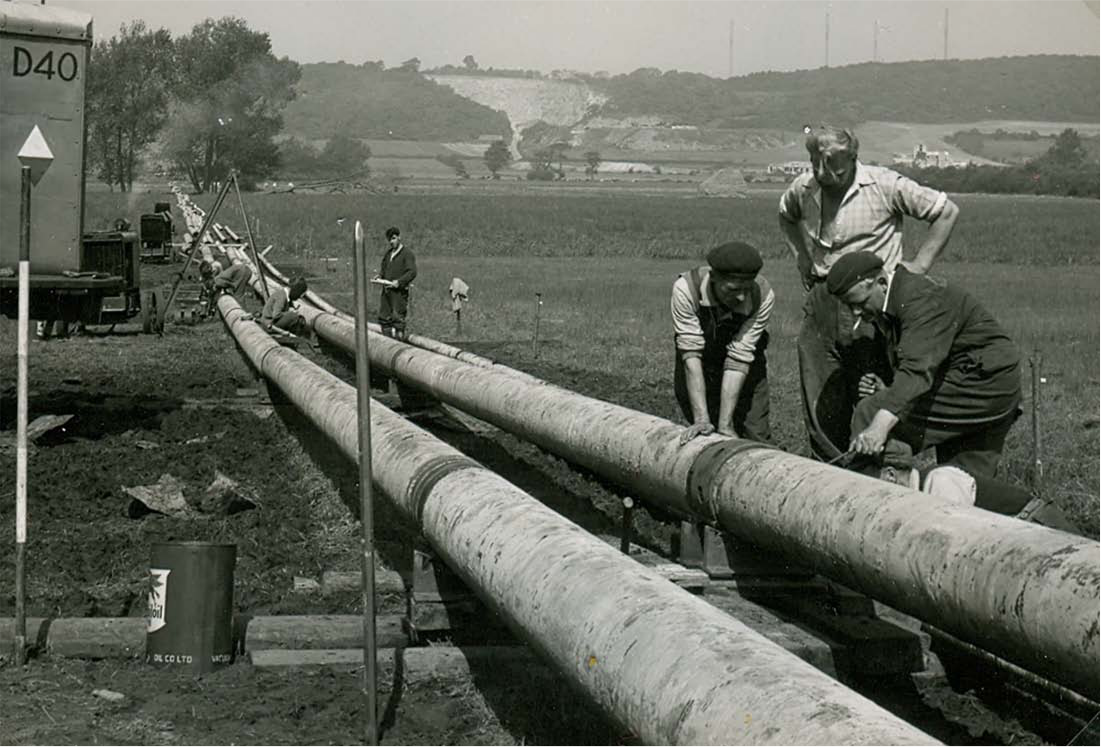
Pipeline Construction. Reproduced with kind permission from the Oil and Pipelines Agency.
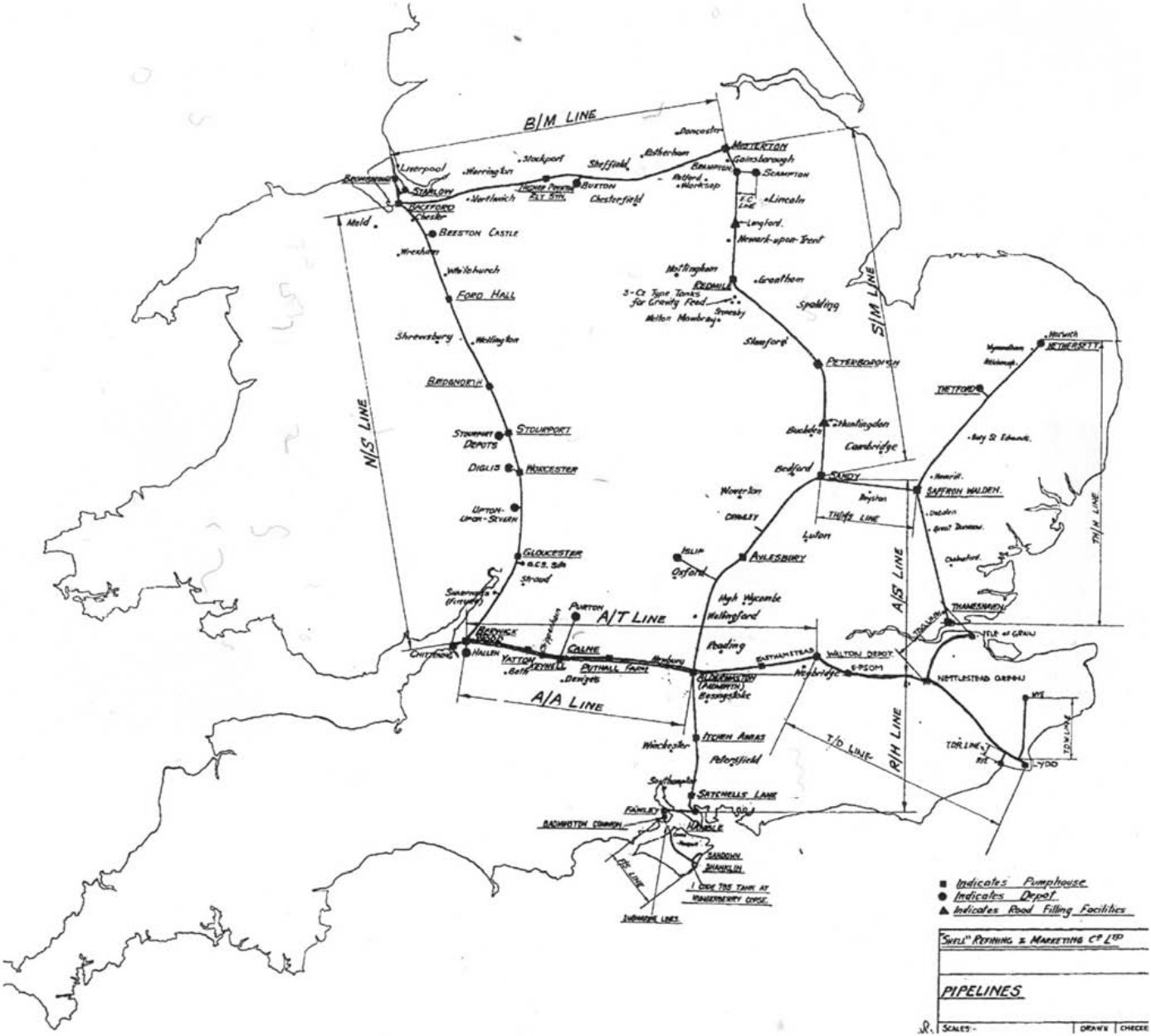
Pipeline Network 1944. Reproduced with kind permission from the Oil and Pipelines Agency.
Nearly all the GPSS pipelines built during the war were either 200 or 250 mm in diameter. They were laid at 1 to 1½-m depth, clear of normal agricultural activities such as ploughing. Unlike the tanks, the pipes were not welded due to both a shortage of welders and 1940s pipe welding techniques being relatively slow. The pipe sections were instead joined together by a mechanical joint known as a Victaulic Coupling. During manufacturing, a groove was cut in the end of each pipe. On site, a rubber ring was seated in the groove and the pipe was held in position by a collar that was tightened by bolts. There was little knowledge in Britain of the potential problems with pipeline corrosion, and the pipelines were only expected to last the war. The only method of anti-corrosion treatment employed was to coat the pipes with black bitumen paint. 6 A team of men and women were, however, employed to patrol the pipeline.
Because the Avonmouth docks were vulnerable to being blocked by bombing, it was decided that it should be connected by pipeline to fuel import facilities on the Mersey. The North/South pipeline was 220-km long and had a capacity of 80,000 tpm. It was also to be used to supply a number of storage depots that had been built along the Severn Valley. It was constructed between November 1941 and June 1942. Fuel also needed to be stockpiled ahead of a possible invasion of Western Europe. The Reading to Hamble pipeline was built between April and June 1942. It was 65-km long and connected a depot near Aldermaston on the Avonmouth/Thames pipeline to depots in the Southampton area. It had a capacity of 120,000 tpm and would enable fuel to be pumped from Avonmouth or the Mersey to the south coast.
VI. The GPSS Ring-Main
The need to transport aviation fuel in increasing quantities for the bombing campaign resulted in the construction of several pipelines in 1943. By far the most challenging of these was the Backford/Misterton 160-km pipeline that had to run across the Pennines. It connected depots near the Mersey to a large new AFRD in Nottinghamshire. The Aldermaston/Sandy 110-km pipeline ran from Aldermaston to a second large new AFRD in Bedfordshire. Both pipelines were completed by May 1943, and by July 1943, a 110-km pipeline, the Sandy/Misterton, had also been constructed creating a ring-main with increased flexibility.
In order for it to be possible to simultaneously supply aviation fuel to East Anglia and motor spirits to London or to the Southampton area, it was decided to construct a second pipeline between Avonmouth and Aldermaston. This was completed by August 1943. All these pipelines were designed with a capacity of 80,000 tpm.
In 1943, with the gaining of complete air superiority over the whole of England, the eastern ports were reopened to tankers. A 60-km pipeline was constructed from Thames Haven to an AFDD at Saffron Walden and then extended another 60 km to an AFDD at Hethersett. A 37-km pipeline from Saffron Walden to Sandy connected it to the GPSS ring-main.
In order to keep the pipelines clean, a metal rod with circular wire brushes and rubber washers was inserted into the pipeline at a storage depot or pump-station and then removed, together with any accumulated dirt, at the next. It was then known as a ‘Go-devil’ and later as a ‘Cleaning Pig’. To move the products, as well as the ‘pigs’, electric pumps were installed at both the storage depot and at intermediate pump-stations. Pumps had to be constantly monitored when running. Instrumentation was limited to bourdon pressure gauges, voltmeters and ammeters. Sites were locally controlled, but a telephone and telex network kept them in contact with each other and Shell-Mex House.
Keeping all the bomber airfields supplied with fuel proved to be a major undertaking for the GPSS. The RAF and United States Air Force (USAF) were now consuming fuel at a rate seven times higher than that envisioned in 1939. A single raid on Germany could use the contents of three C2 tanks. Daily records were kept of fuel consumption and also of the number of tanker journeys made. Airfields would advise their AFDD of the fuel requirements at 10 a.m. and at 7 p.m. Information on the supply requirements for every airfield was also forwarded to Shell-Mex House twice a day by teleprinter.
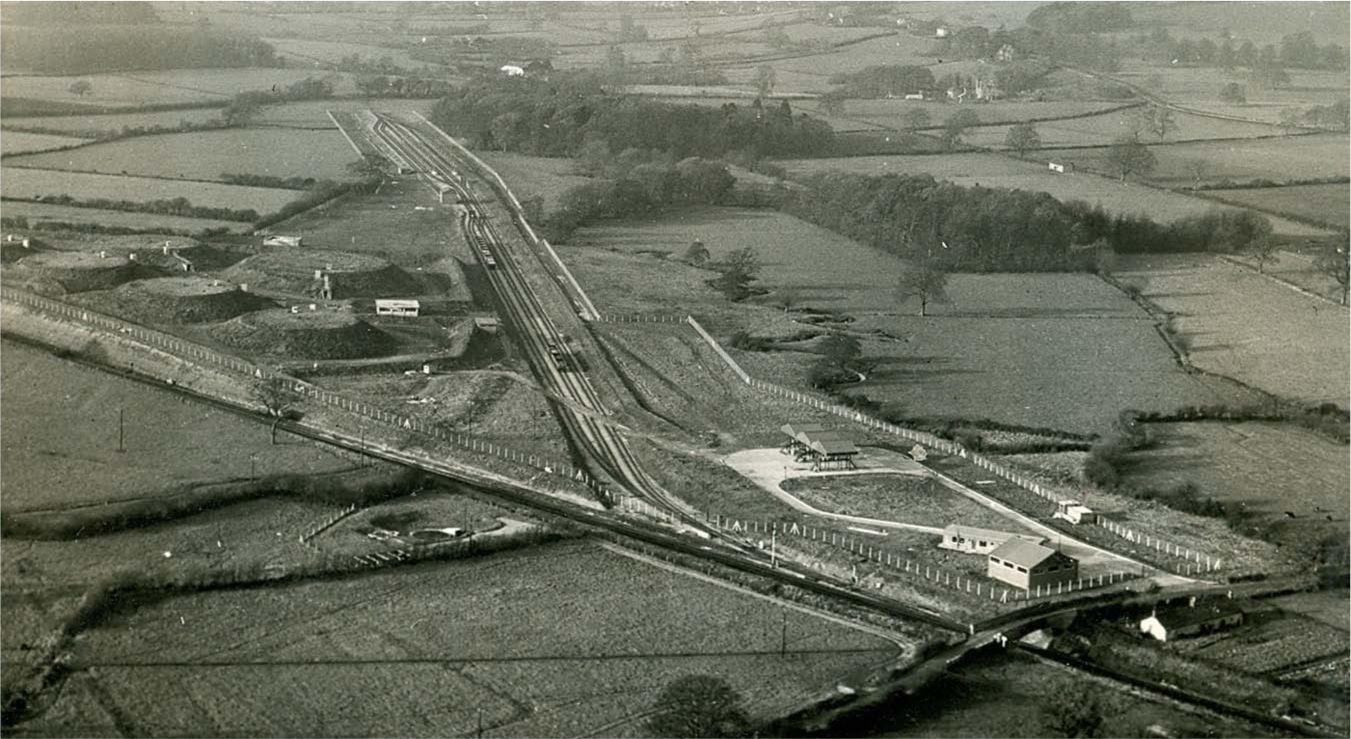
Aerial View of a PSD Showing C2 Tanks, Rail and Road Loading Facilities. Reproduced with kind permission from the Oil and Pipelines Agency.
VII. PLUTO
The PLUTO cross-channel pipelines are better known than any other part of the GPSS. They are also generally perceived to have been vital to the success of the Normandy invasion. Most people also think that PLUTO was an acronym for ‘Pipe-Line under the Ocean’, but according to the official history it stood for ‘Pipeline Underwater Transportation of Oil’. 7
Lord Louis Mountbatten was tasked with making preparations for a possible invasion of occupied Europe. He could not rely on capturing a port intact and was concerned that tankers would be vulnerable to air attack. In April 1942, he asked the minister in charge of the Petroleum Warfare Department ‘Could you run a pipeline under the Channel to supply oil when we invade?’ 8 Submarine pipelines had already been used, but no one had ever attempted to lay a pipeline over such a long distance. The pipeline would need to be assembled into a continuous length before it was laid.
A possible solution was to construct what was essentially a hollow submarine telegraphy cable, with a lead tubing and armoured steel wire, but without the central copper core and insulation. The cable was given the code name HAIS after the inventor and the two companies involved in its initial production. Two engineers also suggested that a sufficiently long length of 3-in steel pipe would be flexible enough to be wound around a very large diameter drum, known as a Conundrum, without developing kinks. It was estimated that such a pipe would survive for at least 6 weeks under the Channel, which, in wartime, was considered sufficient. The pipe was code-named HAMEL after the two engineers.
VIII. BAMBI and DUMBO
PLUTO was planned on the basis that the invasion would take place in the Pas de Calais, the shortest route, with PLUTO being 50 km long. However, in 1943, it was decided that the landings should take place in Normandy, more than doubling the distance for PLUTO. The shortest route was now from the Isle of Wight to Cherbourg. However, the Normandy landings were not to be near Cherbourg, and it would have to be captured before the PLUTO pipeline, code-named BAMBI, could be laid. The Reading/Southampton pipeline was extended to the Isle of Wight for BAMBI. Once the allied armies had secured the French north coast, a much shorter set of pipelines, code-named DUMBO, would be laid from Dungeness in Kent to Boulogne. Dungeness was not close to any existing GPSS pipelines, but by autumn 1943, a 115-km pipeline connected Dungeness to the GPSS.
‘OVERLORD dominated the oil scene in Britain for more than twelve months before the Normandy landings’. 9 Pump-stations were constructed in the uttermost secrecy, both at Dungeness and on the Isle of Wight. A factory was built at Tilbury for welding 2- and 3-in HAMEL pipes into 1200-m lengths. In October 1943, the first of six Conundrums was launched. Virtually, every large cable-making machine was put into service to manufacture the HAIS cable and even cable makers from the United States were utilised.
Stocks of 250,000 tonnes of petrol and diesel in packs and jerricans were built up. During the 12-month period leading up to D-Day, the west to east coast pipelines were kept continuously running at maximum flow rate. Trains of rail tankers were despatched at the rate of 55–65/day. Road tanker drivers were called upon to work 60–65 h/ week.
It was now planned to discharge directly from large ocean going tankers to the shore by 15 June. They were to be moored about 1000-m offshore and then connected through submerged or floating pipelines code-named TOMBOLA to temporary storage tanks on the shore. The Luftwaffe was considered to no longer have the resources to mount a serious aerial threat to OVERLORD.
IX. TOMBOLA and BAMBI
Fuel for the allied armies on D-Day was delivered by dual-purpose tankers carrying petrol in 20-L jerricans. In addition, in anticipation of bulk delivery, concrete storage barges, each capable of holding 180 tonnes of fuel, were towed across the Channel. On 25 June, the first ship to shore TOMBOLA pipeline was laid and fuel flowed through it on 3 July. However, TOMBOLA proved to be only a limited success as the pipelines tended to break on the rocky foreshore. The first PLUTO pipeline was scheduled to be laid on 24 June from Cherbourg harbour. This relied on capturing the Cherbourg harbour intact in 8 days, but it was not taken until 27 June. The Germans, not surprisingly, had systematically demolished all the port facilities. Over a month was now spent in debate as to whether the pipeline terminal should be located outside or inside the breakwaters.
PLUTO was now so far behind programme that some naval authorities suggested that it should be cancelled. On 12 August, the first HAIS cable was laid, but one of the escorting warships managed to catch the cable with her anchor damaging it beyond repair. A second cable lay was carried out on 14 August, but that too ended in disaster. There were also problems with laying the HAMEL pipes. Sir Donald Banks wrote, ‘The technique of cable laying had been mastered but we were not yet sufficiently versed in the practice of connecting the shore ends’. 10
It was not until 22 September that a HAIS cable was finally brought into operation, but at only 250 tonnes/day. The first successful lay of a HAMEL pipe took place on 29 September and pumping now proceeded using both systems. On 3 October, an attempt was made to increase the pressure in the HAIS cable from 50 to 70 bar. Suddenly, the pressure fell to nothing indicating that the cable had broken. Shortly afterwards, the HAMEL pipe also failed and ‘elation was changed into funereal gloom’. 11 On 4 October, all BAMBI operations were stopped.
The total amount of fuel delivered to the allied armies in North-West Europe from D-Day to Victory in Europe (VE) Day, amounted to 5.2 million tonnes. BAMBI delivered less than 0.1% of this at a huge cost in resources. As the official history states, ‘PLUTO contributed nothing to Allied supplies at the time that would have been most valuable’. 12 Once the decision was made to invade in Normandy, then the concept of supplying the initial stages by pipeline from England should have been abandoned.
X. DUMBO
The first HAIS cable was laid from Boulogne on 10 October, but with the weather deteriorating, it took until 27 October for pumping to start. By mid-December, a total of six HAIS cables had been laid, but only four were operational. They could, however, only operate between 20- and 30-bar pressure instead of the planned 99 bar. As a result, daily deliveries averaged only around 700 tonnes. According to the official history, ‘There were frequent changes of plans and the enthusiasm of the PLUTO force gradually dwindled’. In December, the Royal Navy suggested that DUMBO should also be shutdown. 13 On 2 January 1945, a committee ruled that all available HAIS cables and HAMEL pipes should be laid in an attempt to reach the originally planned throughput of 3300 tonnes/day. In all, 11 HAIS cables and 6 HAMEL pipes were laid, some after VE Day in May 1945.
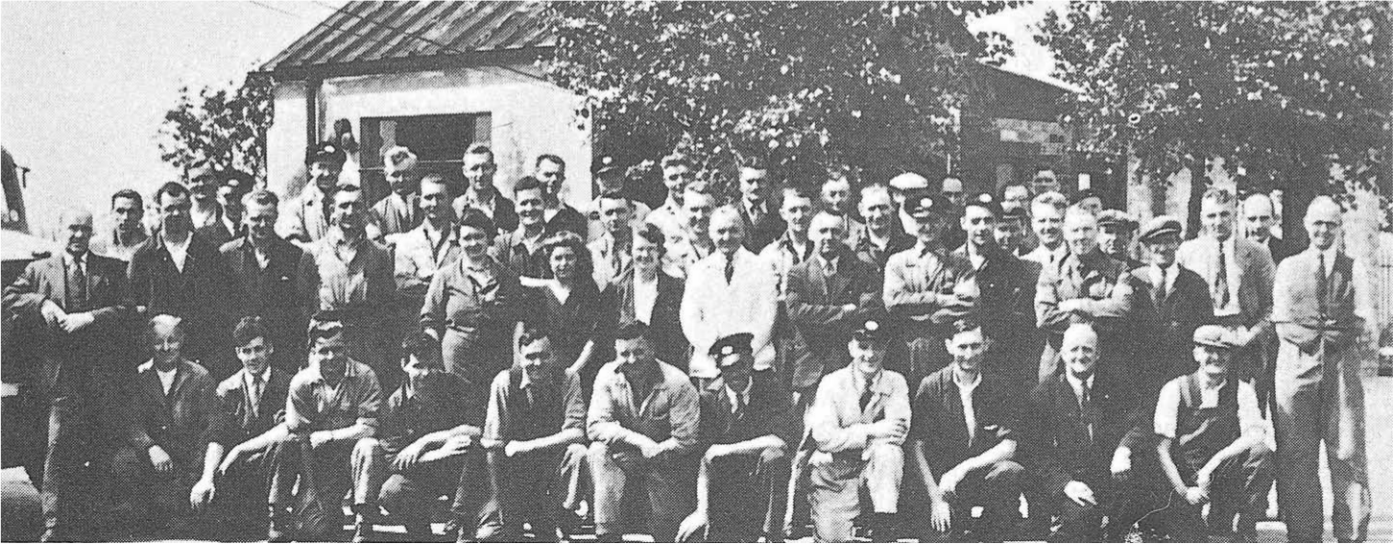
The Men and Women of the Stow Park Air Force Distribution Depot. Reproduced with kind permission from the BPA.
DUMBO was clearly more successful than BAMBI, but by VE Day, only 8% of the fuel delivered was by DUMBO, the rest being mainly by tanker. One defence of PLUTO is that ‘it saved a very large tanker tonnage which was badly needed in the East’. 14 However, according to the official history, DUMBO did not reach its peak flow-rate until after VE Day and that the average flow-rate was around 1800 tonnes/day. 15 The amount carried by PLUTO equated to 2 large tankers per month. Major-General Tickell wrote that ‘we gained very little from Pluto and Dumbo’. 16 The official history concluded that ‘DUMBO was more successful; but at a time when success was of less importance’.
XI. Pipeline Networks
From September 1944, army engineers were rapidly building a pipeline south from Cherbourg that would eventually extend into Germany. It was, however, supplied by ocean tankers, not by PLUTO. A pipeline network was extended out from Boulogne into Germany. This network could truly be considered an extension of PLUTO, and gasoline was pumped from the Mersey through PLUTO into Germany.
The pipeline network that really did contribute greatly to the allied victory was not PLUTO but the unsung and largely unknown GPSS. It carried in excess of 250,000 tpm of fuel through all of 1944 and the early part of 1945. The entire GPSS was an incredible endeavour for first keeping Britain in the war and then providing one of the means for victory to be won.
Footnotes
Acknowledgements
This article is based on the first part of a history of the GPSS that the author is currently writing. The author would like to thank all his former colleagues who worked with him on the GPSS and various friends for their assisting him in the preparation of that book and for their comments and corrections.
Funding
This research received no specific grant from any funding agency in the public, commercial, or not-for-profit sectors.