



Abstract

Allegro’s A1359 Programmable Hall-Effect Sensor
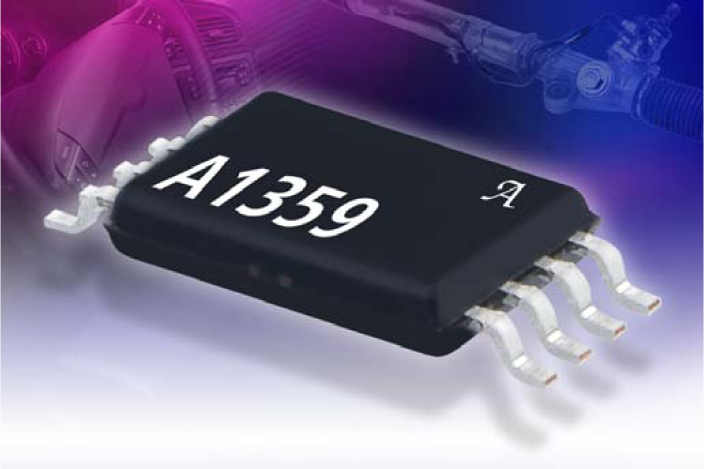
The new A1359 from Allegro MicroSystems Europe is a programmable linear Hall-effect sensor integrated circuit (IC) with a dual analogue/pulse–width modulation (PWM) output that makes it ideal for applications requiring output redundancy.
The new device has been designed for use in applications, such as displacement and angular position sensing, that require high accuracy in conjunction with redundant outputs. This is achieved in the dual tracking output of the A1359, where the PWM output tracks the analogue output to within ±3%.
The accuracy of the IC is enhanced via programmability on the analogue output pin for end-of-line optimisation without the added complexity and cost of a fully programmable device.
The A1359 features one-time programming using non-volatile memory to optimise device sensitivity and to set the quiescent output voltage and duty cycle for a given application or circuit. The sensitivity range of the A1359 is 4–9 mV/G, and the quiescent analogue output is adjustable around 50% of the supply rail voltage.
Optimised performance at different temperatures is achieved by programming the temperature coefficient for sensitivity, quiescent output voltage and duty cycle at end-of-line test.
The A1359 is targeted at the automotive and industrial markets, with end applications including torque sensing in electronic power steering and position sensing of transmission components, brakes and clutch cylinders. The A1359LLETR-T is available in a TSSOP-08 (suffix LE) surface-mount package.
Allegro MicroSystems Europe Ltd.
Mary Regan, +33 (0) 4 50512359,
Kistler’s KiTorq Gets Extended Measuring Ranges
Kistler Instruments has added three new measuring ranges to its KiTorq torque measuring system. The new ranges of 100, 200 and 5000 Nm have been added to the existing ranges of 500, 1000, 2000 or 3000 Nm measuring ranges. All ranges are available with an accuracy class of 0.05% of range. These additional ranges complete the portfolio for test benches for internal combustion engines, electric motors, transmissions and drivetrains.
Rotors of different sizes can be combined with same ringless stator, which is particularly easy to install and allows different items to be tested without the complete reconstruction of the test stand. Kistler claims that the ringless stator design speeds up the installation, protects against damage during assembly operations and facilitates visual observation during the test process.

A single, intelligent stator can be used with any KiTorq rotor of the same speed rating and will automatically recognise the rotor measuring range. This minimises hardware investment as one stator may be used with rotors of differing ranges for different applications. Installation is simplified by the contactless, digital telemetry that does not require an antenna ring. The lack of an antenna ring has not reduced the precision of the sensor that has, Kistler states, an excellent signal bandwidth of 10 kHz and accuracy of better than 0.05%. A speed measurement of 60 pulses per revolution is integrated in the standard system.
Kistler Instruments Limited
01256 741550,