



Abstract

Global Motion Control Market Contracted in 2012
According to a study recently published by IMS Research (http://www.imsresearch.com), sales of motion control products have decreased in 2012 in China as a result of overcapacity, and the global motion control market is forecast to decline by 1.9% compared to 2011. In 2013, this market is projected to rebound with revenue growth of nearly 5% helped by recovery of the Chinese market, yet limited by the continued Eurozone recession.
In 2010 and 2011, the global motion controls market grew strongly with revenues increasing over 20% to reach an estimated value of £8.4b. The year, 2012, says the study, presented a very different situation, with the Eurozone recession and softening of the Chinese economy causing motion control sales to fall well below expectations.
The biggest surprise in 2012 was the extent of the contraction in the Chinese motion control market, where revenues are forecast to decline by an estimated 16.5%–18.5%. Reduced order rates have resulted from overcapacity concerns and conservative buying patterns from machine builders.
Sales of low-end servo products in China have been most affected, impacting the Chinese and Japanese suppliers who rely heavily on this market. The market for high-end servo products is more stable.
Collimating Light for Precision Measurement
Schott and Moritex have developed a telecentric illuminator built on an innovative concept for precision measurement using backlights. It converts diffuse light from an illumination source into a powerful collimated light beam that can produce a highly accurate silhouette for image measurement.
The new generation collimated illumination system MTI-78 is based on Moritex’s advanced telecentric lens optics technology for machine vision. With the help of telecentric optics, light generated by a light-emitting diode (LED) or fibre optic light source passes through the MTI-78 system and is transformed into a parallel light beam. The parallel beam creates a clear edge silhouette image of the object placed between the MTI-78 and telecentric lenses.
The new telecentric illuminator for high-precision size measurement (Photo – Schott/Moritex)

The main benefits are extreme illumination uniformity because of the advanced optics, as well as a variable iris that enables optical light intensity adjustment. The new lens is well suited for use in various applications such as the precise size measurement of automotive parts, electronic components or pharmaceutical packages. For more information, go to http://www.schott.com/lightingimaging.
Testing Wind Turbine Gearboxes with PULSE
Japan’s largest wind turbine gearbox manufacturer Ishibashi faces a familiar challenge in manufacturing wind turbine gearboxes – ensuring the reliability and longevity that is critical to their customer’s return on investment.
At the core of the company’s testing procedure is Brüel & Kjær’s PULSE analyser, and following the acquisition of its first system in 1998, the company now has four PULSE systems in Japan and an additional one in its Chinese facility.
PULSE is Brüel & Kjær’s platform for noise and vibration analysis. Developed as an advanced solution for sound and vibration measurement, PULSE has a vast range of software applications and hardware configurations. Over 11,000 systems have been sold. In this application, PULSE hardware and software is used for research and design – and also records other important parameters, including oil temperature and pressure.
Ishibashi accommodates requirements from customers such as Mitsubishi Heavy Industry and focuses on developing solutions with its customers. This focus brought the need for new equipment, leading to an investment in their first PULSE system.
Other Brüel & Kjær instruments typically used are triaxial accelerometers and a sound intensity probe, with Brüel & Kjær accelerometers and microphones used exclusively.
For more information, go to http://www.bksv.com.
Gasmet Technologies Acquires Ansyco GmbH
The Finnish instrumentation manufacturer Gasmet Technologies Oy has acquired the share capital of Ansyco GmbH (http://www.ansyco.de) in Germany.
Gasmet Technologies (http://www.gasmet.fi) is one of the world’s leading manufacturers of gas monitoring instruments and systems for industrial and environmental applications. The company’s revenue streams are dominated by Fourier transform infrared spectroscopy (FTIR)-based analysers that are capable of performing simultaneous measurements of both organic and inorganic compounds in even the most demanding applications.
Founded in 1989, Ansyco GmbH (Karlsruhe, Germany) has been a distributor of Gasmet products since 1993. According to Mikko Ahro, CEO of Gasmet Technologies,
“The Gasmet Group has been operating from three different locations, Helsinki, Hong Kong and Montreal, and this is a good time to combine Ansyco’s application knowledge with Gasmet’s well-established products to expand the Karlsruhe operation.”
Following the acquisition, Ansyco will be known as ‘Ansyco – a Gasmet Group Company’.
Distech Building Management System Makes the Grade in Scottish Schools
A new Building Management System (BMS) from Distech Controls (http://www.distech-controls.eu) is helping Renfrewshire Council reduce fuel consumption and cut carbon emissions at four schools while educating future generations on the benefits of integrated, energy-efficient control.
This major project has seen a new Distech Control system fitted as part of an extensive building services refurbishment programme.
The existing heating, ventilation and air conditioning (HVAC) plant and control systems in use at St Margaret’s Primary School, Johnstone; St John Bosco Primary School, Erskine; and St Mary’s Primary School and Gallowhill Primary School, both in Paisley, had reached the end of their lifetime. Glasgow-based Advanced Energy Management Services (AEMS) was tasked with stripping out and replacing the mechanical services at each school within a very tight timescale – including configuring and commissioning – of just the 6-week summer holidays.
AEMS has equipped each of the four schools with a more efficient main HVAC plant solution. This includes new gas detection systems and automatic controls from Distech within each boiler house. These monitor and regulate heating and hot water operation, ensuring optimum system efficiency.
One of the schools that is benefiting from a new BMS from Distech Controls

AEMS selected the Distech EC-NetAX web-based, integrated building management platform for the project with the company’s EC-BOS series of network controllers and ECB series of BACnet field controllers, providing approximately 70 control points at each school. Converging with the school’s information technology (IT) network, EC-Net allows secure web-browser access to the system from anywhere within the school environment or locally through touch screens in the main reception area and boiler house.
Apart from providing access to the school management and staff, the control system has also become a part of the education process. Under teacher supervision, kids can access and adjust settings and see the impact of these changes and other energy conservation measures taken at the school. The EC-NetAX platform is easy to use and understand, while attractive three-dimensional (3D) graphics help to engage pupils.
Yokogawa Supplies Integrated Control and Safety Offshore
Yokogawa Europe Solutions B.V. (Companion Company) (http://www.yokogawa.com/eu) has been awarded a contract by GDF Suez E&P UK Ltd to supply the integrated control and safety systems (ICSS) for its new Cygnus Development Project.
This follows on from recent North Sea contract awards from a number of major oil and gas companies, and Yokogawa says that it has designated the upstream oil and gas sector as a focus area in its Evolution 2015 midterm business plan.
Under the contract, Yokogawa Europe will supply the complete ICSS comprising process control and shutdown, emergency shutdown, fire and gas detection (with associated field devices), process data historian, and field device asset management. The ICSS will feature Yokogawa’s Centum VP process automation system, ProSafe-RS safety system, Exaquantum Production Management Solution and PRM asset management package.
This ICSS will provide fully integrated and seamless control and safety functions for the platforms along with a single interface allowing operators to start, control and monitor all facilities from a central control room. Asset management is another important issue; with its rich functionality, PRM will minimise maintenance costs and enable proactive instrument maintenance management. The operator training system (OTS) will be used not only for operator training but also as an engineering tool to confirm changes in control strategy. Yokogawa will also be supplying an OTS using the OmegaLand advanced operator simulation environment.
30 GHz Probing for Serial Data Measurements
Tektronix (http://www.tektronix.com) has launched what it claims is the industry’s ‘lowest noise and highest bandwidth 30 GHz probing system having coaxial connectors’. The new P7600 Series Probing System features probe-specific digital signal processing (DSP) filters that enhance performance and minimise noise levels. When paired with the Tektronix DPO/DSA73304D oscilloscope, the P7600 Series Probing System provides connectivity and signal fidelity for high-speed differential signal measurements on serial bus designs such as Peripheral Component Interconnect (PCI) Express.
Tektronix’s new 30 GHz probing system with coaxial connectors

For high-speed serial data standards, designers are using differential signalling, which can be more efficiently acquired on an oscilloscope using this new mini-coaxial differential probing method. The new P7600 Series includes two direct connect 2.92 mm coaxial inputs enabling conversion of an incoming differential signal pair to a single oscilloscope input channel. This enables up to 30 GHz differential measurement capability on all four DPO/DSA73304D oscilloscope channels.
Efficient uses of oscilloscope channels enable multilane serial bus acquisitions and/or simultaneous acquisition of high-speed data alongside other system activity, like 100 MHz reference clocks or chip-to-chip bus traffic like I2C.
The P7600 Series also includes TriMode functionality that provides full support of differential measurements found in high-speed serial signals, along with independent single-ended and direct common mode measurements through the same probe connection.
Endress+Hauser Celebrates 60th Anniversary
Family-owned specialist measurement and automation engineering company, Endress+Hauser (http://www.endress.com), is celebrating its 60th year in business and has just welcomed its 10,000th employee. In the last year alone, over 500 jobs were created worldwide.
Vereinigte Hüttenwerke was the first production site in Lörrach-Stetten, Germany
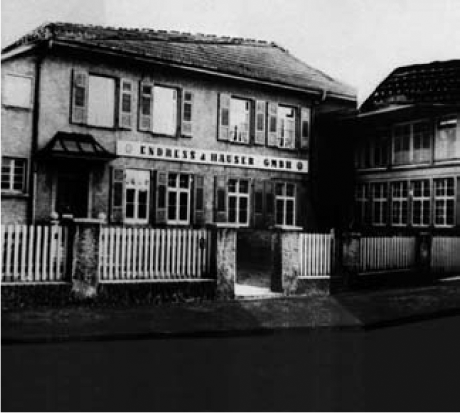
The company is still expanding because, it says, of the continuity of a prudently run family-owned business whose first and foremost principle is to satisfy customers’ needs and requirements. ‘First serve, then earn’ was one of the mottos of company founder Georg H Endress (1924–2008), and the company says that this is still valid today.
Headquartered in Switzerland, Endress+Hauser is a world leader in measurement and automation engineering. The company’s independence, fully owned by the founder’s family, has been laid down in a charter and is bound to be upheld in future.
It all began in February 1953 when Swiss engineer Georg H Endress and German banker Ludwig Hauser set up their company in a backyard in Lörrach, Germany. The first-level measurement instrument was patented 2 years later, and these instruments soon enjoyed a good reputation in the industry. As early as 1957, sales exceeded 1 million Deutschmarks (DM1m).
The Sternenhof building in Reinach, Switzerland – the holding company, Swiss sales centre and other Endress+Hauser companies operate from this corporate headquarters

Over the past 60 years, Endress+Hauser has gone from being the vendor of devices and instruments to a full-range supplier that supports its customers in operating their plants reliably, efficiently, and in an environmentally compatible manner throughout their entire life cycle. According to CEO Klaus Endress,
“Our strength is that we are entirely driven by the market. We learn from our customers and strive to create sustained and outstanding benefits and value for them.”
First Time-Division Duplex–Feature-Driven Development Network Handover Using Long-Term Evolution Test System
Network operators around the world are commissioning dual-standard networks as part of the rapid expansion in time-division long-term evolution (TD-LTE) (long-term evolution time-division duplex (LTE TDD)) networks, and Aeroflex says that its E500 LTE Capacity Test System is ‘the industry’s first capacity tester to successfully handover data services between TDD and FDD networks’. The E500’s handover capability is, therefore, crucial for both operators and network suppliers testing TDD/feature-driven development (FDD) networks.
Converged TDD/FDD networks allow mobile operators to maximise the benefits from their investments, as well as providing the best quality service for customers.
This new test system enables operators to confirm the operation and performance of their network before releasing into the field. It achieves this by enabling the network to be loaded with hundreds to tens of thousands of user equipments (UEs), each capable of emulating different radio-fading profiles with varying data service mixes in a multi-cell environment. The E500 exploits Aeroflex’s TM500 Test Mobile platform, which the company says is the de facto industry standard for LTE and LTE-Advanced (LTE-A) base station and network testing.
The E500 LTE Capacity Test System by Aeroflex

For more information, email:
Solid-State Logic Solver Can Make Nuclear Plant Safer
Safety systems specialist Hima-Sella (
Emphasising the suitability of Hima-Sella’s solid-state logic solver for use in the nuclear industry, the company’s Planar4 secures EMPHASIS approval from Sellafield Ltd

All non-software- or processor-based modules are being evaluated for Safety Integrity Level 2 (SIL 2) for use in the nuclear industry (up to SIL 4 for all other industries). Securing this approval is a rigorous process using the EMPHASIS assessment methodology. It included a Sellafield representative visiting Hima in Germany where the Planar4 was designed and manufactured.
In addition, the software-based (processor-based) Planar4 modules have been subjected to the EMPHASIS assessment methodology. These modules have only been evaluated as suitable for SIL 1 in accordance with current Sellafield requirements. However, they can be re-evaluated to SIL 2, if required, by Sellafield carrying out an additional Independent Confidence building measure such as ‘software evaluation’.
EMPHASIS was developed as part of an R&D project by the UK Control and Instrumentation Nuclear Industry Forum (CINIF) with inputs from the Office of Nuclear Regulation (ONR). It is considered to be the nuclear industry’s methodology for substantiation of SMART and Type ‘B’ devices.
Integrated, PC-Based Building Automation
Beckhoff presented its PC- and Ethernet-based control technology for building services applications for the first time at ISH in Frankfurt am Main, Germany, in March. Around 40% of global energy consumption occurs in buildings, and hence, in view of increasingly scarce resources, there is an urgent demand for more building automation.
Beckhoff’s Bus Terminal system is the basis for the acquisition of all data points in a building. All building functions and function changes are realised in software, making for maximum flexibility and low engineering costs. Functional expansion and modifications can be carried out during operation. The integrated TwinCAT platform can deal with all key building functions, including HVAC systems, room automation, lighting and façade control.
The TwinCAT automation software enables building projects to be programmed based on the international International Electrotechnical Commission (IEC) 61131-3 programming standards. PLC libraries are available for all building services infrastructure components.
For more information, go to http://www.beckhoff.com/ISH and http://www.beckhoff.com/building
News in Brief
Process control system expanded for mining sector
Siemens Industry Automation (http://www.siemens.com) has added many new functions to Version 8.0 of its Cemat process control system for the cement, mining and related industries. Certain functional details of previous versions, such as the maintenance and service management system, have also been further developed for Cemat V8.0. Highlights are the additional operating modes for plants, device groups and individual units, as well as the monitoring of process values, such as accumulated pressure and flow rates. The user can also now put together curve groups very easily.
Better online process monitoring and control
CAMO Software (http://www.camo.com) has released a new version of its Unscrambler X Process Pulse software for process monitoring. It can be used by lab staff, technical services, engineering, R&D or production departments and is suitable for developing control and monitoring strategies for unit operations in pharmaceutical or biotech manufacturing and pilot laboratory test beds, and proof of concept for scale-up/scale-down, or run-time applications involving spectroscopic analysers. It is claimed to be easy to set up and run, enabling users to apply multivariate models to near real-time or real-time data for small production units and applications using portable analysers. It also allows prediction and correction of process deviations before they become a problem.
World first in analogue power-management controls?
Microchip Technology has launched the digitally enhanced power analogue MCP19111, which it claims is the world’s first digitally enhanced power analogue controller. It operates across 4.5–32 V and offers a significant flexibility improvement over conventional analogue-based solutions, says Microchip. It represents the world’s first hybrid, mixed-signal power-management controller, integrating an analogue-based pulse-width modulation (PWM) controller with a fully functional Flash-based microcontroller. This offers the flexibility of a digital solution, with the speed, performance and resolution of an analogue-based controller. MCP19111 devices feature integrated metal oxide semiconductor field-effect transistor (MOSFET) drivers configured for synchronous, step-down applications. When combined with the company’s family of high-speed MOSFETs, the device drives customisable, high-efficiency power conversion. For more information, watch a short video at http://www.microchip.com/get/C0TN