



Abstract

I. Synopsis
In everyday life, people do not give measurement a second thought. They just expect litres of fuel, kilograms of food and so forth to be correct. Despite this general lack of appreciation, good measurement is essential for the proper functioning of a modern society. In fact, I would go further and assert that civilisation and good measurement are partners that inevitably go together. For example you could not build monumental structures like the pyramids without good measurement, and it was not without reason that during the first imperial dynasty in China, the Qin dynasty, weights and measures were standardised.
Beginning with the general idea of measurement, measurement quantities and the concept of a measurement system, this paper will examine the importance of reliable measurement. Examples will be given from everyday life where modern society implicitly relies on good measurement. My aspiration is that the whole paper will be a celebration of the metrologist’s craft and that the reader will go away with a clear understanding of the importance of measurement to modern life.
II. The Historical Rise of Measurement
Ever since civilisation was, man has measured. The ancient Babylonian astrologers knew how to chart the passing of time and became so adept at it that they could predict the occurrence of astronomical phenomena such as eclipses. Trade, even in ancient times, was essential, and weights and measures were established to ensure that trading was carried out in a fair manner. For example, in the book of Deuteronomy in the Bible, written about 1500 BC, it is stated, ‘You shall not have in your bag differing weights, a heavy and a light. You shall not have in your house differing measures, a large and a small. You shall have a perfect and just weight, and a perfect and just measure …’. 1 This shows how seriously ancient Israelite society took the issue of fair trade, with standard weights and measures established to ensure that there were just measurements.
If one considers monumental structures such as temples, ziggurats and pyramids, these could not have been constructed unless accurate dimensional measurements were available. In ancient Egypt, they took this very seriously to the point that the lead architects faced the death penalty if they did not calibrate their length standard by every new moon ( Figure 1 ). This forced not just good measurement practice but the keeping of documentary records to ensure traceability to a measurement standard could be proved. In fact, one could say traceability was literally a matter of life or death!

Copy of ancient Egyptian length standard next to a national copy of the international prototype of the metre bar
Slowly, over time, measurement became more sophisticated but still essentially relied on ‘natural’ standards. For example, a Roman mile was based on 1000 paces, the pace being the length of 5 (human) feet and the rod being the combined length of the feet of 18 ‘average men’. This resulted in some variation in the standard being used, so to improve on this situation, these ‘natural’ standards became transferred to physical artefacts against which others were calibrated. This led to increasing uniformity in measurement – and an opportunity to make money. Trade was to be carried out in the standards of the locale, and if you were trading, say, wheat, oats or oil, then you had to sell in the local measures. This sometimes caused a good degree of confusion as local trading standards had their own reference standards, and these did not always agree with those of other regions. For example, in Figure 2 , there are pictures of two old Spanish liquid measurement standards known as the media cántara (half churn). Both are supposed to be of the same volume, but many cities had their own version – imagine what potential there must have been for confusion and arguments – ‘my media cántara is the right one …’.

Two Spanish media cántara (volume measures) from the Spanish cities of Valladolid and Toledo
In England, the Magna Carta (1215) was a landmark document as far as measurement was concerned. Here, a group of barons tried to constrain the power of King John by forcing him to sign a bill of rights. One of the provisions of the document spelled out that uniform measurement standards were to be used: ‘there is to be one measure of wine and ale and corn within the realm, and one breadth of cloth and it is to be the same with weights’. 2
Another example is the coming of the railways. Before the railways, local time was different in different parts of the country. Time was charted by the interval between successive appearances of stars (or the sun) at particular positions, for example, the time when the sun crossed the meridian was taken to be noon. Because of the rotation of the earth, this took place at different times depending on where you lived – there was nearly a 30 min difference between the east and west of England. This caused all sorts of problems and eventually led to the establishment of the Greenwich meridian, which was used to set the time for the whole of the country, and ultimately for the world.
As we approach modern times, with the increase in national and international trade, and with the rise of multinational manufacturing, it became essential that measurements were placed on an international footing. The precursor to the metric system began in 1790 when Louis XVI commissioned French scientists to recommend a consistent system of weights and measures. Those recommendations were to form the centre piece of the decimal metric system established in June 1799, at the time of the French Revolution. Over time, the decimal metric system came to be increasingly recognised as a reliable measurement system that could be adopted more widely. This led, in 1875, to the establishment of a diplomatic treaty known as ‘the metre convention’ initially adopted by 17 nations who agreed to promote the metric system in their countries. The first base units to be adopted were the metre, the kilogram (see Figure 3 ) and the second. Other units were added over the years (the Kelvin, for example, in 1948) ultimately growing to become Le Système International d’Unités or the SI 3 by international agreement in 1948 and adopted in 1954. The seven base quantities and respective units of the SI system are length, the metre; mass, the kilogram; time, the second; electric current, the ampere; thermodynamic temperature, the kelvin; amount of substance, the mole; and luminous intensity, the candela. These quantities, via the unit definitions, form the basis of the vast majority of all measurements undertaken throughout the world today.
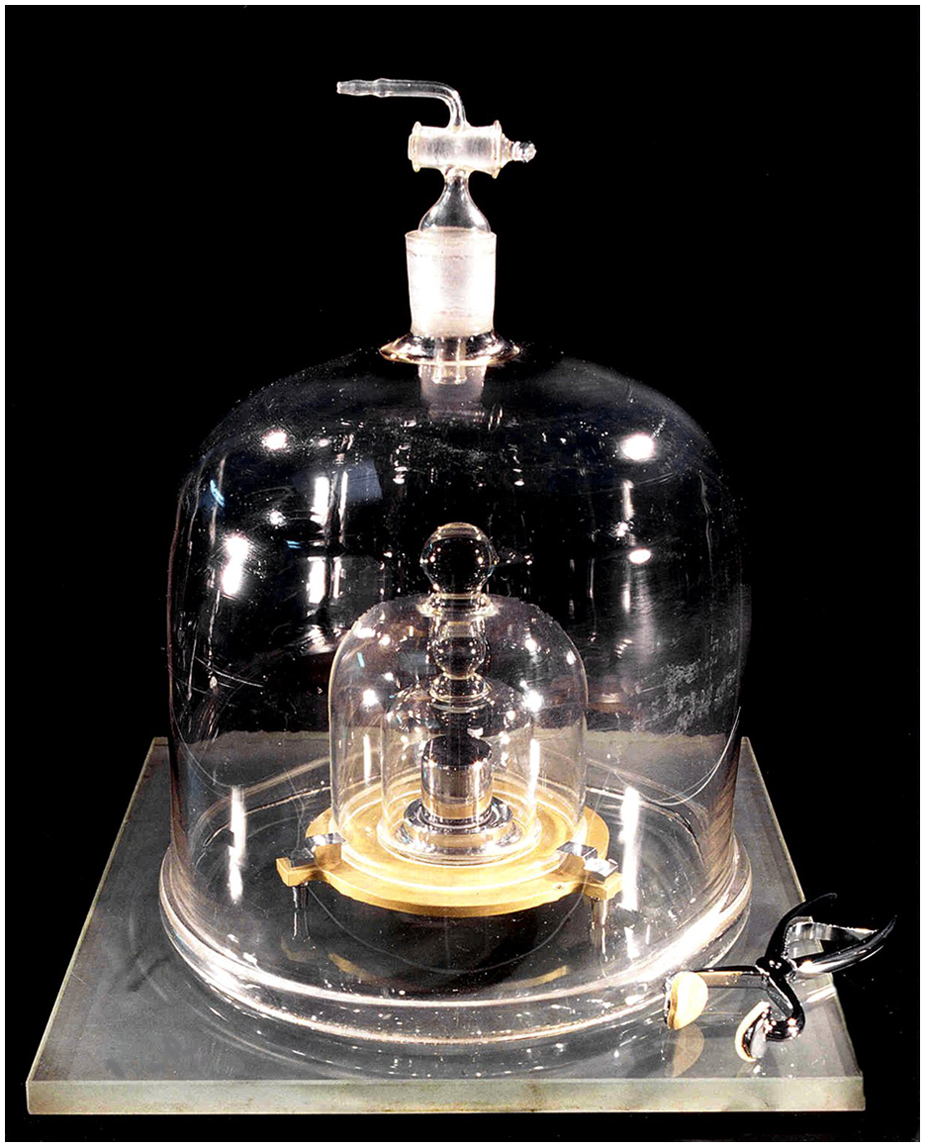
The international prototype kilogram
The United Kingdom was at first resistant to the metric system, despite passionate advocates such as Lord Kelvin who got 8 million ‘British subjects’ to sign a metrification petition in 1904. Despite his constant running down of the imperial ‘no system’, 4 as he was fond of calling it, it was not until 1965 when the Federation of British Industry told the government that it favoured metrification, and steps were taken to introduce the SI system into the United Kingdom.
The SI system continues to evolve to meet current and anticipated measurement needs. Although outside the scope of this paper, it is anticipated that in the next few years, possibly as early as 2015, four of the base units of the SI will be redefined, the kilogram, the ampere, the kelvin and the mole, in terms of fundamental constants of nature. For instance, the size of the kelvin would be set by a fixed value of the Boltzmann constant and would be no longer linked to the water triple point as is currently the case. The interested reader should visit the following webpage of the International Bureau of Weights and Measures (BIPM) for more details: http://www.bipm.org/en/si/new_si
In the late 1800s, it was recognised that there was an urgent need to establish a modern measurement system in the United Kingdom. A home was found for the body tasked with this important role in Teddington, South West London, and so in 1900, the National Physical Laboratory (NPL) was established in Bushy House ( Figure 4 ).

Bushy House the original location of NPL
NPL was formally opened on 19 March 1902 by the then Prince of Wales ( Figure 5 ) – he opened it with the words in the text box below, which are as relevant to NPL’s mission today as they were when spoken 110 years ago. 5

Royal opening of NPL by the Prince of Wales, 19 March 1902
From that time onwards, NPL has been a world leading National Measurement Institute (NMI) responsible for many of the cutting edge innovations in measurement that have taken place. The aim of NPL is to realise, establish, maintain, disseminate and lead developments in all the base quantities of the SI, ensuring that these are realised in an equivalent way with the United Kingdom’s major trading partners. NPL also has an important educational role, helping users improve their practice of measurement and providing solutions to measurement problems in industry and research organisations.
This paper has given a few examples of how important measurements have been through history and has briefly explained how the measurement system currently in use in most of the world arose. In the next part of the paper, the relevance and importance of reliable measurements to many aspects of modern life will be explained. Although reliable measurement is taken completely for granted by most of the population, it is clear that without the background infrastructure in place to make it happen, modern life as we know it would be hard, if not impossible, to sustain.
III. The Importance of Measurement to Modern Life
Reliable measurement is one of the hidden ‘miracles’ of any modern society. This is illustrated, when one considers the examples given below of mass (and volume), length, time and temperature measurement.
A. First, mass metrology
The mass of objects is determined by weighing. This was generally done in the past by comparing a known mass with an unknown mass – for example, a kilogram weight would be compared, using a set of scales, to a kilogram of the things you wanted to buy. However, none of us take our own calibrated weighing scales with us to the supermarket! No, we just assume that the weighing scales in the supermarket, or the weights printed on the thousands of packed goods stocked on their shelves, are correct. Ultimately, all mass measurements in the United Kingdom are linked to the UK national prototype kilogram kept at the NPL ( Figure 3 ), which is itself linked to the one (and only) International Prototype Kilogram that is kept at the BIPM in Paris.
To give an idea of how reliable mass measurements can be, primary kilogram mass standards can be compared to an accuracy of about 1 µg (about 1/1000th the weight of a grain of sugar). NPL uses the national prototype kilogram as a reference against which to make calibrations of weights from less than 1 mg to tens of kilograms. The kilogram also provides traceability for quantities such as force, pressure, density, flow and even humidity.
In the commercial area, when we buy our litres of fuel from a garage, we do not take our personal calibrated litre measure with us and check to make sure that the garage is giving us the correct volume of fuel, we trust that the amount of fuel indicated by the pump is dispensed correctly 6 ( Figure 6 ).

Fuel accurately dispensed by a modern fuel pump
These basic measurements are, in everyday life, just assumed to be correct without a second thought, and of course, they are correct – but only because of the ‘hidden’ measurement infrastructure that supports reliable measurement in the economy.
B. Second, length (or dimensional) metrology
As illustrated above, length measurement has been used by humankind since the earliest epochs. Starting with simple size measurements made by eye of parts of stone and metal tools, dimensional metrology has evolved through the use of material standards such as the Pharaoh’s cubit of ancient Egypt, unification and simplification attempts by various sovereigns of the more anthropic standards (feet, inches and yards), through modern international standards such as bars of brass and then platinum-iridium, to the latest fundamental standard based on the speed of light realised by lasers.
Three periods in history created much of the landscape of modern dimensional metrology: the scientific revolution (1550–1700), the industrial revolution (1750–1850) and the technological revolution (1850–1914). Inventions such as the Vernier scale (1631), Gascoigne’s micrometer callipers (1673), Eli Whitney’s interchangeable musket parts (1799), Whitworth’s interchangeable threads (1841), Johansson’s gauge blocks (1896) and the Zeiss dial indicator (1904), among others, mixed facilitated increased automation and the interchangeability of parts needed for mass production.
In the 21st century, dimensional metrology is a vital component of manufacturing. It covers 14 orders of magnitude from around 20 pm up to 2 km, all traceable to the metre. One might even consider the Earth–Moon distance measurement, performed by time-of-flight laser ranging, to be a traceable measurement of a 400,000 km distance!
At the longest distances, laser interferometers are used to verify the performance of Global Positioning System (GPS) systems using kilometre-long baselines at outdoor test ranges. Such measurements are required to verify measurements of land erosion and stability of energy or waste storage locations. Tracking laser interferometers or laser trackers are used by multinational companies such as Airbus to ensure that aircraft components such as the 40 m wings for the A380 super-jumbo are the correct size and shape to less than 1 mm. In addition, significantly tighter dimensional tolerances than this are required for the efficient operation of gas turbine ( Figure 7 ).

Reliable and accurate dimensional measurements are essential for the construction of complex engineering structures such as the gas turbine engine illustrated here
At medium scales, laser interferometers map the errors in machine tools, enabling precision manufacture to tight tolerances, such as those found in virtually all consumer products such as liquid crystal display (LCD) TVs, portable computer and smartphone chassis, medical implants and car parts. As the length scale decreases, miniature probing systems determine the size, shape and surface texture of micro gears, precision lubricating surfaces and micro-fluidic channels used in diagnostic applications. The smallest dimensional limits are reached by extending the metrologist’s toolbox to include x-ray interferometry, achieving the 0.02-nm accuracies needed for semiconductor production, magnetic data storage and fundamental physics.
C. Third, time metrology
For centuries, time was determined from the rotation of the earth: a day being marked by the passing of particular astronomical objects (e.g. the sun!) across the local meridian. As described above, the coming of the railways led to a ‘standard’ time, that is, Greenwich Mean Time, to be adopted throughout the country. However, with the advent of accurate atomic clocks, 7 it became clear that the rotation of the earth was slightly erratic. That being the case, the definition of time evolved, and since 1967 has been based on caesium atomic clocks, which are many millions of times more reliable than the rotation of the earth.
Why is time important? Well, besides the obvious regulation of our daily lives and the daily time signal on the radio, reliable time measurement is invaluable for a whole host of things. For example, these days many of us would not start a journey without our SatNav, in fact most of us have forgotten about and do not even know how to use paper-based maps! However, what most people do not realise is that SatNavs only work because reliable time signals are beamed to the earth’s surface from a number of satellites that are available 24/7. These time signals are used by the SatNav to determine locations to an accuracy of a few metres and so have become an invaluable aid to navigation ( Figure 8 ).

SatNavs rely on satellite-based time signals to provide accurate directions
Availability of a reliable time signal is essential to the provision of reliable access to the Internet and for mobile phone operation. It is also very important for legal and financial transactions that require a guaranteed time stamp.
Ultimately, time services are dependent on institutes like NPL to ensure that time dissemination is always available and utterly reliable, with the time available in the United Kingdom consistent with other international partners.
D. Fourth, temperature metrology
Being a temperature metrologist, I will spend a little more time on this topic and also please allow me a moment of pedantry. Temperature is measured in degrees Celsius (symbol °C) or kelvin (symbol K) (that the unit name is written without a capital and without a degree); it is not measured in degrees Centigrade, which was effectively abolished as a recognised unit in 1948! 8
Temperature is quite different to many of the other common measurements experienced in everyday life. Let me illustrate this by contrasting it with length. If you took a metre rule and added to it another metre rule, how many metres do you arrive at? The answer is simply 2 m. Now, if you took a cup of water at 20 °C and added it to another cup of water at 20 °C, what is the resultant temperature? Answer 40 °C?! – NO! The water is still at 20 °C. So temperature is something internal to the water, it is not like length or mass, which are extensive quantities.
So what is temperature? It is an indication of the internal energy of the system. Think of a river flowing, the bulk motion of the river has energy associated with it – it can be used to turn, for example, a water wheel, but the water of the river has internal energy associated with its temperature that is independent of its bulk motion. In this case, the temperature of the water is an indication of the kinetic energy of the water molecules within the river. If, for simplicity’s sake, we now think of a simple gas, such as argon or helium, it can be shown that the average kinetic energy of the gas particles is directly proportional to their temperature; in fact, it is exactly (3/2)·kB·T, where kB is a fundamental constant of nature known as Boltzmann’s constant (about 1.38 × 10⁻²³ J K−1) and T is the thermodynamic temperature. 9
The temperature scale in use is known as the International Temperature Scale of 1990 (ITS-90), so-called because it came into force in 1990. To ensure reliable temperature measurement, all thermometers around the world should be ultimately linked to ITS-90 by calibration. ITS-90 is essentially a recipe that defines procedures by which certain specified thermometers can be calibrated in such a way that the values of temperature obtained from them are precise and reproducible, while approximating the thermodynamic value. 10
So far, I have described temperature as a concept, but why is its measurement important? I will illustrate this through examples of where temperature measurement impacts our daily life, then give some examples from industry and science.
What about temperature measurement in daily life? Is it at all important? Well, you probably do not even think about it, but your living room thermostat is a thermometer; your gas boiler has at least two thermometers in it, one for frost protection and another to regulate the temperature; your hot water tank has a thermometer in it and your electric shower will also have at least one thermometer. Your appliances, the washing machine, dishwasher, iron, cooker and hob (probably up to six thermometers in that alone) and tumble dryer all will have one or more thermometers in them. All around the home these invisible sensors are keeping your home running efficiently and comfortably – think of trying to cook dinner, heat your water and heat your iron with an open fire!
What about in medicine? We are familiar with the temperature charts used in hospital, and generally, these days temperature is measured using an ear or oral digital thermometer. But temperature measurement is also vital, for example, for the storage of medicine, blood and vaccines – if these are not kept in a closely controlled temperature environment, they could often be spoilt or rendered ineffective. In diagnosis of medical conditions, specialist thermometry methods are currently being researched for measuring internal body temperatures using specialised magnetic resonance imaging. Thermal imaging, which is essentially a surface temperature measurement technique, is a valuable method for tracking particular clinical conditions such as scleroderma and Raynaud’s phenomena ( Figure 9 ). Thermal imaging has also been used, particularly in the Far East, at airports, to identify febrile individuals and isolate them to reduce or slow the spread of infectious diseases, which is particularly important during pandemic alerts.

Thermal image of a patient’s hands with Raynaud’s phenomena
What about temperature measurement in meteorology? 11 One of the foundation measurements of meteorology is temperature. Accurate long-term records are essential, and there is a global network of sensors measuring air, sea and surface temperatures, all of which must reliably measure temperature if the readings and the information deduced from those results are to be trusted ( Figure 10 ). One aspect of this is the issue of climate change. Only by having reliable temperature references can you know if the Earth’s temperature is rising or not. Remotely sensed temperatures from satellites have become increasingly important in these studies and assuring the quality of this data is essential as decisions are made affecting us all about mitigating global warming.

The classical weather station where most meteorological measurements have historically been taken
What about in industry? Temperature is the single most frequently measured quantity in industry. Space does not permit me to describe the plethora of industrial applications that are dependent upon reliable temperature measurement. Examples include power generation, aerospace, ceramics, glass, aluminium, paper, plastics, food storage and production, to name but a few.
Due to space constraints, I will focus on a single example: the industrial production of iron and steel. The scale of this industry is quite astounding. A modern steel plant can cover several hectares, have its own power station onsite and produce many thousands of tonnes of steel a year. Accurate thermometry – often by non-contact infrared thermometry (try measuring a 100+ tonne roll of steel being unwound at a few metres per second at >1000 °C with a contact thermometer) – is absolutely essential for producing a material with the right characteristics. Figure 11 shows a range of thermal processes that take place in a modern iron and steel plant.
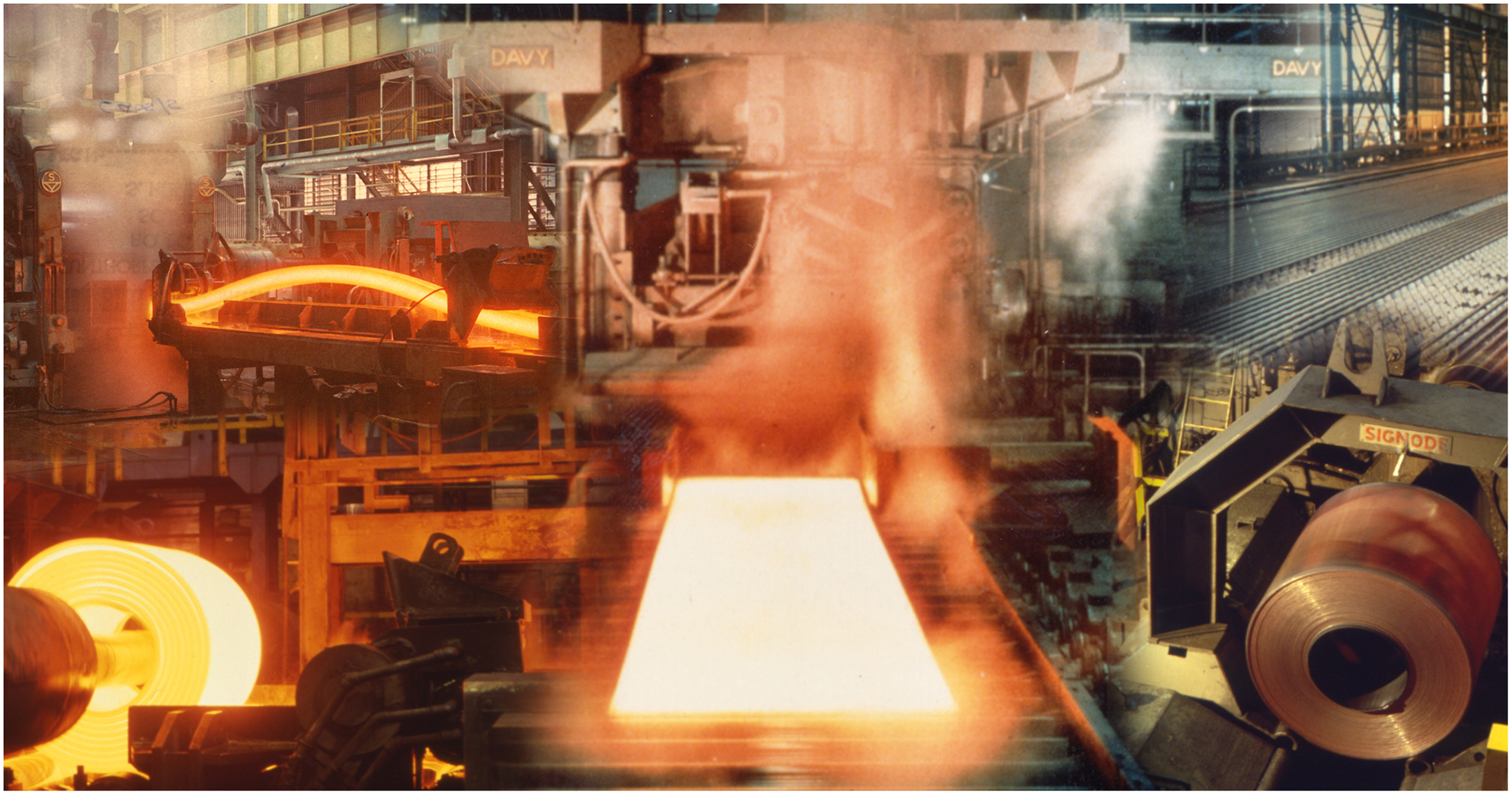
Different processes in a steel plant, production of steel strip (left), heat treatment of steel billet (centre) and cool steel coil (right)
Remember how cars used to rust in the past? Nowadays, modern cars do not really rust, or certainly not at the same rate as previously. Why? Because steel researchers have perfected a process known as the galvanneal process. In this, steel sheet is passed through a bath of molten zinc, and the steel is held at a particular temperature to let the iron and the zinc diffuse into one another at the surface interface. This process only works properly because non-contact thermometers closely control the process while it is underway – too hot or cold and it would not take place satisfactorily and you end up with a large quantity of scrap.
IV. Summary
Examples of where measurement impacts modern life are almost limitless. However, I hope that I have shown from historical examples and illustrations that civilisation and reliable measurement have risen hand-in-hand, and that the products and services we rely on today in daily life are available only because of the hidden ‘miracle’ of reliable measurement.
Footnotes
Acknowledgements
The author would like to thank Dr Andrew Lewis, NPL, for contributing text to illustrate the importance of dimensional measurement and
Figures 1
and
7
. The author also thanks his colleague Dolores del Campo from the Spanish National Measurement Institute for
Figure 2
; Dr Peter Whibberley, NPL, for helpful contributions concerning the importance of time measurement; Dr Kevin Howell, UCL, for
Figure 9
; Stuart Davidson for careful reading of the manuscript and for helpful comments particularly on mass and Alan Green for going the extra ‘mile’ (or is it kilometre?!) to obtain
Figures 6
,
8
and  -0020294013479848" href="#fig10-0020294013479848" id="a-29">
10
.
-0020294013479848" href="#fig10-0020294013479848" id="a-29">
10
.
Funding
The work of the NPL was funded by National Measurement Office.