




Abstract
Global brands’ simultaneous commercial and social compliance requirements may exacerbate supervisor stress and abuse of workers at export factories. Yet, the impacts of supervisors have been underexamined in private regulation. This article draws on the organizational justice literature to analyze the effects of supervisor interpersonal justice (SIJ)—treating subordinates with respect and propriety—on garment workers and how these effects are shaped by labor rights institutions in the workplace and external environment. The authors find that SIJ reduces workers’ turnover intention directly and indirectly through engendering positive affect. The results also suggest that SIJ may have a stronger relationship with positive affect in the presence of worker participation committees (WPCs) and stringent monitoring programs such as the Bangladesh Accord. This article thereby spotlights the relatively neglected role of supervisors in influencing worker well-being and turnover intention in global supply chains.
Keywords
Activists and scholars have long paid attention to sweatshop conditions in global supply chains (GSCs), ranging from wage theft to fatal workplace accidents. Extant research has focused on the development and impacts of various global- and national-level regulatory programs—global corporations’ codes of conduct and audits, multi-stakeholder initiatives (MSIs), and interaction between private and public regulation. The vast literature on the prominent form of private regulation featuring codes and audits has shown only limited and selective improvement on some outcome standards such as safety while making little progress on process rights, particularly freedom of association (Vandenbroucke 2024). Worse, global brands’ simultaneous commercial demands for low prices and fast delivery and the social imperative of compliance with labor and environmental standards has sometimes exacerbated the stress of factory managers and supervisors who in turn verbally abuse workers to meet rising production targets (Alamgir and Banerjee 2019; Anner 2019). Indeed, supervisors significantly shape workers’ perception of their work even at factories with strong regulatory programs (Pike and Godfrey 2012).
Despite its importance, the role of supervisors has been underexplored in private regulation research and practice. The take-up of management training is low among export factories (e.g., in Bangladesh; see Macchiavello, Rabbani, and Woodruff 2015). The impact of supervisors on outcomes relevant to workers and factories is therefore a vital research topic. In this article, we examine the effects of supervisors’ informal interpersonal interaction with workers to complement prior analyses of formal institutions or factory practices and impacts on distributional outcome standards (e.g., wages).
Specifically, we draw on organizational justice literature (Colquitt 2001) to examine how supervisor interpersonal justice (SIJ)—the perception of fair treatment from supervisors featuring respect and propriety (Bies and Moag 1986)—may influence worker turnover intention directly and indirectly by fostering worker positive affect. Turnover is an important event for workers who may have to forgo factory-specific knowledge and seniority benefits as well as an issue for export factory management who struggle with labor shortages and turnover problems (Moon et al. 2023; Jayasinghe 2024). We focus on positive affect as a mediating factor from SIJ to turnover intention because a few case studies have documented workers’ emotional reactions such as anger to workplace abuse (Kabeer, Huq, and Sulaiman 2020: 1385). Additionally, workers’ psychological well-being is generally underexamined in institutions/standards-oriented private regulation literature (Prentice, De Neve, Mezzadri, and Ruwanpura 2018).
Because supervisors do not work in a vacuum, we also examine how labor rights institutions in factories and beyond may shape the effects of SIJ on workers. Conceptually, labor rights institutions such as MSIs may include standards on adverse supervisor behaviors, yet specific workplace behaviors cannot be fully controlled as suggested by transaction cost theory (Williamson 1981). Supervisor enactment of interpersonal justice differs and may have independent effects on workers beyond institutional or contractual prescriptions. Further, the effects of such labor rights institutions are often trumped by global brands’ commercial demands (Cao and Jayasinghe 2024). Empirically, most research suggests that various private regulatory institutions did not improve process rights and therefore did not reduce the abuse of workers (Kabeer et al. 2020; for an exception see Pike 2020) and may even cause abuse (Anner 2019). Despite the limited direct effects of regulatory institutions on supervisor fair treatment, we argue that labor rights institutions may impact some aspects of the work environment in a way that shapes supervisor enactment of interpersonal justice and enhances its positive effects on workers. Specifically, we hypothesize that workplace collective voice mechanisms may communicate worker voice to facilitate more personalized enactment of SIJ and more favorable worker attributions. Stringent external monitoring programs may improve some workplace standards to allow for more stable enactment of SIJ and favorable worker attributions. Analysis of survey data from 1,377 workers from 107 garment factories in Bangladesh provides some evidence for our hypotheses.
This study contributes to the literature on labor regulation in GSCs by highlighting the role of supervisors and examining the impacts of SIJ on worker positive affect and turnover intention. Furthermore, we add nuance to the interaction of public and private regulation by theorizing interactions between supervisors and labor rights institutions at the workplace and beyond. Such an interaction bridges macro and micro perspectives by integrating the private regulation and organizational justice literatures. Our study contributes to research on supervisor justice and worker outcomes by showing positive affect as a mediator between SIJ and worker turnover intention and demonstrating that the effects of SIJ can be strengthened by labor rights institutions in the GSC context. Finally, we also support the growing stream of scholars advocating managerial/supervisor training (Macchiavello et al. 2015; Babbit, Voegeli, and Brown 2016) or measurement of “soft skills” when promoting supervisors in export factories (Uckat and Woodruff 2020).
Working Conditions in Global Supply Chains: Institutions and the Role of Supervisors
A plethora of actors have attempted to improve labor standards in GSCs, including civil society groups, global brands, and various MSIs (Locke 2013; Soundararajan et al. 2025). Extant research has examined the dynamics of such global- or national-level regulatory programs and how they may influence labor rights at export factories (Donaghey and Reinecke 2018; Anner 2021; Cao and Jayasinghe 2024). Researchers found that a prominent form of private regulation—codes of conduct and audits by global corporations or MSIs—has led to some improvements on some outcome standards such as safety issues but has had little or no impact on process rights such as freedom of association (Bartley and Egels-Zandén 2015; Kuruvilla 2021; Vandenbroucke 2024), which are “intrinsic principles of social justice” (Barrientos and Smith 2007: 721).
We note some islands of better practice. Reputation-conscious buyers (Oka 2010) and stringent MSIs that involve unions and have transnational industrial relations agreements (Ashwin et al. 2020) are more likely to improve intended standards (Donaghey and Reinecke 2018; Anner 2021). A few factory-level systems/mechanisms may also improve working conditions in GSCs: lean production systems (Distelhorst, Hainmueller, and Locke 2017); certified management systems (Bird, Short, and Toffel 2019); and worker collective voice mechanisms via unions, worker committees, or collective bargaining (Oka 2016; Pike 2020; Anner 2021; Boudreau 2024). Nevertheless, the effectiveness of workplace collective voice mechanisms may be confined to minor issues such as canteen food rather than costly ones, especially overtime hours, because of constraints from global buyers’ purchasing practices (Yu 2008; Anner 2018; Reinecke and Donaghey 2021).
The limited and selective impacts of private regulation can be attributed to global buyers’ commercial logic manifested in purchasing practices that require low prices, flexibility, and fast delivery (Locke 2013; Anner 2019). Global brands’ simultaneous pressures on commercial requirements and compliance with labor and environmental standards often squeeze the suppliers (Anner 2018; Khan, Ponte, and Lund-Thomsen 2020) who in turn squeeze labor rights and intensify work (Alamgir and Banerjee 2019; Anner 2019; Cao and Jayasinghe 2024). As the last link in the chain of global labor regulation, supervisors balance daily production pressure and several important process rights especially forced labor, discrimination, abuse, and harassment. Indeed, supervisors significantly shape workers’ perception and experience of work even at factories monitored by the International Labor Organization’s (ILO) stringent union-inclusive Better Work program (Pike and Godfrey 2012).
Despite their importance, the role of supervisors has been understudied in the global labor governance literature. The trumping of social standards by commercial logic at the global buyer level (Cao and Jayasinghe 2024) may cascade to suppliers who prioritize efficiency over social concerns. This outcome is reported in a few case studies of factory practices that show that supervisors resort to verbal abuse to discipline and motivate workers to meet production targets (Pike and Godfrey 2012; Ahmed and Uddin 2022). For example, Akhter, Rutherford, and Chu (2019: 6) reported that supervisors in their case study of Bangladeshi garment factories perceived workers as “unwilling to work,” prone to talking and lagging behind production targets if not shouted at. In fact, verbal abuse of workers is a prevalent problem in GSCs across several countries (Rourke 2014; Anner 2019; Kabeer et al. 2020). The private regulation literature has noted the lack of progress on process rights including abuse (Vandenbroucke 2024) but has seldom attributed this to the role of supervisors (for exceptions see Rourke 2014; Babbit et al. 2016).
Prevalent supervisor verbal abuse also underscores the lack of attention to supervisors in private regulatory practice. In principle, human dignity and “no degrading treatment” is a basic universal human right coded in prominent international covenants (e.g., Article 5 of Universal Declaration of Human Rights 1948; Article 7 of International Covenant on Civil and Political Rights 1976, and ILO’s C190 Violence and Harassment Convention 2019). Consequently, the codes of stringent MSIs and reputation-conscious buyers (e.g., Nike) often include standards prohibiting abuse and harassment. Yet, such standards are seldom enforced on supervisors. Even some government officials and factory managers do not perceive supervisor verbal abuse as a problem (Ahmed and Uddin 2022). This neglect echoes research showing low attention to management training (Macchiavello et al. 2015) in factories’ compliance strategies.
To address the relatively low priority of supervisors in the practice and academic analysis of private regulation, it is important to theorize and show supervisors’ impacts on variables important to workers and factory management. We thus draw on organizational behavior (OB) literature relevant to the impacts of supervisors. Significant OB research on abusive supervision showed its detrimental effects on employee task performance, well-being, and withdrawal from work (see review by Fischer, Tian, Lee, and Hughes 2021). In the GSC context, Rourke (2014) also showed negative impacts of verbal abuse on worker productivity and firm profits. While the effectiveness of supervisor abuse has been discredited in the literature, it is also important to reflect on normative concerns regarding humane treatment and interpersonal justice. We therefore engage OB literature on organizational justice (Colquitt 2001) and supervisor interpersonal justice (SIJ) (Rupp and Cropanzano 2002) to explore its impacts in the GSC context, meeting calls for greater integration of organizational and social justice (Colquitt, Hill, and De Cremer 2023: 424).
Specifically, we examine how supervisors’ interpersonal justice—the perception of fair treatment from supervisors (Bies and Moag 1986)—may directly and indirectly influence worker turnover intention through fostering worker positive affect. Worker shortages and absenteeism are important issues for export factories (Jayasinghe 2024) and worker turnover can impact product quality concerns by global brands (Moon et al. 2023). Turnover is also an important event for workers who may forgo factory-specific knowledge and seniority benefits. The large literature on employee turnover has not yet specifically theorized turnover issues in GSC contexts (see meta-analysis by Rubenstein, Eberly, Lee, and Mitchell 2018) and leading scholars on turnover have advocated more research to capture context (Hom, Lee, Shaw, and Hausknecht 2017: 539). Two studies that do focus on GSCs showed that turnover rates relate to compliance with various standards (Li and Kuruvilla 2023) and living conditions interventions (Adhvaryu, Nyshadham, and Xu 2023). We build on these emerging studies on turnover in GSCs to consider the potential effects of supervisors and their interaction with labor rights institutions at the workplace and beyond.
Theory and Hypotheses
Supervisor Interpersonal Justice and Worker Turnover Intention
Interpersonal justice refers to the perception that authority figures such as supervisors treat employees with respect and propriety (Bies and Moag 1986; Colquitt 2001). It typically includes treating subordinates in a polite manner, with dignity, respect, and refraining from improper remarks and comments (Colquitt 2001). Although individuals’ interpersonal justice orientation may vary to a certain degree, justice is a fundamental human motive and “one of the most sacred and pervasive themes in social behavior” (Lerner 1975: 1; Lerner and Clayton 2011). As a fundamental and sometimes subconscious motive, people may use and respond to justice in a social context with automatic reactions as well as with thoughtful controlled reactions (Lerner and Clayton 2011). Focusing on the more automatic reaction to justice akin to Kahneman’s (2011)“System 1” fast, intuitive cognition, we propose a direct effect from SIJ to worker turnover intention based on the assumption that workers will have an intuitive attraction to supervisor justice. Workers may also evaluate SIJ in the light of the factory context, in line with Kahneman’s (2011)“System 2” slow, complex thinking. Such reasoned responses to SIJ via workers’ positive affect and how labor rights institutions shape workers’ attributions and emotional reactions are elaborated in Hypotheses (2)–(4).
Consistent with our expectation that workers may be intuitively attracted by SIJ and less inclined to leave the factory, Özkan’s (2022) meta-analysis showed a negative relationship (r = −0.361) between interpersonal justice—which is often enacted by supervisors—and turnover intention. We maintain that this negative relationship will also hold in the GSC context because workers at export factories also react strongly to disrespect or abuse from supervisors (Pike and Godfrey 2012: 12; Ahmed and Uddin 2022). Supervisor abuse may influence their job choices, as shared by one Bangladeshi garment worker (Akhter et al. 2019: 6): “I changed two other factories because the supervisors of the factories do not behave with the workers nicely. I heard that this factory is good . . . so I joined.” Relatedly, Seo and Chung (2019) found that abusive supervision was linked with higher worker turnover intention among Chinese factory workers. Therefore, we expect justice to invert this relationship and lower such intentions.
We do acknowledge that SIJ, especially in a GSC context, does not impact workers in a vacuum. Many factors may affect SIJ and worker turnover. These include stringent MSIs and collective worker voice mechanisms that may improve compliance with labor standards in some cases (Oka 2016; Kabeer et al. 2020; Pike 2020), which in turn relate to worker turnover rates (Li and Kuruvilla 2023). However, such regulatory institutions may not determine SIJ for two reasons. Conceptually, although labor rights institutions may include standards or procedures to prevent adverse supervisor behaviors, as transaction cost theory (Williamson 1981) suggests, everyday control of specific supervisor behaviors is difficult to achieve. Supervisor enactment of interpersonal justice in their daily work—which also entails broader normative/moral principles such as respect—varies and may have independent effects on workers beyond institutional or contractual prescriptions. Empirically, most research suggests that various private regulatory institutions did not reduce abuse of workers (Barrientos and Smith 2007; Kabeer et al. 2020: 1387; Ahmed and Uddin 2022; for an exception see Pike 2020). Anner (2019) even suggested that the global brands’ conflicting demands of social compliance and predatory purchasing practices contribute to more abuse of workers.
Overall, owing to its interpersonal and processual nature we posit that SIJ has a unique impact on turnover intentions not captured by other institutions (i.e., even in a well-regulated environment, supervisor conduct varies in ways that affect workers). Indeed, in some cases these institutional factors are not necessarily the top priority in workers’ turnover decisions (Li and Kuruvilla 2023). We thus hypothesize that:
Indirect Effect of Supervisor Interpersonal Justice through Positive Affect
One major pathway 1 through which SIJ may influence workers’ intentions and behaviors is “affect” (Colquitt et al. 2013). Interpersonal justice often leads to positive feelings such as positive affect or pleasantness in recipients (Colquitt et al. 2013), which in turn influence worker intentions and behaviors. SIJ may meet some important human needs such as self-esteem and self-determination (Cropanzano, Byrne, Bobocel, and Rupp 2001; Decker and Van Quaquebeke 2015), thus leading to higher positive affect as shown in Colquitt et al.’s (2013: 212) meta-analysis. This finding is also congruent with research from a resources lens showing how supervisors provide subordinates with psychological resources or help them cope with work-related stressors, resulting in higher positive affect (e.g., Jasiński and Derbis 2023).
We propose that SIJ may improve factory workers’ positive affect at work, including feelings such as enthusiasm and pride. Emotional reactions to interpersonal (in)justice also feature in workers’ accounts in the GSC context. For instance, workers often describe negative feelings toward supervisor verbal abuse such as anger (Kabeer et al. 2020: 1385) or feelings of being “humiliated, helpless, unworthy and unaccepted at work” (Ahmed and Uddin 2022: 546). Describing positive/negative feelings toward justice/injustice from supervisors, another worker shared, “If they [supervisors] talk and behave with us well . . . we become happy after working hard. When they are rude and harsh, we become upset and feel threatened” (Akhter et al. 2019: 6). We thus posit that:
Building on this, positive affect may in turn influence workers’ turnover intentions. The broader turnover literature suggests that affect can explain employee turnover through a hedonistic approach of seeking desirable or avoiding undesirable situations (Maertz and Griffeth 2004). In the GSC context, Seo and Chung’s (2019) study on Chinese factory workers found that psychological emotional states mediate the relationship between abusive supervision and turnover intention. We thus hypothesize the following:
Synergy between Supervisor Interpersonal Justice and Workplace Collective Voice Mechanism
The organizational context may shape the effect of the overall level of SIJ by influencing how supervisors enact justice and how workers attribute the reasons for supervisor justice. Specifically, when justice such as fair treatment is delivered in a way sensitive to the personal situation of the recipient (e.g., by mentioning the latter’s name), this personal sensitivity can accentuate positive reactions from the recipient (e.g., Ployhart, Ryan, and Bennett 1999; Margolis and Molinsky 2008). In this regard, supervisors can benefit from feedback on workers’ concerns and needs collected from formal collective voice mechanisms at the workplace. As many worker concerns relate to supervisors (Pike 2020), workers may feel freer and safer to communicate their issues and needs via collective voice platforms such as workers’ committees or unions rather than through individual confrontation with supervisors (Freeman and Medoff 1984). Supervisors can then draw on such worker voice and feedback to attend to the particular needs of workers under their supervision. Indeed, Babbitt and Brown (2018) showed that supervisors at garment factories who are exposed to workers’ views exhibit a higher level of perspective-taking and humanization of workers, which reduces worker abuse. Absent collective voice, supervisors might act out their personal (often negative) perceptions of workers (Akhter et al. 2019). Informed supervisor treatment is likely to create more positive feelings among workers, thereby increasing retention.
Further, workers may make more positive attributions of informed supervisor treatment in lieu of collective voice mechanisms. Workers may think that their supervisors responded to their collective voice and thus respect them in the way they desired. Here, the effects on workers are a combination of SIJ per se—as in a context without unions/committees—plus the value of workers’ perception that their voice was heard and implemented. Indeed, voice is an important element of procedural justice (Thibaut and Walker 1975), and procedural justice has been found to strengthen the effect of interpersonal justice (Huang and Huang 2016). In the GSC context, Adhvaryu, Molina, and Nyshadham’s (2019) study found that the Indian garment workers who had the opportunity to express voice via a survey showed lower turnover rates and absenteeism. Arguably, workers’ perception of their voice being responded to by supervisors could have stronger effects on worker affect and behavior.
We note that sensitive SIJ and favorable worker attributions are more likely to occur when collective voice mechanisms function well. Such synergy may diminish with constrained voice mechanisms (e.g., Anner 2018). Although the actual synergy may vary across contexts, we propose that, on average, a stronger SIJ-positive relationship is more likely to materialize under collective voice mechanisms.
Synergy between Supervisor Interpersonal Justice and External Stringent Monitoring Programs
Although the organizational justice literature has not yet examined how institutions outside the organization may shape the effects of organizational justice (Colquitt et al. 2023), we suggest that monitoring programs in the environment may influence justice enactment and worker attributions as well. Pertaining to GSCs, we propose that stringent labor rights monitoring programs may amplify the effects of SIJ on workers by facilitating more stable enactment of fair treatment. Justice variability—for example, being polite one day but rude the next day—creates uncertainty and thus increases employee stress (Matta et al. 2017) and can negate the benefits of an overall positive level of interpersonal justice (Matta, Scott, Guo, and Matusik 2020).
External monitoring programs—whether led by individual brands or MSIs (Ashwin et al. 2020)—differ in their stringency (Rodríguez-Garavito 2005; Fransen and Burgoon 2012). The more stringent ones (e.g., FairWear and Better Work) have the following three attributes: comprehensive labor standards, strong enforcement mechanisms that include worker complaint channels, and a degree of control by societal actors such as involving unions at the global and/or factory level (Fransen and Burgoon 2012). By contrast, permissive MSIs including the amfori Business Social Compliance Initiative (BSCI) and the Worldwide Responsible Apparel Production Certification Program (WRAP) lack one or all of the three stringent elements. The effects of stringent MSIs often emanate from both the standards and enforcement of the MSI per se as well as the private regulation programs of individual reputation-conscious buyers who joined the MSI (Oka 2010).
External stringent monitoring programs may create a more conducive environment for supervisors to show a consistent level of propriety and respect to workers. First, such programs may prompt factory management to address some factory-wide issues such as health and safety standards and minimum wages (e.g., Barrientos and Smith 2007; Kabeer et al. 2020). Such improvements may save supervisors’ mental and psychological energy, enabling them to enact more consistent fair treatment of workers. Managers are less capable of enacting fair treatment when they are themselves depleted (Whiteside and Barclay 2018) or have heavy workloads (Sherf, Venkataramani, and Gajendran 2019).
External stringent monitoring programs may also contribute to workers’perception that they have some power via these external institutions to influence supervisors’ behavior. This potential empowerment may emanate from stringent programs’ complaint mechanisms (e.g., worker hotlines) through which workers can file their grievances to internal voice mechanisms or external parties (Fransen and Burgoon 2012). For example, the Accord on Fire and Building Safety in Bangladesh and the Alliance for Bangladesh Workers’ Safety (hereafter Accord/Alliance) both established worker complaint channels. Although Accord/Alliance focused on safety issues, their complaint mechanisms received worker reports on many other issues (e.g., 79% of worker calls to Alliance’s helpline were “non-safety” issues; Donaghey and Reinecke 2018: 32), perhaps because Bangladeshi workers perceived global buyers and institutions “as the primary guardian of workers’ welfare and rights” (Kabeer et al. 2020: 1387).
Workers’ perceived power may also come from the involvement of union or worker representatives in stringent MSIs. For instance, both the Accord and Alliance gave union or worker representatives the right to be present during safety inspections, which signaled symbolic power to workers who often “enjoy little respect” but saw union leaders’ co-presence with inspectors as “a powerful demonstration that workers were eligible to speak on the same level with outside authorities and managers” (Donaghey and Reinecke 2018: 29). As grassroots workers may have very limited knowledge of specific standards in the codes of MSI and related brands (Graz, Piazza, and Walter 2022), they may perceive stringent programs and associated brand buyers, regardless of single issue-focused programs (e.g., Accord/Alliance for safety) or comprehensive ones (e.g., Better Work), as potential external allies against various grievances, including supervisor behaviors.
Such a personal sense of power—a perceived ability to influence other people in specific contexts (Anderson, John, and Keltner 2012: 316)—is related with more positive emotions (Anderson and Berdahl 2002) and can amplify the effects of justice especially among workers in low hierarchical positions (van Dijke, De Cremer, Langendijk, and Anderson 2018). That is, the effects of SIJ in factories subject to external stringent monitoring programs may comprise SIJ per se and associated worker perceptions of increased power (from external source) to influence SIJ.
Admittedly, the abovementioned more stable justice enactment and positive worker attribution are contingent on functioning and visible monitoring programs in the environment. Workers may be unaware of some codes or MSIs (Graz et al. 2022) and may sometimes collude with managers to hoodwink auditors (Hoang and Jones 2012). On average, and especially for stringent and visible monitoring programs, we hypothesize a synergy:
Overall, we have hypothesized a direct relationship between SIJ and turnover intention and an indirect effect via positive affect. Workplace voice mechanisms and external stringent monitoring programs may amplify such effects. Figure 1 graphically summarizes our hypotheses.
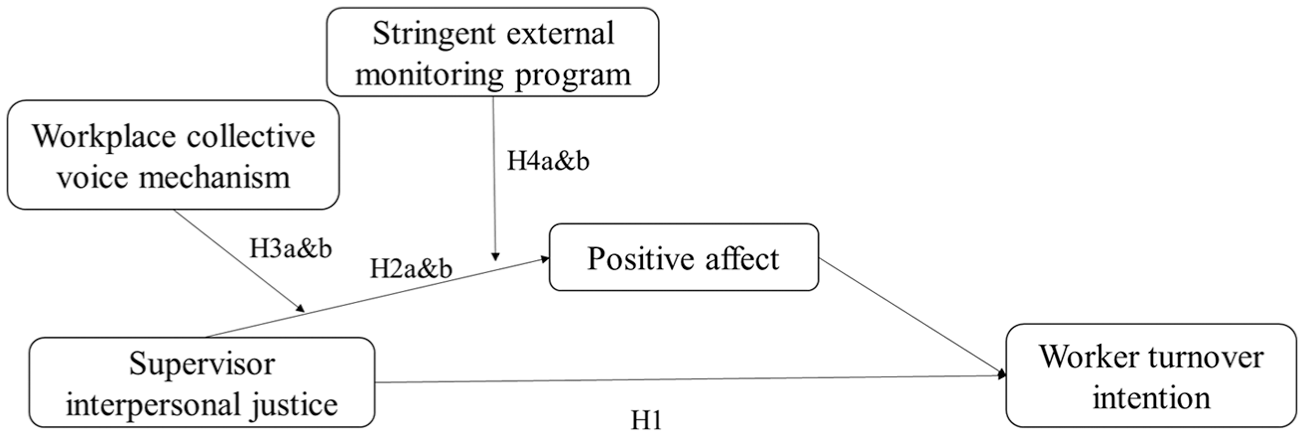
Proposed Model
Methodology
Data
We drew on a survey of 1,500 garment workers in Bangladesh in 2017 collected by Naila Kabeer and colleagues (2020). The Bangladeshi garment industry provides a suitable case to examine our hypotheses for two reasons. First, several studies documented severe abuse of Bangladeshi garment workers (Akhter et al. 2019; Kabeer et al. 2020; Ahmed and Uddin 2022) but the take-up of supervisor training is low (Macchiavello et al. 2015). Demonstrating the benefits of SIJ may thus provide support for positive intervention/supervisor training or selection to address a prevalent issue in this context. Second, Bangladesh hosts many visible labor rights institutions providing an opportunity to examine their interaction with supervisor behavior. As regards workplace collective voice mechanisms, the Bangladeshi 2006 Labor Act required Worker Participation Committees (WPCs) of managers and workers—for social dialogue—in factories with 50 or more workers, and the 2013 amended Act requires open election of worker representatives to WPCs (Kabeer et al. 2020: 1381–82). Further, after the Rana Plaza tragedy that killed 1,134 garment workers in 2013, two stringent monitoring schemes were established: the Accord on Fire and Building Safety in Bangladesh, and the Alliance for Bangladesh Workers’ Safety. Unlike other schemes such as Better Work, Accord/Alliance does not mandate WPCs or promote supervisor training, making supervisor treatment relatively independent of these two institutions and an appropriate case to explore their interactions.
The workers in our study were sampled from five industrial locations within the Dhaka area for their high concentration of garment workers: 200 women and 100 men were randomly sampled from each neighborhood, reflecting the higher percentage of women in the garment sector (Kabeer et al. 2020: 1367). Local researchers visited workers in their residences and filled in workers’ responses to ensure the quality of the answers. Our final sample comprises 1,377 workers from 107 factories after deleting observations not suitable for our analysis (explained below).
Measures and Items
Supervisor interpersonal justice was measured by three items. Two items overlap with seminal statements on interpersonal justice capturing respect/politeness and proper language/no improper remarks (Bies and Moag 1986; Colquitt 2001). Those items are: “My supervisor respects me, is polite with me” (reflecting “respect”); “My supervisor does not use bad language with me or make indecent comments” (reflecting “propriety”). As justice rules may evolve with time and/or context and because an important reason for supervisor verbal abuse of garment workers is mistakes or falling behind targets (Ahmed and Uddin 2022), we also added a third item based on later research that found supervisor support (with tasks or defending the employee against others in the firm) is an important justice rule in how employees assess supervisor justice (Hollensbe, Khazanchi, and Masterson 2008; Fortin et al. 2020: 1640). Specifically, our third item is: “If I unintentionally make a mistake, my supervisor will side with me.” These three items were measured on a 5-point scale ranging from strongly disagree (1) to strongly agree (5). Cronbach’s alpha for the three items is 0.85.
Positive affect was measured by three items from Zevon and Tellegen’s (1982) mood checklist of 60 adjectives: enthusiastic/eager, proud, and contented. The question asks the workers, “How do you usually feel in the workplace?” (3-point Likert scale). “Enthusiastic” and “proud” are among Watson, Clark, and Tellegen’s (1988) classic 10-item scale of positive affect; “contented” is among Zevon and Tellegen’s (1982) longer list, which is relevant in the wake of “constant pressure” among Bangladeshi garment workers (Akhter et al. 2019: 5). Although the item on enthusiasm shows lower correlation with the other two items and has lower factor loading, we include all three items 2 to maximize use of information. Cronbach’s alpha for this scale is 0.69.
Turnover intention was measured by a single item used by Hom, Griffeth, and Sellaro (1984: 148): “What are the chances of you leaving this factory within the next 12 months?” The choices coded from 1 to 5: will not go (1), strong change of staying, not sure, strong change of leaving, and going to leave (5).
The workplace collective voice mechanism was measured in two stages. Analytically we needed to determine if the factory had a WPC, based on workers’ perceptions. To that end, in our first stage we relied on a survey question that asked workers, “Is there a worker participation committee (WPC) in the factory?” Among the 107 factories with two or more workers sampled, the majority of workers answered “yes” (n = 1,121, 81.41%), followed by “I don’t know” (n = 146, 10.6%), and “no” (n = 110, 7.99%). We looked at the workers’ background information and their responses regarding WPC within each factory. Workers from 28 factories (10.7% of workers) unanimously said “yes” (coded as WPC = 1) and 5 factories (0.7%) unanimously “no” (coded as WPC = 0). We also observed that 72 factories (88% of workers) had mixed responses. Among these 72 factories, 33 (46.55%) were easy to score because the disagreeing respondent(s) said, “I don’t know” and we followed the consensus answer.
For the remaining 39 factories with inconsistent explicit worker perceptions of WPC presence, a second stage of coding was involved in which, methodologically, we used distinct individual perceptions to assign a factory-level characteristic. We followed the “key informants” methodology used by inter-organizational scholars. Specifically, we draw on the work of Kumar, Stern, and Anderson (1993) who acknowledged the necessity of relying on human informants in the absence of reliable archival data, and the challenges associated with multiple raters who diverge from each other. In such cases, the authors mentioned three approaches based on the literature. Two of the options involve some statistical approach, such as aggregation (e.g., using structural equation modeling, SEM), or a latent trait modeling (LTM) approach. The third is the consensus method, which uses the agreement of competent, key informants. We have preferred the latter option above the others because our analysis ideally requires a definite answer in terms of the presence (or absence) of WPC. To determine who the key informants are in each factory we needed to assess their competence. To that end, we examined 1) the workers’ demographic information, including their job designations, seniority, and years of schooling, along with 2) their knowledge of matters that a competent informant would know. Specifically, we paid attention to whether any workers affirmatively responded to knowing about buyer codes of conduct, local labor laws, and whether they voted in the WPC elections.
Following the key informants approach, it was relatively straightforward to operationalize our WPC variable for most of the 39 factories where respondents had conflicting views. 3 For such cases, Kumar et al. (1993) proposed a hybrid approach in their article that combined elements of aggregation, LTM, and consensus methods. But given that our variable is binary (yes/no) and is a measure of the presence or absence of the WPCs, we primarily relied on the consensus approach. However, we also paid attention to whether our key informants were the majority in a group—which they were in 23 out of the 39 factories (includes 91% workers in this subgroup). We identify approximately 16 factories (9% of workers within this subgroup) where the group with the key informant consensus had the same number of people as the opposite consensus (yes vs. no), mostly attributable to small sample sizes (n≤ 11). Regardless, in most cases within the 39 factories the consensus answer was very clear. For example, among 33 factories, the few disagreeing workers had lower job positions such as helper and/or a shorter tenure in the factory, whereas the majority group typically included some senior workers such as quality inspectors who often had more years in the factory and/or garments industry. We thus used the response of the majority workers with key informants. We found only six boundary cases (n = 2 to 4 workers, though one had n = 6) with equal or close number of “yes” or “no” answers on WPC from two or three workers at similar jobs and with similar seniority. We selected the answer of the worker(s) who indicated better knowledge of codes, laws, and whether they had voted in the WPC elections.
Finally, in two factories (n = 3 and 4 workers) everyone responded, “I don’t know” to the WPC question. We decided to extrapolate an answer rather than abandon them because these factories were still valid for measurement of other variables in our analysis. These two factories are relatively small (with respondents indicating 200 to 600 total workers) and some workers are near the legal minimum working age of 14 to 17. Such small factories were less likely to have a WPC. And one of these factories had an operator with 12 years in the garment industry and a quality inspector in our sample; even they responded “don’t know” regarding WPC presence, signaling its absence. We thus report the main results coding WPC = 0 for the two factories in which all workers did not know whether their factory had a WPC. Even if these two factories were incorrectly assigned a score (along with the boundary cases mentioned above), such errors are more likely to increase noise in the data and thus make our moderation analyses conservative.
On the whole, we acknowledge two important limitations. First, there is still a risk of making a mistake as even competent informants may not always agree with each other (Kumar et al. 1993). Second, although we are treating this variable as an objective measure at the factory level, it is still a proxy variable (albeit a highly sophisticated one) rooted in workers’ perceptions. However, such perceptions could be an important pathway that relates to how the factory-level WPC may shape workers’ attribution and reactions to SIJ, as we explained in H3.
External stringent monitoring program was captured by asking workers the name of their current factory. Kabeer et al. (2020) independently checked whether the factory’s name was on supplier factory lists disclosed online by Accord and Alliance. Although differences exist between Accord and Alliance—for example, legally binding vs. voluntary, and industrial democracy vs. corporate social responsibility—they both improved some safety issues with their own methods (Donaghey and Reinecke 2018). Our data set makes it difficult to tease out the effect of each because most factories covered by the Alliance are also in the Accord: 31 of the 107 factories (29%) are covered by both Accord and Alliance, 39 (36.4%) factories are covered by just Accord, and only 2 (1.9%) by just Alliance. Therefore, we aggregate the affiliation to either initiative in a single Accord/Alliance variable: 72 (67%) factories, or 87.7% of the workers, are covered by them whereas 35 other factories in our sample are outside their remit. This measure primarily captures the coverage of the Accord, which covers 70 factories jointly or alone.
Although the Accord and the Alliance also promoted safety committees, these differ from WPCs mandated by the law that cover more general issues. Of the 72 factories covered by Accord/Alliance, 63 also have WPCs, perhaps because these are large factories for which the Bangladeshi law mandated WPCs. Among the 35 factories outside Accord/Alliance, 13 have WPCs based on majority confirmation and the key informants rule. And among the 32 factories without WPCs, 9 were covered by Accord/Alliance. These results allow us to examine the moderation effect of each institution in the absence of the other in subsample analysis (see the Robustness Analysis section).
We also checked factory names against the Better Work Bangladesh (BWB) factory list in 2017 and the WRAP certified factory list in 2025 (the only publicly available lists at the time of writing). None of the factories not covered by Accord/Alliance were covered by these two programs. Among those covered by Accord/Alliance, 13 factories (18% workers) are also in BWB, and 12 factories (18% workers) were covered by WRAP. This suggests that factories that score 0 on our variable are poorly monitored, if not completely outside external private regulation. Therefore, scoring a 1 on our variable suggests being covered by some form(s) of stringent monitoring, especially the Accord.
Control variables include gender (coded 1 for woman), age (years), tenure in garments industry (years), job satisfaction, and monthly pay for their potential influence on turnover or turnover intention found in meta-analysis (Rubenstein et al. 2018). Job satisfaction was measured by a single item on a 3-point scale: “Considering everything, how satisfied are you with your job?” We also controlled for monthly pay (basic wage plus overtime pay and log transformed) because of the importance of income in influencing worker turnover (Li and Kuruvilla 2023).
We had two approaches controlling for the potental confounding effect of factory management systems that may influence both SIJ and worker turnover intention. First, we included variables on perceived management style. The survey asked workers to pick which one of the following statements best describe the relationship between management and workers in their factory: “Workers are treated like family members”; “The management regularly consults workers or their representatives to find out about workers’ problems”; “The factory has rules that all workers must be aware of and follow”; and “We are lucky to get the job; therefore, we must obey orders.” We labeled the first item (treated as family members, 14.3% workers) as a perceived paternalistic management style to indicate worker perception of management being predominantly characterized by benevolence or provision of decent work conditions, stemming from top management values or business strategy (Pellegrini and Scandura 2008; Perry, Wood, and Fernie 2015). We code the second item (regular consultation, 8.6%) as perceived consultative management style, which also allows us to control for factory-level procedural justice—allowing voice—that may trickle down to supervisor justice and worker attitudes (Colquit et al. 2013). As the last two items both emphasize rule/order obedience with similar negative implications for our variables, we combined them under the label perceived authoritarian management style, which emphasizes worker perceptions of authority, discipline, and control (Pellegrini and Scandura 2008); we use this as the baseline group in our analysis. Second, we use factory fixed-effects by including dummy variables for each (n– 1) factory to control for other unmeasured factory-wide practices. This approach excludes 128 observervations with only one worker in the factory.
Finally, we included a fixed effect for job types as exposure to supervisors may vary across jobs and the labor market or alternative jobs for distinct jobs/skills may differ and influence turnover intention. In the subset in which factories with only one worker were omitted, there were approximately 20 types of jobs, with the largest groups being operator (49.39%) and helper (23.43%). 4 After deleting jobs with only one worker for job fixed effect, our final sample comprises 1,377 workers at 13 types of jobs across 107 factories.
Analytical Strategy
We conducted all the analyses using an ordinary least squares (OLS) regression framework, including the mediation analyses. For the mediation test in H2b, the basic intuition popularized by Baron and Kenny (1986) is to look at three regression models: the relationships between the independent variable (X) and the mediator (M), between the mediator (M) and dependent variable (Y), and whether the relationship between X and Y is significantly reduced with the inclusion of M. Since then, mediation tests have developed further. For instance, in the following models a×X→M and X+b×M→Y, the product of coefficients a×b (the mediation index) is used as the size of the mediation or indirect effect of X to Y through M (e.g., Hayes 2018). 5
Multiple ways are available to test the statistical significance of this mediation index. 6 We rely on the bootstrapping method, which balances risk and power better than other methods (Preacher and Hayes 2008). We performed a bootstrap with 10,000 iterations and reported confidence intervals at 95% for our mediation (H2b) and moderated mediation (H3b and H4b) tests. We also triangulated these significance tests with Monte Carlo simulations as a robustness check.
Findings
Descriptive Statistics
Our final sample comprises mostly permanent workers (96.8%) in the sewing/making sections (67.9%) or the finishing section (18.88%). Most workers were under monthly wage contracts (96.01%), with approximately 3.78% on piece-rate contracts. Only 60 workers (4.36%) reported having a union in the workplace, while the majority did not know (61.29%).
Table 1 reports descriptive statistics of our final sample. SIJ was rated an average of 3.4—the median being 3.7— on a 5-point scale, echoing prior findings of verbal abuse of workers (e.g., Ahmed and Uddin 2022) as well as fair treatment for many workers. Workers reported low turnover intention, with the majority choosing 1 (“will not go,” 67.6%). Relatedly, workers scored high on positive affect as well: 2.4 on a 3-point scale.
Variable Overview
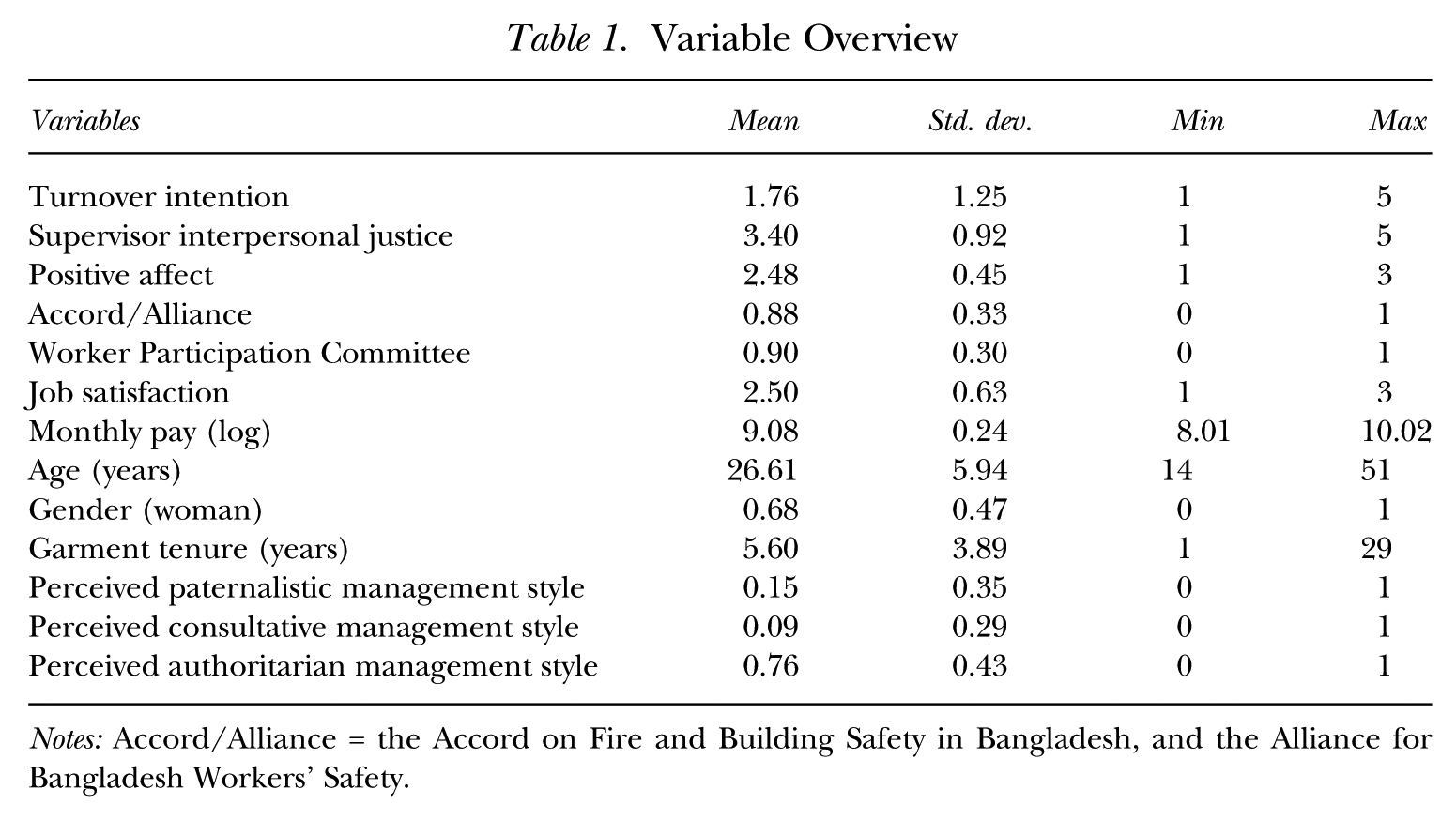
Notes: Accord/Alliance = the Accord on Fire and Building Safety in Bangladesh, and the Alliance for Bangladesh Workers’ Safety.
Table 2 reports bivariate correlations among the variables. As we expected, SIJ shows a significant negative relationship with turnover intention and is associated with higher positive affect. Further, SIJ did not vary significantly with WPC (r = 0.02) or Accord/Alliance (r = 0.01), suggesting the relative independence of these variables and the safety focus of Accord/Alliance.
Bivariate Correlations among Studied Variables
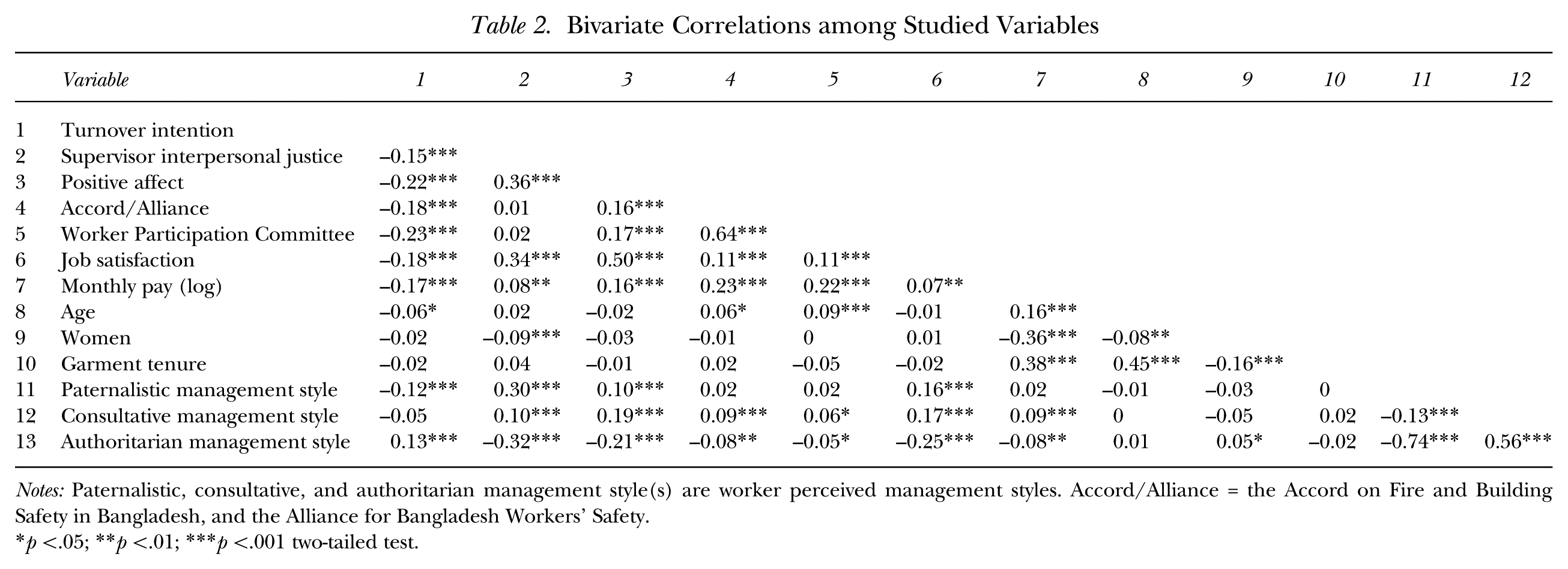
Notes: Paternalistic, consultative, and authoritarian management style(s) are worker perceived management styles. Accord/Alliance = the Accord on Fire and Building Safety in Bangladesh, and the Alliance for Bangladesh Workers’ Safety.
p <.05; **p <.01; ***p <.001 two-tailed test.
Analysis Results
As shown in Table 3, model 1’s OLS regression results, H1—the relationship between SIJ and turnover intention—was supported (β = −0.106; p = 0.008). The coefficient suggests that, a 1 unit increase in SIJ is associated with a 0.106 unit decrease in turnover intention (both were on a 5-point scale), controlling for other variables among workers in the same factory. As the average turnover intention was 1.76 in our sample, a 0.106 decrease represents a 6% drop. 7
Direct and Indirect Effects of Supervisor Interpersonal Justice
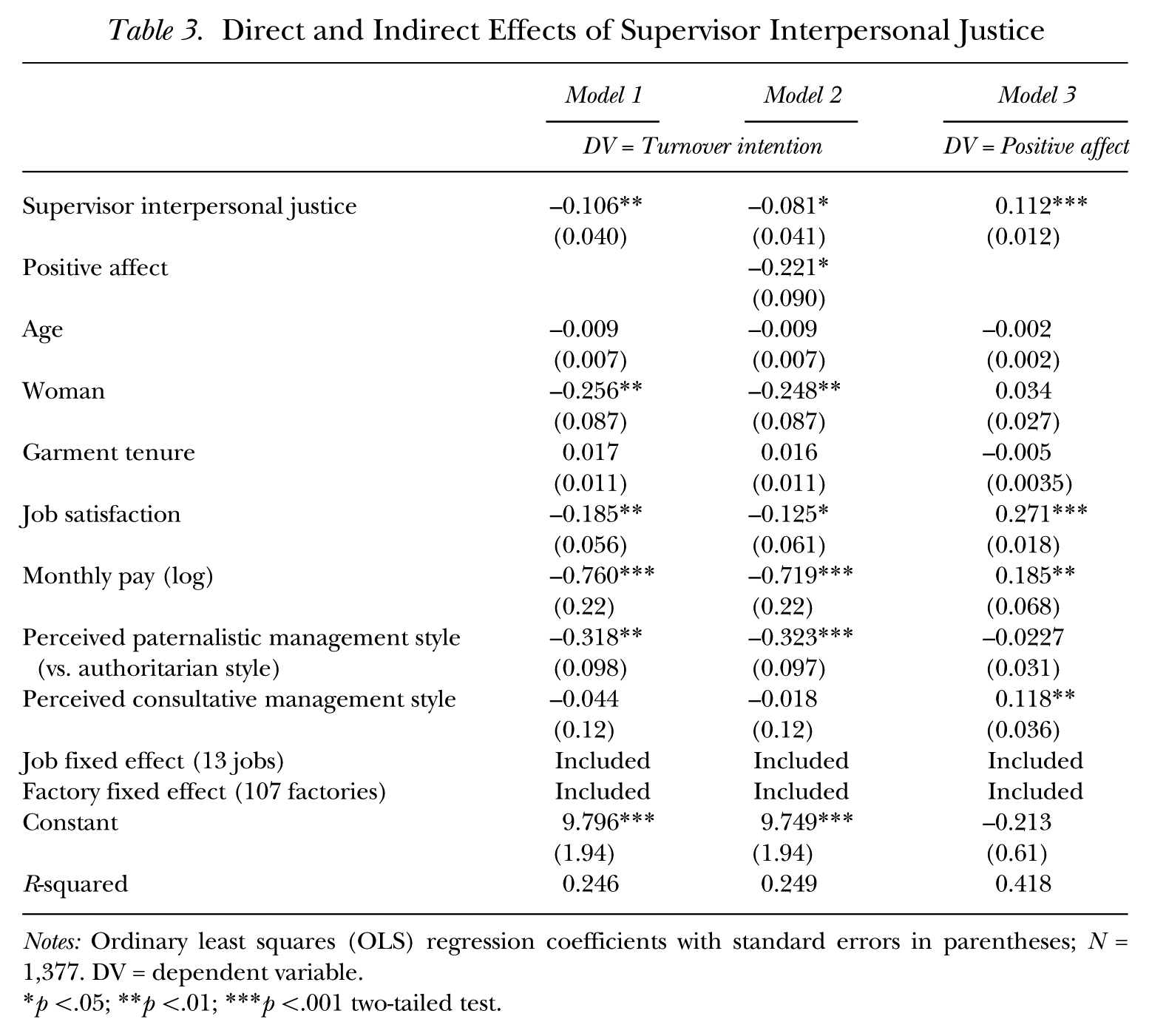
Notes: Ordinary least squares (OLS) regression coefficients with standard errors in parentheses; N = 1,377. DV = dependent variable.
p <.05; **p <.01; ***p <.001 two-tailed test.
H2a suggested a postive relationship between SIJ and positive affect. The results in model 3 of Table 3 support this hypothesis: β = 0.112 (p < 0.001). This result suggests that a 1 unit increase in SIJ is related with a 0.112 unit (on a 3-point scale, or 4.5%) increase in worker positive affect, accounting for other variables within each factory. H2b proposed an indirect effect from SIJ to turnover intention via positive affect. Model 2 in Table 3 supported a signficant negative relationship from positive affect to turnover intention: β = −0.221, p = 0.014. And the coefficient for SIJ on turnover intention with the inclusion of the mediator/positive affect in model 2 decreased to β = −0.081 (p = 0.046) from −0.106 in model 1. The indirect effect from SIJ to turnover intention via positive affect is thus −0.025 (i.e., 0.112 ×–0.221). Based on bootstrap (10,000 repeated sampling), the mediation index was significant at 95% confidence intervals (CI): [–0.0473, −0.0047], which excludes zero. In other words, the mediation index that signifies the indirect effect is unlikely to be zero in the population. H2b is thus also supported.
Regarding control variables, turnover intention was lower for female workers and workers with higher job satisfaction or monthly pay, consistent with prior findings on turnover rates (Li and Kuruvilla 2023). Perceived paternalistic management style (compared to authoritarian style) is significantly related to lower turnover intention, but not with positive affect. Perceived consultative management style is related with significantly higher positive affect but not turnover intention.
H3 proposed synergy between SIJ and workplace voice mechanisms such as WPC. We examine this moderation by adding an interaction term between SIJ and WPC in the regression for positive affect. As shown in Table 4, model 4, the coefficient for the interaction term is significant: β = 0.136, p = 0.002. As we included factory fixed effects, this essentially suggests that the relationship between SIJ and positive affect is stronger (by 0.136 units) among factories with WPCs compared to those without. As the positive sign indicates, Figure 2 plotting the moderation effect shows a steeper line between SIJ and positive affect when the factory has a WPC. Simple slope tests show that the relationship between SIJ and positive affect is b = −0.014 (p = 0.729) in the absence of a WPC; this relationship becomes positive and significant when a WPC exists: b = 0.122 (p < 0.001). As the main effect of SIJ on positive affect is 0.112 (model 3 in Table 3), having a WPC is associated with 8.9% increase in the effect of SIJ. H3a is supported.
Synergy between Supervisor Interpersonal Justice and Labor Rights Institutions
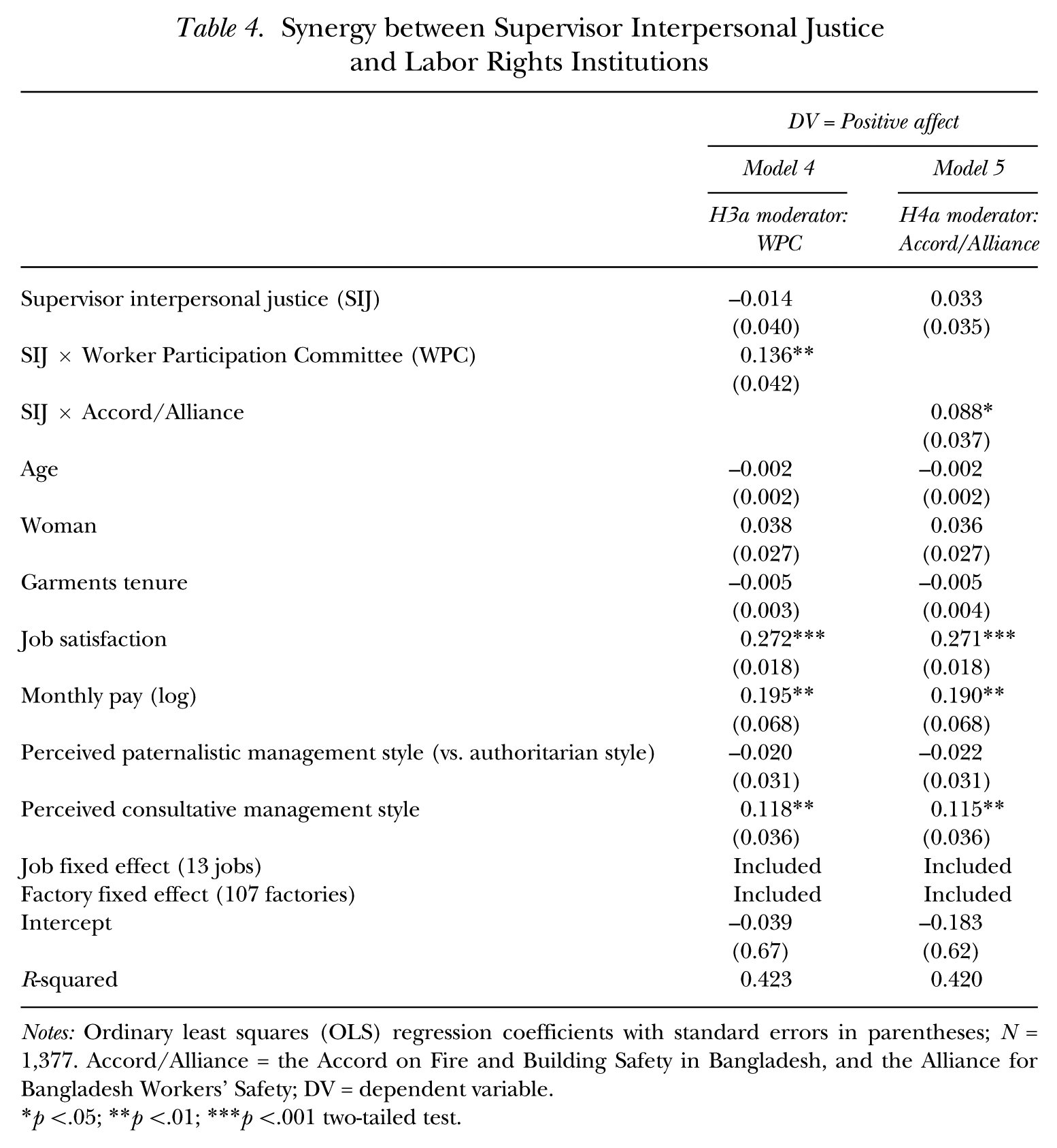
Notes: Ordinary least squares (OLS) regression coefficients with standard errors in parentheses; N = 1,377. Accord/Alliance = the Accord on Fire and Building Safety in Bangladesh, and the Alliance for Bangladesh Workers’ Safety; DV = dependent variable.
p <.05; **p <.01; ***p <.001 two-tailed test.
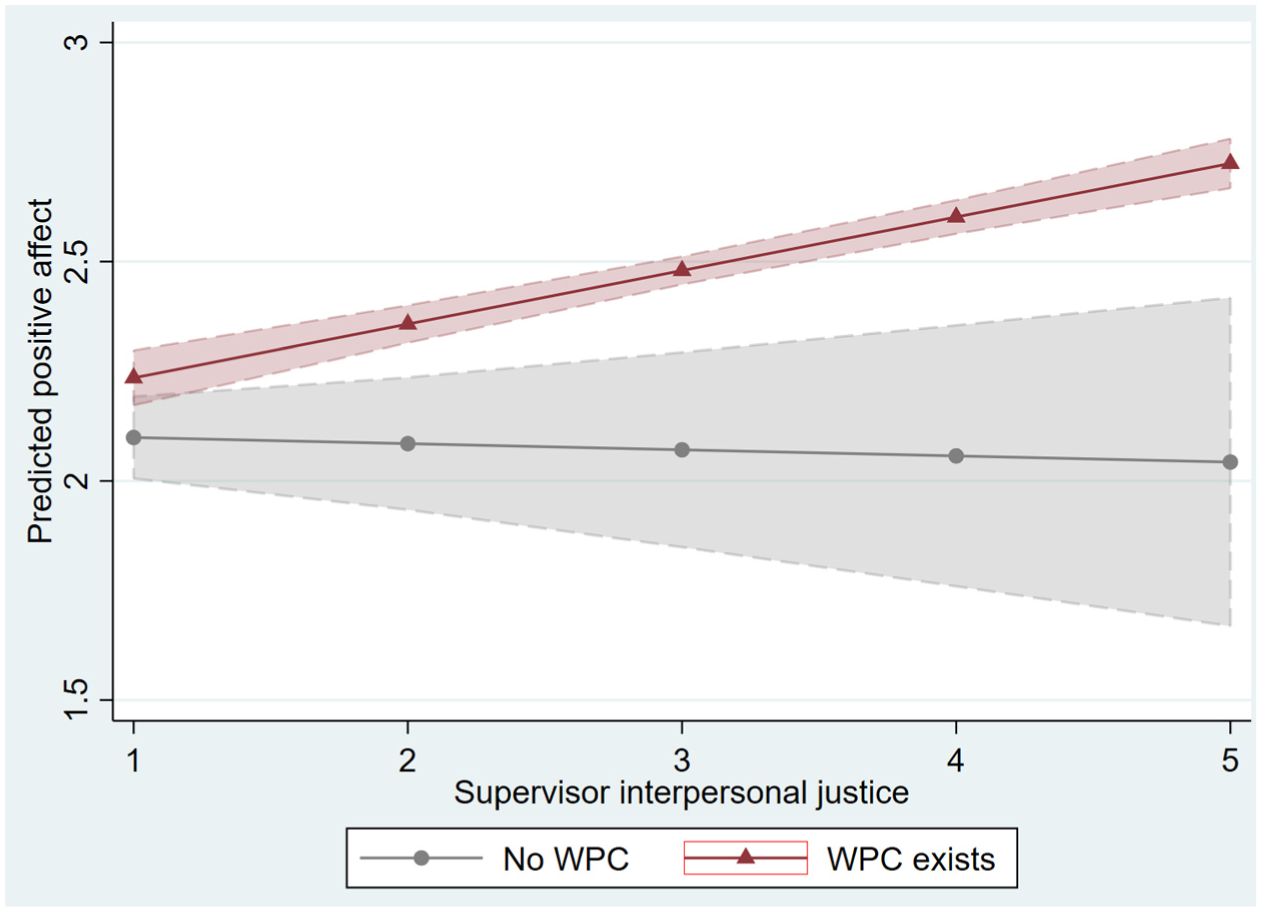
Interaction with Worker Participation Committee (WPC)
For H3b on moderated mediation, we conducted a bootstrap of 10,000 iterations that effectively multiplies the coefficient for the interaction term—SIJ × WPC (model 1 in Table 4)—and the coefficient for positive affect→turnover intention (model 2 in Table 3). 8 The indirect relationship between SIJ and turnover intention was moderated by WPC at 95% CI: [–0.0693, −0.003], which excludes zero. H3b is supported.
Turning to synergy with Accord/Alliance, the interaction between SIJ and Accord/Alliance is positive and significant for positive affect: β = 0.088, p = 0.016 (model 5 in Table 4). As with the discussion on H3b above, our fixed effect model implies factories under Accord/Alliance coverage benefit from a stronger effect of SIJ on positive affect (by 0.088). Figure 3 plots this interaction effect, showing a steeper line among workers covered by Accord/Alliance. Simple slope tests show that the relationship between SIJ and positive affect was not significant among workers not covered by Accord/Alliance: b = 0.033, p = 0.342; but this relationship becomes significant with the coverage of Accord/Alliance: b = 0.121, p < 0.001. Accord/Alliance coverage is related with an 8% increase from the main effect of SIJ on positive affect. H4a is supported. For H4b on moderated mediation by Accord/Alliance, the index is also significant at 95% bootstrap (10,000 iterations) confidence interval: [–0.0497, −0.0003] albeit the upper bound is very close to zero. H4b is thus supported.
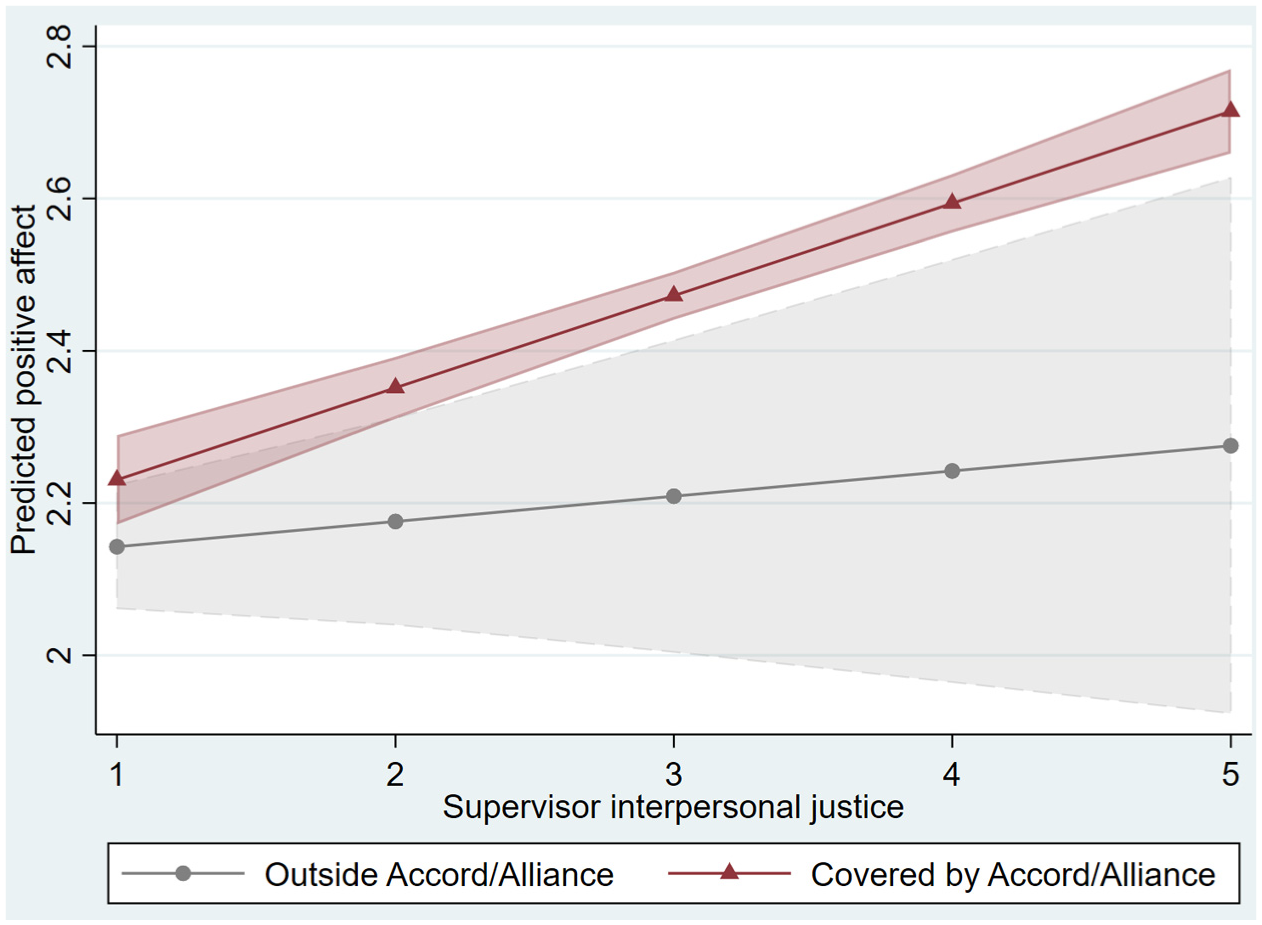
Interaction with Accord/Alliance
Robustness Analysis
We conducted the following robustness analyses. First, we note a strong overlap between WPC and Accord/Alliance in our data. Among 72 factories covered by Accord/Alliance, 63 (87.5% factories) also have WPC. We think it is still meaningful to have these two moderators in our analysis because, besides their conceptual difference, Accord/Alliance is an objective measure and WPC presence is based on the majority of workers’ perceptions or those of competent respondents (which leaves some room for error). To probe their separate moderation effects, we analyze WPC’s moderation on the relationship between SIJ and positive affect (H3a) among the 169 workers from 35 factories outside Accord/Alliance. The moderation term in the full model (H3a) with the 169 workers was not significant (β = 0.108, p = 0.173) due to limited observations and a large number of control variables (53) and thus low statistical power to find significant results. We then drop job fixed effect (10-plus dummy variables), and the interaction term was marginally significant 9 : β = 0.138, p = 0.066. We also analyze the moderation effect of Accord/Alliance among 32 factories (133 workers) without WPC. The interaction term for the full model (H4a) was not significant (β = 0.048, p = 0.713), and remained so even when we removed the dummy variables for job designation (β = 0.065, p = 0.606). This might result from the small sample size. These separate analyses suggest that WPC may moderate the relationship between SIJ and positive affect outside Accord/Alliance, but the moderation effect of Accord/Alliance outside WPC deserves more research (we elaborate in the Discussion section).
Second, we analyze potential endogeneity of supervisor justice; in particular, is SIJ predicted by WPC or Accord/Alliance? In our sample, they differ conceptually (none of the schemes mandates the others) and are statistically uncorrelated. We run a random effects model using WPC and Accord/Alliance, together with age, gender, garment tenure, monthly pay, jobs, and perceived management styles, to predict SIJ. The coefficients for WPC and Accord/Alliance are not significant (p > 0.163) while perceived paternalistic and consultative management styles both relate with better SIJ (p < 0.001).
We analyze the variance of SIJ and find that 6% of the difference is between factories whereas 94% of the variance arises from differences across individuals within the same factory. Although the between-variance is relatively small, there is a chance that some factory characteristics systematically influence SIJ. We allow for this possibility by accounting for potential clustering of SIJ in factories (Abadie, Athey, Imbens, and Woolridge 2023). More specifically, we use the clustered bootstrap approach to resample at the group/factory level to test all our hypotheses. The advantage of this method is that it is non-parametric and does not make any assumptions about the model (Field and Welsh 2007), and it outperforms the OLS-based or cluster robust standard error approach (Harden 2011). It is also an intuitive extension of the regular bootstrap approach and could accommodate our sensitive moderated mediation tests. In 10,000 iterations, we resampled at the cluster/factory level and constructed a 95% confidence interval of the coefficient for all the analyses (including the main effects and moderations). We found the same pattern as our OLS/regular bootstrap findings, except the moderated mediation of Accord/Alliance, which became insignificant. Table 5 summarizes confidence intervals for the mediation (H2b) and moderated mediations (H3b and H4b) using regular bootstrapping, Monte Carlo simulations (MCS), and clustered bootstrapping. Overall, results suggest that the moderation effect of Accord/Alliance is less robust or it may shape other factory practices that together directly influence SIJ. We return to this in the Discussion section.
Alternative Significance Analysis Results of Mediation and Moderated Mediation
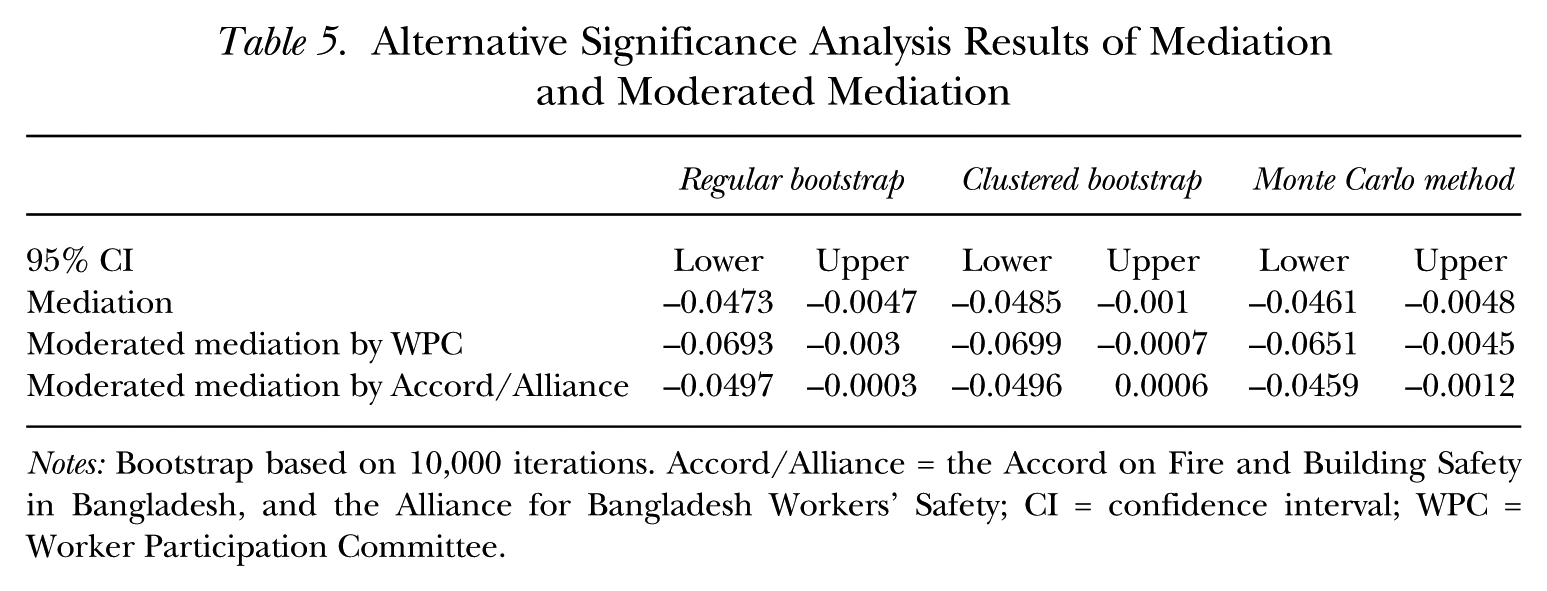
Notes: Bootstrap based on 10,000 iterations. Accord/Alliance = the Accord on Fire and Building Safety in Bangladesh, and the Alliance for Bangladesh Workers’ Safety; CI = confidence interval; WPC = Worker Participation Committee.
Third, we further examine the sensitivity of our main results to potential unmeasured omitted variables that could influence both SIJ and outcome variables. We followed the partial R2 method of Cinelli and Hazlett (2020) and summarize the steps and detailed test results in the Online Appendix. The SIJ–turnover intention relationship (H1) can become non-significant (p > 0.05) in the presence of a confounder that explains 1.99% of the residual variances of SIJ and turnover intention; a confounder as strong as perceived paternalistic management style—a benchmark variable in our data—can do just that. So, this relationship can be explained away. The SIJ–positive affect relationship (H2a) can become non-significant by a confounder that explains 17.87% of the residual variances of both SIJ and positive affect. In our data, a confounder as strong as job satisfaction would not make it non-significant, though a confounder two times as strong as job satisfaction would. As job satisfaction already explains 10.9% (partial R2 = 0.109) of the residual variance of positive affect, it is less likely to have confounders stronger than this. The relationship is relatively robust, though an extreme confounder might exist. The positive affect–turnover intention relationship (H2b) can also be explained away by a confounder accounting for 1.41% of the residual variances of both, and a confounder as strong as job satisfaction can do that. We extend this approach to simulate a mediation index from SIJ to positive affect to turnover intention and it is not robust to confounder(s). These results suggest that our findings on SIJ’s direct and indirect effect on turnover are fragile while the relationship between SIJ and positive affect is relatively robust. We discuss implications in the next section.
Discussion
We extend previous analyses of the impacts of global/national regulatory institutions and factory-level systems on workers in GSCs to examine the underexplored impacts of supervisors. We use organizational justice research to explain how SIJ may influence worker well-being (or positive affect at work) and turnover intention. We further theorize the synergy between SIJ and labor rights institutions at the factory level and beyond. Analysis of survey data from 1,377 workers at 107 garment factories in Bangladesh shows that SIJ is negatively related to turnover intention. We further find that SIJ is related to a higher level of positive affect, which partially mediates its effect on turnover intention. Additionally, we find that the SIJ–positive affect relationship is stronger in factories with WPC and Accord/Alliance coverage. And SIJ’s indirect effect on turnover through positive affect is stronger in the presence of a WPC. These findings suggest that supervisors may relate to variables that are important to workers and factory management, which supports the call for more attention to them in private regulation research and practice.
Our use of an extant data set is not ideal, and we acknowledge issues with our measure of labor rights institutions. We derived our WPC variable from the individual perceptions of its presence or absence, and converted individual perceptions into a factory-level institution based on majority confirmation and key informants methodology. There were workers who did not perceive or know about WPC in factories in which others perceived it (11.1%) and vice versa (11.3%). Such perceptual differences should weaken the difference between factories with and without WPC and thus our chance of finding a significant moderation effect. Similarly, only a minority of workers in our sample are not covered by these institutions—133 workers (9.7%) were in 32 factories without a WPC and 169 workers (12.3%) in 35 factories outside the Accord/Alliance. These small numbers may contribute to large confidence intervals in estimating effects for the groups without these institutions (see Figures 2 and 3), which may reduce our chance of finding significant moderation effects (difference between groups with and without the institutions). Thus, each of our moderation results could be conservative.
We also note a strong overlap between WPC and Accord/Alliance in our sample, and we found weaker/little support for the moderation effect of Accord/Alliance outside WPC. This may result from our small sample: Among 32 factories (133 workers) without WPCs, only 9 factories (31 workers) were inside Accord/Alliance. Another potential explanation is the much lower worker awareness of Accord/Alliance than of WPC: Among 1,208 workers covered by Accord/Alliance, 10 (0.8%) said “no” while 552 (45.7%) selected, “I don’t know,” regarding a question on whether their factory is affiliated with Accord/Alliance. This low awareness increased among the workers outside WPC: Only 3 of the 31 workers without a WPC knew their factories were covered by Accord/Alliance. Such limited awareness may contribute to weak worker attribution (personal sense of power), another mechanism that we proposed may condition the effect of SIJ on workers (H4).
The moderated mediation effect of Accord/Alliance also became insignificant, as indicated by its confidence interval, after clustered bootstrapping. Lower worker awareness of Accord/Alliance may contribute to its weaker effect and thus make it less stable under clustered bootstrapping. Further, Accord/Alliance may impact other factory practices that together influence SIJ. For instance, in our data set, Accord/Alliance is related to a significantly higher level of perceived consultative management practice, which is also associated with better SIJ (see correlations in Table 2). Although we have controlled for perceived management styles and factory fixed effects, we acknowledge that stringent external monitoring may shape management practices in particular type of factories, and influence SIJ. We have focused on the interaction between individual institutions and perceptions of supervisor justice behavior in this study, and our data limit our ability to examine interaction between institutions and factory practices. Future research could explore how diverse institutions and factory practices may interact to shape SIJ and worker reactions.
We also acknowledge the fragility of our results from a cross-sectional data set. Although we have controlled for perceived management styles and factory fixed effect, sensitivity tests show that the SIJ–turnover intention relationship, the positive affect–turnover intention relationship, and the mediation index could be explained away by confounders. Although the SIJ–positive affect relationship is more robust, very strong confounders could also make it non-significant. We take our findings as initial evidence on some benefits of positive supervision in GSCs such as enhancing worker well-being. We hope this work serves as a springboard to more research that brings in more established concepts and measures from organizational behavior and justice literatures to better model micro-level supervisor behaviors and worker experiences at factories and to show how labor rights institutions at multiple levels may improve them.
Future research can build on our study to better measure and examine antecedents and consequences of supervisor fair/humane treatment of workers in GSCs. Although our measure of interpersonal justice overlaps with two seminal items of this construct, we added a third item—on supervisor support if the worker makes a mistake—based on later research (Hollensbe et al. 2008) and our context. Similarly, our measure of positive affect comprises two items from Watson et al.’s (1988) classic measure as well as another less often used item—contented—which we think is important in our sample of workers stressed by production targets. Future research may test the validity of our measures or establish measures valid for production workers at export factories. Additionally, we were unable to control for supervisor gender in our sample. Menzel and Woodruff’s (2021: 6) study with more than 46,000 Bangladeshi garment workers showed that 93% of the supervisors are men while approximately 80% of frontline production workers are women. The dynamic between male supervisors and female workers may exacerbate the impacts of SIJ (Akhter et al. 2019) and even include sexual harassment (Ahmed and Uddin 2022), but we could not capture this in our sample. Future studies could consider the dyadic relationship between the gender of supervisor and worker.
Besides supervisor and worker characteristics, more research could explore when and how institutions can improve supervisor behaviors and worker experiences of process rights. We have suggested that labor rights institutions conceptually cannot fully control supervisor behaviors and empirically have not addressed abuse of workers attributable to technical issues or conflicting commercial versus social requirements from global buyers (e.g., Barrientos and Smith 2007; Kabeer et al. 2020). A combination of various institutions and practices may shape supervisor justice behaviors. For instance, the Better Work program, which emphasizes supervisor training (Babbit et al. 2016), stringent monitoring, and collective worker voice, can improve supervisor interaction with workers in some cases (Pike 2020). Future research can examine when and how individual labor rights institutions and configurations of them can improve supervisors’ humane treatment of workers.
Our article contributes to the labor regulation in global supply chains literature by showcasing the role of supervisors and their impacts on workers in relation to other labor rights institutions. It is among the first to examine the relationships between positive supervisor behaviors, worker positive affect, and turnover intention with survey data on a large number of workers in GSCs. We thus add some positive evidence to prior (mostly case) studies on supervisor abuse (e.g., Ahmed and Uddin 2022), advancing evidence on the important role of supervisors in GSCs. Further, we extend prior research on the interaction between private and public regulation (e.g., Amengual 2010) by proposing an interaction between micro- and institutional-level factors. In so doing, we integrate private regulation and organizational behavior literatures. Our study is the first to examine how labor rights institutions at the workplace and beyond may shape the effects of supervisor justice on workers, contributing a contextualized study on the effects of supervisor justice (e.g., Colquitt et al. 2023).
Our findings also have practical implications for global corporations, MSIs, factory owners, and supervisors in GSCs. Supervisors’ fair treatment of workers can influence worker well-being (positive affect) and turnover intention, an issue that concerns global brands and supplier factories (Moon et al. 2023). Our findings echo the importance of training supervisors in communication skills (Babbitt et al. 2016; Pike 2020) as part of factory capability-building projects. We also provide some evidence supporting field experiments among Bangladeshi garment factories (Uckat and Woodruff 2020) that show the downstream benefits of hiring or promoting supervisors using diagnostics to measure soft skills. Practices targeting supervisors—training, hiring, or promotion—can be part of a bundle of management practices to improve worker and firm outcomes.
Conclusion
We extend prior research on the impacts of global-, national- and factory-level institutions on labor standards in global supply chains by telling a story centered on the role of supervisors, measured from the perspective of workers. Our analysis of supervisor interpersonal justice and worker outcomes among 1,377 workers from 107 garment factories in Bangladesh shows that SIJ is related to lower turnover intention directly and indirectly by fostering higher positive affect. The results also suggest that SIJ may have a stronger relationship with positive affect in the presence of workplace collective voice mechanisms and stringent monitoring programs, and SIJ’s indirect effect on turnover intention could be stronger in factories with a collective voice mechanism.
Our study contributes to the private regulation literature by highlighting the impacts of supervisors on worker and firm outcomes. We echo research that advocates for training supervisors in communication skills (Babbit et al. 2016) or promoting supervisors for their soft skills (Uckat and Woodruff 2020). Finally, our theory and select findings on the varying effects of SIJ on workers under distinct labor rights institutions also adds to the growing literature on how various factors at multiple levels may interact with each other to improve workers’ rights and experiences in export factories (e.g., Amengual and Kuruvilla 2020; Boudreau 2024).
Supplemental Material
sj-pdf-1-ilr-10.1177_00197939261419730 – Supplemental material for Supervisor Interpersonal Justice and Worker Turnover Intention in Global Supply Chains: Evidence from Bangladesh Garment Factories
Supplemental material, sj-pdf-1-ilr-10.1177_00197939261419730 for Supervisor Interpersonal Justice and Worker Turnover Intention in Global Supply Chains: Evidence from Bangladesh Garment Factories by Sazid Ahmad, Chunyun Li and Sarah Ashwin in ILR Review
Footnotes
Acknowledgements
The authors are grateful for suggestions received on previous iterations of this paper from Jiaqing (Kathy) Sun, Aaron Aujla, Rashi Sonal, and more broadly the colleagues in the Employment Relations and Human Resource (ERHR) group at LSE’s Department of Management. We thank Naila Kabeer, Lopita Huq, and Munshi Sulaiman, who collected the survey data on which this article is based. The survey was conducted for the project “Changes in the Governance of Garment Global Production Networks,” funded by the Volkswagen Foundation under its Europe and Global Challenges program. The project entailed collaboration between the London School of Economics and the BRAC Institute of Governance and Development and was supported by supplementary funding from ESRC-DFID (ES/ L005484/1). Along with Kabeer’s team, we also thank Adiba Afros, Mahabub Rahman, Saiful Islam, and the late Simeen Mahmud.

For general questions as well as for information regarding the data and/or computer programs used to generate the results presented in the article, please contact Sazid Ahmad at
1
Another major path centers on social exchange such as organizational commitment or leader–member exchange, which is less relevant in our context.
2
We find a similar pattern of results for our hypotheses when using two items for positive affect.
3
We also reviewed worker background for all majority/unanimous consensus factories for thoroughness.
4
We did some minor cleaning of this variable, cross-checking with job section.
5
The same logic can be analogously applied to moderated mediation, depending on how we theorize the moderation.
6
One method is the Sobel test, which follows the logic of a typical t-test that (often unrealistically) assumes a normal distribution of product of coefficients. The Monte Carlo method is a better one that assumes normal distribution of individual coefficient (not the product) and simulates the coefficients and multiplies them in each case (with multiple simulations). The third and best method is bootstrapping, which makes no assumption about distribution of coefficients and computes the mediation index based on samples drawn from the raw data.
7
Calculated as 100 × (0.106/1.76) = 6%.
9
Analysis among the subsamples outside Accord/Alliance shows that SIJ→positive affect is only marginally significant (β = 0.127, p = 0.051) among the 67 workers at 12 factories with WPCs and it was negative and not significant (β = −0.024, p = 0.647) among the 102 workers at 23 factories without WPCs.