



Abstract
Tech workers—professionals in the technology industry, such as software engineers, product managers, and UX designers—are not normally associated with labor activism. Yet, since 2017, there has been a significant rise in workplace activism over “bread-and-butter” issues among this group. Using an original data set, the authors demonstrate how, in the case of tech workers, periods of intense workplace social activism preceded later periods of heightened labor activism. Regression analysis confirms that participation in social activism increases the likelihood of labor activism six months to one year later at the same company. Extending Rick Fantasia’s cultures of solidarity to professional workers, the authors highlight a new mechanism by which professionals engage in labor organizing: First, tech workers, guided by their professional interest in socially beneficial work, engage in workplace social activism. This action generates solidarity among employee-participants but also creates conflict with management and leads to the emergence of labor activism among professionals.
In 2018, at the height of the #MeToo movement, the New York Times broke a story about a $90 million settlement paid to Andy Rubin, a former Google executive who was asked to resign after credible claims of sexual harassment (Wakabayashi, Griffith, Tsang, and Conger 2018). The revelation formed the basis for a walkout of 20,000 Google employees, many of whom would eventually join the company’s minority union, the Alphabet Workers’ Union. While the spotlight of this protest was on discrimination against women and people of color, the demonstration also featured calls for improved working conditions for all Google employees.
In recent years, tech professionals—such as software engineers, product managers, and user experience (UX) designers—have started participating in “bread-and-butter” labor activism (meaning issues such as wages, benefits, hours, and working conditions). Google contractors at HCL Technologies won the first-ever union of software engineers in the United States in 2019, followed shortly by Kickstarter employees who formed the first wall-to-wall union in the tech sector. (Wall-to-wall means a union that organizes everyone in a workplace, regardless of their particular job.) In 2022, hundreds of tech workers at the New York Times voted 404 to 88 to certify their union. Seeing this opportunity, national unions, including the Communication Workers of America (CWA), United Steel Workers, and the Office and Professional Employees International Union (OPEIU), have also poured resources into organizing tech professionals. At the time of publication, more than two dozen unions are recognized in the industry.
Conventionally, scholars have understood labor activism as a response to exploitation and a means to improve economic and working conditions. Yet tech professionals are well compensated, afforded considerable workplace autonomy, and have high labor market power, allowing them to switch jobs rather than organize for change from within the firm. Moreover, they have historically self-identified as professionals, creatives, or entrepreneurs rather than workers (Dorschel 2022a; Rothstein 2022), making them conventionally seen as incompatible with labor activism (Milton 2003; Van Jaarsveld 2004; Brophy 2006; Dorschel 2022b). So, why have tech professionals engaged in bread-and-butter labor activism in recent years?
To explain the rise of labor activism in the tech industry, we collected and analyzed all publicly documented instances of collective action by US tech workers from 2014 to 2022. Over this period, tech professionals engaged not only in bread-and-butter labor activism but also in another type of workplace activism that we call social activism, meaning activism over issues that do not directly impact the participating employees’ wages or working conditions. Employees protesting a military contract would be an example of this. Using a logistic regression model and company fixed effects, we test the relationship between the two types of workplace activism and the effects that organizational types have on labor activism.
Existing research has highlighted how social issues can spur labor activism vis-à-vis social movement spillover, wherein social movements can influence each other and even lead to the birth of new movements (Meyer and Whittier 1994; Isaac and Christiansen 2002; Isaac, McDonald, and Lukasik 2006; Ferguson, Dudley, and Soule 2018). By contrast, the case of tech workers demonstrates how spillovers, driven by instances of social activism as opposed to extra-organizational effects, such as shared strategies and framing, can occur within a single organization. To explore this spillover mechanism in which bread-and-butter labor activism emerges, we conduct case studies of workplace activism at Google and Microsoft.
We argue that tech workers possess a distinctive professional identity centered on using technology for societal benefit. However, when employers undermine these idealistic values by engaging with perceived bad actors, such as oil companies or militaries, they violate tech workers’ belief in contributing to the social good. In response, tech workers, guided by their unique professional identity in preserving the social good, engage in social activism in the workplace. Participation in such activism generates solidarity among employee-participants. It can also create conflict with management, who see such protest strategies as tarnishing the company’s brand image. In this way, social activism exposes the previously hidden divide between workers and management, masked by the industry’s techno-utopianism. Consequently, employees come to understand their own identities not just as professionals but as workers, creating the basis for bread-and-butter labor activism.
Do Professionals Participate in Labor Activism?
Professionals can be defined as workers with jurisdiction over a particular set of skills or decisions for which a labor market exists. In academic literature, professionals are portrayed at the top of an ecosystem of employment in the United States, protected by high barriers to entry for their profession, allowing them to negotiate for high compensation and a degree of self-governance through professional organizations (Abbott 1988; Brint 1994; Freidson 2001). From their advantaged position, professionals would seem to have neither the need nor the interest to challenge existing systems of power in the workplace.
Empirical accounts confirm these challenges and demonstrate how workers use professional ideologies to justify their lack of involvement in labor activism. Ideologies can exist at the level of the profession but can also permeate entire industries associated with professionalism, such as tech or finance. In their account of hospital worker organizing, Fink and Greenberg (2009) noted the difficulty of getting pharmacists to strike and unionize alongside service and maintenance workers due to “reservations about mixing ‘professionalism’ and ‘unionism’” (p. 116). Within the same workplace, inequalities in pay, treatment, and respect can allow one set of workers to distance themselves from the struggles of others. In other cases, entire industries can be infused with an anti-labor sentiment based on a more general ideology of professionalism. In a case highly relevant to our own, Milton (2003) described the challenges of unionizing “high-tech talent,” arguing that workers saw unions as “opposed to the meritocracy . . . that anchors excellence in technology-based industries” (p. 41). The workers Milton described encompass numerous professions and span several companies, but all identify with an industry-wide neoliberal ideology that Barbrook and Cameron (1996) summarized as a “[r]elentless drive to . . . intensify the creative powers of human labor” (p. 44). Dorschel (2021) and English-Lueck (2011) have noted similar meritocratic and entrepreneurial ideologies among tech workers, suggesting that these professionals face a twofold challenge of combating both the ideologies of their individual professions and the greater industry.
What is apparent, however, is that while there is virtually no documentation of labor activism among certain professional groups, including consultants, structural engineers, and accountants, instances of professionals engaging in labor activism do exist. Since the first Trump presidency, journalists and tech workers have increasingly participated in labor activism. In “Unlikely Activists,”Rothstein (2019) showed that Information and Communication Technology (ICT) professionals participated in labor activism, challenging the common portrayal of weak labor as a structural feature of the knowledge economy. Meanwhile, teachers and nurses have been among the most significant groups in US organized labor in the past few decades (Weiner 2012; Dube, Kaplan, and Thompson 2016). Common among these professions—journalists, teachers, nurses, and tech workers—is a strong moral impetus to do good that exceeds mere professional competence. For journalists, this dedication is rooted in a commitment to journalistic integrity. Nurses are guided by an ethical duty to provide high-quality care. Teachers carry the moral responsibility of child development and education. Similarly, tech workers hold techno-utopian beliefs that technology expands democracy and reduces hierarchy (Turner 2006). As such, these groups select their profession with the belief that their work will be helpful to society (Augustine and King 2022; McAdam, Fielding-Singh, Laryea, and Hill 2022; Wilmers and Zhang 2022).
Compared to other professional workers, teachers, nurses, journalists, and tech workers are more likely to use their careers or professions as platforms for expressing social or political beliefs. This, perhaps, in part, explains the inclination to participate in activism at work. This feature overlaps with existing literature on occupational activism (Coley and Schachle 2023; Rheinhardt, Briscoe, and Joshi 2023), whereby workers contribute to social change by leveraging connections to their occupational identity or community (Cornfield, Coley, Isaac, and Dickerson 2018). 1 Occupational activism and workplace social activism are not interchangeable. Social activism in the workplace does not necessarily need to rely on occupational identity or community, whereas this is integral to the definition of occupational activism. Occupational activism is therefore just one type of social activism that can be found in the workplace. When we use the term “social activism” we are implying a broader category of activism that encompasses occupational activism within it.
Even among this group of morally inclined professionals, tech workers represent perhaps the most standout category of labor organizing because of their relatively high rates of pay and significant work benefits. We do not suggest, however, that tech workers have no labor-related grievances—we will highlight examples of this later in this article. Still, teachers, nurses, and journalists share a significantly higher degree of precarity and exploitation, making labor activism an apparent solution to their grievances. Teachers and nurses, for example, have been historically underpaid, are more likely to be staffed by women and people of color than other professions, and are only recently seen as “professional,” partly as a result of activism that advocated for the importance of their work (Apesoa-Varano and Varano 2004; Fink and Greenberg 2009). Journalists were, in the mid-20th century, in part influenced and incited to unionize when they saw blue-collar print workers receiving higher wages as a result of their success in organizing (Salamon 2023). They, too, underwent a gradual professionalization process. Since the mid-2010s, the profession faced rising precarity and the proliferation of freelance journalistic work, leading to a resurgence of labor activism (Luce and Shaffer 2020; Salamon 2020). Similarly, the recent unionization successes of medical residents were largely in response to the COVID-19 pandemic, increased burnout, and dissatisfaction over long hours and low pay (Lin, Ge, and Pal 2022).
In sum, tech workers make for an informative case study for two reasons. First, tech workers—like nurses, teachers, and journalists—are morally motivated and select into their careers to express social or political beliefs. Second, even among morally motivated professionals, tech workers stand out in terms of wages and working conditions, making their participation in labor activism more confounding. As a result, tech workers represent what Seawright and Gerring (2008) called a deviant case, which best allows us to probe for new explanations as to why professionals participate in labor activism. In this way, the case of tech workers presents a rare example that sheds light on the interactions between social activism and labor activism among professionals.
Possible Explanations behind the Rise of Labor Activism in Tech
One explanation for the rise of labor activism among tech professionals is that a shock to labor relations caused workers to respond with labor activism. The economic downturn following the post-pandemic interest rate hike in 2022 caused employers to respond with austerity measures, notably mass layoffs in the tech sector for the first time since the burst of the dot-com bubble (Mickle, Weise, and Grant 2023). Employers have also implemented new practices to tighten control over workers, revoking work-from-home policies, rolling back office perks, and creating new reporting requirements. Literature in labor relations has indeed documented that dissatisfaction with pay, promotion, job security, and working conditions is strongly tied to labor organizing (Schriesheim 1978). This pattern can be traced even among high-tech workers. Brophy (2006) showed how contractors at Microsoft seized a political opportunity created by a new labor policy and an existing class-action lawsuit to launch a new union that would fight for improved working conditions.
Sheehan and Williams (2023) followed this tradition and posit that the rise of bread-and-butter activism is attributable to this financial dip, arguing that management used the macro-economic climate as an opportunity to reset labor relations in their favor, precipitating a labor response from workers. The data we present, however, do not generally support theories of a “shock” in labor relations in 2022 or even in earlier years. Our data show a steady rise in labor activism as early as 2019—three years before the resetting of labor relations that Sheehan and Williams (2023) referred to. A true shock should be experienced as a sudden upsurge in labor activism events, not as a gradual increase beginning years prior to austerity measures. Moreover, many labor actions, such as winning a union election, typically take years to accomplish, which means that public-facing labor activism in 2022—the year attributed to the shock in labor relations—would have begun germinating long before.
A second explanation is that external social factors and the political climate led to the rise of labor activism in the US technology industry. Journalistic accounts from the early years of workplace social activism identify Trump’s presidential election, and the broader resistance against the president, as an instigating force for a more politically aware and active workforce (Tiku 2019; Tarnoff 2020). This trend reflects how one social movement can have spillover effects on a seemingly disparate social movement (Meyer and Whittier 1994). Mass movements in the 1960s have been shown to have had a significant effect on labor organizing during that same time period, driving these movements to adopt more militant tactics and increasing participation from minority groups that had previously been excluded (Isaac and Christiansen 2002; Isaac, McDonald, and Lukasik 2006). Ferguson, Dudley, and Soule (2018) demonstrated how more protest activity in a city can subsequently lead to higher levels of unionization in that same city, with greater spillover effects accruing to more progressive unions.
As studies have shown, professional tech worker populations in the United States are politically left-leaning on the whole and identify strongly with a pro-social vision of the tech industry (Rider 2022; Selling and Strimling 2023). It is highly possible that spillover effects from left-leaning social movements during the first Trump presidency led to greater labor activism in the tech industry. Even if not due to Trump himself, the other social movements and current events that occurred in these years, such as the Black Lives Matter (BLM) protests in the summer of 2020, the COVID-19 pandemic (which temporally aligned with the BLM protests of 2020), and a well-publicized series of union drives at Starbucks, Amazon, and elsewhere, could have had an effect on workers deciding to organize labor actions as well as social activism.
The political zeitgeist is undoubtedly important, but it alone does not explain why tech workers—and not other left-leaning, high-paid professionals—participate in labor activism. If it did, we would expect those in law, structural engineering, architecture, or clinical research to also participate in labor activism. 2 Yet, there is no evidence of substantial labor activism by professionals in these other industries. Moreover, pegging the shift to Trump’s election would suggest a significant dip in employee activism under the Biden administration, for which there is no evidence. Instead, our data show a steady rise in tech workers’ participation in labor activism starting in the final years of Trump’s presidency and before the BLM protests, the COVID-19 pandemic, and the nationwide surge in labor activism. This observation does not exclude that these events could have prolonged or increased this rise.
Although the preceding account does not give us a full explanation for the surge in labor activism in the tech sector, it does provide a possible cause for social activism in the workplace. Many early protests by tech professionals directly responded to Trump’s presidency and the policies he advocated. This connection leads us to a third explanation: Participation in social activism spurred those same workers to engage in later labor activism. Theorists of class consciousness have modeled the resurgence of labor activism among subsets of US workers using a dual conception of structure and agency (Sewell 1992). The rise of unionizing efforts has been seen as an interplay between structural forces (political movements, industrial conflicts, and management strategies) and worker agency (social and ethnic identities, organizational strength, and mobilization of political resources) (Fantasia 1988; Delgado 1993). In Cultures of Solidarity (1988), Fantasia demonstrated how professional and worker identities can be synergistic rather than antagonistic and can encourage previously reluctant professionals to engage in labor activism. In one of his case studies, nurses developed a worker identity partly in reaction to management’s anti-union campaigns. Professional identities bolstered nurses’ demands by positioning them as authorities on patient care. Management’s pushback on demands became seen as a misalignment of professional values as well as a conflict along class lines.
The preceding literature provides us with a clear hypothesis to test: Social activism in the workplace draws on professional identity but also utilizes the opportunities afforded by particular political platforms and historical moments (Rheinhardt, Briscoe, and Joshi 2023). It can also precipitate conflict between workers and managers at the individual level when workers are demoted or fired for their activism and at the organizational level when demands are not met (Rheinhardt, Poskanzer, and Briscoe 2023). In this way, workplace social activism can lead to the sort of generative conflict that Fantasia (1988) sees as essential for the development of class consciousness.
We begin with the most general premise—that social activism, due to its conflictual nature and its propensity for generating solidarity, creates the conditions for professionals to develop class consciousness. For these reasons, we might expect to see a positive relationship between heightened workplace social activism and heightened labor activism:
Within this explanation, we can examine an additional mechanism in greater detail to account for exactly why social activism in the workplace sets the stage for labor activism. It is possible that social activism in the workplace itself directly contributed to later labor activism by increasing the organizational strength of professional workers. Organizational strength can best be understood as the social ties that build into sustainable organizing resources, which include informal collectives, formal institutions, or common processes and strategies (McAdam 1982). We posit that social activism in the workplace allows workers to build organizational strength by connecting with other like-minded workers and building sustainable institutions and processes that they return to for future organizing efforts. As our own data show, protest actions in the US tech industry were organized by a variety of groups, ranging from dispersed ad-hoc groups to short-term collectives to longer-lasting worker organizations. Each has varying capacities for building trust among workers, creating sustainable and committed constituencies for activism, and building toward labor activism. For these reasons, we expect to see a positive relationship between the presence of worker groups with organizational strength and heightened labor activism in the US technology industry.
In sum, we propose that this third explanation—that social activism leads to labor activism and that social activism produces the organizational strength necessary for sustained labor activism—merits further research. The rest of this article systematically examines the relationship between social and labor activism and how such a transition took place in the tech sector.
Research Methods
Data
The basis of our analysis is an original data set 3 of collective actions in the US technology industry from 2014 to 2022, which we gathered using NexisUni news archives. To compile this data set, we searched for articles in which collective action terms 4 occurred within 25 words of employment terms 5 for the computing and information technology industry. To qualify for our data set, events must be “collective” and present “evidence of action” by currently or recently employed “tech workers.” Our data set of events is heavily skewed toward actions reported in the English language press because we conducted our search only in English. Moreover, we exclude five actions that involved workers at multiple companies, such as the Tech Against Fascism protests, for which engineers, researchers, analysts, and designers across India’s and the US’s technology sectors signed an open letter condemning the Indian government’s repression of citizens during the 2019 democracy uprising. The majority of collective actions in the archive took place at large tech companies such as Google, Microsoft, and Amazon. Together, these three companies amounted to 51% of the total recorded collective actions in this study. One reason for this may be because the media biases larger tech companies in their reporting, which would make large tech firms appear with a higher likelihood in our data set.
We filtered our search to include only actions that were organized by or included tech workers in the United States, resulting in 175 instances of collective action by US-based tech workers between 2014 and 2022, inclusive. This data set also served as the basis for the panel data set we constructed for our regression analysis, which we describe later.
We find that since 2017, the number of collective actions by tech workers in the United States has grown exponentially. In 2017, there were four reported actions in the industry, at Palantir, Google, and Facebook, all protesting the same set of ethical issues—Trump’s Muslim registry and immigration ban and the tech industry’s involvement and complicity. As illustrated in Figure 1, collective action taken by tech workers exploded in 2018, peaking in 2019, and has remained relatively high in the following years. In 2019 and 2021, the top years for protests, there were 46 in each year.
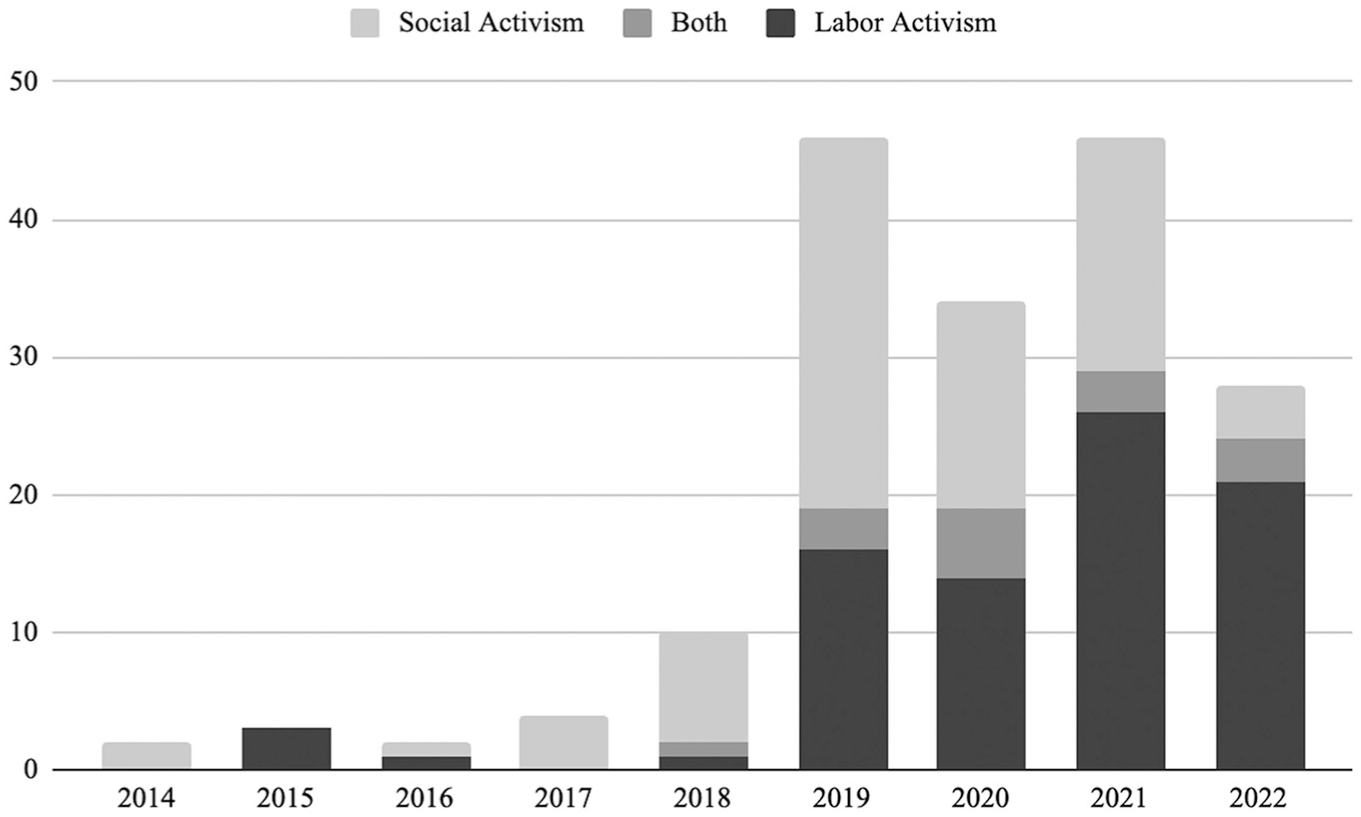
Collective Actions by Social versus Labor Activism
Measures
Since we are concerned with explaining the rise of labor activism (H1), we differentiated each collective action in the data set as either workplace social activism or labor activism based on the nature of the issue being protested. Each collective action entry was reviewed by two individuals—the initial coder and a separate reviewer—to ensure intercoder reliability across entries.
We define bread-and-butter labor activism (which we call “labor activism” as a shorthand) as collective actions that demand direct change to the wages and/or working conditions of the participating employees. The focus in this article is on the organizing over these bread-and-butter issues, which is unusual to see from professionals such as tech workers. Protests about the wages/working conditions of another group of workers do not qualify. Union campaigns are considered labor activism. We do not believe that bread-and-butter labor activism is representative of all labor activism; instead, bread-and-butter labor activism narrowly focused on the wages/working conditions of the participating employees is the subject of this study because of its novelty in the particular case of tech workers.
We define social activism as collective actions in which the subject of protest does not involve participants’ wages or direct employment conditions. Our definition of workplace social activism builds on the concept of “social movement unionism,” which emerged first in the late 1980s as a criticism of traditional trade unionism. It was also labor unions’ response to the rise of new social movements, including feminist, anti-war, human rights, and environmental movements (Waterman 1993). While Waterman’s definition of social movement unionism encompasses workplace activism over a wide range of issues from increased union control over the labor process to investment and technology decisions, we focus on the aspect of this definition that emphasizes protesting for demands beyond wages and working conditions.
Based on this definition, tech workers protesting against military contracts are included in our definition of social activism because such protests are against potential harms caused by the military. And even though contributing to a military contract may change the meaning that workers ascribe to their work, it affects their working conditions in a non-material way. Workers organizing for better LGBTQ+ content moderation policies at YouTube would similarly be classified as social activism since participants do not expect changes in their own employment conditions as a result of their activism.
We also count workers protesting for the wages/working conditions of another group as social activism. For instance, tech workers at Facebook supporting their cafeteria workers’ union drive would also be considered social activism from the perspective of the former group of workers because even though the union drive is about wages/working conditions, their support for the drive would not result in direct improvements to their own wages/working conditions (Russell 2019).
In this article, we label actions regarding discrimination, harassment, diversity, equity, and inclusion as labor activism unless an explicit connection is made to systemic injustice or a broader social movement, such as Black Lives Matter or #MeToo. Or consider the case of Google’s walkout in 2018. Without context, it may seem like this type of collective action should be categorized as labor activism since many of the demands made by protestors are concerned with internal company policy. Moreover, the issue of sexual harassment from an executive is an abuse of managerial power. However, the walkout consistently referenced the #MeToo movement, which turned individual instances of sexual harassment and abuse into a global social and political movement. We categorized this event as both social and labor activism because, although workers were the recipients of harm perpetuated by the target of the protest in this case, the event organizers also referenced the protest as one of a series of fights in a broader systemic struggle against sexism and disempowerment in the workplace. Thus, while the topic of protest is considered bread-and-butter, the motivation behind the action is aligned with the moral values of the tech workers’ professional identity.
In addition to categorizing the type of protest, we also want to test the effects of organization types on labor activism (H2). We coded each entry of the data set by the type of organization (if any) responsible for organizing the collective action: employee resource groups (ERGs), employee activism groups (EAGs), and unions. Employee activism groups, or EAGs as we term them, resemble ERGs in that they may be formed around a specific identity group or a specific issue. However, they are not organized or sanctioned by management. Often, these groups emerge after individuals belonging to no particular group organize an action and decide to solidify their collaboration. The group Google Walkout for Real Change came together this way. Although these employee activism groups are relatively informal and have no official membership, some have a logo; a website, or Medium, or GitHub page where they can post open letters; and social media accounts. In many cases, these groups are sustained over time and have a track record for organizing multiple protests or campaigns. Unions are distinguished from ERGs and EAGs on two dimensions. First, firm-based unions typically involve a national union. Second, and more important, organizing a union requires formal organizational capacities, such as an organizing committee, dedicated weekly meetings and goal-setting, and usually the involvement of the National Labor Relations Board (NLRB).
We examined news articles to extract information about the type of organization responsible for organizing an action. When the protest strategy was to release an open letter, it was easy to determine whether an organization was involved because the organization would sign the open letter with their name. However, not all protests involved an open letter, so we had to rely on the news reporting of the protest to determine if any organization was involved. We recognize that this approach likely means underrepresenting the role of EAGs and ERGs in our data set.
Methods of Analysis
Using a logistic regression model, we evaluate the effects of social activism and organizational types on the likelihood of labor activism occurring at a company on any given day. The unit of analysis is company-day. Our sample includes all companies in the US tech industry with any recorded instances of workplace social activism or labor activism. If a company has no instances of social or labor activism, they are not included in our sample.
We constructed panel data from our archive: For every day
Because instances of activism are relatively uncommon at any given company, we chose a logistic probability model, better suited to rare events than is a linear probability model (King and Zheng 2001). We added firm fixed effects to account for unobserved company-specific characteristics.
Model (1):
The intercept,
Results
Descriptive Evidence
Using this basic topology of social and labor activism, our data analysis illustrates a clear shift in the proportion of social-to-labor activism over the period we examined. Figure 1 presents the split between collective actions categorized as social and labor activism. Figure 2 presents the split as a percentage of total collective actions over the same period, showing a clear shift from actions of the former category to the latter. As Figure 2 shows, the proportion of labor activism has grown from just 10% in 2018 to more than 75% in 2022 and is even higher (20% and 85%) when counting actions that are categorized as both social and labor activism. Because our data rely on news articles, the gradual decline in the total number of collective actions observed may not necessarily indicate an overall decrease in tech organizing, but rather, a shift away from media-centric tactics (such as walkouts and open letters) in favor of internal or underground labor organizing. 6
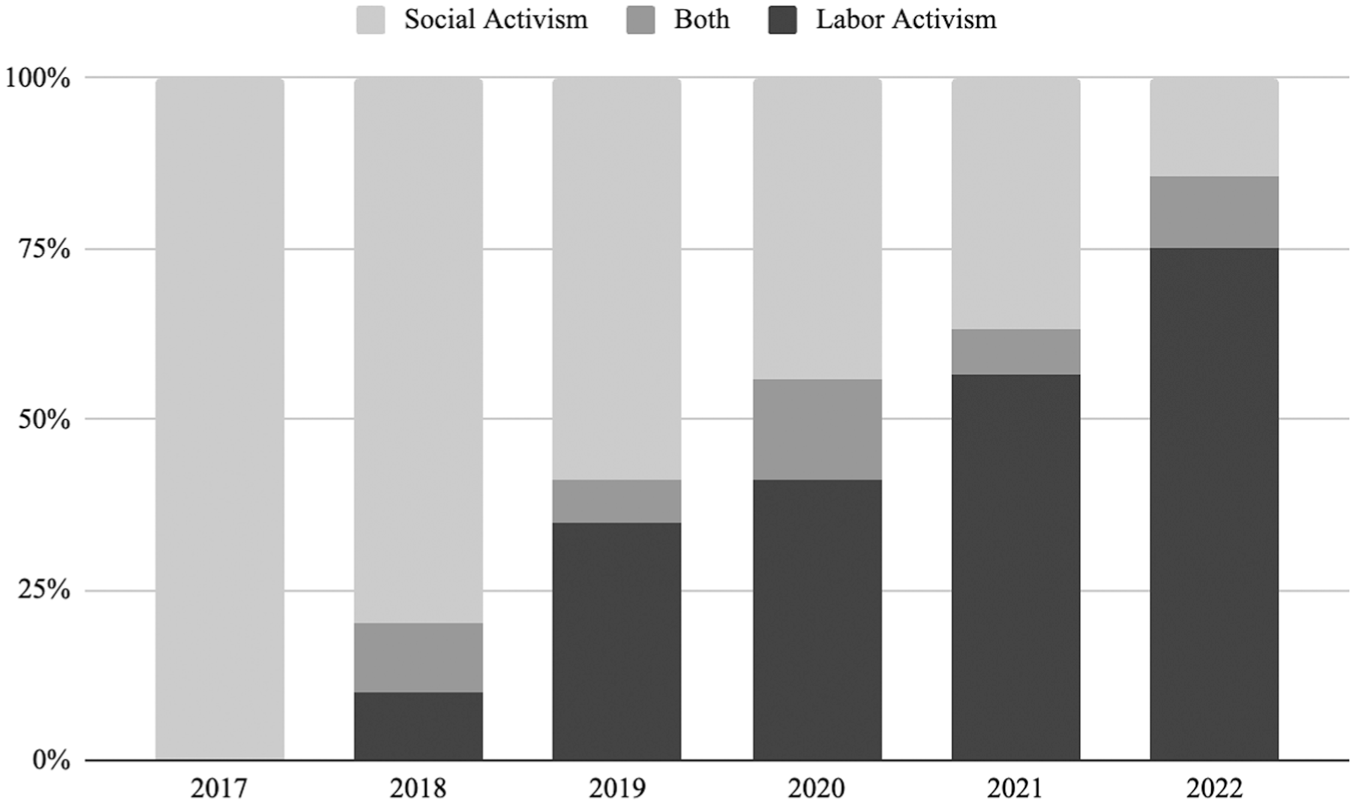
Proportion of Social versus Labor Activism by Year
In addition to identifying a clear and gradual shift from social to labor activism in the workplace (see Figure 2), our data set also illustrates that neither social nor labor activism in the tech industry has been dominated by a single issue or social movement. Figure 3 presents the breakdown of social activism events from 2018 to 2022 by the most prevalent issues across the tech industry. Figure 4 presents the same data for labor activism. For social activism, several issues reappeared over the course of several years—climate change, military contracts, and opposition to the Trump presidency. Some issues are largely temporal. In 2020, BLM-related protests by tech workers contributed more than a third of documented actions but have logged no actions in subsequent years. Labor activism is similarly varied. Coronavirus, one of the temporal issues, contributes just a small percentage of activism among professional workers.
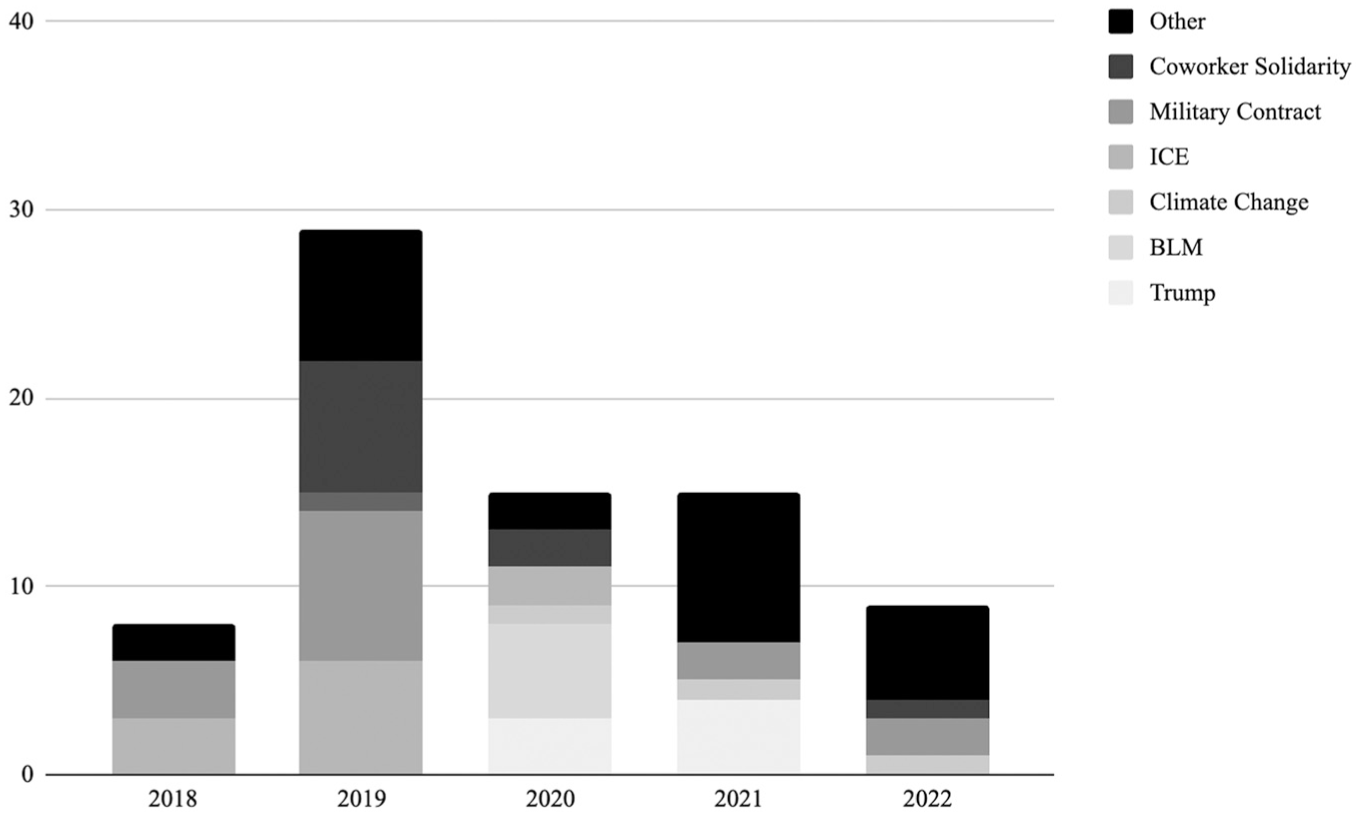
Social Activism by Issue (2018–2022)
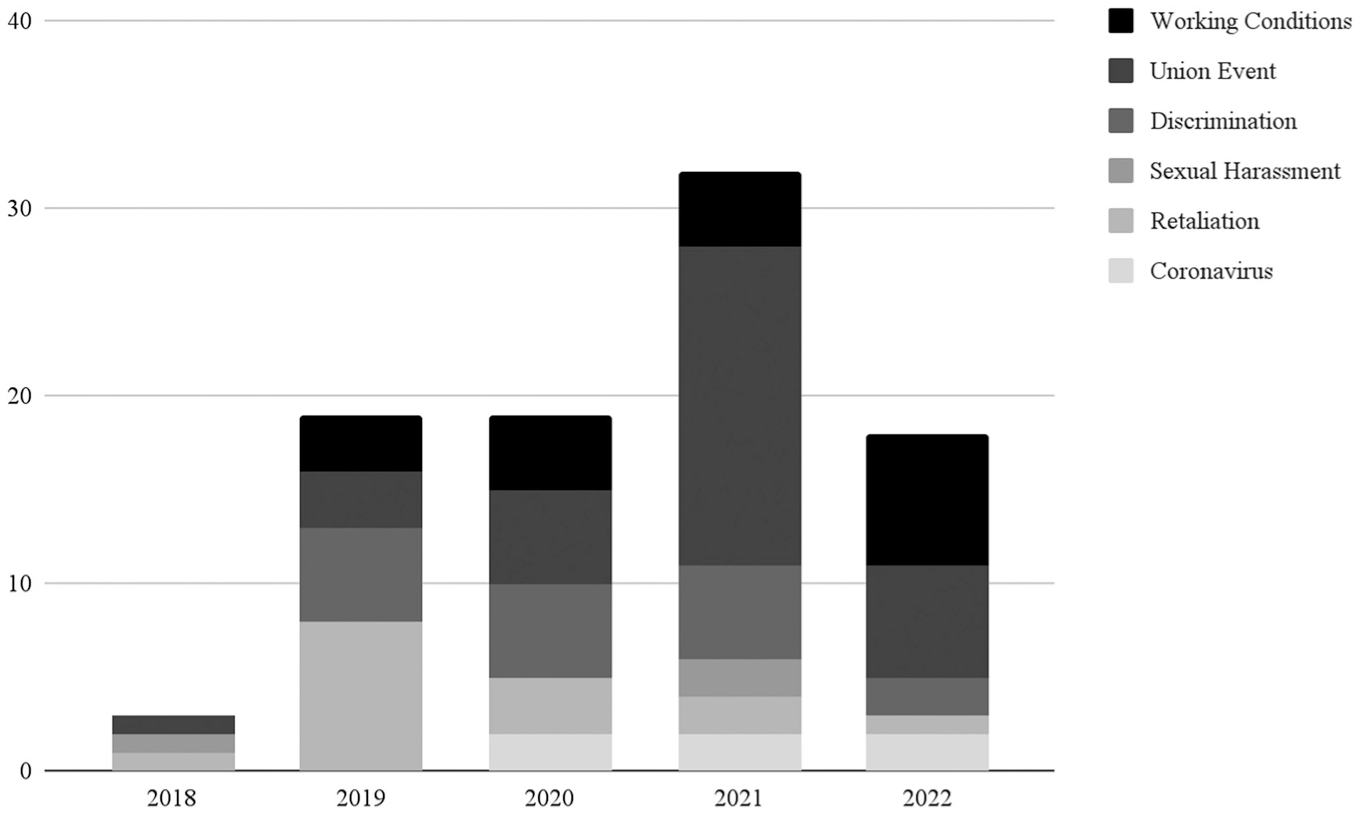
Labor Activism by Issue (2018–2022)
When it comes to organizations, our data suggest a strong correlation between the likelihood of labor activism and certain organizational types. We find that a large portion of social activism is organized by EAGs. ERGs represented only 1% of our data set, so we excluded it from further analysis. Labor activism, not surprisingly, is often organized by unions. A large portion of social and labor activism also comes from individual actors who are not organized into a group.
This analysis illustrates a steady shift from social to labor activism between 2017 and 2022, suggesting a correlation between social and labor activism (H1). It also suggests a correlation between certain organizational types and labor activism (H2). Next, we present the results of our regression to show the effects of social activism and organizational types on the likelihood of labor activism occurring at a company on any given day.
Regression
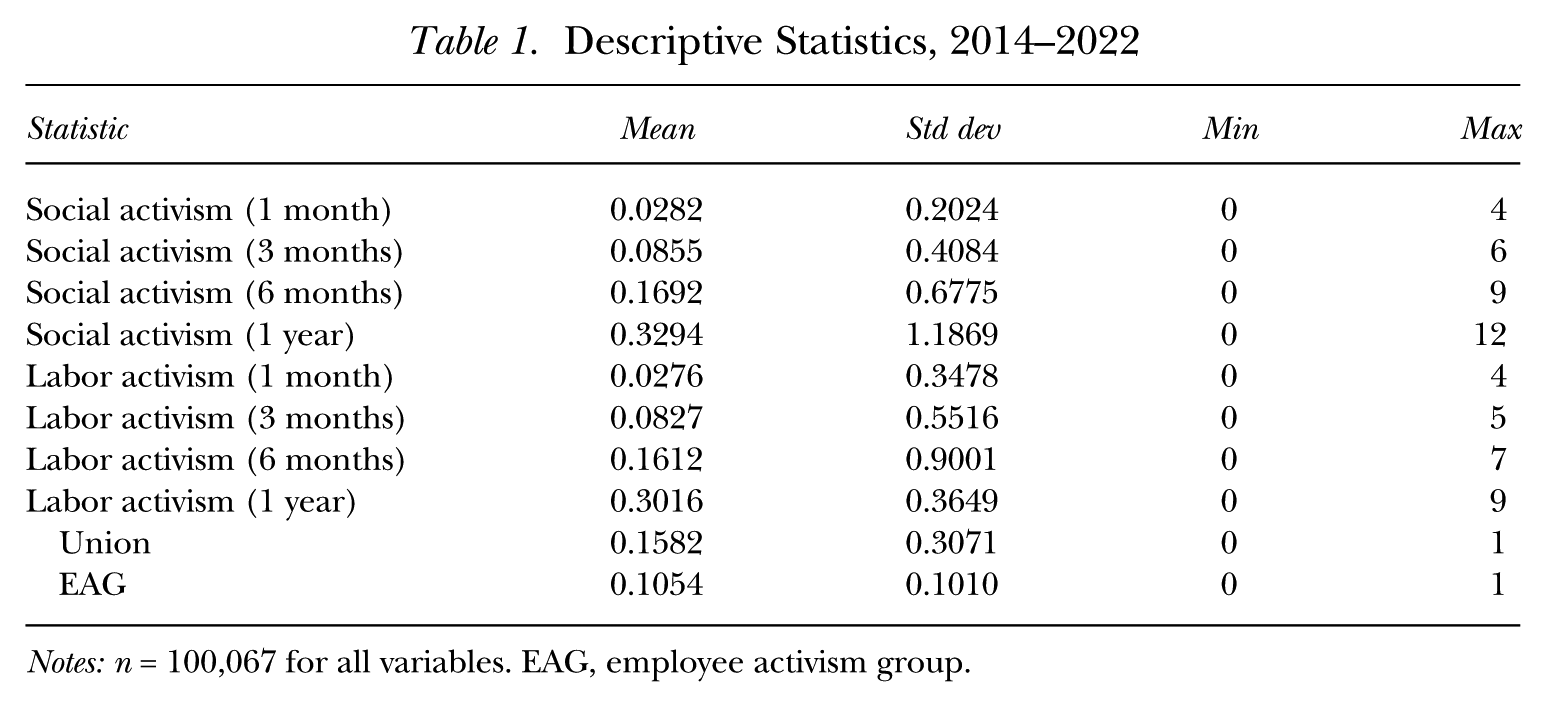
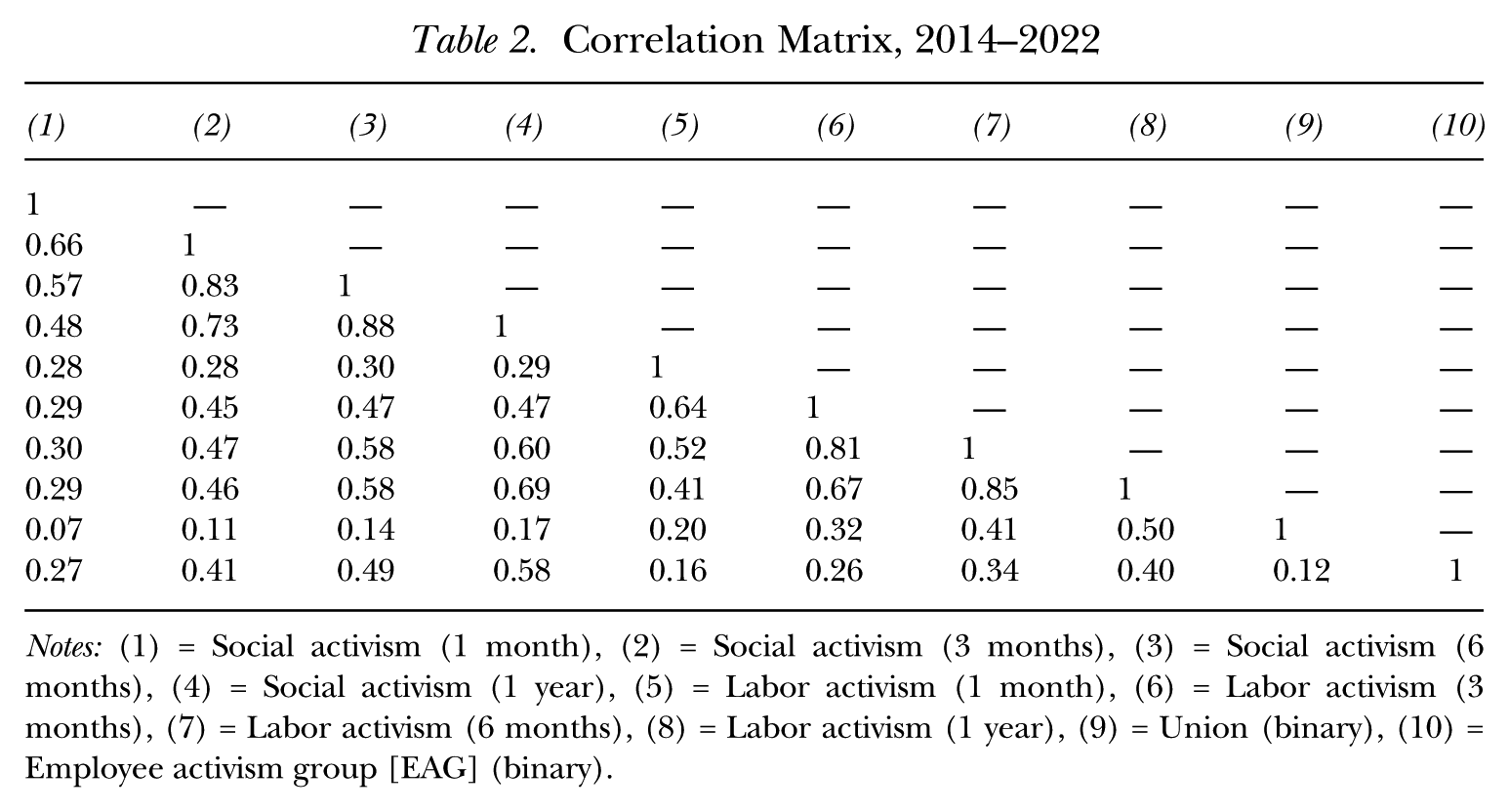
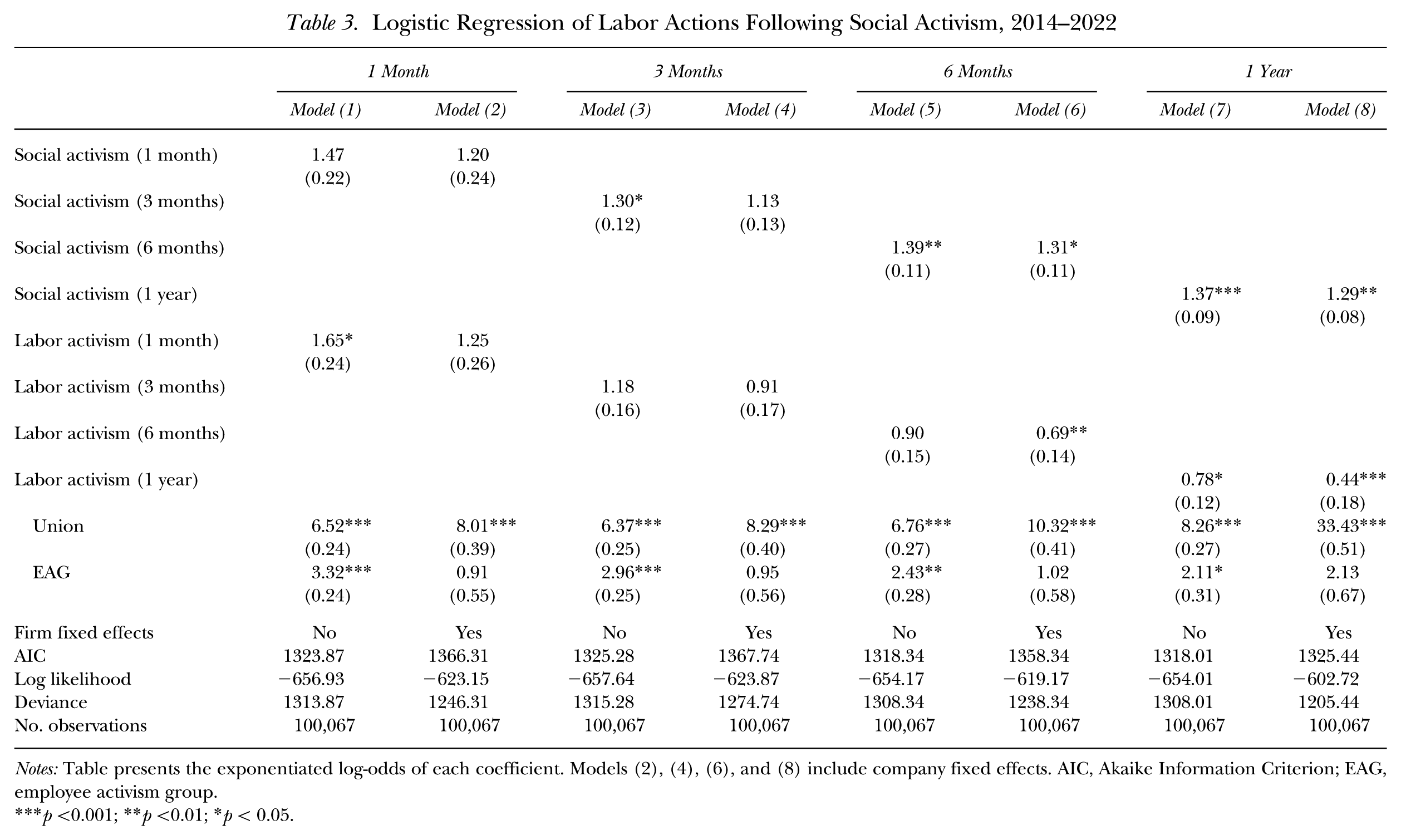
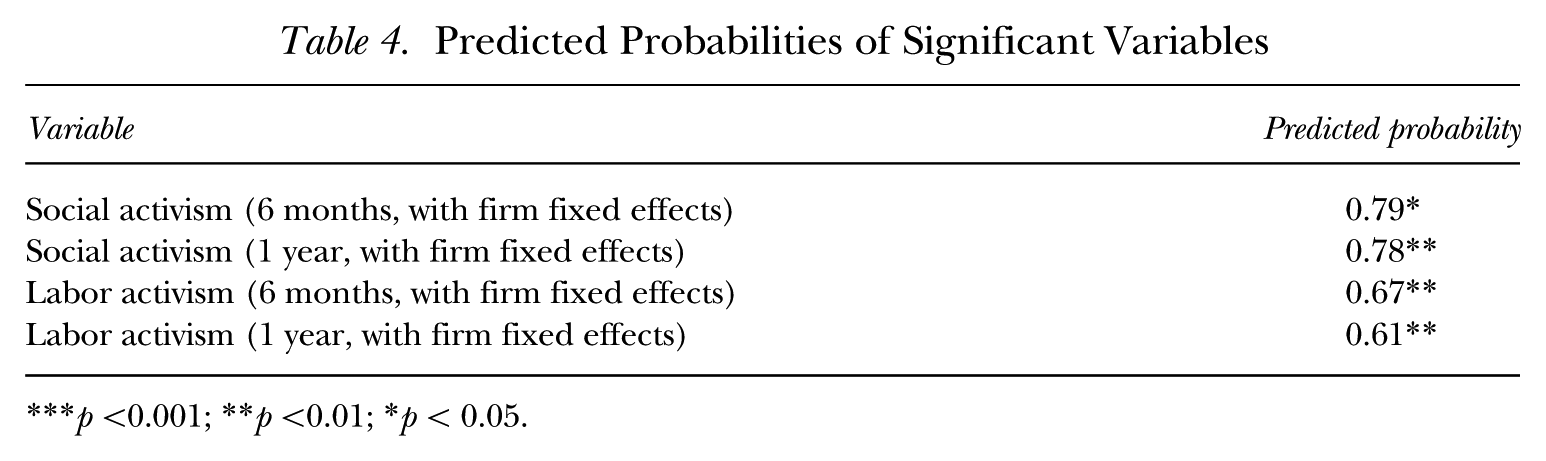
From our logistic regression models, we find a relationship between prior social activism and labor activism (H1). Table 1 shows our descriptive statistics, and Table 2 shows our correlation matrix. Table 3 shows the results of our logistic regression models. We present the exponentiated log-odds, the odds ratios, of each coefficient. For example, an odds ratio of 1.5 can be interpreted as a 1.5 times higher likelihood of the dependent variable occurring, for each one unit increase in the independent variable. Models (2), (4), (6), and (8) include company fixed effects. Deviance and log-likelihood scores both indicate that the models with firm fixed effects explain a greater portion of variability. We also include Akaike Information Criterion (AIC) as a goodness of fit measure that penalizes overfitting. AIC measures decrease for models with fixed effects. In our results, we therefore consider only those that are statistically significant both with and without company fixed effects. In this way, we ensure that results account for both the greatest amount of variation in our models but also that they cannot be attributed solely to overfitting. All results had a Variance Inflation Factor (VIF) below 7. In addition to the log-odds ratios, we present the predicted probabilities of all statistically significant variables of interest in Table 4. This gives the probability of the given event (in our case, a labor action) occurring: 1.0 indicates absolute certainty of an event occurring and 0.0 indicates no possibility of an event occurring.
Descriptive Statistics, 2014–2022
Notes: n = 100,067 for all variables. EAG, employee activism group.
Correlation Matrix, 2014–2022
Notes: (1) = Social activism (1 month), (2) = Social activism (3 months), (3) = Social activism (6 months), (4) = Social activism (1 year), (5) = Labor activism (1 month), (6) = Labor activism (3 months), (7) = Labor activism (6 months), (8) = Labor activism (1 year), (9) = Union (binary), (10) = Employee activism group [EAG] (binary).
Logistic Regression of Labor Actions Following Social Activism, 2014–2022
Notes: Table presents the exponentiated log-odds of each coefficient. Models (2), (4), (6), and (8) include company fixed effects. AIC, Akaike Information Criterion; EAG, employee activism group.
p <0.001; **p <0.01; *p < 0.05.
Predicted Probabilities of Significant Variables
p <0.001; **p <0.01; *p < 0.05.
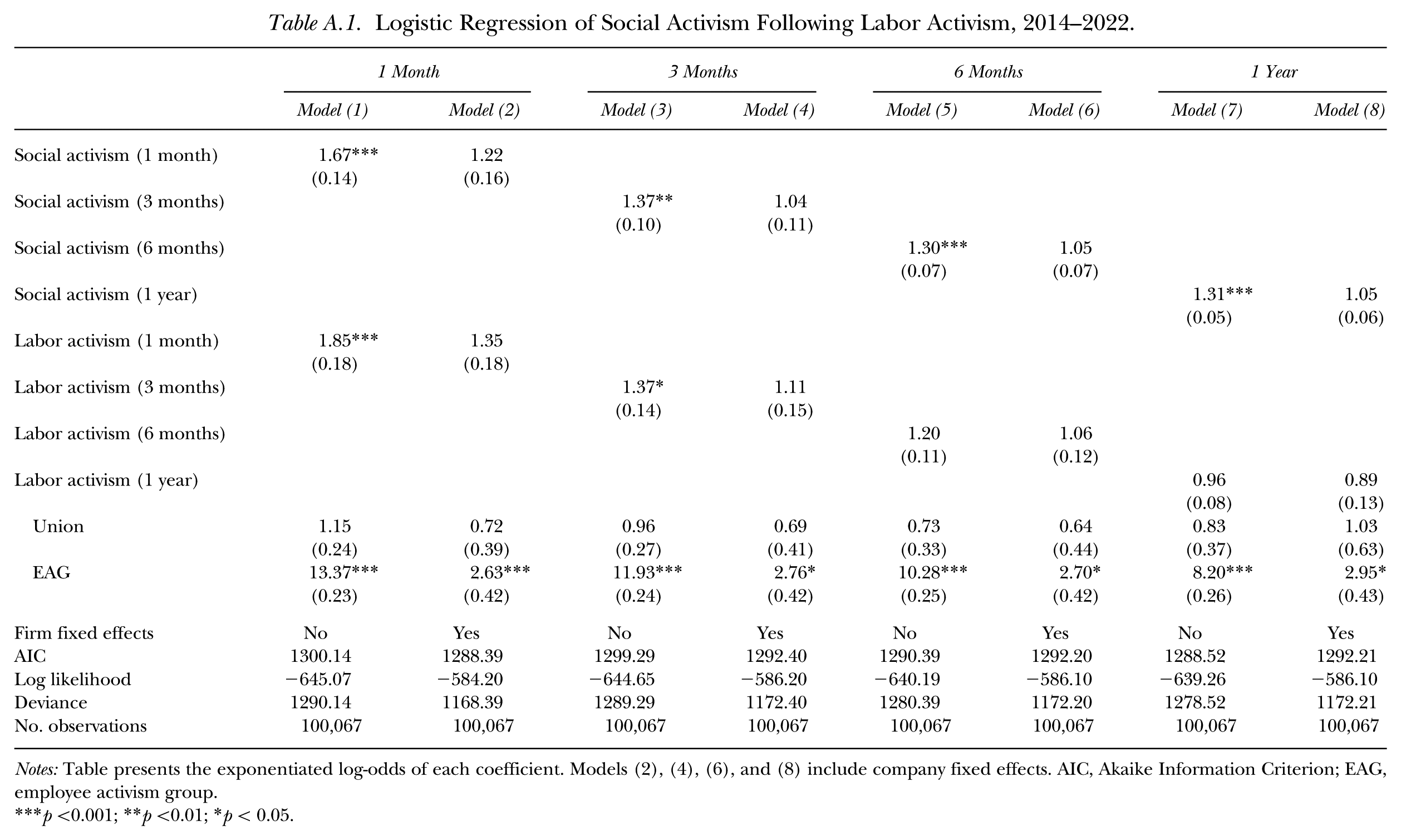
Table 3 demonstrates that, among tech companies where workers organized collective actions, the odds that labor actions would be organized at a company were approximately 1.3 times greater when workers at that company had organized social activism in the prior six or twelve months than when workers had not organized social activism in the twelve months prior, supporting H1. This finding equates to a 78–79% probability of a labor action occurring. Previous social activism seems, in general, to be a stronger predictor of labor activism than previous instances of labor activism. The duration in which labor activism may occur after social activism appears to have an effect: Social activism six months and twelve months previous has a positive impact on the likelihood of labor activism occurring in a company. Labor activism in the previous six or more months appears to decrease the likelihood of labor activism at a company (predicted probability of 61–67%). To rule out the possibility that it is labor activism driving social activism, we also ran the regression with social activism as the independent variable. Results are not statistically significant with the addition of firm fixed effects. These results are presented in Table A.1 in the Appendix.
We believe this variation in the duration may be because labor activism often takes time to organize. Union drives can take several months to several years, and similarly, it could take a long time to build the organizational strength required to conduct a walkout or other work stoppages. During these stretches of time, workers are not only building their numbers by convincing workers to participate but also convincing those workers that participating in a labor action is an effective way to achieve their goals.
We have two suggestions as to why labor activism six or more months prior appears to decrease the likelihood of labor activism. First, 20 of the labor actions in our data set mark the announcement of the recognition of a union (either voluntarily or by NLRB election). It can take months or years to bargain and ratify a new contract, and while it is common for workers to take labor actions during a long contract campaign, it is possible that collective actions during contract campaigns aimed at pressuring management to give in to demands at the bargaining table do not begin until more than one year of bargaining has occurred. This scenario could be due to hopes that the bargaining process itself can achieve the aims that collective action has been used for in the past. For example, the New York Times Tech Guild went public in April 2021, held a walkout in August 2021, and was recognized via NLRB election in March 2022. We have no subsequent instances of activism of any kind by tech workers in this workplace in our data set, which ends nine months later in December 2022, although they held another walkout in October 2023 to protest return-to-office policies. This finding could also be attributable to our data set: Collective actions that are commonly used during the bargaining period, like “sticker up” campaigns, are not frequently reported in the media. Second, our data set is reliant on news reports that may not capture the full picture. News interest in labor-related activities is more likely concentrated in the immediate period after the start of a union drive or election (which make up 29.7% of our labor actions in the data set) and may drop off over time.
We find significant positive effects on the odds that workers would engage in labor activism at a given company when prior actions were organized by a union but not when they were organized by an EAG. It is perhaps not surprising and, in fact, could be seen as tautological, that labor unions would increase participation in labor activism given that their function is to organize collective labor actions by workers. We find support for only part of H2. The presence of organized groups within a company does not by itself increase the odds of later labor activism.
Case Studies in Collective Action
Above, we systematically demonstrate a relationship between social activism and labor activism. To illustrate, in practice, how participation in social activism creates the necessary conditions for labor activism to occur, we examine two sequences of workplace activism at Google and Microsoft. In both cases, employees participated in social activism between 2018 and 2020. Google employees developed their activism into labor activism, whereas social activism at Microsoft tapered off without evidence for a clear shift toward labor activism. To conduct these case studies, we analyzed all collective actions in our data set involving Google and Microsoft employees and used process tracing to evaluate how events from one event influenced future events. Recognizing that not all protests are related, we grouped collective actions by the issues at the heart of the actions.
In these cases, we identify the following steps of a causal mechanism that results in social activism leading to labor activism: 1) social activism occurs, 2) creating conflict with management and leading employee activists to identify as workers. This conflict is a necessary condition for 3) workers to engage in labor activism as a way to gain more power and voice in the workplace. For cases in which conflict with management never occurs or is diffused early on, we do not have the necessary conditions for later labor activism.
For this case study, we examine a series of collective actions in 2019 regarding Google’s contracts with the US military, the government of China, US Customs and Border Patrol (CBP), Immigration and Customs Enforcement (ICE), and the Office of Refugee Resettlement (ORR). The events in this case can be seen in a timeline in Figure 5.A.
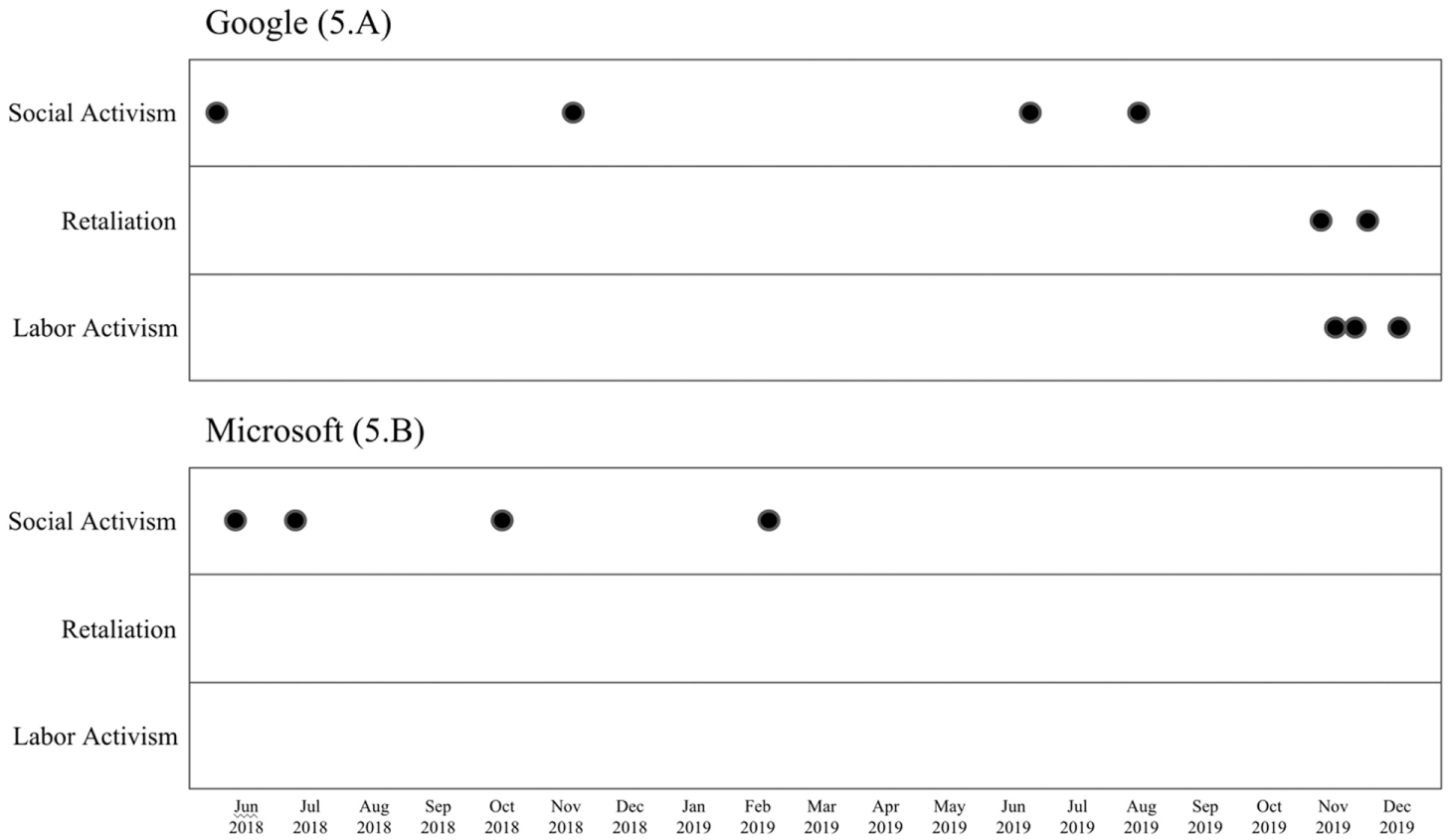
Timeline of Workplace Activism and Instances of Retaliation in the Google (5.A) and Microsoft (5.B) Case Studies
First, social activism occurred. In May and November 2018, Google workers published open letters in protests against two Google military contracts, one called Project Maven, and another called Project Dragonfly. In August 2019, an EAG calling themselves No GCP for CBP published an open letter/petition on Medium demanding that Google pledge not to support CBP, ICE, or ORR by allowing them to use Google’s cloud infrastructure services (GCP)—we classified this action as social activism. Google worker Rebecca Rivers helped organize this letter, which stated in part: In working with CBP, ICE, or ORR, Google would be trading its integrity for a bit of profit, and joining a shameful lineage. . . . We refuse to be complicit. It is unconscionable that Google, or any other tech company, would support agencies engaged in caging and torturing vulnerable people.
Open letters such as this one that leveraged a strong sense of moral justice were typical among instances of social activism.
Second, Google management responded to the social activism with retaliation, creating conflict with workers. On November 12, 2019, Rivers and another Google worker, Laurence Berland, were placed on involuntary leave from Google (noted in Figure 5.A as retaliation). Berland had participated in a different instance of social activism in June 2019, protesting Google’s participation in San Francisco’s pride parade despite the company’s unwillingness to change YouTube’s content moderation policies which, at the time, allowed floods of anti-LGBTQ+ comments on the platform and led to harassment of queer creators. 7
Third, workers responded to this retaliation with labor activism. On November 19, 2019, approximately 20 Google workers accompanied Berland into a meeting with management in protest of what they saw as retaliation against Berland’s and Rivers’ organizing. On November 22, 2019, around 200 Google workers showed up to a protest in front of Google’s San Francisco office, demanding Rivers’ and Berland’s re-instatement. Because these protests were directly concerned with disciplinary actions taken on co-workers, we categorized both protests as instances of labor activism. Notably, no particular worker organization was affiliated with these protests.
Google then responded with further retaliation, creating more conflict with workers. On November 25, 2019, three days before Thanksgiving, Berland and Rivers, as well as two other organizers named Sophie Waldman and Paul Duke, were fired (noted in Figure 5.A as retaliation). Google’s stated reason was that they had violated company policies by accessing company documents that were “outside the scope of their jobs.”
After repeated retaliation, workers responded with labor activism again. On December 3, 2019, the “Thanksgiving Four” posted an open letter on Medium and announced they were filing an Unfair Labor Practice charge with the National Labor Relations Board (NLRB).
8
The open letter states: Google wants to send a message to everyone: if you dare to engage in protected labor organizing, you will be punished. . . . Now is the time to organize, to join with your colleagues, and hold the bosses accountable! Until we all come together in solidarity, for our workplace, for our communities, and for our world, nothing will change.
In stark contrast to the moralistic language that Google employees used to oppose the company’s contract with CBP, this letter adopts the language of labor organizing and demonstrates class consciousness.
This 2019 case study of social activism at Google extends Fantasia’s cultures of solidarity argument—that workers’ capacity and drive to organize emerge out of conflict with management—to professional tech workers. It shows that tech workers, motivated by their unique social-justice-centered professional identity, may participate in social activism when they see their company pursue profit at the expense of its socially driven mission. However, when they seek resolutions to their problems and their efforts are frustrated or retaliated against, they drop their social-justice-centered professional identities and recognize themselves as workers, thus pushing them to use the tools of class struggle. We see such a transformation as the basis on which sustained labor activism is possible.
Microsoft
The preceding finding presents the need for a counterfactual: What would have happened if Google’s management had not retaliated against its workers for their activism? To answer this question, we turned to Microsoft, where employee activism resembled Google’s until approximately the beginning of 2020. Like Google, Microsoft employees were engaged in activism against government contracting after Trump’s 2016 election. A timeline of the relevant collective actions can be seen in Figure 5.B.
Like at Google, first, social activism occurred. On June 19, 2018, after discovering that Microsoft had a contract with the Immigration and Customs and Enforcement (ICE) agency, employees published a petition in the New York Times demanding the contract’s cancellation. After this petition, Microsoft employees formed an informal employee activist group called MSWorkers4Good and went on to protest and petition against a variety of other social and political issues.
These actions were followed by more social activism. On July 26, 2018, two Microsoft employees presented their CEO with an online petition containing more than 300,000 signatures (including 500 employees) calling for the firm to cancel their contract with ICE. On October 12, 2018, Microsoft employees published an open letter calling on Microsoft to abstain from bidding for the $10 billion cloud contract for the Joint Enterprise Deference Infrastructure (JEDI) with the US Department of Defense. On February 22, 2019, Microsoft employees circulated an open letter among the companies’ more than 130,000-person staff demanding that executives cancel a $479 million contract with the US Army for the Integrated Visual Augmentation System (IVAS), which would provide weapons technology to the US military to “increase lethality” of army soldiers. The letter read in part, “We did not sign up to develop weapons, and we demand a say in how our work is used.”
We have no further actions in our data set with the same subject at Microsoft. There was no overt retaliation and no labor activism. Unlike Google, however, Microsoft did not suppress employee activism or punish its participants in a direct or public way. Despite robust employee activism in 2018, 2019, and 2020, we find no evidence that any Microsoft employee was fired in retaliation. Brad Smith, Microsoft’s president and head of legal, said that the company stands out compared to other tech giants because it embraces employee activism whereas others do not (Carlson and Akhtar 2020).
Takeaways
Overall, workers at the two firms had similar tactics when it came to employee activism. Both drew on social issues such as immigration and relied on public pressure via the media (through open letters) to assert their claims. In 2021, Microsoft even signed a neutrality agreement with CWA’s leadership, promising not to interfere with employee organizing. Since then, employee activism at Microsoft (excluding its subsidiaries) has slowed significantly. Ironically, it was Microsoft’s tolerance of employee activism and avoidance of conflict that ended up deterring employee activism from growing further. We have only four instances of labor activism in our data set at Microsoft (not including its subsidiaries): one instance in April 2019, during which employees met with the CEO to discuss gender discrimination, and three separate instances (in 2019, 2020, and 2021) of employees circulating spreadsheets to compare salaries and point out inequity in compensation. None of these actions resulted in further public organizing.
Presented with two case studies, we see two mechanisms at play: 1) that social activism leads to conflict with management, and 2) that labor activism emerges as a response to this conflict. At Google, where employee activism was met with highly visible retaliation, workers developed a culture of solidarity and began engaging in labor activism. This path led to the creation of a minority union at Alphabet—Google’s parent company—which has won bargaining rights at one workplace under Alphabet’s umbrella and improvements in material conditions at several more. At Microsoft, where management avoided direct conflict with workers, labor activism was not sustainable.
There are other possible explanations for these differences. Google and Microsoft developed into large multinational companies during different eras and have different company cultures. And as the New York Times wrote about, the latter largely avoided the tech lash of the late 2010s, suggesting that the two companies have dissimilar approaches to public relations (Lohr 2019). These variations could explain why workers at Google pursued labor activism and workers at Microsoft did not, which merits further research. However, some evidence suggests that employees of these two firms are similarly ideologically aligned: US Federal Election Commission data show workers at both companies donated heavily to essentially the same set of electoral candidates and Political Action Committees in 2020 and 2016, including Joe Biden, Bernie Sanders, Raphael Warnock, Jon Ossof, the Democratic National Committee, and Hillary Clinton (Alphabet Inc Profile: Summary, n.d.; Microsoft Corp Profile: Summary, n.d.).
Discussion and Conclusion
Professionals are not conventionally associated with bread-and-butter labor activism. Nonetheless, our article provides evidence of tech workers, some of the highest-paid professionals, participating in labor organizing across the sector. What is behind the rise of labor activism among tech workers? To answer this question, we examined all documented instances of collective action by US-based professional tech workers from 2014 to 2022. Our analysis comprises three parts. First, descriptive statistics show that labor activism was preceded by a surge in social activism in the workplace. Second, using a logistic regression model and company fixed effects to test the relationship between the two types of workplace activism, we find that US-based tech workers are more likely to engage in labor activism if they have a history of social activism at their company. Finally, to explore the mechanism in which one leads to the other, we conducted a case study of the transformation of social activism to labor activism at Google and Microsoft. We find that for tech workers, participation in political, cultural, or identity-based struggles can generate conflict with management and expose the cleavage between workers and management, thereby creating the necessary conditions for labor activism.
With these findings, we contribute to the literature in two ways. Existing literature suggests that professionals, from their advantaged position, have neither the need nor the interest to challenge existing systems of power in the workplace. Alongside recent research on teachers and nurses (Weiner 2012; Dube et al. 2016; Gastón 2022), our first contribution is to add the case of tech professionals to the growing evidence that professionals do, in fact, engage in labor activism. Second, we offer a new perspective on professional tech workers. The literature on tech workers has focused on the culture of the tech industry and, more recently, the culture of tech work, which describes tech workers as individualistic and aligned with management, making them unlikely candidates for labor activism (Dorschel 2022a). What little documentation there is on workplace activism in the tech industry has, as a result, theorized tech worker protests as a product of that culture (Tarnoff 2020; Boag, Suresh, Lepe, and D’Ignazio 2022; Nedzhvetskaya and Tan 2022). While recognizing these features of tech work, this article draws attention to the rise of labor activism and how tech workers, through participating in social activism, developed class consciousness and a worker identity, thereby laying the foundation for labor activism.
Fantasia (1988) demonstrated how professional and worker identities can be synergistic rather than antagonistic and can encourage previously reluctant professionals to engage in labor activism. We document a similar phenomenon but among professional workers in an entire industry. When tech workers started to participate in workplace activism, many believed that working toward the greater social good was a shared professional value. When management responded to social activism demands with retaliation, however, it became clear to tech workers that their values were not shared by their bosses. They were driven to act collectively with other workers to grow their power within the organization. In this way, social activism became an instigating force for later labor activism. We see this mechanism play out in detail in our case study of Google employees, whereas it is notably absent in our case study of Microsoft employees. Our findings parallel previous literature on spillover effects from social movements, though in our case we demonstrate how spillover occurs within a single organization, driven by conflict between workers and managers from preceding social activism as opposed to extra-organizational effects, such as shared strategies and framing.
One future research avenue is to unpack the role that employee organizations play in the transition from social to labor activism. While the presence of a union does have a strong effect on the likelihood of labor activism, other employee organizations—in particular, employee activist groups—did not affect the likelihood of labor activism, according to our regression. We recognize that EAGs do not all operate in the same way and can thus represent vastly different degrees of organizational strength. For example, Amazon’s EAG (Amazon Employees for Climate Justice) was formed in 2019 and has sustained itself as a group to this date. Some EAGs, such as Google Walkout For Real Change, even laid the groundwork for future minority unions. By contrast, Facebook employees’ EAG, Workers4Workers, was active for only one year. This variation in EAGs suggests that future work can be done to dissect the relationship between social activism, organizational strength, and labor activism.
The biggest limitation in our analysis is the reliance on news articles, which give us insight only into public events that journalists find newsworthy. We can think of many instances of both types of protest action archived in our data set that never garnered press, such as open letters that were never leaked. Past studies of social movements have relied heavily on news archives precisely because it is so difficult to attain a high-level view of a social movement across multiple geographies and organizations any other way (Earl, Martin, McCarthy, and Soule 2004). Recently, social movement scholars have been able to develop unique methods that rely on social media data, most prominently Twitter (Wood and Goldstein 2023). Our experience cataloging workplace activism in the US tech industry, however, suggests that workplace protests are far less likely to appear on social media than are street protests because workers are more likely to organize and promote these protests through company-level communications such as email lists or private messaging channels. We do not have reason to believe that either social activism or labor activism at tech companies would be reported on less frequently in the news than the other, so while we believe our archive has gaps, we do not believe there is a systematic bias that would greatly affect our findings.
Finally, it is important to acknowledge that although our data indicate a significant increase in labor activism over the past five years, tech workplace activism is still in its early stages. Our data suffer from right-hand censoring, so we must acknowledge that it is too early to know whether what we have observed is an aberration from a long-term trend or a sign of a lasting change in the trend of professional labor organizing itself. In particular, while our descriptive analysis shows that the wave of tech labor organizing began several years before the tech downturn and austerity era, which began in late 2022, our data set, which ends in 2022, does not measure the effects of this era on labor activism in the tech industry. Moreover, the most significant rounds of layoffs coming from the tech downturn took place at the end of 2022 and 2023. The story of labor activism in tech is still unfolding.
Despite these limitations, this article provides new evidence for why professional workers may, as an outcome of social activism, begin to participate in labor activism. We see this development as a positive one. In an increasingly powerful and unaccountable tech industry, we believe that this work of labor organizing is precisely the type of work that can create a lasting impact on democratizing the industry and the future of work.
Footnotes
Appendix
Logistic Regression of Social Activism Following Labor Activism, 2014–2022.
| 1 Month | 3 Months | 6 Months | 1 Year | |||||
|---|---|---|---|---|---|---|---|---|
| Model (1) | Model (2) | Model (3) | Model (4) | Model (5) | Model (6) | Model (7) | Model (8) | |
| Social activism (1 month) | 1.67*** (0.14) |
1.22 (0.16) |
||||||
| Social activism (3 months) | 1.37** |
1.04 |
||||||
| Social activism (6 months) | 1.30*** |
1.05 |
||||||
| Social activism (1 year) | 1.31*** |
1.05 |
||||||
| Labor activism (1 month) | 1.85*** |
1.35 |
||||||
| Labor activism (3 months) | 1.37* |
1.11 |
||||||
| Labor activism (6 months) | 1.20 |
1.06 |
||||||
| Labor activism (1 year) | 0.96 |
0.89 |
||||||
| Union | 1.15 |
0.72 |
0.96 |
0.69 |
0.73 |
0.64 |
0.83 |
1.03 |
| EAG | 13.37*** |
2.63*** |
11.93*** |
2.76* |
10.28*** |
2.70* |
8.20*** |
2.95* |
| Firm fixed effects | No | Yes | No | Yes | No | Yes | No | Yes |
| AIC | 1300.14 | 1288.39 | 1299.29 | 1292.40 | 1290.39 | 1292.20 | 1288.52 | 1292.21 |
| Log likelihood | −645.07 | −584.20 | −644.65 | −586.20 | −640.19 | −586.10 | −639.26 | −586.10 |
| Deviance | 1290.14 | 1168.39 | 1289.29 | 1172.40 | 1280.39 | 1172.20 | 1278.52 | 1172.21 |
| No. observations | 100,067 | 100,067 | 100,067 | 100,067 | 100,067 | 100,067 | 100,067 | 100,067 |
Notes: Table presents the exponentiated log-odds of each coefficient. Models (2), (4), (6), and (8) include company fixed effects. AIC, Akaike Information Criterion; EAG, employee activism group.
p <0.001; **p <0.01; *p < 0.05.
Acknowledgements
We thank Jamie Woodcock, Susan Silbey, Adam Reich, Jason Jackson, Heather Haveman, Neil Fligstein, and Mathijs de Vaan for feedback on earlier versions of this article. We also benefited from comments by participants in the 2024 American Sociological Association conference and the Center for Culture, Organizations, and Politics workshop at UC Berkeley. Wynnie Chan, Hyatt Dirbas, and Claire Ma made substantial contributions to the data set for this research project. All errors are our own. Data are available at  .
.
Additional results and programs used to generate the results presented in the article are available from the corresponding author, JS Tan, at
1
Occupational activism need not necessarily take place within the workplace, though in practice, it often does.
2
4
Collective action terms include protest*, petition*, strike*, open letter*, walk out*, union*, boycott*, letter*, lawsuit*, discuss*, and negotiate*.
5
Employment terms include employee*, worker*, contract*, and labor*.
6
The decline in total collective actions might also demonstrate a shift in interest in the news media from covering collective actions by tech workers. However, labor news coverage has expanded in US-based publications over this period, so we would not expect this to be the case.
7
We classified this as social activism because, while LGBTQ+ rights affect workers in their workplaces, the subject of this protest was how YouTube’s policies affected content creators, not YouTube workers such as Berland.
8
The four were later joined by Kathryn Spiers, who was fired for a different protest action at the company, making them the “Thanksgiving Five.”