



Abstract
This article, based on stakeholder interviews and document analysis, compares the development of supply chain labor governance institutions in the United Kingdom, Sweden, and Germany beginning in the late 1990s. The authors address the puzzle of why the United Kingdom’s union-inclusive multi-stakeholder initiative (MSI), the Ethical Trading Initiative, rose to national dominance, while two similar MSIs failed in Germany (the Roundtable Codes of Conduct) and Sweden (DressCode). They find that these differing outcomes can be explained by the approaches of Northern unions to address problems of representation in relation to Southern workers in governance struggles, and how effectively they used the power resources at their disposal. The authors develop an agentic theory of union resourcefulness based on these findings, which complements extant structural arguments. Drawing on theories of ideational power resources, they show how sensemaking processes are central to marshaling and (re)creating power resources. This theorization of resourcefulness helps to explain outcome variation in unions’ ongoing struggle for influence in globalized production.
Keywords
Global supply chains appeared to offer multinational firms liberation from the constraints of national industrial relations (IR) systems, but a combination of labor protest in producer countries and activist campaigns in consumer markets meant it proved difficult for globalizing firms to escape responsibility for offshored production workers. “Governance struggles” over globalized production largely focused on lead firms, giving them a Northern, and often national, locus. This focus drew national unions into contestation regarding exploitation of Southern workers in supply chains. Yet Northern unions did not represent Southern workers and lacked traditional power resources through which to influence production workers’ conditions. We ask how Northern unions addressed problems of representation of Southern workers and power resources in global supply chains to secure union voice in supply chain labor governance initiatives (SCLGIs). In doing so we analyze how union power resources, and the resourcefulness of their utilization, have mattered, developing an agentic concept of resourcefulness.
To explore this question, we select critical cases in which the relationship between the national power resources available to unions and the outcomes of governance struggles appears unexpected. On the one hand, we examine Germany and Sweden where, despite IR traditions of social partnership, attempts to develop union-inclusive SCLGIs failed in the period 1998–2014. On the other hand, we consider the United Kingdom where, notwithstanding nearly two decades of market liberalization and union marginalization, a union-inclusive multi-stakeholder initiative (MSI), the Ethical Trading Initiative (ETI), emerged in 1998 to become the central British SCLGI. By contrast, in Germany and Sweden attempts to develop union-inclusive MSIs, the Roundtable Codes of Conduct and DressCode, respectively, faltered. In their place, an industry-led unitarist labor and environmental governance initiative, the Business Social Compliance Initiative (BSCI, now Amfori BSCI), achieved dominance. In terms of sector, our cases focus on garment supply chains in which domestic Northern unions were challenged by the offshoring of production to the Global South.
We have chosen cases from the first phase of supply chain labor governance (SCLG) institutional emergence because historical distance means we know which institutions failed and which eventually attained national dominance. Yet institutional emergence in this domain continues, not least because extant labor governance of global supply chains remains severely deficient. In some cases, the locus of labor governance has shifted, becoming more international and Southern-focused, as, for example, in the case of the Bangladesh and International Accords on Fire and Building Safety. Yet the national arena of Northern sourcing countries remains important, as illustrated by the recent wave of due diligence legislation, such as the German Supply Chain Due Diligence Act 2023, which attempts to govern global supply chains by regulating Northern lead firms. Meanwhile, although union voice in labor governance was legitimized by the 2011 United Nations’ Guiding Principles on Business and Human Rights, it remains an area of contention—as evidenced, for example, by the emergence of the business-led Alliance for Worker Safety as an alternative to the union-inclusive Bangladesh Accord in the aftermath of the 2013 Rana Plaza catastrophe. Given continued institutional innovation, it is vital to understand how national unions can leverage their power resources to maximize union voice in SCLGIs.
Drawing data from interviews with key participants and documentary sources, we develop an agentic concept of union resourcefulness to complement the extant structural account. Our theory draws on recent literature on ideational power resources, showing how sensemaking processes are central to marshaling and (re)creating power resources. In particular, we highlight the importance of ideational clarity and creativity in circumstances in which other power resources are depleted. Our theory enables us to account for the unlikely success of the UK trade unions and failure of German and Swedish unions to sustain a union-inclusive SCLGI.
Securing Union-Inclusive SCLGIs: Union Power Resources and National Contexts
Buyer-led retail production chains in which Northern “lead firms” sourced finished consumer goods such as garments, toys, and consumer electronics from mainly Southern suppliers (Gereffi 1996) emerged in the 1960s and expanded under government encouragement beginning in the 1980s (Mayer and Phillips 2017). Reports of sweatshops and protests regarding exploitation soon followed (Marques 2016), with the Clean Clothes Campaign (CCC) playing a prominent role in organizing European protests (Bair and Palpacuer 2012). The anti-sweatshop movement catalyzed a wave of institutional emergence of SCLGIs.
Scholars have identified political contestation and firms’ reputational concerns as key drivers of the development of collective SCLGIs, whether MSIs or business-led initiatives (Bartley 2007; Fransen 2012). Corporate resistance to the constraints of stakeholder engagement was a factor in the development of business-led initiatives (Fransen 2012). By contrast, governments tended to support MSIs, albeit as an alternative to hard regulation (Bartley 2007; Knudsen and Moon 2017). Unions were not a focus of the institutional emergence literature, although union missteps were deemed significant in the failure to develop MSIs in Sweden (Egels-Zandén and Wahlqvist 2007; Fransen 2012) and Switzerland (Fransen 2012). We aim to provide a fuller understanding of unions’ contribution to the emergence of SCLGIs, particularly in relation to the dimension of union inclusion, which has only recently been explicitly included in classifications of private governance (Donaghey and Reinecke 2018; Ashwin et al. 2020).
We conceptualize unions’ involvement as a “governance struggle,” the aim of which from a union perspective is to “create a new field of rules that will enable workers to exercise power” (McCallum 2013: 12). Following this insight, we argue that for unions a crucial outcome in governance struggles is inclusion in institutional arrangements, which in turn enables union voice in rule-making, affording opportunities to extend union power. For example, even “paper commitments” (Hafner-Burton and Tsutsui 2005) can prove generative, providing a potential focus for organizing or contestation by workers in producing countries (Bartley and Egels-Zandén 2016).
Yet, Northern-based unions’ claim to inclusion within SCLGIs is not straightforward. Reinecke and Donaghey (2023) made a distinction between “representation as claim” and “representation as structure.” In the former, groups use discourse and communication to make a claim to represent a distinct constituency, without having direct accountability to that group. This label would apply, for example, to labor rights advocates or nongovernmental organizations (NGOs) speaking on behalf of workers in supply chains. By contrast, representation as structure applies when representatives are elected, authorized, and held accountable by the constituency they represent. This would apply to unions of workers in supply chains (where these exist), and the Global Union Federations (GUFs) to which such unions belong. Unions situated in the countries in which lead firms are headquartered fall between these two categories. They are not elected by or accountable to workers in the supply chains, yet their representative claim has some “structural” basis since they belong to GUFs (in the case of sectoral unions) or the International Trade Union Confederation (ITUC) (in the case of national confederations), making them part of an international trade union “family” uniting Northern and Southern unions and espousing solidaristic aims.
The involvement of national trade unions has a political logic, because SCLGIs have often been nationally organized, with their structure following the locus of economic power as well as activism, which is frequently in lead firms’ home countries. A tendency that began with MSIs has continued, with the latest manifestation being Northern nationally based due-diligence laws. This situation poses a dilemma for Northern unions: Accountability to members would not necessarily dictate involvement in such initiatives, which predominantly concern the conditions of Southern workers, yet expectations of international trade union solidarity would do so. Non-involvement in national initiatives would also cede the terrain of labor governance to firms and NGOs, with unions sensitive to NGOs usurping “their” territory of labor rights (Reinecke and Donaghey 2023). Globalized garment and retail supply chains therefore continue to pose challenges for Northern unions. They face questions of representation—how should they respond to the new world of global production?—and of power resources—what influence can they leverage? We ask how national unions have addressed these problems.
Union Power Resources and Resourcefulness in Supply Chain Governance Struggles
We apply the union power resources framework to governance struggles in relation to SCLGIs. Scholars have noted puzzling relationships between union strength and outcomes in terms of union inclusion in SCLGIs (Bair and Palpacuer 2012), as well as the development of corporate social responsibility (CSR) (Gjølberg 2009), with findings suggesting that union power resources at the national level do not necessarily translate into influence on the labor governance strategies of globalizing firms. For example, labor-excluding Amfori-BSCI dominates in erstwhile heartlands of union strength such as Germany and Sweden. Such discrepancies have not, however, been systematically examined in terms of union power resources, and how these can be leveraged in situations where unions lack straightforward representation. In relation to global supply chains, conventional union power resources became less relevant, with coalitional (Schmalz, Ludwig, and Webster 2018) and ideational power resources (McLaughlin and Wright 2018; Carstensen, Ibsen, and Schmidt 2022) gaining significance. Moreover, the mobilization of such resources—that is, resourcefulness—becomes crucial.
Below we consider the relevance of union power resources (PRs) to supply chain governance struggles, extending extant theorization of union resourcefulness, before providing a preliminary analysis of the availability of these PRs in our country cases in the subsequent section. Our analysis underscores the relational character of union PRs, which comprises unions’ capacity to have power over or influence other actors (e.g., structural PRs or ideational PRs, respectively) or inhere in relationships (e.g., institutional and coalitional PRs). This understanding informs our analysis below and subsequent application.
Traditional union PRs had limited potential in relation to SCLGIs. Unions representing retail production workers in our three case-study countries were fast losing members through offshoring and hence possessed little associational power derived from union membership, organization, and ability to mobilize (Schmalz et al. 2018). They also lacked structural power from workers’ location in the economy and power to disrupt capitalist production and accumulation (Wright 2000; Silver 2003). Unions did possess residual associational power within national trade union federations, but had little relevant mobilization capacity. Nevertheless, Schmalz and colleagues (2018) argued that GUFs represent an important extension of associational power and facilitate the articulation of union action.
Institutional power stems from the embedding of past social compromises (Dörre, Holst, and Nachtwey 2009). Noting the relational dimension of union PRs, we divide institutional PRs into three subcomponents. The first part is the power derived, as the name implies, from institutions and the “field of rules” developed by unions and other actors. For example, encompassing IR institutions, such as those in Germany and Sweden, can serve as important PRs for worker representatives faced with firm “externalization” strategies (Doellgast, Holtgrewe, and Deery 2009; Doellgast, Sarmiento-Mirwaldt, and Benassi 2016), although they may become less relevant once offshoring has occurred. The second and third components comprise relations with employers and government, respectively. Institutional power is stronger in countries with a tradition of social dialogue (Brookes 2013), which potentially gives unions in such settings entrée with employers and government, with whom unions have developed a history of cooperation or at least rule-based interaction.
Coalitional power—alliances with other actors—has been a crucial feature of governance struggles in the garment industry (Anner et al. 2006; Merk 2009), whether in collaboration between Northern anti-sweatshop campaigners and Southern garment workers (Brookes 2013) or NGOs and Northern and international unions (Reinecke and Donaghey 2023). NGOs and activists have been particularly effective at exposing worker exploitation. A key question regarding coalitional power has been unions’ ability to harness NGOs’ campaigning energy while also promoting a union agenda. Achieving such synergy required ideas regarding how Southern workers’ interests could be forwarded by Northern trade unions: that is, ideational resources.
Carstensen and colleagues (2022) argued that ideas are central to the sensemaking processes of actors navigating social transformations. Moreover, ideational resources may be particularly important, as in our cases, when other PRs are depleted (Preminger 2020: 219), since ideas have a generative capacity that may salvage or propagate other resources. In terms of unions’ ability to use such resources, one strand of scholarship is agency oriented, with actors seen as capable of “conscious construction,” albeit with reference to “existing ideational structures” (Carstensen and Schmidt 2016: 323). Other scholars have stressed the importance of long-standing “ideological formations” rooted in national IR traditions in shaping ideational resources (Tassinari, Donaghey, and Galetto 2022). This difference in emphasis may reflect empirical variation: Unions can differ in their level of ideational innovation and the reflexiveness with which they approach ideological legacies. Legacies may also differ in their usefulness and applicability to new circumstances.
Acknowledging that unions’ ability to generate ideational resources may vary underscores that PRs are only actualized in use (Zajak 2017)—that is, through resourcefulness. Ganz (2000) provided a theory of resourcefulness, yet despite its nomenclature Ganz’s account is structural rather than agentic. Ganz focused on the organizational and individual preconditions of what he called “strategic capacity,” which he used to explain how union resourcefulness could compensate for a lack of resources. These structural preconditions entailed leadership and organizational characteristics including biography and networks in the case of leadership, and deliberation and accountability structures within organizations. We concur that the preconditions identified by Ganz can facilitate effective agency. Nevertheless, since unions often face unpropitious structural conditions, we see a need to theorize the agentic dimension of resourcefulness.
Given the generative properties of ideas, our agentic theory of resourcefulness includes an ideational component. We define resourcefulness as the interpretation, effective utilization, and (re)creation of PRs. Interpretation is an ideational process through which knowledge is linked to action “through analysis of circumstances” (Gumbrell-McCormick and Hyman 2013: 194), including the analysis of available PRs, and sensemaking involving the manipulation of (old and new) ideas to develop action-oriented frames (Hauptmeier and Heery 2014), which form part of union strategic choice (Frege and Kelly 2003). “Effective utilization” depends on interpretation and entails unions showing an awareness of and ability to use PRs that are available to them. Together, interpretation and effective utilization can facilitate the strengthening of existing or creation of new PRs. Unions in our three cases were forced to navigate a social transformation, providing a test of their resourcefulness.
Contexts: Previewing Resources and Outcomes
In our three case study countries, union-inclusive MSIs emerged between 1997 and 2001. Only the United Kingdom’s ETI proved sustainable, however, with the stakeholders involved in Germany’s Roundtable and Sweden’s DressCode failing to develop an agreed purpose. In this section we identify the PRs available to unions in our case study countries as they entered the governance struggles over SCLGIs, as a prelude to our analysis of the resourcefulness of their deployment. We also preview the outcome of the three cases, which are unexpected in terms of initial PRs.
As noted above, none of the unions in our cases had relevant associational or structural power. Nevertheless, all had access to international associational power—in the form of ITUC and GUF affiliations—giving them the capacity to “jump scale” (Merk 2009) to augment limited local associational resources. Turning to institutional PR, in terms of our first subcomponent, which we refer to as the field of rules, German and Swedish unions potentially had an advantage over UK unions because of more developed IR institutions such as industry collective bargaining and European works councils (EWCs). Yet conditions in the garment industry limited the value of such rules. For example, Anner and colleagues (2006), comparing unions’ attempts to deal with firm internationalization in the automobile, shipping, and garment industries, found that while auto unions were able to use the institutional resource of EWCs to forge effective cooperation strategies with auto unions in Brazil, garment unions were unable to do so because they lacked associational and structural PRs in Europe. Garment sector EWCs focused on interests of European employees in functions such as marketing, design, and distribution (Miller 2003). Thus, the utility of this power resource in relation to the formation of SCLGIs is unclear.
Relations with government are the second dimension of institutional power. Governments were architects of the “global value chain world,” and actively promoted private governance as a form of regulatory outsourcing (Mayer and Phillips 2017). Having said this, state non-intervention in IR was part of Sweden’s tradition of social dialogue; correspondingly, the Swedish government was not involved in DressCode. The German state was more engaged, especially with traditional union allies, the Social Democratic Party (SPD), in power. Accordingly, the German Roundtable Codes of Conduct was initiated in 2001 under the SPD–Green coalition by the SPD-led Federal Ministry for Economic Cooperation and Development (BMZ), which also provided funding and moderated the steering committee. Finally, although since 1979 British unions had been systematically undermined by successive Conservative governments (Howell 2005), the new Labour government of 1997 sought to rehabilitate unions. Correspondingly, the Labour government has been identified as crucial to the ETI’s formation (Knudsen and Moon 2017: 115–220), with the Department for International Development (DfID) providing initial funding. DfID was not directly involved in negotiations regarding the ETI’s governance, aims, and approach (Schaller 2007), and had no formal role thereafter. Nevertheless, government backing was important in stabilizing the ETI and encouraging firm involvement. Thus, government financial support was present in both the German and UK cases, but only the German government had formal administrative involvement.
Regarding the final dimension of institutional power, relations with employers, Sweden and Germany again appeared to be better situated. This was certainly the case in Sweden where garment firms, influenced by national traditions of social dialogue, provided the funding for DressCode and remained committed to the project throughout. German employers were likewise initially willing to engage in the Roundtable, although increasingly liberal business associations (Kinderman 2008) developed a skeptical stance, providing ideational and network support to firms discovering the opportunities of socially unconstrained global supply chains. Finally, as will be seen, UK firms were initially unsympathetic to union inclusion in the ETI, but equally were not coordinated by strong business associations as in Germany.
Turning to coalitional PR, anti-sweatshop campaigners were active across our three cases in the late 1990s, creating potential for alliances with unions. In all cases, NGOs and activists played an essential role as the main source of contention pushing firms toward MSIs. In all cases they cooperated with national trade unions, recognizing the importance of union voice in SCLG. Unions’ starting points in terms of potential PRs available for governance struggles in our cases are summarized in Table 1.
Potential Union Power Resources
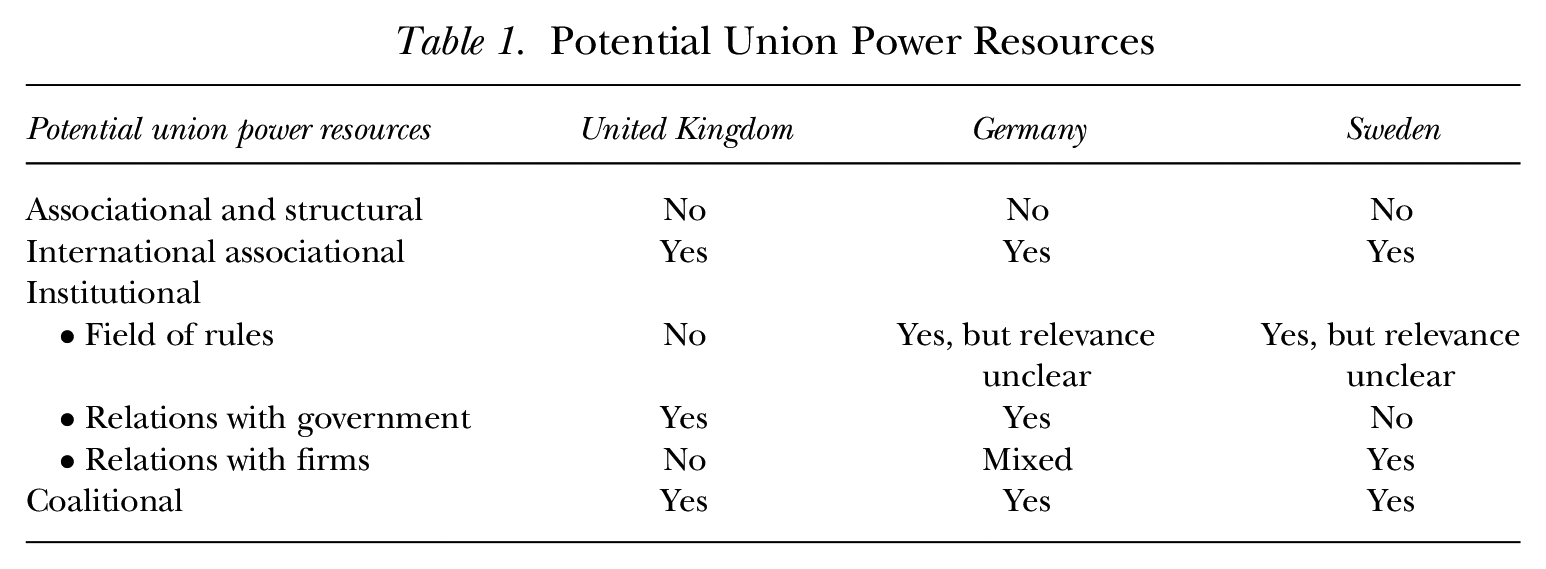
Table 1 shows that the unions faced broadly similar situations, with UK unions slightly behind in terms of relations with firms. Ideational PRs are not included in Table 1 because such resources cannot be meaningfully categorized as available or absent. Ideas are always potentially available, although as noted above scholars differ in their understanding of actors’ ideational latitude. We discuss the use of ideational PRs in the country cases, as part of a detailed analysis of the resourcefulness with which unions used the PRs potentially available to them.
In terms of outcomes, the ETI quickly established itself as the dominant SCLGI in the United Kingdom, a position it has maintained for more than two decades. ETI has consensus-based tripartite governance by member companies, unions, and NGOs. Its Base Code is derived from International Labour Organization (ILO) core conventions and United Nations (UN) human rights standards. ETI has an experimental approach, so that in addition to annual reporting on code implementation, member companies are expected to participate in pilot projects focused on Base Code implementation (Hughes 2001), with a requirement to show engagement and improvement as a condition of continued membership (Schaller 2007). In 2020, 10 out of the top 20 UK-owned store-based retailers were members, while 14 of the top 20 selling UK-owned garment retailers and 5 out of the 6 largest UK-owned UK supermarket chains 1 in 2019 were members (Euromonitor 2020; ETI 2021). Notably, we observe very little “standards shopping” in the form of UK firms migrating to the BSCI. Rather, continental European firms wishing to signal higher standards, such as H&M and C&A, have joined the ETI.
In Germany, the Roundtable Codes of Conduct was launched in 2001. Bringing together government representatives, trade unions, firms, industry associations, and NGOs, the Roundtable was conceived as a learning and discussion forum to improve the implementation of labor and social standards in developing countries. Rather than developing its own code of conduct, the Roundtable sought a common understanding on effective implementation and monitoring of codes of conduct. Unlike the ETI, however, it lost momentum, with unions lacking a clear conception of how to use the forum. Within a few years, the BSCI, a business-led initiative created to harmonize standards and coordinate members’ global supply chain compliance efforts through reducing redundant auditing and costs (Berzau 2011: 139), became the nationally dominant SCLGI with more than 800 German members by 2021, including 6 of the top 20 German-owned store-based retailers and 11 of the top 20 German-owned garment retailers (Euromonitor 2020; Amfori 2021). The deficiencies of this unitarist model were implicitly acknowledged by the BMZ, which, in 2014 following the Rana Plaza disaster, created the Partnership for Sustainable Textiles MSI to signal a more serious approach to SCLG in the garment industry.
Swedish garment firms, NGOs, and unions came together to found DressCode in 1998 with the aim of developing a common code of conduct and certification system. Just before its launch, however, DressCode collapsed in 2002 when the unions withdrew their support (Egels-Zandén, Lindberg, and Hyllman 2015). As in Germany, BSCI became the nationally dominant SCLGI with more than 100 Swedish members by 2021, including 3 of the top 5 Swedish-owned store-based retailers 2 (Euromonitor 2020; Amfori 2021). In 2020, a Swedish ETI was launched as a sister organization to the UK ETI. So far, no Swedish garment firms have joined Swedish ETI, although the three largest garment retailers now belong to the UK-based ETI rather than the BSCI.
As our analysis of union relations with other actors reveals, the orientations of governments and employers do not straightforwardly predict these outcomes, while activist contestation was significant across all contexts. Union PRs are also not a clear guide to outcomes. We therefore need to examine unions’ deployment of their resources, that is, their resourcefulness.
Data and Methods
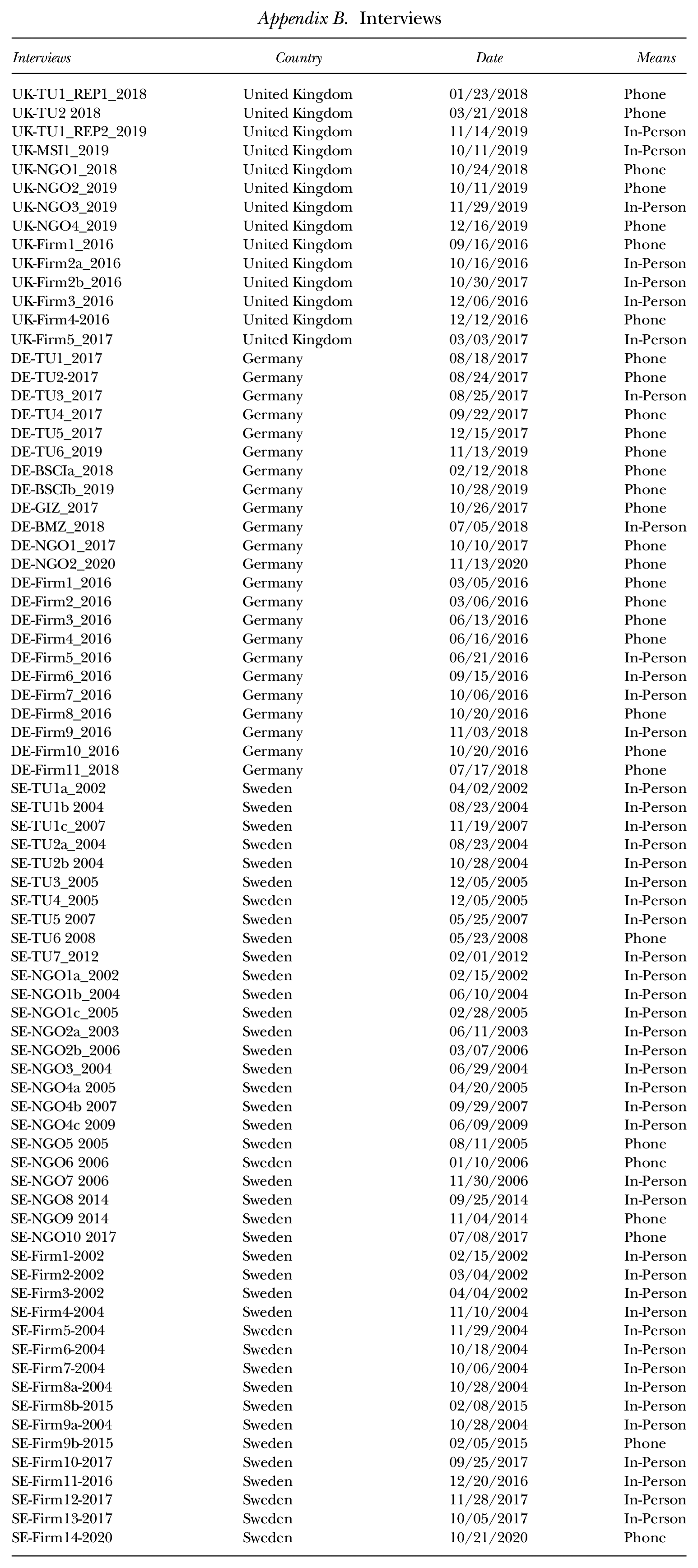
Seeking to understand the role of unions in governance struggles around SCLGIs, we conducted a comparative analysis of the rise of the ETI in the United Kingdom and the failure of the union-inclusive Roundtable Codes of Conduct in Germany and DressCode in Sweden. Our two main sources of data were published documents relating to the initiatives’ inceptions (see Appendix A) and 78 interviews with key informants who took part in negotiations over the creation of SCLGIs from unions, firms, and NGOs, as well as relevant current members and leaders of the initiatives and other industry experts (see Appendix B). Interviews were semi-structured and lasted approximately one hour. Respondents have been anonymized.
We coded interview transcripts, notes from informal talks, and documentary sources to identify emergent themes. We carefully traced the development of each initiative and unions’ role in their formation. Throughout the analysis, we compared unions’ understanding of their PRs, and their approaches to addressing workers’ representation issues in globalizing supply chains, to identify and understand key differences.
United Kingdom: The Surprising Emergence of the ETI
Unions’ chances of securing their objectives in governance struggles in the United Kingdom seemed remote. British unions had scant associational power among production workers in retail value chains such as garments and were embattled after nearly two decades of Conservative government. Despite these unpropitious circumstances, the unions secured all their negotiating objectives in relation to the ETI, leading to official endorsement of the ETI by the International Confederation of Free Trade Unions (ICFTU, now ITUC). Below we show how resourcefulness enabled unions to develop a response to the representation quandary and extend their PRs in global supply chains.
The ETI was formally launched in December 1997, with three years of funding from DfID and the endorsement of the Department of Trade and Industry. In September 1998 it produced its Base Code (UK Parliament Trade and Industry Select Committee 1999; see Appendix A). The initial coalition that founded the ETI included NGOs (Fair Trade Foundation, Oxfam, Save the Children International, World Development Movement, and Catholic Agency for Overseas Development [CAFOD]); unions (the Trades Union Congress [TUC], the International Textile, Garment and Leather Workers’ Federation [ITGLWF], and the ICFTU); and firms (Sainsbury’s, Littlewoods, and the Body Shop) (Marques 2016).
The enduring importance of the ETI to the TUC is well captured in the following response from a TUC representative: We could easily have ended up in a situation where the dominant CSR body didn’t have unions on it, didn’t fundamentally believe that worker representation was a fundamental necessity to improving the lives of workers, took a bit more of a paternalistic approach, just said, “Well, as long as somebody makes sure they’ve got somewhere safe to sleep and they don’t have to work too hard, everything will be fine” [laughs]. That kind of approach—that maybe has happened in other countries—would have been really difficult for us because we have a far more complex relationship with companies in Britain than most, say, European countries have got. Again, from that point of view it [the ETI] has kept us in the game. It’s preserved the influence both of us as an organisation and workers’ rights as an issue. I’m very firmly in the camp that thinks . . . it’s laid the groundwork for lots of good work, even if it hasn’t necessarily done it itself. (UK_TU1_REP1_2018; attributions in this style refer to interviewees, listed in Appendix B)
As this respondent notes, UK unions had lower reserves of institutional power in terms of relations with employers than their European counterparts. The ETI was thus crucial for keeping the TUC “in the game,” thereby legitimizing union inclusion in SCLG. It also “laid the groundwork” for other initiatives, facilitating the extension of institutional PRs.
How did this happen? The ETI grew out of the Monitoring and Verification Working Group (MVWG) formed in 1996, which included representatives of companies, NGOs, and trade unions who met regularly to discuss codes of conduct. The stimulus for development of the MVWG was exposés of labor exploitation by NGOs alongside a “deluge of media-generated public concern” (Hughes 2001: 425). Convened by Simon Zadek, the Development Director of the New Economics Foundation (NEF), 3 a British think tank promoting social and economic justice, the MVWG brought internationalizing corporates into dialogue with their critics. Zadek’s skills as a convenor were an important ingredient in ETI’s formation; respondents from the unions and NGOs independently used the phrase “silver-tongued” to describe Zadek’s “extraordinary . . . ability to seduce the corporates” (UK_NGO3_2019). Nevertheless, as one of the participants in the early MVWG noted, “The ETI was extremely organizationally founded. . . . It grew out of a committee of organizations” (UK_TU2_2018).
British firms, however, were not organized. Instead, individual firms such as Sainsbury’s supermarket and Littlewoods, a department store chain, played a leading role in the MVWG (Hughes 2001). NGO and union informants reported genuine commitment and openness among some corporate representatives. That a significant section of UK business eventually followed these pioneers can partly be attributed to Labour government support (Knudsen and Moon 2017), but also, in contrast to the situation in Germany, to the absence of a UK business association advising caution. Indeed, no respondent spontaneously mentioned the relevant UK business associations—the British Retail Consortium or the Confederation of British Industry—in relation to ETI’s foundation, and when asked directly said they played no role. Thus, while UK unions lacked institutional power, they also, as a positive flipside of liberal IR, faced unorganized employers.
Firms were brought to the table by powerful British development NGOs. One NGO representative (UK_NGO3_2019) underlined the relative salience of NGOs and unions to early corporate participants in the MVWG, explaining, “We’ve got massive NGOs, and that meant that . . . the companies actually said to us, ‘Well, we’re only at the table because of the NGOs, we’re not at the table because of the unions.’” Marginalized trade unions were not seen as natural partners by UK companies seeking to address supply chain labor rights violations. Thus, unions’ coalitional power in the form of NGO support was crucial. NGOs perceived union participation as essential to the legitimacy of any MSI: “We insisted on the trade unions being there. They [firms] would have quite happily not had them there. And we suffered for our insistence, but it was the right thing to do. You can’t possibly have a labor rights multi-stakeholder without the unions being served” (UK-NGO3-2019). This supportive stance was confirmed by union representatives on the MVWG.
In negotiations over the ETI, UK unions were represented by an international officer of the national union confederation, the TUC. Ganz (2000: 1016) argued that “organizational structures that . . . draw resources from a diversity of salient constituencies” are more likely to generate resourceful responses. In negotiations for the ETI, the TUC involved highly salient constituencies, jumping scale to draw on the associational power of international union bodies. This move provided a partial answer to the representation problem in global supply chains and showed a reflective awareness of the need to marshal external PRs. As a union representative explained: The TUC said that the international trade union movement should be involved because the TUC quite correctly said that we don’t represent workers globally, we represent workers here. But the ITUC [ICFTU] and the ITGLWF they represent workers globally, so you should have them involved. And that was seen at the time, by the NGOs, as a good thing. (UK_TU2_2018)
Including international unions proved an important element of the TUC’s success. The representatives of the TUC, ICFTU, and ITGLWF—Simon Steyne, Dwight Justice, and Neil Kearney, respectively—formed a formidable triumvirate. They had three negotiating objectives, which they adhered to and attained. These objectives provided the second part of their answer to the representation problem, which was that unions should use the ETI to facilitate the development of Southern worker voice through extending institutional PRs. First, the unions insisted on tripartite governance of the ETI with separate union and NGO representation, and decision-making through consensus rather than voting (to prevent an inbuilt corporate majority). As the TUC representative quoted above noted, this embedded union legitimacy institutionally, preserving union influence in SCLG. Even though TUC influence generally wanes under Conservative governments (UK_TU1_REP1_2018), union inclusion in conversations regarding SCLG remains routine. Second, unions wanted ETI’s Base Code to include ILO core labor standards and to conform to the 1997 ICFTU/International Trade Secretariat code of conduct. This ensured that union rights such as freedom of association were recognized by corporate members, and laid down conditions for the expansion of union voice in supply chains. Third, the unions opposed a certification approach, which potentially crowded out Southern worker voice. The union negotiators asserted that labor practices could not be certified in the absence of functioning independent trade unions and effective labor regulation (UK_TU1_REP2_2019), a position Kearney and Justice (2001) subsequently promoted in their guidance for trade unionists regarding codes of conduct.
In negotiations the unions were unyielding on these points of principle. Justice was “very tough, very direct, Texan style” (UK_TU1_REP2_2019); according to an NGO representative (UK_NGO3_2019), “He could block for the Olympics.” Kearney, meanwhile, was charismatic, a dealmaker who “played extraordinarily well in this entire space” (UK_NGO4_2019). In addition to their negotiating prowess, the unions demonstrated resourcefulness in interpreting and extending PRs. First, they leveraged the coalitional power entailed in the NGOs’ insistence that a legitimate MSI required union inclusion, threatening to walk away if union demands were not met (a threat realized elsewhere in relation to the Fair Labor Association and later DressCode). Second, ideational clarity—secured through involving the international unions—enabled the union side to focus on the creation of future power resources. The unions’ long-term approach to the creation of PRs was noted by an NGO representative who recalled, In many ways they were quite right to be obstructive and difficult. They did have a long game and it’s a bit like working with the Vatican, they have a different timescale. . . . They understand the power of documents. And they were very, very insistent on the core labor standards. And I can’t remember, I think there was pushback from the companies but there was no way it was going to be agreed without the core labor standards in there, good for them, absolutely brilliant. . . . That’s the difference, unions do strategy, NGOs and companies do tactics. (UK_NGO3_2019)
Through their negotiations, unions were able to provide a coherent answer to the representation problem, extending the potential for Southern worker voice and creating institutional power in the form of “documents” underwriting core labor standards and labor inclusion in SCLG. Such inclusion is generative, potentially extending union influence beyond the remit of any single organization to create, in McCallum’s (2013: 12) words, “a new field of rules” giving workers opportunities to exercise power. UK unions thus made the most of what initially appeared to be meager resources, deploying them to create enduring influence and laying “the groundwork for lots of good work” (UK_TU1_REP1_2018).
Germany: Multi-stakeholder Approach Falters
As in the United Kingdom, a German MSI—the Roundtable Codes of Conduct—emerged in response to anti-sweatshop movements in the late 1990s. But this initiative faltered and was superseded by the business-led BSCI. Like their UK counterparts, German unions lacked associational PRs, but proved unable to compensate through resourcefulness. German unions failed to interpret the transformation of their environment, focusing their scarce resources on strategies grounded in past ideas of union strength—the inclusion of social clauses in the World Trade Organization and, later, global framework agreements (GFAs). Additionally, unions were confronted with well-organized employers with strong ties to internationally organized industry associations.
Failure of the Roundtable Codes of Conduct (2001 to 2004)
Amid mounting civil society pressure, a German branch of the CCC was established on October 19, 1996, at a strategy meeting of NGOs and unions. In January 2001, in response to continued contestation, the first session of the Roundtable Codes of Conduct (Runder Tisch Verhaltenskodizes) was initiated by the SPD-led BMZ. Attendees included representatives of various ministries (e.g., labor, BMZ, foreign affairs); trade unions (IG Metall, Verdi, IG BCE, DGB Bildungswerk); firms (mostly garment firms including Otto, PUMA, Adidas, KarstadtQuelle, Steilmann, and the chemical firm BASF); employers (confederation of German industries [BDI]); the foreign trade association of German retail trade [AVE]); and NGOs (VENRO, FIAN, Transfair, CCC). The secretariat of the Roundtable was run by a governmental organization, the German Agency for Technical Cooperation (GTZ, now GIZ), and financed by the BMZ, which also moderated the steering committee, with decisions based on the principle of consensus.
Like their UK counterparts, German unions’ PRs were diminishing; the associational and structural power of the German textile and garment union (Gewerkschaft Textil-Bekleidung, GTB) was evaporating. West German garment firms began outsourcing production in the 1960s, first to Eastern Europe and then to Asia, triggering significant job losses among garment workers. The East German garment and textile sector was then devastated by the disappearance of the Eastern market after 1989, with employment in the sector halved between 1989 and 1991 (CCC Germany founder, cited in Sluiter 2009: 101): This is not like in the automotive industry. . . . Textile was just dead. Except technical textiles . . . and technical textiles, these are practically cars. . . . And the clothing industry? . . . . The Triumphs that used to exist, the Hugo Bosses, the big companies, there is nothing left. (DE-TU6-2019)
Responding to this contraction, the GTB was dissolved in 1998 with the remaining garment workers becoming part of IG Metall. Differences between the interests of garment and automobile workers soon surfaced, however, leaving garment workers’ hopes for stronger representation unrealized. Meanwhile, although unions remained institutionally entrenched, their power was threatened by increasingly assertive employer associations and creeping government unilateralism under Gerhard Schröder (Streeck 2009).
Alongside DGB Bildungswerk, the educational branch of the German Trade Union Federation (DGB), Germany’s most powerful sectoral unions, IG Metall, Verdi, and IG BCE, were involved in the Roundtable. Although members of other GUFs, none of these unions were affiliated with the ITGLWF. 4 This organizational distinction was reinforced by personal networks. As one German unionist explained, UK unions could rely on the support from ITGLWF and its General Secretary Neil Kearney, which “in these years had an education office in Newcastle with four Englishmen . . . [who] contributed a lot through personal networking. A lot went through personal structures in the founding of ETI, which then really worked together trustingly” (DE-TU6-2019). German unions in the Roundtable did not draw on the ITGLWF’s expertise, but rather, as shown below, were influenced by IG Metall’s auto sector experiences, illustrating the salience of Ganz’s (2000) structural components of resourcefulness.
Correspondingly, German unions’ ideational approach reflected past strength rather than the challenging reality of the garment sector. First, they focused on securing binding acceptance of international labor standards in multilateral and bilateral trade agreements (DGB 1996: 20–21; Suedwind/IG Metall 2004: 55–56; both sources listed in Appendix A), arguing this was “the most crucial demand of all . . . [because] ‘core labor standards’ are the only thing that we have as binding under international law and they need to be anchored” (DE-TU5-2017). This mirrored their view that implementing human rights and labor standards was “primarily the task of governments” (IG Metall 2007: 677; see Appendix A). Second, with equal ambition, German unions, especially IG Metall, supported the conclusion of GFAs as a transnational extension of national IR. This approach did not bear fruit until 2015 when the first garment GFA involving a German firm was signed (Tchibo), followed by Esprit in 2018. Notably, Tchibo was an ETI member.
Third, reflecting the experience of IG Metall in sectors in which institutional resources remained potent, unions attempted to use EWCs. But as noted above (Miller 2003; Anner et al. 2006), this approach proved inapplicable to garment supply chains: Starting in 1994 we had the instrument of the European works councils. . . . And for the first time we had the opportunity to get together with our colleagues. . . . The employers were of course operating in Asia already and we painstakingly started in Europe. . . . Colleagues in Spain went to a foreign country for the first time then, they hadn’t even been to Portugal. And you have to see the topic “garment” against that background. It’s different from Volkswagen who was already discussing a global-business-corporation back then. It was totally different in garment. It was a laborious thing to even set up communication. (DE-TU5-2017)
Taken together, these approaches suggest German unions were influenced by “ideological legacies” (Tassinari et al. 2022) related to past, especially institutional, PRs. They did not interpret the new reality of the garment sector or generate ideas regarding how to maximize the potential of the Roundtable as a new vehicle to extend union voice. This finding aligns with Behrens, Fichter, and Frege’s (2003: 27) analysis of German unions’ overall response to change in the 2000s: That while unions’ focus on institutional embeddedness was “once a stable source of strength,” it “increasingly hinders an active search for new ideas and identities to cope with . . . challenges.”
Thus, German unions devoted resources to the Roundtable without developing ideas or engaging with those of international unions regarding how such an MSI could facilitate, or at least avoid crowding out, Southern union voice. This deficiency showed in their relations with NGOs. One representative of a German development NGO reflected that, unlike in the United Kingdom, “the work of comparable actors in Germany on the topics of corporate responsibility and regulation is still very fragmented and not reflected in one overarching common political agenda” (DGB Bildungswerk et al. 2006: 59; Appendix A). But there were significant differences between union and NGO positions in both countries, and in Germany, unlike the United Kingdom, unions and NGOs were formally united in a CCC branch. The key difference was that German unions allowed NGOs to dominate German CCC’s agenda. For example, although German unions formally endorsed the ITUC’s anti-certification policy and were skeptical of unilateral corporate auditing and monitoring efforts (DE-TU4-2017), German CCC’s official position was that codes of conduct and certification promoted labor standards in global supply chains. This position became part of the European CCC’s code of conduct (published in 1998), which the German CCC promoted among German retailers, including in discussions within the Roundtable. Thus, despite their formal coalition with relevant NGOs, German unions lacked the ideational power to use this support resourcefully, thereby engaging themselves in an alliance that contradicted union policy.
German unions thus proved unable to leverage coalitional power to shape the Roundtable. Discussions within the Roundtable were perceived as “tedious,” hampering the implementation of the Roundtable’s campaigns (Stahl and Wötzel 2013: 94). Disillusion with the Roundtable’s slow progress was shared by stakeholders, with German CCC withdrawing in November 2004 after nearly four years within the Roundtable and a two-and-a-half-year negotiation of a pilot project in the garment sector. Frustration peaked over the fact that government-funded pilot projects on labor governance within the Roundtable advantaged businesses, lacked transparency (Rieth and Zimmer 2007: 234), and required financial contributions prohibitive for unions and NGOs (DE-TU6-2019; DE-TU4-2017). Unions remained in the Roundtable, but, given their inability to shape discussions, their engagement declined. “Disappointment set in” (DE-TU4-2017), with unions fearing that firms were only retaining the Roundtable as “occupational therapy,” that is, to pacify and occupy civil society actors while avoiding action (DE-TU6-2019). Frustrated by discussions with firms and increasingly skeptical of voluntary initiatives, NGOs and unions shifted their efforts toward securing binding business regulations and founded a civil-society network called CorA, short for corporate accountability, in 2006. The Roundtable became increasingly irrelevant.
Emergence of the BSCI as the Dominant Initiative (Late 1990s to Present)
While prepared to let the Roundtable languish, garment firms needed to respond to regulatory threats from the European Parliament and Commission, which from the late 1990s debated responses to labor standards scandals in global supply chains (Marques 2016). Garment firms—such as large family-run firms Otto, P&C, Deichmann, and Karstadt/Quelle (all members of the AVE)—began to develop and implement codes of conduct. The organization of early adopters within the AVE and support from the GTZ allowed this endeavor to become industry-wide; the AVE published its own code of conduct in 1999 and, after several AVE/GTZ-organized public–private partnerships, tested the AVE code, a sector-wide model, in 2003. The sector model was applied by several heavyweight AVE members and subsequently was forcefully promoted by the AVE and the Foreign Trade Association (FTA), which, in concert with garment retailers’ organization and network mobilization, allowed for rapid diffusion of the AVE sector model both in Germany and across Europe. This development allowed the foundation of the BSCI in 2004.
The BSCI rapidly achieved dominance by using and extending AVE and FTA networks, utilizing coalitional PRs. For instance, soon after its foundation, the BSCI became part of the European Alliance for CSR leading the “supply chain laboratory” within the Alliance. BSCI also joined the advisory board of Social Accountability International, and closely cooperated with industry associations of important trade partners, including the Chinese National Textile and Apparel Council (CNTAC) and the Istanbul Textile Exporters Association (ITKIB) (AVE annual report 2008: 17–18; see Appendix A). The BSCI’s governance approach matched German employers and industry associations’ use of ideational power in a concerted campaign for deregulation and liberalization in the early 2000s, including in the field of corporate responsibility (Kinderman 2008; Kaplan and Lohmeyer 2020). The FTA lobbied against any binding rules regarding corporate responsibility at the European level, while German employers discursively dismantled entrenched IR institutions (Kinderman 2017).
German unions thus lost the first round of the “battle of ideas” (McLaughlin and Wright 2018) regarding SCLG, failing to turn the unitarist ideational tide and leaving businesses as winners of the governance struggle. Unions proved unable to interpret and marshal their shrinking national-level PRs, cleaving to past approaches and ideas. The BSCI became what Egels-Zandén and Wahlqvist (2007) called a “post-cross-sectoral partnership”—a business-led initiative with “no meaningful participation of key stakeholders” (Merk and Zeldenrust 2005: 16). Following Rana Plaza, the German government created the multi-stakeholder Textile Partnership in 2014, but again the unions initially failed to influence discussions around the Partnership’s action plan (Grimm 2019), highlighting the continued importance of resourcefulness.
Sweden: Union Power Resources, NGO Resourcefulness
As in Germany and the United Kingdom, the Swedish discussion about supply chain working conditions developed in the mid-1990s. A Swedish MSI—DressCode—emerged at the same time as the ETI. As in Germany, this initiative collapsed, and firms ultimately joined BSCI.
The Rise and Fall of DressCode (1996–2001)
A Swedish branch of CCC (SCCC) formed in 1996. This development was driven by a newly founded NGO—Fair Trade Center (FTC)—that in 1996 had only one full-time employee (Egels-Zandén et al. 2015) yet mobilized existing Swedish NGOs (Red Cross Sweden Youth, Swedish World Shops’ Association, SAC Syndicalists, Global Publications Foundation, Emmaus Stockholm, Swedish Cooperative Center, and Förbundet Vi Unga). These NGOs were less established than those involved in the ETI, and—except for FTC—also had limited resources invested in SCCC.
FTC convinced the two main Swedish unions in the garment industry—the Commercial Employees’ Union (CEU) and the Industrial Workers’ Union (IWU)—to help establish SCCC. As in the United Kingdom, NGOs perceived union inclusion as essential to any discussion of worker rights. However, unlike the TUC, Swedish unions lacked ideas regarding how to protect worker rights in supply chains. As one union representative put it, “We liked the CCC idea to start with but had not given this issue a lot of thought” (SE-TU2b-2004). As in Germany, union representatives did not marshal international associational resources to gain ideational support, despite the IWU being a member of the ITGLWF.
In 1997, SCCC launched its first significant campaign urging the four largest Swedish garment brands (H&M, KappAhl, Lindex, and Indiska, representing nearly the entire Swedish industry in terms of turnover) to adopt a code of conduct and auditing system for their suppliers. The FTC had picked up the code of conduct and auditing idea from the CCC, passing to the brands a CCC model code. The brands initially resisted the campaign, but continued pressure and media scandals eventually led H&M (in 1998) and the other firms (in 1998–1999) to adopt codes of conduct similar to the CCC model code.
SCCC then pressured the four Swedish brands to join an MSI to address the issue of code multiplicity. Funding was initially sought from the Swedish government’s donor agency (SIDA), but reflecting a hands-off approach to IR, the government declined. Instead, the four brands funded an MSI (approximately 3 million Swedish krona in total) comprising the brands and members of SCCC. The firms’ willingness to fund the MSI was partly related to pressure orchestrated by the SCCC, but also to Swedish firms’ positioning as sustainability front-runners. As one corporate representative stated, “We clearly had to do something to protect our brand as one of the good guys in the industry” (Sweden-Firm4-2004). Swedish firms’ concern for their reputation as “good guys” was an institutional power resource for unions, since social partnership was part of this image. Meanwhile, the corporate funding injected an outcome focus into DressCode, creating initial momentum.
In 2001, DressCode developed a unified code of conduct to replace the individual brands’ codes. It also drafted a detailed suggestion for an “independent” auditing system. The NGOs and unions in the SCCC would set up and own a foundation that, in turn, would own an auditing firm. Brands would purchase auditing from this firm and in return would be able to use a DressCode logo on their products to signal decent production methods. In other words, DressCode represented an MSI-anchored certification system. These ideas were aligned to the Dutch CCC’s suggestions on how to regulate worker rights, which included a unified code and a similar auditing and labeling system. This close resemblance reflects FTC’s leading role in shaping DressCode, with unions initially making little contribution. That is, the FTC demonstrated resourcefulness—interpreting and marshaling existing and creating new PRs—while the unions followed in their wake, initially showing limited awareness of the potential of certification to crowd out Southern union voice. Indeed, despite highly limited PRs, through the force of its ideas, the FTC was able to dominate unions who theoretically possessed far superior institutional and associational resources. This situation contrasts with the UK case in which, despite the ideational creativity and charisma of NEF leader Simon Zadek, the unions still managed to play a crucial role in shaping the ETI.
In 2002, when all that remained was the signing of the documents that would launch the certification system, DressCode came to a sudden and surprising end. The Swedish unions withdrew their support from DressCode, criticizing its focus on codes of conduct and certification as compared to the unions’ preferred GFAs. The unions’ volte-face can be attributed to the increased influence of ITGLWF in the Swedish discussions after one of the Swedish unions, in 2000, replaced its representative in DressCode with a more internationally connected representative, who was still, in 2021, the international secretary for one of the large national union federations. This change strengthened links between union DressCode representatives and GUF leaders such as Neil Kearney. For example, the new union representative echoed the GUF’s critical stance on certification, arguing that no label can ever guarantee that products are produced without labor exploitation. This contrasted with other—less vocal—union representatives in DressCode who were fairly positive regarding certification. As one union representative remarked after DressCode’s collapse, “I still think that ethical labeling of products is a good idea” (SE-TU3-2005). The unions also argued that they lacked the mandate to enter into agreements on behalf of workers in developing countries (Ählström and Egels-Zandén 2008: 237), which suggests that they had belatedly become aware of the representational issues raised by global supply chains. The NGOs attributed the unions’ withdrawal from DressCode to the change in personnel and reorientation toward GUF policy. As one NGO representative remarked, “The main reason why the unions decided to withdraw was the initiation of policy development at the international union level. . . . The Swedish unions wanted to act in-line with the emerging international policy and hence stall the Swedish process to see how it developed” (cited in Wingborg 2003: 16).
The unions’ withdrawal was met with surprise and criticism from NGOs and brands. Swedish unions’ abrupt escape from a CCC-inspired solution to worker rights violations that clashed with GUF policy reflected their lack of resourcefulness—in particular, a failure to interpret the new environment, or to draw on international associational resources to enable them to do so. This was reflected in their failure to recognize the representational problems entailed in a certification model. This element of DressCode could potentially have been modified had the unions grasped its implications earlier. Institutional and coalitional resources—supportive firms and NGOs—placed Swedish unions in a prime position to negotiate an MSI of their choosing, but they squandered this opportunity.
The brands still wanted to pursue a certification solution after DressCode’s collapse, but NGOs did not want to launch a system without Swedish union support. Thus, despite tension between NGOs and unions (Egels-Zandén et al. 2015), Swedish unions could have leveraged NGO insistence on union inclusion to shape DressCode. This opportunity was lost after the rupture of DressCode, and union–NGO relations deteriorated leading to the collapse of SCCC. Thereafter, Swedish brands directed their search for private regulatory solutions abroad.
BSCI Attains Dominance (2001–2008)
Swedish firms eventually opted for involvement in BSCI, with Lindex and KappAhl joining the working group that initiated the formation of BSCI prior to its launch in 2004. Their involvement was controversial in Sweden, since Swedish NGOs and unions perceived BSCI as an illegitimate one-sided corporate organization and refused to participate in BSCI’s Advisory Council, which was ostensibly intended to provide NGOs and unions a voice. Union and NGO representatives referred to the Advisory Council as a “hostage” role, granting legitimacy to the BSCI without securing commensurate influence.
BSCI quickly emerged as the dominant, and practically only, SCLGI for Swedish garment brands and has remained so since. Despite two high-profile departures (KappAhl and Lindex), more than half the top 20 Swedish garment firms are BSCI members.
In the mid-2010s, BSCI founder-members KappAhl and Lindex left to join ETI UK in 2016 and 2019, respectively. H&M was already a member of ETI UK. Whether migration of the top three Swedish garment brands to ETI indicates a wider Swedish trend is unclear. It does represent a critique of BSCI’s effectiveness and endorsement of ETI’s multi-stakeholder approach. Furthermore, in 2020, a Swedish ETI was launched as a sister organization to the ETI UK. So far, no Swedish garment firms have joined the Swedish ETI. Nevertheless, its creation illustrates the enduring appeal of a union-inclusive approach in Sweden and underscores the failure of union resourcefulness to establish an MSI earlier.
Discussion
Globalizing retail supply chains confronted Northern unions at the national level with a quandary regarding how to forward the interests of Southern production workers within SCLGIs. We have argued that unions’ varying ability to address this issue in our three cases had a significant impact on the diverse outcomes in terms of union inclusion within SCLG. To assess unions’ contribution, we combined the power resource approach with a novel theorization of union “resourcefulness” focused on its agentic properties, which complements Ganz’s (2000) structural account of resourcefulness, providing a cogent means to identify resourceful action not offered by Ganz. We defined resourcefulness as the interpretation, effective utilization, and (re)creation of PRs. Below we show how our theory helps explain outcomes in our three cases.
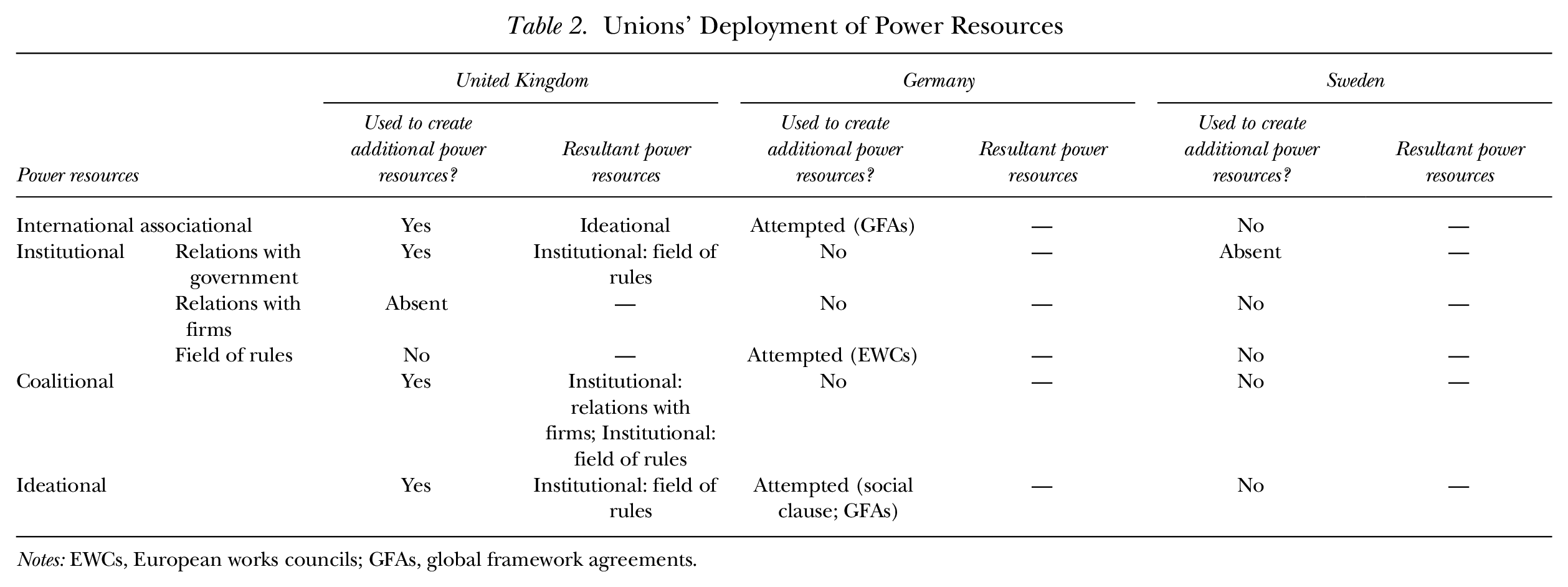
Using our definition of resourcefulness, Table 2 shows that only UK unions were able to interpret and utilize existing PRs, thereby creating additional resources, a new field of rules, as well as a structured relationship between unions and ETI member firms. The German and Swedish columns in Table 2 appear rather stark in relation to the lack of new PRs created. We do not exclude the possibility that during this period these unions created PRs in relation to global supply chains outside the purview of our study. However, it is indisputable that they did not achieve national union-inclusive SCLGIs. We explore these findings in more detail below.
Unions’ Deployment of Power Resources
Notes: EWCs, European works councils; GFAs, global framework agreements.
As shown in Table 2, the TUC capitalized on international associational, coalitional PRs as well as relations with government. Engagement with international trade unions enabled the development of ideational PRs, which in turn fostered new institutional PRs within the ETI entailing a field of rules and relations with firms. In line with Ganz’s (2000) theory, the TUC’s resourcefulness was enabled through the organizational structure of the TUC international office and associated networks. The agentic component was also crucial. The unions leveraged coalitional power in the form of NGO support to ensure that they met their negotiating objectives, drawing maximum benefit from NGOs’ reluctance to agree to a deal without them. This occurred within the enabling environment of Labour government support. Most striking was the ideational clarity that the TUC achieved working with international unions, enabling the union negotiating team to provide a cogent answer to the representational problem faced by Northern unions in relation to Southern production workers. Unions’ interpretation and effective utilization of PRs allowed them to create institutional power entailed in the “paper commitments” (Hafner-Burton and Tsutsui 2005) of the Base Code, generating in McCallum’s (2013: 12) words, “a new field of rules” providing at least the potential to increase Southern worker voice. Resourcefulness also “preserved the influence” (UK_TU1_REP1_2018) of the TUC in national SCLG discussions, providing a structured relationship with firms.
The relational character of PRs posed challenges for German unions. As noted above, although German unions had established relations with firms, corporatist traditions also bequeathed firm collective organization, which facilitated German retailers’ resistance to being constrained by MSI membership. This set of circumstances helps explain firms’ truculence within the Roundtable and the rapid rise of the BSCI once the Roundtable had stalled, but does not account for unions’ failure to define the purpose of their interaction within the Roundtable.
A lack of resourcefulness was key to this failure. Again, Ganz’s (2000) structural determinants of resourcefulness are relevant. In terms of organizational structure, the dominance of IG Metall on the union side meant unions’ ideas were based on the experience of the automobile sector rather than tailored to the garment sector. This disadvantage was compounded by a lack of network ties to the ITGLWF. Accordingly, unions drew on ideological legacies (Tassinari et al. 2022), embracing an ambitious strategy aimed at transferring a national model of social partnership to a transnational arena but without the requisite associational and structural PRs.
Yet a purely structural explanation for unions’ position does not suffice: As Gumbrell-McCormick and Hyman (2013: 191) noted, “Path dependence is a challenge not a fate.” German unions did not use their agency to interpret and harness available PRs. In particular, they drew little benefit from the coalitional support of NGOs. Instead, within the Roundtable the unions contradicted their own policy by agreeing to an NGO-inspired policy of certification, which potentially crowded out, rather than facilitated, Southern union voice. Notably, unions’ lack of ideational clarity preceded corporate exit: Even before the formation of the BSCI, the unions lacked a concept of how to use the Roundtable to develop Southern worker voice and (re)create union PRs.
Confronting the challenge of globalizing supply chains, Swedish unions had a stronger position than German unions. Despite waning structural and associational power, Swedish unions enjoyed strong coalitional and institutional PRs, facing garment firms willing to negotiate to preserve their reputations. Yet in the emergence of DressCode it was the FTC—a tiny new NGO—that displayed resourcefulness and marshaled coalitional PRs through the force of ideational creativity. As in the German case, the Swedish unions did not problematize the representation of Southern production workers nor, consequently, draw on international resources to help them address the problem practically and ideationally, despite IWU affiliation to the ITGLWF, albeit initially without strong informal network ties. Such ties improved with a change in union personnel, but too late to change the fate of DressCode, the direction of which had already been set and ran counter to international union policy. The failure to interpret their transforming environment—the fact that the unions had not given the issue “a lot of thought” (SE-TU2b-2004)—meant that unions squandered their initial advantage, allowing the unitarist BSCI to achieve dominance in Sweden.
We acknowledge that union PRs are relational, and, given this interdependence with other actors, union resourcefulness can only explain part of the story. But we contend that this contribution is significant and understudied. The German case highlights the interaction between the structural and agentic components of resourcefulness, while the overall salience of union resourcefulness is exemplified by the contrast between the UK and Swedish cases. As shown in Table 1, Swedish unions enjoyed a more favorable position in terms of PRs, but, as shown in Table 2, were unable to capitalize on these as did the UK unions. Unlike UK unions, Swedish unions failed to create the ideational resources, whether homegrown or secured through international associational power, required to address the representational problem of Southern workers and secure a union-inclusive outcome.
Our theoretical contribution lies in developing an agentic concept of resourcefulness to complement Ganz’s (2000) structural account. As we have shown, Ganz’s concept of strategic capacity was relevant in our cases, particularly regarding union networks and associated ideational flows. Ganz (2000: 1005) saw strategic capacity as part of a “probabilistic causal chain” leading to resourcefulness and finally better union outcomes. As a complement, our theory identifies the characteristics of resourceful union action. Given the recursive interchange between structure and agency, this is a crucial contribution with resourcefulness able to influence structure: As Table 2 shows, resourcefulness can create new PRs.
We acknowledge that, even in the case of the ETI, the creation of a new “field of rules” far from guaranteed the development of Southern worker voice—production workers’ attempts to use “paper commitments” are often unstable (e.g., Bartley and Egels-Zandén 2016). Nevertheless, spillover effects from the ETI did help facilitate further international agreements including the Action, Collaboration, Transformation (ACT) living wage initiative (Ashwin et al. 2020). Further illustration of the importance of union resourcefulness in SCLG is provided by IndustriALL’s and UNI Global Union’s marshaling of ideational and coalitional power (Reinecke and Donaghey 2023) to secure brand sign-up to the Bangladesh Accord, which extended union PRs both internationally and in Bangladesh. Unions will continue to face labor governance challenges that require resourceful responses. For example, a contemporary challenge for national unions is how to influence the interpretation and use of national due diligence legislation to further Southern worker voice. Even with these recent initiatives the representation quandary pertains and traditional PRs are inapt.
Conclusion
Utilizing three country case studies, we have shown how and why union resourcefulness mattered in the development of national SCLGIs. Empirically, we extend the extant institutional emergence literature, which has focused on employer organization, NGO contestation, and government facilitation, by analyzing unions’ role in governance struggles over SCLGIs, particularly in relation to union voice.
Theoretically, recognizing that structure and agency are always recursively related, we developed an agentic definition of resourcefulness as a complement to Ganz’s (2000) structural account. We show that ideational processes are a crucial component of resourcefulness with the potential to bolster resource-poor organizations. Union resourcefulness thus remains essential in efforts to extend worker voice in global supply chains; the creation of new PRs is “a long game” (UK_NGO3_2019).
Footnotes
Appendix
Interviews
| Interviews | Country | Date | Means |
|---|---|---|---|
| UK-TU1_REP1_2018 | United Kingdom | 01/23/2018 | Phone |
| UK-TU2 2018 | United Kingdom | 03/21/2018 | Phone |
| UK-TU1_REP2_2019 | United Kingdom | 11/14/2019 | In-Person |
| UK-MSI1_2019 | United Kingdom | 10/11/2019 | In-Person |
| UK-NGO1_2018 | United Kingdom | 10/24/2018 | Phone |
| UK-NGO2_2019 | United Kingdom | 10/11/2019 | Phone |
| UK-NGO3_2019 | United Kingdom | 11/29/2019 | In-Person |
| UK-NGO4_2019 | United Kingdom | 12/16/2019 | Phone |
| UK-Firm1_2016 | United Kingdom | 09/16/2016 | Phone |
| UK-Firm2a_2016 | United Kingdom | 10/16/2016 | In-Person |
| UK-Firm2b_2016 | United Kingdom | 10/30/2017 | In-Person |
| UK-Firm3_2016 | United Kingdom | 12/06/2016 | In-Person |
| UK-Firm4-2016 | United Kingdom | 12/12/2016 | Phone |
| UK-Firm5_2017 | United Kingdom | 03/03/2017 | In-Person |
| DE-TU1_2017 | Germany | 08/18/2017 | Phone |
| DE-TU2-2017 | Germany | 08/24/2017 | Phone |
| DE-TU3_2017 | Germany | 08/25/2017 | In-Person |
| DE-TU4_2017 | Germany | 09/22/2017 | Phone |
| DE-TU5_2017 | Germany | 12/15/2017 | Phone |
| DE-TU6_2019 | Germany | 11/13/2019 | Phone |
| DE-BSCIa_2018 | Germany | 02/12/2018 | Phone |
| DE-BSCIb_2019 | Germany | 10/28/2019 | Phone |
| DE-GIZ_2017 | Germany | 10/26/2017 | Phone |
| DE-BMZ_2018 | Germany | 07/05/2018 | In-Person |
| DE-NGO1_2017 | Germany | 10/10/2017 | Phone |
| DE-NGO2_2020 | Germany | 11/13/2020 | Phone |
| DE-Firm1_2016 | Germany | 03/05/2016 | Phone |
| DE-Firm2_2016 | Germany | 03/06/2016 | Phone |
| DE-Firm3_2016 | Germany | 06/13/2016 | Phone |
| DE-Firm4_2016 | Germany | 06/16/2016 | Phone |
| DE-Firm5_2016 | Germany | 06/21/2016 | In-Person |
| DE-Firm6_2016 | Germany | 09/15/2016 | In-Person |
| DE-Firm7_2016 | Germany | 10/06/2016 | In-Person |
| DE-Firm8_2016 | Germany | 10/20/2016 | Phone |
| DE-Firm9_2016 | Germany | 11/03/2018 | In-Person |
| DE-Firm10_2016 | Germany | 10/20/2016 | Phone |
| DE-Firm11_2018 | Germany | 07/17/2018 | Phone |
| SE-TU1a_2002 | Sweden | 04/02/2002 | In-Person |
| SE-TU1b 2004 | Sweden | 08/23/2004 | In-Person |
| SE-TU1c_2007 | Sweden | 11/19/2007 | In-Person |
| SE-TU2a_2004 | Sweden | 08/23/2004 | In-Person |
| SE-TU2b 2004 | Sweden | 10/28/2004 | In-Person |
| SE-TU3_2005 | Sweden | 12/05/2005 | In-Person |
| SE-TU4_2005 | Sweden | 12/05/2005 | In-Person |
| SE-TU5 2007 | Sweden | 05/25/2007 | In-Person |
| SE-TU6 2008 | Sweden | 05/23/2008 | Phone |
| SE-TU7_2012 | Sweden | 02/01/2012 | In-Person |
| SE-NGO1a_2002 | Sweden | 02/15/2002 | In-Person |
| SE-NGO1b_2004 | Sweden | 06/10/2004 | In-Person |
| SE-NGO1c_2005 | Sweden | 02/28/2005 | In-Person |
| SE-NGO2a_2003 | Sweden | 06/11/2003 | In-Person |
| SE-NGO2b_2006 | Sweden | 03/07/2006 | In-Person |
| SE-NGO3_2004 | Sweden | 06/29/2004 | In-Person |
| SE-NGO4a 2005 | Sweden | 04/20/2005 | In-Person |
| SE-NGO4b 2007 | Sweden | 09/29/2007 | In-Person |
| SE-NGO4c 2009 | Sweden | 06/09/2009 | In-Person |
| SE-NGO5 2005 | Sweden | 08/11/2005 | Phone |
| SE-NGO6 2006 | Sweden | 01/10/2006 | Phone |
| SE-NGO7 2006 | Sweden | 11/30/2006 | In-Person |
| SE-NGO8 2014 | Sweden | 09/25/2014 | In-Person |
| SE-NGO9 2014 | Sweden | 11/04/2014 | Phone |
| SE-NGO10 2017 | Sweden | 07/08/2017 | Phone |
| SE-Firm1-2002 | Sweden | 02/15/2002 | In-Person |
| SE-Firm2-2002 | Sweden | 03/04/2002 | In-Person |
| SE-Firm3-2002 | Sweden | 04/04/2002 | In-Person |
| SE-Firm4-2004 | Sweden | 11/10/2004 | In-Person |
| SE-Firm5-2004 | Sweden | 11/29/2004 | In-Person |
| SE-Firm6-2004 | Sweden | 10/18/2004 | In-Person |
| SE-Firm7-2004 | Sweden | 10/06/2004 | In-Person |
| SE-Firm8a-2004 | Sweden | 10/28/2004 | In-Person |
| SE-Firm8b-2015 | Sweden | 02/08/2015 | In-Person |
| SE-Firm9a-2004 | Sweden | 10/28/2004 | In-Person |
| SE-Firm9b-2015 | Sweden | 02/05/2015 | Phone |
| SE-Firm10-2017 | Sweden | 09/25/2017 | In-Person |
| SE-Firm11-2016 | Sweden | 12/20/2016 | In-Person |
| SE-Firm12-2017 | Sweden | 11/28/2017 | In-Person |
| SE-Firm13-2017 | Sweden | 10/05/2017 | In-Person |
| SE-Firm14-2020 | Sweden | 10/21/2020 | Phone |
Acknowledgements
We are indebted to colleagues who provided feedback on earlier versions of this paper. Thanks to Jette Knudsen and Tim Bartley for their helpful comments at the 2018 SASE conference in Kyoto. We are grateful to Erin Leitheiser, our discussant at the 2019 EGOS colloquium in Edinburgh, as well as other participants in the colloquium who helped us reframe the paper. We thank Nicole Butkovich Kraus, our discussant at the 2019 American Sociological Association Annual Meeting in New York, Bastiaan van der Linden who discussed our paper at EGOS 2021 in Amsterdam/online, and Elke Schüßler who gave us valuable advice. We thank our respondents who generously shared their time and reflections.
Finally, we gratefully acknowledge funding by the Volkswagen Foundation for the project “Changes in the Governance of Garment Global Production Networks: Lead Firm, Supplier and Institutional Responses to the Rana Plaza Disaster” under the European and Global Challenges Program.

For general questions as well as for information regarding the data and/or computer programs, please contact the corresponding author, Sarah Ashwin, at
3
NEF had been working on auditing with the Fair Trade Foundation and the Body Shop, giving them the perceived expertise to convene a conversation on codes of conduct.
4
IG Metall was affiliated with International Metalworkers’ Federation (IMF), IG BCE with the International Federation of Chemical, Energy, Mine and General Workers' Unions (ICEM). IMF, ICEM, and ITGLWF merged to become IndustriAll in 2012. Verdi, established in 2001 through the merger of five service sector unions, belonged to UNI global union.