



Abstract
There is substantial evidence of minimum wage non-compliance in the United States and the United Kingdom. In this article, the author compiles new, comprehensive data on the costs that minimum wage violators incur when non-compliance is detected. In both countries, the costs violators face are often little more than the money they saved by underpaying. To have an incentive to comply under existing penalty regimes, typical US firms would thus have to expect a 47% to 83% probability of detection by the Department of Labor (DOL), or a 25% probability of a successful Fair Labor Standards Act (FLSA) suit. In the United Kingdom, typical firms would have to expect a 44% to 56% probability of detection. Actual probabilities of detection are substantially lower than this for many firms and would likely remain so even with realistic increases in enforcement capacity. Improved enforcement alone is thus insufficient: Expected penalties must also substantially increase to ensure that most firms have an incentive to comply.
The minimum wage is a core worker protection in both the United States and the United Kingdom. A large literature attempts to quantify the effect of minimum wages on pay, employment, inequality, and other outcomes. But the minimum wage is only effective if it is paid. And in both the United States and the United Kingdom, evidence of widespread underpayment has been documented. In this article, I ask, “What incentive do firms have to comply with the minimum wage in the US and the UK”? This question is important to understand the efficacy of existing minimum wage legislation and the likely degree of non-compliance (because non-compliance itself is difficult to measure). In turn, estimating the likely degree of non-compliance is important when interpreting results of other minimum wage research, including estimates of disemployment effects (Clemens 2021).
I focus on the federal minimum wage and overtime law in the United States and the national minimum wage in the United Kingdom. In both the US and the UK, the variety of enforcement channels and possible penalties result in a lack of unified data on the costs non-compliant firms face. I therefore first construct a new, detailed data set of the costs and penalties firms face when they are found to have illegally underpaid the minimum wage in both the US and the UK, across various enforcement channels. I then use these data to estimate the penalty violators can expect to pay under numerous plausible scenarios, as a share of back wages. Following Chang and Ehrlich (1985), I use this approach to infer the probability of detection firms would have to expect to have an incentive to comply. I finally compare these expected probabilities of detection to evidence on the actual probability of detection non-compliant firms likely face.
This article builds on empirical work on firms’ minimum wage compliance decisions, including Lott and Roberts (1995), who used data from US Department of Labor enforcement and private lawsuits to estimate firms’ expected cost of violating the minimum wage; Weil (2005), who evaluated the effect of interventions designed to increase compliance in the US apparel industry; Hallett (2018), who provided a systematic analysis of the enforcement system around wage theft in the US; and Metcalf (2018), who analyzed the deterrent effect of the minimum wage penalty and enforcement system in the UK.
Background and Empirical Approach
Framework
How to quantify a firm’s incentive to comply with the minimum wage? A long tradition in economics applies a cost–benefit framework to compliance decisions, suggesting that a profit-maximizing company complies with the law if the profits made by breaking the law are less than the expected costs—a function of the probability of detection and the costs if detected (Becker 1968). For the minimum wage in particular, Chang and Ehrlich (1985) illustrated that, in order to have an incentive to comply, a firm must expect that the probability of detection

The cost–benefit approach assumes that at least some firms actively decide whether to comply. This assumption is not unreasonable. While some employers underpay inadvertently, evidence clearly shows that many employers intentionally violate minimum wage laws in both the US and UK (Bernhardt et al. 2009; Ipsos MORI 2012; Clark and Herman 2017; Levine 2018; Mattera 2018). Consistent with this, evidence from US states indicates that higher penalties reduce violations (Galvin 2016; Clemens and Strain 2020), suggesting some employers make a deliberate cost–benefit calculus about compliance. Moreover, one cannot always distinguish clearly between inadvertent and intentional underpayment: Firms’ incentive to learn about the law and avoid inadvertent non-compliance increases as the penalty for non-compliance grows.
The calculus above assumes that firms are risk-neutral. In Appendix C (all Appendix material may be found in the Online Appendix), I analyze the possible effects of firms’ risk aversion on their incentive to comply. At current penalty levels, even high degrees of risk aversion do not meaningfully affect the probability of detection firms would have to expect in order to have an incentive to comply. However, if penalties were substantially higher, then firms’ degree of risk aversion would matter for the results: A combination of high penalties and a high degree of risk aversion would generate meaningful incentives to comply. Empirical evidence suggests these high levels of risk aversion are unlikely in most firms. 2
Note that this article focuses on the expected penalties levied by the legal system and excludes reputation costs. Both the US and UK enforcement apparatuses make use of reputational harm alongside financial penalties: The US Department of Labor (DOL) publishes case-level information on minimum wage underpayment, and the UK government has an explicit “naming and shaming” scheme. Although reputational costs affect some firms’ labor compliance decisions (Ji and Weil 2015; Johnson 2020), it is insufficient for laws to rely only on reputation: Some firms face few reputational costs (if, for example, they are not customer-facing or have little brand value) and thus, workers at these firms suffer while firms with reputations to maintain may be at a competitive disadvantage.
Context
For the United States, I focus only on the Fair Labor Standards Act (FLSA), which sets the federal minimum wage and overtime law. While several states and localities have minimum wages higher than the federal level, for a large share of workers the federal minimum wage is the binding protection. As of 2020, approximately 40% of US wage and salary workers lived in the 21 states where the federal minimum wage prevailed (DeSilver 2021). 3 I therefore focus on the federal level both because it sets the minimum wage for more than 60 million US workers, and because it provides the baseline that prevents race-to-the-bottom dynamics between states.
For the United Kingdom, I focus on the National Minimum Wage and National Living Wage, which are parts of a national tiered system of hourly minimum wages based on age and apprenticeship status. The UK is an interesting comparator to the US: Its labor market institutions are in many respects similar, with largely decentralized wage setting (private-sector union density is 12% in the UK and 6% in the US in 2022 (Department for Business and Trade 2023; Bureau of Labor Statistics [BLS] 2023a), the minimum wage as one of the major legislated wage protections, and a two-track minimum wage enforcement system that relies on a combination of government inspections and private actions brought by employees in the courts. 4
Estimates suggest both countries experience substantial minimum wage non-compliance. In the US, a survey of frontline workers in low-wage industries found that 68% experienced at least one pay-related violation in any given week, at an average cost of 15% of wages (Bernhardt et al. 2009), and random inspections in the fast food and garment industries found FLSA violations in 40% and 85% of workplaces, respectively (Weil 2010, 2018). 5 In the UK, the government-appointed Low Pay Commission (2019) estimated that more than 22% of covered individuals (defined as those earning up to 5 pence per hour more than the minimum wage) were underpaid in 2019, and that more than a third of these were underpaid by more than 62 pence per hour; estimates of non-compliance from a worker survey are substantially higher (LeRoux, Lucchino, and Wilkinson 2013).
An important difference between the minimum wage landscape in the US and the UK is the “bite” of the minimum wage (i.e., ratio of minimum wage to median wage). In the UK in 2021 the adult national minimum wage was 61% of the median, having been increased substantially since its introduction in 1999, at a bite of 46% (Low Pay Commission 2024). In the US the federal minimum wage in 2021 was 31% of the median, 6 having declined in real terms and relative to the median since its last increase in 2009. The substantially higher bite in the UK means more workers are affected, creating incentives for more widespread non-compliance.
Data
United States
The FLSA has two enforcement channels: a DOL investigation, or a court action. To identify costs faced in DOL investigations, I compiled a case-level data set on all FLSA wage and hour cases investigated by the DOL since 2005. I obtained back wages, civil monetary penalties, and determinations of repeat and willful violations from the DOL’s publicly available Wage and Hour Investigative Support and Reporting Database (WHISARD) and combined this with case-level information on liquidated damages and the use of the “hot goods” provision (detailed below), obtained through a Freedom of Information Act request to the DOL. This combined data set provides a fully comprehensive account of the costs faced by every minimum wage violator detected by a DOL investigation since 2005. Going forward, I refer to this data set as the “DOL WHISARD database.”
All willful violators of the FLSA can be referred by the DOL for criminal prosecution. The WHISARD data do not contain information on these referrals. To identify FLSA criminal convictions, I requested data from the Bureau of Justice Statistics.
I was unable to obtain comprehensive case-level information on private enforcement actions. My calculations on the costs faced by violators in the courts rely on a combination of legal statutes, prior academic literature, and a random sampling of FLSA case information from Westlaw.
United Kingdom
I compiled data on the costs incurred by violating firms from a range of sources by combining publicly available data from UK government reports and the naming and shaming scheme for large minimum wage violators, with 15 Freedom of Information requests submitted to various government departments. This process resulted in data on arrears, penalties, and criminal prosecutions. Unfortunately, my Freedom of Information requests for case-level information were rejected, so all information on penalties levied by Her Majesty’s Revenue and Customs (HMRC) is at the aggregate level. 7 To estimate penalties incurred in employment tribunals, I manually analyzed hundreds of employment tribunal case records in the UK to construct a new database of minimum wage cases and their outcomes.
To my knowledge, the data I have assembled provide the most comprehensive public-domain estimate of the costs firms face for minimum wage violations in the either the United States or the United Kingdom.
United States: Incentives to Comply with the FLSA
DOL Investigations
To analyze the costs firms face after DOL enforcement actions, I use the DOL WHISARD database described above, which contains all 160,992 concluded Wage and Hour Division (WHD) cases since 2005 that feature at least one violation of FLSA minimum wage or overtime provisions in which back wages were found to be owed. I summarize below the assessment of liquidated damages and civil monetary penalties in these data.
Liquidated Damages
All violating firms must pay back wages owed. They may also be required to pay liquidated damages equal to the amount owed in back wages. Until relatively recently, liquidated damages were almost never assessed in DOL investigations, but this has changed in more recent years (Weil 2010, 2018). As shown in Figure 1, fewer than 1% of cases before 2012 were assessed any liquidated damages, but by 2022/23 more than 30% of cases concluded had liquidated damages assessed, and among repeat and/or willful violations the share was greater than 60%.
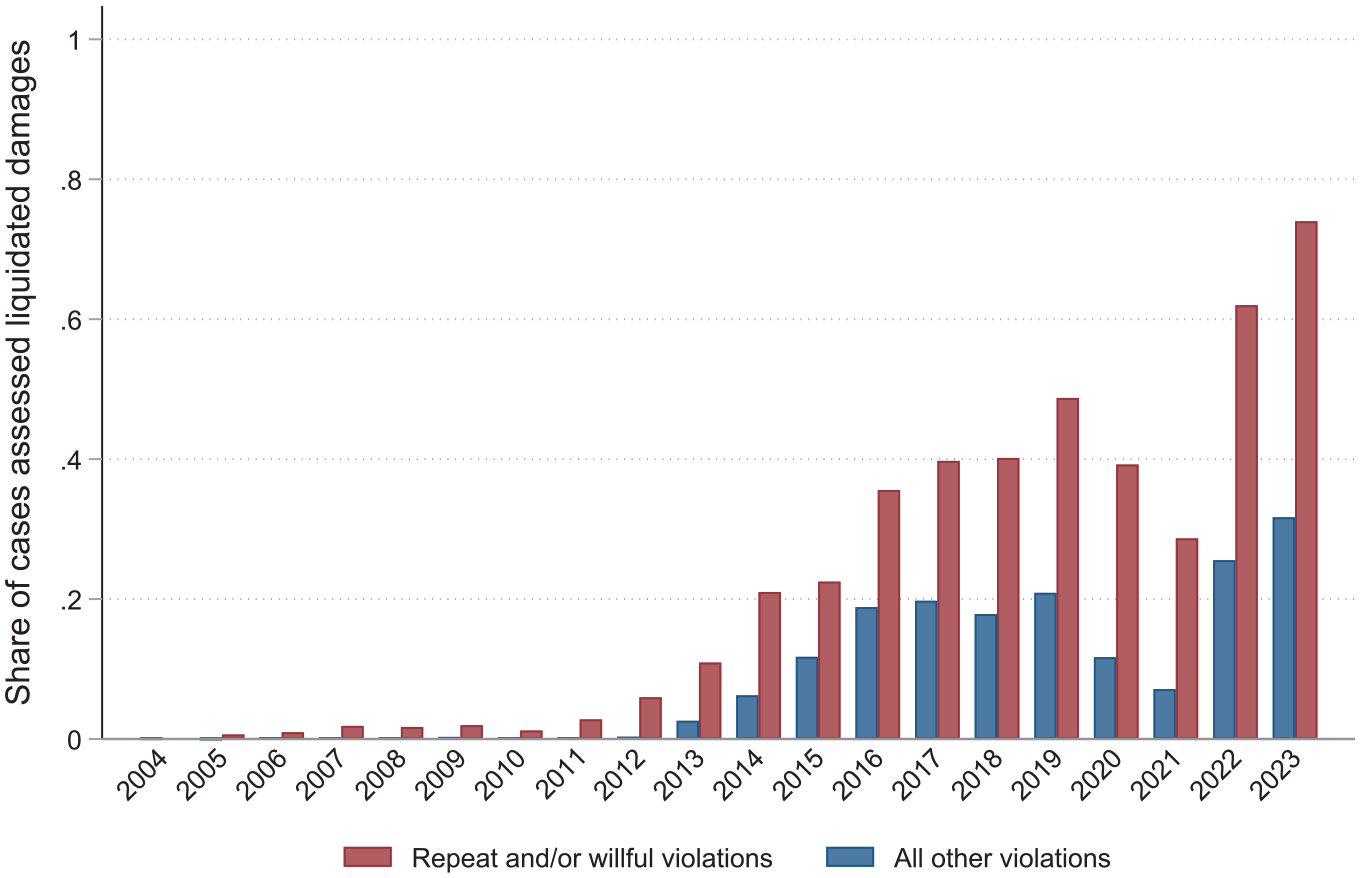
Share of Cases in DOL Investigations Assessed Liquidated Damages
Civil Monetary Penalties
Repeat and/or willful violators may be required to pay a civil monetary penalty (CMP). As Table 1 illustrates, however, CMPs are in practice minimal for almost all violators. First, the vast majority of minimum wage or overtime violations detected by the DOL are not eligible to be assessed CMPs: 91% of cases were first-time violations, and only 2% of first-time violations and 10% of repeat violations were deemed willful. Second, even among repeat and/or willful violators—those eligible for penalties—41% were not required to pay any CMP (Figure 2). Third, in cases in which a CMP is assessed, the amounts are often small relative to the underpayment. As illustrated in Table 1, the median repeat, non-willful violator was required to pay a penalty of 2 cents per dollar of wages owed; the median first-time, willful violator a penalty of 15 cents per dollar of wages owed; and even among violations that were both repeat and willful, the median violator had to pay a penalty of only 29 cents per dollar of wages owed. These three factors together mean that only 6.5% of DOL-identified FLSA underpayment cases had any CMP levied, and a penalty worth more than $1 per dollar of wages owed was levied in only 1.4% of cases.
Liquidated Damages and Civil Monetary Penalty Assessments, by Violation Type and Time Period
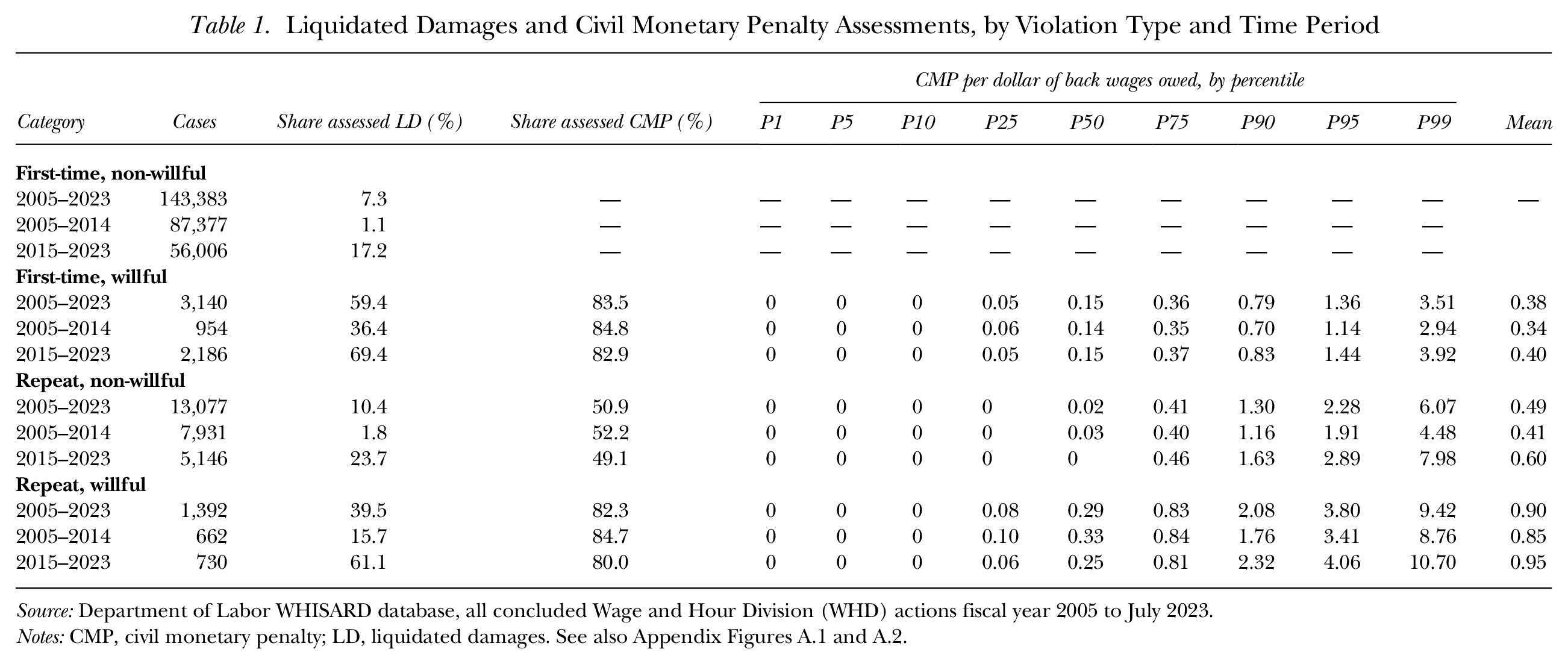
Source: Department of Labor WHISARD database, all concluded Wage and Hour Division (WHD) actions fiscal year 2005 to July 2023.
Notes: CMP, civil monetary penalty; LD, liquidated damages. See also Appendix Figures A.1 and A.2.
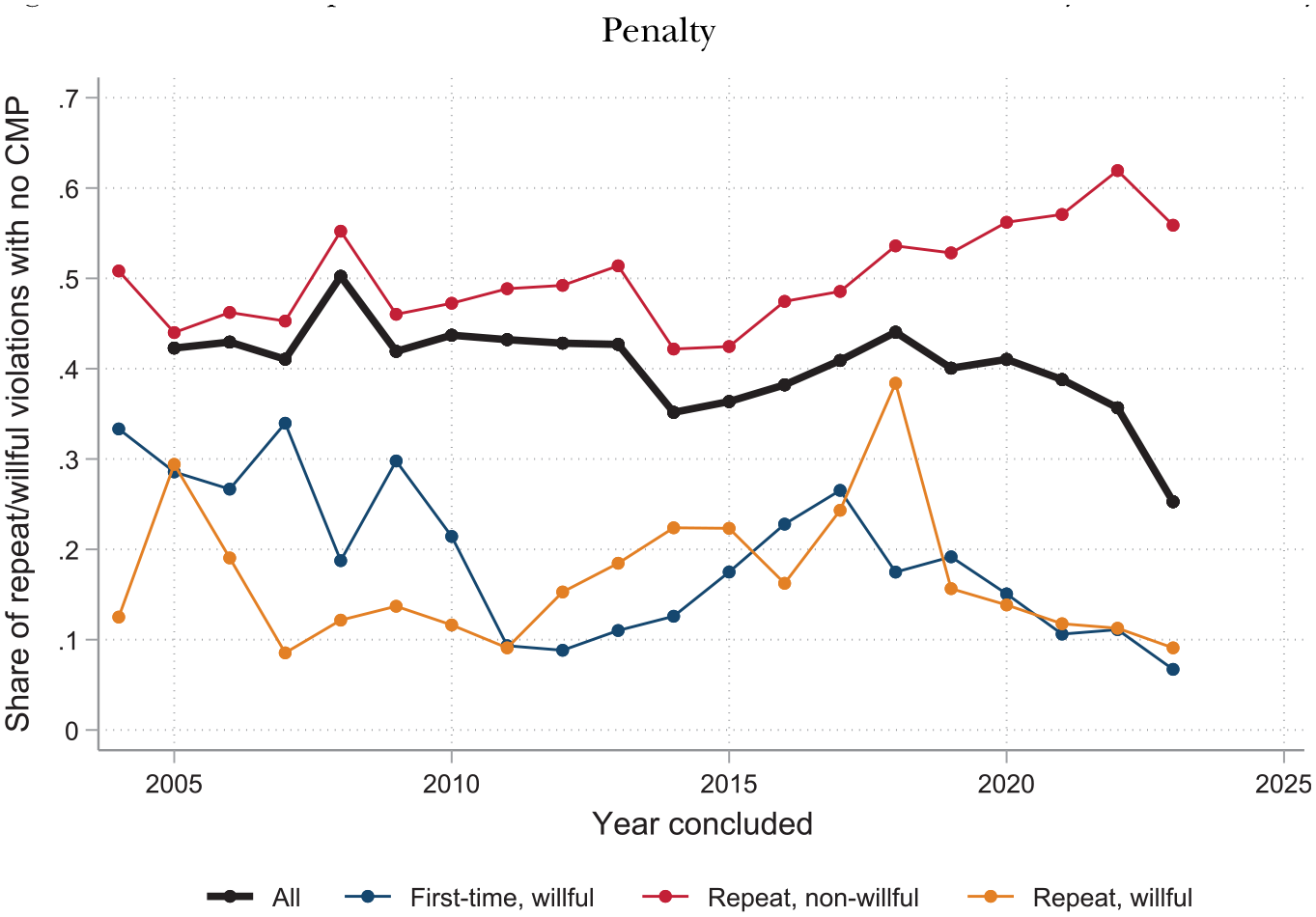
Share of Repeat and/or Willful Violations Not Assessed Any Civil Monetary Penalty
Hot Goods Provision
Under section 15(a) of the FLSA, the “hot goods provision,” the DOL is able to embargo goods that have been manufactured in violation of the FLSA. This provision increases the probability of detection by incentivizing companies higher in the supply chain to monitor their subcontractors, and increases the cost of detection as the costs of embargoes can be many multiples of DOL fines (Weil 2005). The hot goods provision is overwhelmingly used in the garment industry (Weil 2018): 76% of hot goods violations in the DOL WHISARD data were in North American Industry Classification System (NAICS) subsectors 313, 314, 315, and 316. 8 For firms in these industries, the likelihood of the hot goods provision being used is high, at 43% of cases. But these industries represent only about 1.1% of all wage and hour violations. For firms in every other industry, the chance of the provision being used is close to zero (0.15% of cases). Thus, although the DOL has the ability to use the hot goods provision beyond the garment industry (Weil 2010; Koltookian 2014), this occurs so rarely that it seems unlikely to be a major factor in the cost calculus for firms in other industries.
Criminal Prosecution
The FLSA enables willful violators to be referred by the DOL to the Department of Justice for criminal prosecution. According to data from the Bureau of Justice Statistics and Federal Criminal Case Processing Statistics, however, only 38 criminal convictions have occurred for violations of FLSA minimum wage or overtime provisions (sections 206, 207, 211C, 215, 216) in the 26 years between 1994 and 2020 (see Table 2). And although the law provides for a fine of up to $10,000 and a prison sentence of up to six months if convicted, fines were levied in only four cases (with a mean value of $3,063), and no convictions led to prison. Thus, even conditional on a violation being detected and deemed willful by the DOL, the chance of a criminal conviction is less than 0.7% and the chance of a criminal conviction with a fine is 0.08%. 9
Criminal Convictions, FLSA Minimum Wage or Overtime Violations, 1994–2020
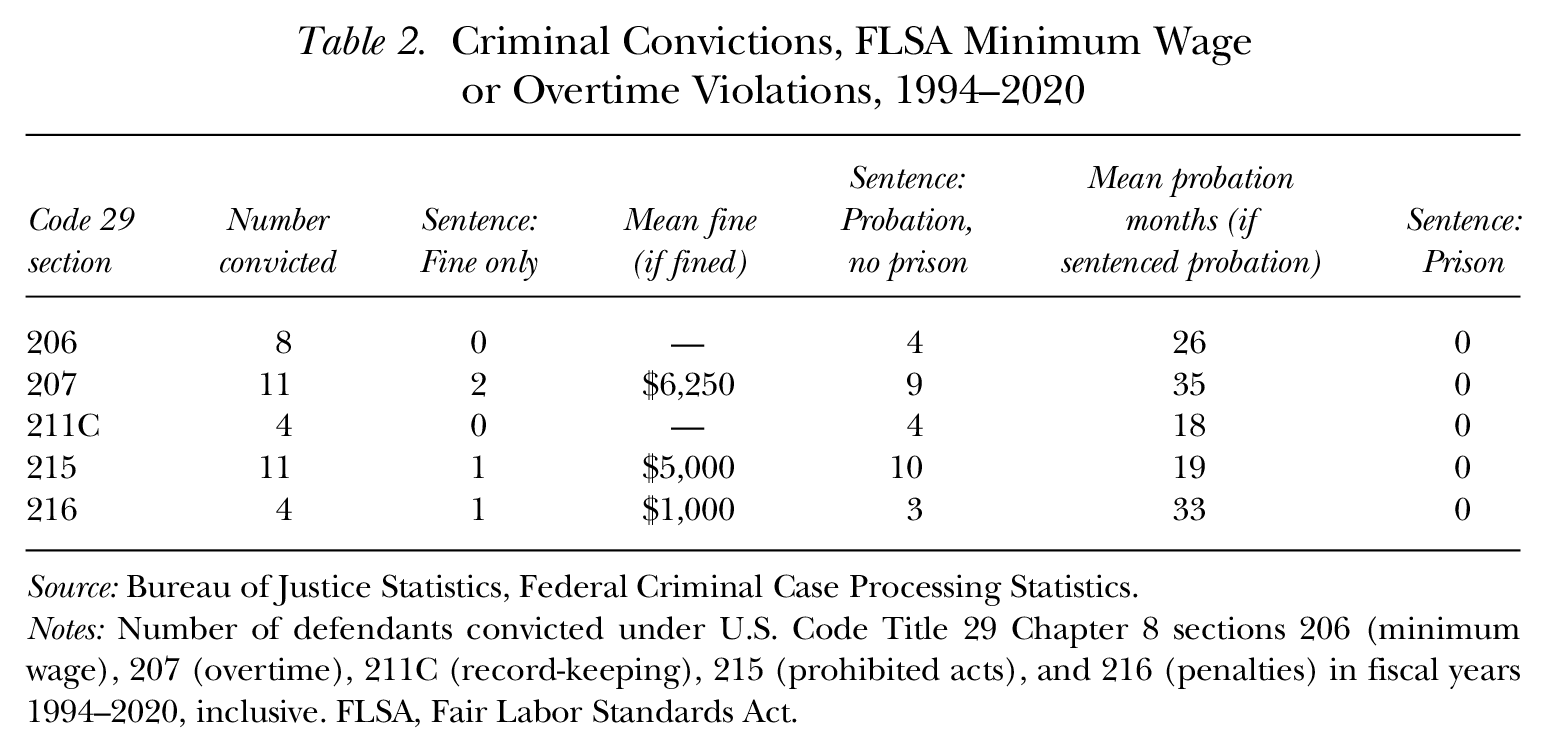
Source: Bureau of Justice Statistics, Federal Criminal Case Processing Statistics.
Notes: Number of defendants convicted under U.S. Code Title 29 Chapter 8 sections 206 (minimum wage), 207 (overtime), 211C (record-keeping), 215 (prohibited acts), and 216 (penalties) in fiscal years 1994–2020, inclusive. FLSA, Fair Labor Standards Act.
Court Actions
If found to have underpaid the minimum wage or overtime in court, the violating firm will be ordered to pay back wages. Courts typically also award liquidated damages alongside back wages (see, e.g., Callen 2012). Other penalties (such as CMPs) are not available in court actions.
The violating firm may also be required to pay the legal costs of the employee(s) who brought the action, as well as having to pay its own legal costs. Attorney’s fee awards can vary substantially depending on the case, and there is no systematic data set available of attorney’s fee awards in FLSA cases. Examining a random sample of 42 federal FLSA cases in Westlaw from 2005 to 2020 for which information was given on attorney’s fees, cost awards, and damages awarded or settlement amounts, we find that the median attorney’s fee award as a share of costs paid by the employer was 34% (and the mean was 41%). Similarly, Eisenberg, Miller, and Germano (2017) found that the median attorney fee award in FLSA collective actions between 2009 and 2013 was 33% and the mean was 30% (see also Fitzpatrick 2010). In general, the larger the settlement amount in the case, the smaller the attorney’s fee award as a share of settlement costs (Eisenberg et al. 2017). Since the settlement in an FLSA minimum wage underpayment case typically consists of back wages and an equal amount in liquidated damages, our estimates would be consistent with the average attorney’s fee awards being roughly of a similar magnitude to the back wages.
Minimum Probability of Detection Required to Incentivize Compliance
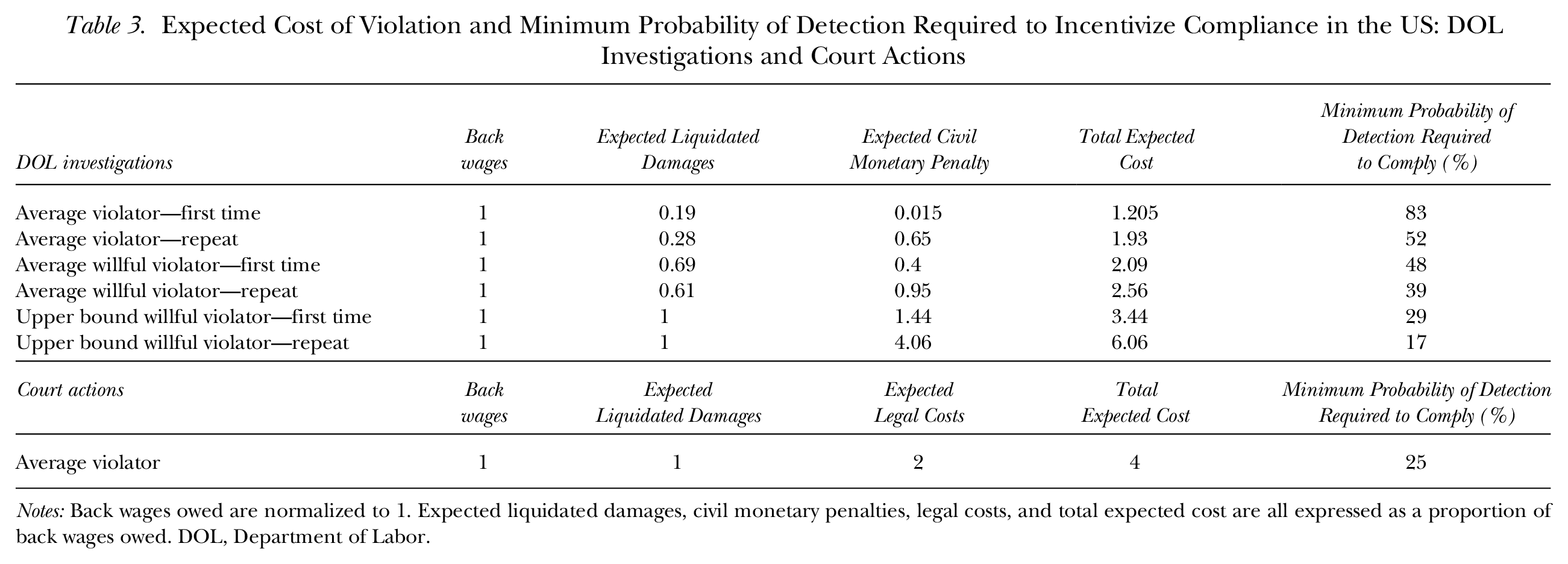
With detailed data on firms’ liquidated damages and CMPs, I now infer the minimum probability of detection firms must expect before they are incentivized to comply. This is the reciprocal of the expected penalty per dollar of wages owed (see Equation (1)). I separately examine four scenarios firms might expect and summarize them in Table 3.
Expected Cost of Violation and Minimum Probability of Detection Required to Incentivize Compliance in the US: DOL Investigations and Court Actions
Notes: Back wages owed are normalized to 1. Expected liquidated damages, civil monetary penalties, legal costs, and total expected cost are all expressed as a proportion of back wages owed. DOL, Department of Labor.
For a DOL investigation, I examine three distinct scenarios, separately analyzing first-time and repeat violators. In all scenarios, the firm is required to pay back wages, but they differ as to expected liquidated damages or CMPs, which I estimate using the DOL WHISARD data for roughly the past decade (2015–2023). 10
DOL—Average Violator
First, consider the average violating firm caught by the DOL: The firm pays back wages, faces the average likelihood of being made to pay liquidated damages, faces the average likelihood of being deemed willful (2% for first-time violators, and 9% for repeat violators), and pays the average CMP. For the average first-time violator, the expected cost per dollar of wages underpaid is $1.205, meaning that the firm would have to expect detection with an 83% probability or higher to have an incentive to comply with the law. For the typical repeat violator, for which liquidated damages are levied more frequently and CMPs are higher, the expected cost per dollar of wages owed is $1.93 and the probability of detection required to incentivize compliance is at least 52%.
DOL—Average Willful Violator
The average willful violator caught by the DOL pays back wages, is deemed a willful violator, faces the average likelihood for a willful violator of being made to pay liquidated damages, and pays the average CMP for a willful violator. In this case, for a first-time violator the expected cost per dollar of wages owed is $2.09, meaning the firm would have to expect detection with a 48% probability or more to have an incentive to comply with the law. For a repeat violator, the relevant figures are $2.56 and 39%, respectively. This scenario applies to only a small share of firms: 2% of first-time and 9% of repeat violations are deemed willful.
DOL—Upper Bound Willful Violator
This scenario represents an extreme upper bound that only the most serious violators might reasonably expect to face: The firm pays back wages and liquidated damages, is deemed a willful violator, and pays the 95th percentile CMP for a willful violator. Since willful violators represent only 2% of first-time and 9% of repeat violators, this scenario effectively estimates the 99.9th percentile penalty for first-time violators and the 99.5th percentile penalty for repeat violators. In this case, for first-time violators the expected cost per dollar of wages owed is $3.44 and for repeat violators $6.06, requiring a probability of detection of at least 29% or 17% to incentivize compliance, respectively.
Court—Average Violator
For court actions, I consider a scenario in which back wages and liquidated damages are automatically awarded, and an attorney’s fee award is also made equivalent to the total back wages owed. Since this attorney’s fee award covers the cost of the plaintiffs’ fees only, I follow DOL (2016) methodology in doubling the plaintiff fee estimate to account for the defendants’ legal costs as well. In this case, the expected cost per dollar of wages owed is $4, requiring a probability of detection of at least 25% to incentivize compliance. Note that attorney’s fee awards tend to be a smaller share of the total settlement as the value of total underpayment increases. This 25% figure is thus likely an underestimate of the incentive to comply for smaller violators and an overestimate for larger violators.
Margin for Error
This analysis may overestimate firms’ incentive to comply for three reasons. First, firms may pay less in back wages than the value of their initial underpayment because the statute of limitations binds, because firms have kept bad records (Bobo 2011), or because a settlement is reached (Cooper and Kroeger 2017; Hallett 2018). Second, the CMP figures reported represent the CMPs assessed by the DOL, not those actually paid. Between 1998 and 2008 only 61% of CMPs assessed were ultimately deemed receivable (Weil 2010). For the average willful repeat violator, adjusting the expected CMP down to 61% of its assessed value would increase the expected probability of detection required to incentivize compliance from 39% to 46%. Third, the wage cost avoided through non-compliance may be larger than we assume if within-firm minimum wage spillover effects are present. Using the estimate from Gopalan, Hamilton, Kalda, and Sovich (2021) that 20% of the increase in labor costs to firms as a result of higher minimum wages come from spillovers to non-minimum-wage workers, we would need to inflate our estimates of the saved wage costs from underpayment by 25%. Consequently, the average first-time violator would have no incentive to comply: The cost of detection is 120.5% of back wages, but the savings in wage payments from non-compliance would be 125% of back wages.
By contrast, this analysis may underestimate firms’ incentives to comply to the degree that efficiency wage effects are important. If worker productivity rises or turnover falls as wages rise, the benefit to the firm of paying workers a wage $1 lower is less than a dollar. I discuss efficiency wage effects and spillovers further in Appendix C.
Actual Probability of Detection
Table 3 shows that a typical violator would have to expect a 48% to 83% probability of detection by the DOL, or a 25% probability of a court action, to have an incentive to comply with the minimum wage. What is the probability of detection they face in practice?
The probability that any given establishment is inspected by the DOL is relatively low. Galvin (2016) estimated that even in the most heavily targeted industries (retail, fast food, and janitorial services), the probability a covered establishment was investigated by the DOL WHD in 2012 was less than 1%. The probability of a violation being detected is weakly higher than these random inspection probabilities, because the DOL targets investigations to sectors, places, and firms most likely to have violations. What is the probability that a violating firm is detected through a targeted inspection? We can estimate this value using data from fast food, which is a sector with high violation rates and good data on violation prevalence and inspection frequency. Approximately 40% of randomly inspected fast food establishments had FLSA violations, and the annual probability of inspection for an establishment among the top 20 fast food brands was around 0.8% (Weil 2010). If 40% of establishments are violators, 0.8% of establishments are inspected per year, and 69% of these targeted inspections find violations, this suggests that each violating firm has a 1.4% chance of being detected through a targeted inspection in a given year (or a 4.2% chance over three years, the maximum length for which back wages can be claimed). This finding illustrates that even under relatively effective targeting, detection probabilities would need to increase by more than an order of magnitude to reach the range of 48% to 83% that the estimates in this article suggest is required to incentivize compliance.
Given the relative scarcity of inspection resources, worker-initiated actions are a key channel for FLSA enforcement. Half of WHD investigations are complaint-led (Weil 2018), and collective actions through the courts have rapidly become a meaningful complement to DOL enforcement action. Between 2013 and 2019, an average of 7,900 FLSA cases were filed in federal court each year (Seyfarth Shaw 2020). Yet worker-initiated actions cannot be relied upon to detect all violations, since workers often do not make complaints or bring suits. This fact is particularly true for the most vulnerable workers. Weil and Pyles (2006) estimated for example that for every 130 overtime violations, only one complaint is received, and the industries with the highest rate of FLSA complaints to the DOL are not the industries with the highest rates of violations. 11
Why would workers not report violations? First, many workers are unaware that their employer’s pay practices are illegal (Bobo 2011; Alexander and Prasad 2014). 12 Second, workers may suspect they have been underpaid, but lack records to prove it (e.g., Dombrowski, Garcia, and Despard 2017). Third, even workers who are aware they are being underpaid may be reluctant to complain if they are scared of employer retaliation, of losing their job if the firm is penalized by the DOL, or of contacting the authorities, if they are undocumented for example (Fine 2006; Weil and Pyles 2006; Bernhardt et al. 2009; Milkman, González, and Narro 2010; Fussell 2011; Alexander and Prasad 2014; Grittner and Johnson 2021). 13 Or, in high-turnover industries, workers may simply move on to another job (Bobo 2011). Finally, if a worker believes that their job would not exist with a higher wage, a firm and worker may collude to avoid paying the minimum wage (e.g., Clemens and Strain 2020). Even if a worker does want to bring a suit, high costs mean that FLSA cases are often not financially viable for individuals or small groups. 14 Collective actions for large groups are more often financially viable, but an estimated 23% of workers are subject to class action waivers (Colvin 2018).
United Kingdom: Incentives to Comply with the Minimum Wage
To calculate UK firms’ incentives to comply with the national minimum wage, as with the US analysis I compile data on the costs firms face through various enforcement channels. Unlike in the US, where case-by-case data on individual DOL investigations are publicly available, HMRC only makes available aggregate data on arrears and penalties. 15 The primary enforcement channels are investigations by HMRC or by a worker bringing an action to an employment tribunal. The data available suggest that in both HMRC investigations and employment tribunals, the penalties firms incur in practice rarely reach the upper limits allowed by the law.
HMRC Investigations
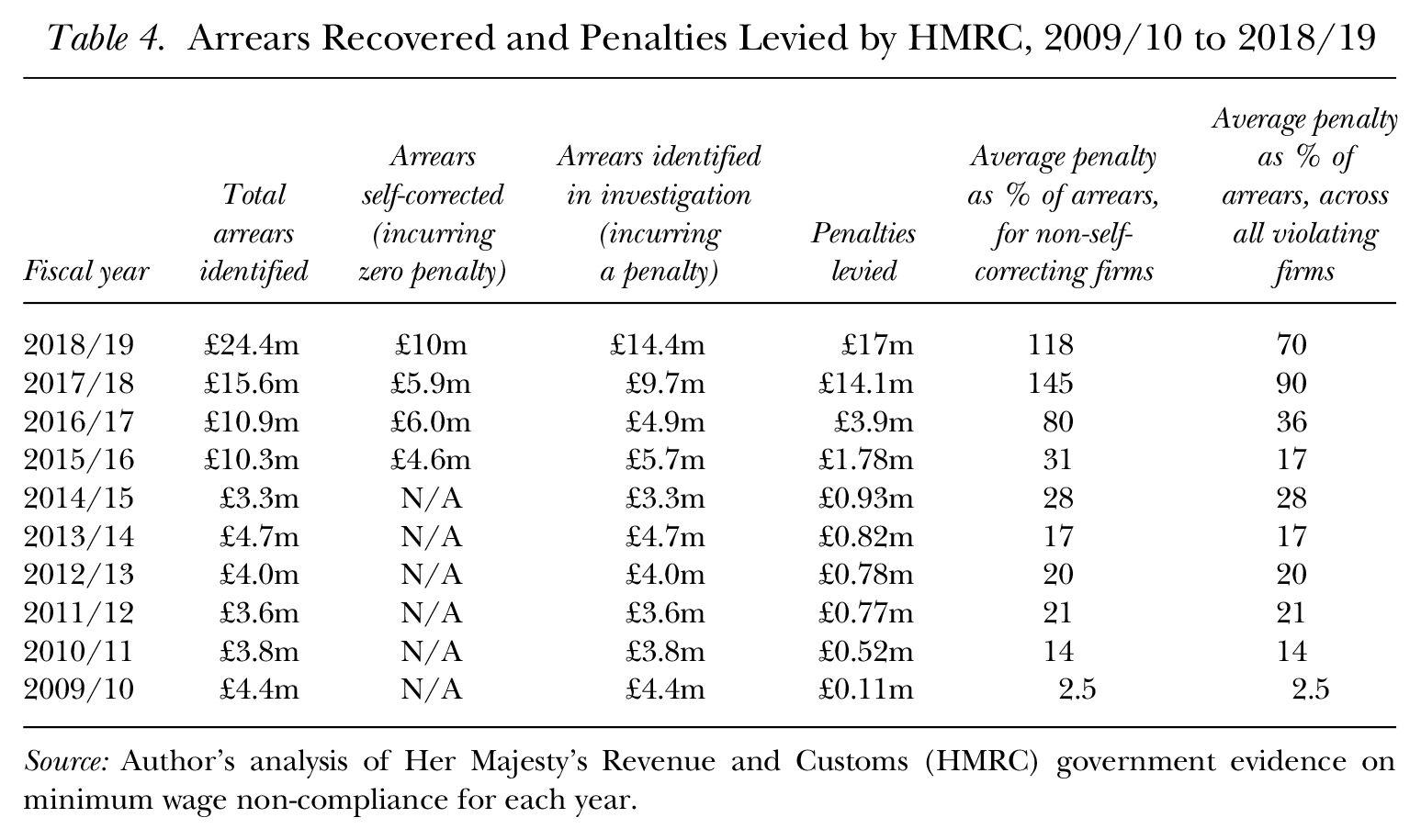
If HMRC finds a minimum wage violation, one of two routes may be followed. In most cases, firms are required to pay arrears owed and an additional penalty, of 100% of arrears if paid within 14 days (the prompt payment discount) and 200% of arrears if paid later. 16 In other cases “where the potential arrears owed are low and the number of workers is small,” the firm may be allowed to self-correct (BEIS 2018), paying only arrears and no additional penalties. Table 4 shows the total arrears in HMRC investigations, penalties levied, and number of workers who received arrears. In the two most recent years, 2017/18 and 2018/19, 27% of violators self-corrected (paying no penalty), 52% paid a penalty worth 100% of arrears, and 13% paid a penalty worth 200% of arrears. 17 The average penalty imposed was £0.78 for each £1 of arrears owed, and the average penalty for firms not offered the option to self-correct was £1.29 for each £1 of arrears owed.
Arrears Recovered and Penalties Levied by HMRC, 2009/10 to 2018/19
Source: Author’s analysis of Her Majesty’s Revenue and Customs (HMRC) government evidence on minimum wage non-compliance for each year.
Criminal Prosecution and Individual Liability
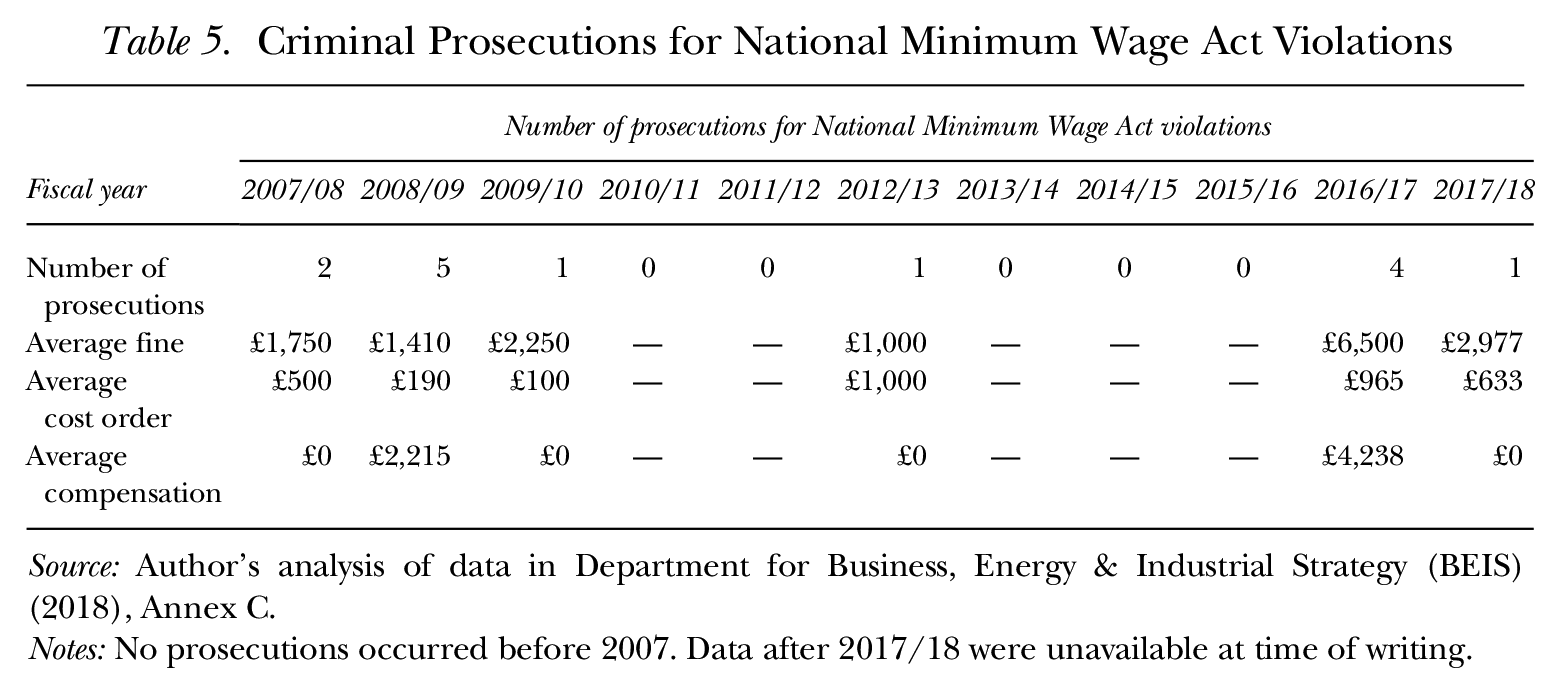
From 1999 to 2018 only 14 criminal prosecutions of firms for minimum wage violations occurred (see Table 5), representing 0.2% of the 7,486 non-self-corrected violations over the period. While potential fines have been unlimited since 2015, the average fine across these 14 cases was £2,695, and the average total costs (including fines, paying compensation to workers, and workers’ costs) levied on firms per case was £5,287.
Criminal Prosecutions for National Minimum Wage Act Violations
Source: Author’s analysis of data in Department for Business, Energy & Industrial Strategy (BEIS) (2018), Annex C.
Notes: No prosecutions occurred before 2007. Data after 2017/18 were unavailable at time of writing.
Individual company officers can also be referred for criminal prosecution or disqualified as company directors if they are found to have connived or consented with underpayment. Publicly available data suggest that as of 2019 there had been no criminal prosecutions of individual officers and only four director disqualifications (see Appendix Table A.3).
Employment Tribunals
In employment tribunals, beyond paying arrears owed, violating firms may have to compensate the worker(s) for financial losses incurred. If “aggravating features” are present, a penalty of 50% of arrears may also be levied, up to £20,000 (reduced by half if paid within 21 days). In certain circumstances judges may make a cost order. To estimate how often firms pay compensation or penalties in excess of arrears, in August 2019 I manually analyzed the Ministry of Justice’s online database of employment tribunal actions. I extracted all cases for which minimum wage arrears were listed and the jurisdiction was one of National Minimum Wage, unlawful deduction of wages, or breach of contract, or the judgment featured the words minimum wage. This process yielded 141 cases (since February 2017, the first cases in the database) in which a firm was found to have underpaid the minimum wage and for which information about the arrears or award was provided. This analysis reveals that in the vast majority of minimum wage cases, tribunals awarded arrears only and no additional costs: Only one of the 141 cases featured a financial penalty for “aggravating features,” five involved a cost award (with an average value of £183), and seven featured compensation in relation to the minimum wage offense (see Appendix Table A.2). Many employers fail even to pay the arrears owed. Only 32% of individuals awarded arrears for unpaid wages in employment tribunals received their payment in full without pursuing further enforcement according to a 2013 government study, and 44% received no payment at all (BIS 2013; see also Appendix Figure A.3 and Rose et al. 2014).
Minimum Probability of Detection Required to Incentivize Compliance
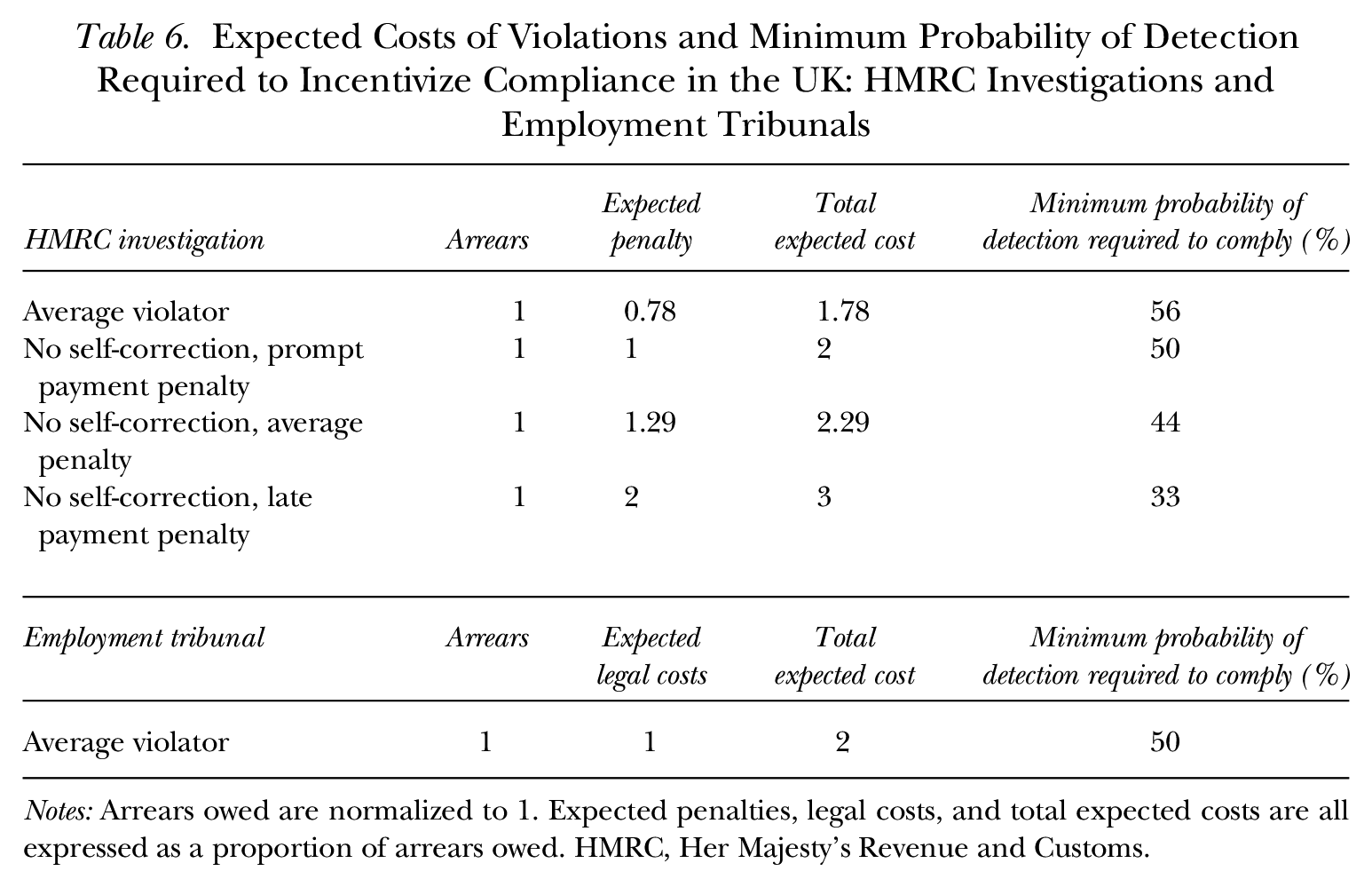
As in the US analysis, I use these data on penalties levied to ask what is the minimum probability of detection that is required to incentivize compliance with the UK’s minimum wage? I consider scenarios for both HMRC investigations and employment tribunals and summarize findings in Table 6.
Expected Costs of Violations and Minimum Probability of Detection Required to Incentivize Compliance in the UK: HMRC Investigations and Employment Tribunals
Notes: Arrears owed are normalized to 1. Expected penalties, legal costs, and total expected costs are all expressed as a proportion of arrears owed. HMRC, Her Majesty’s Revenue and Customs.
HMRC—Average Violator
If the firm expects to face the average outcome of all violating firms subject to an HMRC investigation in 2017/18 and 2018/19 (with the average probability of being offered the option to self-correct), the expected penalty is 78% of arrears, the expected cost per pound of underpaid wages is £1.78, and the expected probability of detection required to incentivize compliance is 56%.
HMRC—No Self-Correction, Prompt Payment Penalty Discount
This scenario assumes the firm will not be offered the option to self-correct, but will pay the penalty promptly, leading to an expected cost of £2 per every £1 of unpaid wages, and an expected probability of detection required to incentivize compliance of 50%.
HMRC—No Self-Correction, Average Penalty
This scenario assumes that the firm can expect the average outcome of all firms that are not offered self-correction by HMRC (facing the average probability that it will not be able to pay the penalty within 14 days), leading to an expected penalty of 129% of arrears owed and an expected probability of detection required to incentivize compliance of 44%.
HMRC—No Self-Correction, Full Penalty
Finally, this scenario assumes that, for some reason, the firm will be unable to pay promptly so it will have to pay the maximum penalty of 200% of arrears, leading to an expected cost of £3 per £1 of unpaid wages, and an expected probability of detection required to incentivize compliance of 33%.
Employment Tribunal, Average Violator
The evidence above suggests that, in employment tribunals, violators almost never have to pay more than the arrears owed. Firms may, however, have to pay their own legal costs. In the absence of comprehensive evidence on legal costs in employment tribunal minimum wage cases, I apply my estimate from US data, of legal costs as roughly equal to back wages. This estimate makes the expected cost per pound of arrears £2, meaning a firm would have to expect detection with 50% probability to have an incentive to comply with the minimum wage purely as a result of this enforcement channel—or, if the firm does not incur legal costs, the firm would have to expect detection with certainty. 18
Actual Probability of Detection
Table 6 illustrates that a typical firm must expect a 44% to 56% probability of detection by HMRC, or a 50% probability of a successful employment tribunal case, to have an incentive to comply with the minimum wage. What is the probability of detection firms face in practice?
In the United Kingdom, a firm’s violation can be detected either by a targeted HMRC investigation into a high-risk sector or firm, or through a worker-initiated action (either a worker complaint to HMRC or a worker action through the Advisory, Conciliation, and Arbitration Service (ACAS); an employment tribunal; or a county court).
Using the Low Pay Commission’s estimates of the prevalence of minimum wage underpayment, I estimate that in April 2018, between 10,960 and 94,490 firms were underpaying the minimum wage. 19 This is almost surely an underestimate, for two reasons: First, it comes from an employer survey so it excludes intentional underpayment or the informal economy (Metcalf 2008; Ritchie, Veliziotis, Drew, and Whittard 2017), and second, it covers only one month of the year and some firms may underpay in other months. HMRC identified 1,456 firms underpaying the minimum wage in fiscal year 2018/19. 20 This finding suggests that a typical violating firm’s probability of detection was no greater than 13%, and may have been as low as 1.5% (or a two-year probability of detection—the maximum time period for which arrears can be repaid—of between 3% and 26%). While significantly higher than estimates for the United States, likely because of the higher ratio of inspectors to covered workers in the United Kingdom, 21 this is still substantially less than the 44% to 56% probability required to incentivize compliance.
Unlike in the US, we can estimate the probability of a worker-led enforcement action, since these must start with a call to ACAS before proceeding to an employment tribunal or county court. ACAS received 10,310 calls relating to the minimum wage in 2017/18, of which 4,430 specifically referred to non-payment (BEIS 2018). With the Low Pay Commission’s estimate that 439,000 workers were underpaid the minimum wage in April 2018, this suggests a probability of, at most, 1% to 3% that a worker who is being underpaid will call ACAS. 22 Although many of these cases may be settled in conciliation or investigated by HMRC, very few proceed to employment tribunals. In 2018/19, 350 cases were taken to employment tribunals in relation to minimum wage underpayment, suggesting a less than 0.1% chance of the case of an underpaid worker reaching an employment tribunal.
As in the US, worker-led enforcement actions are infrequent. Workers may be unaware that their pay is below the legal minimum, 23 unable to prove it if they lack payslip information (Cominetti and Judge 2019), or afraid of retribution by their employer or engagement with the legal system. Moreover, legal support is limited: Legal aid is not available (Pyper, McGuinness, and Brown 2017), trade union legal representation is low (10% of workers in the lowest hourly pay decile are union members (Tomlinson 2019)), and pro bono services are unable to meet demand (Free Representation Unit 2018).
Concluding Remarks
The evidence in this article shows that for many firms in the United States and the United Kingdom, the legal system does not create sufficient incentive to comply with the minimum wage. This conclusion is consistent with a body of research in both the US and the UK that finds very substantial non-compliance.
The US evidence suggests that the penalties levied by DOL investigations, in particular, provide relatively little incentive to comply. This is particularly true for the large majority of violators, who are first-time violators and deemed non-willful. For this group, despite progress in recent years, most violators are still only required to pay back wages owed: Liquidated damages are only levied a third of the time and additional penalties are not applicable.
Why do these firms comply at all with the FLSA? It is important to emphasize that many do not. Estimated rates of underpayment are high across many studies. Galvin (2016), for example, estimated that 17% of low-wage workers (defined as those earning up to 1.5 times the minimum wage) experienced a minimum wage violation in 2013, losing, on average 23% of their earnings. Bernhardt et al. (2009) found that 68% of surveyed low-paid workers experienced a pay-related violation in a given week.
I offer four reasons, however, why firms may comply even when the incentives estimated here push toward non-compliance. First, note that private actions in the courts, where liquidated damages are the norm and legal costs can be high, likely provide a greater deterrent for many firms than DOL enforcement at current penalty levels. This is likely particularly the case for large firms, against whom large collective action cases may be brought. Moreover, the probability of a worker complaint will be substantially higher than average for large or high-profile firms (since only one worker needs to complain for a violation to be detected, and since these might attract more attention from unions, labor advocates, or investigative journalists).
Second, note that in the US the federal minimum wage is so low that even for many very low-wage firms, the market wage they need to pay to workers is likely as high as or higher than the federal minimum: Only 1.3% of hourly-paid US workers were paid at or below the federal minimum wage in 2022 (BLS 2023b). Underpayment would likely become substantially more relevant to firms if the federal minimum was raised. For example, a minimum wage of $15 in 2022 would have affected an estimated one third of US workers (Acs, Giannerelli, Werner, and Biu 2022).
Third, as outlined in the Background and Empirical Approach section, I excluded reputation costs from my analysis. For some firms, reputation costs are an important business factor. This is particularly true for large firms, or for firms with brand value to maintain (see, e.g., Alexander 1999).
Finally, to the extent that many people prefer to obey the law, absent strong business pressures the other way, a non-trivial share of employers may choose anyway to comply with the minimum wage. Further research into individual firms’ and employers’ compliance decisions—and the role of each of these factors in them—would be highly valuable.
How could compliance incentives be improved? If governments wish to increase incentives to comply, they can act on two margins: increasing average penalties or increasing the probability of detection. 24 The two are inversely related, as illustrated by Equation (1). To create an effective deterrent, the expected penalty must increase exponentially as the probability of detection declines (Weil 2010). With current penalty levels in both the US and the UK, most firms would need to expect a probability of detection of more than one in two by the enforcement agencies (DOL or HMRC, respectively) to have an incentive to comply with the law. The scale of inspection resources required for all potential violators in low-wage labor markets to face a 50% probability of detection would be very costly if not unfeasible: Many firms are small, violations are difficult for employees to detect, and employees are often reluctant to report. At the same time, with current probabilities of detection for many firms likely in the single digits, penalties would need to be extremely—perhaps punitively—high to create an effective deterrence regime. This suggests that action is needed on both margins if the legal system is to create a financial incentive for firms to comply with the minimum wage.
The probability of detection can be increased by increasing staff and resources for proactive strategic inspections (Weil 2010, 2018; Metcalf 2018), and by making it easier for workers to bring their own challenges by increasing cooperation with worker advocacy organizations and reducing legal costs (Weil 2010; Gindling, Mossaad, and Trejos 2015; Fine 2017). In turn, the expected penalty can be increased in a number of ways. First, reducing the share of firms that only pay back wages: in the US, ensuring liquidated damages are always levied, and in the UK, reducing the share of violations eligible for self-correction. Second, increasing the penalty for typical violators: considering treble damages in the US, as some states do, and reducing the prompt payment discount in the UK. Third, substantially increasing penalties for serious violators: in the US, substantially increasing civil monetary penalties for willful and repeat violations, extending the statute of limitations for willful and/or repeat violations, extending the use of the hot goods provision, and increasing the use of criminal prosecutions; in the UK, increasing the scope for penalties in cases of egregious or intentional minimum wage violation, automatically levying penalties in employment tribunal cases, and increasing the use of criminal prosecutions and director disqualifications.
When considering appropriate penalties, it is illustrative to note that in both the US and the UK the penalties firms face for underpaying workers—wage theft—are far smaller than the penalties individuals face for theft of items of equivalent value. For example, in the US, shoplifting goods worth $2,500 or more can lead to felony charges and imprisonment in every state (Traub 2017). In the UK, in cases of theft of property worth between £500 and £10,000 in which the offender has “medium culpability,” the Sentencing Council recommends up to 36 weeks’ custody. In contrast, in both countries, while minimum wage underpayment can in theory result in criminal prosecution, large fines, and jail time, this almost never happens.
Finally, effective minimum wage enforcement must deal with the increasingly “fissured” workplace, in which workers are increasingly employed by subcontracting firms, staffing agencies, or franchisees, or work as independent contractors (Weil 2014). These employment structures increase non-compliance with labor and employment laws and make detection more difficult (Ruckelshaus 2008; Weil 2010; Bewley, Rincon-Aznar, and Wilkinson 2014).
Ensuring firms have a strong incentive to comply with the minimum wage will only become more important in the context of proposals to raise minimum wages substantially in both the United States and the United Kingdom. The higher the minimum wage, the larger the number of workers covered and the greater the financial incentive for firms to avoid compliance. In the context of the existing penalty regime, the risk that large increases in minimum wages will fail to translate into large increases in take-home pay for many workers is substantial unless penalties and enforcement are systematically strengthened.
Supplemental Material
sj-pdf-1-ilr-10.1177_00197939241299417 – Supplemental material for Incentives to Comply with the Minimum Wage in the United States and the United Kingdom
Supplemental material, sj-pdf-1-ilr-10.1177_00197939241299417 for Incentives to Comply with the Minimum Wage in the United States and the United Kingdom by Anna Stansbury in ILR Review
Footnotes
Acknowledgements
I am very grateful to Lindsay Judge for our conversations and work together on the UK minimum wage, and for financial support for this work from the Resolution Foundation. The US portion of this paper builds on analysis in Anna Stansbury, “Do US Firms Have an Incentive to Comply with the FLSA and the NLRA?” (PIIE working paper 21-9, June 2021). For helpful comments, I thank Olivier Blanchard, Brandon Brown, Gabriel Chodorow-Reich, Nye Cominetti, Matthew Creagh, Karen Dynan, Claudia Goldin, Kathleen Henehan, Ingrid Hesselbo, Lawrence Katz, Ann Lichter, Alison Morantz, Adam Posen, Zach Rubin, Paul Sellers, Heidi Shierholz, Lawrence Summers, and David Weil, and participants at the 2022 LERA meetings and 2022 Festschrift in honor of Thomas Kochan. With thanks to Michael Davies for research assistance on attorney fees and Kyra Rodriguez for research assistance on criminal prosecutions.
This article is part of a set of papers from a Festschrift honoring Thomas Kochan.
The UK portion of this paper builds on analysis from Lindsay Judge and Anna Stansbury, “Under the Wage Floor” (Resolution Foundation Briefing Note, January 2020).
An Online Appendix is available at http://journals.sagepub.com/doi/suppl/10.1177/00197939241299417. Data replication files are available at  .
.
For information, please address correspondence to
1
See also Ashenfelter and Smith (1979) and .
2
See for more details on this risk aversion exercise, and on the framework. Note also that this framework assumes there are no efficiency wage effects. I also examine the effect of efficiency wage effects on incentives to comply in Appendix C.
3
In 2000, this share was 75%; the falling share reflects increasing state and local minimum wages. Moreover, in many states, federal enforcement is the main enforcement channel since state-level enforcement is weak: Florida has no state minimum wage enforcement agency (Galvin 2016); more than half of states have 15 or fewer wage and hours enforcement staff (Bobo 2011); most states only undertake enforcement in response to complaints (Lurie 2011; Meyer and Greenleaf 2011); and in some states, including Texas and Utah, state enforcement focuses only on workers not covered by the FLSA (Lurie 2011). Note that higher state minimum wages may increase the incentives for firms to not comply, particularly in states with a high “bite”; some states tackle this issue with more stringent penalties (). A higher federal minimum wage would make federal penalties and enforcements the relevant benchmark in more states. For example, as of January 2024, only four states and the District of Columbia had minimum wages higher than $15.
5
Estimates from the Current Population Survey also suggest substantial non-compliance (Eastern Research Group 2014; Galvin 2016; ).
6
Calculated using estimated median hourly wages of $23.05 in 2021, from the Economic Policy Institute State of Working America Data Library.
7
The naming and shaming scheme provides case-level information on arrears but not on penalties levied.
8
These subsectors, respectively, are textile mills, textile product mills, apparel manufacturing, and leather and allied product manufacturing.
9
Calculated using the 3,752 willful FLSA violations between 2005 and 2020 in the DOL WHISARD as the denominator, and the 26 criminal convictions, and 3 convictions requiring fines over the same period as the numerators.
10
I do not include the hot goods provision or criminal prosecution since they are so rarely used.
11
12
Workers may not know the law, or employers may violate the law in ways that are difficult to detect. These include requiring unpaid training; making illegal deductions; not giving breaks or pay for breaks not taken; requiring work before or after shifts; not paying for driving time between jobs; paying insufficient piece rates; making workers pay to work (e.g., for the right to earn tips); or misclassifying workers as independent contractors or as exempt from overtime (see, e.g., Bobo 2011; Nir 2015; ).
13
14
An employee is often responsible for costs of FLSA litigation up front, and may remain liable for attorney fees if the suit is unsuccessful (Ruan 2012). Free legal services are limited (and those with federal funding cannot serve undocumented workers). No-win, no-fee agreements are rarely viable in smaller FLSA cases because of low damage amounts (Becker and Strauss 2008; Lee 2014). Moreover, the opt-in requirement makes bringing large collective actions more difficult under the FLSA than in Rule 23 class actions ().
15
Naming and shaming scheme data list companies and arrears owed, but not penalties levied; my Freedom of Information requests for case-level data were denied.
16
Up to a maximum of £20,000 per worker. The penalty ratio was increased to 200% in 2016 (from 100% in 2014–2016, and 50% before 2014).
17
18
Unless the minimum wage has been increased since the underpayment occurred—then the firm must pay arrears evaluated at the current minimum wage. Note that this estimate reflects an upper bound of the incentives firms face for a worker-initiated action, since many cases are settled in ACAS conciliation (whereby the firm would pay, at most, the arrears owed).
19
The Low Pay Commission estimates the number of workers underpaid and the size categories of their employers. The lower (upper) bound is estimated by assuming that for each firm size category, the total number of workers underpaid were employed in the minimum (maximum) number of firms possible.
20
Obtained from Freedom of Information Request to HMRC, FOI2019/01761. Analysis of naming and shaming scheme data by Judge and Stansbury (2020) suggested that HMRC targeting focuses on larger firms with large total arrears, but often small arrears per worker (while violations detected in employment tribunals tend to be cases affecting few workers with large arrears per worker). See .
22
As before, the 439,000 figure almost certainly underestimates the number of workers underpaid in a given year, because: 1) it is an estimate from an employer survey, and 2) it is estimated in a single month.
23
For similar reasons as listed for the US. In addition, in the UK there are several legal minimum wage bands. Firms may fail to raise pay when a worker ages into a new band, or may pay the apprentice minimum wage in incorrect circumstances. Examples of disguised minimum wage underpayment in various industries can be found in Warhurst, Lloyd, and Dutton (2008), Hussein (2011), Rubery et al. (2011), Ipsos MORI (2012), Pennycook (2013), BIS (2014), Gardiner (2015), Clark and Herman (2017), Ritchie et al. (2017), Kik et al. (2019a, 2019b), and López-Andreu, Papadopoulos, and Hamedani (2019).
24
A social planner may alternatively choose a high minimum wage with imperfect compliance and enforcement (Basu, Chau, and Kanbur 2010), or tolerate limited underpayment and focus scarce enforcement resources only on deep underpayment (Bhorat, Kanbur, and Stanwix 2015).
References
Supplementary Material
Please find the following supplemental material available below.
For Open Access articles published under a Creative Commons License, all supplemental material carries the same license as the article it is associated with.
For non-Open Access articles published, all supplemental material carries a non-exclusive license, and permission requests for re-use of supplemental material or any part of supplemental material shall be sent directly to the copyright owner as specified in the copyright notice associated with the article.
