



Abstract
This article examines the wage earnings of refugee immigrants in Sweden. Using administrative employer–employee data from 1990 onward, approximately 100,000 refugee immigrants who arrived between 1980 and 1996 and were granted asylum are compared to a matched sample of native-born workers. Employing recentered influence function (RIF) quantile regressions to wage earnings for the period 2011–2015, the occupational-task-based Oaxaca–Blinder decomposition approach shows that refugees perform better than natives at the median wage, controlling for individual and firm characteristics. This overperformance is attributable to female refugee immigrants. Given their characteristics, refugee immigrant females perform better than native females across all occupational tasks studied, including non-routine cognitive tasks. A notable similarity of the wage premium exists among various refugee groups, suggesting that cultural differences and the length of time spent in the host country do not have a major impact.
Keywords
Aging populations and shortages of labor in cognitive as well as manual occupations pose challenges in many Organisation for Economic Co-operation and Development (OECD) countries. Do refugee migrants contribute to alleviate those challenges at the crucial level of jobs and tasks? What are the lessons learned from Sweden, a significant destination for refugee immigrants for several decades?
A large body of studies uses differences in workers’ wage premia as an indicator of the competitiveness of immigrants, partly reflecting the effectiveness of a country’s immigration and labor market policies. Many of the papers in this field have centered on occupations; however, influenced by the literature on skill-biased technological change (SBTC), an emerging strand of immigrant research provides new insights by studying workers’ returns to tasks rather than occupations. Disparities between native and foreign-born workers are assessed through the utilization of detailed task data at the occupational level. Recently, researchers have improved the SBTC literature by employing recentered influence function (RIF) quantile regressions and the occupational-task-based Oaxaca–Blinder (OB) decomposition to compare immigrants with native workers across the entire wage distribution, rather than solely at the mean. Our article contributes to this literature by being the first to apply a task-based approach to compare workers across the wage distribution, specifically focusing on refugee immigrants. Additionally, we leverage unique and rich panel data, which enables us to offer results with notable policy implications.
We analyze refugees who arrived in Sweden between 1980 and 1996 and were granted asylum. To assess the significance of cultural distance, duration on labor market integration, and gender, we classify refugees into three distinct categories—namely those from European countries arriving during the period 1990–1996, those from non-European countries arriving during the same period, and immigrants arriving between 1980–1989 without classifying their country of origin—and provide separate investigations for males and females.
We apply coarsened exact matching (CEM) and use an extensive set of individual characteristics to identify a group of the most comparable natives. CEM identifies a control group of almost 95,000 native-born workers who are most comparable to the same number of refugees with regard to their background characteristics (i.e., “endowments”). We also draw a random sample of natives as an additional benchmark.
In the empirical analysis, we consider only individuals who work as employees for 12 months a year and have wage earnings as their main income source. In line with the task-oriented literature, we delineate four task categories: non-routine cognitive, routine cognitive, non-routine manual, and routine manual. Accordingly, we categorize occupations at the 4-digit level. The sample includes individuals born between 1964 and 1980. We have background data from 1990 and estimate regressions over the period 2011–2015. The workers are observed in six industry classifications, five firm sizes, six types of municipalities, and five regions. Using information on their highest educational attainment, we separate the individuals into six categories, from primary school to doctoral degree.
Wage earnings for each worker are expressed relative to the median of the entire labor market on a yearly basis. Experience is measured as the cumulative number of years in which an individual has wage earnings as the main source of income, starting in 1990. Our analysis considers workers at least 15–20 years after their arrival in Sweden as refugees and who work the entire year. We estimate the likelihood of belonging to a specific task group with a panel multinomial logistic (MNL) regression model with random effects.
Background and Related Literature
Most of the existing research on refugee integration shows that refugees are disadvantaged socially and economically at their arrival, relative to the native population, and that several problems tend to persist. This supposition is reflected in large initial gaps in labor outcomes for refugees compared with native workers, which show slow subsequent improvement. The large gap observed in wage earnings is well documented in reviews, such as Kerr and Kerr (2011), Becker and Ferrara (2019), Bevelander (2020), and Brell, Dustmann, and Preston (2020).
With access to large-scale administrative data, we add to this literature by focusing on long-term refugee migrants. We find for Sweden a gender-heterogeneous advantage over comparable natives at the level of occupations and tasks. Kaida, Hou, and Stick (2020) have also studied long-term economic integration of refugees using administrative data for Canada and found that privately sponsored refugees and government-assisted refugees were more successful. Akgündüz and Torun (2020) used both survey and administrative data to study changes of tasks performed among natives in Turkey after the recent inflow of Syrian refugees. The substantial additional low-skilled labor supply increased natives’ task complexity, thereby reducing the intensity of manual tasks and raising the intensity of abstract tasks. Like Akgündüz and Torun (2020), Mayda, Parsons, Peri, and Wagner (2017) employed administrative data but with a long-term perspective. They found that exogenous resettlement of refugees had no adverse effects on natives in the US labor market.
Comprehensive research investigates the underlying reasons for these discrepancies. The main factors are found to be similar to those for migrants in general and include education, experience, home–host country differences, and literacy skills (see, for instance, De Vroome and Van Tubergen 2010; Chin and Cortes 2015; Barbiano di Belgiojoso 2019; Bevelander 2020; and Irastorza and Bevelander 2021). Other explanations include discrimination (Campion 2018), limited social networks (Auer 2018), specific residential areas (Connor 2010), and firm factors (Abowd, Kramarz, and Margolis 1999). The literature also highlights distinct challenges that refugees face in their labor market integration, setting them apart from other immigrants, such as initial employment bans for asylum seekers (Marbach, Hainmueller, and Hangartner 2018), uncertainties about the duration of staying (Schock et al. 2016), physical and mental health conditions related to incidents before the arrival to the host country, and discrimination (Ruiz and Vargas-Silva 2018). Nonetheless, some studies contend that refugees might possess especially strong incentives to integrate in the labor market. For instance, Cortes (2004) suggested that a diminishing likelihood of returning home enhances their motivation to invest in human capital. Using longitudinal Swedish register data to study groups of refugees, Bevelander and Luik (2020) found that country-of-origin differences decrease to a small degree after regression adjustments. Such findings raise doubts about the cultural difference hypothesis.
Drawing from the SBTC framework, a burgeoning body of research, initiated by Peri and Sparber (2009), has recognized the significance of task-based and occupational-sorting perspectives in comprehending wage disparities between native and foreign workers in contemporary economies. Our article aligns with this theoretical perspective. Elaborating on the occupational-task approach, Hurst, Rubinstein, and Shimizu (2021) suggested that Black–White discrimination varies by the task requirements of jobs, explaining a persistent racial wage gap in the United States. In a comparative study for the United States and major European countries, Kaya (2023) also provided evidence for the relevance of the task-based approach of SBTC to explain the changes in the overall wage structure and the gender wage gap. However, although occupational skill prices played a significant role in reducing the US gender wage gap, this was not confirmed in most of the European countries that were studied.
To analyze the wage earning differentials in the Swedish labor market, we adopt the occupational classification scheme of the SBTC literature based on Autor, Levy, and Murnane (2003), Acemoglu and Autor (2011), Autor and Handel (2013), and Acemoglu and Restrepo (2018), among others. This literature highlights the increasing wage gap between non-routine and routine tasks and, in particular, between cognitive and manual work tasks as a consequence of technical change and increased skill intensity.
Following scholars using the entire distribution rather than the mean to study wage gaps, we employ RIF quantile regressions. We explain the wage earnings differences between refugee immigrants and natives across all occupations, controlling for occupational task groups and by using the RIF quantile regression method (Firpo, Fortin, and Lemieux 2009). This approach allows us to estimate the impact of changes in the distribution of the explanatory variables on quantiles of the unconditional distribution of the wage variable. Recent improvements in the flexibility and simplicity of the RIF methodology, developed by Firpo, Fortin, and Lemieux (2018) and Rios-Avila (2020), have facilitated a deeper analysis of immigrants’ relative wage outcomes near the tails and along the entire wage distribution. Important for the purpose of our study, RIF quantile regressions enable the inclusion of high-dimensional fixed effects and an application of a decomposition analysis for population subgroups.
Our article is closely related to a limited number of recent immigration studies using similar techniques with RIF regressions and an Oaxaca–Blinder (OB) decomposition approach to study differences between groups along the distribution of the explanatory variable. Ingwersen and Thomsen (2019) examined the wage gap between natives and immigrants in Germany from 1994 to 2015 and report a significant gap between the categories of foreigners, naturalized immigrants, and comparable native Germans without a migration background. The gap is largest in the upper quantiles. Storm (2022) applied a task-specialization perspective on the native–foreign wage gap in Germany. Using data from the period 1992–2018, he showed that the wage gap is largely explained by natives specializing in high-paying interactive activities between and within occupations, whereas foreign workers are specializing in low-paying manual activities. Muckenhuber, Rehm, and Schnetzer (2022) used a sample of Austrian household data for 2014 to investigate the native–migrant wealth gap as an indicator of integration into society. Controlling for socioeconomic characteristics, they found that the gap is most pronounced especially in the upper half of the distribution, with substantial within-group inequality for migrants and evidence for catching up when second-generation migrants are considered.
We add to the literature studying the importance of occupations, tasks, skills, and distributional statistics for wage differences. To the best of our knowledge, this is the first article that applies this approach specifically on refugee immigrants. We also contribute by considering heterogeneity among refugee workers depending on cultural distances and time of arrival. As a unique advantage, our administrative data allow us to control not only for extensive individual characteristics but also for firm-specific factors and the place of living. From the full population of refugees being granted asylum in Sweden, we select our study sample based on age, arrival period, and region of origin.
As background for our empirical analysis, we provide a brief overview of the institutional framework covering refugee immigration to Sweden. 1 Of Sweden’s population, one in five people was born abroad, and roughly half of them are refugees. The five most common countries of birth are Syria, Iraq, Finland, Poland, and Iran. In the 1970s, Sweden introduced an establishment program open to newly arrived immigrants between the ages of 20 and 65 who have been granted residence permits as refugees, resettled refugees, persons in need of protection, or as close relatives of someone in one of these categories. Participants in the program receive a limited allowance to cover their living expenses, well below the minimum wage in the labor market. The stated aim of the program is that migrants should “learn Swedish, find a job, and become self-sufficient as quickly as possible.” In contrast to other European countries, Sweden does not impose any employment ban that prevents asylum seekers from entering the local labor market with a waiting period upon arrival. There are no geographical restrictions regarding where refugees can look for jobs. The Swedish open labor market entry policy avoids long-term employment delays for refugees that can be observed in other European countries, such as Denmark (Hvidtfeldt, Schultz-Nielsen, Tekin, and Fosgerau 2018).
The average employment rate among refugees and their relatives aged 20–64 amounted to almost 60% in the year 2019, which is somewhat higher than the average for refugees in the European Union. The corresponding figure for other foreign-born migrants was 77%, compared to the internationally very high employment rate of 86% among the native-born. Similar to many other countries, the employment of refugees converges toward the rest of the population over time. While the employment rate among refugee immigrants who have lived in Sweden for 0–9 years was 56% for men and 30% for women in 2019, it increased to approximately 80% for both men and women 20 years after arrival. The large share of refugees staying in the host country for at least 10 years is notable: The rate is 97% among women and 94% among men. The corresponding figure for the entire European Union was below 60% in 2014. 2
Nearly the entire Swedish labor market is governed by collective agreements, spanning both the private and public sectors. The wage structure is regulated primarily across three tiers. First, overarching central wage agreements are established by labor market parties (unions and employers’ organizations). The extent of the general salary range is determined by the bargaining power of these parties. Second, local negotiations occur between employers and workers’ representatives at the firm level. Third, individual employees negotiate wages directly with their employers. Following an earlier era characterized by substantial compression of relative wages due to a centralized “solidarity” bargaining system, the contemporary Swedish wage-setting model permits notable wage flexibility at local workplaces, resulting in significant differentials both within and between plants and industries, albeit still constrained compared to international standards (Hibbs and Locking 2000; Skans, Edin, and Holmlund 2009; Carlsson, Skans, and Skans 2019; Kjellberg 2022). Consequently, significant variation exists within the wage distribution across the occupations we examine, using our task-based research method. Notably, our analysis incorporates controls for company, regional, and individual characteristics.
Data
We use administrative register data provided by Statistics Sweden and accessed through the remote MONA (microdata online access) delivery system. The full population-level databases exploited encompass six administrative registers, which are possible to merge through unique employer and employee codes. These databases are the longitudinal integration database for health insurance and labor market studies (LISA), 3 register-based activity statistics (RAKS), the dynamics of firms and workplaces (FAD), register-based labor market statistics (RAMS), a longitudinal database for integration studies (STATIV), and migration and asylum statistics (MOA). 4
The variables constructed from the data sets include population groups (natives, various refugee groups), demographics (gender, age, marital status, preschool children), education, citizenship, work characteristics (occupational tasks, work experience, annual wage earnings), firm characteristics (industry, firm size), and geography (place of living, place of firm).
Work experience is measured as the cumulative number of years with labor income as the main source of income. This measurement commences in 1990, as we lack access to pre-1990 data for refugees who arrived from 1990 on. We observe workers in six industry classifications, five firm sizes, six types of municipalities, and five regions. Using information on the highest educational attainment, we classify the individuals into six categories, from primary school to doctoral degree.
We impose several restrictions on the data. First, we exclude self-employed individuals since they are obviously not comparable with employed workers. Second, we focus on individuals born between 1954 and 1980. Thus, we compare wage levels for workers aged from 31 to 61 years. Third, we study only refugee immigrants who arrived before 1997 and were granted asylum. Refugees are separated into three subgroups: those from European countries arriving during the period 1990–1996, those from non-European countries arriving during the same period, and immigrants arriving in Sweden between 1980–1989 without classifying their country of origin.
We delineate the first two groups because it is possible that European refugee immigrants may be subject to less discrimination in the labor market than non-European refugees. However, differences may be attributable to level of local knowledge rather than discrimination. It is nevertheless of policy concern whether such differences exist independent of their exact sources. The justification for our third group is to investigate whether a longer time in the new country improves conditions on the labor market.
As a fourth constraint, we consider only individuals who were employed for the entire year (i.e., worked 12 months) and derived their primary income from wages. Their annual wage earnings are calculated as a relative measure, normalized with respect to the median wage earnings for the corresponding year. This measure has a number of advantages. First, we have no need to deflate it each year, as one would do when using log (wage earnings). 5 Second, using the median for normalization is less prone to being affected by outliers and skewness in the wage distribution. Additionally, the normalized value directly indicates whether an individual’s earnings are below or above the median. Third, differences in normalized wage earnings can be interpreted as percentage differences, similar to how estimated coefficients indicate a percentage difference in the dependent variable with log transformation. The normalization is not done separately for subgroups, enabling a direct comparison of wage earnings differences across groups.
Following Acemoglu and Autor (2011), we classify all workers into the four occupational task categories: 1) cognitive non-routine work tasks (professionals, managers, and technicians), 2) cognitive routine tasks (office and administrative support and sales), 3) manual non-routine tasks (personal care, personal service, protective service, food, and cleaning), and 4) manual routine tasks (production, craft, repair, operators, fabricators, and laborers). These occupational categories are established at the 4-digit level in line with the method suggested by Mihaylov and Tijdens (2019), and we map the Swedish Standard Classification of Occupations (SSYK) 2012 classification to the prior SSYK 1996 occupation codes. 6
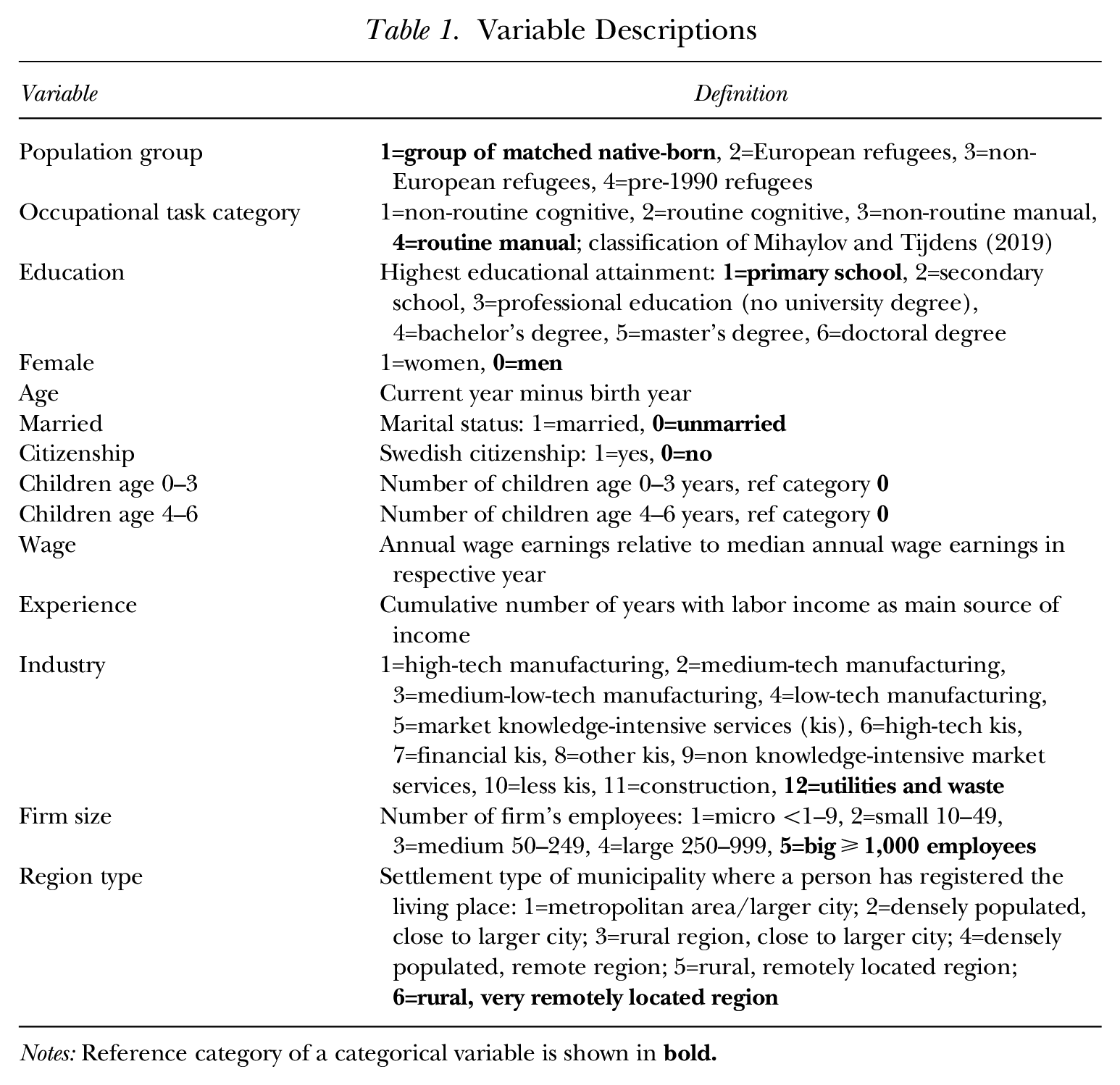
Table 1 provides a comprehensive overview of the variables used for matching and the calculation of relative frequencies of the occupational task category, the RIF regressions, and decomposition analysis. It explains how the administrative data encompass both employer–employee statistics as well as regional information such as settlement type of municipality the person has registered as the living place.
Variable Descriptions
Notes: Reference category of a categorical variable is shown in
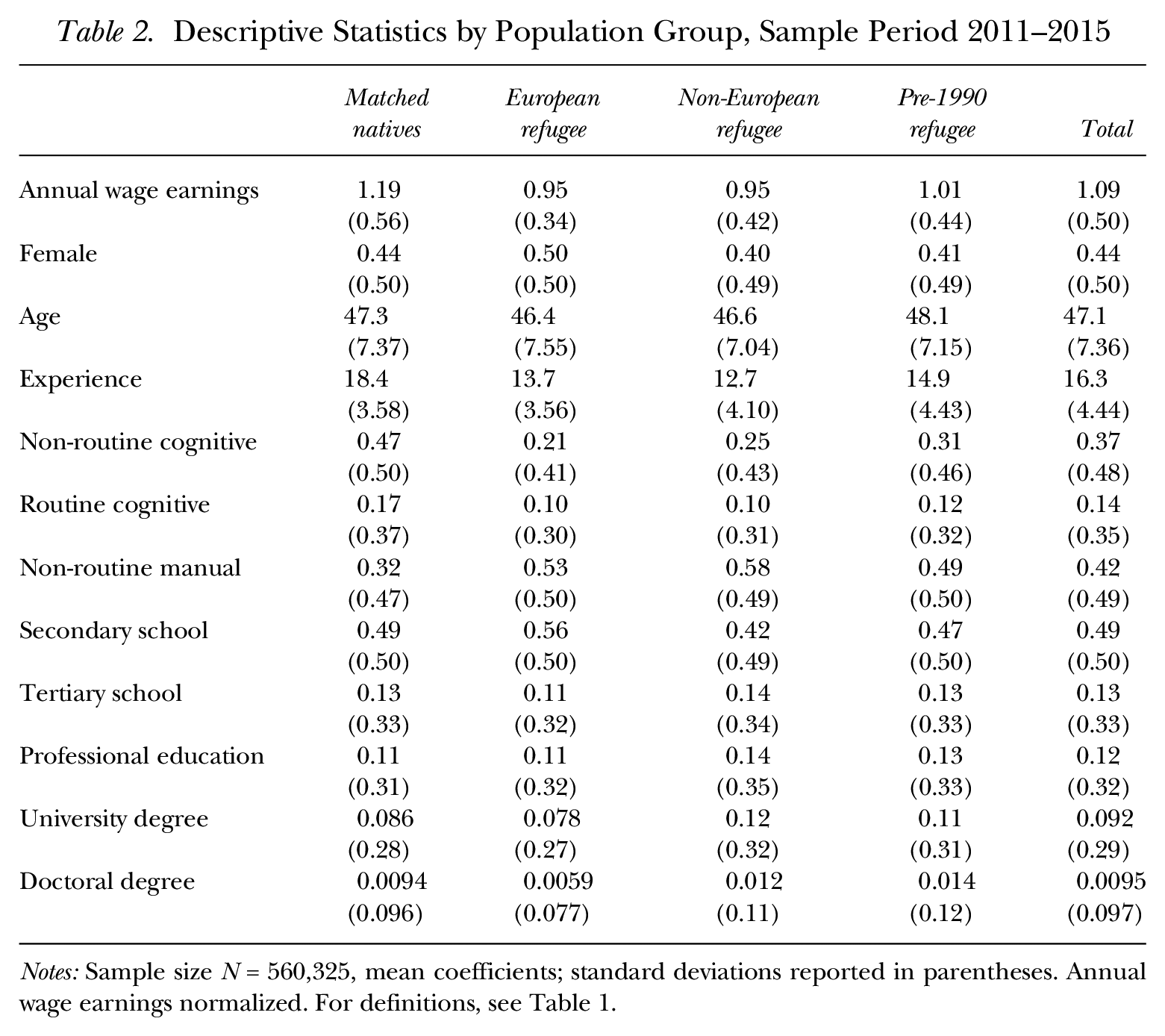
The top row of Table 2 indicates that during the period 2011–2015, matched natives had a 24% higher normalized mean wage compared to refugees who arrived in Sweden between 1990 and 1996 and a 18% higher wage compared to refugees who arrived during the period 1980–1989. Among European refugees who were granted asylum after 1989, half are women. The corresponding proportion for the other two refugee groups is approximately 40%. The average age in the population groups studied was 47 years during the period of our wage estimations. Occupational sorting and disparities in work experience represent two key factors contributing to the discernible wage distinctions between native-born and refugee workers. Natives typically possess an additional 4–6 years of working-life experience, and a significant proportion of them (47% of matched natives) engage in non-routine cognitive occupations, which often offer the highest-paying positions. Conversely, among refugee groups, non-routine manual tasks prevail, with more than half of the post-1989 cohort refugees and nearly 50% of other refugee workers engaged in this occupational category. In terms of average education levels, the most significant finding shown in Table 2 is that, overall, the refugee groups exhibit a higher proportion of well-educated individuals compared to native-born workers.
Descriptive Statistics by Population Group, Sample Period 2011–2015
Notes: Sample size N = 560,325, mean coefficients; standard deviations reported in parentheses. Annual wage earnings normalized. For definitions, see Table 1.
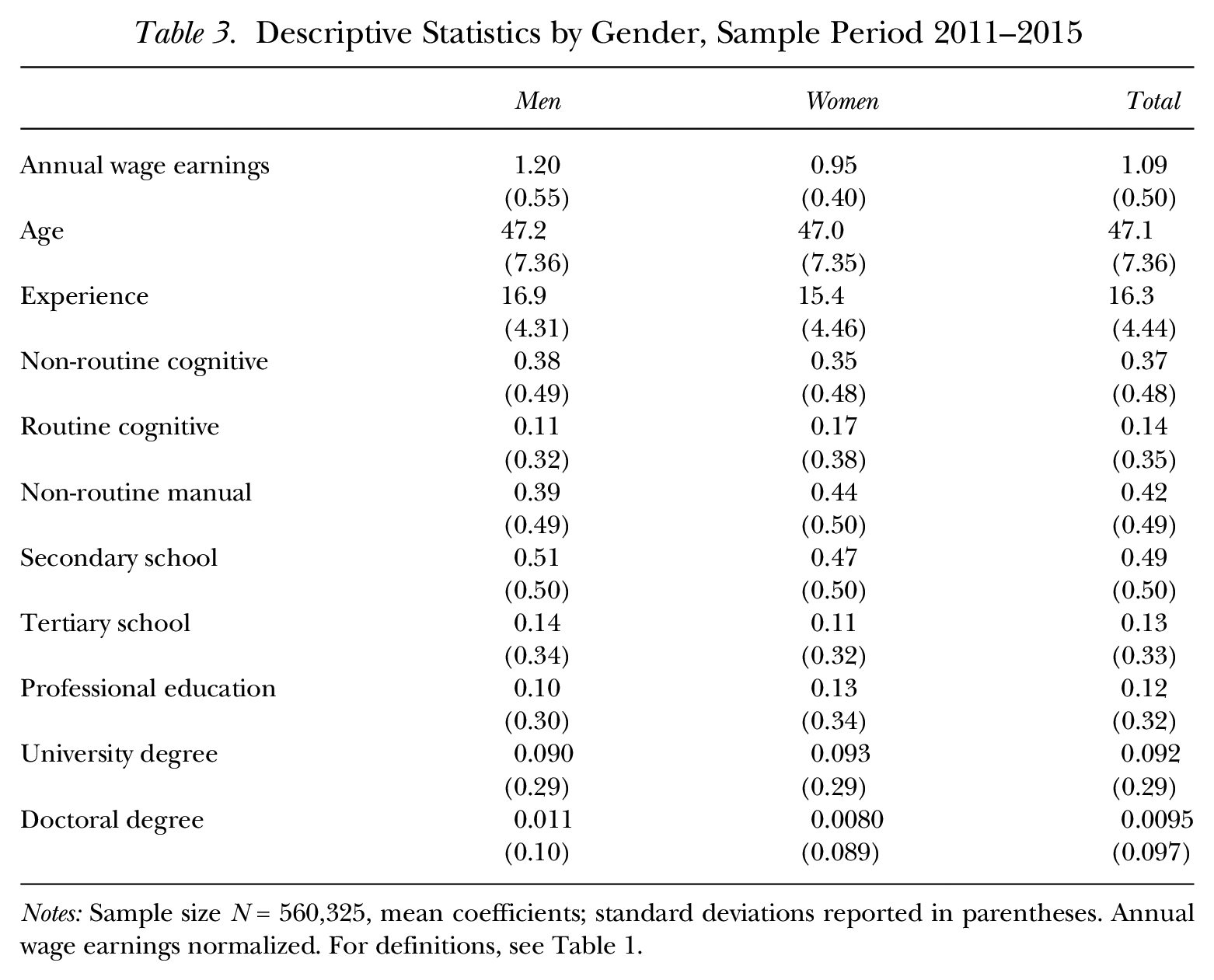
Table 3 further dissects the sample by gender, focusing on the same variables as in Table 2. On average, women’s mean wages are only 80% of their male counterparts’ mean wages. Additionally, when examining other variables, it is noteworthy that men and women are nearly equally distributed in non-routine cognitive occupations, with just over a third in each category. A larger proportion of women are engaged in routine cognitive and non-routine manual occupations, however; for the women’s rate is 61%, compared to men’s 50%.
Descriptive Statistics by Gender, Sample Period 2011–2015
Notes: Sample size N = 560,325, mean coefficients; standard deviations reported in parentheses. Annual wage earnings normalized. For definitions, see Table 1.
Additional background statistics are reported in the Appendix. Tables A.1 and A.2 provide matching statistics based on the year 2010 observations. (Hereafter, numbering for all Appendix material is prefaced with an “A.”) From a population consisting of 2,544,665 natives, we match 94,136 individuals with an equivalent number of refugee immigrants divided into 35,666 European and 30,684 non-European refugees who arrived after 1989, as well as 27,786 European and non-European refugees who arrived between 1980 and 1989.
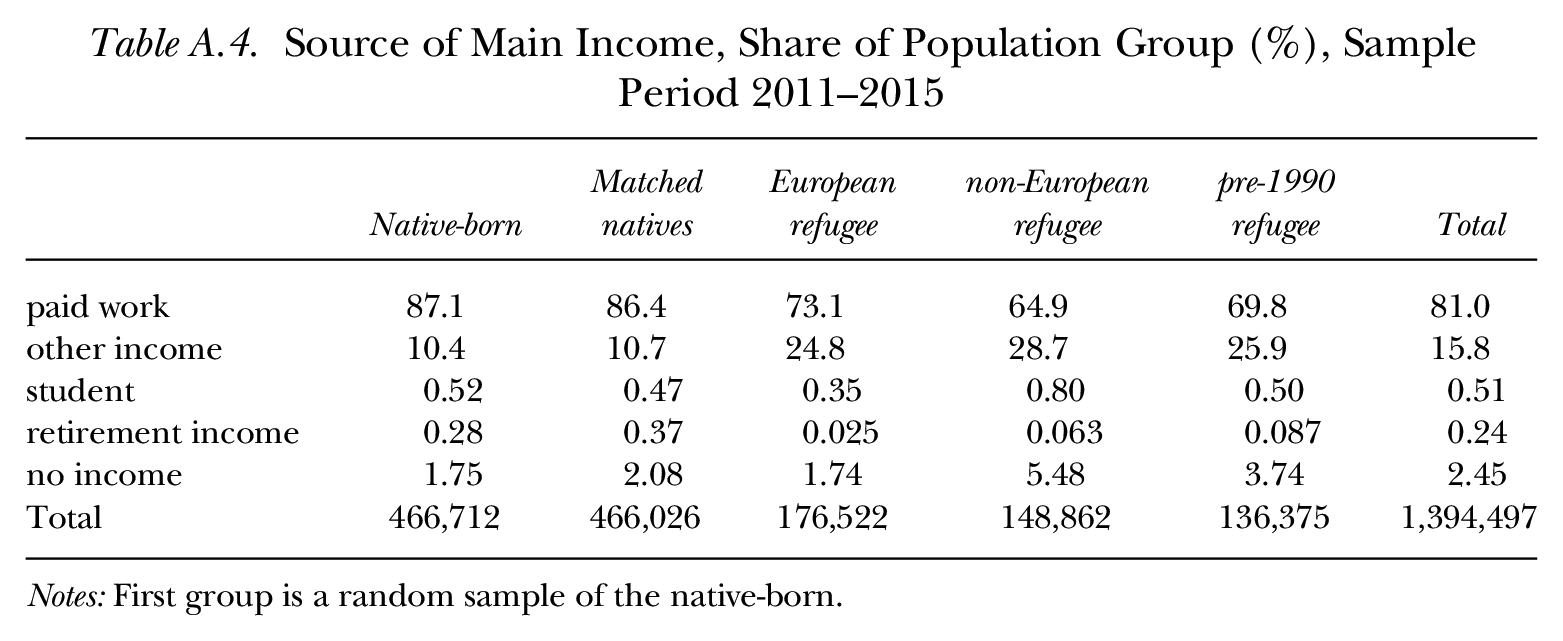
Tables A.3 and A.4 report labor market activities and main incomes for the four population groups in our sample as well as a group consisting of a random sample of native-born workers. The purpose of the latter group is to examine how representative the matched sample is for the entire Swedish labor market. Both tables exhibit a remarkable consistency in the reported variables between refugees and the matched native sample, indicating the feasibility of deriving comprehensive labor market policy insights from our analysis. Working as a year-round employee is the predominant occupation across all groups as shown in Table A.3. Note that post-1989 European refugees display a stronger resemblance to the native population compared to the other two refugee groups. During the period 2011–2015, nearly 90% of native-born individuals primarily relied on paid work as their main income source, in contrast to approximately 70% for the three refugee groups. Notably, more than a quarter of the refugees derived their main income from sources other than paid work. See Table A.4.
Focusing on full-year workers might create a selection bias for native–migrant comparisons when natives have lower unemployment rates. We may therefore overestimate the impact of work experience. The potential bias is limited, however: In Table A.3, we see that between European refugees and the matched natives (those having similar characteristics) the difference in full-year employment rate is negligible, 68.4% compared to 67.8%. Only for non-European refugees does the rate drop to 53.3%. Truncation is also an issue, as we do not know the work experience of migrants prior to arrival in Sweden. This condition could imply that we may underestimate the true work experience of migrants. It is possible that the sum of the two potential biases leads to an underestimate of native–migrant differences.
Empirical Strategy
We use coarsened exact matching (CEM) (Blackwell, Iacus, King, and Porro 2009; Iacus, King, and Porro 2012; King, Lucas, and Nielsen 2017) to find native individuals with characteristics similar to those of refugee immigrants. CEM is a non-parametric technique that requires fewer assumptions compared to other matching approaches. It uses the feature of monotonic imbalance bounding to ensure that adjusting maximum imbalances on one variable does not impact others, eliminating the need for a distinct process to confine data to common support. Moreover, it adheres to the congruence principle, approximates invariance to measurement errors, and effectively balances nonlinearities and interactions within the sample. 7
The matching is performed on year 2010 values—the year before the outcome wage earnings are observed in the period 2011–2015. The variables considered in the matching are gender, marital status, education, parenthood, region type where the person lives, and birth year. 8 Variables that are included in the matching are also included as control variables in the regression models. Since refugee migrants in Sweden can allocate early on in the labor market, our long-term integrated sample is unlikely to be more mobile than the native sample.
In addition, we define a comparison group of randomly selected natives. Consequently, this group is representative of the Swedish population of the respective age cohort, and as such its endowments differ from those of refugee immigrants.
As explained above, in a RIF regression, the dependent wage earnings variable y is calculated by the recentered influence function, RIF (y: G), where G (Gâteaux derivative) is the distributional wage earnings in our analysis, formally expressed as:

X is the vector of explanatory variables, Ex the law of iterative expectations, and the beta coefficients capture the marginal impact of a small change in E(X) on wage earnings. While the expected value of the influence function is equal to zero, by the law of iterated expectations the distributional statistics of wage earnings can be expressed as expectations of the RIF given the covariates.
To investigate how wage earnings vary depending on workers’ status as refugee or native, we specify the following model with multiple fixed effects:

where
Building on unconditional quantile regression, we finally apply the RIF generalization of the OB decomposition for analyzing differences of outcome distributions across groups. The model decomposes observed wage earnings differences between matched natives and refugee workers into an explained and unexplained part and can be expressed as:

We estimate a multinomial logit (MNL) model to examine the likelihood that a person belongs to a specific occupational task category. The MNL model determines the impact of variables on the probability of observing each of four alternative outcomes of each characteristic. For worker i in group j at time t, the probability of membership in the alternative task category k is conditional on regressors

In Equation (4),
Econometric Results
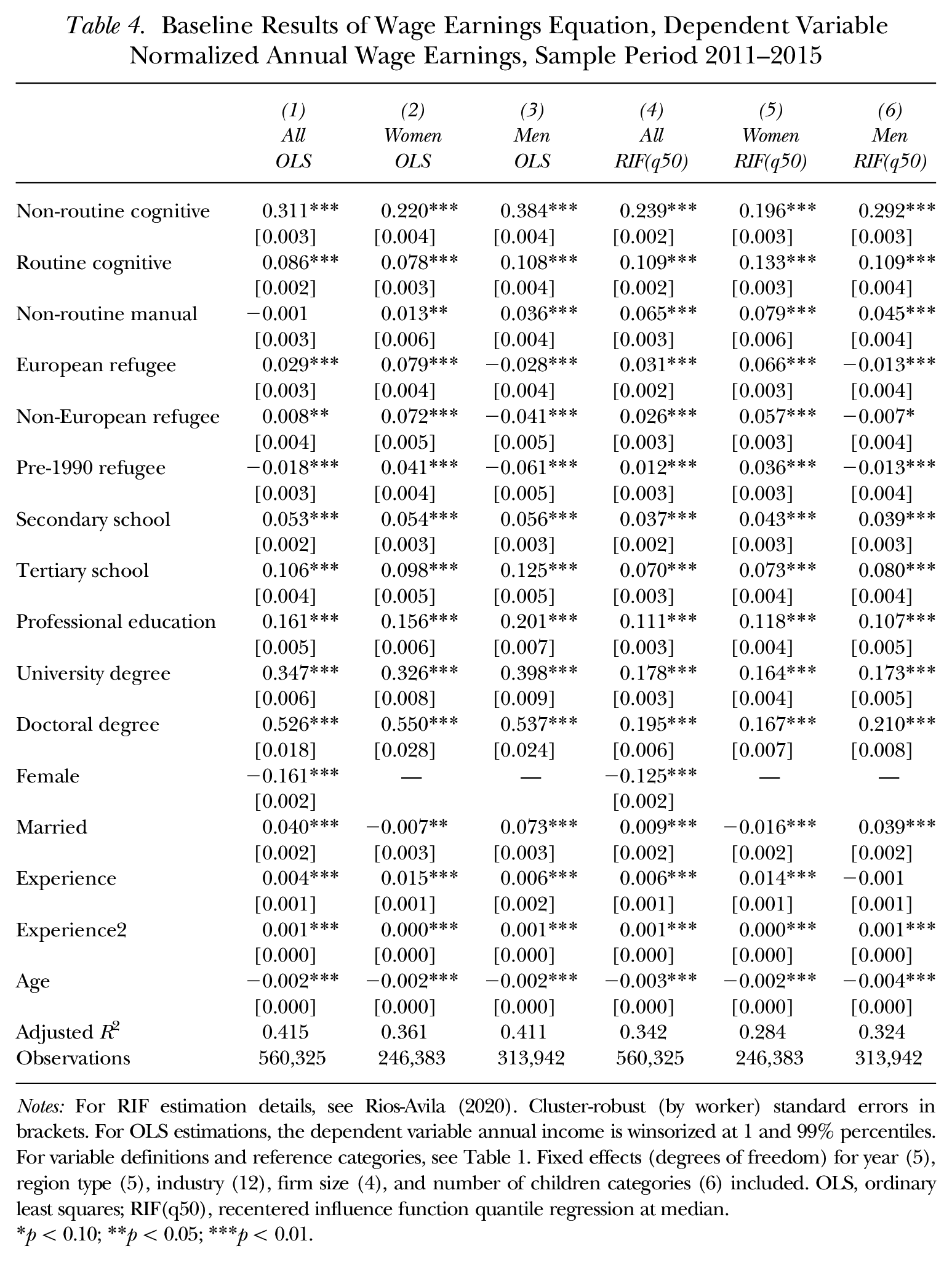
Table 4 reports the estimates of Equation (2) and presents our baseline results, with annual normalized wage earnings for 2011–2015 as the dependent variable. We report results for both OLS (mean) and RIF quantile (median) and distinguish between the total sample (all) as well as women and men separately.
Baseline Results of Wage Earnings Equation, Dependent Variable Normalized Annual Wage Earnings, Sample Period 2011–2015
Notes: For RIF estimation details, see Rios-Avila (2020). Cluster-robust (by worker) standard errors in brackets. For OLS estimations, the dependent variable annual income is winsorized at 1 and 99% percentiles. For variable definitions and reference categories, see Table 1. Fixed effects (degrees of freedom) for year (5), region type (5), industry (12), firm size (4), and number of children categories (6) included. OLS, ordinary least squares; RIF(q50), recentered influence function quantile regression at median.
p < 0.10; **p < 0.05; ***p < 0.01.
Our first finding is that work with non-routine cognitive occupational tasks is awarded with a substantial wage premium, particularly pronounced among men when compared to those in routine manual occupations, our reference group. The OLS point estimate is 0.311 (0.384 for men) and the corresponding RIF estimate is 0.239 (0.292 for men). Both estimators also show a wage premium, albeit much smaller, for routine cognitive occupations.
Turning to the relative wages for refugees and using matched natives as the reference category, the full sample estimates in column (1) and column (4) suggest a positive wage gap, ceteris paribus, for the two refugee groups arriving between 1990 and 1996. The OLS mean estimate is 0.029 for European refugees and 0.008 for non-European refugees. The corresponding results from the median RIF regression are 0.031 and 0.026. Only the relative point estimates for the group of refugees who arrived before 1990 have deviating results between the OLS and RIF regressions. The OLS coefficient is negative (–0.018), while the RIF estimate is positive (0.012). All estimates are significantly different from zero.
Columns (2) and (5) estimate the wage equation separately for women, and columns (3) and (6), separately for men. Note that the estimates from these subsamples suggest that the positive overall outcome for refugees is driven by female workers. Compared to their female native-born counterparts, the point estimates for the three immigrant groups are in the range of 4.1–7.9 (OLS) and 3.6–6.6 (RIF), corresponding to approximately 4–8% higher wages. The OLS findings indicate a 3–6% negative gap in mean wages for male refugees, whereas the RIF regressions reveal only a slightly negative median wage differential of approximately 1%.
A notable gender advantage concerning the female native–immigrant wage gap in comparison with the male native–immigrant gap has been established in a previous RIF-based study on Swedish data (Nilsson 2021). We show that this also applies to refugee immigrants, and that the gap takes on a distinct dimension when studying occupational tasks instead of employment in general. The controls show that the level of education, experience, and engagement in cognitive work tasks are positively associated with higher wages. Conversely, the results indicate an inverse relationship between age and gender (being female).
The unconditional RIF quantile regression plots of population group dummy estimates in the wage equation (see Figure 1) provide further insights into the relationship between wages and immigration by considering the entire wage earnings distribution. The model specification is the same as reported in Table 4. Two key observations can be made from this figure. First, the average OLS estimates (horizontal line below zero) suggest that native-born Swedes have higher wages than refugees, on average. 9 However, the RIF estimates reveal a more nuanced picture when considering the entire wage distribution. Refugees have higher full-year salaries across the wage distribution up to approximately the 60th quantile. Overperformance is greatest for the European refugees who arrived in 1990–1996 (higher wages up to the 70th quantile), second highest for the non-European group who arrived during the same period (65th quantile), and lowest for the earliest refugee group with granted asylum 1980–1989 (60th quantile).
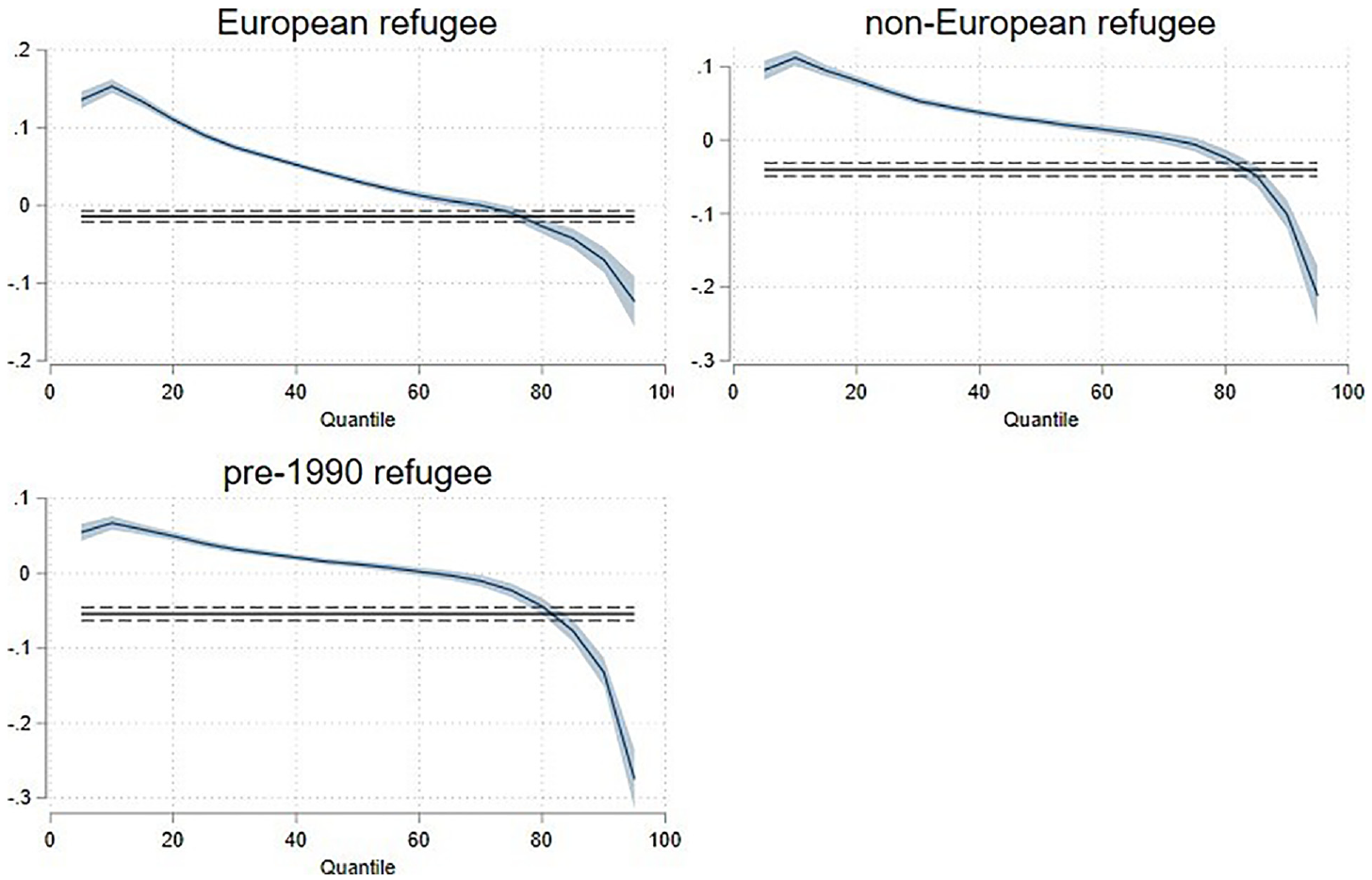
RIF Quantile Regression Plots of Population Group Dummy Coefficient in the Wage Earnings Equation, Sample Period 2011–2015
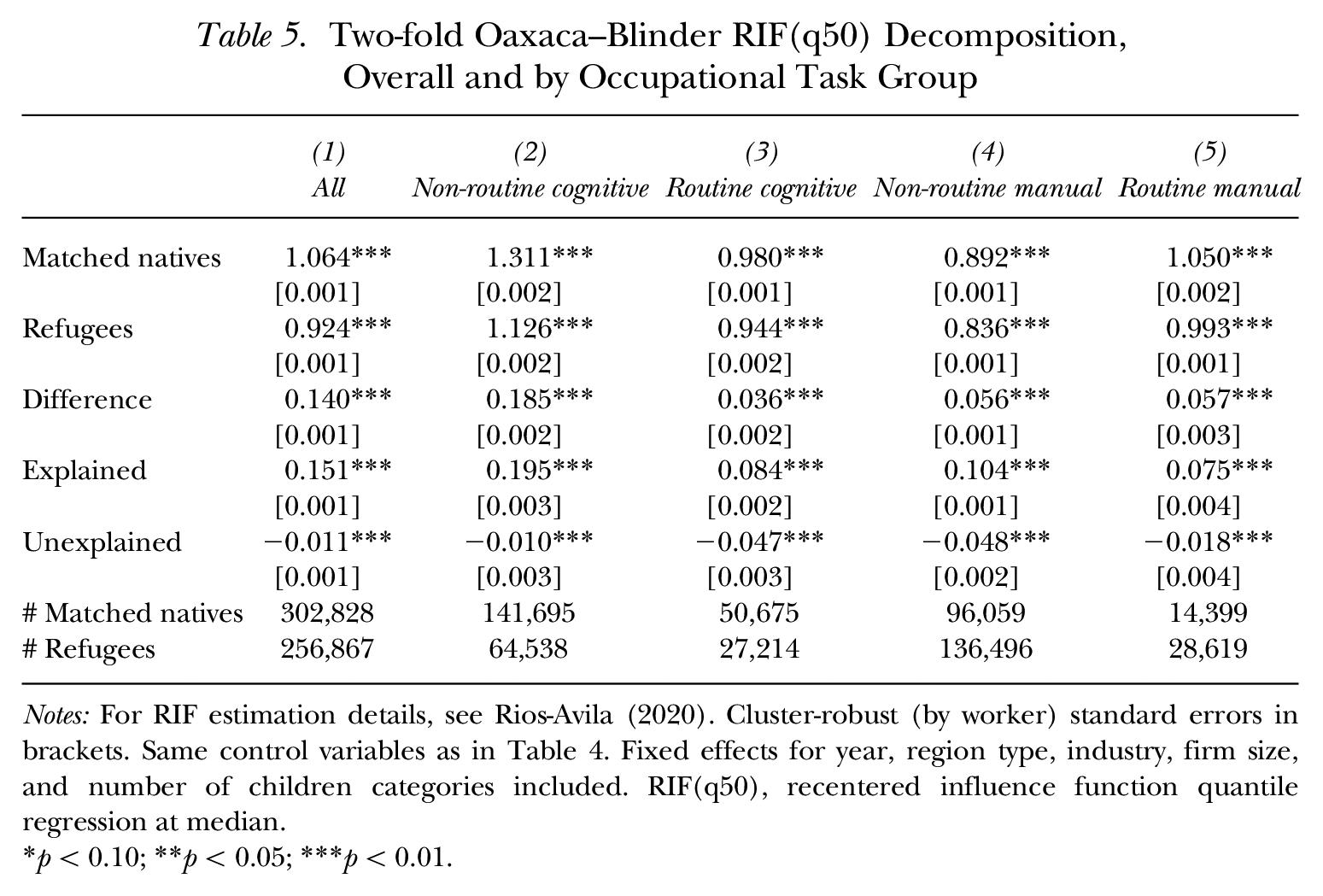
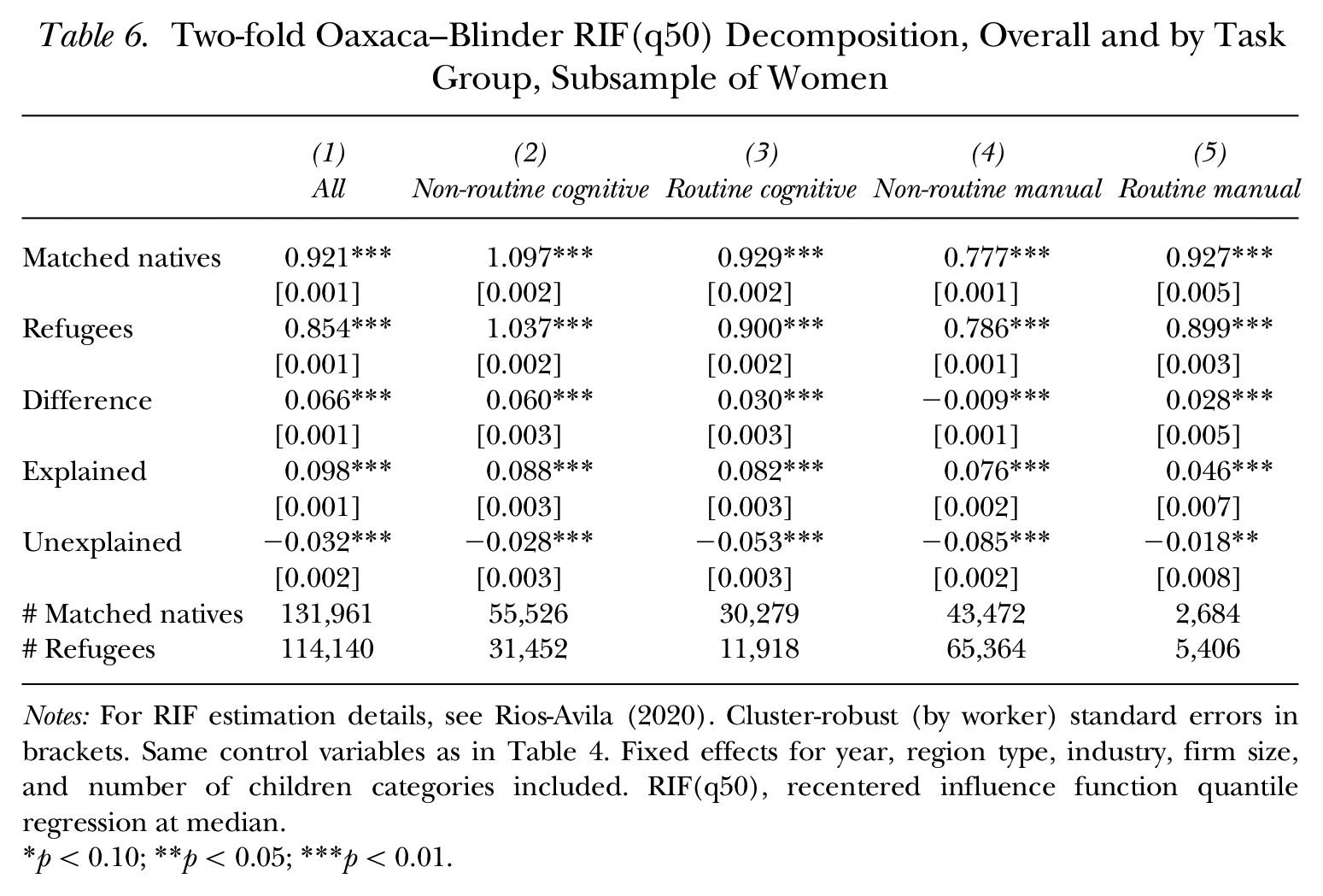
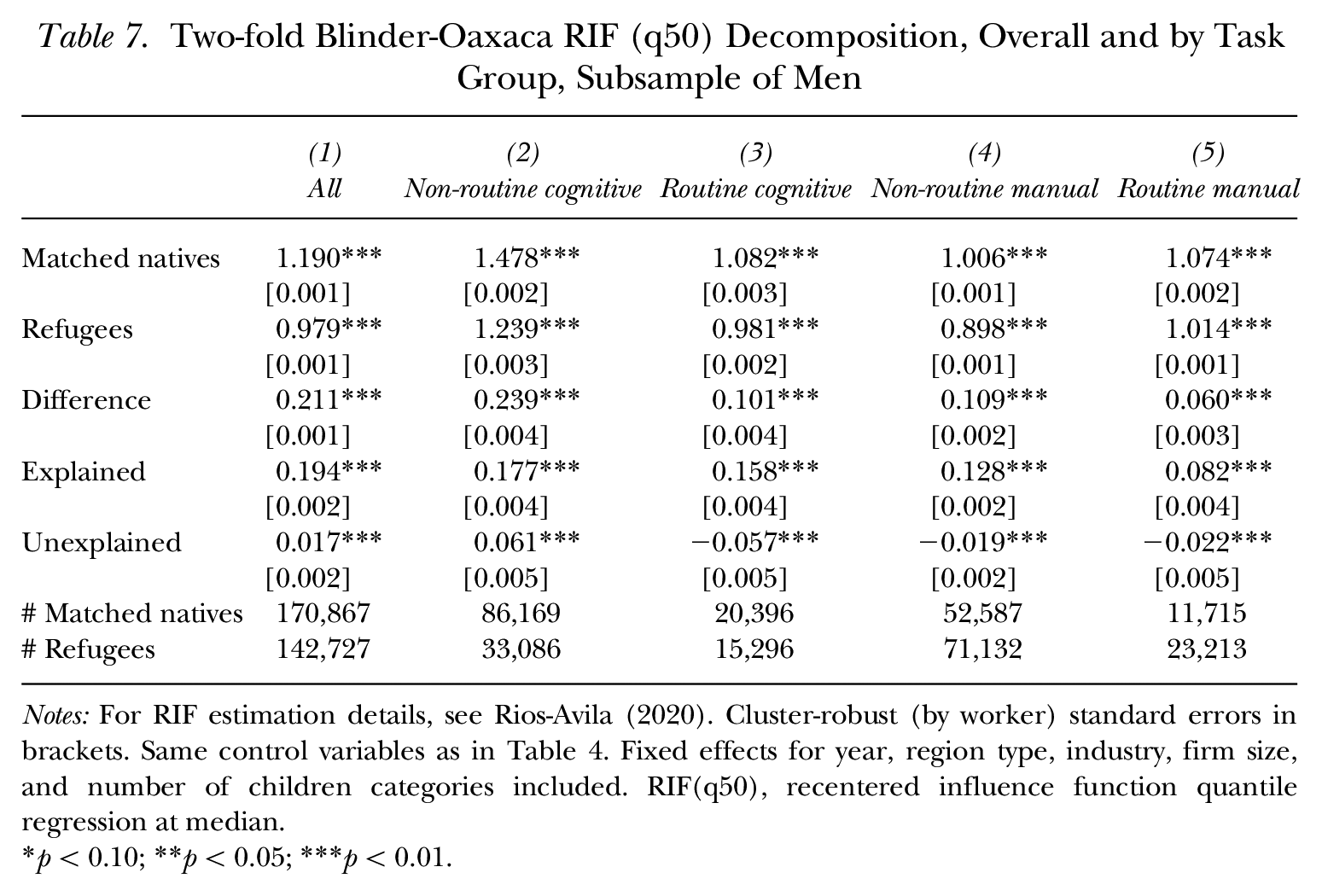
Table 5 presents the two-fold OB decomposition based on the RIF quantile regressions for the 50th quantile (median) for the overall occupational task groups as well as the separate task groups. Table 6 replicates this analysis for women and Table 7 for men. Matched natives are the reference group in the upper part of both tables. The OB decomposition examines how much of the observed differences in wage earnings between matched natives and refugees can be explained by their observed characteristics. Table 7 shows striking differences compared to Table 6. While the observed wage earnings difference for non-routine cognitive occupations is approximately 6% for women, it is nearly 24% for men. Overall, wage earnings differences between natives and refugees are more pronounced for men. As shown in Table 7, the difference between male refugees and native men can almost be explained by differences in endowments, and refugees perform better than expected given their endowment in all task groups except non-routine cognitive tasks.
Two-fold Oaxaca–Blinder RIF(q50) Decomposition, Overall and by Occupational Task Group
Notes: For RIF estimation details, see Rios-Avila (2020). Cluster-robust (by worker) standard errors in brackets. Same control variables as in Table 4. Fixed effects for year, region type, industry, firm size, and number of children categories included. RIF(q50), recentered influence function quantile regression at median.
p < 0.10; **p < 0.05; ***p < 0.01.
Two-fold Oaxaca–Blinder RIF(q50) Decomposition, Overall and by Task Group, Subsample of Women
Notes: For RIF estimation details, see Rios-Avila (2020). Cluster-robust (by worker) standard errors in brackets. Same control variables as in Table 4. Fixed effects for year, region type, industry, firm size, and number of children categories included. RIF(q50), recentered influence function quantile regression at median.
p < 0.10; **p < 0.05; ***p < 0.01.
Two-fold Blinder-Oaxaca RIF (q50) Decomposition, Overall and by Task Group, Subsample of Men
Notes: For RIF estimation details, see Rios-Avila (2020). Cluster-robust (by worker) standard errors in brackets. Same control variables as in Table 4. Fixed effects for year, region type, industry, firm size, and number of children categories included. RIF(q50), recentered influence function quantile regression at median.
p < 0.10; **p < 0.05; ***p < 0.01.
Figures 2–8 show plots illustrating the unconditional OB RIF quantile decomposition across the wage distribution for both the overall sample and subsamples categorized by occupational tasks and gender. Commencing with Figure 2, the 50th quantile (median) decomposition corresponds to the outcomes detailed for the total sample in Table 5. The lower curve in Figure 3 demonstrates that immigrants with non-routine occupational tasks perform better than expected up to the 60th quantile, but there is an unexplained difference from native workers at the upper tail of the distribution.
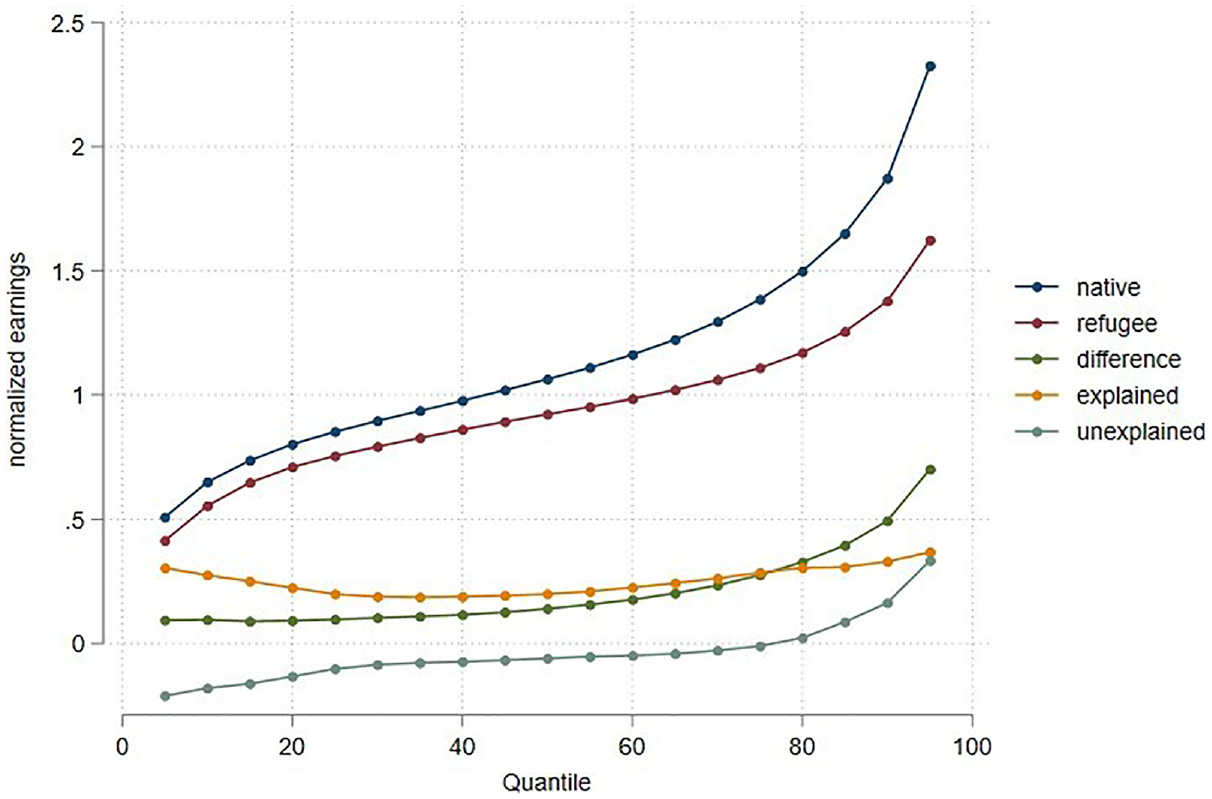
Oaxaca-Blinder RIF Quantile Decompositions Based on Full Sample, Period 2011–2015
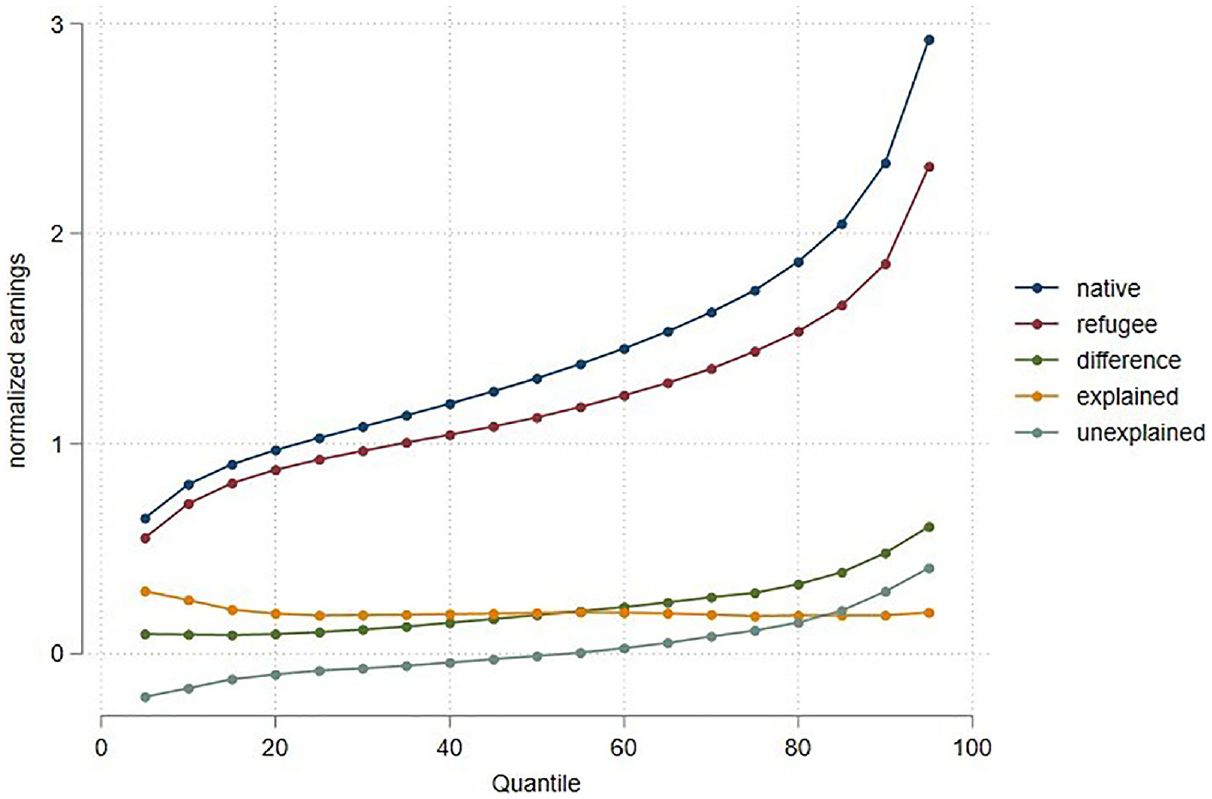
Oaxaca-Blinder RIF Quantile Decompositions Based on Subsample of Non-routine Cognitive Occupations over the Period 2011–2015
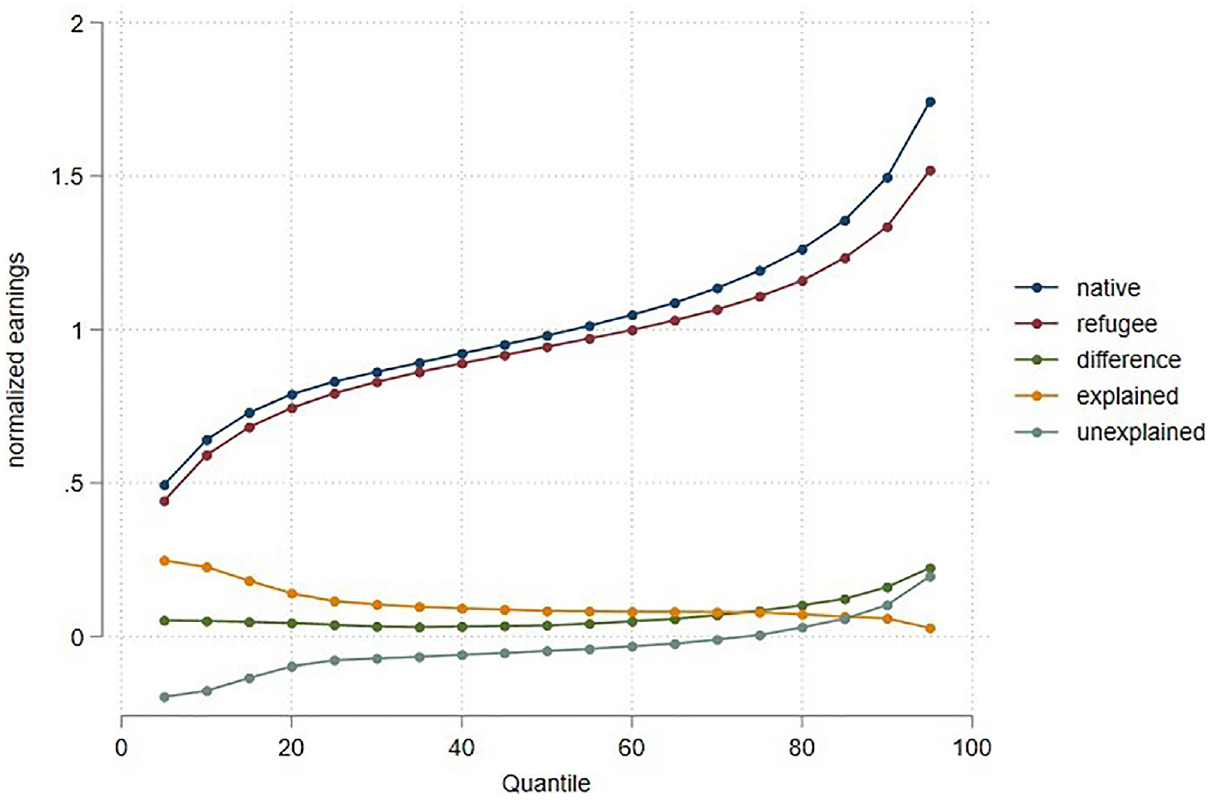
Oaxaca-Blinder RIF Quantile Decompositions Based on Subsample of Routine Cognitive Occupations over the Period 2011–2015
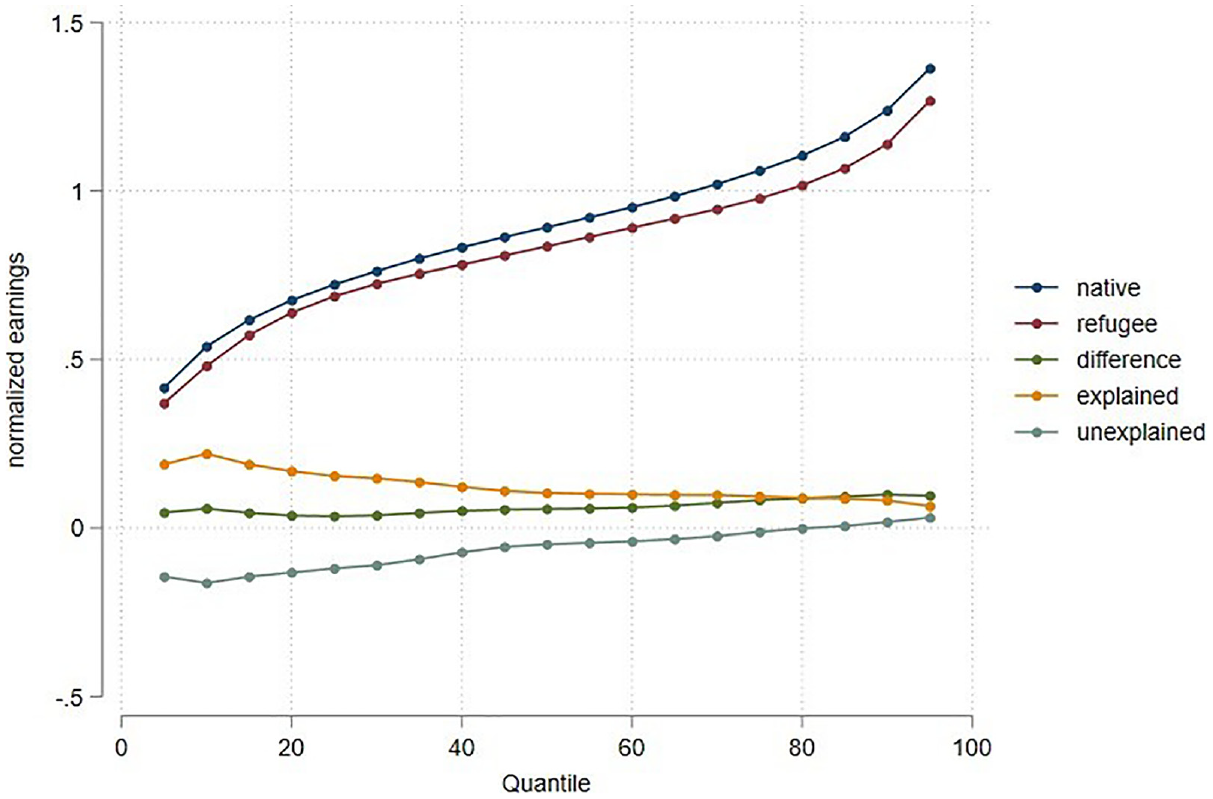
Oaxaca-Blinder RIF Quantile Decompositions Based on Subsample of Non-routine Manual Occupations over the Period 2011–2015
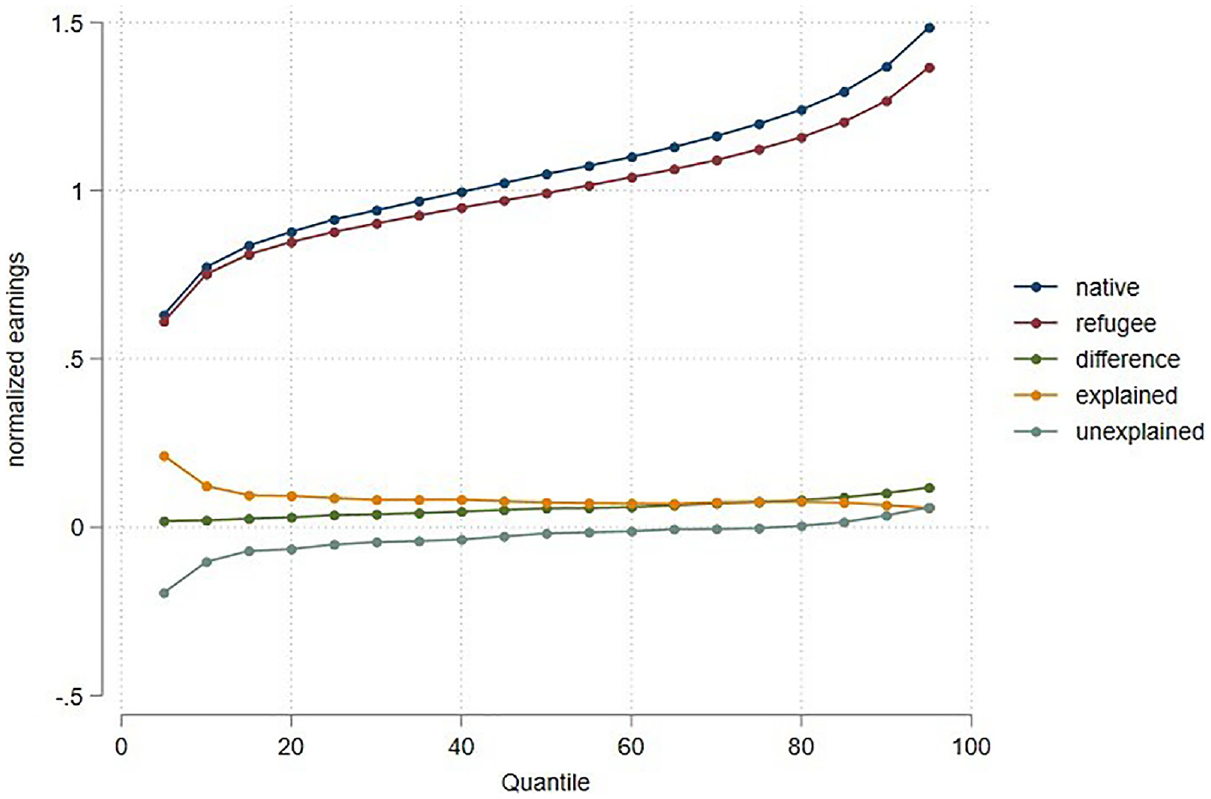
Oaxaca-Blinder RIF Quantile Decompositions Based on Subsample of Routine Manual Occupations over the Period 2011–2015
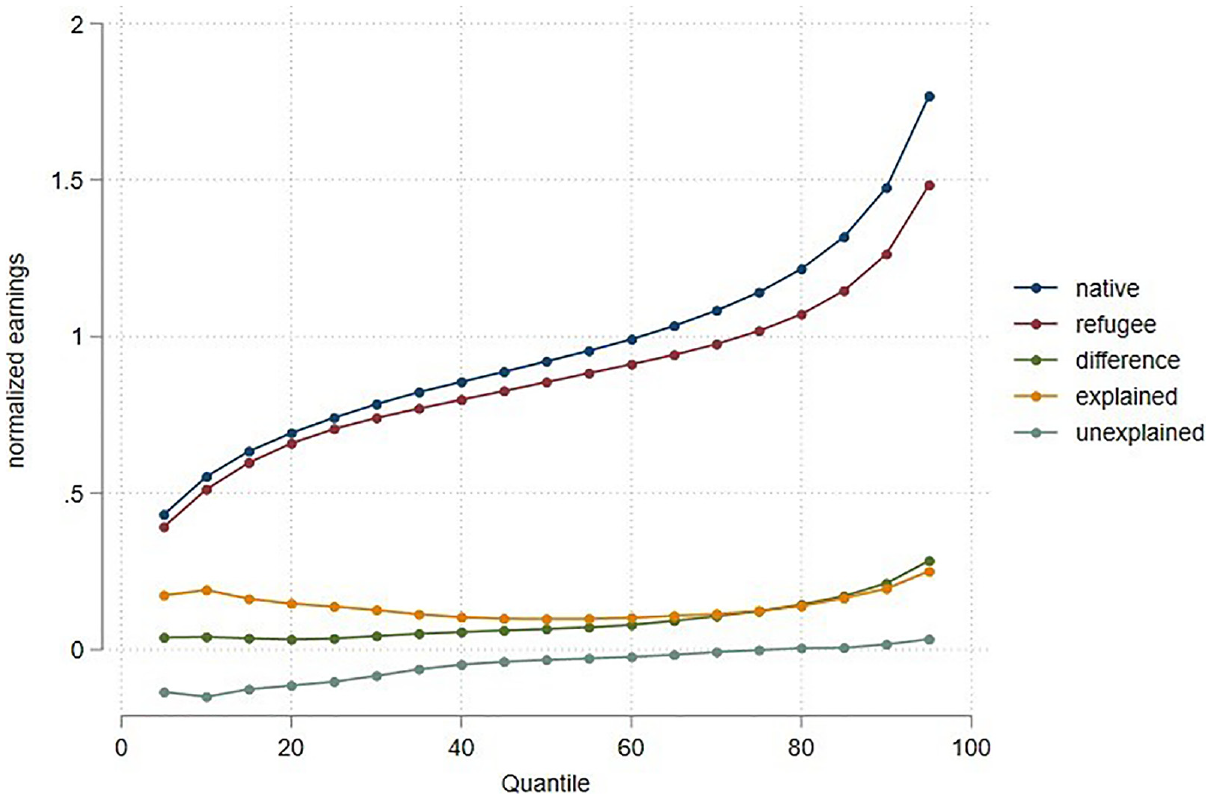
Oaxaca-Blinder RIF Quantile Decompositions Based on Subsample of Women, Sample Period 2011–2015
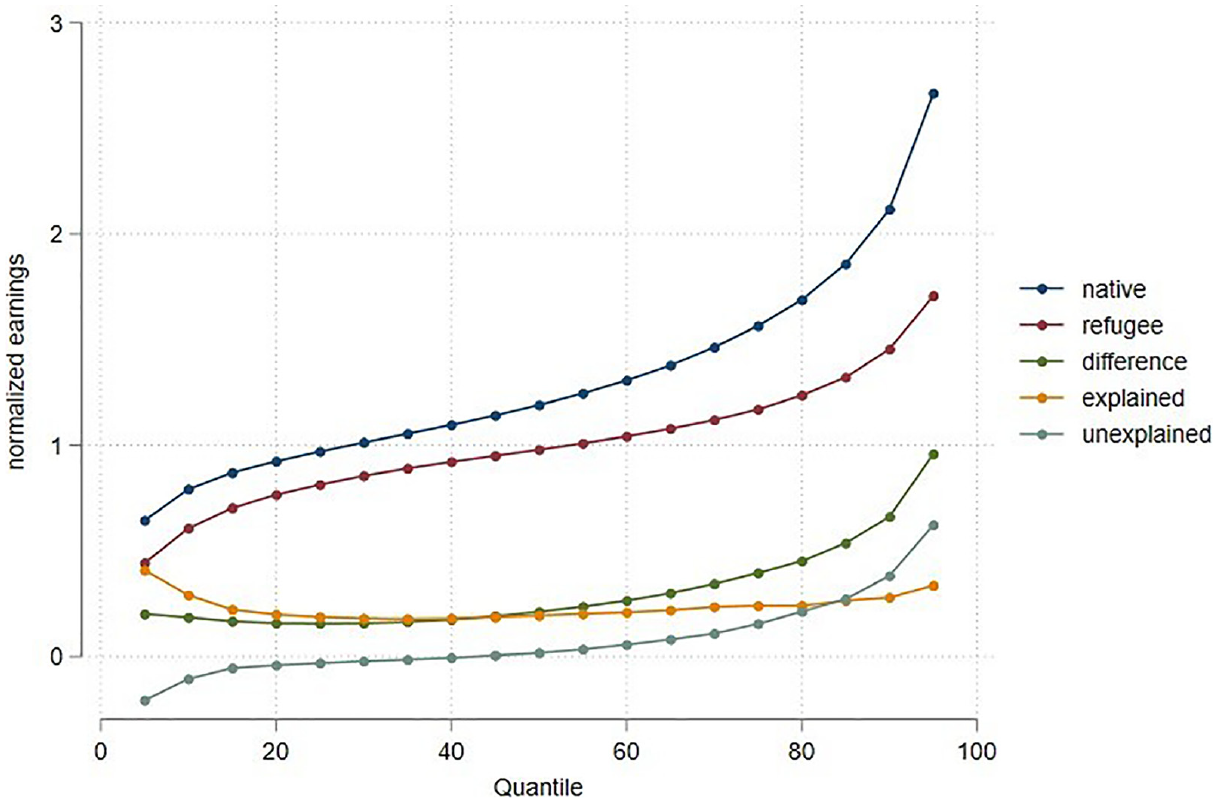
Oaxaca-Blinder RIF Quantile Decompositions Based on Subsample of Men, Sample Period 2011–2015
The two upper curves in Figures 4–6 show a smaller observed wage gap between immigrants and natives along the entire distribution within non-routine cognitive, routine cognitive, and non-routine manual occupations compared to the interpretation of the corresponding curves for the task category non-routine cognitive in Figure 2. The lower curve in Figure 4 suggests that the refugees who work with routine cognitive tasks perform better than expected up to the 60th quantile. Figure 5 indicates that the corresponding level is 80% for immigrants with both non-routine and routine manual tasks.
Having confirmed significant evidence of better-than-expected wage earnings performance for refugee immigrant workers across job tasks at the lower and medium part of the income distribution and finding unexplained differences at the upper tail, controlling for individual, firm, and regional characteristics, we turn to the gender perspective in Figures 7 and 8. The two upper curves in Figures 7 and 8 distinctly illustrate the difference in observed wages between male and female migrant workers compared to their respective native peers. The observed wage earnings gap is notably smaller for female refugees compared to their male counterparts. While the turning point for an unexplained difference in wages is typically around the 40th quantile for men, immigrant women sustain higher wage earnings than expected all the way up to the 80th quantile.
Although the main focus of our article is the wage premium of refugee workers, we are also interested in occupational sorting, since an extensive literature has shown that this is a main explanation to wage differentials between groups in the labor market. Table 8 reports the marginal probability of being employed in one of the four occupational task categories, using the MNL model. Reference groups are matched native workers and males. Controlling for education, experience, age, region, marital status, and the number of children, refugee immigrants exhibit a sizeable and significantly lower likelihood, compared to their native-born peers, of employment in better-paid non-routine and routine cognitive occupational task categories. The opposite applies to manual tasks. The lower part of the table shows that women are more likely than men to work with routine cognitive tasks and non-routine manual tasks compared to men, and they are less likely to be employed in routine manual occupations. However, we observe a small but statistically significant negative difference between women and men regarding the task category non-routine cognitive occupation.
Marginal Probability of Being Employed in Occupational Task Category k, MNL Model
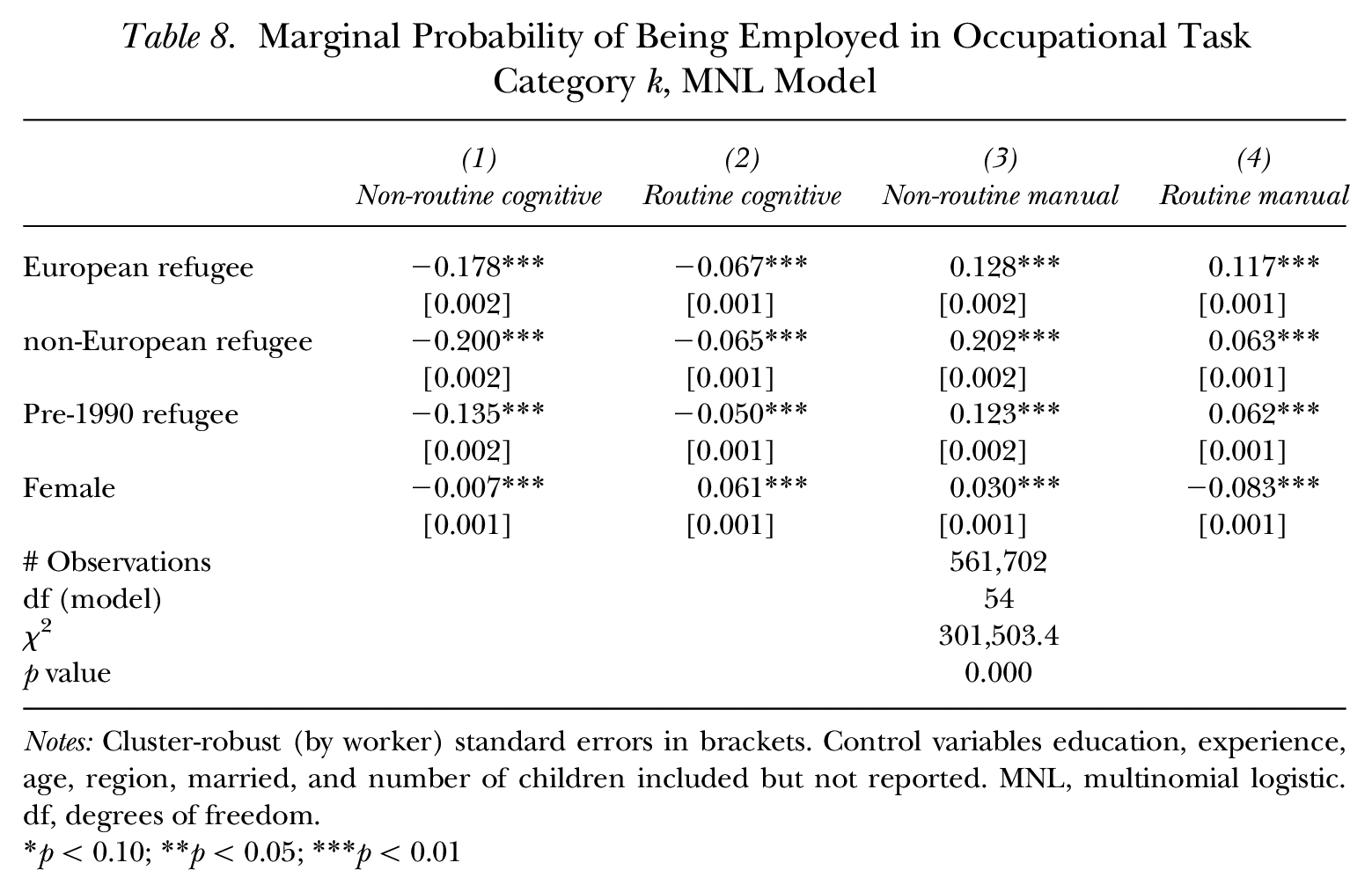
Notes: Cluster-robust (by worker) standard errors in brackets. Control variables education, experience, age, region, married, and number of children included but not reported. MNL, multinomial logistic. df, degrees of freedom.
p < 0.10; **p < 0.05; ***p < 0.01
Robustness Tests
We now proceed to the robustness tests documented in the Appendix. Our baseline results reported in Table 4 provide estimates of the wage earnings from Equation (2), controlling for occupational tasks. As an initial robustness test, Table A.5 replicates the model by replacing task groups (four categories) with occupation fixed effects (426 categories based on the 4-digit SSYK 2012 classification) and narrowing the sample period to 2014–2015. 10 The table illustrates the robustness of the results when replacing work tasks with occupation groups. The estimates for the mean (OLS) and for the median (RIF) remain significant across the three refugee groups and gender specifications, with only one exception: The OLS estimate for pre-1990 refugee males is not significantly different from zero.
Our second robustness test uses the Autor et al. (2003) and Autor and Handel (2013) classification instead of the one suggested by Mihaylov and Tijdens (2019). In alignment with Table 4, the point estimates presented in Table A.6 are both positive and statistically significant using OLS mean and RIF median for post-1989 refugees when considering the total sample of refugees and exclusively female refugees. The outcomes for the pre-1990 refugees resemble those in Table 4. The OLS estimates imply lower relative wages for the entire refugee group, while the RIF median indicates higher wages. In both the OLS mean and RIF median regression, the table presents statistically significant positive estimates for women and negative estimates for men.
Supplementary Results
We report three supplemental sets of results also included in the Appendix. The first is the propensity to work in specific industries, firm sizes, and regions. The second is quantile plots for various task groups, education groups, and other individual characteristics. Our final analysis considers an OB RIF quantile decomposition by industry.
Table A.7 displays the marginal propensity for all refugees and women to work in 12 distinct industries, using matched natives (and men for women) as reference groups. All three refugee groups exhibit a higher propensity than natives to work in both the high-tech and medium-to-low-tech manufacturing industries. The likelihood of employment in knowledge-intensive services (KIS) is lower for individuals with a refugee background compared to native-born workers. This outcome also applies to jobs in construction and utilities. The gender analysis reveals that women are less likely than men to be employed in almost all segments of the labor market, except for the KIS sector.
Table A.8 reveals a consistent pattern in which all three immigrant groups are less likely to work in small companies than are Swedish-born individuals. Conversely, they exhibit an elevated likelihood of being employed in medium-sized and large companies. Notably, women are less inclined than their male counterparts to work in the smallest companies, and they tend to have a greater probability of securing employment in medium-sized companies.
A heterogenous pattern in the probability of employment across specific regional areas is shown in Table A.9. In comparison to natives, post-1989 European refugees are less inclined to work in metropolitan cities and show a higher likelihood of employment in the other five regions included in our analysis. The relationship is the opposite for post-1989 non-European refugees and all pre-1990 refugees.
Figures A.1, A.2, and A.3 show RIF quantile plots of the estimates of several variables in wage Equation (2). For non-routine cognitive occupational tasks, Figure A.1 shows that, relative to the reference non-routine manual, the OLS coefficient is too high in the lower tail of the wage distribution and too low in the upper tail. This means that OLS underestimates wage differences in non-routine cognitive tasks in the upper tail. By contrast, OLS overestimates expected wage levels in the upper tails for routine cognitive and routine manual work tasks, but is otherwise close to the RIF estimates. Figure A.2 shows a clear tendency that OLS underestimates expected wage earnings in the upper tails for all levels of education. Figure A.3 suggests that OLS overestimates wage performance for females in the lower part but overestimates in the upper part. OLS overestimates the importance of experience in the upper tail of the wage distribution. The opposite is shown for age and being married.
Our final supplementary regression results encompass the OB RIF decomposition across various industries. The first set of analyses concerns manufacturing, for which Figure A.4 suggests higher than expected wages for refugee workers between the 40th (high-tech) and the 80th (low-tech) quantile. Our second analysis, reported in Figure A.5, considers knowledge-intensive services. Except for the financial sector, refugee workers in KIS have higher than expected wages in the lower and middle quantiles of the wage distribution. In the financial sector, a distinct pattern emerges, revealing a widening wage gap in the upper half of the wage distribution. Figure A.6 suggests small wage differences along the wage distribution for refugees in other industries, apart from the upper tails.
Conclusions
Aging populations and shortages of labor in cognitive as well as manual occupations pose challenges in many OECD countries. Using administrative register data for Sweden and observations at the work-task level, this article offers a comparative analysis of wage earnings, focusing on the disparity between native-born workers and immigrants with a refugee background. The empirical wage earnings analysis employs the unconditional quantile regression method in conjunction with the Oaxaca–Blinder decomposition approach.
The study unveils results that have not been previously documented. Our key finding suggests that immigrants earn a wage premium at the lower and middle part of the wage distribution a couple of decades after being granted asylum than comparable Swedes with similar job tasks. The unconditional quantile partial effect continues to be positive above the median and up to almost the 70th quantile of the wage earnings distribution. Female refugees contribute significantly to this result. The regression analysis also reveals a striking resemblance in the relative wage earnings distribution across various refugee groups, suggesting that factors such as cultural differences and the duration of their stay in the host country do not have a major impact on the wage premium.
Our task-based study contributes to the lively debates among migration researchers and the general public by shedding more light on refugees’ relative labor market performance. We study individuals several decades after being granted asylum in a country that, relative to its size, hosts a large share of refugee immigrants. To do so, we apply very rare administrative data and use a quantile regression technique that captures the entire wage earnings distribution instead of solely the conditional mean. Further research is expected to provide even deeper insights into the factors explaining the competitiveness of workers with a refugee background.
Footnotes
Appendix
Source of Main Income, Share of Population Group (%), Sample Period 2011–2015
| Native-born | Matched natives | European refugee | non-European refugee | pre-1990 refugee | Total | |
|---|---|---|---|---|---|---|
| paid work | 87.1 | 86.4 | 73.1 | 64.9 | 69.8 | 81.0 |
| other income | 10.4 | 10.7 | 24.8 | 28.7 | 25.9 | 15.8 |
| student | 0.52 | 0.47 | 0.35 | 0.80 | 0.50 | 0.51 |
| retirement income | 0.28 | 0.37 | 0.025 | 0.063 | 0.087 | 0.24 |
| no income | 1.75 | 2.08 | 1.74 | 5.48 | 3.74 | 2.45 |
| Total | 466,712 | 466,026 | 176,522 | 148,862 | 136,375 | 1,394,497 |
Notes: First group is a random sample of the native-born.
Acknowledgements
We thank participants at the following seminars and conferences for comments and suggestions on earlier versions of the paper: KTO-OFCE-GREDEG 2016, Sophia Antipolis AFSE 2017 Université Côte d’Azur, Nice; WRSA 56th Annual Meeting 2017, Santa Fe; the International Conference on Immigration and Labor Market 2017, Gothenburg; the 11th Computational and Financial Econometrics CFE 2017, London; International Workshop on Computational Economics and Econometrics IWcee 2017 National Research Council, Rome; Asian Development Bank 2017, Manila; EcoMod Conference 2017, University of Ljubljana; Växjö University 2018; Portuguese Stata Conference 2020, Porto, University of Minho, Braga; Swedish Ministry of Employment 2020; Stockholm, Institute for Evaluation of Labor Market and Educational Policy 2020 Uppsala; United Nations University–Maastricht Economic and Social Research Institute on Innovation and Technology (MERIT) 2020 Maastricht; and the International Economic Association (IEA) World Congress 2021.
For general questions as well as for information regarding the data and/or computer programs used for this study, please contact
2
4
All databases are retrieved from Statistics Sweden (SCB) and accessed through the remote MONA (microdata online access) delivery system. See also the MONA user guide at  , accessed November 28, 2023. The project database at Statistics Sweden is titled “Economic integration of refugee immigrants,” KTH-P807. The project number can be used for obtaining access to the data at SCB (rather than paying a fee) for either replication purpose or for obtaining an update of the database for future research.
5
Note that log annual wage earnings (log W) and normalized annual wage earnings (W/m) with median m are related. Since (W/m) = 1 + (W–m)/m and log (W/m) ≈ (W–m)/m, we have log W≈W/m+ log m–1.
6
This corresponds to ISCO-88 and ISCO-08, with some Swedish particularities.
7
In addition to identification, computational considerations factor into using matching before performing estimations since it significantly reduces the sample size.
8
We are aware that the ideal match requires the consideration of a broader range of pre-migration characteristics; however, those are not available within the Swedish administrative register data we utilize.
9
Note that the OLS estimates in Figure 1 do not include fixed effects and therefore differ slightly from the OLS estimates reported in .
10
The 4-digit SSYK 2012 classification of occupations is available from 2014. For years 2011–2013, we mapped the SSYK 1996 classification to the SSYK 2012 codes.