




Abstract
This article examines how collective bargaining through unions and workplace codetermination through works councils relate to labor market imperfections and how labor market imperfections relate to employer wage premia. Based on representative German plant data for the years 1999–2016, the authors document that 70% of employers pay wages below the marginal revenue product of labor and 30% pay wages above that level. Findings further show that the prevalence of wage markdowns is significantly smaller when organized labor is present, and that the ratio of wages to the marginal revenue product of labor is significantly larger. Finally, the authors document a close link between labor market imperfections and mean employer wage premia, that is, wage differences between employers corrected for worker sorting.
Keywords
During the past two decades most labor economists abandoned the textbook model of perfect competition and embraced the idea that workers and employers possess some market power in the wage formation process. In the broadest sense, imperfect competition in the labor market can be seen as a situation in which substantial employment rents accrue to workers and employers (Manning 2011). This vision immediately raises the question of how these rents are split among workers and employers.
Booth (2014) approached this question by considering two polar cases of wage formation under imperfect competition: employer wage setting, when employers possess monopsony power; and union wage setting, when workers exercise monopoly power when negotiating wages. Compared to a competitive labor market, labor market imperfections may thus result in either a wage markdown with employers’ monopsony power allowing them to set wages below the marginal revenue product of labor, or a wage markup with workers’ monopoly power permitting them to push through wages above the marginal revenue product.
Against this backdrop, our contribution is to investigate for Germany the extent of labor market imperfections and how they relate to industrial relations and employer wage premia. To that end, we rely on the production function approach to measure price-cost markups from the industrial organization literature (e.g., De Loecker and Warzynski 2012; De Loecker, Goldberg, Khandelwal, and Pavcnik 2016) and its extension to imperfect labor markets by Dobbelaere and Mairesse (2013) that encompasses both wage markdowns and wage markups.
To measure labor market imperfections at the individual employer level, we exploit Dobbelaere and Mairesse’s (2013) result that labor market imperfections drive a wedge between the output elasticities of labor and intermediate inputs and their revenue shares. As shown in recent work by Caselli, Nesta, and Schiavo (2021) and Yeh, Macaluso, and Hershbein (2022), this wedge directly translates into the ratio of wages to the marginal revenue product of labor when considering the market for intermediate inputs as a competitive benchmark. The ratio, in turn, provides us with a direct reduced-form employer-level measure of labor market imperfections that allows the researcher to remain agnostic about market structure and that is directly tied to the employers’ wage bill. So, it is rooted in individual employers’exercise of rather than their potential for labor market power. Furthermore, using the production function approach permits us to control for price-cost markups and thus to account for a possible interdependency between labor and product market imperfections that would otherwise contaminate estimates of labor market imperfections (for a discussion in the case of price-cost markups, see De Loecker et al. 2016).
In this article, we implement the production function approach using a representative sample of approximately 9,000 German plants from the manufacturing and services industries for the years 1999–2016. At the heart of implementation lie sector-specific production function estimates and employer-specific information on input use that allow us to measure the ratio of wages to the marginal revenue product of labor. Here, we follow recent contributions in the literature such as De Loecker and Warzynski (2012), De Loecker et al. (2016), and Yeh et al. (2022) and estimate production functions using Ackerberg, Caves, and Frazer’s (2015) control function estimator.
This article contributes to the literature in several ways. First, we document the prevalence and size of wage markdowns and wage markups among German plants. We then move on to investigate how collective bargaining by unions and workplace codetermination through works councils relate to their prevalence and size, controlling for a rich set of plant characteristics. We expect to find such partial correlations because we believe organized labor will benefit workers in shifting market power from employers to workers. Finally, we examine how the measures of labor market imperfections from the production function approach relate to employer wage premia, that is to employers’ wage levels after accounting for the sorting of workers of varying quality into plants, holding constant plant surplus and a rich set of additional plant characteristics. To measure employer wage premia, we follow Card, Cardoso, Heining, and Kline (2018) and Hirsch and Mueller (2020) and rely on the employer wage effect from an AKM decomposition of individual workers’ log wages (Abowd, Kramarz, and Margolis 1999; AKM hereafter).
Literature, Hypotheses, and Institutional Backdrop
Whereas wage markups and their theoretical foundation in union wage-bargaining models form the starting point of the broad empirical rent-sharing literature (surveyed by Card et al. 2018 and Dobbelaere and Mairesse 2018), wage markdowns are at the heart of the recent literature on the prevalence and causes of monopsony in the labor market (for overviews, see Manning 2011, 2021). Until recently, though, both strands of the literature evolved separately. Furthermore, in quantifying labor market imperfections they have largely neglected possible links between labor and product market imperfections that may contaminate findings.
This perspective started to change with the extension of the production function approach to measuring price-cost markups from the industrial organization literature to imperfect labor markets by Dobbelaere and Mairesse (2013). As shown in recent work by Caselli et al. (2021) and Yeh et al. (2022), this approach allows identifying the ratio of the wages paid by individual employers to the marginal revenue product of labor for a given price-cost markup on the product market.
Lacking, though, is evidence on how labor market imperfections and industrial relations, such as collective bargaining through unions and workplace codetermination through works councils, relate. To be sure, a large body of evidence, including some recent papers identifying wage effects from quasi-experimental variation in industrial relations (e.g., Jäger, Schoefer, and Heining 2021; Jäger, Noy, and Schoefer 2022), suggests that industrial relations affect the wages paid by employers. 1 Yet, in analyzing reduced-form effects of industrial relations on wages these contributions consider only endpoints rather than the parameters we consider that permit direct measurement of how much wages deviate from the marginal revenue product of labor. What is more, evidence resting on quasi-experiments tends to look at specific instances rather than broad-based populations of employers and workers that we are able to consider, though the recent papers by Farber, Herbst, Kuziemko, and Naidu (2021) and Dodini, Salvanes, and Willén (2022) form notable exceptions. For these reasons, we see our contribution as complementary to this quasi-experimental evidence, although, admittedly, we cannot rest identification on that kind of exogenous variation in industrial relations.
By examining how labor market imperfections relate to industrial relations, this article not only contributes to the literature on the determinants of wage markdowns and wage markups but also adds to the literature on the falling labor share in income (e.g., Grossman and Oberfield 2022). If organized labor matters for labor market imperfections in that it shifts market power from employers to workers, then the erosion of organized labor documented for Germany, as for other countries, may be one common source of the trend of a decreasing labor share in income.
Turning to the system of industrial relations in Germany, the principle of bargaining autonomy grants unions and employers the right to regulate wages and working conditions absent state interference. Collective agreements are legally binding, are predominantly concluded as multi-employer agreements between a union and an employers’ association at the sectoral level, and almost always apply to all of the covered employers’ workers, irrespective of workers’ union status. Individual employers are usually bound by a collective agreement as soon as they decide to join an employers’ association. Motivations for opting in include saving on transaction costs in wage setting and other benefits offered by employers’ associations to member firms such as legal services, seminars, and lobbying. Although sectoral negotiations mostly take place in regional bargaining units, officials of the two bargaining parties closely coordinate the regional negotiations within one sector so that variations between them are small. Cross-sectoral coordination by both parties does occur, giving rise to some uniformity in collective bargaining policy across sectors (for details, see Hirsch and Schnabel 2014).
Collective bargaining in Germany predominantly concerns wages, but also determines job classifications, working time, and working conditions. Norms stipulated in the collective agreement are generally minimum terms so that employers bound by the agreement cannot undercut, but only improve upon, these terms and conditions. Exceptions to this general rule are in some cases laid down in so-called opening clauses that allow renegotiating collective bargaining issues, mostly wages and working time, at the plant level, typically under conditions of economic hardship.
Whereas many employers pay higher wages than stipulated in the collective agreements (Jung and Schnabel 2011) and opening clauses have gained ground, for most workers the wages set in the agreements are crucial for the level and development of their actual wages. At the end of our observational window in 2016, 58% (47%) of workers in West (East) Germany held jobs in the 32% (21%) of plants covered by a collective agreement (Ellguth and Kohaut 2017). Compared to the start of our observation period, we see a marked decrease in collective bargaining coverage. In 2000, 70% (55%) of workers in West (East) Germany were employed by the 48% (28%) of covered plants (Kohaut and Schnabel 2003).
On average, plants covered by a collective agreement pay higher wages than uncovered plants (Guertzgen 2009; Fitzenberger, Kohn, and Lembcke 2013). In a recent study, Hirsch and Mueller (2020) further showed that higher average wages in covered plants reflect higher employer wage premia, holding constant plant surplus. They interpreted their finding as evidence that collective bargaining increases workers’ bargaining power. This interpretation is in line with evidence from the empirical rent-sharing literature and with a host of theoretical contributions arguing that collective bargaining enables workers to push through wage markups. Hence, we expect a lower prevalence of wage markdowns and, in general, a higher ratio of wages to the marginal revenue product of labor in covered plants than in uncovered plants.
On top of collective bargaining typically conducted at the sectoral level, the second backbone of Germany’s dual system of industrial relations is given by workplace codetermination through works councils, the German counterpart of the workplace union in other countries. Although the right to works councils is mandatory in all plants with at least five permanent workers, their implementation is not automatic. Setting up a works council requires three workers or a union representative to initiate an election procedure in the plant.
At the end of our observation period in 2016, 43% (34%) of workers in West (East) Germany were employed by the 9% (9%) of plants with a works council (Ellguth and Kohaut 2017). As with collective bargaining coverage, workplace codetermination dropped compared to the start of our observational window. In 2000, 50% (41%) of workers in West (East) Germany had held jobs in the 12% (12%) of plants with a works council (Ellguth and Kohaut 2018). 2 Together, shrinking collective bargaining coverage and works council prevalence point at an erosion of the traditional model of industrial relations in Germany.
Works councils have far-reaching codetermination rights, in particular on what are termed “social matters” that comprise remuneration arrangements, the commencement and termination of working hours, the regulation of overtime and reduced working hours, as well as health and safety measures (for details, see Addison 2009). Unlike unions, though, works councils may not call a strike and they are excluded from reaching agreement with the employer on wages and working conditions that are settled or normally settled by collective agreements between unions and employers’ associations at the sectoral level. One exception to this general rule is that collective agreements contain opening clauses (previously mentioned) that explicitly authorize works councils to do so.
Even if opening clauses are absent, however, works councils’ extensive codetermination rights on many other issues mean that works council existence is likely to improve workers’ bargaining power and thus to spur rent-seeking activities (Freeman and Lazear 1995). In line with this conjecture, extant studies have documented that works council presence is accompanied by higher average wages (Addison, Schnabel, and Wagner 2001; Addison, Teixeira, and Zwick 2010). Furthermore, Hirsch and Mueller (2020) showed that the higher average wages in plants with a works council mirror higher employer wage premia, holding constant plant surplus, and interpreted their finding as evidence that workplace codetermination increases workers’ bargaining power. Although we lack direct empirical evidence on how works council presence relates to labor market imperfections, we follow the conventional wisdom that it shifts market power from employers to workers and thus expect a lower prevalence of wage markdowns and, in general, a higher ratio of wages to the marginal revenue product of labor when works councils are present.
Production Function Approach
To measure labor and product market imperfections at the level of the individual plant, we follow the production function approach introduced by Dobbelaere and Mairesse (2013) and its modification by Yeh et al. (2022). 3 Doing so allows us to quantify by how much wages deviate from the marginal revenue product of labor based on production function estimates and information on plants’ input use. So it provides us with a reduced-form plant-level measure on the direction (that is wage markdown vs. wage markup) and size of labor market imperfections. In this section, we summarize the assumptions and outcomes of this approach, along with underlying intuitions, whereas we relegate derivations to Online Appendix A.
Consider plant

In terms of the plant’s input choices, we assume that 1) labor and intermediate inputs are free of adjustment costs and are thus choice variables in the short run, 2) capital is predetermined and thus is not a choice variable in the short run, and 3) the plant takes the price of its intermediate inputs as given.
4
We further assume that all plants in the market maximize short-run profits. Then, the plant’s optimization problem involves maximizing short-run profits with respect to output
Turning to the plant’s product market first, we obtain the standard result that the plant’s price is a markup over its marginal cost of production; we denote the price-cost markup in the following by

where
Turning to the plant’s labor market, the existence and size of possible wage markdowns and wage markups can be seen from the gap between the output elasticities of intermediate inputs and labor and their respective revenue shares
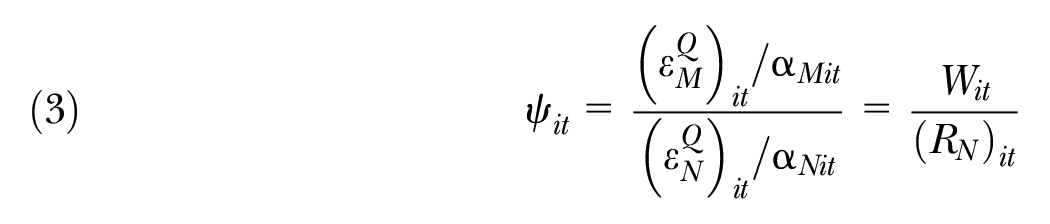
that gives the ratio of the plant’s wage to the marginal revenue product of labor (see Equation (A.7) in Online Appendix A and Yeh et al. 2022). In Equation (3),
The ratio
An alternative employer-level measure of labor market power advocated in the recent literature is employer concentration in occupational labor markets (e.g., Azar, Marinescu, and Steinbaum 2022; Benmelech, Bergman, and Kim 2022; Rinz 2022), which is found to negatively affect wages. Some downsides with this concentration approach exist, however. Unlike the reduced-form measure from the production function approach, it forces the researcher to take a stance on the relevant labor market of employers (say, in terms of occupations, skills, and local labor markets) to measure concentration correctly. 5 Moreover, it is well known from the structure-conduct-performance paradigm of the industrial organization literature (e.g., Syverson 2019) that it is questionable to lend a causal interpretation to any reduced-form relationship between market shares and prices because these are simultaneously determined. Hence, an effect running from concentration to wages is unlikely to be informative on the underlying labor market power unless one is willing to impose assumptions on the market structure, such as Cournot competition (that is, assuming that employers compete on employment). Both these aspects contrast with the production function approach that allows us to remain agnostic about market structure.
That said, we also demonstrate in Online Appendices A.3 and A.4 that the ratio

And in case of a wage mark-up or

Econometric Implementation
Measuring labor and product market imperfections based on the ratio of wages to the marginal revenue product of labor
Production Function
Taking the logarithm of the production function (Equation (1)) results in:

with lower-case letters denoting logs of variables, for example,

with
We approximate the unknown regression function

where the regression constant
Identification
Identifying

In Equation (9),
As elaborated in the section about the production function approach, labor and intermediate inputs are assumed to be variable inputs whereas capital is predetermined. We assume that plants decide on their capital input
To control for unobserved productivity, we use the control-function approach (Levinsohn and Petrin 2003; Ackerberg et al. 2015) that builds on the insight that plants’ optimal input choices hold information about unobserved productivity and that is common in the literature using the production function approach (e.g., De Loecker and Warcynski 2012; De Loecker 2013; De Loecker et al. 2016; Yeh et al. 2022). In particular, we invert the intermediate input demand function to recover the latent productivity level
Given the timing assumptions, plant

Crucially, productivity

Estimation
Using the timing assumptions of the plant’s input choices in combination with the law of motion of productivity, we estimate the coefficients of a translog production function

that we exploit to separate the productivity shock

We use the law of motion of productivity (Equation (9)) in combination with Equation (13) to recover the innovation to plant productivity (
The second stage produces estimates of the production function coefficients

We arrive at estimates of the output elasticities


Hence, both output elasticities vary across plants and over time.
9
Since the observed output


Combining the estimated output elasticities (Equations (15) and (16)) and the adjusted revenue shares (Equations (17) and (18)), we arrive at estimates of the price-cost markup and the ratio of wages to the marginal revenue product of labor:

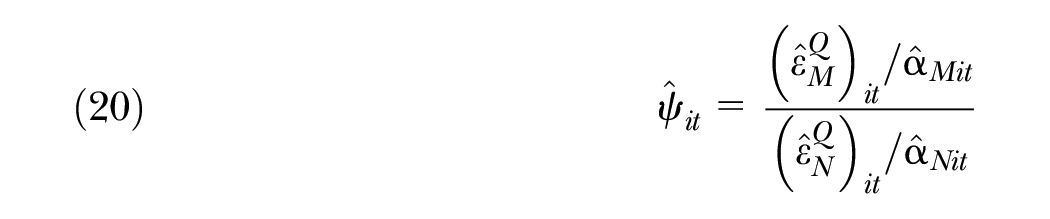
We can further transform the ratio


Data
Our data come from the German Institute for Employment Research (IAB) Establishment Panel described by Ellguth, Kohaut, and Möller (2014). Starting in 1993 (1996), the IAB Establishment Panel has surveyed West (East) German plants (not firms) that employ at least one worker covered by the social security system on June 30 of the survey year, and is representative of the population of these plants.
Critical to our purpose, it contains information on plants’ revenues and intermediate inputs, employment, wage bill, and industrial relations (i.e., collective bargaining coverage and works council existence). To arrive at plants’ total labor costs, we use information from the Federal Statistical Office on the non-wage labor costs at the two-digit sector level and add it to the wage bill. We further deflate all nominal values using two-digit price deflators and apply the procedure described by Eberle, Jacobebbinghaus, Ludsteck, and Witter (2011) to construct a time-consistent sector classification. Although the IAB Establishment Panel has no direct information on plants’ capital stock, it can readily be computed from the included investment data using a modified perpetual inventory approach put forward by Mueller (2008). Since our estimation approach uses lagged information on plants and because the survey information on plants’ revenues and intermediate inputs is for the previous year, plants enter the sample only if we observe them in at least three consecutive years. Using information from the survey waves for 1998–2017, we are thus able to build a panel for the years 1999–2016. 11
In our analysis, we focus on the manufacturing and service sectors and discard the financial and insurance sectors, for which output measures are not comparable to the other sectors in our sample. We further exclude plants producing tobacco products (89 plant-year observations belong to this highly regulated industry) and disregard plants with fewer than five workers, which are not at risk of having a works council. Our final regression sample comprises 42,127 observations of 9,160 plants belonging to 38 two-digit sectors (for descriptive statistics, see Table 1; the included sectors are shown in Table 2). 12
Descriptive Statistics
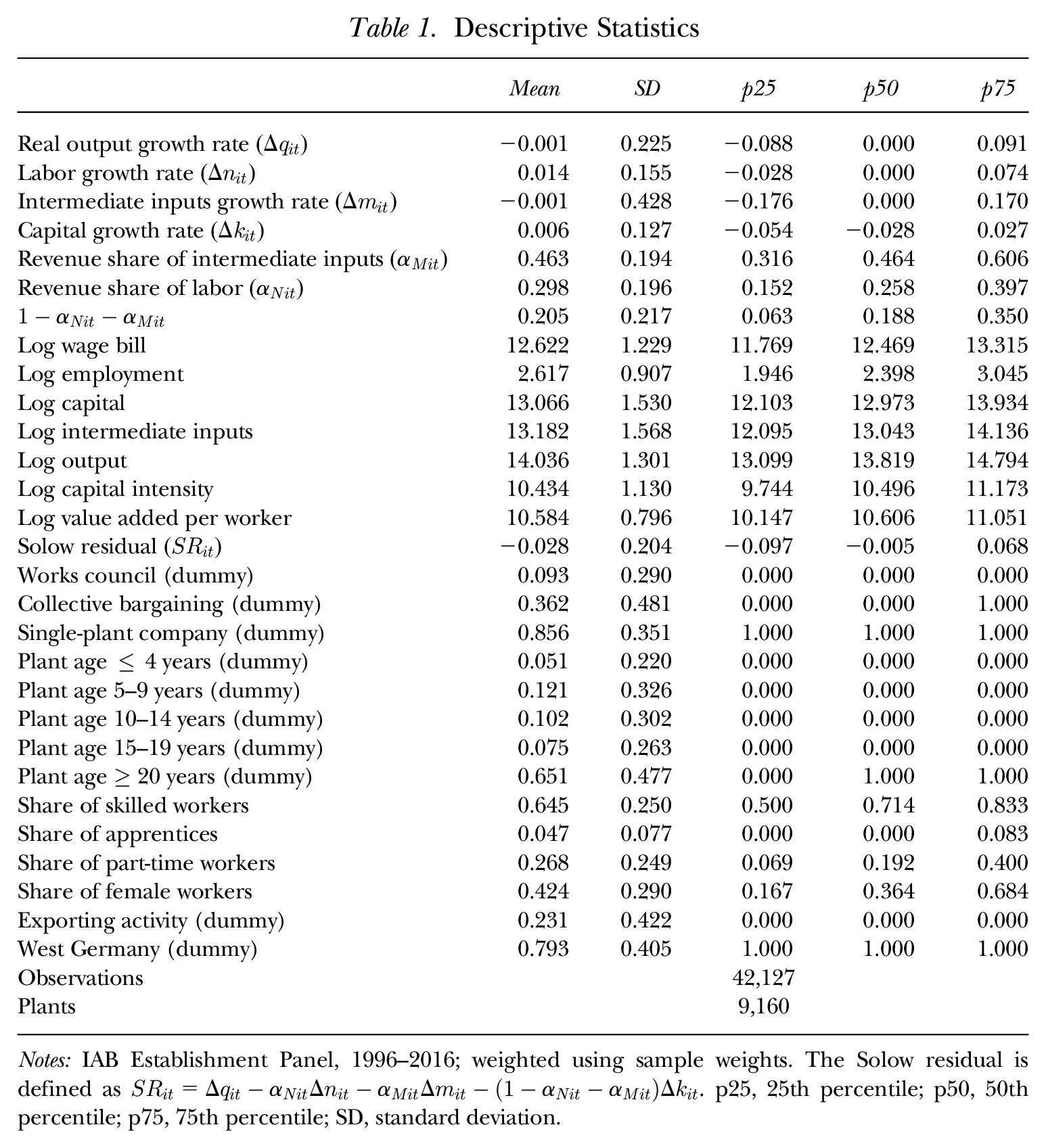
Notes: IAB Establishment Panel, 1996–2016; weighted using sample weights. The Solow residual is defined as
Estimated Output Elasticities and Returns to Scale by Two-Digit Sector (Means)
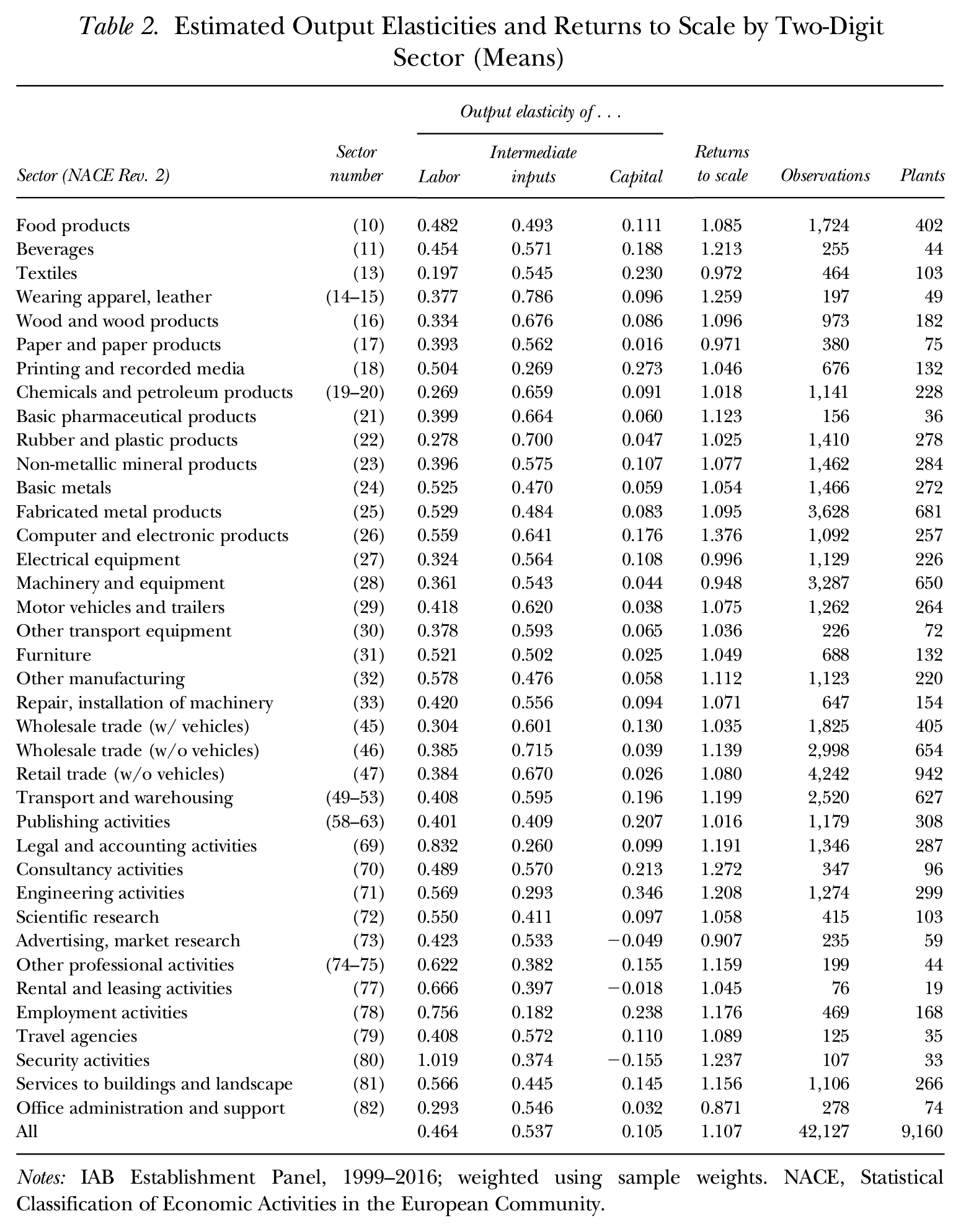
Notes: IAB Establishment Panel, 1999–2016; weighted using sample weights. NACE, Statistical Classification of Economic Activities in the European Community.
Industrial Relations and Labor Market Imperfections
Descriptive Analysis
Using our panel of German plants for the years 1999–2016, we now apply the production function approach. In a first step, we estimate translog production functions for each two-digit sector based on the control function approach by Ackerberg et al. (2015), which allows us to control for unobserved productivity shocks. In a second step, we use the estimated coefficients together with information on plants’ input use to compute the ratio of wages to the marginal revenue product of labor
Table 2 presents means (overall and by two-digit sector) of the estimated output elasticities of labor, intermediate inputs, and capital as well as the resulting returns to scale, that is, the sum of the three output elasticities. For our sample as a whole, average output elasticities are 0.46 for labor, 0.54 for intermediate inputs, and 0.11 for capital, with returns to scale amounting to 1.11 and thus slightly above constant returns. We also see marked differences in production technologies across sectors.
Next, we use plants’ estimated output elasticities and revenue shares to compute the ratio of wages to the marginal revenue product of labor
Prevalence of Labor Market Imperfections (Percentages)
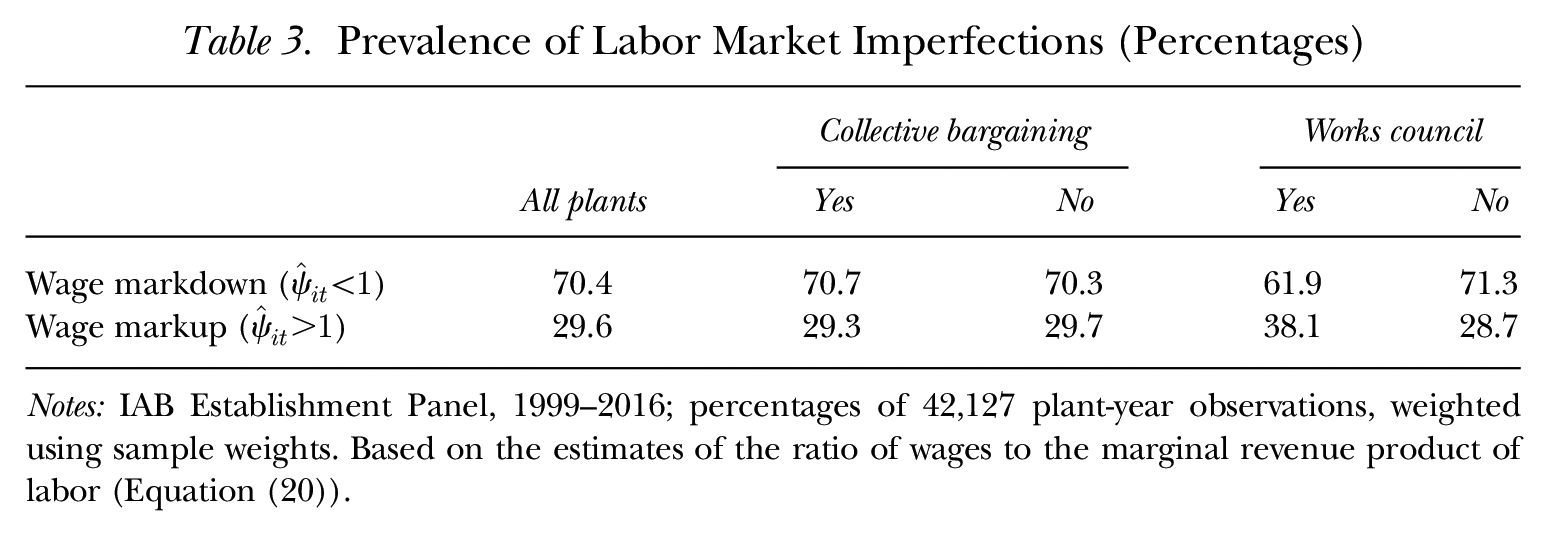
Notes: IAB Establishment Panel, 1999–2016; percentages of 42,127 plant-year observations, weighted using sample weights. Based on the estimates of the ratio of wages to the marginal revenue product of labor (Equation (20)).
Turning to plants’ industrial relations, we observe big differences in the prevalence of wage markdowns across plants with and without a works council and no differences across plants covered by collective agreements and uncovered plants. Wage markdowns are 9 percentage points (pp) less frequent where works councils exist but equally frequent among covered and uncovered plants. These findings make sense against the background that collective bargaining is typically conducted at the sectoral level and is, for this reason, less likely to limit the power imbalance between individual employers and workers than is worker codetermination at the workplace. They further square up with the result of Hirsch and Mueller (2020) that works council existence has a stronger association with the mean employer wage premium than does collective bargaining coverage.
Considering the ratio of wages to the marginal revenue product of labor directly in Table 4, we find that the workers at the median plant receive 69% of the marginal revenue product of labor. This number is very similar to the median ratio of 73% for US manufacturing found by Yeh et al. (2022).
14
We further find substantial variation across observations with an interquartile range of the ratio of 0.68 (see also Figure 1 that provides a histogram of the log ratio, i.e.,
Intensity of Labor Market Imperfections
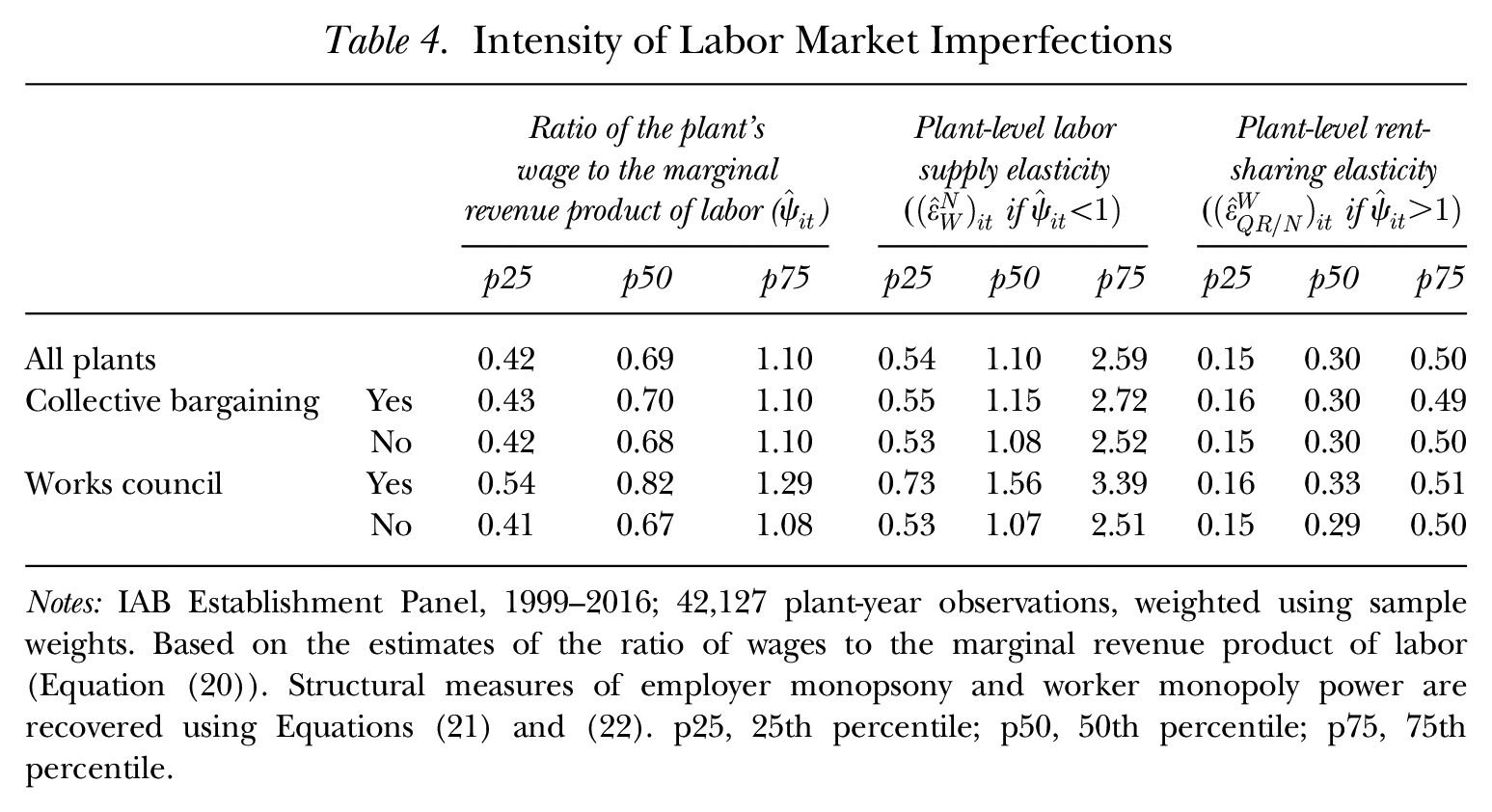
Notes: IAB Establishment Panel, 1999–2016; 42,127 plant-year observations, weighted using sample weights. Based on the estimates of the ratio of wages to the marginal revenue product of labor (Equation (20)). Structural measures of employer monopsony and worker monopoly power are recovered using Equations (21) and (22). p25, 25th percentile; p50, 50th percentile; p75, 75th percentile.
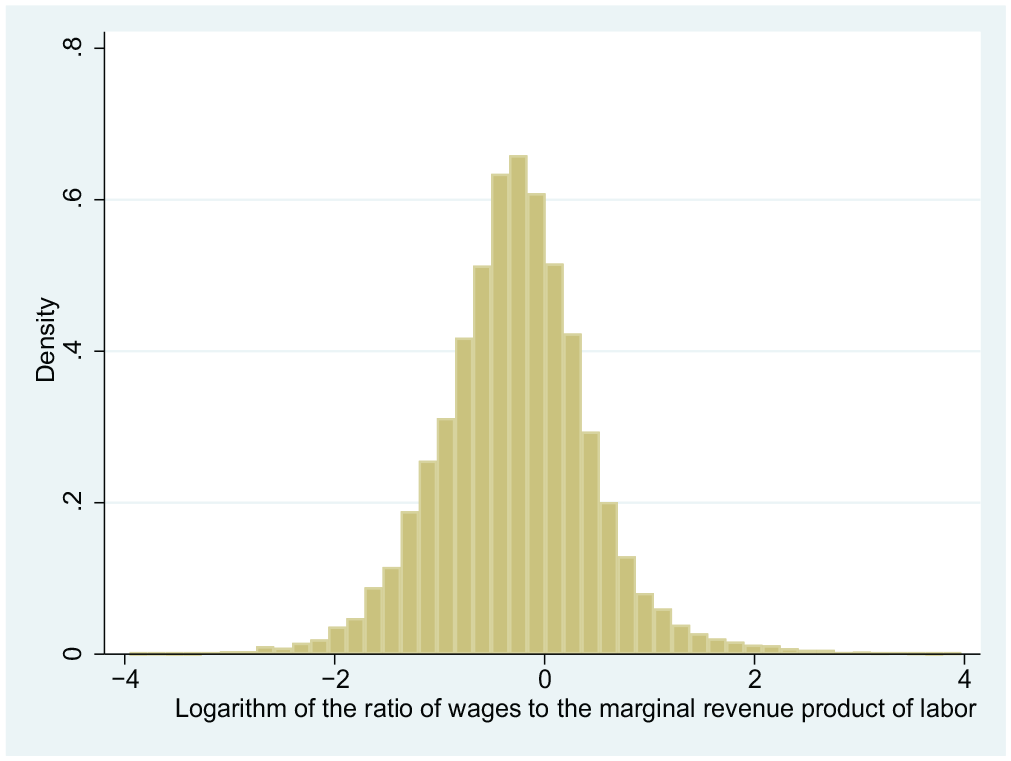
Histogram of the Logarithm of the Ratio of Wages to the Marginal Revenue Product of Labor (
We finally note that wages differ markedly from the marginal revenue product of labor for the vast majority of plants. Specifically, only approximately 10% of observations have a ratio
Bringing plants’ industrial relations into the picture, we find that the median ratio is 82% when a works council is present but 67% when one is not. By contrast, we observe little differences in plants covered by collective bargaining compared to uncovered plants; the median ratio is 70% and 68%, respectively.
On top of the reduced-form ratio of wages to the marginal revenue product, we now turn to the implied plant-level labor supply elasticity under monopsony
For the 70% of observations involving wage markdowns, we find that the median plant-level labor supply elasticity amounts to 1.1, which points to marked monopsony power for employers. This number is not too different from the median of 1,320 elasticity estimates of 1.68 reported in Sokolova and Sorensen (2021) and almost identical to the average elasticity estimate of 1.08 for US firms in Webber (2015), which is one of the rare studies that provides elasticity estimates at the individual employer level as we do, though based on a different methodology. Note, however, that our median elasticity estimate for plants paying a wage markdown is also consistent with previous studies obtaining larger estimates because the average elasticity for all plants estimated by earlier studies is a weighted average of the elasticity in plants with significant monopsony power and the elasticity in those with none. The latter are plants paying marginal-product wages or wage markups, and thus plants likely to face large elasticities. Note also that the implied plant-level labor supply elasticity coming from the production function approach is rooted in observed wage outcomes and thus measures employers’ exercise of (rather than their potential for) monopsony power, whereas elasticity estimates in the literature measure employers’ potential monopsony power only, but not its pass-through to actual wages (for a detailed discussion, see Manning 2011, 2021).
For the 30% of observations involving wage markups, we observe a median rent-sharing elasticity of 0.3, which is at the upper end of the estimates surveyed by Card et al. (2018). But observe, along the lines of the previous paragraph, that these studies report estimates of the average rent-sharing elasticity combining plants paying wage markups and thus plants where substantial rent sharing exists and plants paying wage markdowns, whereas our estimates are for the former group of plants only.
Turning to plants’ industrial relations, we find that the plant-level labor supply elasticity is much bigger in plants with a works council than in plants without (median elasticity of 1.56 vs. 1.07) and a bit bigger in plants covered by collective bargaining than in uncovered plants (median elasticity of 1.15 vs. 1.08). 15 By contrast, we observe small differences in the rent-sharing elasticity between plants with and without a works council (median elasticity of 0.33 vs. 0.29) and no differences between covered and uncovered plants (median elasticity of 0.3 in both cases).
In summary, we find that the presence of works councils is accompanied by a lower prevalence of wage markdowns and a higher ratio of wages to the marginal revenue product of labor in general. We further see that the implied labor supply elasticity of plants paying a wage markdown is larger when works councils are present, as is the implied rent-sharing elasticity of plants paying a wage markup. The picture is less clear when comparing plants covered by collective bargaining and uncovered plants. These inconsistent correlation patterns, however, may simply reflect confounding factors, such as plant size and sector affiliation. Therefore, we now turn to partial correlations from regressions that control for a rich set of plant characteristics.
Regression Analysis
In a first step, we investigate which factors—including industrial relations captured by dummies for collective bargaining coverage and the existence of a works council—influence the probability of a wage markdown or a ratio
Average Marginal Effects on the Probability of a Wage Markdown from Probit Regressions
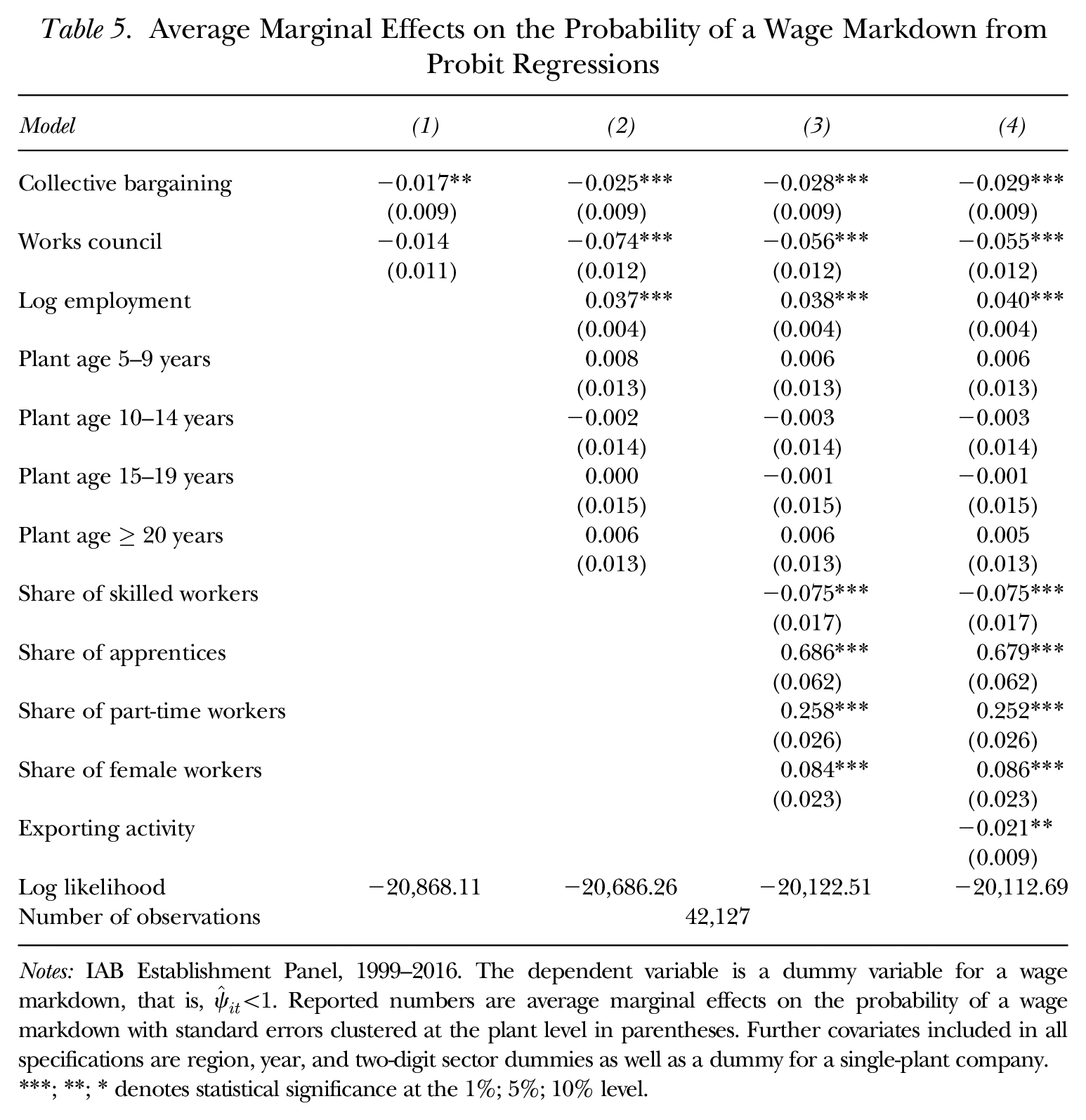
Notes: IAB Establishment Panel, 1999–2016. The dependent variable is a dummy variable for a wage markdown, that is,
; **; * denotes statistical significance at the 1%; 5%; 10% level.
Once we add plant size and plant age to the probit regression (models (2)–(4)), we find that the presence of collective bargaining or a works council is associated with a non-negligible reduction in the conditional probability of a wage markdown. In our richest specification (model (4)), collective bargaining is accompanied by an average drop in probability of 2.9 pp and works council existence by a drop of 5.5 pp, both of which are statistically significant at the 1% level. These findings are consistent with the theoretical insights in Falch and Strøm (2007) arguing that organized labor protects workers in that it seems to reduce the likelihood that employers can impose a wage markdown on them. And in line with the descriptive evidence, works councils existence appears to matter more than collective bargaining coverage. Yet, bear in mind that our regressions rely on cross-sectional variation in industrial relations across plants and thus do not allow us to establish causality. In particular, our sample does not include enough changes in plants’ industrial relations over time to rest identification on within-plant variation given the high data requirements when implementing the production function approach. 16
We further observe some interesting patterns for the control variables. Plant size shows a positive association with the probability of a wage markdown, whereas we find the opposite for exporting plants (in line with previous evidence for Japan by Dobbelaere and Kiyota 2018). Hence, larger and non-exporting plants seem to be more powerful in the labor market. Finally, the composition of the workforce appears to matter. The probability of a wage markdown is lower the more skilled workers are employed, whereas it is higher the more apprentices, part-timers, and females are among the workers, suggesting a more pronounced power imbalance for the latter groups.
Turning to the size rather than the direction of the deviation of wages from the marginal revenue product of labor, we examine how industrial relations and the other plant characteristics included in the probit regressions influence the logarithm of the ratio of wages to the marginal revenue product of labor
OLS Regressions for the Size of the Deviation of Wages from the Marginal Revenue Product of Labor
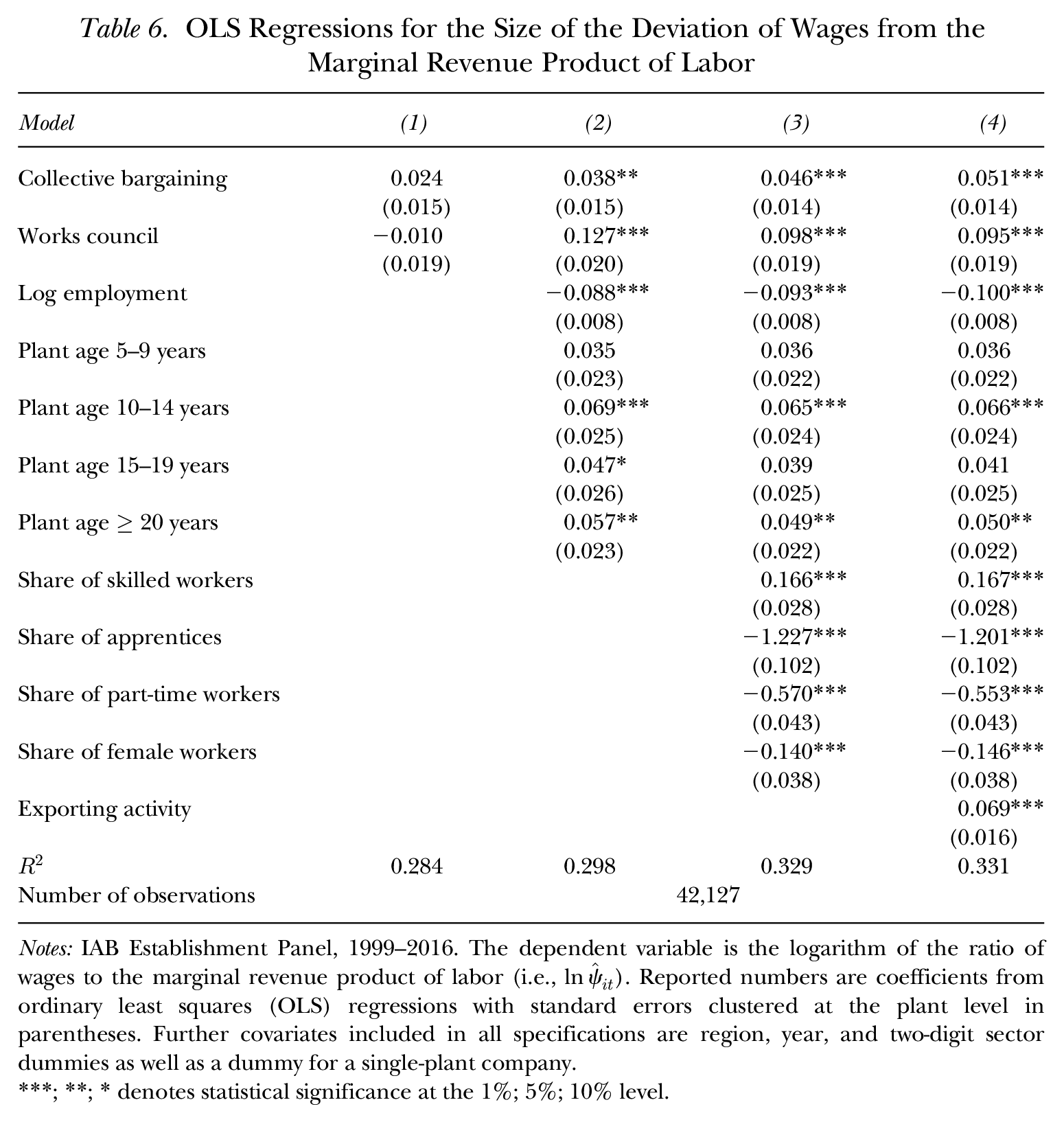
Notes: IAB Establishment Panel, 1999–2016. The dependent variable is the logarithm of the ratio of wages to the marginal revenue product of labor (i.e.,
; **; * denotes statistical significance at the 1%; 5%; 10% level.
Once we control for plant size and plant age (models (2)–(4)), we find that the presence of collective bargaining or a works council is associated with a sizeable increase of the ratio of wages to the marginal revenue product of labor. In the richest specification (model (4)), collective bargaining is accompanied by an average increase in the ratio of 5.1% and works council existence by an increase of 9.5%, both of which are statistically significant at the 1% level. Furthermore, we observe the same (mirror-inverted) patterns for the control variables as in the probit regressions for a wage markdown. 17
Finally, we examine how industrial relations and the other plant characteristics included in our preferred specification of the probit and OLS regressions (i.e., the richest, model (4)) influence the logarithm of 1) the implied plant-level labor supply elasticity
OLS Regressions for the Intensity of Labor Market Imperfections
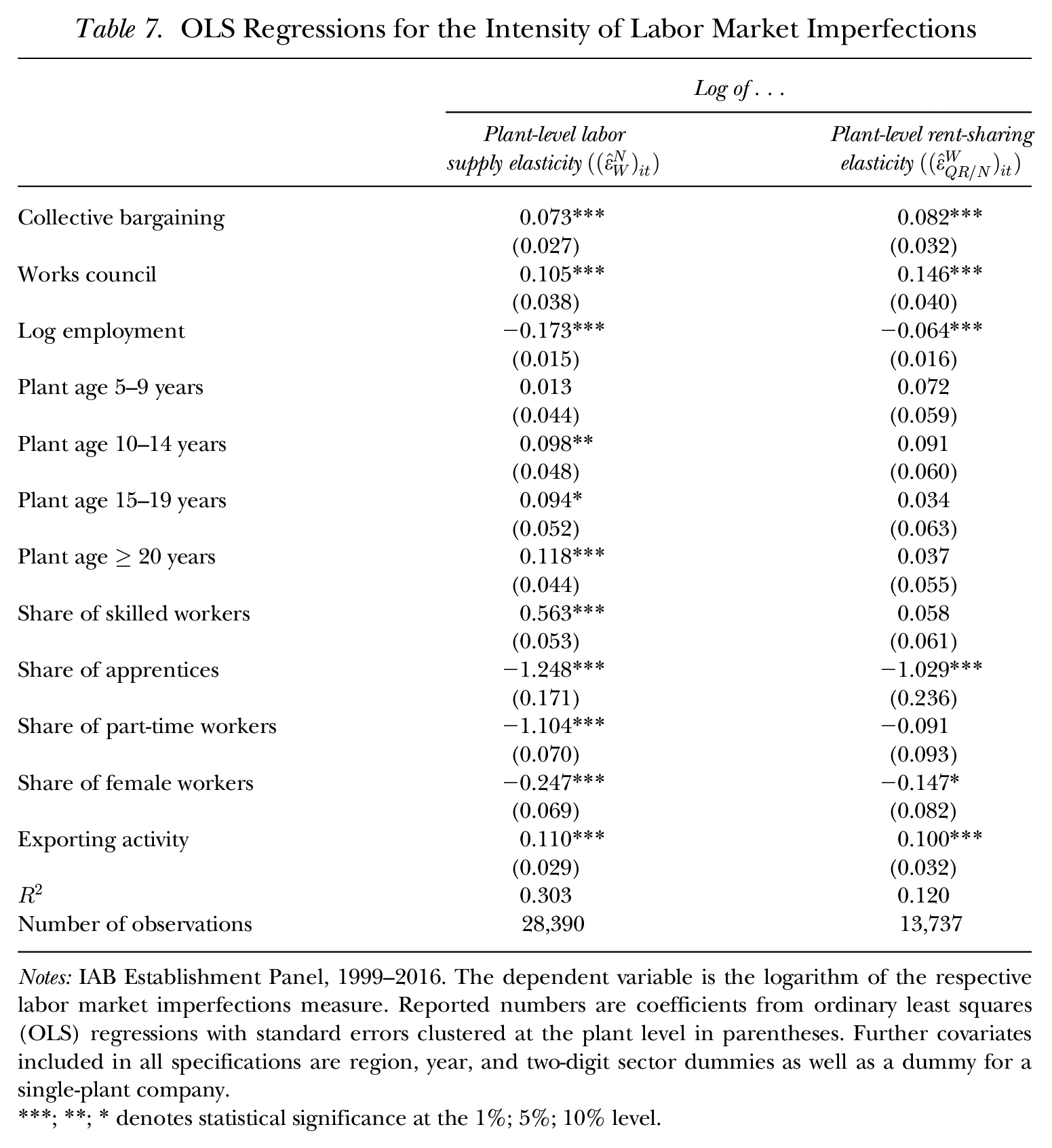
Notes: IAB Establishment Panel, 1999–2016. The dependent variable is the logarithm of the respective labor market imperfections measure. Reported numbers are coefficients from ordinary least squares (OLS) regressions with standard errors clustered at the plant level in parentheses. Further covariates included in all specifications are region, year, and two-digit sector dummies as well as a dummy for a single-plant company.
; **; * denotes statistical significance at the 1%; 5%; 10% level.
We further find the same (mirror-inverted) patterns for the control variables that we obtained from the probit regression for a wage markdown. The plant-level labor supply elasticity shows a negative association with plant size and a positive association with exporting activity. Moreover, it is significantly related to workforce composition. It is larger the more skilled workers are employed and smaller the more apprentices, part-timers, and females are in the workforce. Particularly the latter finding for females is in line with existing evidence that employers possess more monopsony power over female as opposed to male workers (see the recent survey by Hirsch 2016, and Hirsch, Schank, and Schnabel 2010 for Germany).
Turning to the 13,737 observations involving a wage markup, our results for the rent-sharing elasticity are generally similar to those for the plant-level labor supply elasticity. The existence of collective bargaining is associated with a rise in the rent-sharing elasticity of 8.2% and the presence of a works council with a rise of 14.6%, both of which are statistically significant at the 1% level. For the control variables, we obtain, with few exceptions, the same correlation patterns as for the plant-level labor supply elasticity.
Labor Market Imperfections and Employer Wage Premia
The partial correlations between industrial relations and the direction and size of the deviation of wages from the marginal revenue product of labor are consistent with the view that organized labor protects workers in that it reduces the prevalence of wage markdowns and raises the ratio of wages to the marginal revenue product in general. That said, the production function approach as implemented in this article treats labor as a homogenous production factor and abstracts from differences in worker quality in that it compares the output elasticity of labor to its share in revenues and thus to the average wage bill per worker.
Consequently, our findings cannot shed direct light on how labor market imperfections relate to the wage premia paid by employers to their workers, that is to employers’ wage levels after accounting for sorting of workers of different quality into plants that differ in labor market imperfections and the size of rents to be split between employers and workers. Yet, answering this question is not only crucial for our research question, it also provides a most welcome opportunity of cross-validating our measures of labor market imperfections, that is, examining their predictive power for these employer wage premia.
Up to now, evidence on this issue has been scant, though some recent contributions surveyed by Manning (2021) found that measures of employers’ potential monopsony power are associated with wages. 18 This evidence, however, is about individual wages and not about employer wage premia, so worker sorting may contaminate findings. To obtain a measure of employer wage premia that does not suffer from worker sorting, we follow Card et al. (2018) and Hirsch and Mueller (2020) and rely on the AKM plant wage effects estimated for our data by Bellmann, Lochner, Seth, and Wolter (2020) for the three estimation periods 1998–2004, 2005–2010, and 2011–2017. Since we are interested in how labor market imperfections relate to wage outcomes for a given plant surplus, we further follow Hirsch and Mueller (2020) in controlling for the quasi-rent per worker as the proper measure of this surplus. We provide details on our measures of employer wage premia and plant surplus in Online Appendix B.
We first provide some descriptive evidence on the correlation between employer wage premia and 1) the quasi-rent per worker and 2) the log ratio of wages to the marginal revenue product of labor. As is seen in a binned scatterplot (Figure 2) that plots the AKM plant wage effects separately for the three AKM estimation periods that enter our sample (and purged of AKM period effects) against the quasi-rent per worker, a positive relationship exists between employer wage premia and plant surplus that does not change much over time and is pretty similar for the earliest and the latest AKM period. 19 Similarly, a binned scatterplot (Figure 3) that substitutes the log ratio of wages to the marginal revenue product of labor for the quasi-rent per worker shows that the ratio and the AKM plant wage effects are positively related, except for very small values of the ratio. 20 We further see that the relationship does not change much over time and is quite similar for the earliest and the latest AKM period.
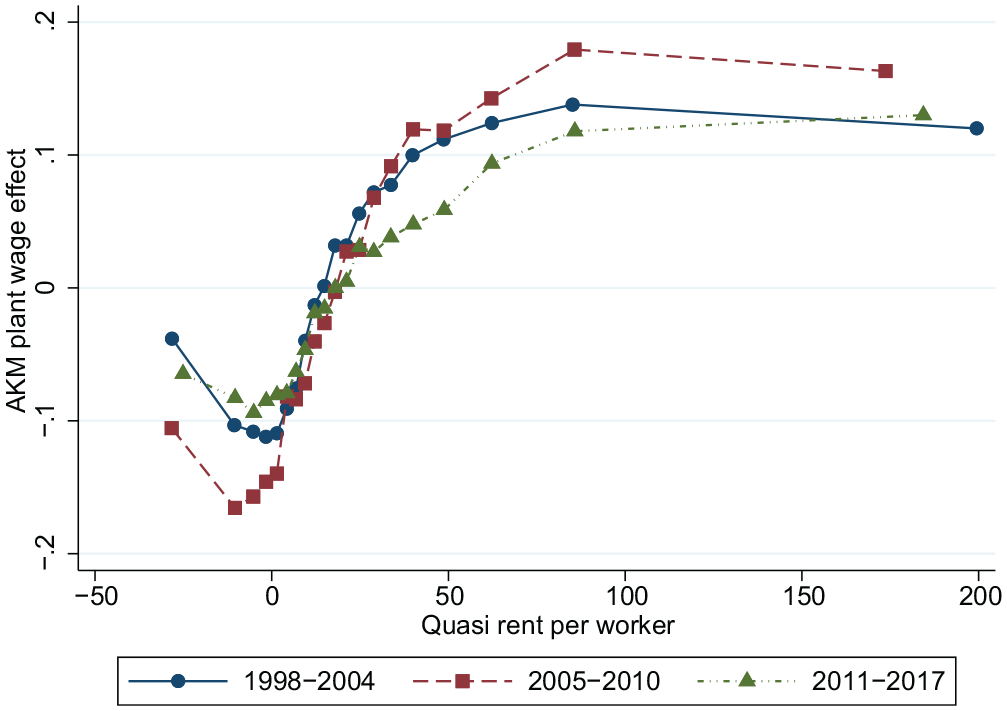
Binned Scatterplot of AKM Plant Wage Effects Against the Quasi-rent per Worker
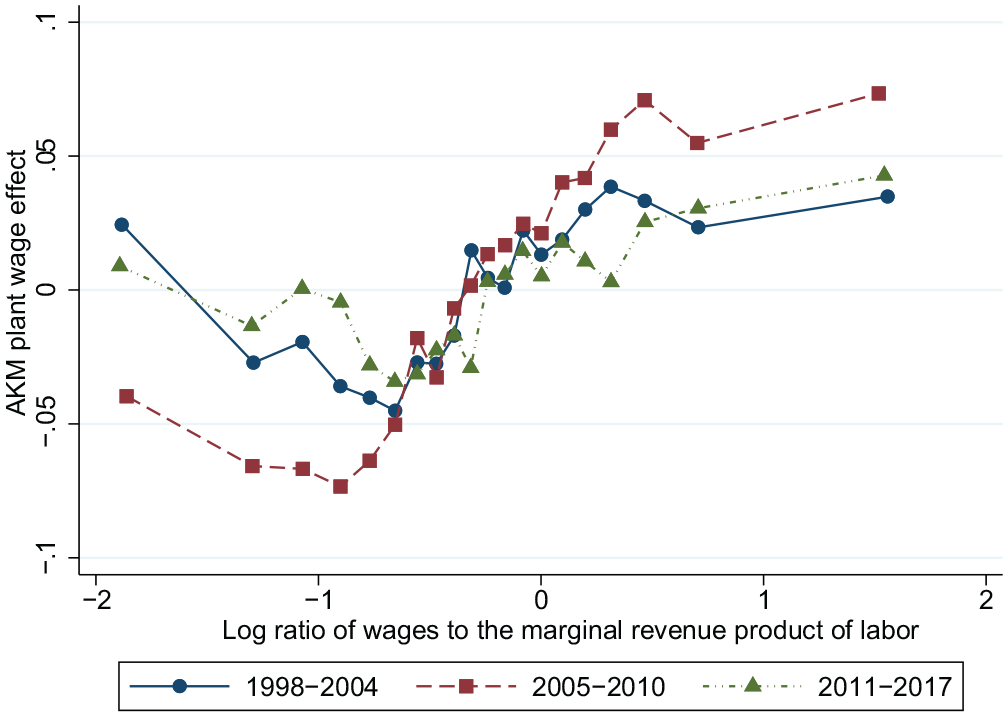
Binned Scatterplot of AKM Plant Wage Effects Against the Log Ratio of Wages to the Marginal Revenue Product of Labor (
To investigate the partial correlation between the measures of labor market imperfections from the production function approach and employer wage premia, we next regress the standardized AKM plant wage effect on these measures, the quasi-rent per worker to control for the plant surplus, and all the control variables included in the previous regressions.
21
To capture the direction of labor market imperfections, we include a dummy variable for the presence of a wage markdown (i.e., for
OLS Regressions for the Employer Wage Premium
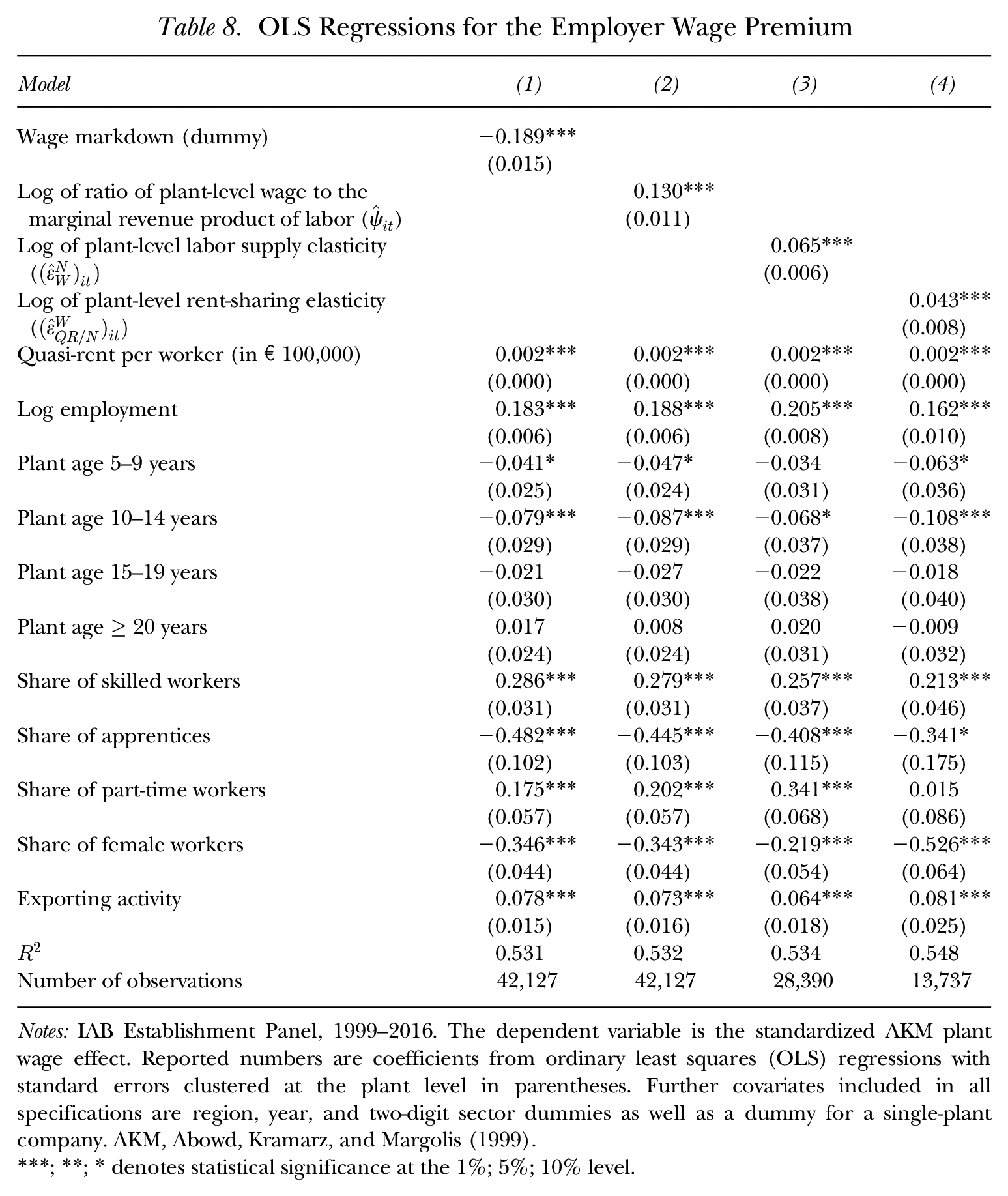
Notes: IAB Establishment Panel, 1999–2016. The dependent variable is the standardized AKM plant wage effect. Reported numbers are coefficients from ordinary least squares (OLS) regressions with standard errors clustered at the plant level in parentheses. Further covariates included in all specifications are region, year, and two-digit sector dummies as well as a dummy for a single-plant company. AKM, Abowd, Kramarz, and Margolis (1999).
; **; * denotes statistical significance at the 1%; 5%; 10% level.
Holding constant plant surplus and the other control variables, we find that a wage markdown is accompanied by a 0.19 standard deviations lower mean wage premium. 22 Note that a standard deviation in wage premia amounts to 24.5 log points in our sample, so this partial correlation is sizeable. We also observe a sizeable association between the log ratio of wages to the marginal revenue product of labor and the mean employer wage premium. A one standard deviation larger log ratio, which amounts to 0.76 in our sample, is associated with a 0.1 (= 0.76 × 0.13) standard deviations larger mean employer wage premium, which is statistically significant at the 1% level.
When restricting to the 28,390 observations involving a wage markdown, we find that a one standard deviation larger log plant-level labor supply elasticity, which amounts to 1.33 in our sample, is accompanied by a 0.09 (= 1.33 × 0.065) standard deviations larger mean wage premium. Finally, restricting to the 13,737 observations involving a wage markup, a one standard deviation larger log rent-sharing elasticity, which is 1.08 in our sample, is associated with a 0.05 (= 1.08 × 0.043) standard deviations larger mean wage premium, which is a somewhat smaller association than for the labor supply elasticity. That said, both partial correlations are statistically significant at the 1% level.
In summary, our findings suggest that labor market imperfections as measured by the production function approach are clearly related to employer wage premia and in the way predicted by theory, thereby cross-validating these measures. Of consequence, both the direction and the size of labor market imperfections relate to the mean employer wage premium while they themselves are clearly related to industrial relations.
Conclusions
This article has investigated the interplay between industrial relations, labor market imperfections, and employer wage premia in Germany and posed two questions. Are labor market imperfections related to industrial relations? And are employer wage premia, in turn, related to labor market imperfections? We addressed these two questions using the production function approach that allows us to infer from production function estimates whether wages deviate from the marginal revenue product of labor and by how much. Based on representative plant-level data from the IAB Establishment Panel encompassing the years 1999–2016, we answered both questions in the affirmative.
At the descriptive level, we found that wage markdowns are far more prevalent than wage markups (70% vs. 30% of plant-year observations) so that the vast majority of German employers pay less than the marginal revenue product of labor. In regressions, we found that wage markdowns are less frequent when collective bargaining is present and, even more so, when a works council is present. These findings for the direction of labor market imperfections are complemented by results for the ratio of wages to the marginal revenue product of labor, which show that the ratio is significantly larger when a works council or collective bargaining exists. Finally, we found that mean employer wage premia are significantly lower when wage markdowns are present and are positively related to the ratio of wages to the marginal revenue product of labor, holding constant plant surplus.
In short, our results are in line with the notion that industrial relations influence rent splitting in imperfect labor markets, with collective bargaining and worker codetermination shifting market power from employers to workers. Hence, they point at organized labor’s erosion as one possible contributor to the falling labor share. That said, our data did not permit us to establish a causal link running from industrial relations to labor market imperfections and from labor market imperfections to employer wage premia, so for instance selection into industrial relation regimes could still play a role. Establishing causality in a rigorous way by using exogenous variation in industrial relations remains a promising avenue for future research.
Supplemental Material
sj-pdf-1-ilr-10.1177_00197939241237757 – Supplemental material for Organized Labor, Labor Market Imperfections, and Employer Wage Premia
Supplemental material, sj-pdf-1-ilr-10.1177_00197939241237757 for Organized Labor, Labor Market Imperfections, and Employer Wage Premia by Sabien Dobbelaere, Boris Hirsch, Steffen Mueller and Georg Neuschaeffer in ILR Review
Footnotes
Acknowledgements
We thank Laszlo Goerke, Fabian Lange, and Todd Sorensen for very useful suggestions. We further appreciate comments by participants of the EALE/SOLE/AASLE 2020, the EEA 2020, the Verein für Socialpolitik 2020, the RES 2021, and the IAAE 2022 conferences, of the 21st IZA/SOLE 2022 Transatlantic meeting and the IAB 2023 workshop on “Imperfect Competition in the Labor Market,” and of presentations in Amsterdam, Basel, Halle, and Lüneburg. We also gratefully acknowledge financial support from the Deutsche Forschungsgemeinschaft under the grant title “Firm Wage Differentials in Imperfect Labour Markets: The Role of Market Power and Industrial Relations in Rent Splitting between Workers and Firms.”
For general questions as well as for information regarding the data and/or computer programs used for this study, please contact the corresponding author at
1
 found for Germany that codetermination at the firm level, which grants worker representatives seats in the supervisory board of large companies, does not affect rent sharing. Note, however, that our article is about codetermination at the workplace level through works councils, which is far more prevalent than board representation and also differs in its scope. As a case in point, unlike labor representatives on the board, works councils possess legal veto rights and thus cannot be overruled by management. Later, we provide details about works councils.
2
Since employers are not allowed to interfere with works council introduction and since elected works councilors enjoy strict employment protection, the low prevalence of works councils implies that running a council imposes some costs on workers. First, as many employers have reservations against works councils (), becoming exposed as a works councilor itself can be costly. Second, works councilors have to actively represent their colleagues’ interests and will be made personally responsible for the negotiation outcomes. Time spent on work as a works councilor, however, counts as regular working time and thus does not necessarily impose extra cost on workers.
3
In our data, we observe plants rather than firms and will thus refer to plants throughout the article.
4
Given recent evidence on imperfections in intermediate inputs markets by and Dhyne, Kikkawa, and Magerman (2022), this latter assumption of price-taking for intermediate inputs might be perceived as being restrictive. This evidence notwithstanding, we stick to the assumption for two reasons. The first is a data reason. Like Morlacco (2020), we could easily model imperfections in intermediate inputs markets as an additional unit cost that drives a wedge between the marginal cost of production and the marginal product of plants’ inputs. Data constraints, however, prevent us from putting this approach to work. The second reason is that we want to focus our empirical analysis on the relationship between industrial relations and labor market imperfections faced by plants, abstaining from noncompetitive buyer behavior in the market for intermediate inputs.
5
The many problems involved when defining the relevant labor market are discussed in detail, for example, by Schubert, Stansbury, and Taska (2022).
6
By allowing a plant-level decision (i.e., export participation) to directly affect the plant’s future productivity we address the potential problem of restricting the productivity process to be exogenous (see footnote 8).
7
An alternative identification strategy is to combine the timing assumptions with the dynamic panel approach of . The latter assumes that productivity follows an
8
Adding the plant’s export status control function approach in the estimation of a gross output production function. To provide intuition for this problem, note that absent such a shifter the plant’s demand for intermediate inputs would be
9
Note that with a Cobb-Douglas production technology, output elasticities would simplify to
10
Such a correction is important because output prices are not available at the plant level so that output levels are obtained by deflating revenues using a two-digit sector output price deflator (see the Data section), inducing bias when measuring real output. Note, however, that this correction cancels out when computing the ratio
11
We cannot use earlier waves because of a change in the questionnaire regarding plants’ industrial relations and because we do not want to constrain our analysis to West Germany.
12
We must drop 1,771 observations (or approximately 4% of observations) because they involve a negative
13
The average price-cost markup across plants is rather modest in size compared to existing estimates in the literature. Yet, consider that previous studies typically ignore labor market imperfections in that they assume competitive wage formation and thus, given that wage markdowns are much more prevalent than wage markups in our data, are prone to overstating the gap between product prices and marginal costs (as discussed in detail by De Loecker et al. 2016). Moreover, as pointed out by a reviewer, the bias from not having separate price and quantity information when estimating production functions, which is at the heart of the Bond, Hashemi, Kaplan, and Zoch (2021) critique, is likely to be exacerbated when not accounting for imperfections in input markets. Reassuringly, our numbers are similar in size to recent estimates that allow for labor market imperfections (e.g., Dobbelaere, Kiyota, and Mairesse 2015; ).
14
15
As previously stated, the labor supply elasticity coming from the production function approach is the elasticity as implied from the observed wage outcomes, so the elasticity value that would rationalize the observed wage outcomes in a monopsony framework. In other words, a larger elasticity in plants where organized labor is present points at lower actual monopsony power compared to plants without organized labor. That said, it does not necessarily imply that workers’ job separations and their labor supply in general are more responsive to wages in organized plants than in non-organized plants, which would increase employers’potential for rather than their exercise of monopsony power. Consequently, our results are not in contradiction to the Hirschman dichotomy of “exit” and “voice” that suggests less wage-elastic job separations in organized than in non-organized plants.
16
Specifically, in our sample only 770 plants enter or leave collective bargaining coverage and 463 plants introduce or abolish a works council (disregarding plants with multiple switches in their collective bargaining or works council status, for which information may reflect measurement issues rather than genuine status changes).
17
As stated in footnote 10, 9,730 (or 23.1%) of the observations in our sample involve estimated price-cost markups below unity that are only sustainable in the short run and may to some extent reflect measurement error. Since the markup
18
For instance, Hirsch, Jahn, Manning, and Oberfichtner (2022) showed that smaller employer monopsony power in denser local labor markets accounts for about half of the urban wage premium in Germany. For the United States, Azar et al. (2022) observed lower posted wages in more concentrated local labor markets, and Benmelech et al. (2022) found a negative association between labor market concentration and wages, as did Rinz (2022). Finally, found that a larger firm-level labor supply elasticity is associated with higher average wages.
19
This finding contrasts with those of Alvarez, Benguria, Engbom, and Moser (2018) for Brazil who documented a less steep relationship between employer wage premia and plant surplus in later periods that substantially contributes to their finding of decreasing wage inequality over time.
20
We note in passing that Figure 3 suggests that employer wage premia are highest among the employers with the narrowest wage markdowns. As pointed out by a reviewer, this is in line with Burdett and Mortensen’s (1998) wage-posting model of oligopsony, but it is at odds with Berger, Herkenhoff, and Mongey’s (2022) model of oligopsony among horizontally differentiated employers in which employers with wider markdowns pay higher wages.
21
We do not observe AKM plant wage effects for 3,825 plant-year observations. We decided to impute these missing AKM plant effects by the predicted values of a linear regression of the observed AKM plant effects on dummies for two-digit sector, plant size (ten categories), and their interaction, time dummies, dummies for a single-plant company, plant age (four categories), and exporting activity, as well as the share of skilled workers, apprentices, part-time workers, and female workers in the plant’s workforce, and the plant’s log wage bill per worker. That said, our results hardly change when restricting to those plant-year observations with non-missing AKM plant effects.
22
We obtain an
References
Supplementary Material
Please find the following supplemental material available below.
For Open Access articles published under a Creative Commons License, all supplemental material carries the same license as the article it is associated with.
For non-Open Access articles published, all supplemental material carries a non-exclusive license, and permission requests for re-use of supplemental material or any part of supplemental material shall be sent directly to the copyright owner as specified in the copyright notice associated with the article.
