




Abstract
High-pay, high-status jobs are competitive and male-dominated and typically demand long work hours. The authors study the role of competition in producing the latter two outcomes using two field experiments. In the first, they find that paying tournament prizes for performance induces both men and women to work longer, but that men respond more than women to the high-prize tournament. In the second, men are more likely than women to choose tournament-based compensation over a wage rate for larger prizes. These results demonstrate that high-stakes workplace competition can fuel gender inequality both directly, because men are more likely to enter and win tournaments, and indirectly, by raising work hours, which hurts women who face greater time demands in household production.
The dominance of high-pay, high-status, elite careers by men is a major driver of gender-based income inequality (Blau and Kahn 2000; Fortin, Bell, and Böhm 2017). Two key features of these careers have each been shown, in isolation, to contribute to women’s low representation: long work hours (Landers, Rebitzer, and Taylor 1996, 1997; Goldin 2014) and workplace competition driven by relative performance incentives (Lazear 2018). However, research documenting the gendered impact of long work hours has not considered the potential role of competition in extending work hours, and experiments designed to study gender differences in response to competition have not included a component that allows workers to increase their effort by working longer.
This article unifies these literatures using two novel field experiments (on 236 workers and 739 job applicants, respectively) that include both competitive and non-competitive compensation structures and allow workers to determine the duration of their work. We are able to test for two types of mechanisms through which workplace competition can contribute to gender inequality. The first is from direct effects of competition that derive from differences in how men and women respond to competitive pay, in their entry and work effort decisions. The second gendered effect of competition is indirect in that it is generated by the possibility that competitive pay causes extended work hours for all workers. If present, this indirect mechanism would imply that the competitive nature of certain high-paying jobs, in which workers compete against their colleagues for bonuses and promotions, is itself a driver of their long work hours. Workers in these jobs can improve their performance ranking by voluntarily working far beyond the standard workweek. Those who cannot do so, however, such as women who have, or expect, greater household or caretaking responsibilities, will be less likely to persist in high-status professional occupations or to attain the highest ranks of corporate leadership (Eagly and Carli 2007; Bertrand, Goldin, and Katz 2010; Matsa and Miller 2011; Kunze and Miller 2017).
Our experimental framework is designed to allow workers to vary their work effort along both extensive (working longer) and intensive (working harder per unit of time) margins. Workers in our primary experiment were offered a fixed ($25) payment for an hour-long work session in which they tested and benchmarked a simple, tablet-computer program for a professor. Upon arrival at the session, workers were assigned to gender-balanced rooms of four workers and provided brief training. They were told they only needed to stay and work for 10 minutes and then complete a survey about the program to be paid the promised wage. Workers were asked, however, to stay for as long as they could, for a maximum of 40 minutes, to benefit the employer. In randomly selected rooms, workers were informed during their training that a bonus payment would be awarded based on total output. Our main treatment was a high-prize tournament with a $30 bonus paid to the highest-output worker in the room; we also tested a lower prize level and a piece rate.
This setup is designed to isolate the impact of workplace competition, the focus of our study, separate from its usual correlates. We avoid selection issues by randomly assigning bonus levels and informing workers about their bonus (if any) only during training. We also avoid variation in outside non-work obligations (e.g., Gershenson and Holt 2015) by recruiting workers for a full hour, but only allowing them to work for up to 40 minutes. The workers all completed the same task in the same physical environment, which fixes the production technology, and the task itself has linear returns to effort (so no convexity). The simplicity and one-time nature of the task also preclude signaling motives. 1 Using a one-time job also allows us to avoid the sample selection and non-random attrition issues that would arise in an experiment that extended over multiple days or weeks, while crucially maintaining the essential aspect of competition, which is pay based on relative performance. Finally, we incorporate the behavioral economics insights that workers can be motivated to invest effort by non-financial rewards that harness social impulses (Gneezy, Meier, and Rey-Biel 2011; Cooper and Kagel 2016). Because ignoring these motivations could cause us to overestimate the impact of tournament pay (Deci 1971; Gneezy et al. 2011), we designed our experiment to stimulate them, by hiring workers for a job that produced meaningful output for the employer and having the employer display consideration for the workers.
Data from our primary experiment allow us to study the indirect mechanism for gender inequality, by testing if total work time increases in response to competitive pay, as well as the direct mechanism, by testing for gender differences in response to competition. Our secondary experiment is focused on the direct mechanism. It tests for gender differences in tournament entry decisions using the same task and work setup as the main experiment but gives workers an up-front choice before the work session between a bonus tournament prize and an overtime wage rate. This experiment allows us to employ a revealed-preference measure of gender differences in tastes for competition that is based on consequential entry choices. Because workers’ outcomes in the main experiment evolve over time, and workers can anticipate and observe the effort choices of their competitors, we cannot isolate their preferences based on these data alone. We therefore use the secondary experiment to isolate individual preferences for competition, separately from equilibrium effects or spillovers across workers.
Background and Contribution
Our main experiment allows us to test the prediction from tournament theory (Lazear and Rosen 1981; Lazear 2018) that increased work effort induced by competitive pay can be manifested along both extensive (working longer) and intensive (working harder per unit of time) margins. The possibility that competition is itself a source of long hours has not previously been examined in the literature on long hours, despite the literature typically focusing on competitive and high-paying careers in which our mechanism might be particularly salient.
Prior studies have emphasized explanations such as production technology (Goldin 2014) or worker signaling of their ability or commitment (Landers et al. 1996, 1997). The theory we consider differs from the framework emphasized in Goldin (2014: figure 4), which posited a convex production technology. 2 Although a finding that competition increases work time would support the emphasis on convexity in compensation with respect to hours in Goldin (2014), note that the source of convexity here is from competition rather than productivity, so long hours can be profitable even with linear technology or diminishing returns to effort. Therefore, while Goldin (2014) expressed optimism about the potential for innovations in production technology to reduce production convexity and thereby increase workplace flexibility and reduce work hours, unfortunately no such outcome can be expected if one source of long work hours is workplace competition. The question of how innovation that increases flexibility affects work hours is increasingly relevant as the COVID-19 pandemic has spurred workplaces to increase their use of remote, online, and asynchronous production (Barrero, Bloom, and Davis 2021).
Our framework resembles that in Goldin (2014) in that the additional work hours must be productive in terms of increasing output for the firm. That condition distinguishes it from the signaling theory in Landers et al. (1996, 1997), in which the value to the firm from the long hours is the information that it provides about workers’ types rather than the additional output. Workers in Landers et al. (1996, 1997) were motivated to supply long hours to achieve high-stakes promotions (such as making partner at a law firm, or receiving tenure in academia). Because promotions “almost always require relative rankings” (Lazear 2018: 202), this resembles our setup. 3 Our idea that competitive incentives increase work hours is also related to Bell and Freeman’s (2001) hypothesis that Americans work longer hours than Germans do because greater US wage inequality makes them more concerned about gaining promotions and advancing in the earnings distribution. In that setting, wage inequality increases the value of winning workplace tournaments and therefore the intensity of competition.
The effects of competition on work hours have also not been assessed in the prior literature on the effects of tournaments. Experimental studies have examined “stated effort” outcomes (Bull, Schotter, and Weigelt 1987) or focused on the intensity margin, measuring total output for a fixed amount of time (Gneezy and Rustichini 2004; Freeman and Gelber 2010; Dohmen and Falk 2011) or speed to complete a fixed task (Gneezy and Rustichini 2004). Non-experimental studies of competition (Ehrenberg and Bognanno 1990; Bandiera, Fischer, Prat, and Ytsma 2021) have similarly focused on the intensive margin. Our framework therefore enables us to examine a new impact of competition on workers as well as a new explanation for long work hours. Because women tend to face greater household responsibilities than do men, these long hours serve as a barrier to women’s entry and advancement in certain careers (e.g., Flabbi and Moro 2012; Gicheva 2013; Mas and Pallais 2017; Cortés and Pan 2019; Wasserman 2023). As a result, finding that competition increases work time for all workers in our controlled setting, where external time constraints are minimized, would imply an operative indirect channel through which competition would harm female workers in other settings, even if no gender differences are found in the experiment.
We also use an experimental framework to study gender differences in response to competition, the direct mechanism, in a previously unexamined setting in which competition plays out over time among competitors who each decide how long to work. Our analyses of the direct effects of competition on gender inequality, in both experiments, contribute to the literature on differences in how men and women respond to competitive pay, reviewed in Niederle and Vesterlund (2011) and Niederle (2016). In our main experiment, we examine gender differences in work time and effort under various compensation schemes, and in our secondary experiment, we study gender differences in entry decisions. By examining variation in the gendered effects of tournaments across differing prize levels ($30 and $15 in the main experiment and $12, $18, $24, $30, and $36 in the secondary experiment), we also relate to prior studies that find gendered responses to competition depending on the particular features of the tournament, such as Niederle and Vesterlund (2007), Gneezy, Leonard, and List (2009), Niederle, Segal, and Vesterlund (2013), Buser, Niederle, and Oosterbeek (2014), Flory, Leibbrandt, and List (2015), and Iriberri and Rey-Biel (2017).
Our two experiments depart from the prior literature by incorporating workplace settings in which workers can set both the intensity and duration of their work effort. This approach captures a realistic feature of high-stakes workplace tournaments that has not been included in prior experiments. Although the prizes in our tournament were naturally modest relative to workplace competitions for annual bonuses or promotions, winning the prize required significantly less time and effort from workers. To the extent that gender differences in work effort are more likely to arise when tournaments have higher stakes, then we might predict that any gender gaps in our setting would only partially capture the gaps that would occur in a natural workplace setting when the stakes and costs are both raised. If women anticipate this, then we should see increasing gender differences in rates of entry into tournaments as the prize levels increase in our second experiment. Outside of the experimental setting (in which the employer is creating gender-balanced work groups), gender differences in the entry margin will affect the share of women in competitive jobs.
Main Field Experiment: Effects of Competition
In our primary experiment, workers are hired for a one-time research assistant position to test and benchmark a new computer program for a university professor during an hour-long scheduled work session. At the beginning of the session, workers are informed that the employer wants to learn how well, and for how long, people can perform the task under varying conditions and that they are required to stay for only 10 minutes for the promised $25 payment. They are asked to try as hard as they can and to stay for as long as they can, for a maximum of 40 minutes, to help the professor obtain more reliable information. 4
The computer program is a simple “game” in which workers earn points by tapping on stationary squares that appear on the screen of a tablet computer. During a work session, the program alternates between “active” and “rest” screens. At the start of each active screen, a stationary red square appears at a random location. The worker earns a point if they tap on the square. Once the red square is tapped, it disappears, and a “Go to the Next Screen” button appears that allows the worker to advance to the next rest screen. If the worker does not tap the advance button, the active screen is displayed for 10 seconds. Each rest screen lasts 10 seconds; there is nothing for workers to do during this time. Once 10 seconds have elapsed, the next active screen appears. With a probability of 10%, the active screen also includes a gold square (in a random location). Tapping the gold square earns 5 points, so workers can earn 6 points on a screen with a gold square by tapping both gold and red squares.
For the duration of their work session, each worker sees running tallies of accumulated points earned and time worked and a countdown timer showing the time left on the current screen. After 10 minutes of testing, a “Go to the Questionnaire” button appears on the bottom of the screen. If the worker taps on the button (and confirms their decision), they end their testing session immediately. After 40 minutes of testing, the questionnaire automatically appears on the screen. Workers can therefore spend between 10 and 40 minutes on the work task. We did not impose a time limit for the questionnaire. All workers are paid via PayPal, within two days of their session.
Two features of the task are designed to mimic essential features of high-stakes workplace contests. First, we address the fact that workers in elite competitive jobs are highly selected based on ability and training for the job and therefore need to expend significant effort to outperform their peers. We do this by designing a job that has a negligible role for innate physical (finger speed) or cognitive (alertness) ability, with no scope for outside knowledge to improve performance. The task is extremely easy to understand and perform, and the rest screens prevent workers from overexerting themselves, making it possible for all workers to work for an extended duration. As a result, it is practically impossible for a high-ability worker to “work smarter, not harder” or to “coast” on low effort and still earn a winning score. The only way to earn points is to sit in the room, watch the screen, and tap the squares. Hence, all workers have a chance to win and should therefore expend effort (Lazear and Rosen 1981; Brown 2011).
Second, to account for the high marginal effort costs experienced by workers devoting long hours to their jobs (because of fatigue or increasing opportunity costs), we focus on costly effort and are not interested in capturing intrinsic motivation for work tasks that are enjoyable to workers. 5 We accomplish this, in part, with the enforced waiting time during rest screens that makes the task boring and tedious and demanding of attention. Questionnaire responses confirmed that workers did not find the task fun or enjoyable. 6
Workers can increase their effort along two margins. They can spend more time working (extensive margin) or click through more screens (intensive margin). Output (points earned) increases in proportion to both margins, while the “gold square” feature of the program introduces a random “luck” component, similar to the ε term in Lazear and Rosen (1981). By limiting work time to a maximum of 40 minutes, the setup resembles the finite time horizon war of attrition examined in Hendricks, Weiss, and Wilson (1988). Although the constraint lowers the effort supplied by workers whose optimal unconstrained work time is greater than 40 minutes, it could increase work time for others, making its impact on total effort theoretically ambiguous.
Treatment Groups
Because our goal is to study the impact of competitive incentives, relative to a situation with no performance incentives, we set our benchmark treatment as a fixed payment (FP) in which workers are paid a certain amount for completing the task and working the required hours specified at the start of the work. In particular, workers are not paid more for staying longer or for producing more output.
Fixed Payment
In the FP treatment group, workers are each given the same payment of $25 for 10 minutes of work, with the explanations and options for how long to stay discussed above. Workers are not paid if they do not work for at least 10 minutes, but they are not provided with any explicit monetary incentive to work longer than 10 minutes. This treatment is meant to reflect a common workplace situation in which an initial agreement (in our case, at the start of training) specifies the worker’s hours and pay, but sometime after the job starts (in our case, at the end of training), the worker is asked to stay past the end of the usual work day to help out (or to finish a task), without any additional pay.
The FP treatment serves two purposes. First, it enables us to confirm that effort is indeed costly to our workers. Second, it allows us to account for recent results from the behavioral economics literature suggesting alternative reasons workers sometimes work longer than their contractually mandated hours even without explicit monetary compensation. This happens, for example, when they are the type of person who always works hard (“boy scouts” in Segal 2012) or when work relationships include elements of gift exchange (see Cooper and Kagel 2016 for a survey). These factors are likely to operate in the workplace, and their effects on labor supply may be affected by monetary incentives. It was therefore important to include them in our labor supply benchmark. We aimed to enhance the reciprocal motives in several ways. First, we recruited workers for one hour and surprised them with the same payment for 10 minutes of work. Second, this choice was explained as resulting from the employer’s concern for the well-being of the workers. Third, we explicitly explained the reason for the work, and how it would help the employer, during the training. To the extent that these efforts inspired reciprocity and feelings of duty toward the employer, those impulses should be expressed through increased labor supply.
Tournament Prize $30
Our main treatment is a winner-take-all tournament with a $30 prize (TP30). In addition to the $25 payment for 10 minutes of work, workers in this treatment compete for a bonus of $30 paid to the worker with the highest total output from each gender-balanced group of four people working in a single room. In the event of a tie, the winner is chosen randomly. This bonus level was calculated to be large enough to entice competition.
After the main two treatments were completed, we ran two additional alternative bonus schemes. As in TP30 and FP, workers in these treatments are all paid the promised $25 for staying at least 10 minutes. They may also receive an additional bonus payment that is related to their performance of the task.
Tournament Prize $15
Our choice of $30 for the main tournament was based on setting the bonus above the fixed payment amount. We have no reason to expect that would be optimal for the employer. Limiting the total work time to 40 minutes also limits the amount of incremental effort the employer can extract from each worker, which suggests that a lower prize amount might be equally effective. We test this proposition with a $15 tournament prize (TP15) treatment.
Piece Rate
This treatment uses a piece rate (PR) bonus to test if outcomes differ with individual incentives based on absolute instead of relative performance. To make the comparison to TP30 meaningful, we calibrated the price per point to match the actual average amount paid in bonus per point under the TP30 tournament, which is 3.33 cents per point. 7 As discussed in Lazear and Rosen (1981), while the relative effects on labor supply of tournament pay and piece-rate compensation depend on the particulars of the model, piece rates are generally a superior (lower cost) way of extracting effort from workers when both options are feasible and workers are risk averse. Relative performance can be a way of reducing risk, by removing common shocks, when variability in output is correlated between workers, but that is not the case in our setting. Thus, theory predicts that the PR treatment would be at least as effective at increasing effort based on the financial incentives. If additional non-financial effects are associated with tastes for competition or additional utility from winning a prize, however, that might increase the relative labor supply under the tournament prize.
In each of the treatments, workers perform the task simultaneously in four-person rooms. They start at the same time but work independently on separate tablets. In treatments that involve competition, workers compete against the other three workers in their room. Because workers only learn of the existence of a bonus and its size at the start of the work session, workers in this experiment are not able to sort or select into their preferred payment structure.
Implementation
Our study was conducted at a major US research university. 8 A professor at the university sent job announcement messages to departmental undergraduate major email lists. The email stated that multiple research assistants (RAs) were needed for the same position, and work sessions would be held in conveniently located library study rooms. The email included a link to an online form through which potential workers could apply for the position, provide contact and background information, and list their periods of availability during the workweek.
Conditional on availability and gender, applicants were randomly assigned to one-hour work sessions in such a way that each session had an equal number of men and women assigned. Applicants were informed by email that they were hired and provided with the date and time of the work session and the location of a central room used for intake. They were asked to confirm their employment by clicking a link. Gender was not mentioned at any time in the hiring or work process. A day before the assigned session, workers were sent a reminder, and upon arrival at the work location, they checked in with the manager. Workers were allocated to maximize the number of four-person, gender-balanced rooms. Those in rooms that were not gender balanced or that had fewer than four workers completed the FP treatment but were excluded from the analysis.
During each work session, workers were seated at a common table, each in front of a tablet to be used for testing. Workers in all rooms tested the same computer game, but the bonus incentive structures varied by room. At the beginning of the session, an assistant described the program testing task, reading from a set of instructions. The assistant answered any questions, made sure the program was loaded and working on each of the tablets, and then left the room. The work was conducted unsupervised unless workers encountered problems. 9 Workers left their tablets on the table when they departed, and the last worker sent a text message to inform the manager that the room was empty so that the tablets could be secured.
Each room of four workers therefore represents a separate “workplace” that has the same production function and work environment as the others but with a distinct, exogenously assigned payment scheme. Our sample includes 15 gender-balanced four-person sessions in FP, TP15, and TP30, and 14 sessions in PR. 10 Characteristics of the 236 workers in the analysis sample are well-balanced across treatments, for all workers and separately by gender, with only minor exceptions (see Appendix Table A.1 and Appendix B.1).
Effects of Competition on Overall Work Time, Effort, and Effort Costs
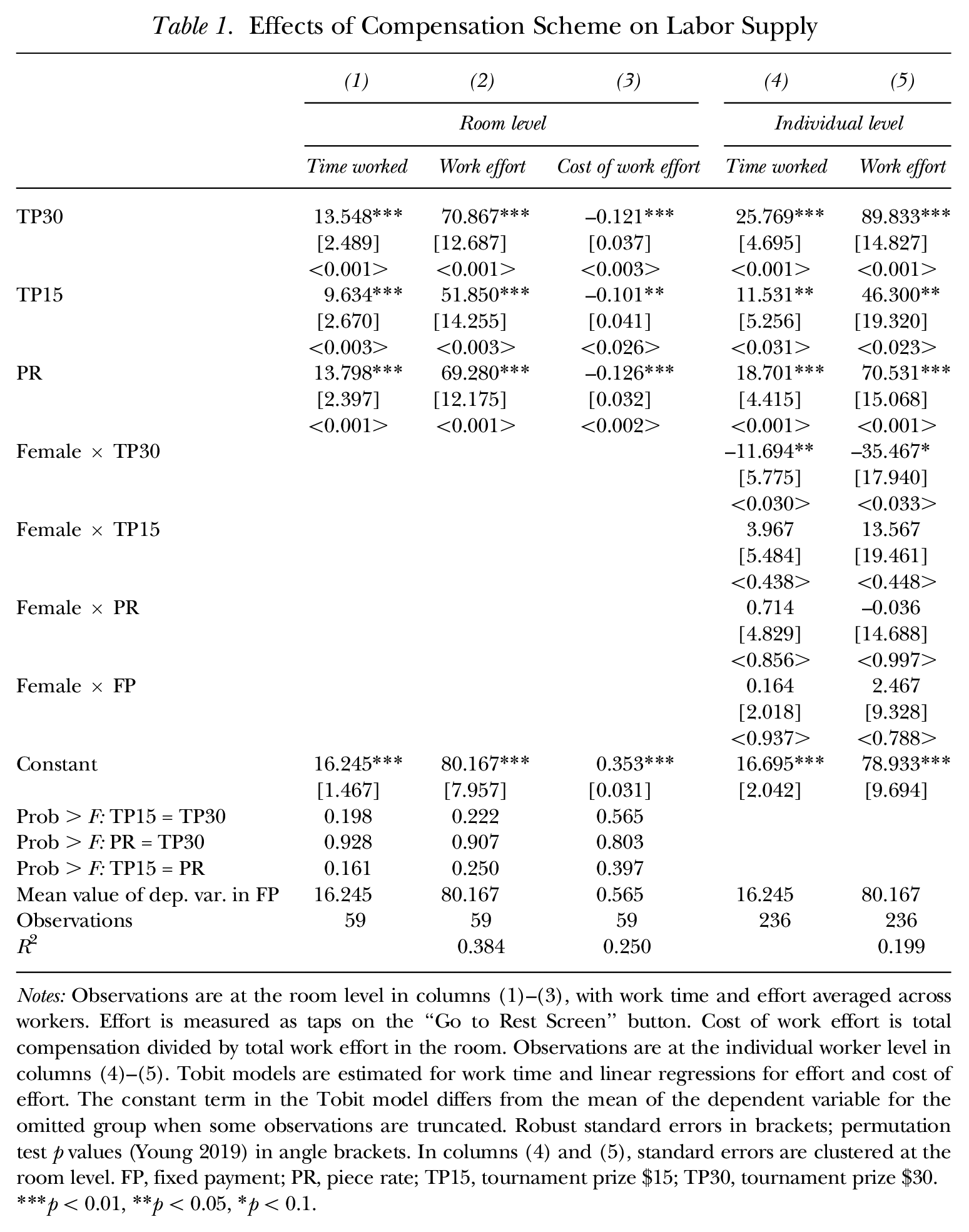
Our first result is that, consistent with theory, work time is indeed substantially higher among workers competing for a $30 tournament prize than among those working for fixed pay. This finding is true notwithstanding our successful efforts to trigger social impulses; more than half of the workers in the fixed payment (FP) treatment, with no monetary incentives to work more than 10 minutes, did so (more than 58%; Appendix Figure A.1), for an average work time of 16.2 minutes (Table 1, column (1)). Nevertheless, work time was significantly longer in TP30, averaging 29.8 minutes, or 83% longer than in FP. Only 15% of TP30 workers stayed less than 11 minutes and 55% worked the full 40 minutes, which is 8 times higher than the share working that long in FP (Appendix Figure A.1).
Effects of Compensation Scheme on Labor Supply
Notes: Observations are at the room level in columns (1)–(3), with work time and effort averaged across workers. Effort is measured as taps on the “Go to Rest Screen” button. Cost of work effort is total compensation divided by total work effort in the room. Observations are at the individual worker level in columns (4)–(5). Tobit models are estimated for work time and linear regressions for effort and cost of effort. The constant term in the Tobit model differs from the mean of the dependent variable for the omitted group when some observations are truncated. Robust standard errors in brackets; permutation test p values (Young 2019) in angle brackets. In columns (4) and (5), standard errors are clustered at the room level. FP, fixed payment; PR, piece rate; TP15, tournament prize $15; TP30, tournament prize $30.
p < 0.01, **p < 0.05, *p < 0.1.
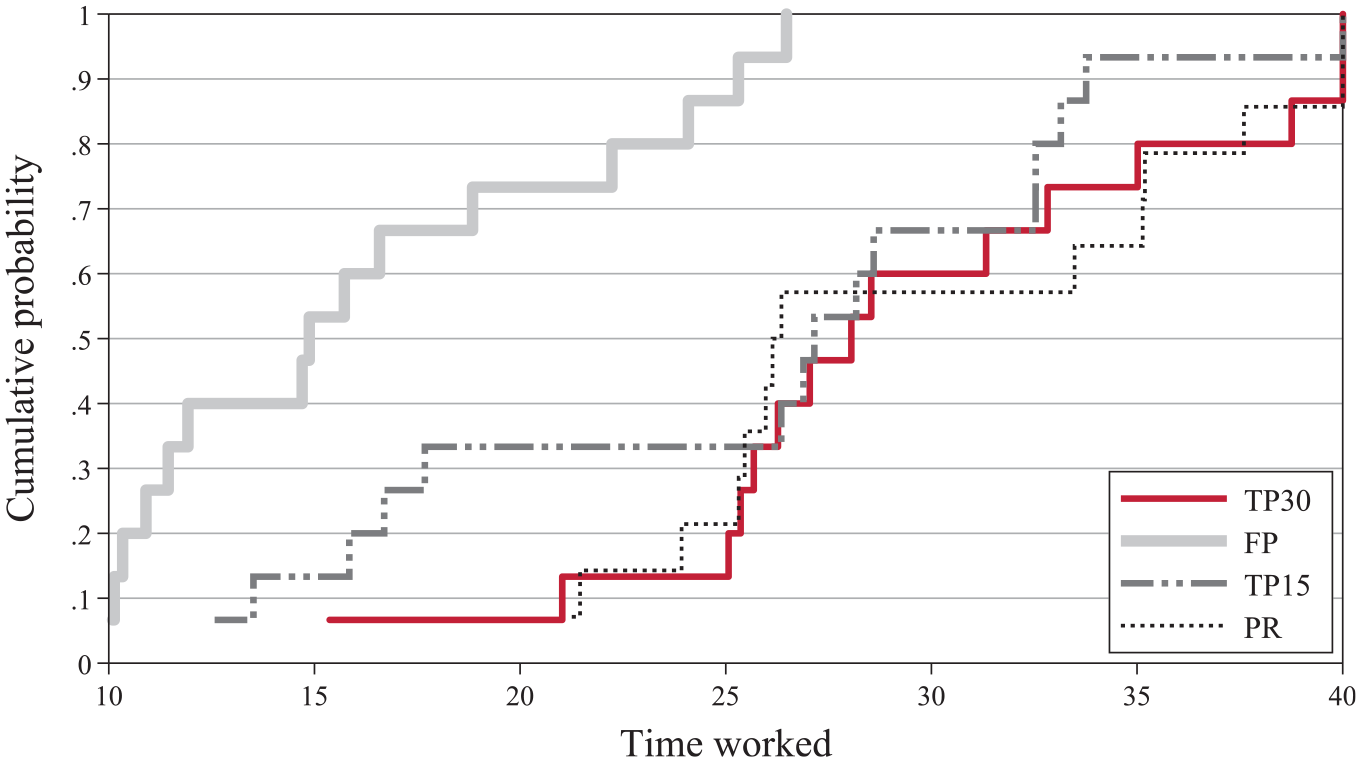
The increase in work time that came from awarding a monetary performance-based bonus in TP30 was also present for the other bonus treatments. Figure 1 illustrates this impact by showing the cumulative distributions of average work time across rooms, separately by treatment. Work time distributions are not statistically distinguishable between the various bonus treatments, but each of the bonus treatments dominate FP. 11 These significant treatment effects are confirmed in regression analysis in Table 1 (column (1)) on mean time spent working and are robust to permutation tests, as recommended by Young (2019). The significant effects of each bonus treatment, relative to FP, are also confirmed in Appendix Table A.2, which reports results from regressions using worker-level data, with standard errors clustered at the room level, and in Appendix Table A.3, which uses worker-level data and adds controls for individual characteristics (listed in Appendix Table A.1). Across all models, work time is higher in TP30 than in TP15, but it is not statistically significant at conventional levels in models without controls. The addition of controls in Appendix Table A.3 renders the difference between the two tournaments statistically significant at the 5% level. These results support the theoretical prediction that tournaments increase work time, while also showing that similar results can be achieved with individual, non-competitive incentives (in PR), when those are technically feasible.
Distribution of Work Time by Treatment
We also confirmed that the additional work time in the bonus treatments translated into higher total effort in those treatments relative to FP. We measure effort by clicks on the “Go to the Rest Screen” button. Table 1 (column (2)) shows significantly higher effort in each of the bonus treatments relative to FP, with an 88% increase in TP30, but no significant differences among the bonus treatments. 12 As a result, we find that offering bonus payments was profitable for the employer, despite the higher compensation per worker. Costs per unit of effort were 52% (or 12 cents) higher in FP than in TP30 (Table 1, column (3)) but not statistically distinguishable across the bonus treatments. 13 This pattern is unchanged if we instead use alternative measures of effort (e.g., work time, red square taps, points earned; see Appendix Table A.5). These results highlight the potential economic value to employers of offering tournament incentives to lower the cost of extracting effort from workers.
Gender Differences in Effects of Competition
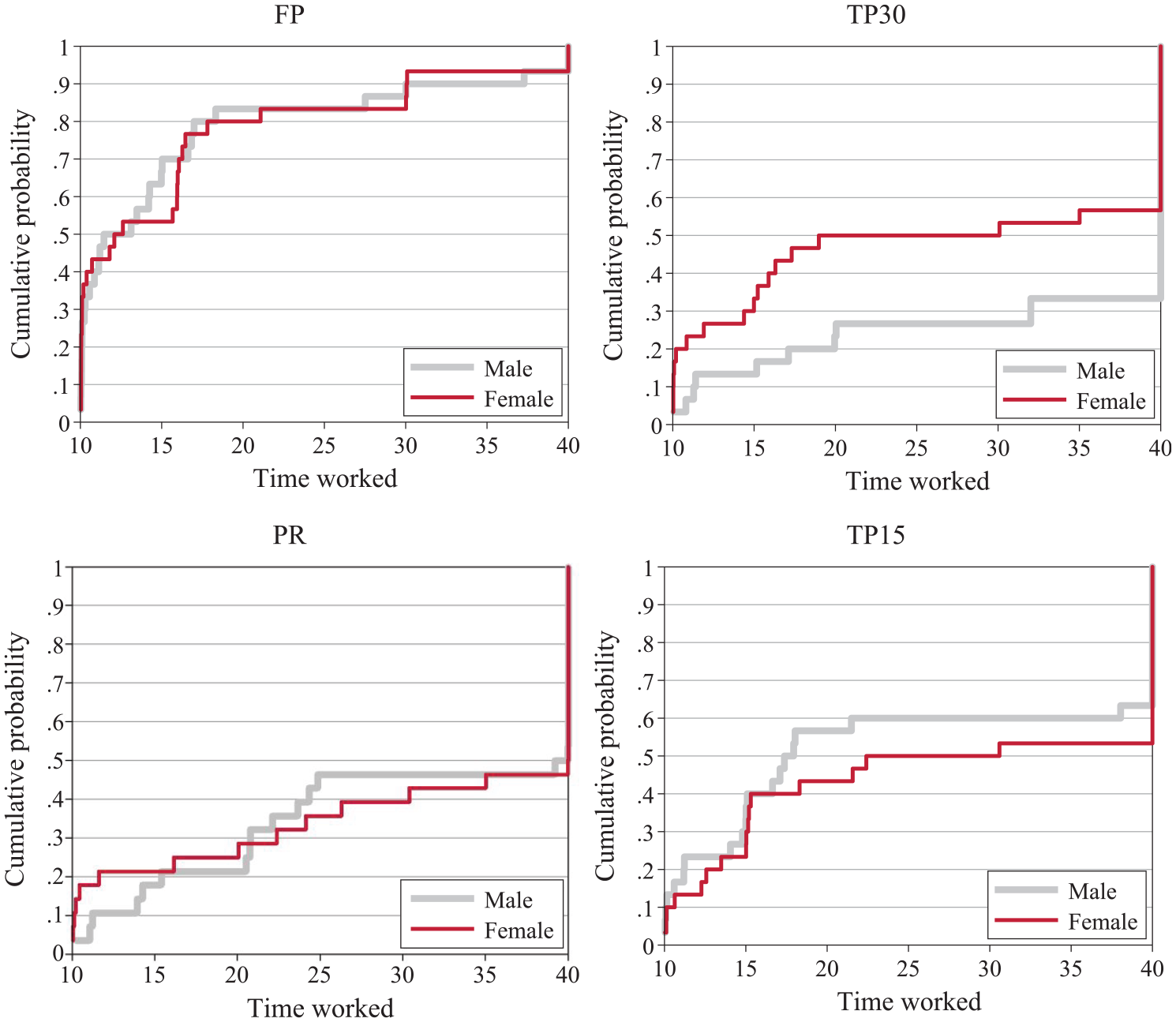
The remainder of our analysis focuses on gender differences in response to competitive compensation structures. We build on significant prior literature finding that, under common workplace conditions (e.g., gender-mixed groups, stereotypically male tasks), competition favors men (Niederle 2016). This imbalance occurs at both entry and performance phases, by disproportionately attracting male workers (Niederle and Vesterlund 2007) and because men increase the intensity of their work effort to a larger extent in response to competition (Gneezy, Niederle, and Rustichini 2003). This section examines data from our main experiment to test for gender differences in response to exogenously imposed competitive incentives. We focus on the novel outcome (relative to prior literature) of work hours in Figure 2 and present regression results for work time and total effort in Table 1.
Distribution of Work Time by Treatment and Gender
The first result is apparent in the work time distributions by gender, across treatments, depicted in Figure 2: Both male and female workers significantly increase their work time in response to financial incentives. Male and female work times are statistically longer in each of the bonus treatments relative to FP (Appendix Table A.6). 14 This result is consistent with effects found in the literature for other effort measures (Bandiera et al. 2021). The second, related result is that male and female work times are statistically indistinguishable from one another in FP, PR, and TP15. The absence of gender differences in the two non-competitive treatments (FP and PR) supports the interpretation that our experimental design eliminated gender differences in outside obligations and that men and women responded similarly to the non-competitive social and financial features of the work.
By contrast, the third key result is a significant gender difference in response to the high-stakes competition. In TP30, men work significantly longer than women and invest significantly more total effort (Table 1). 15 As a result, they represent 73% of TP30 winners. Because this gender gap emerges in a setting in which all workers are available for the maximum work time, the source of the gender difference in TP30 work times likely reflects a differential response to the competitive incentive scheme. The gap in TP30 resembles prior findings in the experimental literature; even the sensitivity of the gap to the prize level (with a gender difference in TP30 but not in TP15) is consistent with prior findings that gender differences in response to competition depend on specific features of the competition, such as the prize amount (Petrie and Segal 2017) and nature of the task (Niederle 2016).
Because our tournaments take place over time, among workers performing their tasks simultaneously and in proximity, each worker’s effort is an equilibrium outcome that depends on their evolving beliefs about the strategies of their competitors. This detail makes it challenging to pinpoint the reason why we find, from our data, a gender gap in TP30 only. One possibility is that men enjoy competition only when the prize is deemed large enough to be exciting and salient (Iriberri and Rey-Biel 2017) and that women respond by leaving earlier in TP30 and later in TP15. The women could be responding to the effects of men’s choices on their chances on winning or to the fact that those choices also shift the gender balance of the room over time. If women prefer not to compete against men (Gneezy et al. 2003; Niederle et al. 2013), they will find the TP15 scheme more attractive: One-third of TP15 sessions ended with single-sex female rooms, while all TP30 sessions had at least one male worker among the last to leave (Fisher exact test p = 0.042). Alternatively, it could be that women are more averse to high-stakes competitions, which offsets the financial draw to them from the higher prize amount, and that women’s departures then induce men to invest even more effort.
Secondary Field Experiment: Opting into Competition
The data from the main experiment suggest gender differences in preferences for workplace competition but are insufficient to determine whether the source is from men’s or women’s relative preferences for higher- or lower-prized tournaments. We refrained from asking workers directly about their beliefs or preferences because that would have undermined the integrity of the field experiment. We therefore conducted a second field experiment, in which workers were hired to perform the same task, but in which they were first given the choice between tournament and overtime wage compensation schemes. The choice job applicants face in the second experiment, of whether to enter a competition, is comparable to the choice workers face in the first experiment, of how long to work, which is itself the result of repeated decisions to continue in the workplace competition. These choices differ in their timing and outside options, but they should both be affected in the same qualitative way by preferences for competitive compensation. Note that decisions in the second experiment are not affected by observable actions of competitors and can therefore be used to assess ex ante preferences for competitive compensation for men and women separately. The second experiment also provides a useful counterpoint to the main experiment in that it allows us to consider the initial entry decision, which has been a focus in the prior literature (Niederle and Vesterlund 2007; Dohmen and Falk 2011), but which has not been considered for tournaments with variable hours.
In the secondary experiment, prospective job applicants are informed at the time of enrollment that compensation will take the form of a $20 flat payment plus a bonus that can either be a wage rate of 20 cents per minute (beyond the first 10 mandatory minutes) or a tournament prize. 16 They are told that tournaments always take place between four workers in the same room, who are assigned to the same prize level, and who selected that tournament at that prize level. Using the same explanation as in the main experiment, potential workers are also told that they need to work for at least 10 minutes to earn $20 and are encouraged to work as long as possible (for up to 40 minutes). Because workers are assigned to prize levels only after their initial intake, they need to indicate if they prefer the overtime wage rate or tournament for each of the potential prize levels ($12, $18, $24, $30, and $36). 17 Employed workers then performed the task under the work conditions described above and were paid performance bonuses according to their assigned tournament prize level and their choice of tournament or overtime wage rate at that level. Applicants’ choices of payment scheme therefore had consequences for their expected payoffs. 18
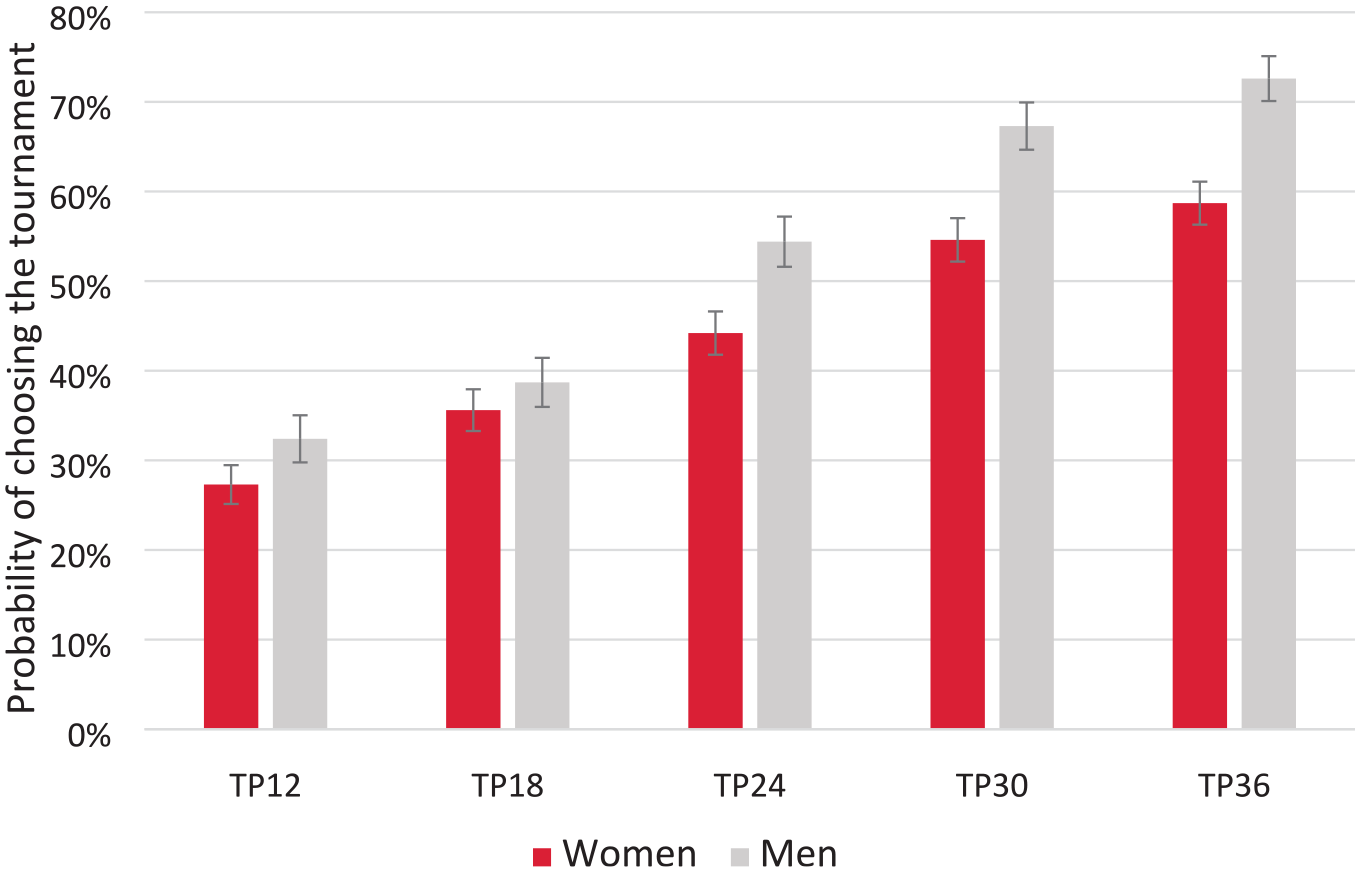
In a pattern that echoes the gender differences in work time and effort found among workers in the main experiment, the main result of the second experiment is a gender gap among applicants (n = 739) that emerges as men become more likely than women to opt into competitions with increasing prize levels. As shown in Figure 3, no significant gender difference is evident in rates of tournament choice for the two lowest prizes (offering lower expected payments for 40 minutes of work than the overtime wage rate), analogous to the similarity in work time between men and women in TP15. As the prize level increases, however, the participation gap increases to 10 percentage points at $24, 13 points at $30, and 14 points at $36, all significant at the 1% level. This pattern echoes the gender gap in work time being present for TP30 but not TP15, suggesting that high-stakes tournaments are what generate gender gaps in tournaments with variable time.
Tournament Entry Rates by Gender
In addition to supporting the findings of the main experiment, the results from the choice experiment also help shed light on the source of women’s apparent non-response to the higher prize level in TP30 relative to TP15. In the main experiment, only men increase their work time between TP15 and TP30. Yet in the choice experiment, both men and women respond to higher prize amounts by choosing the tournament at a higher rate. 19 We infer that women’s stable labor supply between TP15 and TP30 likely emerges in response to the observed behavior of their male co-workers, rather than women’s stronger aversion to high-stakes competitions. When men respond to the higher prize in TP30 by staying significantly longer than in TP15, this behavior raises both the number and share of men among active competitors, which creates dynamic equilibrium effects that depress female persistence in TP30, relative to TP15. The result is similar work times for women in the two tournaments, despite the difference in prize levels and women’s usual responsiveness to financial incentives.
Conclusion
Taken together, the two experiments support prior findings of gender differences in tournament entry and effort and extend them by considering a novel setting with variable time and a new outcome. The ultimate source of these gender differences in behavior may be gender differences in preferences (tastes for competition or risk), beliefs (confidence), or some combination thereof (Gneezy et al. 2003; Niederle and Vesterlund 2007; Gillen, Snowberg, and Yariv 2019). Regardless of their underlying source, our results suggest that high-stakes workplace competitions with variable hours will disproportionately attract and reward male workers and exacerbate gender gaps in labor market outcomes.
If gender gaps in competitive outcomes are in fact attributable to women’s lack of confidence or aversion to risk or competition, it might be possible to improve gender equality by inducing more women to compete. Indeed, research suggests that employers can eliminate gender gaps in entry, without lowering performance standards, by changing the default option (He, Kang, and Lacetera 2021) or by adding an affirmative action program (Niederle et al. 2013) in fixed-time competitions. It may also be possible to socialize girls to be more achievement-oriented and therefore willing to compete (Sandberg 2013; Alan and Ertac 2019).
The initial finding of this article, however—that competition itself increases work time—highlights a key limitation of these approaches. In jobs in which workers can voluntarily supply additional work hours, even women who enjoy competition will be at a disadvantage if they face tighter constraints on their work hours because of household and caretaking responsibilities. If family structures and social expectations continue to rely on women to provide the bulk of unpaid labor, workplaces that require long hours will be unfavorable to women, and employers who want to diversify their top ranks may need to apply differential promotion standards. Even formal restrictions on hours may be ineffective if workers decide to circumvent them and voluntarily supply additional labor. Furthermore, because competition itself drives longer work times, we have little reason to expect that technology-enabled shifts in the labor market, such as rising productivity and income levels (Pecci and Piga 2010), more flexible or remote work arrangements (Barrero et al. 2021), or greater automation (Rifkin 1995; Autor, Levy, and Murnane 2003; Brynjolfsson and McAfee 2014; Acemoglu and Restrepo 2018, 2020; Graetz and Michaels 2018; Frank et al. 2019), will eliminate the requirement of long hours for elite jobs.
Our finding that piece rate incentives also increase labor supply, by an amount comparable to tournaments, on average, might appear to imply that any form of performance pay would contribute equally to gender inequality through the indirect mechanism. This is not the case. While we do find similar overall increases in labor supply across the incentive treatments, the two types of performance pay produce vastly different compensation schedules for individual workers as a function of their effort. Production increases linearly with effort in our setting, as does bonus pay from the piece rate. However, the tournament itself generates a convex relationship between pay and work time, because only the winner receives a bonus (and the winner is typically among the workers who stay the longest). Tournaments penalize workers with time constraints, relative to their production, making them ineffective for motivating part-time or flexible-hour workers; this is not the case for incentives based only on individual performance. The convexity of payoffs with respect to effort in tournaments also amplifies the direct effects of competition resulting from gender differences in labor supply responses to tournament incentives absent external time constraints. In our high-prize treatment, men’s work time was 25.4% greater than women’s, but that was enough to make men 2.75 times more likely to win the tournament, and as a result their bonus pay was 175% higher.
We therefore conclude that as long as workers can improve their relative standing by putting in longer hours, competition itself generates workplace gender inequality. Moving away from competition would require significant changes to organizations and may not be feasible in many cases. As noted by Lazear (2018), relative performance incentives are pervasive in the workplace, and nearly ubiquitous for promotions, because the number of leadership positions is small relative to the workforce. This fact suggests that improving gender workplace equality will require grappling with both direct and indirect effects of competition. Our finding of indirect effects of competition suggests that achieving gender equity at work will require policy and social changes that extend beyond the capacity of individual employers and workplaces. Without such extensive changes, the unequal division of unpaid labor will remain an obstacle to women’s progress in competitive jobs that require long hours. Our finding of direct effects of high-stakes competition on gender inequality, even when external obligations are eliminated by design, further suggests that gender balance in home production will be insufficient alone to produce gender balance in the workplace.
Supplemental Material
sj-pdf-1-ilr-10.1177_00197939231223178 – Supplemental material for Effects of Workplace Competition on Work Time and Gender Inequality
Supplemental material, sj-pdf-1-ilr-10.1177_00197939231223178 for Effects of Workplace Competition on Work Time and Gender Inequality by Amalia R. Miller, Ragan Petrie and Carmit Segal in ILR Review
Footnotes
Acknowledgements
We thank various seminar and conference participants and discussant Amanda Agan for helpful comments. We are also grateful to Cailin Slattery and Elliott Isaac for outstanding research assistance. We acknowledge financial support from the Bankard Fund for Political Economy at the University of Virginia. AEA RCT Registry number AEARCTR-0004266, University of Virginia Human Subjects Approval number 2015-0267-00.
For information regarding the data and/or computer programs used for this study, please address correspondence to
1
Workers were told that they could be hired only once, and none requested recommendations or references.
2
Although we have reason to expect an increasing marginal product of labor at low work hours (from fixed hiring costs or transition costs into tasks for workers), long hours must be accompanied by long working days. Therefore, it is natural to expect diminishing returns to take effect at some point because of fatigue.
3
4
See Appendix B for a complete description of study implementation, including all recruitment materials, scripts, and screen shots. (All Appendices, including Appendix Tables and Figures, are presented online as Supplementary Material.)
5
See Gneezy et al. (2011) for a survey. Even if workers find parts of their jobs intrinsically motivating and therefore experience periods of low (or even negative) effort costs, this feeling is unlikely to apply to all necessary parts of a job to the degree that it exceeds enjoyment from leisure ( ).
).
6
With a scale from 0 (not at all) to 5 (very much), 61.4% of responses to the question, “How much did you enjoy the game?” were 0 (29.2%) or 1 (32.2%). Workers in the fixed payment group, who had no financial incentive to stay longer than 10 minutes, but who often did, expressed the least enjoyment: 73.3% answered 0 (33.3%) or 1 (40.0%).
7
As we do not know our workers’ risk aversion or their beliefs about competitors’ strategies, we cannot derive the piece rate value that is, on average, equivalent to TP30 from their perspective.
9
We dropped all disrupted sessions, six in total. These occurred in early sessions because of workers restarting the program. Subsequently, assistants ensured all programs were running properly prior to leaving the room.
10
We dropped one of the piece rate sessions because, after completing the session, we discovered that it included a worker who had previously been hired under another email address.
11
First-order stochastic dominance (FOSD) tests show the distributions of time worked are indistinguishable between TP30, TP15, and PR. P values for the null hypothesis that the first treatment listed stochastically dominates the second and vice versa are: TP30 vs. TP15 (0.9167, 0.2874); TP30 vs. PR (0.5866, 0.5596); and TP15 vs. PR (0.1349, 0.5693). However, all bonus treatments stochastically dominate FP: TP30 vs. FP (1.000, 0.0001), TP15 vs. FP (1.000, 0.0042), and PR vs. FP (1.000, 0.001).
12
As reported above for work time, when we estimate the model on individual-level data and include controls, we find that the greater effort in TP30, relative to TP15, becomes statistically significant (p value of 0.051; Appendix Table A.3). We separately find that the increased effort in bonus treatments is derived primarily from the extensive margin effect of working longer. We do also find small increases in effort per minute of working, as shown in , for the entire session (which could be affected by selection induced by work time) and during the first 10 minutes (when all workers are present).
13
Our finding of greater effort in the piece rate treatment aligns with the comparison between piece rates and fixed wages in Kube, Maréchal, and Puppe (2013) and with the further examination (also adding work time as an outcome) of the underlying sources of “gift exchange” (using piece rates and different types of gifts) in DellaVigna, List, Malmendier, and Rao (2022).
14
FOSD tests show both men and women work longer with performance pay (PR, TP15, TP30) compared to fixed payment (FP). P values for the null hypothesis that work time under performance pay stochastically dominates under fixed payment and vice versa for men are PR (0, 1.000), TP15 (0.0154, 1.000), and TP30 (0, 1.000). For women: PR (0.0001, 0.9012), TP15 (0.0018, 1.000), and TP30 (0.0081, 0.6810).
15
FOSD tests show the male and female distributions of time worked are not distinguishable in TP15, PR, and FP. P values for the null hypothesis that men’s work time stochastically dominates women’s and vice versa are: TP15 (0.3397, 0.8973), PR (0.5912, 0.4305), and FP (0.4455, 0.5939). Men’s work time does, however, stochastically dominate women’s in the TP30 treatment (1.000, 0.0379). The gender difference in work time fully accounts for the difference in total work effort in our experiment. shows no gender differences in TP30 on the intensive margin of effort (per unit of time, conditional on working), overall, or in the first 10 (mandatory) minutes.
16
We used a wage bonus rather than fixed payment as the alternative compensation scheme because (as shown in the first experiment) the tournament always dominates fixed payment, holding the show-up fee constant. Although, we could have equally used a piece rate bonus, we chose a wage rate because it is more common. Because workers were made aware of the existence of a bonus when applying for the job, the show-up fee was not the only inducement to encourage applications. Reducing the show-up fee had the feature of making the bonus relatively more attractive.
17
The wage rate value is set to equate to the payoff from working the full 30 minutes of overtime at that rate ($6) with the expected payoff to a worker who has a one-in-four chance of winning (i.e., the probability of winning if all workers stay the same time) the median tournament prize ($24). We implemented two versions of randomly choosing the prize: one in which all tournament prizes were equally likely to be selected and another in which we did not mention the likelihood of a prize being selected. Both versions yielded the same qualitative results, so we pooled their data.
References
Supplementary Material
Please find the following supplemental material available below.
For Open Access articles published under a Creative Commons License, all supplemental material carries the same license as the article it is associated with.
For non-Open Access articles published, all supplemental material carries a non-exclusive license, and permission requests for re-use of supplemental material or any part of supplemental material shall be sent directly to the copyright owner as specified in the copyright notice associated with the article.
