



Abstract
In this article, the authors examine the role of labor immigration as a source of institutional change. They use a “most different systems” comparative case study analysis of the Danish and Australian construction sectors to examine the impact of increased labor migration on skill-sourcing practices in countries with distinct national skill formation and industrial relations institutions. Drawing on 73 interviews with industry stakeholders, the authors find that labor migration has produced liberalizing pressures in both Denmark and Australia, albeit in ways that differ from each other. The article contributes to comparative institutional scholarship by illustrating how labor migration can promote or support institutional change in a liberalizing direction by disincentivizing coordinated skill formation. Findings suggest that while national institutions mediate external pressures, such as labor migration, such pressures may affect the incentive structures that can either maintain or erode national institutions.
Keywords
Increased cross-border labor mobility has expanded skill supply in many advanced economies in recent decades. Despite the growing importance of migration as a source of skills, academic research continues to focus almost exclusively on domestic sources of skills supply and their relationship with national institutions (Busemeyer and Trampusch 2019). This research suggests these institutions affect the scale and skill mix of labor migration (Afonso and Devitt 2016). How labor migration affects domestic institutions remains an open question.
Much of the existing scholarship on labor migration and institutions is anchored in the Varieties of Capitalism (VoC) framework. This theory suggests that complementarities between national market institutions create distinct national models (Hall and Soskice 2001) that remain unaffected by external pressures such as international trade and labor migration. The incremental change approach (Streeck and Thelen 2005) suggests that national institutions will transform over time in response to gradual changes; its focus, however, is mainly on domestic sources of change with little attention paid to labor migration and other sources of external pressure.
This article argues that labor migration can be an important source of institutional change. Once the option of recruiting workers from abroad has been established, firms may change their skill-sourcing behaviors, which can incrementally change how institutions function (Streeck and Thelen 2005). Because of the institutional complementarities of national institutions, labor migration may influence skill formation and industrial relations institutions. We also argue that labor migration is associated with liberalizing institutional change—either by directly promoting defection from domestic institutions or by supporting liberal reform through alleviation of the skill shortages that liberalization creates. In examining this issue, we address the following research question: How does labor migration affect skill-sourcing practices and policies in countries with distinct national skill formation and industrial relations institutions?
Relying on a “contextualized” (Locke and Thelen 1995) and “slow” (Almond and Connolly 2020) comparative approach, and drawing primarily on 73 interviews with industry stakeholders, we address this research question by studying firms’ skill-sourcing practices and policies in the Danish and Australian construction sectors. Denmark and Australia represent “most different systems,” as they have liberal and coordinated institutions, respectively. Our focus is construction because the effects of labor migration are more pronounced in this sector than in other sectors (Eldring, Fitzgerald, and Arnholtz 2012). Our empirical focus is on the interaction between vocational education and training, industrial relations, and labor migration, which studies have identified as the main sources of skill supply (Oliver and Wright 2016).
The article thus contributes to the literature on comparative industrial relations and comparative political economy by studying whether and how labor migration, by giving firms a new source of skills, can promote or support institutional change in a liberalizing direction by disincentivizing coordinated skill formation. We highlight that although national institutions mediate external pressures, such as labor migration, such pressures may affect the incentive structures that can either maintain or erode national institutions.
Theoretical Context
Complementary National Institutions and Skill-Sourcing Practices
The importance of labor migration as a source of skills has been a relatively overlooked issue in comparative industrial relations scholarship and related fields with an institutional focus, such as comparative political economy. When addressed, labor migration has mainly been treated as something to be explained by a country’s pre-existing institutions. For example, scholars drawing on the VoC framework (Hall and Soskice 2001) have distinguished between types of market economies. Liberal market economies (LMEs), such as the United States and Australia, are said to rely on market coordination, whereas coordinated market economies (CMEs), such as Germany and Denmark, are more likely to use non-market coordination. This general tendency to rely respectively on market or non-market coordination is upheld by complementarities between institutions that govern diverse aspects of a national economy, such as industrial relations, vocational education and training (VET), corporate governance, inter-firm relations, and employee relations (Hall and Soskice 2001). Our analytical focus on firms’ skill-sourcing practices concerns the first two of these institutions, namely industrial relations and VET, plus immigration policy.
In LMEs, firms are assumed to adopt competitive approaches for addressing their skills needs. They generally rely heavily on recruiting workers from external labor markets, for instance, by poaching workers from their competitors. Firms will therefore limit their workforce training provision to firm-specific skills, rather than general or transferable skills, because they fear losing their training investment when competitors poach workers. Consequently, skill formation institutions in LMEs are mainly focused on providing general skills, which the state and workers typically pay for. This approach is complemented by liberal industrial relations systems, which incentivize workers to invest in their human capital by allowing for large wage differences between higher- and lower-skilled workers (Busemeyer and Iversen 2011).
By contrast, CMEs’ skill formation rests more on collaborative and longer-term actor relations, which is believed to increase the likelihood of firms cooperating with unions and other firms to develop industry-specific skills that apprenticeship systems typically provide (Hall and Soskice 2001; Busemeyer and Trampusch 2019). Coordinated skill formation is complemented by coordinated industrial relations systems that compress wages by setting relatively high wage floors and moderating wage determinations. This approach incentivizes firms to train workers since firms can reap a larger share of training-related productivity gains (Busemeyer and Iversen 2011).
Several scholars have extended these assumptions by examining how national institutions shape immigration policies and employer preferences toward labor migration. Menz (2008) argued that CMEs aim to recruit high-skilled rather than low-skilled migrants to address skills needs, whereas LMEs have demand for both high-skilled and low-skilled migrants. Afonso and Devitt (2016) argued that because LMEs emphasize general rather than industry-specific skills, and because of the tendency of employers to poach rather than to train workers, LMEs can be expected to rely more on labor migration than do CMEs, where low-skilled migrant workers may threaten established wages and working conditions. Other studies have used the VoC framework to analyze how national market institutions condition the scale and skill mix of firms’ demand for migrant labor (e.g., Wright 2012). In sum, previous research has suggested that labor migration as a source of skills is more complementary in LMEs than in CMEs because of the impact of their respective skill formation and industrial relations institutions (Afonso and Devitt 2016; Busemeyer and Trampusch 2019).
From Static Models to Institutional Change
While the VoC framework and its emphasis on institutional complementarities has been an influential lens for analyzing the impact of market institutions on labor migration, it has been criticized for being too static. A growing body of research has emphasized the nature of and processes underpinning institutional change. For example, Streeck and Thelen (2005) distinguished between varieties of abrupt and incremental institutional change. They stressed how institutional change can occur when practices change while formal regulation stays the same. They thus challenge the basic assumption that firms “can be expected to gravitate toward strategies” aligned with national institutions (Hall and Soskice 2001: 15) by arguing there will always be “unruly” firms that seek institutional loopholes and new strategies to improve their competitiveness and profitability (Streeck 2009; Jaehrling and Méhaut 2013).
Direction of change is another issue central to the institutional change literature. Some scholars argue that institutional changes have gone in the direction of deregulatory liberalization (Streeck 2009; Howell 2021), that coordinated economies have been dualized (Emmenegger, Häusermann, Palier, and Seeleib-Kaiser 2012), and that directions of change have varied across countries (Thelen 2014). In contrast to the firm-centered approach of VoC, scholars examining types and directions of institutional change have focused on a broader range of actors, such as employer organizations, trade unions, political parties, and the state (Mahoney and Thelen 2010; Thelen 2014; Baccaro and Howell 2017; Howell 2021). This literature has emphasized overall policy changes (neoliberalism or dualization), changes to individual institutions such as VET institutions (Carstensen and Ibsen 2021), and the role of institutional complementarities in creating pressures for change across institutions (Palier and Thelen 2012). However, this literature has paid little attention to labor migration as a source of institutional change.
In this context, we argue that labor migration should be viewed as a potential source of institutional change and not just as a potential source of skills that complement a country’s pre-established institutions. We believe labor migration can change firms’ behavior in how they source skills and thus lead to incremental change in how institutions function. Streeck and Thelen (2005) described this kind of institutional change through behavioral change as “drift.” Furthermore, we argue that once firms opt to recruit workers from abroad, labor migration starts to affect the institutional complementarities of national institutions in a liberalizing direction.
We distinguish between two ways this liberalization can occur—supporting or promoting. On one hand, labor migration may support liberalizing reforms by alleviating skill-sourcing problems caused by industrial relations or VET institutions that incentivize poaching. When liberalizing reforms erode training coordination efforts, trade unions and employers may try to resist them. However, if employers gain access to migrant workers as an alternative source of labor it diminishes their incentive to solve training problems through coordinated efforts and increases their support for liberal institutions. On the other hand, labor migration may directly promote liberalizing institutional change by causing defection from coordinated training efforts. If labor migration offers firms a market-based, short-term solution for addressing their workforce needs, this disincentivizes firms from participating in coordinated skill formation. Even if both trade unions and employer associations still support a coordinated skill formation system, maintaining such a system can become difficult if behavioral changes result in firms gradually stopping their participation in the training effort.
One potential counterargument is that the industrial relations institutions of CMEs would prevent firms from employing low-skilled and low-wage migrant workers (Menz 2008); however, labor migration also challenges CME industrial relations institutions. The expansion of the labor force with workers who have lower wage expectations due to their home country frame of reference (Piore 1979), or who are easier to control, for instance, because of mobility restrictions associated with their residency status (Anderson 2010), makes effective enforcement of industrial relations institutions more difficult in both CMEs and LMEs (Clibborn and Wright 2018). For unruly firms in CMEs, labor migration creates new market conditions that motivate them to engage in behaviors that challenge institutions (Wagner 2015). Once some unruly firms have found ways of utilizing migrant workers to reduce their labor costs, other firms may feel pressured to follow suit. Therefore, firms in CMEs may be enticed to use migrant workers in response to recruitment challenges. In these ways, labor migration has the potential to support liberal institutions in LMEs and to challenge coordinated institutions in CMEs regarding both skill formation and industrial relations. We therefore need to study the effects of labor migration as a source of institutional change and stability in countries with distinct institutional arrangements.
Methods
We examine how labor migration affects skill-sourcing practices and policies in countries with distinct skill formation and industrial relations institutions through a “most different systems” comparative case design. This approach is appropriate for analysis of cases that largely differ in theoretically important respects, namely the nature of their national institutions, but share similarities in terms of the dependent variable (i.e., institutional change) and the key independent variable (i.e., increased utilization of migrant workers to address skill demand) (Landman and Carvalho 2003; Ryan 2018).
Denmark and Australia can be considered to have “most different” skill-sourcing systems because the main sources of skills supply—that is, industrial relations, training, and immigration—though not exemplary, broadly conform to the LME and CME typologies (Andersen, Wright, and Lansbury 2022). Additionally, Denmark is considered a reluctant “country of immigration” that has traditionally addressed skills needs through domestic institutions. By contrast, Australia is generally classified as a “nation of immigrants” that historically has relied more extensively on immigration, primarily through permanent residency, as a source of skills and labor (Hollifield, Martin, Orrenius, and Héran 2022). Therefore, we would expect the two countries to react in dissimilar ways to contemporary skill-sourcing problems. Recent changes in immigration regulations, however—namely, the expansion of the European Union to include low-wage economies affecting Denmark, and the liberalization of temporary visas in Australia—have altered the role of immigration and its potential relationship with other skill-supply institutions in both countries. If the consequential increased supply of migrant workers led to institutional change in the form of liberalizing skill-sourcing practices in the two countries, the “most different systems” design would suggest that increased migration is the likely cause.
The case studies are analyzed through a “contextualized comparison” (Locke and Thelen 1995), which recognizes that similar institutional change trajectories may appear to differ due to differences in the underlying contexts. For instance, while the inflow of migrant labor is an issue of immigration policy in Australia, the European Union’s free movement of labor and services implies that Denmark cannot regulate inward labor mobility with immigration policy, which instead occurs through collective bargaining institutions. Therefore, to study how labor migration affects institutional changes, we must study different policy areas in the two countries. In addition, since the two countries are institutionally dissimilar to begin with, institutional change in the same (liberalizing) direction may appear to differ greatly in terms of immediate results (Baccaro and Howell 2017). In this context, Almond and Connolly (2020: 59) recommended a slow comparative approach, which relies on in-depth understanding of each case “to gain deeper and more reliable insights into the nature of, and reasons for, cross-national differences and similarities.” If the comparisons are too superficial, they argued, small and subtle yet potentially significant changes may be missed. Furthermore, the temporality of changes may differ greatly. In Denmark, the process of change has been more recent and has therefore not progressed to the same stage of liberalization. In Australia, major VET and industrial relations reforms in the 1990s were followed by incremental changes to immigration policies over a prolonged period. For this reason, we present the cases as two separate studies with their differences and similarities discussed in the conclusion.
To grasp long-term and subtle changes in skill-sourcing practices and institutions, we examine the construction sectors of the two countries. Trade-based skills and collective regulation of working conditions have historically played essential roles in the construction sector (Thelen 2004). Simultaneously, labor migration is also a key feature of the sector in many countries (Belman, Druker, and White 2021). Since the production process of the sector must be on location, the inflow of foreign labor is a key source of internationalization and can act as a functional equivalent to outsourcing (Menz 2005). Labor migration can help alleviate labor shortages, attract needed skills, and potentially secure an inflow of lower-wage labor for firms seeking competitive advantages or responding to competitive pressures. Thus, construction is a suitable sector for analyzing the impact of labor migration on national institutions.
Empirically, we draw primarily upon semi-structured interviews with construction sector officials representing trade unions and employer associations in the two countries. In line with Almond and Connolly’s (2020) call for slow comparison, we utilize interview data from an extended period in both cases. In Denmark, we conducted 42 interviews with union officials, employer association representatives, government officials, and company human resource managers between 2007 and 2021. Interviews addressed changes in the construction sector with particular attention to migrant labor, employers’ skill-sourcing strategies, VET-related problems, and institutional changes associated with these issues. In Australia, we conducted 31 interviews between 2008 and 2021 with union and employer association officials. The questions related mainly to the utilization of various sources of skills supply in the sector, including VET and immigration, the extent to which government policies and industrial relations institutions affected employers’ skill-sourcing strategies, and how and why these strategies and the institutions that affected them changed over time. Using interviews from these extended periods allows us to situate current developments in historical context and reconstruct the trajectory of change in the two countries (see the Online Appendix for further elaboration on the interview data). In addition, we present statistical data to illustrate our argument.
Findings
Denmark
In Denmark, the eastward enlargement of the European Union in 2004 and 2007 directly promoted defection from domestic institutions by providing firms with a new solution for addressing their immediate and long-term labor supply challenges. In the years after EU enlargement, employment of migrant workers significantly increased while the number of apprentices stagnated. Government, trade unions, and employer associations subsequently re-invested in the VET system, going as far as punishing firms that contributed too little to skill formation. At the same time, though, employers rejected collective bargaining reforms that would have prevented labor migration from transforming construction from an intermediate-skilled, medium-wage sector to a low-skilled, low-wage sector. This mixed response by employer associations has allowed firms’ defection from domestic institutions, as observed through stagnant apprenticeship intakes combined with increased recruitment of migrant workers. This defection represents an incremental liberalization process in the sector.
Challenges to the VET System
The Danish VET system retains many characteristics of coordination. Most Danish construction workers have a vocational education obtained through a dual training system, which consists of one year of school-based education and three years of firm-based apprenticeship training. This firm-based training follows a highly standardized program, ensuring that apprentices gain a broad set of transferable skills within their chosen vocation (Jørgensen 2018). Educational boards with employer and trade union representatives govern the system and determine the content of the curriculum.
The VET system has struggled, however, to address the construction sector’s skills needs for several reasons. First, the construction sector needs to educate more apprentices to replace the large cohort of older, retiring workers. The proportion of workers aged 50 years and older increased from 34% to 40% from 2000 to 2020. Second, the construction sector faces the continuous challenge of upskilling workers to improve productivity to accommodate the high wage levels set by the collective bargaining system (Arnholtz and Ibsen 2021). While most occupations across the sector have vocational education qualification requirements (e.g., carpenters, masons, painters), this challenge is particularly pronounced in growing occupations such as earthmoving and concreting, which historically have been unskilled (DK27, DK28; notations refer to interviewees, as listed in Online Appendix Table A.1). Maintaining the functioning of the skill formation system and its complementarity with the wage-setting system thus required an expansion in VET education by increasing apprenticeship numbers. Third, despite this need for educational expansion, insufficient numbers of apprenticeship positions remain a problem. The heavy reliance on firms for training has exposed the VET system to the risk of employers withdrawing. While employer representative and union official interviewees claim that Danish construction firms are typically willing to engage in training (DK27, DK29), they also note that the business cycle affects firms’ willingness to do so. During the economic boom leading up to 2008, construction firms increased apprenticeship recruitment partly in response to labor shortages. From 2007 to 2013, however, the number of newly hired apprentices dropped 37% because firms became more reluctant to open training positions (DK27).
In sum, despite relative institutional stability in the Danish construction VET system, problems with delivering the skills demanded by the sector have increased. While unions have sought to solve these problems primarily by strengthening the VET system, employers have also pursued other options, with labor migration being the most central one.
Emergence of Labor Migration as a Skill-Sourcing Solution
While migrant workers form a large proportion of the construction sector workforce in many countries (Belman et al. 2021), this has traditionally not been the case for Danish construction (DK1, DK2). The enlargement of the European Union in 2004 and 2007, however, delivered this new skill-sourcing option for Danish construction employers by expanding the labor market with a huge workforce with much lower wage expectations and a willingness to move across borders. Free mobility of labor under EU law implies that member states cannot use immigration policy to restrict workers moving from one EU country to another. Therefore, labor mobility is highly market based (Favell 2008), with employer demand playing a key role. The main source of regulating this labor mobility is labor laws or collective agreements that prevent employers from paying migrant workers lower wages than Danish citizens. From 2004 to 2008, Denmark had a transitional regime in place that required firms hiring migrant workers from the new EU member states to abide by a collective agreement but placed no limit on the number of migrant workers they could recruit. Beginning in May 2008, cross-border mobility was completely liberalized.
As the problems with the VET system began to manifest during the Danish construction boom that preceded the 2008 financial crisis, firms started recruiting Eastern European workers to fill vacant positions. They were recruited either as employees or as so-called posted workers engaged via foreign subcontractors. Posted workers are hired under the labor regulations of their home country, which limits the ability of trade unions and authorities to re-regulate their conditions (Wagner and Lillie 2014; Arnholtz and Lillie 2020). However, the lack of a statutory minimum wage in Denmark requires trade unions to extend coverage of collective agreements to ensure that minimum standards apply to posted workers and migrants employed directly by Danish firms. Even if unions achieve this, the flexibility of the collective agreement system allows firms to pay migrant workers much less than Danish citizens (Arnholtz 2021). Thus, while the formal rules of both the VET and the industrial relations system remain unchanged, the recruitment of low-wage migrant workers could cause a “drift” that would fundamentally change the meaning of those rules.
Division among Employers
Although Danish employers are generally supportive of the VET system, the emergence of a new skill-sourcing option opened debates about defection from and support for domestic institutions. Danish employers have been divided over the extent to which labor migration should be utilized. This division was reflected in debates among construction employers about the future of skill-sourcing during the 2008 to 2015 period (DK13, DK14, DK16, DK24). Especially in earthmoving and concreting work, in which most Danish workers lack formal education, using migrant workers at lower wages could increase firm profitability. The chair of the board of the largest construction employer association, the Danish Construction Association (DCA), was at the time the chief executive of a large Danish construction firm that had been a front-runner in using low-cost foreign subcontractors. He pressured DCA’s collective bargaining team not to accommodate union demands for measures that could restrict employers’ capacity to use foreign workers to reduce labor costs (DK24, DK25). In the 2007 collective bargaining round, DCA met union demands on the issue of migrant workers. From 2010 onward the issue became much more contested, with trade unions unable to gain new tools for tackling social dumping related to migrant workers (Arnholtz and Andersen 2018).
Simultaneously, employer associations started reminding their member firms of the flexibility that construction sector collective agreements afforded (DK14, DK25). In Denmark, these agreements have a relatively low minimum wage compared to the average wage in the sector, and firms were encouraged to set wages closer to the minimum. DCA engaged in several legal disputes all concerning migrant workers to defend their members’ right to remunerate at the minimum wage rate (DK17, DK23). Employers thereby tried to minimize the restrictions that the collective bargaining system would place on their ability to use migrant labor as a lower-wage substitute for skilled Danish workers that employers had to train. In other words, DCA aimed to allow for incremental institutional change by defending the status quo of the formal rules.
Employers themselves, however, used a variety of strategies. While some construction firms that relied heavily on migrant workers supported using this new labor-sourcing option and DCA supported their defection from industrial relations regulation, other firms were more skeptical. The latter were typically subcontractors on the larger firms’ projects that found themselves faced with fierce competition from foreign subcontractors who used lower-wage labor. Unable to reduce the wages of their Danish workers, these small- and medium-sized firms supported union demands for more regulation to curb the use of migrant workers as lower-wage labor (DK16). Between these two camps stood a decisive group of large construction firms seeking a mixed strategy to fulfill their labor demands. While these firms wanted to continue the coordinated approach to skill-sourcing by improving the VET system, they also wanted the option of using migrant workers to address their workforce needs (DK30, DK34). As the human resources manager of one of the largest Danish construction firms explained, they actively engaged in shaping and improving VET at both national and local levels, but at the same time established a subsidiary in Poland, which functioned as a temporary agency for the firm’s branches in the Nordic countries including Denmark. “If we can’t get the resources we need here, then we will go abroad,” she explained (DK34).
Achieving the desired mix was not straightforward, however. Because of the 2008 to 2010 economic crisis, and amid increased competition from foreign subcontractors, smaller firms became more reluctant to take on apprentices. According to one employer association representative: Fewer firms take on apprentices now. The larger firms actually hire more than they used to. The medium-sized firms hire the same amount, but the small firms are hiring fewer apprentices, and that matters a lot because there are so many small firms. (DK27)
Thus, the increased recruitment of migrant workers directly promoted defection from domestic VET institutions because increased competition made smaller firms more reluctant to take on the apprentices who would eventually become skilled workers. Employer associations realized that if they wanted a mixed strategy that included vocational training, they would have to take measures to strengthen the VET system and the intake of apprentices.
VET Reforms
After these internal debates, employer associations came out in favor of two VET reforms that were adopted in 2015 and 2016. The 2015 reform sought to rebrand the VET system among prospective students by introducing minimum grades and also introduced a new VET track to provide access to higher education (DK32). In 2016, a tripartite agreement between government, unions, and employer associations supplemented this student-oriented VET reform by increasing firms’ incentives to hire apprentices. Prior to this agreement, firms gained subsidies from the state when they employed an apprentice. With this new agreement, the subsidy was increased and firms with skilled workers employed without having apprentices were fined. As one employer association representative explained: The principle is that if you use skilled labor, you should also contribute to educate the skilled labor—either by taking on apprentices or by paying to a fund, which finances the education of skilled labor. Those who educate are rewarded and those who don’t are punished. (DK27)
These two VET reforms were intended to attract a larger number of better performing students while incentivizing employers to take on more apprentices. Employer associations’ support for these reforms demonstrated their continued commitment to the coordinated VET system. Most interviewees also reported firms becoming more conscious about the importance of developing skills for the future (DK27, DK30, DK31, DK32).
Incremental Liberalization
Although Danish employer associations have considerable influence on national skill formation through their involvement in VET reforms and governance, they have little control over individual firm behavior in sourcing skills. As Figure 1 illustrates, apprenticeship commencements as a proportion of total employment increased during the pre-2008 economic boom but subsequently declined. With employment growing again after the financial crisis recovery, we would expect apprenticeship commencements as a share of total employment to increase again as firms engaged apprentices to address labor shortages. Despite the two VET reforms and the need for more apprentices, however, the commencement rate in 2020 was only on par with that of 2004 even though total employment was much higher. The same trend is evident for the number of completions as a share of total employment. The increase in apprentices that the VET reforms aimed to achieve as a coordinated solution to address the sector’s medium-term labor shortages have not occurred. Over the same period, the migrant worker share of total construction employment increased steadily, from 2.3% in 2004 to 9.3% in 2020, which does not include the substantial numbers of posted workers in the sector. Rather than taking on more apprentices, firms began lobbying for liberalization of Danish immigration policy to allow greater employment of third-country nationals from outside the European Union because of increasing difficulties recruiting workers from within the European Union (DK41, DK42).
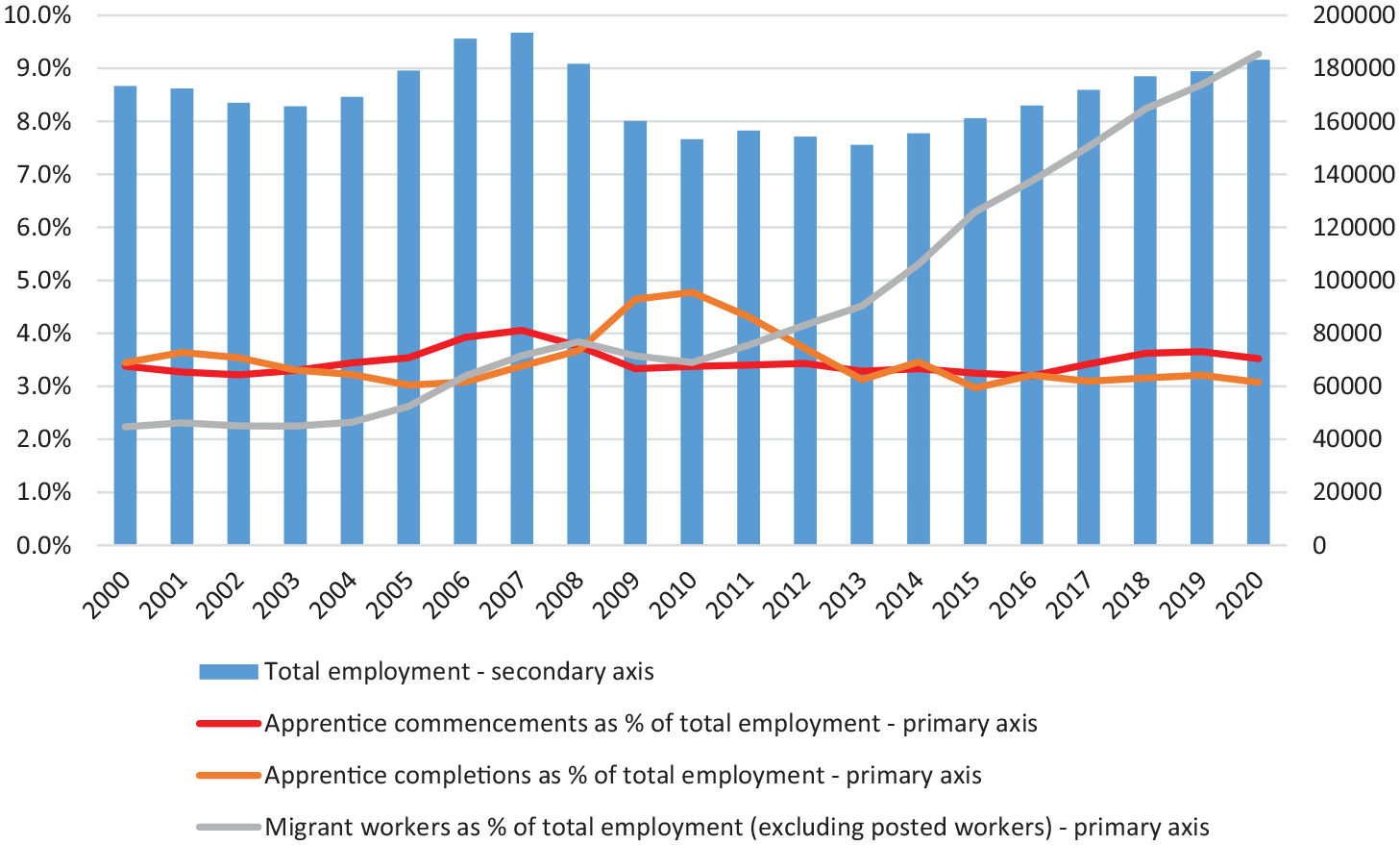
Total Employment, Migrant Workers, and Apprentices in Danish Construction
Despite the efforts to reaffirm the coordinated approach to skill-sourcing through VET reforms, labor migration has become a more prominent feature of the Danish construction sector. While employer association support for VET reforms indicates a commitment to CME institutions, their resistance to industrial relations reform indicates a more mixed strategy that explains why firm-level skill-sourcing practices have shifted from heavy reliance on VET toward increased recruitment of migrant workers. It could be argued that labor migration has helped the Danish construction sector to address immediate labor shortages, but in doing so, it has undermined firms’ incentives to reproduce the skills they need in the future through the VET system. Labor migration has thus promoted a more liberal and market-based approach to skill-sourcing as an alternative to the coordinated VET system in the Danish construction sector. It has given firms an incentive to defect from, and thereby undermine, those coordinating institutions.
Australia
Skill-sourcing institutions in the Australian construction sector have been liberalized in recent decades. Although this development occurred independently of changes to immigration policy, the subsequent expansion of temporary labor migration alleviated institutional failures that have resulted in an undersupply of skills. In this way, immigration policy has supported liberalization by ensuring a successful transition from partially coordinated to liberal skill-sourcing institutions.
Australia’s political economy is generally classified as liberal, but its construction sector was partly coordinated until the 1990s. Thereafter, weakened coordination over industrial relations and the marketization of training by allowing private providers to compete with state colleges for government training funds became defining features of Australia’s liberalized skill-sourcing system, which reflected employer preferences for greater labor market flexibility (Toner 2008; Wright and Kaine 2021). This enhanced employer control over training content and delivery but inhibited the ability of the VET system to address skill shortages.
Consistent with other countries with liberalized skill-sourcing institutions (Barry and Wilkinson 2011), Australian construction employers responded to institutional deficiencies not by strengthening coordination but rather by lobbying governments for market-oriented policies in the form of heavily subsidized training and an expansion of temporary migrant labor. Large government subsidies for employers who took on apprentices sustained training enrollments and led to an increase in the proportion of construction trades workers in training (Fortwengel, Gospel, and Toner 2021). However, stagnant completion rates and concerns about training quality resulted in employers seeking other avenues to supplement their skills and labor needs in the context of strong construction employment growth (Australian Bureau of Statistics 2022). With the liberalized training system not able to fully meet the growing sector’s skills and workforce needs, the expansion of the temporary migrant workforce provided a vital source of skills for construction employers, thus supporting the shift toward liberalization.
Liberalization of Industrial Relations
Since the late 1980s, the construction sector’s industrial relations have been liberalized, which has affected skill-sourcing. The growth of fixed-price contracts encouraged principal contractors to outsource the less profitable parts of their businesses. This development led to increased specialization among principal contractors in project management and contracting out of work previously undertaken internally (Toner 2000a). According to one union official, “The larger employers that used to be able to negotiate [now] just completely abrogate their responsibility to the skills of the workforce by saying, ‘Well, we don’t employ them’” (AU19). In the words of an industry association official who also represents a large construction firm, “We’ve got very few people [employed directly] who have ever picked up a tool” (AU18). Additionally, growing financialization resulted in principal contractors becoming more focused on maximizing their short-term returns and intensifying commercial pressure on subcontractors to become leaner. This led to a deepening of subcontracting arrangements, a decline in direct employment, and a corresponding rise of construction workers being self-employed (McGrath-Champ, Rosewarne, and Rittau 2011).
These developments shifted risks down the contracting chain, which directly affected skill formation in several ways. Training became narrower and more firm-specific in focus, which reduced coordination over skill development (Toner 2000a). According to one union official, “Everyone sub-contracts out so that they can shift the responsibility further down and some people at the very bottom of the chain are squeezed and there’s no room for training” (AU15). The growth in self-employed construction workers, many of whom are “dependent contractors,” further undermined training. Moreover, construction firms became increasingly loath to invest in training self-employed contractors since they were often engaged only on a short-term basis or for the duration of a specific project (Toner 2000b).
The main construction union, the Construction, Forestry, Maritime, Mining, and Energy Union (CFMMEU), remained strong in the commercial and civil segments of the construction sector. The CFMMEU used its industrial power and reputation as one of Australia’s most militant unions to continually push for wage increases and to coordinate training in the sector (Veen and McGrath-Champ 2021). For instance, the CFMMEU in the early 1990s established a training levy paid by employers through collective bargaining agreements, which it used to fund union-provided training centers. Maintaining these provisions proved challenging, however, in the face of liberalization pressures, and most union training centers subsequently closed (AU15, AU16). Furthermore, unions became increasingly weak in residential construction, an area in which self-employment predominated.
Marketization of Vocational Training
Increased cost pressures and risks diminished employer commitment to the training system (McGrath-Champ et al. 2011). The liberalization of construction sector industrial relations detached firms from their workforces, which resulted in training being seen as a risk rather than an investment. As an employer association representative describes it, “The larger companies . . . poach good people, they tend not to train their own. They tend to just pay the money and get ones that someone else has trained up” (AU29). According to one union official, this is a direct consequence of increased subcontracting.
The nature of the contracting and subcontracting [means] the prime contractor then pushes that responsibility down and down and down [the contracting chain]. . . . No one wants to face up to the fundamental issue and that it’s in the self-interest of an individual organization to not do the training. To head hunt or use migration rather than train is a logical decision for an individual company. But when aggregated, when added up, it’s a disaster for the industry and ultimately the country. It’s a classic case of market failure. (AU12)
Certain government policies also weakened training coordination. Liberal industrial relations reforms in the late 1990s narrowed the scope for including clauses relating to training in collective agreements (AU13). Furthermore, Commonwealth and state governments had previously been large employers of construction trades apprentices. But privatization and corporatization of state assets and outsourcing of public-sector work resulted in a dramatic fall in apprenticeship training directly provided by government employers (Toner 2000b, 2008; Veen and McGrath-Champ 2021).
Other policies helped to sustain construction trades training. The introduction of the “New Apprenticeships” program in the late 1990s, which covered both traditional apprenticeships and shorter traineeships, contributed to increased training enrollments. Against the backdrop of construction sector employment growth, large government subsidies for employers who took on a New Apprentice contributed to a significant increase in the training rate, which measures the number of construction trades apprentices and trainees as a proportion of all construction trades workers (National Center for Vocational Education Research 2021b).
Despite an increased volume of construction trades apprenticeship and traineeship training, concerns over training quality emerged. The expansion of the New Apprenticeships program resulted in training of shorter duration, with the proportion of construction trades apprentices and trainees completing training in less than three years increasing from 30% in 1998 to 53% in 2017 (National Center for Vocational Education Research 2021c). Furthermore, the proportion of construction trades apprentices and trainees completing their training relative to both construction trades employment and total construction employment stagnated (see Figure 2). In the words of one senior union official, “The number of [apprenticeship] commencements in the building trades are still reasonably high but the completions are terrible” (AU23). Moreover, compared to other trades occupations, the proportion of construction trades workers completing their apprenticeships is markedly lower and the attrition rate is higher (National Center for Vocational Education Research 2021a).
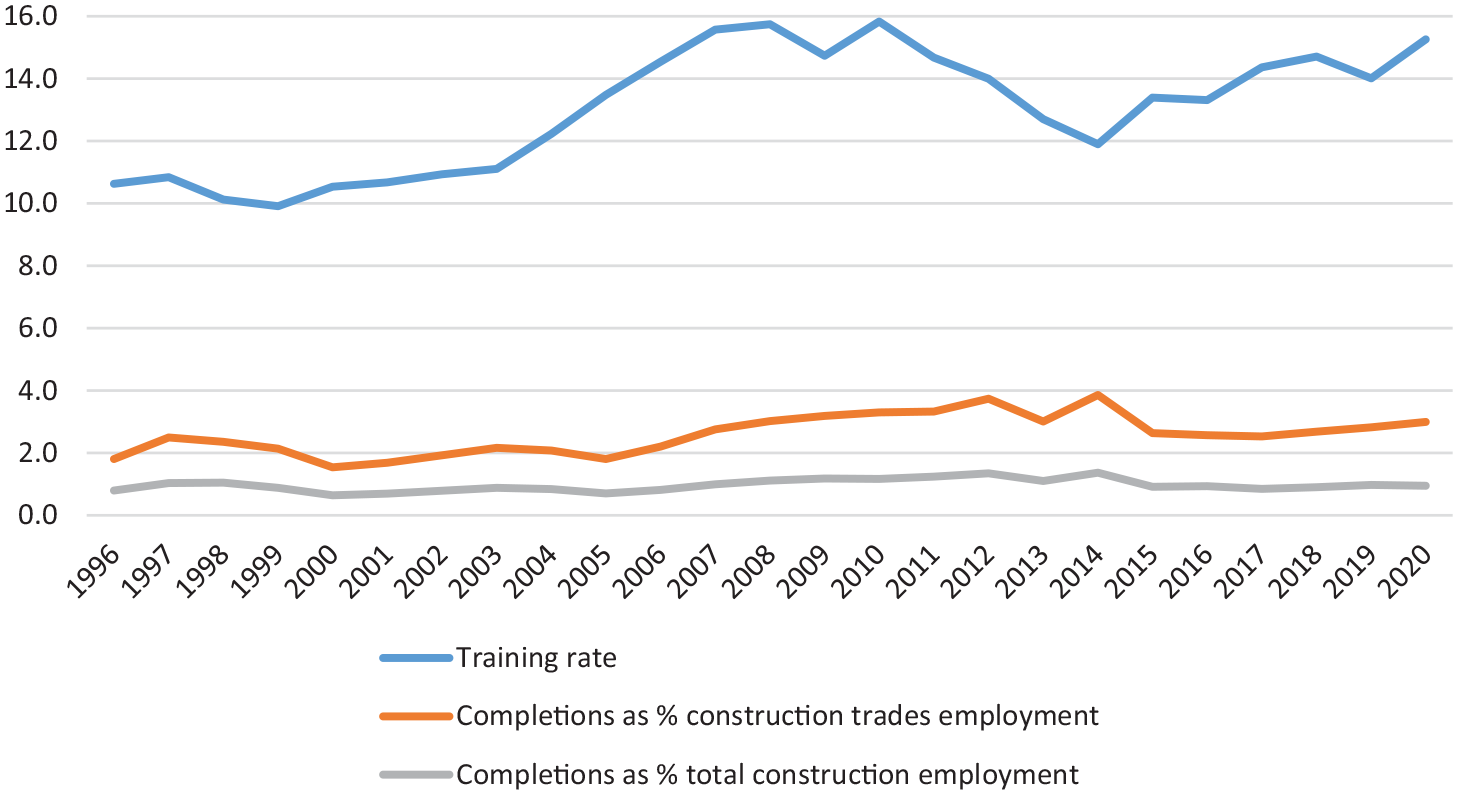
Construction Trades Training and Completion Rates (%), Australia, 1998–2020
Several reasons account for these outcomes. Training fluctuations are partly the result of government policy decisions that initially increased and later tightened subsidies for employers who took on apprentices (Oliver and Wright 2016). Additionally, the prevalence of workers engaged on insecure contracts contributed to low completion rates. According to one union official, “Companies don’t have continuous work for apprentices because of the subcontract system. . . . There’s a lot of exploitation of apprentices: their wages are low, they are used as laborers, [or] they are not actually getting trained in the more fundamental skills” (AU23). Problems with training quality were also attributed to the operation of “bogus” or opportunistic private training providers (AU9). In the words of one employer representative, “We’ve obviously seen problems with the for-profit sector that have been driven by the government policies of how VET is funded. . . . To do [a certain training] course you must have certain prerequisites [but] some of the for-profit [providers] will say: ‘No, we’ll take anyone’” (AU11).
These problems diminished construction employers’ confidence in the VET system, which prompted them to look more favorably upon temporary migrant labor as a source of skills. At the same time, changes to immigration policy made improving the VET system less of a priority.
Expansion of the Temporary Migrant Workforce
Migrant workers have been an important part of the Australian construction workforce since the postwar decades. While available statistics underestimate the number of migrant workers because of the challenges of fully capturing the temporary migrant population, the most recent available census data indicate that migrant workers make up 25.7% of employment in construction (Australian Bureau of Statistics 2016). Traditionally, most migrants working in the Australian labor market, including in construction, had permanent residency. This meant they were entitled to the same rights and conditions as citizens (Wright and Clibborn 2020). The period since 1996, however, has seen the introduction and expansion of various temporary visas, which restricted migrant workers’ mobility and bargaining power and made them a more attractive source of skills. The policy changes that enabled the significant expansion of temporary skilled visas were driven largely by lobbying from national employer associations (Wright 2012), but construction industry associations also played a critical role (AU4, AU8).
A temporary skilled visa and two other visa programs, the working holiday visa, and the international student visa, which allow workers to perform lower-skilled jobs, channeled temporary migrant workers into construction. Policy reforms in 2001 allowed construction employers to engage trades workers on temporary skilled visas. This visa was abolished in 2018 and replaced by a virtually identical visa which, like its predecessor, enables employers to sponsor a worker qualified to perform an occupation deemed to require university or trade-level qualifications for a period of up to four years, after which time they may be eligible to apply for permanent residency (Boucher 2019; Wright and Constantin 2021). Employer associations emphasized that sponsoring migrant workers on temporary skilled visas generally occurred only when there were genuine skills needs that could not be sourced locally. According to one employer representative, “We see overseas skilled migration as only ever being a complement” (AU22).
Visa rules that limit migrants’ mobility create advantages for employers (Anderson 2010). Restrictions on the ability of temporary skilled migrant workers to switch employers constrain workers’ bargaining power and agency (Clibborn and Wright 2018). In the words of one union official, “There’s a lot of vulnerabilities for [temporary visa holders] to even just, for example, raise their hat as a safety issue. For them it could [result in] losing their jobs and then being deported because you’re under a particular visa” (AU13).
This vulnerability served to make temporary skilled migrants a more attractive source of skills. A survey of employer motivations for sponsoring migrant workers on a temporary skilled visa found that construction was among the sectors least likely to use the visa to address skills shortages, despite this being its stated objective. Instead, construction employers were more likely than employers in most other sectors to use the visa to recruit workers with attributes that could elicit increased employer control. Construction employers were also highly likely to cite the low pay rates of the sector as a factor inhibiting their efforts to recruit workers in the local labor market (Wright and Constantin 2021). Other studies have found that construction workers are overrepresented in legal cases of underpayment and mistreatment of temporary skilled visa holders (Boucher 2019).
In 2014 construction was the fourth largest industry sponsor of temporary skilled migrants (Department of Home Affairs 2022). Since then, its sponsorship rates have declined, in part because of the abovementioned policy changes to the temporary skilled visa in 2018 that increased the sponsorship costs and training obligations for employers of temporary skilled migrants. This change made the sponsorship “a lot tougher and a lot more expensive,” according to an employer association official (AU21).
Nevertheless, demand for low-skilled migrants on other temporary visa programs, particularly the working holiday and student visas, has remained strong. According to one union official: [The temporary skilled visa is] the minority in terms of visas in the industry. Most of the visas are coming through working holiday visas, which are completely unregulated effectively, because there’s no employer obligation or sponsorship. And they can employ them as subcontractors. . . . The working holiday visa is a huge category of people working in the industry. (AU23)
Employers utilized the working holiday visa program more extensively following policy changes in 2005 and 2018 that gave temporary migrants visa extensions if they worked in regional areas in certain sectors, including construction. Consequently, construction employment increased among working holiday visa holders as well as international students able to work under the terms of their temporary visa (Reilly et al. 2017; Department of Home Affairs 2021). Construction has also become one of the main sources of employment for undocumented migrants (Clibborn 2015).
Policy changes since the 1990s have weakened Australia’s labor standards enforcement regime by marginalizing the role unions once performed in ensuring that employers comply with their legal obligations. The government labor inspectorate created in response lacks adequate resources to enforce employer compliance with statutory minimum wages and other minimum standards, which has affected temporary migrant workers disproportionately (Clibborn and Wright 2018). These developments have allowed some construction employers to employ working holiday and student visa holders below legal minimum standards. One industry association official conceded: Plasterers is a classic [example where] we have issues around underpayment. . . . There are elements within the industry that will rely on not so much skilled labor migration but more other means, whether legal or otherwise, to bring in teams of semi-skilled workers. (AU11)
Drywalling and plastering are subsectors of construction in which migrant labor has been used to undercut industry norms (AU16, AU29, AU30). One way this was achieved is subcontractors’ use of outside labor-hire firms that hired workers on temporary visas as independent contractors below legal minimum standards, which workers tolerated due to their fear of deportation. According to one union official, this had direct implications for training and skill formation.
There are areas of the industry that have been significantly de-skilled and . . . where we are seeing people on various categories of visas performing almost all of the work. . . . If you look at the major wall and ceiling firms in Sydney and Melbourne . . . the biggest number we find are people on student visas. . . . The method of engagement and training is entirely informal and because of that, there are people who are, in a fair number of cases, working in breach of their visas. They’re susceptible to intimidation and that intimidation may range from worrying about getting dobbed into [the Department of] Immigration and sent home to threats of physical violence against them and their families. (AU9)
In sum, the expansion of temporary migrant labor has supported the liberalization of skill-sourcing in construction. While large government subsidies for employers have sustained construction trades apprenticeship commencement rates, stagnant completion rates and concerns over training quality reflect the struggles of the marketized vocational training system in keeping pace with the rapid growth of construction employment. In this context, the temporary migrant workforce has played an important role in addressing the sector’s skills and labor needs. Although institutional liberalization of VET and industrial relations would have occurred regardless, immigration reform has helped to sustain it. The introduction and subsequent expansion of temporary visas designed to address short-term employer demand has allowed employers to ignore the outcomes of a liberalized VET and industrial relations system. Consequently, labor migration has supported the construction sector’s liberal institutional model because without it, employers would have been forced to strengthen coordination. As an employer association representative expressed it, “Why are we buying in the skill as opposed to training the future needs? It’s easier, less risk” (AU21). Labor migration thus has been a key part of institutional change by compensating for the deficiencies of liberalized skill-sourcing institutions.
Conclusion
Drawing inspiration from comparative political economy scholarship on institutional change, we have analyzed how labor migration has affected skill-sourcing practices in countries with distinct skill formation and industrial relations institutions. Using a most different systems design to compare the construction sectors of Denmark and Australia, our findings indicate that increased availability of migrant labor has contributed to institutional change in a liberalizing direction.
The two countries have handled the process in different ways, which is expected given the differences between their industrial relations, VET, and immigration policies. In Denmark, the institutional change process started with increased labor migration following liberalization of cross-border labor mobility after the expansion of the European Union. While social partners made efforts to maintain the coordinated skill formation system, labor migration has promoted liberalizing change in skill-sourcing practices as individual firms increasingly used this market-based approach for addressing their labor and skills needs. Thus, labor migration changed individual firms’ skill-sourcing behaviors by disincentivizing them from participating in coordinated skill formation despite employer associations’ efforts to maintain coordination.
In Australia, the initial liberalizing reforms came in industrial relations and VET, which had the effect of changing employers’ skill-sourcing behaviors toward more market-oriented strategies albeit with significant government training subsidies. The introduction and expansion of temporary labor migration helped to address the deficiencies of these strategies in meeting skills shortages caused by this liberalization. In that sense, labor immigration supported the liberalizing direction of change by disincentivizing employers from participating in solving these deficiencies through coordinated efforts because it offered them an alternative skill-sourcing solution.
Therefore, in response to our research question, we conclude that while the processes have differed, labor migration has affected skill-sourcing practices and policies in a liberalizing direction in two countries that otherwise represent distinct national models. These changes to skill-sourcing practices constitute an incremental source of institutional change in both countries.
Our article thus resolves a puzzle about the relationship between national industrial relations and skill formation institutions, on the one hand, and labor migration, on the other. While a central assumption in comparative industrial relations and comparative political economy literature is that complementary national institutions can resist the pressure for change exerted by internationalization in the form of international trade, our findings suggest that this is not necessarily the case for internationalization in the form of labor migration. We argue that labor migration can act as a source of institutional change through processes in which institutional complementarities make changes in one set of institutions that spill over into changes in other institutions (Palier and Thelen 2012). This process can appear to differ depending on the character of prevailing institutions, that is, labor migration can support liberalization where institutions are already liberalized, and it can promote liberalization where institutions remain coordinated.
Based on these findings, we suggest that future research should focus on how labor migration changes the incentives for both employers and governments to support national skill formation. The importance of skill-sourcing for both individual firms and national economies implies that as labor migration becomes a more important source of skills, it should be accounted for more fully when understanding national models and their institutional transformations. To better grasp labor migration as a potential source of change in skill-sourcing institutions, our research suggests that while institutional complementarities were viewed originally as a source of stability, they can also lead to spillover change—where change in one institution affects a similar change in another institution—and that increased labor migration may be part of that process. Furthermore, future research should note the distinction between the role of labor migration as a direct driver or promoter of institutional changes and its more indirect role of supporting or underpinning other institutional changes.
Supplemental Material
sj-pdf-1-ilr-10.1177_00197939231153138 – Supplemental material for Labor Migration as a Source of Institutional Change: Danish and Australian Construction Sectors Compared
Supplemental material, sj-pdf-1-ilr-10.1177_00197939231153138 for Labor Migration as a Source of Institutional Change: Danish and Australian Construction Sectors Compared by Jens Arnholtz and Chris F. Wright in ILR Review
Footnotes
The article draws from data collected for several projects funded by grants from the Australian Research Council (DE170101060), the Norwegian Research Council (FINNUT grant 255001), the University of Sydney, and the University of Copenhagen.

For information regarding the data and/or computer programs used for this study, please address correspondence to
References
Supplementary Material
Please find the following supplemental material available below.
For Open Access articles published under a Creative Commons License, all supplemental material carries the same license as the article it is associated with.
For non-Open Access articles published, all supplemental material carries a non-exclusive license, and permission requests for re-use of supplemental material or any part of supplemental material shall be sent directly to the copyright owner as specified in the copyright notice associated with the article.
