




Abstract
Drawing on a qualitative analysis of a group of mobilized precarious workers in Tunisia’s public sector, the author asks how workers’ collective actions are shaped by and, at the same time, can act upon labor unions’ responses to them. Findings suggest that unions can enable and simultaneously constrain precarious workers’ collective actions. More important, workers learn from their interactions with the union, and this learning process can contribute to innovations in workers’ mobilizing structure and repertoire of actions. The Tunisian case contributes to the debate on the relationship between precarious workers and institutionalized actors as well as to the study of mobilized precarious workers by elucidating the ways in which the workers’ embedded and innovative agency plays out within and beyond a well-established labor union.
Precarious work has been recognized as a key feature of the global economy and a growing concern in the global North and South. In addition to job insecurities in private sectors and the proliferation of an informal economy, many Arab and Mediterranean societies have witnessed increasing precariousness in public-sector employment (Paciello and Pioppi 2021). Compared to workers in the neighboring countries, however, workers in Tunisia have more actively and successfully defended their job security, as marked by annual wage increases and the formalization of a large number of casual workers in the public sectors after 2011. Studies have identified and analyzed the powerful Tunisian General Labor Union (UGTT) as a key player in protecting workers’ rights in general as well as in supporting non-unionized workers’ collective actions (King 2017). Yet, the role of precarious workers’ grassroots movements and the way they interact with the UGTT have hardly been examined. Scholarly debate on precarious work points to the importance of taking into account both institutions and mobilized workers in understanding counter-precarization (see next section). Essential to this task is to investigate the interplay between the two.
In this article I focus on the relationship between the UGTT and precarious workers’ grassroots movements, asking how workers’ mobilizing structure and repertoires of actions are conditioned by and, simultaneously, can act upon the institutionalized union attitudes and responses to them. Empirically, I analyze a group of the Tunisian precarious labor force, known as “site workers,” by drawing on in-depth interviews with the workers and observations of their interaction with the UGTT. Introduced by the pre-2011 authoritarian regime, the site work program had hired casual and temporary workers for public services at the municipality level. The state re-introduced this program after the Uprising 1 as an ad hoc way of managing persistently high unemployment by newly hiring more than 50,000 Tunisians without providing them with a written contract of employment and basic social security. The term site workers (U’mal Hadha’ir in Arabic) commonly refers to workers carrying out various types of “work on the ground” (such as farming, sweeping streets, and construction work). In practice, however, many site workers were given several tasks ranging from security guarding to administrative work, such as producing official documents and preparing meetings, as the number of site workers with higher education degrees rapidly increased after 2011. Site workers started their collective actions in 2012, and their struggle over the right to job security is still ongoing as of this writing.
In analyzing the site workers’ case, this article draws on the notion of workers’ embedded agency and a processual understanding of contentious politics, which sees the relationship between dominant actors and challengers not as being static but as being subject to continuous interactions and negotiations. The Tunisian case adds to scholarly efforts to map out the variety of ways in which precarious workers interact with institutionalized unions and seek to advance their interests by unpacking the often ambivalent relationship between the two parties and the ways that workers mobilize within/through and beyond unions. Institutionalized unions may enable and at the same time constrain precarious workers’ collective actions. More important, this ambivalence can contribute to innovations in workers’ mobilizing structure and choices of actions. However limited, workers learn from their failed and successful collective actions as well as from the ways external actors engage with them. Through this learning process they can act as innovative agents.
Precarious Workers and Labor Unions
A significant body of literature has noted that traditional labor unions are unlikely to actively support and represent non-unionized workers for a range of reasons from insiders’ immediate interests, such as higher wages (Lindbeck and Snower 1986), to weakening bargaining capacity of unions vis-à-vis market reformers (Garay 2007: 304) and the state (Chen and Gallagher 2018) in the context of increasing “capital fixes” (Silver 2003) that constrain labor power. Numerous cases of the workers’ movements and forms of “community unionism” (McBride and Greenwood 2009) in the global North and South suggest otherwise. They show various ways through which established unions empower workers outside standard employment (MacKenzie 2009; Benassi and Dorigatti 2015). Taking the case of Italian labor unions, for instance, Politi et al. (2021) demonstrated that they positively contributed to non-standard workers’ collective actions by developing solidarity with the workers. Similarly, several chapters of Eaton, Schurman, and Chen’s (2017) edited volume on the variety of organizing strategies of informal workers discuss the significant roles of unionists in organizing informal and immigrant workers and improving their working conditions in the global South (Fine and Petrozziello 2017; Jgerenaia and Aleksandria 2017; King 2017; Ryklief 2017).
The above debate indicates that multiple factors play out in dissimilar ways depending on the context, leading to diverse responses of unions to counter-precarization (Pulignano, Ortiz, and de Franceschi 2016: 51). According to Dorigatti (2017), it is not union members’ interests alone that determine their relationship to periphery workers, and other variables such as organizational identity also play a significant role in shaping the interactions between trade unions and precarious workers. Also, unions’ stance toward atypical workers is not free from the union’s relationship to other dominant actors in labor relations, for example, the state and employers (Baccaro, Hamann, and Turner 2003). In addition, unions are not free from surrounding institutional contexts and traditions (Boxall 2009), from which structurally embedded unions “derive their resources” (Pulignano et al. 2016: 41). Rather than operate in isolation, these multiple factors may play together “to be mutually influential” (Dorigatti 2017: 922).
We may then think about the possibility that the aforementioned factors (and others) shaping the relationship between institutionalized labor union and precarious workers have an ambivalent effect by which the former enables and at the same time constrains the latter’s collective actions. This effect can happen in moments when multiple factors that condition union interests and behaviors conflict with each other. As the Tunisian case illustrates later, one such scenario is that the union’s inclusive culture linked to its grassroots militancy and the organization’s immediate political calculations and interests play out together in a contentious way, leading to both support and control of mobilized workers. When traditional unions take such an ambivalent position, how does it affect precarious workers’ mobilizing structure and strategies? Also important, how do workers respond to and/or resist challenges to their collective actions in this context?
Addressing these questions, as this article argues, can benefit greatly from a contentious politics approach to the embedded workers and their relationship to institutionalized unions. Continued protests and collective actions by unemployed and precarious workers across the world have called for attention to their abilities to challenge processes of precarization (Lorence 1996; Perry 2007; Baglioni, Baumgarten, Chabanet, and Lahusen 2008; Lahusen 2013; Lewchuk and Dassinger 2016; Hawkins 2017; Rossi 2017; Weeks and Reed 2017; Badimon 2019). For instance, scholars have emphasized that their grassroots mobilizations can play a key role in building and sustaining collective identities in fragmented working conditions (McBride, Stirling, and Winter 2013; López-Andreu 2020; Però 2020). However, according to Rizzo and Atzeni (2020: 1116), workers’ abilities to create and utilize resources (and consequently their activism) are never independent of their precarious conditions, forms, and patterns of exploitation and external actors. In social movement studies, this “embedded” agency has been extensively discussed in relation to, among other things, mobilizing structures and repertoires of action that can be defined respectively as “forms of organization” (both informal and formal) (McAdam, Tarrow, and Tilly 2001: 41) and “forms of claim making” (such as lobbying, campaigning, marching, hunger strikes, and petitions) (Tilly 1978). Studies have noted that challengers’ mobilizing structures and repertoires of action are inherently constrained and shaped by surrounding factors and political institutions (McAdam 1982). When applying to precarious workers’ collective actions, one can easily expect that when institutionalized unions’ level of influence in labor relations is strong and their attitude toward non-unionized workers is supportive, workers are more likely to mobilize through/under the umbrella of the unions and will choose actions that are appropriate and acceptable by the union standards.
From the perspective of contentious politics, the notion that precarious workers’ agencies are deeply entrenched in power relations does not preclude their potential to act innovatively. Rather, workers inevitably but strategically navigate through surrounding actors and factors while seeking to forge effective and alternative forms of organizations and actions. In this sense, innovation in mobilizing structures and types of actions needs to be understood as a form of creative modification or “social appropriation,” namely, appropriating existing modes of organizations and actions and turning them “into vehicles of mobilization” (McAdam et al. 2001: 44). Research on informal and casual workers’ collective actions has noted that workers not only draw on existing resources and institutions but also (re)appropriate them “to fit their unique contexts” (Eaton et al. 2017: 1). Through the case of movement-oriented nongovernmental organizations (NGOs) in China, Li (2020) demonstrated that activist workers develop counter-hegemonic actions not by directly challenging state institutions marked by the labor law and established unions but by penetrating and appropriating them.
Furthermore, contentious politics highlight that social movements’ mobilizing structures and their forms of action are not static but subject to “continuously negotiated interactions” with surrounding conditions and actors (McAdam et al. 2001: 12, emphasis added). When applied to the relationship between precarious workers and institutionalized unions, this scenario means that not only the union attitude toward workers in the initial phase of collective actions but also their constant interactions affect the latter’s mobilizing structure and actions. As their relationship transforms, precarious workers’ modes of organization and claim-making evolve accordingly. Alberti and Però’s (2018) observation on Latin American migrant workers’ relationship to traditional unions in the United Kingdom provided an illustrative example. They noted that British unions that had initially offered crucial organizational support to the migrant workers later became hesitant to support them partly because of the workers’ unconventional forms of mobilizations and demands. In such circumstances, precarious workers who previously opted for working within an institutionalized union created their own organization over time as they felt the union failed to “uphold its commitment to promote basic justice in order to preserve the status quo” (Alberti and Però 2018: 705). Delivery workers in Buenos Aires in Argentina, by contrast, formed a self-organized social movement in the beginning, but their independent collective mobilization transformed into an institutionalized union in the process of adapting to union-led labor relations (Atzeni 2016).
A key implication of the above discussion on contentious politics is that precarious workers may mobilize through and simultaneously beyond an institutionalized union if the union has strong sway in labor relations and is supportive of their mobilization in principle but the workers, through their interactions with the union, perceive that the union’s supportive rhetoric requires bottom-up pressure to be transformed into actions. As I illustrate in the empirical sections of this article, the site workers’ interaction with the UGTT shows that their collective organizing within and at the same time beyond the union was a strategic choice based on the limitations and, more important, the possibilities they learned “over time from past interactions and from information communicated to them by others” (Oliver and Myers 2003: 3). As past experience of precarity informed street vendors in Argentina of the importance of collective organizing (Fernández-Álvarez 2019), site workers’ contentious interactions with the union served as a learning process through which they modified their mobilizing structure and actions to overcome given constraints and to increase pressure over the union.
Methods and Data
This research draws primarily on site workers’ experiences with and perceptions of (counter)precarization practices. In line with Atzeni’s (2016: 195) bottom-up approach, I argue that “departing theoretically from the primacy of workers’ self-activity” helps us delve into the ways in which contextual factors and surrounding actors interact with workers’ embedded agency. It also helps analyze how such interaction shapes precarious workers’ limitations and possibilities for innovative collective actions. In this article, I particularly focus on 1) how site workers navigated through precarious working conditions; 2) the trajectory, mobilizing structure, and dynamics of their collective actions, and importantly; 3) how they perceived and interacted with the UGTT.
The empirical analysis is based on in-depth interviews I conducted with site workers, journalists, and human rights activists as well as my observations of the workers’ protests and informal meetings between November 2020 and June 2021. I approached and selected potential interviewees through a snowballing technique for two reasons. First, while I had pre-determined target interviewees (coordinators and members of the national movement in various localities), their contacts were not accessible prior to the interviews. Second, involving inside informants helped to build trust between the interviewees and myself, a researcher who has “different cultural memberships” from them (Sands, Bourjolly, and Roer-Strier 2007: 368). Prior to interviews, I informed interviewees about the research topic and purpose so that they could decide whether to participate in the interviews. I also made it clear they could withdraw their consent at any time during the interviews.
I used the semi-structured interview format to encourage interviewees to actively participate in and lead the interview process. This interview method provided a flexible environment in which participants had greater leeway in structuring their answers and follow-up questions. To avoid imposing my own views and biases on the interviewees, I asked them key open-ended questions including: Can you tell me about your personal experience working as a site worker? What are some strengths and weaknesses of your social movement? How do you evaluate the UGTT’s approach to the site work issue? More specific follow-up questions were based on the interviewees’ answers.
In total, I carried out 21 in-depth interviews (excluding follow-up conversations with the same interviewees) that were between 30 and 180 minutes in length and were conducted in Arabic through both phone and in-person interviews (see Table A.1). The interviewees included 13 site workers from 10 different regions (out of 24 governorates), 6 coordinators of site workers’ movements (out of 24 regional coordinators), 1 civil society activist, and 1 journalist. The COVID-19 context and the evening curfew imposed in Tunisia affected in-country trips for fieldwork. However, I was able to interview site workers living in other regions by conducting phone interviews with them. The sample interviewees do not represent the whole site worker population, but they bring up common issues related to their lived experience of precarious working conditions. Given the purpose of the research, interviewing site workers and coordinators from different sectors and who were actively involved in street protests and negotiations with the UGTT was essential for analysis of their mobilizing structure, evolving repertoires of action, and their perception of the union. When interviewees preferred in-person meetings, interviews were carried out at protest sites and street cafés in Tunis, the capital city of Tunisia. When permission was given, I recorded interviews by using a digital audio recorder and took notes during and after each interview.
In addition, I observed three site workers’ protests in Tunis (November 17, 2020, December 9, 2020, and March 11, 2021) and their informal meetings held at the protest sites and street cafés. All of these helped me observe and understand site workers’ protest tactics and interactions with security forces, ways in which the workers from various regions and sectors interact with one another, and internal tensions and challenges arising during their protests as well as their efforts to overcome such challenges. Finally, the online social network Facebook pages run by site workers and the UGTT provided an additional source of information through which to have contextual understanding of the case study and to triangulate the findings obtained from the field interviews and observations.
(Re)Introduction of Site Work
The growing precarious workforce has characterized Tunisia’s labor relations as the country’s economy has been rapidly liberalized since the end of the 1980s. Precarity, like other socioeconomic issues such as unemployment and regional inequalities, had long existed in the society (Feltrin 2018). But, the Ben Ali regime (1987–2011) drastically weakened the state-led development and job securities guaranteed by the post-independence government, resulting in an upsurge of unemployment and increasing disparities between coastal and interior regions (Cavatorta and Haugbølle 2012: 184; Kaboub 2012: 305; Murphy 2013: 41, 2017: 683). This outcome in turn led many Tunisians to rely on informal and casual jobs as a means of making a living (Boughzala 2013). The reforms for economic liberalization went hand in hand with several programs designed specifically for unemployed populations. For instance, the state’s Active Labor Market Program (ALMP) introduced paid internships in 1987 to facilitate job creation. In 2004, this program began to offer wage subsidies and exemption of social security to private-sector employers that were willing to hire unemployed university graduates (Angel-Urdinola and Leon-Solano 2011: 2).
Introduced in the time of Habib Bourguiba, the first president of Tunisia after independence (1956–1987), the so-called site work framework also operated as part of Ben Ali’s social framework to tackle the problem of unemployment. It differed, however, from the aforementioned programs for unemployed youth. Whereas the latter aimed to encourage the employment of unemployed graduates in private sectors, the former was designed to hire casual and temporary workers for public services at municipal-level institutes, such as public schools, hospitals, and police stations. The site work program was mentioned in several circulars of then prime minister, Hamed Karoui (1989–1999). Yet, its legal status appeared to be first discussed in the Parliament on February 28, 2002, and stipulated in law 32-2002 regarding a special social security system for certain workers in the agricultural and non-agricultural sectors. Law 32 defined site workers as those “employed by the state as well as local and public institutions.” It set out that social benefits for these workers were to be provided by the National Social Security Fund (Caisse Nationale de Sécurité Sociale [CNSS]) for private-sector employees, and not by the National Pension and Social Security Fund (Caisse Nationale de Retraite et de Prévoyance Sociale [CNRPS]) for public-sector employees.
These policies for unemployed populations and other social protection mechanisms fell short of the intended goals. They failed to function as a buffer to counter the negative consequences of structural reforms, and eventually, contributed to people’s revolt against the deteriorating social and economic conditions as well as against the rampant corruption and political repression that upheld Ben Ali’s authoritarian neoliberalism. His dictatorship came to an end on January 14, 2011. Amid the continued protests, the interim government promised to build a new democratic system and to resolve socioeconomic concerns raised by the majority of Tunisians. Efforts to address authoritarian legacies led to several outcomes in the political realm including the end of the quasi one-party system, release of political prisoners, free and fair elections, and the new 2014 constitution. However, addressing the socioeconomic marginalization of interior regions and job insecurities remained a top priority in rhetoric without having concrete policies in place.
Instead of rethinking and restructuring the old economic system, the state re-introduced the site work framework as a way to ward off further escalation of socioeconomic protests, particularly those taking place in the interior and southern regions. The number of site workers increased from 62,876 in 2010 to approximately 125,000 in 2011 according to research on site work conducted by the Tunisian Forum for Economic and Social Rights (Forum Tunisien pour les Droits Economiques et Sociaux [FTDES] 2015: 8). This finding indicates that the state newly hired nearly 60,000 Tunisians as site workers immediately after the Uprising. Whereas the majority of workers who were hired before 2010 worked in the agricultural sector, by the year 2014, the number of administrative site workers became nearly twice the number of agricultural site workers. Approximately 67% of administrative workers were formerly unemployed people living in the interior and border areas (FTDES 2015: 11), particularly those in Sidi Bouzid and Kasserine where local mobilizations were often framed by the state as a security concern (Han 2021).
When asked why they became site workers, most interviewees noted that although they were aware of the precarious nature of this job they voluntarily chose to be site workers because they believed that they would soon become formal public employees. The idea that they would be integrated into the public employment framework in the near future was not a groundless hope; according to them, that is what local authorities told them (Fieldnote, Tunis, December 9, 2020). This promise was plausible in the context in which thousands of Tunisians, including political prisoners arrested under the Ben Ali regime, were given public-sector jobs through exceptional measures after the Uprising. According to a 40-something aged man who has been working as a site worker in one of the southern regions since 2011, “the interim government that came after the revolution tried to absorb as many unemployed as possible, as quickly as possible. And this precarious work was what we were given” (Interview 1, Tunis, November 17, 2020). Another administrative worker living in the South explained how he ended up being a site worker and why he decided to participate in street protests: The . . . municipality called me to join this work program. They promised me that I will be hired as public employee once I work for four years, and I ended up working as site worker for nearly eleven years. I had to have two additional part-time jobs because they paid me less than minimum wage. I was supposed to receive 352 dinars in the year 2011, but they paid me 250 dinars only. My monthly salary remained 250 dinars until 2016. I was hired by the state to be a precarious worker. . . . We have been working as hard as other public employees, if not harder than them. But our work conditions were massively different from theirs. We didn’t even get health coverage. (Phone Interview 3, December 15, 2020)
Site workers were among those who first staged street demonstrations in 2012 demanding the authorities provide solutions for precarious working conditions. A main source of grievance and motivation for street actions shared among the workers was the perception that their workload and tasks were the same as (if not more than) that of formal employees in public sectors, and yet, there was no legal ground to protect site workers, and they could not earn even the minimum wage.
The UGTT and Precarious Workers in Tunisia
One cannot fully understand the trajectory of site workers’ mobilizing strategies and repertoires of action without taking into account their interactions with the UGTT, the powerful national organization for workers. Established a decade earlier than the independence of Tunisia in 1956, the UGTT played a crucial role in struggles against both colonialism and the post-independence authoritarian regime (Ayubi 1995: 211; Alexander 2000: 466; Allinson 2015: 302; Netterstrøm 2016: 386; Yousfi 2021: 6). Although the union’s main function has been to defend members’ material interests, it has also intervened in political and socioeconomic issues and acted as the representative of civil society. Like other trade unions in the Middle East and North Africa, the top-level union leaders were effectively co-opted with the state interests, and they often contributed to the demobilization of labor militants (Wilder 2015: 356). However, the rank and file of the regional and sectoral unions, particularly those of teachers, exercised a significant degree of autonomy. As Bishara (2020: 178) observed in her analysis of the UGTT, this was partly because its organizational structure was equipped with “mechanisms for internal accountability” that were built on grassroots movements prior to independence. The internal dissents had a great level of autonomy and influence over the union leadership.
Several studies have examined how the UGTT contributed to the 2010–2011 Uprising (Yousfi 2021) and the following democratization process (Beinin 2016). Yet, relatively scant attention has been paid to the dynamic relationship between the union and precarious workers’ collective actions and struggle over job securities. As King (2017) emphasized in his work on subcontracted labor in Tunisia, ending precarious forms of employment has been part of the UGTT’s agenda since the Ben Ali era. Unionists engaged with and sometimes led mobilizations of subcontracted workers in both private and public sectors through various tactics including hunger strikes, sit-ins, and media campaigns throughout the early 2000s (King 2017: 149). Their solidarity movements have brought about some concrete, positive outcomes. For instance, the UGTT, together with the Fédération Générale des Professions et des Services (FGPS), successfully forced the 2011 interim government to promise an end to all forms of subcontracting in the public sector and to re-integrate more than 20,000 subcontracted workers in public institutes and companies into direct employment (King 2017: 151). The UGTT also led negotiations with the state to improve the precarious working conditions of casual labors under Mechanism 16 and 20. Similar to site work, they were introduced by the pre-2011 regime as part of the social and training program for unemployed populations, which in practice functioned to hire un-skilled laborers for public services.
The UGTT’s efforts to eliminate precarious employment have in turn facilitated the spread of other unemployed and casual workers’ protests, including site workers’ mobilizations, across the country. As the case of site workers shows, however, the UGTT’s official stance as the defender of its members as well as workers outside its umbrella has not always translated into direct actions and involvement in these movements. Also, the organization’s relationship to precarious workers’ collective actions was not one-directional. In the remainder of this article, I elucidate the contentious relationship between site workers and the UGTT as well as their ambivalent effects by tracing the trajectory of their interactions from the perspective of the workers’ own experiences of mobilizations through and beyond the union.
State 1: Emergence of Site Workers’ Collective Actions
Site workers’ spontaneous protests and sit-ins at workplaces gradually evolved into collective actions at the municipal scale and then into what they called the Regional Coordination of Site Workers’ Movements across multiple regions. This process was led by a small group of activist workers who voluntarily coordinated and brought together a variety of workplace-based struggles. The community-based collective actions at the regional scale, which were largely absent in the capital city of Tunisia, were opted as an ideal repertoire of action by site workers living in the interior regions given their geographical distance from the central government and unaffordable costs of traveling to the capital (Fieldnote, Tunis, March 11, 2021). Also, each governorate enjoyed considerable autonomy over the operation of site work programs, leading the workers to direct their grievances and demands to local authorities.
When it comes to mobilizing structure, rather than establish formal associations with paid membership, the regional movements took the form of loosely connected networks among local groups and facilitated their communication through elected coordinators. For instance, a regional coordinator representing site workers in Sidi Bouzid was informally elected by 10 municipality-level coordinators in 2015 (Fieldnote, Tunis, March 11, 2021). Collective actions at the regional level were then planned and organized through meetings between one regional and several local coordinators at street cafés or in the regional union buildings that belonged to the UGTT. Site workers did not form their own association or union because they relied on the material and symbolic resources of the UGTT and opted to remain under its umbrella. As I mentioned earlier, although the union’s main objective has been to advance its members’ interests, ending precarious employment has also been part of its agenda since the Ben Ali era. This arrangement led many site workers to consider mobilizing through the UGTT to be a natural course and also a strategic choice. The workers shared the idea that UGTT was the only party they could rely on, as a female site worker noted: The union exists for all workers. [Interviewer: Even workers who are not members of the UGTT?] Yes, it is powerful and represents our society. When we speak to it and ask for help, it defends our rights and supports us. The UGTT is the only place where workers like us can go and ask for protection. (Phone Interview 5, December 18, 2020)
That the workers sought to stay within the UGTT does not mean attempts were not made to build a formal association for site workers. Their legal status and working conditions significantly differed from formal workers within the public employment framework. Therefore, the workers recognized creating a separate union for site workers and incorporating it into the existing union structure (regional and sectoral) as a more reasonable and effective way of empowering themselves. This idea was not realized, however, because according to the workers, it was opposed by the top-level UGTT leaders. A 30-something aged site worker living in Sidi Bouzid and who was actively involved in the street protests noted that “they [UGTT] rejected our mode of struggle within the regional union, so we remained as a social movement at the local level and regional level” (Interview 10, Tunis, March 11, 2021). Indeed, the letter below, which was written by the national bureau of the UGTT to its regional branches on February 6, 2016, and posted on the site workers’ Facebook page, indicates that the union allowed site workers to be affiliated with its organization on the condition of their being absorbed into the existing regional and sectoral unions and not creating their own association.
We would like to remind their [regional unions] brothers and sisters of the circular number 109 which was made on 20 May 2013 regarding the decision of the national executive office to allow site workers and other forms of workers to be affiliated with the Union through the existing regional and sectoral unions, without forming their own union. (UGTT 2016)
Several site workers perceived that in addition to delimiting the workers’ organizing structure, the UGTT was skeptical about the existence of the Regional Coordination of Site Workers’ Movements itself. According to site workers, the union was concerned about the possibility of the workers’ social movements obtaining the same authority as the union and threatening its legitimacy and influence over the site work issue (Fieldnote, December 9, 2020). The quotation from a coordinator’s narrative below indicates that the union also tried to keep the workers’ movement under control in order to protect its organizational identity and interests.
There were coordinators whom the UGTT didn’t trust because of their behaviors and ideologies. It was like, when the union assumed that a coordinator belonged to the Ennahda Movement or Salafist Groups, it said, “Don’t give him the chance to be a coordinator.” . . . This is understandable, to be honest, because we will one day become members of the UGTT, and we know that there are enemies of the union who want to destroy it from within or destroy it by forming social movements. (Interview 11, Tunis, March 11, 2021)
What can be inferred from the workers’ perception of the UGTT is that it was not unionists’ material interest alone that determined their relationship to precarious workers. One could argue that the UGTT’s “institutional identity tied to broader struggles” (Bishara 2020: 191) played out in the post-2011 context to counterbalance what it perceived as an increasing threat of extremism linked to political Islamic forces. The UGTT’s secular position and attempt to counter Islamic extremism conditioned its relationship to the site workers’ movement. When investigating through workers’ own experience of interactions with the UGTT, we learn that the union’s “strategic orientations” (Dorigatti 2017: 920) and their effects were not dualistic. On the one hand, site workers’ affiliation with the powerful trade union provided them with a legitimate channel through which to make their voices heard. On the other hand, over time it increasingly became clear to the workers that the scope and forms of their collective actions had to be limited to what might be acceptable by the union if the workers were to maintain their ties with it.
This top-down relationship partly explains why site workers’ actions were distinguished from those of other unemployed and informal workers. Blocking roads with burning tires and confrontation with police forces were some of the tactics deployed in post-2011 socioeconomic protests to put pressure on the state. These tactics were largely absent in site workers’ protests and strikes. Their collective actions also often involved the regional UGTT branches’ recognition and “pre-approval” to show that their protests were planned with the support of the union (Fieldnote, November 17, 2020). In practice, while the workers’ grassroots movements obtained some degree of support from local and regional union branches, they were fruitless in securing the national union’s intervention or any state concessions for their issue. The site workers’ precarious working conditions continued until 2015 without workers having a chance to negotiate with the state. The UGTT’s responses to site workers in the initial stage of mobilizations indicate they followed neither “subordination” (low interest and lack of institutional support) nor “inclusion” (high interest and equal treatment for non-members), which are two typical forms of union-contingent work relationships in Heery’s (2009: 431) typology. Rather, they fell somewhere in between. When asked why the UGTT did not actively intervene in the site work issue as it did for other precarious workers, such as those under Mechanism 16 and 20, one of the coordinators noted that: In 2011, it was scared of the people, scared of being targeted, like the state, by protesters demanding social justice. That’s why it decided urgently to solve the problem of Mechanism 16 and 20. The same logic [applied] to the other public sector workers. They (the UGTT) were afraid of losing popularity. But after then, precarious workers were no longer a priority in their agenda. (Phone Interview 8, January 17, 2021)
In the process of democratization, the union’s inclusive culture and its narrow political and organizational interests conflicted with each other, leading it to (unwittingly) constrain site workers’ mobilizations while continuing to send moral and material support to them. Such ambivalent attitudes of the union toward site workers would not be easily captured through institutionalist and binary understandings (either supportive or constraining) of the union–precarious workers’ relationship. This ambivalence might be particularly the case for Tunisia as unionists, however critical of their internal politics, tend to emphasize the inclusive image of the UGTT (see, for instance, Bishara 2020). As illustrated later in this article, while site workers sought to maintain a strong tie with the UGTT throughout their collective actions, they were not blind to the exclusionary implications of the union’s own interests, calculations, and strategies.
State 2: Development of Site Workers’ Collective Actions into a National Movement
Site workers’ forms of organizing and claim-making were to some extent limited by their relationship to the UGTT. Like mobilized precarious workers elsewhere, however, the workers acted upon and attempted to overcome the limitations by seeking alternative modes of collective action. For the site workers’ case, the development of a national movement was one such attempt. As a coordinator narrates below, the mobilized site workers recognized that creating a national coalition of the regional movements was necessary to overcome their lack of resources and to maximize political opportunities. The idea of forming a national movement first developed through the interactions among the workers via social media. As in the cases of other grassroots movements in Tunisia, Facebook served as the most effective networking platform for site workers to share ideas, circulate information about their protests, and mobilize participants. The workers forged and developed their networks at the national level not only through their expression of solidarity toward fellow workers but also through actual participation in protests organized in other regions (Fieldnote, Tunis, March 11, 2021). This, with the formation of the national movement, led site workers to rely more on street protests in the capital city of Tunisia to increase their visibility.
A national movement that can bring together workers from different regions is the only way to make our voice heard because we don’t have any other means. . . . It [forming a national movement] happened gradually. We came to know each other through Facebook, and by the way it’s the tool we still use the most for communication. Each regional coordination has its own Facebook group page, so we started learning about site workers’ protests in other regions. (Phone Interview 7, January 16, 2021)
While the regional coordinators often acted as the representatives of the national coalition, there was no hierarchy in its organizational structure. Any site workers were able to join the movement without membership and raise their voices. The national coalition did not have a coordinator either. According to a site worker from Jendouba, the national site workers’ movement was made to be “leaderless in order to facilitate communication and coordination among the workers in a democratic way” (Fieldnote, Tunis, March 11, 2021). The decentralized and horizontal structure of the movement clearly differed from the UGTT’s organizing structure. This alternative mobilizing structure was effective to the extent that it contributed to the growth of the movement in scale. As a coordinator narrates below, it also facilitated the construction of solidarity among workers across sectors and regions: Different governorates have different approaches to site work in terms of salary, health coverage, and other issues specific to their own regions. So, a regional coordinator has no right to intervene in workers’ actions taking place in other regions. But the regional movement alone is not enough to solve the site work problem. . . . That’s why we need the national movement. It keeps us united and makes us more powerful. (Interview 12, Tunis, March 16, 2021)
Site workers’ formation of a horizontally networked national coalition and choice of nationwide protests in Tunis as their repertoire of action shows how their mobilizing structure and claim-making practices gradually shifted in the process of their “negotiated interactions” (McAdam et al. 2001: 12) with the UGTT. The workers’ efforts to move beyond the union instructions and given conditions indicate that their struggle involved a form of “adaptive learning” (Oliver and Myers 2003: 9). A male site worker from Kairouan pointed to the importance of this learning process, noting that “the UGTT does not move unless we move and protest. This is what we learned through our social movement. . . . We will continue to fight until all site workers find their rights back” (Interview 16, Tunis, June 4, 2021). Site workers still opted to remain under the UGTT’s influence. For this, they had to accept the union’s hierarchical structure by not forming their own formal association. At the same time, however, the workers sought to innovate themselves by developing a leader-less social movement. This dual collective organizing strategy deployed by site workers suggests that the mode of mobilization can not only shift from non-unionized to unionized (or vice versa) but also take both forms.
Arguably, it was the workers’ strategic choice to mobilize beyond their regional boundaries that further enhanced their “associational power” (Rizzo and Atzeni 2020: 1116) and pushed the UGTT to seriously intervene in the site work issue. The increasing number of posts related to site work on the UGTT’s official Facebook page can be used as an indicator of a growing commitment of the union to address the issue. From January 2011 to December 2015, the term “site workers” was mentioned only once, in September 2013 when the Union of Education Sector Workers announced a strike and called for the participation of its workers, including site workers. The number of posts specific to the site work issue increased from 3 in 2016 to 49 in 2017. According to coordinator 8, this sudden increase in the workers’ issue began after site workers managed to mobilize more than 4,000 workers in the capital city of Tunisia (Phone Interview 8, January 17, 2021).
The growing connectivity and visibility of site workers on the street increased pressure on both the UGTT and the state to address the site work problem. The first official meeting of the two parties to discuss the issue, along with other forms of precarious work, took place on February 6, 2016. The most significant achievement of the meeting was that site workers were now able to receive the national minimum wage as well as social benefits and health coverage. Although the parties consisting of five UGTT and three government delegates could not reach an agreement regarding how to settle the issue, they expressed the necessity to resolve the workers’ precarious condition in principle and their commitment to further negotiation in the future. Under continued pressure from the site workers’ national movement, the UGTT and the state came to the negotiating table in November 2017, making an agreement to eradicate all forms of precarious work. In December 2018, the two parties met again to prepare a road map of how to resolve the site work issue specifically.
State 3: The October Deal and Afterward
A key achievement of the workers’ continued national-level mobilizations was the agreement made on October 20, 2020, between the state and the UGTT. If realized, this agreement would make an important move forward for site workers as it finally provided an action plan and the time table to incorporate them into the public employment framework. According to the minutes of the agreement published by the UGTT on its Facebook page, the agreement divided more than 25,000 site workers younger than age 45 into five groups so that the state could gradually hire them as public employees within five years starting from 2021 (UGTT 2020). The agreement also promised to provide those older than age 45 with 20,000 dinars as a form of retirement pay by March 2021 as well as continued social benefits including health coverage. The former prime minister, Hichem Mechichi, hailed the agreement, noting that “achieving this agreement for a large section of site workers after years of working in precarious conditions meets the commitments of the government, breaking with the practice of precarious work” (Han 2020).
Most site worker interviewees, however, shared the idea that while the agreement made a positive contribution, it fell short of meeting the promises made to them as it excluded a large portion of site workers from the incorporation framework because of their age. The UGTT, like the state, justified the use of the age limit by referencing the Public Employment Law 112 of 1983 in general and the Decree Law 1031 of 2006. According to these laws, only those younger than 40 (maximum 45 years old only if they registered themselves as job seekers when they were younger than 40) are eligible to apply for public-sector jobs. Site workers viewed the use of public employment laws to limit the number of beneficiaries as wrong and unfair given that it ignored the fact that those now older than 45 have already worked for the state for several years. A 46-year-old woman who worked at a public hospital was one of thousands of Tunisians who started working as site workers in 2011 and were now left out of the category of beneficiaries. Expressing her frustration with the October agreement, she noted that: I’ve been working for this public institute for more than ten years under precarious work conditions. The state hired me in an illegal way. I was 36 when I started this job. The state exploited me and now it wants to throw me out using the employment laws. Whose fault is this? This is oppression and injustice. (Phone Interview 6, January 15, 2021)
The portion of site workers who were between 35 and 49 years of age in 2015 was more than 35% in the farming sector and nearly 44% in the administrative sector (FTDES 2015: 13–14). These percentages indicate that the decision to apply the age limit significantly reduced the number of workers who can be formally employed in public sectors. Many site workers believed that the agreement not only manipulated the employment law to minimize the number of beneficiaries but also used the law to fragment and undermine solidarity among the workers. A journalist who has closely covered the site work issue shared this perception, noting that “the October agreement resulted in a new problem because of the age criteria. It was made to create divisions among site workers” (Interview, Tunis, April 2, 2021). Several coordinators of the site workers’ movement pointed out that the state’s invocation of the employment law came after the workers’ collective actions in the marginalized regions evolved into a cohesive movement capable of mobilizing thousands of workers against the central government (Follow-up Phone Interview 1, December 2, 2020).
The existing legal framework and the political consensus made between the state and the UGTT became a new challenge to site workers. Whether intended or not by the UGTT, the potential negative impact of the age limit on the workers’ collective identity became an increasing concern for many site workers. Also, the interviewed coordinators of the regional movements viewed the October deal not as an isolated instance but as part of the divide-and-conquer tactics they experienced in the process of interacting with the state since 2012. Site workers framed the agreement as clear evidence of the illegality of site work, pushing forward the claim that their issue was a matter of political will and it could not be solved through the existing legal framework. A civil society activist involved in socioeconomic protests echoed this view, noting that “there must be clear political will because the problem boils down to the lack of political will to address the issue” (Interview 2, Tunis, December 1, 2020).
The below narrative from a coordinator illustrates how the movement coordinators, in response to the October deal and its potential negative impact, worked to maintain solidarity among the workers and to tactically deal with the UGTT.
Whenever I have meetings with the UGTT or the government figures, I record the meetings so that everything becomes transparent and clear to my fellow workers. . . . To win this fight, the role of the UGTT is also very crucial, and therefore we cannot go against it. Many site workers started realizing, over time, that the UGTT also exploits our issue for their interest, such as increasing the members’ wage, and site workers protest against it. We (coordinators) let them (the fellow site workers) do their role, and we do our role by using the language the union understands. That’s how we deal with the UGTT. (Follow-up Phone Interview 12, April 7, 2021)
Knowing that the UGTT’s intervention was necessary if site workers were to resolve their issue, the coordinators were cautious not to be seen by the union as acting independently or against it. They were also aware from years of struggle that the union would not act in favor of the workers unless it faced extra pressure. Using the language that the union understands and letting their fellow workers continue street protests were part of their “creative modifications” (McAdam et al. 2001: 49) of the available tools to act upon the responses of the union to the previous phase of the workers’ mobilization.
Indeed, the October deal intensified, rather than mitigated, site workers’ collective actions across the country. The first mass protest at the national level to criticize the deal took place in front of the Tunisian Parliament building and then the UGTT headquarters on December 9, 2020, under the banner of A Day of Rage (Han 2020). The workers, who were younger than 45 years old and included in the list of beneficiaries, were quick to express their support and solidarity for their fellow workers who were excluded from the list. They demanded that the site work issue must be addressed through the creation of an exceptional law, as that was the case with political prisoners and those blacklisted by the Interior Ministry under the authoritarian regime. The workers’ efforts to unify the movement and their continued national-level protests for months eventually pushed the state and the UGTT to acknowledge the unfairness of the deal. The Mechichi government came up with a new law related to the revision of the 1983 public employment law. The revision, which was passed by Parliament in May 2021, created clause 18 to state that the conditions and requirements for hiring public workers do not apply to the site workers who are older than 45 years old.
Conclusion
A dominant narrative regarding the UGTT is that, although being criticized for the leaders’ alliance with the state, it has played a significant role in defending precarious and unemployed workers’ socioeconomic rights. By analyzing site workers’ experiences of interactions with the union, however, this article has shown that the UGTT defended site workers’ rights to decent work in principle, but this stance did not automatically lead the union to actively intervene in their struggle. Also, while the UGTT provided site workers with a legitimate platform from which to make their voice heard, it simultaneously delimited the scope and forms of their mobilizations. Against these constraints, the workers sought to shift the ways the union engaged with them by developing their regional movements into a national coalition movement on the basis of a horizontal mobilizing structure and nationwide collective actions in Tunis. It was the workers’ efforts and innovative actions that pushed the union to (re)open negotiations with the state.
What does the Tunisian case add to the debate on the relationship between precarious workers and institutionalized unions more generally? The literature on unions’ attitudes toward workers outside standard employment has mainly focused on the question of why and how unions positively or negatively affect precarious workers’ collective actions. This article suggests that union attitudes and behaviors toward non-unionized workers are not necessarily binary, and they can enable and at the same time constrain precarious workers’ collective actions. In the case of the UGTT, for example, its general support of marginalized workers in principle and narrow organizational interests operated simultaneously. The question of how multiple factors shaping union attitudes and behaviors may contentiously and/or mutually interact with one another needs more attention in future research.
This article has also addressed the question of what would happen to precarious workers’ mobilizing structure and repertoires of action when institutionalized unions both support and limit them. The contentious politics approach to workers’ embedded agency informs us that, rather than being passively shaped, workers strategically interact with unions, and their modes of action and organization constantly evolve accordingly. If workers perceive that an established union’s supportive rhetoric can turn into actual support, they may prefer to remain within the union structure even if that comes with considerable challenge. Yet they may simultaneously mobilize outside the union structure and choose provocative modes of claim-making in order to have more impact if they, through their learned lessons, consider this tactic feasible and effective. This approach was used by site workers in Tunisia. The workers’ collective organizing and claim-making within and simultaneously beyond the union was the outcome of their past interaction with it and learned experience of both limitations and possibilities for alternative collective actions.
Footnotes
Appendix
Interview Details
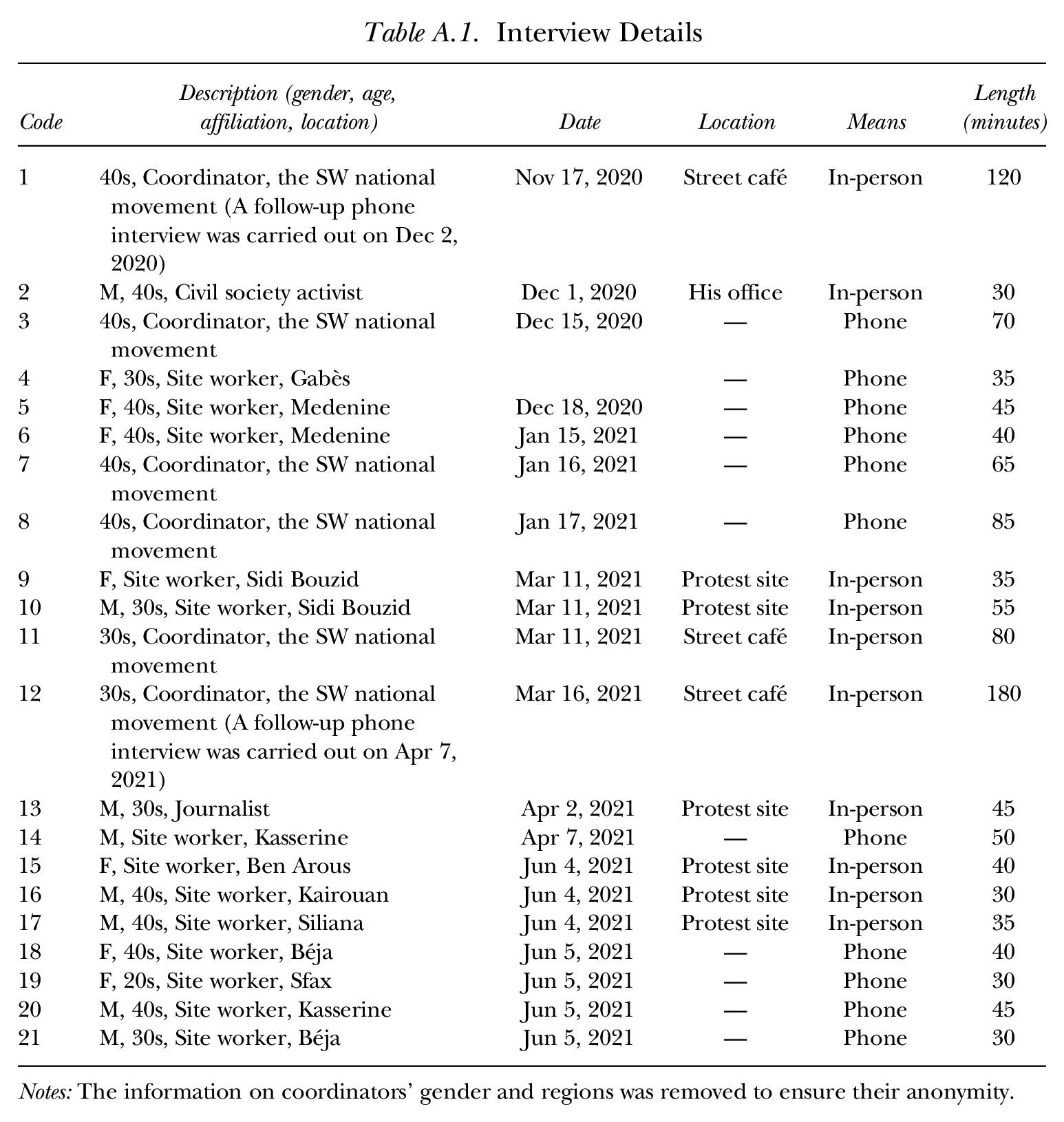
| Code | Description (gender, age, affiliation, location) | Date | Location | Means | Length (minutes) |
|---|---|---|---|---|---|
| 1 | 40s, Coordinator, the SW national movement (A follow-up phone interview was carried out on Dec 2, 2020) | Nov 17, 2020 | Street café | In-person | 120 |
| 2 | M, 40s, Civil society activist | Dec 1, 2020 | His office | In-person | 30 |
| 3 | 40s, Coordinator, the SW national movement | Dec 15, 2020 | — | Phone | 70 |
| 4 | F, 30s, Site worker, Gabès | — | Phone | 35 | |
| 5 | F, 40s, Site worker, Medenine | Dec 18, 2020 | — | Phone | 45 |
| 6 | F, 40s, Site worker, Medenine | Jan 15, 2021 | — | Phone | 40 |
| 7 | 40s, Coordinator, the SW national movement | Jan 16, 2021 | — | Phone | 65 |
| 8 | 40s, Coordinator, the SW national movement | Jan 17, 2021 | — | Phone | 85 |
| 9 | F, Site worker, Sidi Bouzid | Mar 11, 2021 | Protest site | In-person | 35 |
| 10 | M, 30s, Site worker, Sidi Bouzid | Mar 11, 2021 | Protest site | In-person | 55 |
| 11 | 30s, Coordinator, the SW national movement | Mar 11, 2021 | Street café | In-person | 80 |
| 12 | 30s, Coordinator, the SW national movement (A follow-up phone interview was carried out on Apr 7, 2021) | Mar 16, 2021 | Street café | In-person | 180 |
| 13 | M, 30s, Journalist | Apr 2, 2021 | Protest site | In-person | 45 |
| 14 | M, Site worker, Kasserine | Apr 7, 2021 | — | Phone | 50 |
| 15 | F, Site worker, Ben Arous | Jun 4, 2021 | Protest site | In-person | 40 |
| 16 | M, 40s, Site worker, Kairouan | Jun 4, 2021 | Protest site | In-person | 30 |
| 17 | M, 40s, Site worker, Siliana | Jun 4, 2021 | Protest site | In-person | 35 |
| 18 | F, 40s, Site worker, Béja | Jun 5, 2021 | — | Phone | 40 |
| 19 | F, 20s, Site worker, Sfax | Jun 5, 2021 | — | Phone | 30 |
| 20 | M, 40s, Site worker, Kasserine | Jun 5, 2021 | — | Phone | 45 |
| 21 | M, 30s, Site worker, Béja | Jun 5, 2021 | — | Phone | 30 |
Notes: The information on coordinators’ gender and regions was removed to ensure their anonymity.
This article is part of an ILR Review Special Issue on Labor in the Middle East and North Africa: Precarity, Inequality, and Migration.
This work was supported by the Economic and Social Research Council (ESRC) under Grant [ES/W00559x/1].
For information regarding the data and/or computer programs used for this study, please address correspondence to
1
The Tunisian Revolution, also known as the Uprising, was an intense campaign of civil resistance from December 17, 2010, to January 14, 2011.

References

 [Stop the suffering of site workers]